
Knowledge Management for Biodiversity (KM4B) -
CB
Published · 25 slides · 0 views
1 / 1
Description
Knowledge Management for Biodiversity (KM4B) - Webinar 1 Introduction to KM under the Convention and its Protocols Erie Tamale Capacity Building and Knowledge Management Unit Implementation Support Division Knowledge Management in the
Related Topics
Share
Embed code
Download this presentation From Below
"Knowledge Management for Biodiversity (KM4B) -" is the property of its rightful owner. Permission is granted to download and print the materials on this website for personal, non-commercial use only, and to display it on your personal computer provided you do not modify the materials and that you retain all copyright notices contained in the materials. By downloading content from our website, you accept the terms of this agreement.
Presentation Transcript
01
Knowledge Management for Biodiversity (KM4B) - Webinar 1
Introduction to KM under the Convention and its Protocols
Erie Tamale
Capacity Building and Knowledge Management Unit
Implementation Support Division<br>
Introduction to KM under the Convention and its Protocols
Erie Tamale
Capacity Building and Knowledge Management Unit
Implementation Support Division<br>
02
Knowledge Management in the context of Kunming Montreal Global Biodiversité Framework
Knowledge Management for Biodiversity Webinar Series
Implementation time table Knowledge for Development Partnership 2 AGENDA<br>
Knowledge Management for Biodiversity Webinar Series
Implementation time table Knowledge for Development Partnership 2 AGENDA<br>
03
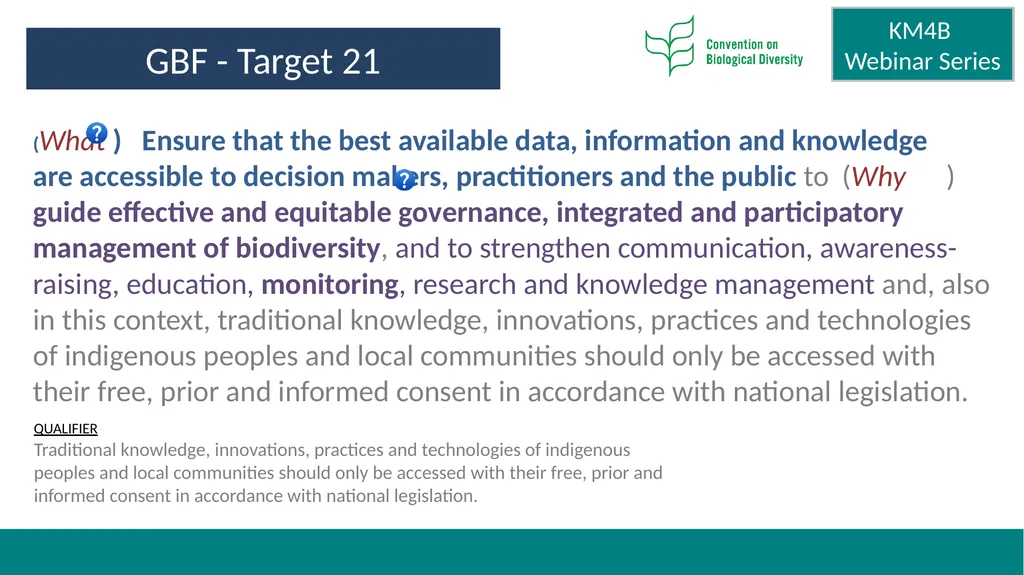
GBF - Target 21 (What ) Ensure that the best available data, information and knowledge are accessible to decision makers, practitioners and the public to (Why ) guide effective and equitable governance, integrated and participatory management of biodiversity, and to strengthen communication, awareness-raising, education, monitoring, research and knowledge management and, also in this context, traditional knowledge, innovations, practices and technologies of indigenous peoples and local communities should only be accessed with their free, prior and informed consent in accordance with national legislation. QUALIFIER
Traditional knowledge, innovations, practices and technologies of indigenous peoples and local communities should only be accessed with their free, prior and informed consent in accordance with national legislation.<br>
Traditional knowledge, innovations, practices and technologies of indigenous peoples and local communities should only be accessed with their free, prior and informed consent in accordance with national legislation.<br>
04
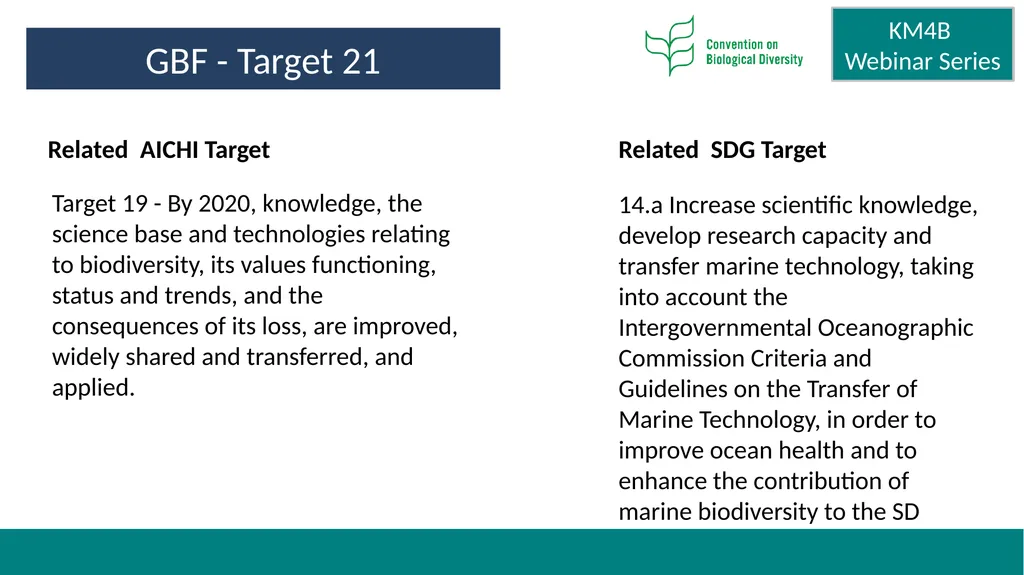
GBF - Target 21 Target 19 - By 2020, knowledge, the science base and technologies relating to biodiversity, its values functioning, status and trends, and the consequences of its loss, are improved, widely shared and transferred, and applied. Related AICHI Target 14.a Increase scientific knowledge, develop research capacity and transfer marine technology, taking into account the Intergovernmental Oceanographic Commission Criteria and Guidelines on the Transfer of Marine Technology, in order to improve ocean health and to enhance the contribution of marine biodiversity to the SD Related SDG Target<br>
05
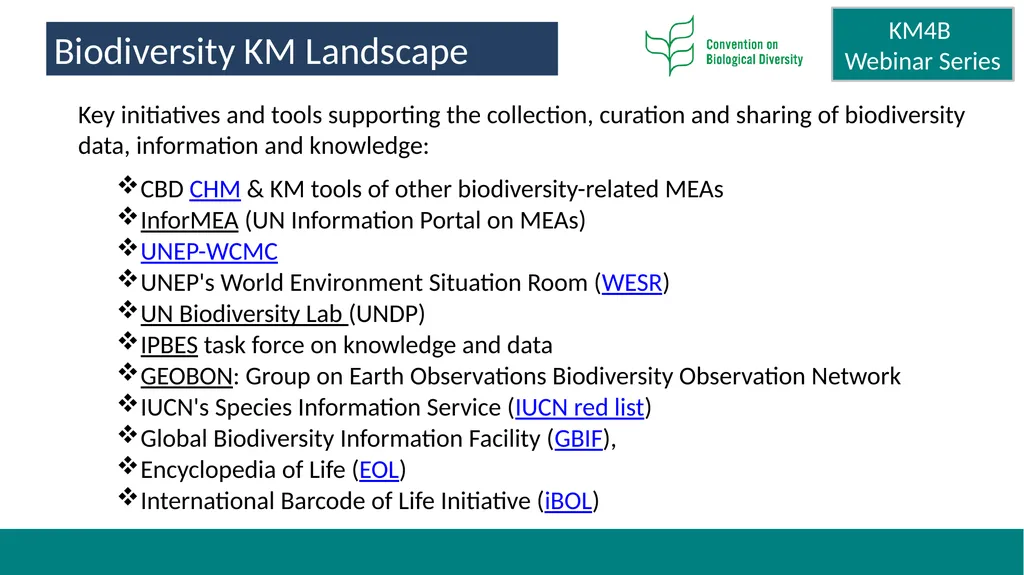
Key initiatives and tools supporting the collection, curation and sharing of biodiversity data, information and knowledge:
CBD CHM & KM tools of other biodiversity-related MEAs
InforMEA (UN Information Portal on MEAs)
UNEP-WCMC
UNEP's World Environment Situation Room (WESR)
UN Biodiversity Lab (UNDP)
IPBES task force on knowledge and data
GEOBON: Group on Earth Observations Biodiversity Observation Network
IUCN's Species Information Service (IUCN red list)
Global Biodiversity Information Facility (GBIF),
Encyclopedia of Life (EOL)
International Barcode of Life Initiative (iBOL) Biodiversity KM Landscape<br>
CBD CHM & KM tools of other biodiversity-related MEAs
InforMEA (UN Information Portal on MEAs)
UNEP-WCMC
UNEP's World Environment Situation Room (WESR)
UN Biodiversity Lab (UNDP)
IPBES task force on knowledge and data
GEOBON: Group on Earth Observations Biodiversity Observation Network
IUCN's Species Information Service (IUCN red list)
Global Biodiversity Information Facility (GBIF),
Encyclopedia of Life (EOL)
International Barcode of Life Initiative (iBOL) Biodiversity KM Landscape<br>
06
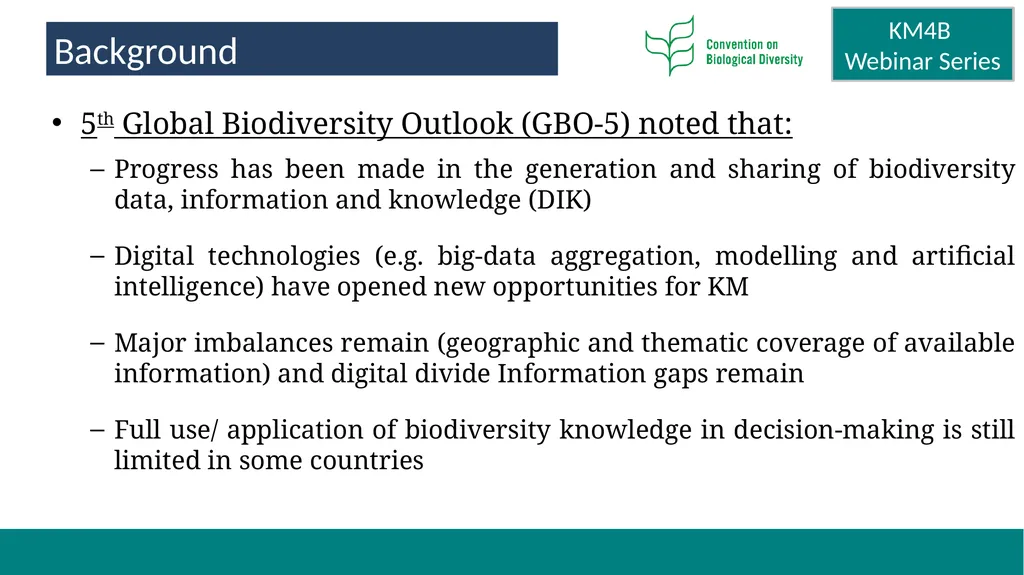
5th Global Biodiversity Outlook (GBO-5) noted that:
Progress has been made in the generation and sharing of biodiversity data, information and knowledge (DIK)
Digital technologies (e.g. big-data aggregation, modelling and artificial intelligence) have opened new opportunities for KM
Major imbalances remain (geographic and thematic coverage of available information) and digital divide Information gaps remain
Full use/ application of biodiversity knowledge in decision-making is still limited in some countries Background<br>
Progress has been made in the generation and sharing of biodiversity data, information and knowledge (DIK)
Digital technologies (e.g. big-data aggregation, modelling and artificial intelligence) have opened new opportunities for KM
Major imbalances remain (geographic and thematic coverage of available information) and digital divide Information gaps remain
Full use/ application of biodiversity knowledge in decision-making is still limited in some countries Background<br>
07
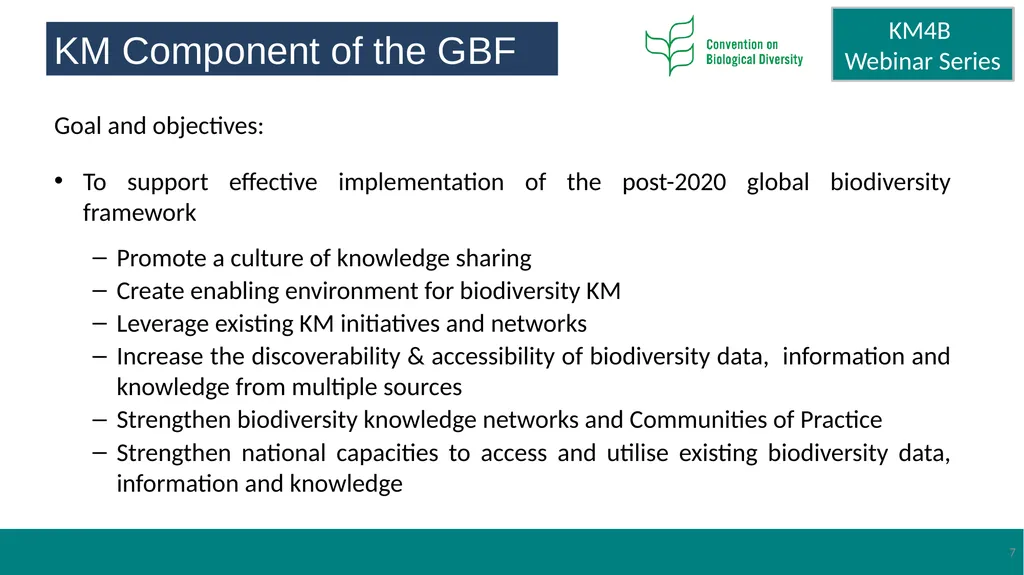
7 Goal and objectives:
To support effective implementation of the post-2020 global biodiversity framework
Promote a culture of knowledge sharing
Create enabling environment for biodiversity KM
Leverage existing KM initiatives and networks
Increase the discoverability & accessibility of biodiversity data, information and knowledge from multiple sources
Strengthen biodiversity knowledge networks and Communities of Practice
Strengthen national capacities to access and utilise existing biodiversity data, information and knowledge KM Component of the GBF<br>
To support effective implementation of the post-2020 global biodiversity framework
Promote a culture of knowledge sharing
Create enabling environment for biodiversity KM
Leverage existing KM initiatives and networks
Increase the discoverability & accessibility of biodiversity data, information and knowledge from multiple sources
Strengthen biodiversity knowledge networks and Communities of Practice
Strengthen national capacities to access and utilise existing biodiversity data, information and knowledge KM Component of the GBF<br>
08
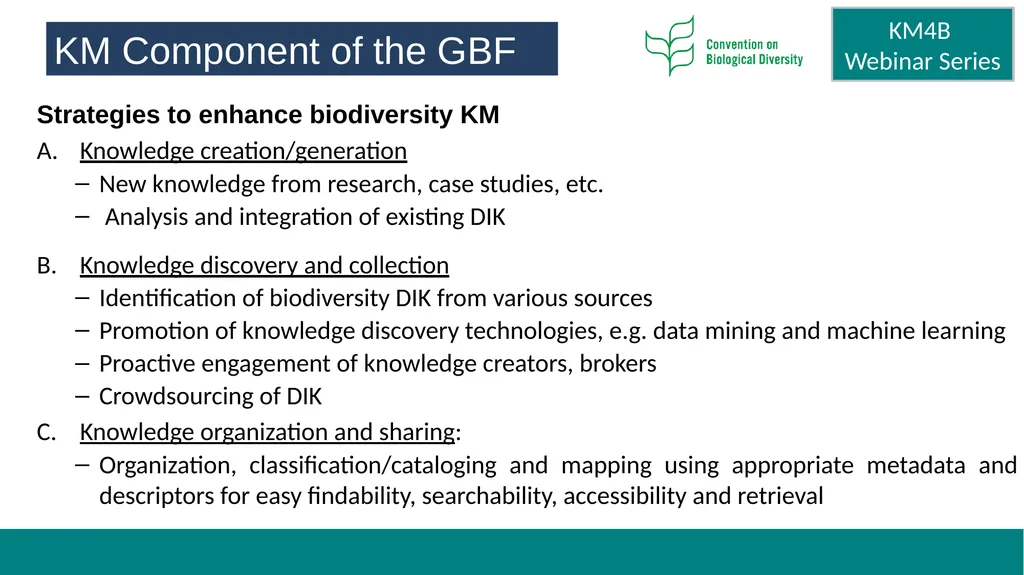
Strategies to enhance biodiversity KM
Knowledge creation/generation
New knowledge from research, case studies, etc.
Analysis and integration of existing DIK
Knowledge discovery and collection
Identification of biodiversity DIK from various sources
Promotion of knowledge discovery technologies, e.g. data mining and machine learning
Proactive engagement of knowledge creators, brokers
Crowdsourcing of DIK
Knowledge organization and sharing:
Organization, classification/cataloging and mapping using appropriate metadata and descriptors for easy findability, searchability, accessibility and retrieval KM Component of the GBF<br>
Knowledge creation/generation
New knowledge from research, case studies, etc.
Analysis and integration of existing DIK
Knowledge discovery and collection
Identification of biodiversity DIK from various sources
Promotion of knowledge discovery technologies, e.g. data mining and machine learning
Proactive engagement of knowledge creators, brokers
Crowdsourcing of DIK
Knowledge organization and sharing:
Organization, classification/cataloging and mapping using appropriate metadata and descriptors for easy findability, searchability, accessibility and retrieval KM Component of the GBF<br>
09
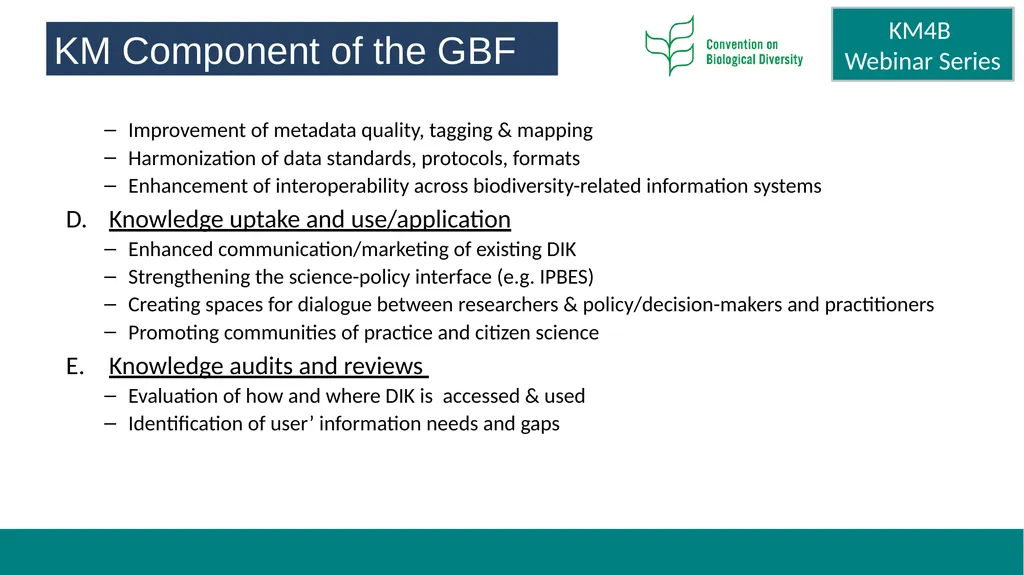
Improvement of metadata quality, tagging & mapping
Harmonization of data standards, protocols, formats
Enhancement of interoperability across biodiversity-related information systems
Knowledge uptake and use/application
Enhanced communication/marketing of existing DIK
Strengthening the science-policy interface (e.g. IPBES)
Creating spaces for dialogue between researchers & policy/decision-makers and practitioners
Promoting communities of practice and citizen science
Knowledge audits and reviews
Evaluation of how and where DIK is accessed & used
Identification of user’ information needs and gaps KM Component of the GBF<br>
Harmonization of data standards, protocols, formats
Enhancement of interoperability across biodiversity-related information systems
Knowledge uptake and use/application
Enhanced communication/marketing of existing DIK
Strengthening the science-policy interface (e.g. IPBES)
Creating spaces for dialogue between researchers & policy/decision-makers and practitioners
Promoting communities of practice and citizen science
Knowledge audits and reviews
Evaluation of how and where DIK is accessed & used
Identification of user’ information needs and gaps KM Component of the GBF<br>
10
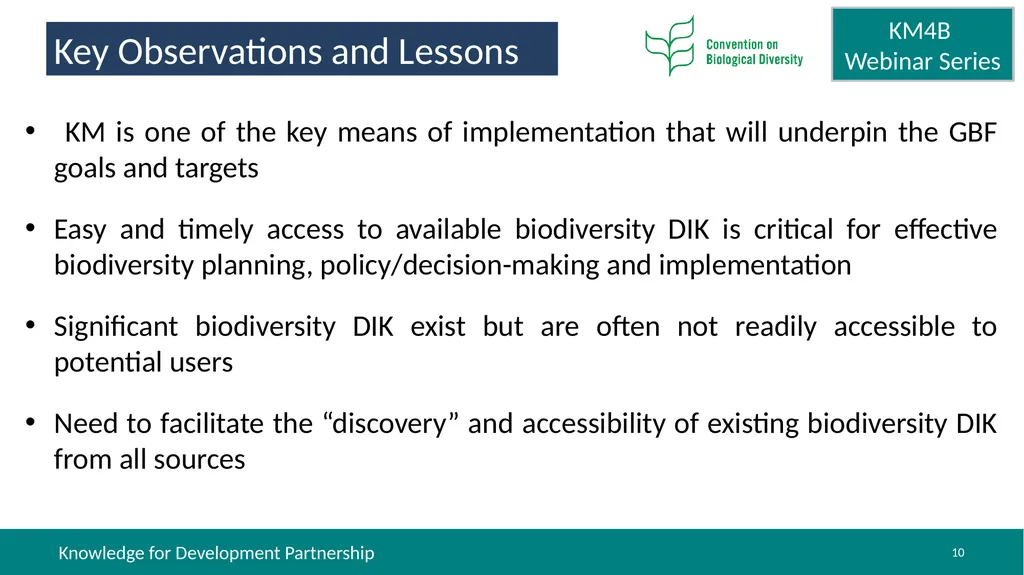
Knowledge for Development Partnership 10 KM is one of the key means of implementation that will underpin the GBF goals and targets
Easy and timely access to available biodiversity DIK is critical for effective biodiversity planning, policy/decision-making and implementation
Significant biodiversity DIK exist but are often not readily accessible to potential users
Need to facilitate the “discovery” and accessibility of existing biodiversity DIK from all sources Key Observations and Lessons<br>
Easy and timely access to available biodiversity DIK is critical for effective biodiversity planning, policy/decision-making and implementation
Significant biodiversity DIK exist but are often not readily accessible to potential users
Need to facilitate the “discovery” and accessibility of existing biodiversity DIK from all sources Key Observations and Lessons<br>
11
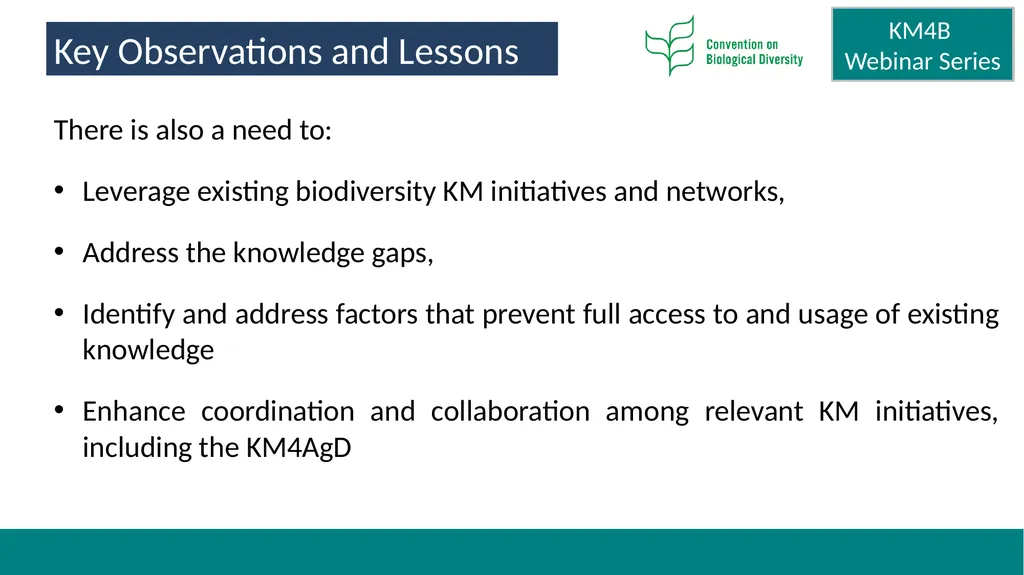
There is also a need to:
Leverage existing biodiversity KM initiatives and networks,
Address the knowledge gaps,
Identify and address factors that prevent full access to and usage of existing knowledge
Enhance coordination and collaboration among relevant KM initiatives, including the KM4AgD Key Observations and Lessons<br>
Leverage existing biodiversity KM initiatives and networks,
Address the knowledge gaps,
Identify and address factors that prevent full access to and usage of existing knowledge
Enhance coordination and collaboration among relevant KM initiatives, including the KM4AgD Key Observations and Lessons<br>
12
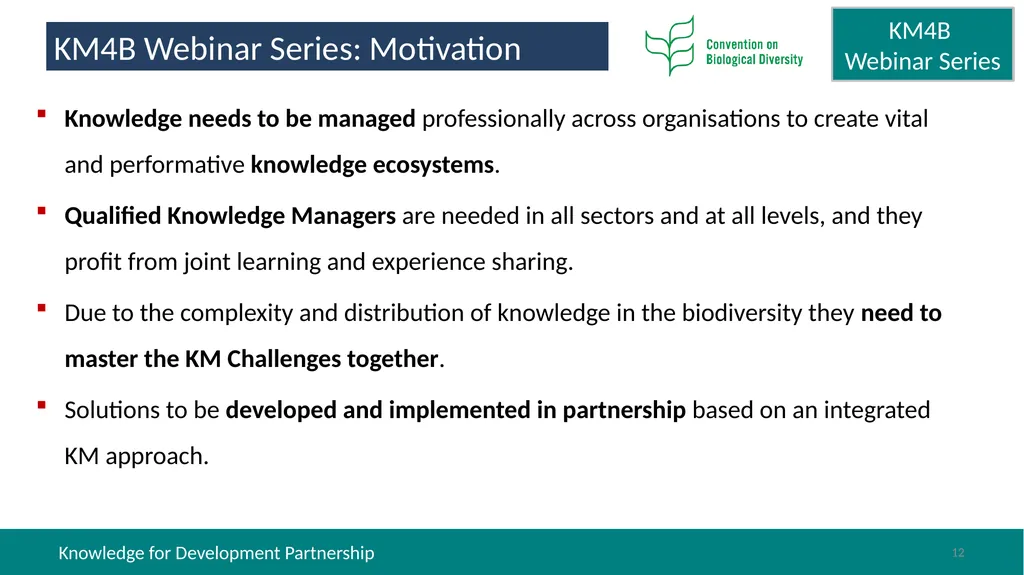
Knowledge needs to be managed professionally across organisations to create vital and performative knowledge ecosystems.
Qualified Knowledge Managers are needed in all sectors and at all levels, and they profit from joint learning and experience sharing.
Due to the complexity and distribution of knowledge in the biodiversity they need to master the KM Challenges together.
Solutions to be developed and implemented in partnership based on an integrated KM approach. Knowledge for Development Partnership 12 KM4B Webinar Series: Motivation<br>
Qualified Knowledge Managers are needed in all sectors and at all levels, and they profit from joint learning and experience sharing.
Due to the complexity and distribution of knowledge in the biodiversity they need to master the KM Challenges together.
Solutions to be developed and implemented in partnership based on an integrated KM approach. Knowledge for Development Partnership 12 KM4B Webinar Series: Motivation<br>
13
Knowledge Management for Biodiversity (KM4B) Initiative Knowledge for Development Partnership<br>
14
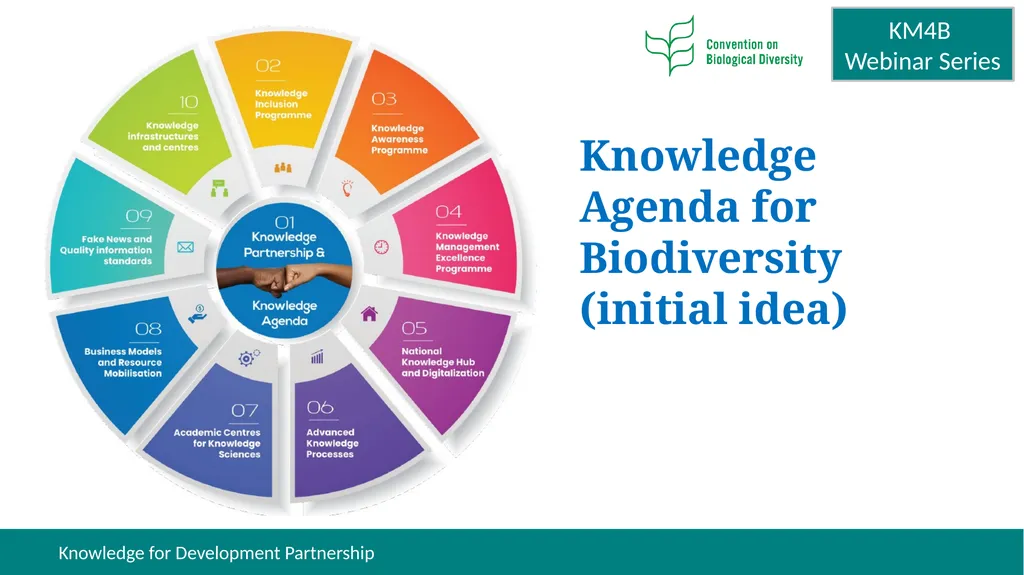
Knowledge Agenda for Biodiversity (initial idea) Knowledge for Development Partnership<br>
15
KM4B Webinar Series – Scheduled Programme https://km4b.cbd.int/webinars<br>
16
Appendix<br>
17
Content Knowledge is at the heart of the post-2020 biodiversity agenda
KM for Biodiversity Challenge 2023
Implementation time table Knowledge for Development Partnership 17<br>
KM for Biodiversity Challenge 2023
Implementation time table Knowledge for Development Partnership 17<br>
18
Concept brief<br>
19
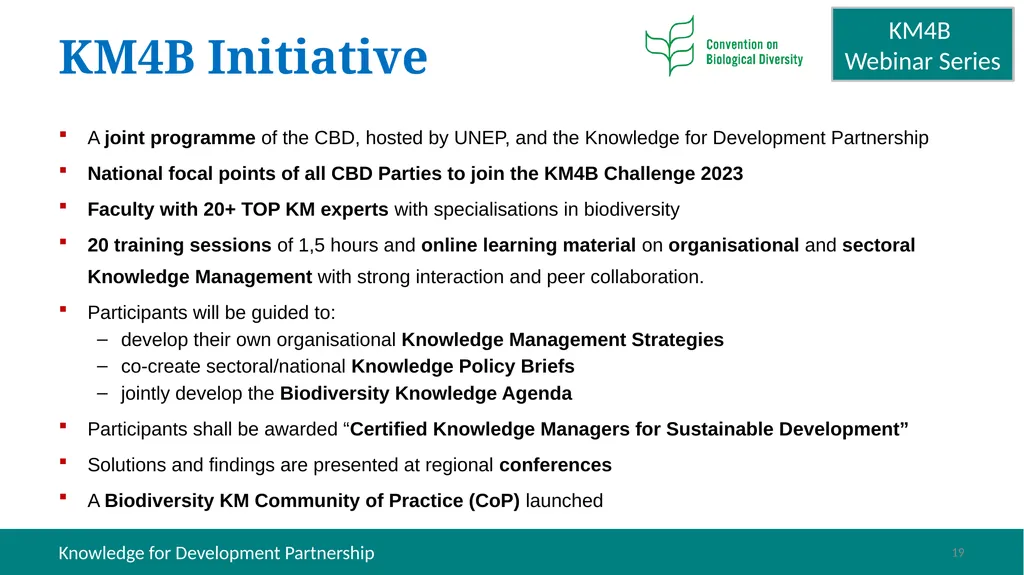
KM4B Initiative A joint programme of the CBD, hosted by UNEP, and the Knowledge for Development Partnership
National focal points of all CBD Parties to join the KM4B Challenge 2023
Faculty with 20+ TOP KM experts with specialisations in biodiversity
20 training sessions of 1,5 hours and online learning material on organisational and sectoral Knowledge Management with strong interaction and peer collaboration.
Participants will be guided to:
develop their own organisational Knowledge Management Strategies
co-create sectoral/national Knowledge Policy Briefs
jointly develop the Biodiversity Knowledge Agenda
Participants shall be awarded “Certified Knowledge Managers for Sustainable Development”
Solutions and findings are presented at regional conferences
A Biodiversity KM Community of Practice (CoP) launched Knowledge for Development Partnership 19<br>
National focal points of all CBD Parties to join the KM4B Challenge 2023
Faculty with 20+ TOP KM experts with specialisations in biodiversity
20 training sessions of 1,5 hours and online learning material on organisational and sectoral Knowledge Management with strong interaction and peer collaboration.
Participants will be guided to:
develop their own organisational Knowledge Management Strategies
co-create sectoral/national Knowledge Policy Briefs
jointly develop the Biodiversity Knowledge Agenda
Participants shall be awarded “Certified Knowledge Managers for Sustainable Development”
Solutions and findings are presented at regional conferences
A Biodiversity KM Community of Practice (CoP) launched Knowledge for Development Partnership 19<br>
20
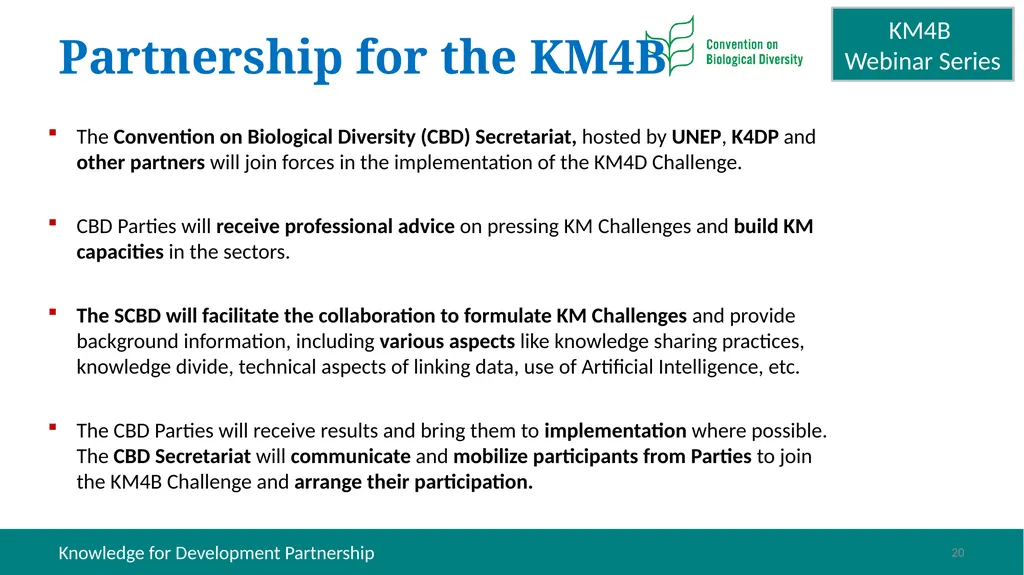
Partnership for the KM4B The Convention on Biological Diversity (CBD) Secretariat, hosted by UNEP, K4DP and other partners will join forces in the implementation of the KM4D Challenge.
CBD Parties will receive professional advice on pressing KM Challenges and build KM capacities in the sectors.
The SCBD will facilitate the collaboration to formulate KM Challenges and provide background information, including various aspects like knowledge sharing practices, knowledge divide, technical aspects of linking data, use of Artificial Intelligence, etc.
The CBD Parties will receive results and bring them to implementation where possible. The CBD Secretariat will communicate and mobilize participants from Parties to join the KM4B Challenge and arrange their participation. Knowledge for Development Partnership 20<br>
CBD Parties will receive professional advice on pressing KM Challenges and build KM capacities in the sectors.
The SCBD will facilitate the collaboration to formulate KM Challenges and provide background information, including various aspects like knowledge sharing practices, knowledge divide, technical aspects of linking data, use of Artificial Intelligence, etc.
The CBD Parties will receive results and bring them to implementation where possible. The CBD Secretariat will communicate and mobilize participants from Parties to join the KM4B Challenge and arrange their participation. Knowledge for Development Partnership 20<br>
21
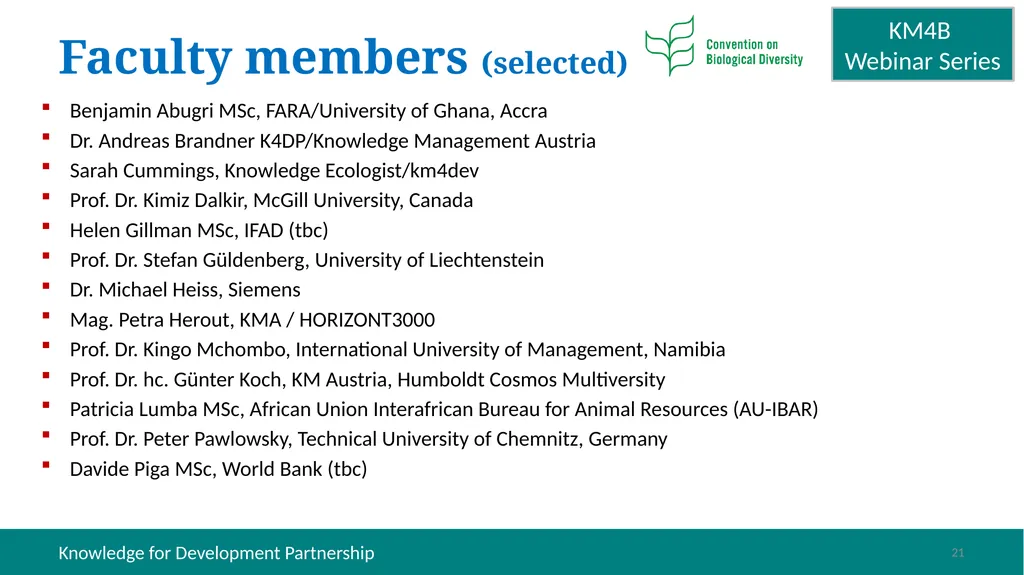
Faculty members (selected) Benjamin Abugri MSc, FARA/University of Ghana, Accra
Dr. Andreas Brandner K4DP/Knowledge Management Austria
Sarah Cummings, Knowledge Ecologist/km4dev
Prof. Dr. Kimiz Dalkir, McGill University, Canada
Helen Gillman MSc, IFAD (tbc)
Prof. Dr. Stefan Güldenberg, University of Liechtenstein
Dr. Michael Heiss, Siemens
Mag. Petra Herout, KMA / HORIZONT3000
Prof. Dr. Kingo Mchombo, International University of Management, Namibia
Prof. Dr. hc. Günter Koch, KM Austria, Humboldt Cosmos Multiversity
Patricia Lumba MSc, African Union Interafrican Bureau for Animal Resources (AU-IBAR)
Prof. Dr. Peter Pawlowsky, Technical University of Chemnitz, Germany
Davide Piga MSc, World Bank (tbc) Knowledge for Development Partnership 21<br>
Dr. Andreas Brandner K4DP/Knowledge Management Austria
Sarah Cummings, Knowledge Ecologist/km4dev
Prof. Dr. Kimiz Dalkir, McGill University, Canada
Helen Gillman MSc, IFAD (tbc)
Prof. Dr. Stefan Güldenberg, University of Liechtenstein
Dr. Michael Heiss, Siemens
Mag. Petra Herout, KMA / HORIZONT3000
Prof. Dr. Kingo Mchombo, International University of Management, Namibia
Prof. Dr. hc. Günter Koch, KM Austria, Humboldt Cosmos Multiversity
Patricia Lumba MSc, African Union Interafrican Bureau for Animal Resources (AU-IBAR)
Prof. Dr. Peter Pawlowsky, Technical University of Chemnitz, Germany
Davide Piga MSc, World Bank (tbc) Knowledge for Development Partnership 21<br>
22
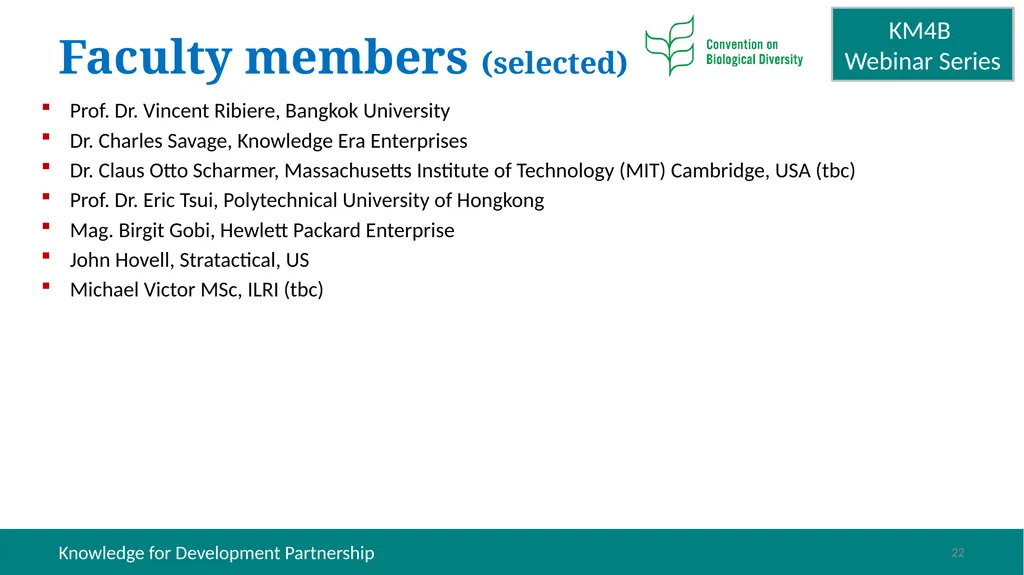
Faculty members (selected) Prof. Dr. Vincent Ribiere, Bangkok University
Dr. Charles Savage, Knowledge Era Enterprises
Dr. Claus Otto Scharmer, Massachusetts Institute of Technology (MIT) Cambridge, USA (tbc)
Prof. Dr. Eric Tsui, Polytechnical University of Hongkong
Mag. Birgit Gobi, Hewlett Packard Enterprise
John Hovell, Stratactical, US
Michael Victor MSc, ILRI (tbc) Knowledge for Development Partnership 22<br>
Dr. Charles Savage, Knowledge Era Enterprises
Dr. Claus Otto Scharmer, Massachusetts Institute of Technology (MIT) Cambridge, USA (tbc)
Prof. Dr. Eric Tsui, Polytechnical University of Hongkong
Mag. Birgit Gobi, Hewlett Packard Enterprise
John Hovell, Stratactical, US
Michael Victor MSc, ILRI (tbc) Knowledge for Development Partnership 22<br>
23
Timetable Knowledge Management for Biodiversity Challenge 2023 Knowledge for Development Partnership<br>
24
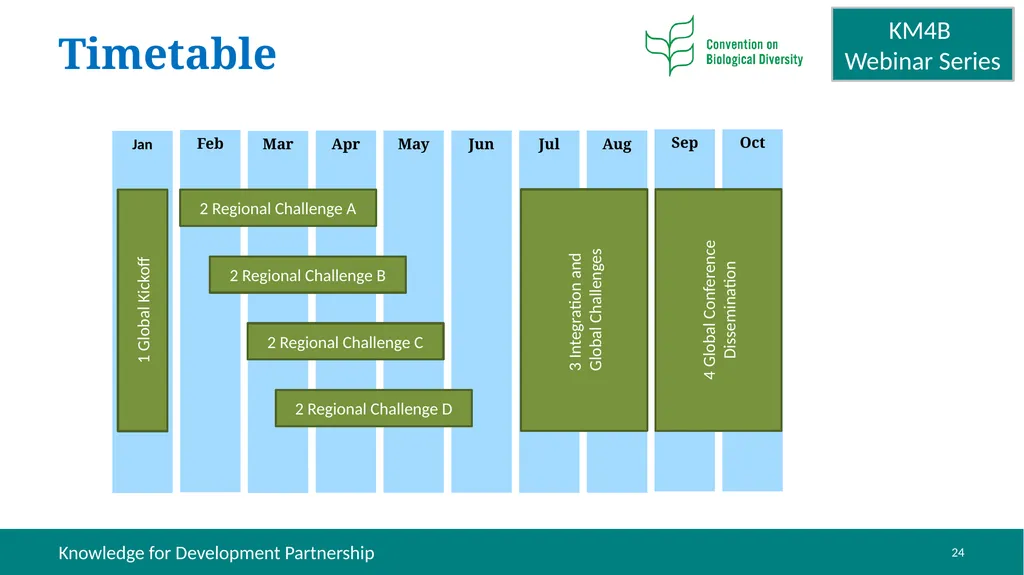
Timetable Knowledge for Development Partnership 24 Jan Oct Sep Aug Feb Jul May Apr Mar Jun 1 Global Kickoff 2 Regional Challenge A 2 Regional Challenge B 2 Regional Challenge C 2 Regional Challenge D 3 Integration and
Global Challenges 4 Global Conference Dissemination<br>
25
Contact Erie Tamale
Head, Capacity Building and Knowledge Management Unit
CBD Secretariat
Email: erie.tamale@un.org
Prof. Dr. Andreas Brandner, Executive Director
Knowledge for Development Partnership
Email: andreas.brandner@k4dp.org
www.k4dp.org Knowledge for Development Partnership 25<br>
Head, Capacity Building and Knowledge Management Unit
CBD Secretariat
Email: erie.tamale@un.org
Prof. Dr. Andreas Brandner, Executive Director
Knowledge for Development Partnership
Email: andreas.brandner@k4dp.org
www.k4dp.org Knowledge for Development Partnership 25<br>