
KNOWLEDGE ORGANISER: Módulo 6 – Mi barrio y yo KEY
AS
Published · 2 slides · 0 views

1 / 1
Description
KNOWLEDGE ORGANISER: Módulo 6 Mi barrio y yo KEY VOCABULARY INTRODUCCIÓN En Colombia todo es posible Qué hay en tu paísregión? - What is there in your countryregion? En (el norte de) mi paísregión - In (the north of) my
Related Topics
Share
Embed code
Download this presentation From Below
"KNOWLEDGE ORGANISER: Módulo 6 – Mi barrio y yo KEY" is the property of its rightful owner. Permission is granted to download and print the materials on this website for personal, non-commercial use only, and to display it on your personal computer provided you do not modify the materials and that you retain all copyright notices contained in the materials. By downloading content from our website, you accept the terms of this agreement.
Presentation Transcript
01
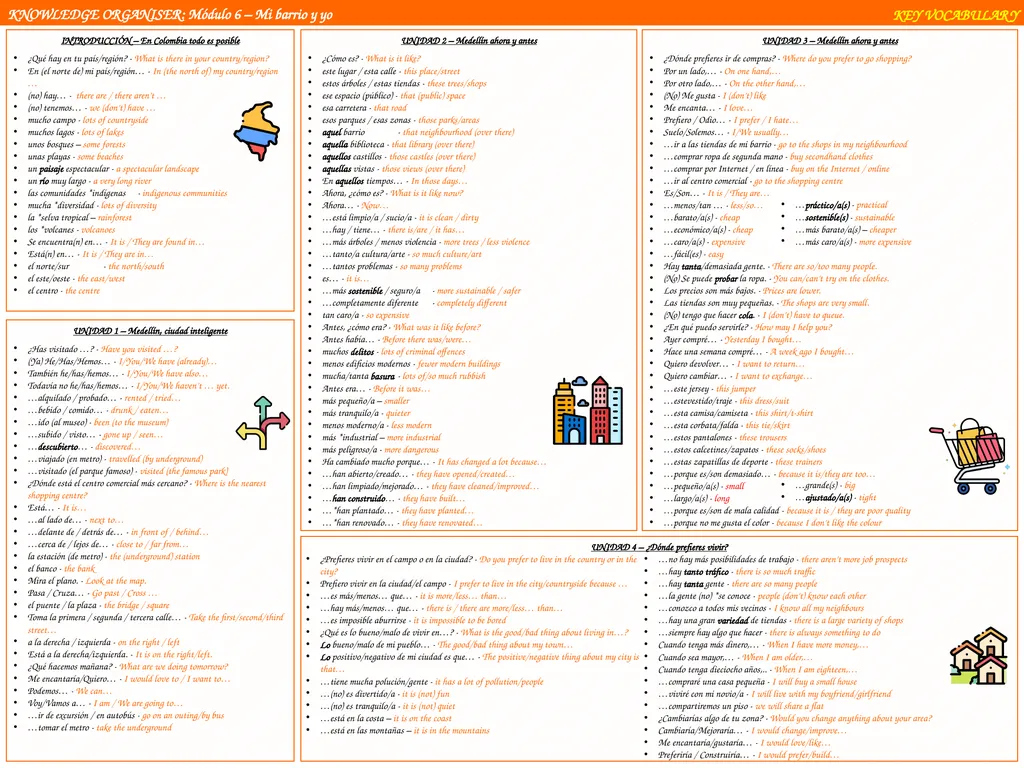
KNOWLEDGE ORGANISER: Módulo 6 – Mi barrio y yo KEY VOCABULARY INTRODUCCIÓN – En Colombia todo es posible
¿Qué hay en tu país/región? - What is there in your country/region?
En (el norte de) mi país/región… - In (the north of) my country/region …
(no) hay… - there are / there aren’t …
(no) tenemos… - we (don’t) have …
mucho campo - lots of countryside
muchos lagos - lots of lakes
unos bosques – some forests
unas playas - some beaches
un paisaje espectacular - a spectacular landscape
un río muy largo - a very long river
las comunidades *indígenas - indigenous communities
mucha *diversidad - lots of diversity
la *selva tropical – rainforest
los *volcanes - volcanoes
Se encuentra(n) en… - It is / They are found in…
Está(n) en… - It is / They are in…
el norte/sur - the north/south
el este/oeste - the east/west
el centro - the centre UNIDAD 1 – Medellín, ciudad inteligente
¿Has visitado …? - Have you visited …?
(Ya) He/Has/Hemos… - I/You/We have (already)…
También he/has/hemos… - I/You/We have also…
Todavía no he/has/hemos… - I/You/We haven’t … yet.
…alquilado / probado… - rented / tried…
…bebido / comido… - drunk / eaten…
…ido (al museo) - been (to the museum)
…subido / visto… - gone up / seen…
…descubierto… - discovered…
…viajado (en metro) - travelled (by underground)
…visitado (el parque famoso) - visited (the famous park)
¿Dónde está el centro comercial más cercano? - Where is the nearest shopping centre?
Está… - It is…
…al lado de… - next to…
…delante de / detrás de… - in front of / behind…
…cerca de / lejos de… - close to / far from…
la estación (de metro) - the (underground) station
el banco - the bank
Mira el plano. - Look at the map.
Pasa / Cruza… - Go past / Cross …
el puente / la plaza - the bridge / square
Toma la primera / segunda / tercera calle… - Take the first/second/third street…
a la derecha / izquierda - on the right / left
Está a la derecha/izquierda. - It is on the right/left.
¿Qué hacemos mañana? - What are we doing tomorrow?
Me encantaría/Quiero… - I would love to / I want to…
Podemos… - We can…
Voy/Vamos a… - I am / We are going to…
…ir de excursión / en autobús - go on an outing/by bus
…tomar el metro - take the underground UNIDAD 2 – Medellín ahora y antes
¿Cómo es? - What is it like?
este lugar / esta calle - this place/street
estos árboles / estas tiendas - these trees/shops
ese espacio (público) - that (public) space
esa carretera - that road
esos parques / esas zonas - those parks/areas
aquel barrio - that neighbourhood (over there)
aquella biblioteca - that library (over there)
aquellos castillos - those castles (over there)
aquellas vistas - those views (over there)
En aquellos tiempos… - In those days…
Ahora, ¿cómo es? - What is it like now?
Ahora… - Now…
…está limpio/a / sucio/a - it is clean / dirty
…hay / tiene… - there is/are / it has…
…más árboles / menos violencia - more trees / less violence
…tanto/a cultura/arte - so much culture/art
…tantos problemas - so many problems
es… - it is…
…más sostenible / seguro/a - more sustainable / safer
…completamente diferente - completely different
tan caro/a - so expensive
Antes, ¿cómo era? - What was it like before?
Antes había… - Before there was/were…
muchos delitos - lots of criminal offences
menos edificios modernos - fewer modern buildings
mucha/tanta basura - lots of/so much rubbish
Antes era… - Before it was…
más pequeño/a – smaller
más tranquilo/a - quieter
menos moderno/a - less modern
más *industrial – more industrial
más peligroso/a - more dangerous
Ha cambiado mucho porque… - It has changed a lot because…
…han abierto/creado… - they have opened/created…
…han limpiado/mejorado… - they have cleaned/improved…
…han construido… - they have built…
…*han plantado… - they have planted…
…*han renovado… - they have renovated… UNIDAD 3 – Medellín ahora y antes
¿Dónde prefieres ir de compras? - Where do you prefer to go shopping?
Por un lado,… - On one hand,…
Por otro lado,… - On the other hand,…
(No) Me gusta - I (don’t) like
Me encanta… - I love…
Prefiero / Odio… - I prefer / I hate…
Suelo/Solemos… - I/We usually…
…ir a las tiendas de mi barrio - go to the shops in my neighbourhood
…comprar ropa de segunda mano - buy secondhand clothes
…comprar por Internet / en línea - buy on the Internet / online
…ir al centro comercial - go to the shopping centre
Es/Son… - It is / They are…
…menos/tan … - less/so…
…barato/a(s) - cheap
…económico/a(s) - cheap
…caro/a(s) - expensive
…fácil(es) - easy
Hay tanta/demasiada gente. - There are so/too many people.
(No) Se puede probar la ropa. - You can/can’t try on the clothes.
Los precios son más bajos. - Prices are lower.
Las tiendas son muy pequeñas. - The shops are very small.
(No) tengo que hacer cola. - I (don’t) have to queue.
¿En qué puedo servirle? - How may I help you?
Ayer compré… - Yesterday I bought…
Hace una semana compré… - A week ago I bought…
Quiero devolver… - I want to return…
Quiero cambiar… - I want to exchange…
…este jersey - this jumper
…estevestido/traje - this dress/suit
…esta camisa/camiseta - this shirt/t-shirt
…esta corbata/falda - this tie/skirt
…estos pantalones - these trousers
…estos calcetines/zapatos - these socks/shoes
…estas zapatillas de deporte - these trainers
…porque es/son demasiado… - because it is/they are too…
…pequeño/a(s) - small
…largo/a(s) - long
…porque es/son de mala calidad - because it is / they are poor quality
…porque no me gusta el color - because I don’t like the colour …práctico/a(s) - practical
…sostenible(s) - sustainable
…más barato/a(s) – cheaper
…más caro/a(s) - more expensive …grande(s) - big
…ajustado/a(s) - tight UNIDAD 4 – ¿Dónde prefieres vivir? ¿Prefieres vivir en el campo o en la ciudad? - Do you prefer to live in the country or in the city?
Prefiero vivir en la ciudad/el campo - I prefer to live in the city/countryside because …
…es más/menos… que… - it is more/less… than…
…hay más/menos… que… - there is / there are more/less… than…
…es imposible aburrirse - it is impossible to be bored
¿Qué es lo bueno/malo de vivir en…? - What is the good/bad thing about living in…?
Lo bueno/malo de mi pueblo… - The good/bad thing about my town…
Lo positivo/negativo de mi ciudad es que… - The positive/negative thing about my city is that…
…tiene mucha polución/gente - it has a lot of pollution/people
…(no) es divertido/a - it is (not) fun
…(no) es tranquilo/a - it is (not) quiet
…está en la costa – it is on the coast
…está en las montañas – it is in the mountains …no hay más posibilidades de trabajo - there aren’t more job prospects
…hay tanto tráfico - there is so much traffic
…hay tanta gente - there are so many people
…la gente (no) *se conoce - people (don’t) know each other
…conozco a todos mis vecinos - I know all my neighbours
…hay una gran variedad de tiendas - there is a large variety of shops
…siempre hay algo que hacer - there is always something to do
Cuando tenga más dinero,… - When I have more money,…
Cuando sea mayor,… - When I am older,…
Cuando tenga dieciocho años,.. - When I am eighteen,…
…compraré una casa pequeña - I will buy a small house
…viviré con mi novio/a - I will live with my boyfriend/girlfriend
…compartiremos un piso - we will share a flat
¿Cambiarías algo de tu zona? - Would you change anything about your area?
Cambiaría/Mejoraría… - I would change/improve…
Me encantaría/gustaría… - I would love/like…
Preferiría / Construiría… - I would prefer/build…<br>
¿Qué hay en tu país/región? - What is there in your country/region?
En (el norte de) mi país/región… - In (the north of) my country/region …
(no) hay… - there are / there aren’t …
(no) tenemos… - we (don’t) have …
mucho campo - lots of countryside
muchos lagos - lots of lakes
unos bosques – some forests
unas playas - some beaches
un paisaje espectacular - a spectacular landscape
un río muy largo - a very long river
las comunidades *indígenas - indigenous communities
mucha *diversidad - lots of diversity
la *selva tropical – rainforest
los *volcanes - volcanoes
Se encuentra(n) en… - It is / They are found in…
Está(n) en… - It is / They are in…
el norte/sur - the north/south
el este/oeste - the east/west
el centro - the centre UNIDAD 1 – Medellín, ciudad inteligente
¿Has visitado …? - Have you visited …?
(Ya) He/Has/Hemos… - I/You/We have (already)…
También he/has/hemos… - I/You/We have also…
Todavía no he/has/hemos… - I/You/We haven’t … yet.
…alquilado / probado… - rented / tried…
…bebido / comido… - drunk / eaten…
…ido (al museo) - been (to the museum)
…subido / visto… - gone up / seen…
…descubierto… - discovered…
…viajado (en metro) - travelled (by underground)
…visitado (el parque famoso) - visited (the famous park)
¿Dónde está el centro comercial más cercano? - Where is the nearest shopping centre?
Está… - It is…
…al lado de… - next to…
…delante de / detrás de… - in front of / behind…
…cerca de / lejos de… - close to / far from…
la estación (de metro) - the (underground) station
el banco - the bank
Mira el plano. - Look at the map.
Pasa / Cruza… - Go past / Cross …
el puente / la plaza - the bridge / square
Toma la primera / segunda / tercera calle… - Take the first/second/third street…
a la derecha / izquierda - on the right / left
Está a la derecha/izquierda. - It is on the right/left.
¿Qué hacemos mañana? - What are we doing tomorrow?
Me encantaría/Quiero… - I would love to / I want to…
Podemos… - We can…
Voy/Vamos a… - I am / We are going to…
…ir de excursión / en autobús - go on an outing/by bus
…tomar el metro - take the underground UNIDAD 2 – Medellín ahora y antes
¿Cómo es? - What is it like?
este lugar / esta calle - this place/street
estos árboles / estas tiendas - these trees/shops
ese espacio (público) - that (public) space
esa carretera - that road
esos parques / esas zonas - those parks/areas
aquel barrio - that neighbourhood (over there)
aquella biblioteca - that library (over there)
aquellos castillos - those castles (over there)
aquellas vistas - those views (over there)
En aquellos tiempos… - In those days…
Ahora, ¿cómo es? - What is it like now?
Ahora… - Now…
…está limpio/a / sucio/a - it is clean / dirty
…hay / tiene… - there is/are / it has…
…más árboles / menos violencia - more trees / less violence
…tanto/a cultura/arte - so much culture/art
…tantos problemas - so many problems
es… - it is…
…más sostenible / seguro/a - more sustainable / safer
…completamente diferente - completely different
tan caro/a - so expensive
Antes, ¿cómo era? - What was it like before?
Antes había… - Before there was/were…
muchos delitos - lots of criminal offences
menos edificios modernos - fewer modern buildings
mucha/tanta basura - lots of/so much rubbish
Antes era… - Before it was…
más pequeño/a – smaller
más tranquilo/a - quieter
menos moderno/a - less modern
más *industrial – more industrial
más peligroso/a - more dangerous
Ha cambiado mucho porque… - It has changed a lot because…
…han abierto/creado… - they have opened/created…
…han limpiado/mejorado… - they have cleaned/improved…
…han construido… - they have built…
…*han plantado… - they have planted…
…*han renovado… - they have renovated… UNIDAD 3 – Medellín ahora y antes
¿Dónde prefieres ir de compras? - Where do you prefer to go shopping?
Por un lado,… - On one hand,…
Por otro lado,… - On the other hand,…
(No) Me gusta - I (don’t) like
Me encanta… - I love…
Prefiero / Odio… - I prefer / I hate…
Suelo/Solemos… - I/We usually…
…ir a las tiendas de mi barrio - go to the shops in my neighbourhood
…comprar ropa de segunda mano - buy secondhand clothes
…comprar por Internet / en línea - buy on the Internet / online
…ir al centro comercial - go to the shopping centre
Es/Son… - It is / They are…
…menos/tan … - less/so…
…barato/a(s) - cheap
…económico/a(s) - cheap
…caro/a(s) - expensive
…fácil(es) - easy
Hay tanta/demasiada gente. - There are so/too many people.
(No) Se puede probar la ropa. - You can/can’t try on the clothes.
Los precios son más bajos. - Prices are lower.
Las tiendas son muy pequeñas. - The shops are very small.
(No) tengo que hacer cola. - I (don’t) have to queue.
¿En qué puedo servirle? - How may I help you?
Ayer compré… - Yesterday I bought…
Hace una semana compré… - A week ago I bought…
Quiero devolver… - I want to return…
Quiero cambiar… - I want to exchange…
…este jersey - this jumper
…estevestido/traje - this dress/suit
…esta camisa/camiseta - this shirt/t-shirt
…esta corbata/falda - this tie/skirt
…estos pantalones - these trousers
…estos calcetines/zapatos - these socks/shoes
…estas zapatillas de deporte - these trainers
…porque es/son demasiado… - because it is/they are too…
…pequeño/a(s) - small
…largo/a(s) - long
…porque es/son de mala calidad - because it is / they are poor quality
…porque no me gusta el color - because I don’t like the colour …práctico/a(s) - practical
…sostenible(s) - sustainable
…más barato/a(s) – cheaper
…más caro/a(s) - more expensive …grande(s) - big
…ajustado/a(s) - tight UNIDAD 4 – ¿Dónde prefieres vivir? ¿Prefieres vivir en el campo o en la ciudad? - Do you prefer to live in the country or in the city?
Prefiero vivir en la ciudad/el campo - I prefer to live in the city/countryside because …
…es más/menos… que… - it is more/less… than…
…hay más/menos… que… - there is / there are more/less… than…
…es imposible aburrirse - it is impossible to be bored
¿Qué es lo bueno/malo de vivir en…? - What is the good/bad thing about living in…?
Lo bueno/malo de mi pueblo… - The good/bad thing about my town…
Lo positivo/negativo de mi ciudad es que… - The positive/negative thing about my city is that…
…tiene mucha polución/gente - it has a lot of pollution/people
…(no) es divertido/a - it is (not) fun
…(no) es tranquilo/a - it is (not) quiet
…está en la costa – it is on the coast
…está en las montañas – it is in the mountains …no hay más posibilidades de trabajo - there aren’t more job prospects
…hay tanto tráfico - there is so much traffic
…hay tanta gente - there are so many people
…la gente (no) *se conoce - people (don’t) know each other
…conozco a todos mis vecinos - I know all my neighbours
…hay una gran variedad de tiendas - there is a large variety of shops
…siempre hay algo que hacer - there is always something to do
Cuando tenga más dinero,… - When I have more money,…
Cuando sea mayor,… - When I am older,…
Cuando tenga dieciocho años,.. - When I am eighteen,…
…compraré una casa pequeña - I will buy a small house
…viviré con mi novio/a - I will live with my boyfriend/girlfriend
…compartiremos un piso - we will share a flat
¿Cambiarías algo de tu zona? - Would you change anything about your area?
Cambiaría/Mejoraría… - I would change/improve…
Me encantaría/gustaría… - I would love/like…
Preferiría / Construiría… - I would prefer/build…<br>
02
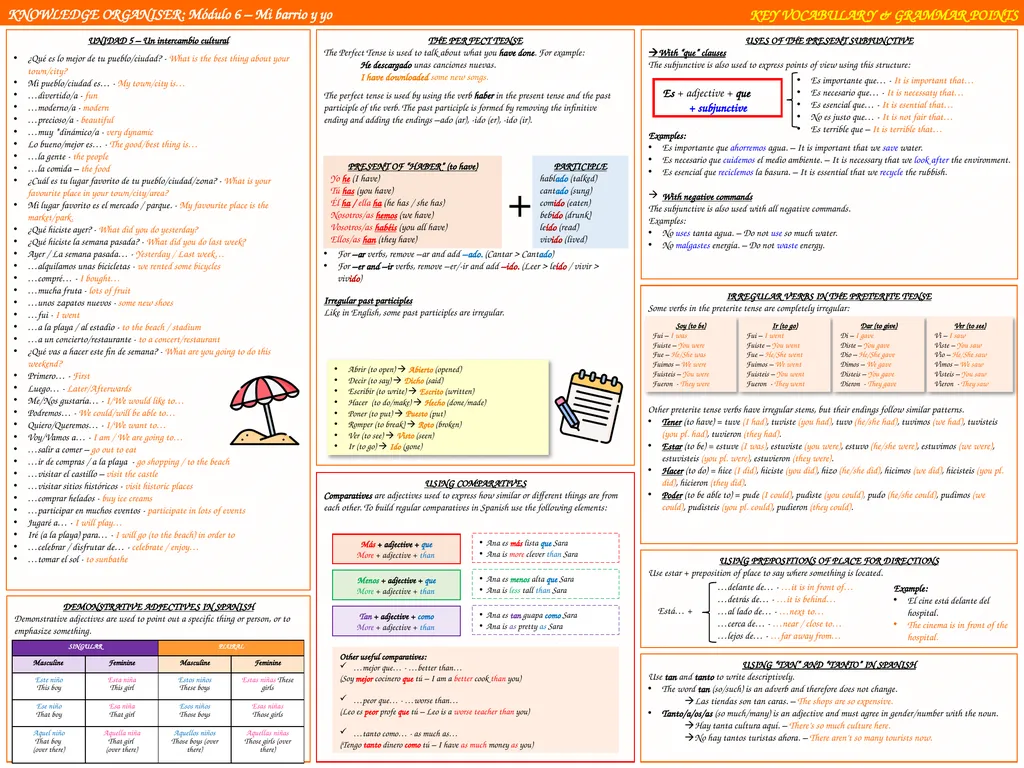
KNOWLEDGE ORGANISER: Módulo 6 – Mi barrio y yo KEY VOCABULARY & GRAMMAR POINTS UNIDAD 5 – Un intercambio cultural
¿Qué es lo mejor de tu pueblo/ciudad? - What is the best thing about your town/city?
Mi pueblo/ciudad es… - My town/city is…
…divertido/a - fun
…moderno/a - modern
…precioso/a - beautiful
…muy *dinámico/a - very dynamic
Lo bueno/mejor es… - The good/best thing is…
…la gente - the people
…la comida – the food
¿Cuál es tu lugar favorito de tu pueblo/ciudad/zona? - What is your favourite place in your town/city/area?
Mi lugar favorito es el mercado / parque. - My favourite place is the market/park.
¿Qué hiciste ayer? - What did you do yesterday?
¿Qué hiciste la semana pasada? - What did you do last week?
Ayer / La semana pasada… - Yesterday / Last week…
…alquilamos unas bicicletas - we rented some bicycles
…compré… - I bought…
…mucha fruta - lots of fruit
…unos zapatos nuevos - some new shoes
…fui - I went
…a la playa / al estadio - to the beach / stadium
…a un concierto/restaurante - to a concert/restaurant
¿Qué vas a hacer este fin de semana? - What are you going to do this weekend?
Primero… - First
Luego… - Later/Afterwards
Me/Nos gustaría… - I/We would like to…
Podremos… - We could/will be able to…
Quiero/Queremos… - I/We want to…
Voy/Vamos a… - I am / We are going to…
…salir a comer – go out to eat
…ir de compras / a la playa - go shopping / to the beach
…visitar el castillo – visit the castle
…visitar sitios históricos - visit historic places
…comprar helados - buy ice creams
…participar en muchos eventos - participate in lots of events
Jugaré a… - I will play…
Iré (a la playa) para… - I will go (to the beach) in order to
…celebrar / disfrutar de… - celebrate / enjoy…
…tomar el sol - to sunbathe DEMONSTRATIVE ADJECTIVES IN SPANISH
Demonstrative adjectives are used to point out a specific thing or person, or to emphasize something. THE PERFECT TENSE
The Perfect Tense is used to talk about what you have done. For example:
He descargado unas canciones nuevas.
I have downloaded some new songs.
The perfect tense is used by using the verb haber in the present tense and the past participle of the verb. The past participle is formed by removing the infinitive ending and adding the endings –ado (ar), -ido (er), -ido (ir).
How to form the past participle
For –ar verbs, remove –ar and add –ado. (Cantar > Cantado)
For –er and –ir verbs, remove –er/-ir and add –ido. (Leer > leído / vivir > vivido)
Irregular past participles
Like in English, some past participles are irregular. PRESENT OF “HABER” (to have)
Yo he (I have)
Tú has (you have)
Él ha / ella ha (he has / she has)
Nosotros/as hemos (we have)
Vosotros/as habéis (you all have)
Ellos/as han (they have) PARTICIPLE
hablado (talked)
cantado (sung)
comido (eaten)
bebido (drunk)
leído (read)
vivido (lived) + Abrir (to open) Abierto (opened)
Decir (to say) Dicho (said)
Escribir (to write) Escrito (written)
Hacer (to do/make) Hecho (done/made)
Poner (to put) Puesto (put)
Romper (to break) Roto (broken)
Ver (to see) Visto (seen)
Ir (to go) Ido (gone) USING COMPARATIVES
Comparatives are adjectives used to express how similar or different things are from each other. To build regular comparatives in Spanish use the following elements: Más + adjective + que
More + adjective + than Ana es más lista que Sara
Ana is more clever than Sara Menos + adjective + que
More + adjective + than Ana es menos alta que Sara
Ana is less tall than Sara Tan + adjective + como
More + adjective + than Ana es tan guapa como Sara
Ana is as pretty as Sara Other useful comparatives:
…mejor que… - …better than…
(Soy mejor cocinero que tú – I am a better cook than you)
…peor que… - …worse than…
(Leo es peor profe que tú – Leo is a worse teacher than you)
…tanto como… - as much as…
(Tengo tanto dinero como tú – I have as much money as you) USES OF THE PRESENT SUBJUNCTIVE
With “que” clauses
The subjunctive is also used to express points of view using this structure:
Es + adjective + que
Examples:
Es importante que ahorremos agua. – It is important that we save water.
Es necesario que cuidemos el medio ambiente. – It is necessary that we look after the environment.
Es esencial que reciclemos la basura. – It is essential that we recycle the rubbish.
With negative commands
The subjunctive is also used with all negative commands.
Examples:
No uses tanta agua. – Do not use so much water.
No malgastes energía. – Do not waste energy. Es importante que… - It is important that…
Es necesario que… - It is necessaty that…
Es esencial que… - It is esential that…
No es justo que… - It is not fair that…
Es terrible que – It is terrible that… + subjunctive IRREGULAR VERBS IN THE PRETERITE TENSE
Some verbs in the preterite tense are completely irregular:
Other preterite tense verbs have irregular stems, but their endings follow similar patterns.
Tener (to have) = tuve (I had), tuviste (you had), tuvo (he/she had), tuvimos (we had), tuvisteis (you pl. had), tuvieron (they had).
Estar (to be) = estuve (I was), estuviste (you were), estuvo (he/she were), estuvimos (we were), estuvisteis (you pl. were), estuvieron (they were).
Hacer (to do) = hice (I did), hiciste (you did), hizo (he/she did), hicimos (we did), hicisteis (you pl. did), hicieron (they did).
Poder (to be able to) = pude (I could), pudiste (you could), pudo (he/she could), pudimos (we could), pudisteis (you pl. could), pudieron (they could). Soy (to be)
Fui – I was
Fuiste – You were
Fue – He/She was
Fuimos – We were
Fuisteis – You were
Fueron - They were Ir (to go)
Fui – I went
Fuiste – You went
Fue – He/She went
Fuimos – We went
Fuisteis – You went
Fueron - They went Dar (to give)
Di – I gave
Diste – You gave
Dio – He/She gave
Dimos – We gave
Disteis – You gave
Dieron - They gave Ver (to see)
Vi – I saw
Viste – You saw
Vio – He/She saw
Vimos – We saw
Visteis – You saw
Vieron - They saw USING PREPOSITIONS OF PLACE FOR DIRECTIONS
Use estar + preposition of place to say where something is located. Está… + …delante de… - …it is in front of…
…detrás de… - …it is behind…
…al lado de… - …next to…
…cerca de… - …near / close to…
…lejos de… - …far away from… USING “TAN” AND “TANTO” IN SPANISH
Use tan and tanto to write descriptively.
The word tan (so/such) is an adverb and therefore does not change.
Las tiendas son tan caras. – The shops are so expensive.
Tanto/a/os/as (so much/many) is an adjective and must agree in gender/number with the noun.
Hay tanta cultura aquí. – There’s so much culture here.
No hay tantos turistas ahora. – There aren’t so many tourists now. Example:
El cine está delante del hospital.
The cinema is in front of the hospital.<br>
¿Qué es lo mejor de tu pueblo/ciudad? - What is the best thing about your town/city?
Mi pueblo/ciudad es… - My town/city is…
…divertido/a - fun
…moderno/a - modern
…precioso/a - beautiful
…muy *dinámico/a - very dynamic
Lo bueno/mejor es… - The good/best thing is…
…la gente - the people
…la comida – the food
¿Cuál es tu lugar favorito de tu pueblo/ciudad/zona? - What is your favourite place in your town/city/area?
Mi lugar favorito es el mercado / parque. - My favourite place is the market/park.
¿Qué hiciste ayer? - What did you do yesterday?
¿Qué hiciste la semana pasada? - What did you do last week?
Ayer / La semana pasada… - Yesterday / Last week…
…alquilamos unas bicicletas - we rented some bicycles
…compré… - I bought…
…mucha fruta - lots of fruit
…unos zapatos nuevos - some new shoes
…fui - I went
…a la playa / al estadio - to the beach / stadium
…a un concierto/restaurante - to a concert/restaurant
¿Qué vas a hacer este fin de semana? - What are you going to do this weekend?
Primero… - First
Luego… - Later/Afterwards
Me/Nos gustaría… - I/We would like to…
Podremos… - We could/will be able to…
Quiero/Queremos… - I/We want to…
Voy/Vamos a… - I am / We are going to…
…salir a comer – go out to eat
…ir de compras / a la playa - go shopping / to the beach
…visitar el castillo – visit the castle
…visitar sitios históricos - visit historic places
…comprar helados - buy ice creams
…participar en muchos eventos - participate in lots of events
Jugaré a… - I will play…
Iré (a la playa) para… - I will go (to the beach) in order to
…celebrar / disfrutar de… - celebrate / enjoy…
…tomar el sol - to sunbathe DEMONSTRATIVE ADJECTIVES IN SPANISH
Demonstrative adjectives are used to point out a specific thing or person, or to emphasize something. THE PERFECT TENSE
The Perfect Tense is used to talk about what you have done. For example:
He descargado unas canciones nuevas.
I have downloaded some new songs.
The perfect tense is used by using the verb haber in the present tense and the past participle of the verb. The past participle is formed by removing the infinitive ending and adding the endings –ado (ar), -ido (er), -ido (ir).
How to form the past participle
For –ar verbs, remove –ar and add –ado. (Cantar > Cantado)
For –er and –ir verbs, remove –er/-ir and add –ido. (Leer > leído / vivir > vivido)
Irregular past participles
Like in English, some past participles are irregular. PRESENT OF “HABER” (to have)
Yo he (I have)
Tú has (you have)
Él ha / ella ha (he has / she has)
Nosotros/as hemos (we have)
Vosotros/as habéis (you all have)
Ellos/as han (they have) PARTICIPLE
hablado (talked)
cantado (sung)
comido (eaten)
bebido (drunk)
leído (read)
vivido (lived) + Abrir (to open) Abierto (opened)
Decir (to say) Dicho (said)
Escribir (to write) Escrito (written)
Hacer (to do/make) Hecho (done/made)
Poner (to put) Puesto (put)
Romper (to break) Roto (broken)
Ver (to see) Visto (seen)
Ir (to go) Ido (gone) USING COMPARATIVES
Comparatives are adjectives used to express how similar or different things are from each other. To build regular comparatives in Spanish use the following elements: Más + adjective + que
More + adjective + than Ana es más lista que Sara
Ana is more clever than Sara Menos + adjective + que
More + adjective + than Ana es menos alta que Sara
Ana is less tall than Sara Tan + adjective + como
More + adjective + than Ana es tan guapa como Sara
Ana is as pretty as Sara Other useful comparatives:
…mejor que… - …better than…
(Soy mejor cocinero que tú – I am a better cook than you)
…peor que… - …worse than…
(Leo es peor profe que tú – Leo is a worse teacher than you)
…tanto como… - as much as…
(Tengo tanto dinero como tú – I have as much money as you) USES OF THE PRESENT SUBJUNCTIVE
With “que” clauses
The subjunctive is also used to express points of view using this structure:
Es + adjective + que
Examples:
Es importante que ahorremos agua. – It is important that we save water.
Es necesario que cuidemos el medio ambiente. – It is necessary that we look after the environment.
Es esencial que reciclemos la basura. – It is essential that we recycle the rubbish.
With negative commands
The subjunctive is also used with all negative commands.
Examples:
No uses tanta agua. – Do not use so much water.
No malgastes energía. – Do not waste energy. Es importante que… - It is important that…
Es necesario que… - It is necessaty that…
Es esencial que… - It is esential that…
No es justo que… - It is not fair that…
Es terrible que – It is terrible that… + subjunctive IRREGULAR VERBS IN THE PRETERITE TENSE
Some verbs in the preterite tense are completely irregular:
Other preterite tense verbs have irregular stems, but their endings follow similar patterns.
Tener (to have) = tuve (I had), tuviste (you had), tuvo (he/she had), tuvimos (we had), tuvisteis (you pl. had), tuvieron (they had).
Estar (to be) = estuve (I was), estuviste (you were), estuvo (he/she were), estuvimos (we were), estuvisteis (you pl. were), estuvieron (they were).
Hacer (to do) = hice (I did), hiciste (you did), hizo (he/she did), hicimos (we did), hicisteis (you pl. did), hicieron (they did).
Poder (to be able to) = pude (I could), pudiste (you could), pudo (he/she could), pudimos (we could), pudisteis (you pl. could), pudieron (they could). Soy (to be)
Fui – I was
Fuiste – You were
Fue – He/She was
Fuimos – We were
Fuisteis – You were
Fueron - They were Ir (to go)
Fui – I went
Fuiste – You went
Fue – He/She went
Fuimos – We went
Fuisteis – You went
Fueron - They went Dar (to give)
Di – I gave
Diste – You gave
Dio – He/She gave
Dimos – We gave
Disteis – You gave
Dieron - They gave Ver (to see)
Vi – I saw
Viste – You saw
Vio – He/She saw
Vimos – We saw
Visteis – You saw
Vieron - They saw USING PREPOSITIONS OF PLACE FOR DIRECTIONS
Use estar + preposition of place to say where something is located. Está… + …delante de… - …it is in front of…
…detrás de… - …it is behind…
…al lado de… - …next to…
…cerca de… - …near / close to…
…lejos de… - …far away from… USING “TAN” AND “TANTO” IN SPANISH
Use tan and tanto to write descriptively.
The word tan (so/such) is an adverb and therefore does not change.
Las tiendas son tan caras. – The shops are so expensive.
Tanto/a/os/as (so much/many) is an adjective and must agree in gender/number with the noun.
Hay tanta cultura aquí. – There’s so much culture here.
No hay tantos turistas ahora. – There aren’t so many tourists now. Example:
El cine está delante del hospital.
The cinema is in front of the hospital.<br>