Knowledge Organiser: Year 11 French HT1 Verbs and
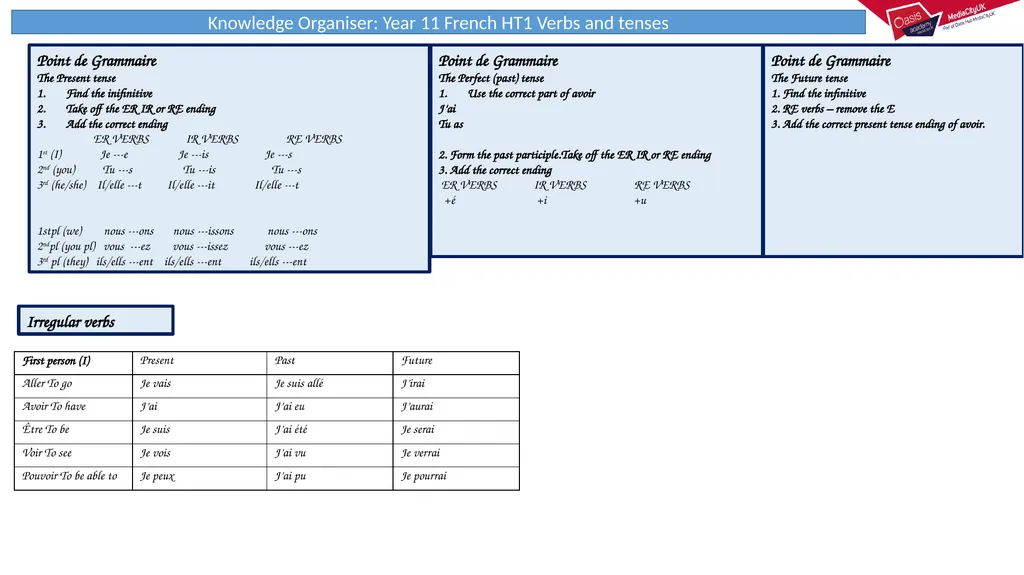
Description: Knowledge Organiser: Year 11 French HT1 Verbs and tenses Point de Grammaire The Present tense Find the inifinitive Take off the ER IR or RE ending Add the correct ending ER VERBS IR VERBS RE VERBS 1st (I) Je ---e Je ---is Je ---s 2nd (you)
Related Topics
Download Presentation
"Knowledge Organiser: Year 11 French HT1 Verbs and" is the property of its rightful owner. Permission is granted to download and print the materials on this website for personal, non-commercial use only, and to display it on your personal computer provided you do not modify the materials and that you retain all copyright notices contained in the materials. By downloading content from our website, you accept the terms of this agreement.
Presentation Transcript
slide1. Knowledge Organiser: Year 11 French HT1 Verbs and tenses Point de Grammaire
The Present tense
Find the inifinitive
Take off the ER IR or RE ending
Add the correct ending
ER VERBS IR VERBS RE VERBS
1st (I) Je ---e Je ---is Je ---s
2nd (you) Tu ---s Tu ---is Tu ---s
3rd (he/she) Il/elle ---t Il/elle ---it Il/elle ---t
1stpl (we) nous ---ons nous ---issons nous ---ons
2ndpl (you pl) vous ---ez vous ---issez vous ---ez
3rd pl (they) ils/ells ---ent ils/ells ---ent ils/ells ---ent Point de Grammaire
The Future tense
1. Find the infinitive
2. RE verbs – remove the E
3. Add the correct present tense ending of avoir. Irregular verbs Point de Grammaire
The Perfect (past) tense
Use the correct part of avoir
J’ai
Tu as
2. Form the past participle.Take off the ER IR or RE ending
3. Add the correct ending
ER VERBS IR VERBS RE VERBS
+é +i +u<br>
slide2. Knowledge Organiser: Geography Year 7 HAZARDS - Half Term 1 Key Vocabulary to learn:
Tectonic Hazard: Hazard that occurs from within planet earth eg. Volcano, earthquake, tsunami
Continental Drift: The theory that all continents move slowly on top of a liquid core
Plate Tectonics: The theory that the earths crust is made up of a several plates which glide over the mantle
Convection Currents: Currents of heat in the mantle which slowly move the crust
Inner Core: The solid metal innermost part of the earth. It is around 5700 degrees Celsius.
Outer Core: Liquid metal layer surrounding the inner core. Roughly 4500 degrees Celsius
Mantle: Ranging from 900 – 4000 degrees Celsius this is the molten rock layer that the core sits on
Crust: Earths hard outer layer is either continental or oceanic
Magma: Molten rock in the earth’s mantle
Lava: Molten rock that has erupted onto the earths surface
Primary effect: Happen as a direct result of a hazard eg. Gas pipes break
Secondary effect: Happen as a result of the primary effect eg. Fires break out
Climatic Hazard: Hazard that results from conditions of the atmosphere eg. Tropical storm, heat wave A map to show plate boundaries Case study: Effects of the Haiti Earthquake Structure of the earth Case study: Effects of Tropical Storm Haiyan<br>
slide3. Knowledge Organiser: Geography Year 8 HAZARDS - Half Term 1 Key Vocabulary to learn:
Tectonic Hazard: Hazard that occurs from within planet earth eg. Volcano, earthquake, tsunami
Continental Drift: The theory that all continents move slowly on top of a liquid core
Plate Tectonics: The theory that the earths crust is made up of a several plates which glide over the mantle
Convection Currents: Currents of heat in the mantle which slowly move the crust
Inner Core: The solid metal innermost part of the earth. It is around 5700 degrees Celsius.
Outer Core: Liquid metal layer surrounding the inner core. Roughly 4500 degrees Celsius
Mantle: Ranging from 900 – 4000 degrees Celsius this is the molten rock layer that the core sits on
Crust: Earths hard outer layer is either continental or oceanic
Magma: Molten rock in the earth’s mantle
Lava: Molten rock that has erupted onto the earths surface
Primary effect: Happen as a direct result of a hazard eg. Gas pipes break
Secondary effect: Happen as a result of the primary effect eg. Fires break out
Climatic Hazard: Hazard that results from conditions of the atmosphere eg. Tropical storm, heat wave A map to show plate boundaries Case study: Responses to the Haiti earthquake
Food, water, medical supplies and temporary shelter were given by the USA.
Temporary hospitals were set up by the Red Cross, so that injured people could be treated.
The UK raised £100 million to help provide emergency shelter, medicine, clean water and sanitation.
The USA immediately sent ships, helicopters and troops to help search and rescue victims. They also gave $100 million in aid.
The World Bank pledged $100 million to support long-term reconstruction and recovery programmes in Haiti.
United Nations (UN) troops and police were sent to help distribute aid and keep order.
¾ of the damaged buildings were repaired.
Cash for work programs were set up in the long term to support locals by paying for them to help clear rubble Structure of the earth Case study: Responses to a tropical storm
The Philippines Red Cross delivered food (rice, canned food)
1200 evacuation centres were created to help the homeless
France, Belgium and Israel help set up temporary hospitals.
US, Australia and the EU provided financial support for people to start new lives.
Cash for work’ programmes were created in the long term to help
Rice farming and fishing were re-established.
1000s of new homes were built in areas away from the risk of flooding.
Reconstruction of roads, bridges, and airports.
The UN, UK, Australia, Japan and US provided long-term medical supplies and financial aid.<br>
slide4. Knowledge Organiser: Geography Year 9 Plate Tectonics - Half Term 1 Key Vocabulary to learn:
Pangaea: The name of the supercontinent when all land masses were joined together. It began to break apart around 200 million years ago
Continental Drift: The theory proposed by Alfred Wegner in 1912 that all continents move slowly on top of a liquid core
Plate Tectonics: The theory that the earths crust is made up of a several plates which glide over the mantle
Convection Currents: Currents of heat in the mantle which slowly move the crust
Inner Core: The solid metal innermost part of the earth. It is around 5700 degrees Celsius.
Outer Core: Liquid metal layer surrounding the inner core. Roughly 4500 degrees Celsius
Mantle: Ranging from 900 – 4000 degrees Celsius this is the molten rock layer that the core sits on
Crust: Earths hard outer layer is either continental or oceanic
Magma: Molten rock in the earth’s mantle
Lava: Molten rock that has erupted onto the earths surface A map to show plate boundaries Destructive plate boundary: Structure of the earth<br>
slide5. Knowledge Organiser: Geography Year 10 Coasts– Half Term 1<br>
slide6. Knowledge Organiser: Geography Y11 Changing Economic World NEE – Newly emerging economy
LIC – Low income country
HIC – High income country
Employment Structure - % of workers in each industrial sector
Primary Industry – extraction of raw materials (agriculture, mining, fishing)
Secondary Industry– manufacturing of raw materials (food processing, clothes, oil refinery)
Tertiary Industry – selling of services and skills (education, health service, transportation)
Quaternary Industry – information and research services (ICT, computing, research, consultancy)
Pre-Industrial UK – before the 1800s (mainly primary industry)
Industrial UK – Late 1800s – 1950s (mainly secondary industry)
Post Industrial UK – 1950s onwards (secondary industry declines, mainly tertiary and quaternary industry)
Industrialisation – Process of moving towards a mainly secondary (manufacturing) economy
De-Industrialisation – Process of decline in manufacturing industry
Science Park – designated areas for research and cutting edge technology development Key Vocabulary UK links to other countries:
Trade: UK overseas exports are worth £250Bn per year
Culture: Media and creative industries exported worldwide
Transport: Channel Tunnel, Heathrow = hub airport
Electronic Communications: Global IT HQs, trans-Atlantic communication networks<br>
slide7. What was England like?
England was ruled by Edward the Confessor from 1042 until 1066.
1.5 million people lived in England at the time.
Everyone was a Christian and went to Church.
1 of every 100 people were rich. William, Duke of Normandy (France) said Edward was a distant relative. William was the only blood relative of Edward, but the English throne did not work in this way. William was supported by the Pope. Harold Godwinson was a powerful and rich English nobleman. According to an Anglo-Saxon account of the events, Edward named Harold his successor. The day after Edward died, the Witan (the royal council) said Godwinson would be King. He was the only claim to the throne by right. Harald Hardrada, King of Norway was a Viking warrior. He believed he should be King because his ancestor, King Cnut had once ruled England (1016-1033). He was helped by Godwinson’s brother, Tostig. Harold’s Army:
Housecarls: Approx 2500 well paid, fully trained and armed with the finest weapons. The fought with huge battleaxes which could chop off a horse’s head!
The Fyrd: Approx 5000 peasants who also fight for the King when required. They are armed with swords and javelins but most of the men use farming tools such as pitchforks. They are not well trained but they are fighting for their country. William’s Army:
Norman foot soldiers: Approx 6500 well-armed soldiers. They have large swords and shields.
Archers: 1500 archers armed with small wooden bows that can fire 6 or 7 arrows a minute. A skilled archer can kill a man from about 180m away. They don’t wear armour.
The Knights: 2000 knights. Highly trained, loyal, professional soldiers. They ride into battle on big, strong warhorses. They wear metal helmets, chain mail suits and carry large shields. They also carry large spears and a sword. Knights charge at full speed towards their opponents. The Battle of Hastings:
Harold marched to meet William. He had an army of 7000 and 2500 of these were well trained. William had 10,000 well equipped men.
Harold made his men stand up on a steep hill because this would slow William’s men down.
The battle began on 14th October at 9:30am. William’s men fired arrows. Harold’s men formed a shield wall.
William’s men could not break through the shield wall.
The battle continued for two hours and they could not see William anywhere, but he took off his helmet and shouted: “I am alive.” What a brave leader!
The hill was so steep, so William ordered his men to run away. The English thought he had given up so ran down the hill to celebrate.
William’s knights turned around and killed lots of Harold’s men.
William repeated the trick again and Harold was killed at 6pm. Feudal System Year 7 – History – Medieval England<br>
slide8. Industrial Revolution - Working in the factories:
Between 1750 and 1805, a series of new inventions meant that workers who had spun thread and woven cloth in their homes went out of business.
These men and women had to find work in other occupations, or go to work in the new factories and mills.
Of course, it was not just adult men and women who went to work in the new factories and mills. It was also children (most factories employed children from the ages of only six or seven.)
The children of home textile workers were also given simple tasks to do, although the spinning and weaving was left to older, more skilled workers.
Machines like the ‘water frame’ were automatic and could be operated by children – they needed small hands to pick out loose threads (even if it meant the loss of a finger)
A list of jobs for different Children in the Mill:
Sweeping up cotton from the floor
Bringing up a new basket of cotton to be put onto the spindles
Cleaning the machinery so that it runs smoothly
Reaching under the machinery to repair broken threads
Passing cotton to an adult worker who is putting it onto the spindles Industrial Revolution – Mines
Following the invention of the steam engine, demand for coal rocketed throughout Britain. Although the use of coal did exist before the industrial revolution this tended to be on small scale operations and it was from mines near to the surface.
Coal was needed in vast quantities for the Industrial Revolution. For centuries, people in Britain had made do with charcoal if they needed a cheap and easy to acquire fuel. ... The development of factories by Arkwright and the improvement of the steam engine by Watt further increased demand for coal.
Dangers of the Mines: underground mining hazards included suffocation, gas poisoning, roof collapse, rock burst, outbursts, and gas explosions. Firedamp explosions could trigger the much-more-dangerous coal dust explosions, which can engulf an entire pit. From 1750 Britain went through a process of change in a number of key areas:
Agriculture – New tools, fertilizers and harvesting techniques were introduced, resulting in increased productivity and agricultural prosperity.
Industry – factories sprung up all over the country creating more efficient ways to produce goods such as wool, cotton and coal. The increase in factories brought thousands of new jobs.
Transport and communications - Thomas Telford built roads and canals in the 1700s and George Stephenson and Isambard Kingdom Brunel oversaw the 'Railway Mania' of the 1800s. There had previously been no very fast way of transporting goods and people around the country.
Technology - There were also many scientific discoveries and technological inventions that changed society and industry. Changes to sanitation and medical treatment such as the work of John Snow and Edward Jenner improved people’s quality of life. Year 8 Industrial Revolution knowledge organiser<br>
slide9. Knowledge Organiser – The First World War and its legacy Timeline Key Concepts Key Words Alliances:
For a number of years tension between the main European powers has been increasing. In 1914 there were two main power blocks / alliances:
The Triple Entente- Great Britain / France / Russia
The Triple Alliance- Germany / Italy and Austria-Hungary
Each member promised to help its allies if they were attacked by a country belonging to another alliance.<br>
slide10. Knowledge Organiser: Weimar and Nazi Germany 1918-39
KT2: Hitler’s Rise to Power, 1919-33<br>
slide11. The Armistice. BIG 3 and their differing opinions. David Lloyd George/ Prime Minister of Great Britain and his aims:
Was elected by the British public to ‘hang the Kaiser’ and ‘make Germany’ pay. He wanted to keep Germany weak; however, he also wanted to avoid humiliating the Germans.
Wanted to end the German threat to the British Empire and reduce Germany’s navy so it was no longer a threat to Britain’s navy! Woodrow Wilson/ President of the USA and his aims:
The USA joined the war in 1917 and didn’t suffer as much as Britain and France. He wanted to prevent Germany becoming aggressive again but didn’t think it should be punished too much.
Wanted different national groups to have the right to rule themselves – known as ‘self-determination.’ George Clemenceau/ Prime Minister of France and his aims:
Around 1.4 million Frenchmen had been killed in the Great War and huge areas of France had been destroyed. He wanted revenge on Germany for all of this suffering.
He wanted Germany to pay for all the damage that the war had caused and wanted to weaken Germany’s armed forced so they would never be able to attack France again. Treaty of Versailles:
On 28th June 1919 it was announced the ‘Big Three’ had reached an agreement at the Paris Peace Conference.
It became known as the ’Treaty of Versailles’ because the leaders met in the Palace of Versailles, just outside Paris.
Germany had not been allowed to go to the peace talks and called the treaty a ‘Diktat’, or dictated peace – they were devastated by the way they were treated. KEY FACTS: THE TERMS OF THE TREATY OF VERSAILLES (BRAT)
BLAME – Germany was blamed for causing the war. This was called ‘Clause 231’ or the ‘War Guilt Clause’
REPARATIONS – Germany would have to pay for the damage caused by war. In 1921 this was set at £6.6bn, over 42 years.
ARMY – The German army was reduced to 100, 000 men. No planes, tanks or submarines. 6 Battleships.
TERRITORY – Germany lost over 10% of its land and people. Alsace Lorraine to France
Other key factors:
The League of Nations was formed and Germany was not allowed to join.
Germany’s colonies in Africa were given as mandates to the League of Nations, which meant that Britain and France controlled them.
Germany was split in two by the Polish Corridor, a strip of land was given to Poland to allow them to have access to the sea. Hatred for the Treaty of Versailles.
The part of the treaty that many Germans hated the most was Article 231, the war guilt clause. The German economy was in ruins.
Germany was also humiliated by the loss of their army – a huge source of national pride before and during the war.Many felt that France could attack at any stage. Key words<br>
slide12. Knowledge Organiser: Year 7 HT1 Spanish Los miembros de la familia
Padre – Dad
Madre – Mum
Hermano – brother
Hermana – sister
Abuelo – grandad
Abuela – grandma
Tío – Uncle
Tía – auntie
Primo – Cousin
Sobrino – nephew
Sobrina – niece
Nieto – grandchild
Gemelos – twins
Hijo único- only child
Padrastro – step-dad
Madrastra – step-mum
Hermanastro – step- brother
Hermanastra – step - sister Preguntas claves
¿Describe tu familia? ¿Tienes hermanos? ¿Cómo es tu pelo? ¿Cómo son tus ojos? Gramática –
TENER (to have) SER (to be)
Tengo – I have Soy – I am
Tienes – you have Eres – you are
Tiene – he/she has Es – he/she is
Tenemos – we have Somos – we are
Tenéis – you all have Sois – You all are
Tienen – they have Son – they are El pelo y los ojos
Tengo el pelo... – I have the hair…
Tengo los ojos…- I have the eyes…
Negro – black
Marrón – brown
Rubio – blonde
Gris – grey
Pelirrojo - ginger
Verde – green
Azúl – blue
Rojo –red
Naranja – orange
Blanco – white
Rosa – pink
Amarillo - yellow
Morado – purple
* Tengo el ojo morado- I have a black eye Adjetivos
Alto – tall alegre - happy
Bajo – small grande - big
Delgado – thtin amable - friendly
Gordo – fat bonito - beautiful
Llevar gafas –wear glasses
Pecas – freckles feo - ugly
Barba – beard travieso - naughty
Calvo – bald inteligente - intelligent
Simpático – nice joven - young
Antipático – nasty Viejo - old
Valiente – brace
Tímido –shy
Triste – sad Remember that when describing your eye colour you need to make the words PLURAL.<br>
slide13. Knowledge Organiser: Year 8 Unit 1 Spanish El Tiempo - Weather
Hace frío – it’s cold
Hace calor – it’s hot
Hace sol – it’s sunny
Hace viento – ‘’ windy
Está nublado – ‘’cloudy
Hay tormenta –stormy Preguntas Claves
¿Cómo es tu ciudad? – What is your city like?
¿Cómo era tu ciudad en el pasado? – What was your city like in the past?
¿Qué se puede hacer en tu ciudad? –What can you do in your city?
¿Qué hiciste en tu ciudad la semana pasada? – What did you do in your city last week?
¿Cómo es la clima en tu ciudad? –What is the weather like in your city? Gramática
Key Verbs
Ir – to go
Voy – I go
Vas – You go
Va – He/she goes
Vamos – we go
Váis – You go (plural)
Van – They go Lugares - Places
El ayuntamiento - town hall
El centro commercial – shopping centre
El cine - cinema
El colegio - school
La iglesia - church
El hospital - hospital
La mezquita - mosque
El supermercado - supermarket
El parque - park
El teatro - theatre
Las tiendas - shops Gramática
Key Verbs
Ir – to go – past tense
Fui – I went
Fuiste – You went
Fue – He/She went
Fuimos – We went
Fuistéis – You went
Fueron – They went Gramática
Other Key Verbs
Hay – There is/are
Había – There was
Habían – There were
Habrá – There will be
Es – It is
Era – It was
Será – It will be
Se puede – You can<br>
slide14. Knowledge Organiser: Year 9 Unit 1 Spanish La família
Mi hermana My sister
Mi madre My mum
Mi tía My auntie
Mi abuelo My grandad
Mi padre My dad
Mi tío My uncle
Mi hermano My brother
Mis abuelos My grandparents
Mi abuela My grandma
Mi primo/a My cousin
Mi padrastro stepdad
Mi madrastra stepmum
Mi hermanastro stepbrother
Mi hermanastra stepsister Frases que saber
Me llevo bien con – I get on well with
Me peleo con – I fight with
Echo de menos a – I miss Preguntas Claves
¿Cómo es tu família? – What is your family like?
Descríbeme un miembro de tu família – Describe a member of your family.
¿Te gustaría casarte en el futuro? – Would you like to get married in the future?
¿ Te gustaría tener hijos en el futuro? – Would you like to have children in the future? Las Relaciones Personales
alegre – happy
amable – kind
amistoso – friendly
el amor – love
animado – lively
antipático – nasty
cariñoso – affectionate
casarme – to get married
un compañero – a friend/mate
egoísta - selfish
enamorarme – to fall in love
gracioso – funny
guapo – good looking
hablador – chatty
honrado – honest
maduro – mature
perezoso – lazy
serio – serious
simpático – nice
soltero – single
travieso – naughty
triste- sad
valiente - brave Gramática
El futuro
Voy a – I am going to
Me gustaría – I would like
Quiero – I want
Quisiera – I would like
1st person future tense
Infinitive + é
1st person conditional tense
Infinitive + ía Gramática
Key Verbs
Tener – to have
tengo – I have
tienes – you have
tiene - it has
tenemos – we have
tenéis – you have (pl)
tienen – they have Gramática
Key Verbs
Ser – to be
soy – I am
eres – you have
es – he/she/it is
somos – we have
sóis – you are (plural)
son – they are Frases con tener
tener _ años: to be _ years old
tener calor: to be hot
tener frío: to be cold
tener hambre: to be hungry
tener sed: to be thirsty
tener sueño: to be sleepy
tener miedo: to be frightened
tener prisa: to be in a hurry
tener razón: to be right
no tener razón: to be wrong
tener suerte: to be lucky<br>
slide15. Knowledge Organiser: Year 10 HT1 Spanish – La Vida Sana Key verbs
Comer – to eat
Beber – to drink
Hacer – to do
Evitar – to avoid
Cenar - to have your evening meal
Jugar – to play
Cocinar – to cook
Correr – to run
Elegir – to choose
Probar – to try
Tener hambre/sed – to be hungry/thirsty
Mantenerme en forma – to keep in shape Preguntas Claves:
¿Qué comes normalmente? – What do you normally eat?
2. ¿Qué hace para mantenerte en forma? – What do you do to stay healthy?
3. ¿Qué hiciste para mantenerte en forma la semana pasada? – What did you do to stay healthy last week?
4. ¿Qué harás para mantenerte en forma en el futuro? – What will you do to stay healthy in the future? La comida – food
El aceite - oil
El agua (mineral) – (mineral) water
El alimento – food
El arroz – rice
El atún – tuna
El azúcar – sugar
La barra (de pan) – loaf (of bread)
La bebibda – dribk
El bocadillo – sandwich
Los caramelos- sweets
La carne – meat
La cebolla – onion
La cena – evening meal
La cerveza – beer
La comida – food
La comida basura – junk food
Los champiñones – mushrooms
El chorizo – sausage
La chuleta – chop
De cerdo – pork
De cordero – lamb
De vaca – beef
El filete – steak
La fresa – strawberry
La galleta – biscuit
Las gambas – prawns
La grasa – fat
Los guisantes – peas
El helado – ice cream Gramática
El Presente (present) 1st person
Find infinitive 2.Take off AR/ER/IR 3. +o
como, bebo, desayuno, almuerzo, ceno
El Pretérito (past) 1st person
Find infinitive 2. Take off AR + é 3. Take off ER/IR +í
Comí, bebí, desayuné
El Futuro 1st person
Find infinitive 2. +é
Comeré, desayunaré
Key Verbs
Se debe – you must
Tiene que – You have to
Hay que – you have to La comida – food
El huevo – egg
El jamón – ham
La leche – milk
La lechuga – lettuce
Ls legumbres – vegetables
La mantequilla – butter
La manzana – apple
Los mariscos – seafood
La mermelada – jam
La naranja – orange
La nata – cream
El pastel – cake
La patata – potato
La pera – pear
El perrito caliente – hot dog
El pescado – fish
La pimiento – pepper
La piña – pineapple
El plátano – banana
El pollo – chicken
El postre – pudding
El queso- cheese
La sal – salt
Las salchichas – sausages
La salsa – sauce
La sopa - soup
El té – tea
La tostada – toast
Las uvas – grapes
Las verduras – vegetables
El zumo - juice
La zanahoría - carrot Adjectivos
Asco - disgusting
Dulce – sweet
Grasiento – greasy/fatty
Malsano - unhealthy
Picante – spicy
Rico – delicious
Repugnate - disgusting
Salado – salty
Sano – healthy
Asqueroso - disgusting<br>
slide16. Knowledge Organiser: Year 11 Spanish Mi Barrio Keywords
las afueras – outskirts
el aparcamiento – parking
el árbol – tree
el ayuntamiento – town hall
el barrio –neighbourhood
la biblioteca – library
el bosque – forest
la calle – street
el campo – countryside
la cancha – (sports) court
el centro comercial – shopping centre
el cine – cinema
la ciudad – city
el club de jóvenes – Youth club
la comisaría – police station
el Correos – Post Office
el edificio – building
la fábrica – factory
los grandes almacenes – department stores
la granja – farm
el habitante – inhabitant
la iglesia – church
el lago – lake
el Mercado – market
la mezquita- mosque
el museo – museum
el parque infantil – playground
el paro – unemployment
Dinero – money
Una red de transporte – transport network Preguntas Claves
¿Dónde vives? – Where do you live?
¿Cómo es tu barrio? – What is your neighbourhood like?
¿Cómo era Salford en el pasado ? – What was Salford like in the past?
Tu ciudad, ¿es interesante para turistas ? – Is your city intersting for tourists?
¿Qué hay que hacer para los jóvenes?– What is there for young people to do?
¿Qué hiciste en tu ciudad la semana pasada ? – What did you do in your city last week?
¿Qué tiempo hace normalmente en tu región ? – What is the weather normally like in your área?
¿Es mejor vivir en el campo o la ciudad ? Is it better to live in the countryside or the city?
¿Qué es lo positivo y lo negativo de vivir en una ciudad ? – What are the positives and negatives of living in a city? la plaza – square
la población – population
el polideportivo – sports centre
el pueblo – village, people, nation
el río – river
la sierra – mountain range
el teatro – theatre
la zona peatonal – pedestrian zone Adjectives
Limpio - clean
Sucio - dirty
Lo major – the best
Lo peor – the worst
Seguro - safe
Peligroso - dangerous
Antiguo - old
Moderno - modern
Nuevo - new
Viejo - old
Bueno - good
Malo - bad
Bonito – pretty
Feo – Ugly
Deprimido – depived
Rico – rich
tranquilo – quiet
Ruidoso - noisy Key Verbs
Tiene - It has
Tenía – It used to have
Es – It is
Era – It was/used to be
Son – They are
Eran – They were
Hay – There is
Había – There used to be
Voy a - I am going to
Me gustaría – i would like
vivir – to live
mudarme – to move
quedarme – to stay Opinions
agradable – pleasnt
bonito – pretty
decepcionante – disappointing
desagradable – unpleasant
las desventajas – the disadvantages
distinto – different
divertido – fun
estupendo – fantastic
fatal – awful
impresionante - impressive
único – unique
las ventajas – the advantages Conjunctions
a pesar de – in spite of
así que – so, therefore
aun (si) - even if
aunque – although
como – as, since
cuando – when
incluso – even
o – or
por eso – for that reason
por lo tanto – therefore
sin embargo – however
tal vez – perhaps
ya que - since *Don’t forget to revise keywords from your GCSE revision booklet for the weekly tests*<br>
The Present tense
Find the inifinitive
Take off the ER IR or RE ending
Add the correct ending
ER VERBS IR VERBS RE VERBS
1st (I) Je ---e Je ---is Je ---s
2nd (you) Tu ---s Tu ---is Tu ---s
3rd (he/she) Il/elle ---t Il/elle ---it Il/elle ---t
1stpl (we) nous ---ons nous ---issons nous ---ons
2ndpl (you pl) vous ---ez vous ---issez vous ---ez
3rd pl (they) ils/ells ---ent ils/ells ---ent ils/ells ---ent Point de Grammaire
The Future tense
1. Find the infinitive
2. RE verbs – remove the E
3. Add the correct present tense ending of avoir. Irregular verbs Point de Grammaire
The Perfect (past) tense
Use the correct part of avoir
J’ai
Tu as
2. Form the past participle.Take off the ER IR or RE ending
3. Add the correct ending
ER VERBS IR VERBS RE VERBS
+é +i +u<br>
slide2. Knowledge Organiser: Geography Year 7 HAZARDS - Half Term 1 Key Vocabulary to learn:
Tectonic Hazard: Hazard that occurs from within planet earth eg. Volcano, earthquake, tsunami
Continental Drift: The theory that all continents move slowly on top of a liquid core
Plate Tectonics: The theory that the earths crust is made up of a several plates which glide over the mantle
Convection Currents: Currents of heat in the mantle which slowly move the crust
Inner Core: The solid metal innermost part of the earth. It is around 5700 degrees Celsius.
Outer Core: Liquid metal layer surrounding the inner core. Roughly 4500 degrees Celsius
Mantle: Ranging from 900 – 4000 degrees Celsius this is the molten rock layer that the core sits on
Crust: Earths hard outer layer is either continental or oceanic
Magma: Molten rock in the earth’s mantle
Lava: Molten rock that has erupted onto the earths surface
Primary effect: Happen as a direct result of a hazard eg. Gas pipes break
Secondary effect: Happen as a result of the primary effect eg. Fires break out
Climatic Hazard: Hazard that results from conditions of the atmosphere eg. Tropical storm, heat wave A map to show plate boundaries Case study: Effects of the Haiti Earthquake Structure of the earth Case study: Effects of Tropical Storm Haiyan<br>
slide3. Knowledge Organiser: Geography Year 8 HAZARDS - Half Term 1 Key Vocabulary to learn:
Tectonic Hazard: Hazard that occurs from within planet earth eg. Volcano, earthquake, tsunami
Continental Drift: The theory that all continents move slowly on top of a liquid core
Plate Tectonics: The theory that the earths crust is made up of a several plates which glide over the mantle
Convection Currents: Currents of heat in the mantle which slowly move the crust
Inner Core: The solid metal innermost part of the earth. It is around 5700 degrees Celsius.
Outer Core: Liquid metal layer surrounding the inner core. Roughly 4500 degrees Celsius
Mantle: Ranging from 900 – 4000 degrees Celsius this is the molten rock layer that the core sits on
Crust: Earths hard outer layer is either continental or oceanic
Magma: Molten rock in the earth’s mantle
Lava: Molten rock that has erupted onto the earths surface
Primary effect: Happen as a direct result of a hazard eg. Gas pipes break
Secondary effect: Happen as a result of the primary effect eg. Fires break out
Climatic Hazard: Hazard that results from conditions of the atmosphere eg. Tropical storm, heat wave A map to show plate boundaries Case study: Responses to the Haiti earthquake
Food, water, medical supplies and temporary shelter were given by the USA.
Temporary hospitals were set up by the Red Cross, so that injured people could be treated.
The UK raised £100 million to help provide emergency shelter, medicine, clean water and sanitation.
The USA immediately sent ships, helicopters and troops to help search and rescue victims. They also gave $100 million in aid.
The World Bank pledged $100 million to support long-term reconstruction and recovery programmes in Haiti.
United Nations (UN) troops and police were sent to help distribute aid and keep order.
¾ of the damaged buildings were repaired.
Cash for work programs were set up in the long term to support locals by paying for them to help clear rubble Structure of the earth Case study: Responses to a tropical storm
The Philippines Red Cross delivered food (rice, canned food)
1200 evacuation centres were created to help the homeless
France, Belgium and Israel help set up temporary hospitals.
US, Australia and the EU provided financial support for people to start new lives.
Cash for work’ programmes were created in the long term to help
Rice farming and fishing were re-established.
1000s of new homes were built in areas away from the risk of flooding.
Reconstruction of roads, bridges, and airports.
The UN, UK, Australia, Japan and US provided long-term medical supplies and financial aid.<br>
slide4. Knowledge Organiser: Geography Year 9 Plate Tectonics - Half Term 1 Key Vocabulary to learn:
Pangaea: The name of the supercontinent when all land masses were joined together. It began to break apart around 200 million years ago
Continental Drift: The theory proposed by Alfred Wegner in 1912 that all continents move slowly on top of a liquid core
Plate Tectonics: The theory that the earths crust is made up of a several plates which glide over the mantle
Convection Currents: Currents of heat in the mantle which slowly move the crust
Inner Core: The solid metal innermost part of the earth. It is around 5700 degrees Celsius.
Outer Core: Liquid metal layer surrounding the inner core. Roughly 4500 degrees Celsius
Mantle: Ranging from 900 – 4000 degrees Celsius this is the molten rock layer that the core sits on
Crust: Earths hard outer layer is either continental or oceanic
Magma: Molten rock in the earth’s mantle
Lava: Molten rock that has erupted onto the earths surface A map to show plate boundaries Destructive plate boundary: Structure of the earth<br>
slide5. Knowledge Organiser: Geography Year 10 Coasts– Half Term 1<br>
slide6. Knowledge Organiser: Geography Y11 Changing Economic World NEE – Newly emerging economy
LIC – Low income country
HIC – High income country
Employment Structure - % of workers in each industrial sector
Primary Industry – extraction of raw materials (agriculture, mining, fishing)
Secondary Industry– manufacturing of raw materials (food processing, clothes, oil refinery)
Tertiary Industry – selling of services and skills (education, health service, transportation)
Quaternary Industry – information and research services (ICT, computing, research, consultancy)
Pre-Industrial UK – before the 1800s (mainly primary industry)
Industrial UK – Late 1800s – 1950s (mainly secondary industry)
Post Industrial UK – 1950s onwards (secondary industry declines, mainly tertiary and quaternary industry)
Industrialisation – Process of moving towards a mainly secondary (manufacturing) economy
De-Industrialisation – Process of decline in manufacturing industry
Science Park – designated areas for research and cutting edge technology development Key Vocabulary UK links to other countries:
Trade: UK overseas exports are worth £250Bn per year
Culture: Media and creative industries exported worldwide
Transport: Channel Tunnel, Heathrow = hub airport
Electronic Communications: Global IT HQs, trans-Atlantic communication networks<br>
slide7. What was England like?
England was ruled by Edward the Confessor from 1042 until 1066.
1.5 million people lived in England at the time.
Everyone was a Christian and went to Church.
1 of every 100 people were rich. William, Duke of Normandy (France) said Edward was a distant relative. William was the only blood relative of Edward, but the English throne did not work in this way. William was supported by the Pope. Harold Godwinson was a powerful and rich English nobleman. According to an Anglo-Saxon account of the events, Edward named Harold his successor. The day after Edward died, the Witan (the royal council) said Godwinson would be King. He was the only claim to the throne by right. Harald Hardrada, King of Norway was a Viking warrior. He believed he should be King because his ancestor, King Cnut had once ruled England (1016-1033). He was helped by Godwinson’s brother, Tostig. Harold’s Army:
Housecarls: Approx 2500 well paid, fully trained and armed with the finest weapons. The fought with huge battleaxes which could chop off a horse’s head!
The Fyrd: Approx 5000 peasants who also fight for the King when required. They are armed with swords and javelins but most of the men use farming tools such as pitchforks. They are not well trained but they are fighting for their country. William’s Army:
Norman foot soldiers: Approx 6500 well-armed soldiers. They have large swords and shields.
Archers: 1500 archers armed with small wooden bows that can fire 6 or 7 arrows a minute. A skilled archer can kill a man from about 180m away. They don’t wear armour.
The Knights: 2000 knights. Highly trained, loyal, professional soldiers. They ride into battle on big, strong warhorses. They wear metal helmets, chain mail suits and carry large shields. They also carry large spears and a sword. Knights charge at full speed towards their opponents. The Battle of Hastings:
Harold marched to meet William. He had an army of 7000 and 2500 of these were well trained. William had 10,000 well equipped men.
Harold made his men stand up on a steep hill because this would slow William’s men down.
The battle began on 14th October at 9:30am. William’s men fired arrows. Harold’s men formed a shield wall.
William’s men could not break through the shield wall.
The battle continued for two hours and they could not see William anywhere, but he took off his helmet and shouted: “I am alive.” What a brave leader!
The hill was so steep, so William ordered his men to run away. The English thought he had given up so ran down the hill to celebrate.
William’s knights turned around and killed lots of Harold’s men.
William repeated the trick again and Harold was killed at 6pm. Feudal System Year 7 – History – Medieval England<br>
slide8. Industrial Revolution - Working in the factories:
Between 1750 and 1805, a series of new inventions meant that workers who had spun thread and woven cloth in their homes went out of business.
These men and women had to find work in other occupations, or go to work in the new factories and mills.
Of course, it was not just adult men and women who went to work in the new factories and mills. It was also children (most factories employed children from the ages of only six or seven.)
The children of home textile workers were also given simple tasks to do, although the spinning and weaving was left to older, more skilled workers.
Machines like the ‘water frame’ were automatic and could be operated by children – they needed small hands to pick out loose threads (even if it meant the loss of a finger)
A list of jobs for different Children in the Mill:
Sweeping up cotton from the floor
Bringing up a new basket of cotton to be put onto the spindles
Cleaning the machinery so that it runs smoothly
Reaching under the machinery to repair broken threads
Passing cotton to an adult worker who is putting it onto the spindles Industrial Revolution – Mines
Following the invention of the steam engine, demand for coal rocketed throughout Britain. Although the use of coal did exist before the industrial revolution this tended to be on small scale operations and it was from mines near to the surface.
Coal was needed in vast quantities for the Industrial Revolution. For centuries, people in Britain had made do with charcoal if they needed a cheap and easy to acquire fuel. ... The development of factories by Arkwright and the improvement of the steam engine by Watt further increased demand for coal.
Dangers of the Mines: underground mining hazards included suffocation, gas poisoning, roof collapse, rock burst, outbursts, and gas explosions. Firedamp explosions could trigger the much-more-dangerous coal dust explosions, which can engulf an entire pit. From 1750 Britain went through a process of change in a number of key areas:
Agriculture – New tools, fertilizers and harvesting techniques were introduced, resulting in increased productivity and agricultural prosperity.
Industry – factories sprung up all over the country creating more efficient ways to produce goods such as wool, cotton and coal. The increase in factories brought thousands of new jobs.
Transport and communications - Thomas Telford built roads and canals in the 1700s and George Stephenson and Isambard Kingdom Brunel oversaw the 'Railway Mania' of the 1800s. There had previously been no very fast way of transporting goods and people around the country.
Technology - There were also many scientific discoveries and technological inventions that changed society and industry. Changes to sanitation and medical treatment such as the work of John Snow and Edward Jenner improved people’s quality of life. Year 8 Industrial Revolution knowledge organiser<br>
slide9. Knowledge Organiser – The First World War and its legacy Timeline Key Concepts Key Words Alliances:
For a number of years tension between the main European powers has been increasing. In 1914 there were two main power blocks / alliances:
The Triple Entente- Great Britain / France / Russia
The Triple Alliance- Germany / Italy and Austria-Hungary
Each member promised to help its allies if they were attacked by a country belonging to another alliance.<br>
slide10. Knowledge Organiser: Weimar and Nazi Germany 1918-39
KT2: Hitler’s Rise to Power, 1919-33<br>
slide11. The Armistice. BIG 3 and their differing opinions. David Lloyd George/ Prime Minister of Great Britain and his aims:
Was elected by the British public to ‘hang the Kaiser’ and ‘make Germany’ pay. He wanted to keep Germany weak; however, he also wanted to avoid humiliating the Germans.
Wanted to end the German threat to the British Empire and reduce Germany’s navy so it was no longer a threat to Britain’s navy! Woodrow Wilson/ President of the USA and his aims:
The USA joined the war in 1917 and didn’t suffer as much as Britain and France. He wanted to prevent Germany becoming aggressive again but didn’t think it should be punished too much.
Wanted different national groups to have the right to rule themselves – known as ‘self-determination.’ George Clemenceau/ Prime Minister of France and his aims:
Around 1.4 million Frenchmen had been killed in the Great War and huge areas of France had been destroyed. He wanted revenge on Germany for all of this suffering.
He wanted Germany to pay for all the damage that the war had caused and wanted to weaken Germany’s armed forced so they would never be able to attack France again. Treaty of Versailles:
On 28th June 1919 it was announced the ‘Big Three’ had reached an agreement at the Paris Peace Conference.
It became known as the ’Treaty of Versailles’ because the leaders met in the Palace of Versailles, just outside Paris.
Germany had not been allowed to go to the peace talks and called the treaty a ‘Diktat’, or dictated peace – they were devastated by the way they were treated. KEY FACTS: THE TERMS OF THE TREATY OF VERSAILLES (BRAT)
BLAME – Germany was blamed for causing the war. This was called ‘Clause 231’ or the ‘War Guilt Clause’
REPARATIONS – Germany would have to pay for the damage caused by war. In 1921 this was set at £6.6bn, over 42 years.
ARMY – The German army was reduced to 100, 000 men. No planes, tanks or submarines. 6 Battleships.
TERRITORY – Germany lost over 10% of its land and people. Alsace Lorraine to France
Other key factors:
The League of Nations was formed and Germany was not allowed to join.
Germany’s colonies in Africa were given as mandates to the League of Nations, which meant that Britain and France controlled them.
Germany was split in two by the Polish Corridor, a strip of land was given to Poland to allow them to have access to the sea. Hatred for the Treaty of Versailles.
The part of the treaty that many Germans hated the most was Article 231, the war guilt clause. The German economy was in ruins.
Germany was also humiliated by the loss of their army – a huge source of national pride before and during the war.Many felt that France could attack at any stage. Key words<br>
slide12. Knowledge Organiser: Year 7 HT1 Spanish Los miembros de la familia
Padre – Dad
Madre – Mum
Hermano – brother
Hermana – sister
Abuelo – grandad
Abuela – grandma
Tío – Uncle
Tía – auntie
Primo – Cousin
Sobrino – nephew
Sobrina – niece
Nieto – grandchild
Gemelos – twins
Hijo único- only child
Padrastro – step-dad
Madrastra – step-mum
Hermanastro – step- brother
Hermanastra – step - sister Preguntas claves
¿Describe tu familia? ¿Tienes hermanos? ¿Cómo es tu pelo? ¿Cómo son tus ojos? Gramática –
TENER (to have) SER (to be)
Tengo – I have Soy – I am
Tienes – you have Eres – you are
Tiene – he/she has Es – he/she is
Tenemos – we have Somos – we are
Tenéis – you all have Sois – You all are
Tienen – they have Son – they are El pelo y los ojos
Tengo el pelo... – I have the hair…
Tengo los ojos…- I have the eyes…
Negro – black
Marrón – brown
Rubio – blonde
Gris – grey
Pelirrojo - ginger
Verde – green
Azúl – blue
Rojo –red
Naranja – orange
Blanco – white
Rosa – pink
Amarillo - yellow
Morado – purple
* Tengo el ojo morado- I have a black eye Adjetivos
Alto – tall alegre - happy
Bajo – small grande - big
Delgado – thtin amable - friendly
Gordo – fat bonito - beautiful
Llevar gafas –wear glasses
Pecas – freckles feo - ugly
Barba – beard travieso - naughty
Calvo – bald inteligente - intelligent
Simpático – nice joven - young
Antipático – nasty Viejo - old
Valiente – brace
Tímido –shy
Triste – sad Remember that when describing your eye colour you need to make the words PLURAL.<br>
slide13. Knowledge Organiser: Year 8 Unit 1 Spanish El Tiempo - Weather
Hace frío – it’s cold
Hace calor – it’s hot
Hace sol – it’s sunny
Hace viento – ‘’ windy
Está nublado – ‘’cloudy
Hay tormenta –stormy Preguntas Claves
¿Cómo es tu ciudad? – What is your city like?
¿Cómo era tu ciudad en el pasado? – What was your city like in the past?
¿Qué se puede hacer en tu ciudad? –What can you do in your city?
¿Qué hiciste en tu ciudad la semana pasada? – What did you do in your city last week?
¿Cómo es la clima en tu ciudad? –What is the weather like in your city? Gramática
Key Verbs
Ir – to go
Voy – I go
Vas – You go
Va – He/she goes
Vamos – we go
Váis – You go (plural)
Van – They go Lugares - Places
El ayuntamiento - town hall
El centro commercial – shopping centre
El cine - cinema
El colegio - school
La iglesia - church
El hospital - hospital
La mezquita - mosque
El supermercado - supermarket
El parque - park
El teatro - theatre
Las tiendas - shops Gramática
Key Verbs
Ir – to go – past tense
Fui – I went
Fuiste – You went
Fue – He/She went
Fuimos – We went
Fuistéis – You went
Fueron – They went Gramática
Other Key Verbs
Hay – There is/are
Había – There was
Habían – There were
Habrá – There will be
Es – It is
Era – It was
Será – It will be
Se puede – You can<br>
slide14. Knowledge Organiser: Year 9 Unit 1 Spanish La família
Mi hermana My sister
Mi madre My mum
Mi tía My auntie
Mi abuelo My grandad
Mi padre My dad
Mi tío My uncle
Mi hermano My brother
Mis abuelos My grandparents
Mi abuela My grandma
Mi primo/a My cousin
Mi padrastro stepdad
Mi madrastra stepmum
Mi hermanastro stepbrother
Mi hermanastra stepsister Frases que saber
Me llevo bien con – I get on well with
Me peleo con – I fight with
Echo de menos a – I miss Preguntas Claves
¿Cómo es tu família? – What is your family like?
Descríbeme un miembro de tu família – Describe a member of your family.
¿Te gustaría casarte en el futuro? – Would you like to get married in the future?
¿ Te gustaría tener hijos en el futuro? – Would you like to have children in the future? Las Relaciones Personales
alegre – happy
amable – kind
amistoso – friendly
el amor – love
animado – lively
antipático – nasty
cariñoso – affectionate
casarme – to get married
un compañero – a friend/mate
egoísta - selfish
enamorarme – to fall in love
gracioso – funny
guapo – good looking
hablador – chatty
honrado – honest
maduro – mature
perezoso – lazy
serio – serious
simpático – nice
soltero – single
travieso – naughty
triste- sad
valiente - brave Gramática
El futuro
Voy a – I am going to
Me gustaría – I would like
Quiero – I want
Quisiera – I would like
1st person future tense
Infinitive + é
1st person conditional tense
Infinitive + ía Gramática
Key Verbs
Tener – to have
tengo – I have
tienes – you have
tiene - it has
tenemos – we have
tenéis – you have (pl)
tienen – they have Gramática
Key Verbs
Ser – to be
soy – I am
eres – you have
es – he/she/it is
somos – we have
sóis – you are (plural)
son – they are Frases con tener
tener _ años: to be _ years old
tener calor: to be hot
tener frío: to be cold
tener hambre: to be hungry
tener sed: to be thirsty
tener sueño: to be sleepy
tener miedo: to be frightened
tener prisa: to be in a hurry
tener razón: to be right
no tener razón: to be wrong
tener suerte: to be lucky<br>
slide15. Knowledge Organiser: Year 10 HT1 Spanish – La Vida Sana Key verbs
Comer – to eat
Beber – to drink
Hacer – to do
Evitar – to avoid
Cenar - to have your evening meal
Jugar – to play
Cocinar – to cook
Correr – to run
Elegir – to choose
Probar – to try
Tener hambre/sed – to be hungry/thirsty
Mantenerme en forma – to keep in shape Preguntas Claves:
¿Qué comes normalmente? – What do you normally eat?
2. ¿Qué hace para mantenerte en forma? – What do you do to stay healthy?
3. ¿Qué hiciste para mantenerte en forma la semana pasada? – What did you do to stay healthy last week?
4. ¿Qué harás para mantenerte en forma en el futuro? – What will you do to stay healthy in the future? La comida – food
El aceite - oil
El agua (mineral) – (mineral) water
El alimento – food
El arroz – rice
El atún – tuna
El azúcar – sugar
La barra (de pan) – loaf (of bread)
La bebibda – dribk
El bocadillo – sandwich
Los caramelos- sweets
La carne – meat
La cebolla – onion
La cena – evening meal
La cerveza – beer
La comida – food
La comida basura – junk food
Los champiñones – mushrooms
El chorizo – sausage
La chuleta – chop
De cerdo – pork
De cordero – lamb
De vaca – beef
El filete – steak
La fresa – strawberry
La galleta – biscuit
Las gambas – prawns
La grasa – fat
Los guisantes – peas
El helado – ice cream Gramática
El Presente (present) 1st person
Find infinitive 2.Take off AR/ER/IR 3. +o
como, bebo, desayuno, almuerzo, ceno
El Pretérito (past) 1st person
Find infinitive 2. Take off AR + é 3. Take off ER/IR +í
Comí, bebí, desayuné
El Futuro 1st person
Find infinitive 2. +é
Comeré, desayunaré
Key Verbs
Se debe – you must
Tiene que – You have to
Hay que – you have to La comida – food
El huevo – egg
El jamón – ham
La leche – milk
La lechuga – lettuce
Ls legumbres – vegetables
La mantequilla – butter
La manzana – apple
Los mariscos – seafood
La mermelada – jam
La naranja – orange
La nata – cream
El pastel – cake
La patata – potato
La pera – pear
El perrito caliente – hot dog
El pescado – fish
La pimiento – pepper
La piña – pineapple
El plátano – banana
El pollo – chicken
El postre – pudding
El queso- cheese
La sal – salt
Las salchichas – sausages
La salsa – sauce
La sopa - soup
El té – tea
La tostada – toast
Las uvas – grapes
Las verduras – vegetables
El zumo - juice
La zanahoría - carrot Adjectivos
Asco - disgusting
Dulce – sweet
Grasiento – greasy/fatty
Malsano - unhealthy
Picante – spicy
Rico – delicious
Repugnate - disgusting
Salado – salty
Sano – healthy
Asqueroso - disgusting<br>
slide16. Knowledge Organiser: Year 11 Spanish Mi Barrio Keywords
las afueras – outskirts
el aparcamiento – parking
el árbol – tree
el ayuntamiento – town hall
el barrio –neighbourhood
la biblioteca – library
el bosque – forest
la calle – street
el campo – countryside
la cancha – (sports) court
el centro comercial – shopping centre
el cine – cinema
la ciudad – city
el club de jóvenes – Youth club
la comisaría – police station
el Correos – Post Office
el edificio – building
la fábrica – factory
los grandes almacenes – department stores
la granja – farm
el habitante – inhabitant
la iglesia – church
el lago – lake
el Mercado – market
la mezquita- mosque
el museo – museum
el parque infantil – playground
el paro – unemployment
Dinero – money
Una red de transporte – transport network Preguntas Claves
¿Dónde vives? – Where do you live?
¿Cómo es tu barrio? – What is your neighbourhood like?
¿Cómo era Salford en el pasado ? – What was Salford like in the past?
Tu ciudad, ¿es interesante para turistas ? – Is your city intersting for tourists?
¿Qué hay que hacer para los jóvenes?– What is there for young people to do?
¿Qué hiciste en tu ciudad la semana pasada ? – What did you do in your city last week?
¿Qué tiempo hace normalmente en tu región ? – What is the weather normally like in your área?
¿Es mejor vivir en el campo o la ciudad ? Is it better to live in the countryside or the city?
¿Qué es lo positivo y lo negativo de vivir en una ciudad ? – What are the positives and negatives of living in a city? la plaza – square
la población – population
el polideportivo – sports centre
el pueblo – village, people, nation
el río – river
la sierra – mountain range
el teatro – theatre
la zona peatonal – pedestrian zone Adjectives
Limpio - clean
Sucio - dirty
Lo major – the best
Lo peor – the worst
Seguro - safe
Peligroso - dangerous
Antiguo - old
Moderno - modern
Nuevo - new
Viejo - old
Bueno - good
Malo - bad
Bonito – pretty
Feo – Ugly
Deprimido – depived
Rico – rich
tranquilo – quiet
Ruidoso - noisy Key Verbs
Tiene - It has
Tenía – It used to have
Es – It is
Era – It was/used to be
Son – They are
Eran – They were
Hay – There is
Había – There used to be
Voy a - I am going to
Me gustaría – i would like
vivir – to live
mudarme – to move
quedarme – to stay Opinions
agradable – pleasnt
bonito – pretty
decepcionante – disappointing
desagradable – unpleasant
las desventajas – the disadvantages
distinto – different
divertido – fun
estupendo – fantastic
fatal – awful
impresionante - impressive
único – unique
las ventajas – the advantages Conjunctions
a pesar de – in spite of
así que – so, therefore
aun (si) - even if
aunque – although
como – as, since
cuando – when
incluso – even
o – or
por eso – for that reason
por lo tanto – therefore
sin embargo – however
tal vez – perhaps
ya que - since *Don’t forget to revise keywords from your GCSE revision booklet for the weekly tests*<br>