
Knowledge Organiser Year 7: Key Literary
A
Published · 5 slides · 0 views
1 / 1
Description
Knowledge Organiser Year 7: Key Literary Vocabulary: MediaMedium The materials and tools used by an artist to create a piece of art. Technique The skill in which an artist uses tools and materials to create a piece of art. Abstract A piece
Related Topics
Share
Embed code
Download this presentation From Below
"Knowledge Organiser Year 7: Key Literary" is the property of its rightful owner. Permission is granted to download and print the materials on this website for personal, non-commercial use only, and to display it on your personal computer provided you do not modify the materials and that you retain all copyright notices contained in the materials. By downloading content from our website, you accept the terms of this agreement.
Presentation Transcript
01
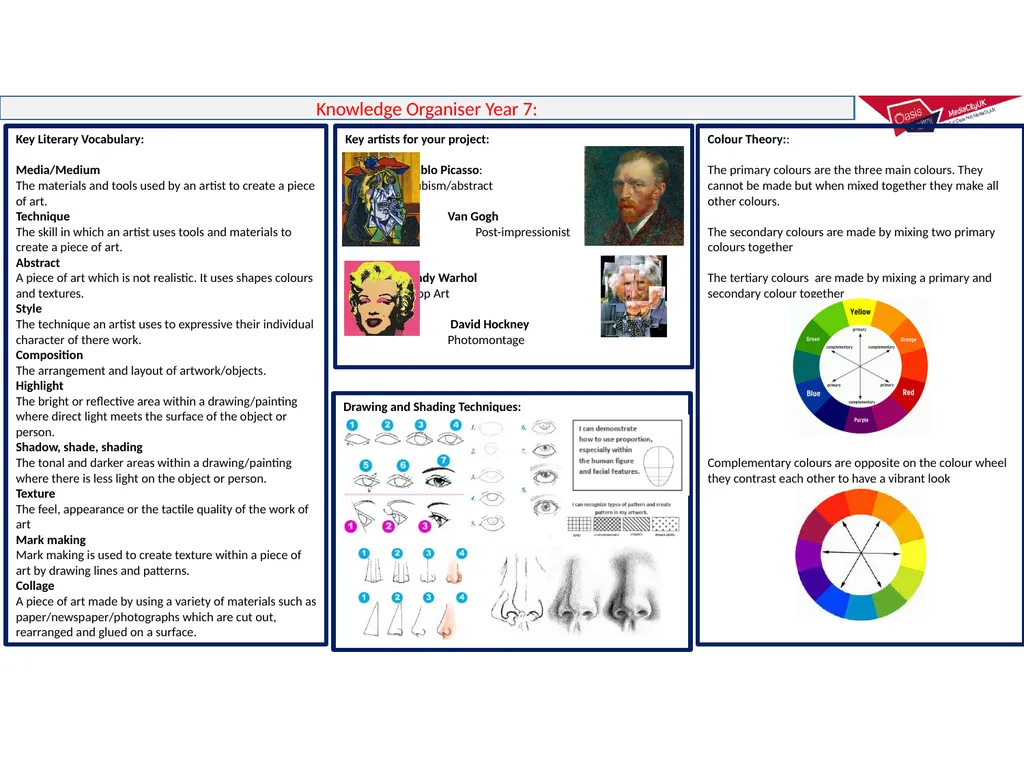
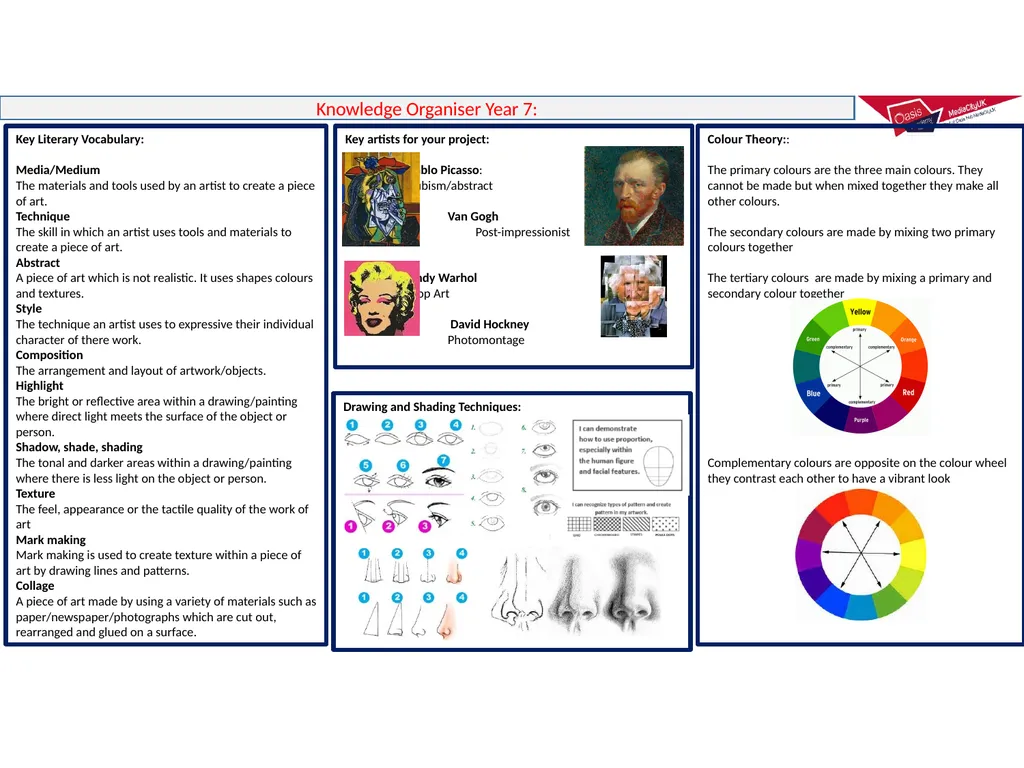
Knowledge Organiser Year 7: Key Literary Vocabulary:
Media/Medium
The materials and tools used by an artist to create a piece of art.
Technique
The skill in which an artist uses tools and materials to create a piece of art.
Abstract
A piece of art which is not realistic. It uses shapes colours and textures.
Style
The technique an artist uses to expressive their individual character of there work.
Composition
The arrangement and layout of artwork/objects.
Highlight
The bright or reflective area within a drawing/painting where direct light meets the surface of the object or person.
Shadow, shade, shading
The tonal and darker areas within a drawing/painting where there is less light on the object or person.
Texture
The feel, appearance or the tactile quality of the work of art
Mark making
Mark making is used to create texture within a piece of art by drawing lines and patterns.
Collage
A piece of art made by using a variety of materials such as paper/newspaper/photographs which are cut out, rearranged and glued on a surface. Colour Theory::
The primary colours are the three main colours. They cannot be made but when mixed together they make all other colours.
The secondary colours are made by mixing two primary
colours together
The tertiary colours are made by mixing a primary and secondary colour together
Complementary colours are opposite on the colour wheel they contrast each other to have a vibrant look Key artists for your project:
Pablo Picasso:
Cubism/abstract
Van Gogh
Post-impressionist
Andy Warhol
Pop Art
David Hockney
Photomontage Drawing and Shading Techniques:<br>
02
Knowledge Organiser Year 8: Key Literary Vocabulary:
Media/Medium
The materials and tools used by an artist to create a piece of art.
Technique
The skill in which an artist uses tools and materials to create a piece of art.
Abstract
A piece of art which is not realistic. It uses shapes colours and textures.
Style
The technique an artist uses to expressive their individual character of there work.
Composition
The arrangement and layout of artwork/objects.
Highlight
The bright or reflective area within a drawing/painting where direct light meets the surface of the object or person.
Shadow, shade, shading
The tonal and darker areas within a drawing/painting where there is less light on the object or person.
Texture
The feel, appearance or the tactile quality of the work of art
Mark making
Mark making is used to create texture within a piece of art by drawing lines and patterns.
Collage
A piece of art made by using a variety of materials such as paper/newspaper/photographs which are cut out, rearranged and glued on a surface. Colour Theory::
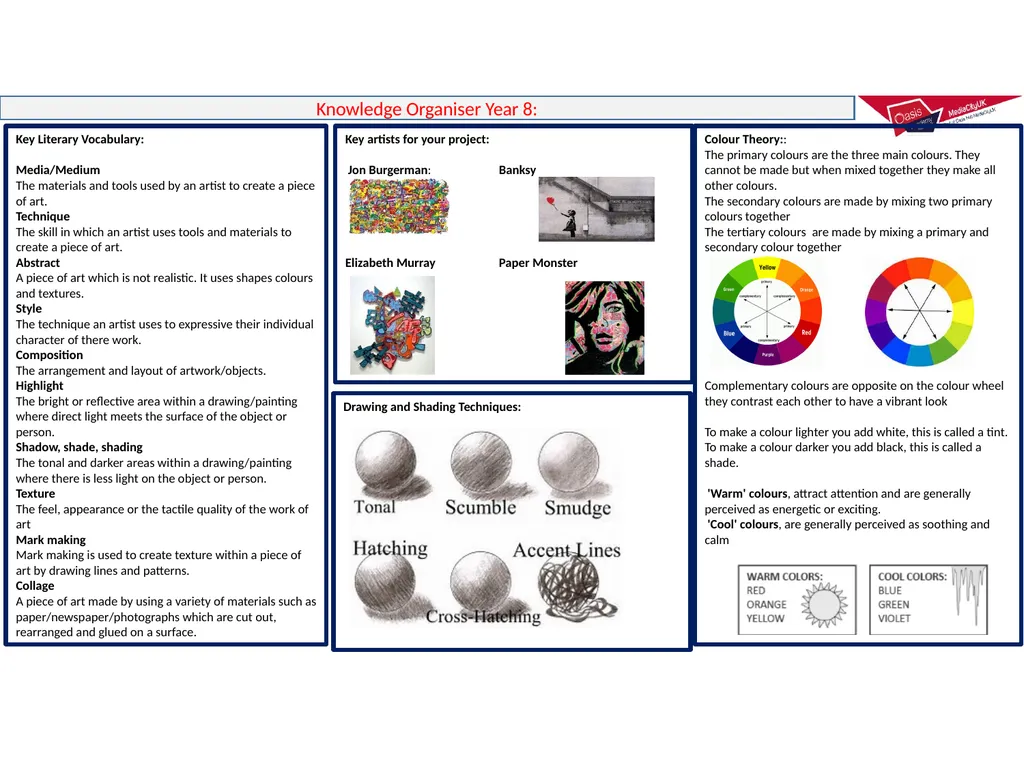
The primary colours are the three main colours. They cannot be made but when mixed together they make all other colours.
The secondary colours are made by mixing two primary
colours together
The tertiary colours are made by mixing a primary and secondary colour together
Complementary colours are opposite on the colour wheel they contrast each other to have a vibrant look
To make a colour lighter you add white, this is called a tint.
To make a colour darker you add black, this is called a shade.
'Warm' colours, attract attention and are generally perceived as energetic or exciting.
'Cool' colours, are generally perceived as soothing and calm Key artists for your project:
Jon Burgerman: Banksy
Elizabeth Murray Paper Monster Drawing and Shading Techniques:<br>
03
Knowledge Organiser Year 9: Key Literary Vocabulary:
Media/Medium
The materials and tools used by an artist to create a piece of art.
Technique
The skill in which an artist uses tools and materials to create a piece of art.
Abstract
A piece of art which is not realistic. It uses shapes colours and textures.
Style
The technique an artist uses to expressive their individual character of there work.
Composition
The arrangement and layout of artwork/objects.
Highlight
The bright or reflective area within a drawing/painting where direct light meets the surface of the object or person.
Shadow, shade, shading
The tonal and darker areas within a drawing/painting where there is less light on the object or person.
Texture
The feel, appearance or the tactile quality of the work of art
Mark making
Mark making is used to create texture within a piece of art by drawing lines and patterns.
Perspective
Perspective allows artists to trick the eye into seeing depth on a flat surface. This creates the illusion of 3D drawing
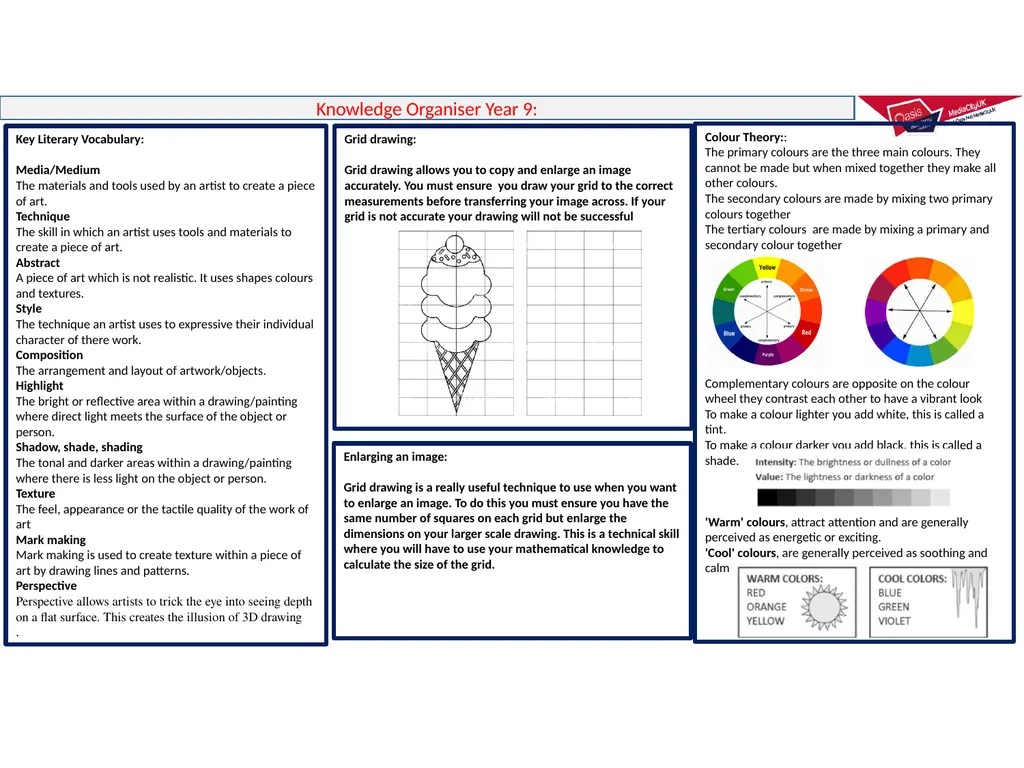
. Grid drawing:
Grid drawing allows you to copy and enlarge an image accurately. You must ensure you draw your grid to the correct measurements before transferring your image across. If your grid is not accurate your drawing will not be successful Enlarging an image:
Grid drawing is a really useful technique to use when you want to enlarge an image. To do this you must ensure you have the same number of squares on each grid but enlarge the dimensions on your larger scale drawing. This is a technical skill where you will have to use your mathematical knowledge to calculate the size of the grid. Colour Theory::
The primary colours are the three main colours. They cannot be made but when mixed together they make all other colours.
The secondary colours are made by mixing two primary
colours together
The tertiary colours are made by mixing a primary and secondary colour together
Complementary colours are opposite on the colour wheel they contrast each other to have a vibrant look
To make a colour lighter you add white, this is called a tint.
To make a colour darker you add black, this is called a shade.
'Warm' colours, attract attention and are generally perceived as energetic or exciting.
'Cool' colours, are generally perceived as soothing and calm<br>
04
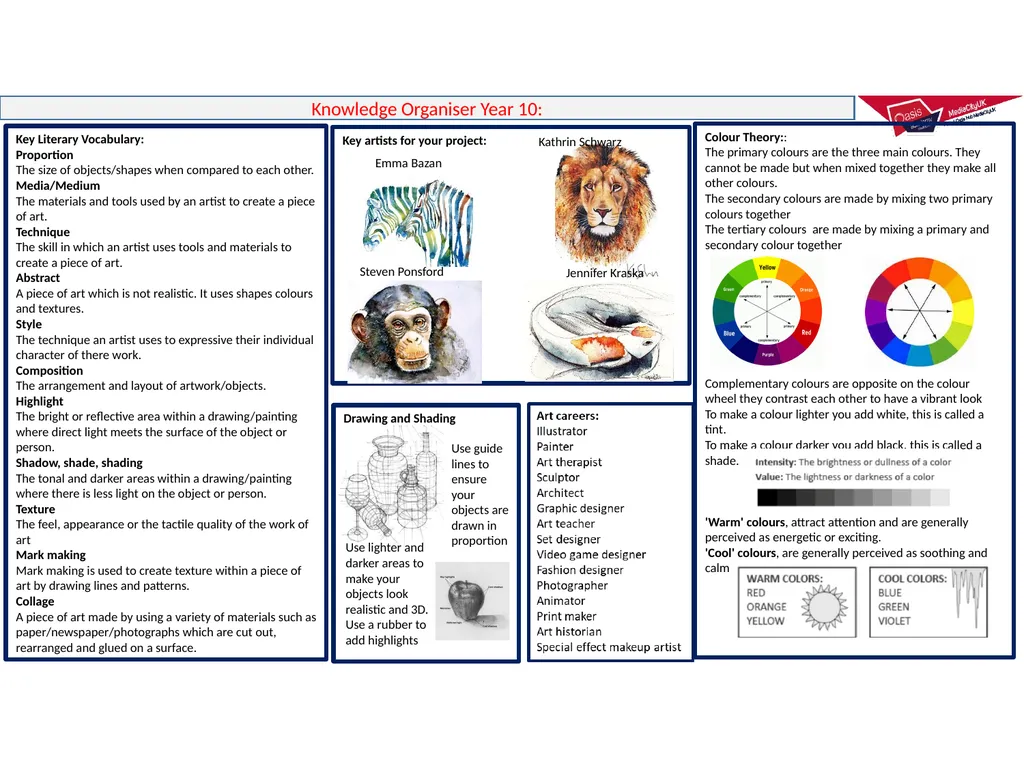
Knowledge Organiser Year 10: Key Literary Vocabulary:
Proportion
The size of objects/shapes when compared to each other.
Media/Medium
The materials and tools used by an artist to create a piece of art.
Technique
The skill in which an artist uses tools and materials to create a piece of art.
Abstract
A piece of art which is not realistic. It uses shapes colours and textures.
Style
The technique an artist uses to expressive their individual character of there work.
Composition
The arrangement and layout of artwork/objects.
Highlight
The bright or reflective area within a drawing/painting where direct light meets the surface of the object or person.
Shadow, shade, shading
The tonal and darker areas within a drawing/painting where there is less light on the object or person.
Texture
The feel, appearance or the tactile quality of the work of art
Mark making
Mark making is used to create texture within a piece of art by drawing lines and patterns.
Collage
A piece of art made by using a variety of materials such as paper/newspaper/photographs which are cut out, rearranged and glued on a surface. Key artists for your project: Drawing and Shading Techniques: Colour Theory::
The primary colours are the three main colours. They cannot be made but when mixed together they make all other colours.
The secondary colours are made by mixing two primary
colours together
The tertiary colours are made by mixing a primary and secondary colour together
Complementary colours are opposite on the colour wheel they contrast each other to have a vibrant look
To make a colour lighter you add white, this is called a tint.
To make a colour darker you add black, this is called a shade.
'Warm' colours, attract attention and are generally perceived as energetic or exciting.
'Cool' colours, are generally perceived as soothing and calm Kathrin Schwarz Steven Ponsford Emma Bazan Jennifer Kraska Use guide lines to ensure your objects are drawn in proportion Use lighter and darker areas to make your objects look realistic and 3D. Use a rubber to add highlights<br>
05
Knowledge Organiser Year 11: Key Literary Vocabulary:
Media/Medium
The materials and tools used by an artist to create a piece of art.
Technique
The skill in which an artist uses tools and materials to create a piece of art.
Abstract
A piece of art which is not realistic. It uses shapes colours and textures.
Style
The technique an artist uses to expressive their individual character of there work.
Composition
The arrangement and layout of artwork/objects.
Highlight
The bright or reflective area within a drawing/painting where direct light meets the surface of the object or person.
Shadow, shade, shading
The tonal and darker areas within a drawing/painting where there is less light on the object or person.
Texture
The feel, appearance or the tactile quality of the work of art
Mark making
Mark making is used to create texture within a piece of art by drawing lines and patterns.
Collage
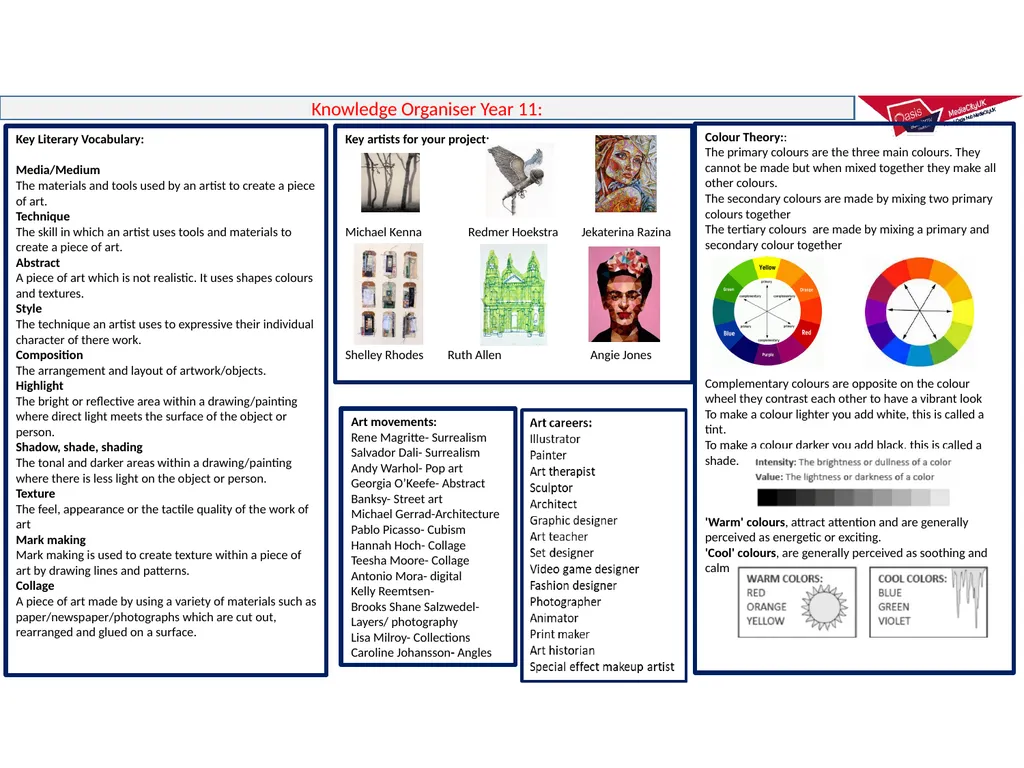
A piece of art made by using a variety of materials such as paper/newspaper/photographs which are cut out, rearranged and glued on a surface. Key artists for your project:
Michael Kenna Redmer Hoekstra Jekaterina Razina
Shelley Rhodes Ruth Allen Angie Jones Art movements:
Rene Magritte- Surrealism
Salvador Dali- Surrealism
Andy Warhol- Pop art
Georgia O’Keefe- Abstract
Banksy- Street art
Michael Gerrad-Architecture
Pablo Picasso- Cubism
Hannah Hoch- Collage
Teesha Moore- Collage
Antonio Mora- digital
Kelly Reemtsen-
Brooks Shane Salzwedel- Layers/ photography
Lisa Milroy- Collections
Caroline Johansson- Angles Colour Theory::
The primary colours are the three main colours. They cannot be made but when mixed together they make all other colours.
The secondary colours are made by mixing two primary
colours together
The tertiary colours are made by mixing a primary and secondary colour together
Complementary colours are opposite on the colour wheel they contrast each other to have a vibrant look
To make a colour lighter you add white, this is called a tint.
To make a colour darker you add black, this is called a shade.
'Warm' colours, attract attention and are generally perceived as energetic or exciting.
'Cool' colours, are generally perceived as soothing and calm<br>