
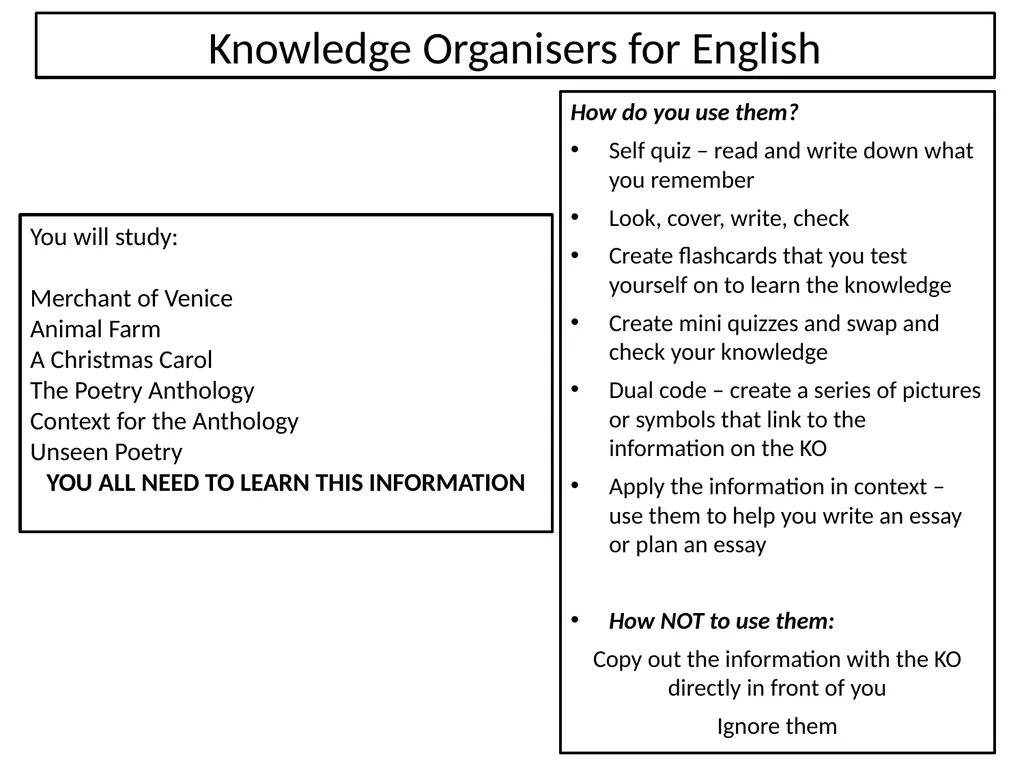
Knowledge Organisers for English How do you use
LV
Published · 12 slides · 0 views

1 / 1


Description
Knowledge Organisers for English How do you use them? Self quiz read and write down what you remember Look, cover, write, check Create flashcards that you test yourself on to learn the knowledge Create mini quizzes and swap and check your
Related Topics
Share
Embed code
Download this presentation From Below
"Knowledge Organisers for English How do you use" is the property of its rightful owner. Permission is granted to download and print the materials on this website for personal, non-commercial use only, and to display it on your personal computer provided you do not modify the materials and that you retain all copyright notices contained in the materials. By downloading content from our website, you accept the terms of this agreement.
Presentation Transcript
01
Knowledge Organisers for English How do you use them?
Self quiz – read and write down what you remember
Look, cover, write, check
Create flashcards that you test yourself on to learn the knowledge
Create mini quizzes and swap and check your knowledge
Dual code – create a series of pictures or symbols that link to the information on the KO
Apply the information in context – use them to help you write an essay or plan an essay
How NOT to use them:
Copy out the information with the KO directly in front of you
Ignore them You will study:
Merchant of Venice
Animal Farm
A Christmas Carol
The Poetry Anthology
Context for the Anthology
Unseen Poetry
YOU ALL NEED TO LEARN THIS INFORMATION<br>
02
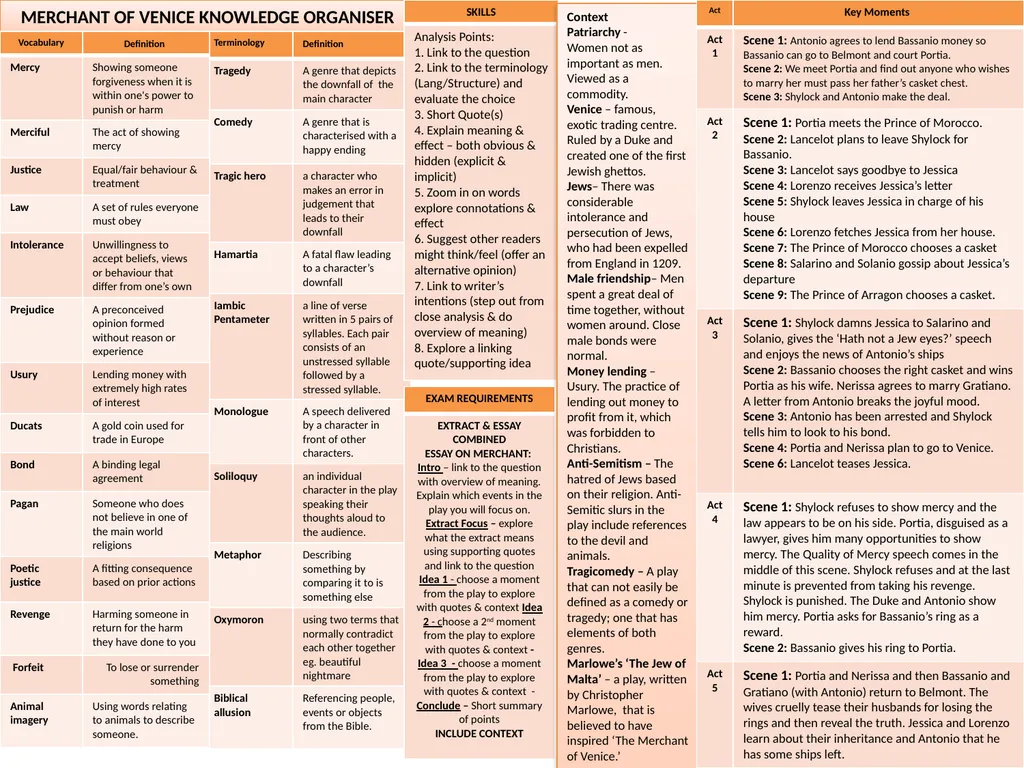
MERCHANT OF VENICE KNOWLEDGE ORGANISER Context
Patriarchy -
Women not as
important as men. Viewed as a commodity.
Venice – famous, exotic trading centre. Ruled by a Duke and created one of the first Jewish ghettos.
Jews– There was considerable intolerance and persecution of Jews, who had been expelled from England in 1209.
Male friendship– Men spent a great deal of time together, without women around. Close male bonds were normal.
Money lending – Usury. The practice of lending out money to profit from it, which was forbidden to Christians.
Anti-Semitism – The hatred of Jews based on their religion. Anti-Semitic slurs in the play include references to the devil and animals.
Tragicomedy – A play that can not easily be defined as a comedy or tragedy; one that has elements of both genres.
Marlowe’s ‘The Jew of Malta’ – a play, written by Christopher Marlowe, that is believed to have inspired ‘The Merchant of Venice.’<br>
03
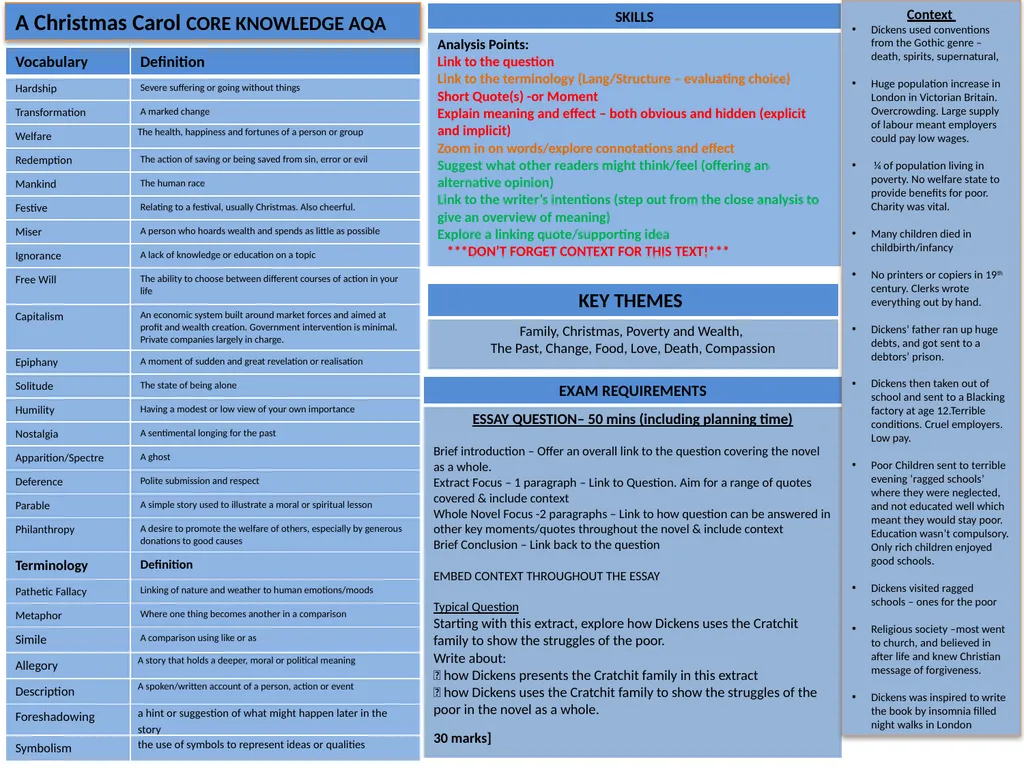
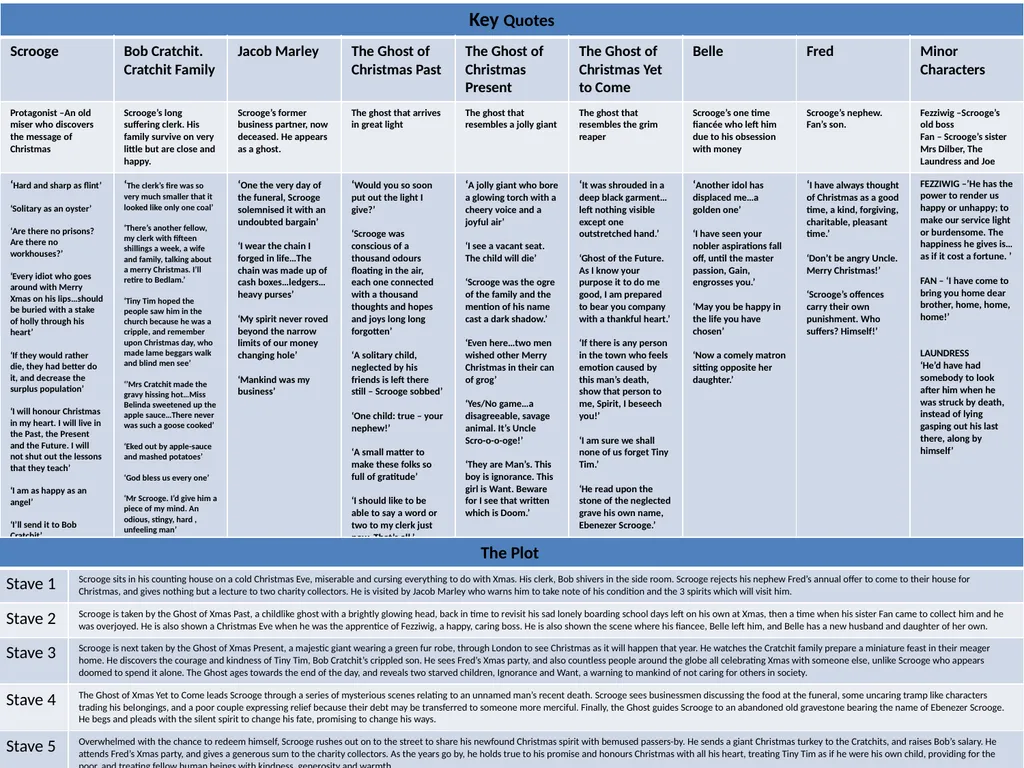
A Christmas Carol CORE KNOWLEDGE AQA Context
Dickens used conventions from the Gothic genre –death, spirits, supernatural,
Huge population increase in London in Victorian Britain. Overcrowding. Large supply of labour meant employers could pay low wages.
¼ of population living in poverty. No welfare state to provide benefits for poor. Charity was vital.
Many children died in childbirth/infancy
No printers or copiers in 19th century. Clerks wrote everything out by hand.
Dickens’ father ran up huge debts, and got sent to a debtors’ prison.
Dickens then taken out of school and sent to a Blacking factory at age 12.Terrible conditions. Cruel employers. Low pay.
Poor Children sent to terrible evening ‘ragged schools’ where they were neglected, and not educated well which meant they would stay poor. Education wasn’t compulsory. Only rich children enjoyed good schools.
Dickens visited ragged schools – ones for the poor
Religious society –most went to church, and believed in after life and knew Christian message of forgiveness.
Dickens was inspired to write the book by insomnia filled night walks in London<br>
04
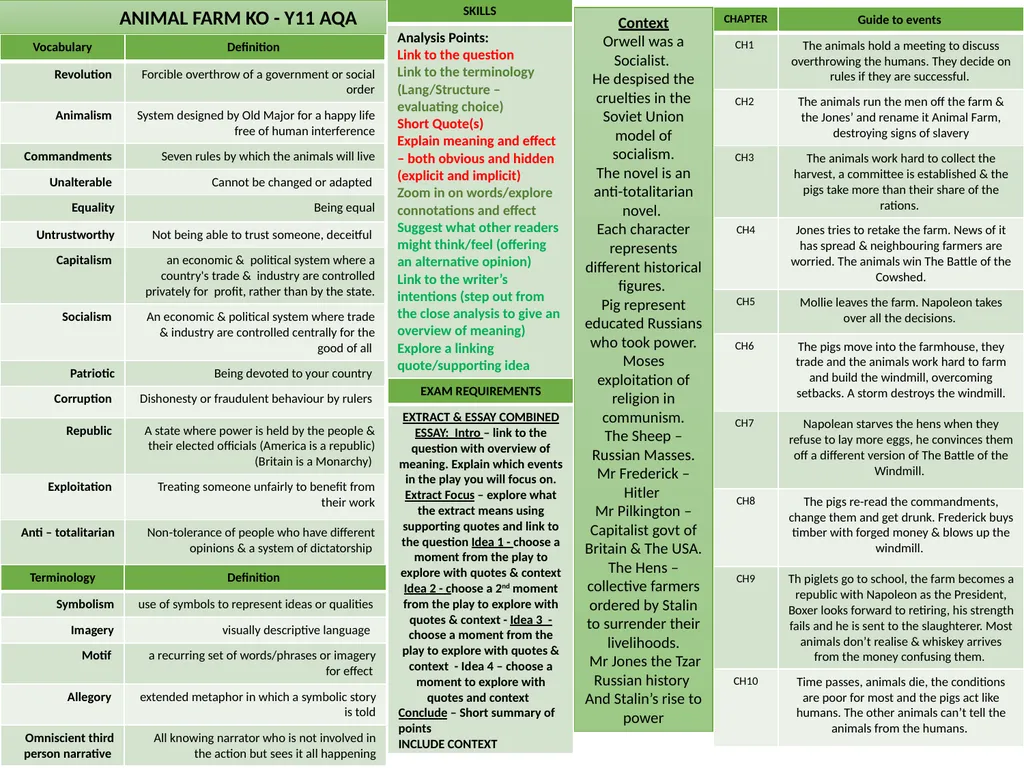
ANIMAL FARM KO - Y11 AQA Context
Orwell was a Socialist.
He despised the cruelties in the Soviet Union model of socialism.
The novel is an anti-totalitarian novel.
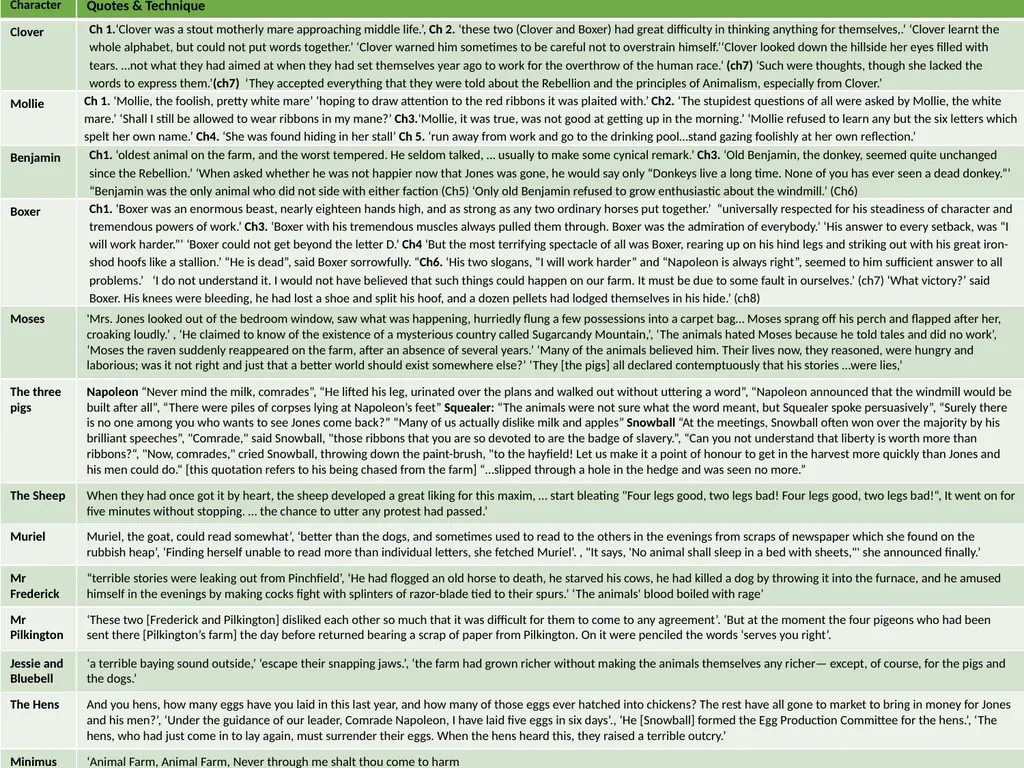
Each character represents different historical figures.
Pig represent educated Russians who took power.
Moses exploitation of religion in communism.
The Sheep – Russian Masses. Mr Frederick – Hitler
Mr Pilkington – Capitalist govt of Britain & The USA.
The Hens – collective farmers ordered by Stalin to surrender their livelihoods.
Mr Jones the Tzar
Russian history
And Stalin’s rise to power<br>
05
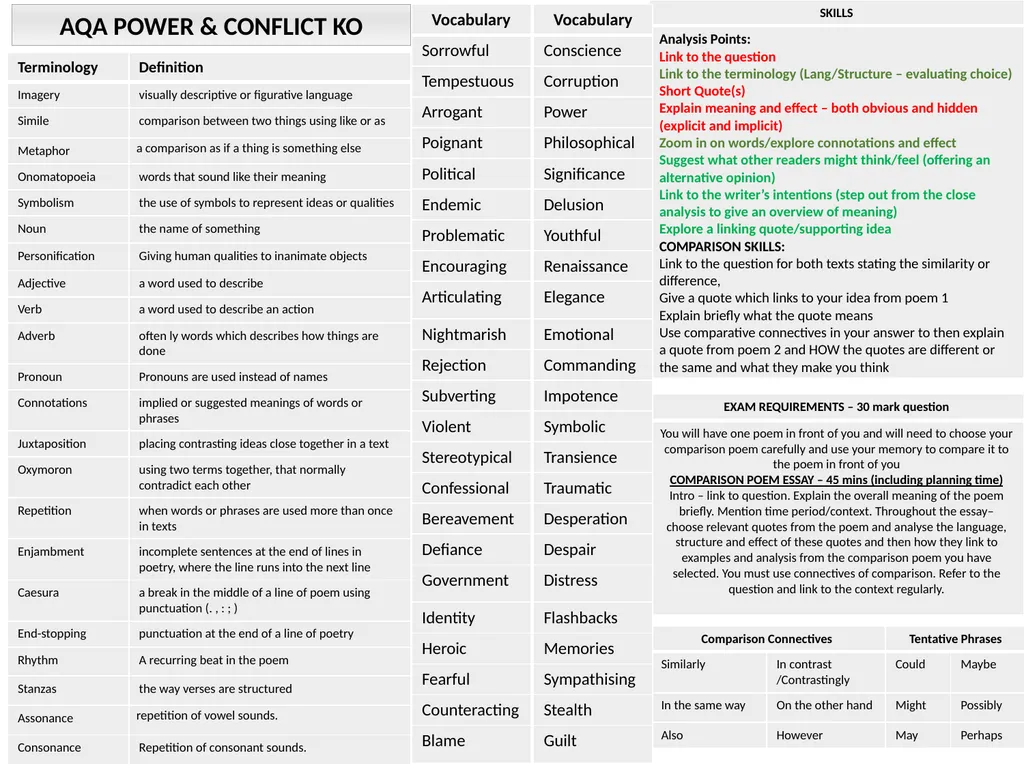
AQA POWER & CONFLICT KO<br>
06
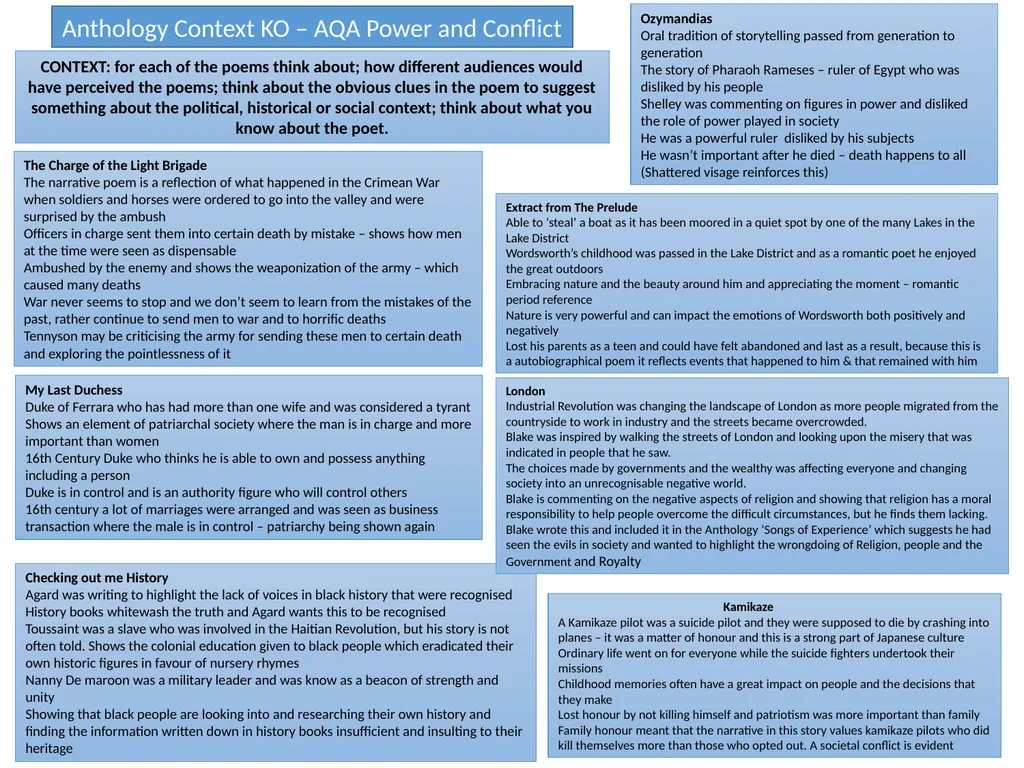
CONTEXT: for each of the poems think about; how different audiences would have perceived the poems; think about the obvious clues in the poem to suggest something about the political, historical or social context; think about what you know about the poet.<br>
07
The Charge of the Light Brigade
The narrative poem is a reflection of what happened in the Crimean War when soldiers and horses were ordered to go into the valley and were surprised by the ambush
Officers in charge sent them into certain death by mistake – shows how men at the time were seen as dispensable
Ambushed by the enemy and shows the weaponization of the army – which caused many deaths
War never seems to stop and we don’t seem to learn from the mistakes of the past, rather continue to send men to war and to horrific deaths
Tennyson may be criticising the army for sending these men to certain death and exploring the pointlessness of it My Last Duchess
Duke of Ferrara who has had more than one wife and was considered a tyrant
Shows an element of patriarchal society where the man is in charge and more important than women
16th Century Duke who thinks he is able to own and possess anything including a person
Duke is in control and is an authority figure who will control others
16th century a lot of marriages were arranged and was seen as business transaction where the male is in control – patriarchy being shown again Extract from The Prelude
Able to ‘steal’ a boat as it has been moored in a quiet spot by one of the many Lakes in the Lake District
Wordsworth’s childhood was passed in the Lake District and as a romantic poet he enjoyed the great outdoors
Embracing nature and the beauty around him and appreciating the moment – romantic period reference
Nature is very powerful and can impact the emotions of Wordsworth both positively and negatively
Lost his parents as a teen and could have felt abandoned and last as a result, because this is a autobiographical poem it reflects events that happened to him & that remained with him Ozymandias
Oral tradition of storytelling passed from generation to generation
The story of Pharaoh Rameses – ruler of Egypt who was disliked by his people
Shelley was commenting on figures in power and disliked the role of power played in society
He was a powerful ruler disliked by his subjects
He wasn’t important after he died – death happens to all (Shattered visage reinforces this) Checking out me History
Agard was writing to highlight the lack of voices in black history that were recognised
History books whitewash the truth and Agard wants this to be recognised
Toussaint was a slave who was involved in the Haitian Revolution, but his story is not often told. Shows the colonial education given to black people which eradicated their own historic figures in favour of nursery rhymes
Nanny De maroon was a military leader and was know as a beacon of strength and unity
Showing that black people are looking into and researching their own history and finding the information written down in history books insufficient and insulting to their heritage Kamikaze
A Kamikaze pilot was a suicide pilot and they were supposed to die by crashing into planes – it was a matter of honour and this is a strong part of Japanese culture
Ordinary life went on for everyone while the suicide fighters undertook their missions
Childhood memories often have a great impact on people and the decisions that they make
Lost honour by not killing himself and patriotism was more important than family
Family honour meant that the narrative in this story values kamikaze pilots who did kill themselves more than those who opted out. A societal conflict is evident Anthology Context KO – AQA Power and Conflict CONTEXT: for each of the poems think about; how different audiences would have perceived the poems; think about the obvious clues in the poem to suggest something about the political, historical or social context; think about what you know about the poet. London
Industrial Revolution was changing the landscape of London as more people migrated from the countryside to work in industry and the streets became overcrowded.
Blake was inspired by walking the streets of London and looking upon the misery that was indicated in people that he saw.
The choices made by governments and the wealthy was affecting everyone and changing society into an unrecognisable negative world.
Blake is commenting on the negative aspects of religion and showing that religion has a moral responsibility to help people overcome the difficult circumstances, but he finds them lacking.
Blake wrote this and included it in the Anthology ‘Songs of Experience’ which suggests he had seen the evils in society and wanted to highlight the wrongdoing of Religion, people and the Government and Royalty<br>
08
The Emigree
Heritage is important and the power of memory for individuals
Middle eastern wars are being referenced in the poem and although she is no longer living there she cannot go back as it is not safe
Banning a language from being spoken does happen but people continue to secretly speak their language
Passports create a sense of belonging to a place and although they are only a small booklet they have wider symbolic significance
As a migrant or emigrant there is a sense of belonging that is missing from the new place that you live and a sense that you always long for the past Tissue
Could be a reference to religious hope that many people have
Records have been written down for centuries and help us to learn more about the past
We chart our history through buildings as well as through records
Biblically God has a grand design for everyone (if you are religious) and this seems to be alluded to here
Extended metaphor in the whole poem compares the architecture of life and paper and buildings to the construct of living War Photographer
Newspapers will pay for the pictures that are taken in a war zone in order to publicise it, but don’t take into account the human suffering
Horrors of war remain with the people who have witnessed it
Religious motif and the literary allusion
to The Soldier
The physical act of taking the photographs captures for eternity the suffering and pain caused by war
Life in this country is easy compared to the suffering endured by others in war zones and it is difficult to put yourself in those situations Poppies
Context of war and remembrance – thinking about remembering those who died in the war
Mothers who have lost a child may make poppies and make themselves busy to fill the gap and the loss
Remembrance Sunday Parades are well-known
War memorials are a symbol of war and the remembrance in most towns across the country and seen as a part of our heritage
Birds are often used as symbols in literature and while the wars happening in Iraq and Afghanistan were still raging when Weir wrote this poem perhaps the wider symbolism is the lack of freedom these men have. The poet has not had a son Remains
Soldier shoots the bank robber and is haunted by the image – replaying of events in the mind of the soldier
Mental health of soldiers is impacted by events that they
Duty of the soldier to carry on despite the suffering they have endured – PTSD
Gulf War is referenced here, and the experiences are told as an anecdote by Armitage to bring to life the experiences of the soldiers
Macbeth is referenced here – so who is the guilty party and emphasises the guilt of the soldier Bayonet Charge
Telling a story of a bayonet charge and the emotional impact this has on the person at war – his fathers experience in WW1 shaped his childhood
Many soldiers went into war through a sense of patriotic duty, but found the reality very difficult
Individual men wouldn’t make a huge difference and they would have questioned the worth of war
Mustard gas was a horrific new invention that meant many men and animals suffered horrible painful choking deaths like the death of the hare
No reason for going to war seems justifiable. The human sacrifice is too wasteful. Storm on the Island
Being in a cottage on the edge of a cliff during a storm in Ireland – feels secure as the cottage has weathered storms before
Tragic chorus is an element of Greek tragedy and commenting on what happens
On the edge watching the storm and seeing the effects of nature on a rugged landscape
Nature being used to show the unpredictability of the weather. Everyone is aware of pets that are tame and malleable but that they are still creatures we can’t control, just like we can’t control the weather
Heaney was Irish and would have been familiar with this landscape Exposure
WW1 suggests that people suffered not only from injuries but from the terrible weather and not being inside – trenches offered little protection from the harsh reality of winter
The poor weather conditions in the war make the long-standing suffering even worse for the soldiers – Owen was writing from experience as he suffered through the war
War is unpredictable and men were not prepared well enough to cope with the long waits in between a sudden burst of action
War is a slow and long process, and nothing happens immediately almost as if men lose hope through the continued suffering they face and the way that they seen to lose a part of themselves
Owen died just before the end of the war so writing his experiences helped others to understand and relate to the reality of war and how different elements such as the weather played a part in the misery of the men fascinated by the weather and the way nature manipulated the surroundings<br>
09
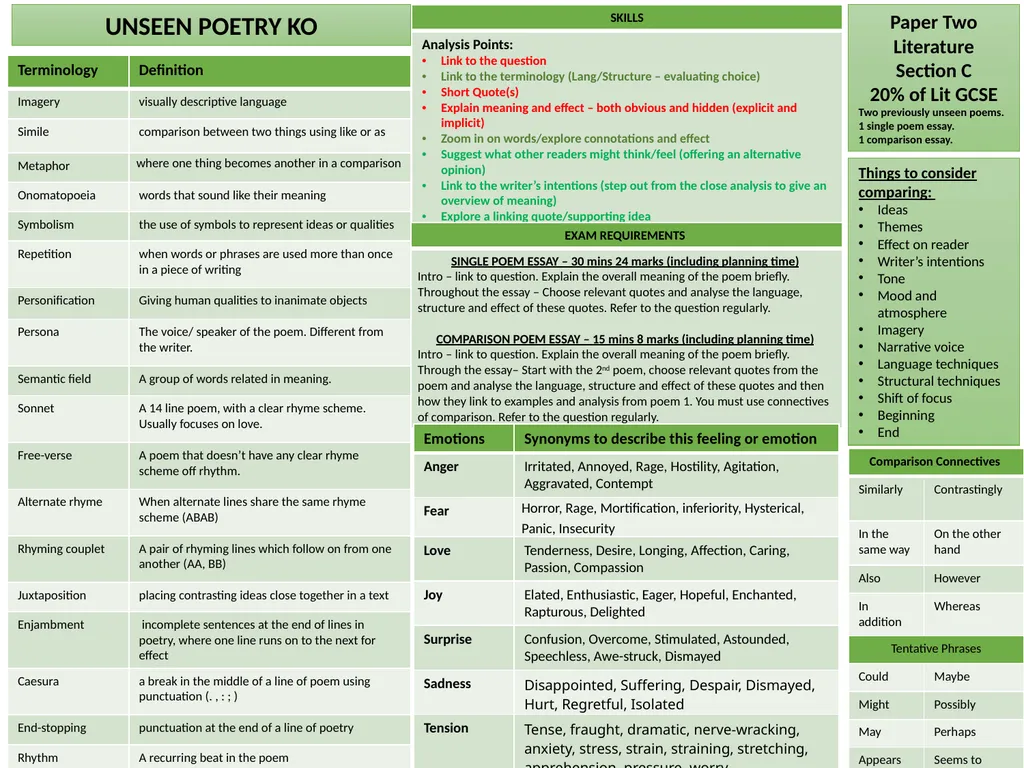
UNSEEN POETRY KO Things to consider comparing:
Ideas
Themes
Effect on reader
Writer’s intentions
Tone
Mood and atmosphere
Imagery
Narrative voice
Language techniques
Structural techniques
Shift of focus
Beginning
End Paper Two Literature
Section C
20% of Lit GCSE
Two previously unseen poems.
1 single poem essay.
1 comparison essay.<br>
Ideas
Themes
Effect on reader
Writer’s intentions
Tone
Mood and atmosphere
Imagery
Narrative voice
Language techniques
Structural techniques
Shift of focus
Beginning
End Paper Two Literature
Section C
20% of Lit GCSE
Two previously unseen poems.
1 single poem essay.
1 comparison essay.<br>