L3 MATHS LIT LESSON 2 TOPIC 2 Three dimensional shapes Volume, maps, scale, net-scale LESSON OBECTIVES: (what we want to knowor do at the end of the lesson) 2.2.5 Manipulate given formulae to calculate the unknown values when the
"L3 MATHS LIT LESSON 2 – TOPIC 2 Three dimensional" is the property of its rightful owner. Permission is granted to
download and print the materials on this website for personal, non-commercial use only, and to display it
on your personal computer provided you do not modify the materials and that you retain all copyright
notices contained in the materials. By downloading content from our website, you accept the terms of this
agreement.
Presentation Transcript
01
L3 MATHS LIT LESSON 2 – TOPIC 2 Three dimensional shapes – Volume, maps, scale, net-scale LESSON OBECTIVES: (what we want to know/or do at the end of the lesson)
2.2.5 Manipulate given formulae to calculate the unknown values when the perimeter/circumference and area of the following shapes are given:
Square
Rectangle
Triangle
Circle
Semi-circle
2.3.3Using a scale on a plan and/or map where the measurements are known to calculate actual length and distance
2.3.4 Calculate map and/or plan measurements when actual lengths and distances are known using a given scale
2.3.5 Determine the scale of a map/plan or model derived from given information
2.3.5 Use road, street and route maps to determine the following:
A specific location
The distance between 2 positions
Routes to travel from one destination to another
The shortest and/or fastest and/or most appropriate mode of transport for a planned trip
2.4.1 Use various packaging arrangements of objects (ie blocks, balls, cans and boxes) to determine the most appropriate way to package the objects for optimal usage of space.
2.4.3 Draw a net of 3D regular solids to investigate packing problems 1 compiled by B ADAMS<br>
02
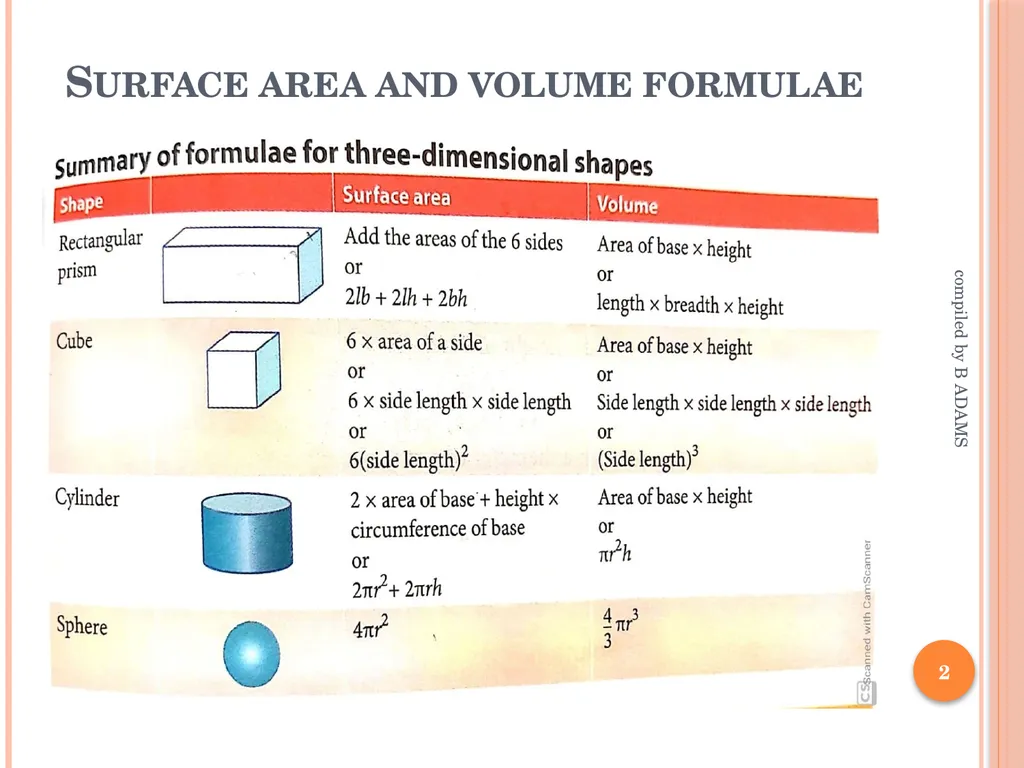
Surface area and volume formulae 2 compiled by B ADAMS<br>
03
What we need to know: In the previous slide, I added the formula sheet for surface area and Volume.
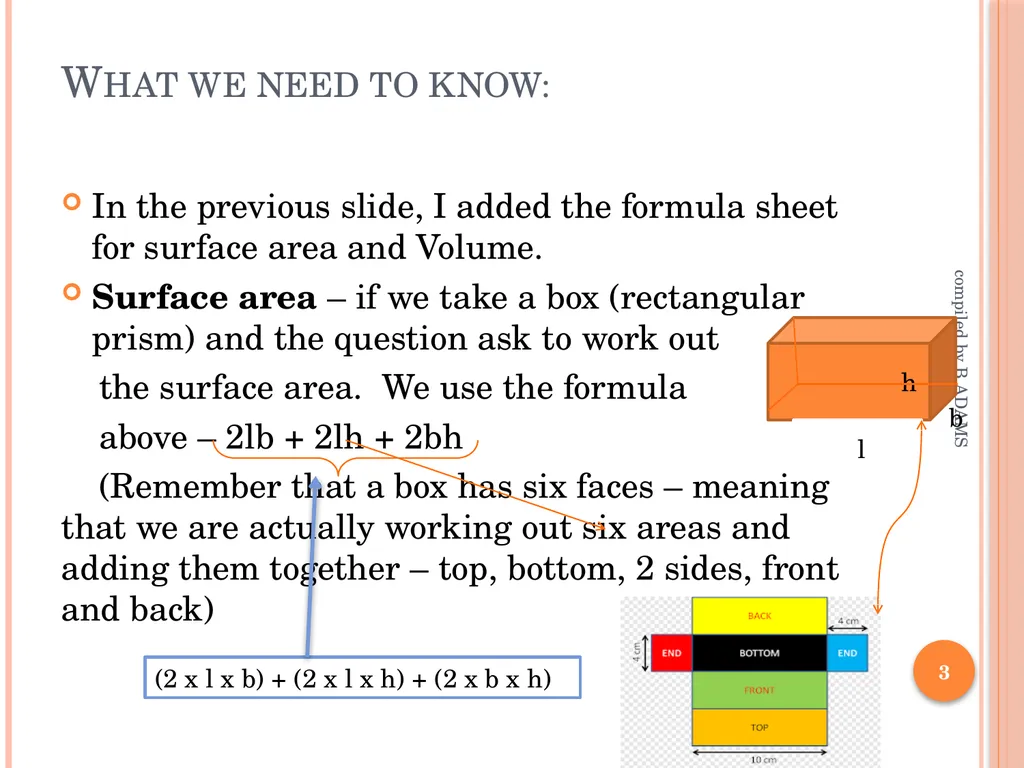
Surface area – if we take a box (rectangular prism) and the question ask to work out
the surface area. We use the formula
above – 2lb + 2lh + 2bh
(Remember that a box has six faces – meaning that we are actually working out six areas and adding them together – top, bottom, 2 sides, front and back) h ll b (2 x l x b) + (2 x l x h) + (2 x b x h) 3 compiled by B ADAMS<br>
04
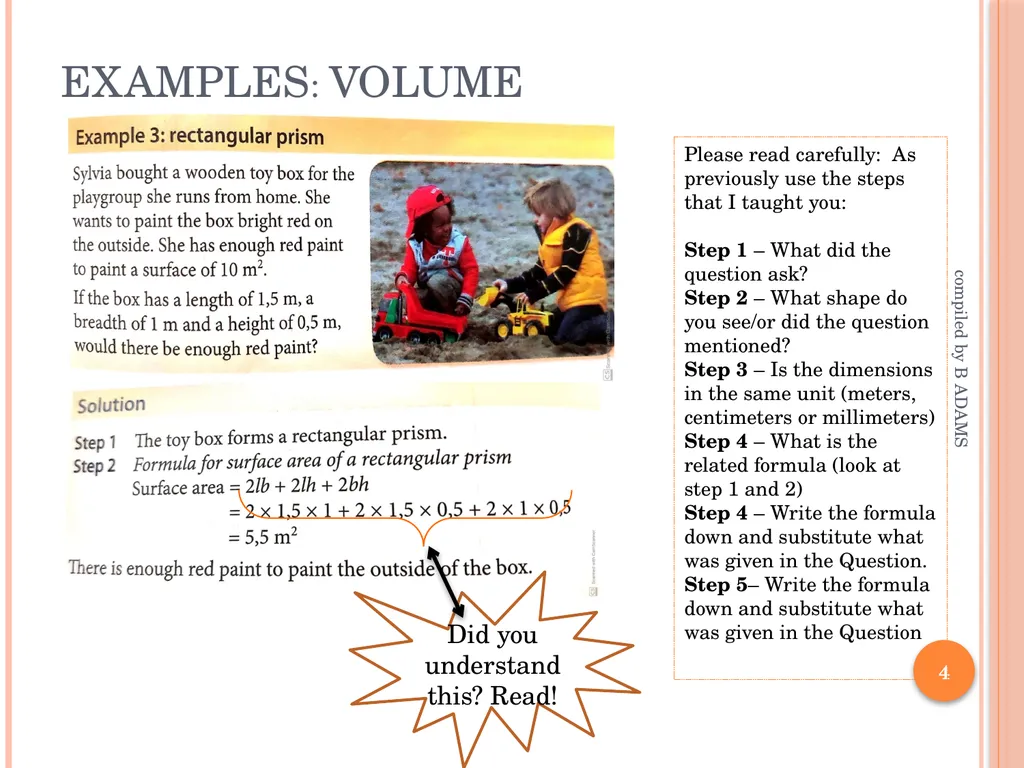
EXAMPLES: VOLUME 4 Please read carefully: As previously use the steps that I taught you:
Step 1 – What did the question ask?
Step 2 – What shape do you see/or did the question mentioned?
Step 3 – Is the dimensions in the same unit (meters, centimeters or millimeters)
Step 4 – What is the related formula (look at step 1 and 2)
Step 4 – Write the formula down and substitute what was given in the Question.
Step 5– Write the formula down and substitute what was given in the Question Did you understand this? Read! compiled by B ADAMS<br>
05
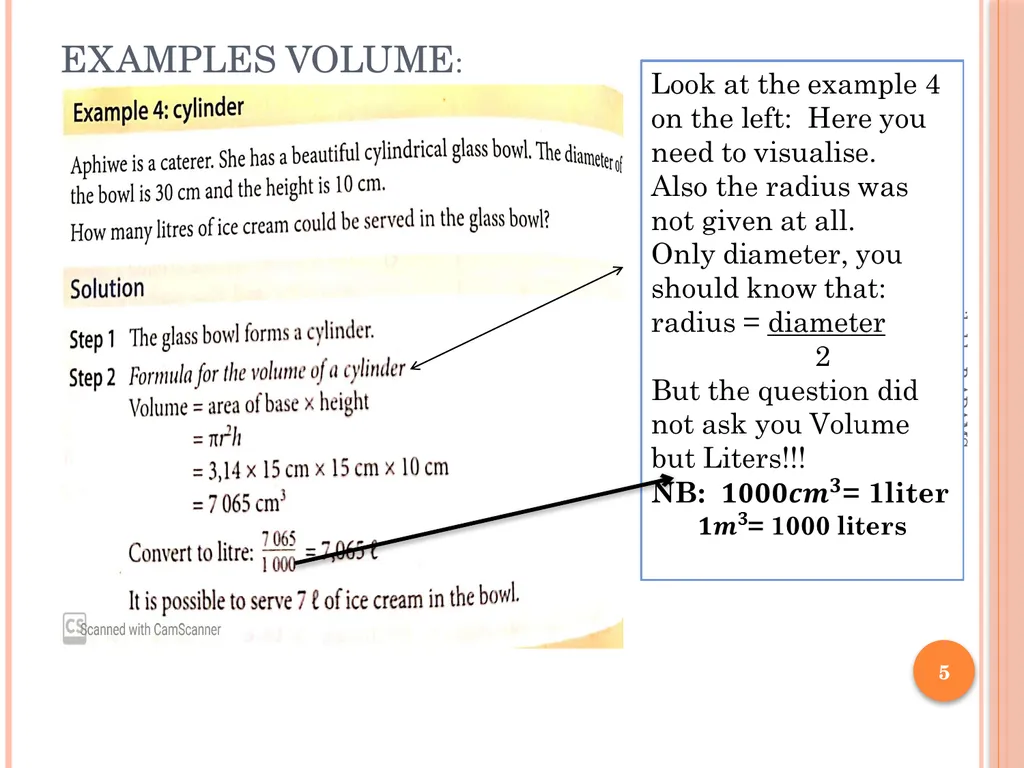
EXAMPLES VOLUME: 5 compiled by B ADAMS<br>
06
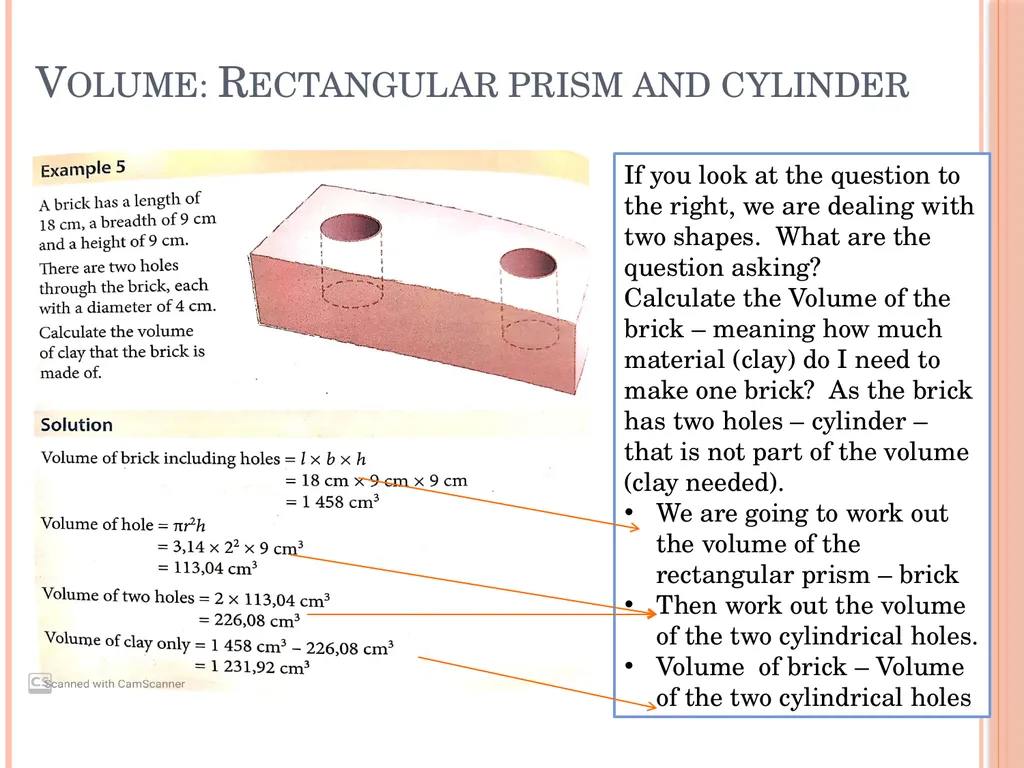
Volume: Rectangular prism and cylinder 6 If you look at the question to the right, we are dealing with two shapes. What are the question asking?
Calculate the Volume of the brick – meaning how much material (clay) do I need to make one brick? As the brick has two holes – cylinder – that is not part of the volume (clay needed).
We are going to work out the volume of the rectangular prism – brick
Then work out the volume of the two cylindrical holes.
Volume of brick – Volume of the two cylindrical holes compiled by B ADAMS<br>
07
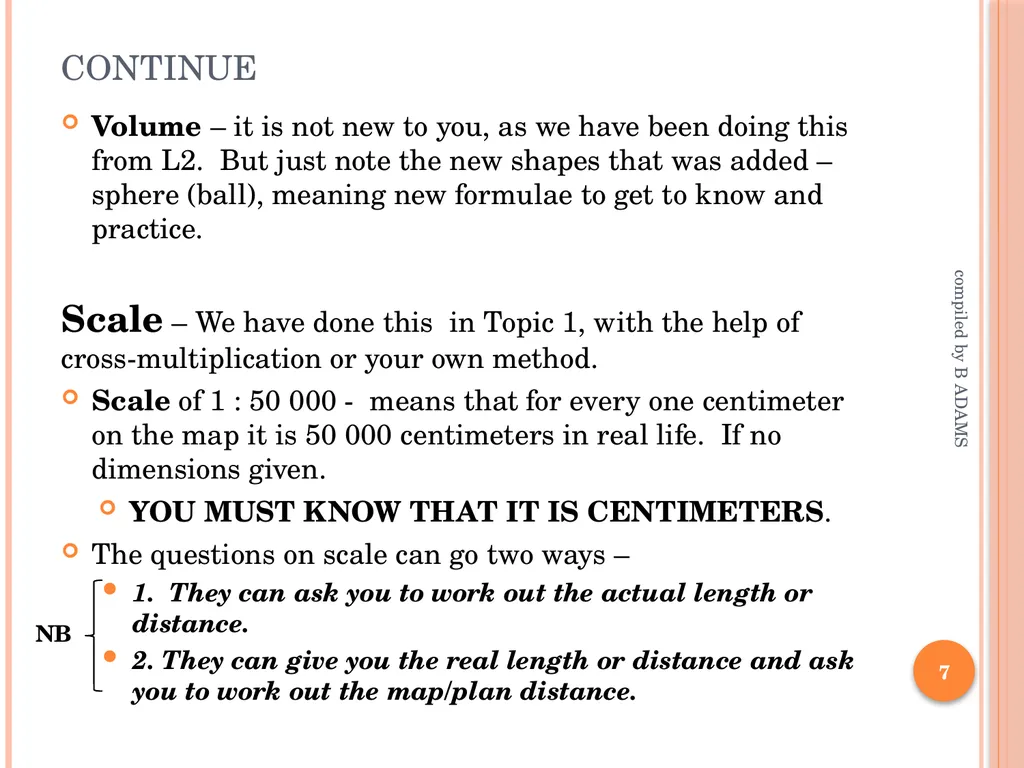
continue Volume – it is not new to you, as we have been doing this from L2. But just note the new shapes that was added – sphere (ball), meaning new formulae to get to know and practice.
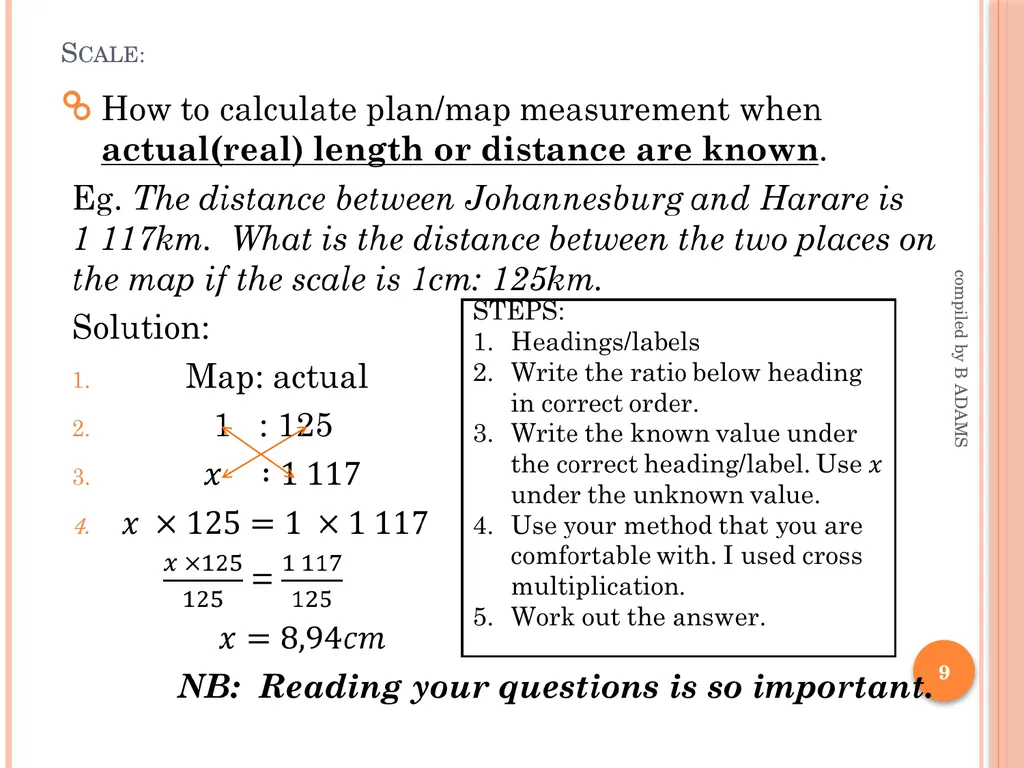
Scale – We have done this in Topic 1, with the help of cross-multiplication or your own method.
Scale of 1 : 50 000 - means that for every one centimeter on the map it is 50 000 centimeters in real life. If no dimensions given.
YOU MUST KNOW THAT IT IS CENTIMETERS.
The questions on scale can go two ways –
1. They can ask you to work out the actual length or distance.
2. They can give you the real length or distance and ask you to work out the map/plan distance. 7 NB compiled by B ADAMS<br>
08
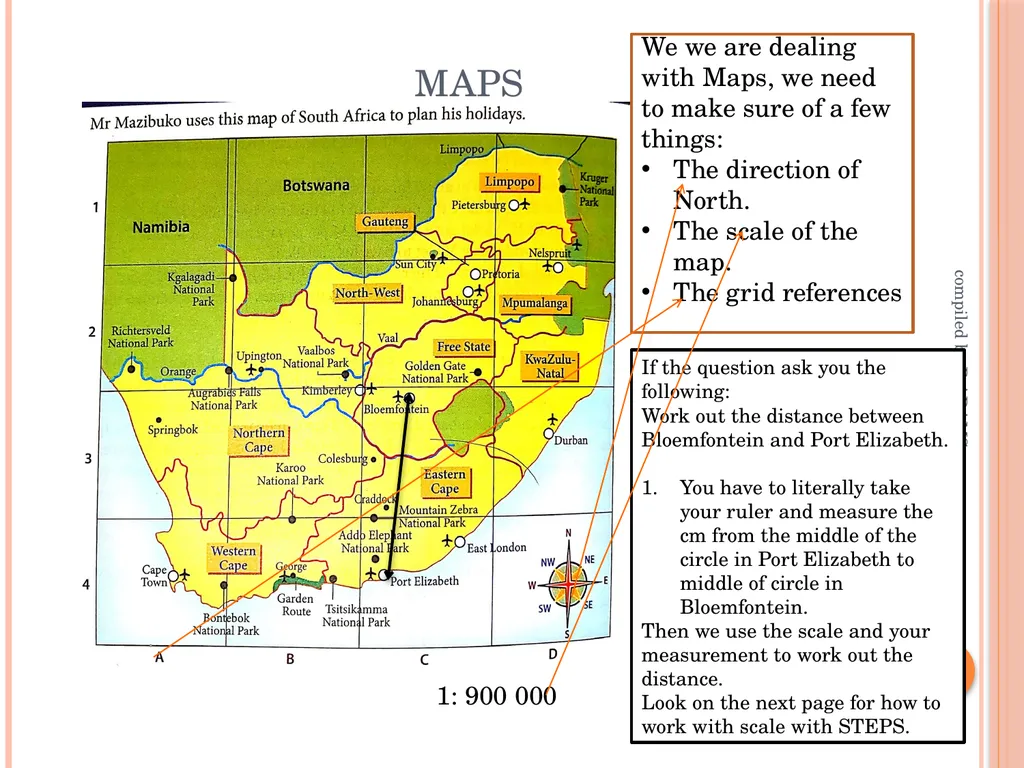
maps 8 We we are dealing with Maps, we need to make sure of a few things:
The direction of North.
The scale of the map.
The grid references If the question ask you the following:
Work out the distance between Bloemfontein and Port Elizabeth.
You have to literally take your ruler and measure the cm from the middle of the circle in Port Elizabeth to middle of circle in Bloemfontein.
Then we use the scale and your measurement to work out the distance.
Look on the next page for how to work with scale with STEPS. 1: 900 000 compiled by B ADAMS<br>
09
Scale: 9 compiled by B ADAMS<br>
10
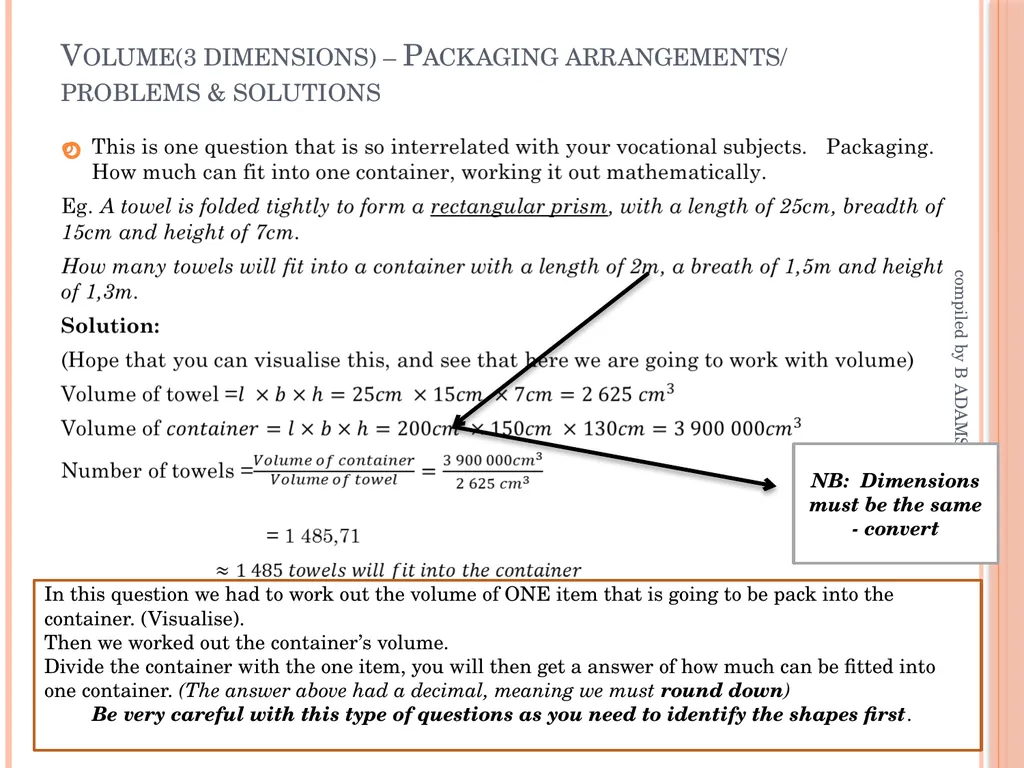
Volume(3 dimensions) – Packaging arrangements/ problems & solutions NB: Dimensions must be the same - convert In this question we had to work out the volume of ONE item that is going to be pack into the container. (Visualise).
Then we worked out the container’s volume.
Divide the container with the one item, you will then get a answer of how much can be fitted into one container. (The answer above had a decimal, meaning we must round down)
Be very careful with this type of questions as you need to identify the shapes first. 10 compiled by B ADAMS<br>
11
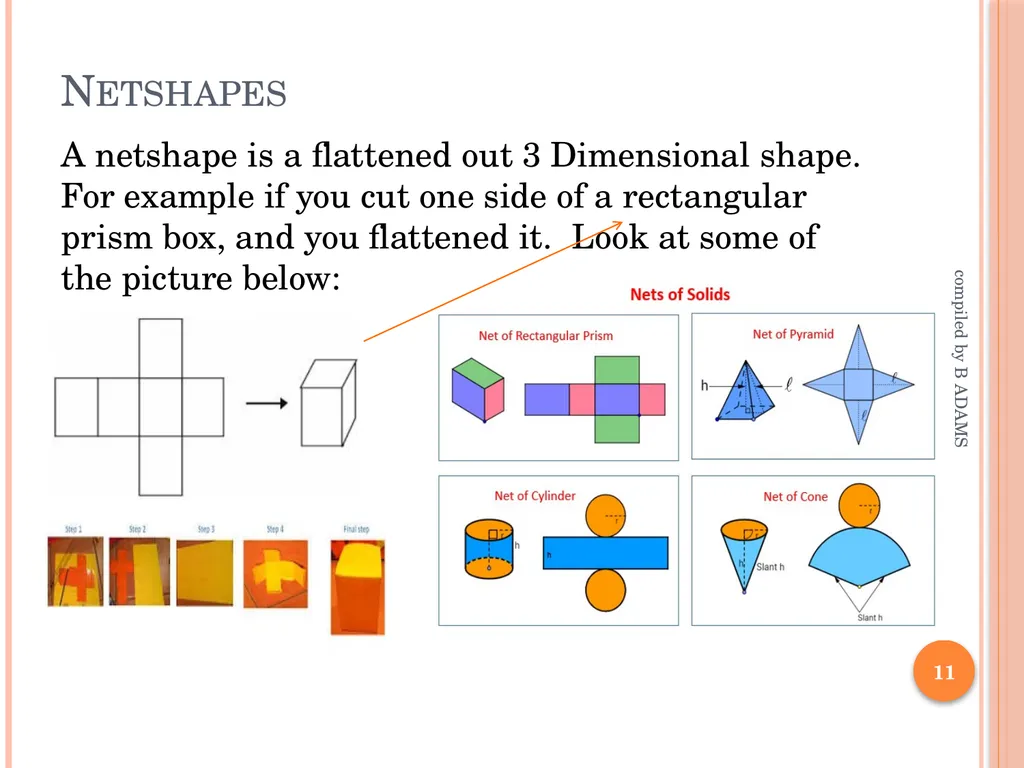
Netshapes A netshape is a flattened out 3 Dimensional shape. For example if you cut one side of a rectangular prism box, and you flattened it. Look at some of the picture below: 11 compiled by B ADAMS<br>
12
Exercises: We need the following Exercises to be done:
Ex 2.5 pg. 121 no 3, 5 (very important)
Ex 2.6 1,2,3 4 and 5 pg. 124
Ex 2.7, 2.8, 2.9 pg. 127
Exercise 2.10 pg. 132 no 1,2,3,4 and 5
Exercise 2.10 6,7 and 8 pg. 132
Exercise 2.11 pg. 141 1,2 & 3
Summative Assessment pg. 142
We are only starting with L3 classes on the 20 July, it is still a long time before we will be seeing each other in the mean time classes must go on.
Please communicate with your lecturer if you don’t understand something,
Keeping quiet is not going to help you.
This will be the NEW normal for all us, using technology for teaching.
Good luck and try your best. 12 compiled by B ADAMS<br>