
Labelling and the media Why do people commit crime
DP
Published · 25 slides · 0 views

1 / 1









Description
Labelling and the media Why do people commit crime and deviance? Beliefs What do Interactionist Sociologists believe? Interactionist Jock Young (1971) used his study of drug users in Notting Hill to demonstrate the process of becoming
Related Topics
Share
Embed code
Download this presentation From Below
"Labelling and the media Why do people commit crime" is the property of its rightful owner. Permission is granted to download and print the materials on this website for personal, non-commercial use only, and to display it on your personal computer provided you do not modify the materials and that you retain all copyright notices contained in the materials. By downloading content from our website, you accept the terms of this agreement.
Presentation Transcript
01
Labelling and the media Why do people commit crime and deviance?<br>
02
Beliefs What do Interactionist Sociologists believe?<br>
03
Interactionist Jock Young (1971) used his study of drug users in Notting Hill to demonstrate the process of becoming deviant:
The marijuana users developed a deviant self concept because their drug of choice was illegal
The deviant element became their main identity in society. They were ‘hippies’ first and foremost
The negative response of those around them and the police made the drug-taking more significant to their lives
Their drug-taking increased<br>
The marijuana users developed a deviant self concept because their drug of choice was illegal
The deviant element became their main identity in society. They were ‘hippies’ first and foremost
The negative response of those around them and the police made the drug-taking more significant to their lives
Their drug-taking increased<br>
04
Interactionist Goffman (1961) wrote about a deviant career in mental illness as he said the negative label of being ‘mad’ is imposed on the patient by society and psychiatry, and the patient must eventually conform to it in order to be treated and made sane.
What other labels are there in society that have negative connotations?<br>
What other labels are there in society that have negative connotations?<br>
05
Howard Becker-Labelling theory Becker argued:
Social groups create deviance by making the rules whose infraction constitutes deviance, and by applying those rules to particular people and labelling them as outsiders.
From this point of view, deviance is not a action which the person commits, but rather a consequence of application by others of the rules and sanctions to an ‘offender’. The deviant is one to whom the label has successfully been applied; deviant behaviour is behaviour that people so label.<br>
Social groups create deviance by making the rules whose infraction constitutes deviance, and by applying those rules to particular people and labelling them as outsiders.
From this point of view, deviance is not a action which the person commits, but rather a consequence of application by others of the rules and sanctions to an ‘offender’. The deviant is one to whom the label has successfully been applied; deviant behaviour is behaviour that people so label.<br>
06
Becker is suggesting that in one sense there is no such thing as a deviant act. An act only becomes deviant when others perceive and define it as such. Becker illustrated his views with the example of a brawl involving young people. In a low income neighbourhood it may be defined by the police as evidence of delinquency, in a wealthy area as evidence of high spirits. If the agents of social control define the youngsters as delinquents and they are convicted of breaking the law, those youngsters have then become deviant. Thus Becker argued, ‘Deviance is not a quality that lies in behaviour itself, but in the interaction between the potential deviant and the agents of social control.<br>
07
The Media and Moral panics Stuart Hall : Policing the Crises.
After a man was stabbed to death at Waterloo station in London. For the first time, a specific crime in Britain was labelled a mugging in the press. It was stories such as this which highlighted an apparently new and frightening crime in Britain. Judges, politicians and the police lined up with the media in stressing the threat that this crime posed to society. A moral panic is this kind of exaggerated outburst of public concern over the morality and behaviour of a group in society. Stuart Hall rejects the view that the panic was inevitable and understandable reaction to a new and rapidly increasing form of violence.
Read: http://www.penelopeironstone.com/Critcher.pdf<br>
After a man was stabbed to death at Waterloo station in London. For the first time, a specific crime in Britain was labelled a mugging in the press. It was stories such as this which highlighted an apparently new and frightening crime in Britain. Judges, politicians and the police lined up with the media in stressing the threat that this crime posed to society. A moral panic is this kind of exaggerated outburst of public concern over the morality and behaviour of a group in society. Stuart Hall rejects the view that the panic was inevitable and understandable reaction to a new and rapidly increasing form of violence.
Read: http://www.penelopeironstone.com/Critcher.pdf<br>
08
News stories and labelling… Bluewater Hoodies
UAE tells men to avoid wearing national dress when travelling abroad<br>
UAE tells men to avoid wearing national dress when travelling abroad<br>
09
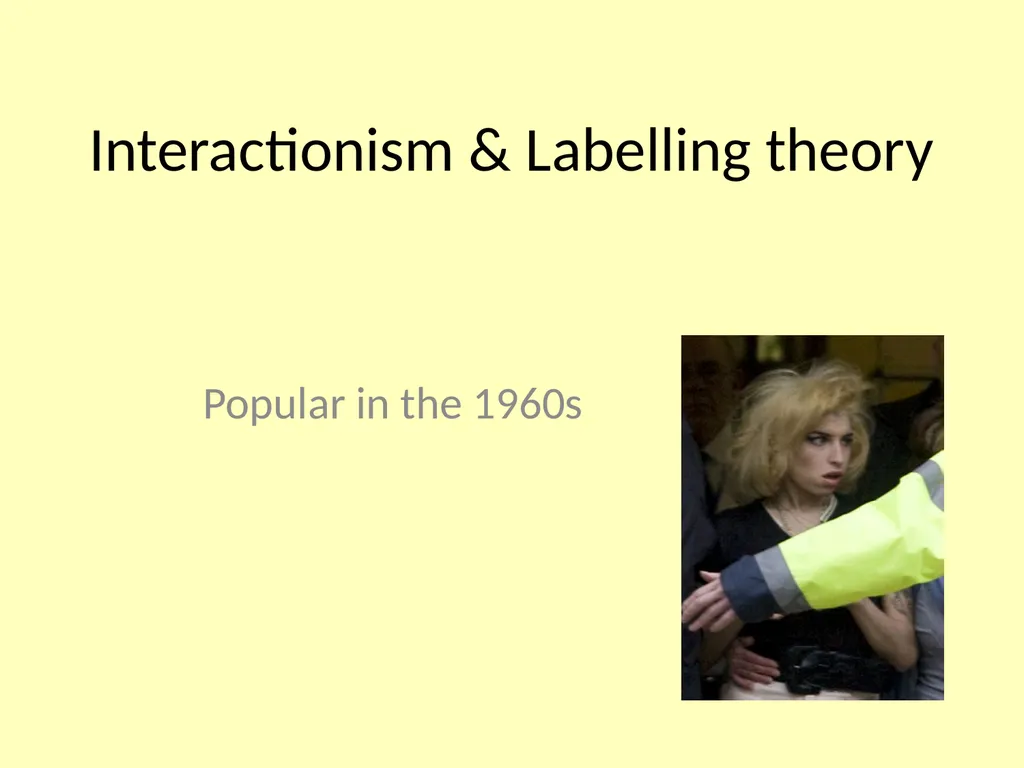
Interactionism & Labelling theory Popular in the 1960s<br>
10
Interactionism Part of Social Action approach & a branch of Interpretivism
Micro theory (favours qualitative methods – observation, informal interviews) – more valid
Symbolic Interactionism = The self is developed through interaction (eg. with parents, teachers, friends) - (Mead)
Social Action is not fixed – individuals are not snooker balls on the snooker table of life. puppets - they interpret what they see, they attach meanings to situations and then react. (Structural theory states that action is a result of external forces that people have no control over!)<br>
Micro theory (favours qualitative methods – observation, informal interviews) – more valid
Symbolic Interactionism = The self is developed through interaction (eg. with parents, teachers, friends) - (Mead)
Social Action is not fixed – individuals are not snooker balls on the snooker table of life. puppets - they interpret what they see, they attach meanings to situations and then react. (Structural theory states that action is a result of external forces that people have no control over!)<br>
11
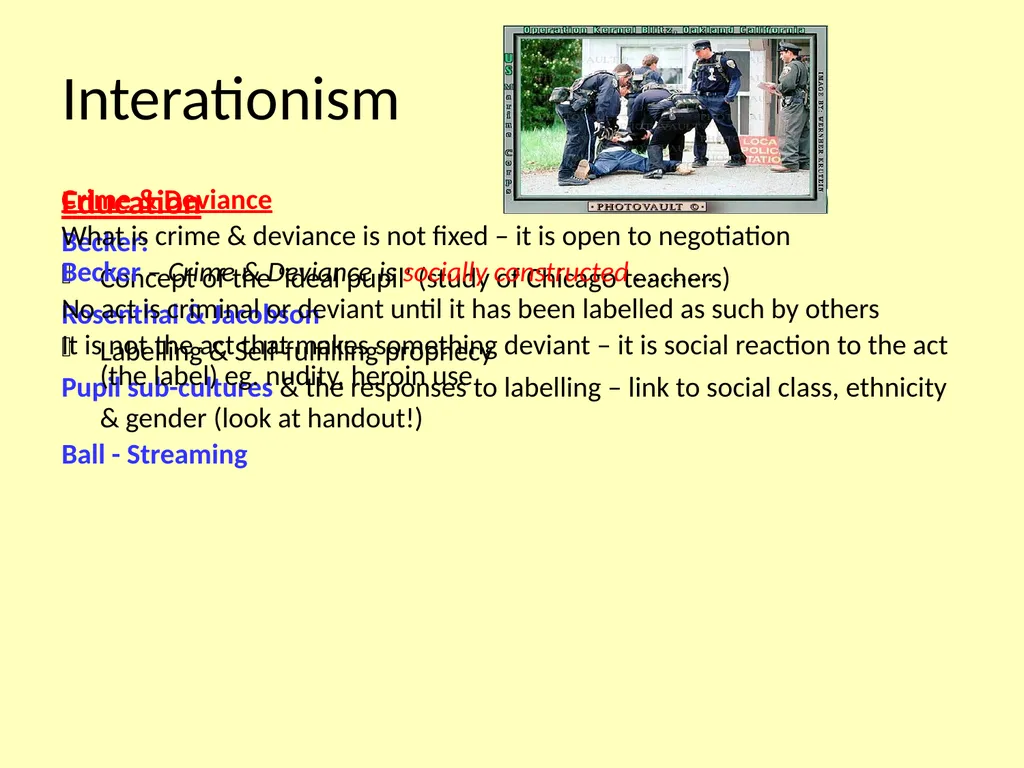
Interationism Education
Becker:
Concept of the ‘ideal pupil’ (study of Chicago teachers)
Rosenthal & Jacobson
Labelling & Self-fulfilling prophecy
Pupil sub-cultures & the responses to labelling – link to social class, ethnicity & gender (look at handout!)
Ball - Streaming Crime & Deviance
What is crime & deviance is not fixed – it is open to negotiation
Becker – Crime & Deviance is socially constructed …………
No act is criminal or deviant until it has been labelled as such by others
It is not the act that makes something deviant – it is social reaction to the act (the label) eg. nudity, heroin use<br>
Becker:
Concept of the ‘ideal pupil’ (study of Chicago teachers)
Rosenthal & Jacobson
Labelling & Self-fulfilling prophecy
Pupil sub-cultures & the responses to labelling – link to social class, ethnicity & gender (look at handout!)
Ball - Streaming Crime & Deviance
What is crime & deviance is not fixed – it is open to negotiation
Becker – Crime & Deviance is socially constructed …………
No act is criminal or deviant until it has been labelled as such by others
It is not the act that makes something deviant – it is social reaction to the act (the label) eg. nudity, heroin use<br>
12
Interactionist theory Becker – ‘The Outsiders’
Uses the example of ‘incest’ from Malinowski’s study of a Pacific Island to explain labelling theory.
‘Under the kapu system, there were forms of bondage and slavery, human sacrifice (Valeri, 1985), and infanticide (Malo, 1951, p. 70; Kamakau, 1961, p. 234). While adult females were afforded many rights and some had great status, it was kapu for them to eat certain foods; they could be put to death for eating pork, certain kinds of bananas or coconuts, and certain fish (Malo, 1951, p. 29). Poi and taro4 (basic staples of the Hawai‘ian diet) were not to be eaten from the same dish by males and females. Furthermore, in certain circumstances upon threat of death, adult males and adult females were not allowed to eat together, although they could have sex together. Religious laws controlled eating more than they controlled sex.’
http://www.hawaii.edu/PCSS/biblio/articles/2000to2004/2004-sexual-behavior-in-pre-contact-hawaii.html
The act of incest breaks the rules, but someone has to draw attention to the act/to enforce the rules for a social reaction to the deviance to take place. Once this happens – consequences follow.<br>
Uses the example of ‘incest’ from Malinowski’s study of a Pacific Island to explain labelling theory.
‘Under the kapu system, there were forms of bondage and slavery, human sacrifice (Valeri, 1985), and infanticide (Malo, 1951, p. 70; Kamakau, 1961, p. 234). While adult females were afforded many rights and some had great status, it was kapu for them to eat certain foods; they could be put to death for eating pork, certain kinds of bananas or coconuts, and certain fish (Malo, 1951, p. 29). Poi and taro4 (basic staples of the Hawai‘ian diet) were not to be eaten from the same dish by males and females. Furthermore, in certain circumstances upon threat of death, adult males and adult females were not allowed to eat together, although they could have sex together. Religious laws controlled eating more than they controlled sex.’
http://www.hawaii.edu/PCSS/biblio/articles/2000to2004/2004-sexual-behavior-in-pre-contact-hawaii.html
The act of incest breaks the rules, but someone has to draw attention to the act/to enforce the rules for a social reaction to the deviance to take place. Once this happens – consequences follow.<br>
13
INTERACTIONISM Becker –
* Negative labelling & master status (the label of deviant can cancel out other statuses eg. father, plumber, golfer and this can lead to exclusion from society, eg. work). The master status and exclusion can lead to deviant lifestyles, deviant careers and deviant sub-cultures – leads to a self-fulfilling prophecy (the label – prophecy comes true)<br>
* Negative labelling & master status (the label of deviant can cancel out other statuses eg. father, plumber, golfer and this can lead to exclusion from society, eg. work). The master status and exclusion can lead to deviant lifestyles, deviant careers and deviant sub-cultures – leads to a self-fulfilling prophecy (the label – prophecy comes true)<br>
14
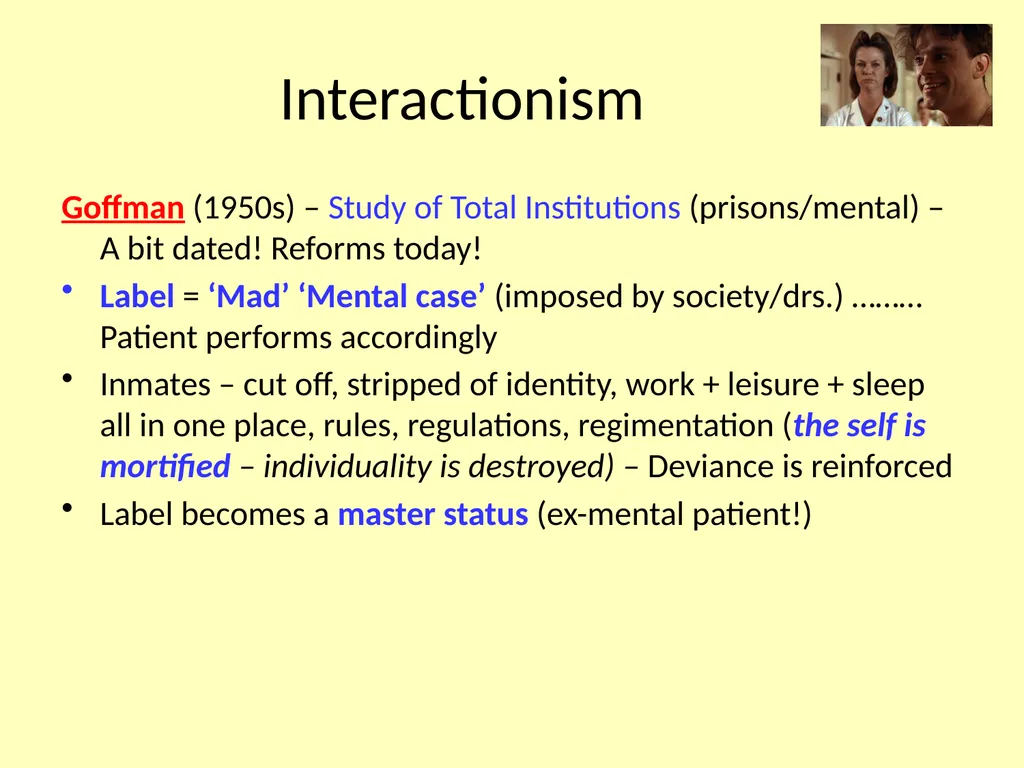
Interactionism Goffman (1950s) – Study of Total Institutions (prisons/mental) – A bit dated! Reforms today!
Label = ‘Mad’ ‘Mental case’ (imposed by society/drs.) ……… Patient performs accordingly
Inmates – cut off, stripped of identity, work + leisure + sleep all in one place, rules, regulations, regimentation (the self is mortified – individuality is destroyed) – Deviance is reinforced
Label becomes a master status (ex-mental patient!)<br>
Label = ‘Mad’ ‘Mental case’ (imposed by society/drs.) ……… Patient performs accordingly
Inmates – cut off, stripped of identity, work + leisure + sleep all in one place, rules, regulations, regimentation (the self is mortified – individuality is destroyed) – Deviance is reinforced
Label becomes a master status (ex-mental patient!)<br>
15
Interactionism Cicourel
Why are some boys likely to be negatively labelled?
‘The typical delinquent’
Decisions made by probation officers whether to make charges or not for a criminal offence – influenced by stereotypical views of a ‘typical delinquent’
It is not what he has done, but how others label him and his actions! Lemert –
Primary & Secondary deviance, eg. Stuttering (Study: Innuits)
Primary – rule-breaking of little importance
Secondary – due to responses of others
Stuttering = primary (minor speech defect)
Chronic stuttering = secondary (a response to society’s reaction)<br>
Why are some boys likely to be negatively labelled?
‘The typical delinquent’
Decisions made by probation officers whether to make charges or not for a criminal offence – influenced by stereotypical views of a ‘typical delinquent’
It is not what he has done, but how others label him and his actions! Lemert –
Primary & Secondary deviance, eg. Stuttering (Study: Innuits)
Primary – rule-breaking of little importance
Secondary – due to responses of others
Stuttering = primary (minor speech defect)
Chronic stuttering = secondary (a response to society’s reaction)<br>
16
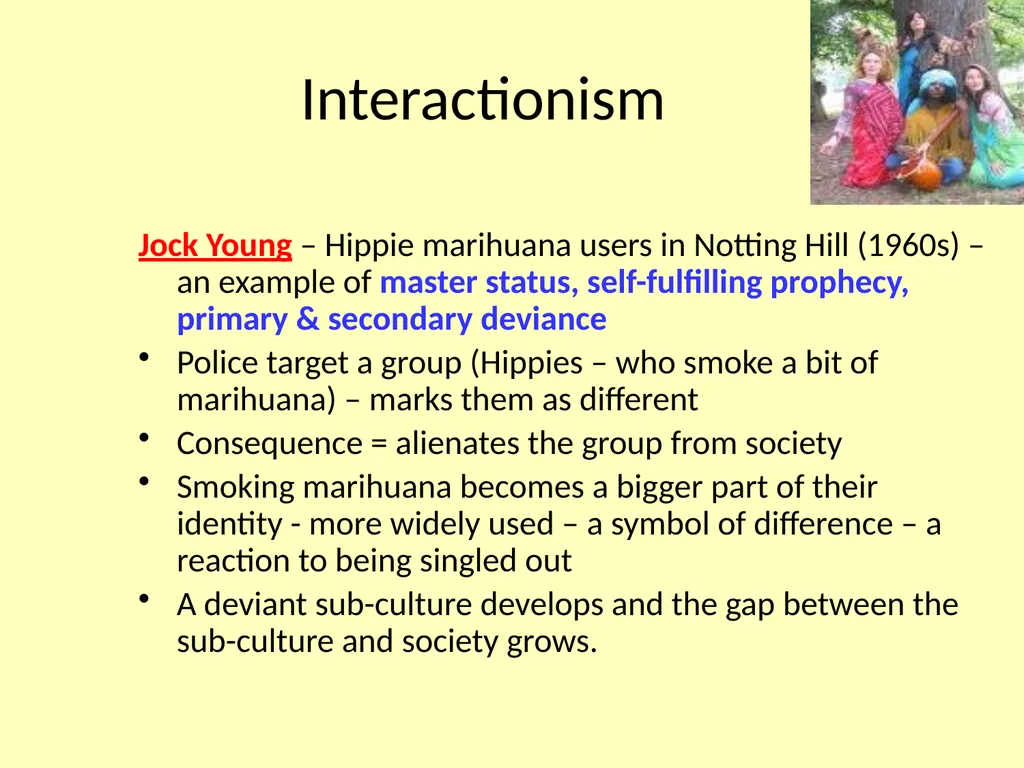
Interactionism Jock Young – Hippie marihuana users in Notting Hill (1960s) – an example of master status, self-fulfilling prophecy, primary & secondary deviance
Police target a group (Hippies – who smoke a bit of marihuana) – marks them as different
Consequence = alienates the group from society
Smoking marihuana becomes a bigger part of their identity - more widely used – a symbol of difference – a reaction to being singled out
A deviant sub-culture develops and the gap between the sub-culture and society grows.<br>
Police target a group (Hippies – who smoke a bit of marihuana) – marks them as different
Consequence = alienates the group from society
Smoking marihuana becomes a bigger part of their identity - more widely used – a symbol of difference – a reaction to being singled out
A deviant sub-culture develops and the gap between the sub-culture and society grows.<br>
17
A02 Labelling as deterministic A criticism of the interactionist perspective is that it is too deterministic.
It assumes that once a person has been labelled, their deviance will inevitably become worse – the labelled person has no option but to get more and more involved in deviant activities.
Ronald Ackers stated: “One sometimes gets the impression from reading the literature that people go about minding their own business, and then – ‘wham’ – bad society comes along and slaps them in the face with a stigmatized label.
Forced into the role of deviant the individual has little choice but to be deviant”.
Critics like Ackers are suggesting that individuals might simply choose to be deviant, regardless of whether they have been labelled.
Labelling does not cause most terrorists to turn to crime: they are motivated by their political beliefs to break the law.<br>
It assumes that once a person has been labelled, their deviance will inevitably become worse – the labelled person has no option but to get more and more involved in deviant activities.
Ronald Ackers stated: “One sometimes gets the impression from reading the literature that people go about minding their own business, and then – ‘wham’ – bad society comes along and slaps them in the face with a stigmatized label.
Forced into the role of deviant the individual has little choice but to be deviant”.
Critics like Ackers are suggesting that individuals might simply choose to be deviant, regardless of whether they have been labelled.
Labelling does not cause most terrorists to turn to crime: they are motivated by their political beliefs to break the law.<br>
18
Interactionists say that deviance is defined by social reaction, which means that an individuals action is not deviant until society labels it as such and in this way, deviant people are not that different from everyone else, and this is the standpoint that there theory of crime and deviance starts from.
They therefore think that because of this there aren’t any universal causes of crime or deviance that can be found out and ‘discovered’ by sociologist researching it.<br>
They therefore think that because of this there aren’t any universal causes of crime or deviance that can be found out and ‘discovered’ by sociologist researching it.<br>
19
Interactionists stress the point of view that deviance is relative as it varies over place and time as it is defined by each situation and each society differently within societies.
This view has been challenged as some critics argue that people in societies are not as passive as Interactionists suggests. Taylor, Walton and Young (1973) argued that there are many forms of behaviour which are widely viewed as being deviant and so deviants know that they are breaking the law or social rules before any social reaction, but they still do it.
Gouldner (1973) accused Interactionists of being fascinated with deviance and he even suggested that they enjoyed observing deviants that were deemed ‘cool’ and hanging out with the underworld of society and they aren’t interested about changing society.
A02: X.ref Malestream sociology.<br>
This view has been challenged as some critics argue that people in societies are not as passive as Interactionists suggests. Taylor, Walton and Young (1973) argued that there are many forms of behaviour which are widely viewed as being deviant and so deviants know that they are breaking the law or social rules before any social reaction, but they still do it.
Gouldner (1973) accused Interactionists of being fascinated with deviance and he even suggested that they enjoyed observing deviants that were deemed ‘cool’ and hanging out with the underworld of society and they aren’t interested about changing society.
A02: X.ref Malestream sociology.<br>
20
AO2
Marxist critics accused Interactionists of ignoring the role of power when defining crime and deviance as certain groups have power to influence what is classified as socially unacceptable or criminal behaviour.<br>
Marxist critics accused Interactionists of ignoring the role of power when defining crime and deviance as certain groups have power to influence what is classified as socially unacceptable or criminal behaviour.<br>
21
Deviant career Ronald Akers (1967) criticised both Becker and Lemert for presenting individuals as powerless to make decisions to take control of their own identity as deviance, according to Akers, is not something that happens to people but a choice that individuals make.<br>
22
Methodology? Micro
Generalisations not possible
Low validity?
Low reliability?
Subjective
Meta narrative?
Male stream?
Coherent?<br>
Generalisations not possible
Low validity?
Low reliability?
Subjective
Meta narrative?
Male stream?
Coherent?<br>
23
http://www.youtube.com/watch?v=asLx-fwQyUU X.ref labelling and edct: Brown Eyes blue eyes.
Pygmalion in the classroom.
Teacher expectations and achievement.<br>
Pygmalion in the classroom.
Teacher expectations and achievement.<br>
24
INTERACTIONISM – EVALUATION – A02 However ……………….
Strengths & weaknesses<br>
Strengths & weaknesses<br>