
Labor-Management Collaboration: Impact on Student
Description: Labor-Management Collaboration: Impact on Student Achievement Saul Rubinstein California Labor Management Initiative May 9, 2015 San Diego Overview Identify Key Principles for Successful Union-Management Collaborative Partnerships Link
Related Topics
Download Presentation
"Labor-Management Collaboration: Impact on Student" is the property of its rightful owner. Permission is granted to download and print the materials on this website for personal, non-commercial use only, and to display it on your personal computer provided you do not modify the materials and that you retain all copyright notices contained in the materials. By downloading content from our website, you accept the terms of this agreement.
Presentation Transcript
slide1. Labor-Management Collaboration:
Impact on Student Achievement
Saul Rubinstein
California Labor Management Initiative
May 9, 2015
San Diego<br>
slide2. Overview Identify Key Principles for Successful Union-Management Collaborative Partnerships
Link between Partnerships, Educator Collaboration & Student Performance
Impact of Partnerships on Union-Management Relations
Impact of Partnerships on Knowledge Transfer and Adoption of Innovation
Unions as Value-Adding Networks
Policy Implications and State Initiatives
Create a Network of Educator Collaboration Across NJ and within Districts<br>
slide3. Union-Management Partnerships and Educational Quality An Approach to Public School Reform/Improvement based on:
District-level & School-level Union- Management Collaboration
Empowering Educator Collaboration in Schools
Innovation from Educators Within Districts & Schools
Focus on Teaching and Learning<br>
slide4. .<br>
slide6. .<br>
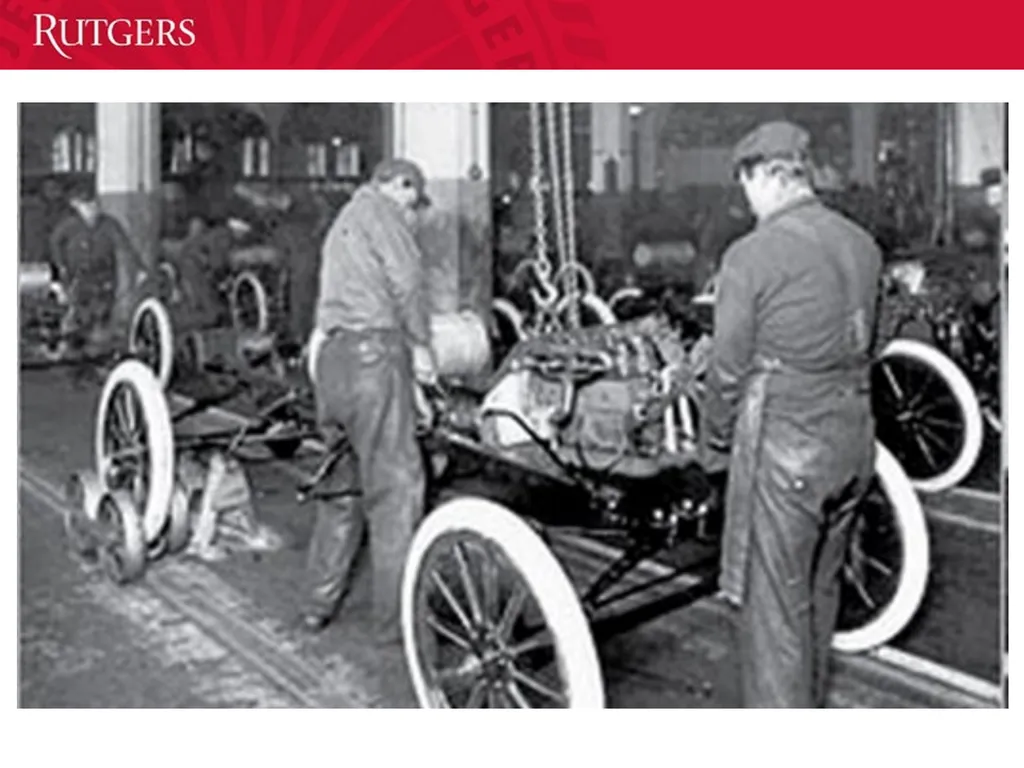
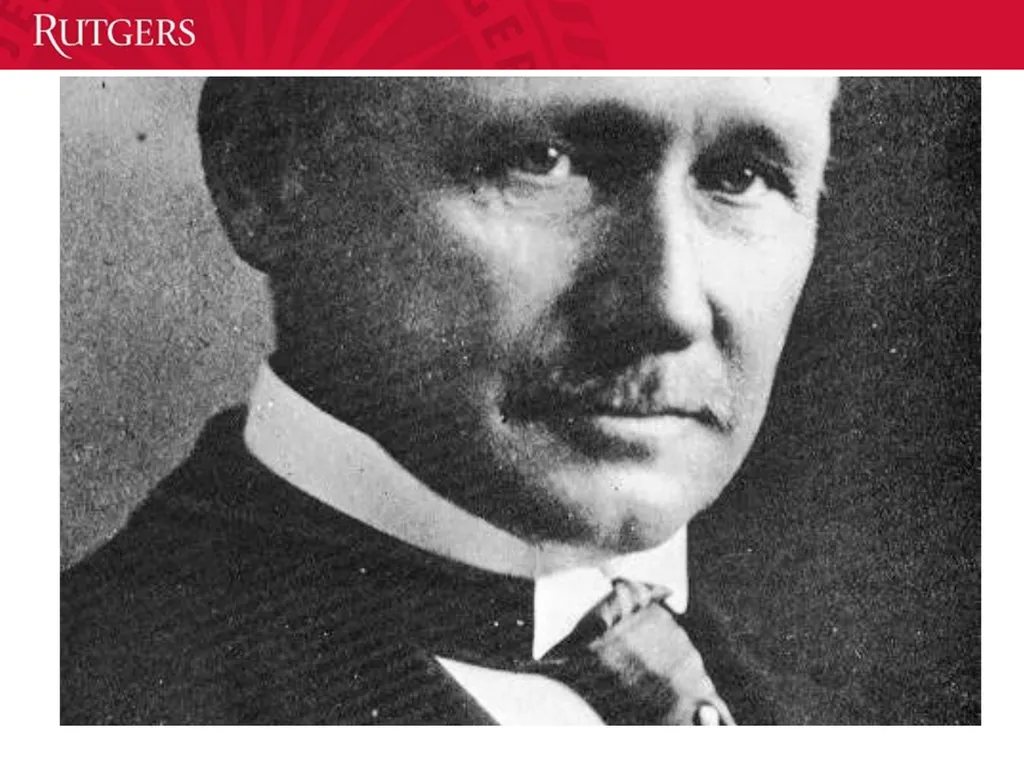
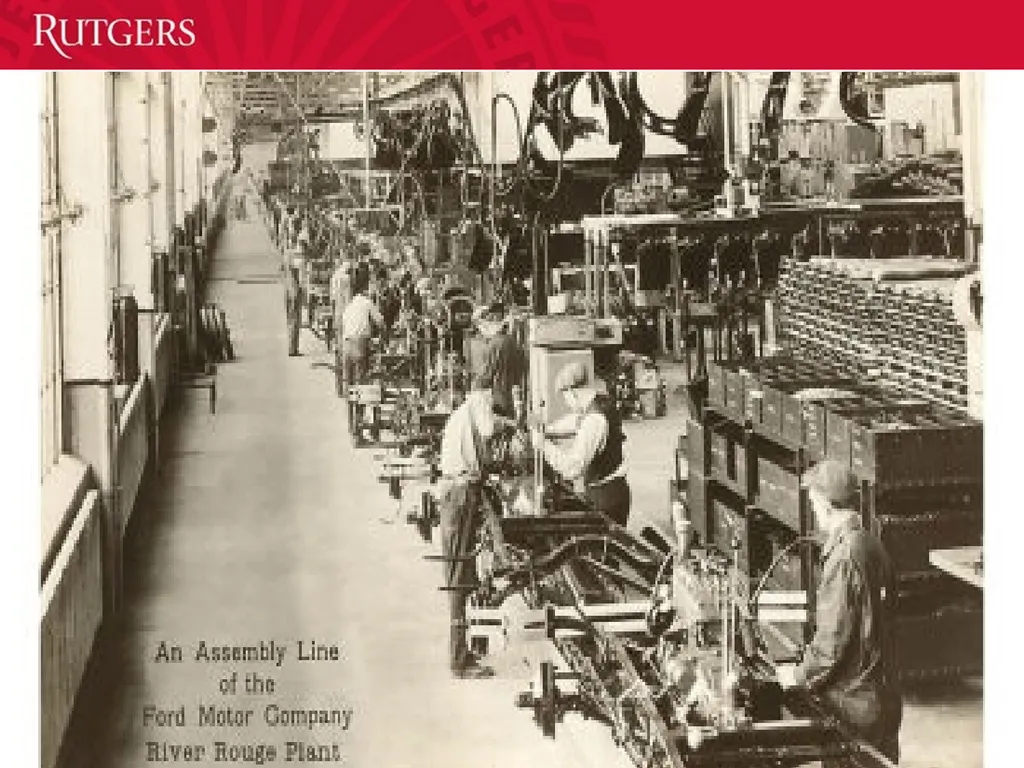
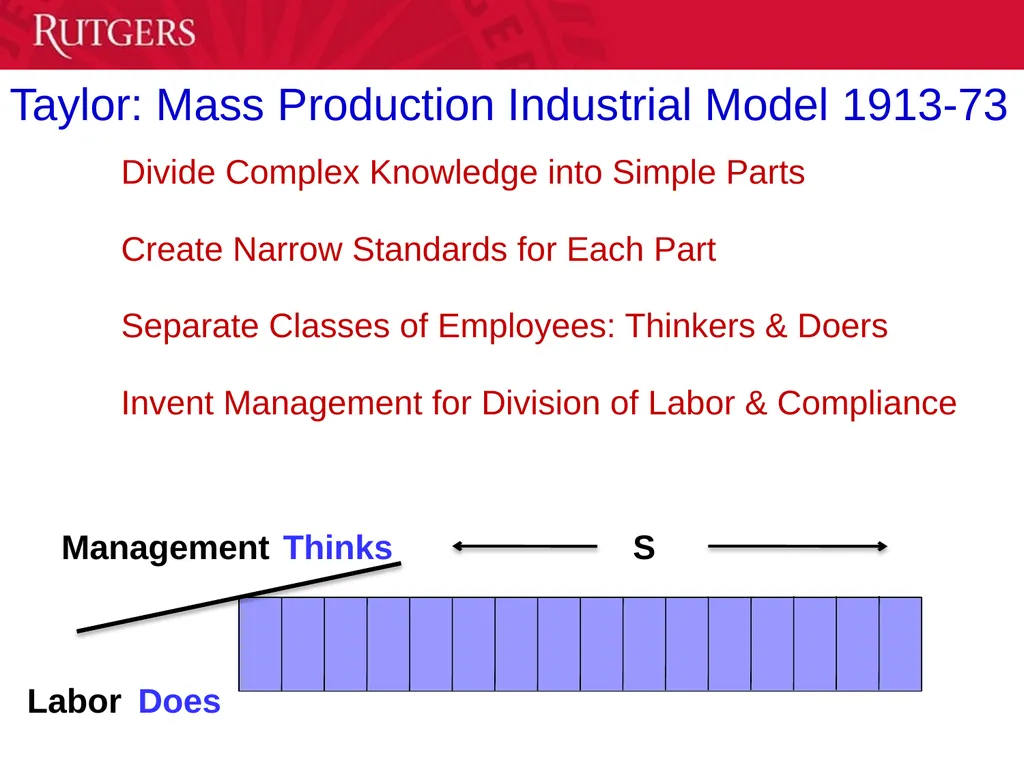
slide7. Taylor: Mass Production Industrial Model 1913-73 S Management Labor Thinks Does Divide Complex Knowledge into Simple Parts Create Narrow Standards for Each Part Separate Classes of Employees: Thinkers & Doers Invent Management for Division of Labor & Compliance<br>
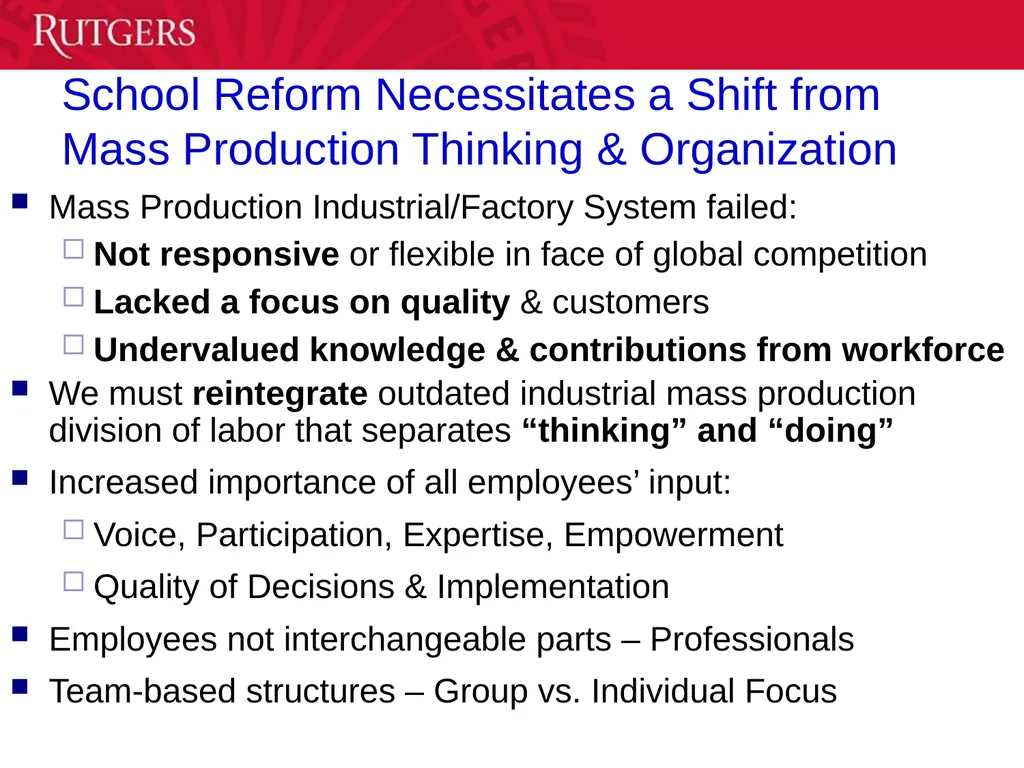
slide8. School Reform Necessitates a Shift from Mass Production Thinking & Organization Mass Production Industrial/Factory System failed:
Not responsive or flexible in face of global competition
Lacked a focus on quality & customers
Undervalued knowledge & contributions from workforce
We must reintegrate outdated industrial mass production division of labor that separates “thinking” and “doing”
Increased importance of all employees’ input:
Voice, Participation, Expertise, Empowerment
Quality of Decisions & Implementation
Employees not interchangeable parts – Professionals
Team-based structures – Group vs. Individual Focus<br>
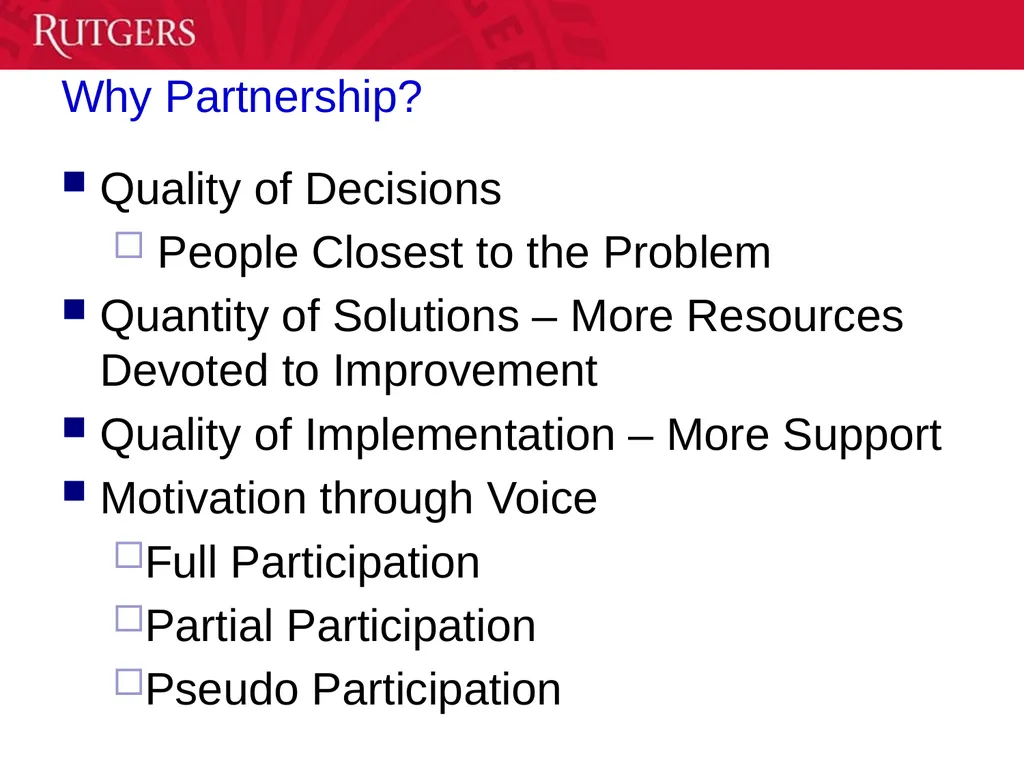
slide9. Why Partnership? Quality of Decisions
People Closest to the Problem
Quantity of Solutions – More Resources Devoted to Improvement
Quality of Implementation – More Support
Motivation through Voice
Full Participation
Partial Participation
Pseudo Participation<br>
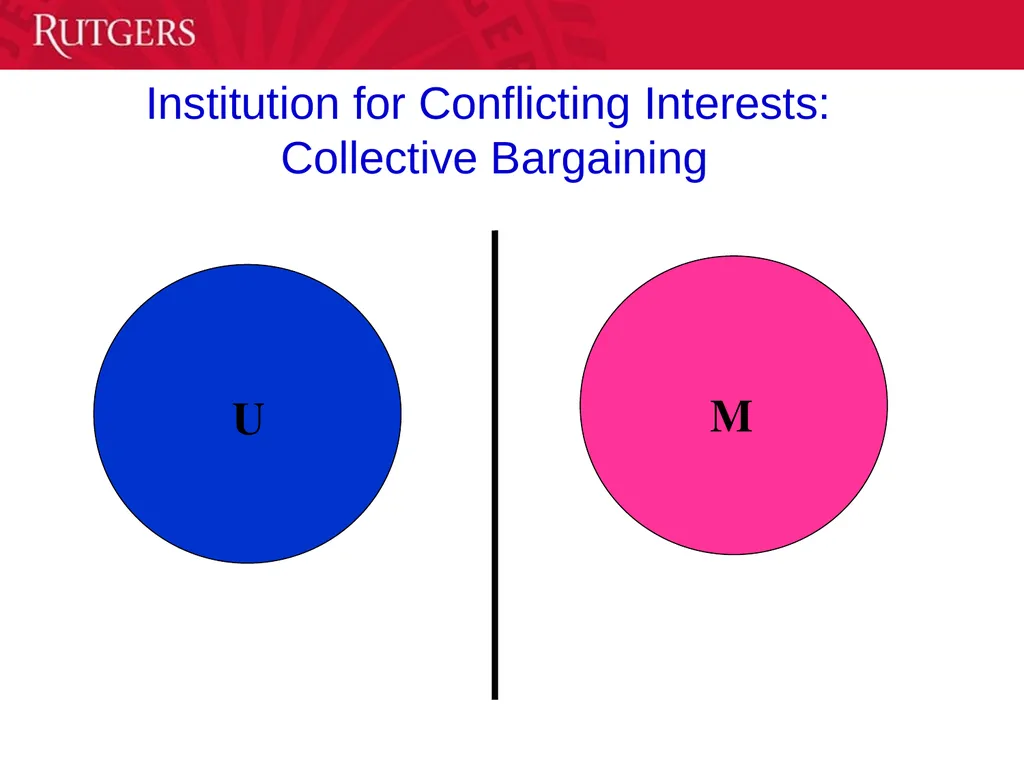
slide10. Institution for Conflicting Interests: Collective Bargaining U M<br>
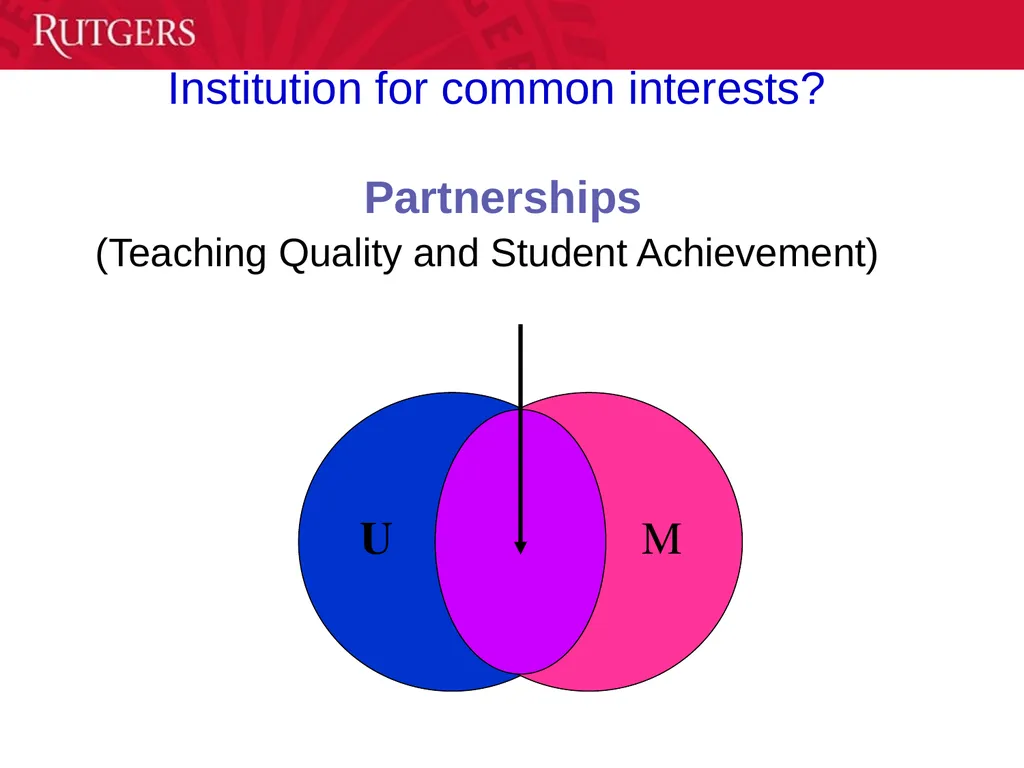
slide11. Institution for common interests? Partnerships U M (Teaching Quality and Student Achievement)<br>
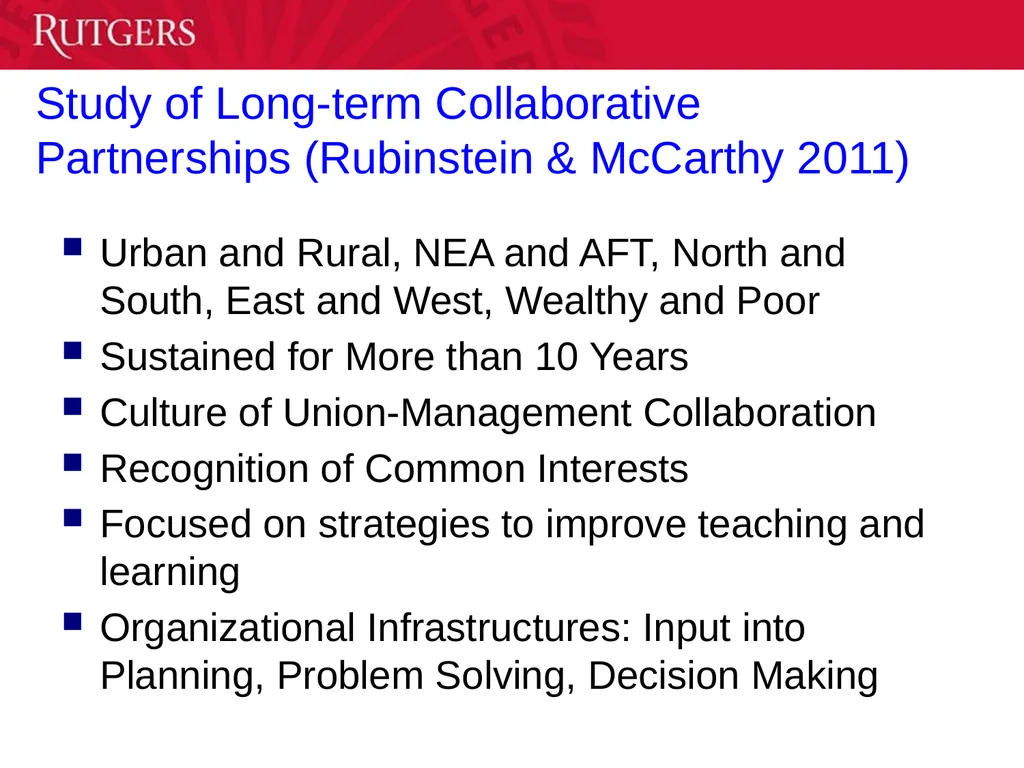
slide12. Study of Long-term Collaborative Partnerships (Rubinstein & McCarthy 2011) Urban and Rural, NEA and AFT, North and South, East and West, Wealthy and Poor
Sustained for More than 10 Years
Culture of Union-Management Collaboration
Recognition of Common Interests
Focused on strategies to improve teaching and learning
Organizational Infrastructures: Input into Planning, Problem Solving, Decision Making<br>
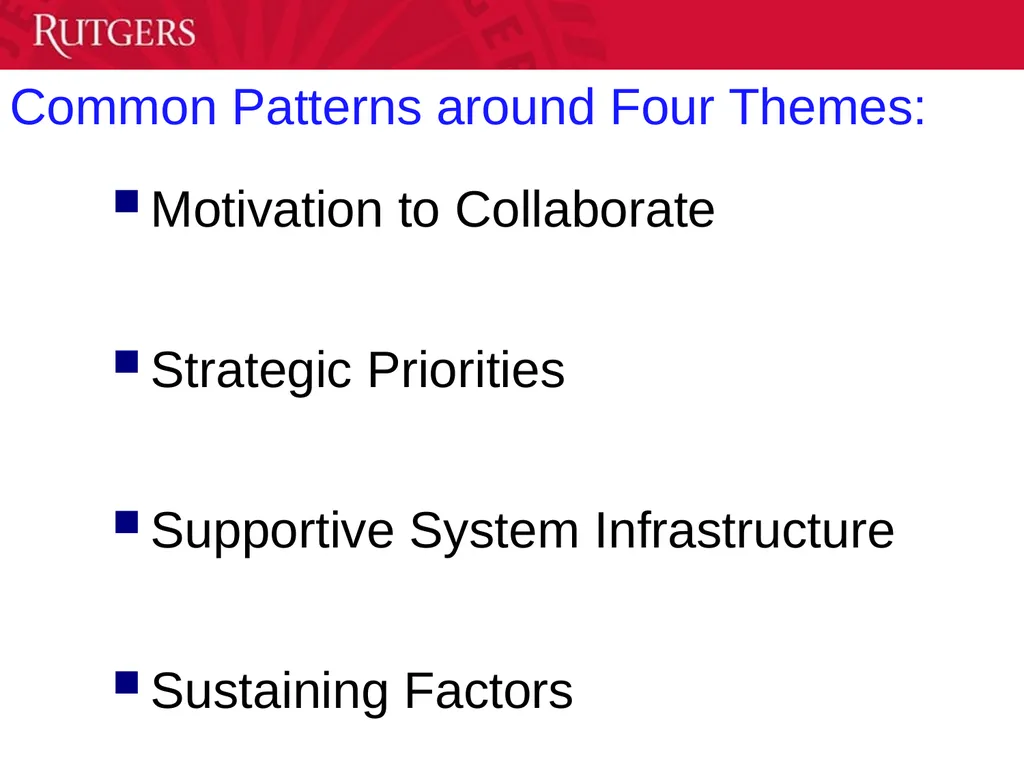
slide13. Common Patterns around Four Themes: Motivation to Collaborate
Strategic Priorities
Supportive System Infrastructure
Sustaining Factors<br>
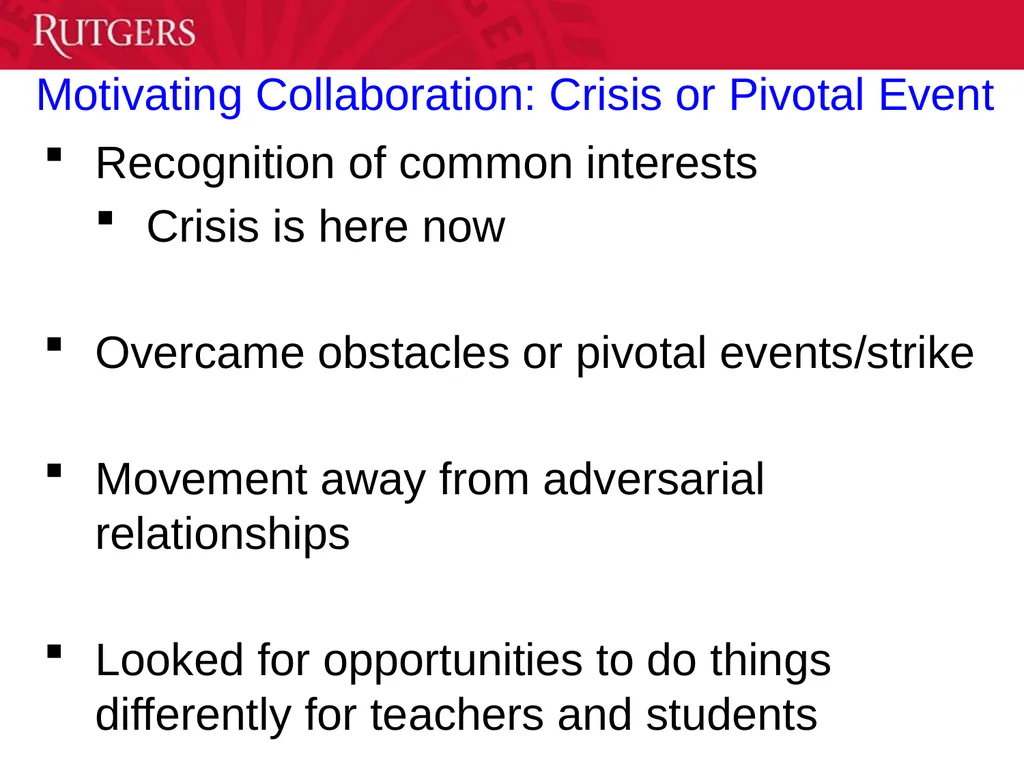
slide14. Motivating Collaboration: Crisis or Pivotal Event Recognition of common interests
Crisis is here now
Overcame obstacles or pivotal events/strike
Movement away from adversarial relationships
Looked for opportunities to do things differently for teachers and students<br>
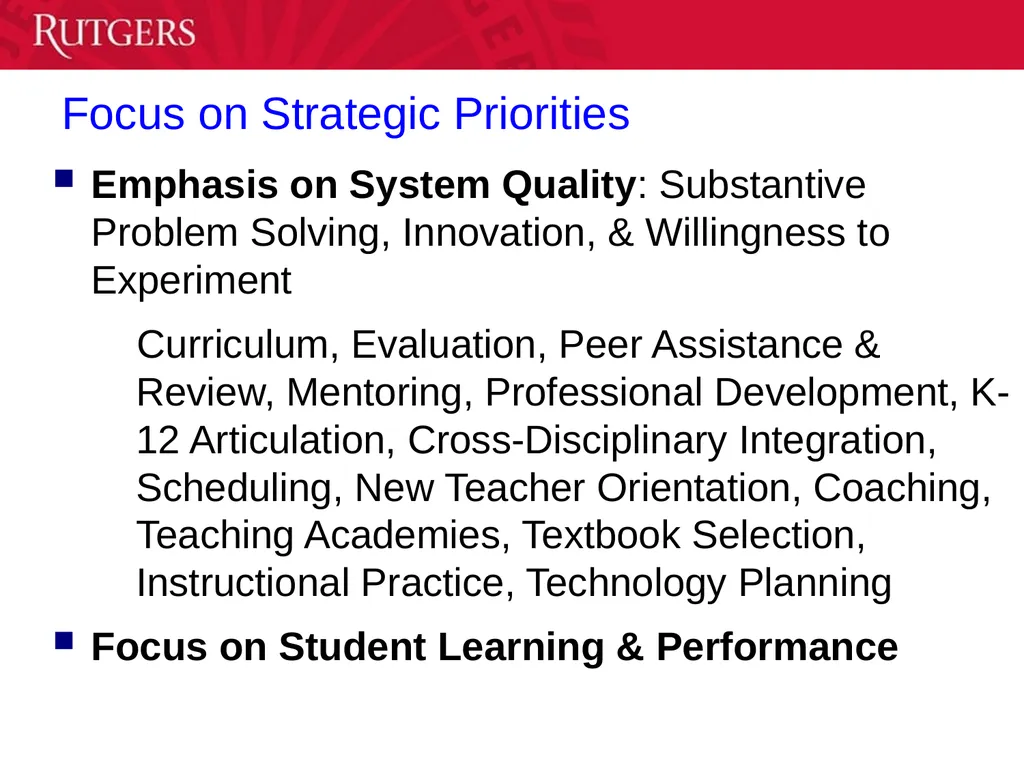
slide15. Focus on Strategic Priorities Emphasis on System Quality: Substantive Problem Solving, Innovation, & Willingness to Experiment
Curriculum, Evaluation, Peer Assistance & Review, Mentoring, Professional Development, K-12 Articulation, Cross-Disciplinary Integration, Scheduling, New Teacher Orientation, Coaching, Teaching Academies, Textbook Selection, Instructional Practice, Technology Planning
Focus on Student Learning & Performance<br>
slide16. Supportive System Infrastructure Embedded Culture of Collaboration & Inclusion
Organization & Systems Change not a Program
Collaborative Structures at District & School-levels
Joint Building-level Teams, School Improvement Committees, Leadership Teams, Grade-level & Department Teams
Shared Decision Making, Management & Effective Implementation
Joint Learning Opportunities
Dense Internal Organizing by Partnership as a Quality Network<br>
slide17. Sustaining Factors Community engagement
Support from board of education
Long-term strong leadership
Internal labor markets – promotion from within
Leadership development
Succession planning
Support from national union
Supportive contract language<br>
slide18. Key Elements of Partnerships Aligned Interests
Culture of Collaboration
Strategic Focus on Teaching and Learning
Organizational Structures District & School-Levels
Training & Capacity Building
Strong Leadership, Development & Succession Planning
Community and School Board as Partners<br>
slide19. Partnership as a Structure to Find Solutions and Implement Them Tests Show Gaps but Not How to Fill Them
Partnerships are Based on Creating Solutions
Focus on Organizational Systems
Education System as a Collective Enterprise Not an Individual Practice, and the Union is Central to the Network of Teachers
Improvement is Team-based not Individual
Human Capital = Skills; Social Capital = Relationships<br>
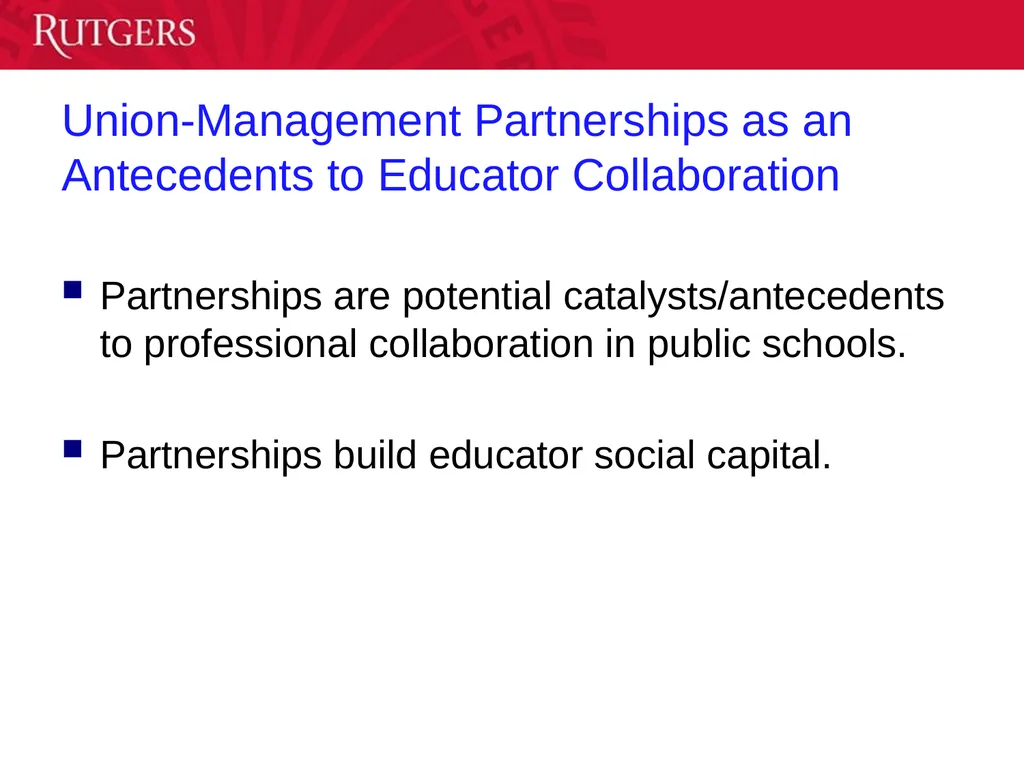
slide20. Union-Management Partnerships as an Antecedents to Educator Collaboration Partnerships are potential catalysts/antecedents to professional collaboration in public schools.
Partnerships build educator social capital.<br>
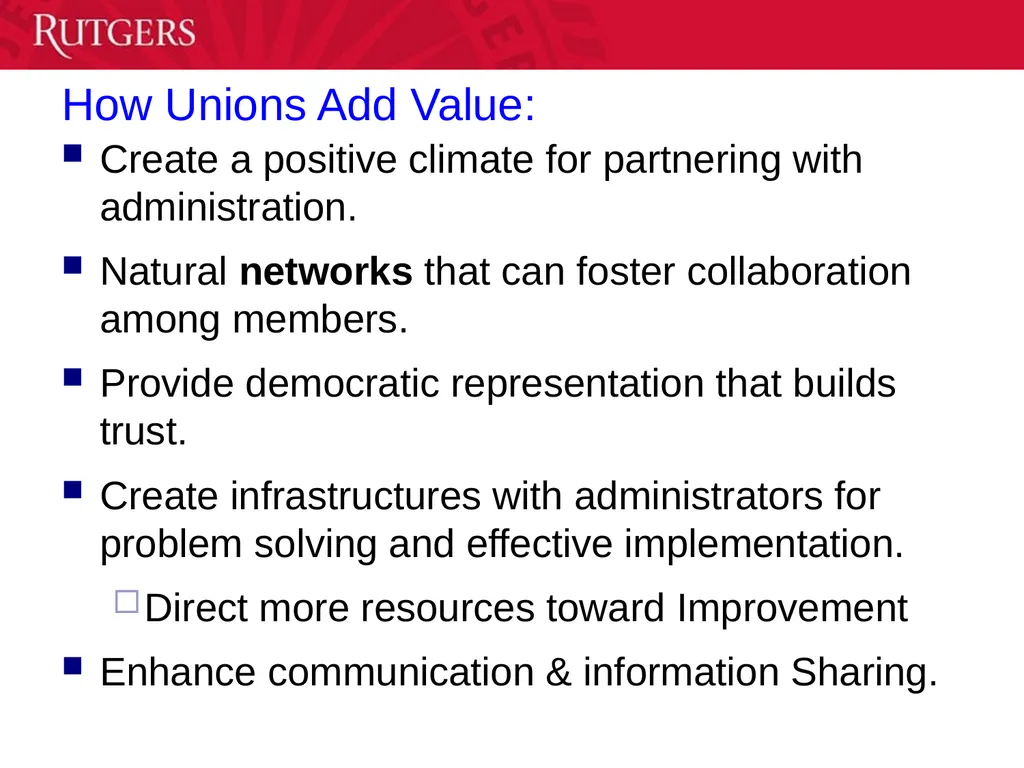
slide21. How Unions Add Value: Create a positive climate for partnering with administration.
Natural networks that can foster collaboration among members.
Provide democratic representation that builds trust.
Create infrastructures with administrators for problem solving and effective implementation.
Direct more resources toward Improvement
Enhance communication & information Sharing.<br>
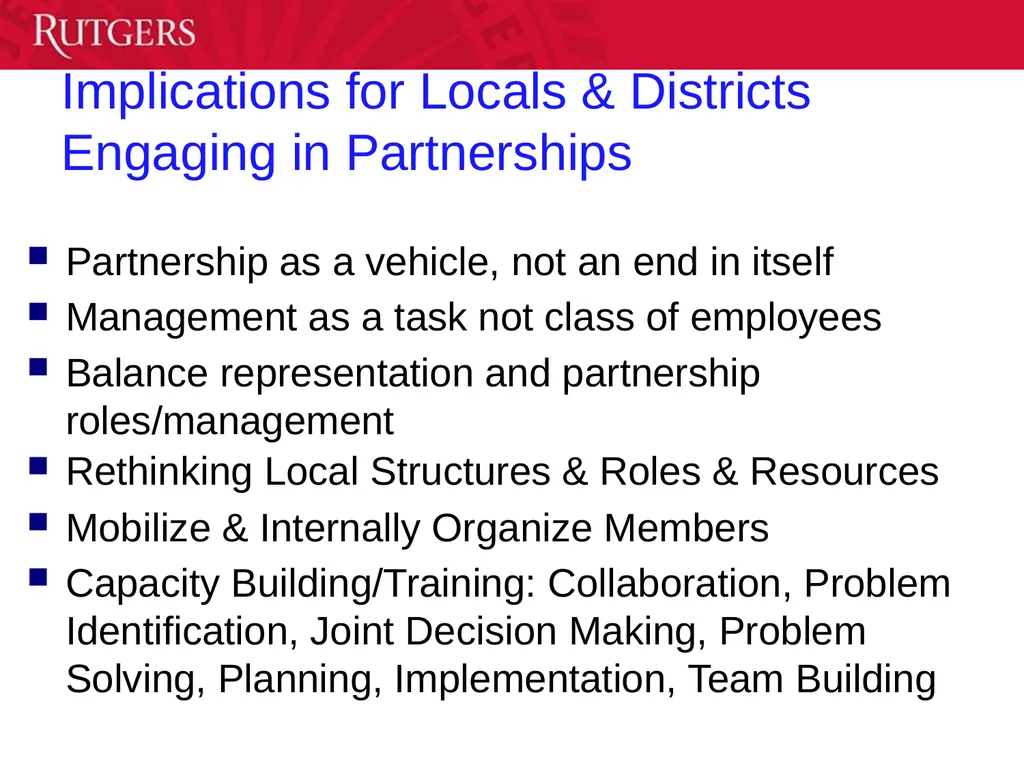
slide22. Implications for Locals & Districts Engaging in Partnerships Partnership as a vehicle, not an end in itself
Management as a task not class of employees
Balance representation and partnership roles/management
Rethinking Local Structures & Roles & Resources
Mobilize & Internally Organize Members
Capacity Building/Training: Collaboration, Problem Identification, Joint Decision Making, Problem Solving, Planning, Implementation, Team Building<br>
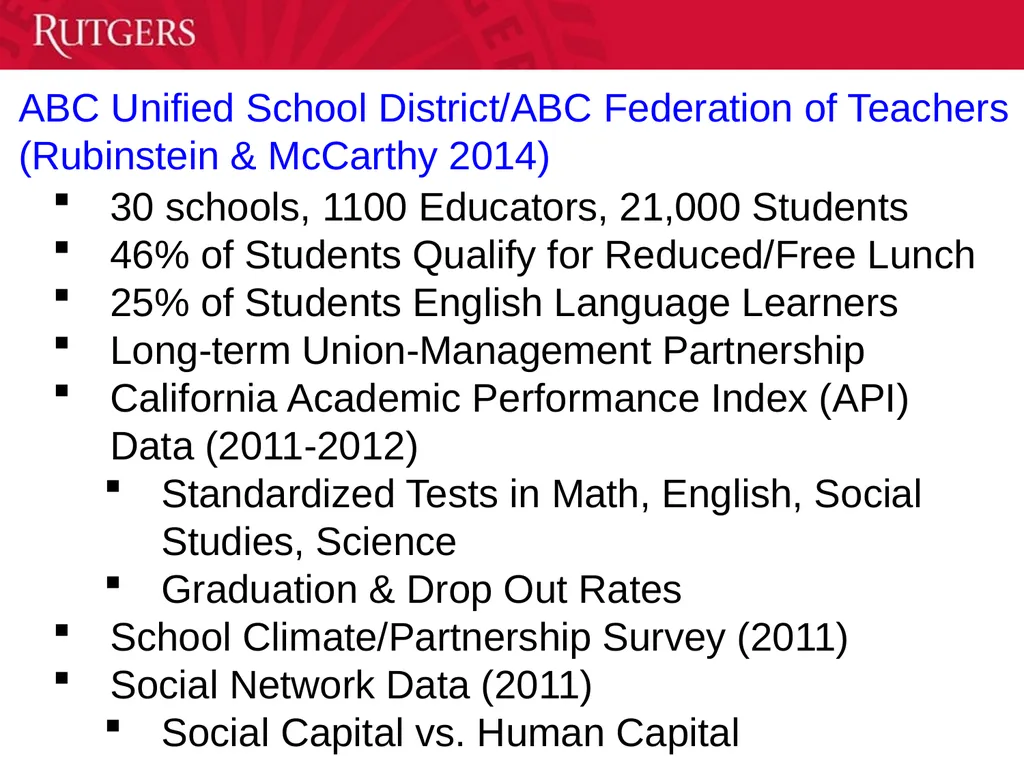
slide23. 30 schools, 1100 Educators, 21,000 Students
46% of Students Qualify for Reduced/Free Lunch
25% of Students English Language Learners
Long-term Union-Management Partnership
California Academic Performance Index (API) Data (2011-2012)
Standardized Tests in Math, English, Social Studies, Science
Graduation & Drop Out Rates
School Climate/Partnership Survey (2011)
Social Network Data (2011)
Social Capital vs. Human Capital ABC Unified School District/ABC Federation of Teachers
(Rubinstein & McCarthy 2014)<br>
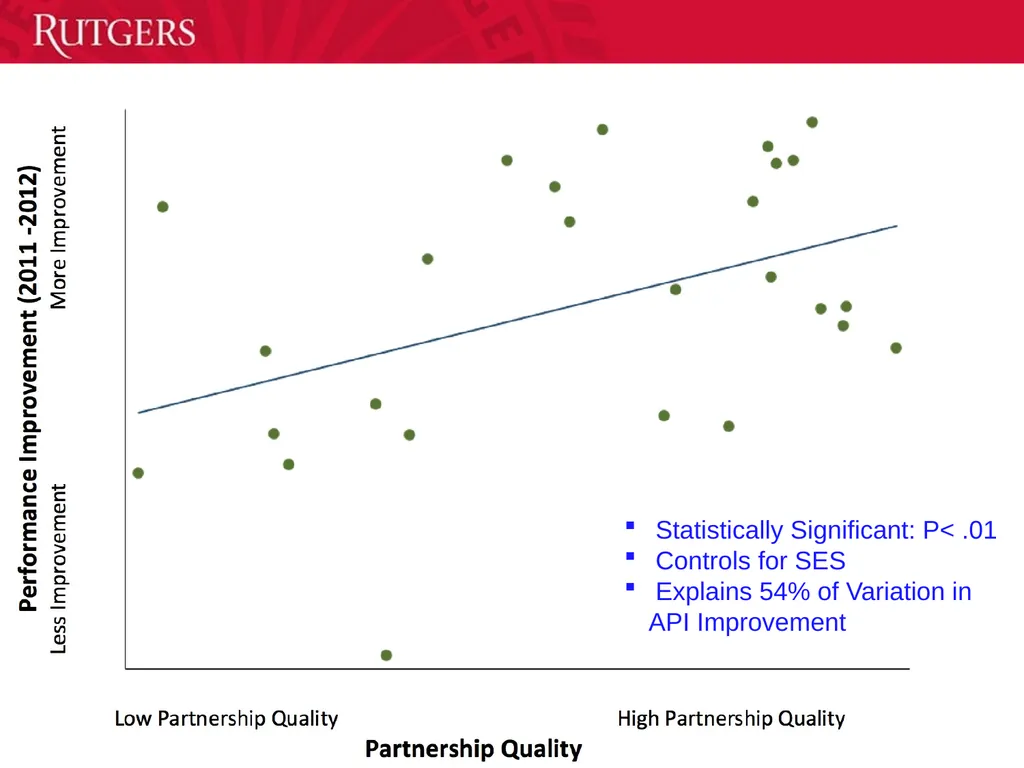
slide24. Statistically Significant: P< .01
Controls for SES
Explains 54% of Variation in API Improvement<br>
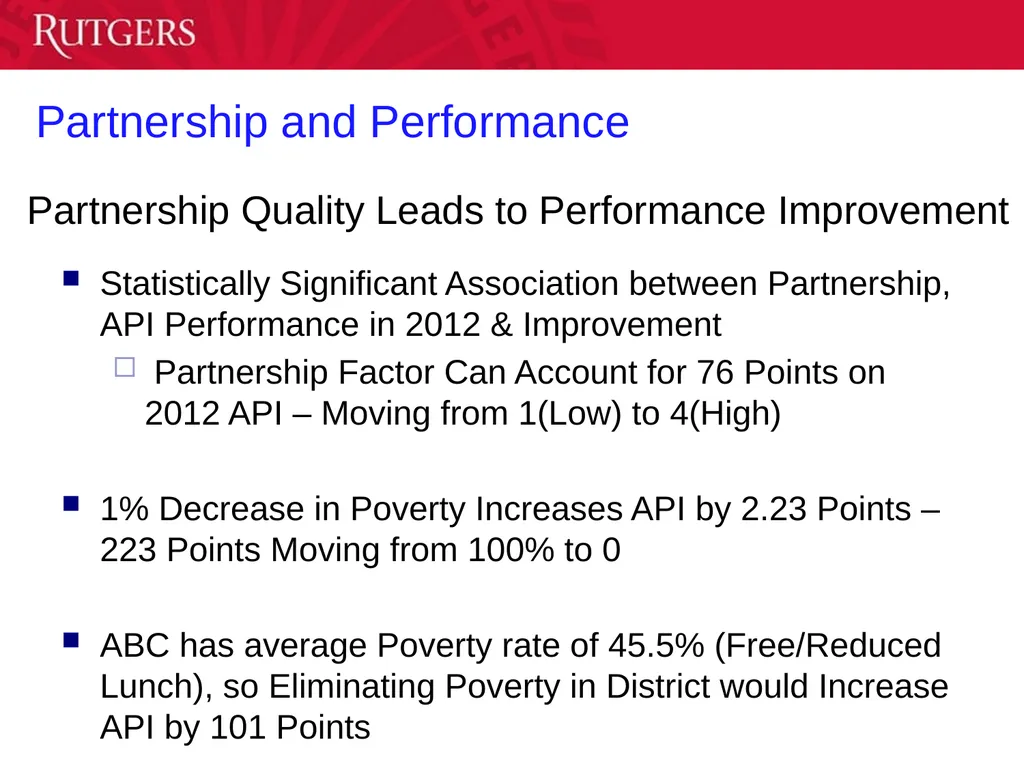
slide25. Partnership and Performance Statistically Significant Association between Partnership, API Performance in 2012 & Improvement
Partnership Factor Can Account for 76 Points on 2012 API – Moving from 1(Low) to 4(High)
1% Decrease in Poverty Increases API by 2.23 Points – 223 Points Moving from 100% to 0
ABC has average Poverty rate of 45.5% (Free/Reduced Lunch), so Eliminating Poverty in District would Increase API by 101 Points Partnership Quality Leads to Performance Improvement<br>
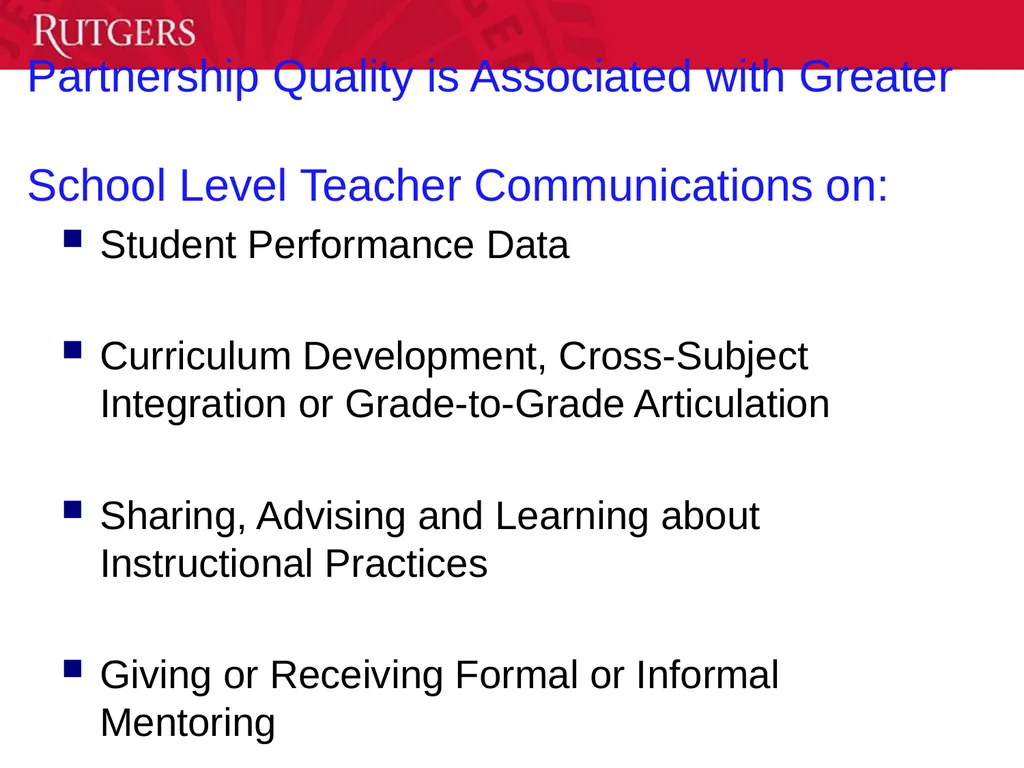
slide26. Partnership Quality is Associated with Greater School Level Teacher Communications on: Student Performance Data
Curriculum Development, Cross-Subject Integration or Grade-to-Grade Articulation
Sharing, Advising and Learning about Instructional Practices
Giving or Receiving Formal or Informal Mentoring<br>
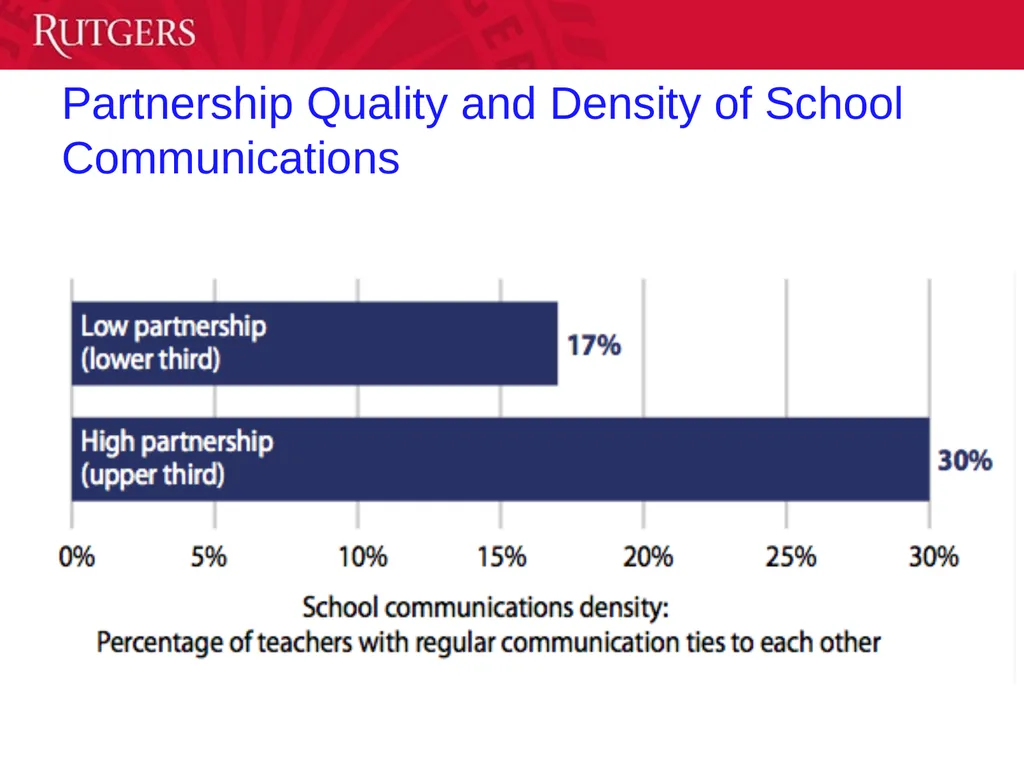
slide27. Partnership Quality and Density of School Communications<br>
slide28. School Network Communication Density is Associated with Student Performance 2012 & Improvement from 2011 to 2012 Moving from a school communication density of 17% to 30% is associated with an increase of 9 API Points
Moving from a school communication density of 17% to 69% is associated with an increase of 36 API Points<br>
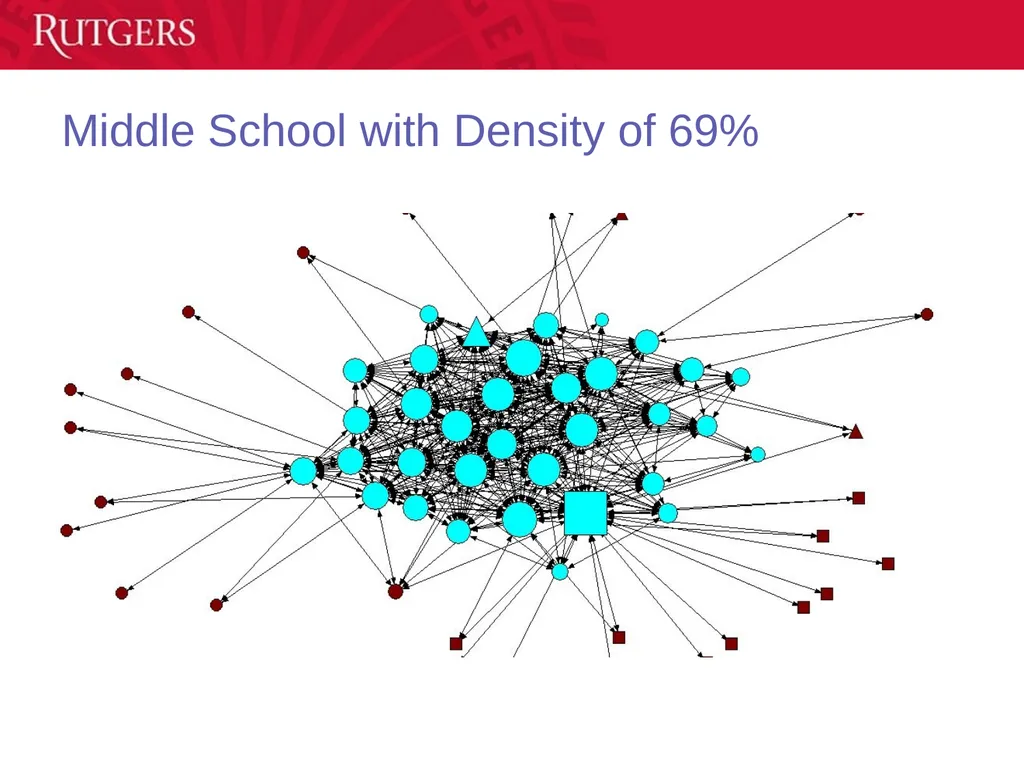
slide29. Middle School with Density of 69%<br>
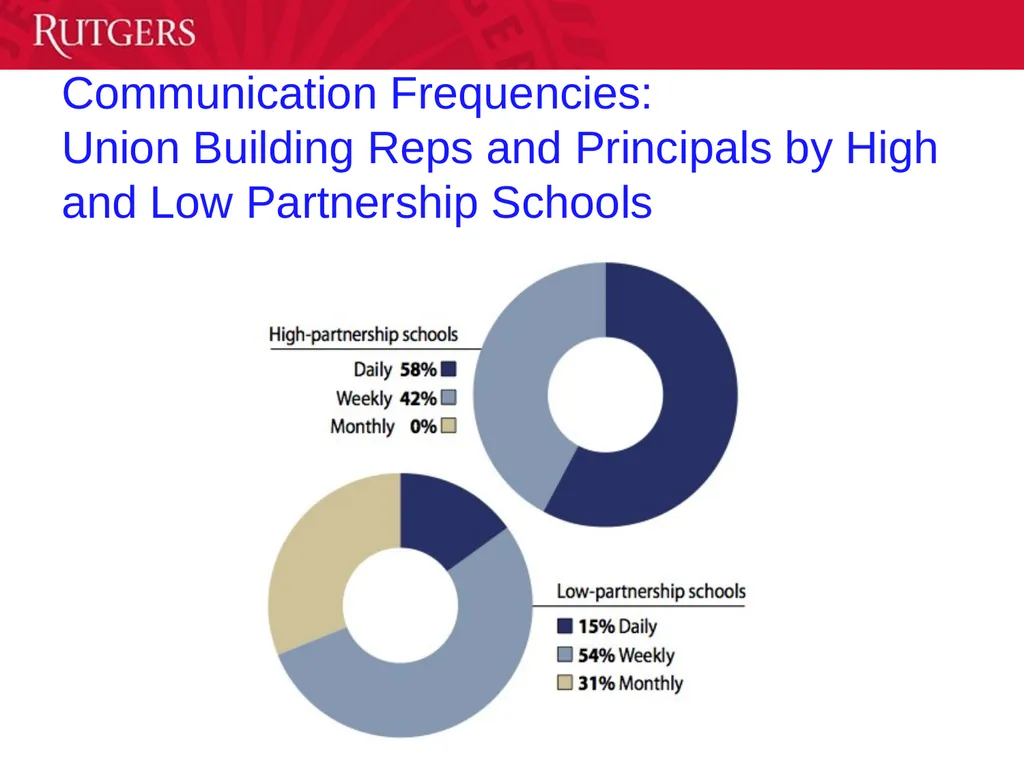
slide30. Communication Frequencies: Union Building Reps and Principals by High and Low Partnership Schools<br>
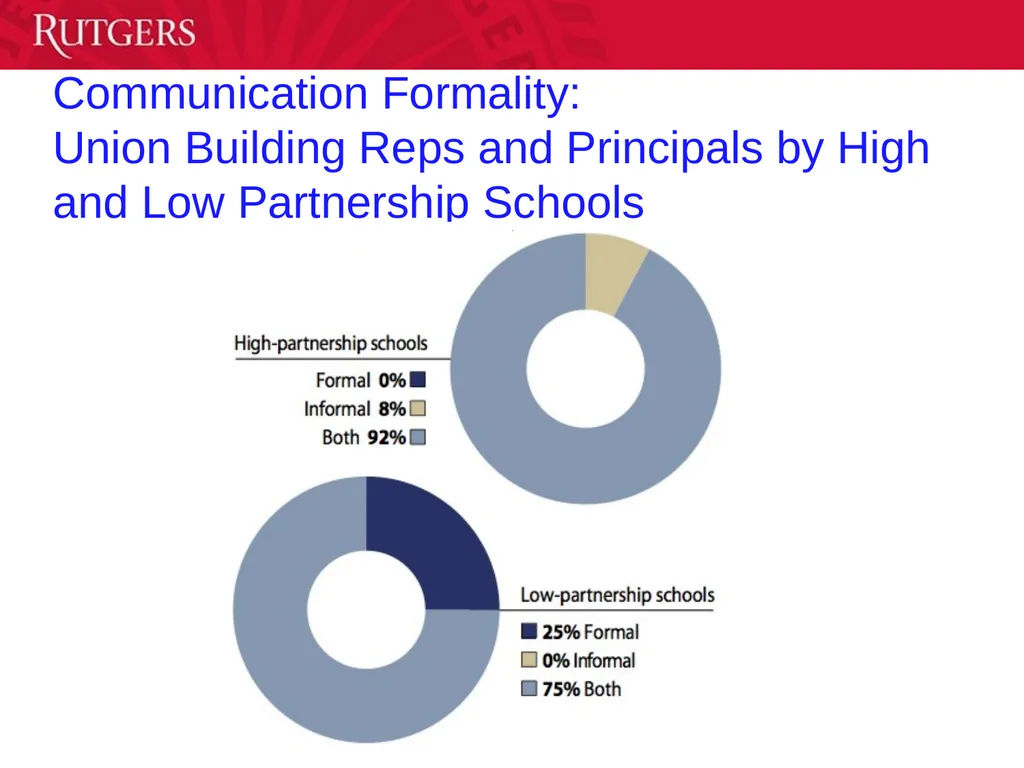
slide31. Communication Formality: Union Building Reps and Principals by High and Low Partnership Schools<br>
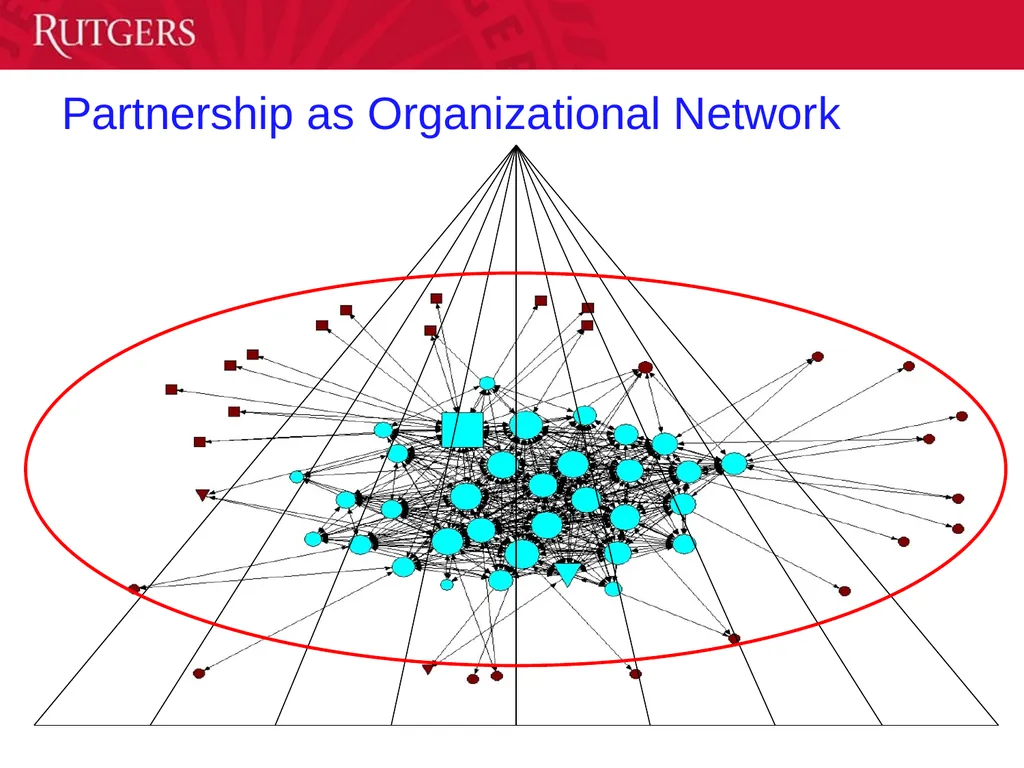
slide32. Partnership as Organizational Network<br>
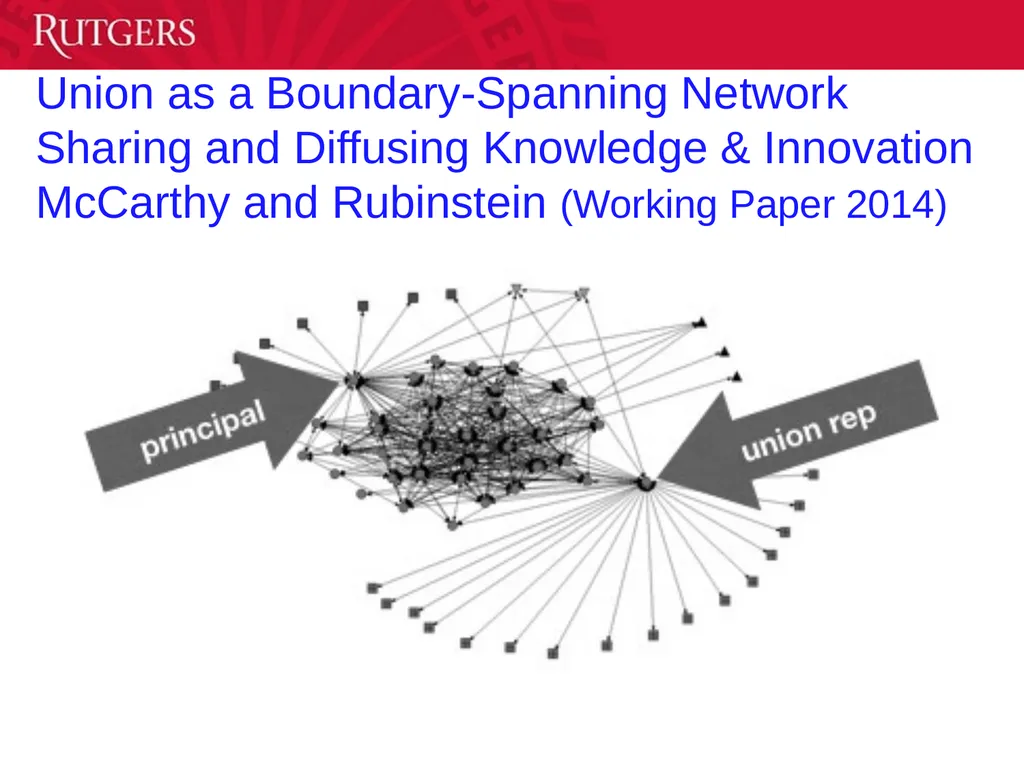
slide33. Union as a Boundary-Spanning Network Sharing and Diffusing Knowledge & Innovation McCarthy and Rubinstein (Working Paper 2014)<br>
slide34. Unions & Partnerships as Boundary-Spanning Networks for Innovation Teachers in Schools with Stronger Partnerships are More Likely to Know About & Implement Innovations from Other Schools
Unions Reps who are Better Connected to other Union Reps Facilitate this Knowledge Transfer
Knowledge Transfer Strongest when Partnership is Strong & Union Reps are Better Connected
Adds Value to Knowledge Transfer through their Contributions to Organizational Social Capital<br>
slide35. Research Findings Formal Union-Management Partnerships Improve Student Performance
Including in High Poverty Schools
Partnerships Lead to More Extensive Collaboration between Teachers
More Extensive Teacher Collaboration Improves Student Performance
Partnerships Lead to More Frequent and More Informal Communication between Union Representatives and Principals
Partnerships are Institutional Networks for Information Sharing & Diffusing Innovation<br>
slide36. Policy Implications Innovations will not diffuse, be sustained or become institutionalized without widespread support from state and federal policy.
Incentivize collaborative approaches to:
Evaluation, mentoring, professional development, common core, peer assistance and review
Create waivers/mandate relief for collaborative reform efforts
Create incentives for pilot innovations<br>
slide37. Policy Implications Need Institutional Support:
Learning Networks across districts interested in collaborative approaches linking experienced districts with inexperienced ones
State-level resources to build capacity: training, skill development, facilitation
Need state & regional conferences to demonstrate collaborative approaches to school improvement; provide technical support; & publicize examples/models of best practice
Research on innovation that works & share findings widely<br>
slide38. State-Level Initiatives Massachusetts Education Partnership
Consortium for Educational Change – Illinois
Labor-Management Initiative - California
NJ Collaborative School Leadership Network
All Stakeholders: NJEA, AFTNJ, NJ School Boards Assn, NJ Assn School Administrators, NJ Principals Assn, State Assembly & Senate, Community, Rutgers, 20+ Districts
Need to Link these Initiatives for Mutual Support and Learning<br>
slide39. Next Steps in Research Expand Study to Include More Districts
Looking at Teacher Outcomes (Turnover, Transfers, Leaving Profession)
Examine Patterns of Grade & Subject-level Collaboration and Student Performance
Examine Inter-school Networks and Collaboration including Role of Union as Network in Facilitating Adoption of Innovation across Schools
Study State-level Collaborative Efforts Questions/comments: saul.rubinstein@rutgers.edu<br>
Impact on Student Achievement
Saul Rubinstein
California Labor Management Initiative
May 9, 2015
San Diego<br>
slide2. Overview Identify Key Principles for Successful Union-Management Collaborative Partnerships
Link between Partnerships, Educator Collaboration & Student Performance
Impact of Partnerships on Union-Management Relations
Impact of Partnerships on Knowledge Transfer and Adoption of Innovation
Unions as Value-Adding Networks
Policy Implications and State Initiatives
Create a Network of Educator Collaboration Across NJ and within Districts<br>
slide3. Union-Management Partnerships and Educational Quality An Approach to Public School Reform/Improvement based on:
District-level & School-level Union- Management Collaboration
Empowering Educator Collaboration in Schools
Innovation from Educators Within Districts & Schools
Focus on Teaching and Learning<br>
slide4. .<br>
slide6. .<br>
slide7. Taylor: Mass Production Industrial Model 1913-73 S Management Labor Thinks Does Divide Complex Knowledge into Simple Parts Create Narrow Standards for Each Part Separate Classes of Employees: Thinkers & Doers Invent Management for Division of Labor & Compliance<br>
slide8. School Reform Necessitates a Shift from Mass Production Thinking & Organization Mass Production Industrial/Factory System failed:
Not responsive or flexible in face of global competition
Lacked a focus on quality & customers
Undervalued knowledge & contributions from workforce
We must reintegrate outdated industrial mass production division of labor that separates “thinking” and “doing”
Increased importance of all employees’ input:
Voice, Participation, Expertise, Empowerment
Quality of Decisions & Implementation
Employees not interchangeable parts – Professionals
Team-based structures – Group vs. Individual Focus<br>
slide9. Why Partnership? Quality of Decisions
People Closest to the Problem
Quantity of Solutions – More Resources Devoted to Improvement
Quality of Implementation – More Support
Motivation through Voice
Full Participation
Partial Participation
Pseudo Participation<br>
slide10. Institution for Conflicting Interests: Collective Bargaining U M<br>
slide11. Institution for common interests? Partnerships U M (Teaching Quality and Student Achievement)<br>
slide12. Study of Long-term Collaborative Partnerships (Rubinstein & McCarthy 2011) Urban and Rural, NEA and AFT, North and South, East and West, Wealthy and Poor
Sustained for More than 10 Years
Culture of Union-Management Collaboration
Recognition of Common Interests
Focused on strategies to improve teaching and learning
Organizational Infrastructures: Input into Planning, Problem Solving, Decision Making<br>
slide13. Common Patterns around Four Themes: Motivation to Collaborate
Strategic Priorities
Supportive System Infrastructure
Sustaining Factors<br>
slide14. Motivating Collaboration: Crisis or Pivotal Event Recognition of common interests
Crisis is here now
Overcame obstacles or pivotal events/strike
Movement away from adversarial relationships
Looked for opportunities to do things differently for teachers and students<br>
slide15. Focus on Strategic Priorities Emphasis on System Quality: Substantive Problem Solving, Innovation, & Willingness to Experiment
Curriculum, Evaluation, Peer Assistance & Review, Mentoring, Professional Development, K-12 Articulation, Cross-Disciplinary Integration, Scheduling, New Teacher Orientation, Coaching, Teaching Academies, Textbook Selection, Instructional Practice, Technology Planning
Focus on Student Learning & Performance<br>
slide16. Supportive System Infrastructure Embedded Culture of Collaboration & Inclusion
Organization & Systems Change not a Program
Collaborative Structures at District & School-levels
Joint Building-level Teams, School Improvement Committees, Leadership Teams, Grade-level & Department Teams
Shared Decision Making, Management & Effective Implementation
Joint Learning Opportunities
Dense Internal Organizing by Partnership as a Quality Network<br>
slide17. Sustaining Factors Community engagement
Support from board of education
Long-term strong leadership
Internal labor markets – promotion from within
Leadership development
Succession planning
Support from national union
Supportive contract language<br>
slide18. Key Elements of Partnerships Aligned Interests
Culture of Collaboration
Strategic Focus on Teaching and Learning
Organizational Structures District & School-Levels
Training & Capacity Building
Strong Leadership, Development & Succession Planning
Community and School Board as Partners<br>
slide19. Partnership as a Structure to Find Solutions and Implement Them Tests Show Gaps but Not How to Fill Them
Partnerships are Based on Creating Solutions
Focus on Organizational Systems
Education System as a Collective Enterprise Not an Individual Practice, and the Union is Central to the Network of Teachers
Improvement is Team-based not Individual
Human Capital = Skills; Social Capital = Relationships<br>
slide20. Union-Management Partnerships as an Antecedents to Educator Collaboration Partnerships are potential catalysts/antecedents to professional collaboration in public schools.
Partnerships build educator social capital.<br>
slide21. How Unions Add Value: Create a positive climate for partnering with administration.
Natural networks that can foster collaboration among members.
Provide democratic representation that builds trust.
Create infrastructures with administrators for problem solving and effective implementation.
Direct more resources toward Improvement
Enhance communication & information Sharing.<br>
slide22. Implications for Locals & Districts Engaging in Partnerships Partnership as a vehicle, not an end in itself
Management as a task not class of employees
Balance representation and partnership roles/management
Rethinking Local Structures & Roles & Resources
Mobilize & Internally Organize Members
Capacity Building/Training: Collaboration, Problem Identification, Joint Decision Making, Problem Solving, Planning, Implementation, Team Building<br>
slide23. 30 schools, 1100 Educators, 21,000 Students
46% of Students Qualify for Reduced/Free Lunch
25% of Students English Language Learners
Long-term Union-Management Partnership
California Academic Performance Index (API) Data (2011-2012)
Standardized Tests in Math, English, Social Studies, Science
Graduation & Drop Out Rates
School Climate/Partnership Survey (2011)
Social Network Data (2011)
Social Capital vs. Human Capital ABC Unified School District/ABC Federation of Teachers
(Rubinstein & McCarthy 2014)<br>
slide24. Statistically Significant: P< .01
Controls for SES
Explains 54% of Variation in API Improvement<br>
slide25. Partnership and Performance Statistically Significant Association between Partnership, API Performance in 2012 & Improvement
Partnership Factor Can Account for 76 Points on 2012 API – Moving from 1(Low) to 4(High)
1% Decrease in Poverty Increases API by 2.23 Points – 223 Points Moving from 100% to 0
ABC has average Poverty rate of 45.5% (Free/Reduced Lunch), so Eliminating Poverty in District would Increase API by 101 Points Partnership Quality Leads to Performance Improvement<br>
slide26. Partnership Quality is Associated with Greater School Level Teacher Communications on: Student Performance Data
Curriculum Development, Cross-Subject Integration or Grade-to-Grade Articulation
Sharing, Advising and Learning about Instructional Practices
Giving or Receiving Formal or Informal Mentoring<br>
slide27. Partnership Quality and Density of School Communications<br>
slide28. School Network Communication Density is Associated with Student Performance 2012 & Improvement from 2011 to 2012 Moving from a school communication density of 17% to 30% is associated with an increase of 9 API Points
Moving from a school communication density of 17% to 69% is associated with an increase of 36 API Points<br>
slide29. Middle School with Density of 69%<br>
slide30. Communication Frequencies: Union Building Reps and Principals by High and Low Partnership Schools<br>
slide31. Communication Formality: Union Building Reps and Principals by High and Low Partnership Schools<br>
slide32. Partnership as Organizational Network<br>
slide33. Union as a Boundary-Spanning Network Sharing and Diffusing Knowledge & Innovation McCarthy and Rubinstein (Working Paper 2014)<br>
slide34. Unions & Partnerships as Boundary-Spanning Networks for Innovation Teachers in Schools with Stronger Partnerships are More Likely to Know About & Implement Innovations from Other Schools
Unions Reps who are Better Connected to other Union Reps Facilitate this Knowledge Transfer
Knowledge Transfer Strongest when Partnership is Strong & Union Reps are Better Connected
Adds Value to Knowledge Transfer through their Contributions to Organizational Social Capital<br>
slide35. Research Findings Formal Union-Management Partnerships Improve Student Performance
Including in High Poverty Schools
Partnerships Lead to More Extensive Collaboration between Teachers
More Extensive Teacher Collaboration Improves Student Performance
Partnerships Lead to More Frequent and More Informal Communication between Union Representatives and Principals
Partnerships are Institutional Networks for Information Sharing & Diffusing Innovation<br>
slide36. Policy Implications Innovations will not diffuse, be sustained or become institutionalized without widespread support from state and federal policy.
Incentivize collaborative approaches to:
Evaluation, mentoring, professional development, common core, peer assistance and review
Create waivers/mandate relief for collaborative reform efforts
Create incentives for pilot innovations<br>
slide37. Policy Implications Need Institutional Support:
Learning Networks across districts interested in collaborative approaches linking experienced districts with inexperienced ones
State-level resources to build capacity: training, skill development, facilitation
Need state & regional conferences to demonstrate collaborative approaches to school improvement; provide technical support; & publicize examples/models of best practice
Research on innovation that works & share findings widely<br>
slide38. State-Level Initiatives Massachusetts Education Partnership
Consortium for Educational Change – Illinois
Labor-Management Initiative - California
NJ Collaborative School Leadership Network
All Stakeholders: NJEA, AFTNJ, NJ School Boards Assn, NJ Assn School Administrators, NJ Principals Assn, State Assembly & Senate, Community, Rutgers, 20+ Districts
Need to Link these Initiatives for Mutual Support and Learning<br>
slide39. Next Steps in Research Expand Study to Include More Districts
Looking at Teacher Outcomes (Turnover, Transfers, Leaving Profession)
Examine Patterns of Grade & Subject-level Collaboration and Student Performance
Examine Inter-school Networks and Collaboration including Role of Union as Network in Facilitating Adoption of Innovation across Schools
Study State-level Collaborative Efforts Questions/comments: saul.rubinstein@rutgers.edu<br>