
Laboratory process improvement for identification
KB
Published · 30 slides · 0 views
1 / 1


Description
Laboratory process improvement for identification of Anti-M Kate Walsh, SMS, RCI Overview of presentation Background of Anti-M Interesting Scientific Papers The Anti-M problem! How we currently manage Anti-M in RCI Why review? Proposed
Related Topics
Share
Embed code
Download this presentation From Below
"Laboratory process improvement for identification" is the property of its rightful owner. Permission is granted to download and print the materials on this website for personal, non-commercial use only, and to display it on your personal computer provided you do not modify the materials and that you retain all copyright notices contained in the materials. By downloading content from our website, you accept the terms of this agreement.
Presentation Transcript
01
Laboratory process improvement for identification of Anti-M Kate Walsh, SMS, RCI<br>
02
Overview of presentation Background of Anti-M
Interesting Scientific Papers
The Anti-M problem!
How we currently manage Anti-M in RCI
Why review?
Proposed changes
Results
Proposed report<br>
Interesting Scientific Papers
The Anti-M problem!
How we currently manage Anti-M in RCI
Why review?
Proposed changes
Results
Proposed report<br>
03
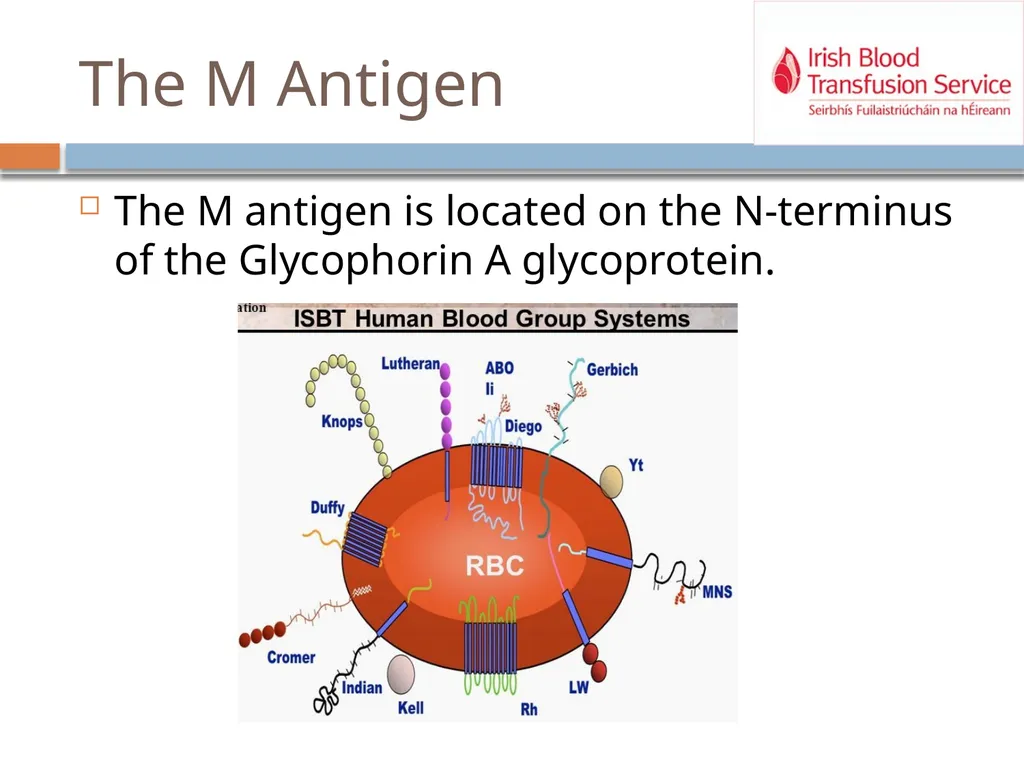
The M Antigen The M antigen is located on the N-terminus of the Glycophorin A glycoprotein.<br>
04
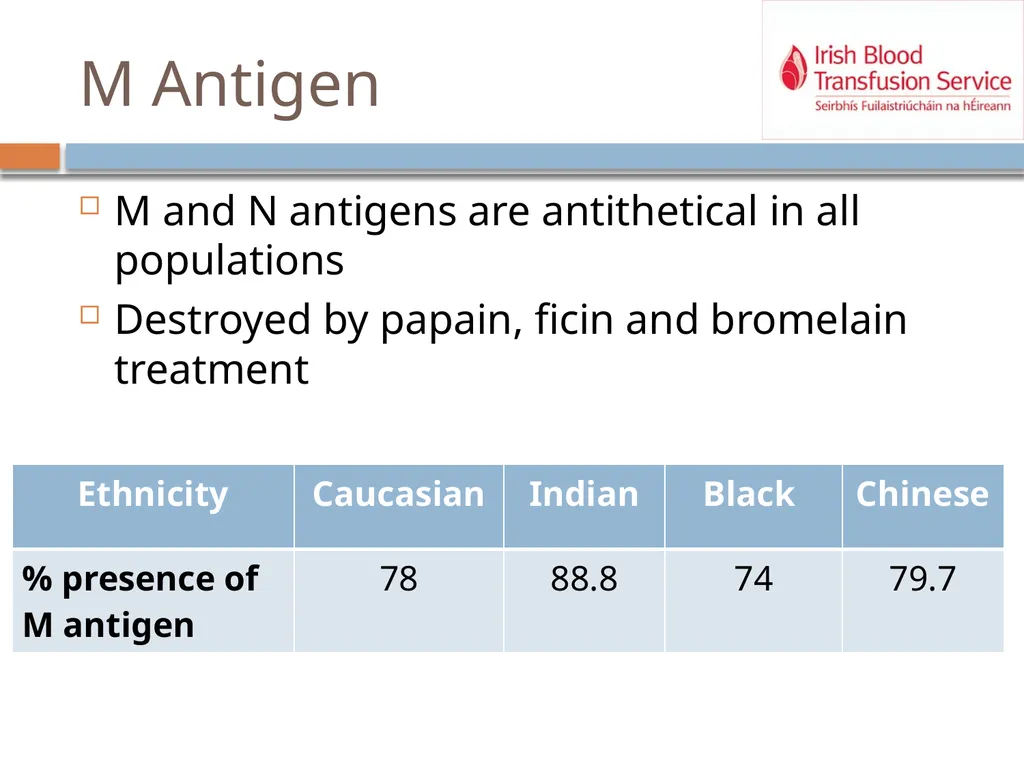
M Antigen M and N antigens are antithetical in all populations
Destroyed by papain, ficin and bromelain treatment
Prevalence :<br>
Destroyed by papain, ficin and bromelain treatment
Prevalence :<br>
05
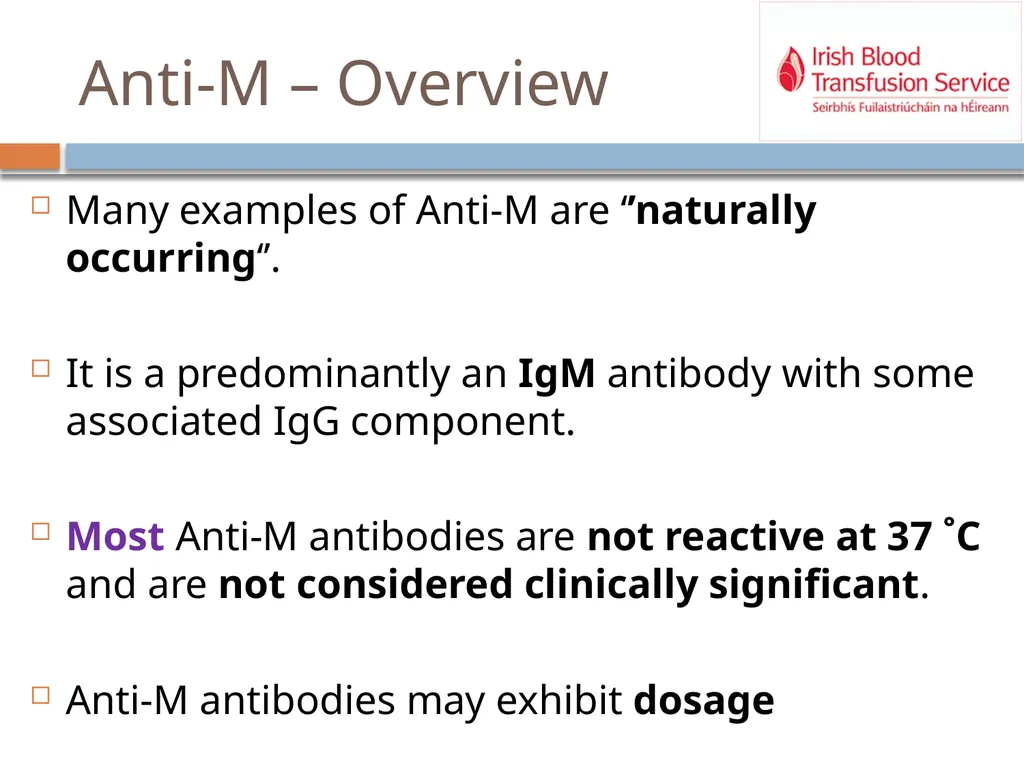
Anti-M – Overview Many examples of Anti-M are ‘’naturally occurring‘’.
It is a predominantly an IgM antibody with some associated IgG component.
Most Anti-M antibodies are not reactive at 37 ˚C and are not considered clinically significant.
Anti-M antibodies may exhibit dosage<br>
It is a predominantly an IgM antibody with some associated IgG component.
Most Anti-M antibodies are not reactive at 37 ˚C and are not considered clinically significant.
Anti-M antibodies may exhibit dosage<br>
06
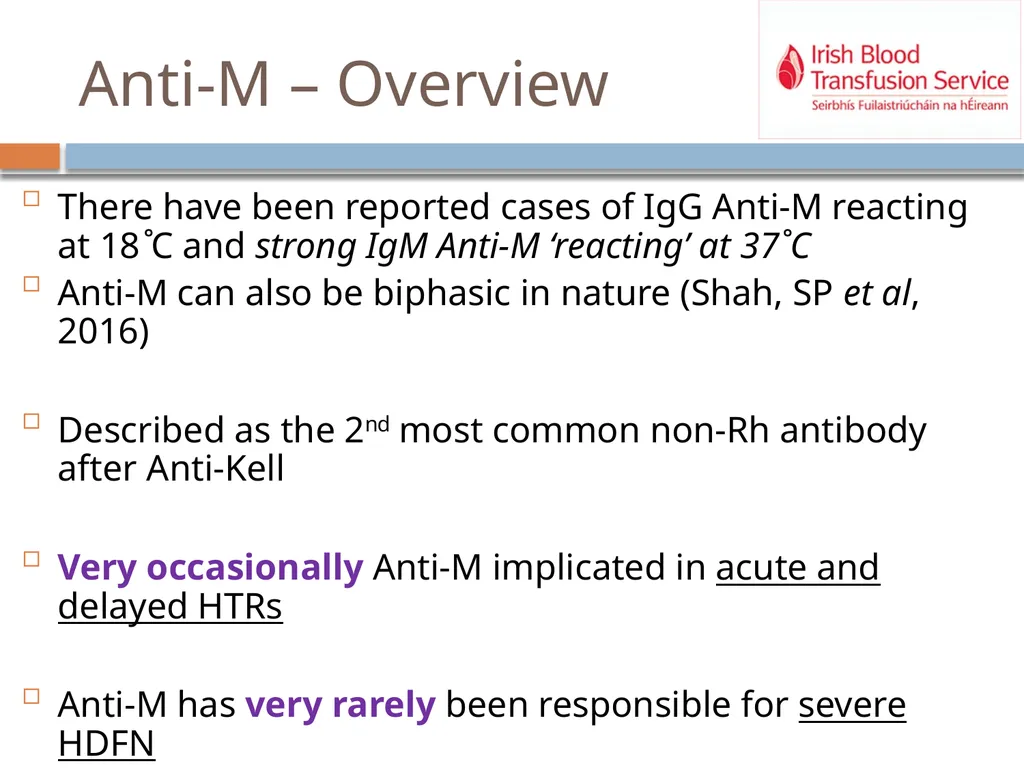
Anti-M – Overview There have been reported cases of IgG Anti-M reacting at 18˚C and strong IgM Anti-M ‘reacting’ at 37˚C
Anti-M can also be biphasic in nature (Shah, SP et al, 2016)
Described as the 2nd most common non-Rh antibody after Anti-Kell
Very occasionally Anti-M implicated in acute and delayed HTRs
Anti-M has very rarely been responsible for severe HDFN<br>
Anti-M can also be biphasic in nature (Shah, SP et al, 2016)
Described as the 2nd most common non-Rh antibody after Anti-Kell
Very occasionally Anti-M implicated in acute and delayed HTRs
Anti-M has very rarely been responsible for severe HDFN<br>
07
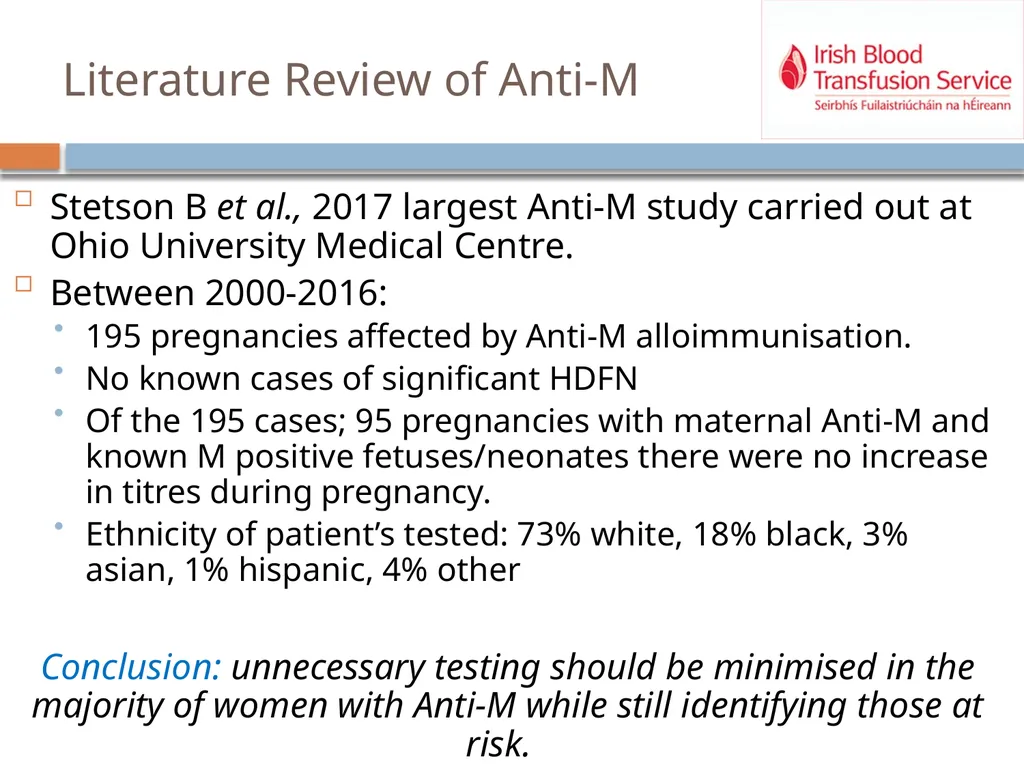
Literature Review of Anti-M Stetson B et al., 2017 largest Anti-M study carried out at Ohio University Medical Centre.
Between 2000-2016:
195 pregnancies affected by Anti-M alloimmunisation.
No known cases of significant HDFN
Of the 195 cases; 95 pregnancies with maternal Anti-M and known M positive fetuses/neonates there were no increase in titres during pregnancy.
Ethnicity of patient’s tested: 73% white, 18% black, 3% asian, 1% hispanic, 4% other
Conclusion: unnecessary testing should be minimised in the majority of women with Anti-M while still identifying those at risk.<br>
Between 2000-2016:
195 pregnancies affected by Anti-M alloimmunisation.
No known cases of significant HDFN
Of the 195 cases; 95 pregnancies with maternal Anti-M and known M positive fetuses/neonates there were no increase in titres during pregnancy.
Ethnicity of patient’s tested: 73% white, 18% black, 3% asian, 1% hispanic, 4% other
Conclusion: unnecessary testing should be minimised in the majority of women with Anti-M while still identifying those at risk.<br>
08
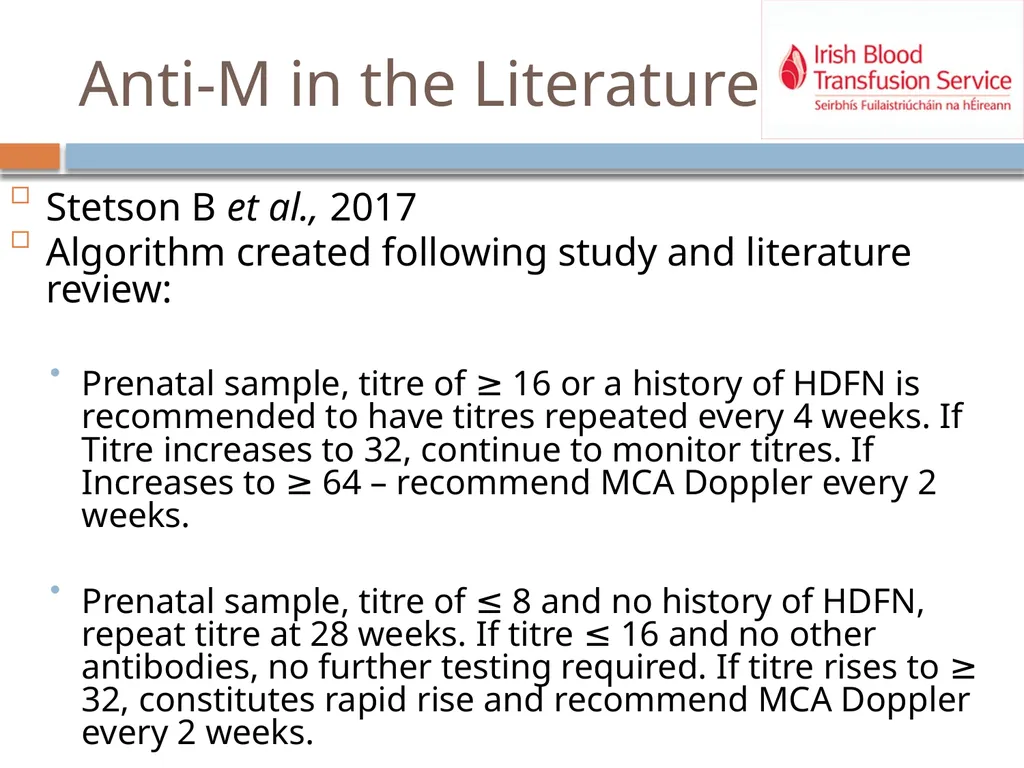
Anti-M in the Literature Stetson B et al., 2017
Algorithm created following study and literature review:
Prenatal sample, titre of ≥ 16 or a history of HDFN is recommended to have titres repeated every 4 weeks. If Titre increases to 32, continue to monitor titres. If Increases to ≥ 64 – recommend MCA Doppler every 2 weeks.
Prenatal sample, titre of ≤ 8 and no history of HDFN, repeat titre at 28 weeks. If titre ≤ 16 and no other antibodies, no further testing required. If titre rises to ≥ 32, constitutes rapid rise and recommend MCA Doppler every 2 weeks.<br>
Algorithm created following study and literature review:
Prenatal sample, titre of ≥ 16 or a history of HDFN is recommended to have titres repeated every 4 weeks. If Titre increases to 32, continue to monitor titres. If Increases to ≥ 64 – recommend MCA Doppler every 2 weeks.
Prenatal sample, titre of ≤ 8 and no history of HDFN, repeat titre at 28 weeks. If titre ≤ 16 and no other antibodies, no further testing required. If titre rises to ≥ 32, constitutes rapid rise and recommend MCA Doppler every 2 weeks.<br>
09
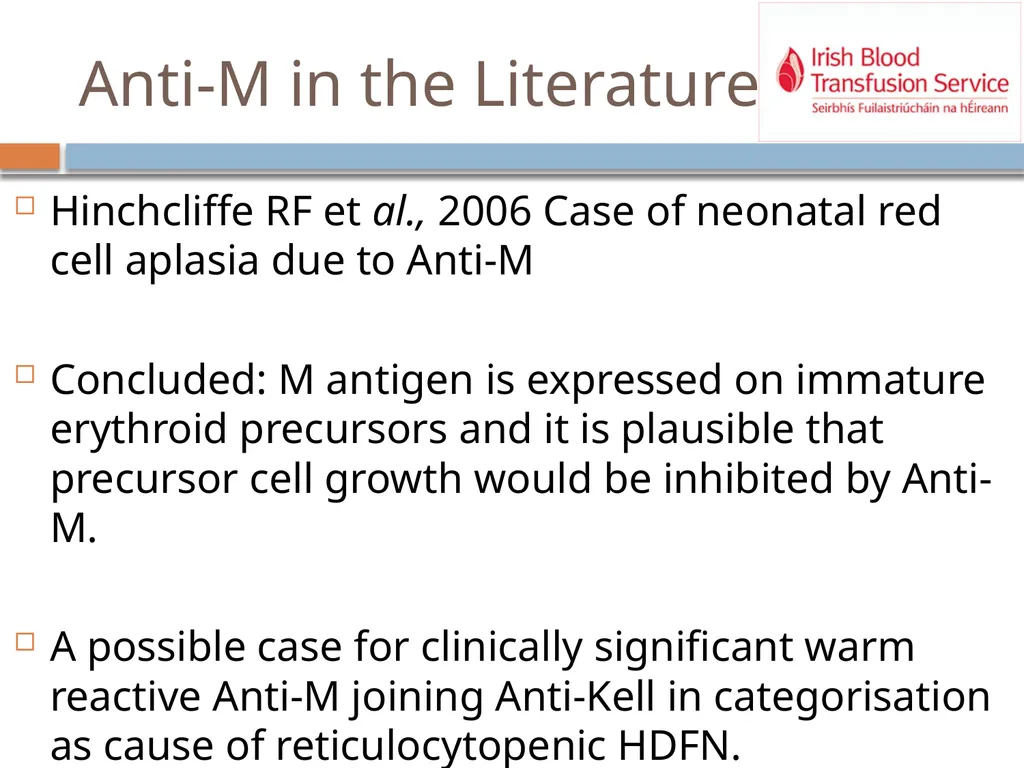
Anti-M in the Literature Hinchcliffe RF et al., 2006 Case of neonatal red cell aplasia due to Anti-M
Concluded: M antigen is expressed on immature erythroid precursors and it is plausible that precursor cell growth would be inhibited by Anti-M.
A possible case for clinically significant warm reactive Anti-M joining Anti-Kell in categorisation as cause of reticulocytopenic HDFN.<br>
Concluded: M antigen is expressed on immature erythroid precursors and it is plausible that precursor cell growth would be inhibited by Anti-M.
A possible case for clinically significant warm reactive Anti-M joining Anti-Kell in categorisation as cause of reticulocytopenic HDFN.<br>
10
Anti-M in the literature Hiroyasu, Y et al., 2014
Review of Japanese literature in relation to HDFN caused by Anti-M antibodies.
Reported 34 cases of mild to fatal HDFN in Japan from 1975-2012
Most requiring therapeutic intervention.
Not comparable to the rare account of Anti-M induced HDFN in the Stetson B et al., 2017. However only 4 patients were Asian!
Posited that it’s possible genetic markers linked to race affect the immune response to eythrocyte alloantigens.<br>
Review of Japanese literature in relation to HDFN caused by Anti-M antibodies.
Reported 34 cases of mild to fatal HDFN in Japan from 1975-2012
Most requiring therapeutic intervention.
Not comparable to the rare account of Anti-M induced HDFN in the Stetson B et al., 2017. However only 4 patients were Asian!
Posited that it’s possible genetic markers linked to race affect the immune response to eythrocyte alloantigens.<br>
11
Anti-M in the literature Hiroyasu, Y et al., 2014 (Japanese)
29 infants with HDFN due to Anti-M reviewed
8/10 infants with severe HDFN had maternal titres of ≤16 at delivery.
Supports the theory that Anti-M may cause anaemia due to both destruction of fetals RBCs and suppression of erythropoesis. Should we consider ETHNICITY
when dealing with
Anti-M??<br>
29 infants with HDFN due to Anti-M reviewed
8/10 infants with severe HDFN had maternal titres of ≤16 at delivery.
Supports the theory that Anti-M may cause anaemia due to both destruction of fetals RBCs and suppression of erythropoesis. Should we consider ETHNICITY
when dealing with
Anti-M??<br>
12
Anti-M in the literature 3 papers detailing clinically significant Anti-M antibodies, from 2012, 2014 and 2015- all from India!
Gagandeep K et al., 2012
Discussed the potential for falsely identified clinically significant 37°C Anti-M.
high-titre
high-affinity
reacting very strongly at room temperature
Misinterpreted Anti-M as the tubes reactants were allowed to cool after centrifugation and prior to reading.<br>
Gagandeep K et al., 2012
Discussed the potential for falsely identified clinically significant 37°C Anti-M.
high-titre
high-affinity
reacting very strongly at room temperature
Misinterpreted Anti-M as the tubes reactants were allowed to cool after centrifugation and prior to reading.<br>
13
Anti-M in the literature Makroo, RN et al., 2014
84% of Anti-M antibodies were of IgG class, or possessing an IgG component
causing reactivity @37°C and thus potentially clinically significant.
Determining thermal amplitude of Anti-M
2 papers used: DTT treatment (IgG / IgM) of patient’s plasma
1 paper used: 37˚ C tube technique<br>
84% of Anti-M antibodies were of IgG class, or possessing an IgG component
causing reactivity @37°C and thus potentially clinically significant.
Determining thermal amplitude of Anti-M
2 papers used: DTT treatment (IgG / IgM) of patient’s plasma
1 paper used: 37˚ C tube technique<br>
14
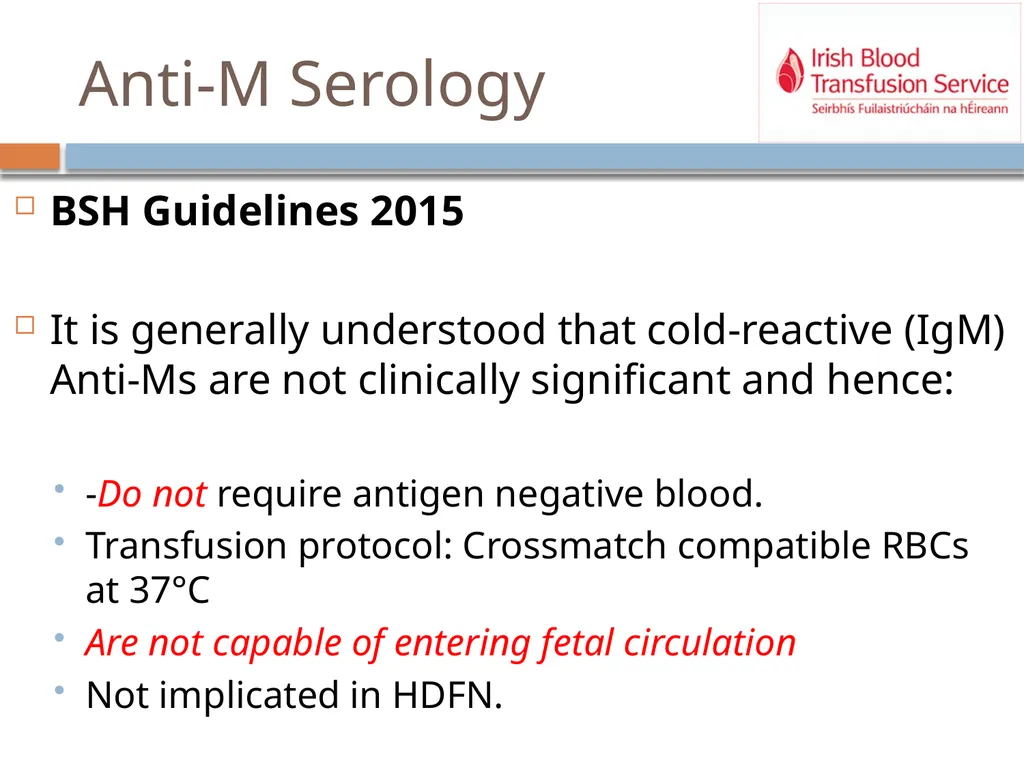
Anti-M Serology BSH Guidelines 2015
It is generally understood that cold-reactive (IgM) Anti-Ms are not clinically significant and hence:
-Do not require antigen negative blood.
Transfusion protocol: Crossmatch compatible RBCs at 37°C
Are not capable of entering fetal circulation
Not implicated in HDFN.<br>
It is generally understood that cold-reactive (IgM) Anti-Ms are not clinically significant and hence:
-Do not require antigen negative blood.
Transfusion protocol: Crossmatch compatible RBCs at 37°C
Are not capable of entering fetal circulation
Not implicated in HDFN.<br>
15
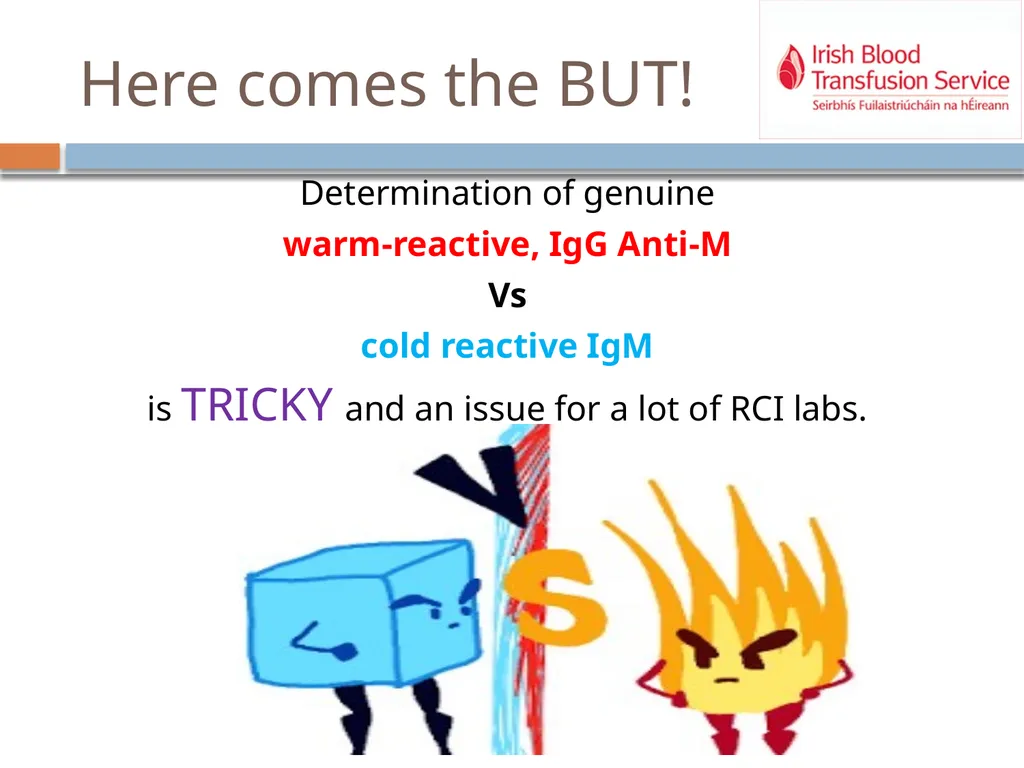
Here comes the BUT! Determination of genuine
warm-reactive, IgG Anti-M
Vs
cold reactive IgM
is TRICKY and an issue for a lot of RCI labs.<br>
warm-reactive, IgG Anti-M
Vs
cold reactive IgM
is TRICKY and an issue for a lot of RCI labs.<br>
16
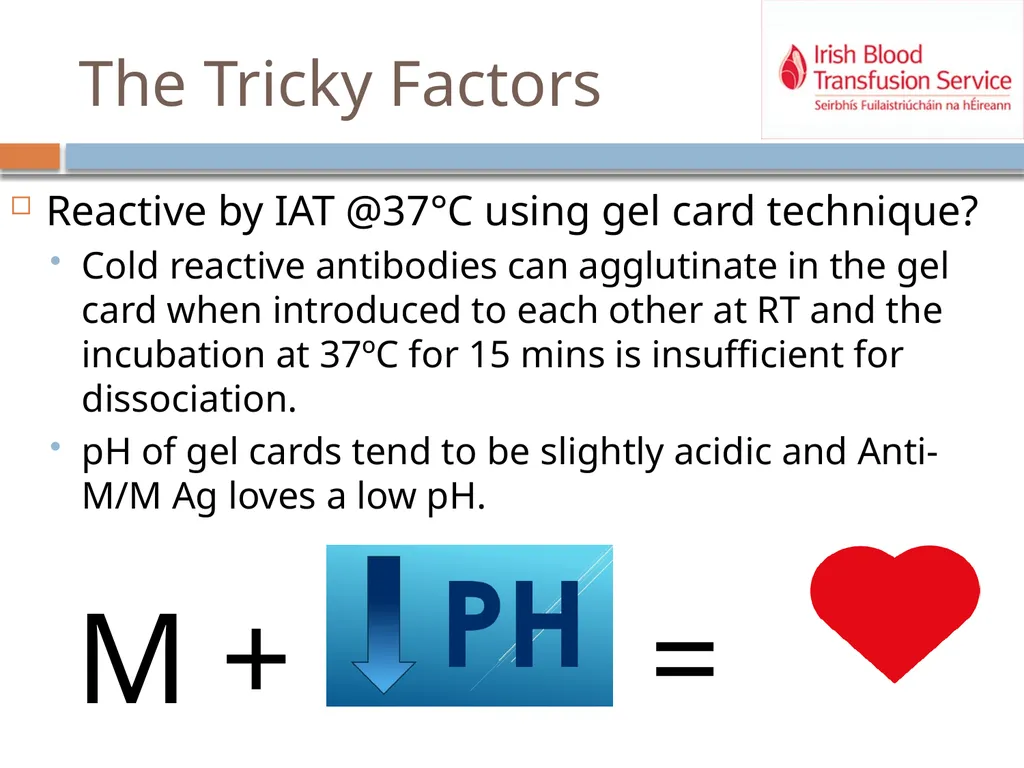
The Tricky Factors Reactive by IAT @37°C using gel card technique?
Cold reactive antibodies can agglutinate in the gel card when introduced to each other at RT and the incubation at 37ºC for 15 mins is insufficient for dissociation.
pH of gel cards tend to be slightly acidic and Anti-M/M Ag loves a low pH.
M + =<br>
Cold reactive antibodies can agglutinate in the gel card when introduced to each other at RT and the incubation at 37ºC for 15 mins is insufficient for dissociation.
pH of gel cards tend to be slightly acidic and Anti-M/M Ag loves a low pH.
M + =<br>
17
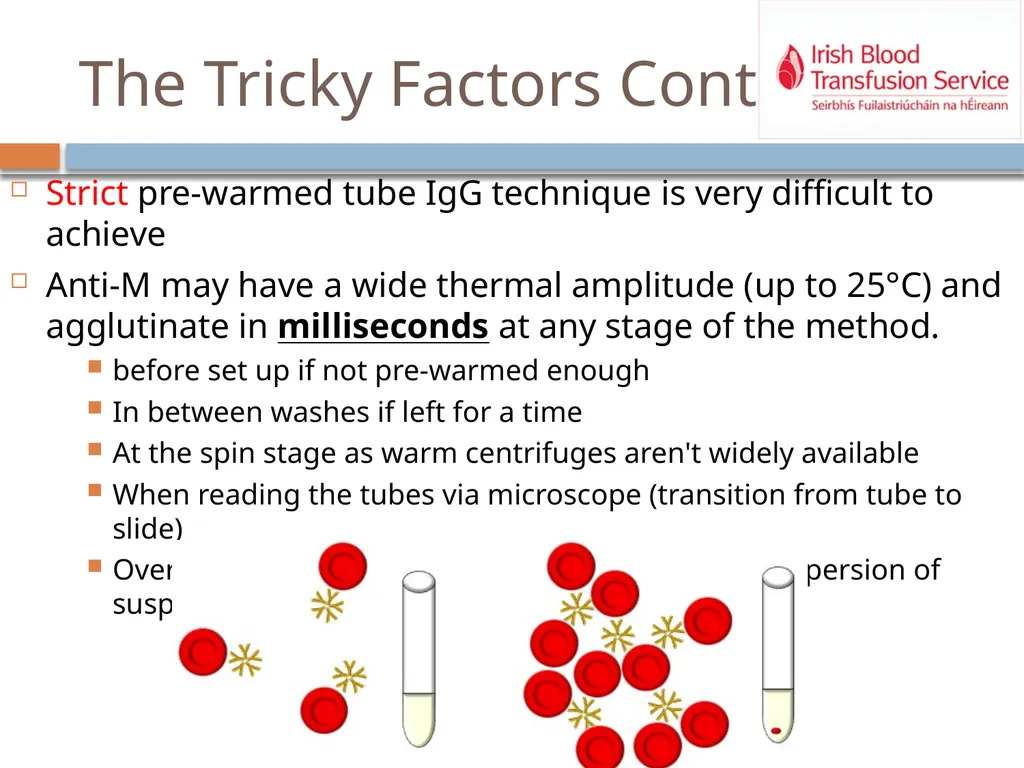
The Tricky Factors Cont. Strict pre-warmed tube IgG technique is very difficult to achieve
Anti-M may have a wide thermal amplitude (up to 25°C) and agglutinate in milliseconds at any stage of the method.
before set up if not pre-warmed enough
In between washes if left for a time
At the spin stage as warm centrifuges aren't widely available
When reading the tubes via microscope (transition from tube to slide)
Over-reading macroscopically due to insufficient dispersion of suspension<br>
Anti-M may have a wide thermal amplitude (up to 25°C) and agglutinate in milliseconds at any stage of the method.
before set up if not pre-warmed enough
In between washes if left for a time
At the spin stage as warm centrifuges aren't widely available
When reading the tubes via microscope (transition from tube to slide)
Over-reading macroscopically due to insufficient dispersion of suspension<br>
18
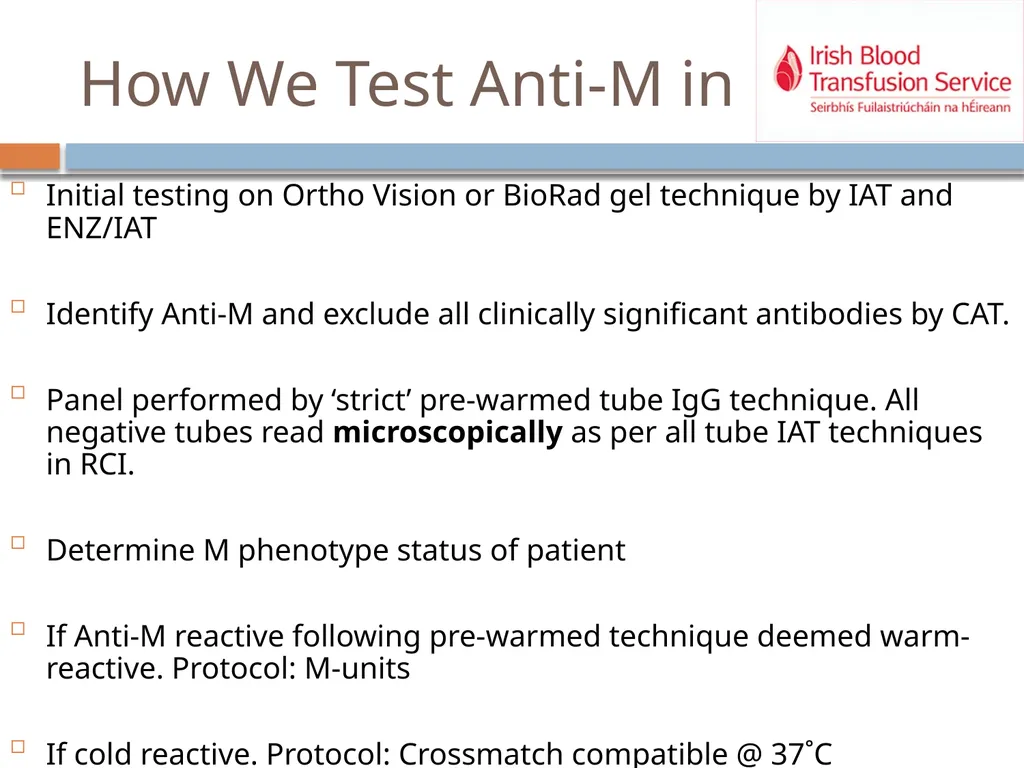
How We Test Anti-M in RCI Initial testing on Ortho Vision or BioRad gel technique by IAT and ENZ/IAT
Identify Anti-M and exclude all clinically significant antibodies by CAT.
Panel performed by ‘strict’ pre-warmed tube IgG technique. All negative tubes read microscopically as per all tube IAT techniques in RCI.
Determine M phenotype status of patient
If Anti-M reactive following pre-warmed technique deemed warm-reactive. Protocol: M-units
If cold reactive. Protocol: Crossmatch compatible @ 37˚C<br>
Identify Anti-M and exclude all clinically significant antibodies by CAT.
Panel performed by ‘strict’ pre-warmed tube IgG technique. All negative tubes read microscopically as per all tube IAT techniques in RCI.
Determine M phenotype status of patient
If Anti-M reactive following pre-warmed technique deemed warm-reactive. Protocol: M-units
If cold reactive. Protocol: Crossmatch compatible @ 37˚C<br>
19
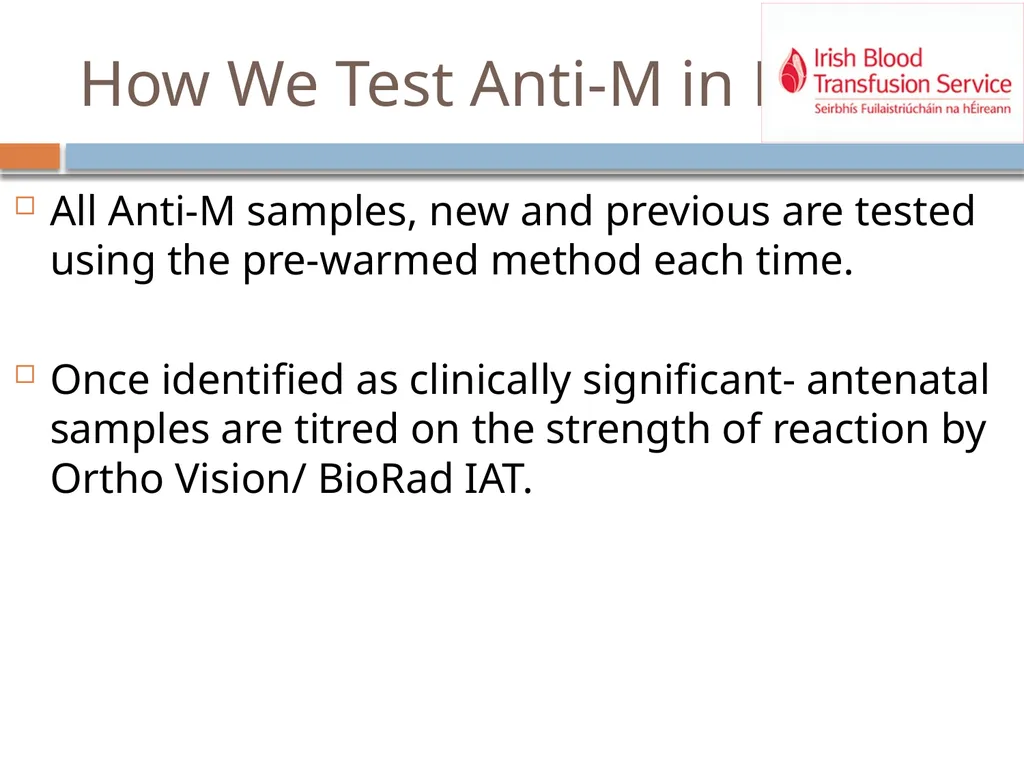
How We Test Anti-M in RCI All Anti-M samples, new and previous are tested using the pre-warmed method each time.
Once identified as clinically significant- antenatal samples are titred on the strength of reaction by Ortho Vision/ BioRad IAT.<br>
Once identified as clinically significant- antenatal samples are titred on the strength of reaction by Ortho Vision/ BioRad IAT.<br>
20
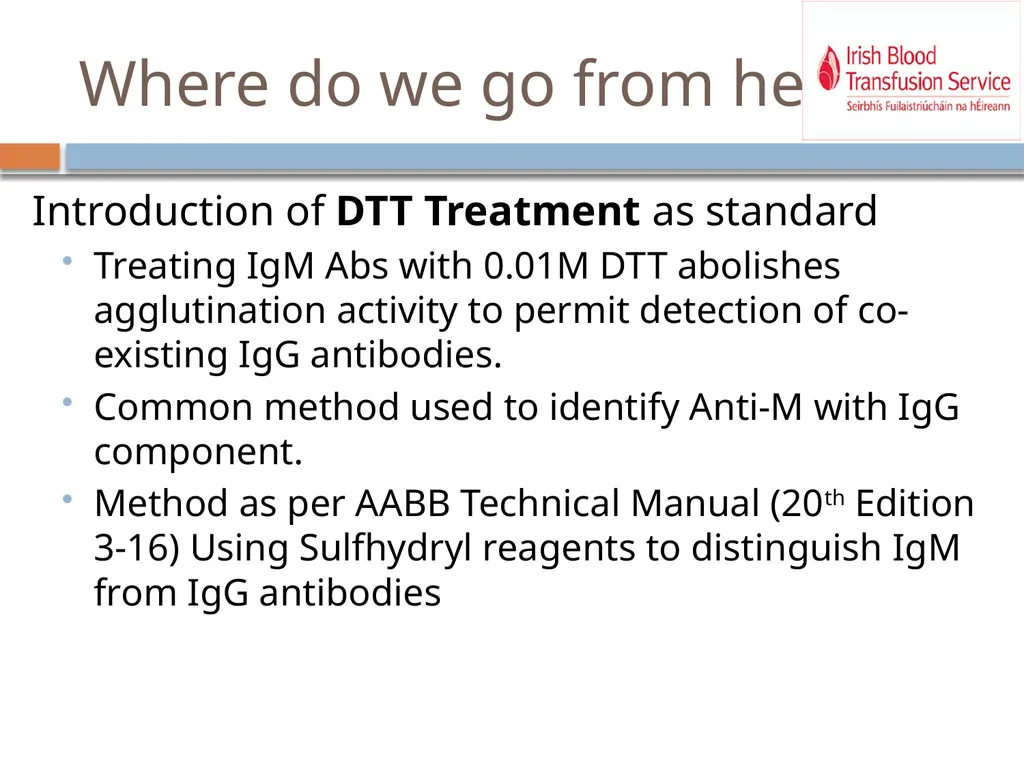
Where do we go from here? Introduction of DTT Treatment as standard
Treating IgM Abs with 0.01M DTT abolishes agglutination activity to permit detection of co-existing IgG antibodies.
Common method used to identify Anti-M with IgG component.
Method as per AABB Technical Manual (20th Edition 3-16) Using Sulfhydryl reagents to distinguish IgM from IgG antibodies<br>
Treating IgM Abs with 0.01M DTT abolishes agglutination activity to permit detection of co-existing IgG antibodies.
Common method used to identify Anti-M with IgG component.
Method as per AABB Technical Manual (20th Edition 3-16) Using Sulfhydryl reagents to distinguish IgM from IgG antibodies<br>
21
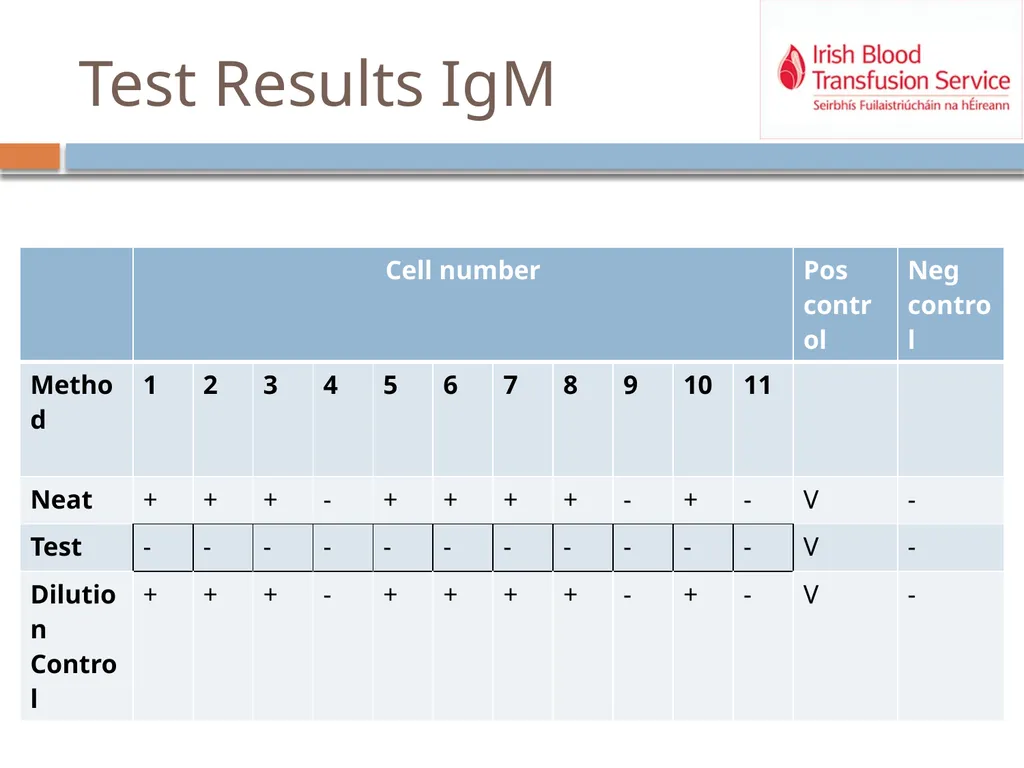
Test Results IgM<br>
22
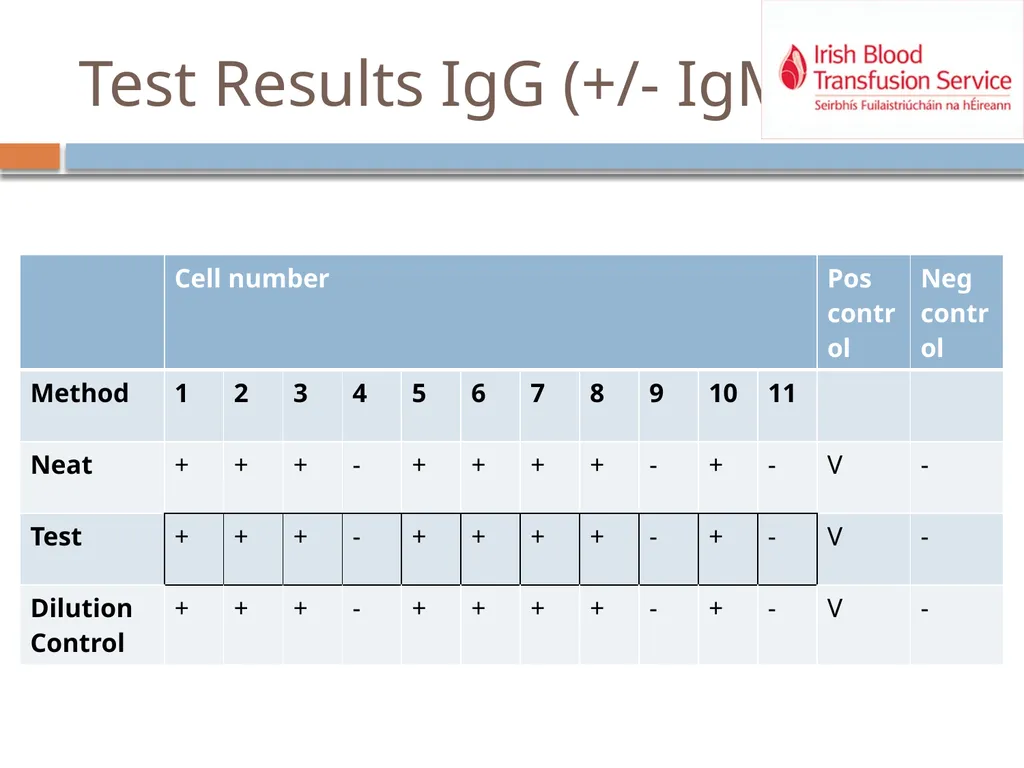
Test Results IgG (+/- IgM)<br>
23
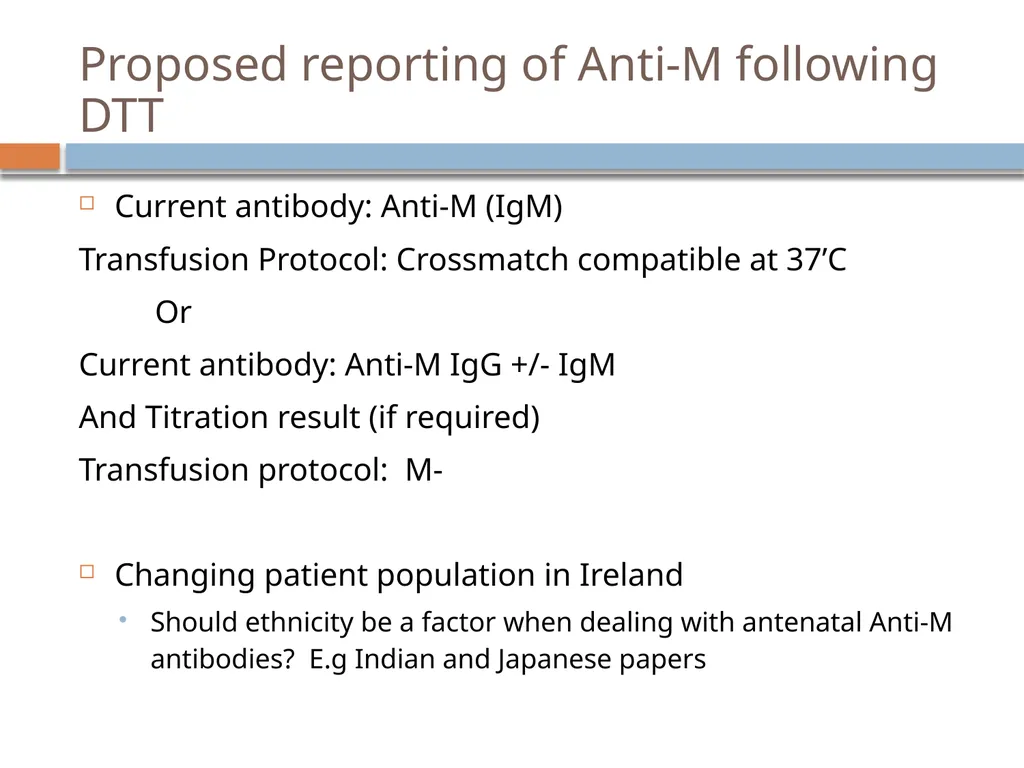
Proposed reporting of Anti-M following DTT Current antibody: Anti-M (IgM)
Transfusion Protocol: Crossmatch compatible at 37’C
Or
Current antibody: Anti-M IgG +/- IgM
And Titration result (if required)
Transfusion protocol: M-
Changing patient population in Ireland
Should ethnicity be a factor when dealing with antenatal Anti-M antibodies? E.g Indian and Japanese papers<br>
Transfusion Protocol: Crossmatch compatible at 37’C
Or
Current antibody: Anti-M IgG +/- IgM
And Titration result (if required)
Transfusion protocol: M-
Changing patient population in Ireland
Should ethnicity be a factor when dealing with antenatal Anti-M antibodies? E.g Indian and Japanese papers<br>
24
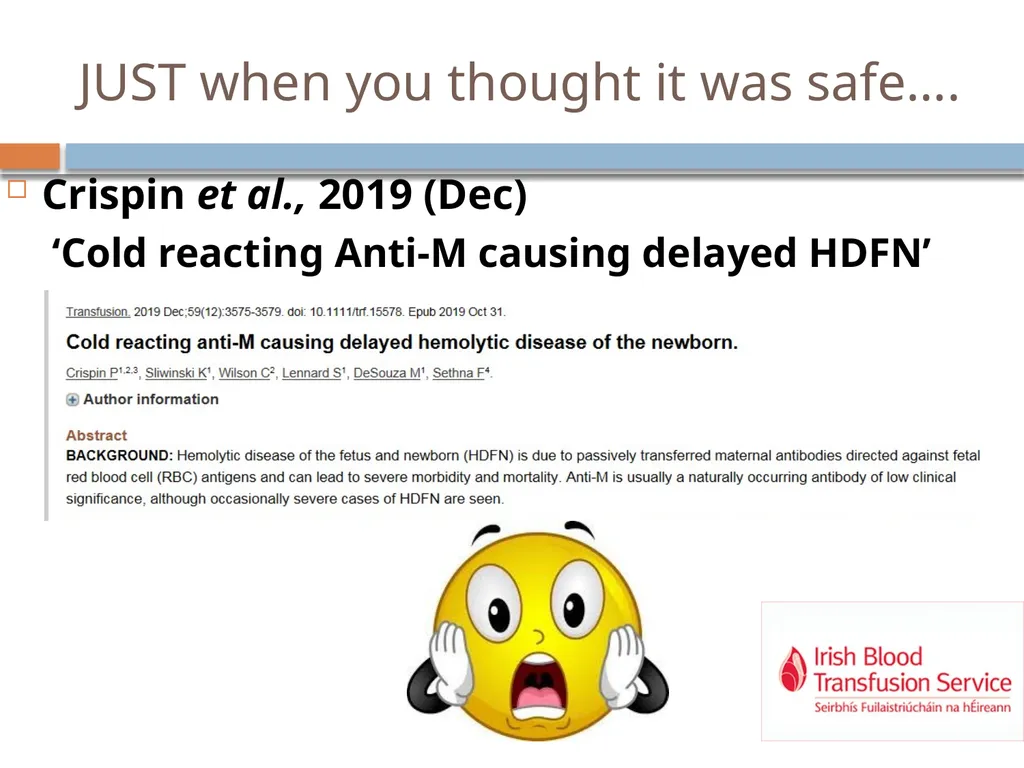
JUST when you thought it was safe…. Crispin et al., 2019 (Dec)
‘Cold reacting Anti-M causing delayed HDFN’<br>
‘Cold reacting Anti-M causing delayed HDFN’<br>
25
JUST when you thought it was safe… Crispin et al.,
Patient’s second pregnancy, Anti-M detected by direct saline tube @ 4˚C, RT and 37˚C.
35 weeks gestation titre results: 6 @37 ˚C , 32 @4˚C
Fetal assessment: Normal
Cord blood DAT: positive
Eluate: Anti-M and Anti-D (prophylactic)
Fetal Hb dropped in the first week, with significant anaemia (63g/L) after discharge.
Baby re-admitted for transfusion twice.
4 months old, Hb normalised.<br>
Patient’s second pregnancy, Anti-M detected by direct saline tube @ 4˚C, RT and 37˚C.
35 weeks gestation titre results: 6 @37 ˚C , 32 @4˚C
Fetal assessment: Normal
Cord blood DAT: positive
Eluate: Anti-M and Anti-D (prophylactic)
Fetal Hb dropped in the first week, with significant anaemia (63g/L) after discharge.
Baby re-admitted for transfusion twice.
4 months old, Hb normalised.<br>
26
JUST when you thought it was safe… Explanations proposed:
Anti IgG Anti-M crossed the placenta and caused cold-agglutination.
OR
IgM Anti-M crossed the placenta. Large IgM structure linked to strong saline agglutination seen with this antibody-BUT also limits the ability to cross the placenta.
OR
Haemolysis was due to an undetected antibody to low incidence antigen<br>
Anti IgG Anti-M crossed the placenta and caused cold-agglutination.
OR
IgM Anti-M crossed the placenta. Large IgM structure linked to strong saline agglutination seen with this antibody-BUT also limits the ability to cross the placenta.
OR
Haemolysis was due to an undetected antibody to low incidence antigen<br>
27
However the Anti-M wasn’t tested using either DTT treatment or pre-warmed tube IgG
So it supports the argument that accurately identifying the IgG/IgM status of anti-M is both tricky and clinically important!
However, the use of DTT for IgG/ IgM classification is more robust than tube technique.<br>
So it supports the argument that accurately identifying the IgG/IgM status of anti-M is both tricky and clinically important!
However, the use of DTT for IgG/ IgM classification is more robust than tube technique.<br>
28
References Roback, J. (2011). Technical manual. Bethesda, Md.: AABB
Makroo R N, Bhatia A, Gupta R, Phillip J. Prevalence of Rh, Duffy, Kell, Kidd & MNSs blood group antigens in the Indian blood donor population. Indian J Med Res 2013;137:521-6
Clarke G, Côté J, Lane D. MNS System: Anti-M [Internet]. Ottawa: Canadian Blood Services; 2019 Oct 9 [09-01-2020].
Stetson B, Scrape S, Markham KB. Anti-M Alloimmunization: Management and Outcome at a Single Institution. AJP Rep. 2017;7(4):e205–e210.
Tondon R, Kataria R, Chaudhry R. Anti-M: Report of two cases and review of literature. Asian J Transfus Sci. 2008;2(2):81–83.
Makroo RN, Arora B, Bhatia A, Chowdhry M, Luka RN. Clinical significance of antibody specificities to M, N and Lewis blood group system . Asian J Transfus Sci 2014;8:96-9<br>
Makroo R N, Bhatia A, Gupta R, Phillip J. Prevalence of Rh, Duffy, Kell, Kidd & MNSs blood group antigens in the Indian blood donor population. Indian J Med Res 2013;137:521-6
Clarke G, Côté J, Lane D. MNS System: Anti-M [Internet]. Ottawa: Canadian Blood Services; 2019 Oct 9 [09-01-2020].
Stetson B, Scrape S, Markham KB. Anti-M Alloimmunization: Management and Outcome at a Single Institution. AJP Rep. 2017;7(4):e205–e210.
Tondon R, Kataria R, Chaudhry R. Anti-M: Report of two cases and review of literature. Asian J Transfus Sci. 2008;2(2):81–83.
Makroo RN, Arora B, Bhatia A, Chowdhry M, Luka RN. Clinical significance of antibody specificities to M, N and Lewis blood group system . Asian J Transfus Sci 2014;8:96-9<br>
29
References Yasuda, H & Ohto, H& Nollet, K & Kawabata, Kinuyo & Saito, Shunnichi & Yagi, Yoshihito & Yutaka, Negishi & Ishida, Atsushi. (2013). Hemolytic Disease of the Fetus and Newborn With Late-Onset Anemia due to Anti-M: A Case Report and Review of the Japanese Literature. Transfusion medicine reviews. 28. 10.1016/j.tmrv.2013.10.002.
Hinchliffe RF, Nolan B, Vora AJ, Stamps R. Neonatal pure red cell aplasia due to anti-M. Arch Dis Child Fetal Neonatal Ed. 2006;91(6):F467–F468.
Philip J, Kushwaha N, Jain N. Report of two cases of anti-M antibody in antenatal patients. Asian J Transfus Sci. 2015;9(1):89–91.
Crispin, P., Sliwinski, K., Wilson, C., Lennard, S., DeSouza, M. and Sethna, F. (2019), Cold reacting anti‐M causing delayed hemolytic disease of the newborn. Transfusion, 59: 3575-3579.
‘Are patients with anti-M being managed appropriately’. Presented by J. Crumlish at BBTS, 2014.<br>
Hinchliffe RF, Nolan B, Vora AJ, Stamps R. Neonatal pure red cell aplasia due to anti-M. Arch Dis Child Fetal Neonatal Ed. 2006;91(6):F467–F468.
Philip J, Kushwaha N, Jain N. Report of two cases of anti-M antibody in antenatal patients. Asian J Transfus Sci. 2015;9(1):89–91.
Crispin, P., Sliwinski, K., Wilson, C., Lennard, S., DeSouza, M. and Sethna, F. (2019), Cold reacting anti‐M causing delayed hemolytic disease of the newborn. Transfusion, 59: 3575-3579.
‘Are patients with anti-M being managed appropriately’. Presented by J. Crumlish at BBTS, 2014.<br>
30
Questions?<br>