
Laboratory Safety Training Developed for Science
KL
Published · 64 slides · 0 views

1 / 1

Description
Laboratory Safety Training Developed for Science Laboratories Laboratory Safety Training This training presentation has been created for those who are required to undergo general laboratory safety training. It is also recommended for those
Related Topics
Share
Embed code
Download this presentation From Below
"Laboratory Safety Training Developed for Science" is the property of its rightful owner. Permission is granted to download and print the materials on this website for personal, non-commercial use only, and to display it on your personal computer provided you do not modify the materials and that you retain all copyright notices contained in the materials. By downloading content from our website, you accept the terms of this agreement.
Presentation Transcript
01
Laboratory Safety Training Developed for Science Laboratories<br>
02
Laboratory Safety Training This training presentation has been created for those who are required to undergo general laboratory safety training. It is also recommended for those laboratories that do not fall under regulation, but are needing a safety laboratory overview.<br>
03
Introduction Laboratory safety is the key to reducing injury and illness. There are many exposures in the laboratory that pose a hazard to your health. It is important to have proper training so you, as the employee, are aware of the potential dangers that may threaten your health or life.<br>
04
Introduction As you go through this training module, you will have a better understanding regarding the concept of safety and how safety is utilized in every aspect of your life. The University has an obligation to protect each student, assistant, faculty and staff. There are also regulations that pertain to ISU to ensure compliance.<br>
05
Agency Information Several agencies are involved in safety compliance at the University. The following agencies impact our laboratories in regards to safety.
National Institute of Health (NIH)
In charge of laboratories that use or contain recombinant DNA. They specify the practices for constructing and handling the rDNA.<br>
06
Agency Information Centers for Disease Control and Prevention (CDC)
In charge of laboratories that use or contain infectious agents. They are focused on protecting personnel and the laboratory environmental from exposure to infectious agents. They are also aiming at preventative measures by adhering to strict containment.<br>
07
Agency Information Illinois Department of Labor (IDOL)
IDOL primarily monitors Hazardous Materials, Hazard Communication, Bloodborne Pathogens, and Occupational Exposure to Hazardous Chemicals in Laboratories at ISU. OSHA is in charge of monitoring work conditions and eliminating physical and health hazards at the work place.<br>
08
Agency Information Environmental Protection Agency (EPA)
The EPA is in charge of the wastes that ISU generates and stores. Many hazardous wastes are used in research laboratories and they pose a threat to humans, animals, plants, and the environment. There are also biohazardous wastes that are regulated and must be properly decontaminated and disposed of.<br>
09
Agency Information Environmental Health & Safety Office (EHS)
The EHS office plays a large role in overseeing the various activities that take place on campus. They interpret laws and regulations, and maintain up-to-date records of current health and safety standards. The duties range from fire safety and laboratory safety to training and emergency response.<br>
10
General safety information<br>
11
Chemical Hygiene Plan When a chemical is in the laboratory, the hazards of that chemical must be communicated to you. According to Occupational Safety and Health Administration (OSHA), a Chemical Hygiene Plan (CHP) is required to relay information regarding procedures, equipment, PPE, and work practices that are capable of protecting employees from health hazards.<br>
12
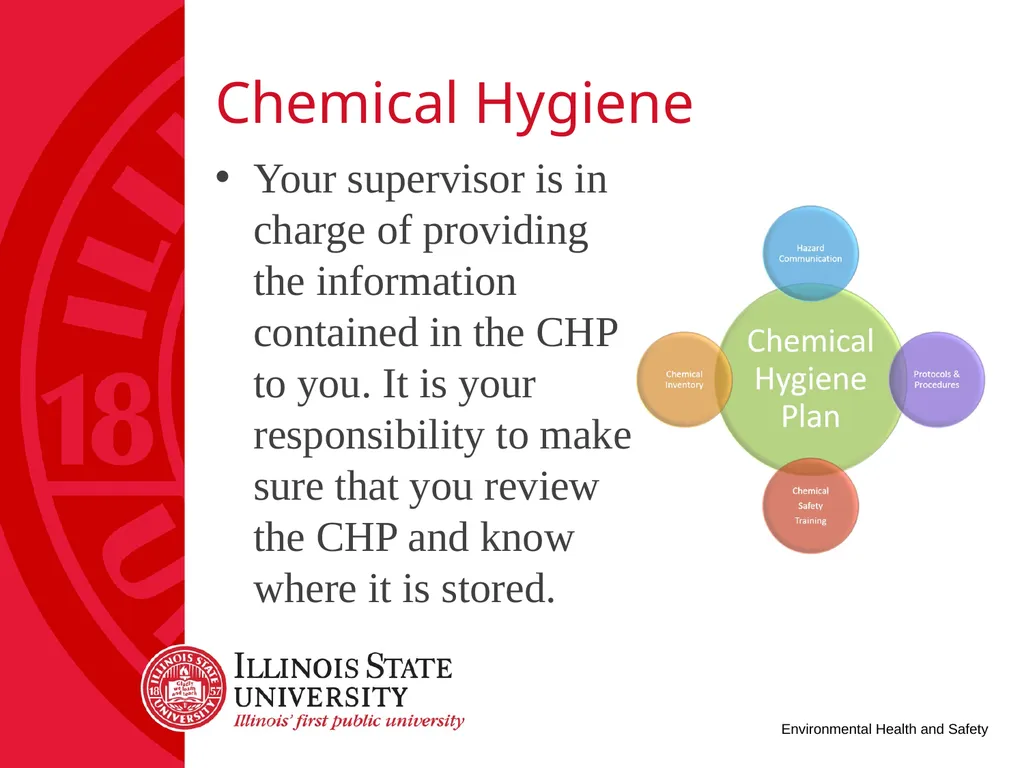
Chemical Hygiene Your supervisor is in charge of providing the information contained in the CHP to you. It is your responsibility to make sure that you review the CHP and know where it is stored.<br>
13
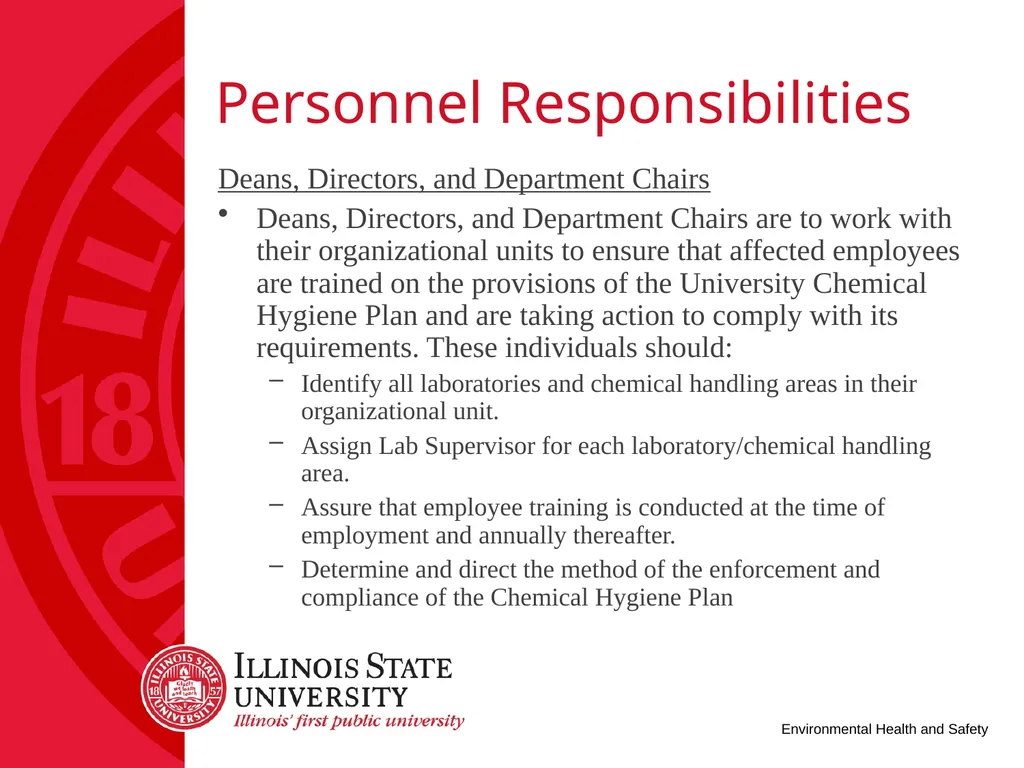
Personnel Responsibilities Deans, Directors, and Department Chairs
Deans, Directors, and Department Chairs are to work with their organizational units to ensure that affected employees are trained on the provisions of the University Chemical Hygiene Plan and are taking action to comply with its requirements. These individuals should:
Identify all laboratories and chemical handling areas in their organizational unit.
Assign Lab Supervisor for each laboratory/chemical handling area.
Assure that employee training is conducted at the time of employment and annually thereafter.
Determine and direct the method of the enforcement and compliance of the Chemical Hygiene Plan<br>
14
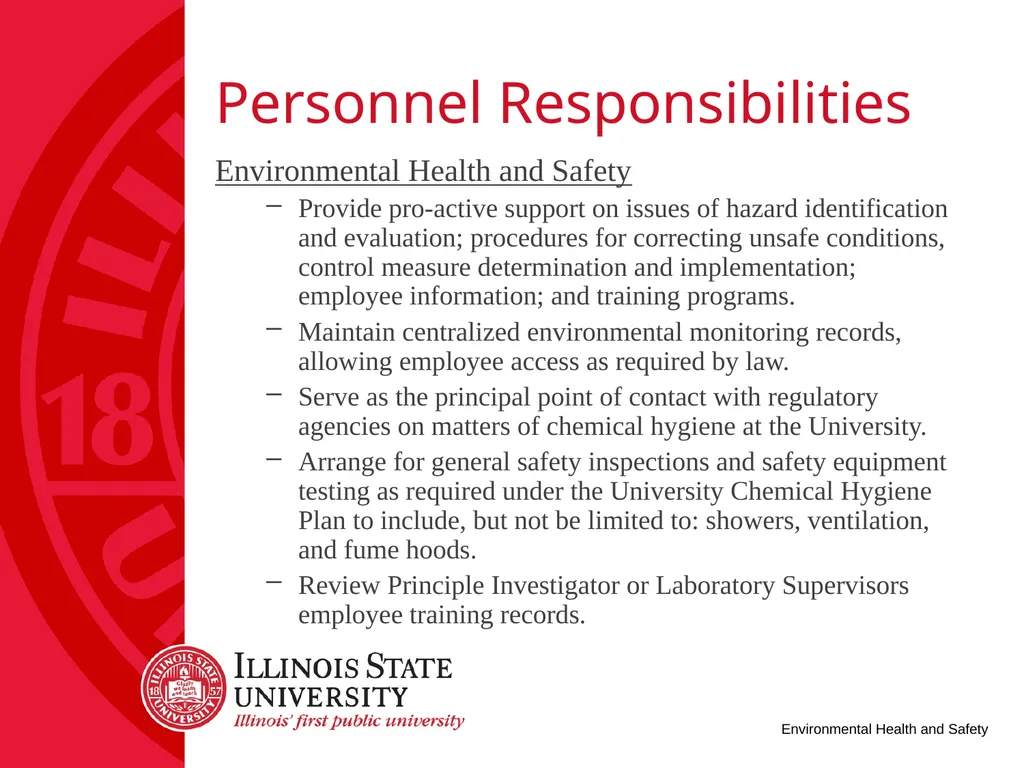
Personnel Responsibilities Environmental Health and Safety
Provide pro-active support on issues of hazard identification and evaluation; procedures for correcting unsafe conditions, control measure determination and implementation; employee information; and training programs.
Maintain centralized environmental monitoring records, allowing employee access as required by law.
Serve as the principal point of contact with regulatory agencies on matters of chemical hygiene at the University.
Arrange for general safety inspections and safety equipment testing as required under the University Chemical Hygiene Plan to include, but not be limited to: showers, ventilation, and fume hoods.
Review Principle Investigator or Laboratory Supervisors employee training records.<br>
15
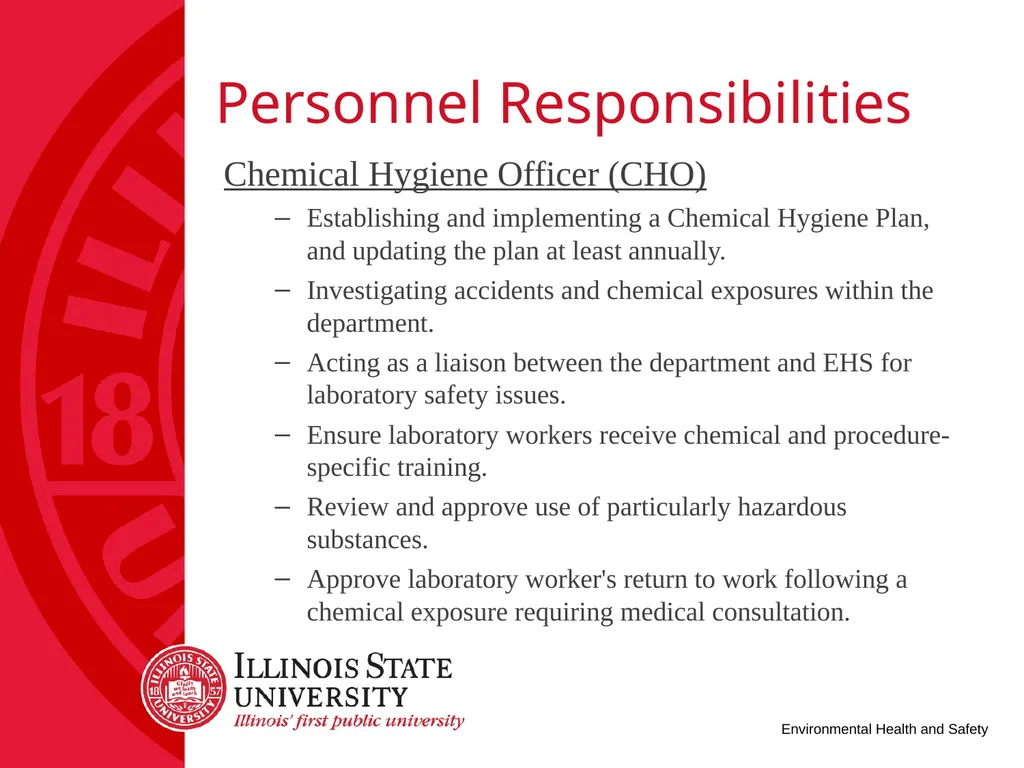
Personnel Responsibilities Chemical Hygiene Officer (CHO)
Establishing and implementing a Chemical Hygiene Plan, and updating the plan at least annually.
Investigating accidents and chemical exposures within the department.
Acting as a liaison between the department and EHS for laboratory safety issues.
Ensure laboratory workers receive chemical and procedure-specific training.
Review and approve use of particularly hazardous substances.
Approve laboratory worker's return to work following a chemical exposure requiring medical consultation.<br>
16
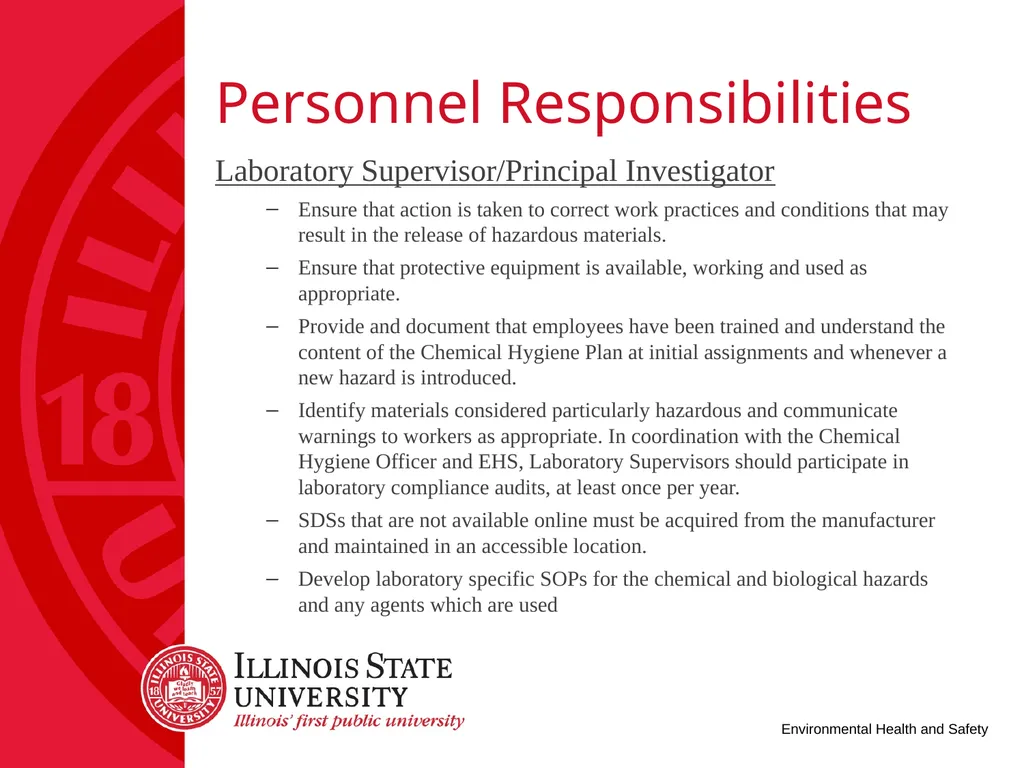
Personnel Responsibilities Laboratory Supervisor/Principal Investigator
Ensure that action is taken to correct work practices and conditions that may result in the release of hazardous materials.
Ensure that protective equipment is available, working and used as appropriate.
Provide and document that employees have been trained and understand the content of the Chemical Hygiene Plan at initial assignments and whenever a new hazard is introduced.
Identify materials considered particularly hazardous and communicate warnings to workers as appropriate. In coordination with the Chemical Hygiene Officer and EHS, Laboratory Supervisors should participate in laboratory compliance audits, at least once per year.
SDSs that are not available online must be acquired from the manufacturer and maintained in an accessible location.
Develop laboratory specific SOPs for the chemical and biological hazards and any agents which are used<br>
17
Personnel Responsibilities Lab Workers
Understand and act in accordance with the Chemical Hygiene Plan and any laboratory-specific standard operating procedures.
Participate in training programs.
Practice good personal chemical hygiene
Report all accidents and incidents to the supervisor on a timely basis.
Review SDSs or other chemical safety information as needed to ensure an understanding of the chemical hazards in the laboratory.<br>
18
Standard Operating Procedures (SOPs) Laboratory-Specific SOP Template
Standard Operating Procedures (SOP) are required by Occupational Safety & Health Administration’s (OSHA) laboratory standard section (1910.1450(e3i)) to be developed and maintained by individual laboratories.
Laboratories must perform a hazard assessment of the laboratory procedures to determine which SOPs must be developed. At a minimum a laboratory must have laboratory specific SOPs for the chemical and biological hazards and any agents which are used in approved animal studies.<br>
19
Standard Operating Procedures (SOPs) Any chemical which has specific handling procedures or equipment should have an SOP developed for the specific use of those chemicals.
An SOP must contain at a minimum the specific personal protective equipment required, engineering controls, decontamination procedures, waste disposal procedures and a description of the laboratory procedure that will be performed.<br>
20
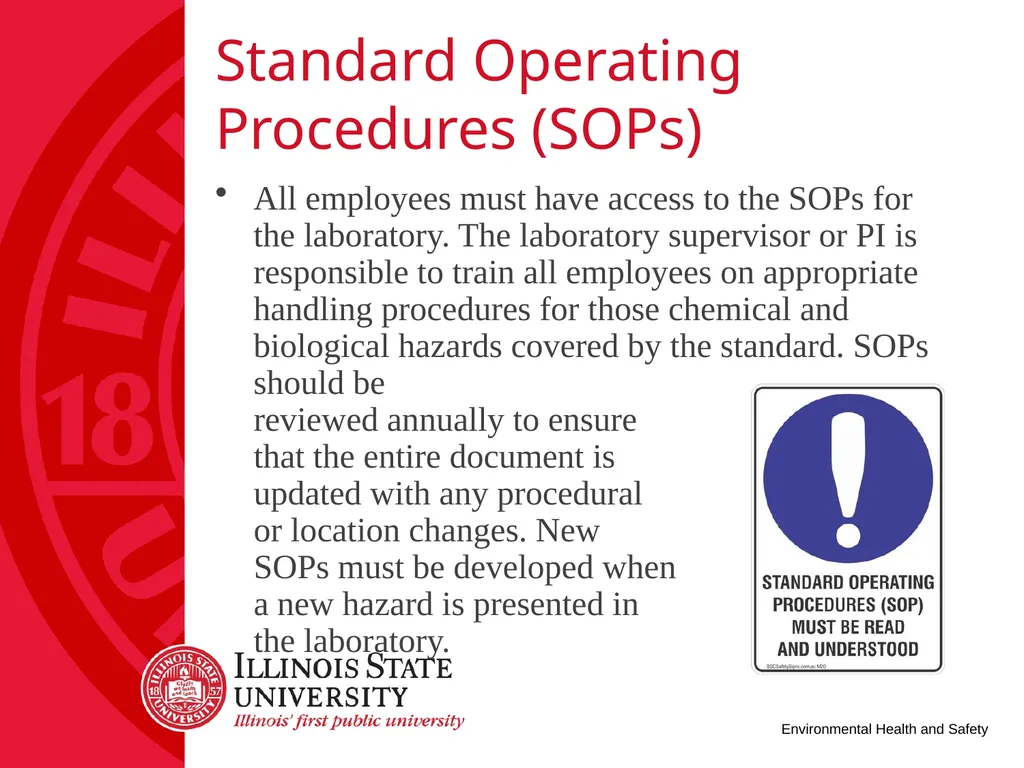
Standard Operating Procedures (SOPs) All employees must have access to the SOPs for the laboratory. The laboratory supervisor or PI is responsible to train all employees on appropriate handling procedures for those chemical and biological hazards covered by the standard. SOPs should be
reviewed annually to ensure
that the entire document is
updated with any procedural
or location changes. New
SOPs must be developed when
a new hazard is presented in
the laboratory.<br>
21
Hazard Identification
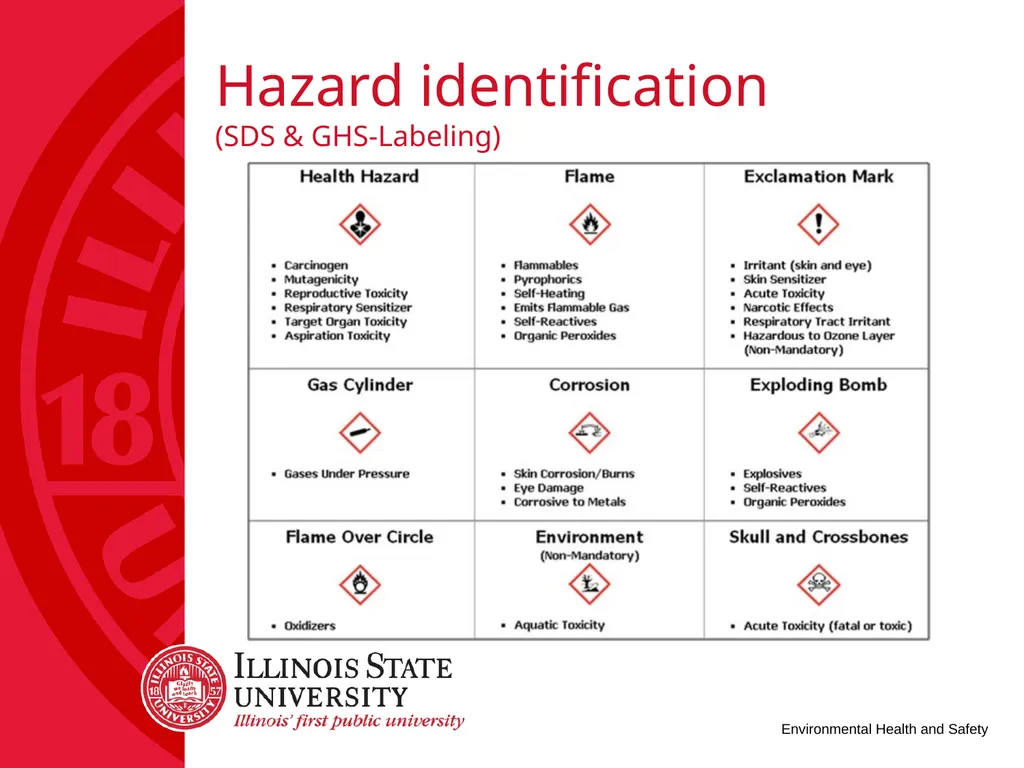
(SDS & GHS-Labeling) Although the OSHA Lab Standard (29 CFR 1910.1450) applies to the laboratory use of chemicals, the elements of the OSHA Hazard Communication Standard (29CFR1910.1200) will be implemented on chemical labels and Safety Data Sheets (SDS). It is very important that lab employees be aware of the Hazard Communication labeling requirements and SDS format.<br>
22
Hazard identification
(SDS & GHS-Labeling) With respect to labels and Safety Data Sheets:
Labels on incoming containers of hazardous chemicals shall not be removed or defaced.
Secondary and transfer containers are not required to have a GHS-compliant label; however, labels must be placed on chemical containers that display the common name of the chemical and any relevant hazard information [i.e. NFPA 704 Hazard rating or Hazardous Material Information System (HMIS)].
Safety Data Sheets that are received with incoming shipments of hazardous chemicals must be maintained and readily accessible to laboratory employees<br>
23
Hazard identification
(SDS & GHS-Labeling)<br>
24
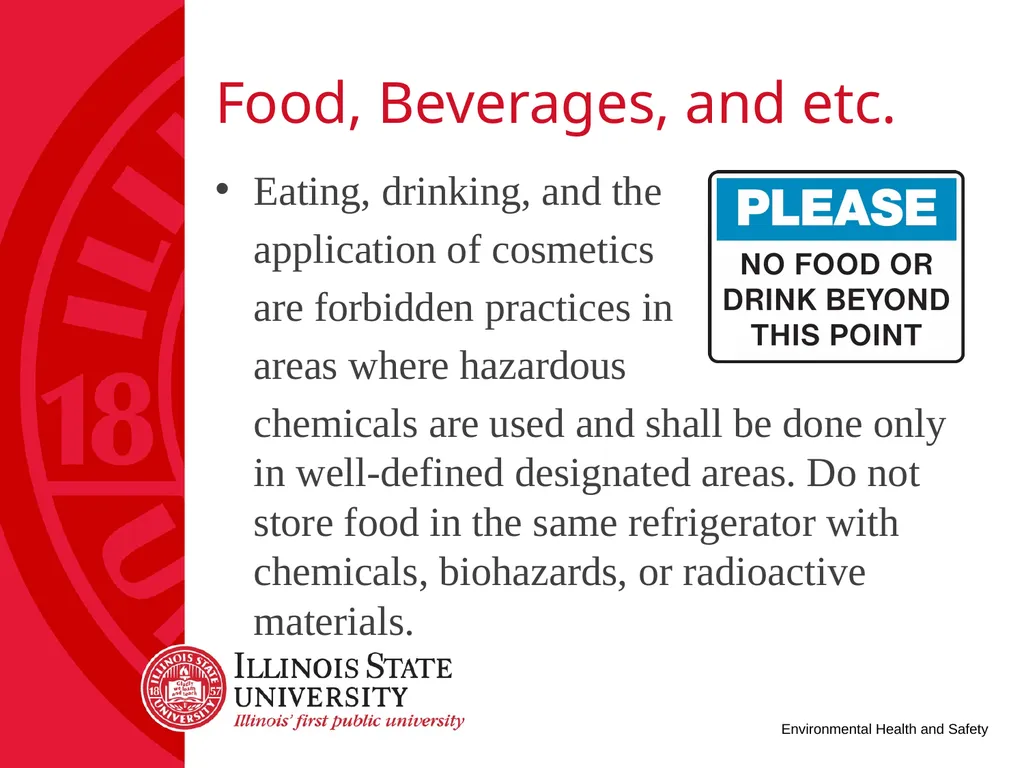
Food, Beverages, and etc. Eating, drinking, and the
application of cosmetics
are forbidden practices in
areas where hazardous
chemicals are used and shall be done only in well-defined designated areas. Do not store food in the same refrigerator with chemicals, biohazards, or radioactive materials.<br>
25
Lab specific safety issues<br>
26
Safety Equipment Certain equipment is necessary to achieve compliance and most importantly to provide adequate protection.
The safety equipment that is needed is known as primary and secondary barriers.<br>
27
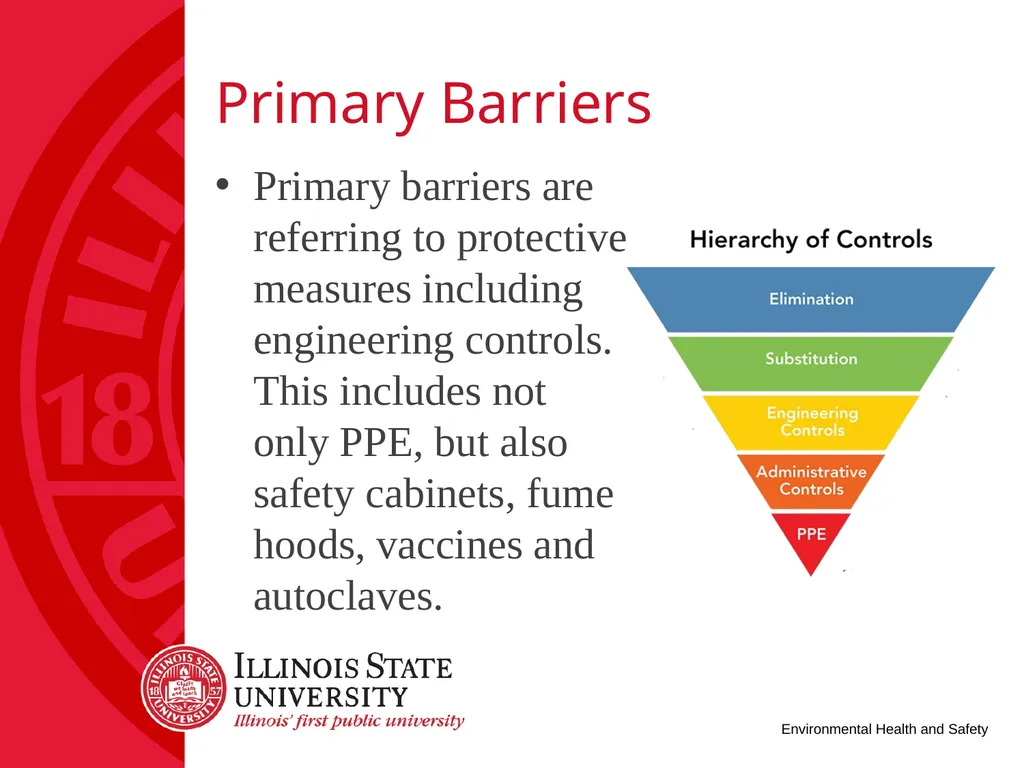
Primary Barriers Primary barriers are referring to protective measures including engineering controls. This includes not only PPE, but also safety cabinets, fume hoods, vaccines and autoclaves.<br>
28
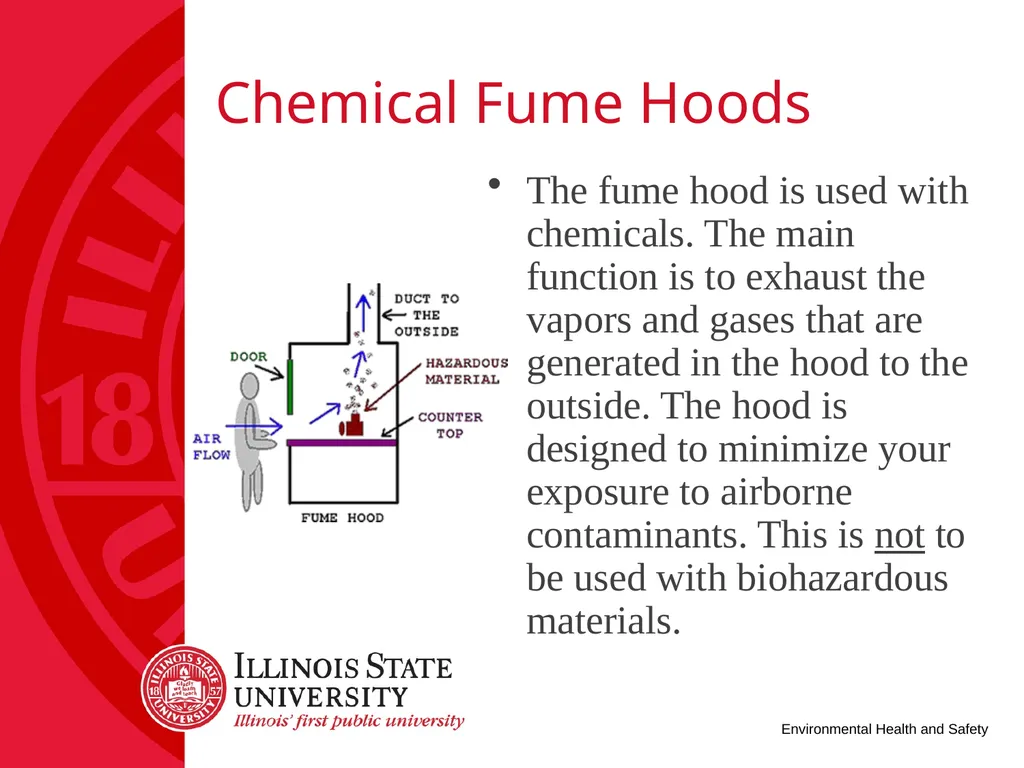
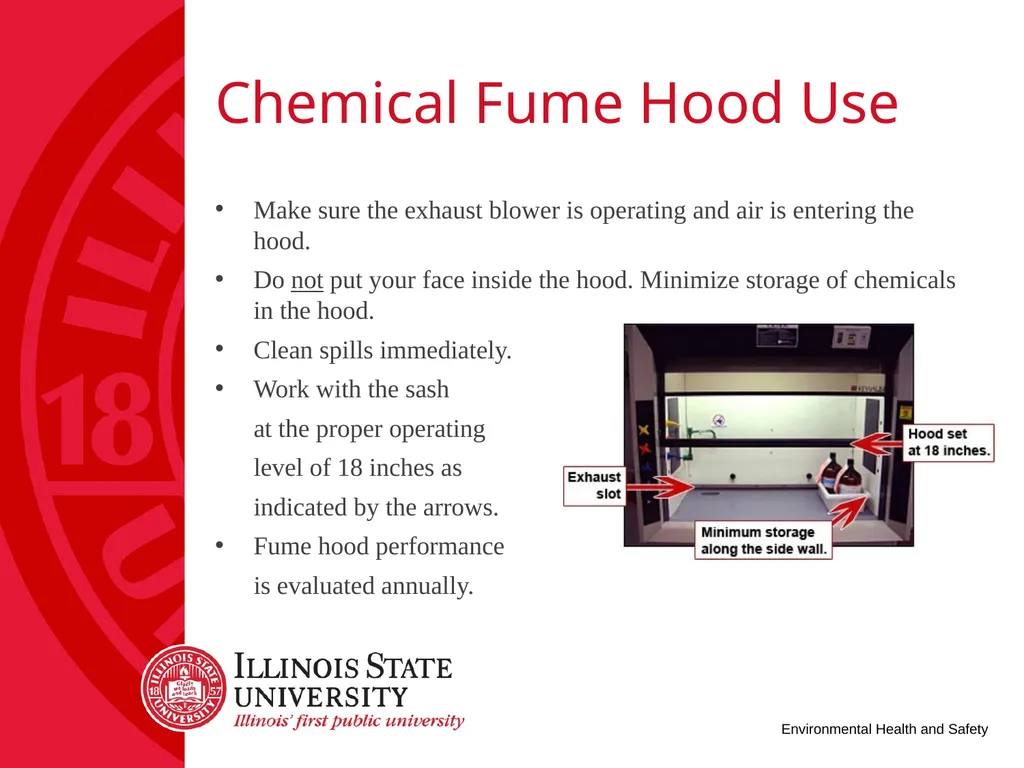
Chemical Fume Hoods The fume hood is used with chemicals. The main function is to exhaust the vapors and gases that are generated in the hood to the outside. The hood is designed to minimize your exposure to airborne contaminants. This is not to be used with biohazardous materials.<br>
29
Chemical Fume Hood Use Make sure the exhaust blower is operating and air is entering the hood.
Do not put your face inside the hood. Minimize storage of chemicals in the hood.
Clean spills immediately.
Work with the sash
at the proper operating
level of 18 inches as
indicated by the arrows.
Fume hood performance
is evaluated annually.<br>
30
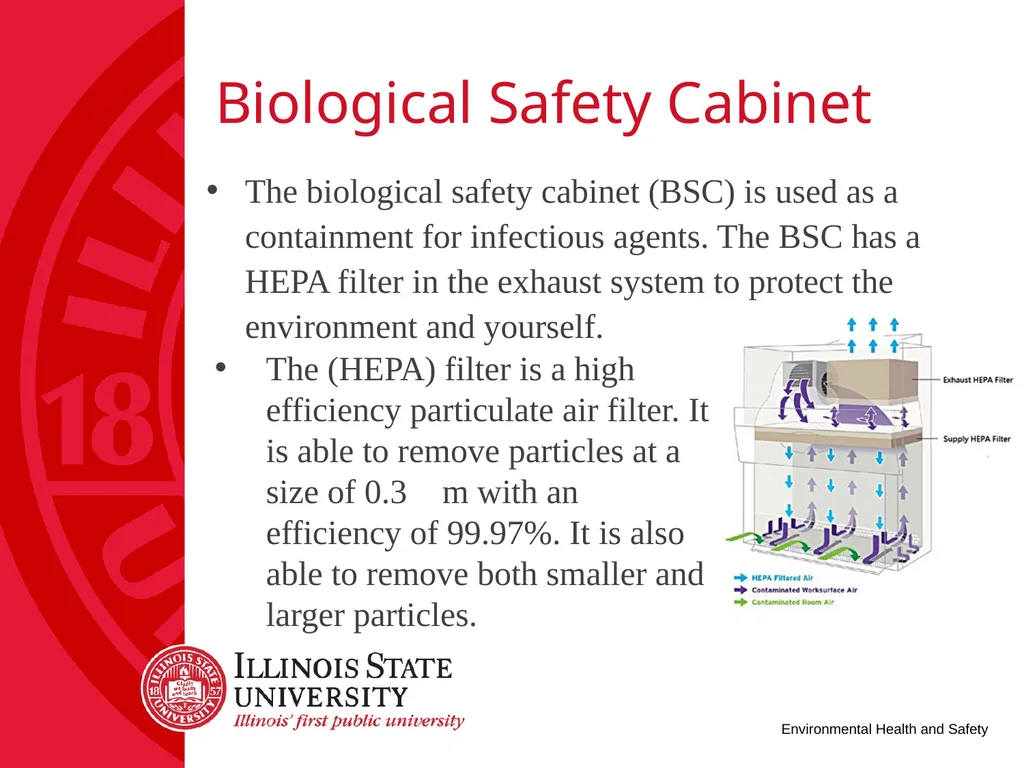
Biological Safety Cabinet The biological safety cabinet (BSC) is used as a containment for infectious agents. The BSC has a HEPA filter in the exhaust system to protect the environment and yourself. The (HEPA) filter is a high efficiency particulate air filter. It is able to remove particles at a size of 0.3 m with an efficiency of 99.97%. It is also able to remove both smaller and larger particles.<br>
31
Biological Safety Cabinet There are 3 classes of BSC that are used. The higher the risk group and biosafety level, the higher the class of cabinet that is used.
If there is an infectious agent being used, whether it is used in research animals or cultured, it must be manipulated inside the BSC.<br>
32
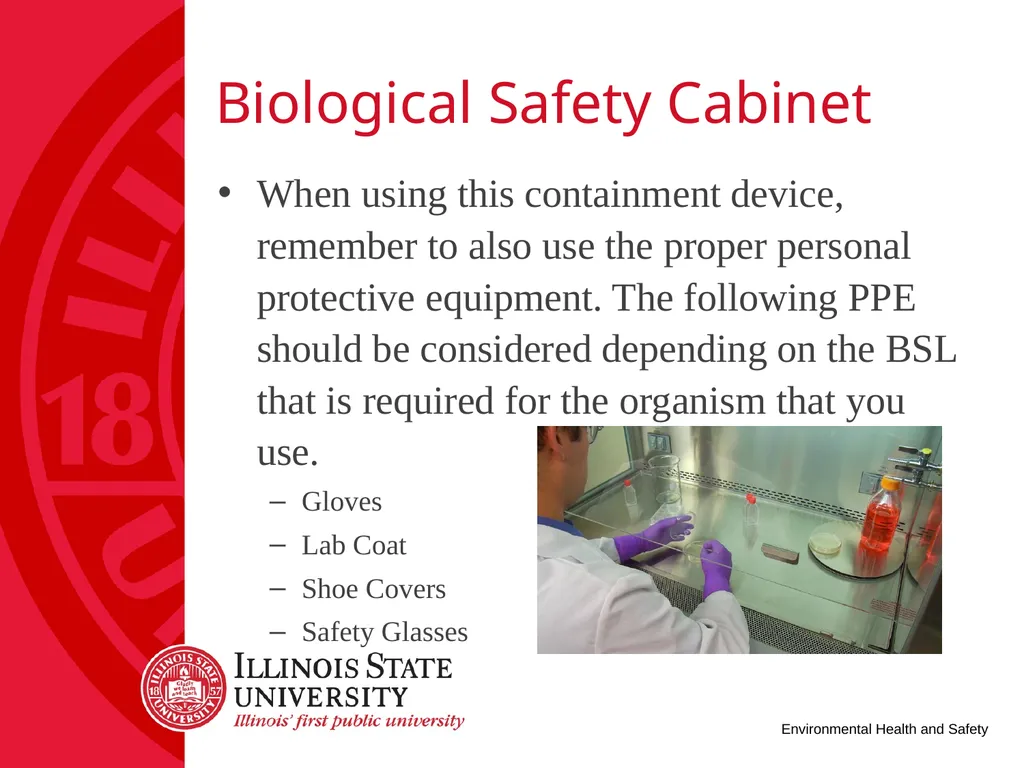
Biological Safety Cabinet When using this containment device, remember to also use the proper personal protective equipment. The following PPE should be considered depending on the BSL that is required for the organism that you use.
Gloves
Lab Coat
Shoe Covers
Safety Glasses<br>
33
Biosafety Cabinet Use Always make sure that the BSC has been decontaminated both before and after use. Decontamination methods vary depending on the infectious agent being used. Once the decontamination of the cabinet is complete, place the waste in a biohazard bag for autoclave.
Do not bring contaminated materials out of the cabinet until they have been surface decontaminated. If you are unable to decontaminate, place the material into a closed container to transfer it to the autoclave.<br>
34
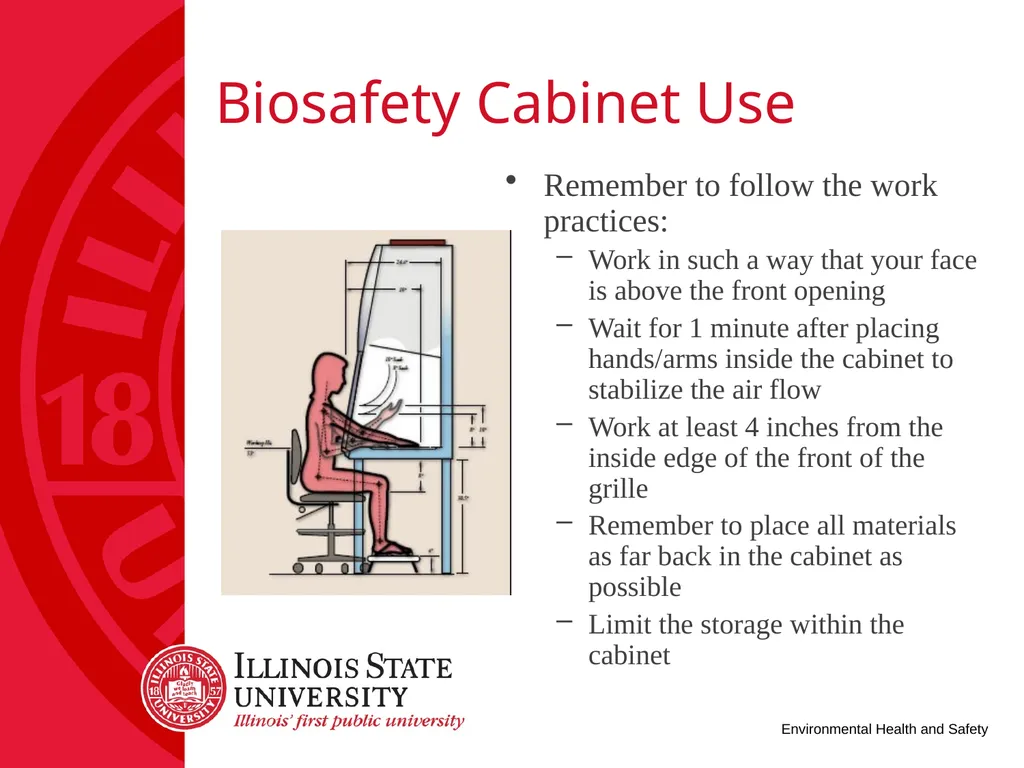
Biosafety Cabinet Use Remember to follow the work practices:
Work in such a way that your face is above the front opening
Wait for 1 minute after placing hands/arms inside the cabinet to stabilize the air flow
Work at least 4 inches from the inside edge of the front of the grille
Remember to place all materials as far back in the cabinet as possible
Limit the storage within the cabinet<br>
35
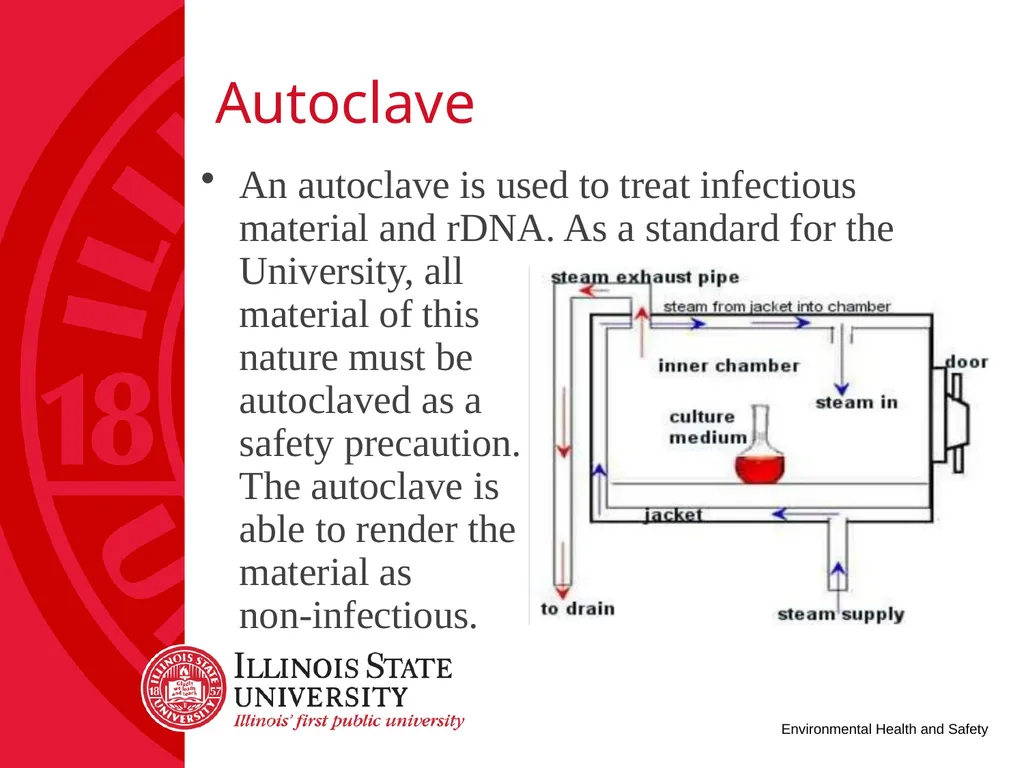
Autoclave An autoclave is used to treat infectious material and rDNA. As a standard for the University, all
material of this
nature must be
autoclaved as a
safety precaution.
The autoclave is
able to render the
material as
non-infectious.<br>
36
Autoclave The autoclave is able to reach a high temperature to sterilize the agent. It is important to know the standard operating procedures (SOP) for the autoclave. The SOP is located next to each autoclave. If the temperature or pressure is inadequate, the bag is overfilled, or the peak time is not long enough the material will not be properly decontaminated.<br>
37
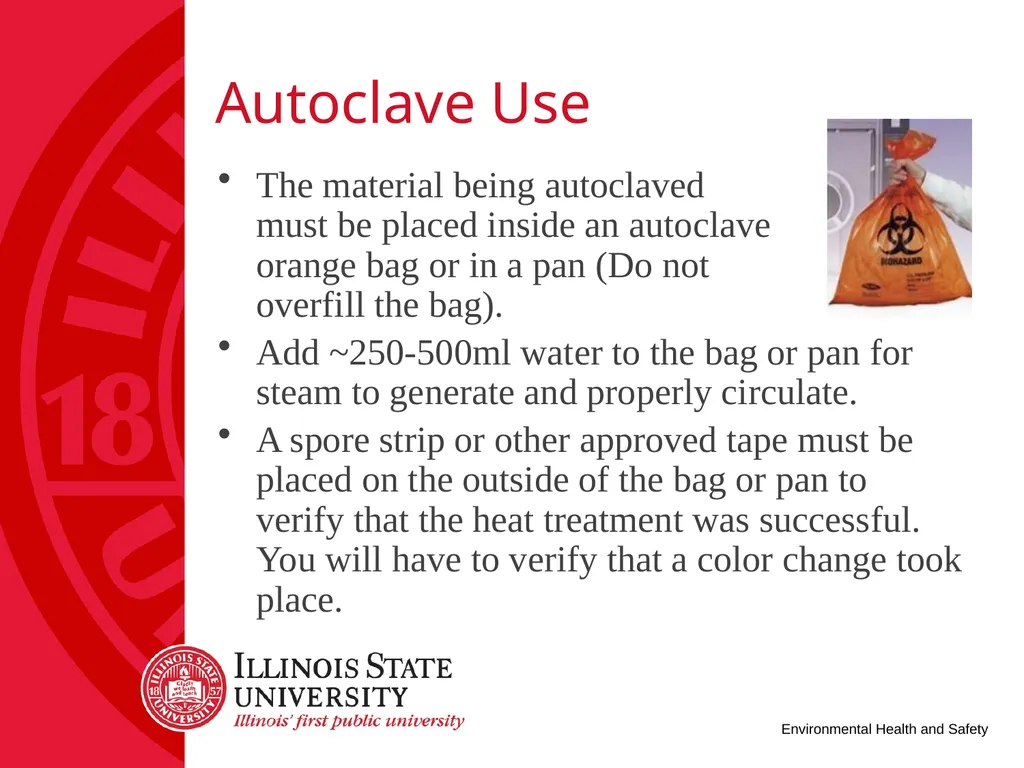
Autoclave Use The material being autoclaved
must be placed inside an autoclave
orange bag or in a pan (Do not
overfill the bag).
Add ~250-500ml water to the bag or pan for steam to generate and properly circulate.
A spore strip or other approved tape must be placed on the outside of the bag or pan to verify that the heat treatment was successful. You will have to verify that a color change took place.<br>
38
Autoclave Use The autoclave must reach a temperature of 121°C (250 °F) for at least ½ hour at a pressure of 15psi.
After successfully being autoclaved, the material can be placed in regular trash.
Sharps must be incinerated. When the container is full, a pick up can be scheduled through EHS for proper disposal.<br>
39
Autoclave Log Each time the autoclave is used, the log must be completed by the individual using it. The log is to be located at the site of the autoclave. The information contained within the log is as follows:
Date
Generator Name (P.I.)
Location
Time the autoclave reached 121°C
Max Temp.
Pressure
Type of waste
If spores or tape were used
Weight
Person using autoclave<br>
40
Autoclave Log The log is required by EPA and it must be maintained for 3 years by the department.
The purpose of the log is to ensure that proper decontamination is taking place.
If a new log is needed at the autoclave, contact biology department or EHS.<br>
41
Biosafety Level (BSL) As the risk increases, the BSL also increases. The different BSLs have been established as preventative measures against human infection.
Each BSL has specific containment practices that CDC and NIH have advised. Taking precautionary measures can help to minimize hazards associated with infectious agents.<br>
42
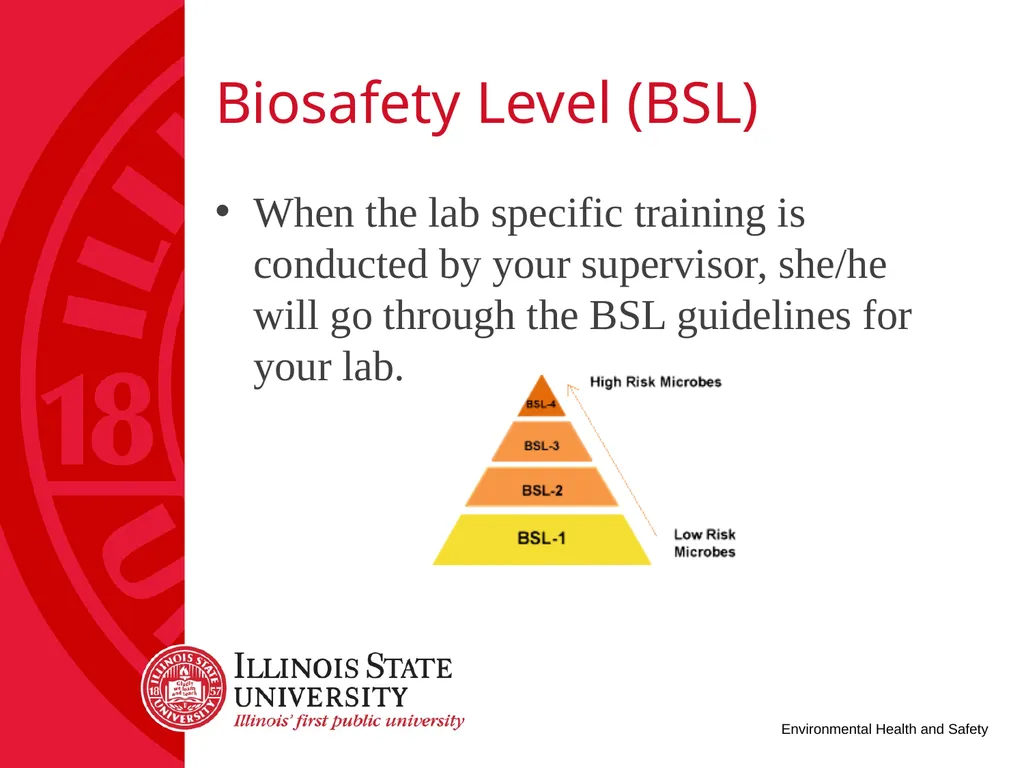
Biosafety Level (BSL) When the lab specific training is conducted by your supervisor, she/he will go through the BSL guidelines for your lab.<br>
43
Safe lab practices<br>
44
Personal Protective Equipment (PPE) Respiratory Protection
Respirators, when properly selected and used, can offer protection against a wide variety of airborne contaminants. Respiratory protection should only be used when other methods of exposure control are not effective or impractical.
All respirator use must comply with the ISU's Respiratory Protection Program. More detailed information, including required forms and helpful links, is available on the EHS Respiratory Protection webpage.
Anyone who wishes to use a respirator must contact EHS and comply with all components of the ISU Respiratory Protection Program. EHS will perform a hazard assessment of the operation necessitating the use of the respirator and help determine the proper level of protection<br>
45
Personal Protective Equipment (PPE) Eye and Face Protection
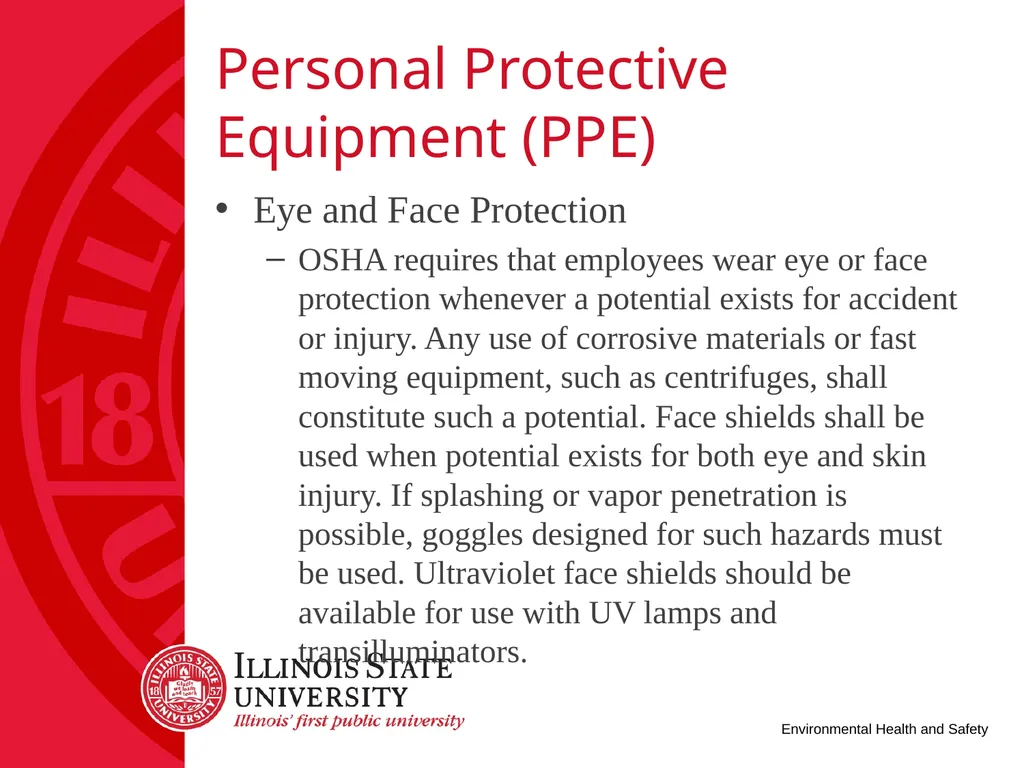
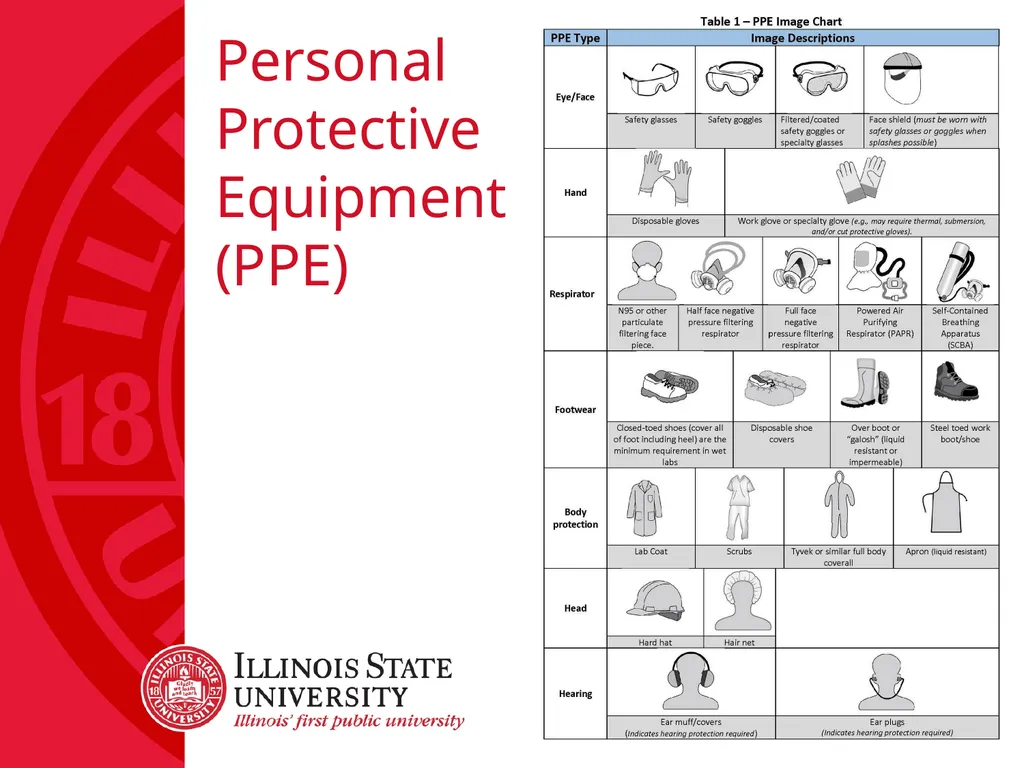
OSHA requires that employees wear eye or face protection whenever a potential exists for accident or injury. Any use of corrosive materials or fast moving equipment, such as centrifuges, shall constitute such a potential. Face shields shall be used when potential exists for both eye and skin injury. If splashing or vapor penetration is possible, goggles designed for such hazards must be used. Ultraviolet face shields should be available for use with UV lamps and transilluminators.<br>
46
Personal Protective Equipment (PPE)<br>
47
Personal Protective Equipment (PPE) Glove Use
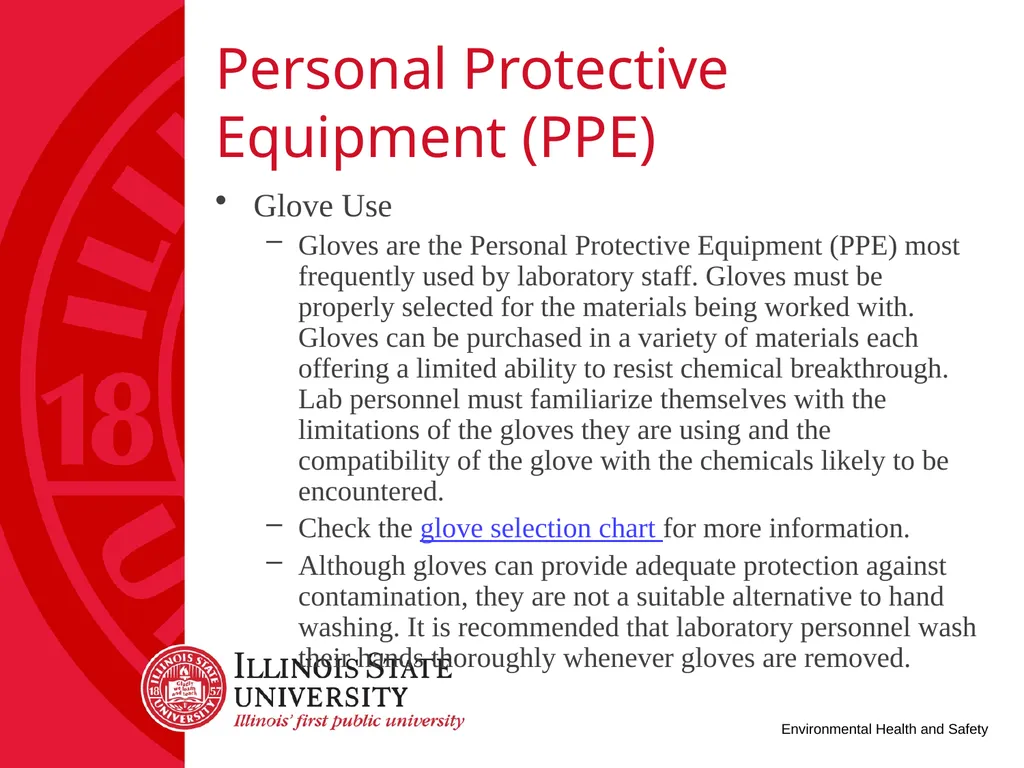
Gloves are the Personal Protective Equipment (PPE) most frequently used by laboratory staff. Gloves must be properly selected for the materials being worked with. Gloves can be purchased in a variety of materials each offering a limited ability to resist chemical breakthrough. Lab personnel must familiarize themselves with the limitations of the gloves they are using and the compatibility of the glove with the chemicals likely to be encountered.
Check the glove selection chart for more information.
Although gloves can provide adequate protection against contamination, they are not a suitable alternative to hand washing. It is recommended that laboratory personnel wash their hands thoroughly whenever gloves are removed.<br>
48
Personal Protective Equipment (PPE) Clothing
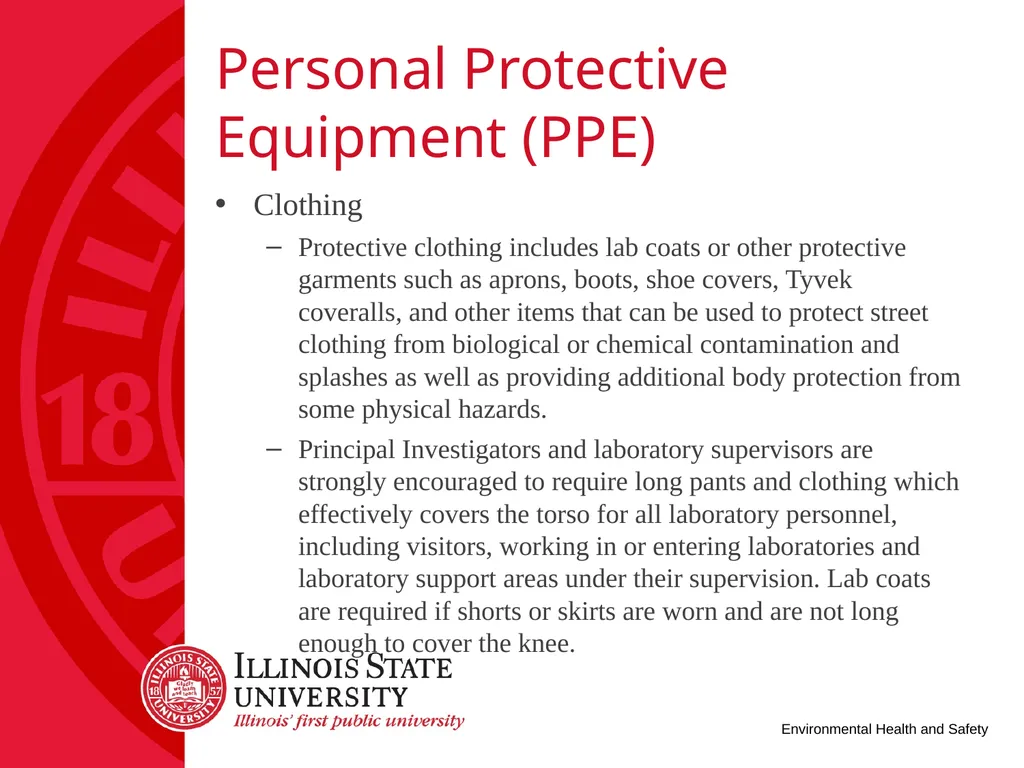
Protective clothing includes lab coats or other protective garments such as aprons, boots, shoe covers, Tyvek coveralls, and other items that can be used to protect street clothing from biological or chemical contamination and splashes as well as providing additional body protection from some physical hazards.
Principal Investigators and laboratory supervisors are strongly encouraged to require long pants and clothing which effectively covers the torso for all laboratory personnel, including visitors, working in or entering laboratories and laboratory support areas under their supervision. Lab coats are required if shorts or skirts are worn and are not long enough to cover the knee.<br>
49
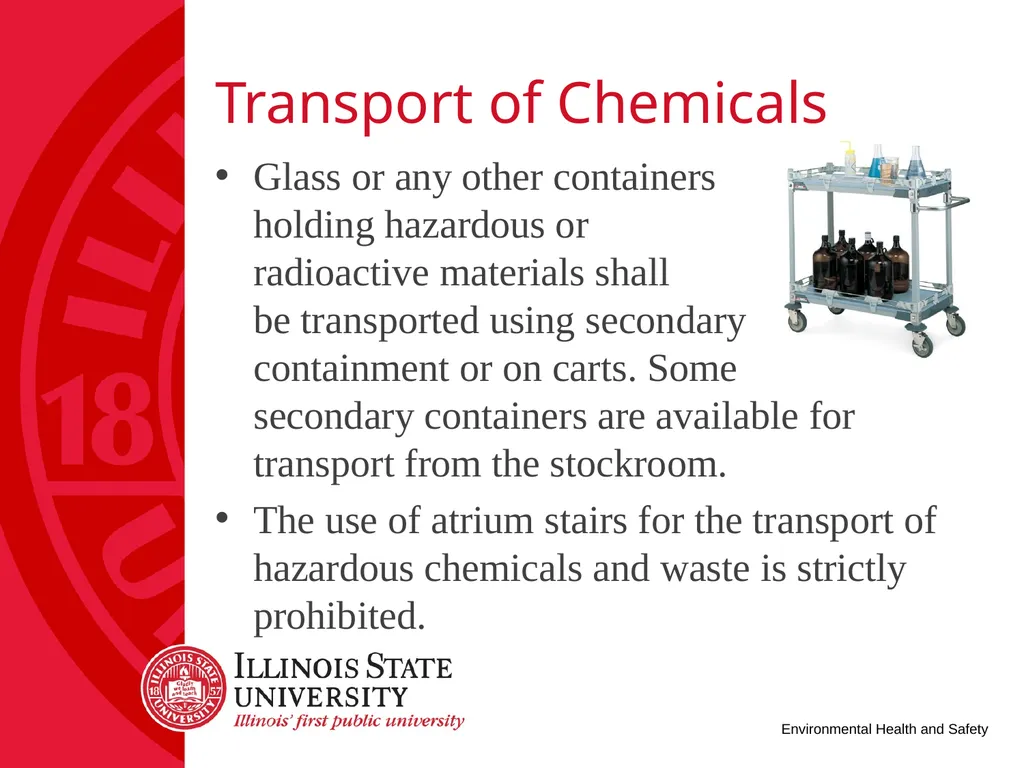
Transport of Chemicals Glass or any other containers
holding hazardous or
radioactive materials shall
be transported using secondary
containment or on carts. Some
secondary containers are available for transport from the stockroom.
The use of atrium stairs for the transport of hazardous chemicals and waste is strictly prohibited.<br>
50
Waste Disposal Management of chemical and hazardous wastes at the University is accomplished by the generator of the waste with the assistance of Environmental Health and Safety (EHS).
EHS will assist generators on campus to help assure that wastes are managed in accordance with the regulations.
The generator is ultimately responsible for assuring that waste generated is managed in a safe and appropriate manner.<br>
51
Waste Disposal Hazardous waste must be disposed of through the Environmental Health & Safety office. If you need to have hazardous waste picked up, please submit a Hazardous Waste Pick-Up Form, or contact EHS at 309-438-8325.<br>
52
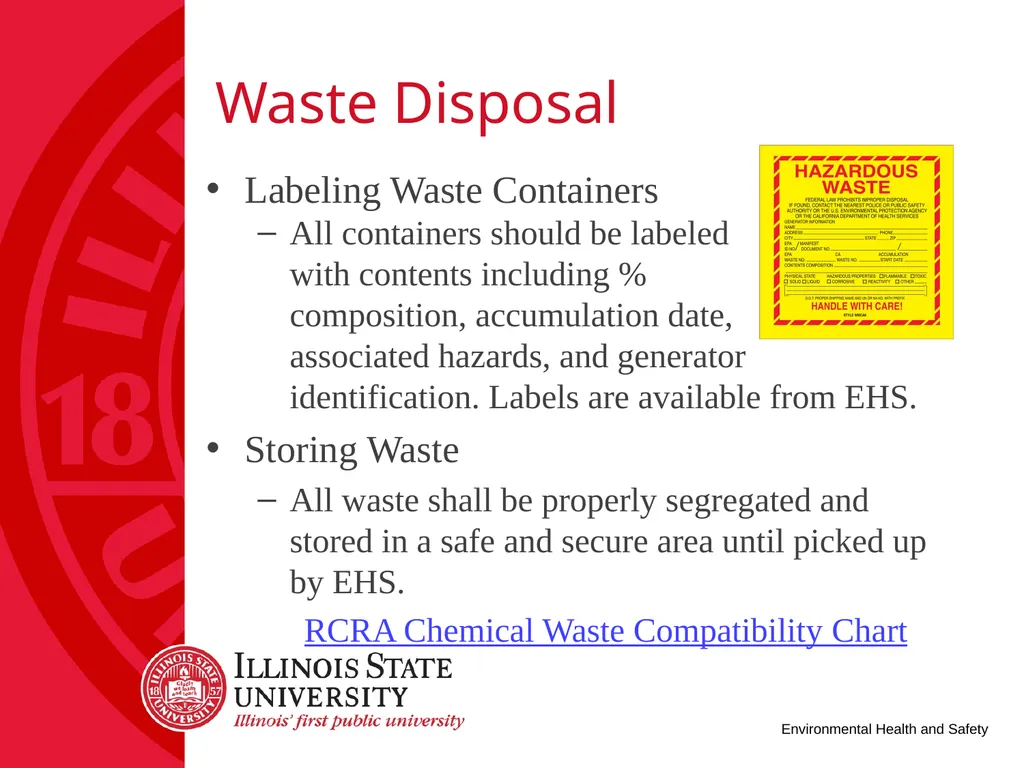
Waste Disposal Labeling Waste Containers
All containers should be labeled
with contents including %
composition, accumulation date,
associated hazards, and generator
identification. Labels are available from EHS.
Storing Waste
All waste shall be properly segregated and stored in a safe and secure area until picked up by EHS.
RCRA Chemical Waste Compatibility Chart<br>
53
Emergency procedures<br>
54
Evacuation Protocol When an evacuation has been ordered or initiated due to a fire alarm:
Evacuate immediately by following the nearest Exit signs.
Proceed to the designated emergency assembly area.
After reporting to the designated emergency assembly area, begin the accountability process.
Let the police or fire department know if someone is missing or trapped inside and/or is in need of assistance.
Stay out of the way of emergency personnel and equipment.
Do not enter the building until you are approved to do so by the University Personnel.<br>
55
Emergency Response Departments are required to have specific Emergency Response Procedures that direct individuals what to do in the event of an emergency in their department. All employees must be trained and understand the specifics of their departmental Emergency Response Plan.<br>
56
Phone Numbers Emergencies
911
Environmental Health & Safety
309-438-8325
ISU Police Dept.
309-438-8631<br>
57
Chemical Spill Response Minor spills can be managed by laboratory personnel familiar with the chemical spilled. Each lab has a spill response kit intended to be used on small spills of known material.
Spills involving a large volume of material or acutely hazardous substances should be managed by trained personnel.
If you are involved in a large spill you must immediately contact EHS (309-438-8325) during regular business hours or ISUPD afterhours<br>
58
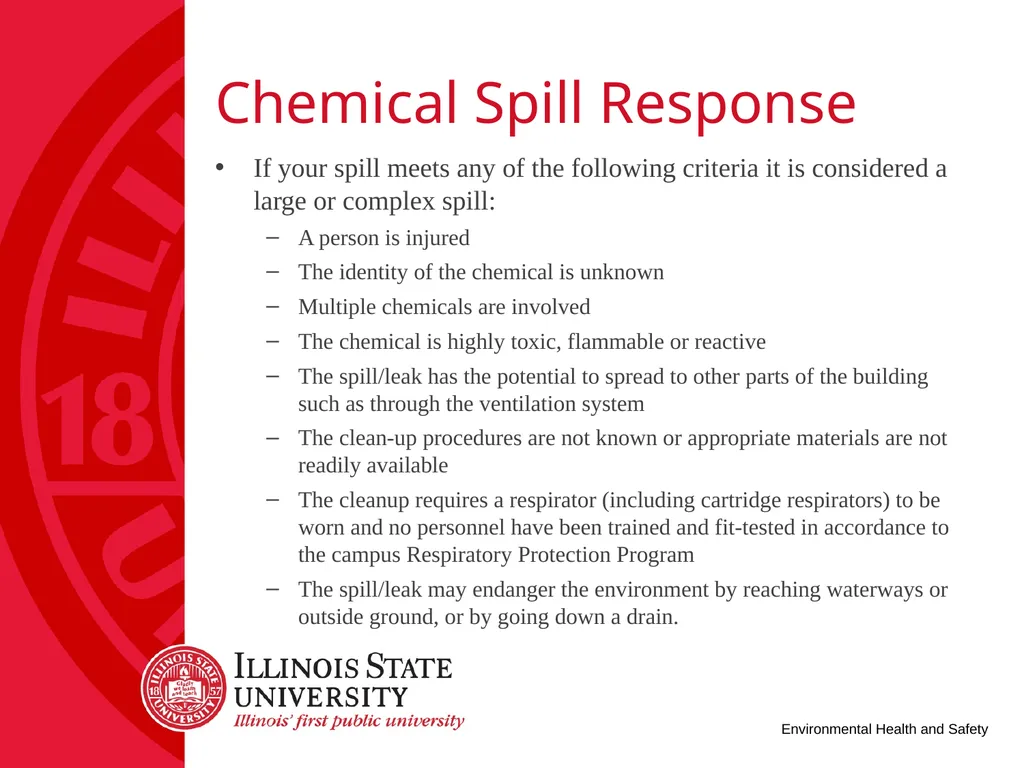
Chemical Spill Response If your spill meets any of the following criteria it is considered a large or complex spill:
A person is injured
The identity of the chemical is unknown
Multiple chemicals are involved
The chemical is highly toxic, flammable or reactive
The spill/leak has the potential to spread to other parts of the building such as through the ventilation system
The clean-up procedures are not known or appropriate materials are not readily available
The cleanup requires a respirator (including cartridge respirators) to be worn and no personnel have been trained and fit-tested in accordance to the campus Respiratory Protection Program
The spill/leak may endanger the environment by reaching waterways or outside ground, or by going down a drain.<br>
59
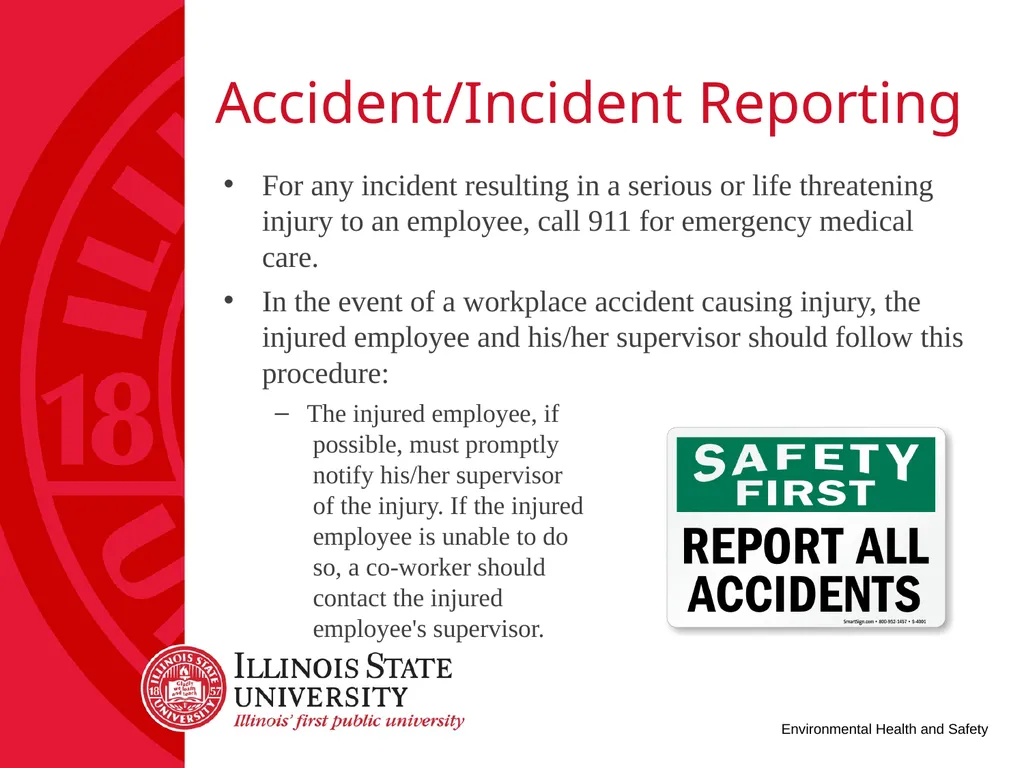
Accident/Incident Reporting For any incident resulting in a serious or life threatening injury to an employee, call 911 for emergency medical care.
In the event of a workplace accident causing injury, the injured employee and his/her supervisor should follow this procedure:
The injured employee, if
possible, must promptly
notify his/her supervisor
of the injury. If the injured
employee is unable to do
so, a co-worker should
contact the injured
employee's supervisor.<br>
60
Accident/Incident Reporting Seeking Medical Attention
If the injured employee needs immediate medical attention, the supervisor, or designee in his/her absence, should call 911 and request emergency medical care.
If the injury does not warrant immediate care, but medical treatment or evaluation is deemed warranted, the supervisor or designee should arrange transportation via a university vehicle to the designated medical facility.<br>
61
Accident/Incident Reporting Investigate
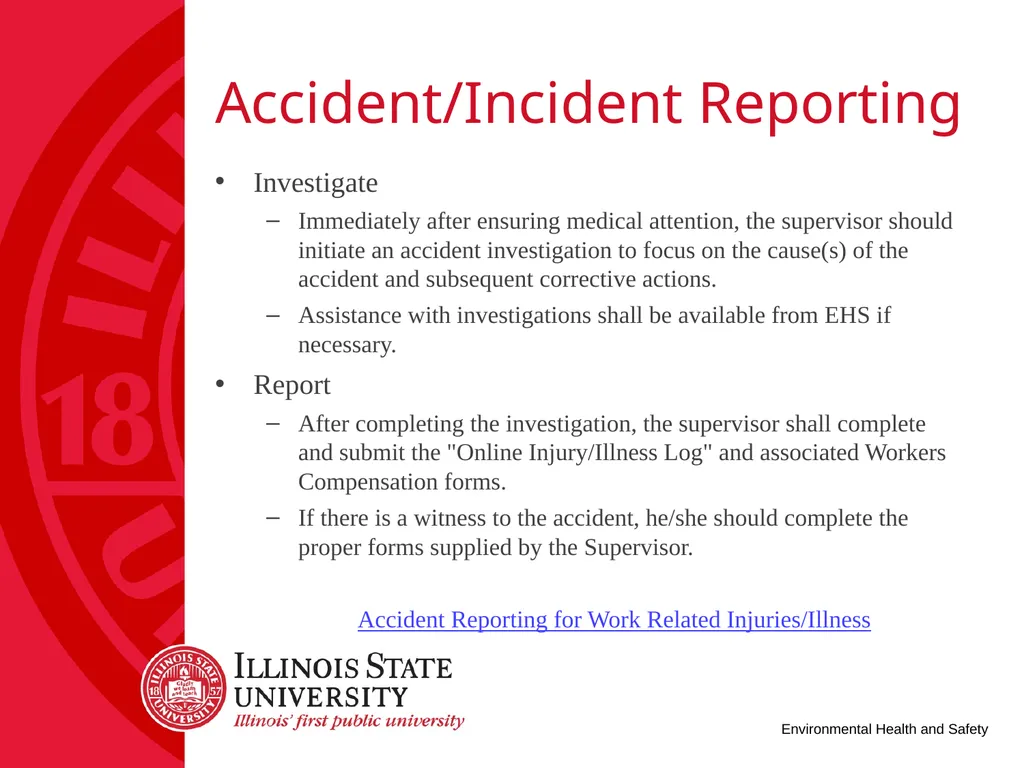
Immediately after ensuring medical attention, the supervisor should initiate an accident investigation to focus on the cause(s) of the accident and subsequent corrective actions.
Assistance with investigations shall be available from EHS if necessary.
Report
After completing the investigation, the supervisor shall complete and submit the "Online Injury/Illness Log" and associated Workers Compensation forms.
If there is a witness to the accident, he/she should complete the proper forms supplied by the Supervisor.
Accident Reporting for Work Related Injuries/Illness<br>
62
Training Completed You have now completed the General Lab Safety Training presentation. If you have any questions please take the time to ask your supervisor or call EHS. By signing the training form, you are stating that you have completed the training and that you understand the content within the training. Please fill out the Certificate of Completion & turn it into your immediate supervisor.<br>
63
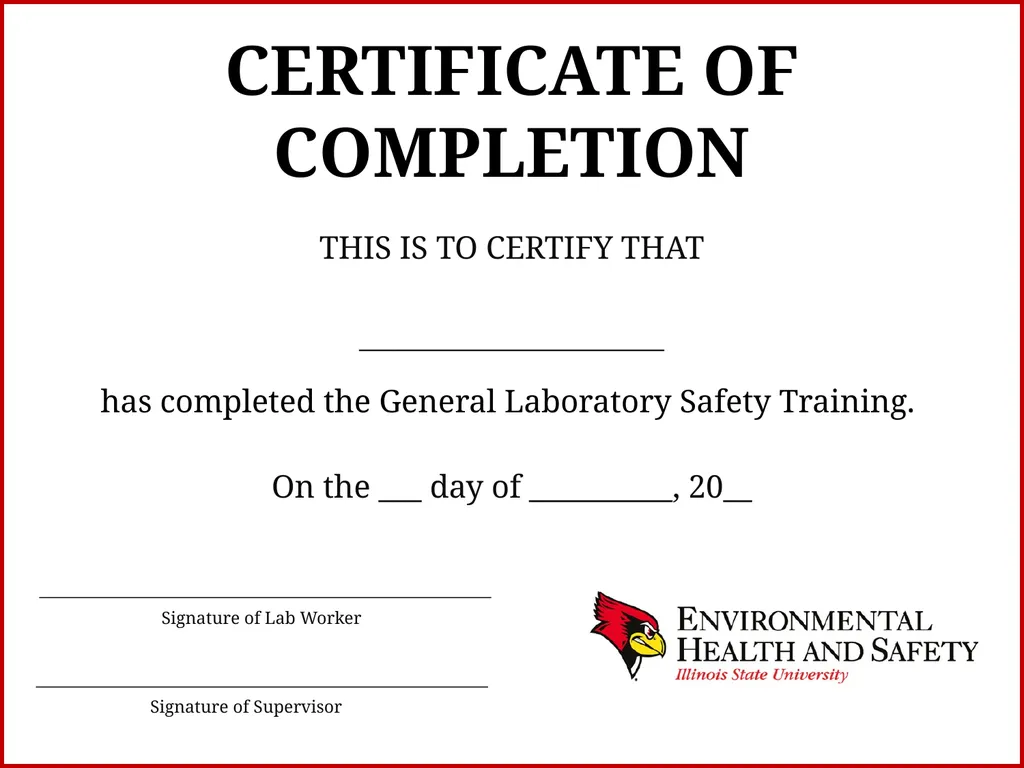
this is to certify that
__________________________
has completed the General Laboratory Safety Training.
On the ___ day of __________, 20__ Signature of Lab Worker Signature of Supervisor Certificate of Completion<br>