04
Purposes of Nominalisation Nominalisation helps achieve a higher degree of abstraction and technicality.
Nominalisation is significant in constructing a distant and abstract world that can be reflected on.
Nominalisation is one of the language choices that enables movement towards highly written-like texts.<br>
05
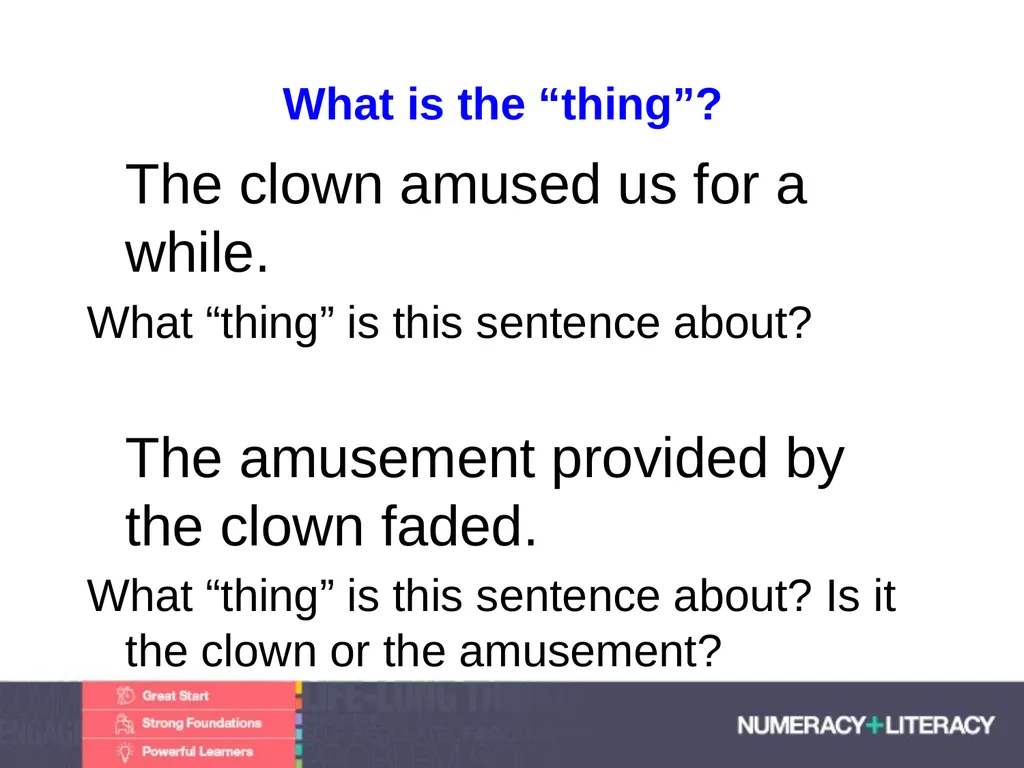
What is the “thing”? The clown amused us for a while.
What “thing” is this sentence about?
The amusement provided by the clown faded.
What “thing” is this sentence about? Is it the clown or the amusement?<br>
06
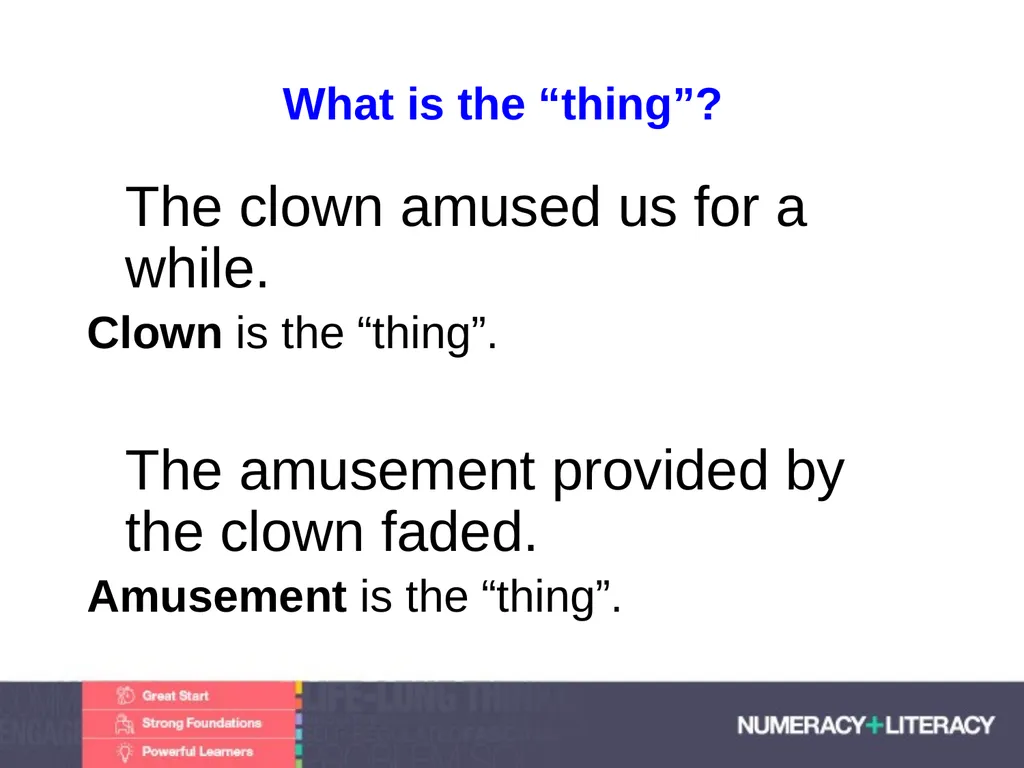
What is the “thing”? The clown amused us for a while.
Clown is the “thing”.
The amusement provided by the clown faded.
Amusement is the “thing”.<br>
07
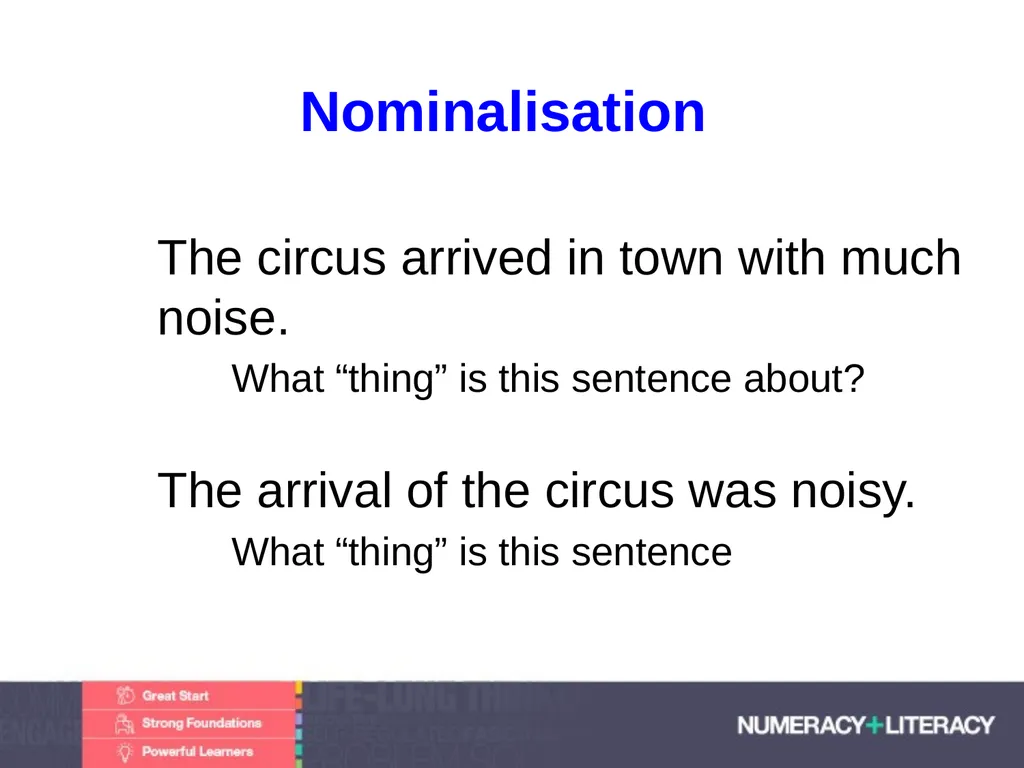
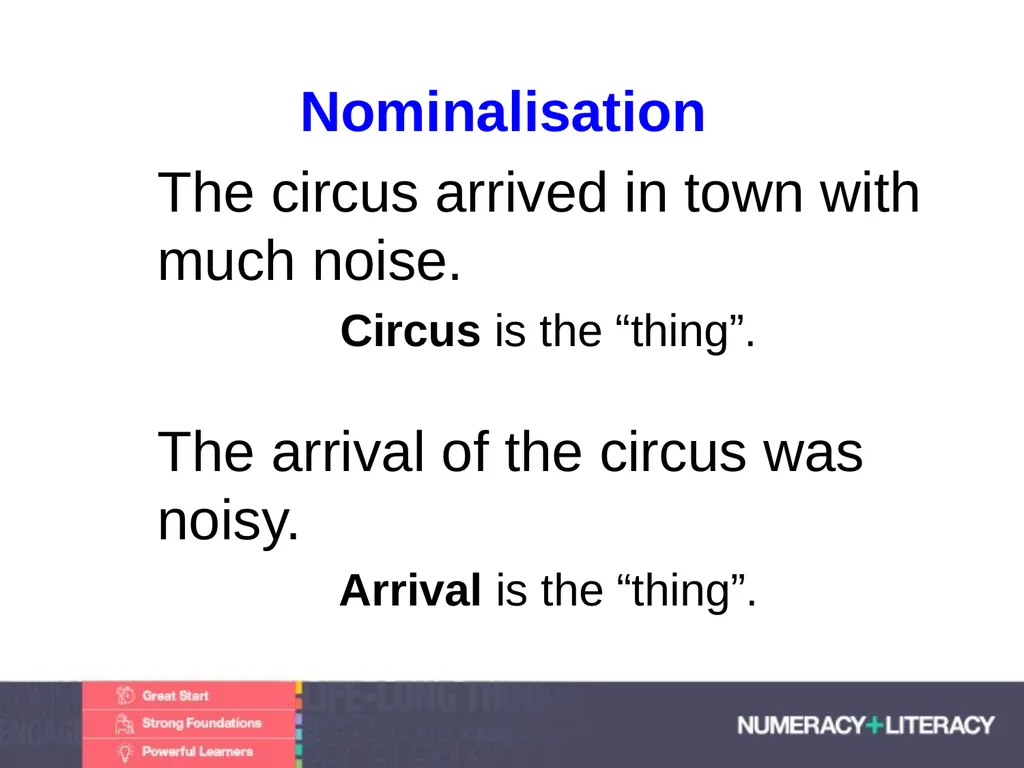
Nominalisation The circus arrived in town with much noise.
What “thing” is this sentence about?
The arrival of the circus was noisy.
What “thing” is this sentence about?<br>
08
Nominalisation The circus arrived in town with much noise.
Circus is the “thing”.
The arrival of the circus was noisy.
Arrival is the “thing”.<br>
09
Checkpoint If clown, amusement, circus and arrival are all “things”, we can call them nouns (names of things).<br>
10
Nominalisation Let’s now consider two of these nouns: clown and circus.
You can detect these nouns with your five senses.<br>
11
Nominalisation Reflect for a moment about whether detecting “things” with all your five senses can truly be said about nouns like amusement and arrival. You’ll probably agree that amusement and arrival are a different sort of noun compared to clown and circus. The first two are names of concepts, ideas or phenomenon so there is more to nominalisation than simply changing a non-noun to a noun.
Now let’s look at some nominalisations in school.<br>
12
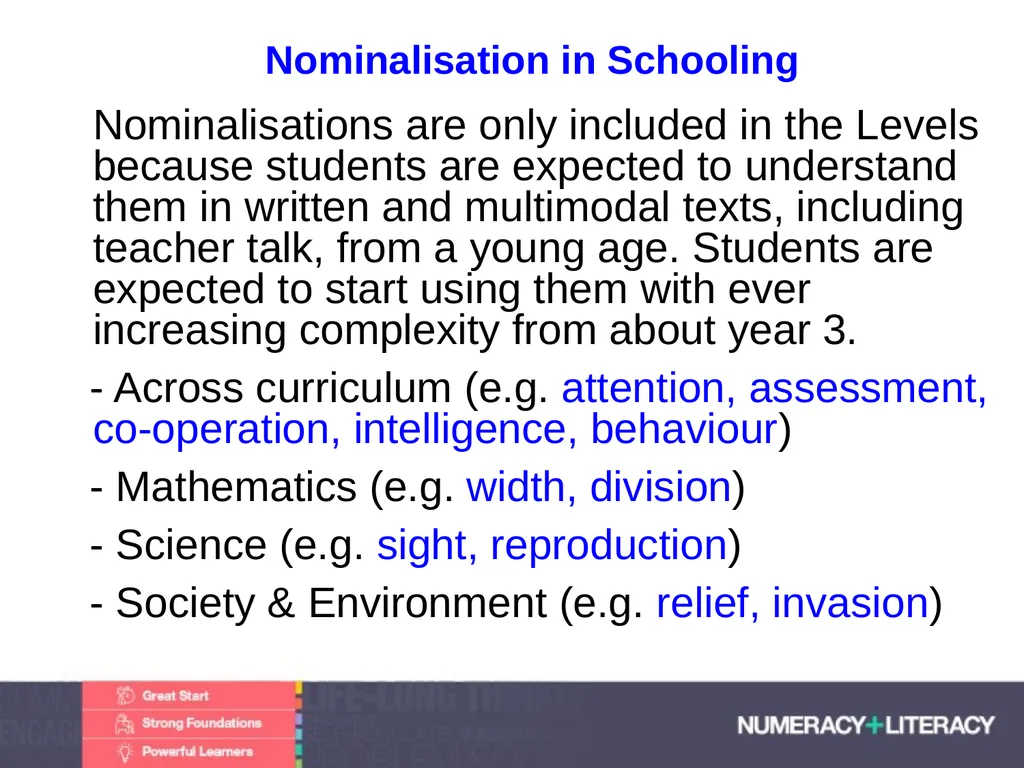
Nominalisation in Schooling Nominalisations are only included in the Levels because students are expected to understand them in written and multimodal texts, including teacher talk, from a young age. Students are expected to start using them with ever increasing complexity from about year 3.
- Across curriculum (e.g. attention, assessment, co-operation, intelligence, behaviour)
- Mathematics (e.g. width, division)
- Science (e.g. sight, reproduction)
- Society & Environment (e.g. relief, invasion)<br>
13
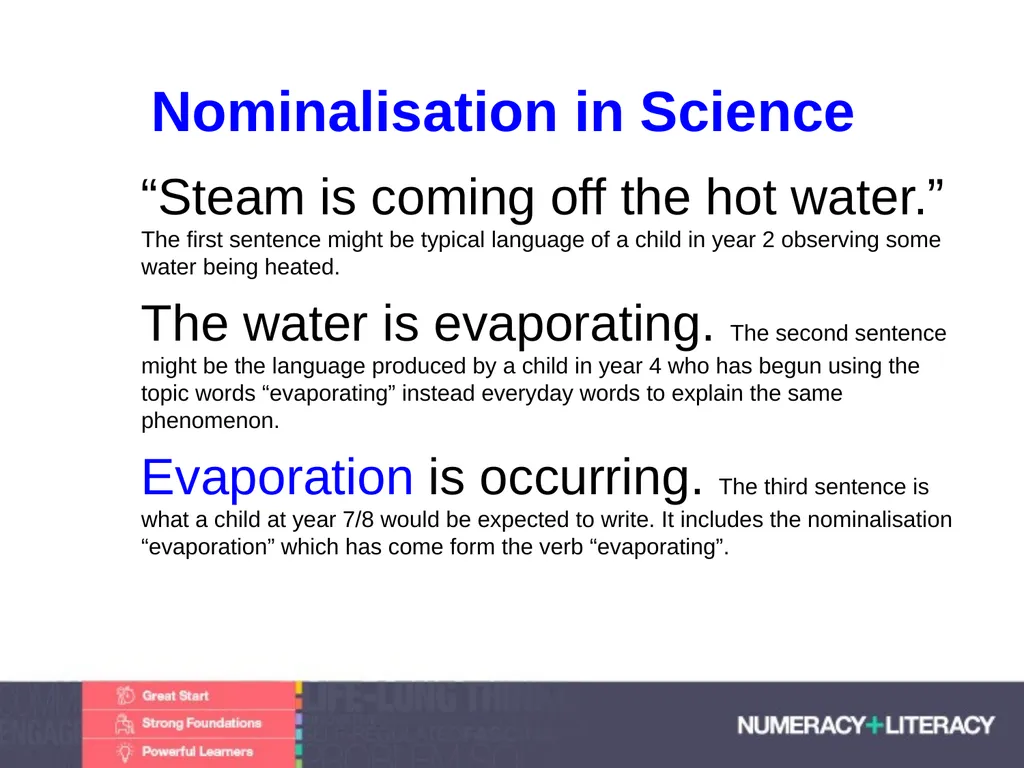
Nominalisation in Science “Steam is coming off the hot water.” The first sentence might be typical language of a child in year 2 observing some water being heated.
The water is evaporating. The second sentence might be the language produced by a child in year 4 who has begun using the topic words “evaporating” instead everyday words to explain the same phenomenon.
Evaporation is occurring. The third sentence is what a child at year 7/8 would be expected to write. It includes the nominalisation “evaporation” which has come form the verb “evaporating”.<br>
14
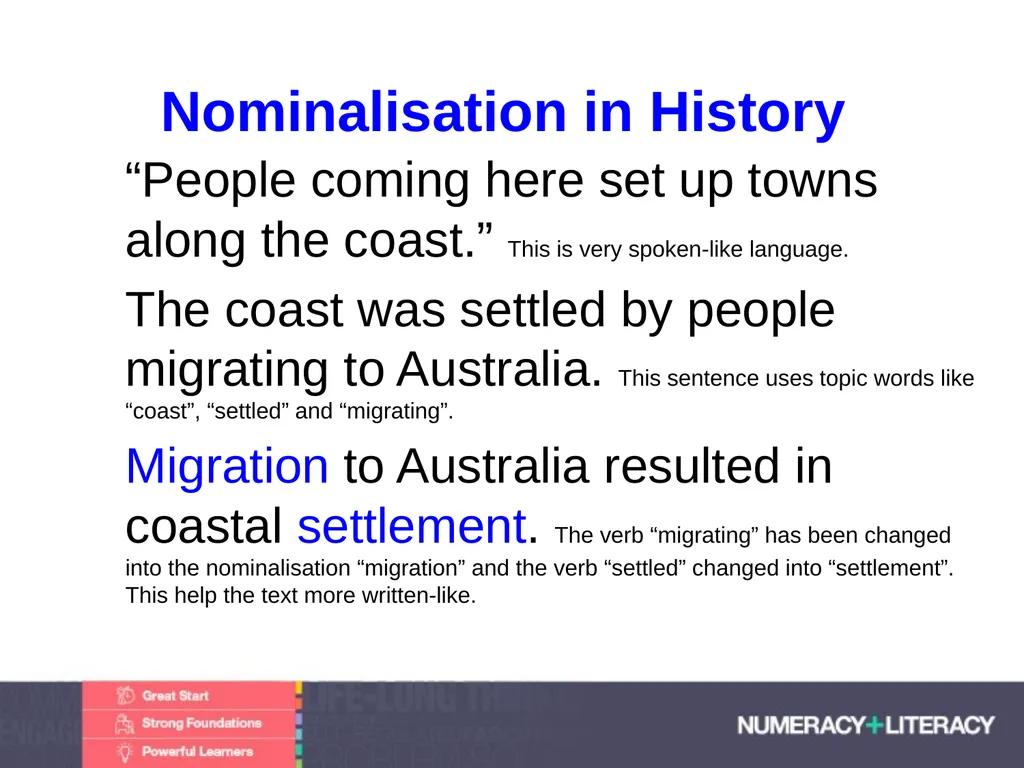
Nominalisation in History “People coming here set up towns along the coast.” This is very spoken-like language.
The coast was settled by people migrating to Australia. This sentence uses topic words like “coast”, “settled” and “migrating”.
Migration to Australia resulted in coastal settlement. The verb “migrating” has been changed into the nominalisation “migration” and the verb “settled” changed into “settlement”. This help the text more written-like.<br>
15
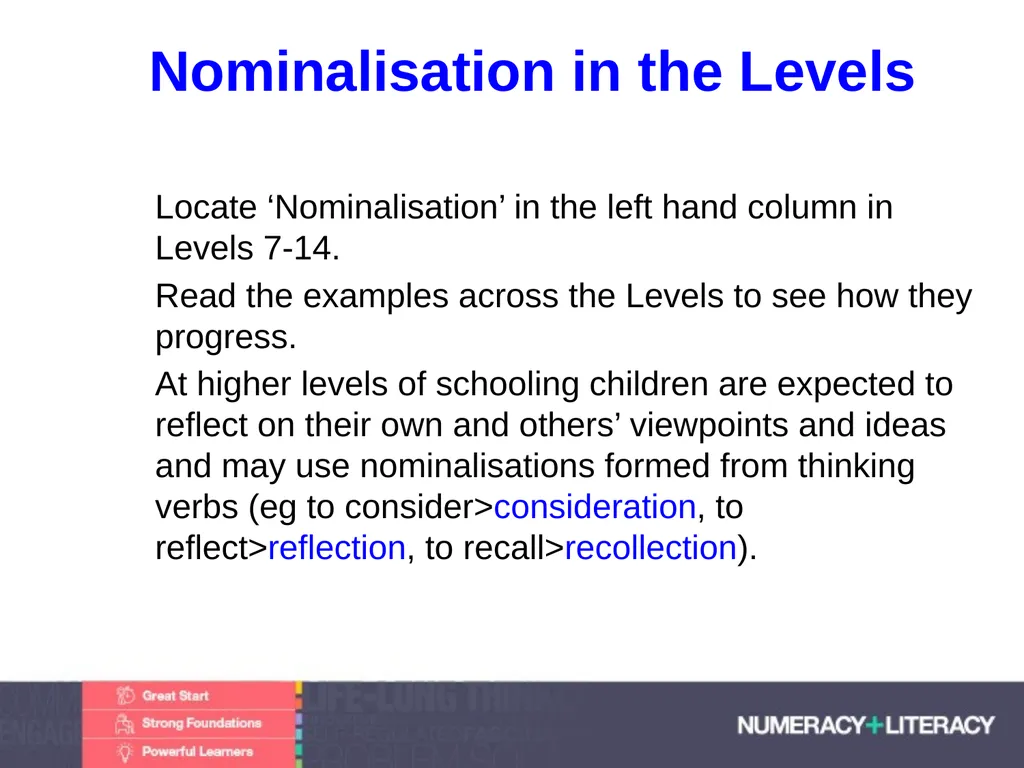
Nominalisation in the Levels Locate ‘Nominalisation’ in the left hand column in Levels 7-14.
Read the examples across the Levels to see how they progress.
At higher levels of schooling children are expected to reflect on their own and others’ viewpoints and ideas and may use nominalisations formed from thinking verbs (eg to consider>consideration, to reflect>reflection, to recall>recollection).<br>
16
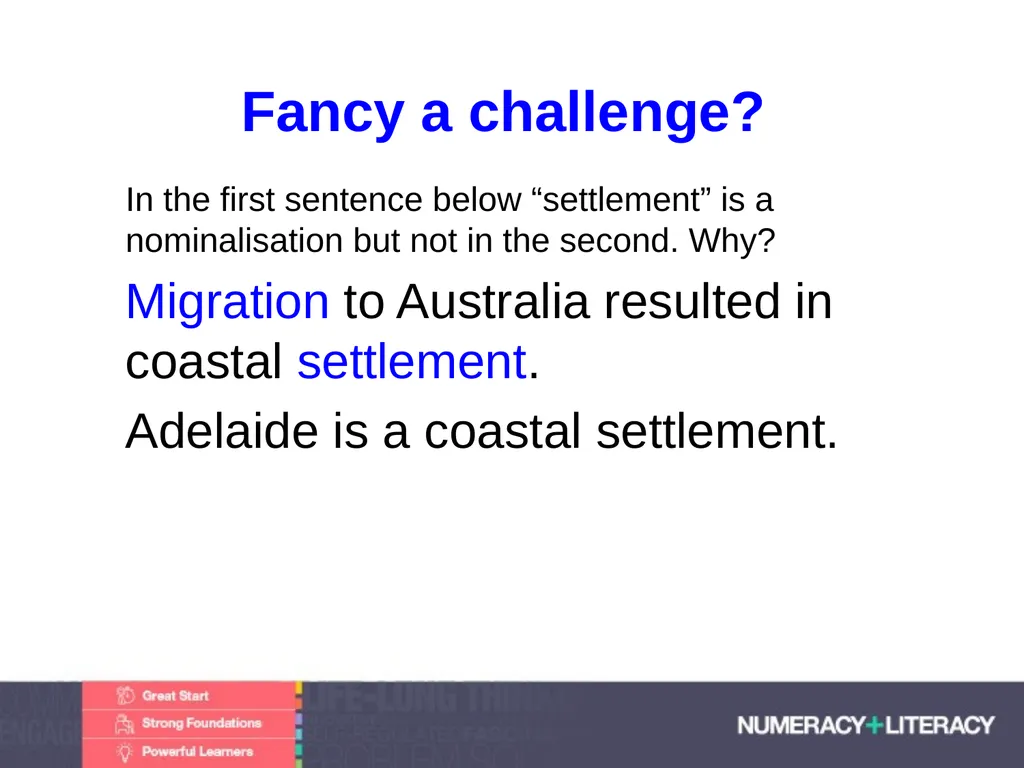
Fancy a challenge? In the first sentence below “settlement” is a nominalisation but not in the second. Why?
Migration to Australia resulted in coastal settlement.
Adelaide is a coastal settlement..<br>
17
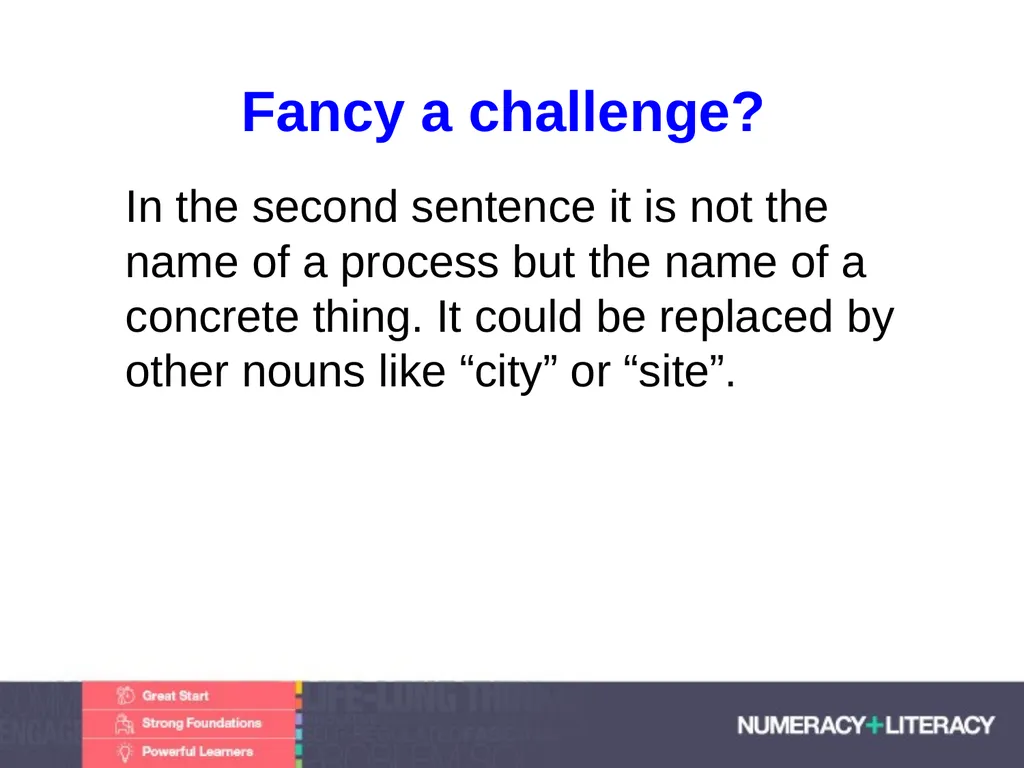
Fancy a challenge? In the second sentence it is not the name of a process but the name of a concrete thing. It could be replaced by other nouns like “city” or “site”.<br>
18
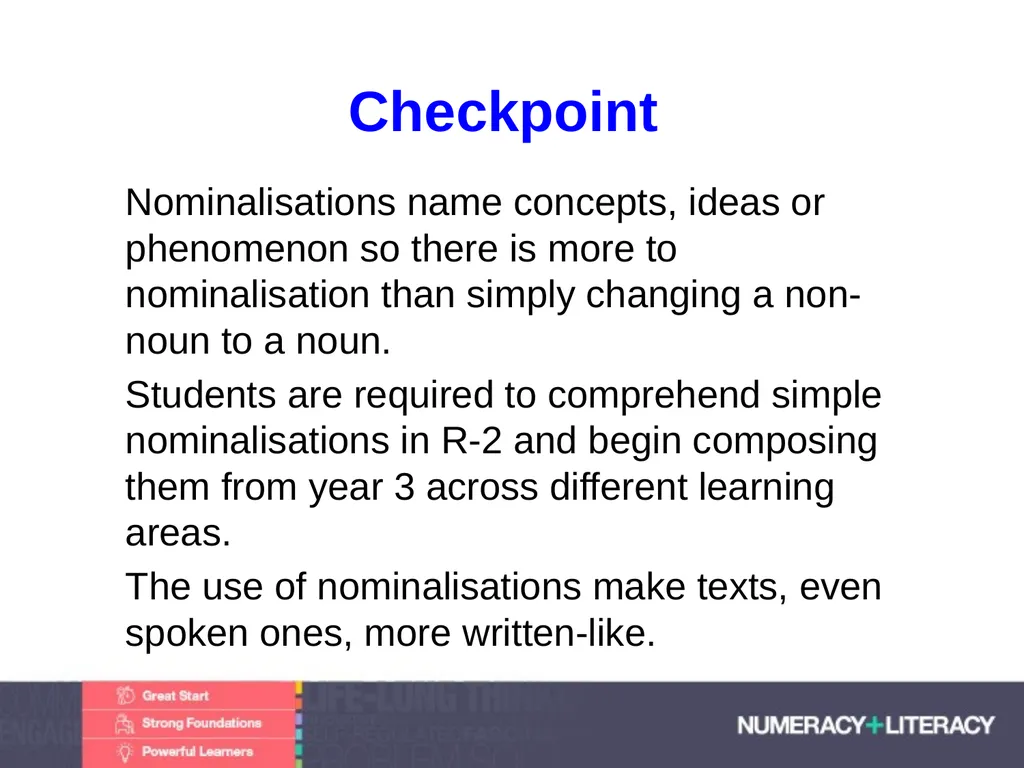
Checkpoint Nominalisations name concepts, ideas or phenomenon so there is more to nominalisation than simply changing a non-noun to a noun.
Students are required to comprehend simple nominalisations in R-2 and begin composing them from year 3 across different learning areas.
The use of nominalisations make texts, even spoken ones, more written-like.<br>
19
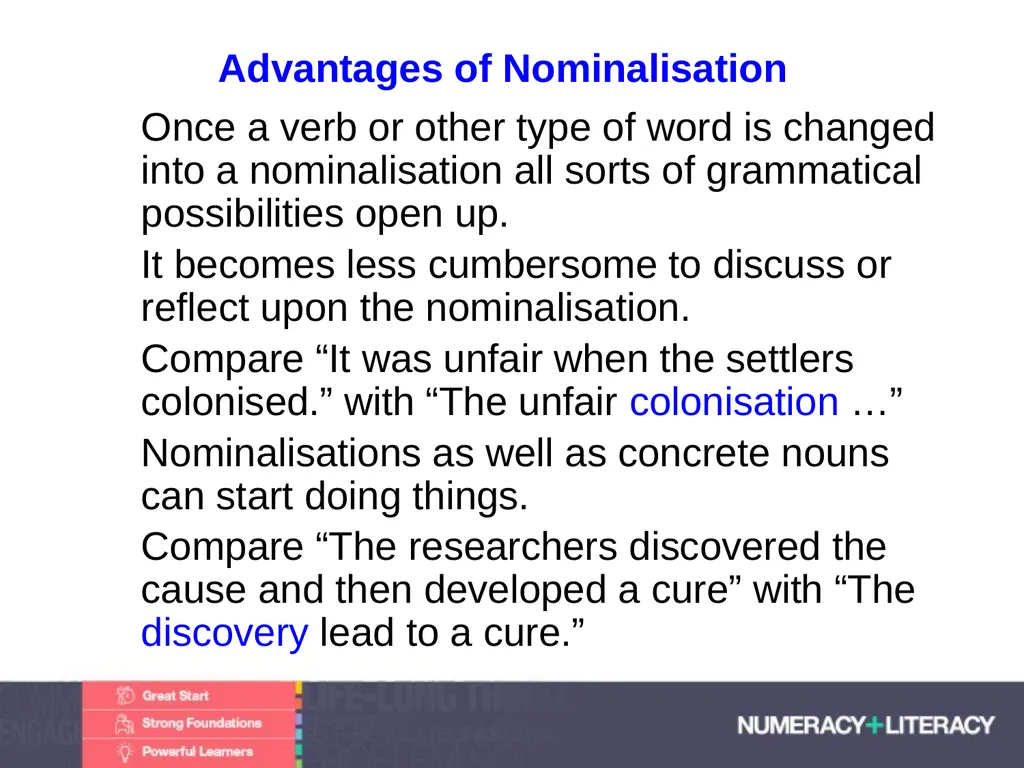
Advantages of Nominalisation Once a verb or other type of word is changed into a nominalisation all sorts of grammatical possibilities open up.
It becomes less cumbersome to discuss or reflect upon the nominalisation.
Compare “It was unfair when the settlers colonised.” with “The unfair colonisation …”
Nominalisations as well as concrete nouns can start doing things.
Compare “The researchers discovered the cause and then developed a cure” with “The discovery lead to a cure.”<br>
20
Purposes of Nominalisation You saw this slide early in the PowerPoint. Hopefully the purposes are even clearer now.
Nominalisation helps achieve a higher degree of abstraction and technicality.
Nominalisation is significant in constructing a distant and abstract world that can be reflected on.
Nominalisation is one of the language choices that enables movement towards highly written-like texts.<br>
21
Optional Extension Activities The remaining slides extend this module by providing opportunities to change isolated words and words within sentences into nominalisations.<br>
22
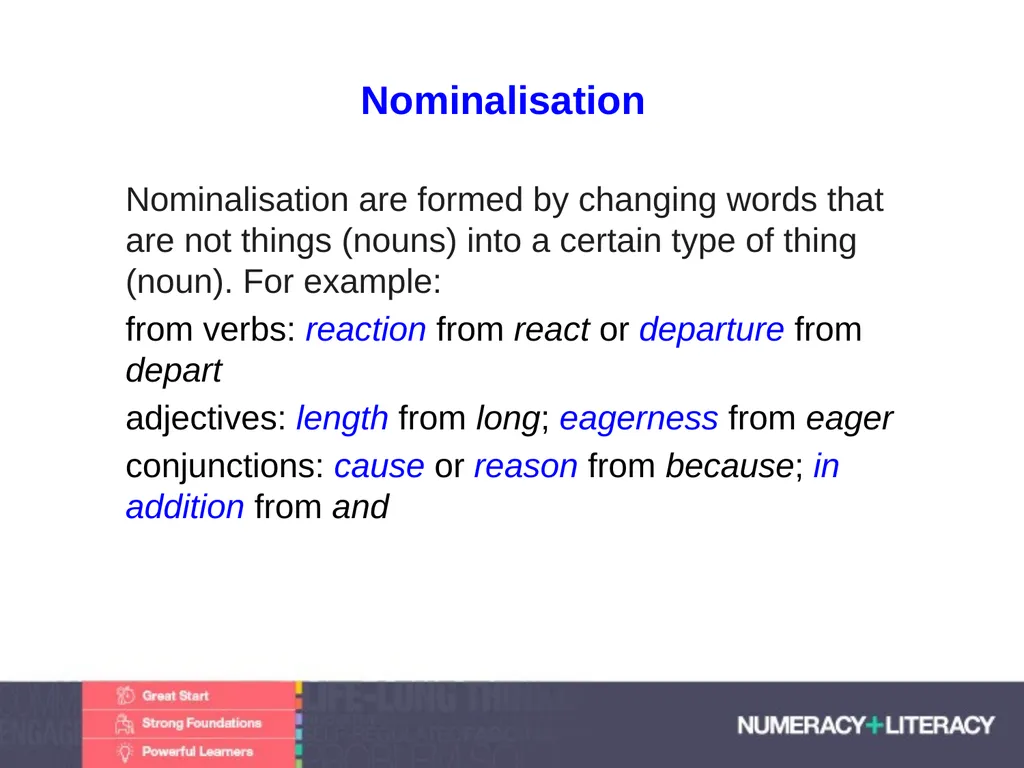
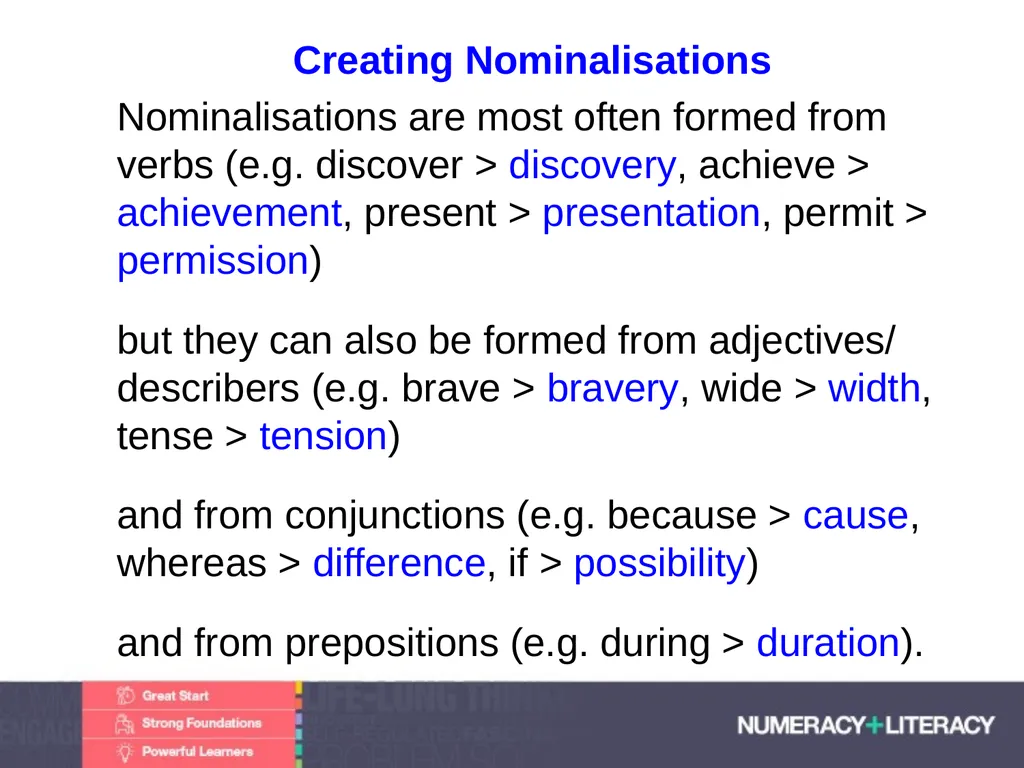
Creating Nominalisations Nominalisations are most often formed from verbs (e.g. discover > discovery, achieve > achievement, present > presentation, permit > permission)
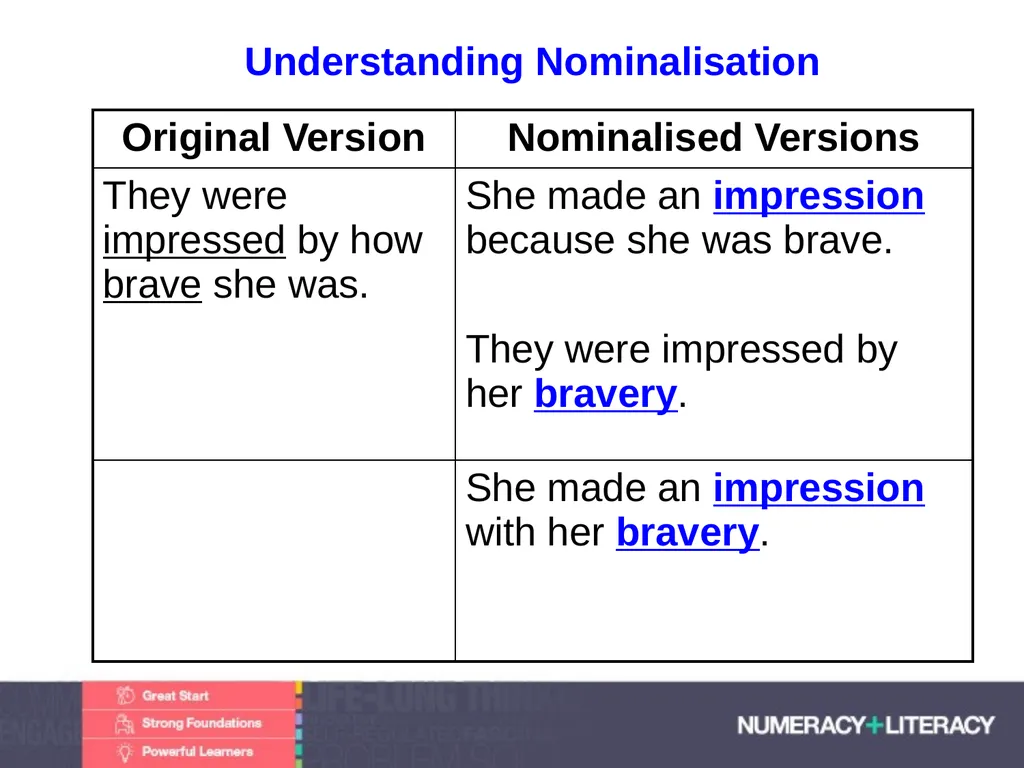
but they can also be formed from adjectives/ describers (e.g. brave > bravery, wide > width, tense > tension)
and from conjunctions (e.g. because > cause, whereas > difference, if > possibility)
and from prepositions (e.g. during > duration).<br>
23
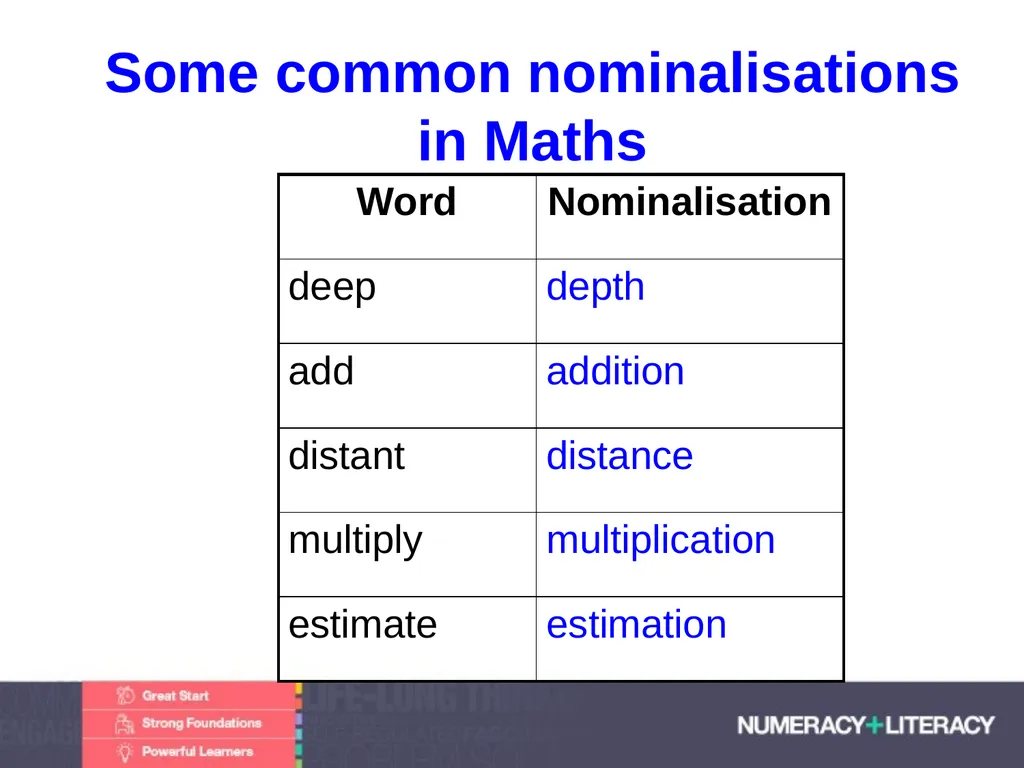
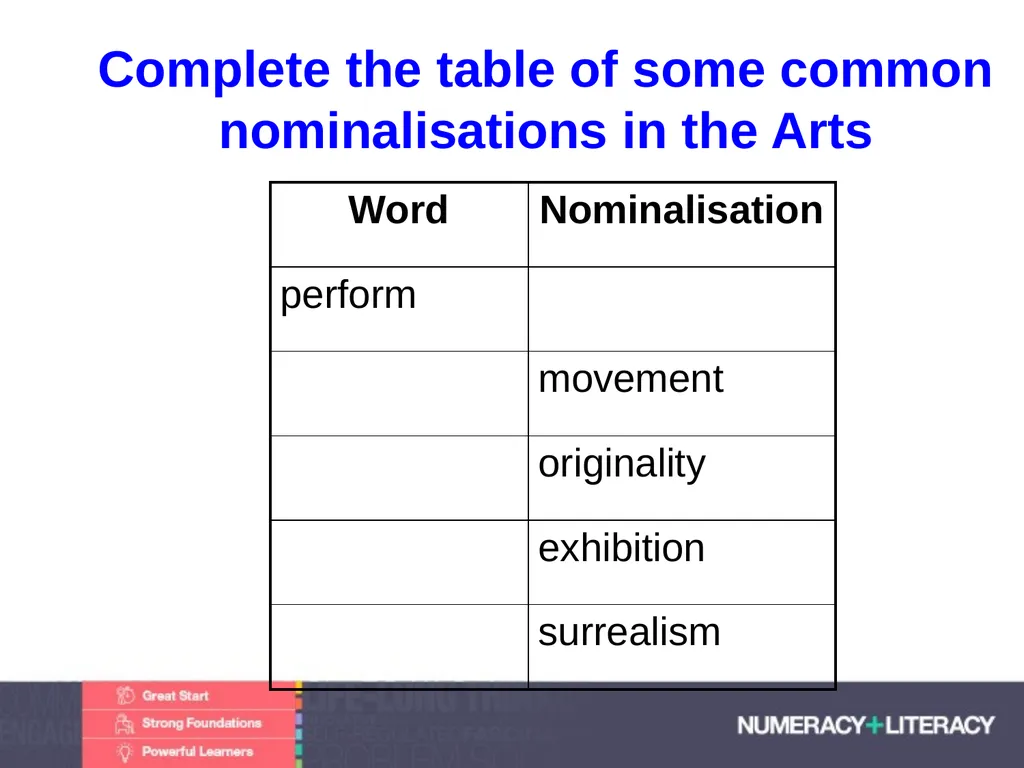
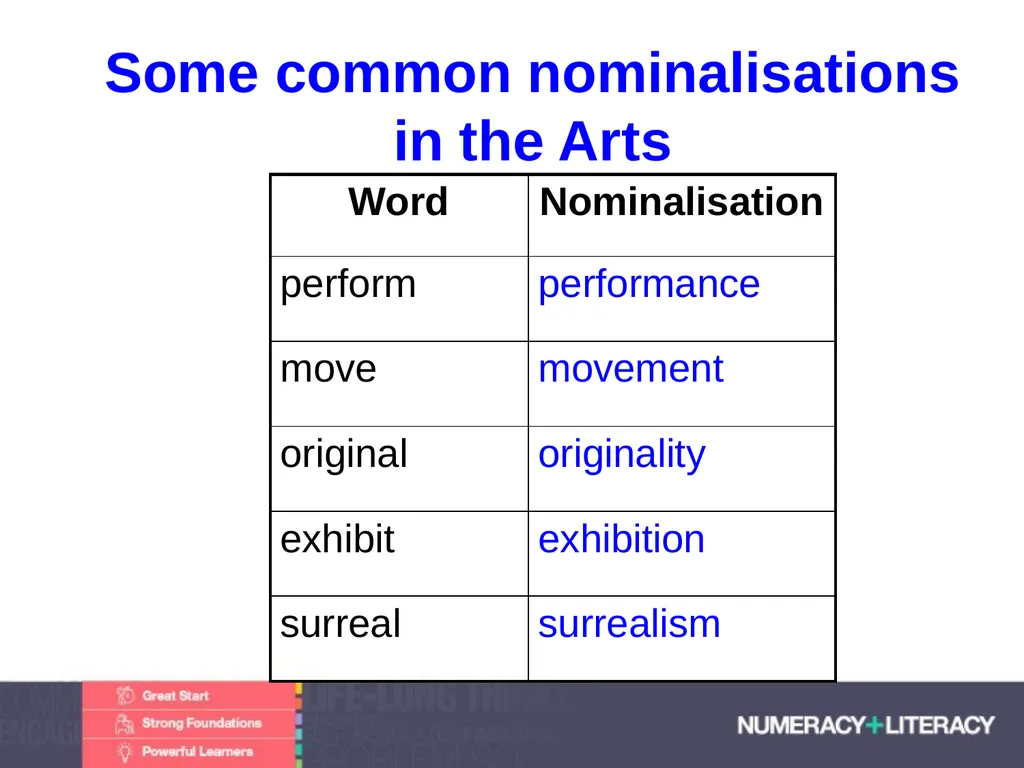
Creating Nominalisations The next few slides allow you to change words that are either verbs or adjectives/describers into nominalisations from a couple of learning areas. areas<br>
24
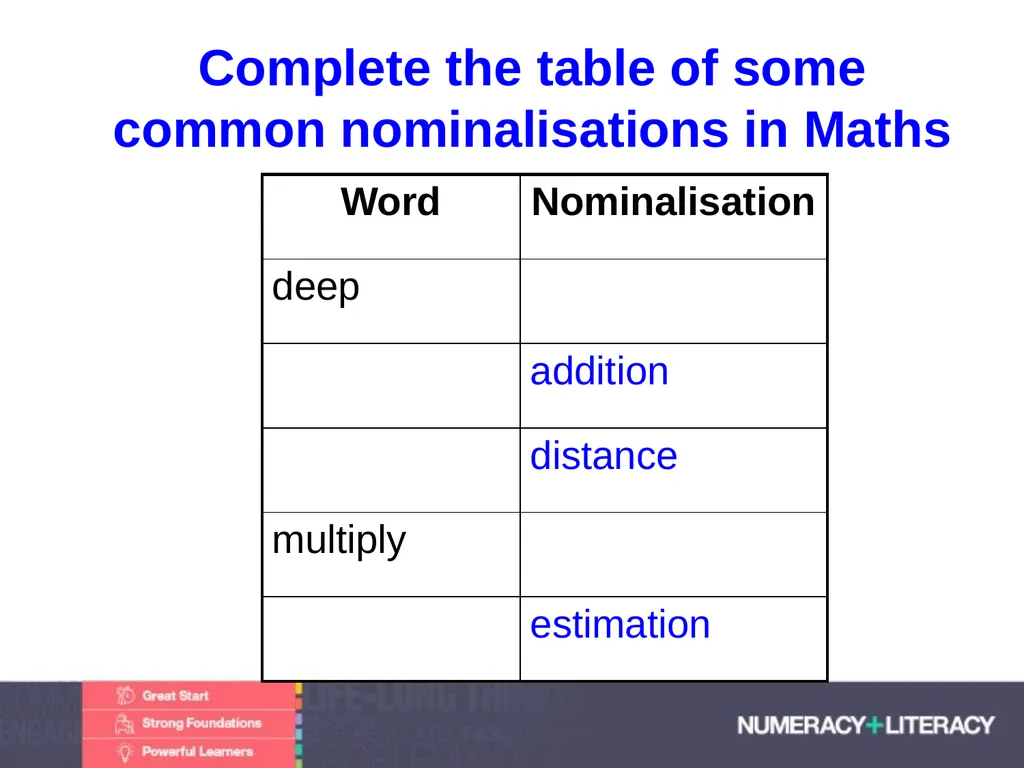
Complete the table of some common nominalisations in Maths<br>
25
Some common nominalisations in Maths<br>
26
Complete the table of some common nominalisations in the Arts<br>
27
Some common nominalisations in the Arts<br>
28
Understanding Nominalisation<br>
29
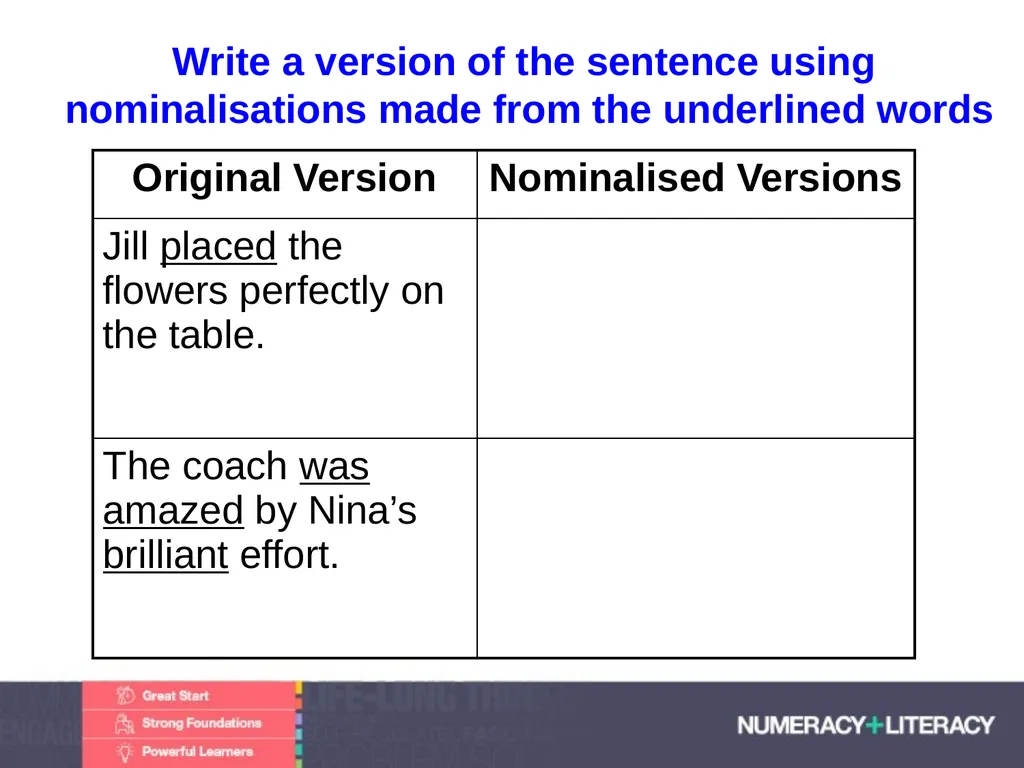
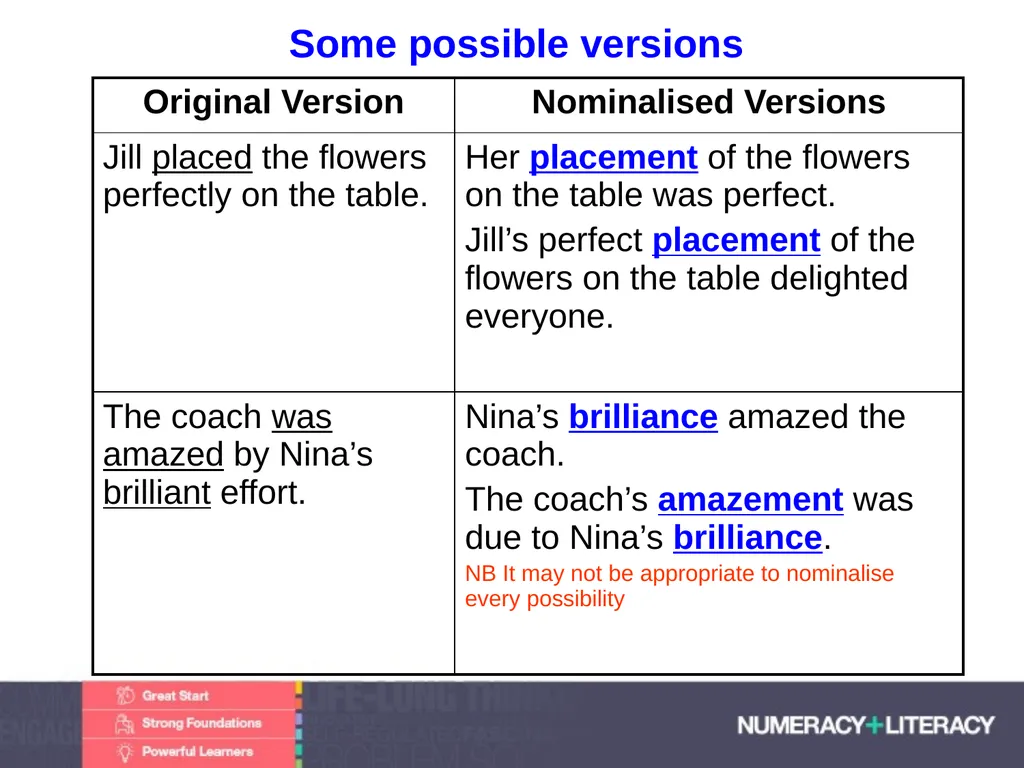
Write a version of the sentence using nominalisations made from the underlined words<br>
30
Some possible versions<br>
31
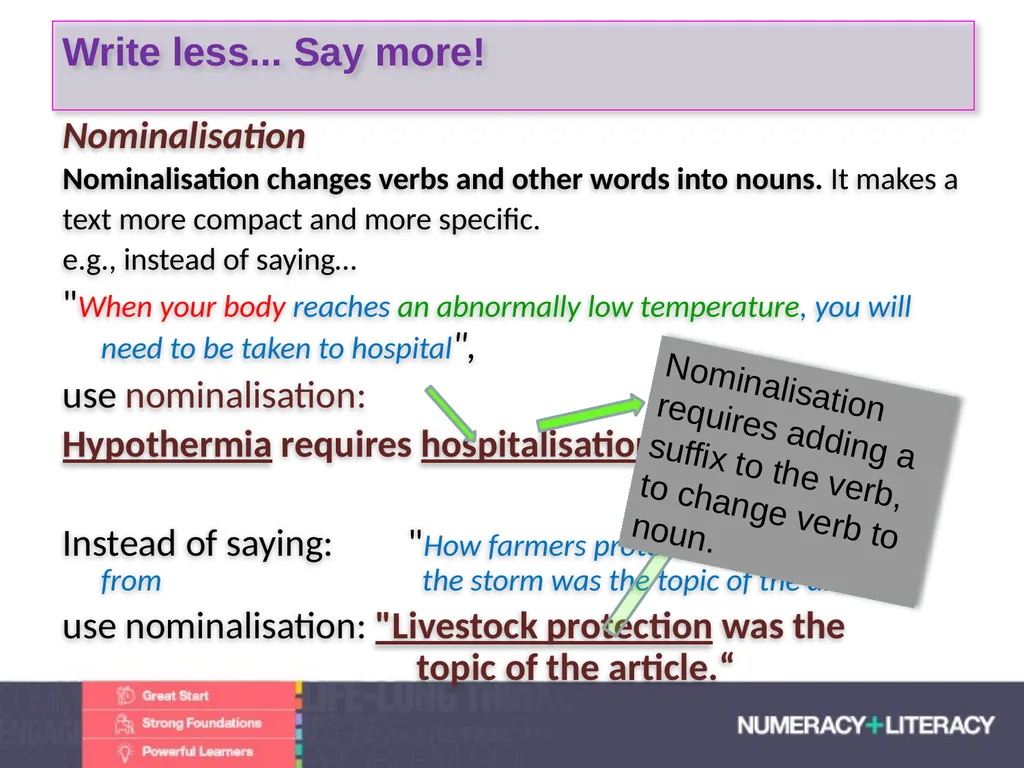
Write less... Say more! Nominalisation
Nominalisation changes verbs and other words into nouns. It makes a
text more compact and more specific.
e.g., instead of saying…
"When your body reaches an abnormally low temperature, you will need to be taken to hospital",
use nominalisation:
Hypothermia requires hospitalisation.
Instead of saying: "How farmers protected their livestock from the storm was the topic of the article",
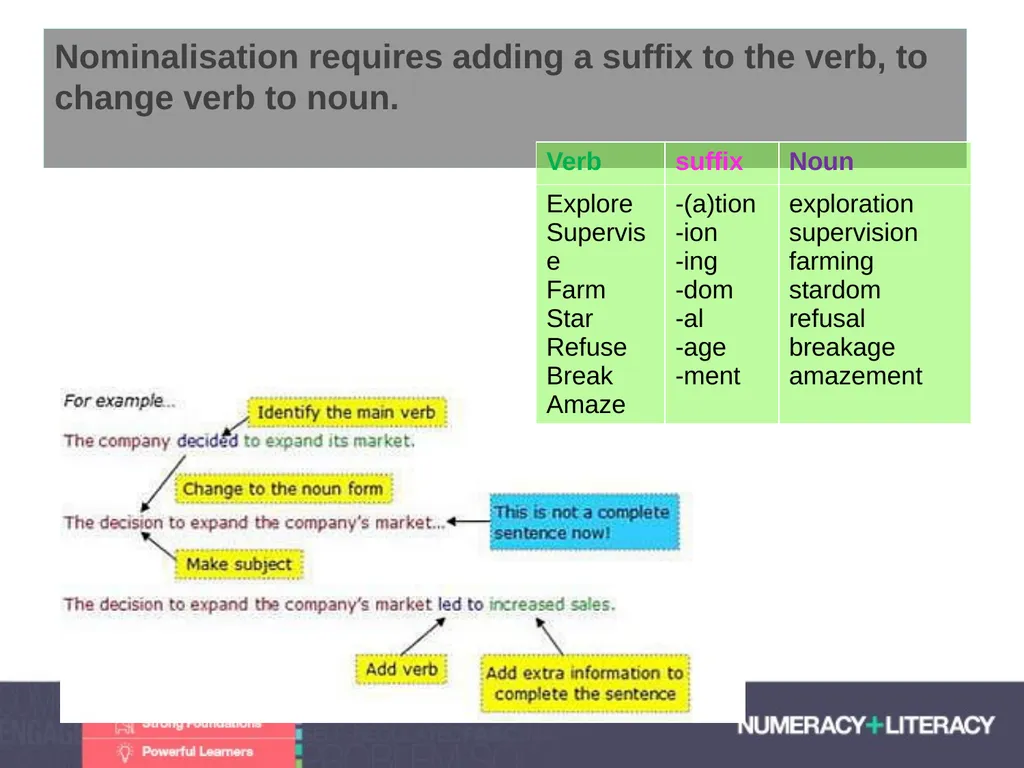
use nominalisation: "Livestock protection was the topic of the article.“ Nominalisation requires adding a suffix to the verb, to change verb to noun.<br>
32
Nominalisation requires adding a suffix to the verb, to change verb to noun.<br>