
Language functions in English Assistant Lecturer :


Description: Language functions in English Assistant Lecturer : Ahmed Najm Abed University of kufa, Faculty of Education . Department of English Introduction We can describe language by using words to talk about grammar (grammatical description). But we
Related Topics
Download Presentation
"Language functions in English Assistant Lecturer :" is the property of its rightful owner. Permission is granted to download and print the materials on this website for personal, non-commercial use only, and to display it on your personal computer provided you do not modify the materials and that you retain all copyright notices contained in the materials. By downloading content from our website, you accept the terms of this agreement.
Presentation Transcript
slide1. Language functions in English Assistant Lecturer : Ahmed Najm Abed
University of kufa, Faculty of Education . Department of English<br>
slide2. Introduction We can describe language by using words to talk about grammar (grammatical description). But we can also describe language by saying how it is used. This is the function of the language (functional description) . For example, “I’m sorry” represents the function of apologizing and, “Good Morning!” represents the function of greeting .<br>
slide3. Apologizing To apologize is to tell someone that you are sorry for having done something that has caused him inconvenience or unhappiness: Example
I must apologize to peter for my late arrival.<br>
slide4. Making Apologies I do apologize for …...
I must apologize for ……
I apologize for……….
I am so sorry for ……..
Please, forgive me for ……
Excuse me for………..<br>
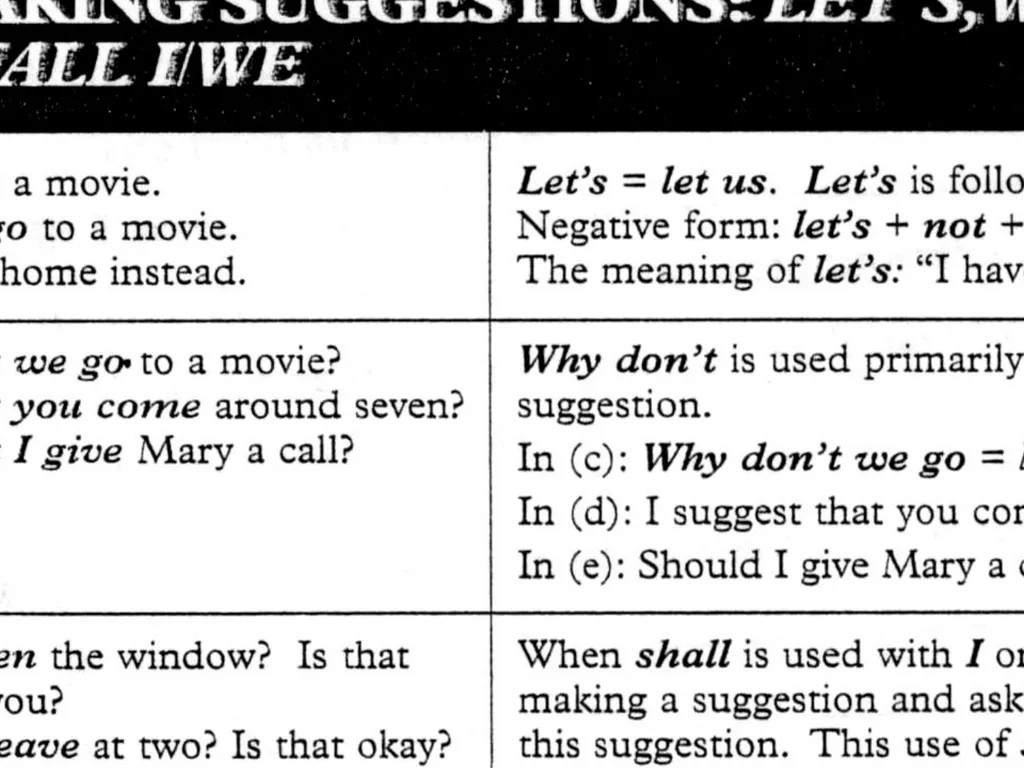
slide5. making suggestions We make suggestions when deciding what to do with our friends, or giving them advice on what they might do in a certain situation.<br>
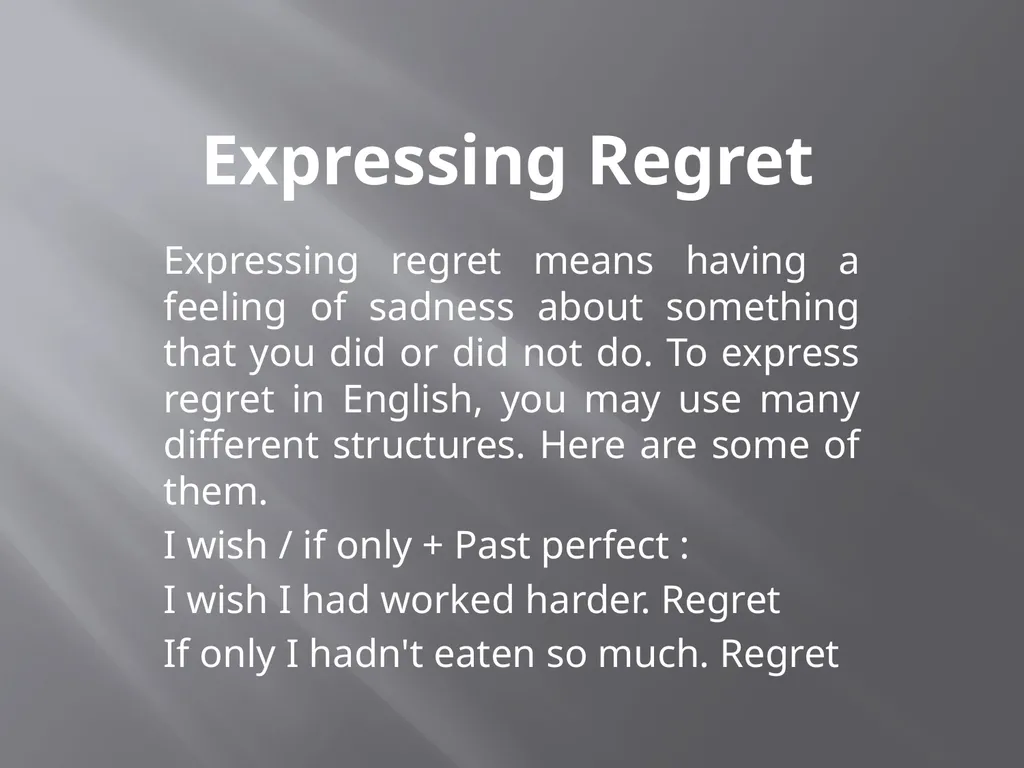
slide7. Expressing Regret Expressing regret means having a feeling of sadness about something that you did or did not do. To express regret in English, you may use many different structures. Here are some of them.
I wish / if only + Past perfect :
I wish I had worked harder. Regret
If only I hadn't eaten so much. Regret<br>
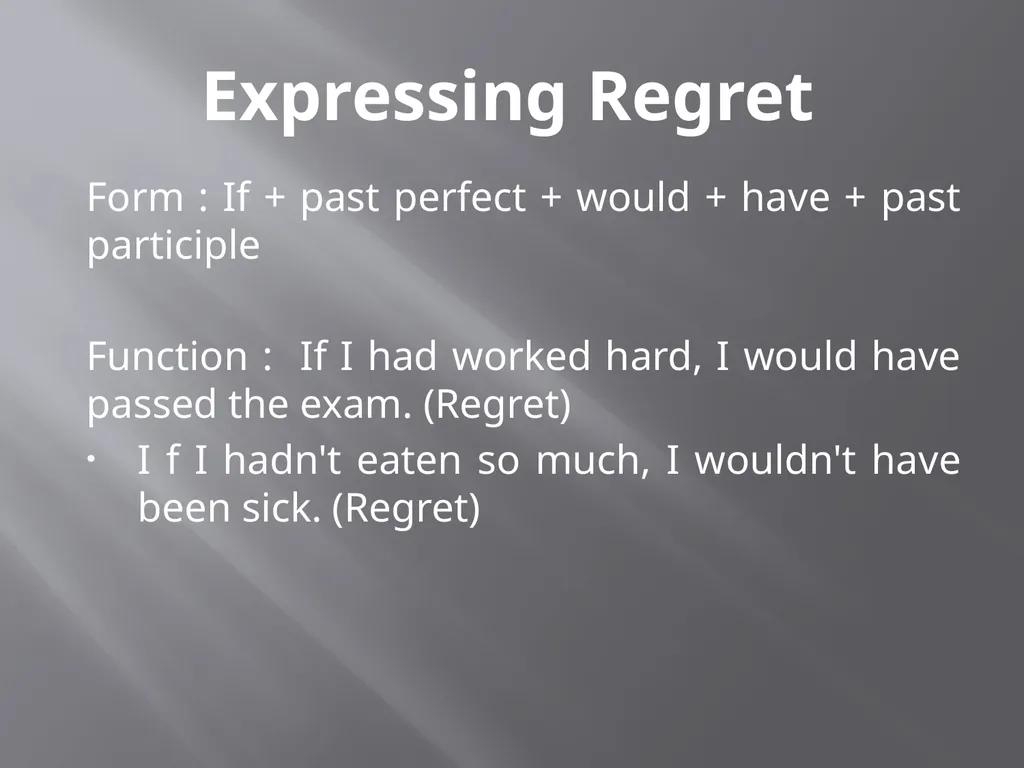
slide8. Expressing Regret Form : If + past perfect + would + have + past participle
Function : If I had worked hard, I would have passed the exam. (Regret)
I f I hadn't eaten so much, I wouldn't have been sick. (Regret)<br>
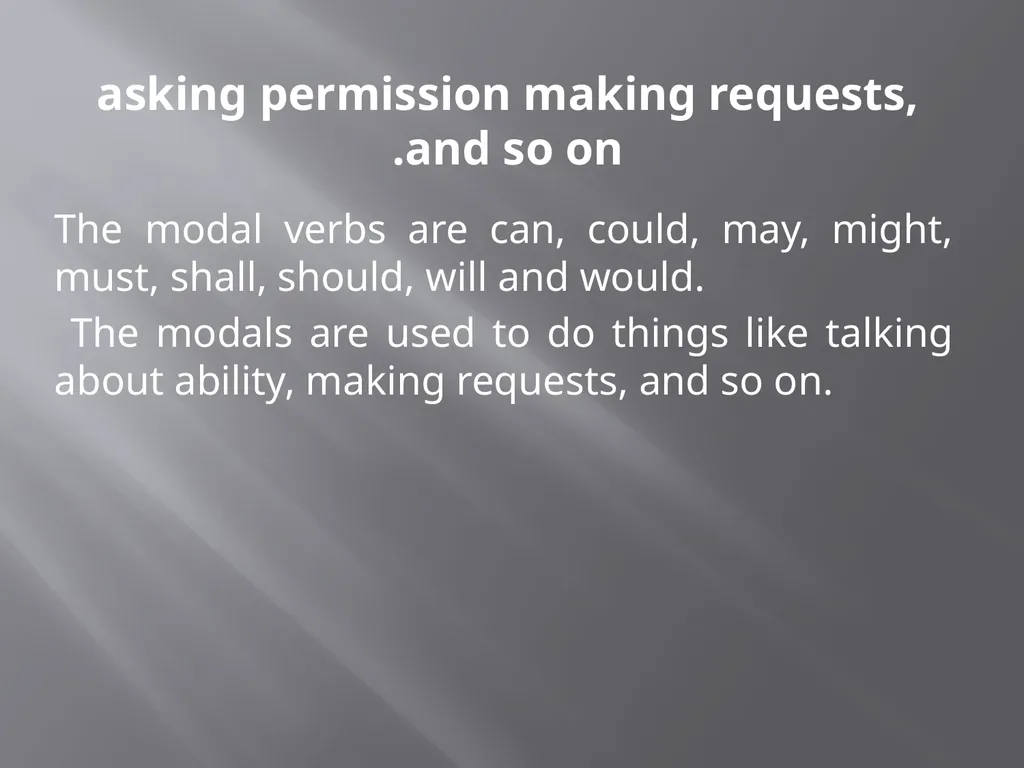
slide9. asking permission making requests, and so on. The modal verbs are can, could, may, might, must, shall, should, will and would.
The modals are used to do things like talking about ability, making requests, and so on.<br>
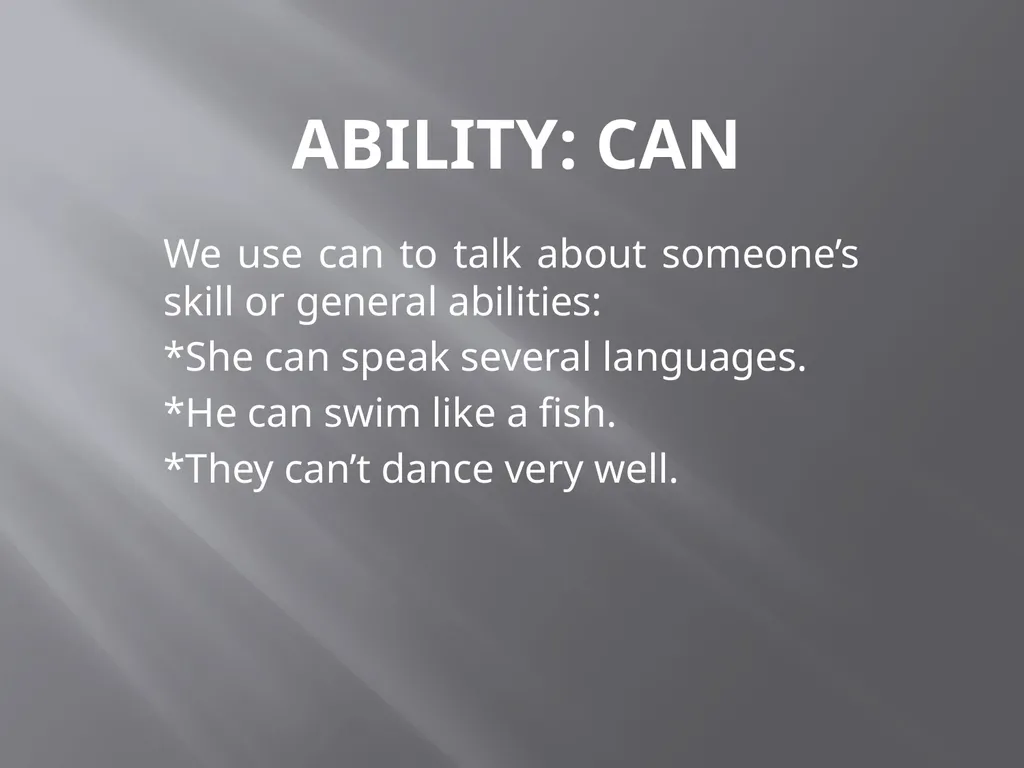
slide10. Ability: CAN We use can to talk about someone’s skill or general abilities:
*She can speak several languages.
*He can swim like a fish.
*They can’t dance very well.<br>
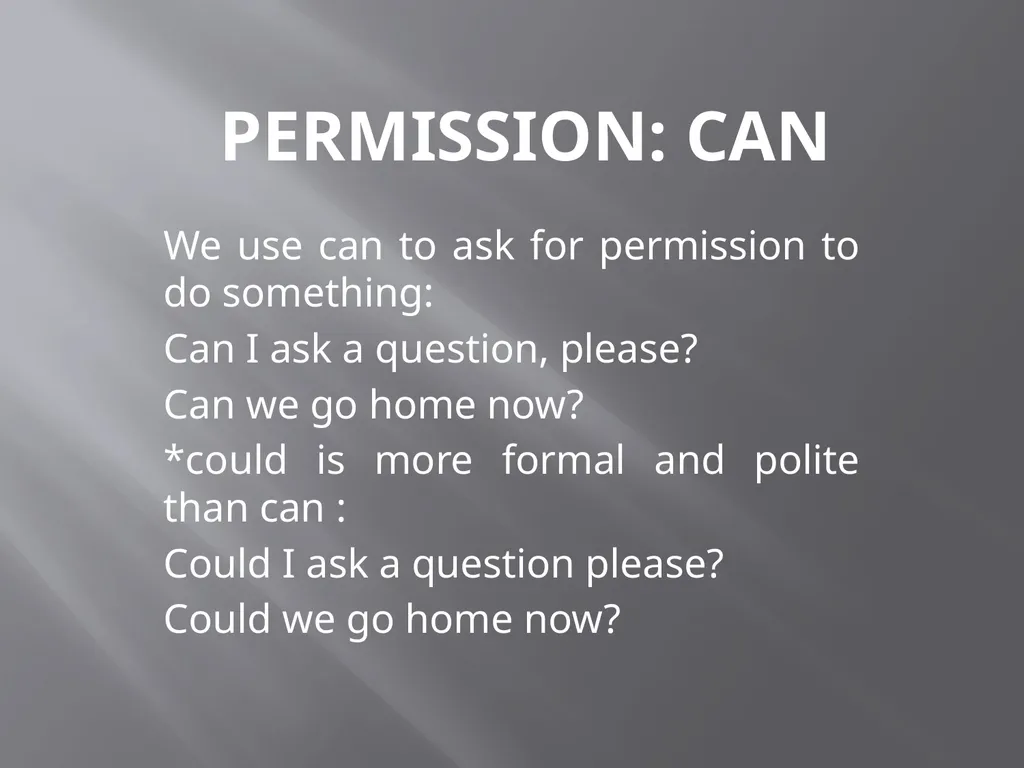
slide11. Permission: can We use can to ask for permission to do something:
Can I ask a question, please?
Can we go home now?
*could is more formal and polite than can :
Could I ask a question please?
Could we go home now?<br>
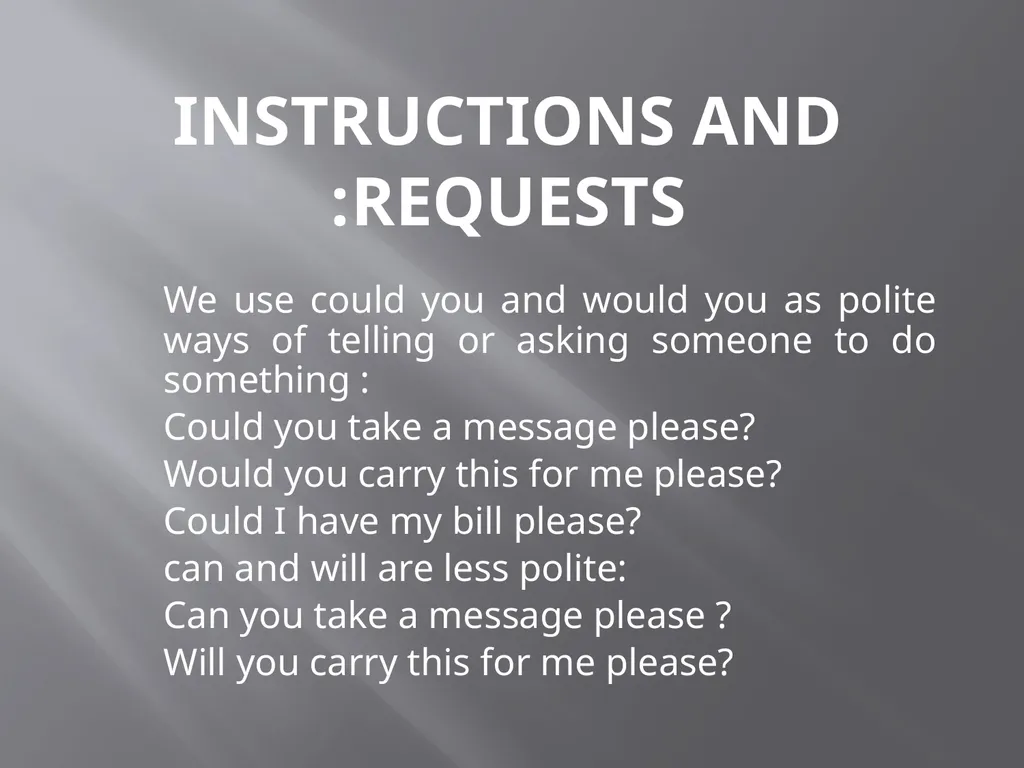
slide12. Instructions and requests: We use could you and would you as polite ways of telling or asking someone to do something :
Could you take a message please?
Would you carry this for me please?
Could I have my bill please?
can and will are less polite:
Can you take a message please ?
Will you carry this for me please?<br>
slide13. Instructions and Requests: We use ( could you ) and (would you) as polite ways of telling or asking someone to do something :
Could you take a message please ?
Would you carry this for me please ?
Could I have my bill please?
can and will are less polite :
Can you take a message please ?
Will you carry this for me please?<br>
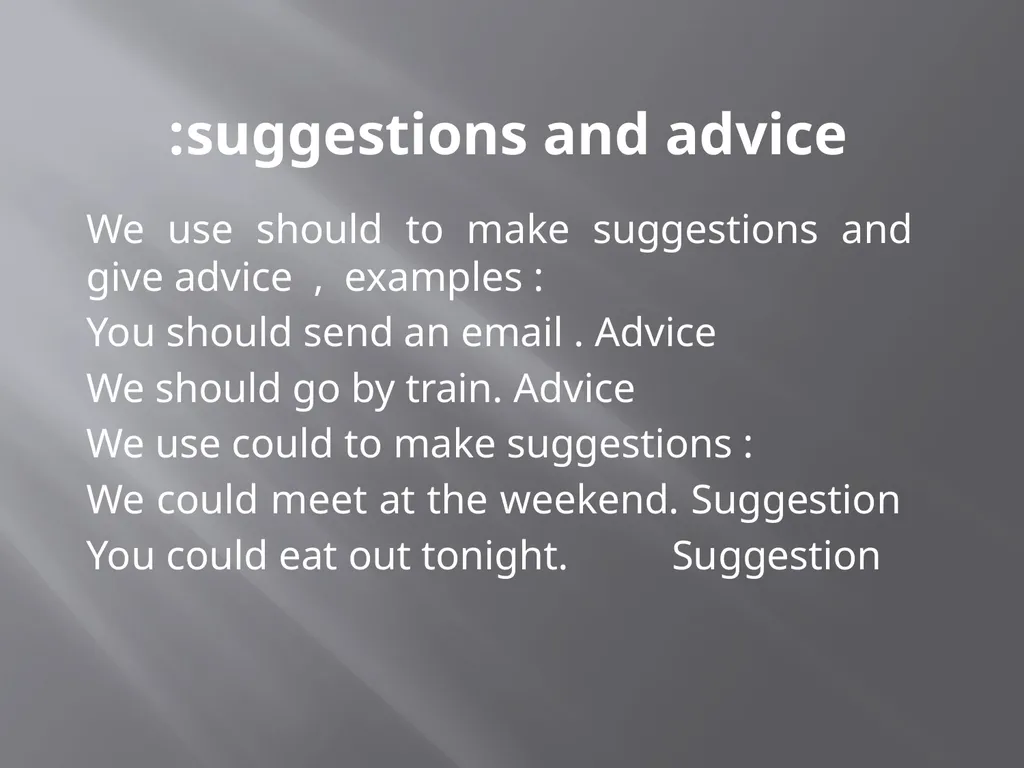
slide14. suggestions and advice: We use should to make suggestions and give advice , examples :
You should send an email . Advice
We should go by train. Advice
We use could to make suggestions :
We could meet at the weekend. Suggestion
You could eat out tonight. Suggestion<br>
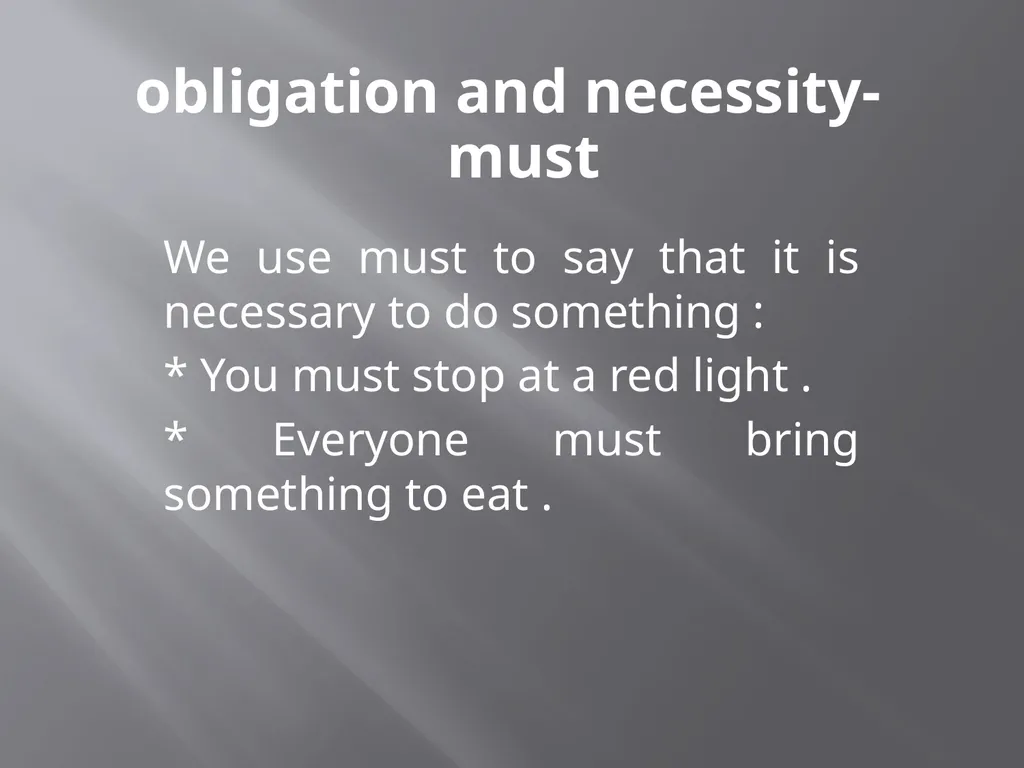
slide15. obligation and necessity- must We use must to say that it is necessary to do something :
* You must stop at a red light .
* Everyone must bring something to eat .<br>
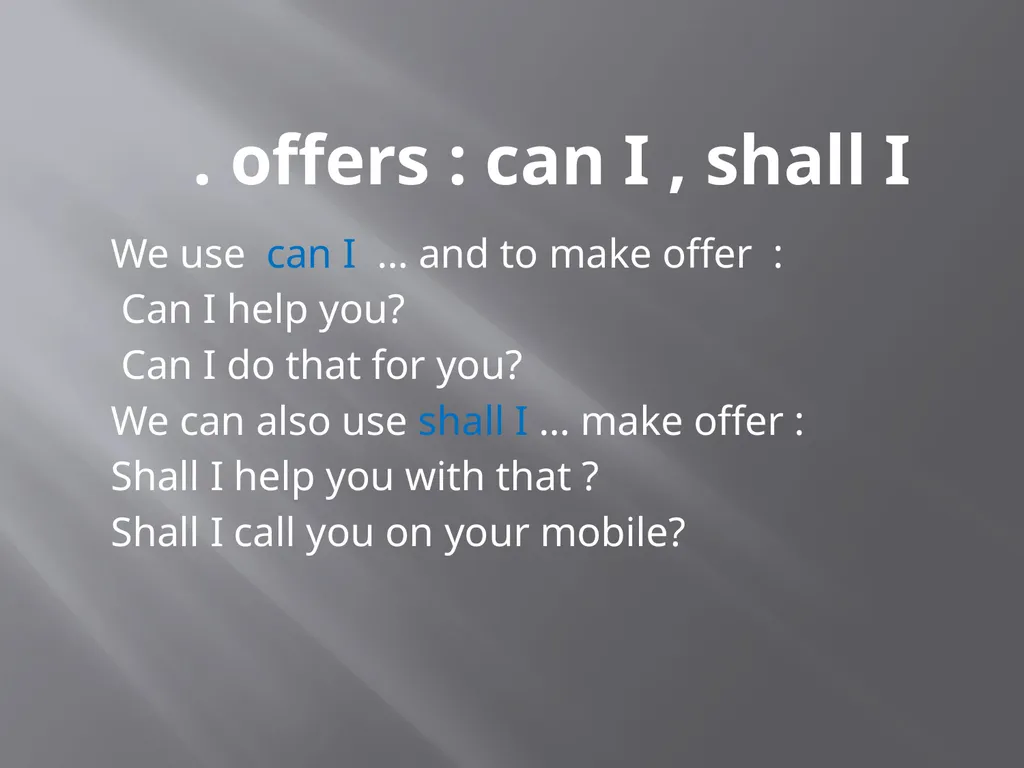
slide16. offers : can I , shall I . We use can I … and to make offer :
Can I help you?
Can I do that for you?
We can also use shall I … make offer :
Shall I help you with that ?
Shall I call you on your mobile?<br>
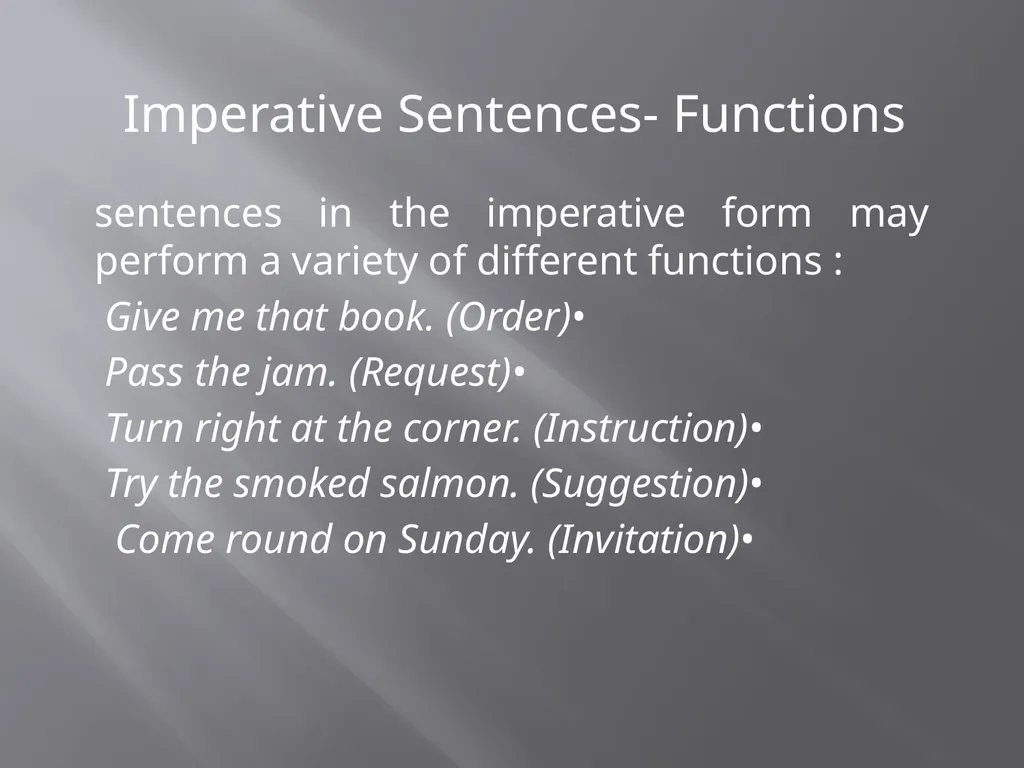
slide17. Imperative Sentences- Functions sentences in the imperative form may perform a variety of different functions :
•Give me that book. (Order)
•Pass the jam. (Request)
•Turn right at the corner. (Instruction)
•Try the smoked salmon. (Suggestion)
•Come round on Sunday. (Invitation)<br>
University of kufa, Faculty of Education . Department of English<br>
slide2. Introduction We can describe language by using words to talk about grammar (grammatical description). But we can also describe language by saying how it is used. This is the function of the language (functional description) . For example, “I’m sorry” represents the function of apologizing and, “Good Morning!” represents the function of greeting .<br>
slide3. Apologizing To apologize is to tell someone that you are sorry for having done something that has caused him inconvenience or unhappiness: Example
I must apologize to peter for my late arrival.<br>
slide4. Making Apologies I do apologize for …...
I must apologize for ……
I apologize for……….
I am so sorry for ……..
Please, forgive me for ……
Excuse me for………..<br>
slide5. making suggestions We make suggestions when deciding what to do with our friends, or giving them advice on what they might do in a certain situation.<br>
slide7. Expressing Regret Expressing regret means having a feeling of sadness about something that you did or did not do. To express regret in English, you may use many different structures. Here are some of them.
I wish / if only + Past perfect :
I wish I had worked harder. Regret
If only I hadn't eaten so much. Regret<br>
slide8. Expressing Regret Form : If + past perfect + would + have + past participle
Function : If I had worked hard, I would have passed the exam. (Regret)
I f I hadn't eaten so much, I wouldn't have been sick. (Regret)<br>
slide9. asking permission making requests, and so on. The modal verbs are can, could, may, might, must, shall, should, will and would.
The modals are used to do things like talking about ability, making requests, and so on.<br>
slide10. Ability: CAN We use can to talk about someone’s skill or general abilities:
*She can speak several languages.
*He can swim like a fish.
*They can’t dance very well.<br>
slide11. Permission: can We use can to ask for permission to do something:
Can I ask a question, please?
Can we go home now?
*could is more formal and polite than can :
Could I ask a question please?
Could we go home now?<br>
slide12. Instructions and requests: We use could you and would you as polite ways of telling or asking someone to do something :
Could you take a message please?
Would you carry this for me please?
Could I have my bill please?
can and will are less polite:
Can you take a message please ?
Will you carry this for me please?<br>
slide13. Instructions and Requests: We use ( could you ) and (would you) as polite ways of telling or asking someone to do something :
Could you take a message please ?
Would you carry this for me please ?
Could I have my bill please?
can and will are less polite :
Can you take a message please ?
Will you carry this for me please?<br>
slide14. suggestions and advice: We use should to make suggestions and give advice , examples :
You should send an email . Advice
We should go by train. Advice
We use could to make suggestions :
We could meet at the weekend. Suggestion
You could eat out tonight. Suggestion<br>
slide15. obligation and necessity- must We use must to say that it is necessary to do something :
* You must stop at a red light .
* Everyone must bring something to eat .<br>
slide16. offers : can I , shall I . We use can I … and to make offer :
Can I help you?
Can I do that for you?
We can also use shall I … make offer :
Shall I help you with that ?
Shall I call you on your mobile?<br>
slide17. Imperative Sentences- Functions sentences in the imperative form may perform a variety of different functions :
•Give me that book. (Order)
•Pass the jam. (Request)
•Turn right at the corner. (Instruction)
•Try the smoked salmon. (Suggestion)
•Come round on Sunday. (Invitation)<br>