
Language Over Time Working with AO3 Slide 1 Those
LV
Published · 46 slides · 0 views

1 / 1


Description
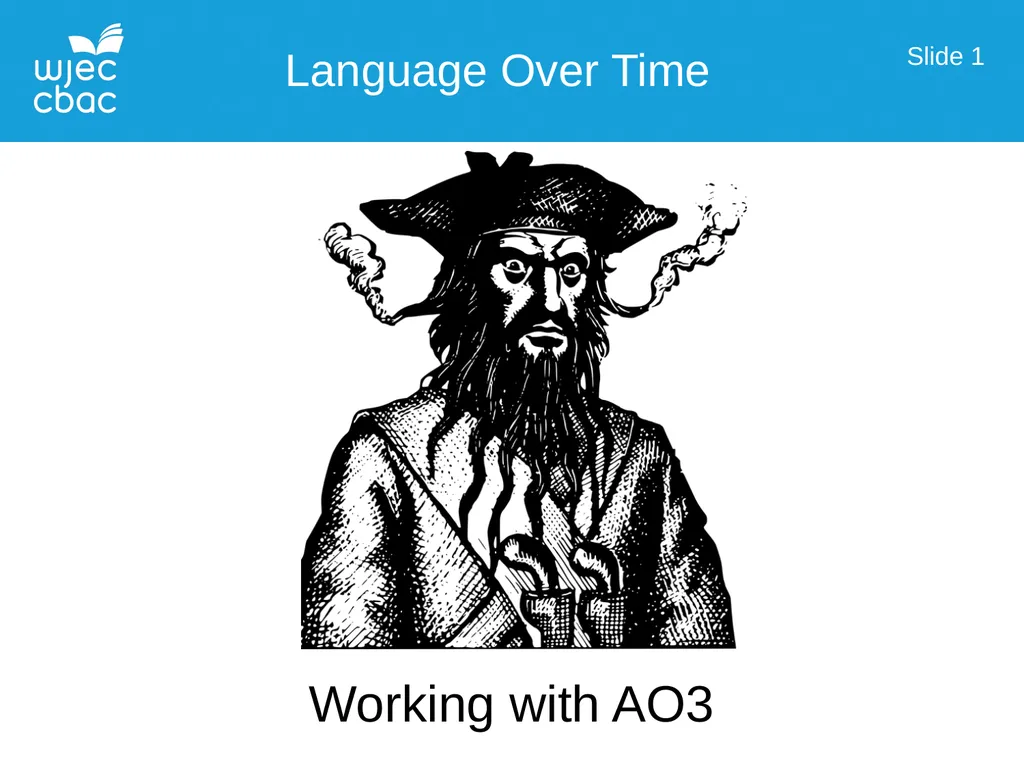
Language Over Time Working with AO3 Slide 1 Those of his Crew who were taken alive, told a Story which may appear a little incredible; however, we think it will not be fair to omit it, since we had it from their own Mouths. That once upon a
Related Topics
Share
Embed code
Download this presentation From Below
"Language Over Time Working with AO3 Slide 1 Those" is the property of its rightful owner. Permission is granted to download and print the materials on this website for personal, non-commercial use only, and to display it on your personal computer provided you do not modify the materials and that you retain all copyright notices contained in the materials. By downloading content from our website, you accept the terms of this agreement.
Presentation Transcript
01
Language Over Time Working with AO3 Slide 1<br>
02
Those of his Crew who were taken alive, told a Story which may appear a little incredible; however, we think it will not be fair to omit it, since we had it from their own Mouths. That once upon a Cruize,* they found out that they had a Man on Board more than their Crew; such a one was seen several Days amongst them, sometimes below, and sometimes upon Deck, yet no Man in the Ship could give an Account who he was. It seems, they verily believed it was the Devil.
*a voyage or journey between two specific places which a ship makes regularly Slide 2 Q1(b): ‘cruize’<br>
*a voyage or journey between two specific places which a ship makes regularly Slide 2 Q1(b): ‘cruize’<br>
03
Example 1
The noun ‘cruize’ shows language change as it is
now spelt ‘cruise’. This could have been because
spelling was more phonetic in Early Modern English, with words looking more similar to how they sound. Slide 3 Q1(b): ‘cruize’ Recognising a successful response<br>
The noun ‘cruize’ shows language change as it is
now spelt ‘cruise’. This could have been because
spelling was more phonetic in Early Modern English, with words looking more similar to how they sound. Slide 3 Q1(b): ‘cruize’ Recognising a successful response<br>
04
Example 2
The second example is a noun and it has narrowed in meaning over time. It was a general reference to a journey or voyage and now it’s a more specific and closed type of journey usually one taken for the purposes of leisure. Slide 4 Q1(b): ‘cruize’ Recognising a successful response<br>
The second example is a noun and it has narrowed in meaning over time. It was a general reference to a journey or voyage and now it’s a more specific and closed type of journey usually one taken for the purposes of leisure. Slide 4 Q1(b): ‘cruize’ Recognising a successful response<br>
05
Example 5
The abstract noun ‘cruize’ is an example of a borrowing as Britain explored the world by sea. The use of the ‘z’ is also evidence of Americanisation as America was declaring linguistic independence from Britain with Webster’s dictionary (first printed in 1828). Slide 5 Q1(b): ‘cruize’ Recognising a successful response<br>
The abstract noun ‘cruize’ is an example of a borrowing as Britain explored the world by sea. The use of the ‘z’ is also evidence of Americanisation as America was declaring linguistic independence from Britain with Webster’s dictionary (first printed in 1828). Slide 5 Q1(b): ‘cruize’ Recognising a successful response<br>
06
Example 1
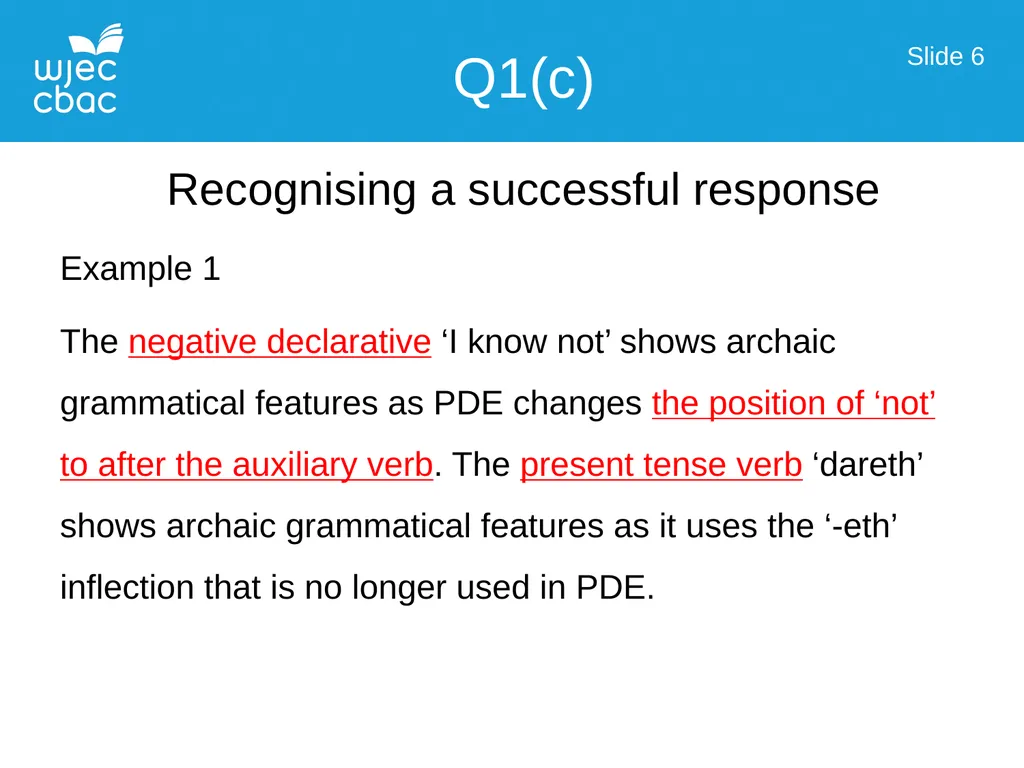
The negative declarative ‘I know not’ shows archaic grammatical features as PDE changes the position of ‘not’ to after the auxiliary verb. The present tense verb ‘dareth’ shows archaic grammatical features as it uses the ‘-eth’ inflection that is no longer used in PDE. Slide 6 Q1(c) Recognising a successful response<br>
The negative declarative ‘I know not’ shows archaic grammatical features as PDE changes the position of ‘not’ to after the auxiliary verb. The present tense verb ‘dareth’ shows archaic grammatical features as it uses the ‘-eth’ inflection that is no longer used in PDE. Slide 6 Q1(c) Recognising a successful response<br>
07
Example 3
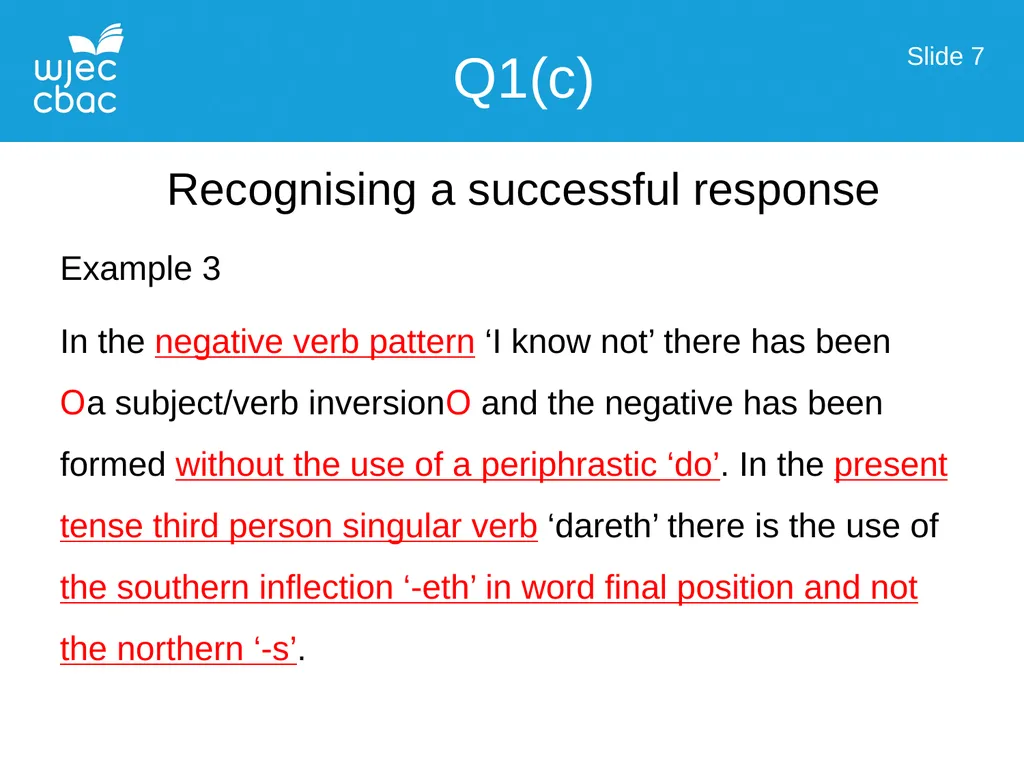
In the negative verb pattern ‘I know not’ there has been Oa subject/verb inversionO and the negative has been formed without the use of a periphrastic ‘do’. In the present tense third person singular verb ‘dareth’ there is the use of the southern inflection ‘-eth’ in word final position and not the northern ‘-s’. Slide 7 Q1(c) Recognising a successful response<br>
In the negative verb pattern ‘I know not’ there has been Oa subject/verb inversionO and the negative has been formed without the use of a periphrastic ‘do’. In the present tense third person singular verb ‘dareth’ there is the use of the southern inflection ‘-eth’ in word final position and not the northern ‘-s’. Slide 7 Q1(c) Recognising a successful response<br>
08
Example 5
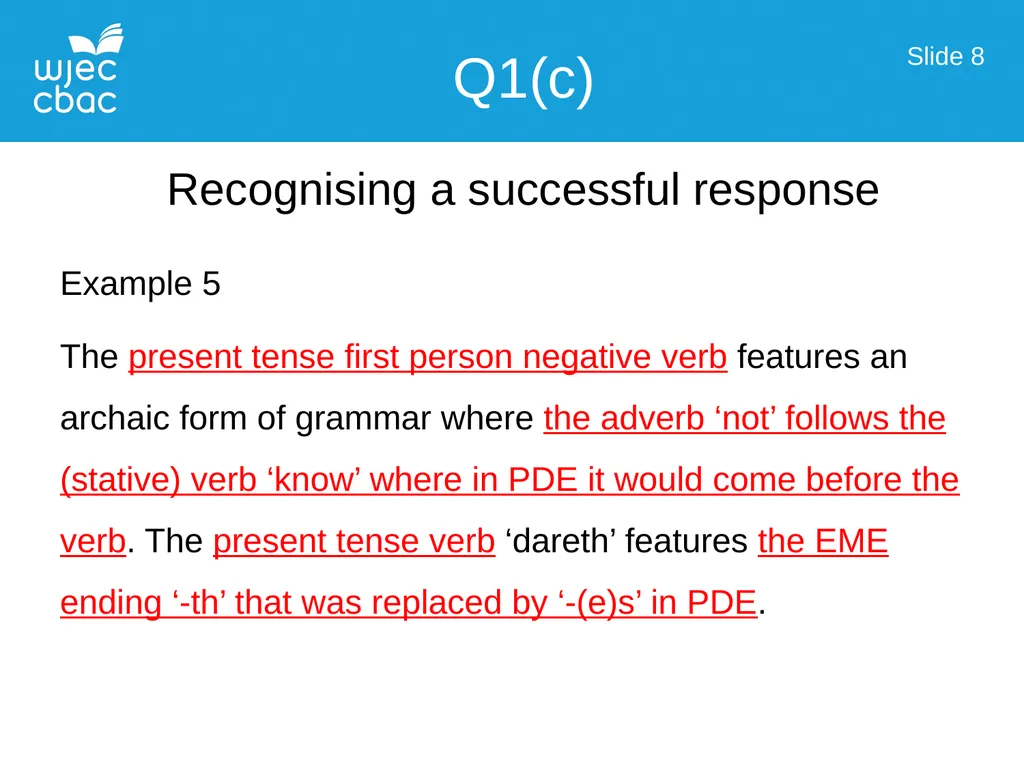
The present tense first person negative verb features an archaic form of grammar where the adverb ‘not’ follows the (stative) verb ‘know’ where in PDE it would come before the verb. The present tense verb ‘dareth’ features the EME ending ‘-th’ that was replaced by ‘-(e)s’ in PDE. Slide 8 Q1(c) Recognising a successful response<br>
The present tense first person negative verb features an archaic form of grammar where the adverb ‘not’ follows the (stative) verb ‘know’ where in PDE it would come before the verb. The present tense verb ‘dareth’ features the EME ending ‘-th’ that was replaced by ‘-(e)s’ in PDE. Slide 8 Q1(c) Recognising a successful response<br>
09
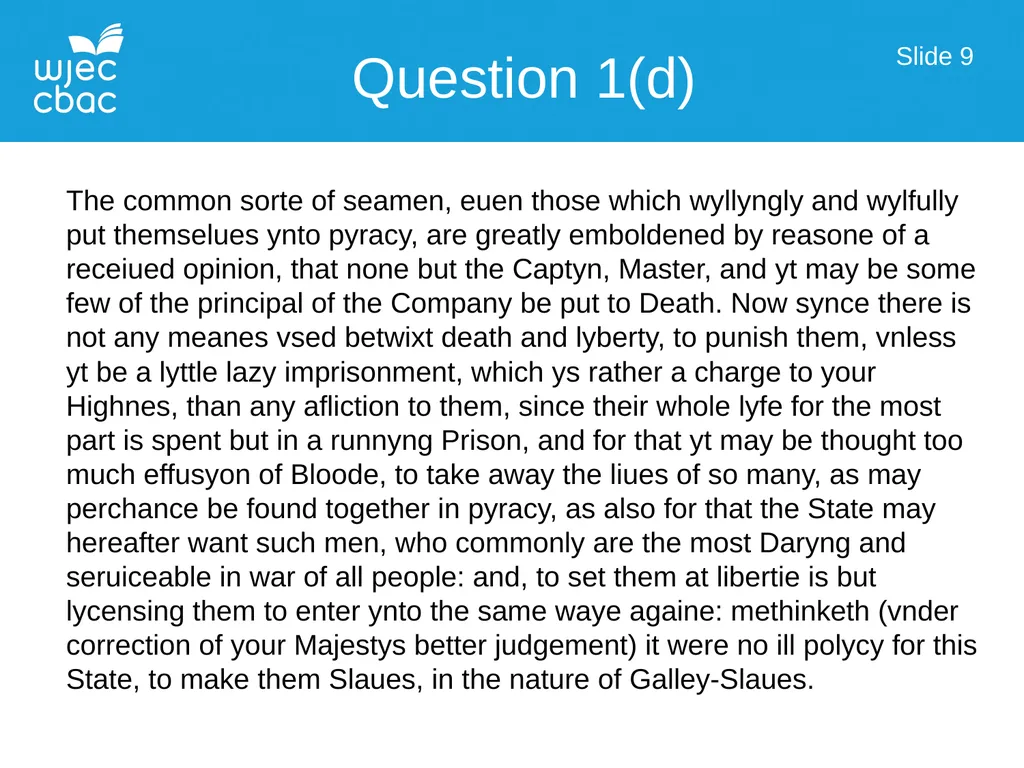
Slide 9 Question 1(d) The common sorte of seamen, euen those which wyllyngly and wylfully put themselues ynto pyracy, are greatly emboldened by reasone of a receiued opinion, that none but the Captyn, Master, and yt may be some few of the principal of the Company be put to Death. Now synce there is not any meanes vsed betwixt death and lyberty, to punish them, vnless yt be a lyttle lazy imprisonment, which ys rather a charge to your Highnes, than any afliction to them, since their whole lyfe for the most part is spent but in a runnyng Prison, and for that yt may be thought too much effusyon of Bloode, to take away the liues of so many, as may perchance be found together in pyracy, as also for that the State may hereafter want such men, who commonly are the most Daryng and seruiceable in war of all people: and, to set them at libertie is but lycensing them to enter ynto the same waye againe: methinketh (vnder correction of your Majestys better judgement) it were no ill polycy for this State, to make them Slaues, in the nature of Galley-Slaues.<br>
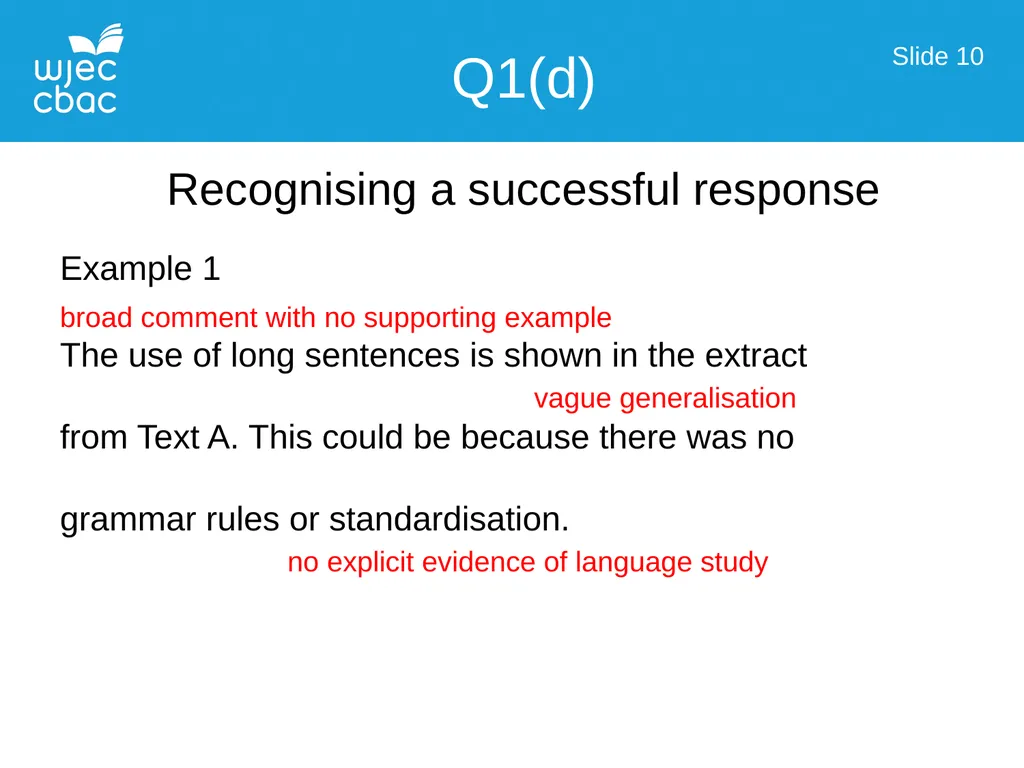
10
Example 1
broad comment with no supporting example
The use of long sentences is shown in the extract vague generalisation
from Text A. This could be because there was no
grammar rules or standardisation.
no explicit evidence of language study Slide 10 Q1(d) Recognising a successful response<br>
broad comment with no supporting example
The use of long sentences is shown in the extract vague generalisation
from Text A. This could be because there was no
grammar rules or standardisation.
no explicit evidence of language study Slide 10 Q1(d) Recognising a successful response<br>
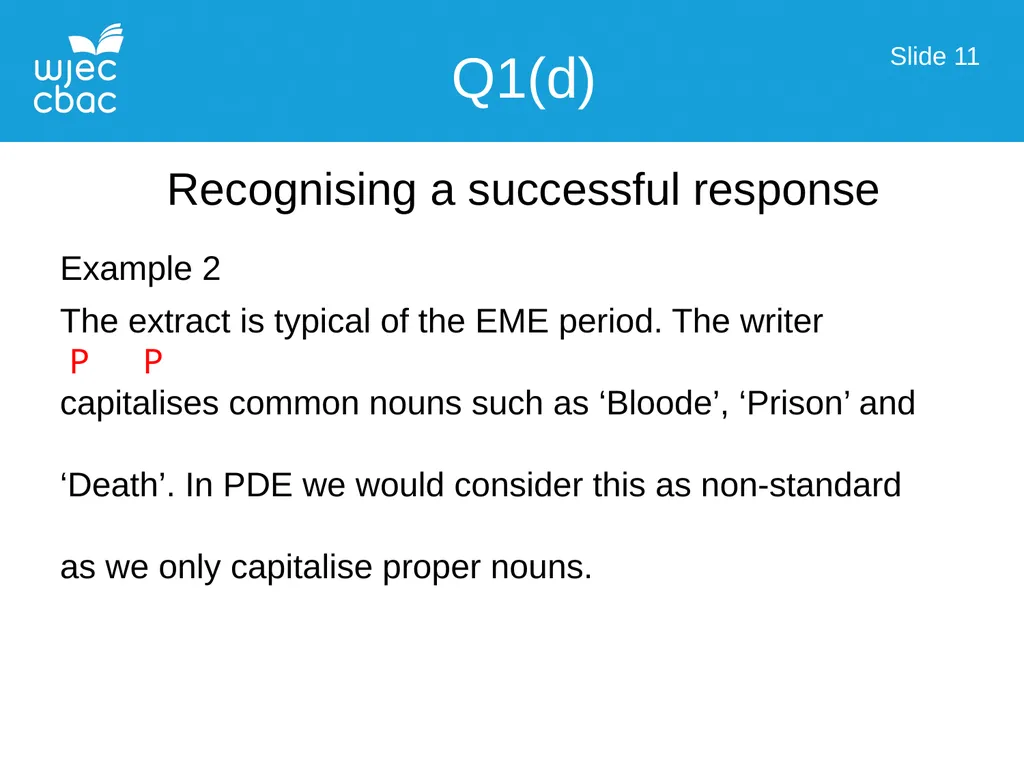
11
Example 2
The extract is typical of the EME period. The writer
P P
capitalises common nouns such as ‘Bloode’, ‘Prison’ and
‘Death’. In PDE we would consider this as non-standard
as we only capitalise proper nouns. Slide 11 Q1(d) Recognising a successful response<br>
The extract is typical of the EME period. The writer
P P
capitalises common nouns such as ‘Bloode’, ‘Prison’ and
‘Death’. In PDE we would consider this as non-standard
as we only capitalise proper nouns. Slide 11 Q1(d) Recognising a successful response<br>
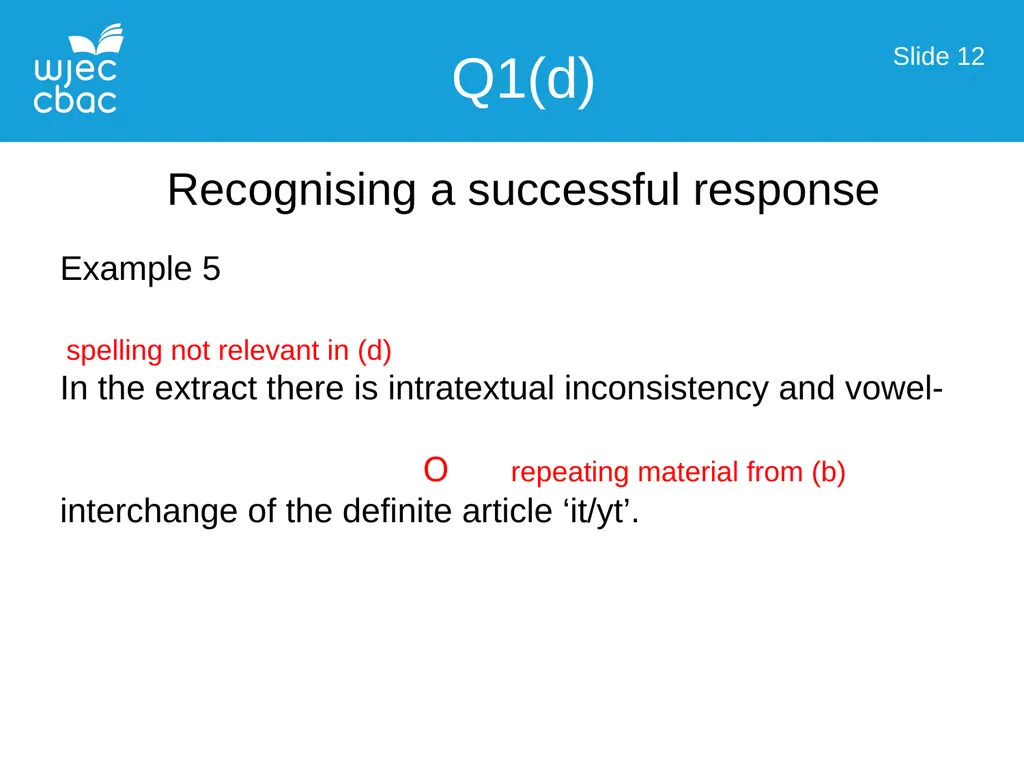
12
Example 5
spelling not relevant in (d)
In the extract there is intratextual inconsistency and vowel-
O repeating material from (b)
interchange of the definite article ‘it/yt’. Slide 12 Q1(d) Recognising a successful response<br>
spelling not relevant in (d)
In the extract there is intratextual inconsistency and vowel-
O repeating material from (b)
interchange of the definite article ‘it/yt’. Slide 12 Q1(d) Recognising a successful response<br>
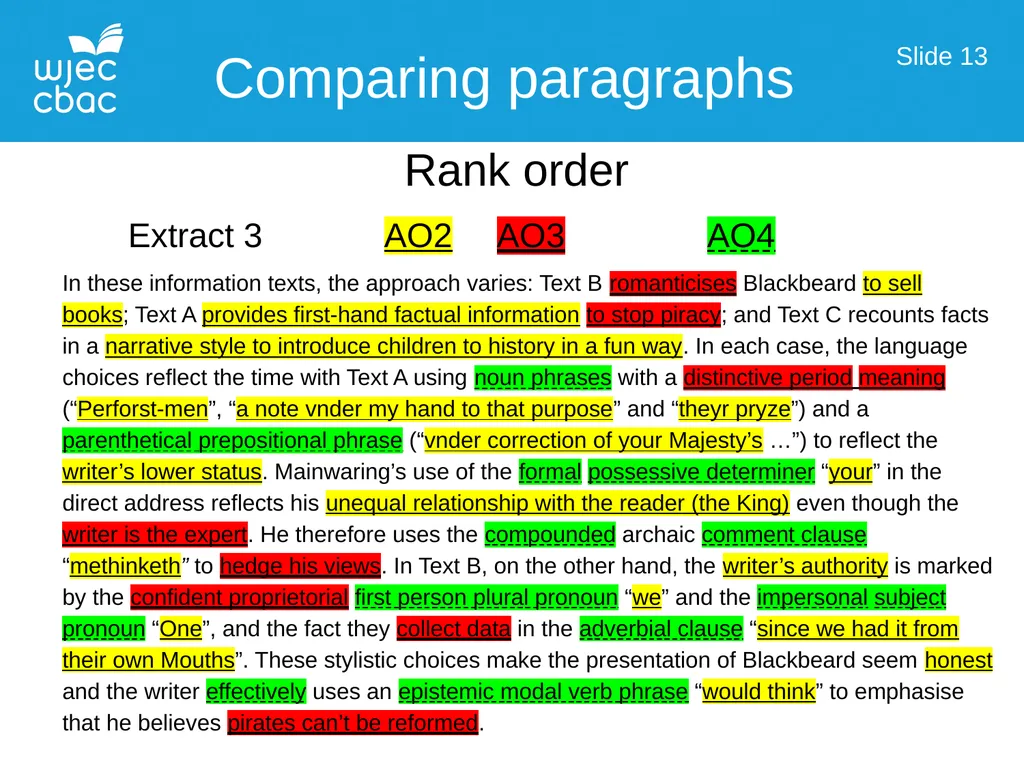
13
Rank order Slide 13 Comparing paragraphs Extract 3 AO2 AO3 AO4 In these information texts, the approach varies: Text B romanticises Blackbeard to sell books; Text A provides first-hand factual information to stop piracy; and Text C recounts facts in a narrative style to introduce children to history in a fun way. In each case, the language choices reflect the time with Text A using noun phrases with a distinctive period meaning (“Perforst-men”, “a note vnder my hand to that purpose” and “theyr pryze”) and a parenthetical prepositional phrase (“vnder correction of your Majesty’s …”) to reflect the writer’s lower status. Mainwaring’s use of the formal possessive determiner “your” in the direct address reflects his unequal relationship with the reader (the King) even though the writer is the expert. He therefore uses the compounded archaic comment clause “methinketh” to hedge his views. In Text B, on the other hand, the writer’s authority is marked by the confident proprietorial first person plural pronoun “we” and the impersonal subject pronoun “One”, and the fact they collect data in the adverbial clause “since we had it from their own Mouths”. These stylistic choices make the presentation of Blackbeard seem honest and the writer effectively uses an epistemic modal verb phrase “would think” to emphasise that he believes pirates can’t be reformed.<br>
14
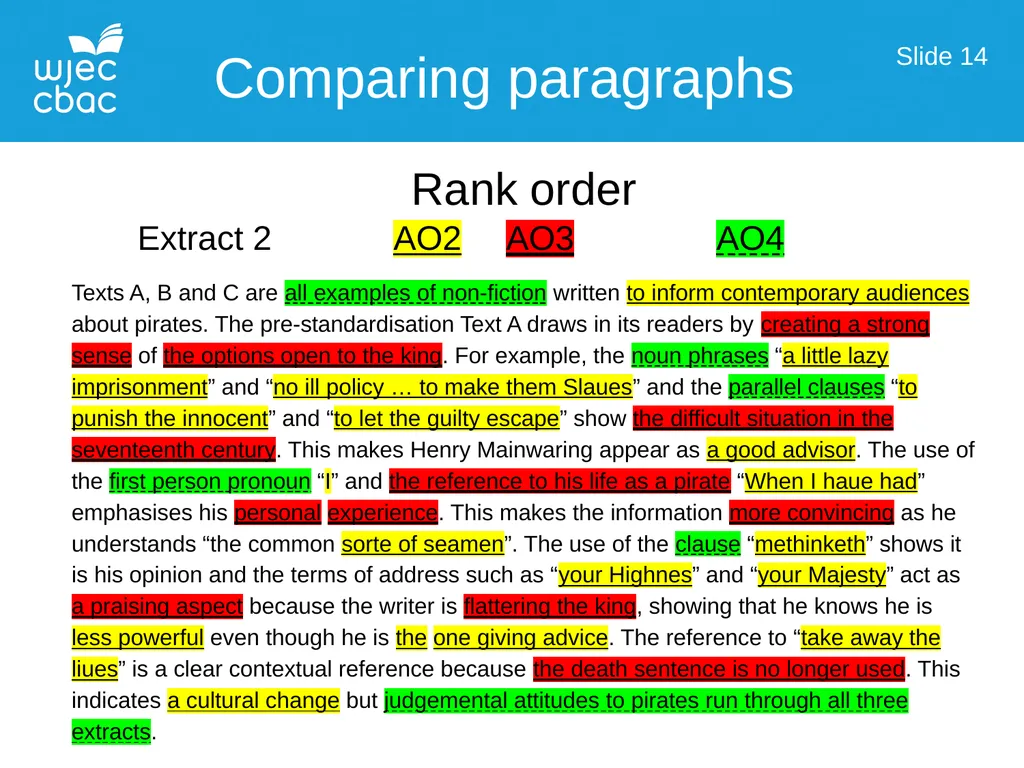
Rank order Slide 14 Comparing paragraphs Extract 2 AO2 AO3 AO4 Texts A, B and C are all examples of non-fiction written to inform contemporary audiences about pirates. The pre-standardisation Text A draws in its readers by creating a strong sense of the options open to the king. For example, the noun phrases “a little lazy imprisonment” and “no ill policy … to make them Slaues” and the parallel clauses “to punish the innocent” and “to let the guilty escape” show the difficult situation in the seventeenth century. This makes Henry Mainwaring appear as a good advisor. The use of the first person pronoun “I” and the reference to his life as a pirate “When I haue had” emphasises his personal experience. This makes the information more convincing as he understands “the common sorte of seamen”. The use of the clause “methinketh” shows it is his opinion and the terms of address such as “your Highnes” and “your Majesty” act as a praising aspect because the writer is flattering the king, showing that he knows he is less powerful even though he is the one giving advice. The reference to “take away the liues” is a clear contextual reference because the death sentence is no longer used. This indicates a cultural change but judgemental attitudes to pirates run through all three extracts.<br>
15
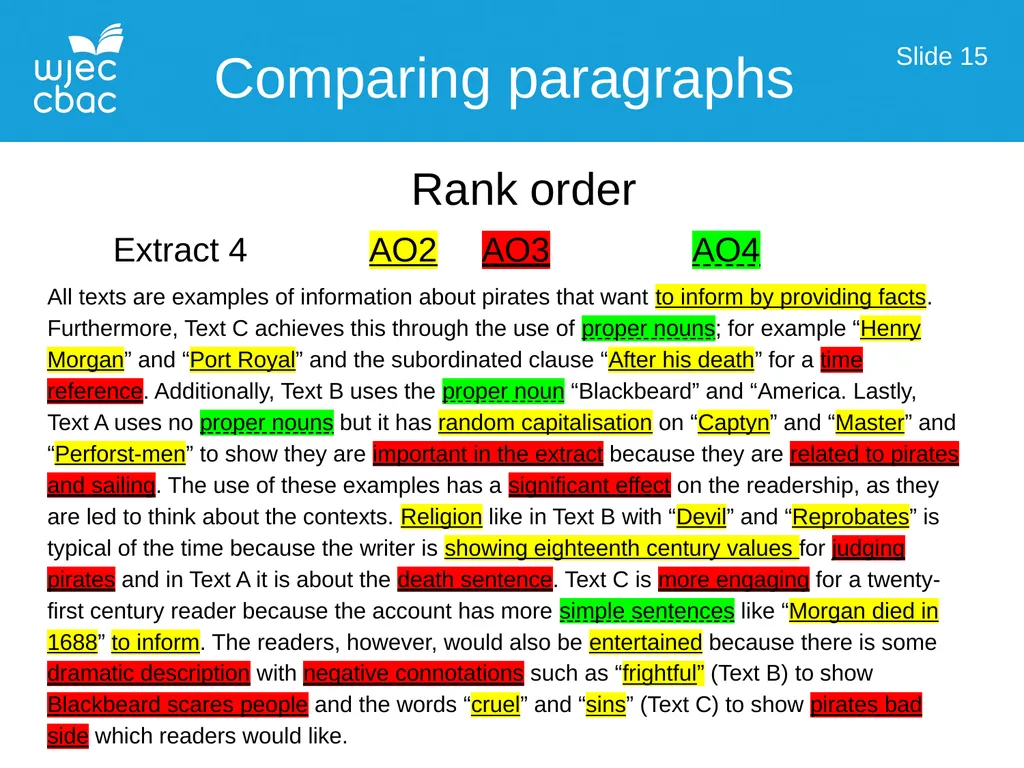
Rank order Slide 15 Comparing paragraphs All texts are examples of information about pirates that want to inform by providing facts. Furthermore, Text C achieves this through the use of proper nouns; for example “Henry Morgan” and “Port Royal” and the subordinated clause “After his death” for a time reference. Additionally, Text B uses the proper noun “Blackbeard” and “America. Lastly, Text A uses no proper nouns but it has random capitalisation on “Captyn” and “Master” and “Perforst-men” to show they are important in the extract because they are related to pirates and sailing. The use of these examples has a significant effect on the readership, as they are led to think about the contexts. Religion like in Text B with “Devil” and “Reprobates” is typical of the time because the writer is showing eighteenth century values for judging pirates and in Text A it is about the death sentence. Text C is more engaging for a twenty-first century reader because the account has more simple sentences like “Morgan died in 1688” to inform. The readers, however, would also be entertained because there is some dramatic description with negative connotations such as “frightful” (Text B) to show Blackbeard scares people and the words “cruel” and “sins” (Text C) to show pirates bad side which readers would like. Extract 4 AO2 AO3 AO4<br>
16
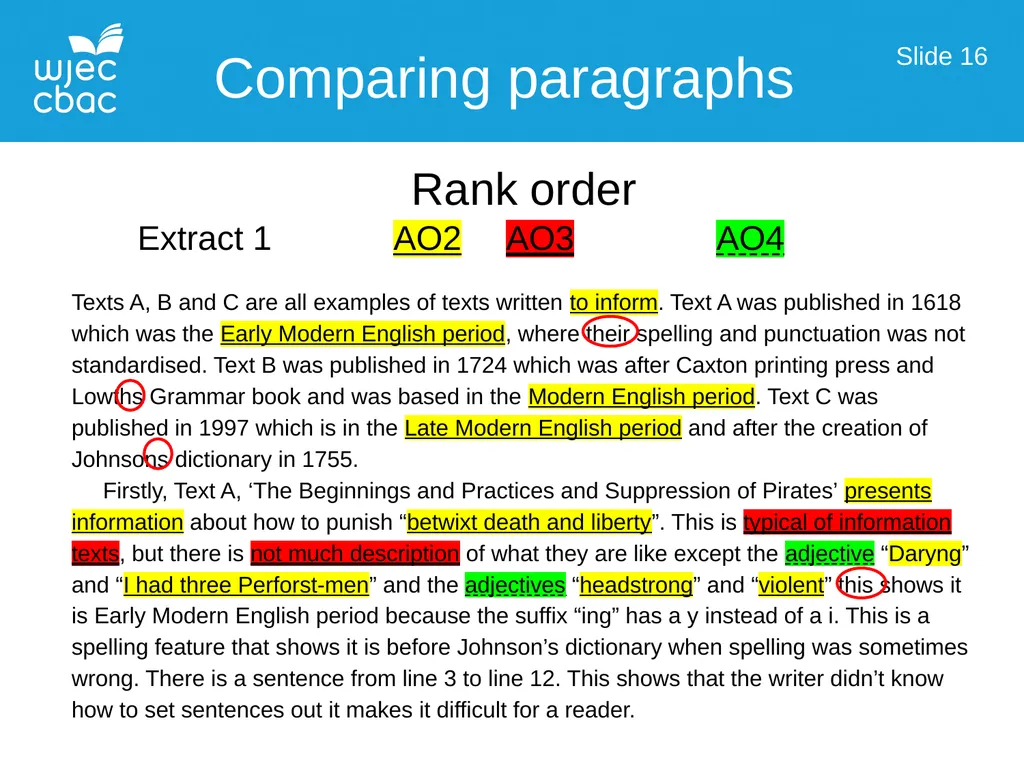
Rank order Slide 16 Comparing paragraphs Extract 1 AO2 AO3 AO4 Texts A, B and C are all examples of texts written to inform. Text A was published in 1618 which was the Early Modern English period, where their spelling and punctuation was not standardised. Text B was published in 1724 which was after Caxton printing press and Lowths Grammar book and was based in the Modern English period. Text C was published in 1997 which is in the Late Modern English period and after the creation of Johnsons dictionary in 1755.
Firstly, Text A, ‘The Beginnings and Practices and Suppression of Pirates’ presents information about how to punish “betwixt death and liberty”. This is typical of information texts, but there is not much description of what they are like except the adjective “Daryng” and “I had three Perforst-men” and the adjectives “headstrong” and “violent” this shows it is Early Modern English period because the suffix “ing” has a y instead of a i. This is a spelling feature that shows it is before Johnson’s dictionary when spelling was sometimes wrong. There is a sentence from line 3 to line 12. This shows that the writer didn’t know how to set sentences out it makes it difficult for a reader.<br>
17
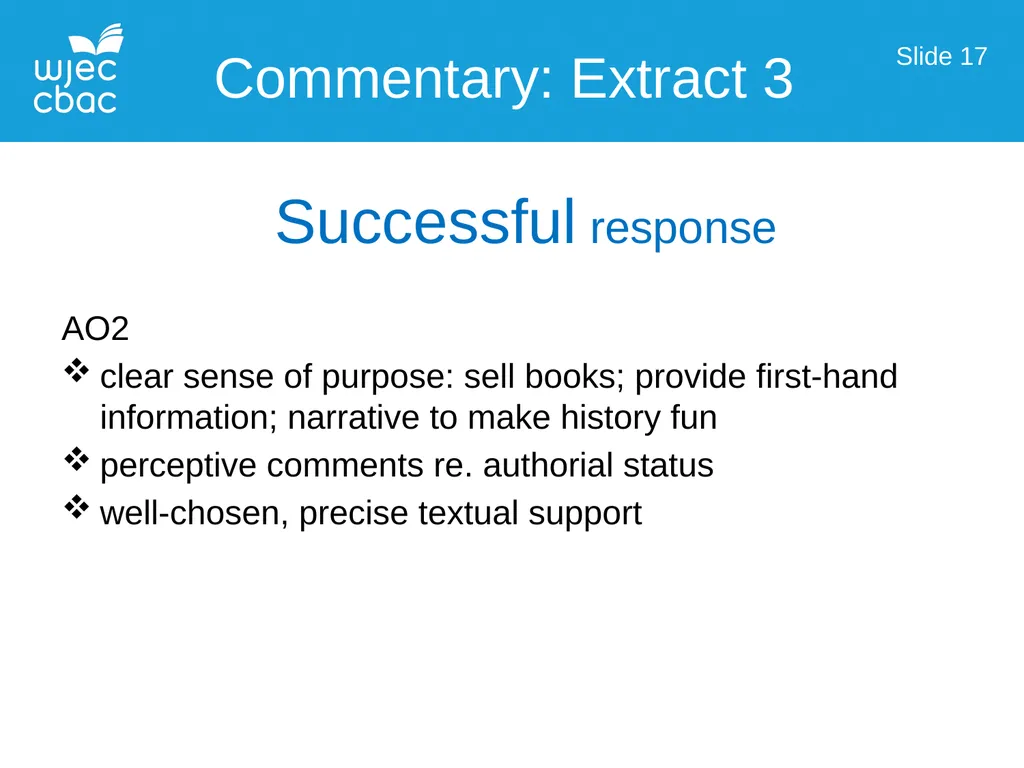
Successful response AO2
clear sense of purpose: sell books; provide first-hand information; narrative to make history fun
perceptive comments re. authorial status
well-chosen, precise textual support Slide 17 Commentary: Extract 3<br>
clear sense of purpose: sell books; provide first-hand information; narrative to make history fun
perceptive comments re. authorial status
well-chosen, precise textual support Slide 17 Commentary: Extract 3<br>
18
AO3
clear appreciation of context and how this shapes language choices
engaging with meaning – intelligent interpretation (presentation of Blackbeard ‘seem[s] honest’; ‘ can’t be reformed’)
assured, embedded evaluation (‘distinctive period meaning’, ‘confident proprietorial 1st person …’, ‘effectively uses’) Slide 18 Commentary: Extract 3<br>
clear appreciation of context and how this shapes language choices
engaging with meaning – intelligent interpretation (presentation of Blackbeard ‘seem[s] honest’; ‘ can’t be reformed’)
assured, embedded evaluation (‘distinctive period meaning’, ‘confident proprietorial 1st person …’, ‘effectively uses’) Slide 18 Commentary: Extract 3<br>
19
AO4
intelligent connections made (romanticisation vs first-hand facts; underplaying status in A vs ‘confident’ voice in B)
accurate and precise use of terminology to support points. Slide 19 Commentary: Extract 3<br>
intelligent connections made (romanticisation vs first-hand facts; underplaying status in A vs ‘confident’ voice in B)
accurate and precise use of terminology to support points. Slide 19 Commentary: Extract 3<br>
20
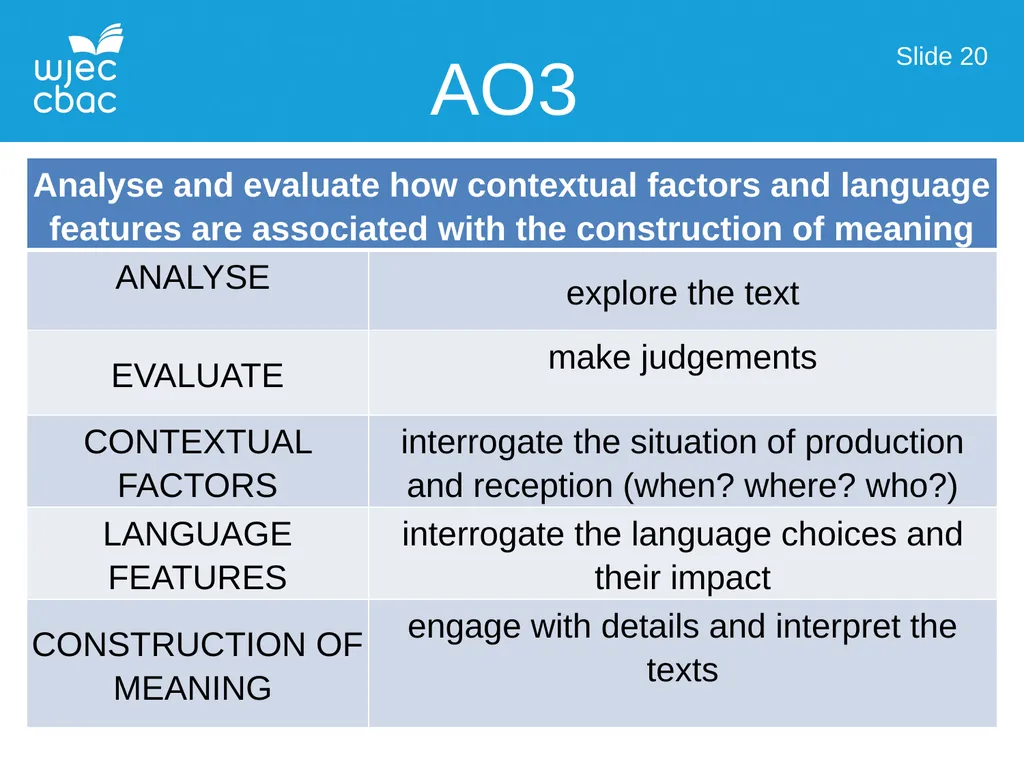
AO3 Slide 20<br>
21
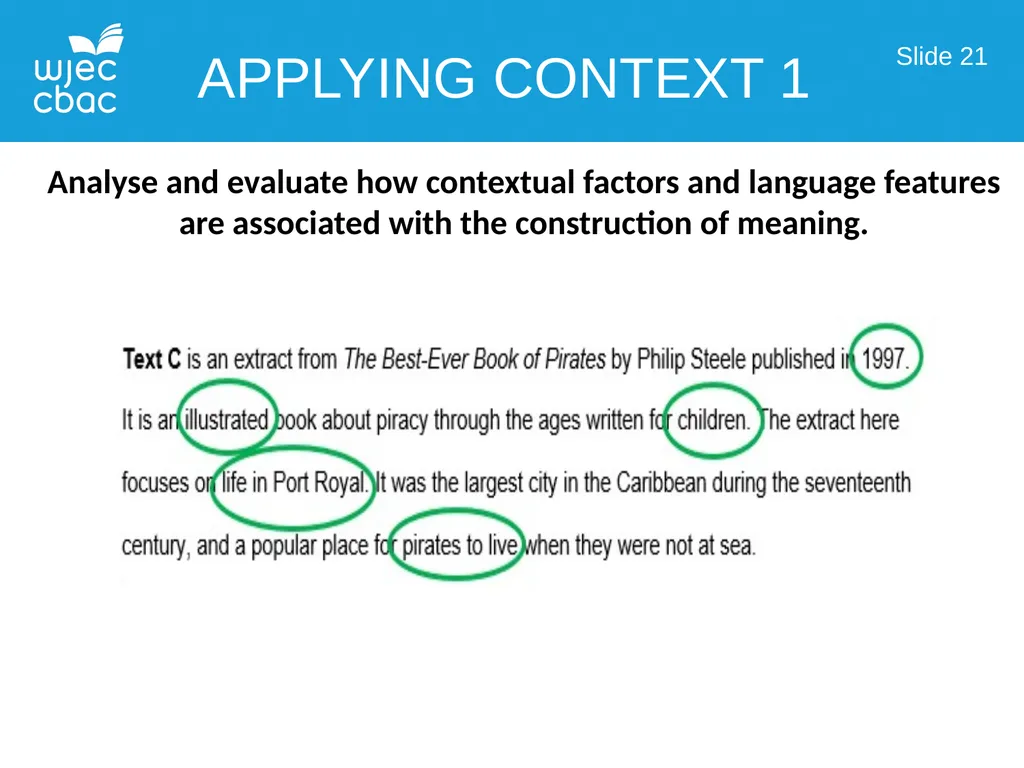
Analyse and evaluate how contextual factors and language features are associated with the construction of meaning. APPLYING CONTEXT 1 Slide 21<br>
22
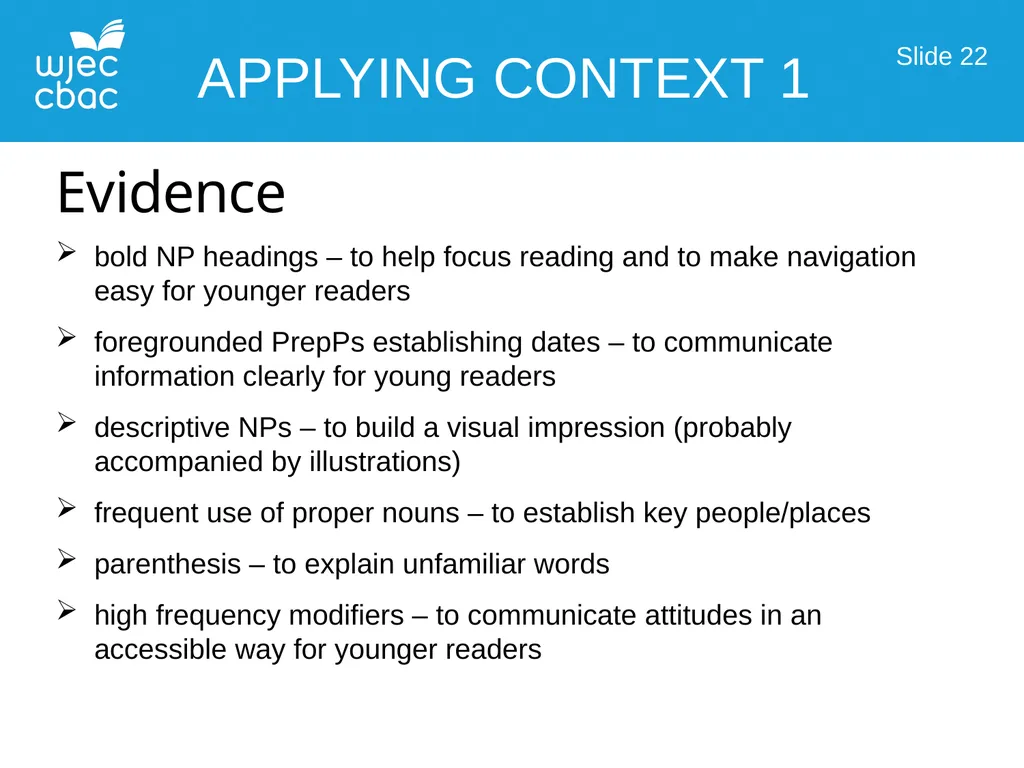
APPLYING CONTEXT 1 Slide 22 Evidence
bold NP headings – to help focus reading and to make navigation easy for younger readers
foregrounded PrepPs establishing dates – to communicate information clearly for young readers
descriptive NPs – to build a visual impression (probably accompanied by illustrations)
frequent use of proper nouns – to establish key people/places
parenthesis – to explain unfamiliar words
high frequency modifiers – to communicate attitudes in an accessible way for younger readers<br>
bold NP headings – to help focus reading and to make navigation easy for younger readers
foregrounded PrepPs establishing dates – to communicate information clearly for young readers
descriptive NPs – to build a visual impression (probably accompanied by illustrations)
frequent use of proper nouns – to establish key people/places
parenthesis – to explain unfamiliar words
high frequency modifiers – to communicate attitudes in an accessible way for younger readers<br>
23
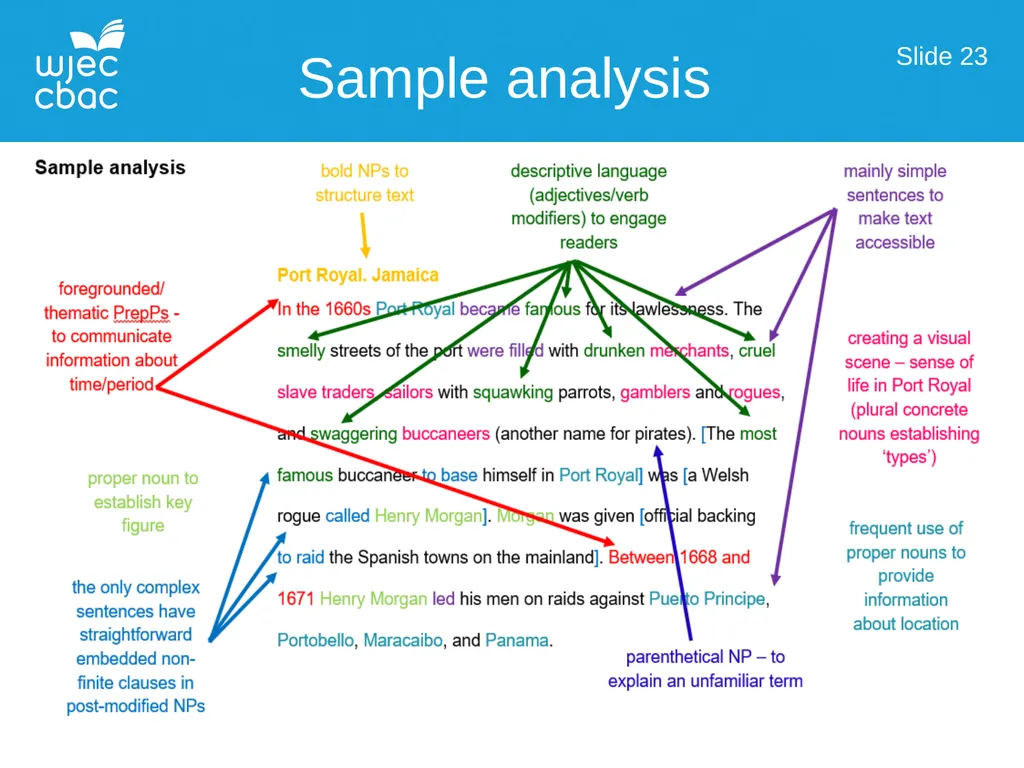
Sample analysis Slide 23<br>
24
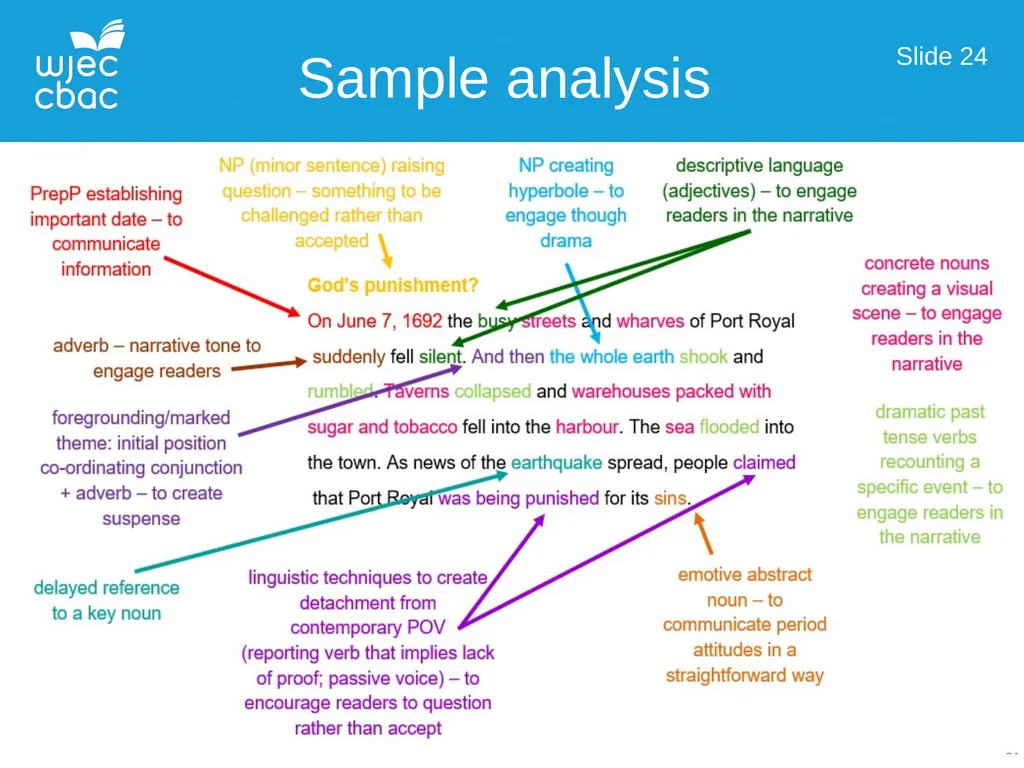
Sample analysis Slide 24<br>
25
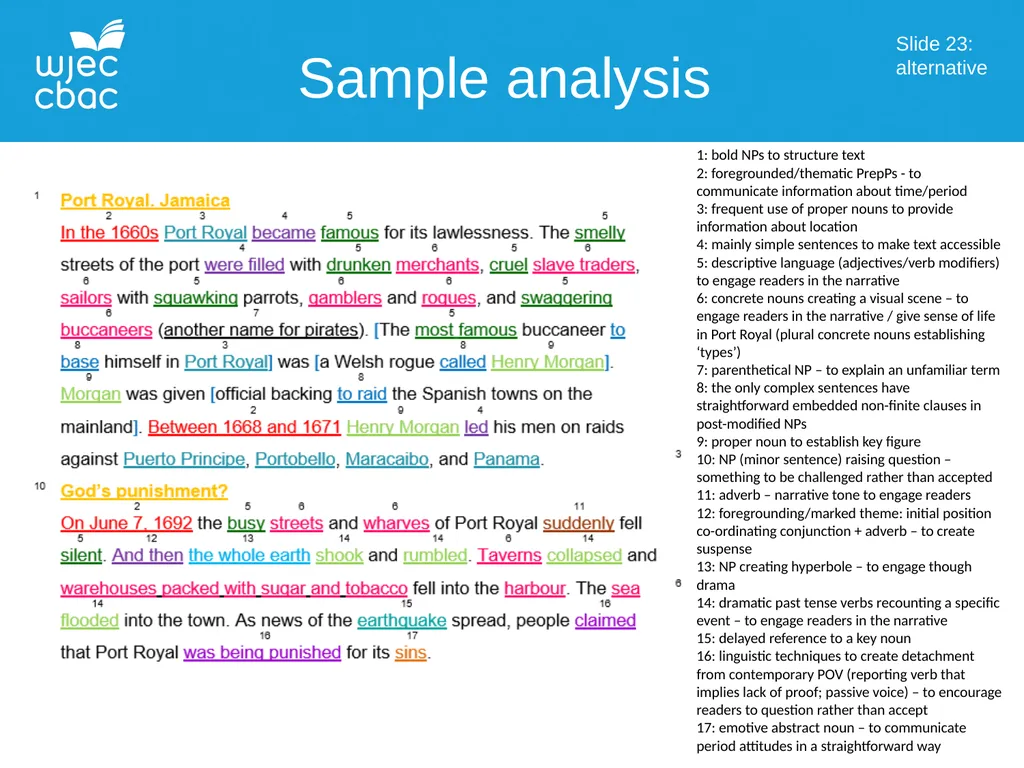
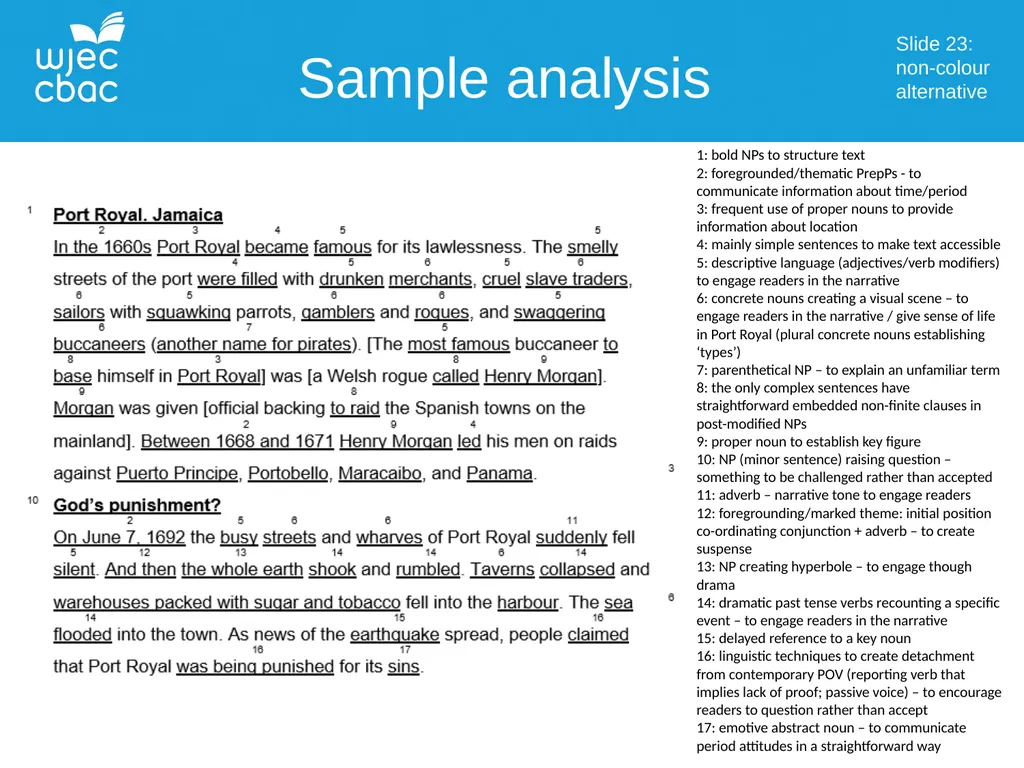
Sample analysis Slide 23: alternative 1: bold NPs to structure text
2: foregrounded/thematic PrepPs - to communicate information about time/period
3: frequent use of proper nouns to provide information about location
4: mainly simple sentences to make text accessible
5: descriptive language (adjectives/verb modifiers) to engage readers in the narrative
6: concrete nouns creating a visual scene – to engage readers in the narrative / give sense of life in Port Royal (plural concrete nouns establishing ‘types’)
7: parenthetical NP – to explain an unfamiliar term
8: the only complex sentences have straightforward embedded non-finite clauses in post-modified NPs
9: proper noun to establish key figure
10: NP (minor sentence) raising question – something to be challenged rather than accepted
11: adverb – narrative tone to engage readers
12: foregrounding/marked theme: initial position
co-ordinating conjunction + adverb – to create suspense
13: NP creating hyperbole – to engage though drama
14: dramatic past tense verbs recounting a specific event – to engage readers in the narrative
15: delayed reference to a key noun
16: linguistic techniques to create detachment from contemporary POV (reporting verb that implies lack of proof; passive voice) – to encourage readers to question rather than accept
17: emotive abstract noun – to communicate period attitudes in a straightforward way<br>
2: foregrounded/thematic PrepPs - to communicate information about time/period
3: frequent use of proper nouns to provide information about location
4: mainly simple sentences to make text accessible
5: descriptive language (adjectives/verb modifiers) to engage readers in the narrative
6: concrete nouns creating a visual scene – to engage readers in the narrative / give sense of life in Port Royal (plural concrete nouns establishing ‘types’)
7: parenthetical NP – to explain an unfamiliar term
8: the only complex sentences have straightforward embedded non-finite clauses in post-modified NPs
9: proper noun to establish key figure
10: NP (minor sentence) raising question – something to be challenged rather than accepted
11: adverb – narrative tone to engage readers
12: foregrounding/marked theme: initial position
co-ordinating conjunction + adverb – to create suspense
13: NP creating hyperbole – to engage though drama
14: dramatic past tense verbs recounting a specific event – to engage readers in the narrative
15: delayed reference to a key noun
16: linguistic techniques to create detachment from contemporary POV (reporting verb that implies lack of proof; passive voice) – to encourage readers to question rather than accept
17: emotive abstract noun – to communicate period attitudes in a straightforward way<br>
26
Sample analysis Slide 23: non-colour alternative 1: bold NPs to structure text
2: foregrounded/thematic PrepPs - to communicate information about time/period
3: frequent use of proper nouns to provide information about location
4: mainly simple sentences to make text accessible
5: descriptive language (adjectives/verb modifiers) to engage readers in the narrative
6: concrete nouns creating a visual scene – to engage readers in the narrative / give sense of life in Port Royal (plural concrete nouns establishing ‘types’)
7: parenthetical NP – to explain an unfamiliar term
8: the only complex sentences have straightforward embedded non-finite clauses in post-modified NPs
9: proper noun to establish key figure
10: NP (minor sentence) raising question – something to be challenged rather than accepted
11: adverb – narrative tone to engage readers
12: foregrounding/marked theme: initial position
co-ordinating conjunction + adverb – to create suspense
13: NP creating hyperbole – to engage though drama
14: dramatic past tense verbs recounting a specific event – to engage readers in the narrative
15: delayed reference to a key noun
16: linguistic techniques to create detachment from contemporary POV (reporting verb that implies lack of proof; passive voice) – to encourage readers to question rather than accept
17: emotive abstract noun – to communicate period attitudes in a straightforward way<br>
2: foregrounded/thematic PrepPs - to communicate information about time/period
3: frequent use of proper nouns to provide information about location
4: mainly simple sentences to make text accessible
5: descriptive language (adjectives/verb modifiers) to engage readers in the narrative
6: concrete nouns creating a visual scene – to engage readers in the narrative / give sense of life in Port Royal (plural concrete nouns establishing ‘types’)
7: parenthetical NP – to explain an unfamiliar term
8: the only complex sentences have straightforward embedded non-finite clauses in post-modified NPs
9: proper noun to establish key figure
10: NP (minor sentence) raising question – something to be challenged rather than accepted
11: adverb – narrative tone to engage readers
12: foregrounding/marked theme: initial position
co-ordinating conjunction + adverb – to create suspense
13: NP creating hyperbole – to engage though drama
14: dramatic past tense verbs recounting a specific event – to engage readers in the narrative
15: delayed reference to a key noun
16: linguistic techniques to create detachment from contemporary POV (reporting verb that implies lack of proof; passive voice) – to encourage readers to question rather than accept
17: emotive abstract noun – to communicate period attitudes in a straightforward way<br>
27
APPLYING CONTEXT 2 Slide 25 Text A (1618) Contextual factors
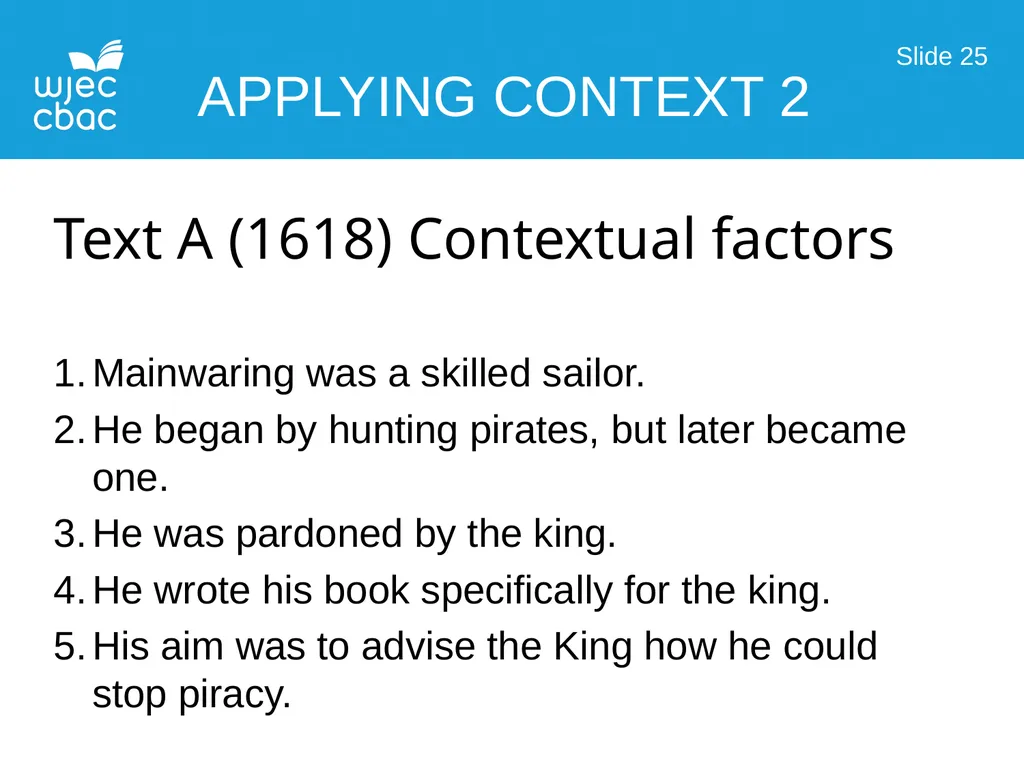
Mainwaring was a skilled sailor.
He began by hunting pirates, but later became one.
He was pardoned by the king.
He wrote his book specifically for the king.
His aim was to advise the King how he could stop piracy.<br>
Mainwaring was a skilled sailor.
He began by hunting pirates, but later became one.
He was pardoned by the king.
He wrote his book specifically for the king.
His aim was to advise the King how he could stop piracy.<br>
28
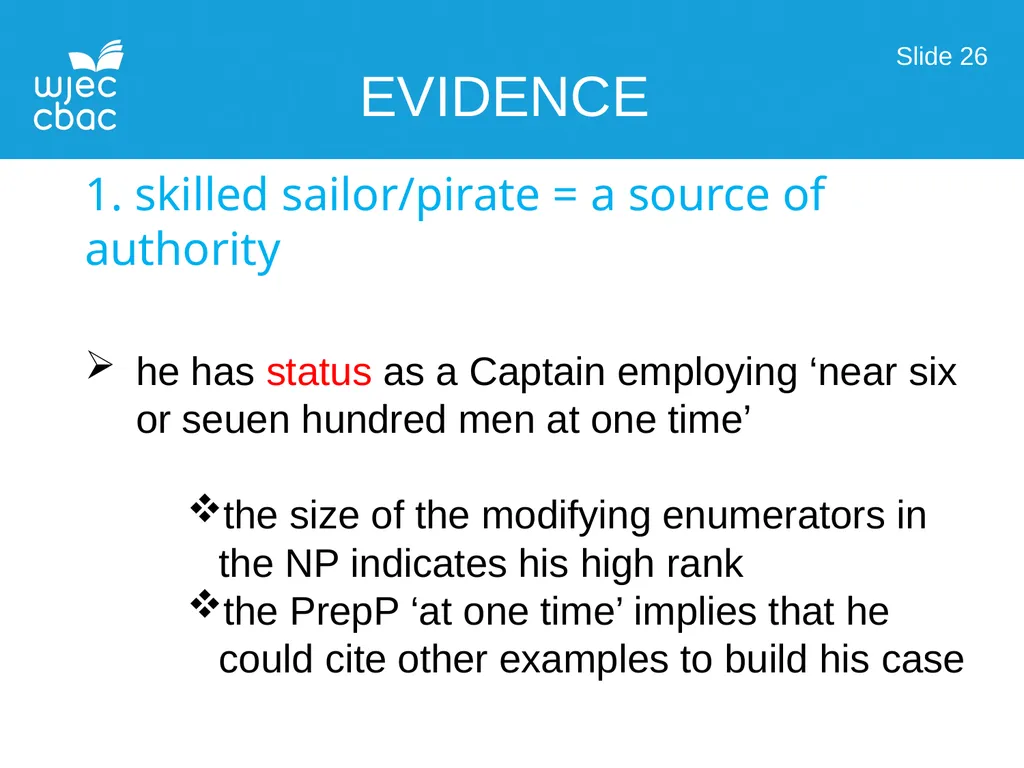
EVIDENCE Slide 26 1. skilled sailor/pirate = a source of authority
he has status as a Captain employing ‘near six or seuen hundred men at one time’
the size of the modifying enumerators in the NP indicates his high rank
the PrepP ‘at one time’ implies that he could cite other examples to build his case<br>
he has status as a Captain employing ‘near six or seuen hundred men at one time’
the size of the modifying enumerators in the NP indicates his high rank
the PrepP ‘at one time’ implies that he could cite other examples to build his case<br>
29
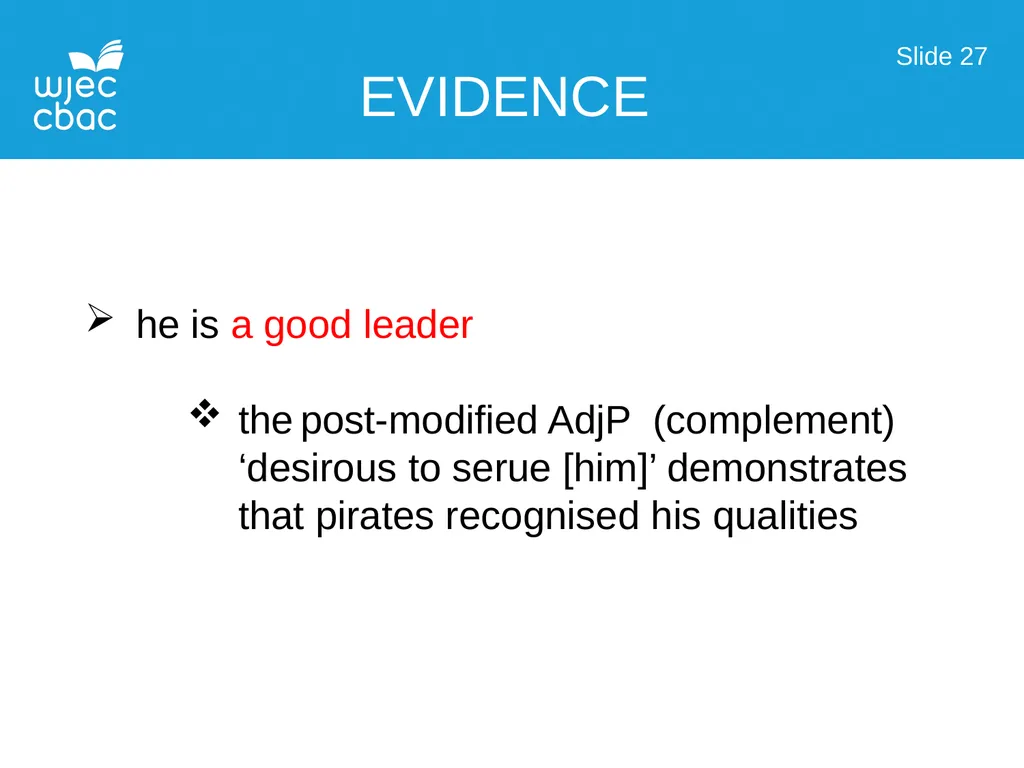
EVIDENCE Slide 27 he is a good leader
the post-modified AdjP (complement) ‘desirous to serue [him]’ demonstrates that pirates recognised his qualities<br>
the post-modified AdjP (complement) ‘desirous to serue [him]’ demonstrates that pirates recognised his qualities<br>
30
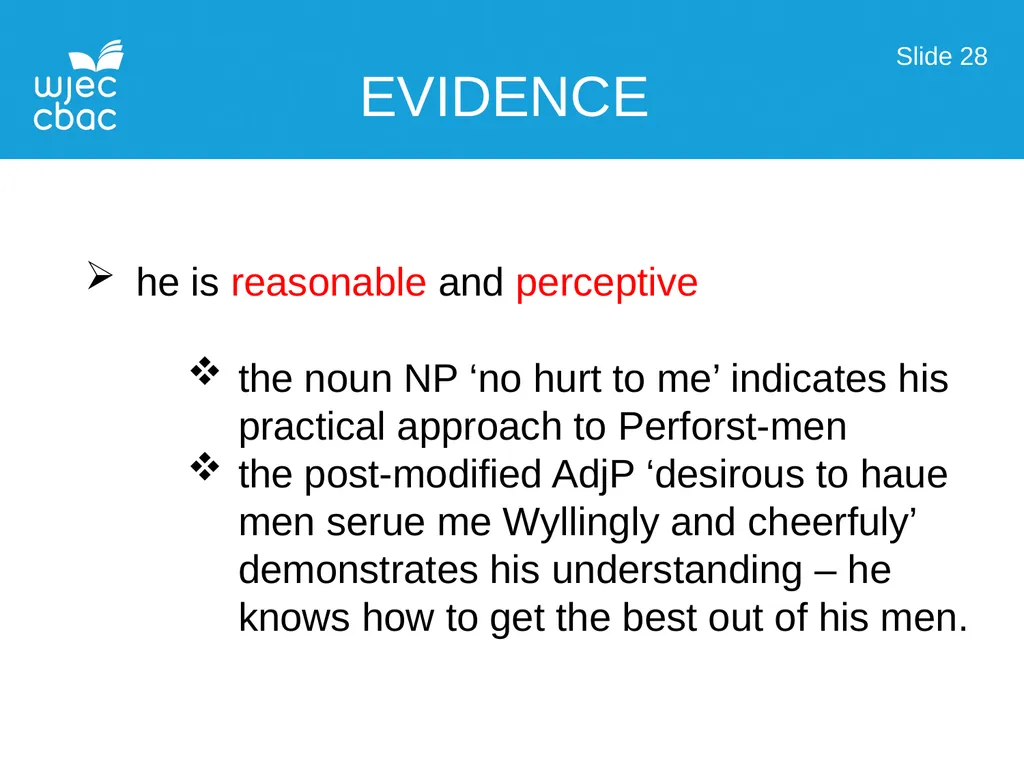
EVIDENCE Slide 28 he is reasonable and perceptive
the noun NP ‘no hurt to me’ indicates his practical approach to Perforst-men
the post-modified AdjP ‘desirous to haue men serue me Wyllingly and cheerfuly’ demonstrates his understanding – he knows how to get the best out of his men.<br>
the noun NP ‘no hurt to me’ indicates his practical approach to Perforst-men
the post-modified AdjP ‘desirous to haue men serue me Wyllingly and cheerfuly’ demonstrates his understanding – he knows how to get the best out of his men.<br>
31
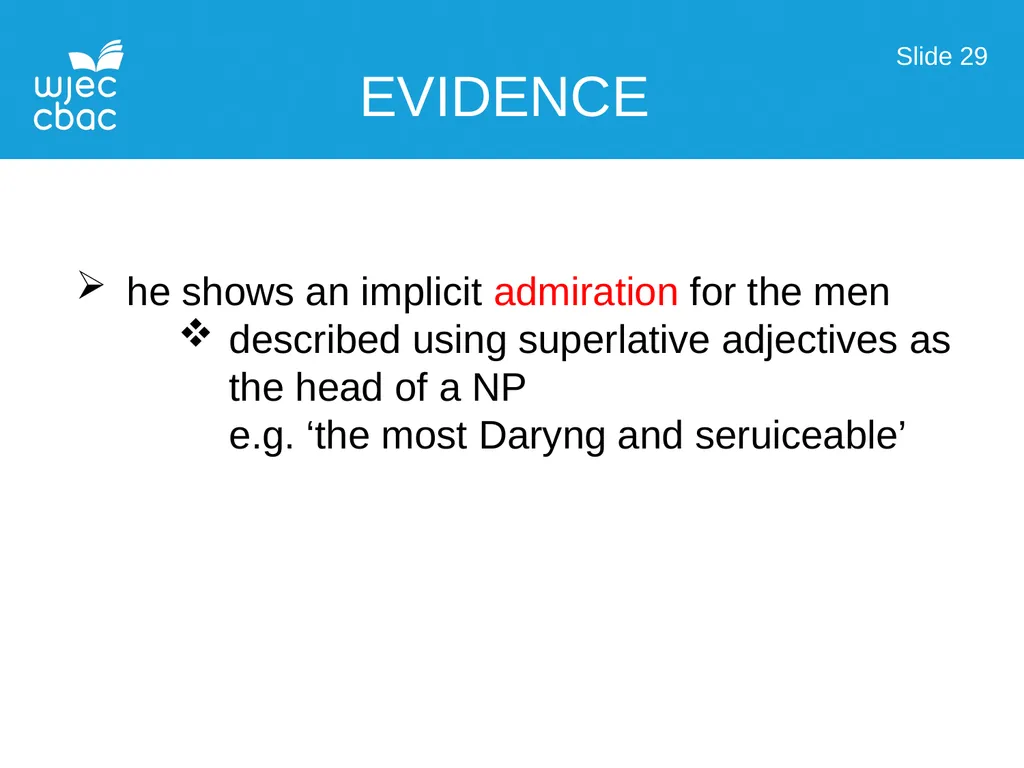
EVIDENCE Slide 29 he shows an implicit admiration for the men
described using superlative adjectives as the head of a NP
e.g. ‘the most Daryng and seruiceable’<br>
described using superlative adjectives as the head of a NP
e.g. ‘the most Daryng and seruiceable’<br>
32
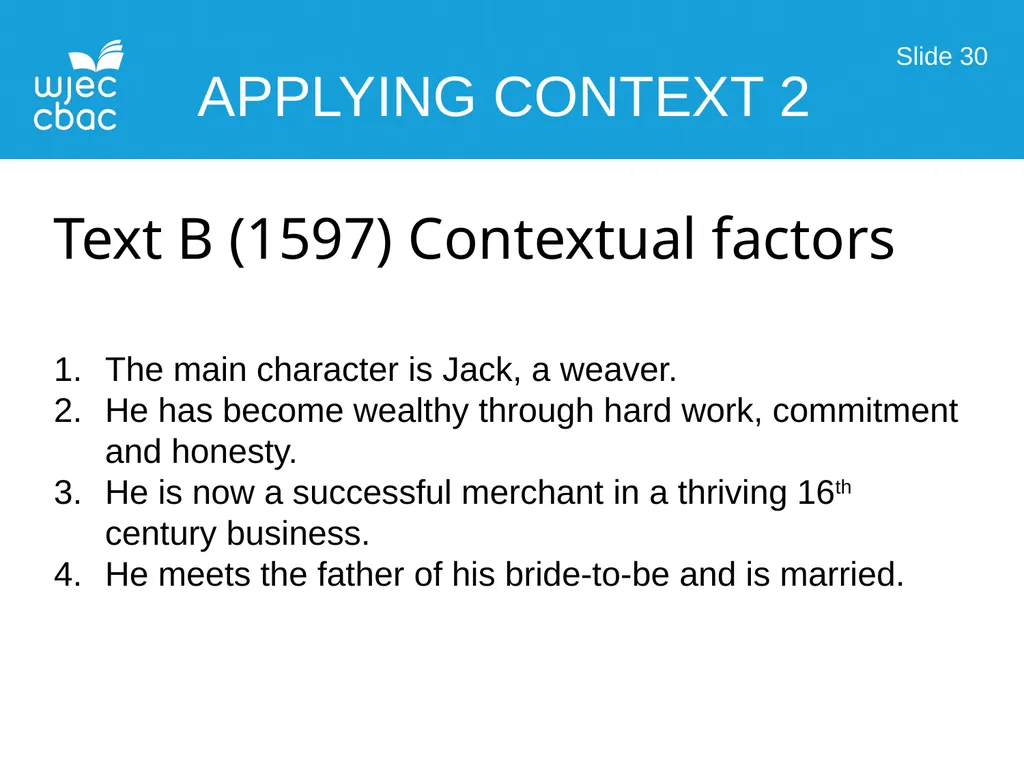
APPLYING CONTEXT 2 Slide 30 Text B (1597) Contextual factors
The main character is Jack, a weaver.
He has become wealthy through hard work, commitment and honesty.
He is now a successful merchant in a thriving 16th century business.
He meets the father of his bride-to-be and is married.<br>
The main character is Jack, a weaver.
He has become wealthy through hard work, commitment and honesty.
He is now a successful merchant in a thriving 16th century business.
He meets the father of his bride-to-be and is married.<br>
33
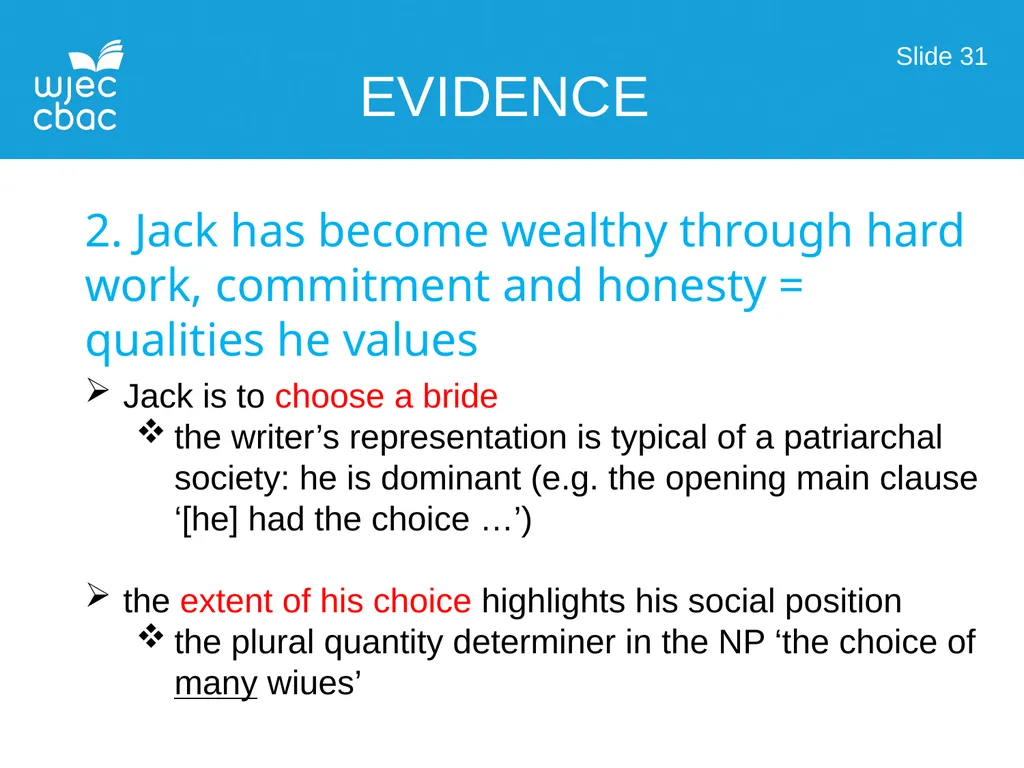
EVIDENCE Slide 31 2. Jack has become wealthy through hard work, commitment and honesty = qualities he values
Jack is to choose a bride
the writer’s representation is typical of a patriarchal society: he is dominant (e.g. the opening main clause ‘[he] had the choice …’)
the extent of his choice highlights his social position
the plural quantity determiner in the NP ‘the choice of many wiues’<br>
Jack is to choose a bride
the writer’s representation is typical of a patriarchal society: he is dominant (e.g. the opening main clause ‘[he] had the choice …’)
the extent of his choice highlights his social position
the plural quantity determiner in the NP ‘the choice of many wiues’<br>
34
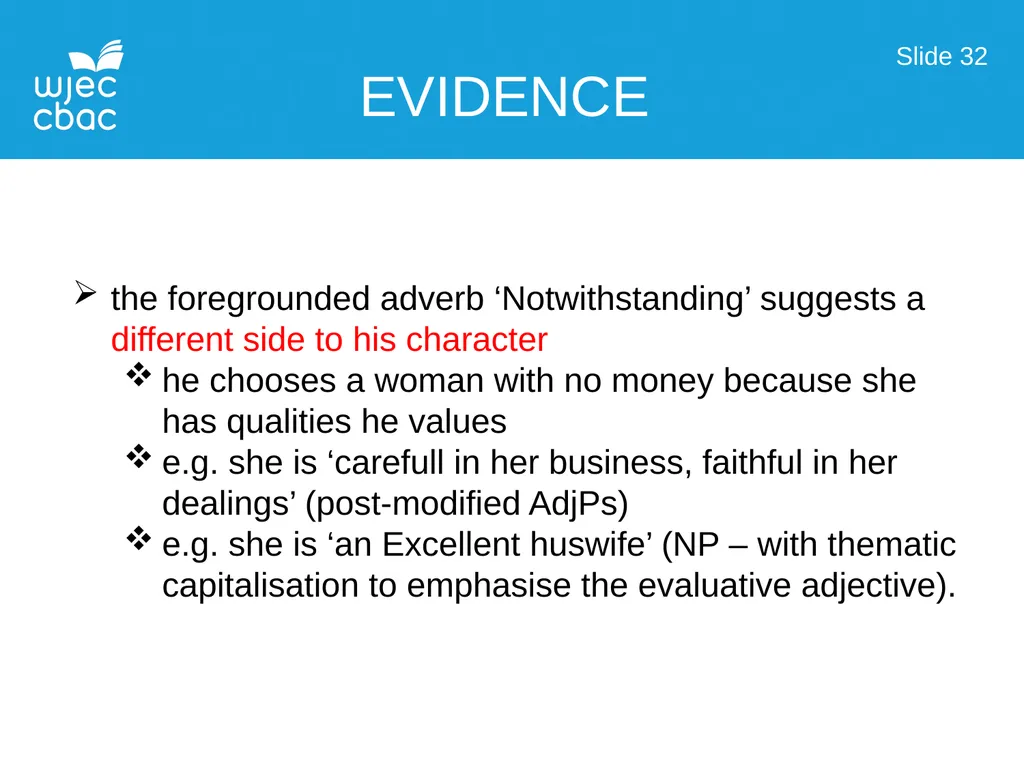
EVIDENCE the foregrounded adverb ‘Notwithstanding’ suggests a different side to his character
he chooses a woman with no money because she has qualities he values
e.g. she is ‘carefull in her business, faithful in her dealings’ (post-modified AdjPs)
e.g. she is ‘an Excellent huswife’ (NP – with thematic capitalisation to emphasise the evaluative adjective). Slide 32<br>
he chooses a woman with no money because she has qualities he values
e.g. she is ‘carefull in her business, faithful in her dealings’ (post-modified AdjPs)
e.g. she is ‘an Excellent huswife’ (NP – with thematic capitalisation to emphasise the evaluative adjective). Slide 32<br>
35
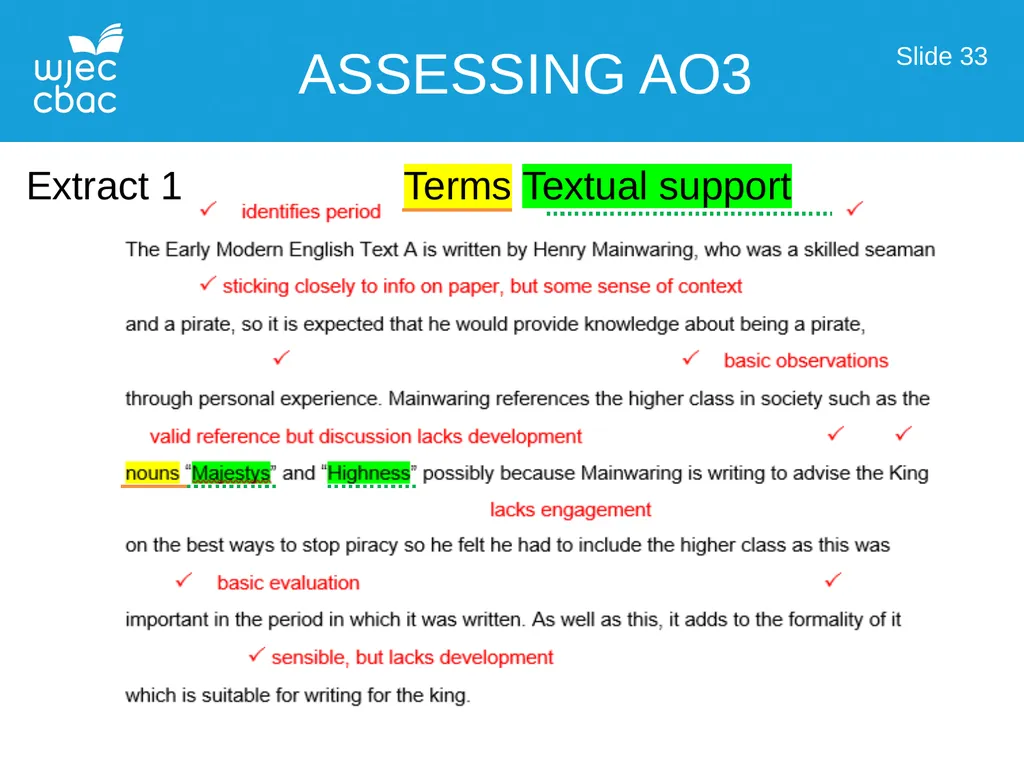
ASSESSING AO3 Slide 33 Extract 1 Terms Textual support<br>
36
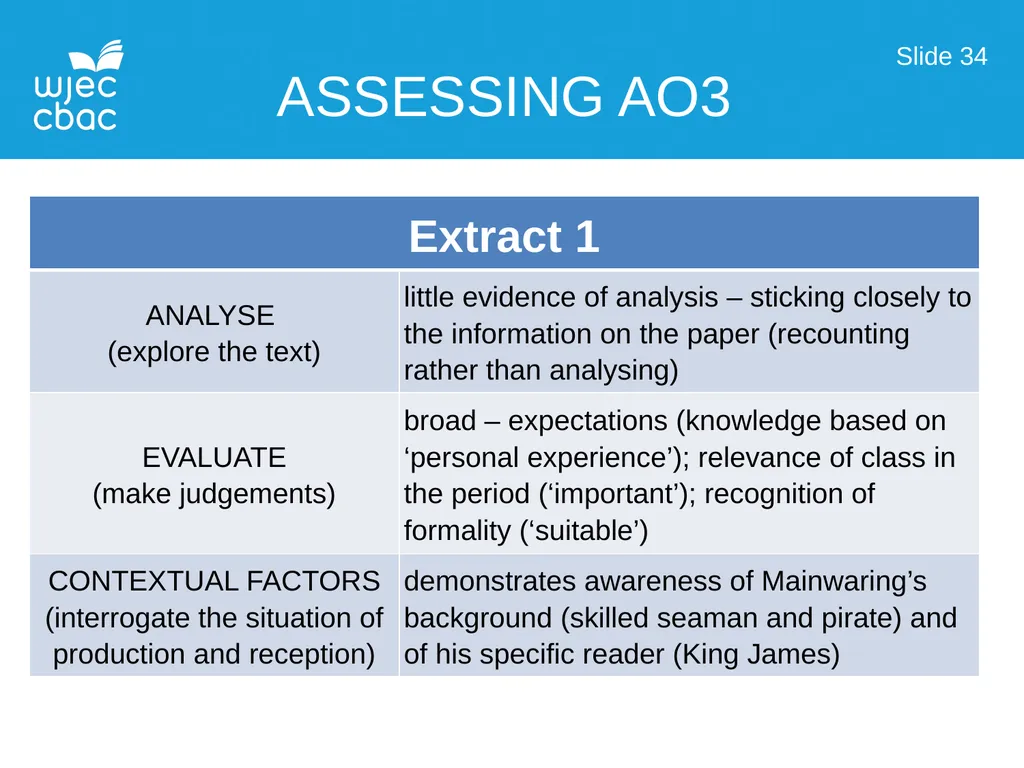
ASSESSING AO3 Slide 34<br>
37
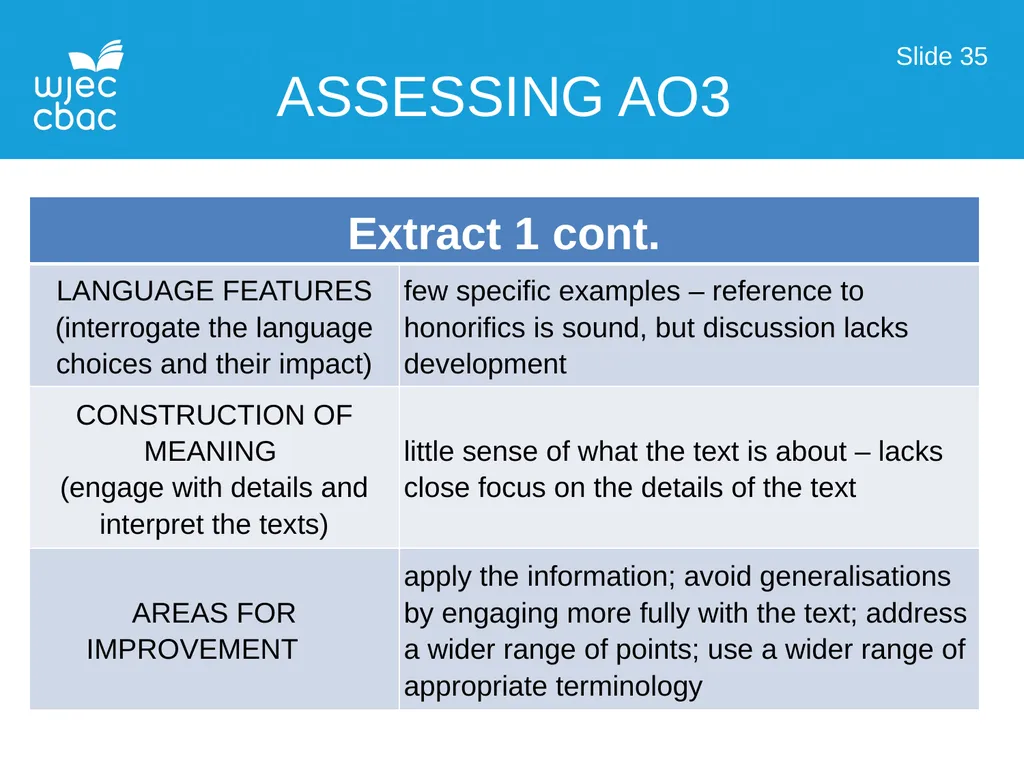
ASSESSING AO3 Slide 35<br>
38
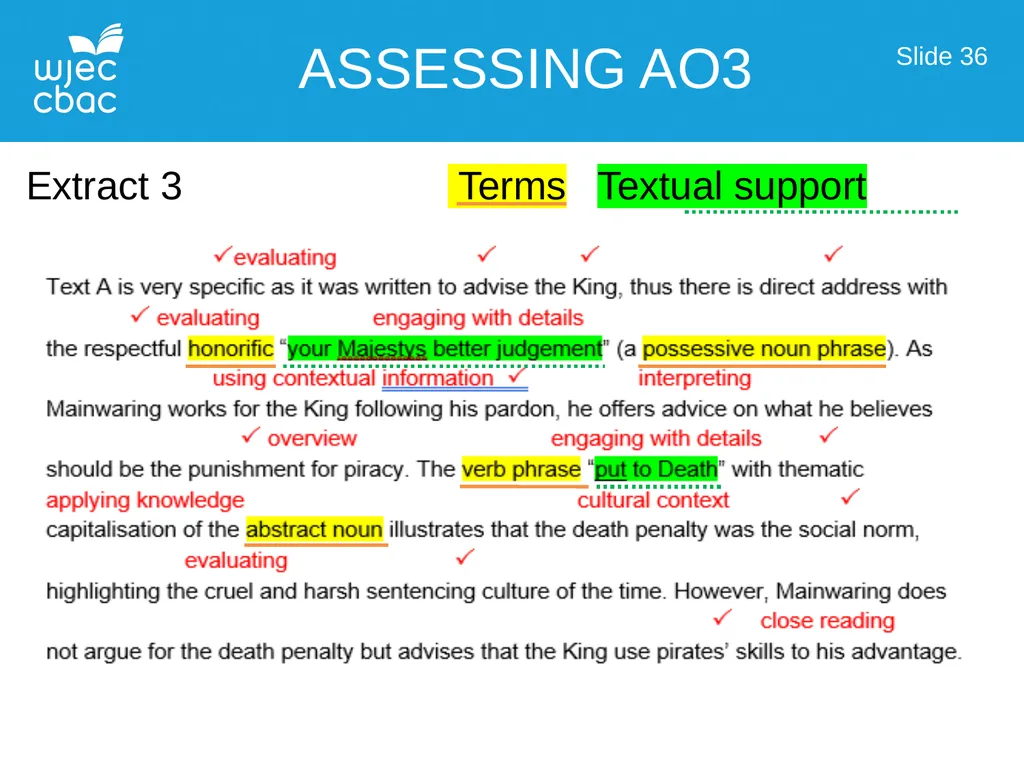
ASSESSING AO3 Slide 36 Extract 3 Terms Textual support<br>
39
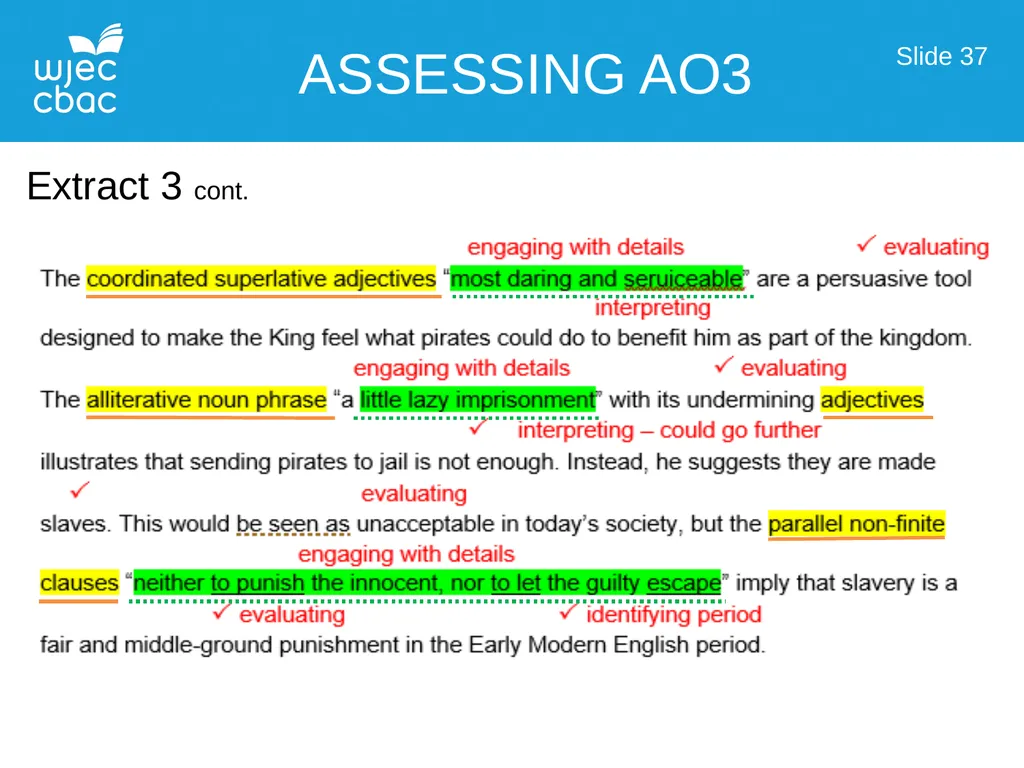
ASSESSING AO3 Slide 37 Extract 3 cont.<br>
40
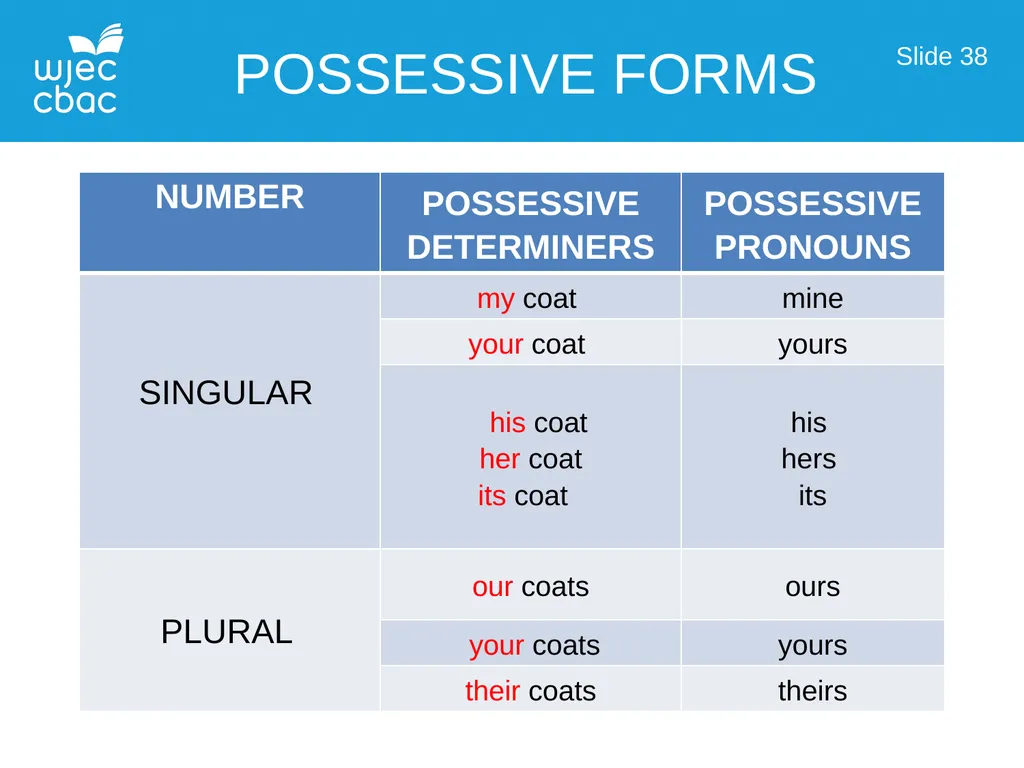
POSSESSIVE FORMS Slide 38<br>
41
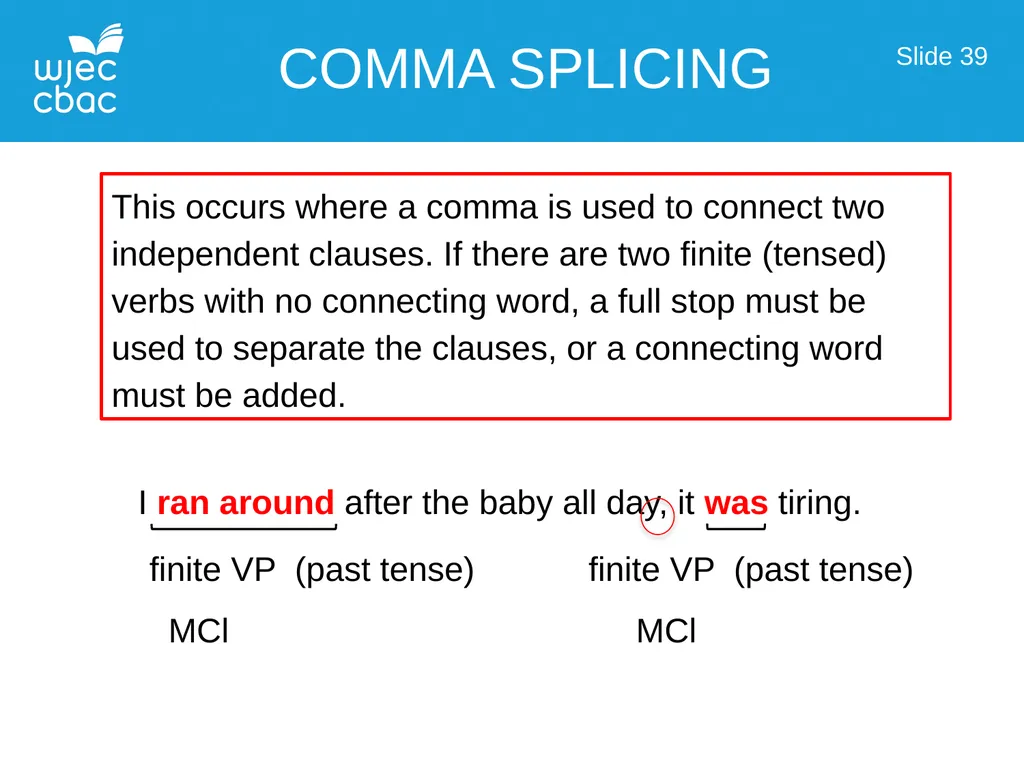
COMMA SPLICING Slide 39 This occurs where a comma is used to connect two independent clauses. If there are two finite (tensed) verbs with no connecting word, a full stop must be used to separate the clauses, or a connecting word must be added. I ran around after the baby all day, it was tiring. finite VP (past tense) finite VP (past tense)
MCl MCl<br>
MCl MCl<br>
42
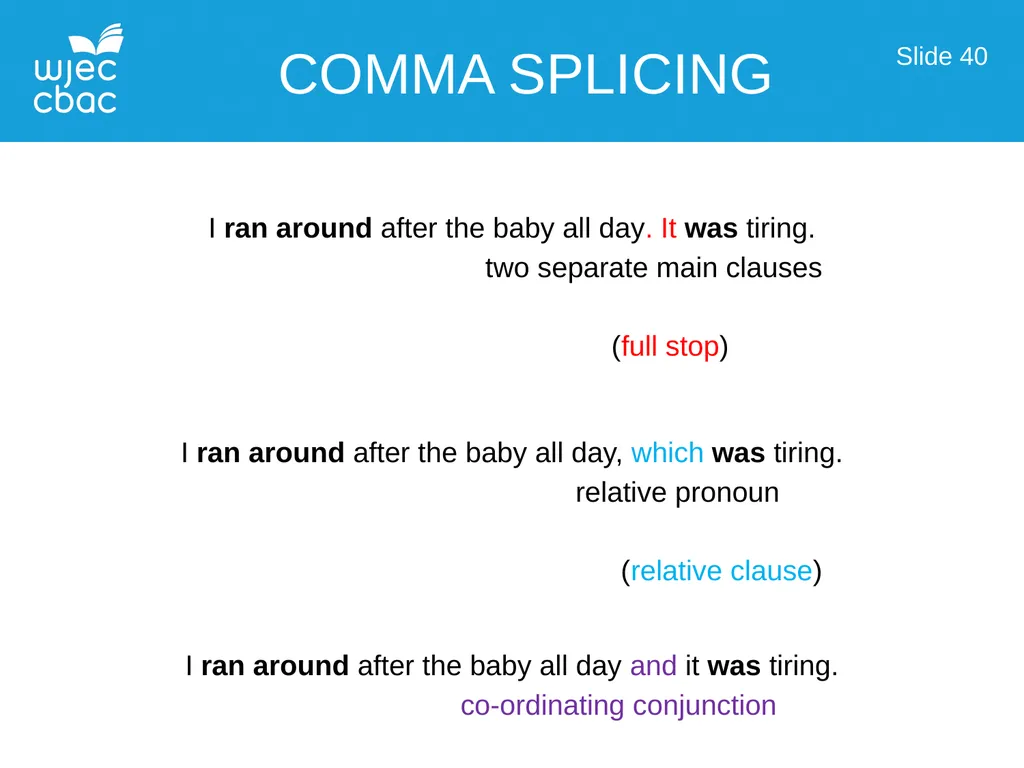
COMMA SPLICING Slide 40 I ran around after the baby all day. It was tiring.
two separate main clauses
(full stop)
I ran around after the baby all day, which was tiring. relative pronoun (relative clause)
I ran around after the baby all day and it was tiring. co-ordinating conjunction<br>
I ran around after the baby all day, which was tiring. relative pronoun (relative clause)
I ran around after the baby all day and it was tiring. co-ordinating conjunction<br>
43
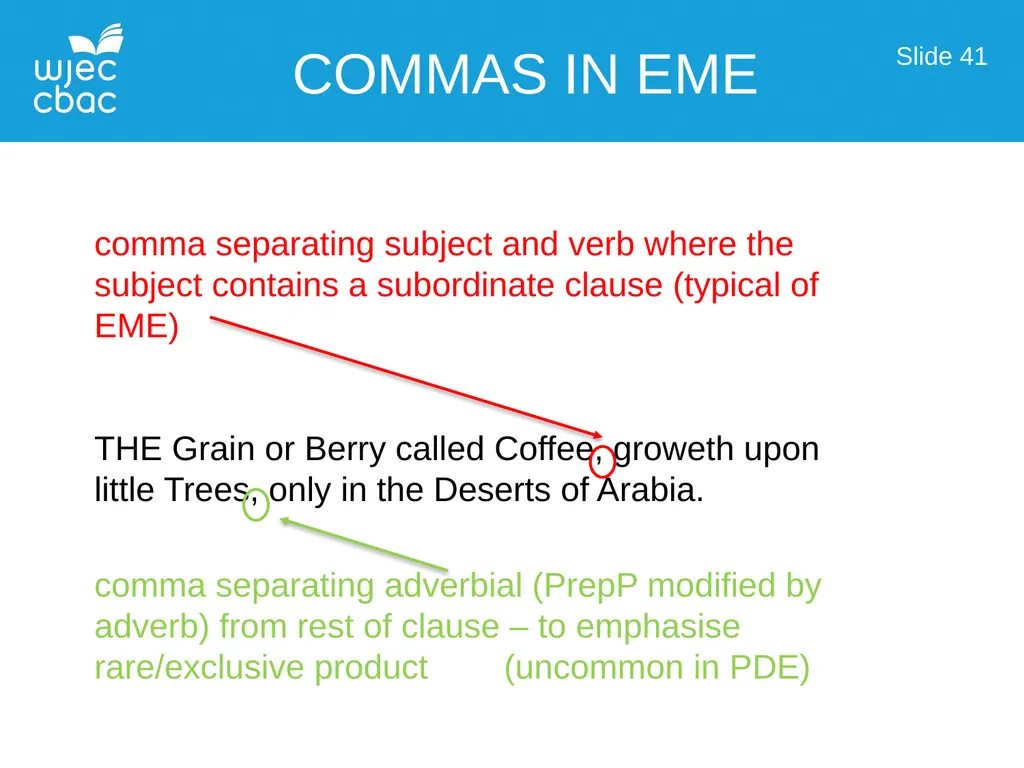
COMMAS IN EME Slide 41 comma separating subject and verb where the subject contains a subordinate clause (typical of EME)
THE Grain or Berry called Coffee, groweth upon little Trees, only in the Deserts of Arabia.
comma separating adverbial (PrepP modified by adverb) from rest of clause – to emphasise rare/exclusive product (uncommon in PDE)<br>
THE Grain or Berry called Coffee, groweth upon little Trees, only in the Deserts of Arabia.
comma separating adverbial (PrepP modified by adverb) from rest of clause – to emphasise rare/exclusive product (uncommon in PDE)<br>
44
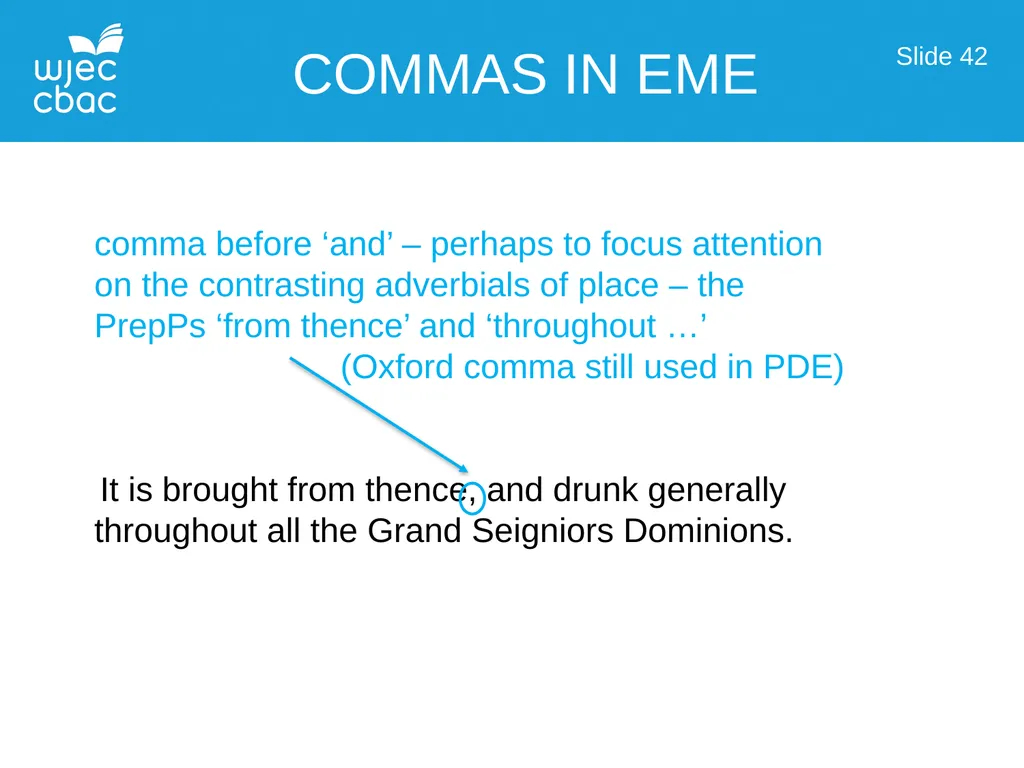
COMMAS IN EME Slide 42 comma before ‘and’ – perhaps to focus attention on the contrasting adverbials of place – the PrepPs ‘from thence’ and ‘throughout …’
(Oxford comma still used in PDE)
It is brought from thence, and drunk generally throughout all the Grand Seigniors Dominions.<br>
It is brought from thence, and drunk generally throughout all the Grand Seigniors Dominions.<br>
45
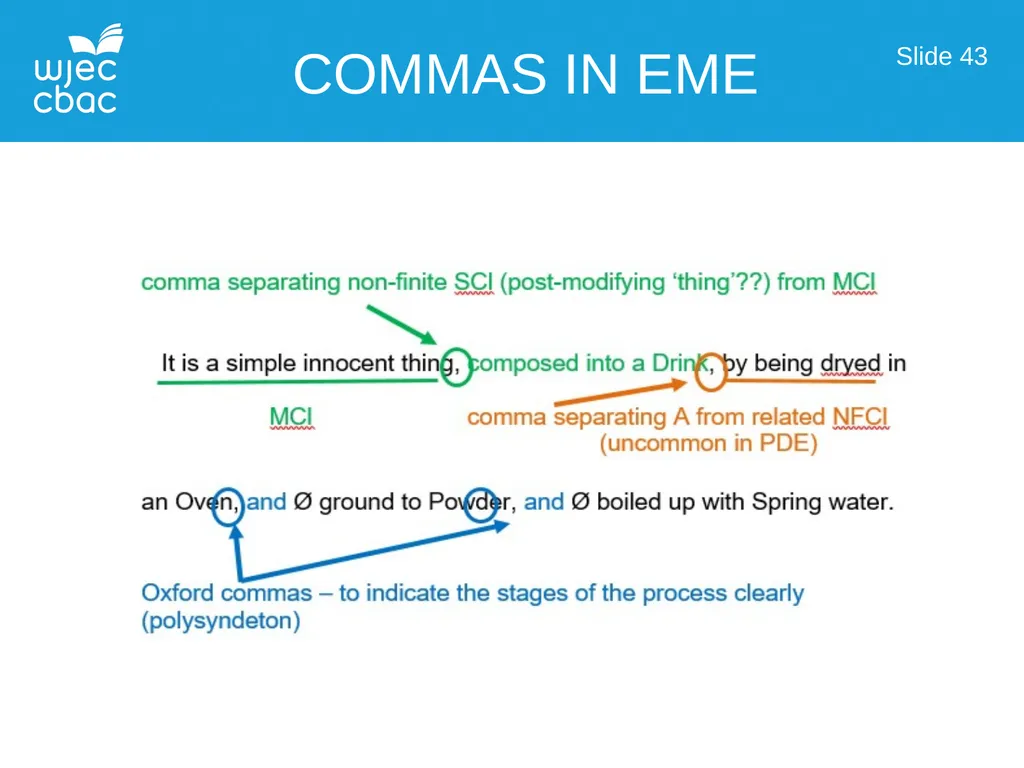
COMMAS IN EME Slide 43<br>
46
Cwestiynau? | Any Questions?<br>