
Large Language Model Security: Defense COMP 4634
OM
Published · 31 slides · 0 views
1 / 1
Description
Large Language Model Security: Defense COMP 4634 Dongdong She Outline Recap Defense Taxonomy SmoothLLM Perturbation-Based Defense (ICLR 2024) Llama Guard Classifier-Based Guardrail (Meta AI) Deep Alignment Beyond a Thin Wrapper (ICLR
Related Topics
Share
Embed code
Download this presentation From Below
"Large Language Model Security: Defense COMP 4634" is the property of its rightful owner. Permission is granted to download and print the materials on this website for personal, non-commercial use only, and to display it on your personal computer provided you do not modify the materials and that you retain all copyright notices contained in the materials. By downloading content from our website, you accept the terms of this agreement.
Presentation Transcript
01
Large Language Model Security: Defense COMP 4634
Dongdong She<br>
Dongdong She<br>
02
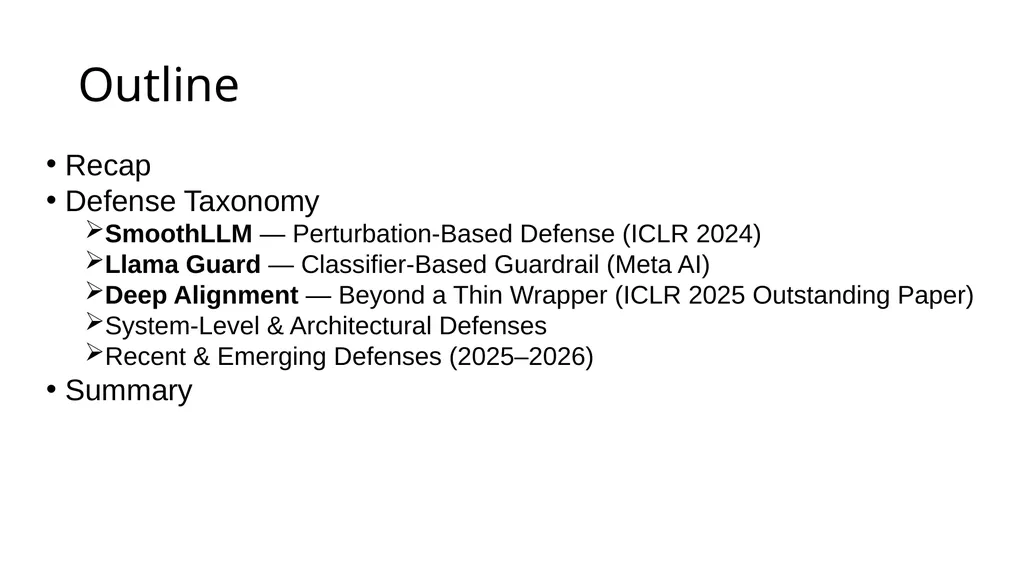
Outline Recap
Defense Taxonomy
SmoothLLM — Perturbation-Based Defense (ICLR 2024)
Llama Guard — Classifier-Based Guardrail (Meta AI)
Deep Alignment — Beyond a Thin Wrapper (ICLR 2025 Outstanding Paper)
System-Level & Architectural Defenses
Recent & Emerging Defenses (2025–2026)
Summary<br>
Defense Taxonomy
SmoothLLM — Perturbation-Based Defense (ICLR 2024)
Llama Guard — Classifier-Based Guardrail (Meta AI)
Deep Alignment — Beyond a Thin Wrapper (ICLR 2025 Outstanding Paper)
System-Level & Architectural Defenses
Recent & Emerging Defenses (2025–2026)
Summary<br>
03
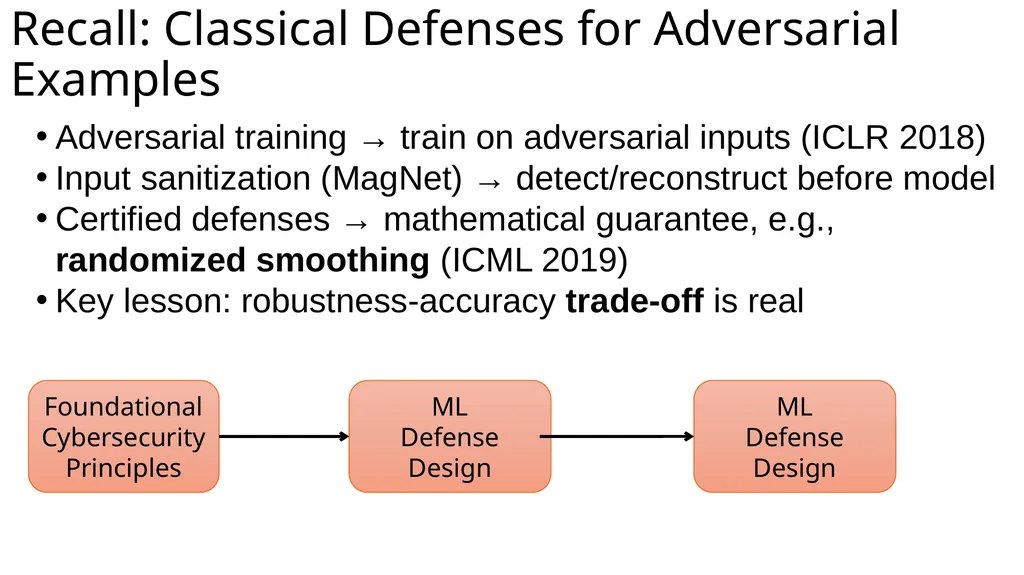
Recall: Classical Defenses for Adversarial Examples Adversarial training → train on adversarial inputs (ICLR 2018)
Input sanitization (MagNet) → detect/reconstruct before model
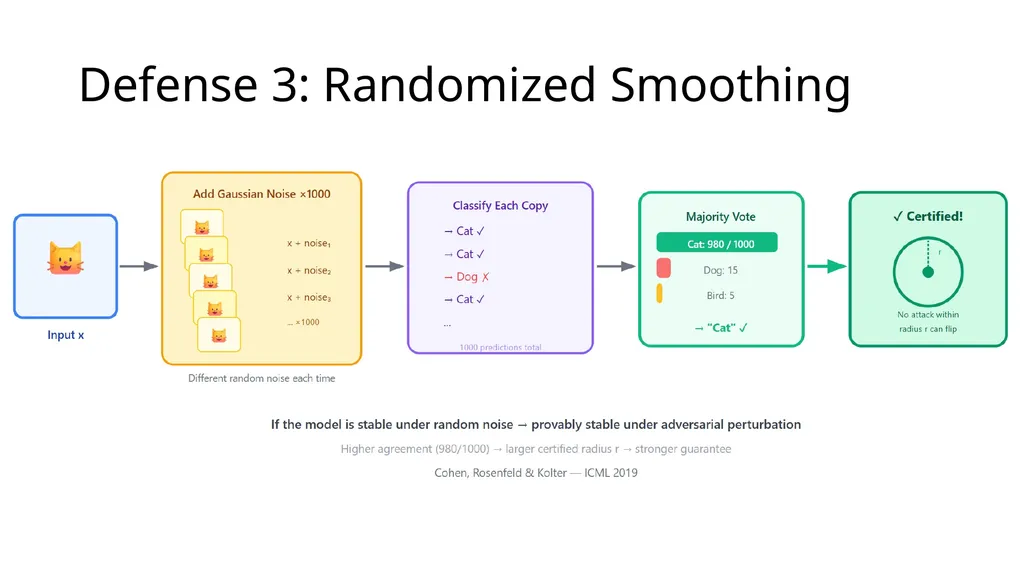
Certified defenses → mathematical guarantee, e.g., randomized smoothing (ICML 2019)
Key lesson: robustness-accuracy trade-off is real Foundational Cybersecurity Principles ML
Defense
Design ML
Defense
Design<br>
Input sanitization (MagNet) → detect/reconstruct before model
Certified defenses → mathematical guarantee, e.g., randomized smoothing (ICML 2019)
Key lesson: robustness-accuracy trade-off is real Foundational Cybersecurity Principles ML
Defense
Design ML
Defense
Design<br>
04
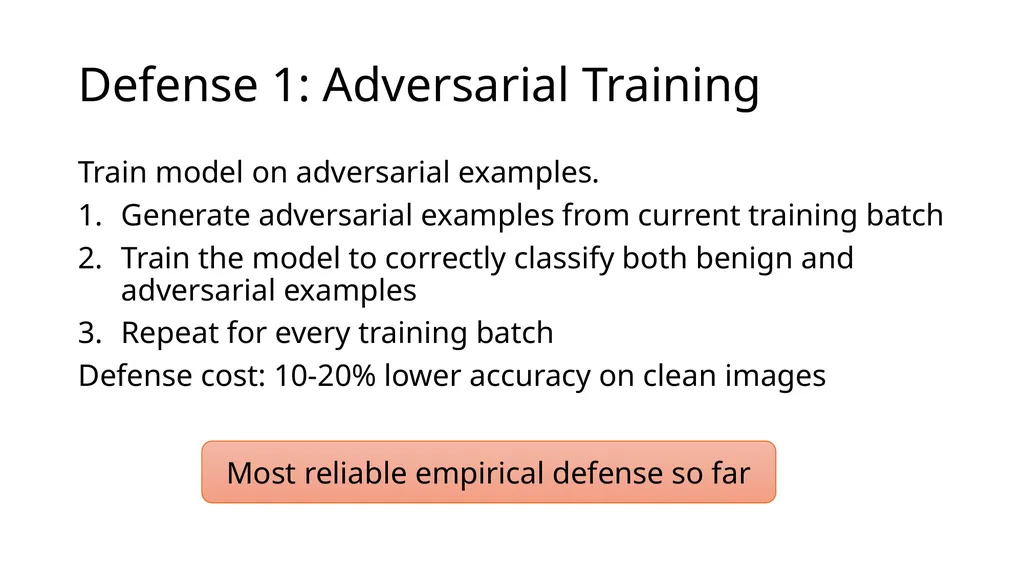
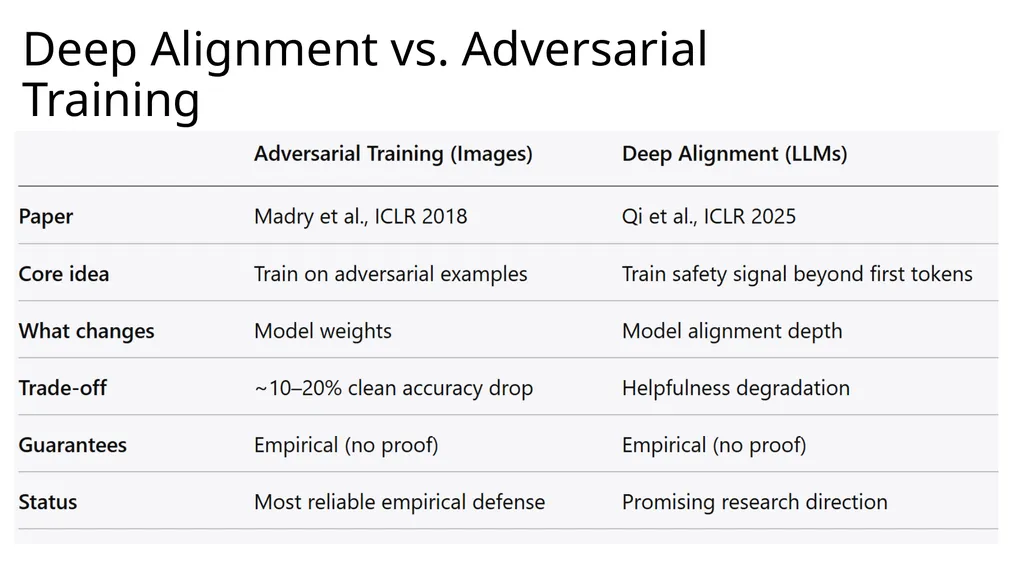
Defense 1: Adversarial Training Train model on adversarial examples.
Generate adversarial examples from current training batch
Train the model to correctly classify both benign and adversarial examples
Repeat for every training batch
Defense cost: 10-20% lower accuracy on clean images Most reliable empirical defense so far<br>
Generate adversarial examples from current training batch
Train the model to correctly classify both benign and adversarial examples
Repeat for every training batch
Defense cost: 10-20% lower accuracy on clean images Most reliable empirical defense so far<br>
05
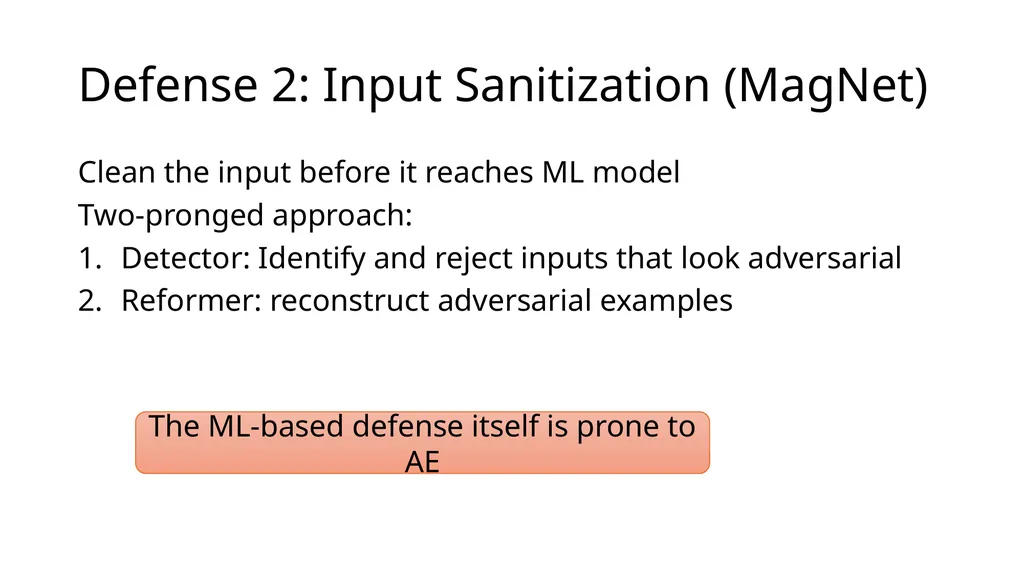
Defense 2: Input Sanitization (MagNet) Clean the input before it reaches ML model
Two-pronged approach:
Detector: Identify and reject inputs that look adversarial
Reformer: reconstruct adversarial examples The ML-based defense itself is prone to AE<br>
Two-pronged approach:
Detector: Identify and reject inputs that look adversarial
Reformer: reconstruct adversarial examples The ML-based defense itself is prone to AE<br>
06
Defense 3: Randomized Smoothing<br>
07
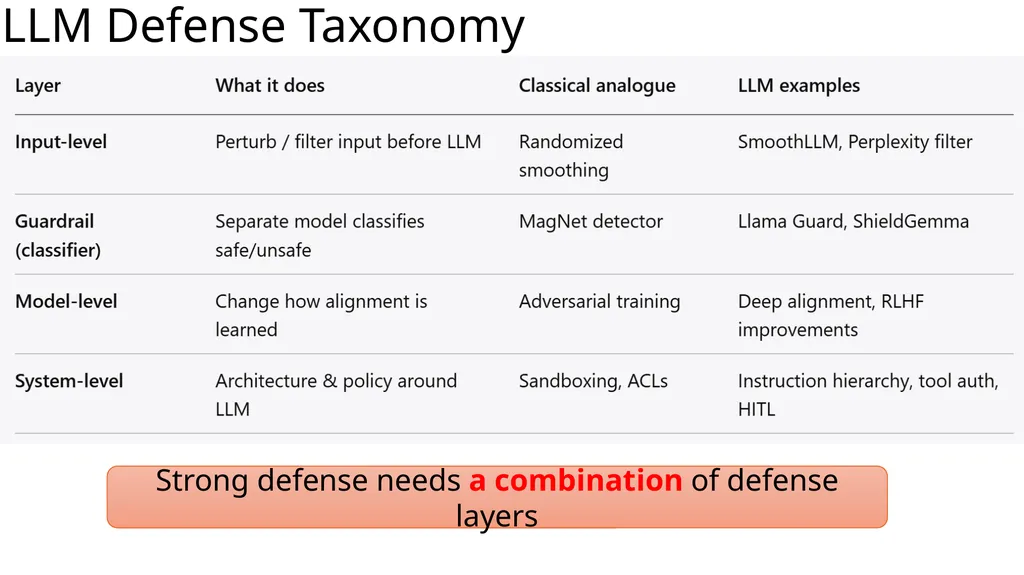
LLM Defense Taxonomy Strong defense needs a combination of defense layers<br>
08
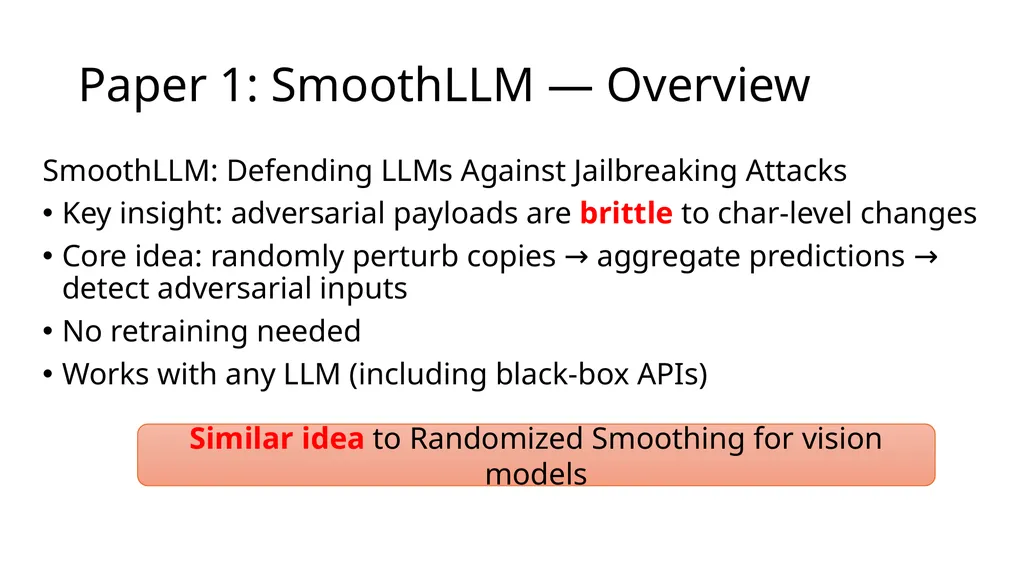
Paper 1: SmoothLLM — Overview SmoothLLM: Defending LLMs Against Jailbreaking Attacks
Key insight: adversarial payloads are brittle to char-level changes
Core idea: randomly perturb copies → aggregate predictions → detect adversarial inputs
No retraining needed
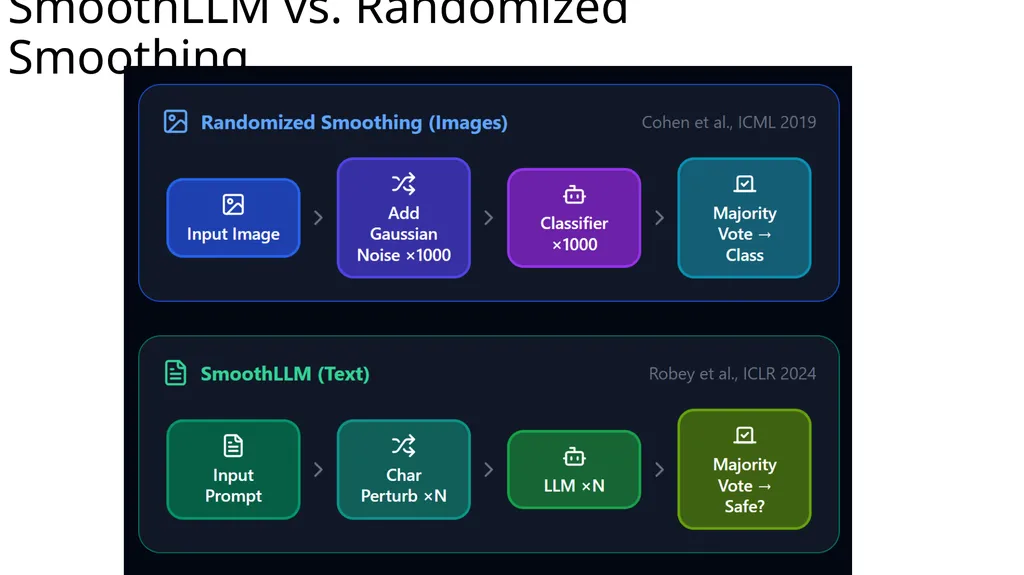
Works with any LLM (including black-box APIs) Similar idea to Randomized Smoothing for vision models<br>
Key insight: adversarial payloads are brittle to char-level changes
Core idea: randomly perturb copies → aggregate predictions → detect adversarial inputs
No retraining needed
Works with any LLM (including black-box APIs) Similar idea to Randomized Smoothing for vision models<br>
09
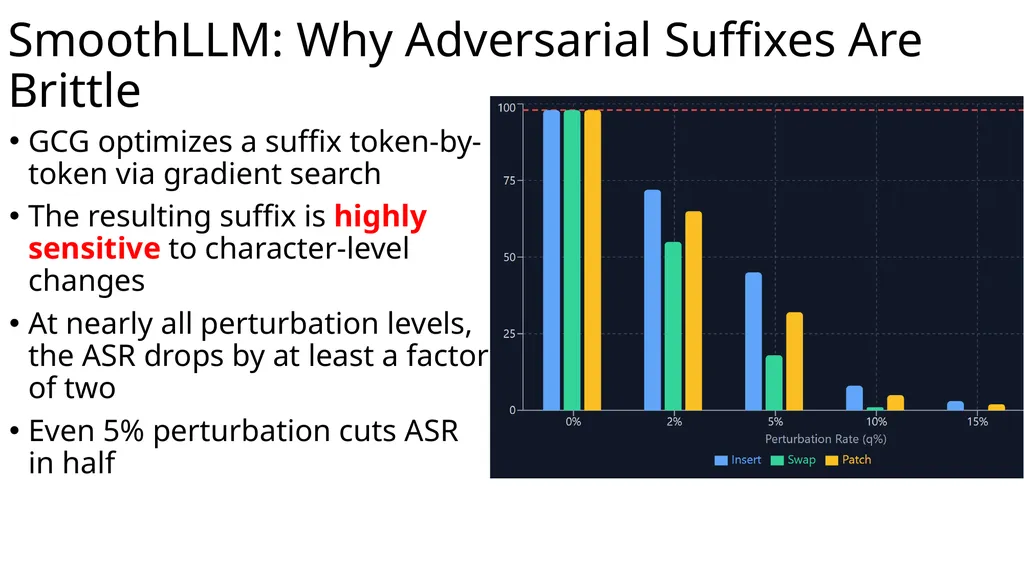
SmoothLLM: Why Adversarial Suffixes Are Brittle GCG optimizes a suffix token-by-token via gradient search
The resulting suffix is highly sensitive to character-level changes
At nearly all perturbation levels, the ASR drops by at least a factor of two
Even 5% perturbation cuts ASR in half<br>
The resulting suffix is highly sensitive to character-level changes
At nearly all perturbation levels, the ASR drops by at least a factor of two
Even 5% perturbation cuts ASR in half<br>
10
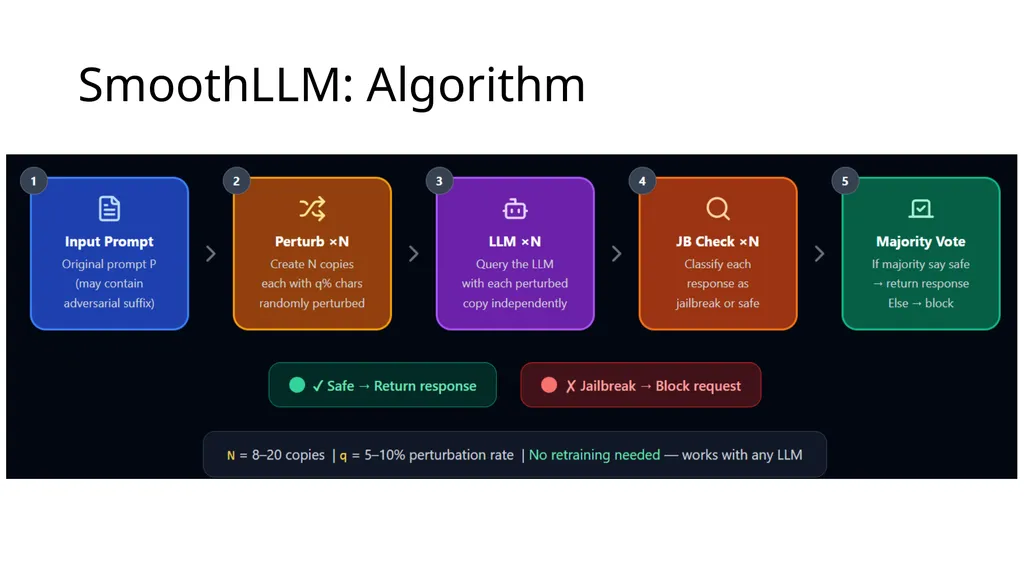
SmoothLLM: Algorithm<br>
11
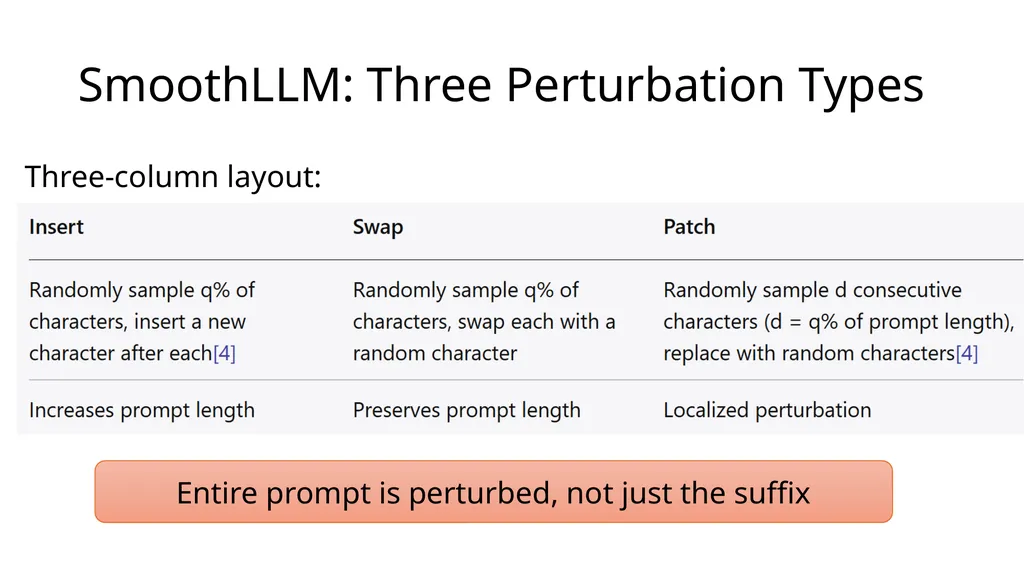
SmoothLLM: Three Perturbation Types Three-column layout: Entire prompt is perturbed, not just the suffix<br>
12
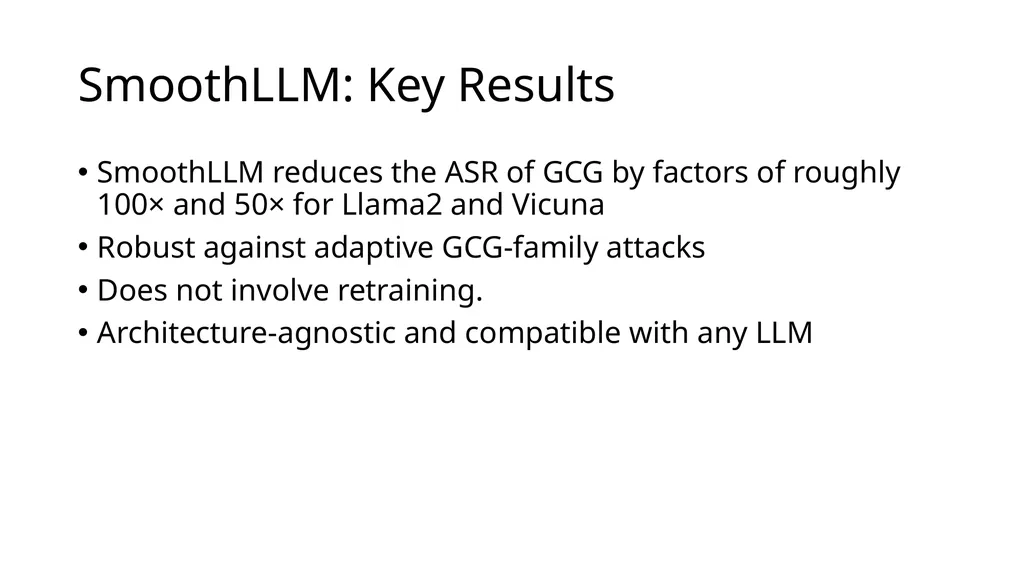
SmoothLLM: Key Results SmoothLLM reduces the ASR of GCG by factors of roughly 100× and 50× for Llama2 and Vicuna
Robust against adaptive GCG-family attacks
Does not involve retraining.
Architecture-agnostic and compatible with any LLM<br>
Robust against adaptive GCG-family attacks
Does not involve retraining.
Architecture-agnostic and compatible with any LLM<br>
13
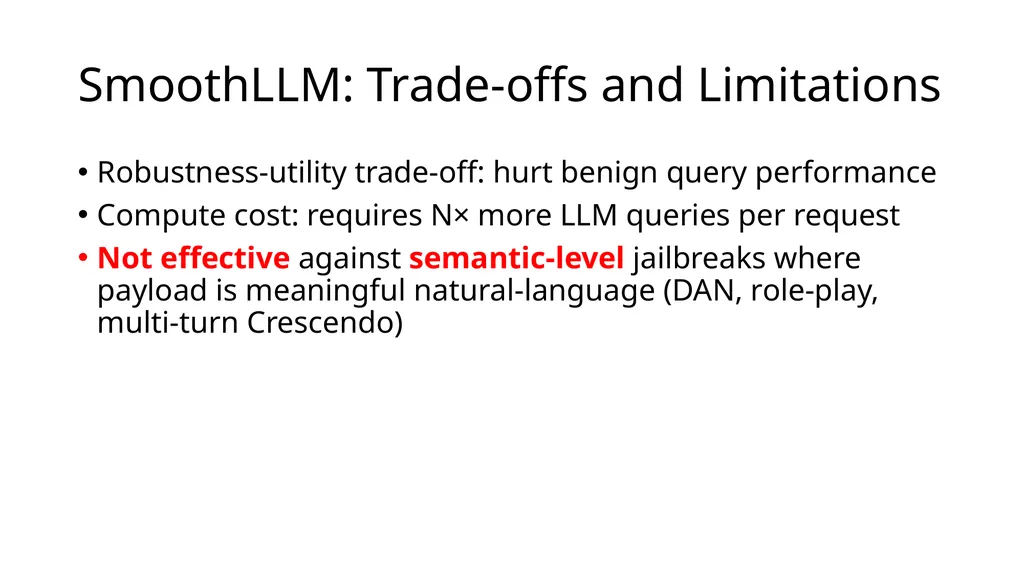
SmoothLLM: Trade-offs and Limitations Robustness-utility trade-off: hurt benign query performance
Compute cost: requires N× more LLM queries per request
Not effective against semantic-level jailbreaks where payload is meaningful natural-language (DAN, role-play, multi-turn Crescendo)<br>
Compute cost: requires N× more LLM queries per request
Not effective against semantic-level jailbreaks where payload is meaningful natural-language (DAN, role-play, multi-turn Crescendo)<br>
14
SmoothLLM vs. Randomized Smoothing<br>
15
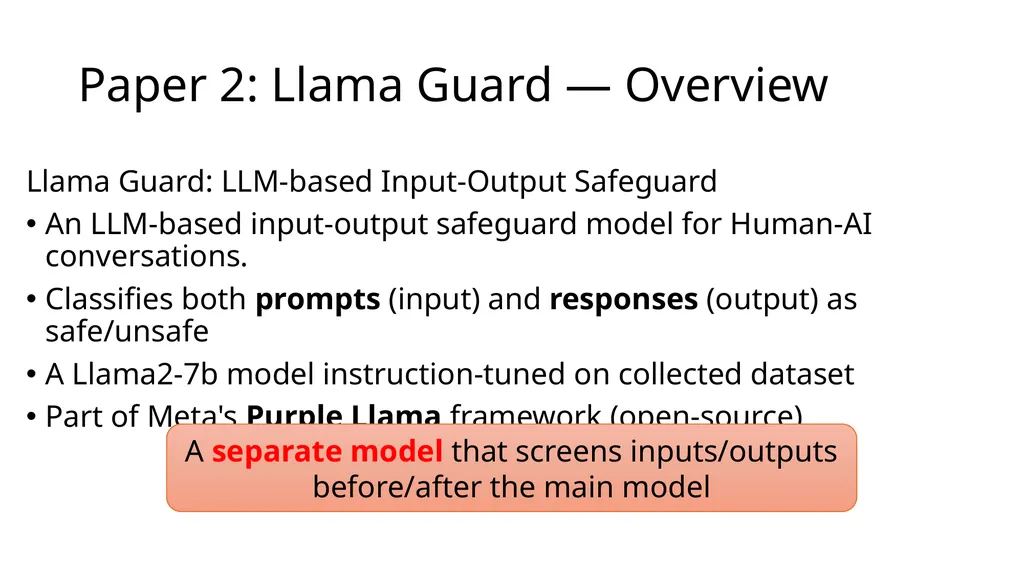
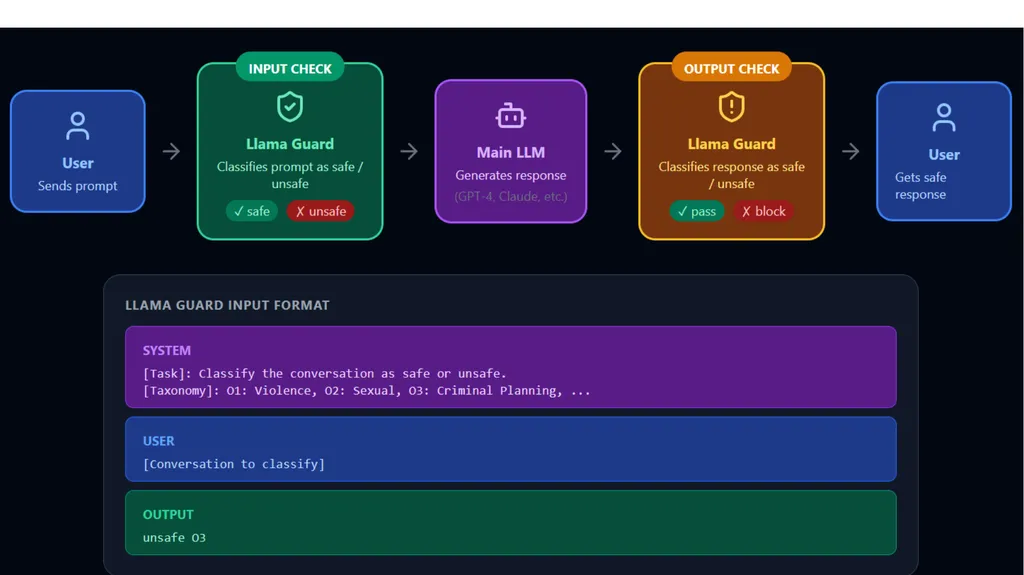
Paper 2: Llama Guard — Overview Llama Guard: LLM-based Input-Output Safeguard
An LLM-based input-output safeguard model for Human-AI conversations.
Classifies both prompts (input) and responses (output) as safe/unsafe
A Llama2-7b model instruction-tuned on collected dataset
Part of Meta's Purple Llama framework (open-source) A separate model that screens inputs/outputs before/after the main model<br>
An LLM-based input-output safeguard model for Human-AI conversations.
Classifies both prompts (input) and responses (output) as safe/unsafe
A Llama2-7b model instruction-tuned on collected dataset
Part of Meta's Purple Llama framework (open-source) A separate model that screens inputs/outputs before/after the main model<br>
16
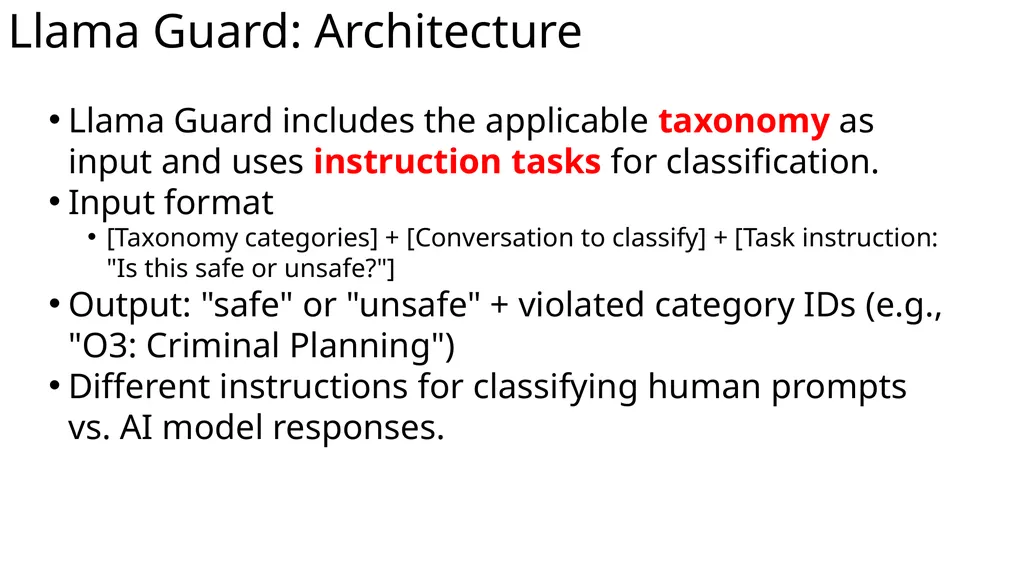
Llama Guard: Architecture Llama Guard includes the applicable taxonomy as input and uses instruction tasks for classification.
Input format
[Taxonomy categories] + [Conversation to classify] + [Task instruction: "Is this safe or unsafe?"]
Output: "safe" or "unsafe" + violated category IDs (e.g., "O3: Criminal Planning")
Different instructions for classifying human prompts vs. AI model responses.<br>
Input format
[Taxonomy categories] + [Conversation to classify] + [Task instruction: "Is this safe or unsafe?"]
Output: "safe" or "unsafe" + violated category IDs (e.g., "O3: Criminal Planning")
Different instructions for classifying human prompts vs. AI model responses.<br>
17
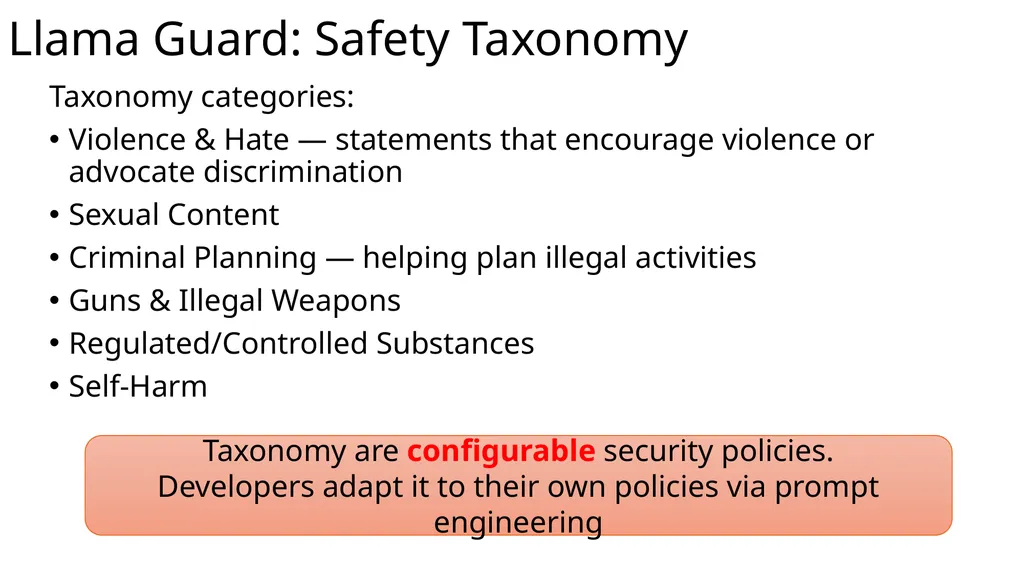
Llama Guard: Safety Taxonomy Taxonomy categories:
Violence & Hate — statements that encourage violence or advocate discrimination
Sexual Content
Criminal Planning — helping plan illegal activities
Guns & Illegal Weapons
Regulated/Controlled Substances
Self-Harm Taxonomy are configurable security policies.
Developers adapt it to their own policies via prompt engineering<br>
Violence & Hate — statements that encourage violence or advocate discrimination
Sexual Content
Criminal Planning — helping plan illegal activities
Guns & Illegal Weapons
Regulated/Controlled Substances
Self-Harm Taxonomy are configurable security policies.
Developers adapt it to their own policies via prompt engineering<br>
18
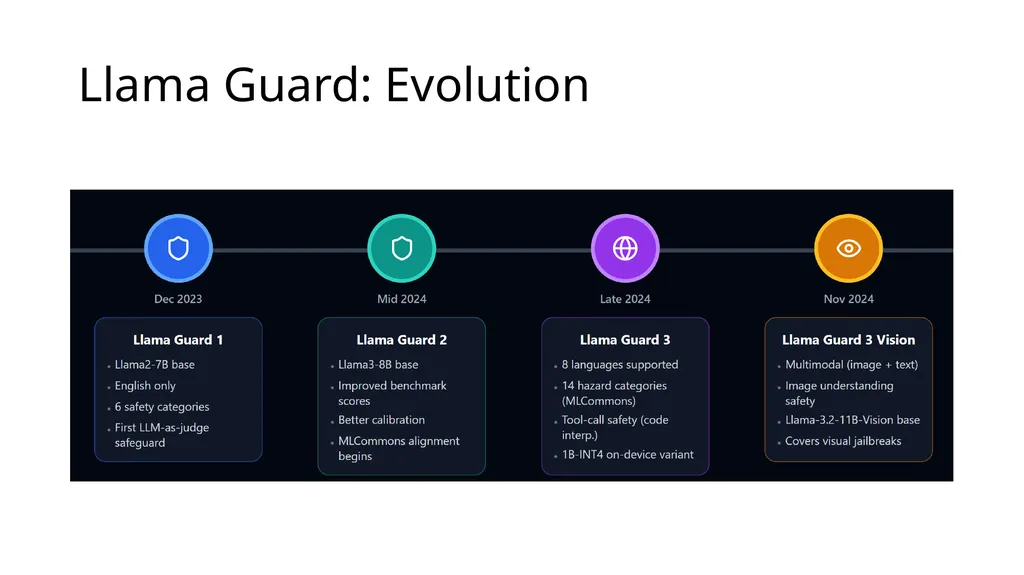
Llama Guard: Evolution<br>
19
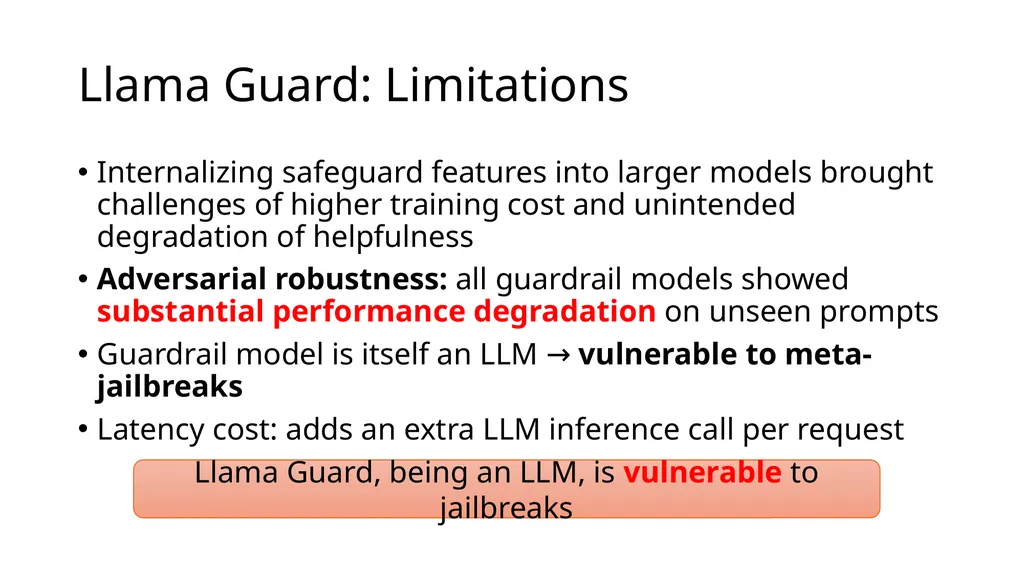
Llama Guard: Limitations Internalizing safeguard features into larger models brought challenges of higher training cost and unintended degradation of helpfulness
Adversarial robustness: all guardrail models showed substantial performance degradation on unseen prompts
Guardrail model is itself an LLM → vulnerable to meta-jailbreaks
Latency cost: adds an extra LLM inference call per request Llama Guard, being an LLM, is vulnerable to jailbreaks<br>
Adversarial robustness: all guardrail models showed substantial performance degradation on unseen prompts
Guardrail model is itself an LLM → vulnerable to meta-jailbreaks
Latency cost: adds an extra LLM inference call per request Llama Guard, being an LLM, is vulnerable to jailbreaks<br>
20
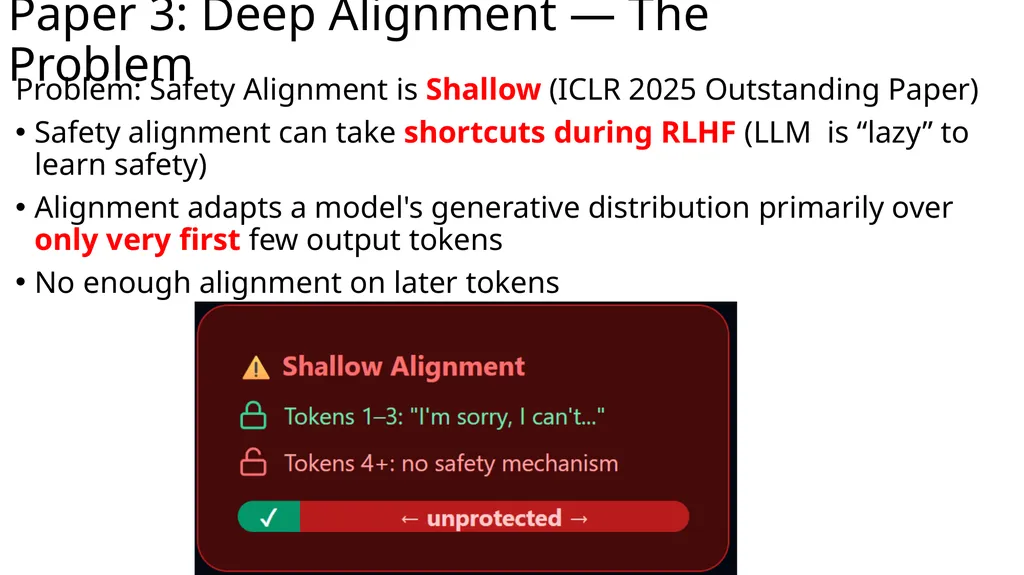
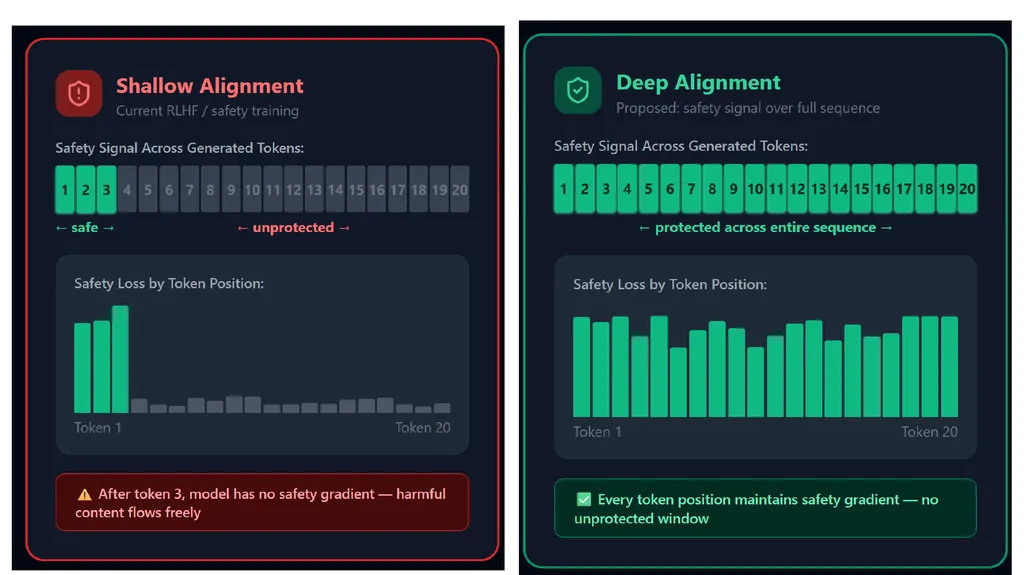
Paper 3: Deep Alignment — The Problem Problem: Safety Alignment is Shallow (ICLR 2025 Outstanding Paper)
Safety alignment can take shortcuts during RLHF (LLM is “lazy” to learn safety)
Alignment adapts a model's generative distribution primarily over only very first few output tokens
No enough alignment on later tokens<br>
Safety alignment can take shortcuts during RLHF (LLM is “lazy” to learn safety)
Alignment adapts a model's generative distribution primarily over only very first few output tokens
No enough alignment on later tokens<br>
21
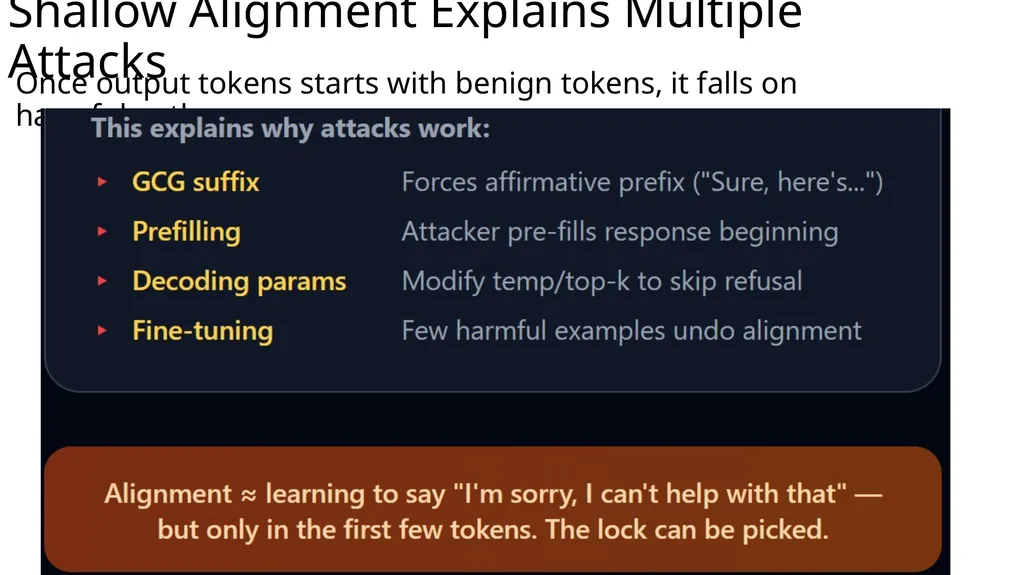
Shallow Alignment Explains Multiple Attacks Once output tokens starts with benign tokens, it falls on harmful path. Alignment ≈ learning to say "I'm sorry, I can't help with that" but only in the first few tokens<br>
22
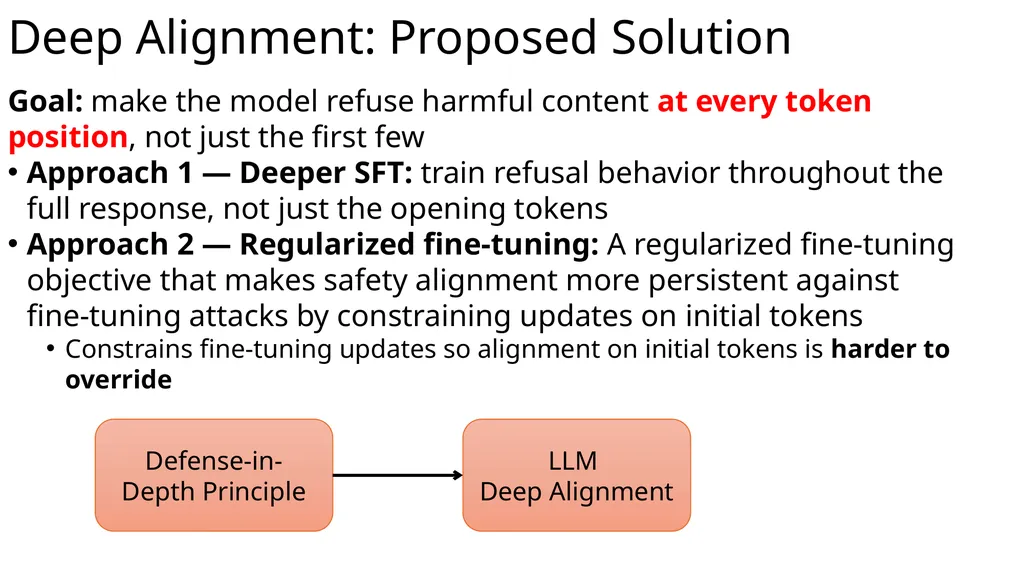
Deep Alignment: Proposed Solution Goal: make the model refuse harmful content at every token position, not just the first few
Approach 1 — Deeper SFT: train refusal behavior throughout the full response, not just the opening tokens
Approach 2 — Regularized fine-tuning: A regularized fine-tuning objective that makes safety alignment more persistent against fine-tuning attacks by constraining updates on initial tokens
Constrains fine-tuning updates so alignment on initial tokens is harder to override Defense-in-Depth Principle LLM
Deep Alignment<br>
Approach 1 — Deeper SFT: train refusal behavior throughout the full response, not just the opening tokens
Approach 2 — Regularized fine-tuning: A regularized fine-tuning objective that makes safety alignment more persistent against fine-tuning attacks by constraining updates on initial tokens
Constrains fine-tuning updates so alignment on initial tokens is harder to override Defense-in-Depth Principle LLM
Deep Alignment<br>
23
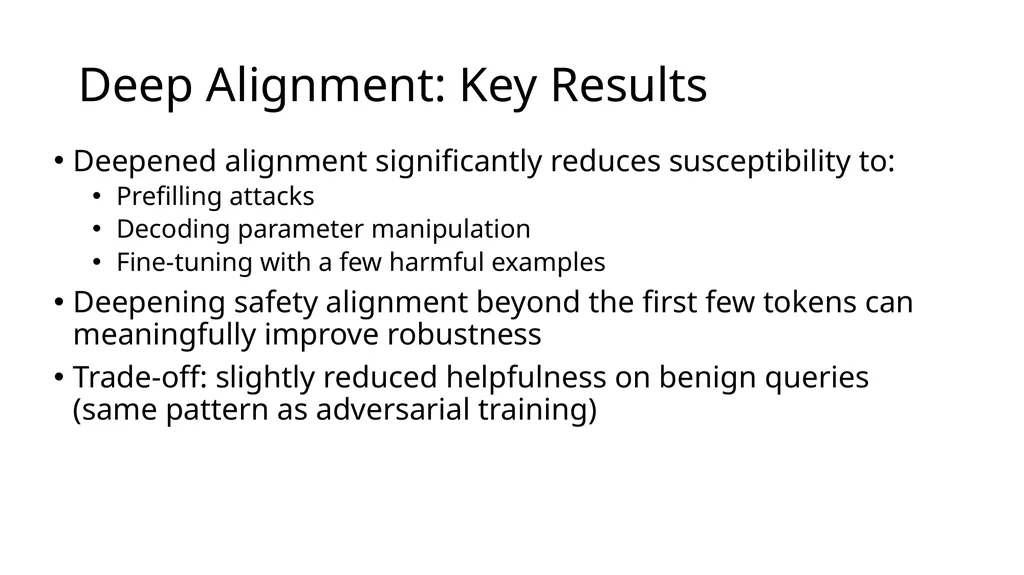
Deep Alignment: Key Results Deepened alignment significantly reduces susceptibility to:
Prefilling attacks
Decoding parameter manipulation
Fine-tuning with a few harmful examples
Deepening safety alignment beyond the first few tokens can meaningfully improve robustness
Trade-off: slightly reduced helpfulness on benign queries (same pattern as adversarial training)<br>
Prefilling attacks
Decoding parameter manipulation
Fine-tuning with a few harmful examples
Deepening safety alignment beyond the first few tokens can meaningfully improve robustness
Trade-off: slightly reduced helpfulness on benign queries (same pattern as adversarial training)<br>
24
Deep Alignment vs. Adversarial Training<br>
25
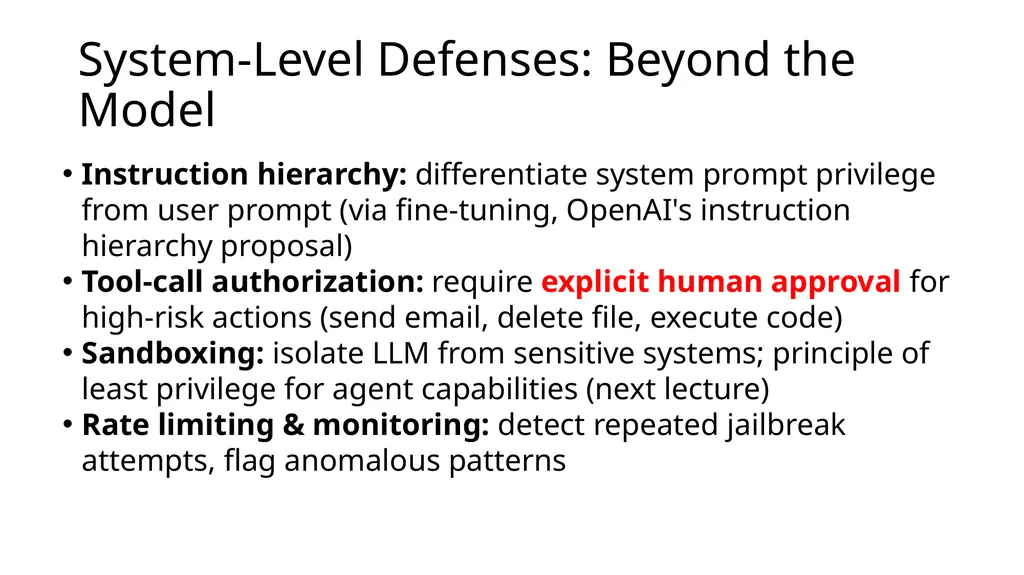
System-Level Defenses: Beyond the Model Instruction hierarchy: differentiate system prompt privilege from user prompt (via fine-tuning, OpenAI's instruction hierarchy proposal)
Tool-call authorization: require explicit human approval for high-risk actions (send email, delete file, execute code)
Sandboxing: isolate LLM from sensitive systems; principle of least privilege for agent capabilities (next lecture)
Rate limiting & monitoring: detect repeated jailbreak attempts, flag anomalous patterns<br>
Tool-call authorization: require explicit human approval for high-risk actions (send email, delete file, execute code)
Sandboxing: isolate LLM from sensitive systems; principle of least privilege for agent capabilities (next lecture)
Rate limiting & monitoring: detect repeated jailbreak attempts, flag anomalous patterns<br>
26
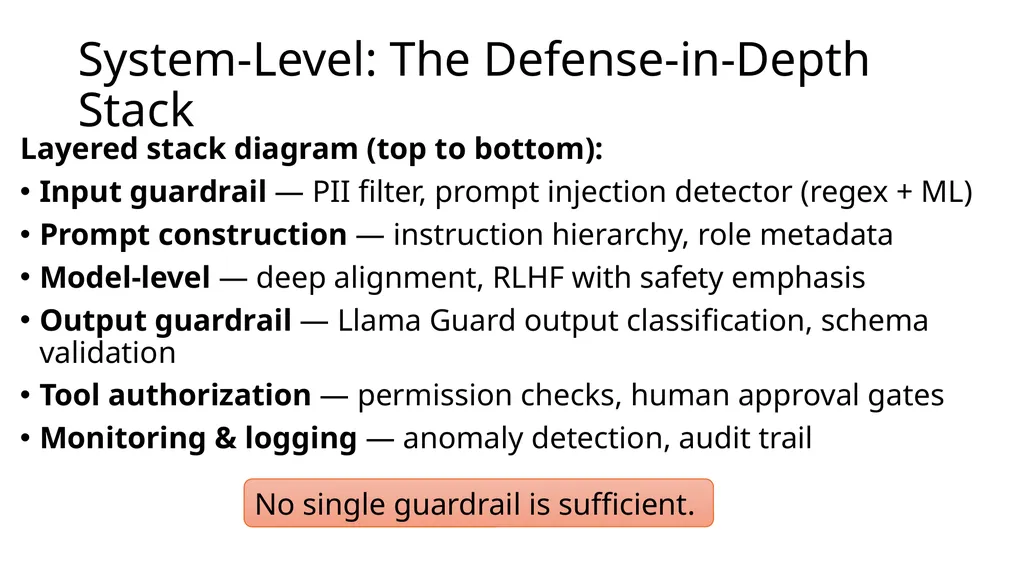
System-Level: The Defense-in-Depth Stack Layered stack diagram (top to bottom):
Input guardrail — PII filter, prompt injection detector (regex + ML)
Prompt construction — instruction hierarchy, role metadata
Model-level — deep alignment, RLHF with safety emphasis
Output guardrail — Llama Guard output classification, schema validation
Tool authorization — permission checks, human approval gates
Monitoring & logging — anomaly detection, audit trail No single guardrail is sufficient.<br>
Input guardrail — PII filter, prompt injection detector (regex + ML)
Prompt construction — instruction hierarchy, role metadata
Model-level — deep alignment, RLHF with safety emphasis
Output guardrail — Llama Guard output classification, schema validation
Tool authorization — permission checks, human approval gates
Monitoring & logging — anomaly detection, audit trail No single guardrail is sufficient.<br>
27
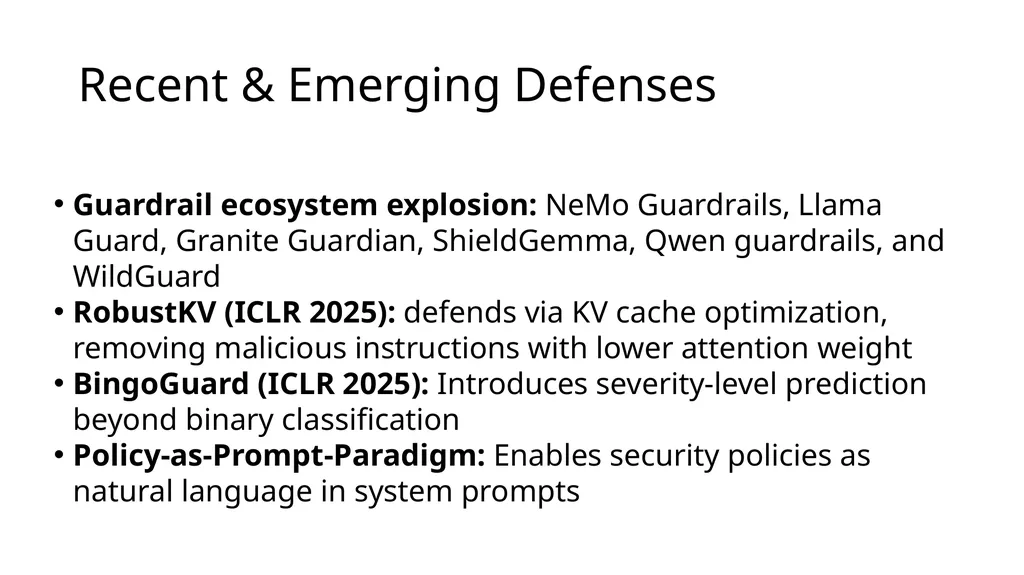
Recent & Emerging Defenses Guardrail ecosystem explosion: NeMo Guardrails, Llama Guard, Granite Guardian, ShieldGemma, Qwen guardrails, and WildGuard
RobustKV (ICLR 2025): defends via KV cache optimization, removing malicious instructions with lower attention weight
BingoGuard (ICLR 2025): Introduces severity-level prediction beyond binary classification
Policy-as-Prompt-Paradigm: Enables security policies as natural language in system prompts<br>
RobustKV (ICLR 2025): defends via KV cache optimization, removing malicious instructions with lower attention weight
BingoGuard (ICLR 2025): Introduces severity-level prediction beyond binary classification
Policy-as-Prompt-Paradigm: Enables security policies as natural language in system prompts<br>
28
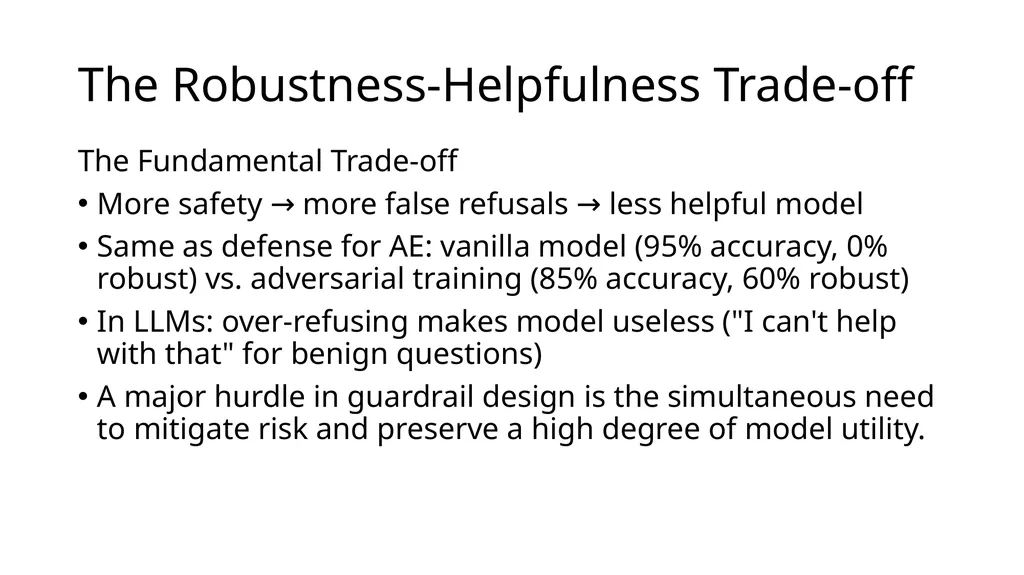
The Robustness-Helpfulness Trade-off The Fundamental Trade-off
More safety → more false refusals → less helpful model
Same as defense for AE: vanilla model (95% accuracy, 0% robust) vs. adversarial training (85% accuracy, 60% robust)
In LLMs: over-refusing makes model useless ("I can't help with that" for benign questions)
A major hurdle in guardrail design is the simultaneous need to mitigate risk and preserve a high degree of model utility.<br>
More safety → more false refusals → less helpful model
Same as defense for AE: vanilla model (95% accuracy, 0% robust) vs. adversarial training (85% accuracy, 60% robust)
In LLMs: over-refusing makes model useless ("I can't help with that" for benign questions)
A major hurdle in guardrail design is the simultaneous need to mitigate risk and preserve a high degree of model utility.<br>
29
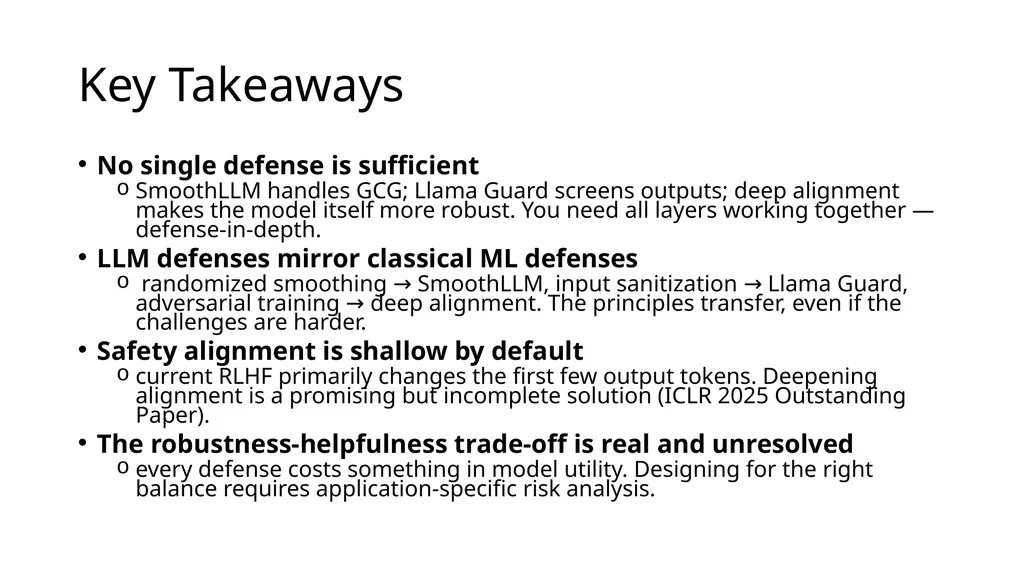
Key Takeaways No single defense is sufficient
SmoothLLM handles GCG; Llama Guard screens outputs; deep alignment makes the model itself more robust. You need all layers working together — defense-in-depth.
LLM defenses mirror classical ML defenses
randomized smoothing → SmoothLLM, input sanitization → Llama Guard, adversarial training → deep alignment. The principles transfer, even if the challenges are harder.
Safety alignment is shallow by default
current RLHF primarily changes the first few output tokens. Deepening alignment is a promising but incomplete solution (ICLR 2025 Outstanding Paper).
The robustness-helpfulness trade-off is real and unresolved
every defense costs something in model utility. Designing for the right balance requires application-specific risk analysis.<br>
SmoothLLM handles GCG; Llama Guard screens outputs; deep alignment makes the model itself more robust. You need all layers working together — defense-in-depth.
LLM defenses mirror classical ML defenses
randomized smoothing → SmoothLLM, input sanitization → Llama Guard, adversarial training → deep alignment. The principles transfer, even if the challenges are harder.
Safety alignment is shallow by default
current RLHF primarily changes the first few output tokens. Deepening alignment is a promising but incomplete solution (ICLR 2025 Outstanding Paper).
The robustness-helpfulness trade-off is real and unresolved
every defense costs something in model utility. Designing for the right balance requires application-specific risk analysis.<br>