Large Scale Search: Inverted Index, etc. Comp: 441552 Large Scale Machine Learning Classical Search Problem Given: A (giant) set of text documents Assume it is a static collection for the moment Task: Retrieve documents that is relevant to
"Large Scale Search: Inverted Index, etc. Comp:" is the property of its rightful owner. Permission is granted to
download and print the materials on this website for personal, non-commercial use only, and to display it
on your personal computer provided you do not modify the materials and that you retain all copyright
notices contained in the materials. By downloading content from our website, you accept the terms of this
agreement.
Presentation Transcript
01
Large Scale Search: Inverted Index, etc. Comp: 441/552 Large Scale Machine Learning<br>
02
Classical Search Problem Given: A (giant) set of text documents
Assume it is a static collection for the moment
Task: Retrieve documents that is relevant to the user’s query<br>
03
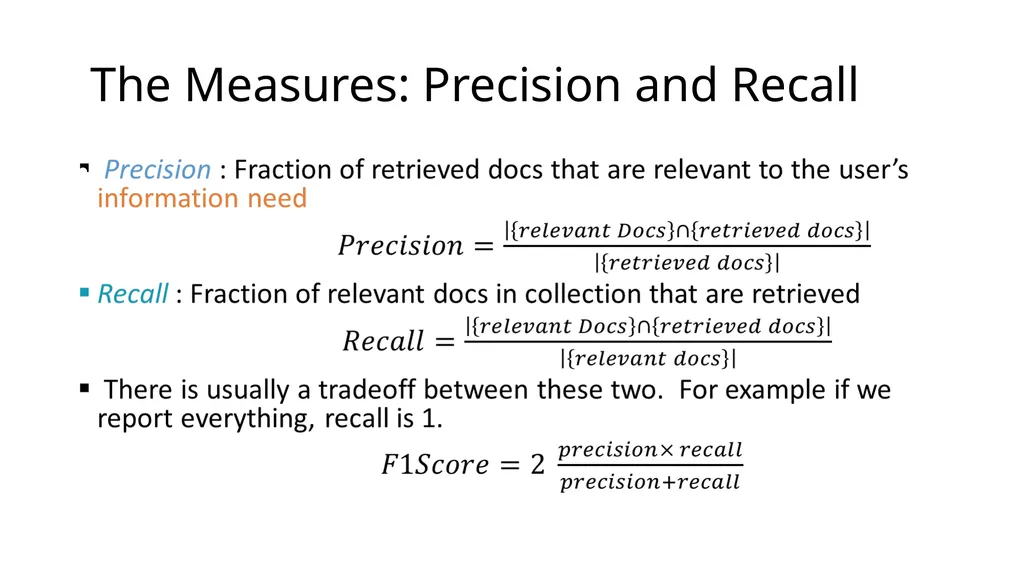
The Measures: Precision and Recall<br>
04
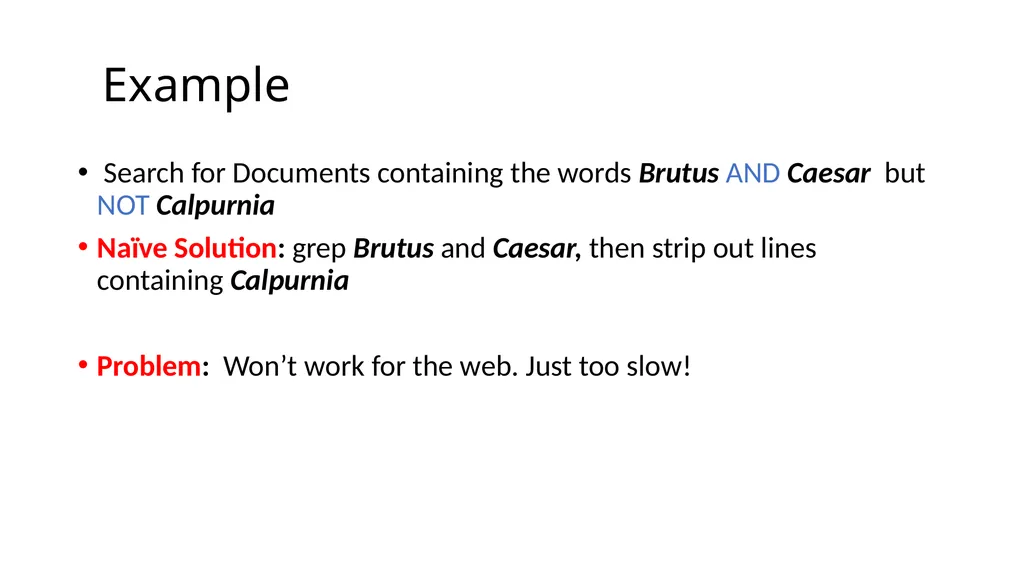
Example Search for Documents containing the words Brutus AND Caesar but NOT Calpurnia
Naïve Solution: grep Brutus and Caesar, then strip out lines containing Calpurnia
Problem: Won’t work for the web. Just too slow!<br>
05
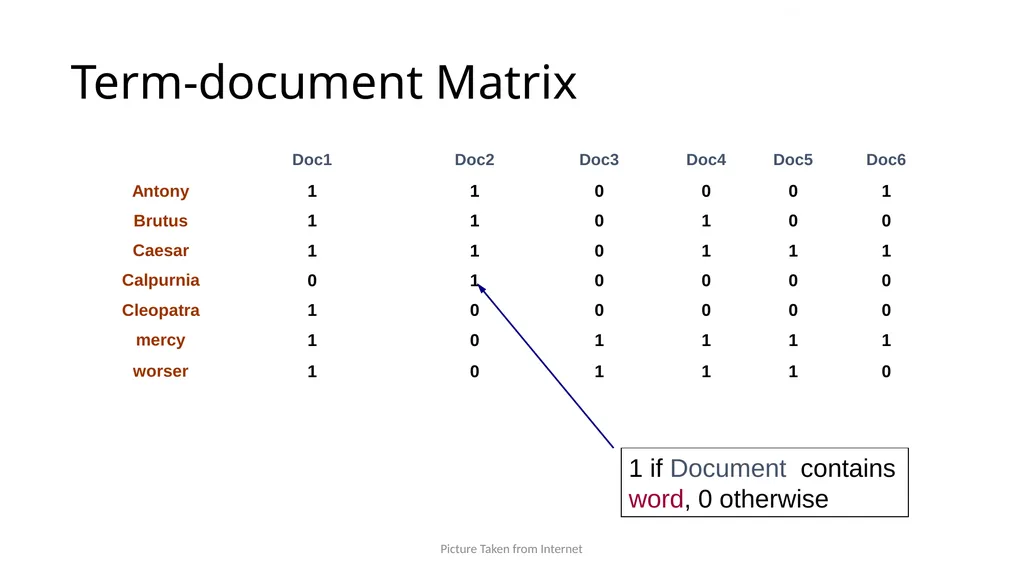
Term-document Matrix 1 if Document contains word, 0 otherwise Sec. 1.1 Picture Taken from Internet<br>
06
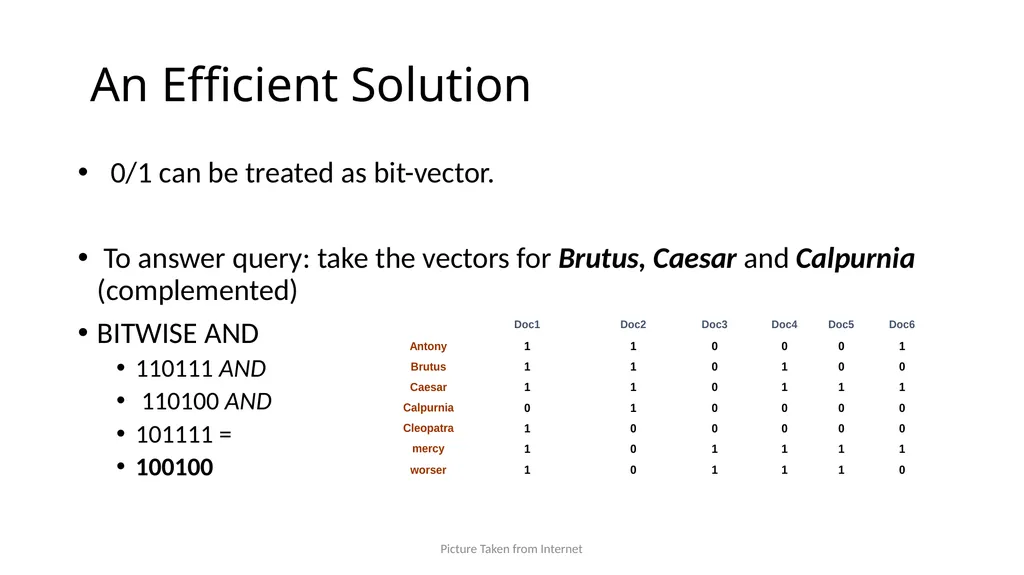
An Efficient Solution 0/1 can be treated as bit-vector.
To answer query: take the vectors for Brutus, Caesar and Calpurnia (complemented)
BITWISE AND
110111 AND
110100 AND
101111 =
100100 Picture Taken from Internet<br>
07
Issue: Cant build the Matrix Even for 1 million documents, with say 500K distinct terms.
We get around half a trillion 0s and 1s. Storage will blow up.
Every document is sparse and usually contains around 1000 terms on average, so the number of 1s is around a billion.
How to exploit sparsity ?<br>
08
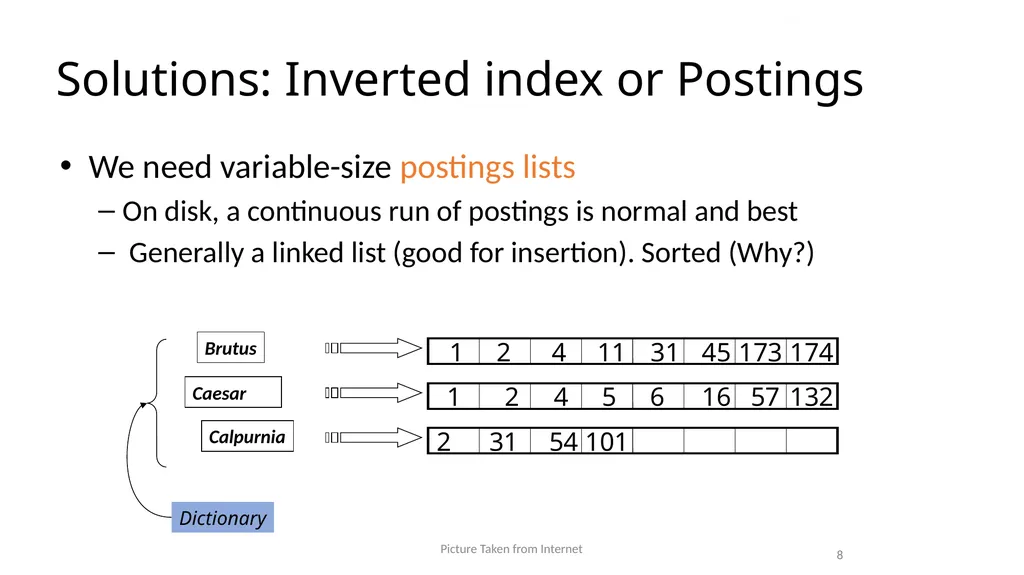
Solutions: Inverted index or Postings We need variable-size postings lists
On disk, a continuous run of postings is normal and best
Generally a linked list (good for insertion). Sorted (Why?) 8 Sec. 1.2 Brutus Calpurnia Caesar 2 31 174 54 101 Picture Taken from Internet<br>
09
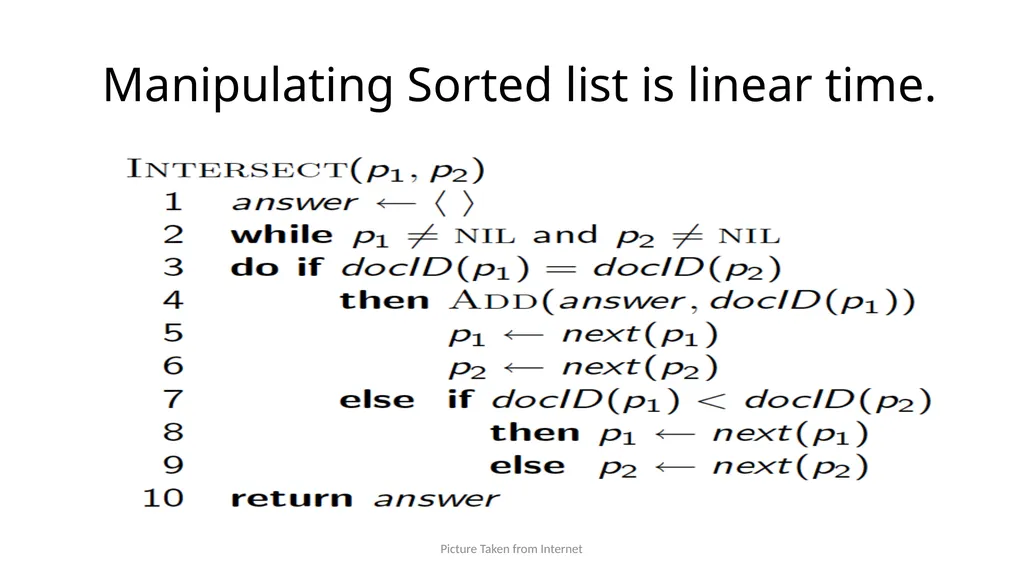
Manipulating Sorted list is linear time. Picture Taken from Internet<br>
10
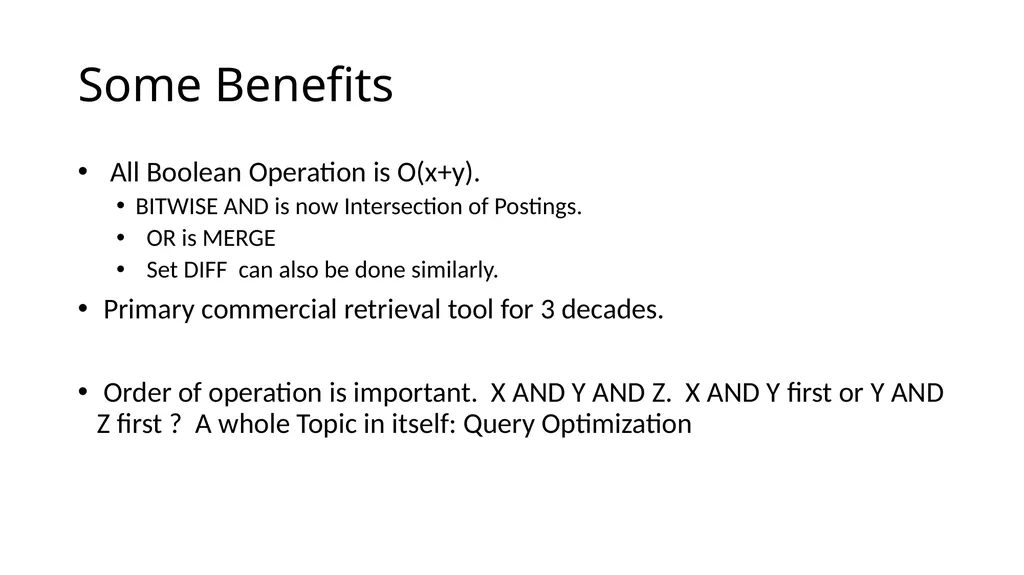
Some Benefits All Boolean Operation is O(x+y).
BITWISE AND is now Intersection of Postings.
OR is MERGE
Set DIFF can also be done similarly.
Primary commercial retrieval tool for 3 decades.
Order of operation is important. X AND Y AND Z. X AND Y first or Y AND Z first ? A whole Topic in itself: Query Optimization<br>
11
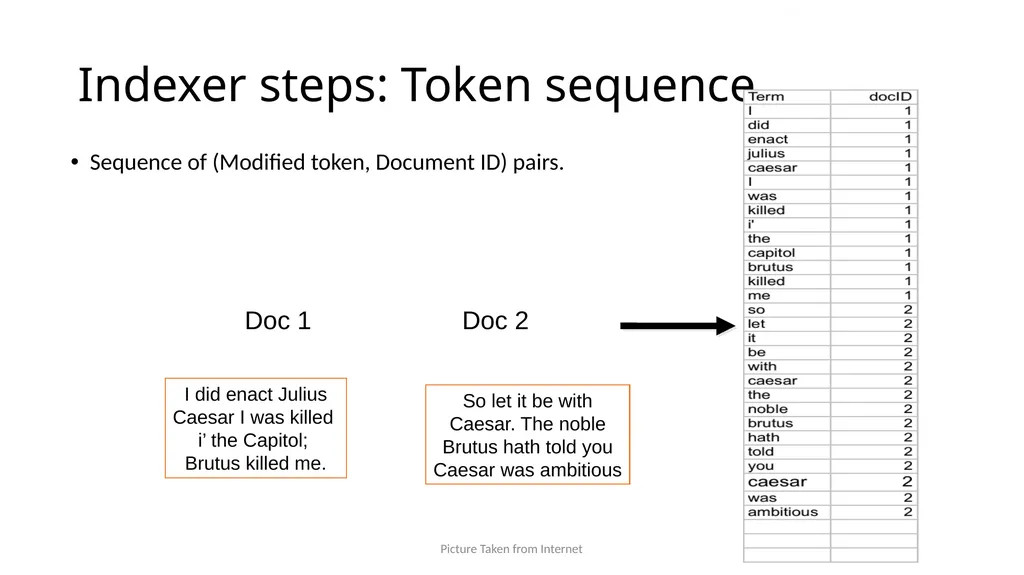
Indexer steps: Token sequence Sequence of (Modified token, Document ID) pairs. I did enact Julius
Caesar I was killed
i’ the Capitol;
Brutus killed me. Doc 1 So let it be with
Caesar. The noble
Brutus hath told you
Caesar was ambitious Doc 2 Sec. 1.2 Picture Taken from Internet<br>
12
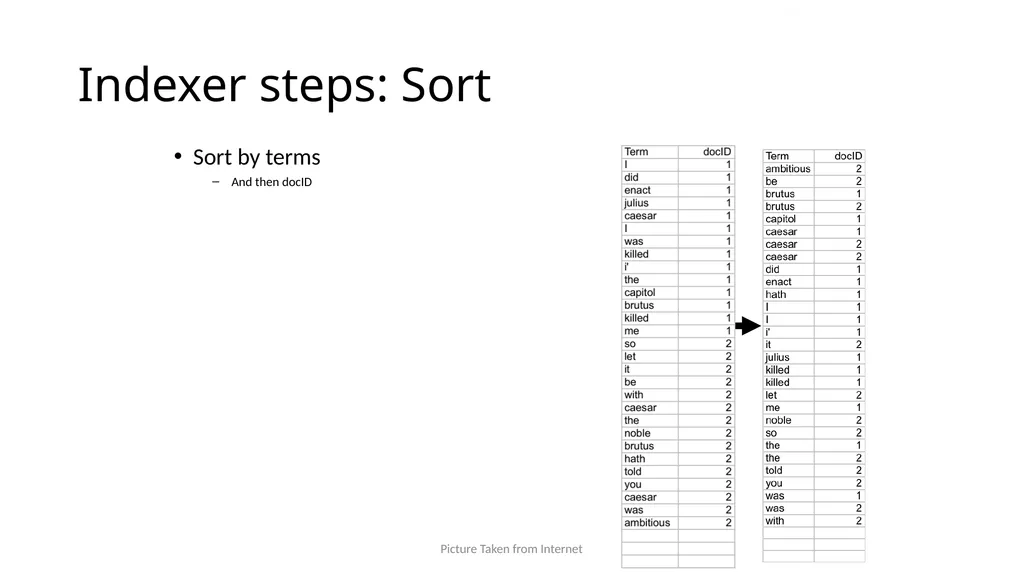
Indexer steps: Sort Sort by terms
And then docID Sec. 1.2 Picture Taken from Internet<br>
13
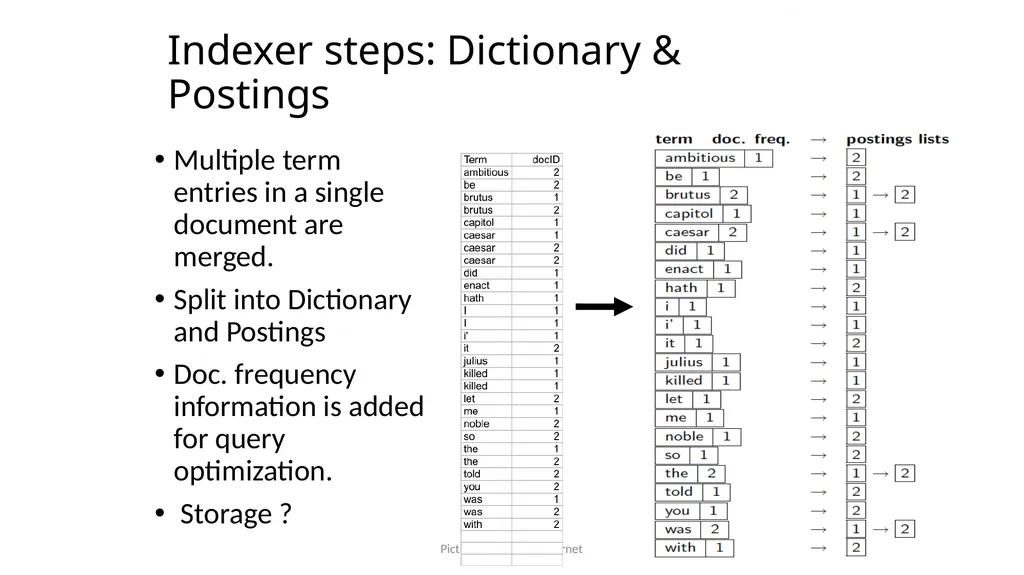
Indexer steps: Dictionary & Postings Multiple term entries in a single document are merged.
Split into Dictionary and Postings
Doc. frequency information is added for query optimization.
Storage ? Sec. 1.2 Picture Taken from Internet<br>
14
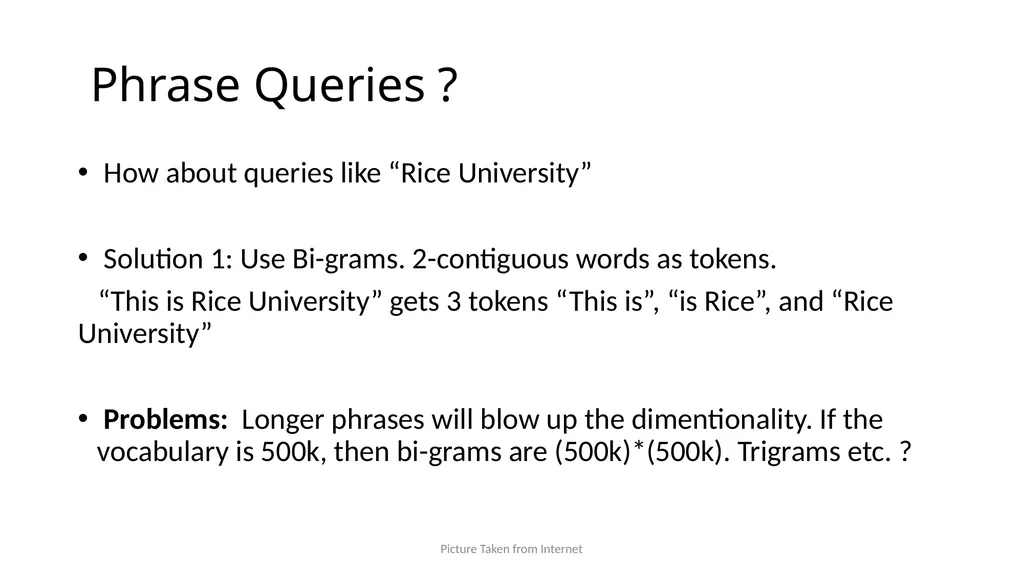
Phrase Queries ? How about queries like “Rice University”
Solution 1: Use Bi-grams. 2-contiguous words as tokens.
“This is Rice University” gets 3 tokens “This is”, “is Rice”, and “Rice University”
Problems: Longer phrases will blow up the dimentionality. If the vocabulary is 500k, then bi-grams are (500k)*(500k). Trigrams etc. ? Picture Taken from Internet<br>
15
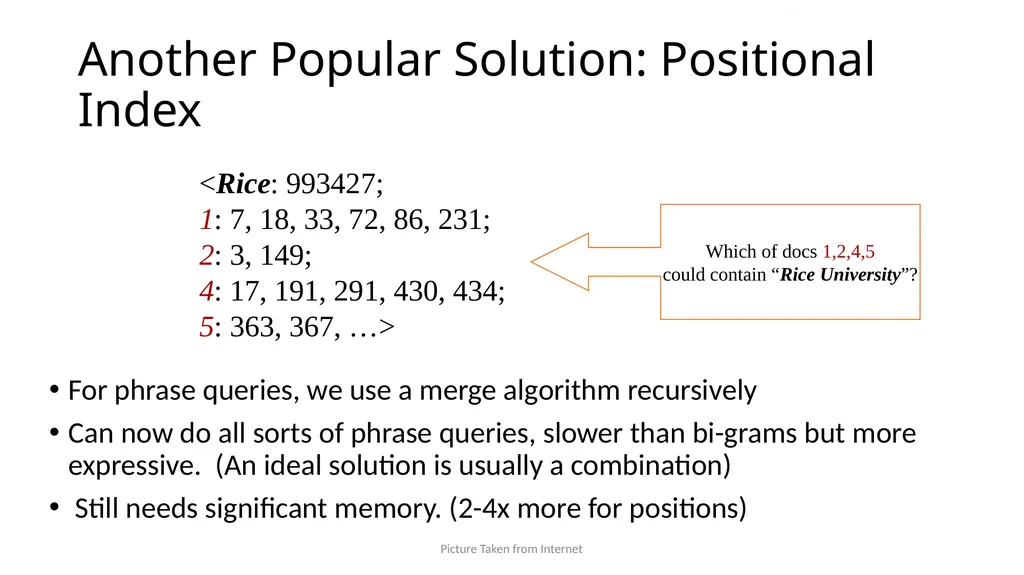
Another Popular Solution: Positional Index For phrase queries, we use a merge algorithm recursively
Can now do all sorts of phrase queries, slower than bi-grams but more expressive. (An ideal solution is usually a combination)
Still needs significant memory. (2-4x more for positions) <Rice: 993427;
1: 7, 18, 33, 72, 86, 231;
2: 3, 149;
4: 17, 191, 291, 430, 434;
5: 363, 367, …> Which of docs 1,2,4,5
could contain “Rice University”? Sec. 2.4.2 Picture Taken from Internet<br>
16
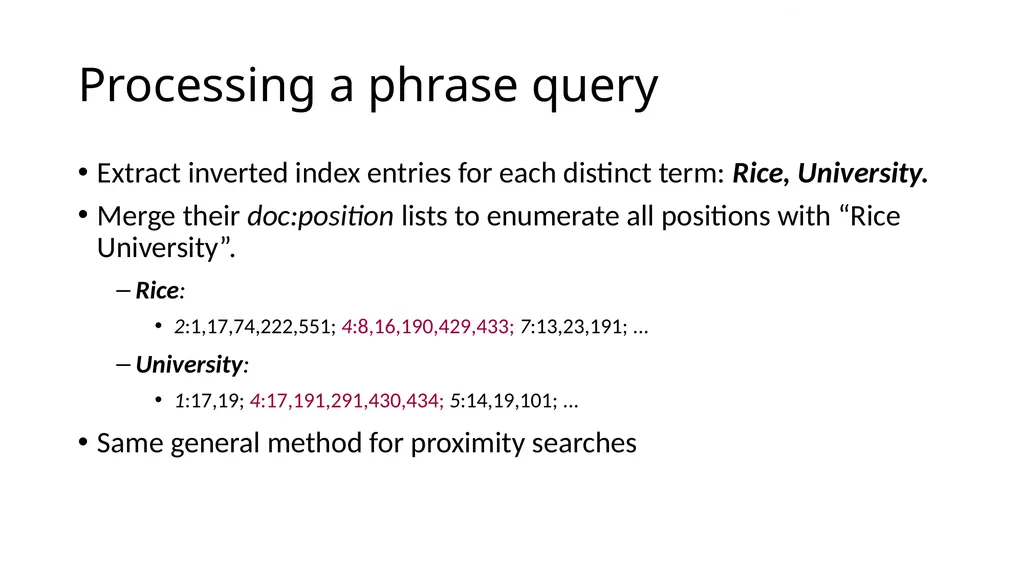
Processing a phrase query Extract inverted index entries for each distinct term: Rice, University.
Merge their doc:position lists to enumerate all positions with “Rice University”.
Rice:
2:1,17,74,222,551; 4:8,16,190,429,433; 7:13,23,191; ...
University:
1:17,19; 4:17,191,291,430,434; 5:14,19,101; ...
Same general method for proximity searches Sec. 2.4.2<br>
17
Power Law in Real World Catching results is a very powerful idea.
Identifying Heavy-Hitters on data streams is a topic in itself. Picture from https://moz.com/blog/illustrating-the-long-tail<br>