
Last Level Collective Hardware Prefetching For
Description: Last Level Collective Hardware Prefetching For Data-Parallel Applications George Michelogiannakis, John Shalf Lawrence Berkeley National Laboratory, Berkeley, CA, USA HiPC 2017 Overview Last-level cache (LLC) prefetcher that exploits
Related Topics
Download Presentation
"Last Level Collective Hardware Prefetching For" is the property of its rightful owner. Permission is granted to download and print the materials on this website for personal, non-commercial use only, and to display it on your personal computer provided you do not modify the materials and that you retain all copyright notices contained in the materials. By downloading content from our website, you accept the terms of this agreement.
Presentation Transcript
slide1. Last Level Collective Hardware Prefetching For Data-Parallel Applications George Michelogiannakis, John Shalf
Lawrence Berkeley National Laboratory,
Berkeley, CA, USA
HiPC 2017<br>
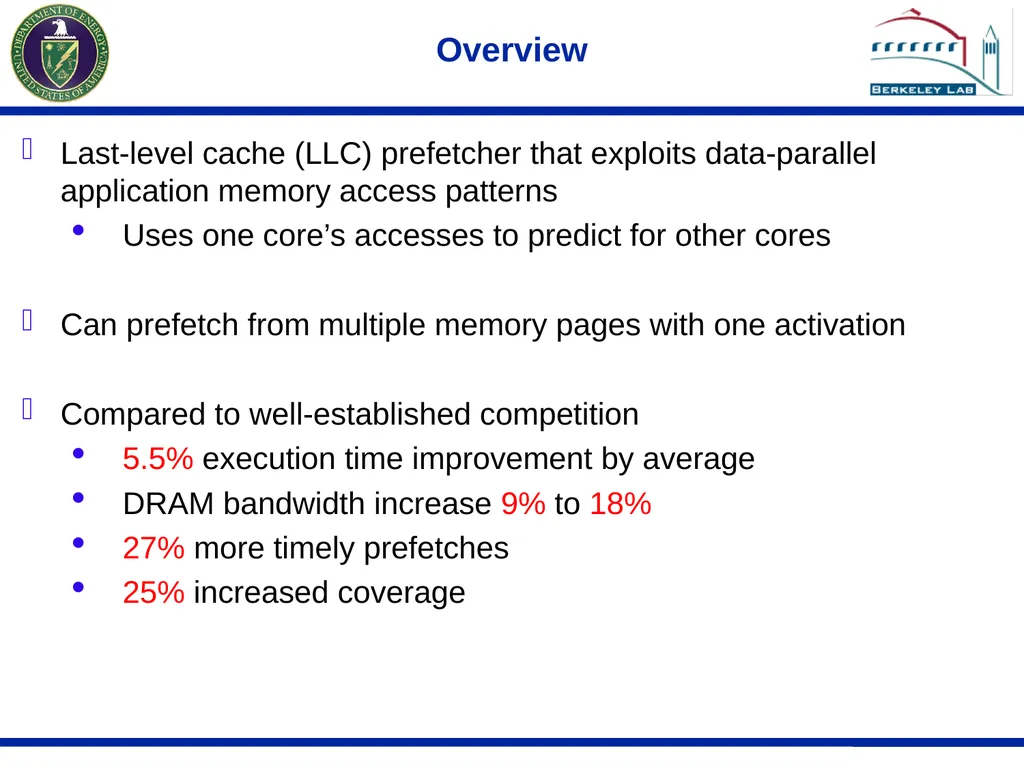
slide2. Overview Last-level cache (LLC) prefetcher that exploits data-parallel application memory access patterns
Uses one core’s accesses to predict for other cores
Can prefetch from multiple memory pages with one activation
Compared to well-established competition
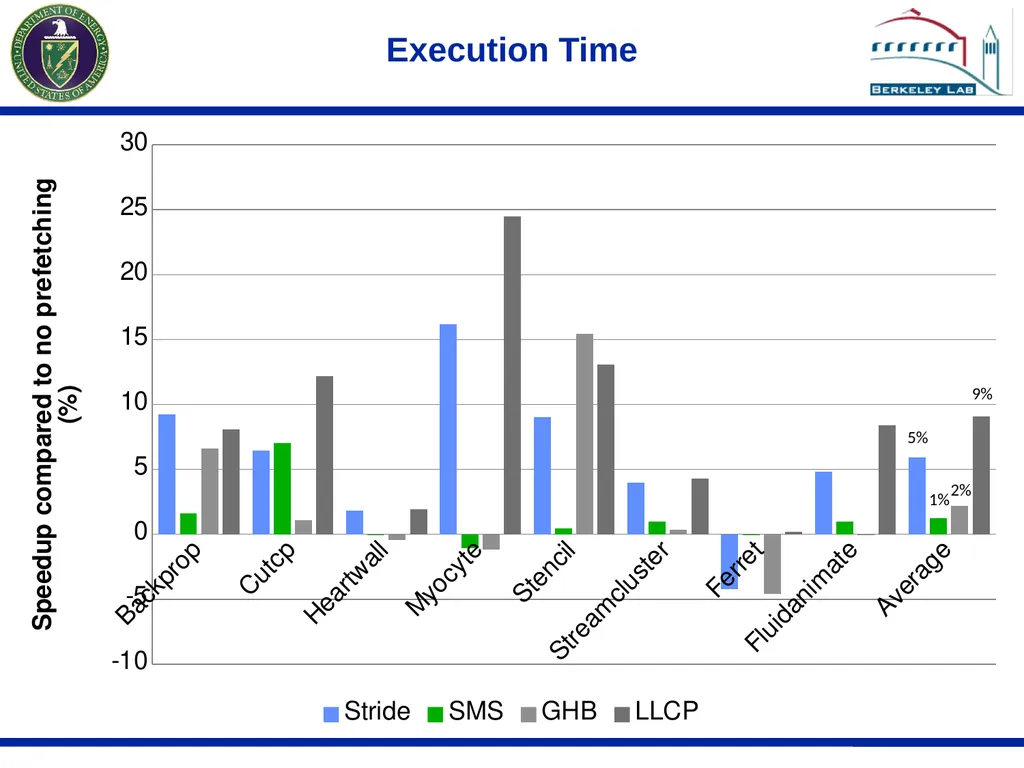
5.5% execution time improvement by average
DRAM bandwidth increase 9% to 18%
27% more timely prefetches
25% increased coverage<br>
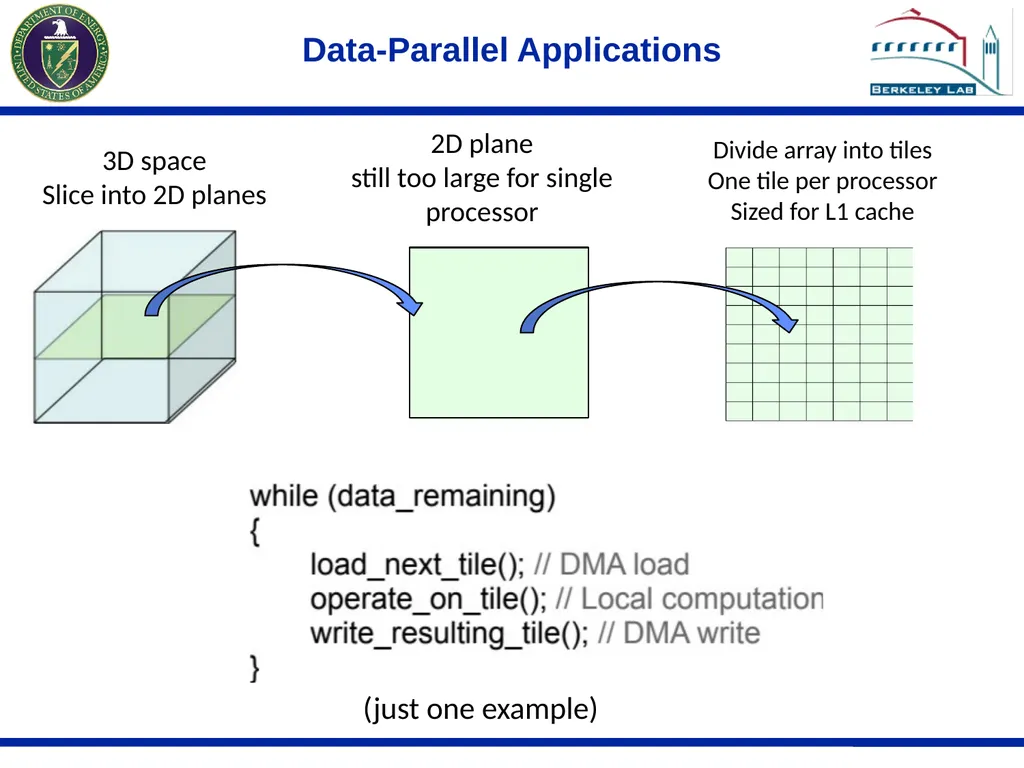
slide3. Data-Parallel Applications 3D space
Slice into 2D planes 2D plane
still too large for single processor Divide array into tiles
One tile per processor
Sized for L1 cache (just one example)<br>
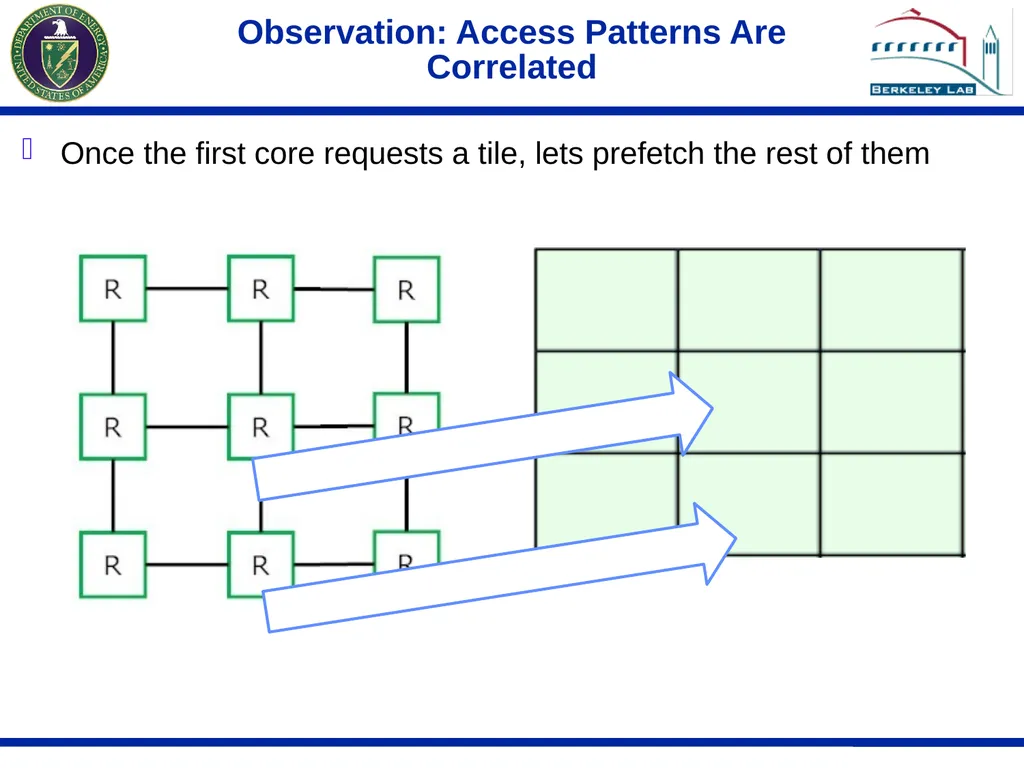
slide4. Observation: Access Patterns Are Correlated Once the first core requests a tile, lets prefetch the rest of them<br>
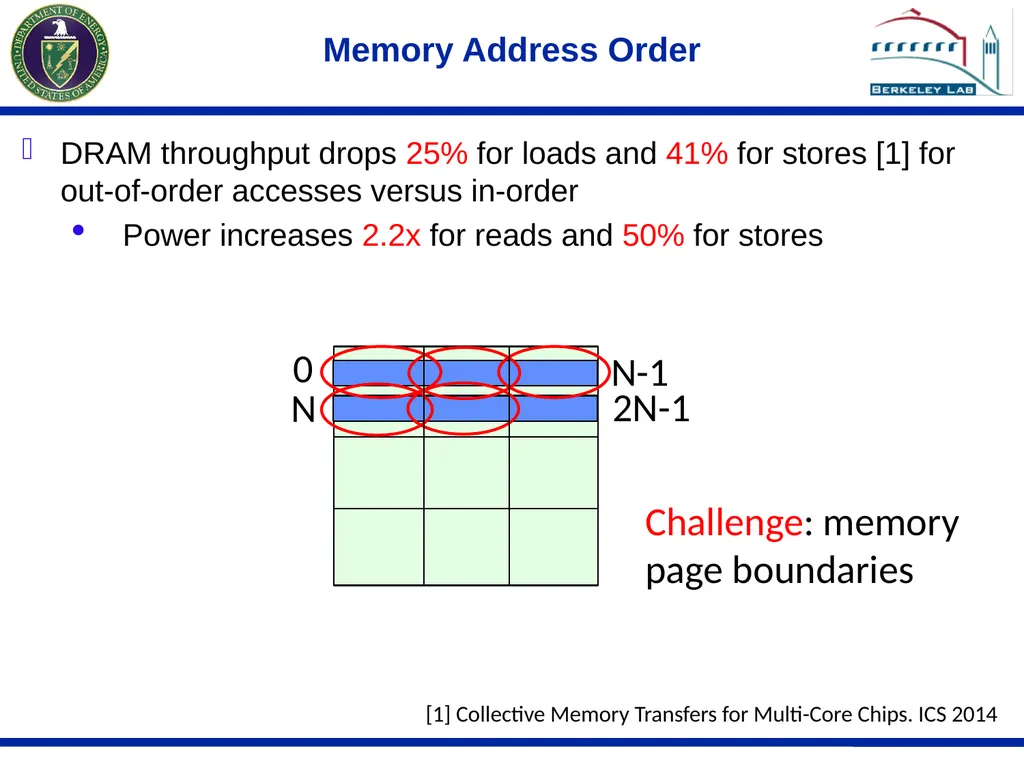
slide5. Memory Address Order DRAM throughput drops 25% for loads and 41% for stores [1] for out-of-order accesses versus in-order
Power increases 2.2x for reads and 50% for stores [1] Collective Memory Transfers for Multi-Core Chips. ICS 2014 0 N-1 N 2N-1 Challenge: memory page boundaries<br>
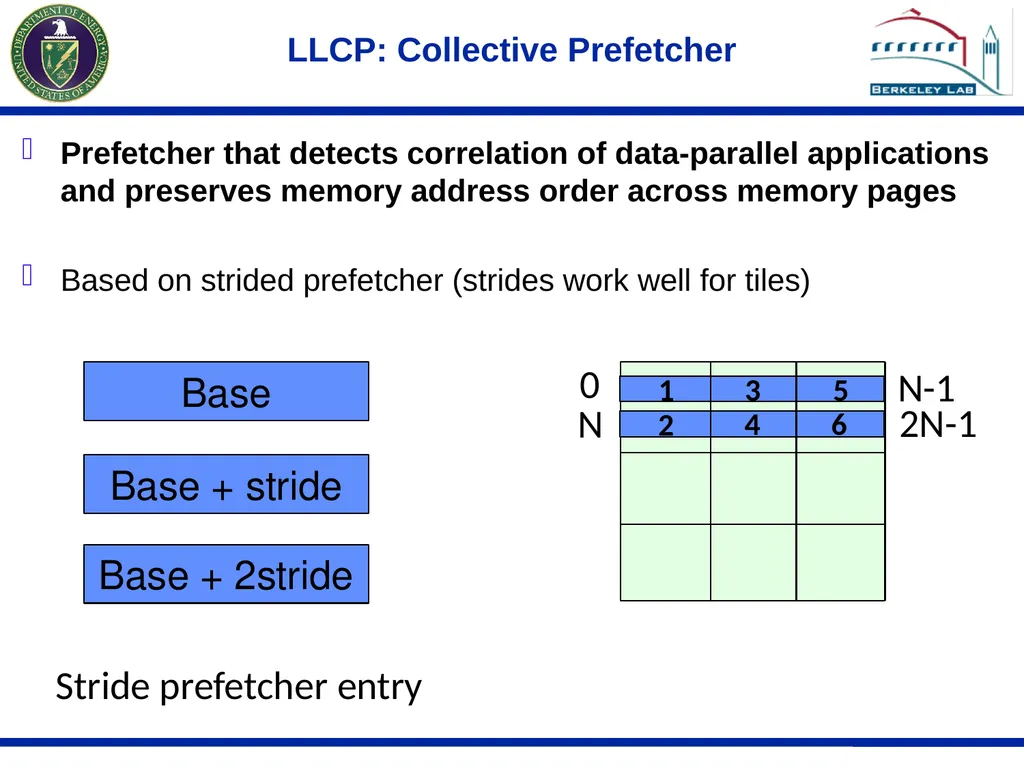
slide6. LLCP: Collective Prefetcher Prefetcher that detects correlation of data-parallel applications and preserves memory address order across memory pages
Based on strided prefetcher (strides work well for tiles) Base 0 N-1 N 2N-1 1 2 Base + stride Base + 2stride 3 4 5 6 Stride prefetcher entry<br>
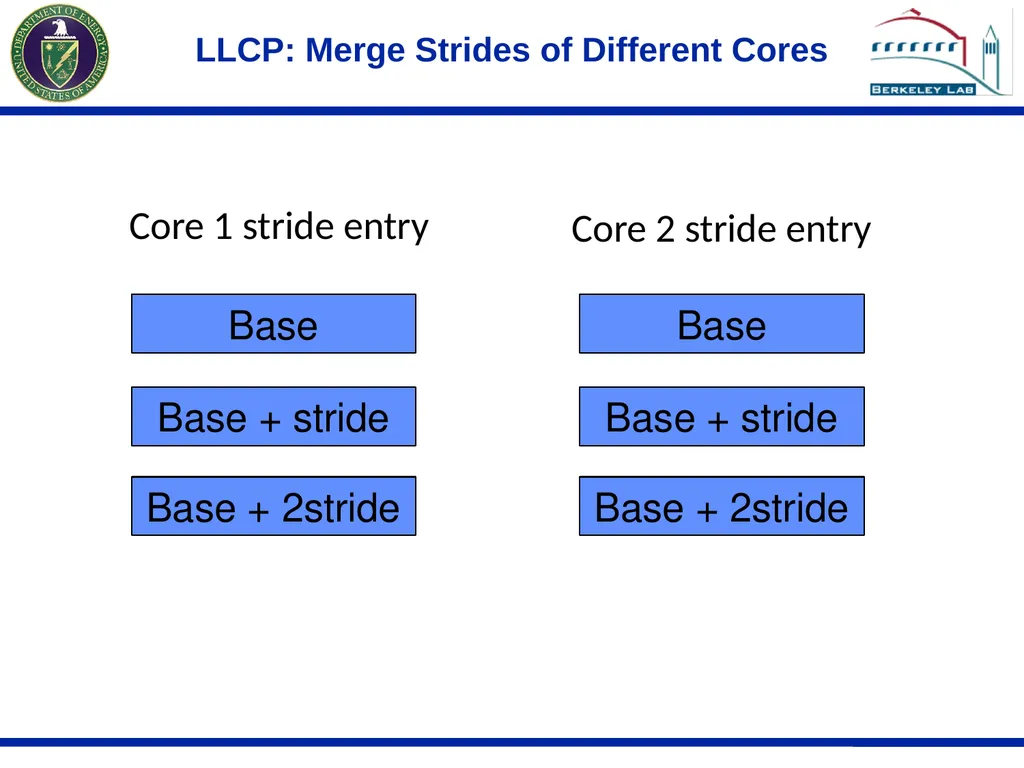
slide7. LLCP: Merge Strides of Different Cores Base Base + stride Base + 2stride Base Base + stride Base + 2stride Core 1 stride entry Core 2 stride entry<br>
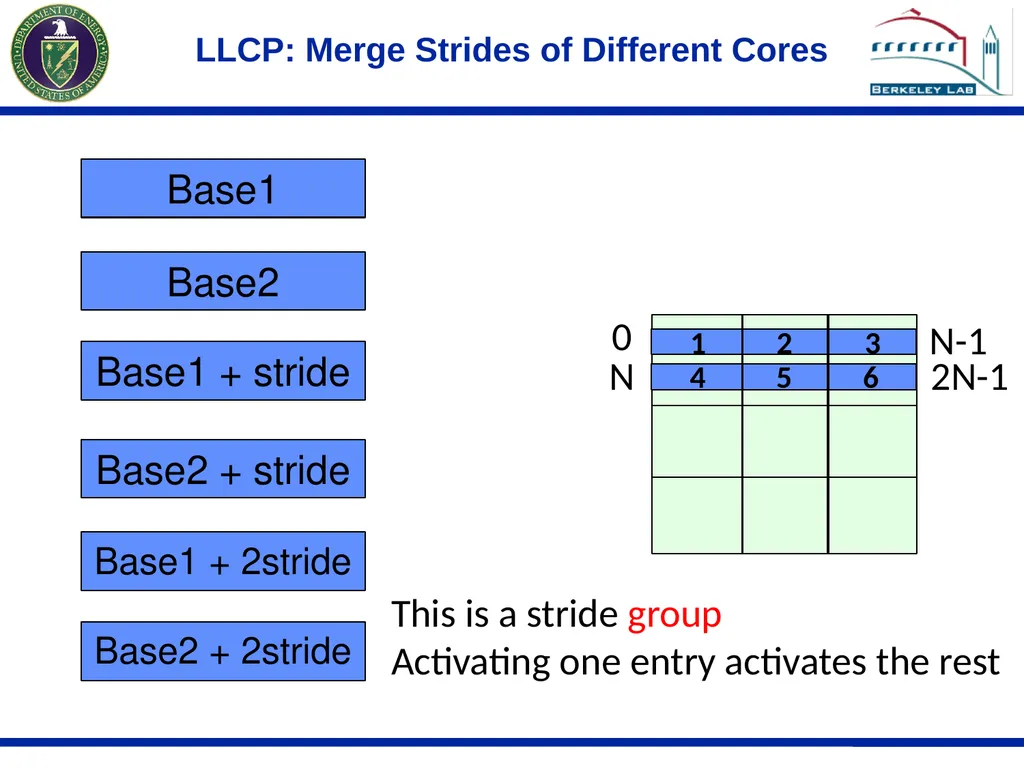
slide8. LLCP: Merge Strides of Different Cores 0 N-1 N 2N-1 1 4 2 5 3 6 Base1 Base2 Base1 + stride Base2 + stride Base1 + 2stride Base2 + 2stride This is a stride group
Activating one entry activates the rest<br>
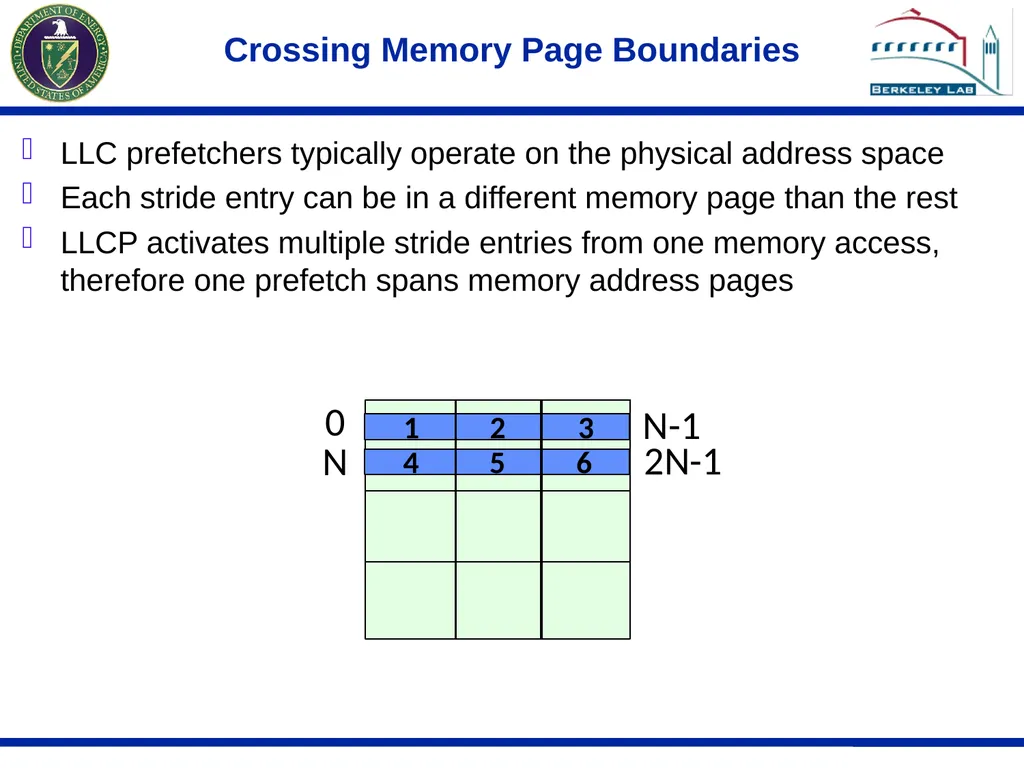
slide9. Crossing Memory Page Boundaries LLC prefetchers typically operate on the physical address space
Each stride entry can be in a different memory page than the rest
LLCP activates multiple stride entries from one memory access, therefore one prefetch spans memory address pages 0 N-1 N 2N-1 1 4 2 5 3 6<br>
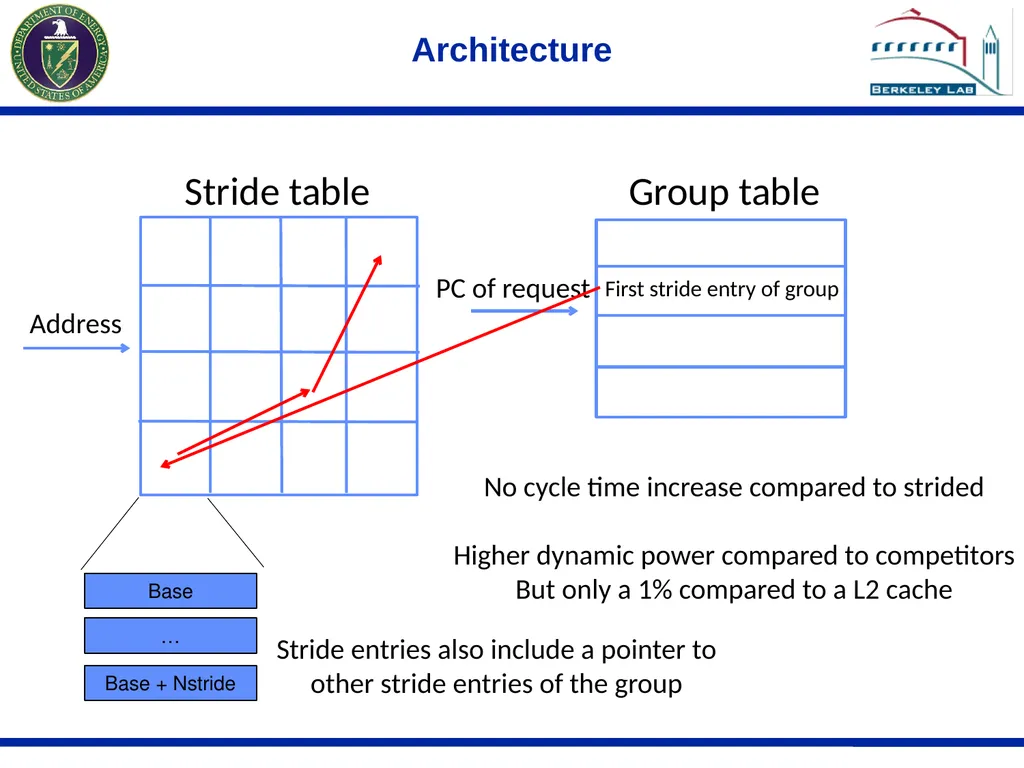
slide10. Architecture Stride table Address Base Base + Nstride … Group table PC of request Stride entries also include a pointer to
other stride entries of the group First stride entry of group No cycle time increase compared to strided
Higher dynamic power compared to competitors
But only a 1% compared to a L2 cache<br>
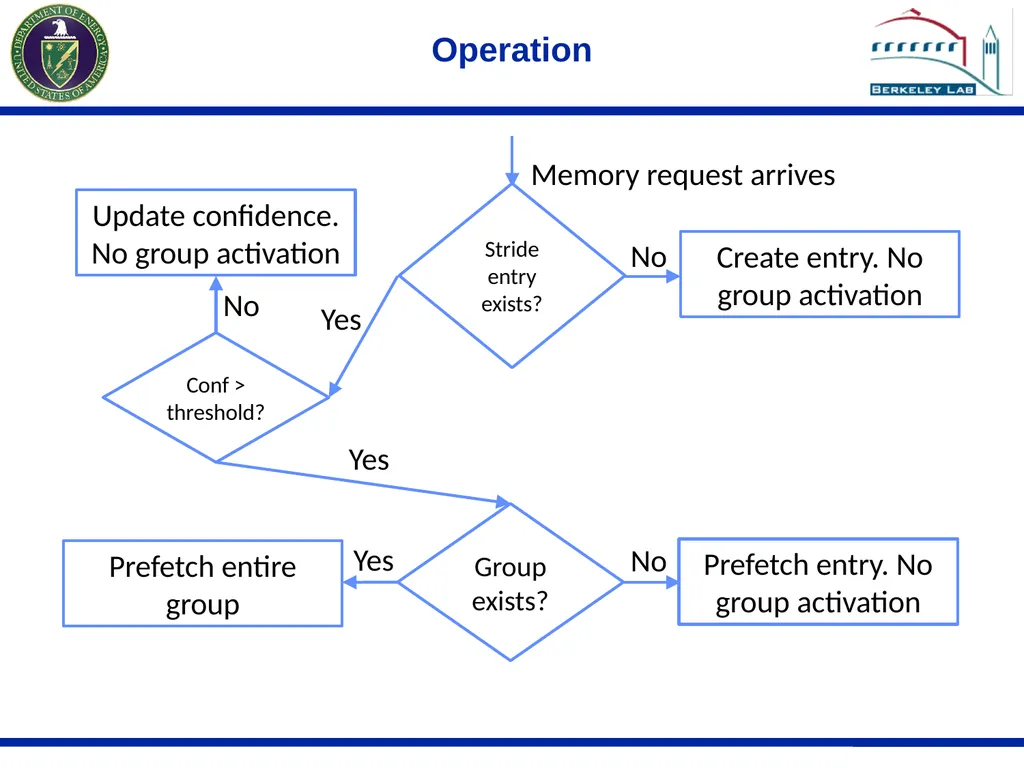
slide11. Operation Memory request arrives Stride entry exists? Create entry. No group activation Conf > threshold? No Yes Update confidence. No group activation No Group exists? Yes No Yes Prefetch entire group Prefetch entry. No group activation<br>
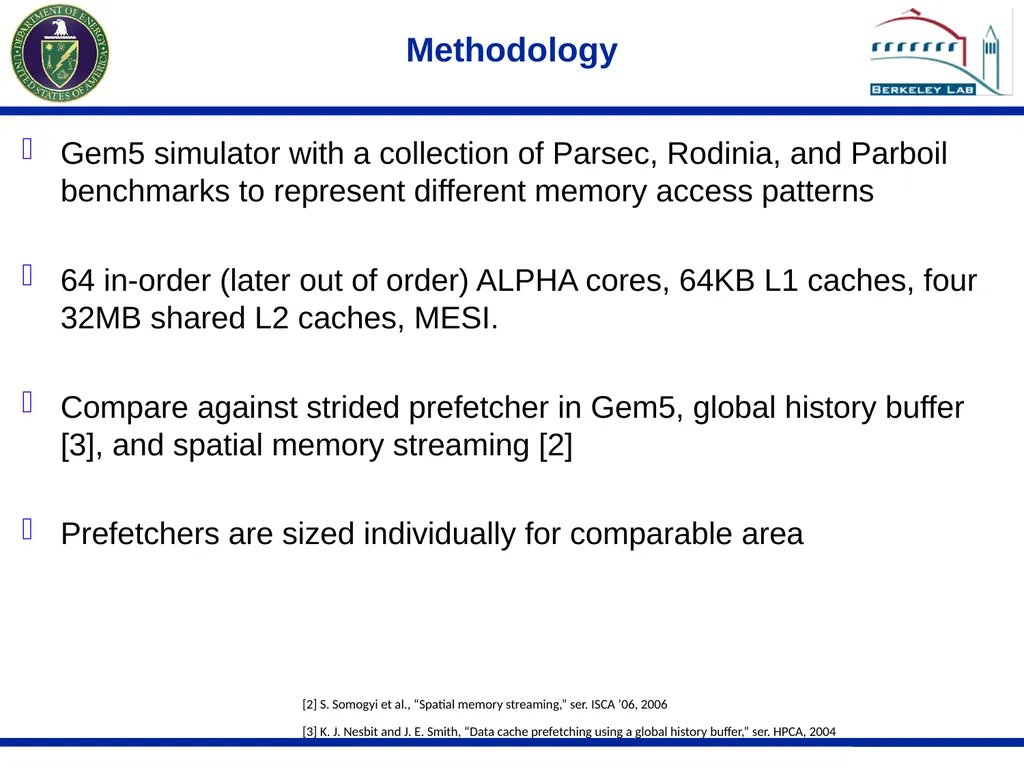
slide12. Methodology Gem5 simulator with a collection of Parsec, Rodinia, and Parboil benchmarks to represent different memory access patterns
64 in-order (later out of order) ALPHA cores, 64KB L1 caches, four 32MB shared L2 caches, MESI.
Compare against strided prefetcher in Gem5, global history buffer [3], and spatial memory streaming [2]
Prefetchers are sized individually for comparable area [2] S. Somogyi et al., “Spatial memory streaming,” ser. ISCA ’06, 2006
[3] K. J. Nesbit and J. E. Smith, “Data cache prefetching using a global history buffer,” ser. HPCA, 2004<br>
slide13. Execution Time 5% 9% 2% 1%<br>
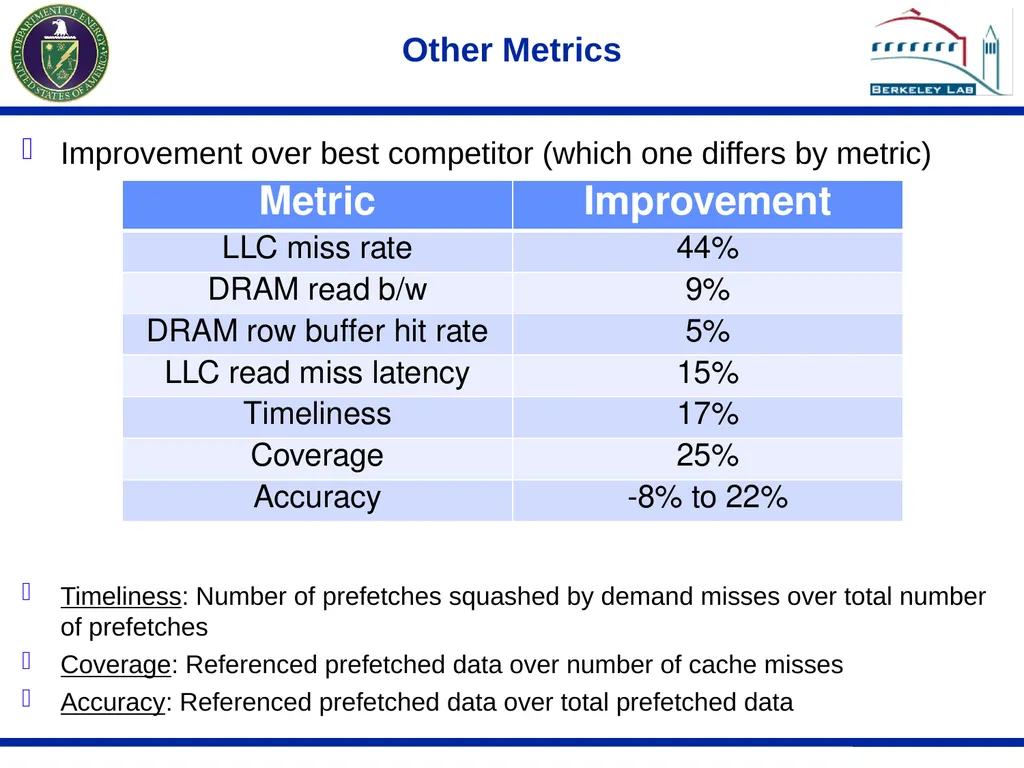
slide14. Other Metrics Improvement over best competitor (which one differs by metric)
Timeliness: Number of prefetches squashed by demand misses over total number of prefetches
Coverage: Referenced prefetched data over number of cache misses
Accuracy: Referenced prefetched data over total prefetched data<br>
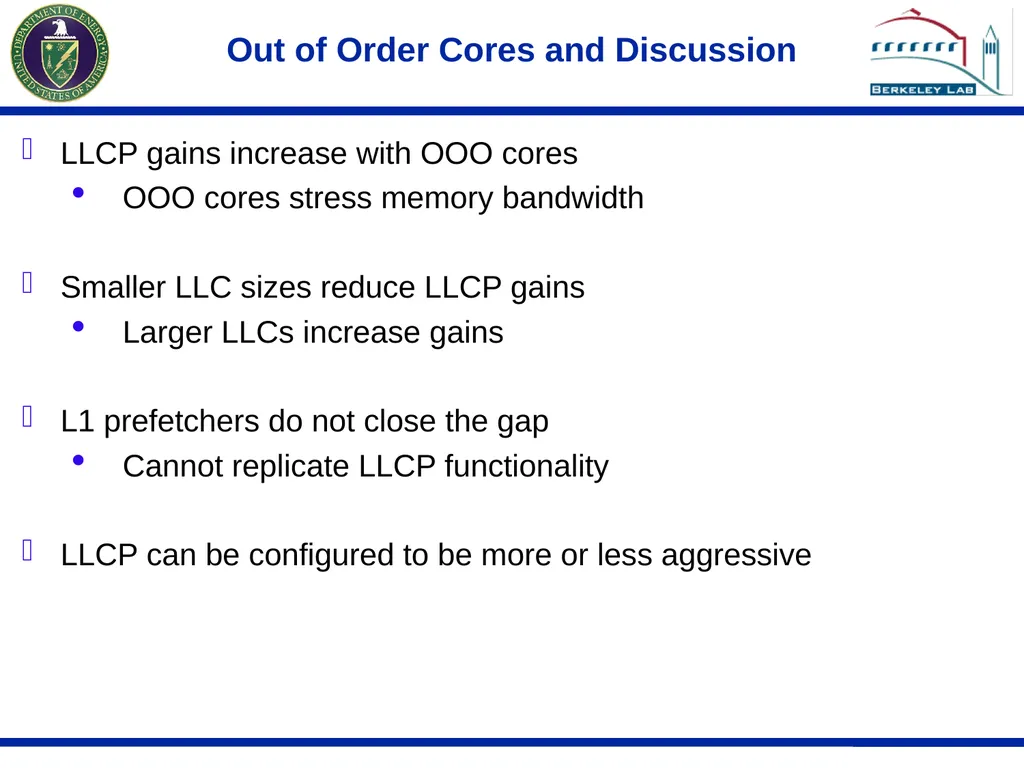
slide15. Out of Order Cores and Discussion LLCP gains increase with OOO cores
OOO cores stress memory bandwidth
Smaller LLC sizes reduce LLCP gains
Larger LLCs increase gains
L1 prefetchers do not close the gap
Cannot replicate LLCP functionality
LLCP can be configured to be more or less aggressive<br>
slide16. Conclusion LLCP exploits data-parallel memory access patterns to improve performance
Prefetch from multiple memory pages from a single activation
Access DRAM in memory address order
Compared to competition
5.5% execution time improvement by average
DRAM bandwidth increase 9% to 18%
27% more timely prefetches
25% increased coverage
Questions?<br>
Lawrence Berkeley National Laboratory,
Berkeley, CA, USA
HiPC 2017<br>
slide2. Overview Last-level cache (LLC) prefetcher that exploits data-parallel application memory access patterns
Uses one core’s accesses to predict for other cores
Can prefetch from multiple memory pages with one activation
Compared to well-established competition
5.5% execution time improvement by average
DRAM bandwidth increase 9% to 18%
27% more timely prefetches
25% increased coverage<br>
slide3. Data-Parallel Applications 3D space
Slice into 2D planes 2D plane
still too large for single processor Divide array into tiles
One tile per processor
Sized for L1 cache (just one example)<br>
slide4. Observation: Access Patterns Are Correlated Once the first core requests a tile, lets prefetch the rest of them<br>
slide5. Memory Address Order DRAM throughput drops 25% for loads and 41% for stores [1] for out-of-order accesses versus in-order
Power increases 2.2x for reads and 50% for stores [1] Collective Memory Transfers for Multi-Core Chips. ICS 2014 0 N-1 N 2N-1 Challenge: memory page boundaries<br>
slide6. LLCP: Collective Prefetcher Prefetcher that detects correlation of data-parallel applications and preserves memory address order across memory pages
Based on strided prefetcher (strides work well for tiles) Base 0 N-1 N 2N-1 1 2 Base + stride Base + 2stride 3 4 5 6 Stride prefetcher entry<br>
slide7. LLCP: Merge Strides of Different Cores Base Base + stride Base + 2stride Base Base + stride Base + 2stride Core 1 stride entry Core 2 stride entry<br>
slide8. LLCP: Merge Strides of Different Cores 0 N-1 N 2N-1 1 4 2 5 3 6 Base1 Base2 Base1 + stride Base2 + stride Base1 + 2stride Base2 + 2stride This is a stride group
Activating one entry activates the rest<br>
slide9. Crossing Memory Page Boundaries LLC prefetchers typically operate on the physical address space
Each stride entry can be in a different memory page than the rest
LLCP activates multiple stride entries from one memory access, therefore one prefetch spans memory address pages 0 N-1 N 2N-1 1 4 2 5 3 6<br>
slide10. Architecture Stride table Address Base Base + Nstride … Group table PC of request Stride entries also include a pointer to
other stride entries of the group First stride entry of group No cycle time increase compared to strided
Higher dynamic power compared to competitors
But only a 1% compared to a L2 cache<br>
slide11. Operation Memory request arrives Stride entry exists? Create entry. No group activation Conf > threshold? No Yes Update confidence. No group activation No Group exists? Yes No Yes Prefetch entire group Prefetch entry. No group activation<br>
slide12. Methodology Gem5 simulator with a collection of Parsec, Rodinia, and Parboil benchmarks to represent different memory access patterns
64 in-order (later out of order) ALPHA cores, 64KB L1 caches, four 32MB shared L2 caches, MESI.
Compare against strided prefetcher in Gem5, global history buffer [3], and spatial memory streaming [2]
Prefetchers are sized individually for comparable area [2] S. Somogyi et al., “Spatial memory streaming,” ser. ISCA ’06, 2006
[3] K. J. Nesbit and J. E. Smith, “Data cache prefetching using a global history buffer,” ser. HPCA, 2004<br>
slide13. Execution Time 5% 9% 2% 1%<br>
slide14. Other Metrics Improvement over best competitor (which one differs by metric)
Timeliness: Number of prefetches squashed by demand misses over total number of prefetches
Coverage: Referenced prefetched data over number of cache misses
Accuracy: Referenced prefetched data over total prefetched data<br>
slide15. Out of Order Cores and Discussion LLCP gains increase with OOO cores
OOO cores stress memory bandwidth
Smaller LLC sizes reduce LLCP gains
Larger LLCs increase gains
L1 prefetchers do not close the gap
Cannot replicate LLCP functionality
LLCP can be configured to be more or less aggressive<br>
slide16. Conclusion LLCP exploits data-parallel memory access patterns to improve performance
Prefetch from multiple memory pages from a single activation
Access DRAM in memory address order
Compared to competition
5.5% execution time improvement by average
DRAM bandwidth increase 9% to 18%
27% more timely prefetches
25% increased coverage
Questions?<br>