
Lauren Richards Changing the Subject – One Step
Description: Lauren Richards Changing the Subject One Step (Where the Subject Appears Once Only) 24th June 2024 Prerequisite Knowledge Representations Used Bar models Balance scales Future Links Changing the subject of a formula where the subject
Related Topics
Download Presentation
"Lauren Richards Changing the Subject – One Step" is the property of its rightful owner. Permission is granted to download and print the materials on this website for personal, non-commercial use only, and to display it on your personal computer provided you do not modify the materials and that you retain all copyright notices contained in the materials. By downloading content from our website, you accept the terms of this agreement.
Presentation Transcript
slide1. Lauren Richards Changing the Subject – One Step
(Where the Subject Appears Once Only) 24th June 2024<br>
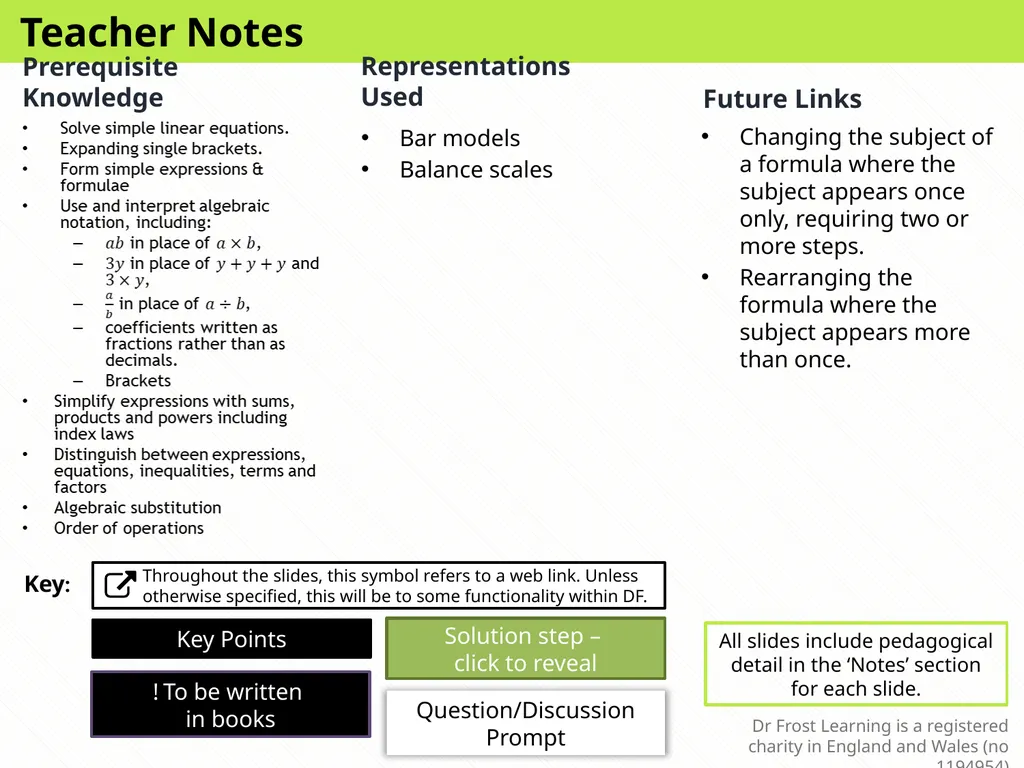
slide2. Prerequisite Knowledge Representations Used Bar models
Balance scales Future Links Changing the subject of a formula where the subject appears once only, requiring two or more steps.
Rearranging the formula where the subject appears more than once.<br>
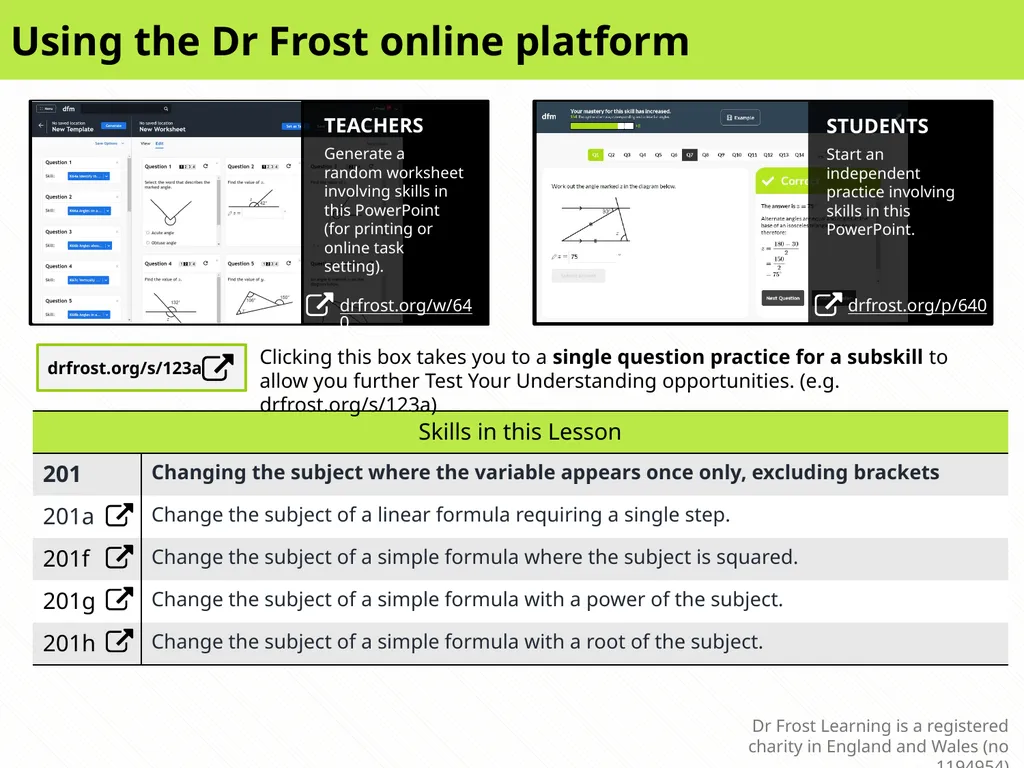
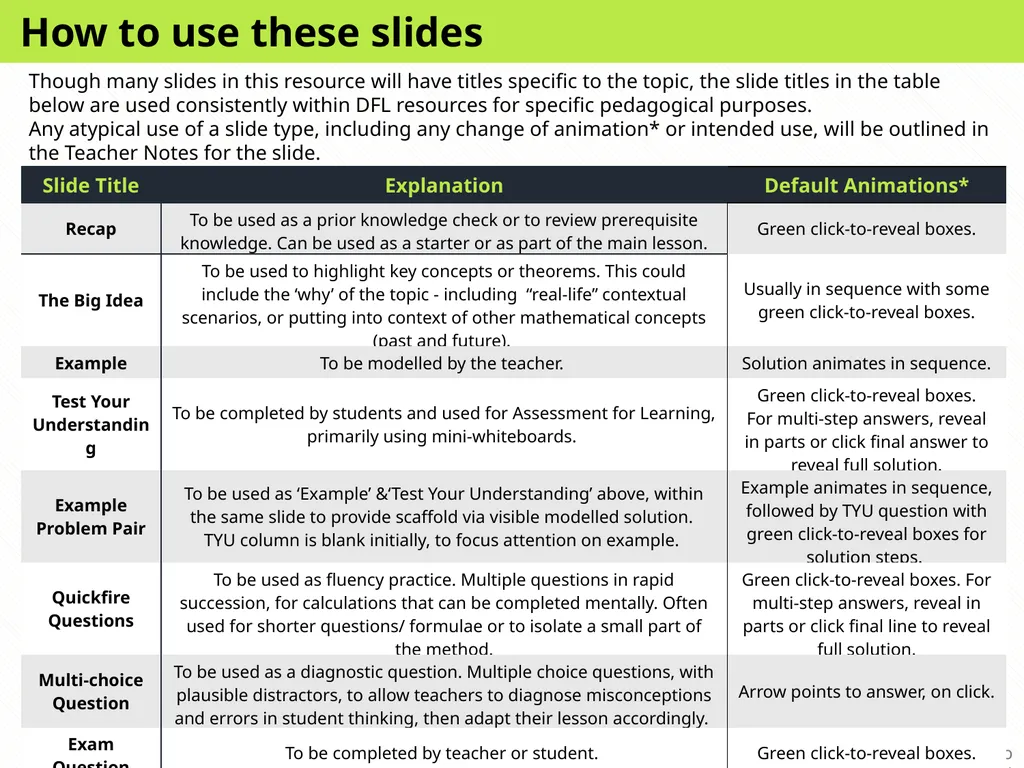
slide3. Using the Dr Frost online platform TEACHERS
Generate a random worksheet involving skills in this PowerPoint (for printing or online task setting). STUDENTS
Start an independent practice involving skills in this PowerPoint. drfrost.org/w/640 Clicking this box takes you to a single question practice for a subskill to allow you further Test Your Understanding opportunities. (e.g. drfrost.org/s/123a) drfrost.org/p/640<br>
slide5. Contents For lessons covering many concepts, please click the below to navigate quickly to the relevant part of the lesson.<br>
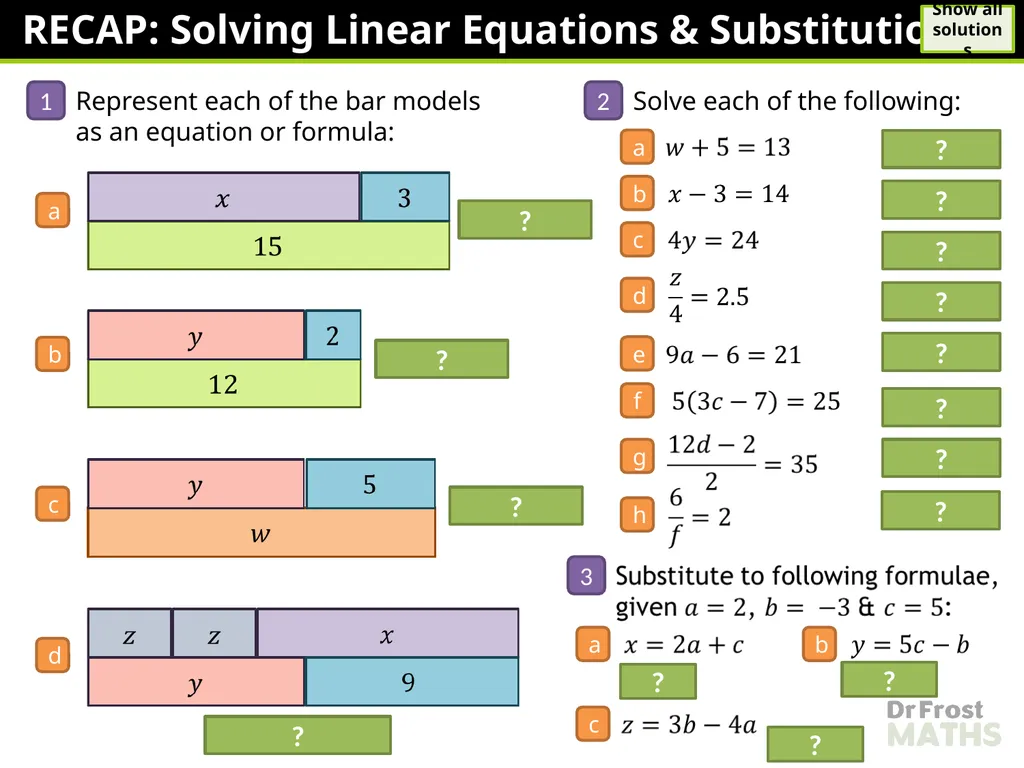
slide6. RECAP: Solving Linear Equations & Substitution 2 Solve each of the following: a b c d e f g h ? ? ? ? ? ? ? 1 Represent each of the bar models as an equation or formula: a b c d 3 ? a c b Show all solutions ? ? ? ? ? ? ?<br>
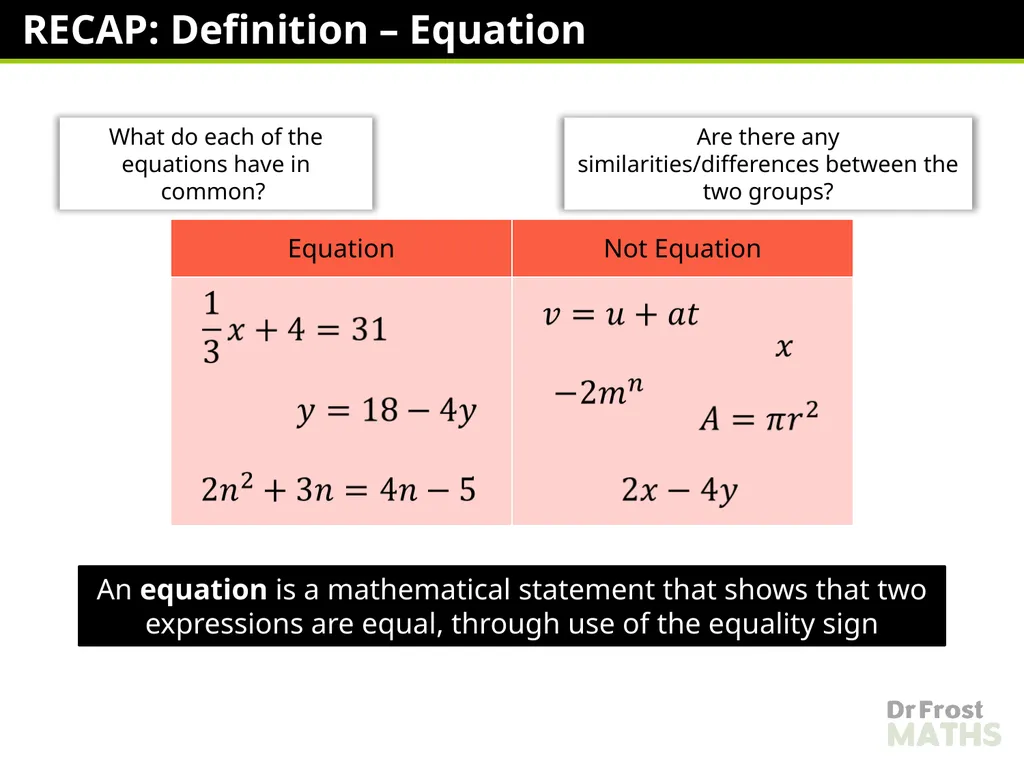
slide7. RECAP: Definition – Equation What do each of the equations have in common? Are there any similarities/differences between the two groups? An equation is a mathematical statement that shows that two expressions are equal, through use of the equality sign<br>
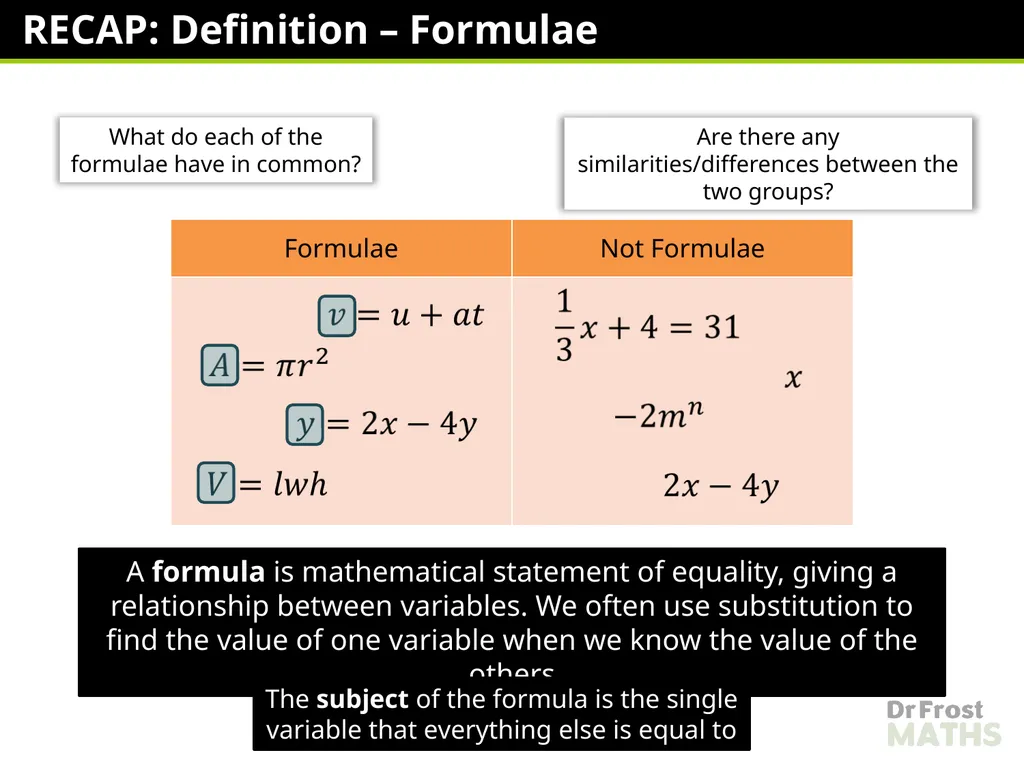
slide8. RECAP: Definition – Formulae What do each of the formulae have in common? Are there any similarities/differences between the two groups? A formula is mathematical statement of equality, giving a relationship between variables. We often use substitution to find the value of one variable when we know the value of the others The subject of the formula is the single variable that everything else is equal to<br>
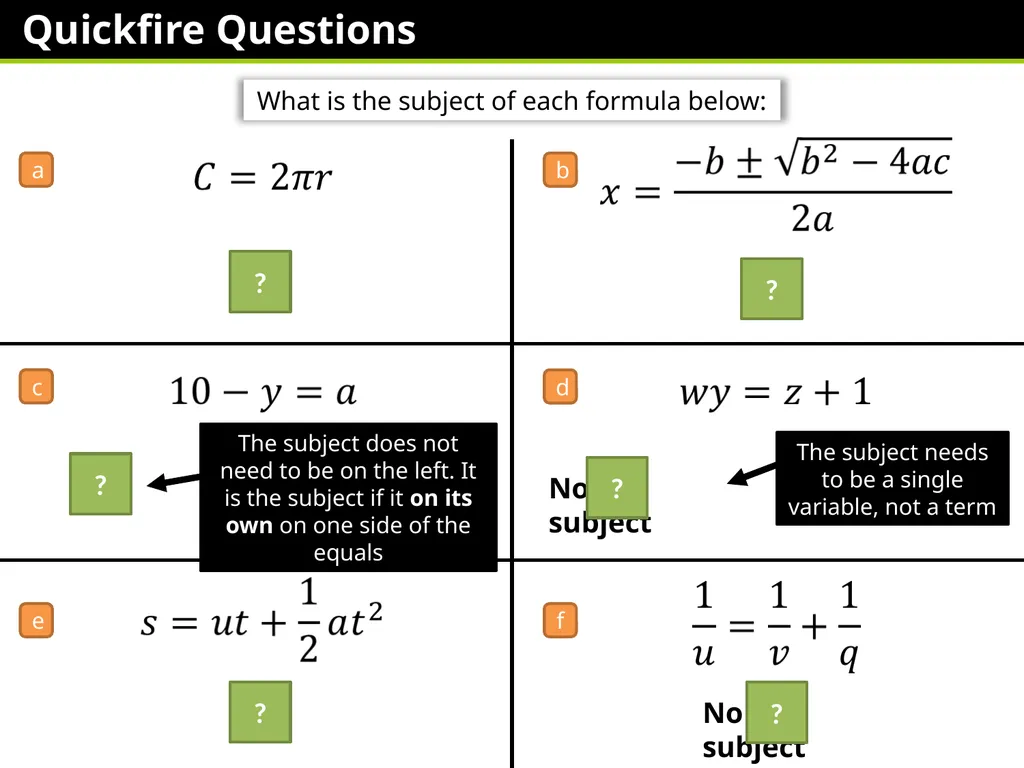
slide9. Quickfire Questions No subject No subject ? ? ? ? ? ? a b What is the subject of each formula below: c d e f The subject does not need to be on the left. It is the subject if it on its own on one side of the equals The subject needs to be a single variable, not a term<br>
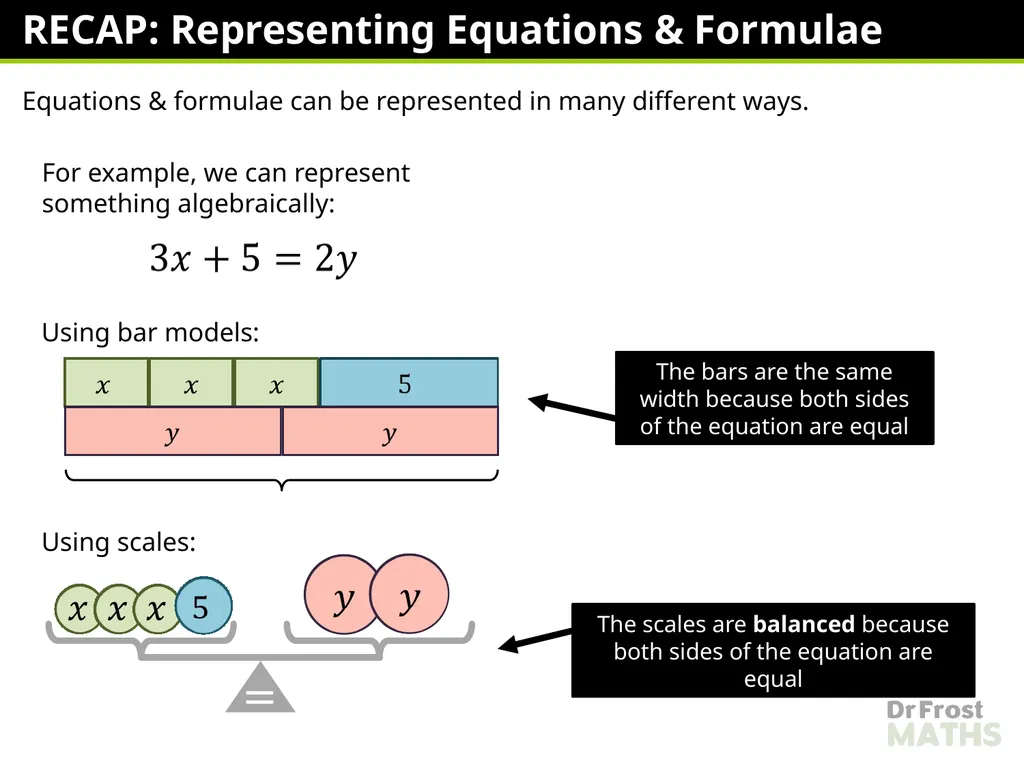
slide10. RECAP: Representing Equations & Formulae Equations & formulae can be represented in many different ways. For example, we can represent something algebraically: Using scales: Using bar models: The scales are balanced because both sides of the equation are equal The bars are the same width because both sides of the equation are equal<br>
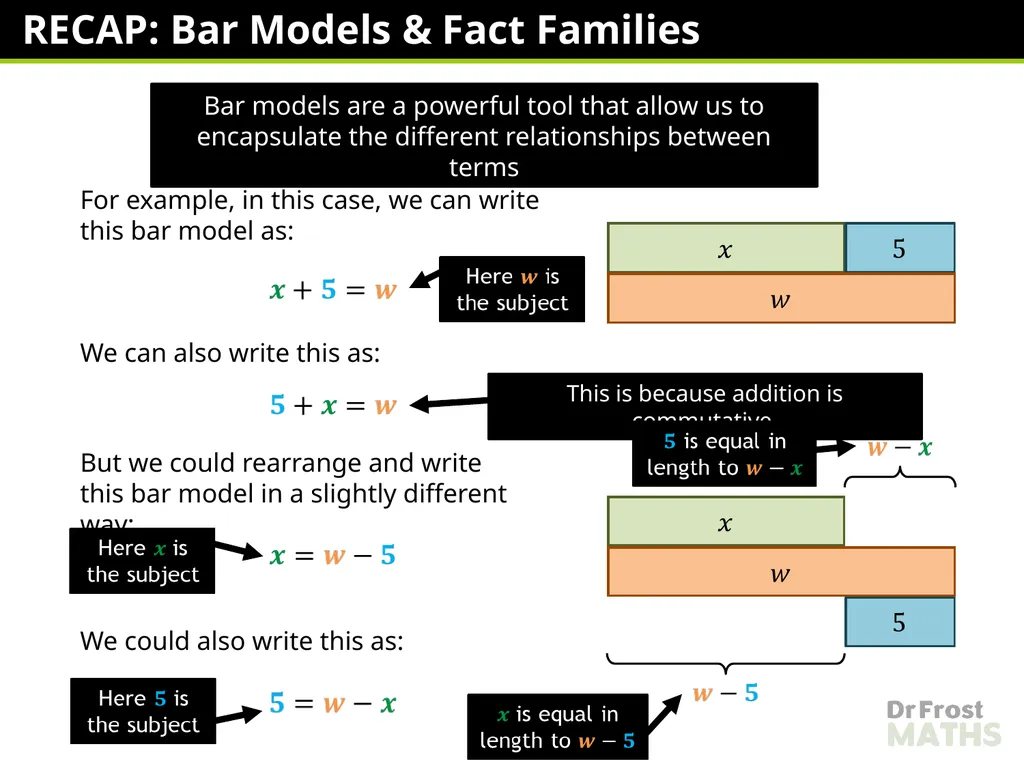
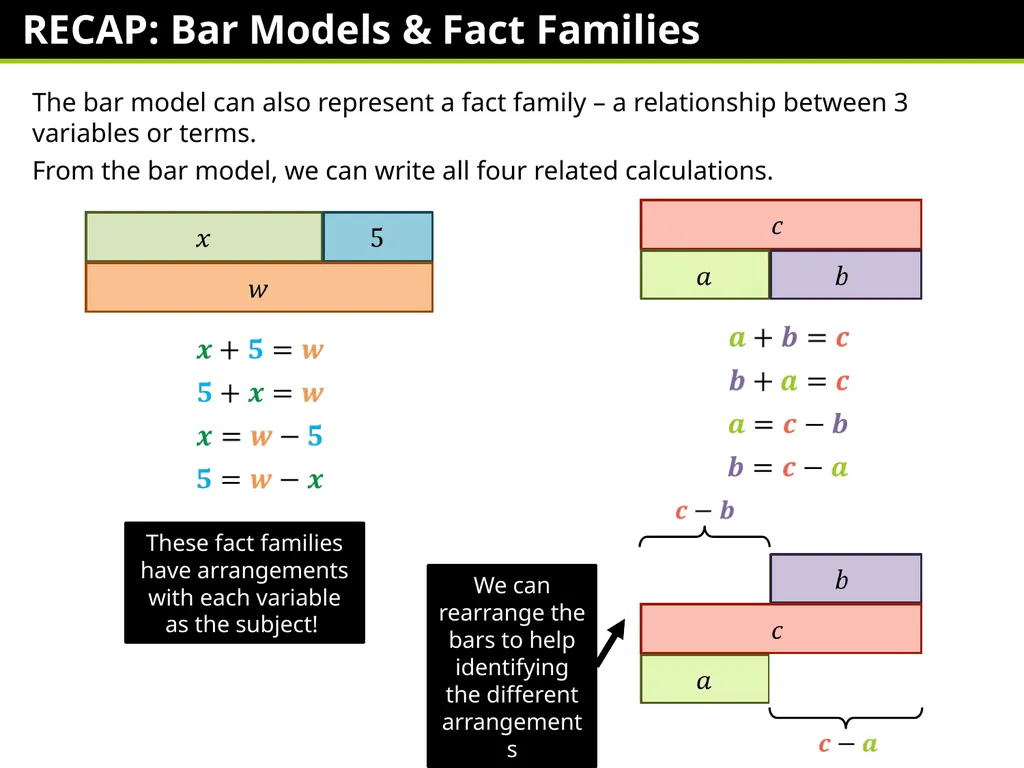
slide11. RECAP: Bar Models & Fact Families For example, in this case, we can write this bar model as: But we could rearrange and write this bar model in a slightly different way: Bar models are a powerful tool that allow us to encapsulate the different relationships between terms We could also write this as: We can also write this as: This is because addition is commutative<br>
slide12. RECAP: Bar Models & Fact Families The bar model can also represent a fact family – a relationship between 3 variables or terms. From the bar model, we can write all four related calculations. We can rearrange the bars to help identifying the different arrangements These fact families have arrangements with each variable as the subject!<br>
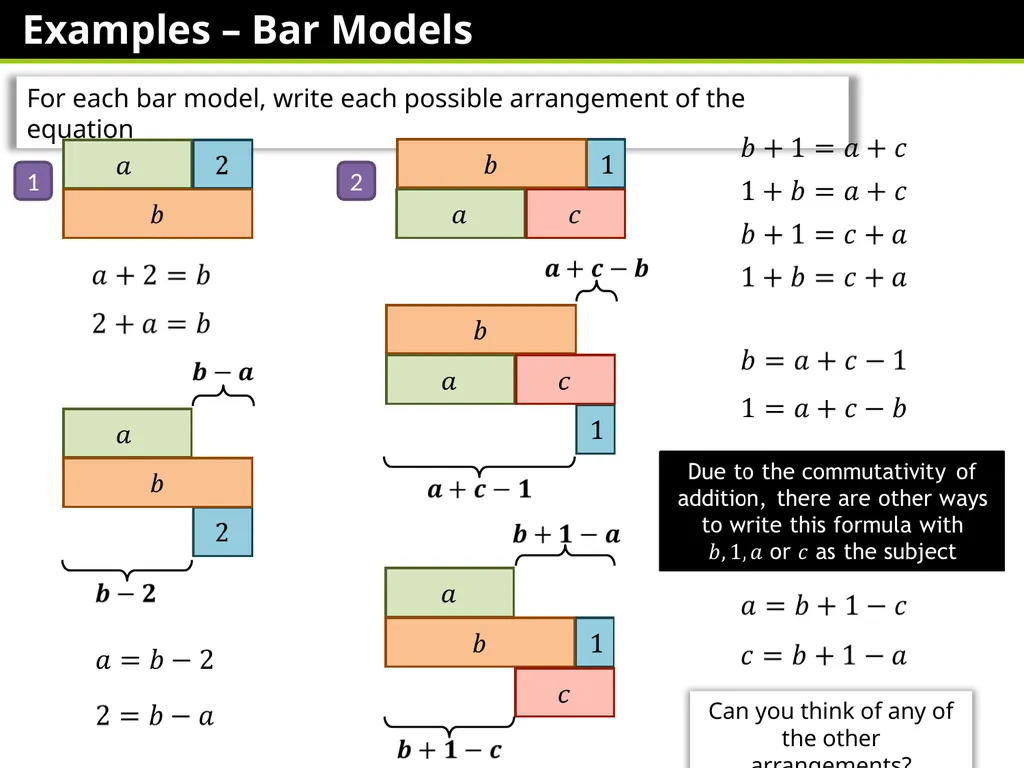
slide13. Examples – Bar Models For each bar model, write each possible arrangement of the equation 1 2 Can you think of any of the other arrangements?<br>
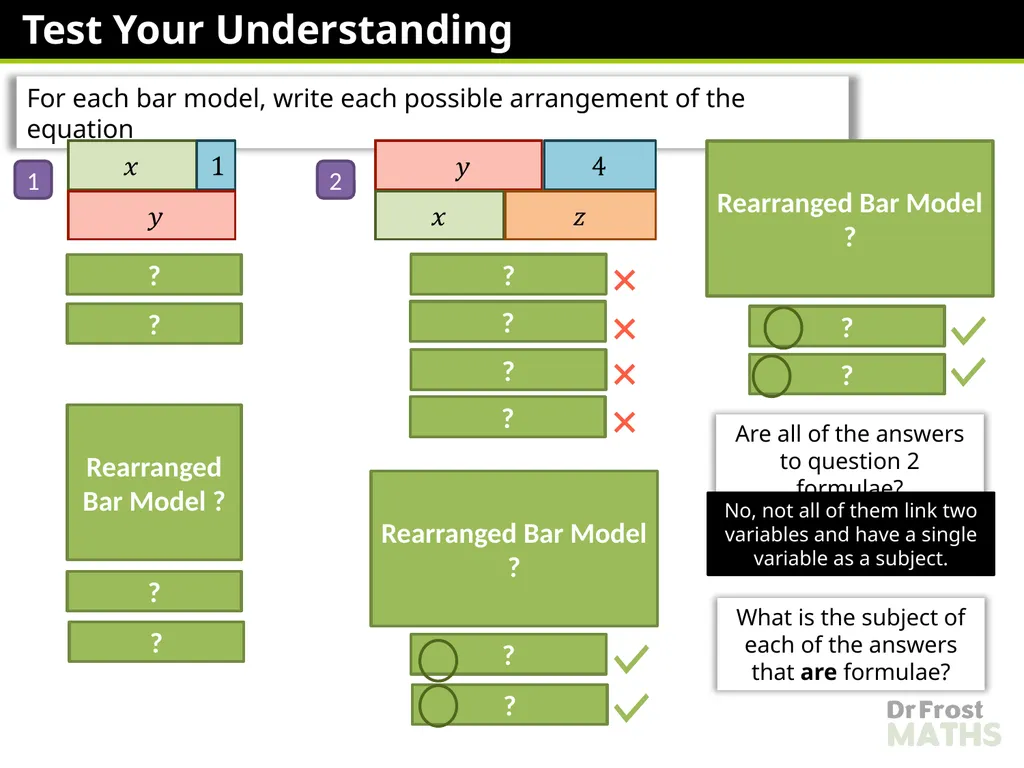
slide14. ? ? ? ? Test Your Understanding For each bar model, write each possible arrangement of the equation 1 2 ? Rearranged Bar Model ? ? ? Rearranged Bar Model ? ? ? Rearranged Bar Model ? ? ? ? What is the subject of each of the answers that are formulae? Are all of the answers to question 2 formulae? No, not all of them link two variables and have a single variable as a subject.<br>
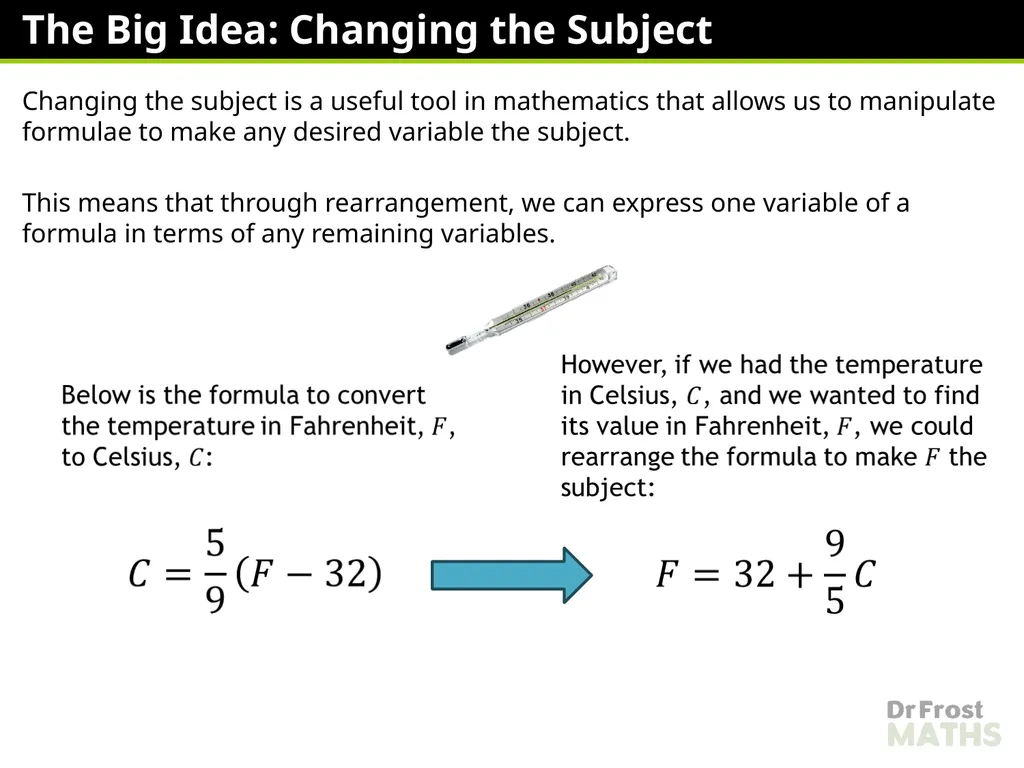
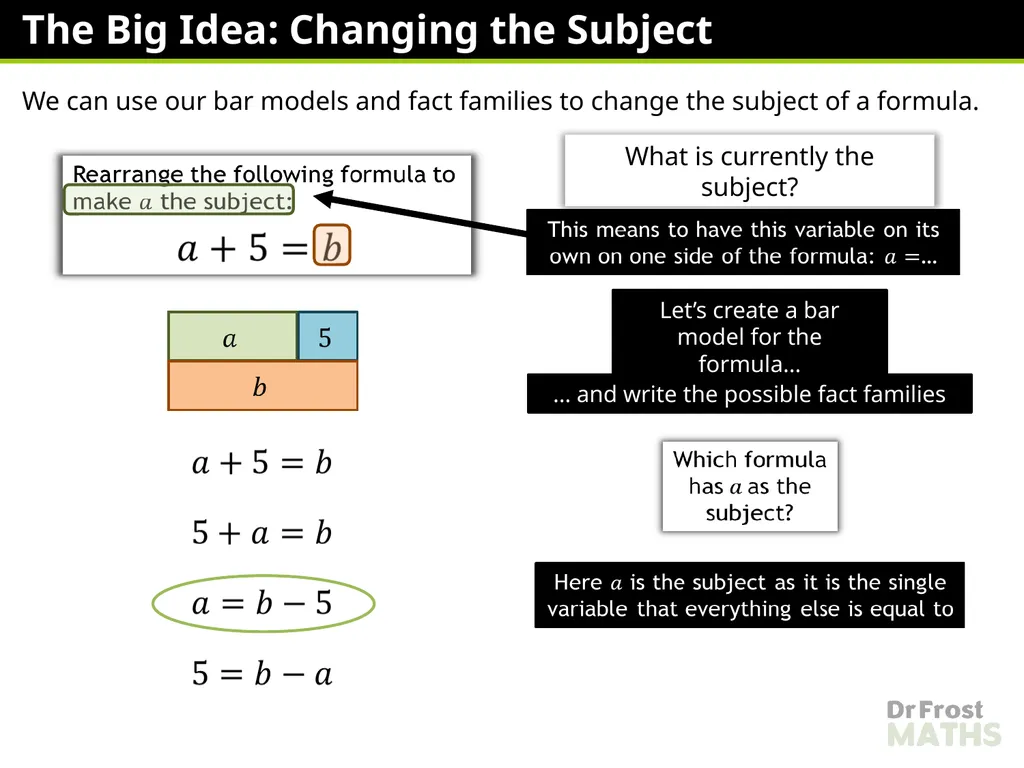
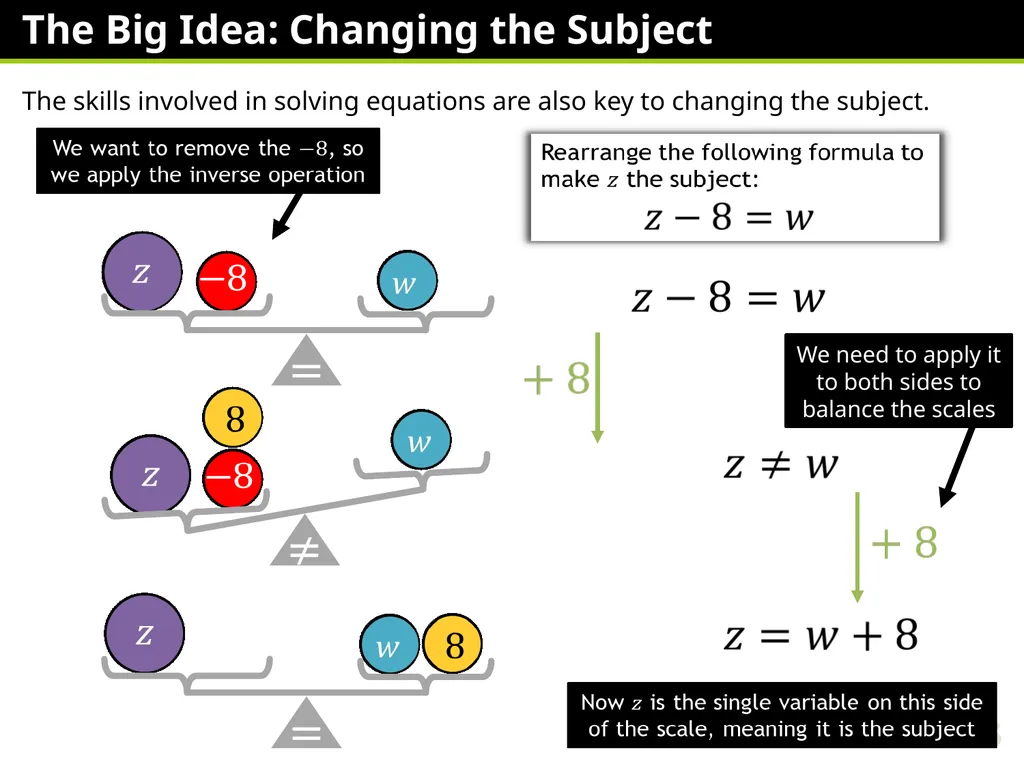
slide15. The Big Idea: Changing the Subject Changing the subject is a useful tool in mathematics that allows us to manipulate formulae to make any desired variable the subject. This means that through rearrangement, we can express one variable of a formula in terms of any remaining variables.<br>
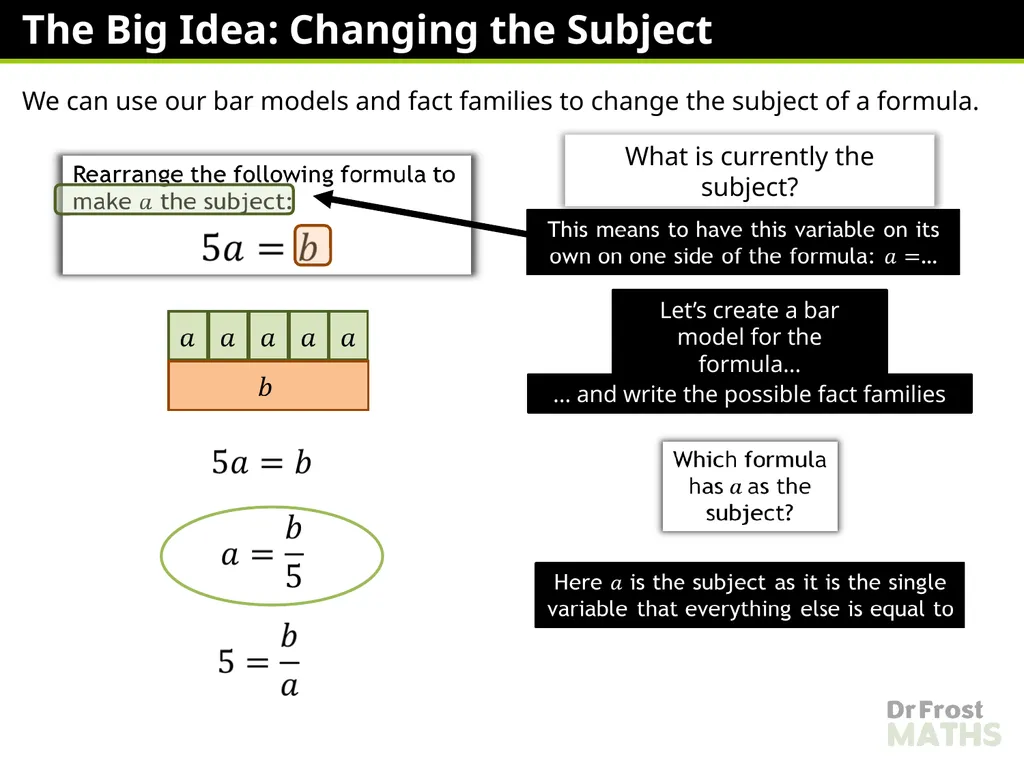
slide16. The Big Idea: Changing the Subject We can use our bar models and fact families to change the subject of a formula. Let’s create a bar model for the formula… … and write the possible fact families What is currently the subject?<br>
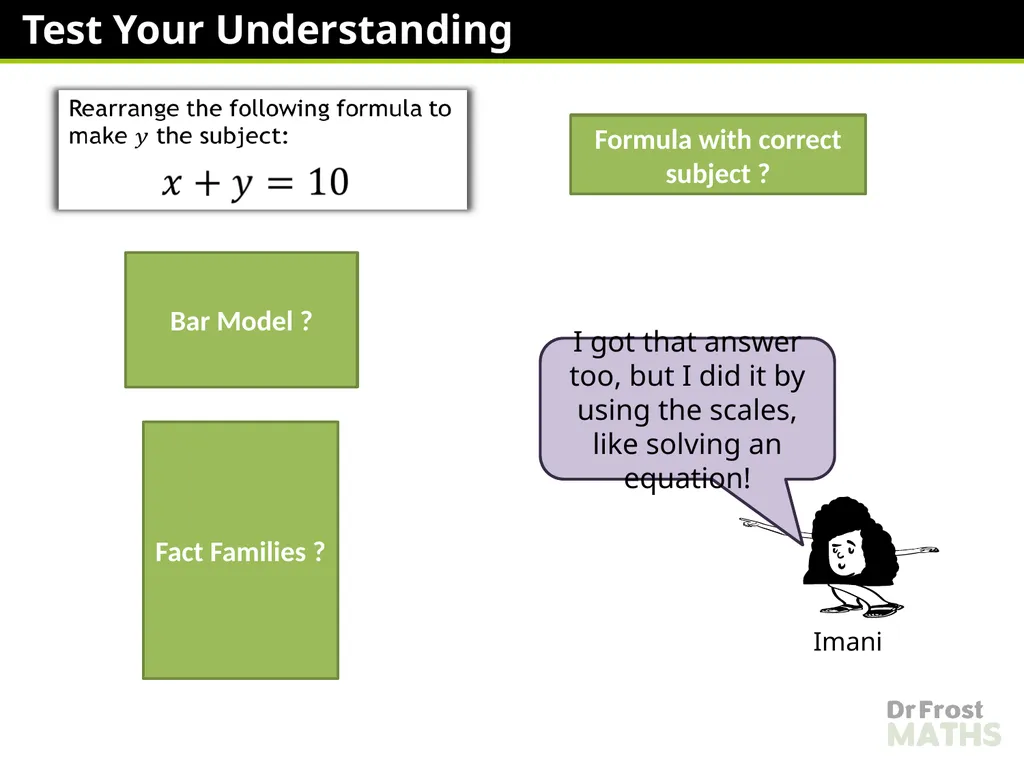
slide17. Test Your Understanding Fact Families ? Bar Model ? Formula with correct subject ? Imani I got that answer too, but I did it by using the scales, like solving an equation!<br>
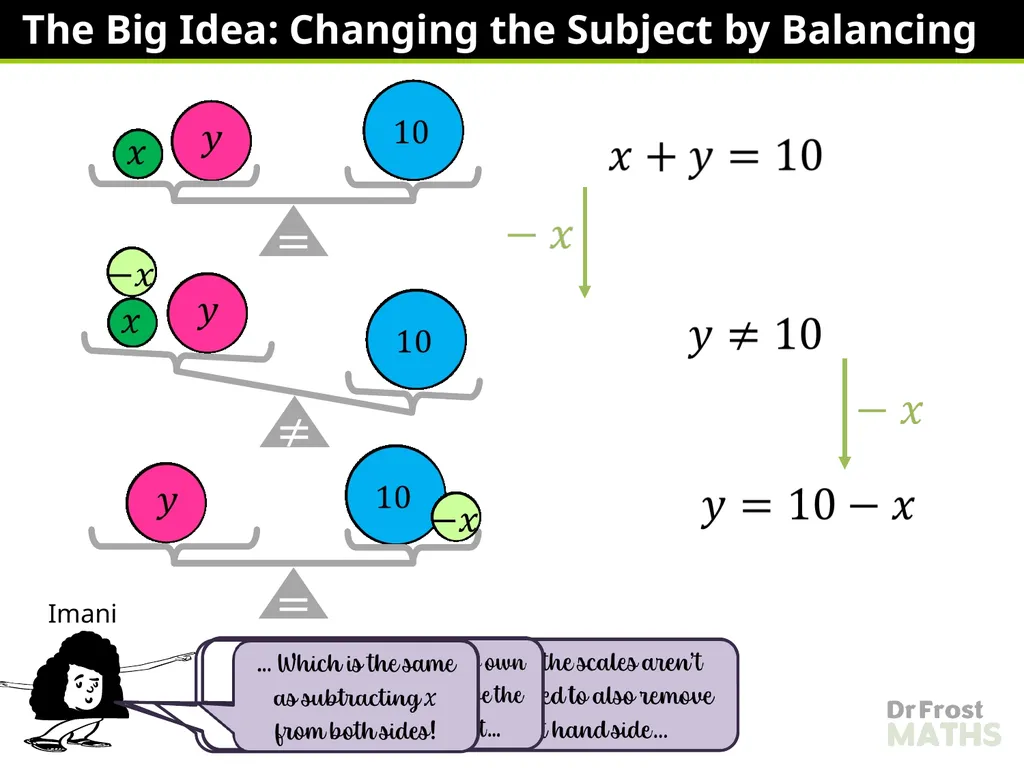
slide18. The Big Idea: Changing the Subject by Balancing Imani<br>
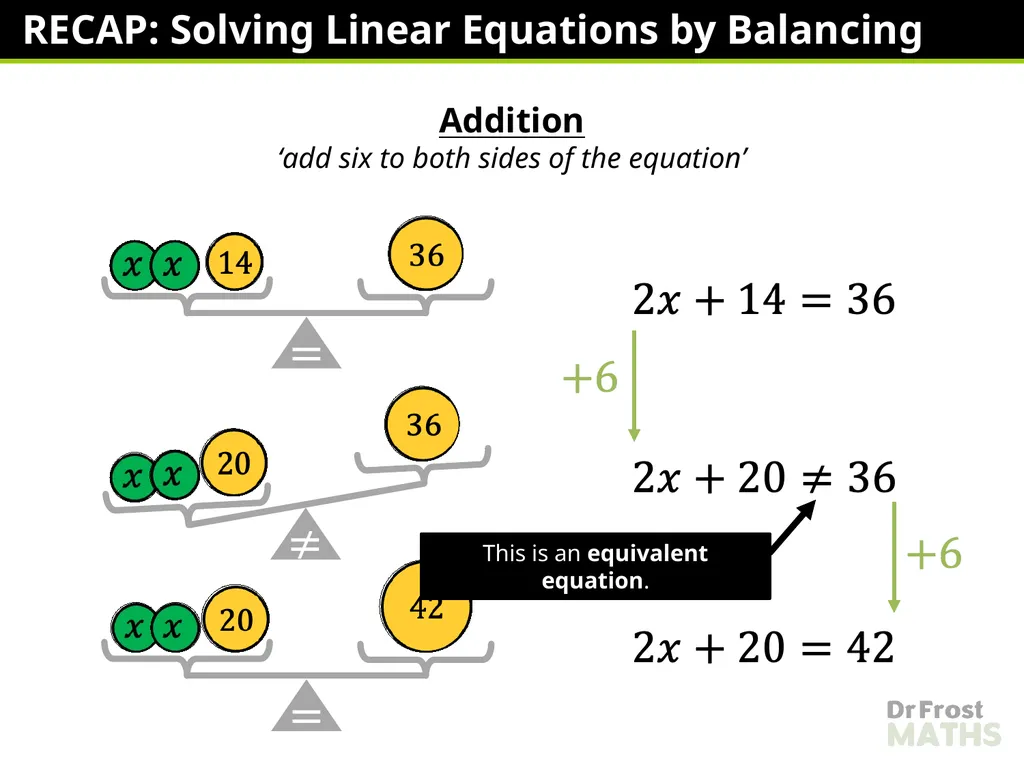
slide19. RECAP: Solving Linear Equations by Balancing This is an equivalent equation. Addition
‘add six to both sides of the equation’<br>
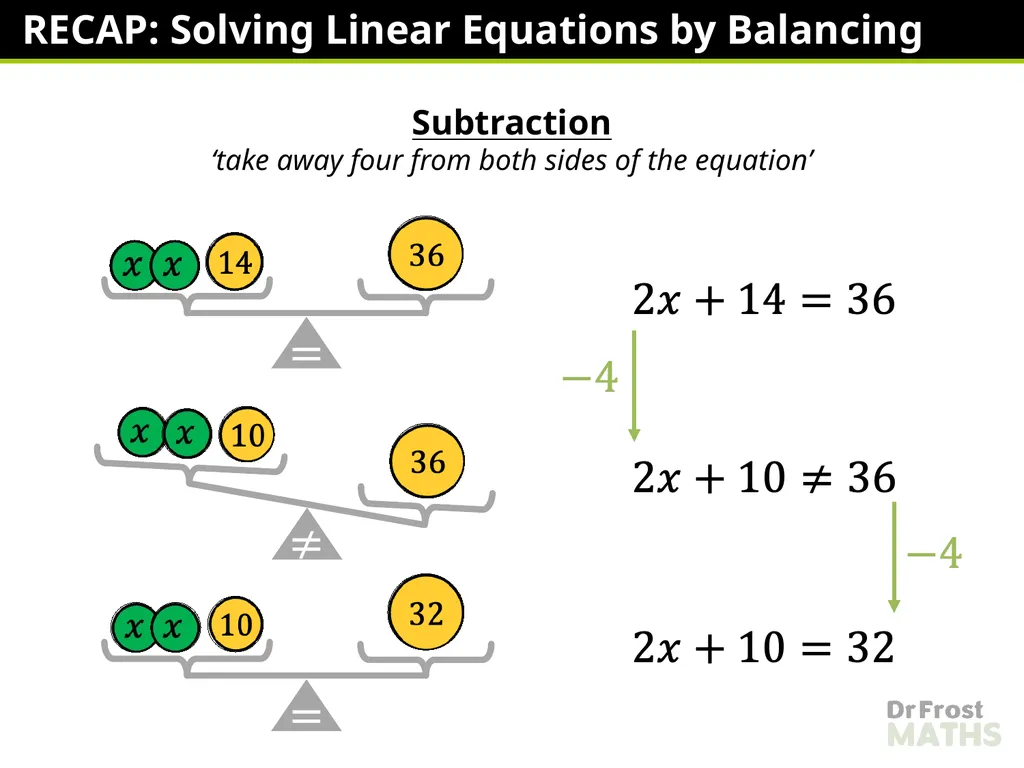
slide20. RECAP: Solving Linear Equations by Balancing Subtraction
‘take away four from both sides of the equation’<br>
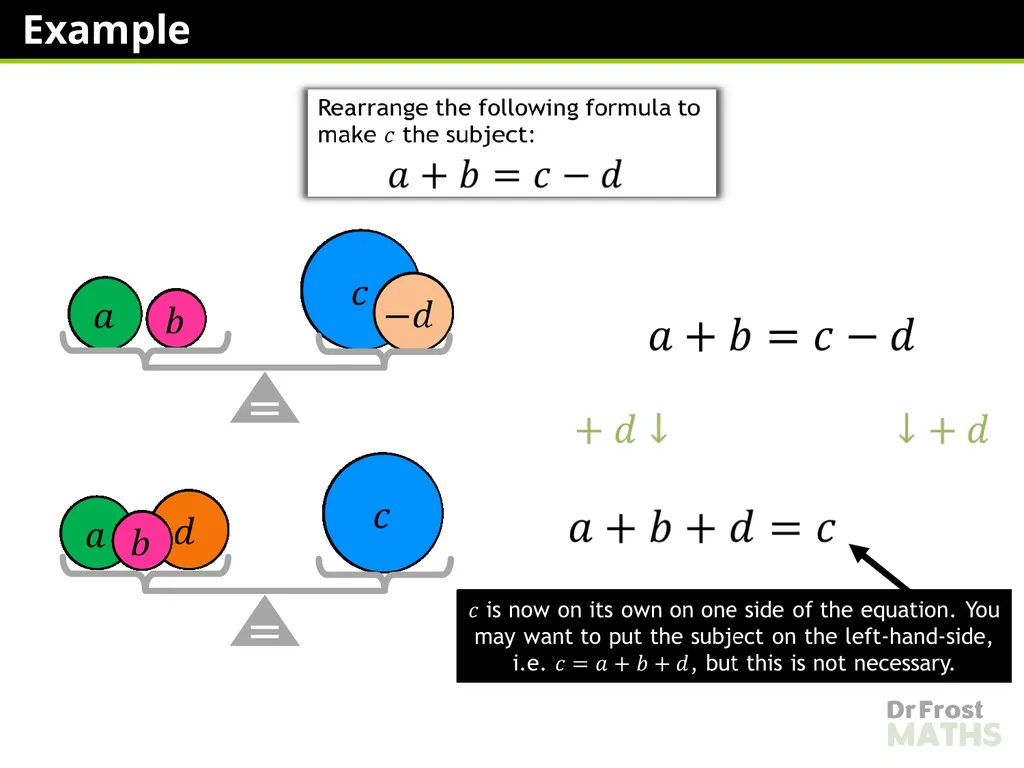
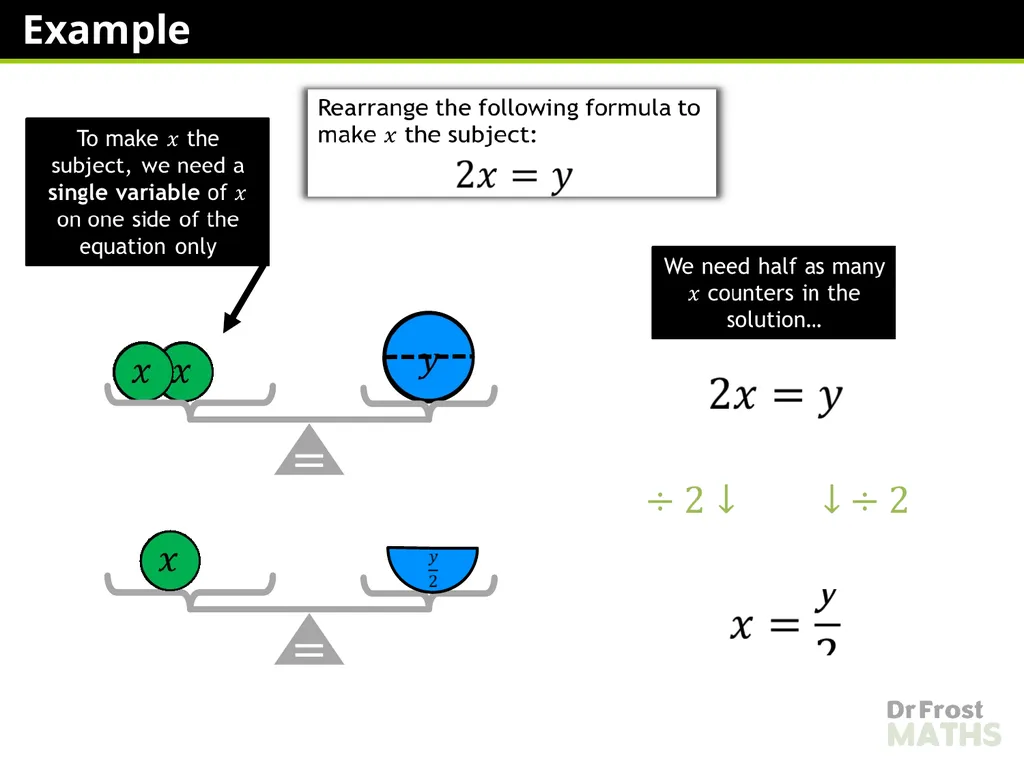
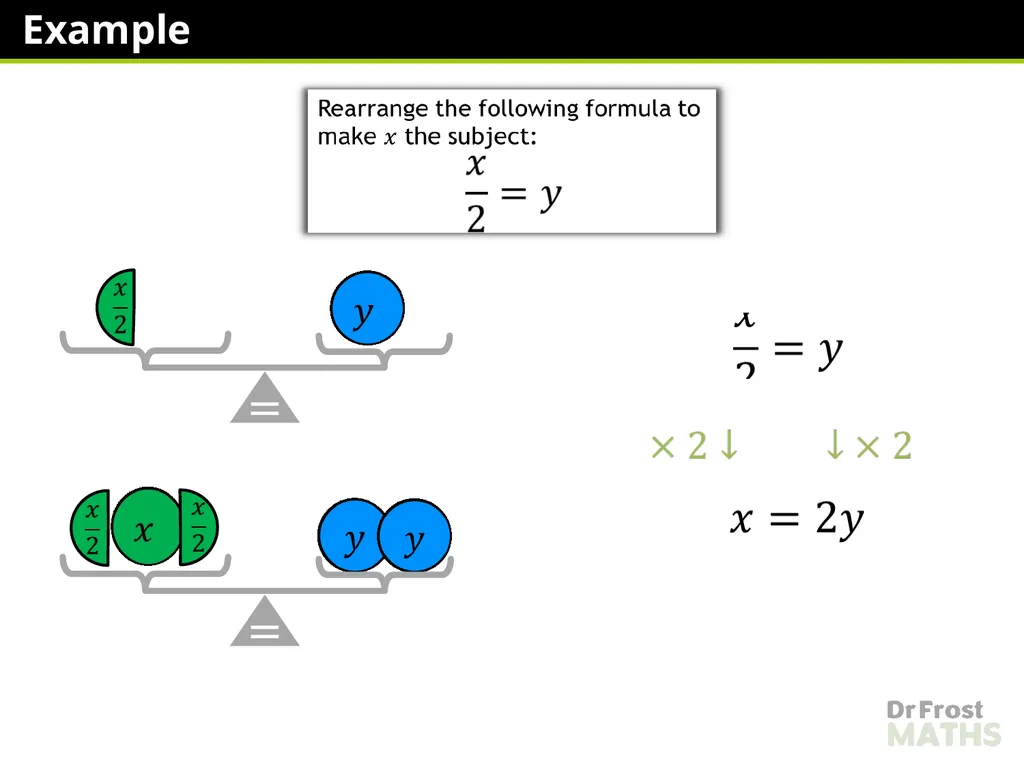
slide21. The Big Idea: Changing the Subject The skills involved in solving equations are also key to changing the subject. We need to apply it to both sides to balance the scales<br>
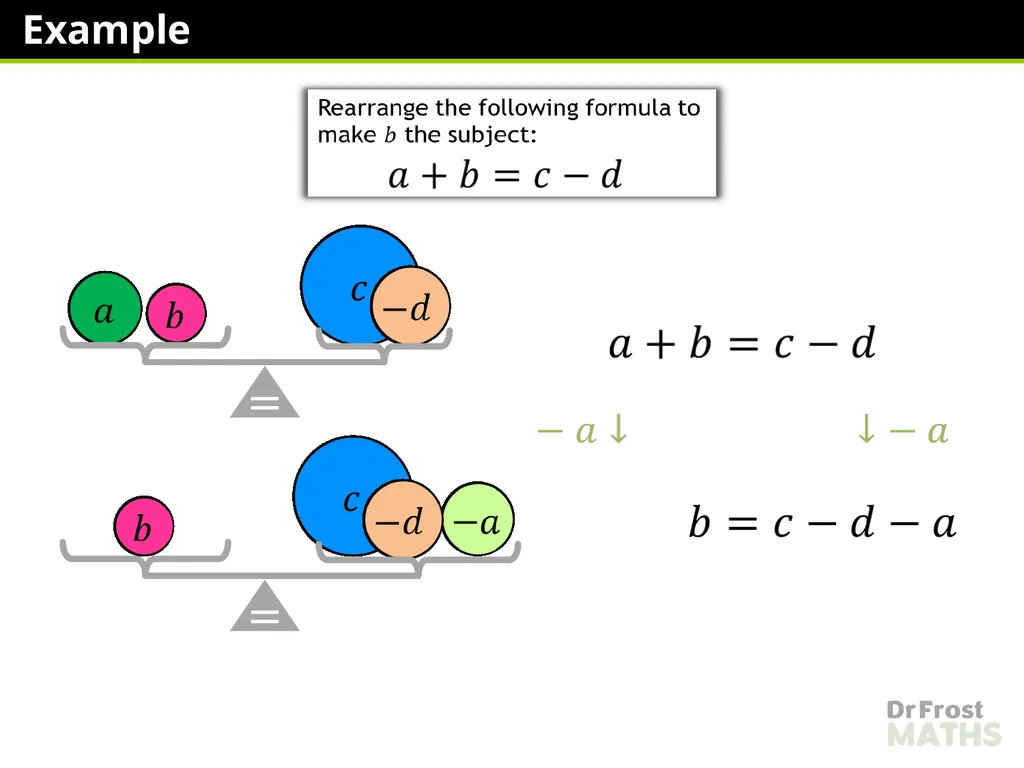
slide22. Example<br>
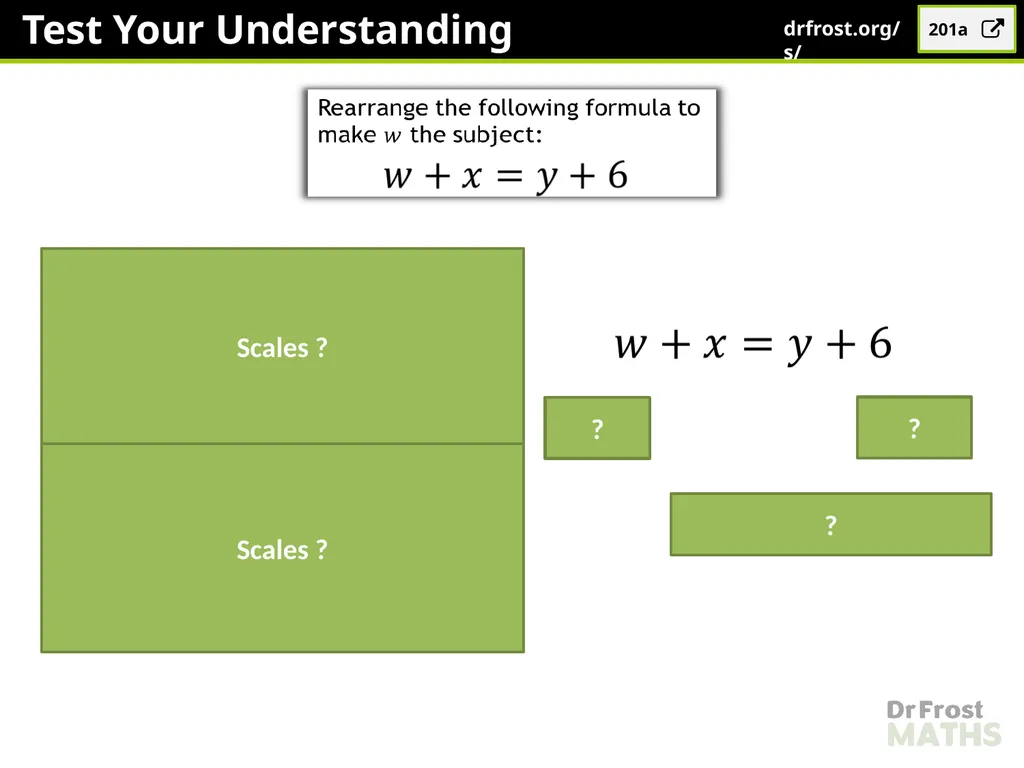
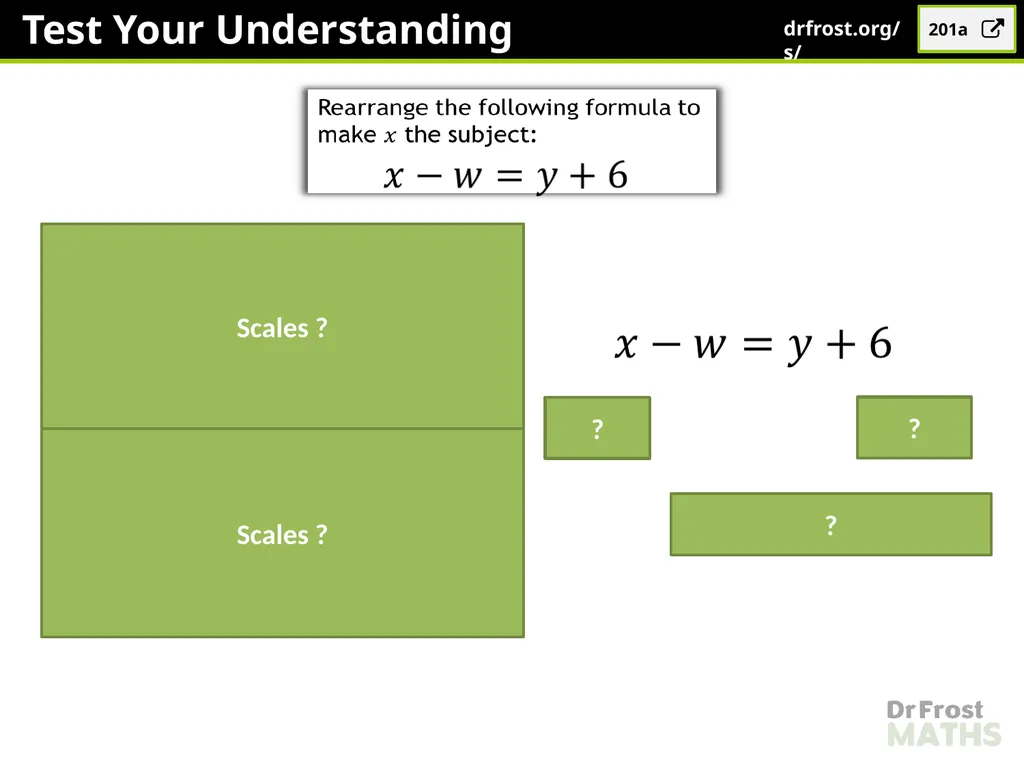
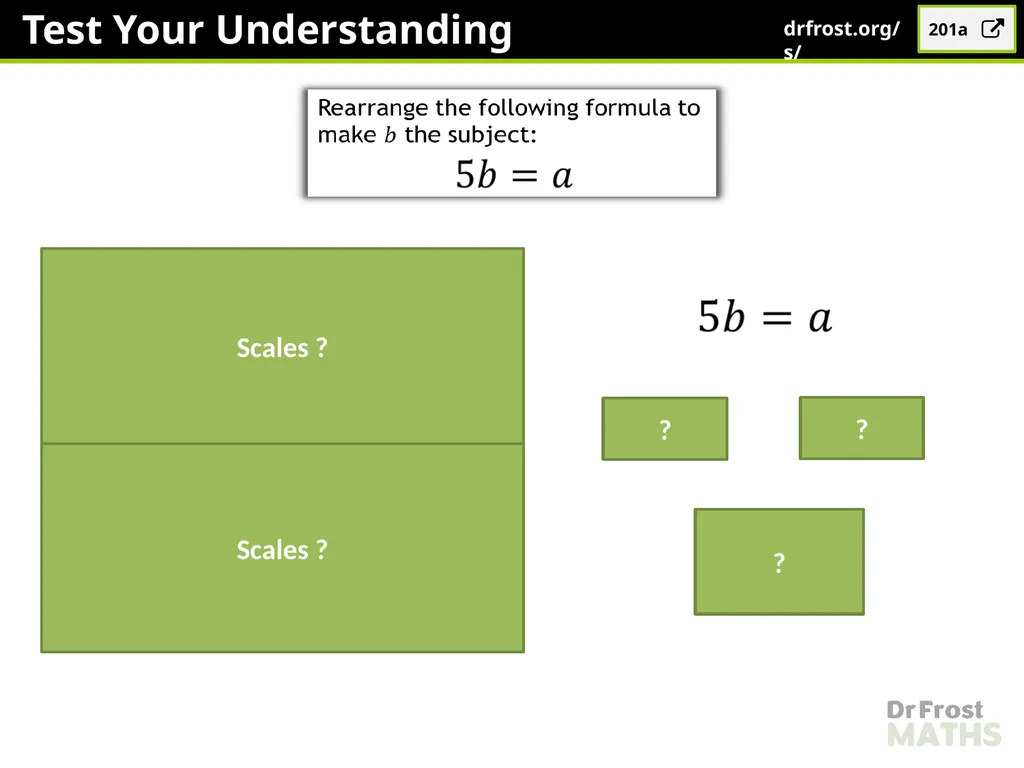
slide23. ? Test Your Understanding ? ? Scales ? Scales ? drfrost.org/s/<br>
slide24. Example<br>
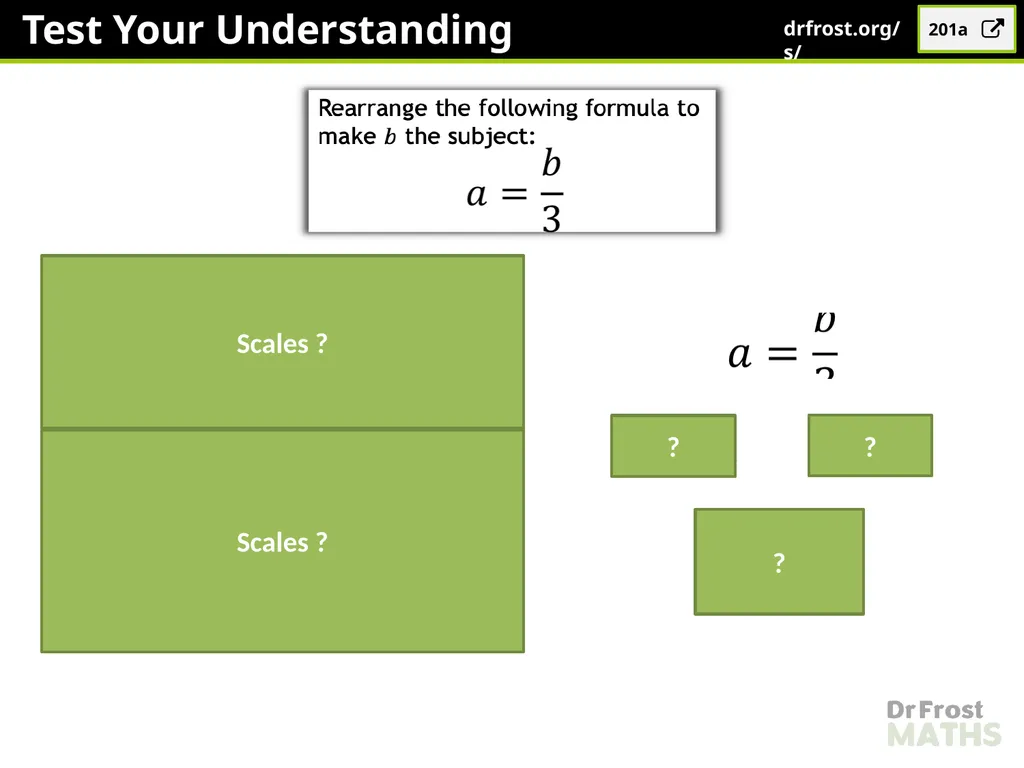
slide25. ? ? ? Test Your Understanding Scales ? Scales ? drfrost.org/s/<br>
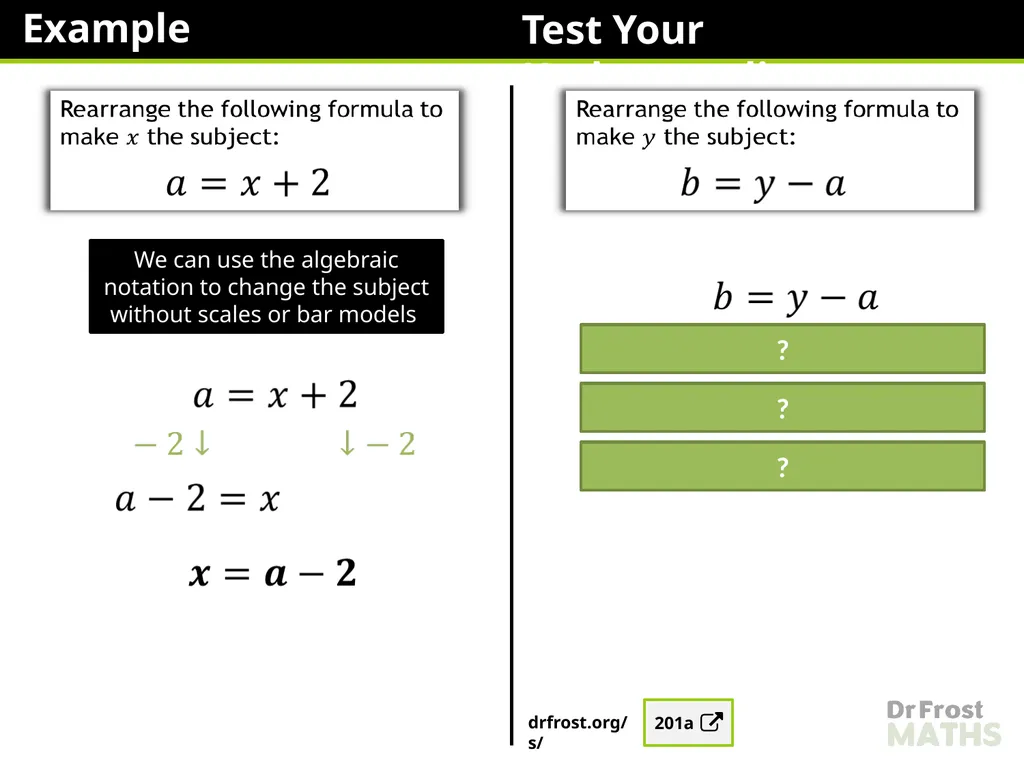
slide26. We can use the algebraic notation to change the subject without scales or bar models ? ? ? drfrost.org/s/<br>
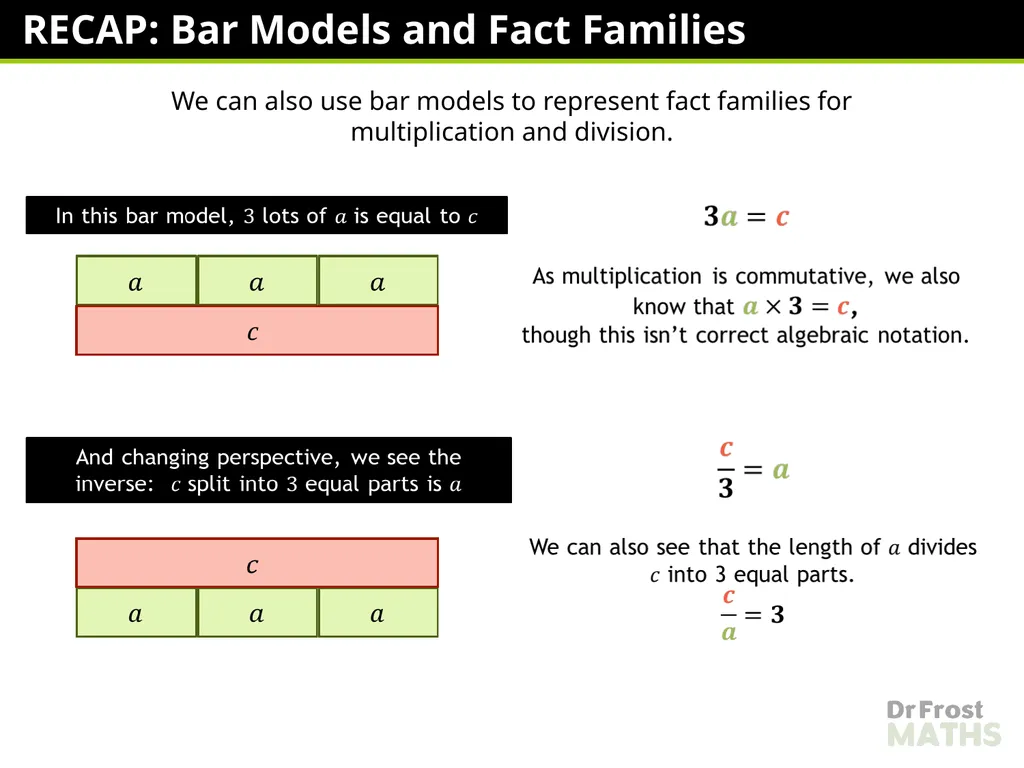
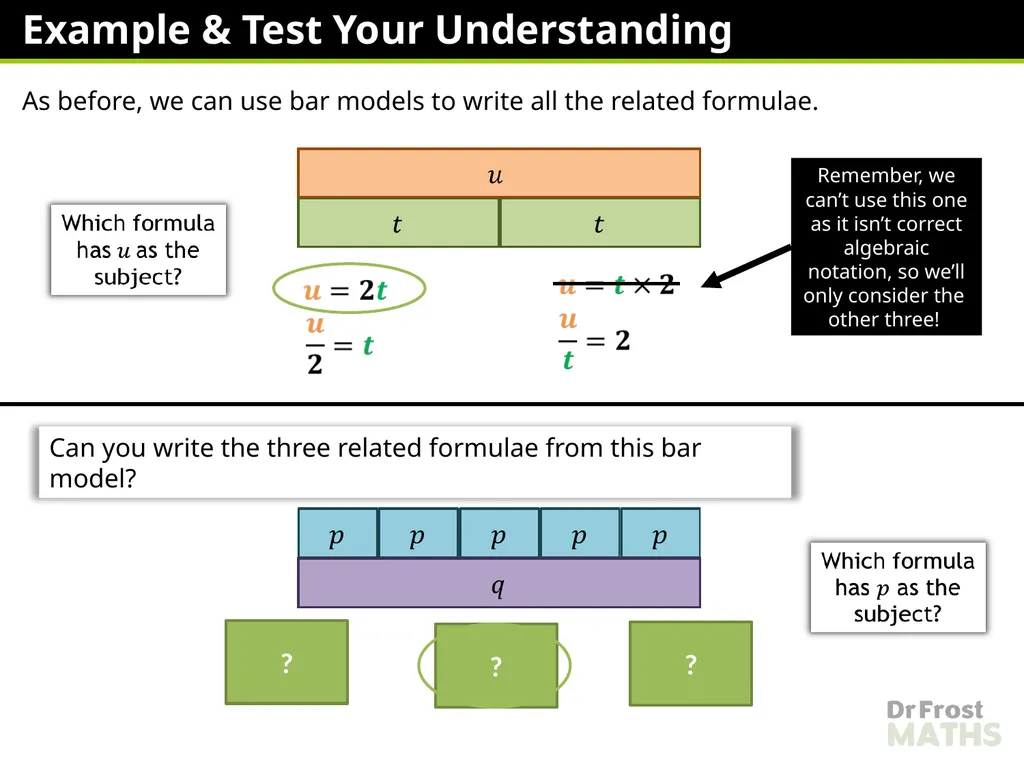
slide27. RECAP: Bar Models and Fact Families We can also use bar models to represent fact families for multiplication and division.<br>
slide28. Example & Test Your Understanding Can you write the three related formulae from this bar model? ? As before, we can use bar models to write all the related formulae. Remember, we can’t use this one as it isn’t correct algebraic notation, so we’ll only consider the other three! ? ?<br>
slide29. The Big Idea: Changing the Subject We can use our bar models and fact families to change the subject of a formula. Let’s create a bar model for the formula… … and write the possible fact families What is currently the subject?<br>
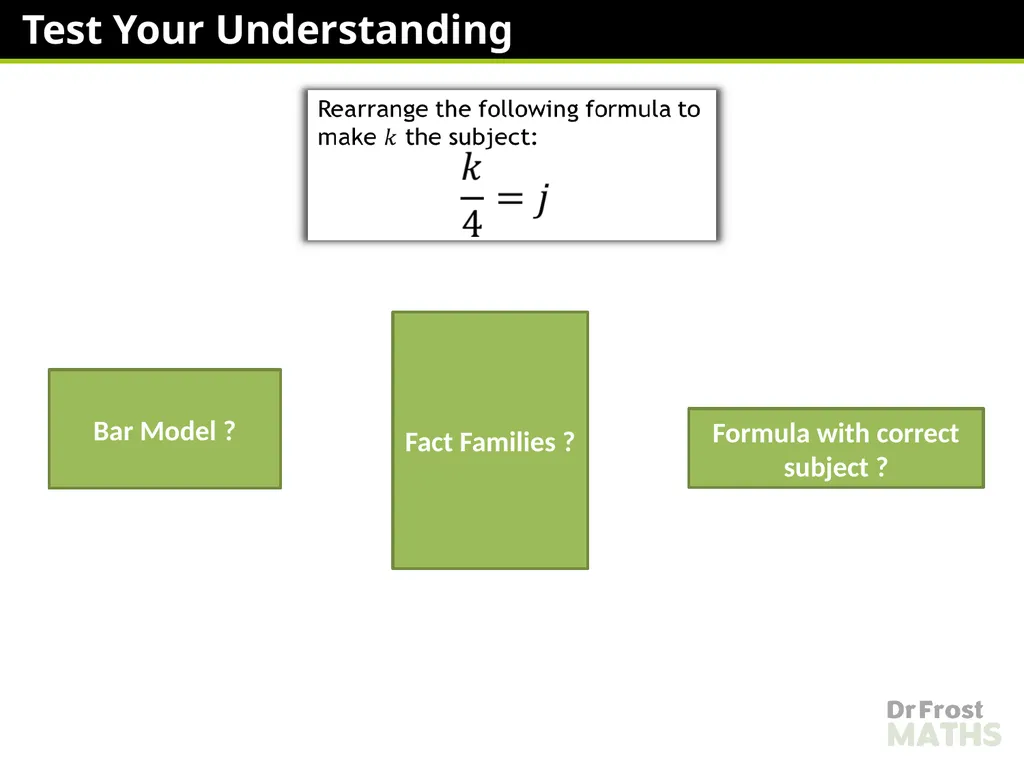
slide30. Test Your Understanding Fact Families ? Formula with correct subject ? Bar Model ?<br>
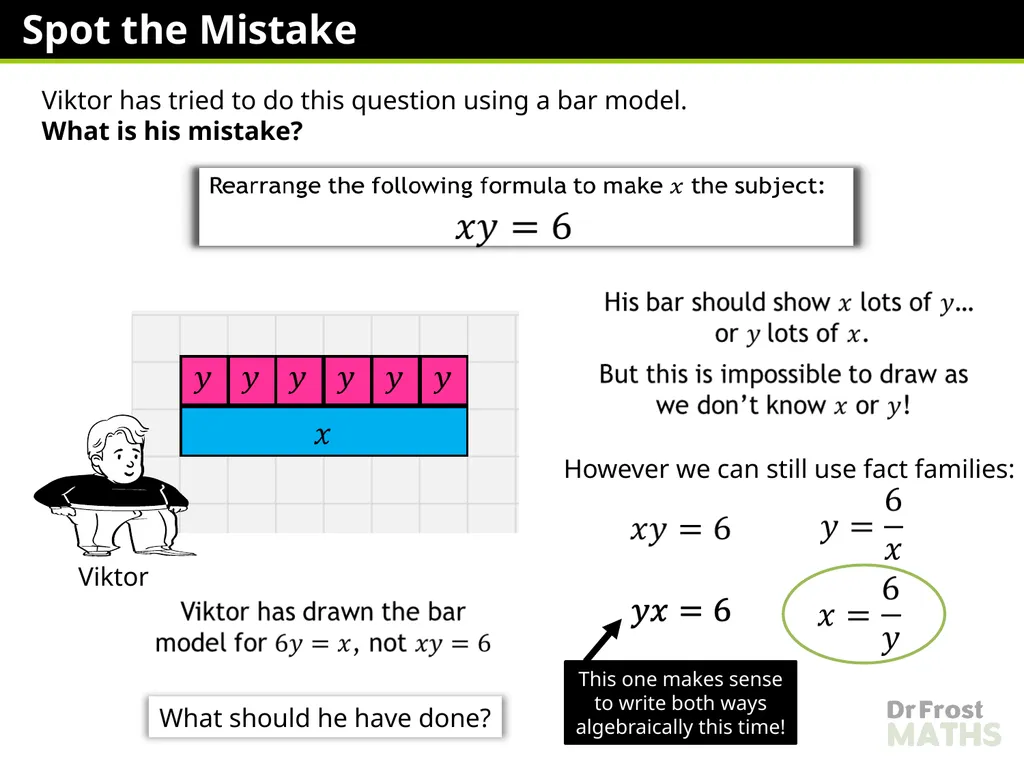
slide31. Spot the Mistake Viktor has tried to do this question using a bar model. What is his mistake? Viktor What should he have done? However we can still use fact families: This one makes sense to write both ways algebraically this time!<br>
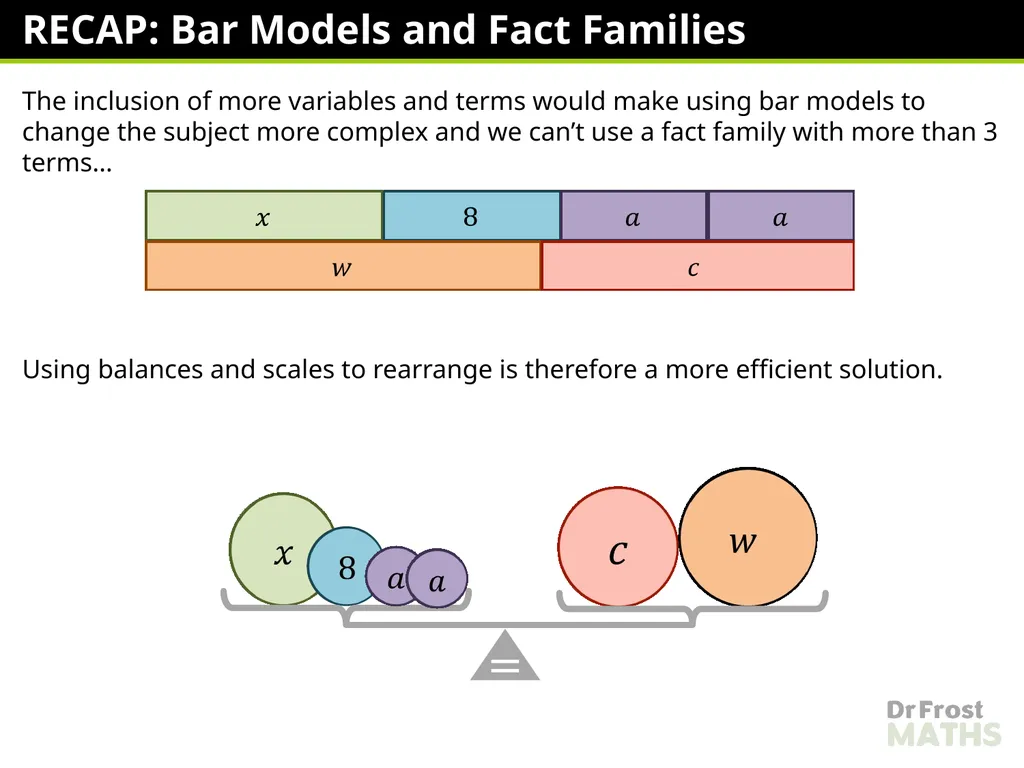
slide32. RECAP: Bar Models and Fact Families The inclusion of more variables and terms would make using bar models to change the subject more complex and we can’t use a fact family with more than 3 terms… Using balances and scales to rearrange is therefore a more efficient solution.<br>
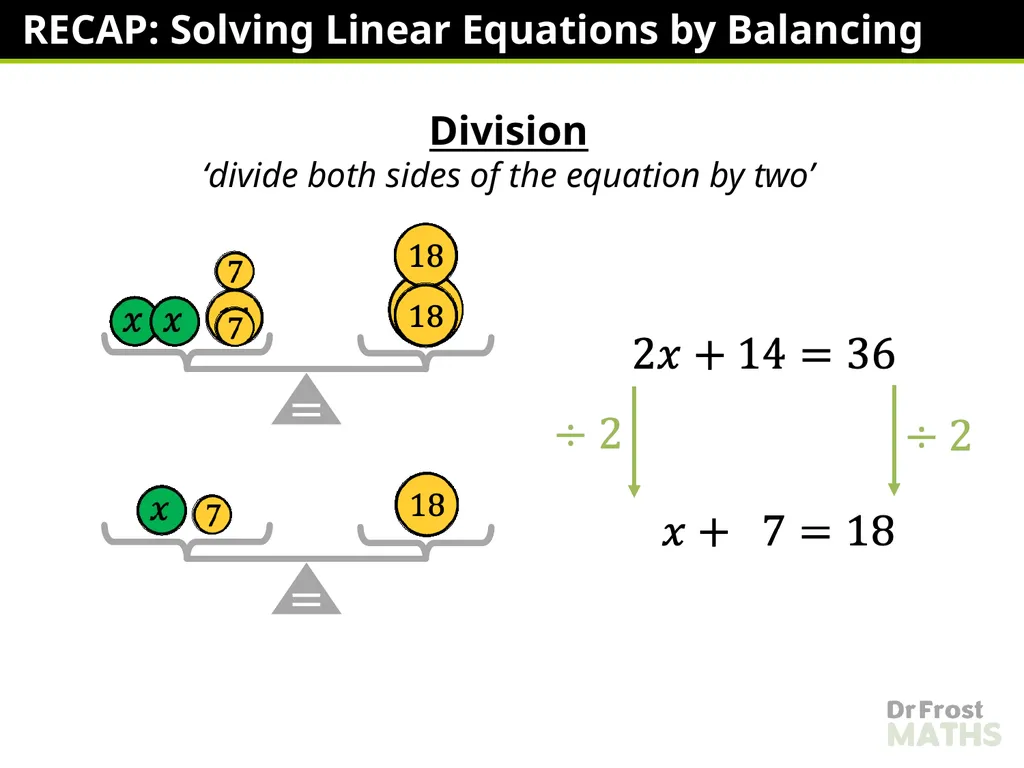
slide33. RECAP: Solving Linear Equations by Balancing Division
‘divide both sides of the equation by two’<br>
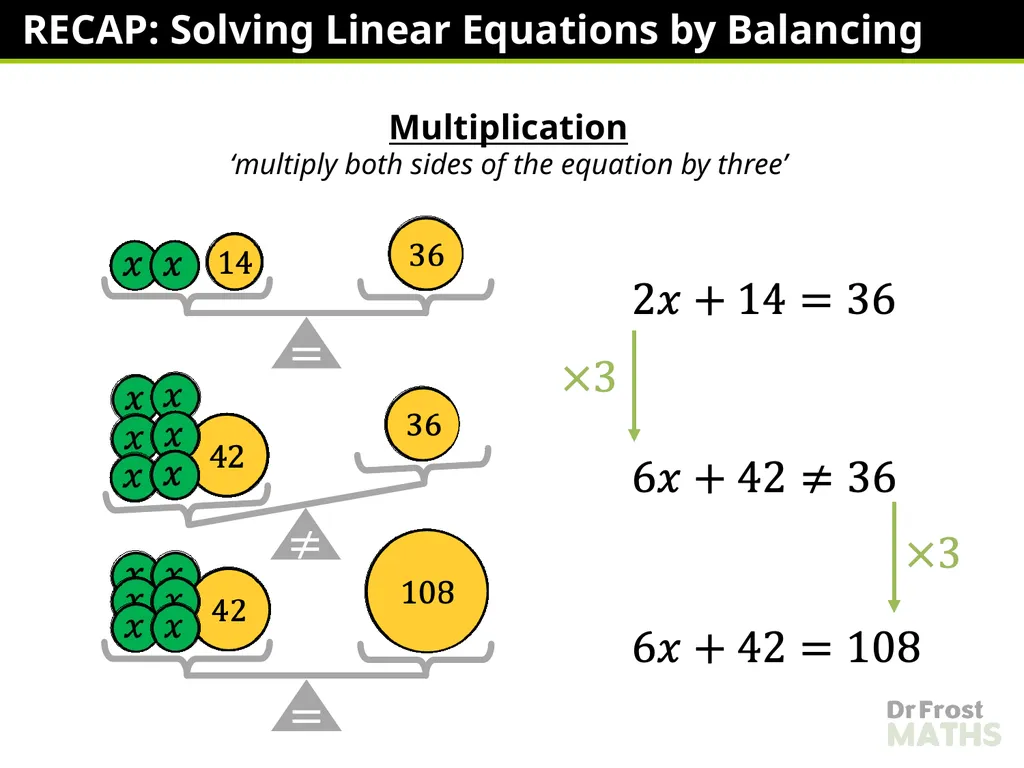
slide34. RECAP: Solving Linear Equations by Balancing Multiplication
‘multiply both sides of the equation by three’<br>
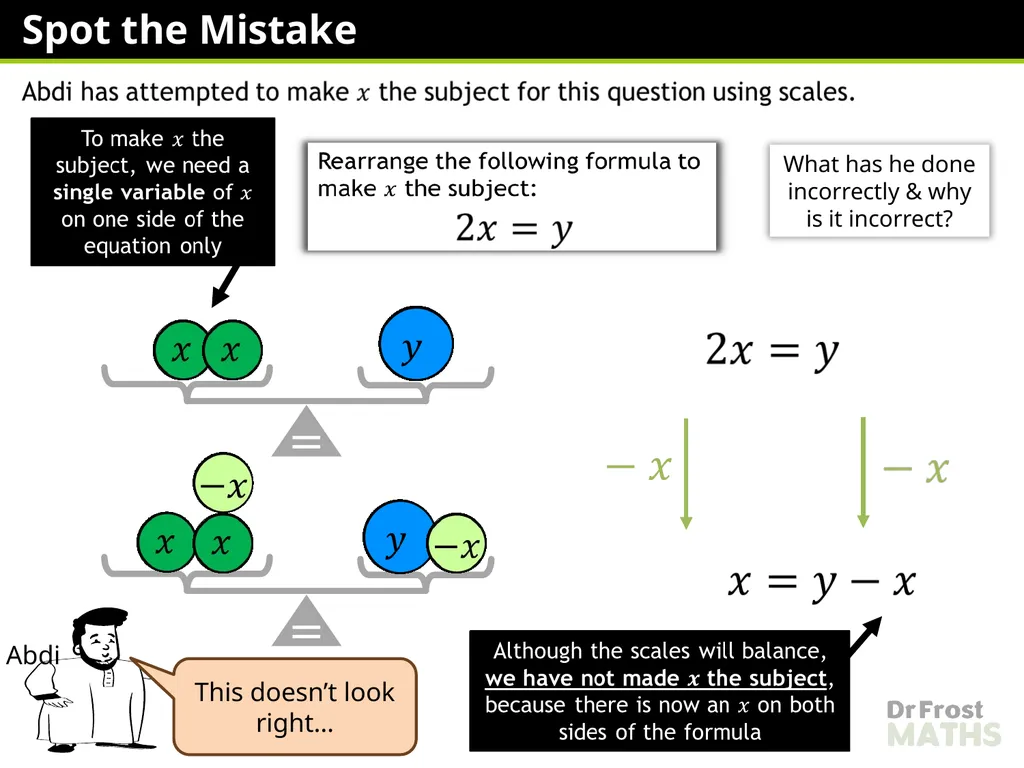
slide35. Spot the Mistake Abdi This doesn’t look right… What has he done incorrectly & why is it incorrect?<br>
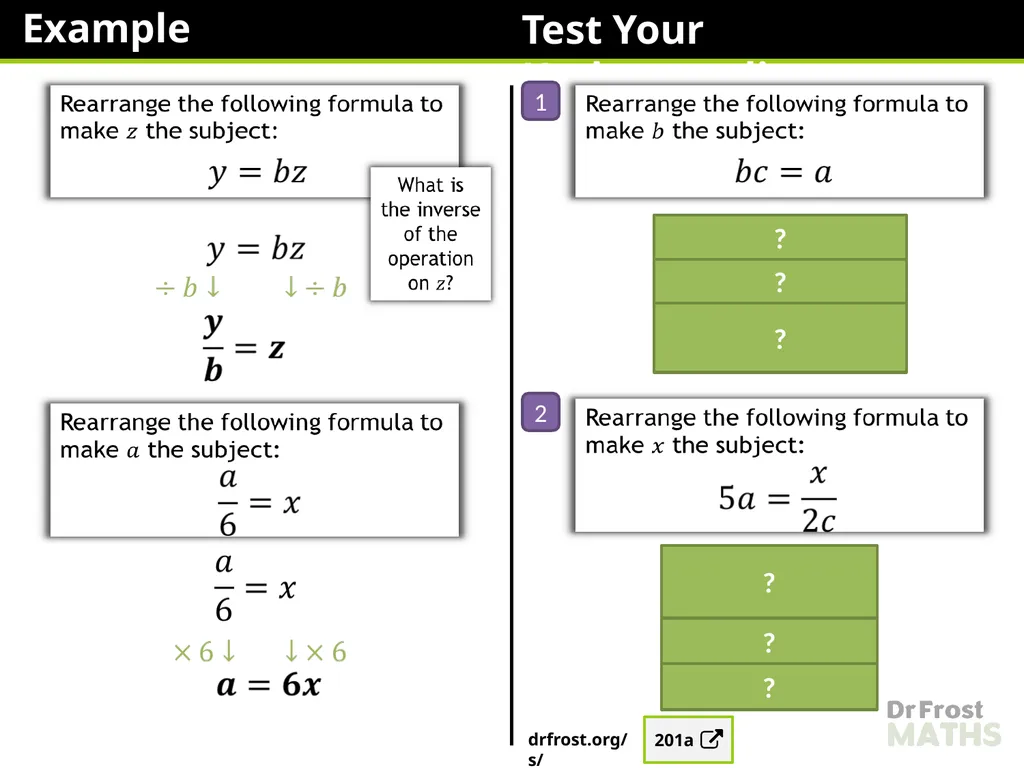
slide36. Example<br>
slide37. Test Your Understanding ? ? ? Scales ? Scales ? drfrost.org/s/<br>
slide38. Example<br>
slide39. Test Your Understanding ? ? ? Scales ? Scales ? drfrost.org/s/<br>
slide40. 1 2 ? ? ? ? ? ? drfrost.org/s/<br>
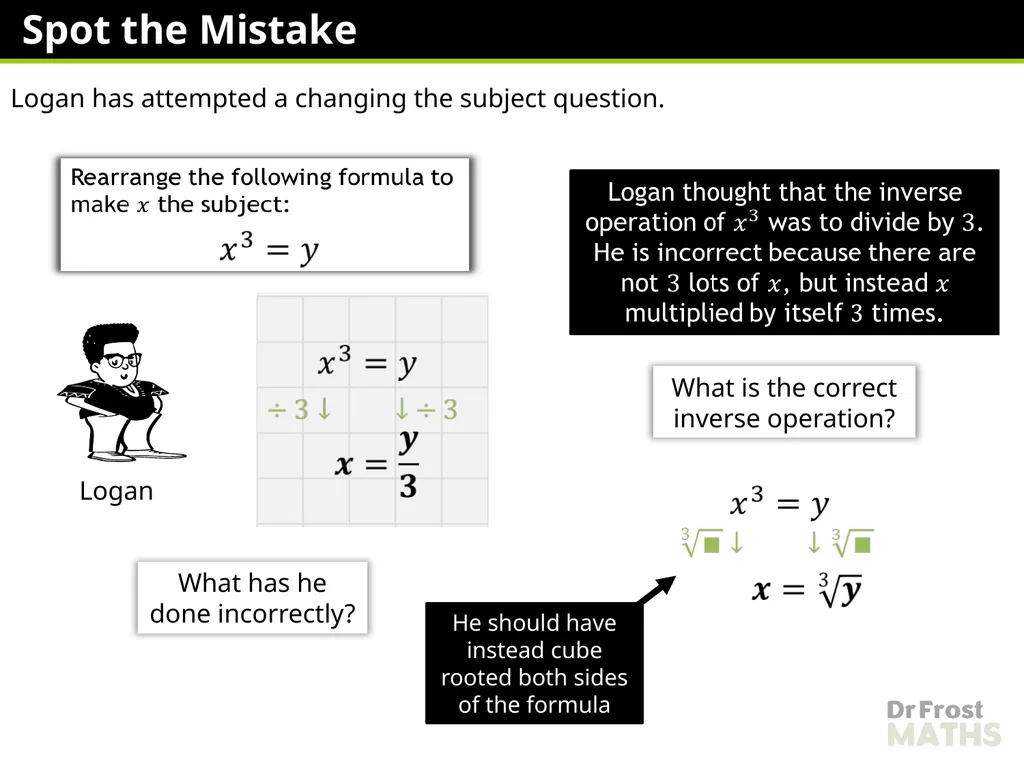
slide41. Spot the Mistake Logan Logan has attempted a changing the subject question. What has he done incorrectly? What is the correct inverse operation? He should have instead cube rooted both sides of the formula<br>
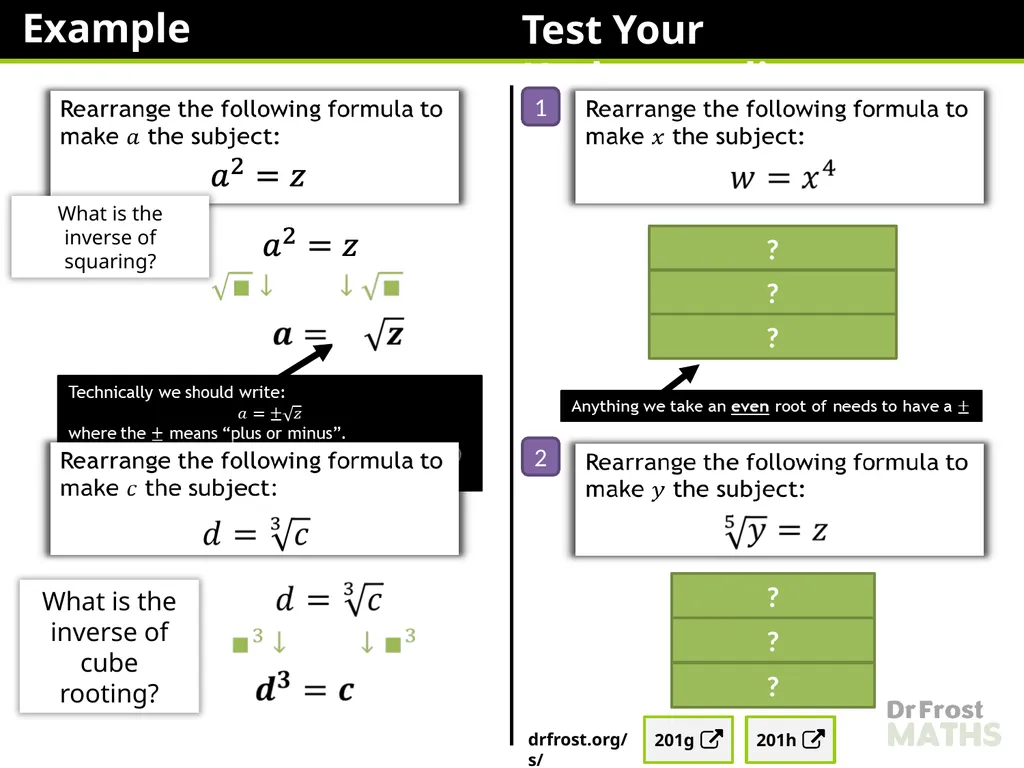
slide42. 1 2 ? ? ? ? ? What is the inverse of squaring? What is the inverse of cube rooting? ? drfrost.org/s/<br>
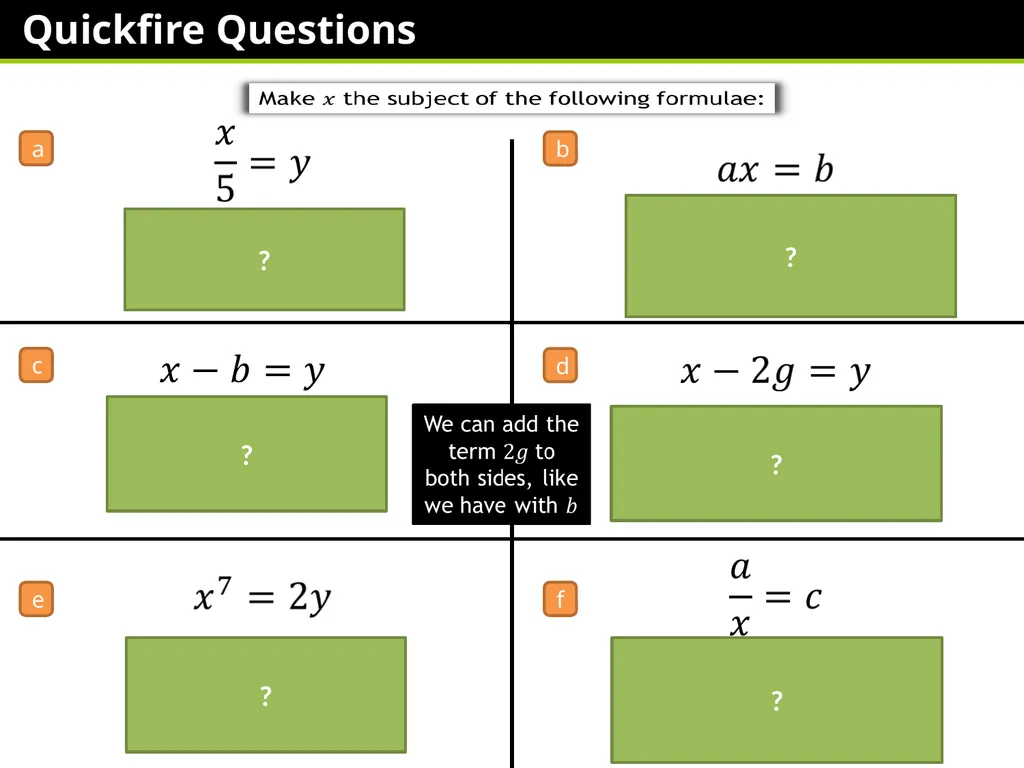
slide43. Quickfire Questions a b c d e f ? ? ? ? ? ?<br>
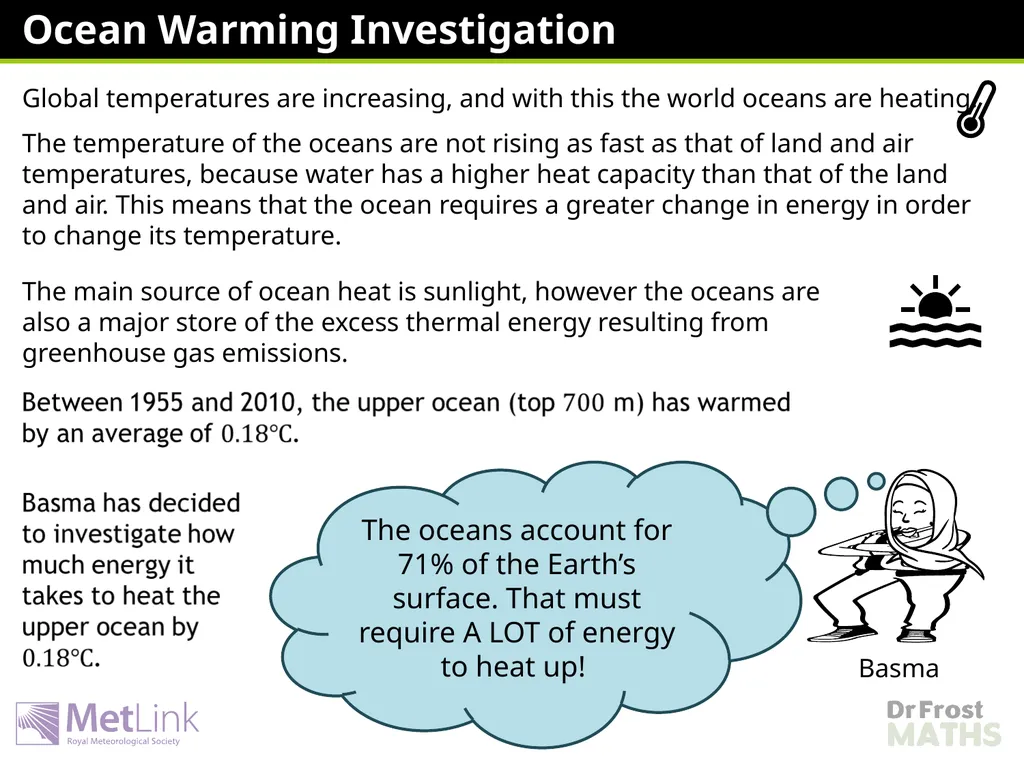
slide44. Ocean Warming Investigation Global temperatures are increasing, and with this the world oceans are heating. The temperature of the oceans are not rising as fast as that of land and air temperatures, because water has a higher heat capacity than that of the land and air. This means that the ocean requires a greater change in energy in order to change its temperature. The main source of ocean heat is sunlight, however the oceans are also a major store of the excess thermal energy resulting from greenhouse gas emissions. Basma The oceans account for 71% of the Earth’s surface. That must require A LOT of energy to heat up!<br>
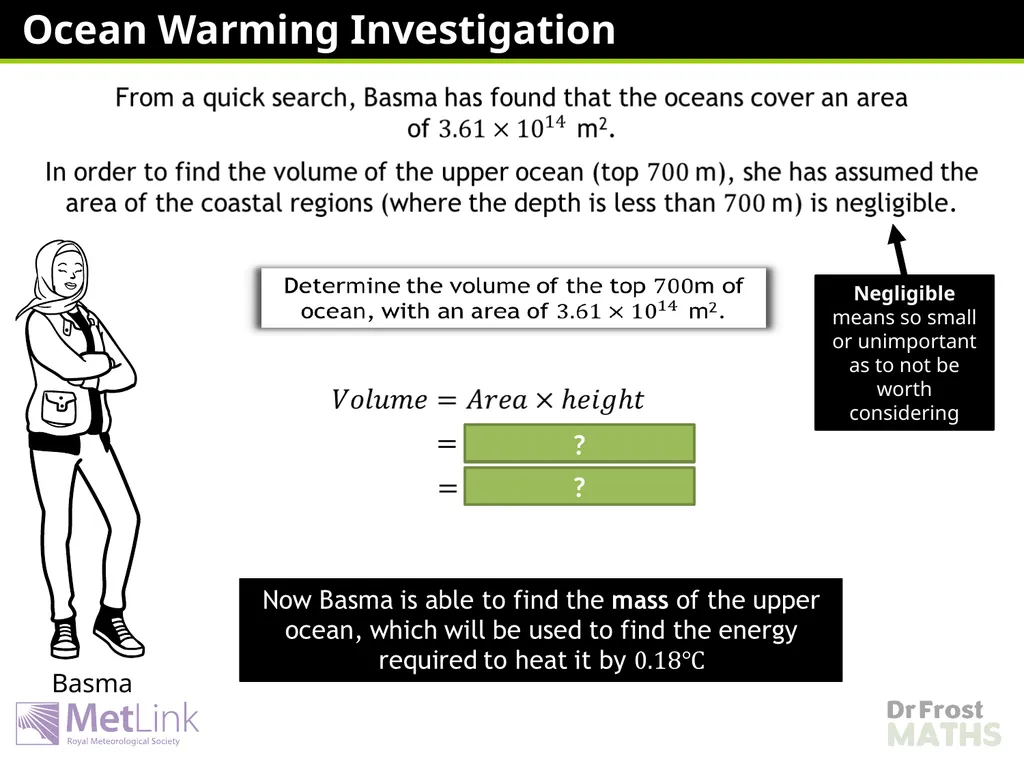
slide45. Ocean Warming Investigation ? ? Basma Negligible means so small or unimportant as to not be worth considering<br>
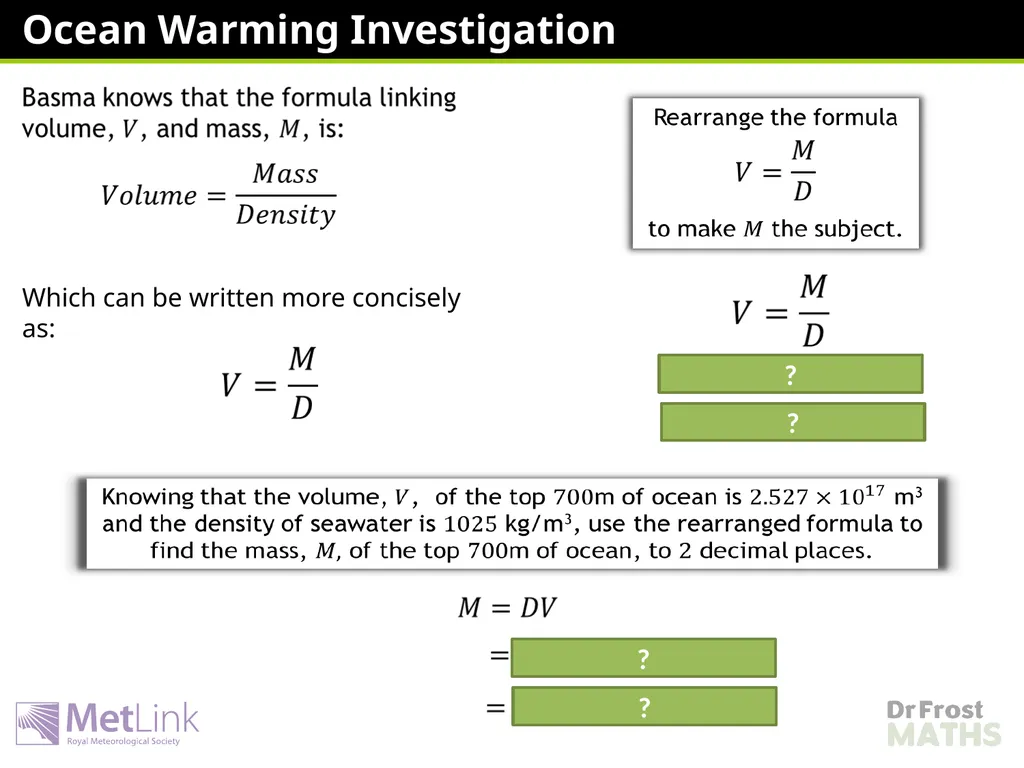
slide46. Ocean Warming Investigation Which can be written more concisely as: ? ? ? ?<br>
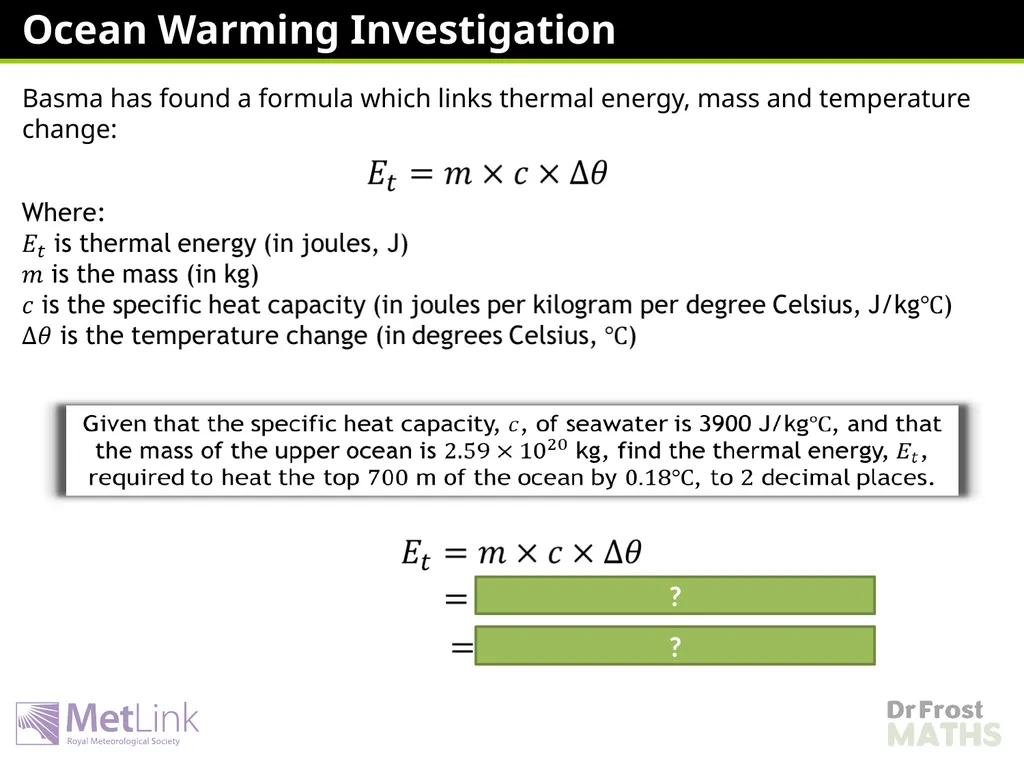
slide47. Ocean Warming Investigation Basma has found a formula which links thermal energy, mass and temperature change: ? ?<br>
slide48. Ocean Warming Investigation Basma<br>
slide49. ? ? Exercise (Available as a separate worksheet) 1 a b c d e f g h i 2 a b c d e f g 3 a b c d e f g h i 4 a b c ? ? ? ? ? ? ? ? ? ? ? ? ? ? ? ? ? ? ? ? ? ? ? ? ? ? Show all solutions<br>
slide2. Prerequisite Knowledge Representations Used Bar models
Balance scales Future Links Changing the subject of a formula where the subject appears once only, requiring two or more steps.
Rearranging the formula where the subject appears more than once.<br>
slide3. Using the Dr Frost online platform TEACHERS
Generate a random worksheet involving skills in this PowerPoint (for printing or online task setting). STUDENTS
Start an independent practice involving skills in this PowerPoint. drfrost.org/w/640 Clicking this box takes you to a single question practice for a subskill to allow you further Test Your Understanding opportunities. (e.g. drfrost.org/s/123a) drfrost.org/p/640<br>
slide5. Contents For lessons covering many concepts, please click the below to navigate quickly to the relevant part of the lesson.<br>
slide6. RECAP: Solving Linear Equations & Substitution 2 Solve each of the following: a b c d e f g h ? ? ? ? ? ? ? 1 Represent each of the bar models as an equation or formula: a b c d 3 ? a c b Show all solutions ? ? ? ? ? ? ?<br>
slide7. RECAP: Definition – Equation What do each of the equations have in common? Are there any similarities/differences between the two groups? An equation is a mathematical statement that shows that two expressions are equal, through use of the equality sign<br>
slide8. RECAP: Definition – Formulae What do each of the formulae have in common? Are there any similarities/differences between the two groups? A formula is mathematical statement of equality, giving a relationship between variables. We often use substitution to find the value of one variable when we know the value of the others The subject of the formula is the single variable that everything else is equal to<br>
slide9. Quickfire Questions No subject No subject ? ? ? ? ? ? a b What is the subject of each formula below: c d e f The subject does not need to be on the left. It is the subject if it on its own on one side of the equals The subject needs to be a single variable, not a term<br>
slide10. RECAP: Representing Equations & Formulae Equations & formulae can be represented in many different ways. For example, we can represent something algebraically: Using scales: Using bar models: The scales are balanced because both sides of the equation are equal The bars are the same width because both sides of the equation are equal<br>
slide11. RECAP: Bar Models & Fact Families For example, in this case, we can write this bar model as: But we could rearrange and write this bar model in a slightly different way: Bar models are a powerful tool that allow us to encapsulate the different relationships between terms We could also write this as: We can also write this as: This is because addition is commutative<br>
slide12. RECAP: Bar Models & Fact Families The bar model can also represent a fact family – a relationship between 3 variables or terms. From the bar model, we can write all four related calculations. We can rearrange the bars to help identifying the different arrangements These fact families have arrangements with each variable as the subject!<br>
slide13. Examples – Bar Models For each bar model, write each possible arrangement of the equation 1 2 Can you think of any of the other arrangements?<br>
slide14. ? ? ? ? Test Your Understanding For each bar model, write each possible arrangement of the equation 1 2 ? Rearranged Bar Model ? ? ? Rearranged Bar Model ? ? ? Rearranged Bar Model ? ? ? ? What is the subject of each of the answers that are formulae? Are all of the answers to question 2 formulae? No, not all of them link two variables and have a single variable as a subject.<br>
slide15. The Big Idea: Changing the Subject Changing the subject is a useful tool in mathematics that allows us to manipulate formulae to make any desired variable the subject. This means that through rearrangement, we can express one variable of a formula in terms of any remaining variables.<br>
slide16. The Big Idea: Changing the Subject We can use our bar models and fact families to change the subject of a formula. Let’s create a bar model for the formula… … and write the possible fact families What is currently the subject?<br>
slide17. Test Your Understanding Fact Families ? Bar Model ? Formula with correct subject ? Imani I got that answer too, but I did it by using the scales, like solving an equation!<br>
slide18. The Big Idea: Changing the Subject by Balancing Imani<br>
slide19. RECAP: Solving Linear Equations by Balancing This is an equivalent equation. Addition
‘add six to both sides of the equation’<br>
slide20. RECAP: Solving Linear Equations by Balancing Subtraction
‘take away four from both sides of the equation’<br>
slide21. The Big Idea: Changing the Subject The skills involved in solving equations are also key to changing the subject. We need to apply it to both sides to balance the scales<br>
slide22. Example<br>
slide23. ? Test Your Understanding ? ? Scales ? Scales ? drfrost.org/s/<br>
slide24. Example<br>
slide25. ? ? ? Test Your Understanding Scales ? Scales ? drfrost.org/s/<br>
slide26. We can use the algebraic notation to change the subject without scales or bar models ? ? ? drfrost.org/s/<br>
slide27. RECAP: Bar Models and Fact Families We can also use bar models to represent fact families for multiplication and division.<br>
slide28. Example & Test Your Understanding Can you write the three related formulae from this bar model? ? As before, we can use bar models to write all the related formulae. Remember, we can’t use this one as it isn’t correct algebraic notation, so we’ll only consider the other three! ? ?<br>
slide29. The Big Idea: Changing the Subject We can use our bar models and fact families to change the subject of a formula. Let’s create a bar model for the formula… … and write the possible fact families What is currently the subject?<br>
slide30. Test Your Understanding Fact Families ? Formula with correct subject ? Bar Model ?<br>
slide31. Spot the Mistake Viktor has tried to do this question using a bar model. What is his mistake? Viktor What should he have done? However we can still use fact families: This one makes sense to write both ways algebraically this time!<br>
slide32. RECAP: Bar Models and Fact Families The inclusion of more variables and terms would make using bar models to change the subject more complex and we can’t use a fact family with more than 3 terms… Using balances and scales to rearrange is therefore a more efficient solution.<br>
slide33. RECAP: Solving Linear Equations by Balancing Division
‘divide both sides of the equation by two’<br>
slide34. RECAP: Solving Linear Equations by Balancing Multiplication
‘multiply both sides of the equation by three’<br>
slide35. Spot the Mistake Abdi This doesn’t look right… What has he done incorrectly & why is it incorrect?<br>
slide36. Example<br>
slide37. Test Your Understanding ? ? ? Scales ? Scales ? drfrost.org/s/<br>
slide38. Example<br>
slide39. Test Your Understanding ? ? ? Scales ? Scales ? drfrost.org/s/<br>
slide40. 1 2 ? ? ? ? ? ? drfrost.org/s/<br>
slide41. Spot the Mistake Logan Logan has attempted a changing the subject question. What has he done incorrectly? What is the correct inverse operation? He should have instead cube rooted both sides of the formula<br>
slide42. 1 2 ? ? ? ? ? What is the inverse of squaring? What is the inverse of cube rooting? ? drfrost.org/s/<br>
slide43. Quickfire Questions a b c d e f ? ? ? ? ? ?<br>
slide44. Ocean Warming Investigation Global temperatures are increasing, and with this the world oceans are heating. The temperature of the oceans are not rising as fast as that of land and air temperatures, because water has a higher heat capacity than that of the land and air. This means that the ocean requires a greater change in energy in order to change its temperature. The main source of ocean heat is sunlight, however the oceans are also a major store of the excess thermal energy resulting from greenhouse gas emissions. Basma The oceans account for 71% of the Earth’s surface. That must require A LOT of energy to heat up!<br>
slide45. Ocean Warming Investigation ? ? Basma Negligible means so small or unimportant as to not be worth considering<br>
slide46. Ocean Warming Investigation Which can be written more concisely as: ? ? ? ?<br>
slide47. Ocean Warming Investigation Basma has found a formula which links thermal energy, mass and temperature change: ? ?<br>
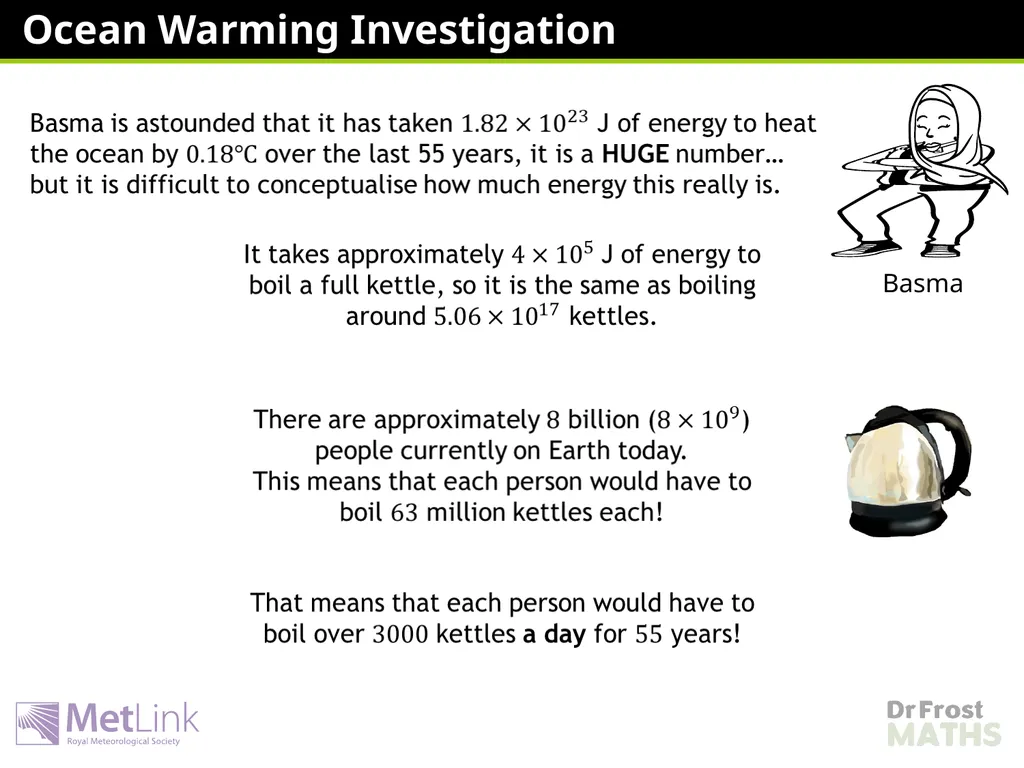
slide48. Ocean Warming Investigation Basma<br>
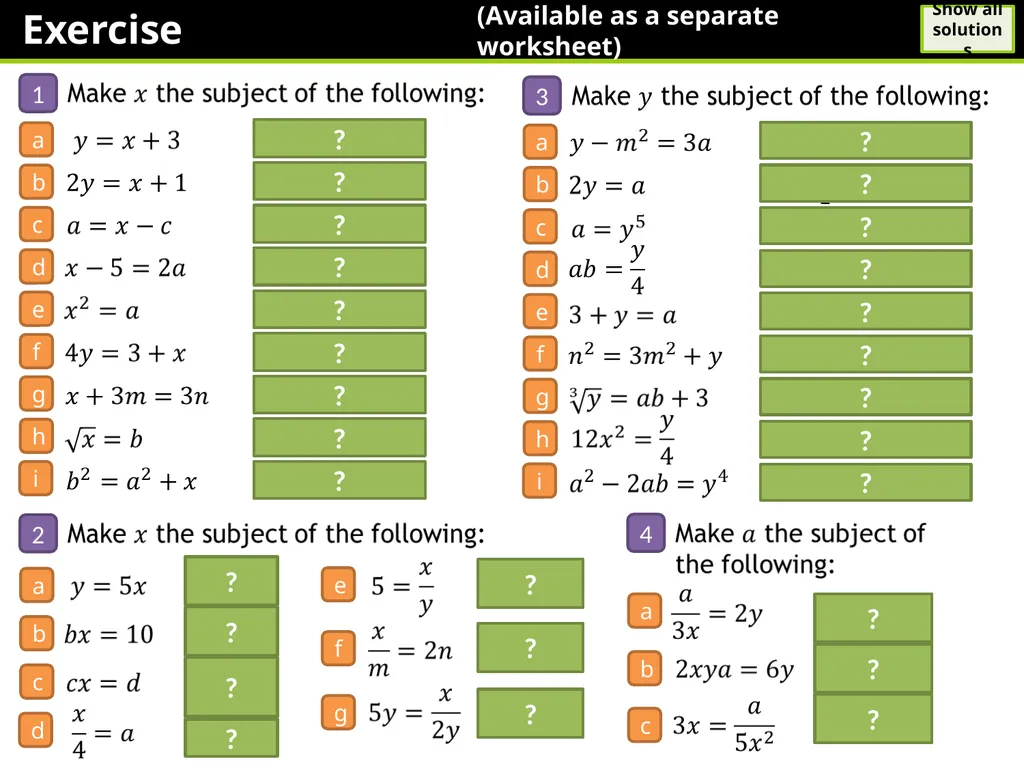
slide49. ? ? Exercise (Available as a separate worksheet) 1 a b c d e f g h i 2 a b c d e f g 3 a b c d e f g h i 4 a b c ? ? ? ? ? ? ? ? ? ? ? ? ? ? ? ? ? ? ? ? ? ? ? ? ? ? Show all solutions<br>