Law Enforcement, Human Rights and Gender Chapter 13 United Nations, 2025 Overview Chapter 13: Law Enforcement, Human Rights and Gender 3 Key international rights instruments Chapter 13: Law Enforcement, Human Rights and Gender 4
"Law Enforcement, Human Rights and Gender Chapter" is the property of its rightful owner. Permission is granted to
download and print the materials on this website for personal, non-commercial use only, and to display it
on your personal computer provided you do not modify the materials and that you retain all copyright
notices contained in the materials. By downloading content from our website, you accept the terms of this
agreement.
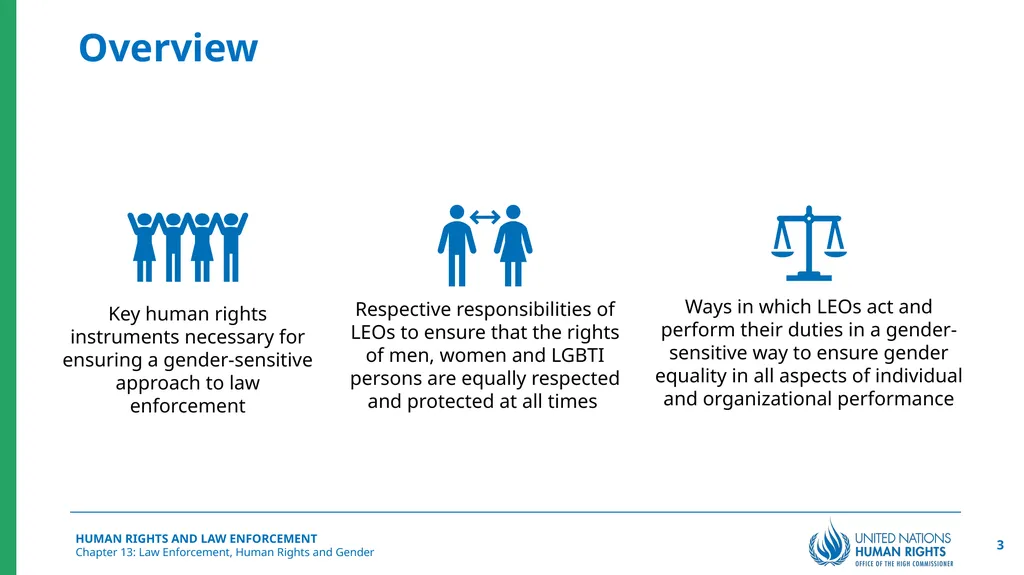
Overview Chapter 13: Law Enforcement, Human Rights and Gender 3<br>
03
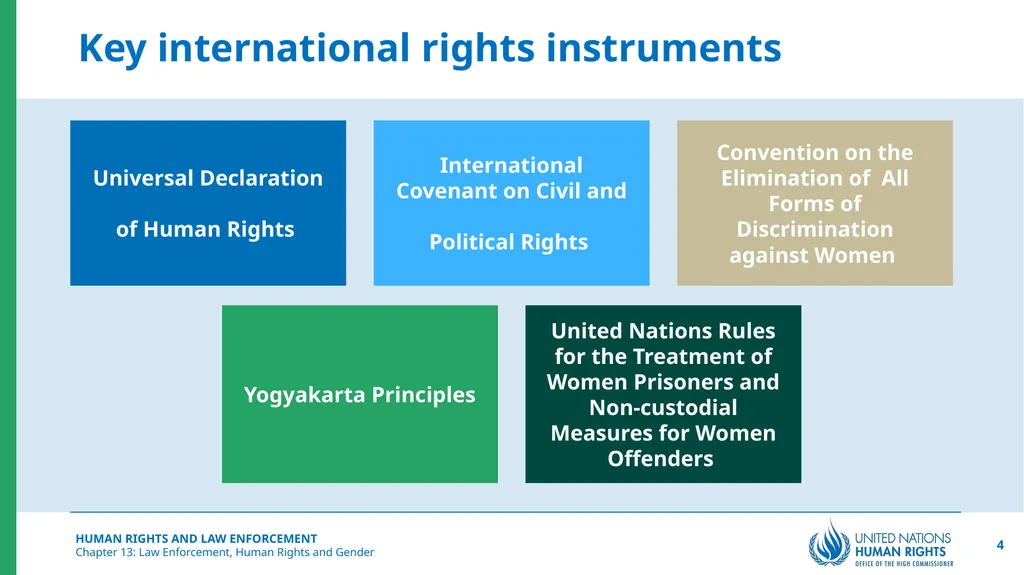
Key international rights instruments Chapter 13: Law Enforcement, Human Rights and Gender 4<br>
04
Fundamental principle relevant to law enforcement and the human rights of women Chapter 13: Law Enforcement, Human Rights and Gender 5 Equality and non-discrimination
“Any distinction, exclusion or restriction made on the basis of sex which has the effect or purpose of impairing or nullifying the recognition, enjoyment or exercise by women, irrespective of their marital status, on a basis of equality of men and women …” (CEDAW, art. 1)<br>
05
Right to freedom from violence, exploitation, abuse Chapter 13: Law Enforcement, Human Rights and Gender 6 Address traditional attitudes and gender-based violence
Omission or failure by LEOs to act on information about gender-based violence is a violation of the responsibility to protect
Failure to investigate gender-based violence is a violation of the responsibility to protect Definition: “Any act of gender-based violence that results in, or is likely to result in, physical, sexual or psychological harm or suffering to women, including threats of such acts, coercion or arbitrary deprivation of liberty, whether occurring in public or private life” (Declaration on the Elimination of Violence against Women)<br>
06
Responding to gender-based violence Chapter 13: Law Enforcement, Human Rights and Gender 7 Enable inter-agency cooperation for prevention
Increase LEO availability (24/7) and accessibility
Invest in emergency response capacity
Develop comprehensive protocols for investigation
Establish special units to deal with domestic violence
Develop victim-oriented crisis interventions
Implement intensive training for LEOs on how to deal with the phenomenon 3 key roles:
Prevent, Respect and Protect Victims<br>
07
Right to freedom from violence, exploitation, abuse (continued) Chapter 13: Law Enforcement, Human Rights and Gender 8 Rape and other sexual offences:
Prevention, detection and responses to victims
Sexual violence in times of conflict:
War crimes when systematic/widespread attack
Command responsibility (see ICC landmark case Prosecutor v. Gombo)<br>
08
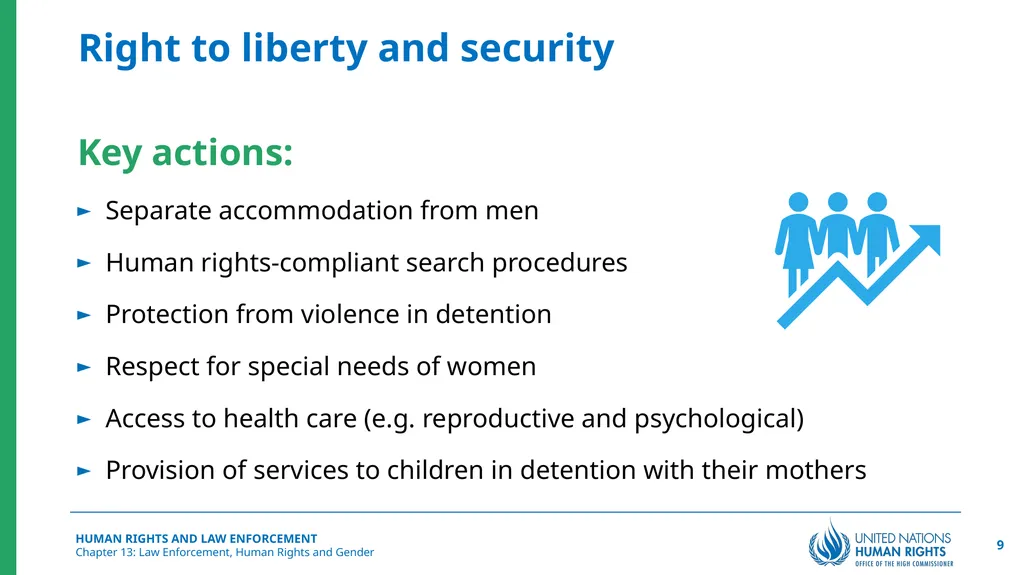
Right to liberty and security Chapter 13: Law Enforcement, Human Rights and Gender 9 Key actions:
Separate accommodation from men
Human rights-compliant search procedures
Protection from violence in detention
Respect for special needs of women
Access to health care (e.g. reproductive and psychological)
Provision of services to children in detention with their mothers<br>
09
Right to work Chapter 13: Law Enforcement, Human Rights and Gender 10 Key actions:
Provide equal opportunity in law enforcement recruitment, vocational training and promotion
Abstain from gender biases in law enforcement operational decisions
Enable a women-friendly law enforcement work environment (flexibility in working hours, facilities at police stations, e.g. toilets and changing rooms)<br>
10
Human rights relevant to LGBTI persons and law enforcement Chapter 13: Law Enforcement, Human Rights and Gender 11<br>
11
Human rights relevant to LGBTI persons and law enforcement Chapter 13: Law Enforcement, Human Rights and Gender 12<br>
12
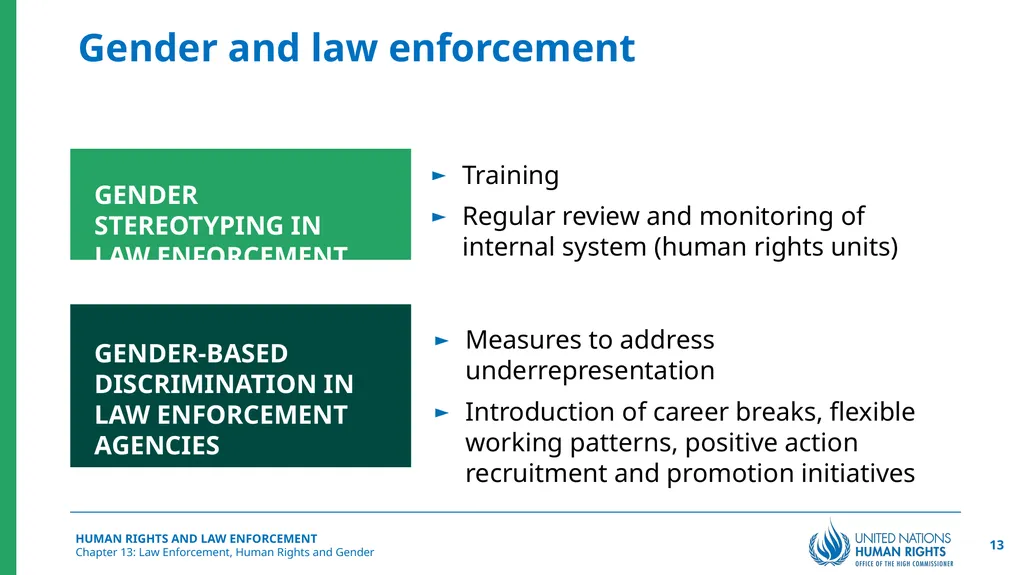
Gender and law enforcement Chapter 13: Law Enforcement, Human Rights and Gender 13 GENDER STEREOTYPING IN LAW ENFORCEMENT Training
Regular review and monitoring of internal system (human rights units) GENDER-BASED DISCRIMINATION IN LAW ENFORCEMENT AGENCIES Measures to address underrepresentation
Introduction of career breaks, flexible working patterns, positive action recruitment and promotion initiatives<br>
13
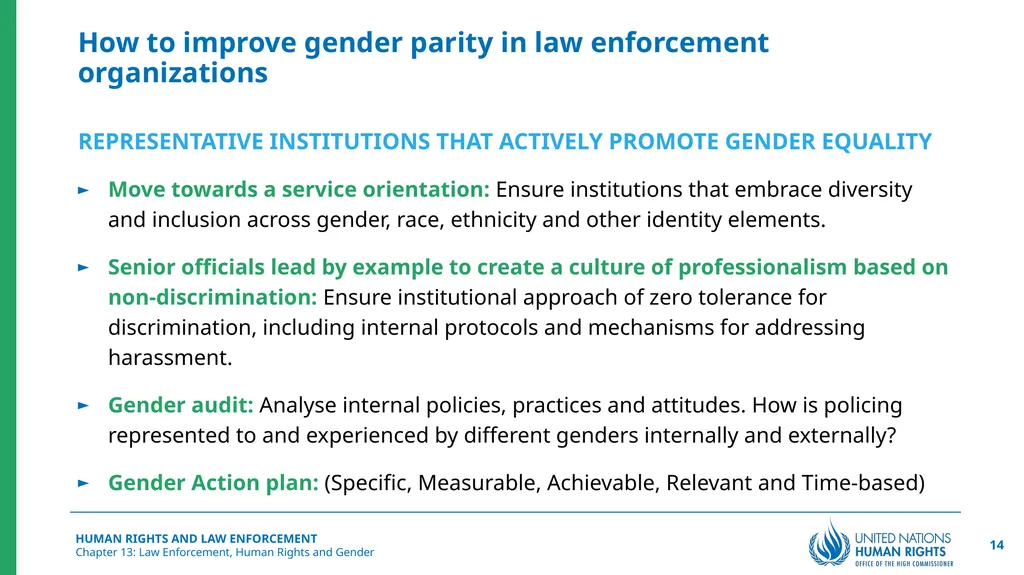
How to improve gender parity in law enforcement organizations Chapter 13: Law Enforcement, Human Rights and Gender 14 REPRESENTATIVE INSTITUTIONS THAT ACTIVELY PROMOTE GENDER EQUALITY
Move towards a service orientation: Ensure institutions that embrace diversity and inclusion across gender, race, ethnicity and other identity elements.
Senior officials lead by example to create a culture of professionalism based on non-discrimination: Ensure institutional approach of zero tolerance for discrimination, including internal protocols and mechanisms for addressing harassment.
Gender audit: Analyse internal policies, practices and attitudes. How is policing represented to and experienced by different genders internally and externally?
Gender Action plan: (Specific, Measurable, Achievable, Relevant and Time-based)<br>
14
How to improve Gender parity in law enforcement organizations Chapter 13: Law Enforcement, Human Rights and Gender 15 POLICY INTERVENTIONS AND TARGETED ACTIONS TO BREAK HISTORIC AND INSTITUTIONAL DISCRIMINATION
Remove legal and policy barriers (direct and indirect discrimination) for gender equality in the police institution. Ensure that recruitment, training, retention and advancement policies are not discriminatory.
Introduction of career breaks, flexible working arrangements, positive action in recruitment and promotion initiatives. Other examples include flexible work schedules, parental leave and childcare support.
Gender sensitive facilities and equipment. Policing uniforms and facilities (such as accommodation and lavatories) are designed with gender diversity in mind and promote inclusion, including through consultation with women and LGBTI persons.<br>
15
How to improve Gender parity in law enforcement organizations Chapter 13: Law Enforcement, Human Rights and Gender 16 TARGETED ACTIONS TO INCREASE FEMALE AND LGBTI OFFICERS IN MID- AND SENIOR-LEVEL POSITIONS
Recruitment drives explicitly targeting women and LGBTI persons to ensure a broad recruitment base of qualified candidates.
Pre-academy selection support programmes to ensure potential female and LGBTI candidates can meet entry requirements.
Ensure recruitment criteria and processes are required and relevant and do not screen out women and LGBTI applicants in a discriminatory manner.
Senior female and LGBTI law enforcement officer command development courses to identify and retain female and LGBTI candidates for mid- and senior-level positions.
Mentoring and training programmes for female and LGBTI aspiring leaders.
Use of police associations to assist in providing networks, mentoring and peer support to women and LGBTI persons within law enforcement institutions.<br>
16
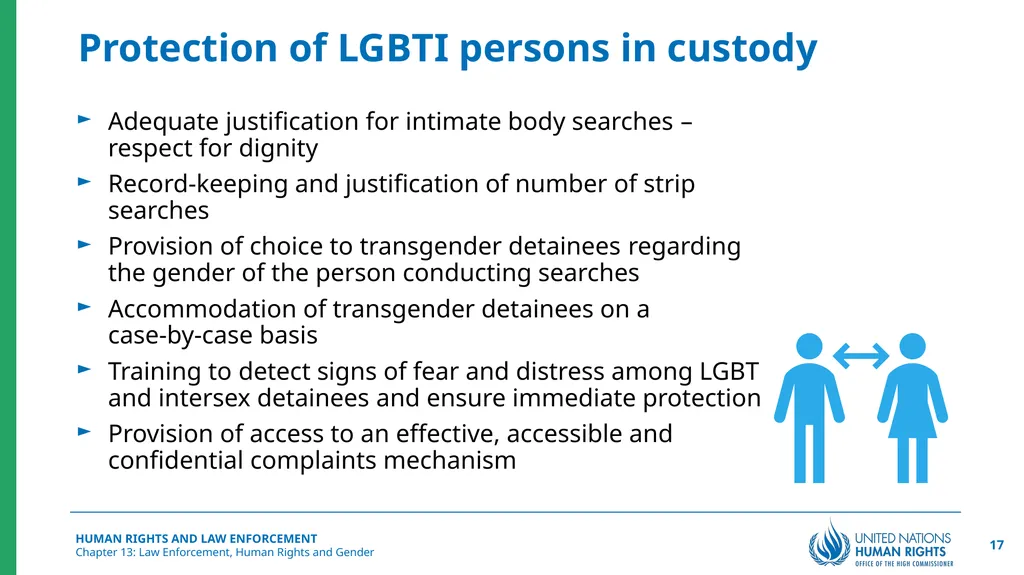
Protection of LGBTI persons in custody Chapter 13: Law Enforcement, Human Rights and Gender 17 Adequate justification for intimate body searches – respect for dignity
Record-keeping and justification of number of strip searches
Provision of choice to transgender detainees regarding the gender of the person conducting searches
Accommodation of transgender detainees on a case-by-case basis
Training to detect signs of fear and distress among LGBT and intersex detainees and ensure immediate protection
Provision of access to an effective, accessible and confidential complaints mechanism<br>