
Layout Setting-up the course strategy Office work
Description: Layout Setting-up the course strategy Office work syllabus Prerequisites Introduction Management of Enterprise Information System Course Strategy and Officework Please commit yourself to lecture time ( late arrival are not acceptable),
Related Topics
Download Presentation
"Layout Setting-up the course strategy Office work" is the property of its rightful owner. Permission is granted to download and print the materials on this website for personal, non-commercial use only, and to display it on your personal computer provided you do not modify the materials and that you retain all copyright notices contained in the materials. By downloading content from our website, you accept the terms of this agreement.
Presentation Transcript
slide1. Layout Setting-up the course strategy
Office work
syllabus
Prerequisites
Introduction Management of Enterprise
Information System<br>
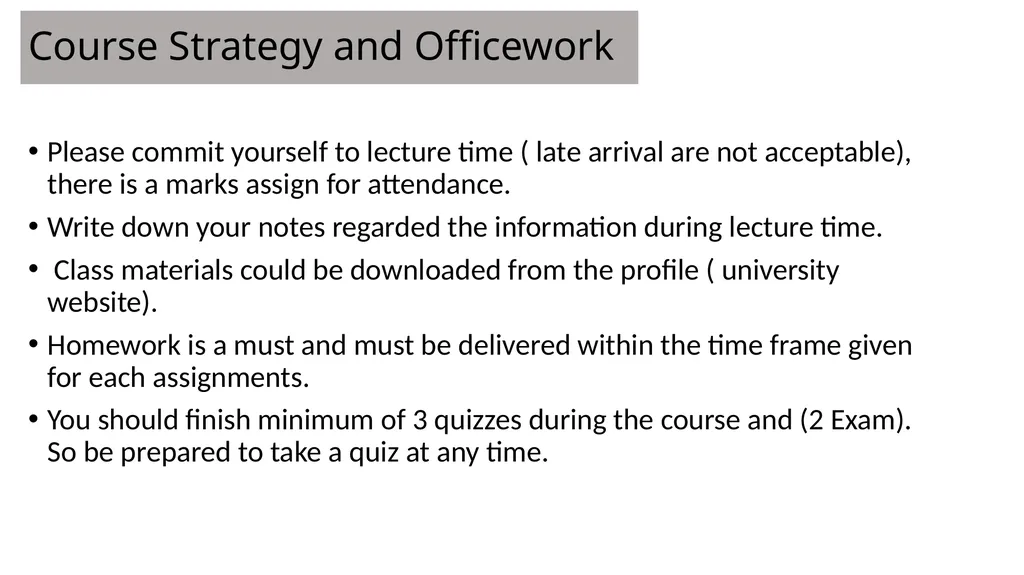
slide2. Course Strategy and Officework Please commit yourself to lecture time ( late arrival are not acceptable), there is a marks assign for attendance.
Write down your notes regarded the information during lecture time.
Class materials could be downloaded from the profile ( university website).
Homework is a must and must be delivered within the time frame given for each assignments.
You should finish minimum of 3 quizzes during the course and (2 Exam). So be prepared to take a quiz at any time.<br>
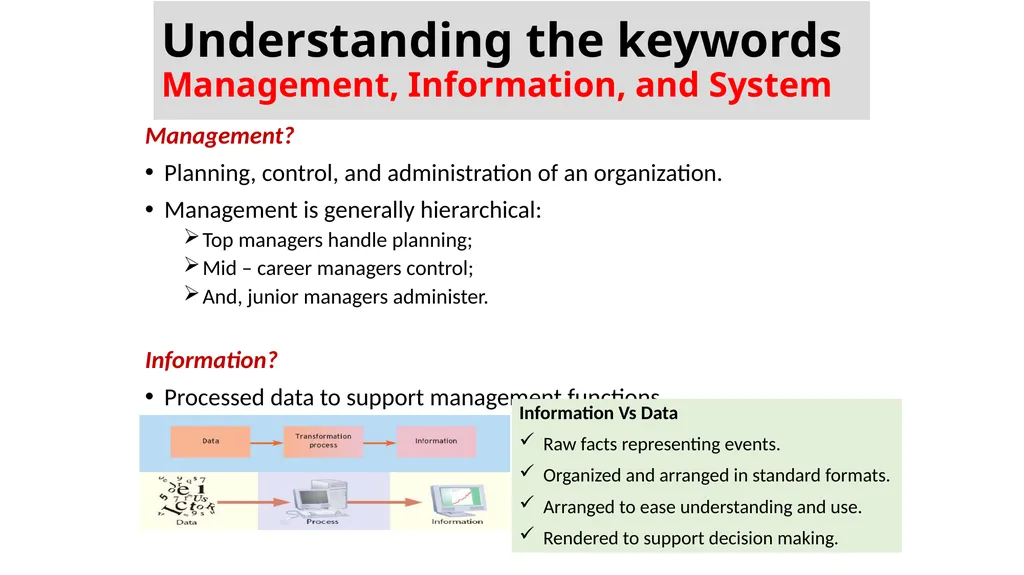
slide4. Understanding the keywords Management, Information, and System Management?
Planning, control, and administration of an organization.
Management is generally hierarchical:
Top managers handle planning;
Mid – career managers control;
And, junior managers administer.
Information?
Processed data to support management functions Information Vs Data
Raw facts representing events.
Organized and arranged in standard formats.
Arranged to ease understanding and use.
Rendered to support decision making.<br>
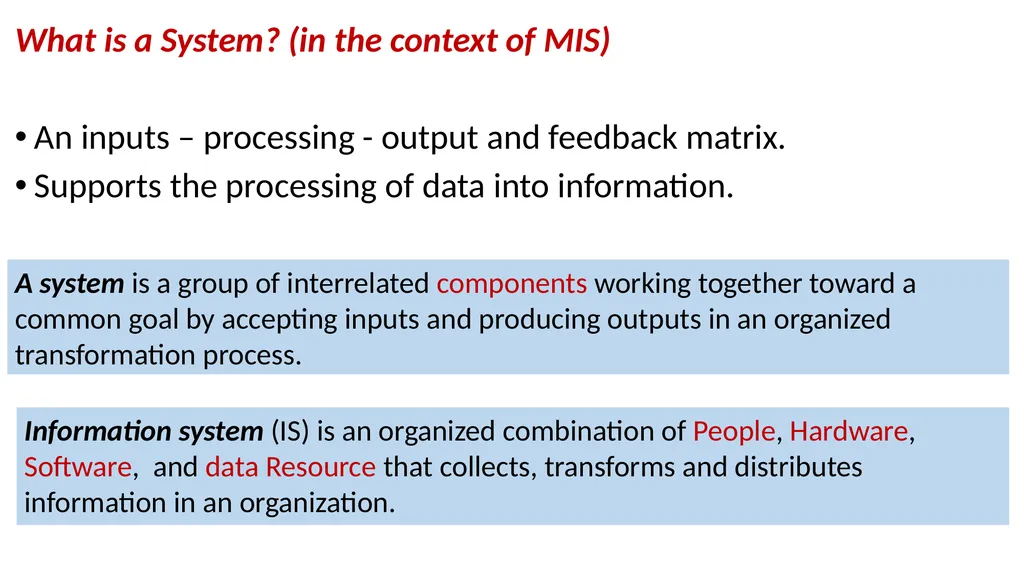
slide5. What is a System? (in the context of MIS)
An inputs – processing - output and feedback matrix.
Supports the processing of data into information. A system is a group of interrelated components working together toward a common goal by accepting inputs and producing outputs in an organized transformation process. Information system (IS) is an organized combination of People, Hardware, Software, and data Resource that collects, transforms and distributes information in an organization.<br>
slide6. Management Information System A management information system (MIS) is a system or process that provides the information necessary to manage an organization effectively.
Used by managers throughout the organization to help them in
directing,
planning,
coordinating,
communicating,
and decision-making.<br>
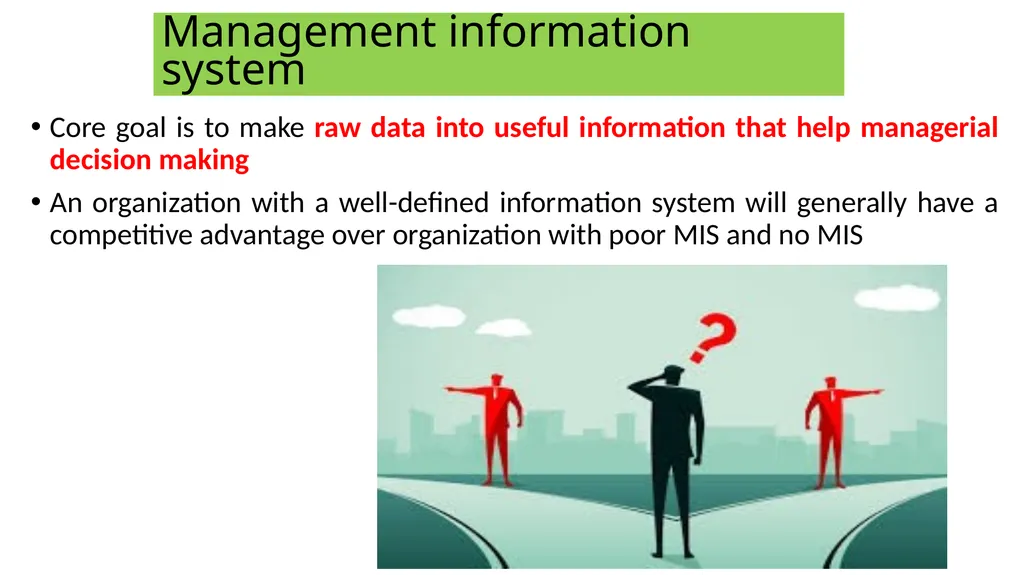
slide7. Management information system Core goal is to make raw data into useful information that help managerial decision making
An organization with a well-defined information system will generally have a competitive advantage over organization with poor MIS and no MIS<br>
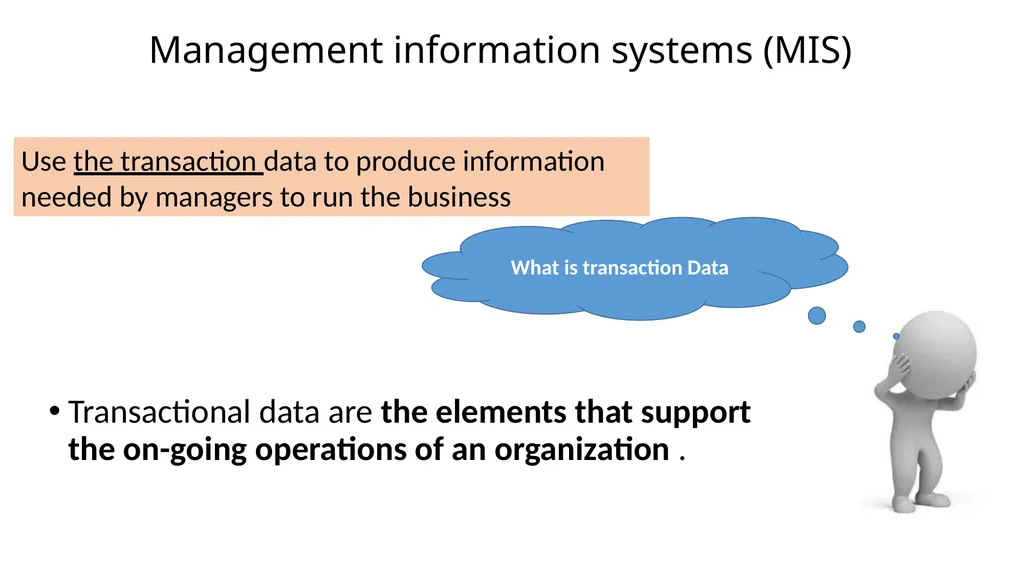
slide8. Management information systems (MIS) Use the transaction data to produce information
needed by managers to run the business What is transaction Data Transactional data are the elements that support the on-going operations of an organization .<br>
slide9. What are the reasons for MIS? The MIS plays the role of information generation, communication, problem identification and helps in the process of decision-making. The MIS, therefore, plays a vital role in the management, administration and operation of an organization
MIS provides the necessary information to the managers and supervisors at various levels<br>
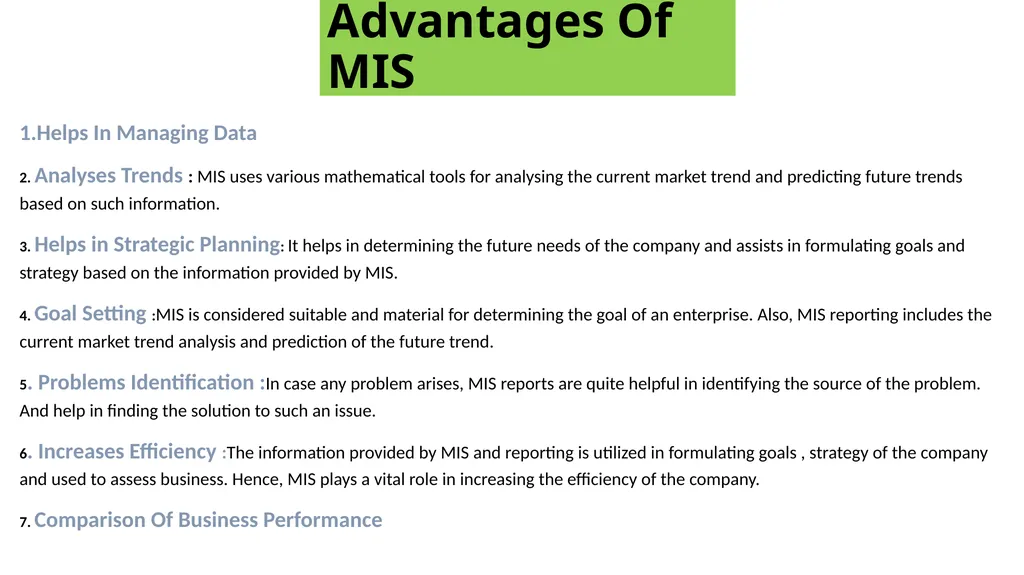
slide10. Advantages Of MIS Helps In Managing Data
2. Analyses Trends : MIS uses various mathematical tools for analysing the current market trend and predicting future trends based on such information.
3. Helps in Strategic Planning: It helps in determining the future needs of the company and assists in formulating goals and strategy based on the information provided by MIS.
4. Goal Setting :MIS is considered suitable and material for determining the goal of an enterprise. Also, MIS reporting includes the current market trend analysis and prediction of the future trend.
5. Problems Identification :In case any problem arises, MIS reports are quite helpful in identifying the source of the problem. And help in finding the solution to such an issue.
6. Increases Efficiency :The information provided by MIS and reporting is utilized in formulating goals , strategy of the company and used to assess business. Hence, MIS plays a vital role in increasing the efficiency of the company.
7. Comparison Of Business Performance<br>
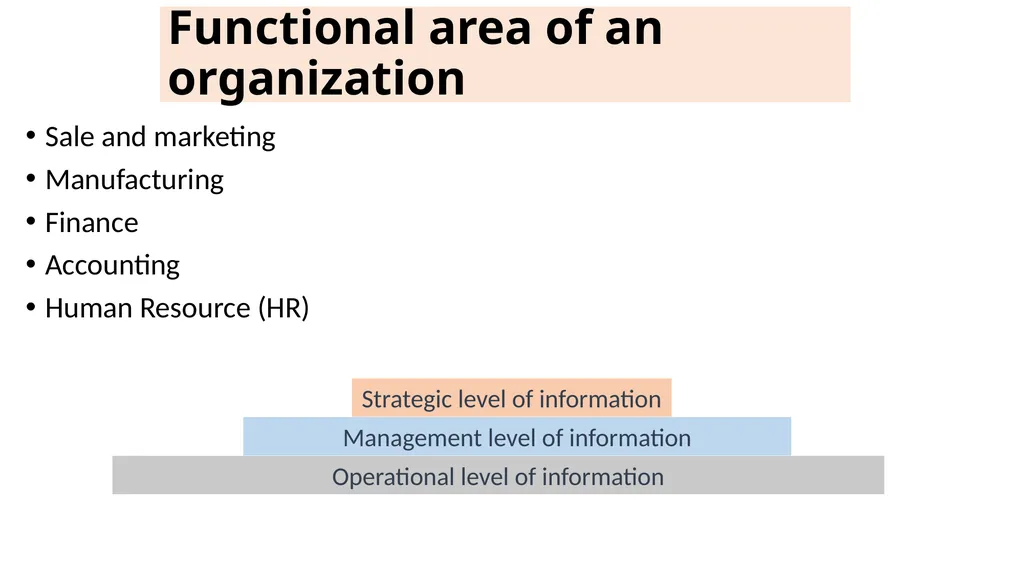
slide11. Functional area of an organization Sale and marketing
Manufacturing
Finance
Accounting
Human Resource (HR) Strategic level of information Management level of information Operational level of information<br>
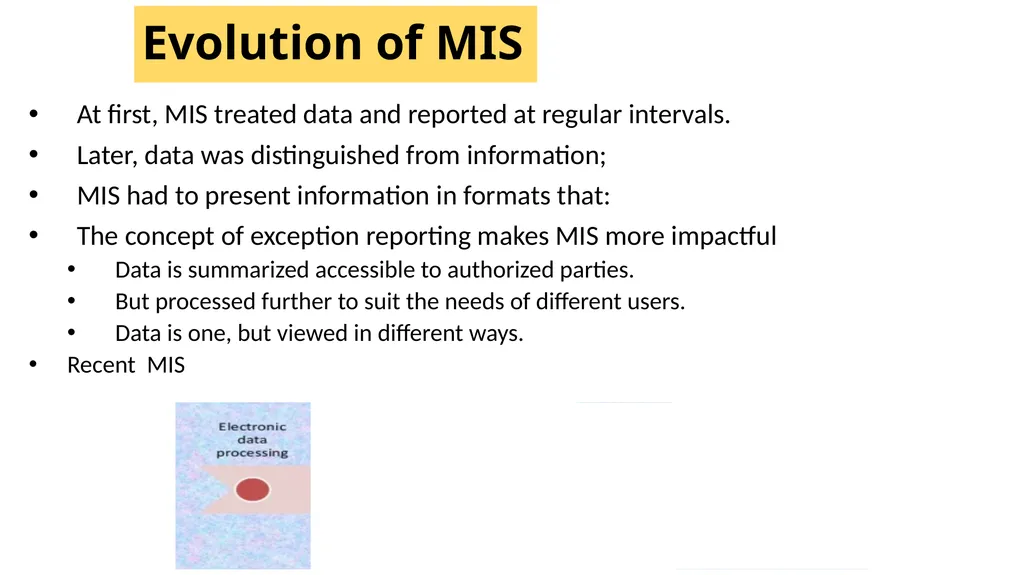
slide12. Evolution of MIS At first, MIS treated data and reported at regular intervals.
Later, data was distinguished from information;
MIS had to present information in formats that:
The concept of exception reporting makes MIS more impactful
Data is summarized accessible to authorized parties.
But processed further to suit the needs of different users.
Data is one, but viewed in different ways.
Recent MIS<br>
Office work
syllabus
Prerequisites
Introduction Management of Enterprise
Information System<br>
slide2. Course Strategy and Officework Please commit yourself to lecture time ( late arrival are not acceptable), there is a marks assign for attendance.
Write down your notes regarded the information during lecture time.
Class materials could be downloaded from the profile ( university website).
Homework is a must and must be delivered within the time frame given for each assignments.
You should finish minimum of 3 quizzes during the course and (2 Exam). So be prepared to take a quiz at any time.<br>
slide4. Understanding the keywords Management, Information, and System Management?
Planning, control, and administration of an organization.
Management is generally hierarchical:
Top managers handle planning;
Mid – career managers control;
And, junior managers administer.
Information?
Processed data to support management functions Information Vs Data
Raw facts representing events.
Organized and arranged in standard formats.
Arranged to ease understanding and use.
Rendered to support decision making.<br>
slide5. What is a System? (in the context of MIS)
An inputs – processing - output and feedback matrix.
Supports the processing of data into information. A system is a group of interrelated components working together toward a common goal by accepting inputs and producing outputs in an organized transformation process. Information system (IS) is an organized combination of People, Hardware, Software, and data Resource that collects, transforms and distributes information in an organization.<br>
slide6. Management Information System A management information system (MIS) is a system or process that provides the information necessary to manage an organization effectively.
Used by managers throughout the organization to help them in
directing,
planning,
coordinating,
communicating,
and decision-making.<br>
slide7. Management information system Core goal is to make raw data into useful information that help managerial decision making
An organization with a well-defined information system will generally have a competitive advantage over organization with poor MIS and no MIS<br>
slide8. Management information systems (MIS) Use the transaction data to produce information
needed by managers to run the business What is transaction Data Transactional data are the elements that support the on-going operations of an organization .<br>
slide9. What are the reasons for MIS? The MIS plays the role of information generation, communication, problem identification and helps in the process of decision-making. The MIS, therefore, plays a vital role in the management, administration and operation of an organization
MIS provides the necessary information to the managers and supervisors at various levels<br>
slide10. Advantages Of MIS Helps In Managing Data
2. Analyses Trends : MIS uses various mathematical tools for analysing the current market trend and predicting future trends based on such information.
3. Helps in Strategic Planning: It helps in determining the future needs of the company and assists in formulating goals and strategy based on the information provided by MIS.
4. Goal Setting :MIS is considered suitable and material for determining the goal of an enterprise. Also, MIS reporting includes the current market trend analysis and prediction of the future trend.
5. Problems Identification :In case any problem arises, MIS reports are quite helpful in identifying the source of the problem. And help in finding the solution to such an issue.
6. Increases Efficiency :The information provided by MIS and reporting is utilized in formulating goals , strategy of the company and used to assess business. Hence, MIS plays a vital role in increasing the efficiency of the company.
7. Comparison Of Business Performance<br>
slide11. Functional area of an organization Sale and marketing
Manufacturing
Finance
Accounting
Human Resource (HR) Strategic level of information Management level of information Operational level of information<br>
slide12. Evolution of MIS At first, MIS treated data and reported at regular intervals.
Later, data was distinguished from information;
MIS had to present information in formats that:
The concept of exception reporting makes MIS more impactful
Data is summarized accessible to authorized parties.
But processed further to suit the needs of different users.
Data is one, but viewed in different ways.
Recent MIS<br>