Lazy Learners (or Learning from Your Neighbors) Eager learners, when given a set of training tuples, will construct a classification model before receiving new (e.g., test) tuples to classify. Lazy learners, simply store training tuples (or
"Lazy Learners (or Learning from Your Neighbors)" is the property of its rightful owner. Permission is granted to
download and print the materials on this website for personal, non-commercial use only, and to display it
on your personal computer provided you do not modify the materials and that you retain all copyright
notices contained in the materials. By downloading content from our website, you accept the terms of this
agreement.
Presentation Transcript
01
Lazy Learners (or Learning from Your Neighbors)<br>
02
Eager learners, when given a set of training tuples, will construct a classification model before receiving new (e.g., test) tuples to classify.
Lazy learners, simply store training tuples (or perform minimal processing) and wait until a test tuple is encountered. Only when it sees the test tuple does it perform generalization to classify the tuple based on its similarity to the stored training tuples.
Unlike eager learning methods, lazy learners do less work when a training tuple is presented and more work when making a classification or numeric prediction for the test tuple.
The most popular example of Lazy learners is k-Nearest-Neighbor (k-NN) Classifiers.<br>
03
k-Nearest-Neighbor (k-NN) Algorithm<br>
04
The K-Nearest Neighbors (K-NN) algorithm is a popular algorithm used mostly for solving classification problems.
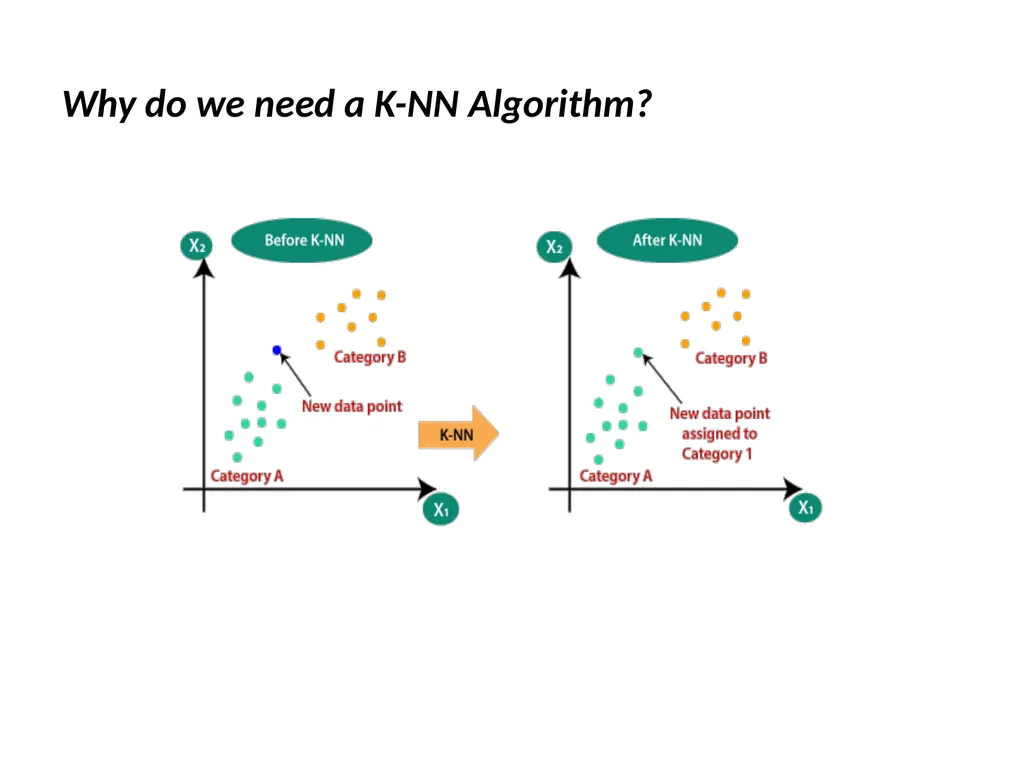
The K-NN algorithm stores all the available data (training data) and classifies a new data point (test data) based on the similarity.
In other words, The K-NN algorithm compares a new data point to the data / values in a given data set (with different classes or categories). Based on its closeness or similarities in a given range (K) of neighbors, the algorithm assigns the new data to a class or category in the data set (training data).<br>
05
Why do we need a K-NN Algorithm?<br>
06
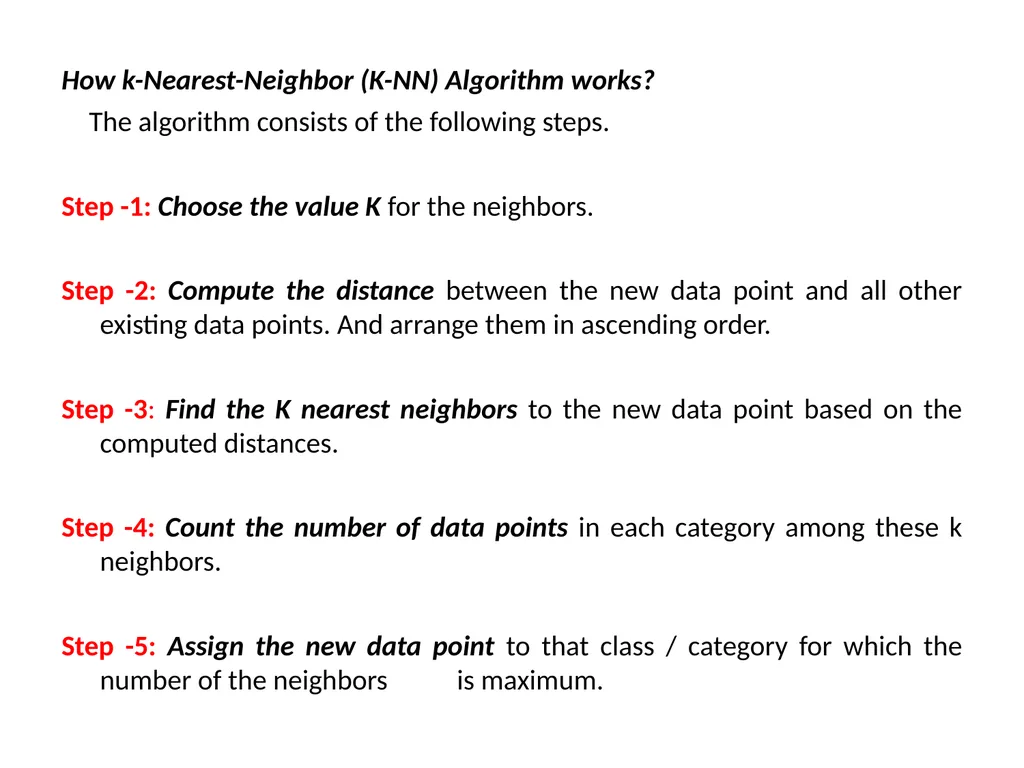
How k-Nearest-Neighbor (K-NN) Algorithm works?
The algorithm consists of the following steps.
Step -1: Choose the value K for the neighbors.
Step -2: Compute the distance between the new data point and all other existing data points. And arrange them in ascending order.
Step -3: Find the K nearest neighbors to the new data point based on the computed distances.
Step -4: Count the number of data points in each category among these k neighbors.
Step -5: Assign the new data point to that class / category for which the number of the neighbors is maximum.<br>
07
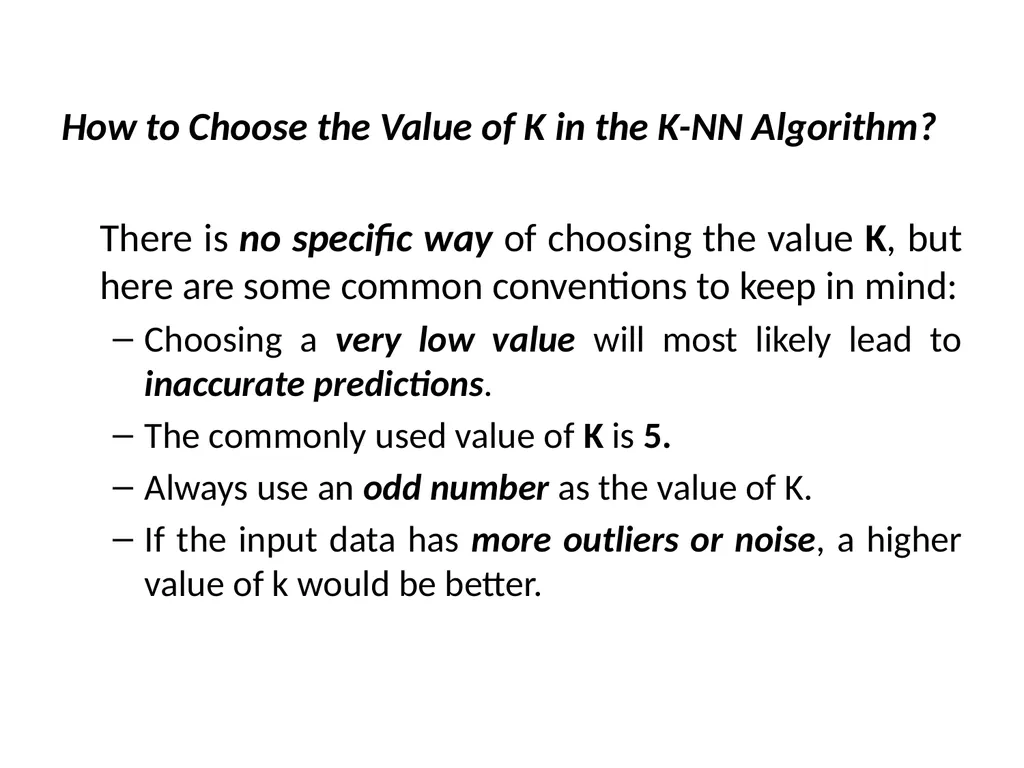
How to Choose the Value of K in the K-NN Algorithm?
There is no specific way of choosing the value K, but here are some common conventions to keep in mind:
Choosing a very low value will most likely lead to inaccurate predictions.
The commonly used value of K is 5.
Always use an odd number as the value of K.
If the input data has more outliers or noise, a higher value of k would be better.<br>
08
How to Compute the Distance? (or)
Distance Measures Used in KNN Algorithm?
The K-NN algorithm enables us to classify or categorize the new data point by calculating the distance from other pre-existing data points.
To calculate the distance we use any of the following are Distance Measures.
Euclidean distance
Manhattan distance<br>
09
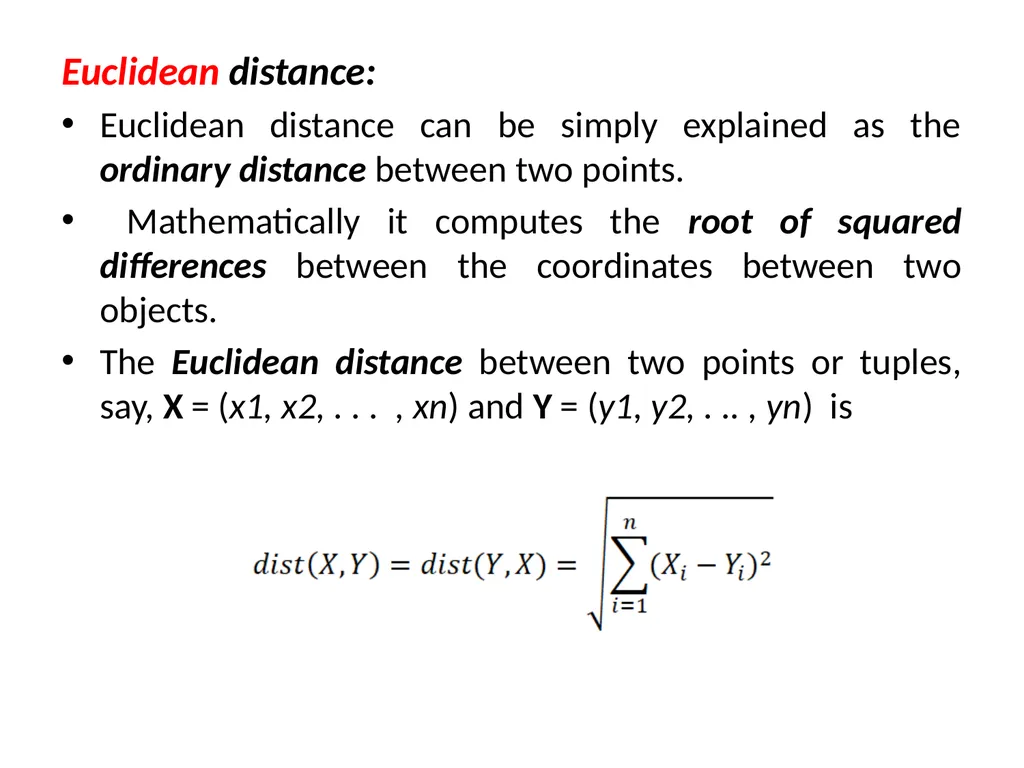
Euclidean distance:
Euclidean distance can be simply explained as the ordinary distance between two points.
Mathematically it computes the root of squared differences between the coordinates between two objects.
The Euclidean distance between two points or tuples, say, X = (x1, x2, . . . , xn) and Y = (y1, y2, . .. , yn) is<br>
10
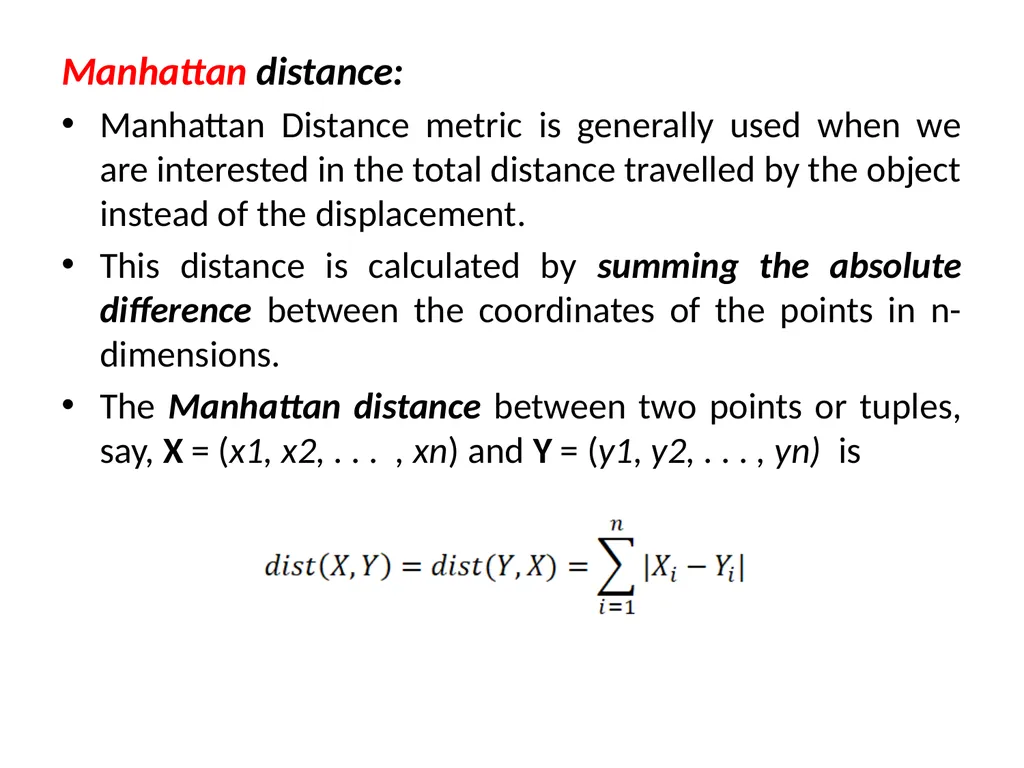
Manhattan distance:
Manhattan Distance metric is generally used when we are interested in the total distance travelled by the object instead of the displacement.
This distance is calculated by summing the absolute difference between the coordinates of the points in n-dimensions.
The Manhattan distance between two points or tuples, say, X = (x1, x2, . . . , xn) and Y = (y1, y2, . . . , yn) is<br>
11
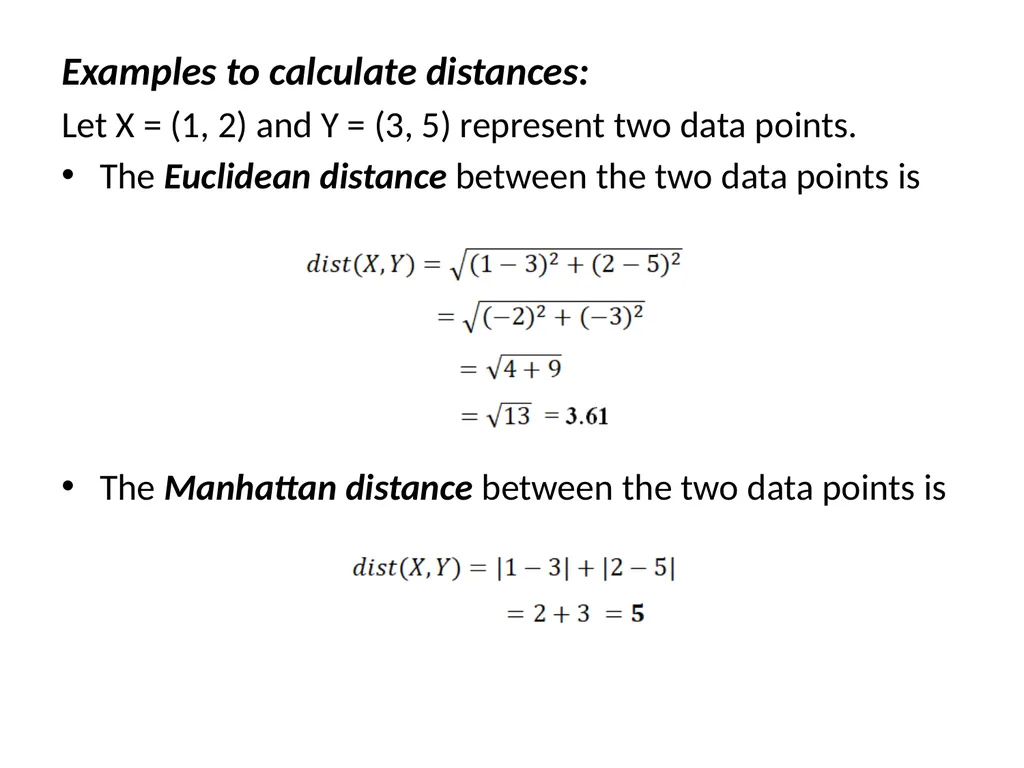
Examples to calculate distances:
Let X = (1, 2) and Y = (3, 5) represent two data points.
The Euclidean distance between the two data points is
The Manhattan distance between the two data points is<br>
12
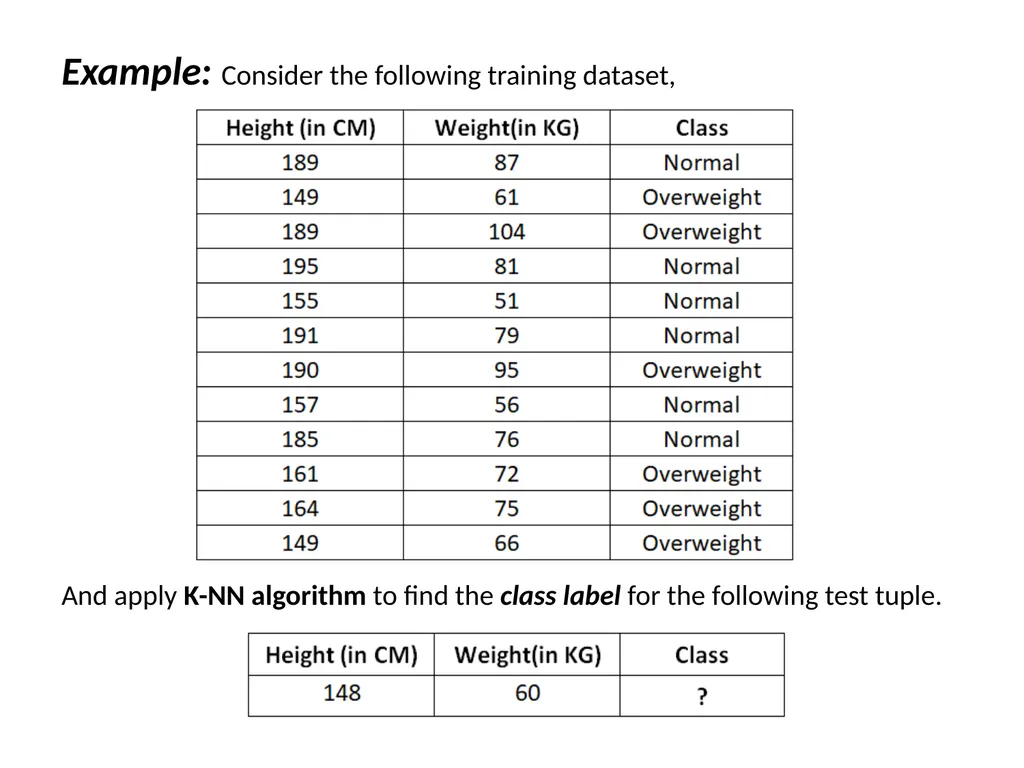
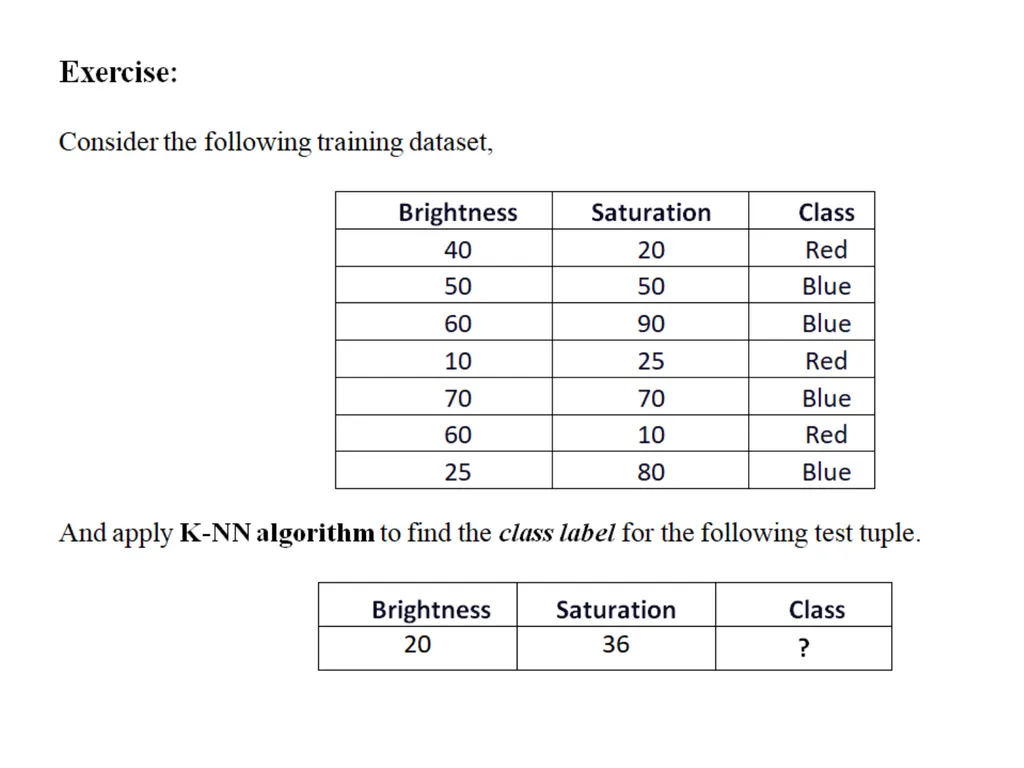
Example: Consider the following training dataset,
And apply K-NN algorithm to find the class label for the following test tuple.<br>
13
Solution:
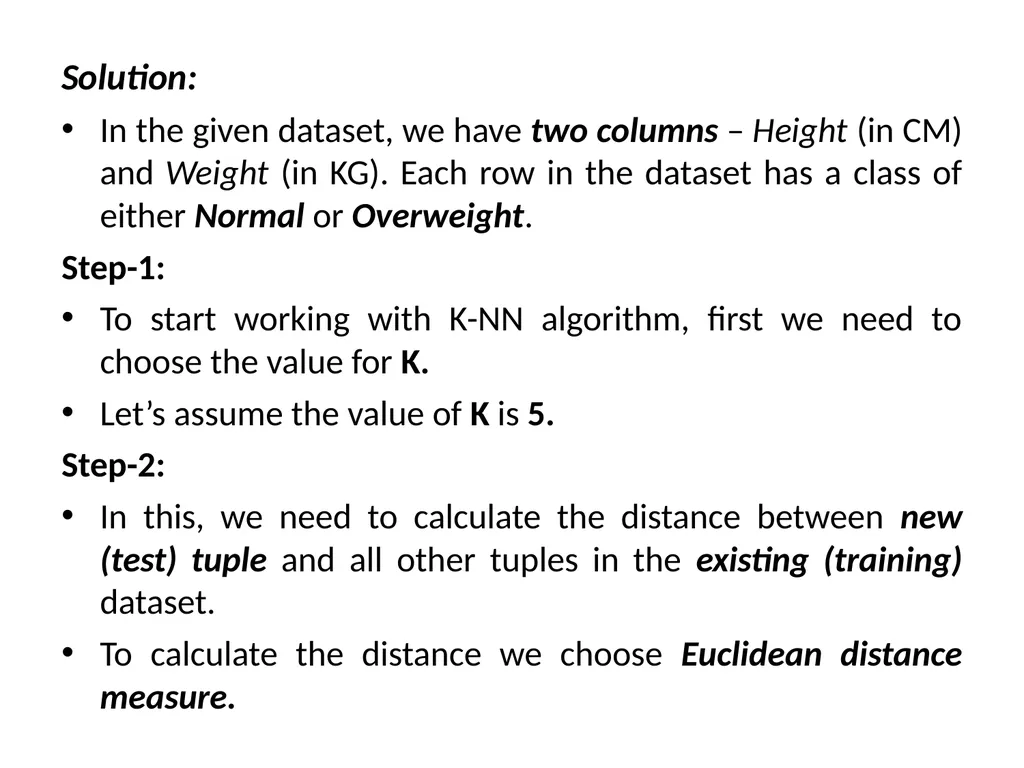
In the given dataset, we have two columns – Height (in CM) and Weight (in KG). Each row in the dataset has a class of either Normal or Overweight.
Step-1:
To start working with K-NN algorithm, first we need to choose the value for K.
Let’s assume the value of K is 5.
Step-2:
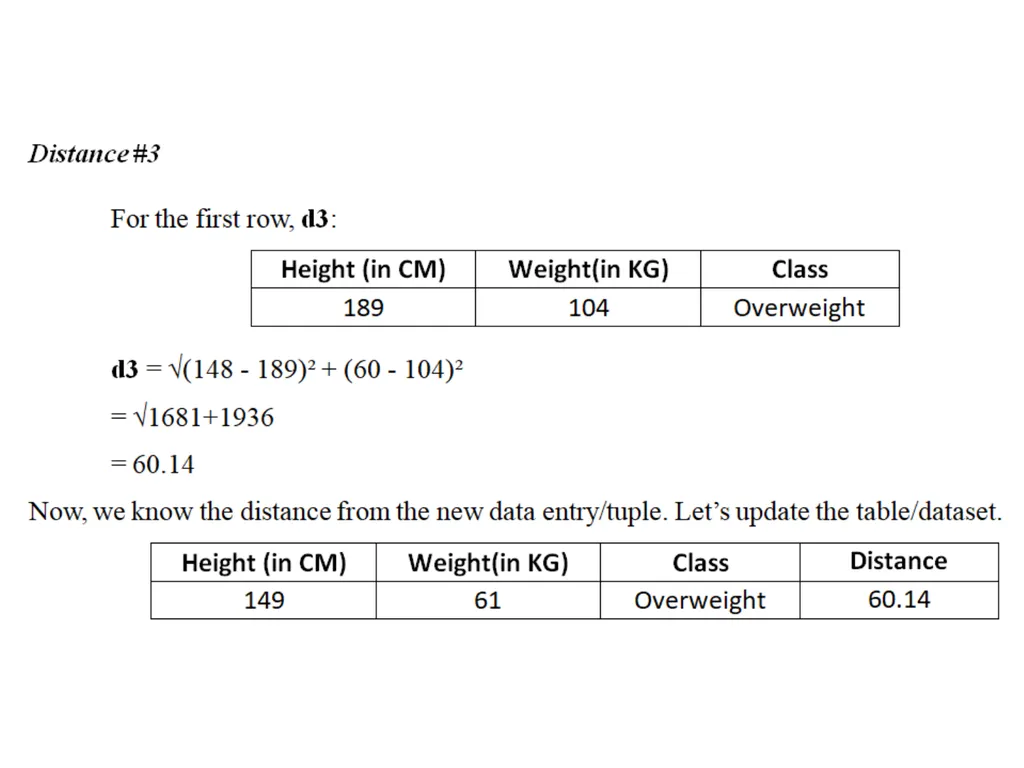
In this, we need to calculate the distance between new (test) tuple and all other tuples in the existing (training) dataset.
To calculate the distance we choose Euclidean distance measure.<br>
14
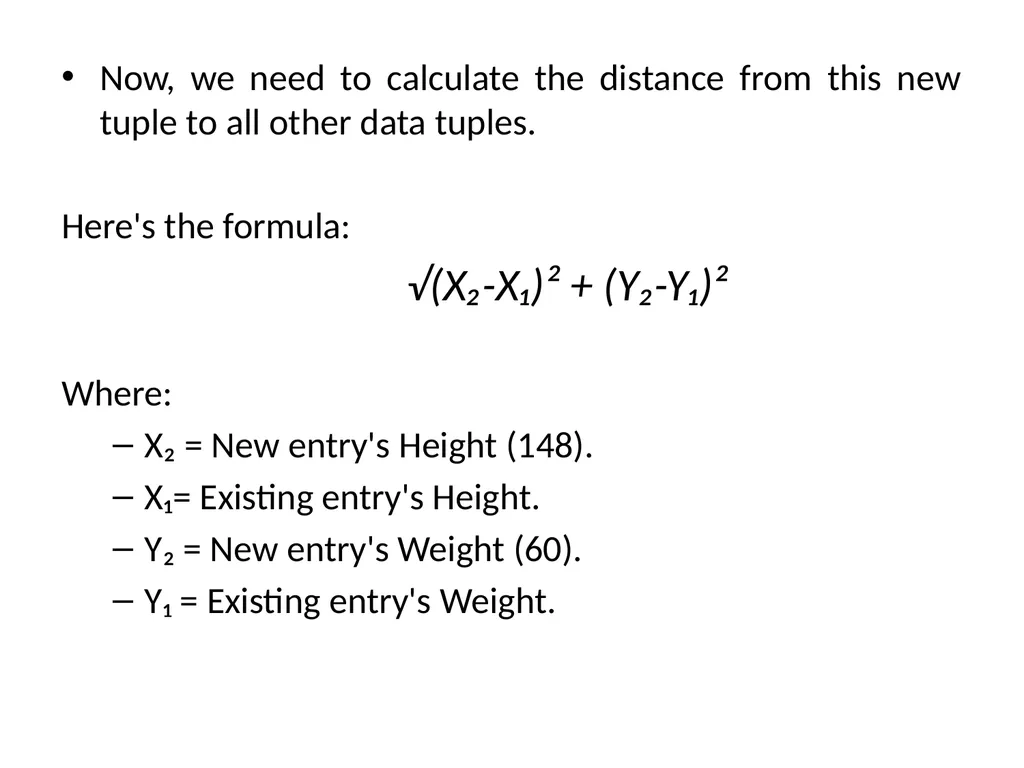
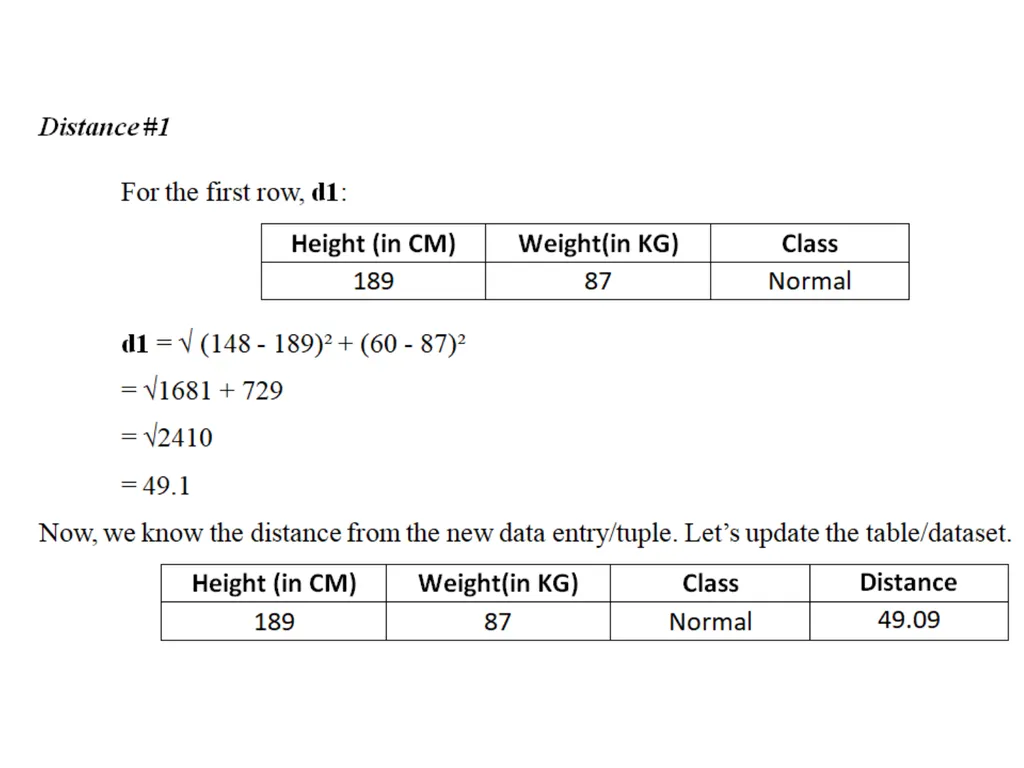
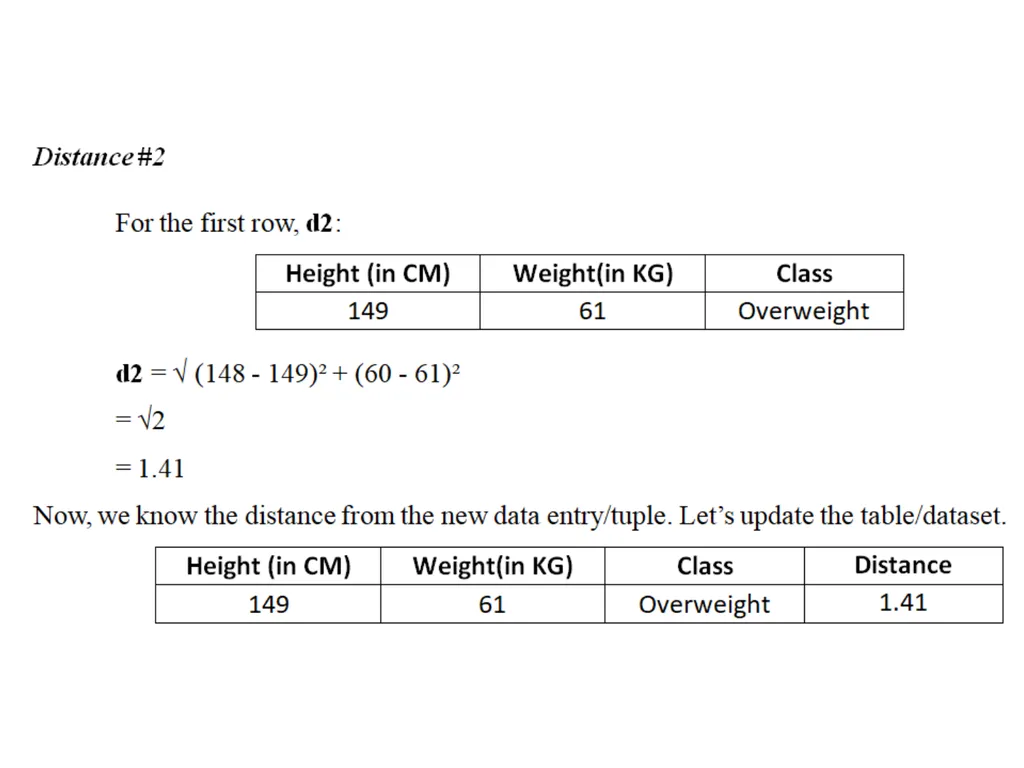
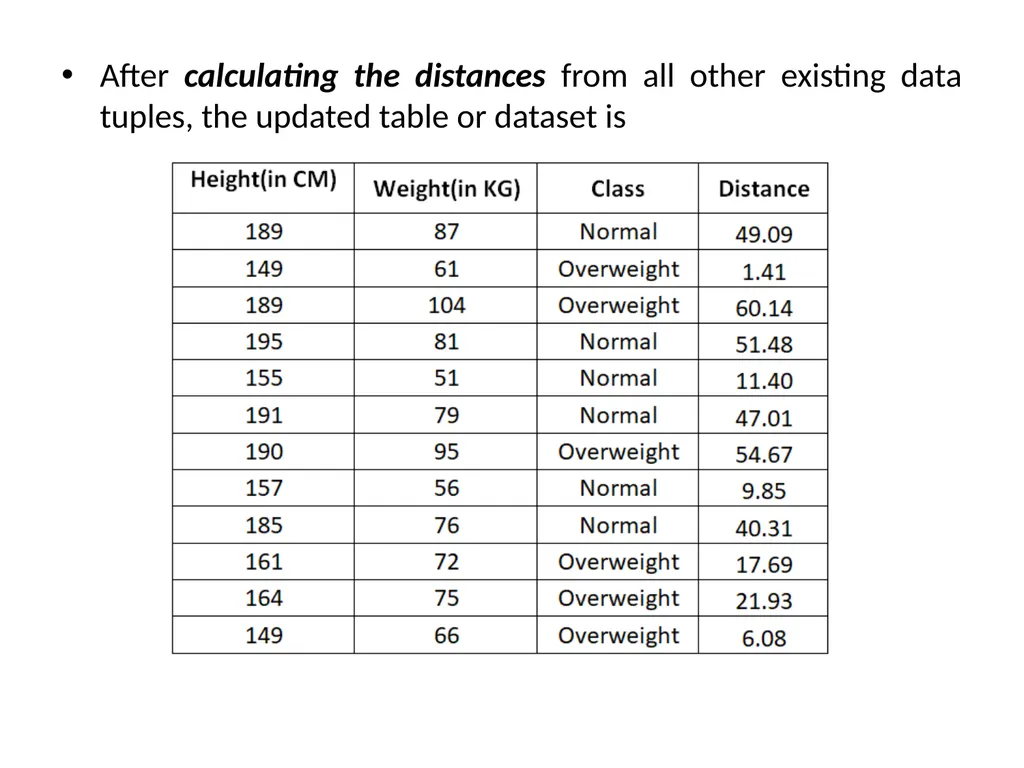
Now, we need to calculate the distance from this new tuple to all other data tuples.
After calculating the distances from all other existing data tuples, the updated table or dataset is<br>
16
Let's rearrange the distances in ascending order:<br>
17
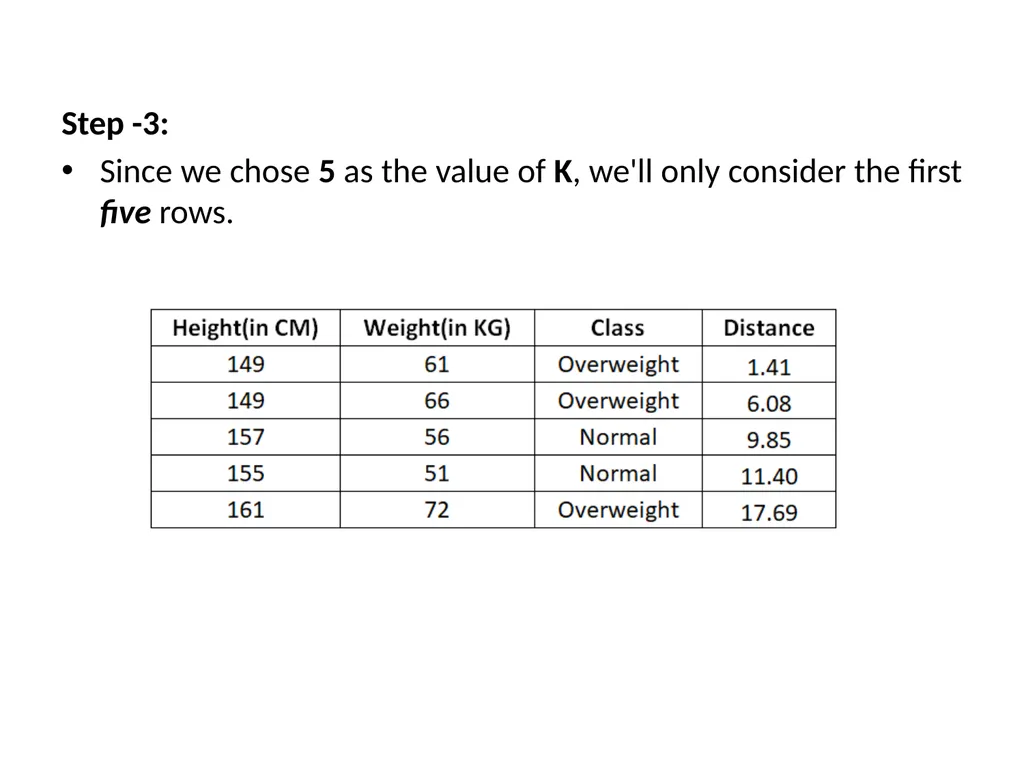
Step -3:
Since we chose 5 as the value of K, we'll only consider the first five rows.<br>
18
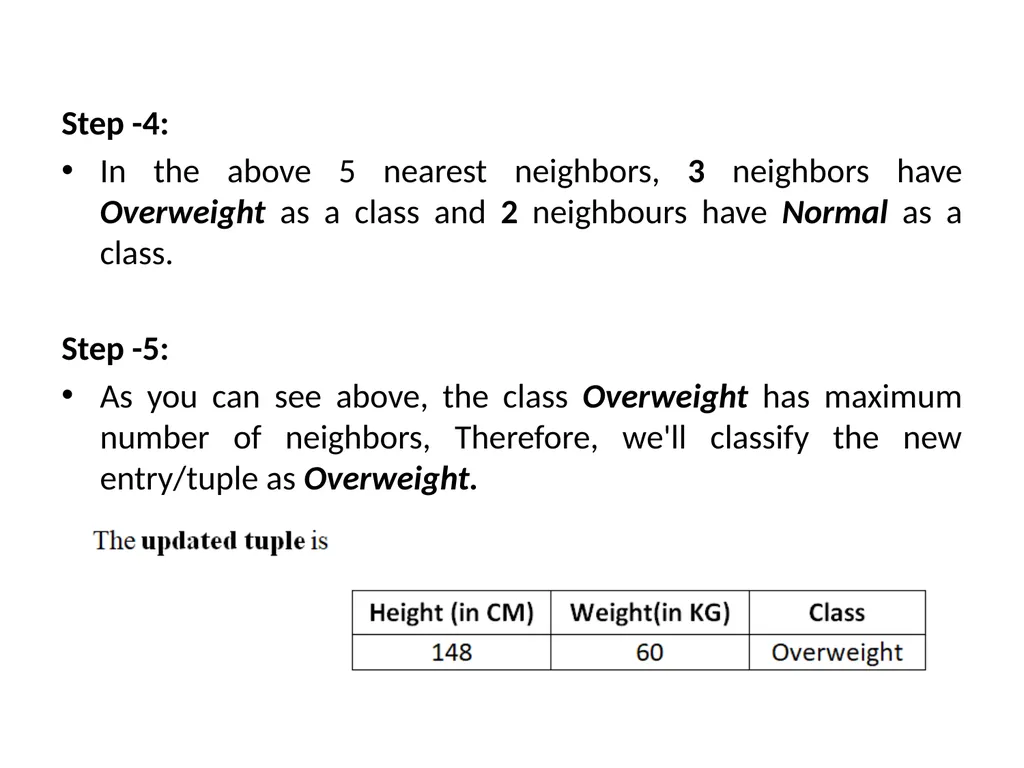
Step -4:
In the above 5 nearest neighbors, 3 neighbors have Overweight as a class and 2 neighbours have Normal as a class.
Step -5:
As you can see above, the class Overweight has maximum number of neighbors, Therefore, we'll classify the new entry/tuple as Overweight.<br>
19
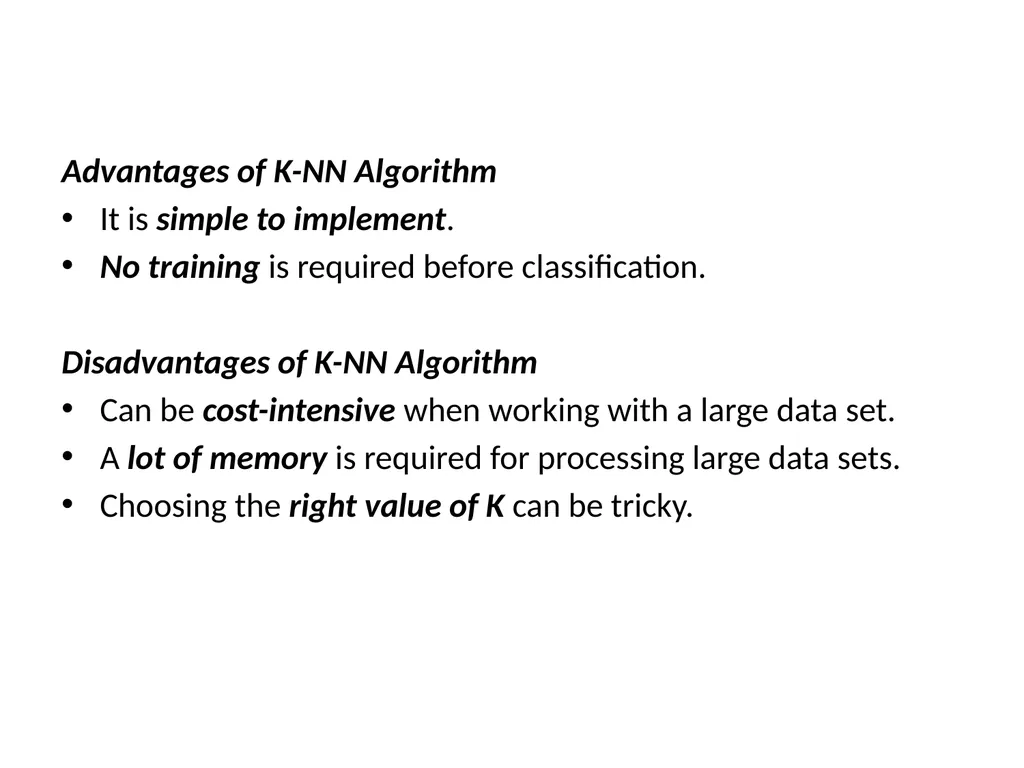
Advantages of K-NN Algorithm
It is simple to implement.
No training is required before classification.
Disadvantages of K-NN Algorithm
Can be cost-intensive when working with a large data set.
A lot of memory is required for processing large data sets.
Choosing the right value of K can be tricky.<br>