Leaf Cuttings Used for a restricted range of plants. Petiole Non-petiole Leaf portionsection Leaf cuttings Many plants can be propagated from just a single leaf. The stems of these plants are too short to take stem cuttings. Leaf cutting
"Leaf Cuttings Used for a restricted range of" is the property of its rightful owner. Permission is granted to
download and print the materials on this website for personal, non-commercial use only, and to display it
on your personal computer provided you do not modify the materials and that you retain all copyright
notices contained in the materials. By downloading content from our website, you accept the terms of this
agreement.
Presentation Transcript
01
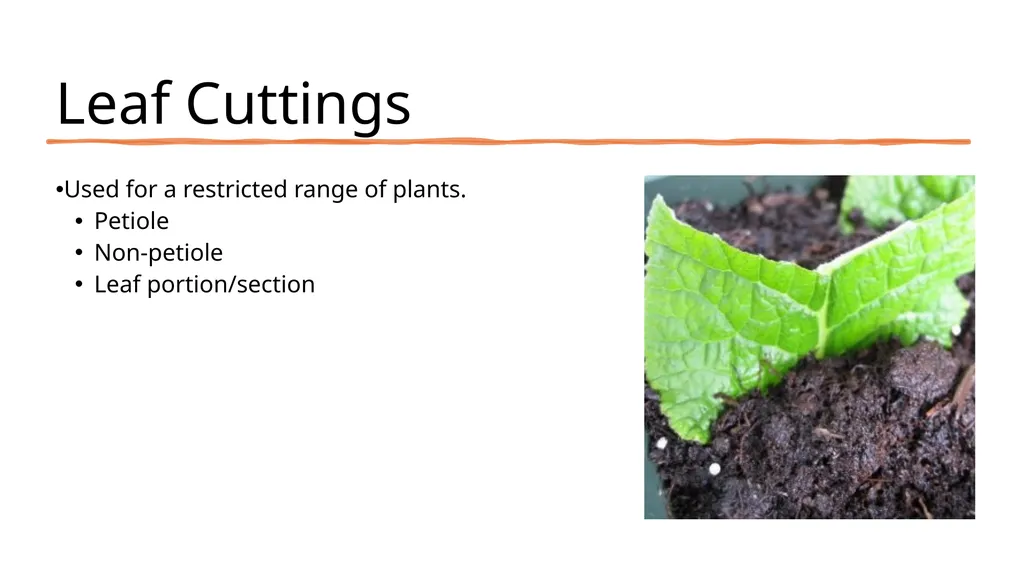
Leaf Cuttings Used for a restricted range of plants.
Petiole
Non-petiole
Leaf portion/section<br>
02
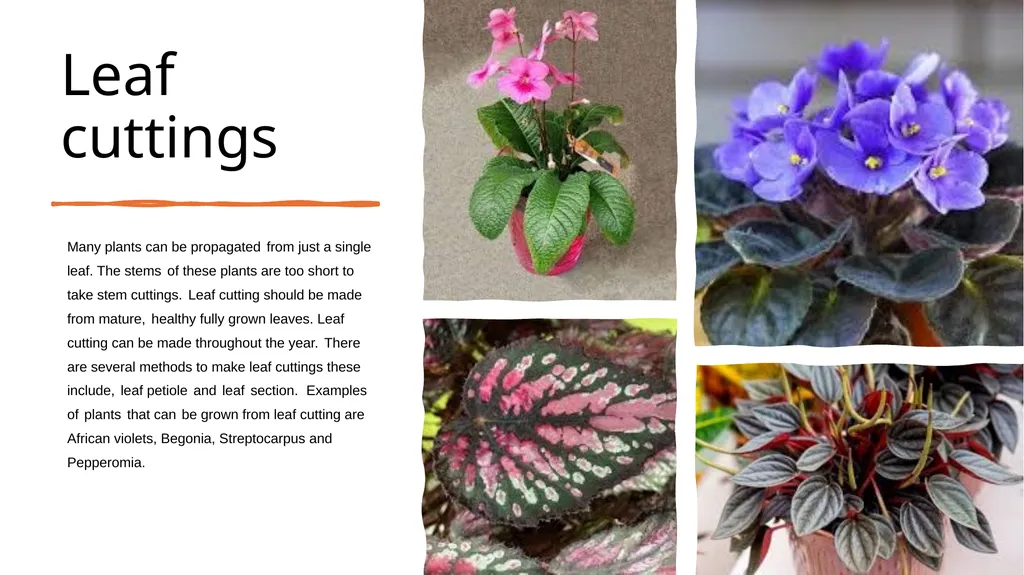
Leaf cuttings Many plants can be propagated from just a single leaf. The stems of these plants are too short to take stem cuttings. Leaf cutting should be made from mature, healthy fully grown leaves. Leaf cutting can be made throughout the year. There are several methods to make leaf cuttings these include, leaf petiole and leaf section. Examples of plants that can be grown from leaf cutting are African violets, Begonia, Streptocarpus and Pepperomia.<br>
03
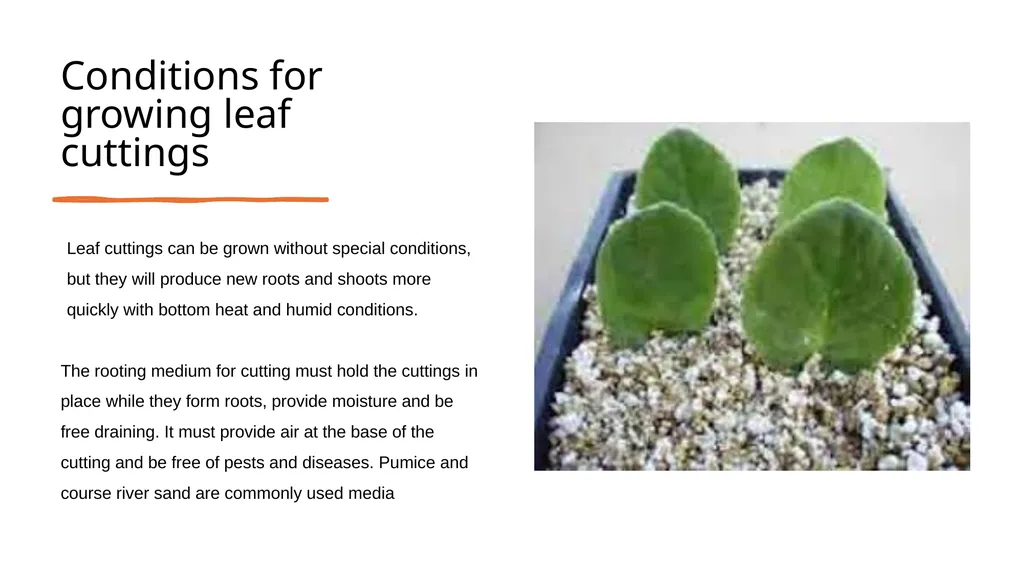
Conditions for growing leaf cuttings Leaf cuttings can be grown without special conditions, but they will produce new roots and shoots more quickly with bottom heat and humid conditions.
The rooting medium for cutting must hold the cuttings in place while they form roots, provide moisture and be free draining. It must provide air at the base of the cutting and be free of pests and diseases. Pumice and course river sand are commonly used media<br>
04
Petiole Cuttings Leaf cuttings are used for plant types whose stems are too short to take stem cuttings.
Leaf petiole cuttings are used commercially to propagate some indoor plants with thick leaves.
The plant material is taken from leaves that are mature, fully developed and healthy e.g. African Violets.
Plant material for leaf petiole cuttings can be taken at any time of the year.
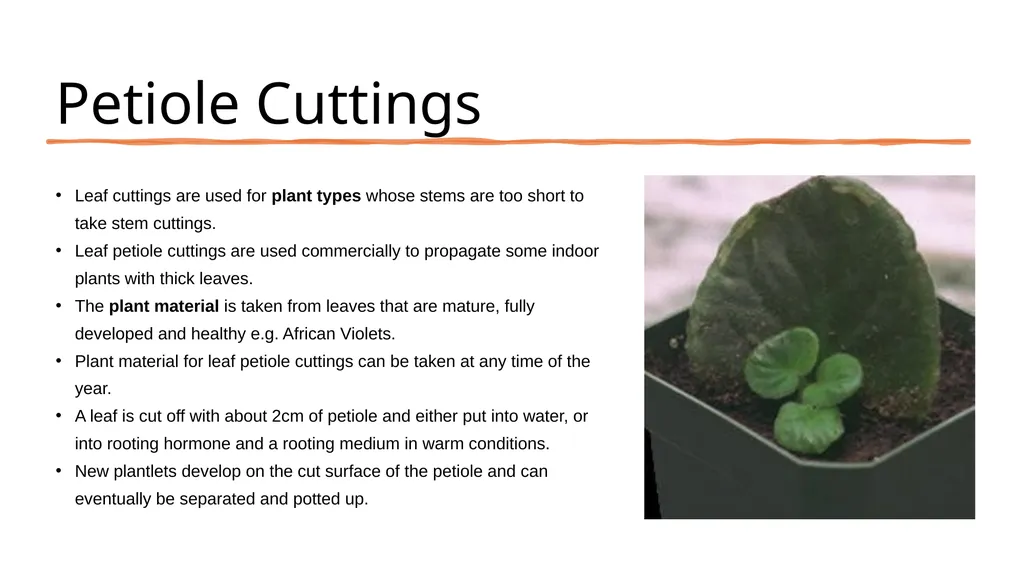
A leaf is cut off with about 2cm of petiole and either put into water, or into rooting hormone and a rooting medium in warm conditions.
New plantlets develop on the cut surface of the petiole and can eventually be separated and potted up.<br>
05
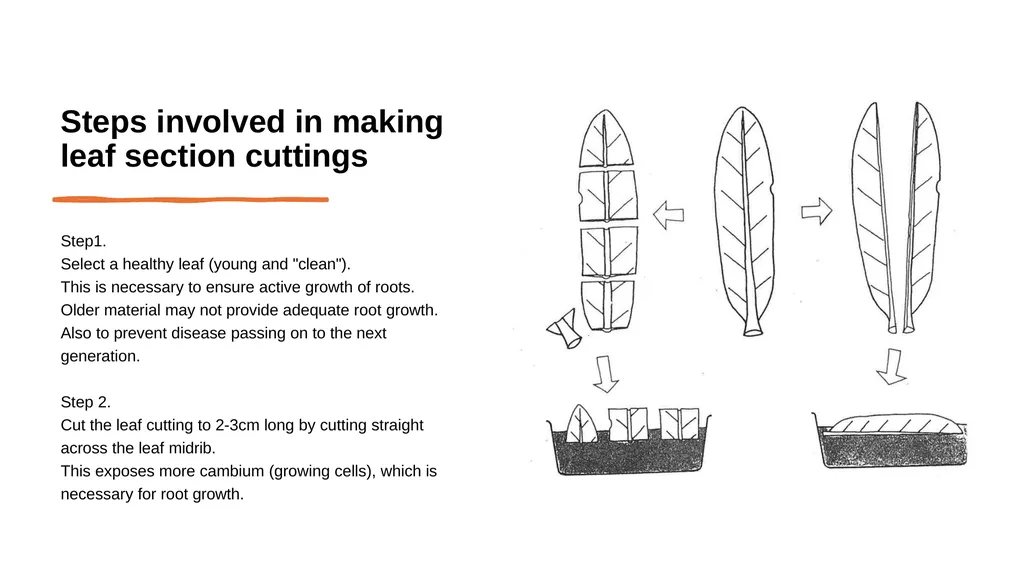
Steps involved in making leaf section cuttings Step1.
Select a healthy leaf (young and "clean").
This is necessary to ensure active growth of roots. Older material may not provide adequate root growth. Also to prevent disease passing on to the next generation.
Step 2.
Cut the leaf cutting to 2-3cm long by cutting straight across the leaf midrib.
This exposes more cambium (growing cells), which is necessary for root growth.<br>
06
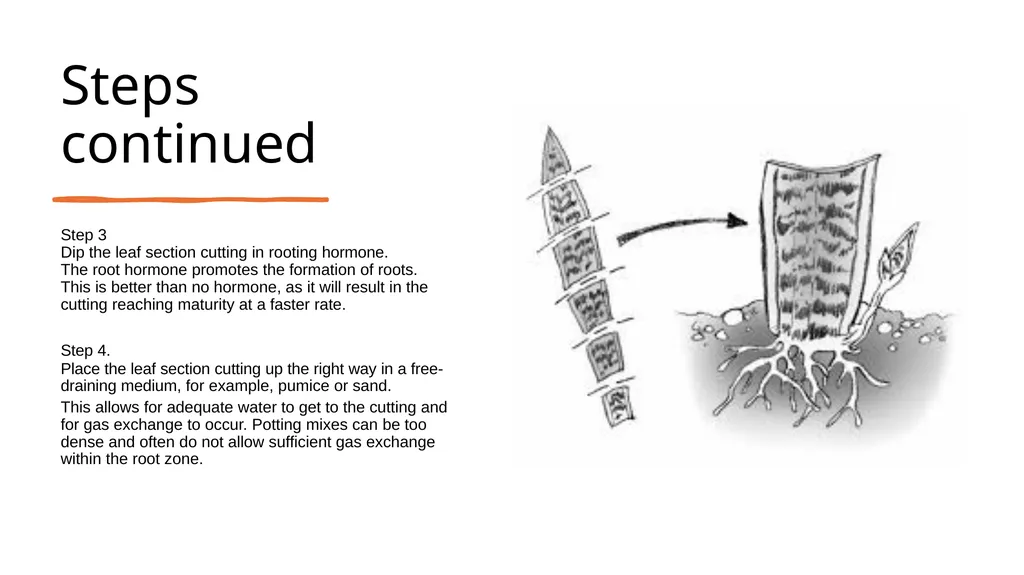
Steps continued Step 3
Dip the leaf section cutting in rooting hormone.
The root hormone promotes the formation of roots. This is better than no hormone, as it will result in the cutting reaching maturity at a faster rate.
Step 4.
Place the leaf section cutting up the right way in a free-draining medium, for example, pumice or sand.
This allows for adequate water to get to the cutting and for gas exchange to occur. Potting mixes can be too dense and often do not allow sufficient gas exchange within the root zone.<br>
07
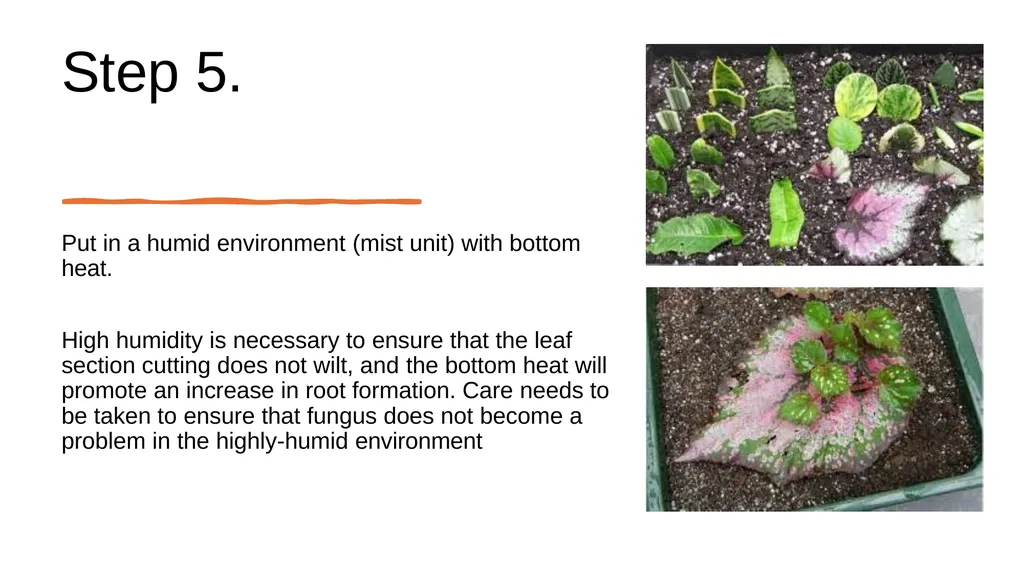
Step 5. Put in a humid environment (mist unit) with bottom heat.
High humidity is necessary to ensure that the leaf section cutting does not wilt, and the bottom heat will promote an increase in root formation. Care needs to be taken to ensure that fungus does not become a problem in the highly-humid environment<br>
08
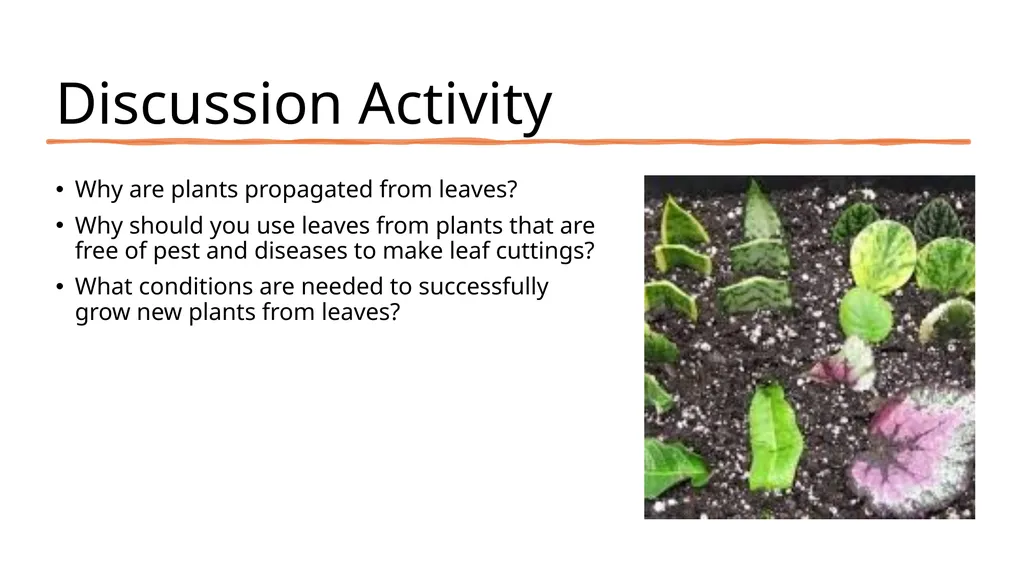
Discussion Activity Why are plants propagated from leaves?
Why should you use leaves from plants that are free of pest and diseases to make leaf cuttings?
What conditions are needed to successfully grow new plants from leaves?<br>
09
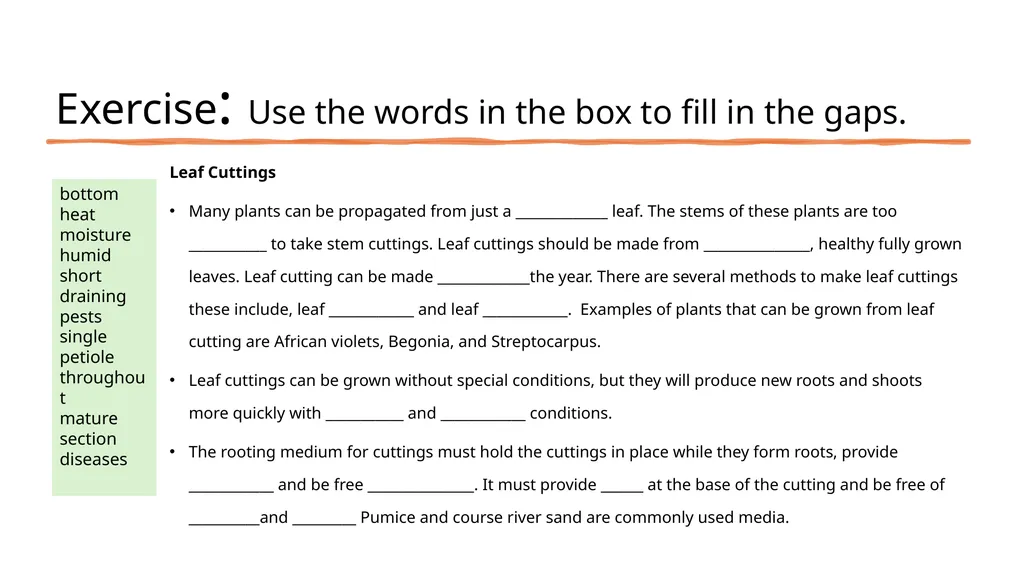
Exercise: Use the words in the box to fill in the gaps. Leaf Cuttings
Many plants can be propagated from just a _____________ leaf. The stems of these plants are too ___________ to take stem cuttings. Leaf cuttings should be made from _______________, healthy fully grown leaves. Leaf cutting can be made _____________the year. There are several methods to make leaf cuttings these include, leaf ____________ and leaf ____________. Examples of plants that can be grown from leaf cutting are African violets, Begonia, and Streptocarpus.
Leaf cuttings can be grown without special conditions, but they will produce new roots and shoots more quickly with ___________ and ____________ conditions.
The rooting medium for cuttings must hold the cuttings in place while they form roots, provide ____________ and be free _______________. It must provide ______ at the base of the cutting and be free of __________and _________ Pumice and course river sand are commonly used media. bottom heat
moisture
humid
short
draining
pests
single
petiole
throughout
mature
section
diseases<br>
10
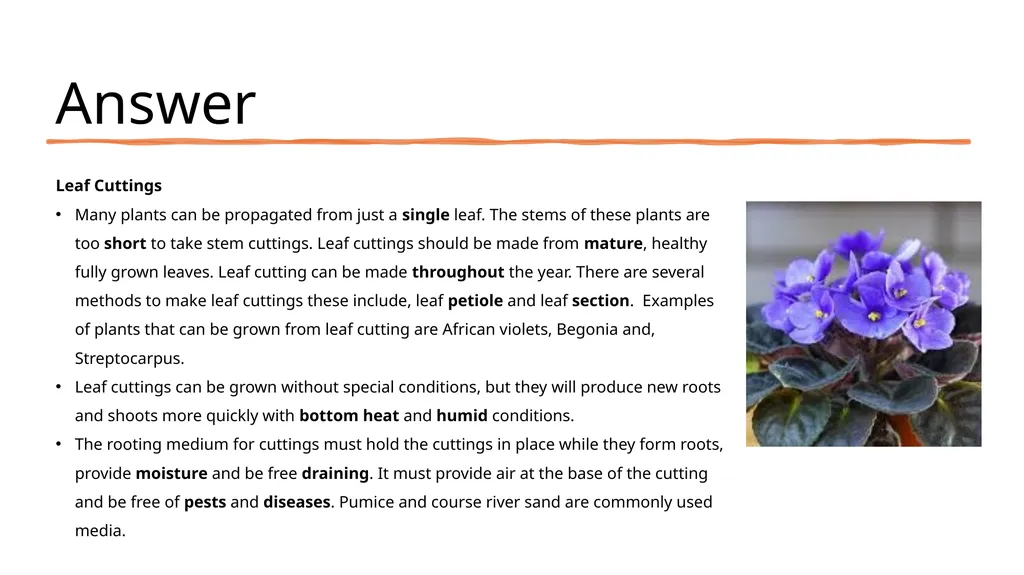
Answer Leaf Cuttings
Many plants can be propagated from just a single leaf. The stems of these plants are too short to take stem cuttings. Leaf cuttings should be made from mature, healthy fully grown leaves. Leaf cutting can be made throughout the year. There are several methods to make leaf cuttings these include, leaf petiole and leaf section. Examples of plants that can be grown from leaf cutting are African violets, Begonia and, Streptocarpus.
Leaf cuttings can be grown without special conditions, but they will produce new roots and shoots more quickly with bottom heat and humid conditions.
The rooting medium for cuttings must hold the cuttings in place while they form roots, provide moisture and be free draining. It must provide air at the base of the cutting and be free of pests and diseases. Pumice and course river sand are commonly used media.<br>