LEAP! Level up your skills in section II writing an introductory paragraph NSW Department of Education Writing about HSC visual arts Creative arts curriculum team LEAP lessons introduction LEAP lessons are structured in 4 parts. Learn
"LEAP! Level up your skills in section II– writing" is the property of its rightful owner. Permission is granted to
download and print the materials on this website for personal, non-commercial use only, and to display it
on your personal computer provided you do not modify the materials and that you retain all copyright
notices contained in the materials. By downloading content from our website, you accept the terms of this
agreement.
Presentation Transcript
01
LEAP! Level up your skills in section II– writing an introductory paragraph NSW Department of Education Writing about HSC visual arts Creative arts curriculum team<br>
02
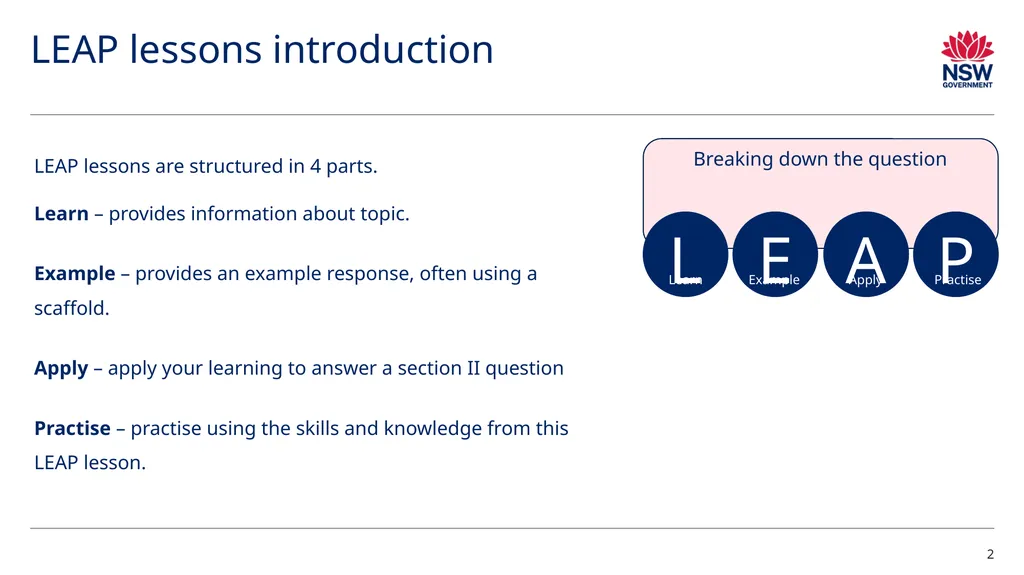
LEAP lessons introduction LEAP lessons are structured in 4 parts.
Learn – provides information about topic.
Example – provides an example response, often using a scaffold.
Apply – apply your learning to answer a section II question
Practise – practise using the skills and knowledge from this LEAP lesson. 2<br>
03
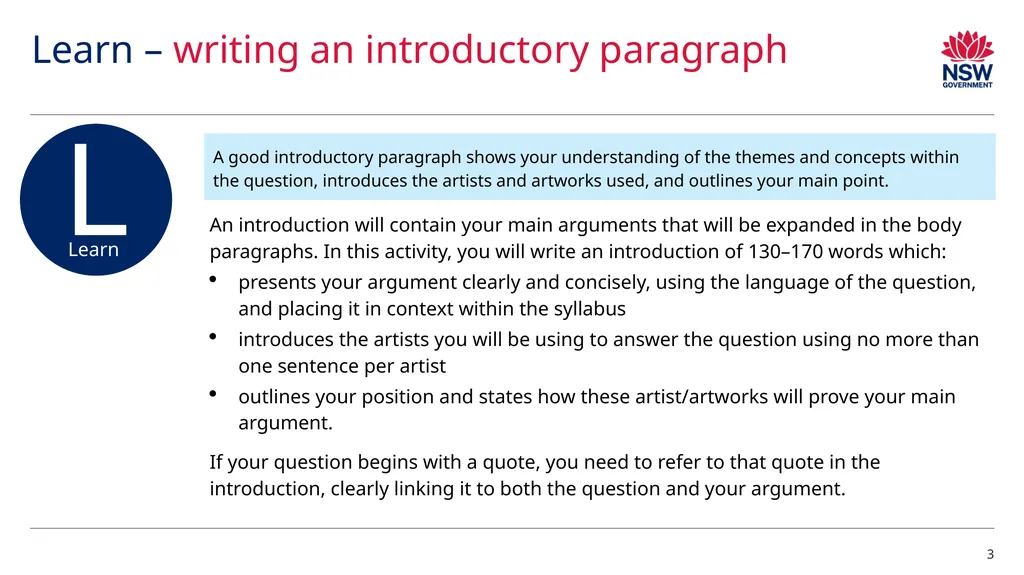
Learn – writing an introductory paragraph A good introductory paragraph shows your understanding of the themes and concepts within the question, introduces the artists and artworks used, and outlines your main point. An introduction will contain your main arguments that will be expanded in the body paragraphs. In this activity, you will write an introduction of 130–170 words which:
presents your argument clearly and concisely, using the language of the question, and placing it in context within the syllabus
introduces the artists you will be using to answer the question using no more than one sentence per artist
outlines your position and states how these artist/artworks will prove your main argument.
If your question begins with a quote, you need to refer to that quote in the introduction, clearly linking it to both the question and your argument. 3<br>
04
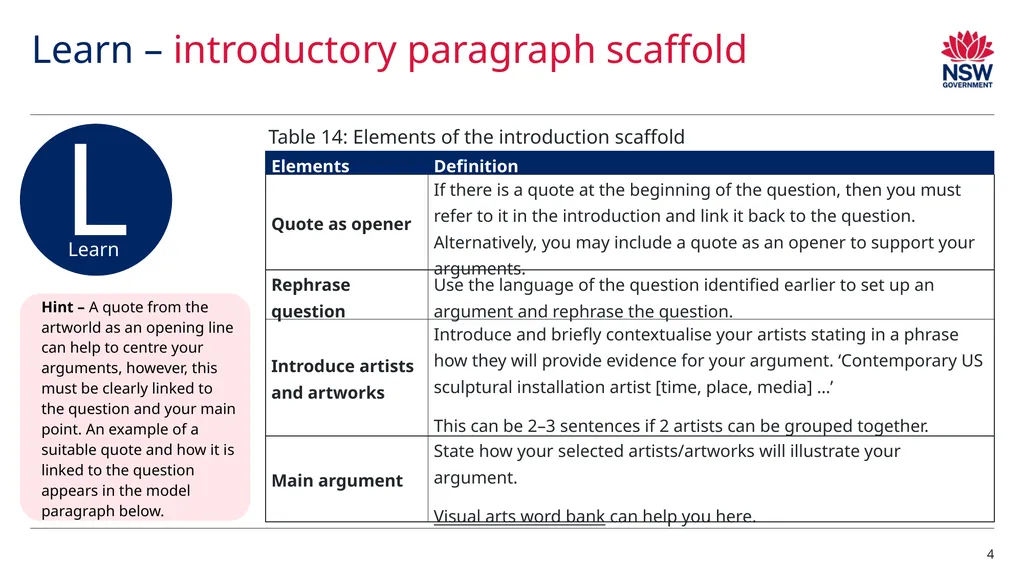
Learn – introductory paragraph scaffold Hint – A quote from the artworld as an opening line can help to centre your arguments, however, this must be clearly linked to the question and your main point. An example of a suitable quote and how it is linked to the question appears in the model paragraph below. Table 14: Elements of the introduction scaffold 4<br>
05
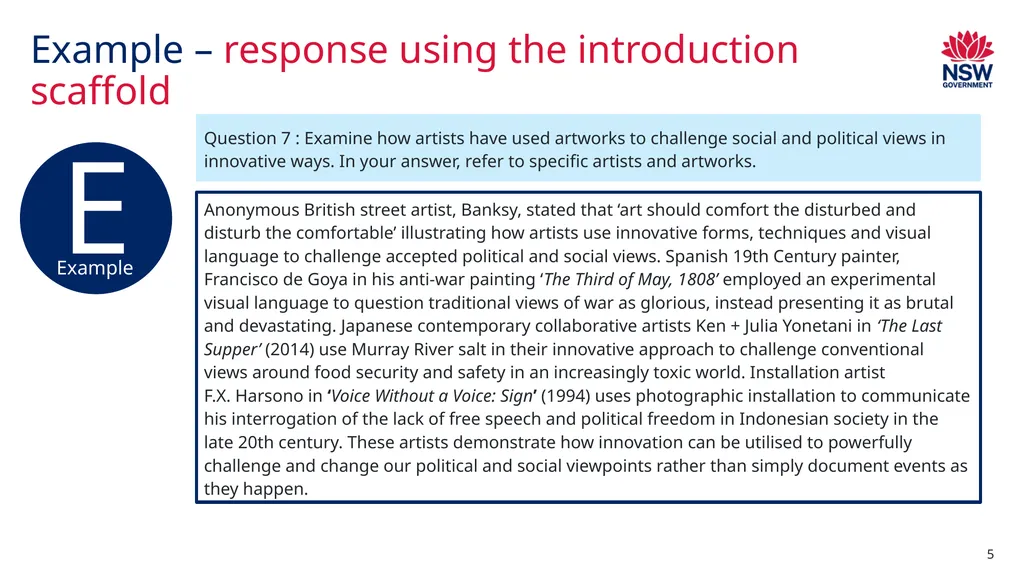
Example – response using the introduction scaffold Question 7 : Examine how artists have used artworks to challenge social and political views in innovative ways. In your answer, refer to specific artists and artworks. Anonymous British street artist, Banksy, stated that ‘art should comfort the disturbed and disturb the comfortable’ illustrating how artists use innovative forms, techniques and visual language to challenge accepted political and social views. Spanish 19th Century painter, Francisco de Goya in his anti-war painting ‘The Third of May, 1808’ employed an experimental visual language to question traditional views of war as glorious, instead presenting it as brutal and devastating. Japanese contemporary collaborative artists Ken + Julia Yonetani in ‘The Last Supper’ (2014) use Murray River salt in their innovative approach to challenge conventional views around food security and safety in an increasingly toxic world. Installation artist F.X. Harsono in ‘Voice Without a Voice: Sign’ (1994) uses photographic installation to communicate his interrogation of the lack of free speech and political freedom in Indonesian society in the late 20th century. These artists demonstrate how innovation can be utilised to powerfully challenge and change our political and social viewpoints rather than simply document events as they happen. 5<br>
06
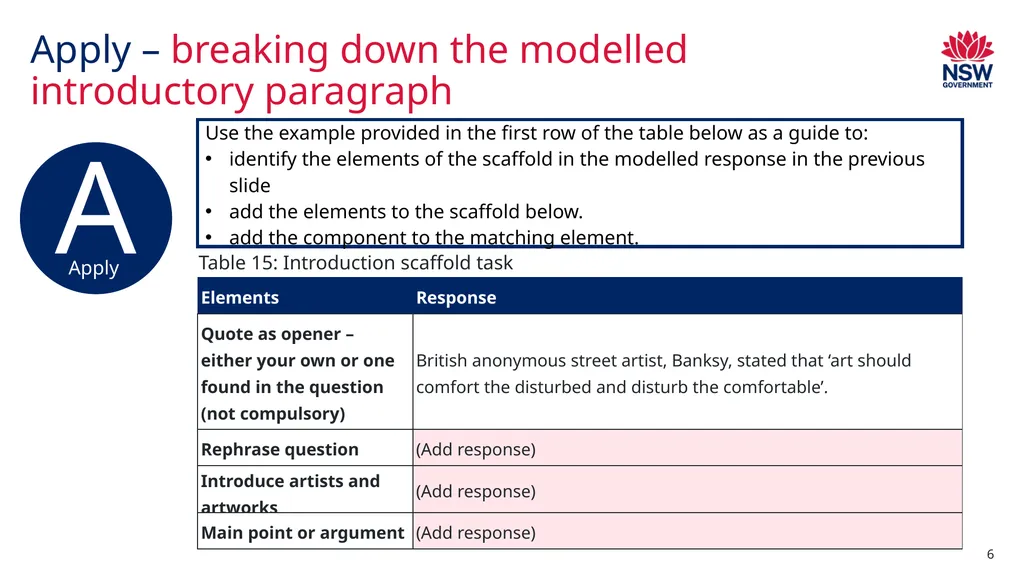
Apply – breaking down the modelled introductory paragraph Use the example provided in the first row of the table below as a guide to:
identify the elements of the scaffold in the modelled response in the previous slide
add the elements to the scaffold below.
add the component to the matching element. Table 15: Introduction scaffold task 6<br>
07
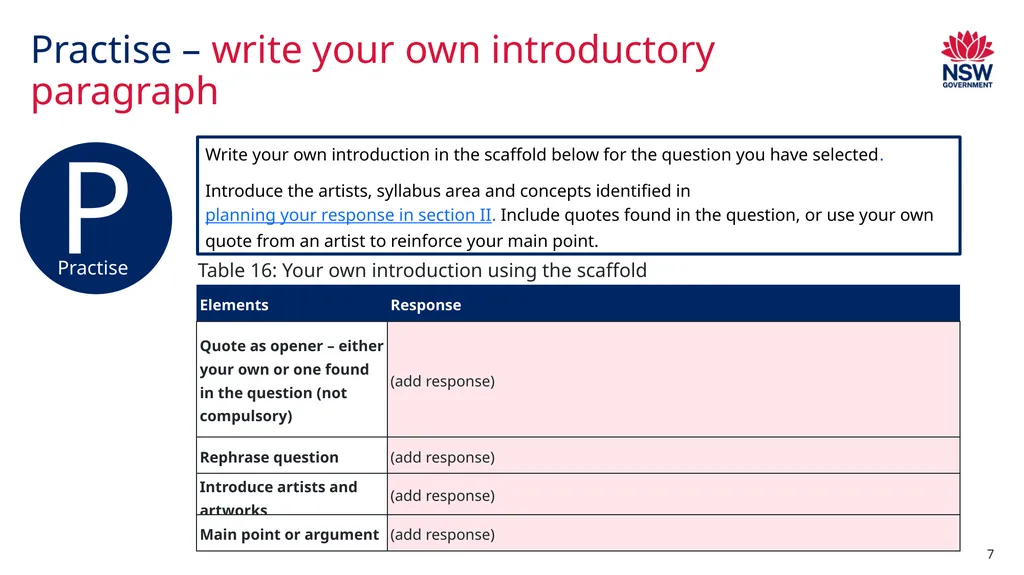
Practise – write your own introductory paragraph Write your own introduction in the scaffold below for the question you have selected.
Introduce the artists, syllabus area and concepts identified in planning your response in section II. Include quotes found in the question, or use your own quote from an artist to reinforce your main point. Table 16: Your own introduction using the scaffold 7<br>