
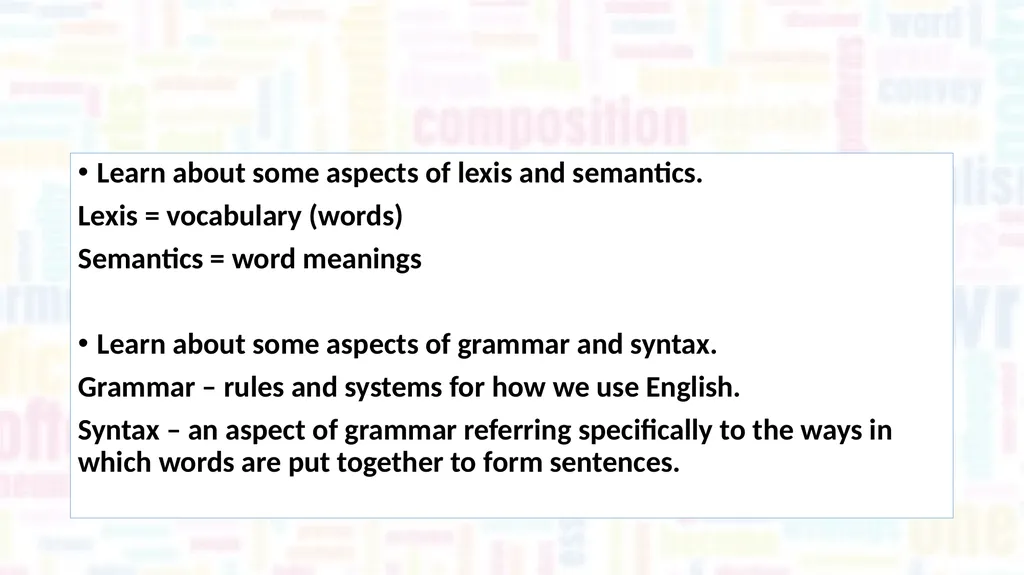
Learn about some aspects of lexis and semantics.

Description: Learn about some aspects of lexis and semantics. Lexis vocabulary (words) Semantics word meanings Learn about some aspects of grammar and syntax. Grammar rules and systems for how we use English. Syntax an aspect of grammar
Related Topics
Download Presentation
"Learn about some aspects of lexis and semantics." is the property of its rightful owner. Permission is granted to download and print the materials on this website for personal, non-commercial use only, and to display it on your personal computer provided you do not modify the materials and that you retain all copyright notices contained in the materials. By downloading content from our website, you accept the terms of this agreement.
Presentation Transcript
slide1. Learn about some aspects of lexis and semantics.
Lexis = vocabulary (words)
Semantics = word meanings
Learn about some aspects of grammar and syntax.
Grammar – rules and systems for how we use English.
Syntax – an aspect of grammar referring specifically to the ways in which words are put together to form sentences.<br>
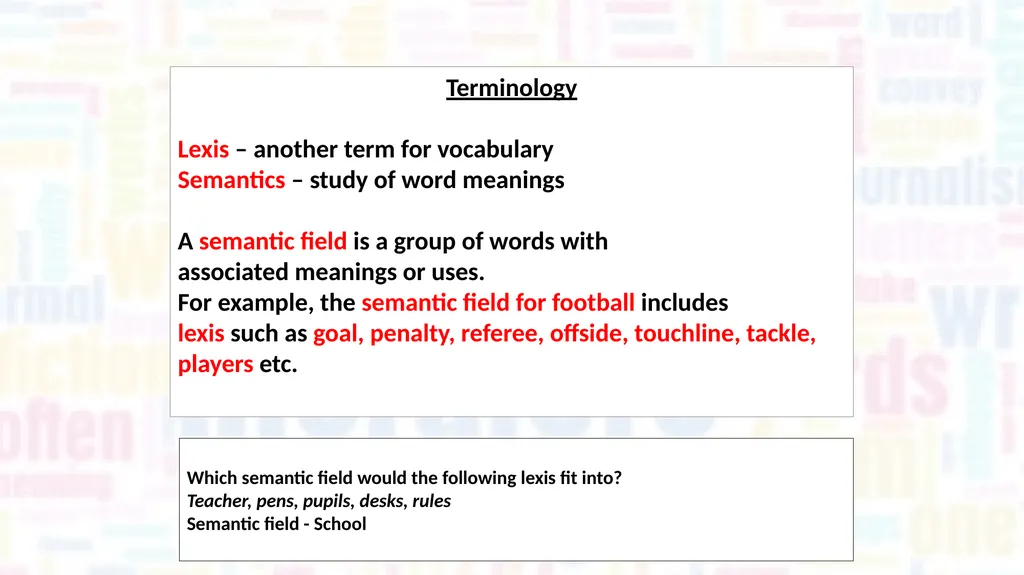
slide2. Terminology
Lexis – another term for vocabulary
Semantics – study of word meanings
A semantic field is a group of words with
associated meanings or uses.
For example, the semantic field for football includes
lexis such as goal, penalty, referee, offside, touchline, tackle, players etc. Which semantic field would the following lexis fit into?
Teacher, pens, pupils, desks, rules
Semantic field - School<br>
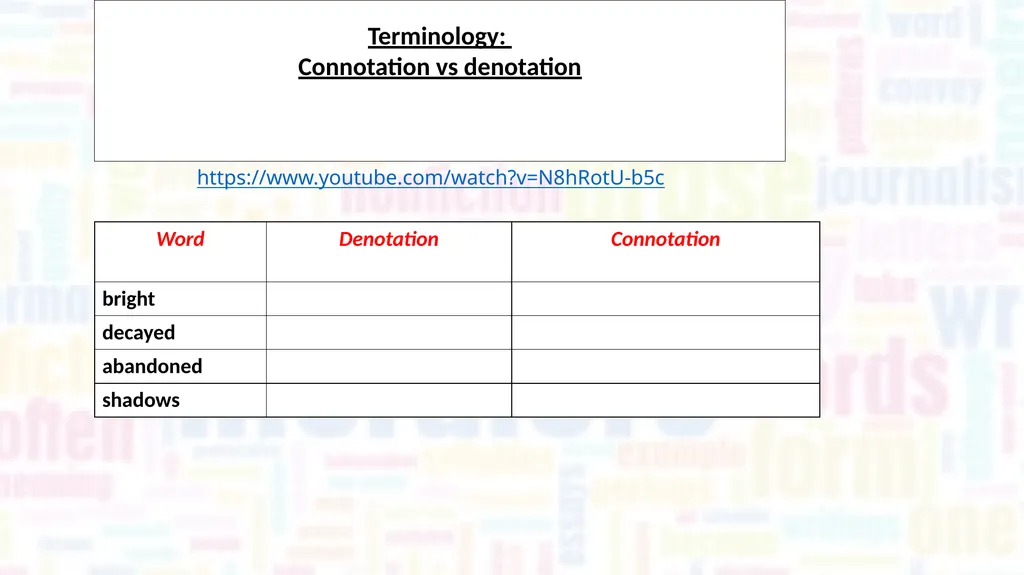
slide3. https://www.youtube.com/watch?v=N8hRotU-b5c Terminology:
Connotation vs denotation<br>
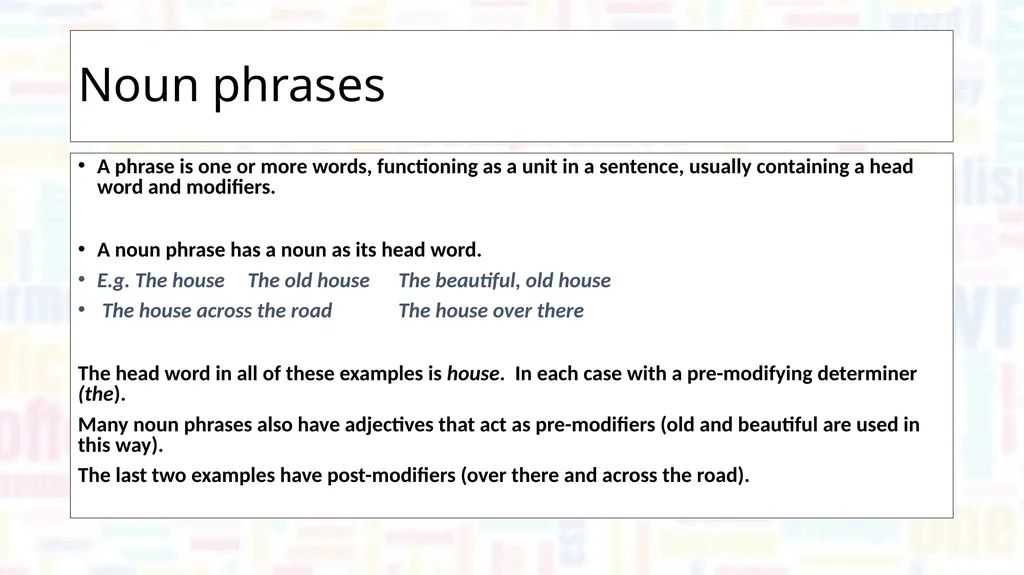
slide4. Noun phrases A phrase is one or more words, functioning as a unit in a sentence, usually containing a head word and modifiers.
A noun phrase has a noun as its head word.
E.g. The house The old house The beautiful, old house
The house across the road The house over there
The head word in all of these examples is house. In each case with a pre-modifying determiner (the).
Many noun phrases also have adjectives that act as pre-modifiers (old and beautiful are used in this way).
The last two examples have post-modifiers (over there and across the road).<br>
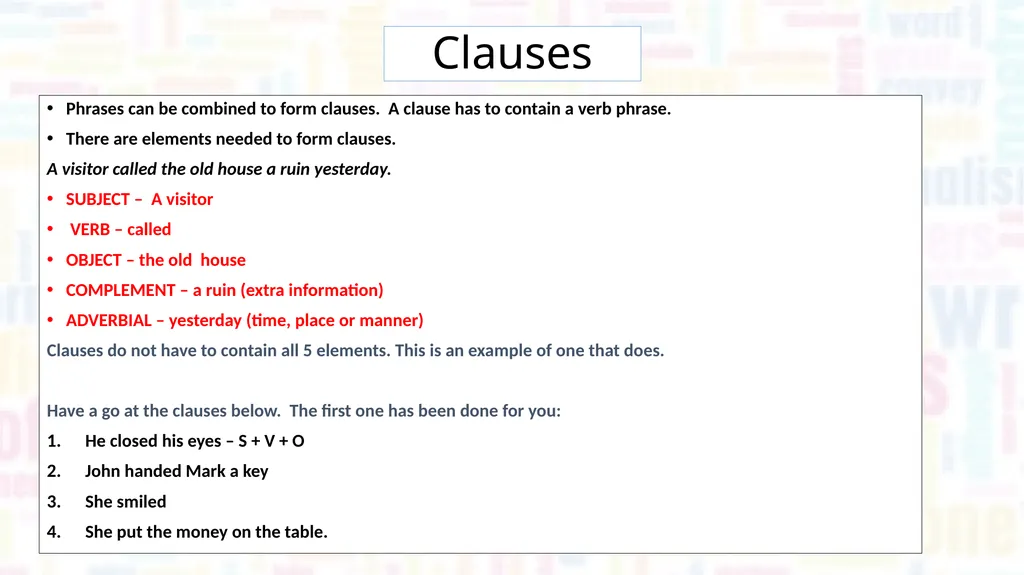
slide5. Clauses Phrases can be combined to form clauses. A clause has to contain a verb phrase.
There are elements needed to form clauses.
A visitor called the old house a ruin yesterday.
SUBJECT – A visitor
VERB – called
OBJECT – the old house
COMPLEMENT – a ruin (extra information)
ADVERBIAL – yesterday (time, place or manner)
Clauses do not have to contain all 5 elements. This is an example of one that does.
Have a go at the clauses below. The first one has been done for you:
He closed his eyes – S + V + O
John handed Mark a key
She smiled
She put the money on the table.<br>
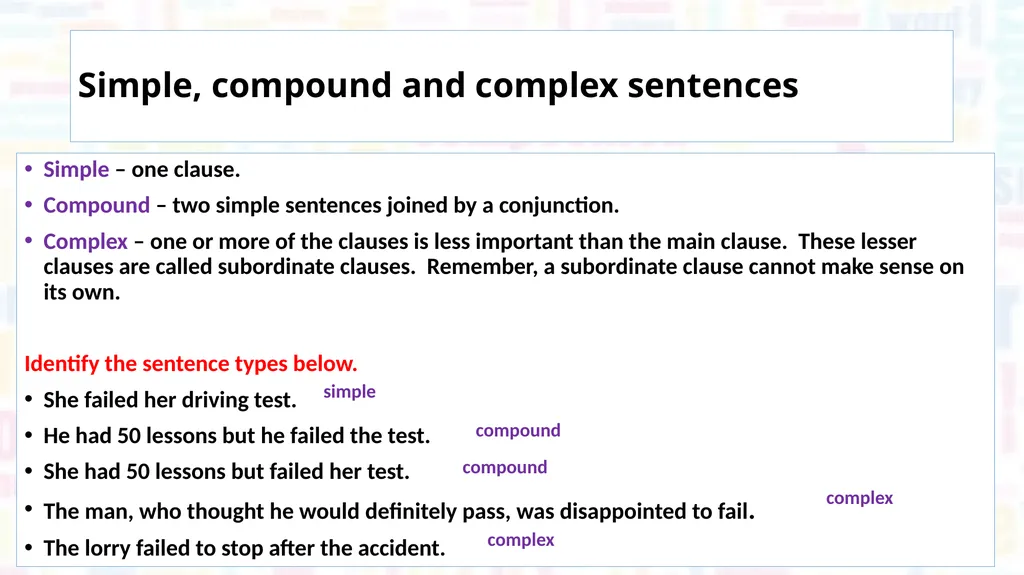
slide6. Simple, compound and complex sentences Simple – one clause.
Compound – two simple sentences joined by a conjunction.
Complex – one or more of the clauses is less important than the main clause. These lesser clauses are called subordinate clauses. Remember, a subordinate clause cannot make sense on its own.
Identify the sentence types below.
She failed her driving test.
He had 50 lessons but he failed the test.
She had 50 lessons but failed her test.
The man, who thought he would definitely pass, was disappointed to fail.
The lorry failed to stop after the accident. simple compound compound complex complex<br>
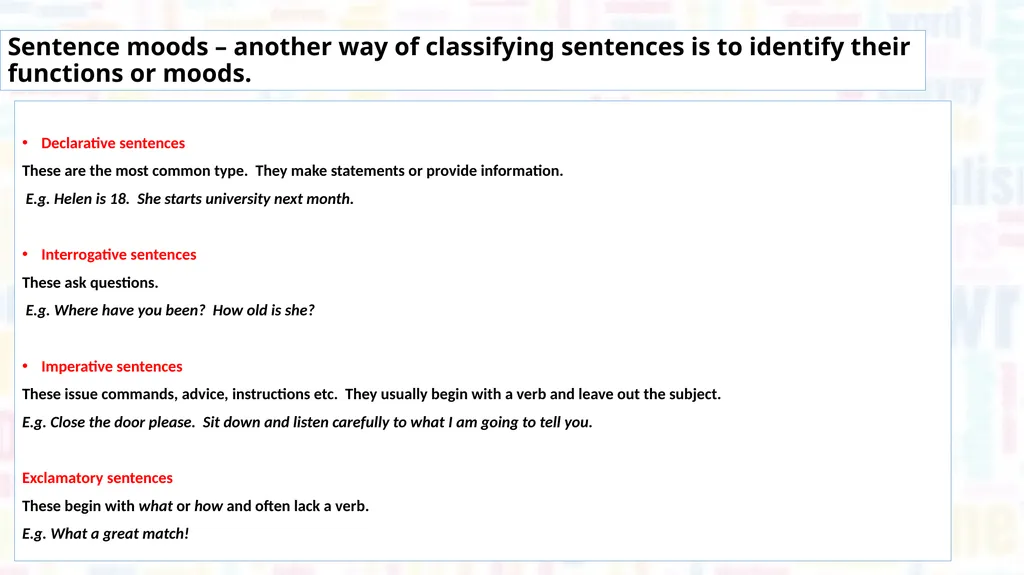
slide7. Sentence moods – another way of classifying sentences is to identify their functions or moods. Declarative sentences
These are the most common type. They make statements or provide information.
E.g. Helen is 18. She starts university next month.
Interrogative sentences
These ask questions.
E.g. Where have you been? How old is she?
Imperative sentences
These issue commands, advice, instructions etc. They usually begin with a verb and leave out the subject.
E.g. Close the door please. Sit down and listen carefully to what I am going to tell you.
Exclamatory sentences
These begin with what or how and often lack a verb.
E.g. What a great match!<br>
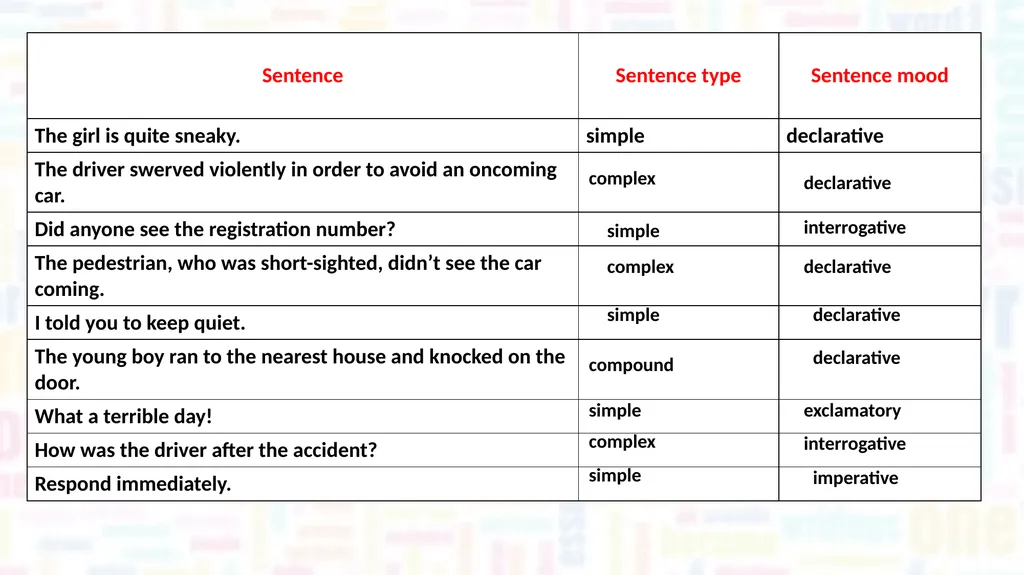
slide8. simple simple simple simple complex complex complex compound declarative declarative declarative declarative exclamatory interrogative imperative interrogative<br>
Lexis = vocabulary (words)
Semantics = word meanings
Learn about some aspects of grammar and syntax.
Grammar – rules and systems for how we use English.
Syntax – an aspect of grammar referring specifically to the ways in which words are put together to form sentences.<br>
slide2. Terminology
Lexis – another term for vocabulary
Semantics – study of word meanings
A semantic field is a group of words with
associated meanings or uses.
For example, the semantic field for football includes
lexis such as goal, penalty, referee, offside, touchline, tackle, players etc. Which semantic field would the following lexis fit into?
Teacher, pens, pupils, desks, rules
Semantic field - School<br>
slide3. https://www.youtube.com/watch?v=N8hRotU-b5c Terminology:
Connotation vs denotation<br>
slide4. Noun phrases A phrase is one or more words, functioning as a unit in a sentence, usually containing a head word and modifiers.
A noun phrase has a noun as its head word.
E.g. The house The old house The beautiful, old house
The house across the road The house over there
The head word in all of these examples is house. In each case with a pre-modifying determiner (the).
Many noun phrases also have adjectives that act as pre-modifiers (old and beautiful are used in this way).
The last two examples have post-modifiers (over there and across the road).<br>
slide5. Clauses Phrases can be combined to form clauses. A clause has to contain a verb phrase.
There are elements needed to form clauses.
A visitor called the old house a ruin yesterday.
SUBJECT – A visitor
VERB – called
OBJECT – the old house
COMPLEMENT – a ruin (extra information)
ADVERBIAL – yesterday (time, place or manner)
Clauses do not have to contain all 5 elements. This is an example of one that does.
Have a go at the clauses below. The first one has been done for you:
He closed his eyes – S + V + O
John handed Mark a key
She smiled
She put the money on the table.<br>
slide6. Simple, compound and complex sentences Simple – one clause.
Compound – two simple sentences joined by a conjunction.
Complex – one or more of the clauses is less important than the main clause. These lesser clauses are called subordinate clauses. Remember, a subordinate clause cannot make sense on its own.
Identify the sentence types below.
She failed her driving test.
He had 50 lessons but he failed the test.
She had 50 lessons but failed her test.
The man, who thought he would definitely pass, was disappointed to fail.
The lorry failed to stop after the accident. simple compound compound complex complex<br>
slide7. Sentence moods – another way of classifying sentences is to identify their functions or moods. Declarative sentences
These are the most common type. They make statements or provide information.
E.g. Helen is 18. She starts university next month.
Interrogative sentences
These ask questions.
E.g. Where have you been? How old is she?
Imperative sentences
These issue commands, advice, instructions etc. They usually begin with a verb and leave out the subject.
E.g. Close the door please. Sit down and listen carefully to what I am going to tell you.
Exclamatory sentences
These begin with what or how and often lack a verb.
E.g. What a great match!<br>
slide8. simple simple simple simple complex complex complex compound declarative declarative declarative declarative exclamatory interrogative imperative interrogative<br>