
Learn more about Rose rosette: https://gd.eppo.int

Learn more about Rose rosette: https://gd.eppo.int
1 / 1
Learn more about Rose rosette: https:gd.eppo.int What is it? How to recognize it? CAN YOU HELP US? Rose rosette virus A threat to roses This poster has been prepared in collaboration with EPPO (www.eppo.int) Your contact details, logos,

Related Topics

Download this presentation From Below

"Learn more about Rose rosette: https://gd.eppo.int" is the property of its rightful owner. Permission is granted to download and print the materials on this website for personal, non-commercial use only, and to display it on your personal computer provided you do not modify the materials and that you retain all copyright notices contained in the materials. By downloading content from our website, you accept the terms of this agreement.

Presentation Transcript

01
Learn more about Rose rosette: https://gd.eppo.int What is it? How to recognize it? CAN YOU HELP US?
Rose rosette virus
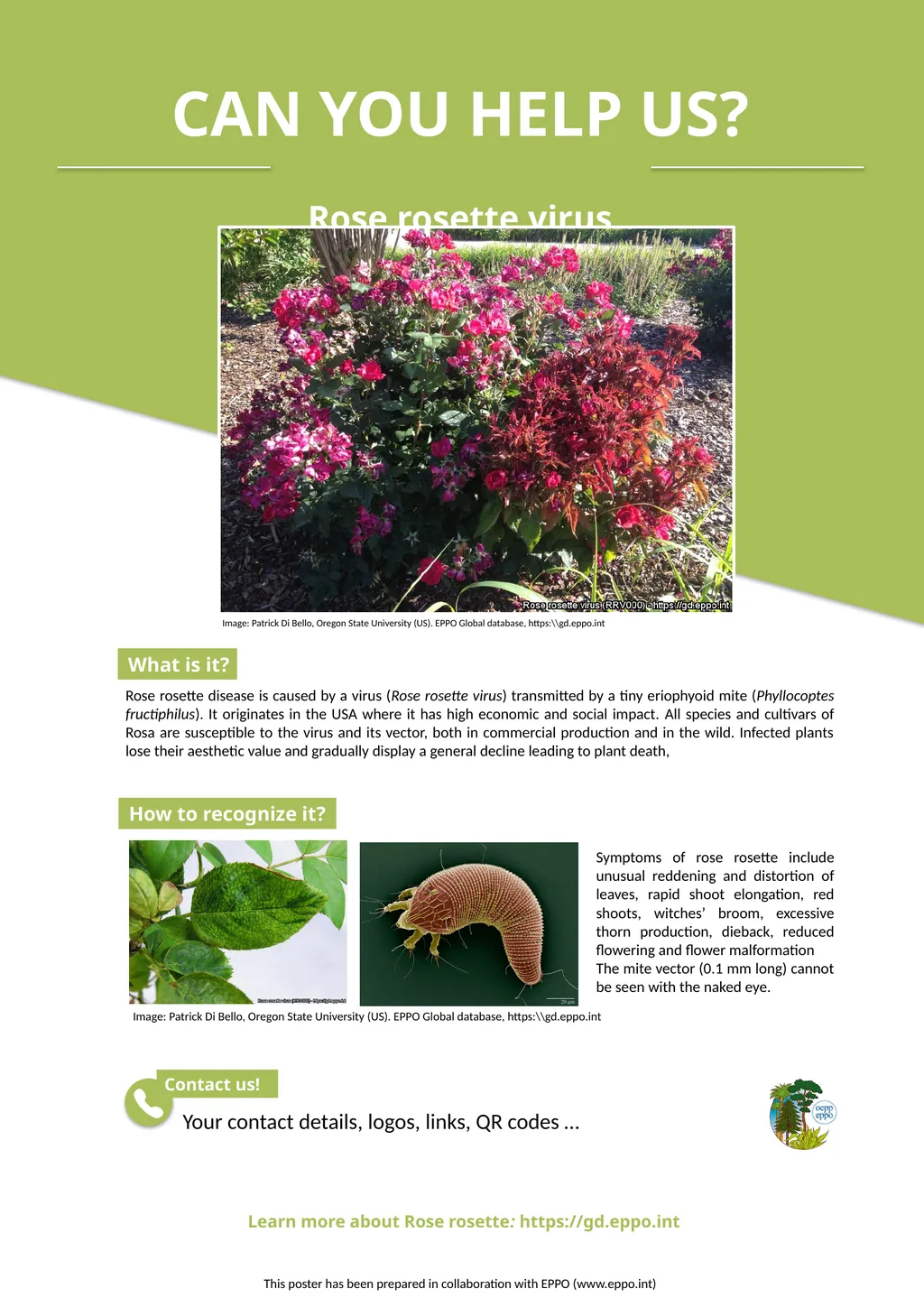
A threat to roses This poster has been prepared in collaboration with EPPO (www.eppo.int) Your contact details, logos, links, QR codes … Rose rosette disease is caused by a virus (Rose rosette virus) transmitted by a tiny eriophyoid mite (Phyllocoptes fructiphilus). It originates in the USA where it has high economic and social impact. All species and cultivars of Rosa are susceptible to the virus and its vector, both in commercial production and in the wild. Infected plants lose their aesthetic value and gradually display a general decline leading to plant death, Symptoms of rose rosette include unusual reddening and distortion of leaves, rapid shoot elongation, red shoots, witches’ broom, excessive thorn production, dieback, reduced flowering and flower malformation
The mite vector (0.1 mm long) cannot be seen with the naked eye. Image: Patrick Di Bello, Oregon State University (US). EPPO Global database, https:\\gd.eppo.int Image: Patrick Di Bello, Oregon State University (US). EPPO Global database, https:\\gd.eppo.int<br>