
Learn More: Regulatory Updates Amanda R. Humphrey
SN
Published · 24 slides · 0 views

1 / 1

Description
Learn More: Regulatory Updates Amanda R. Humphrey Director of Award Administration NU-RES Agenda Context Updates: International Collaborations Engagement (aka Foreign InfluenceInterference) Current and Pending Support (NSF); Other
Related Topics
Share
Embed code
Download this presentation From Below
"Learn More: Regulatory Updates Amanda R. Humphrey" is the property of its rightful owner. Permission is granted to download and print the materials on this website for personal, non-commercial use only, and to display it on your personal computer provided you do not modify the materials and that you retain all copyright notices contained in the materials. By downloading content from our website, you accept the terms of this agreement.
Presentation Transcript
01
Learn More:
Regulatory Updates Amanda R. Humphrey
Director of Award Administration
NU-RES<br>
Director of Award Administration
NU-RES<br>
02
Agenda Context
Updates:
International Collaborations & Engagement (aka Foreign Influence/Interference)
Current and Pending Support (NSF); Other Research Support Reports (NIH)
Conflicts of interest and Commitment
J-CORE
NIH Draft Data Sharing Plan Changes
Human Subject Research
Common Rule Update: Self-Determined Exempt Studies
Human Subject Research Training
Human Fetal Tissue (HFT) Policy
Animal Use and Care – Proposed Rule to Reduce Administrative Burdens<br>
Updates:
International Collaborations & Engagement (aka Foreign Influence/Interference)
Current and Pending Support (NSF); Other Research Support Reports (NIH)
Conflicts of interest and Commitment
J-CORE
NIH Draft Data Sharing Plan Changes
Human Subject Research
Common Rule Update: Self-Determined Exempt Studies
Human Subject Research Training
Human Fetal Tissue (HFT) Policy
Animal Use and Care – Proposed Rule to Reduce Administrative Burdens<br>
03
Context Research is a heavily regulated field that intersects with many complex regulatory areas, including biosafety, human subjects research, export controls, and even at Northeastern, sometimes HIPAA.
This is not meant to be an exhaustive review of regulations, but focused updates on specific areas that may have the most impact on Northeastern. Regulations are a complex maze!<br>
This is not meant to be an exhaustive review of regulations, but focused updates on specific areas that may have the most impact on Northeastern. Regulations are a complex maze!<br>
04
International Collaborations & Engagements (aka Foreign Influence/Interference) What is foreign influence anyway?
FBI calls it “covert actions by foreign governments to influence U.S. political sentiment or public discourse” and to manipulate or exploit U.S. systems
Spans industry, government and academia
Academic setting: gaining access to controlled technologies or proprietary information;
Not just exported controlled information, such as nuclear energy research
Also accessing non-public grant application; for example, a peer reviewer violating confidentiality agreement and providing un-patented or proprietary information to a foreign government<br>
FBI calls it “covert actions by foreign governments to influence U.S. political sentiment or public discourse” and to manipulate or exploit U.S. systems
Spans industry, government and academia
Academic setting: gaining access to controlled technologies or proprietary information;
Not just exported controlled information, such as nuclear energy research
Also accessing non-public grant application; for example, a peer reviewer violating confidentiality agreement and providing un-patented or proprietary information to a foreign government<br>
05
International Collaborations & Engagements
(aka Foreign Influence/Interference) FBI and other agencies are clear that it is not people of a particular national origin that are involved or targeted for investigation
Could also be U.S. born individuals with no prior connections to a foreign government
Individuals may not even know they are being used as part of such an effort by a foreign government;
I.e. receive praise of their work; even as far as offers of funding and status by the other country
Example, China’s 1,000 Talents Program<br>
Could also be U.S. born individuals with no prior connections to a foreign government
Individuals may not even know they are being used as part of such an effort by a foreign government;
I.e. receive praise of their work; even as far as offers of funding and status by the other country
Example, China’s 1,000 Talents Program<br>
06
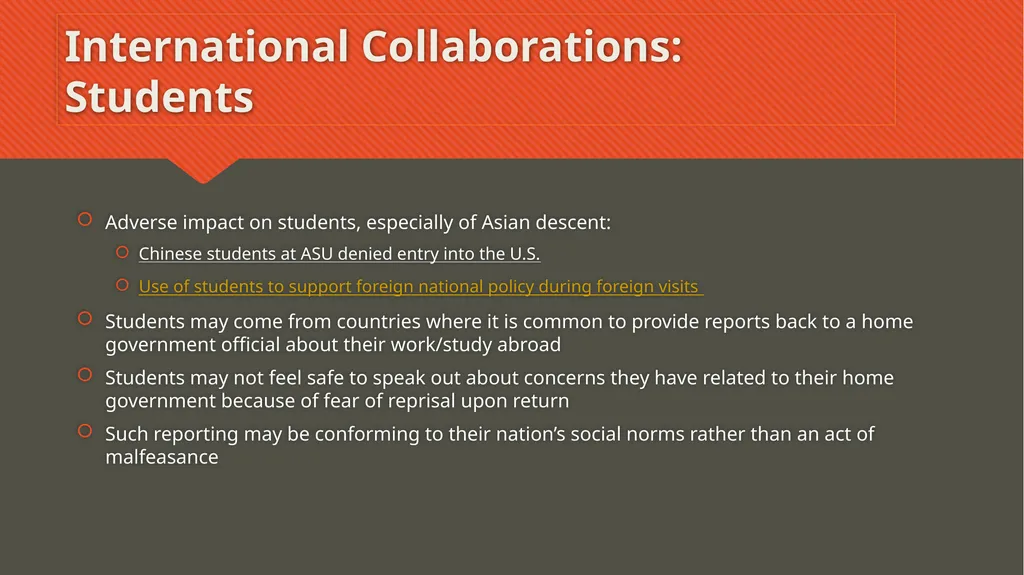
International Collaborations: Students Adverse impact on students, especially of Asian descent:
Chinese students at ASU denied entry into the U.S.
Use of students to support foreign national policy during foreign visits
Students may come from countries where it is common to provide reports back to a home government official about their work/study abroad
Students may not feel safe to speak out about concerns they have related to their home government because of fear of reprisal upon return
Such reporting may be conforming to their nation’s social norms rather than an act of malfeasance<br>
Chinese students at ASU denied entry into the U.S.
Use of students to support foreign national policy during foreign visits
Students may come from countries where it is common to provide reports back to a home government official about their work/study abroad
Students may not feel safe to speak out about concerns they have related to their home government because of fear of reprisal upon return
Such reporting may be conforming to their nation’s social norms rather than an act of malfeasance<br>
07
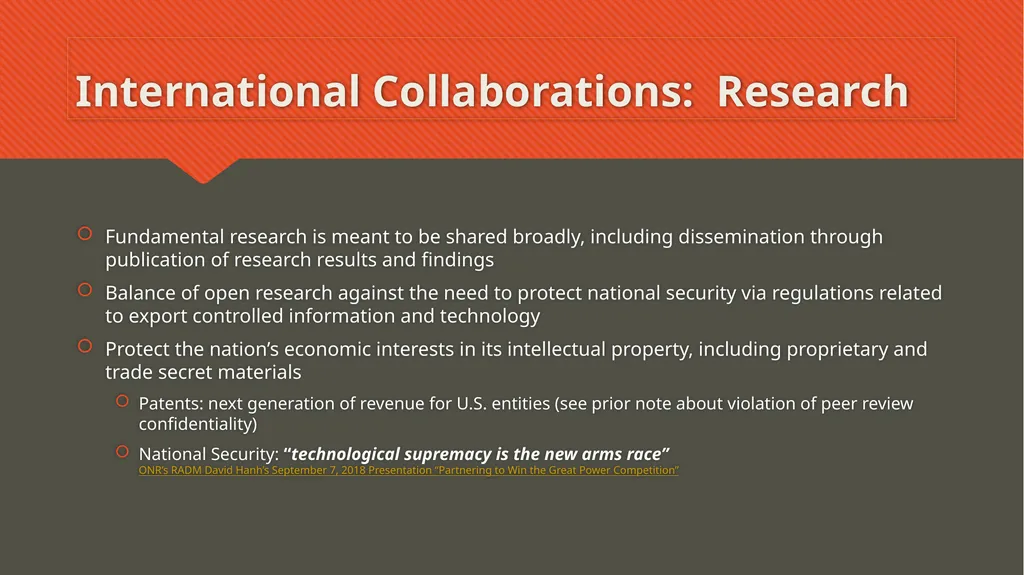
International Collaborations: Research Fundamental research is meant to be shared broadly, including dissemination through publication of research results and findings
Balance of open research against the need to protect national security via regulations related to export controlled information and technology
Protect the nation’s economic interests in its intellectual property, including proprietary and trade secret materials
Patents: next generation of revenue for U.S. entities (see prior note about violation of peer review confidentiality)
National Security: “technological supremacy is the new arms race” ONR’s RADM David Hanh’s September 7, 2018 Presentation “Partnering to Win the Great Power Competition”<br>
Balance of open research against the need to protect national security via regulations related to export controlled information and technology
Protect the nation’s economic interests in its intellectual property, including proprietary and trade secret materials
Patents: next generation of revenue for U.S. entities (see prior note about violation of peer review confidentiality)
National Security: “technological supremacy is the new arms race” ONR’s RADM David Hanh’s September 7, 2018 Presentation “Partnering to Win the Great Power Competition”<br>
08
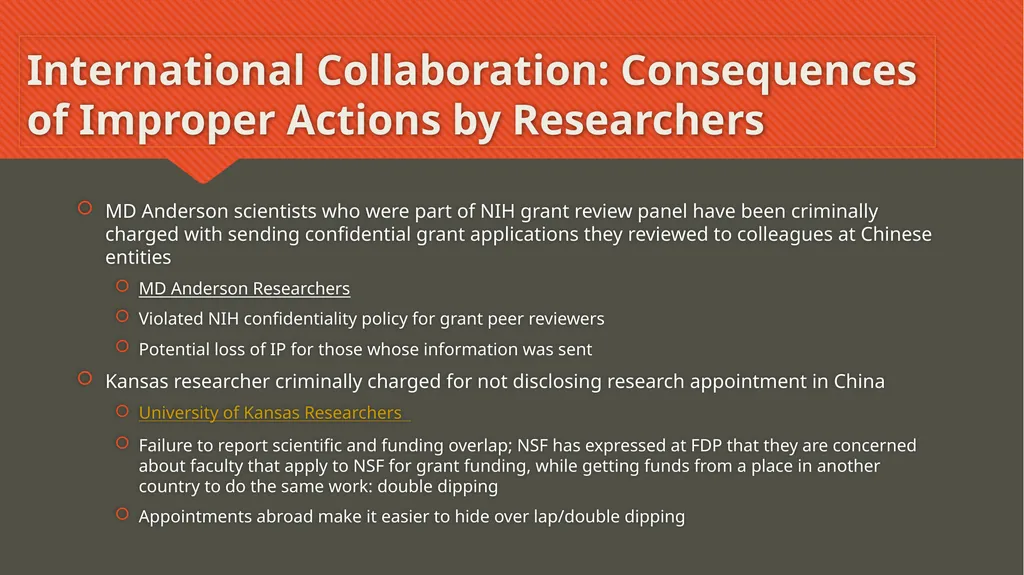
International Collaboration: Consequences of Improper Actions by Researchers MD Anderson scientists who were part of NIH grant review panel have been criminally charged with sending confidential grant applications they reviewed to colleagues at Chinese entities
MD Anderson Researchers
Violated NIH confidentiality policy for grant peer reviewers
Potential loss of IP for those whose information was sent
Kansas researcher criminally charged for not disclosing research appointment in China
University of Kansas Researchers
Failure to report scientific and funding overlap; NSF has expressed at FDP that they are concerned about faculty that apply to NSF for grant funding, while getting funds from a place in another country to do the same work: double dipping
Appointments abroad make it easier to hide over lap/double dipping<br>
MD Anderson Researchers
Violated NIH confidentiality policy for grant peer reviewers
Potential loss of IP for those whose information was sent
Kansas researcher criminally charged for not disclosing research appointment in China
University of Kansas Researchers
Failure to report scientific and funding overlap; NSF has expressed at FDP that they are concerned about faculty that apply to NSF for grant funding, while getting funds from a place in another country to do the same work: double dipping
Appointments abroad make it easier to hide over lap/double dipping<br>
09
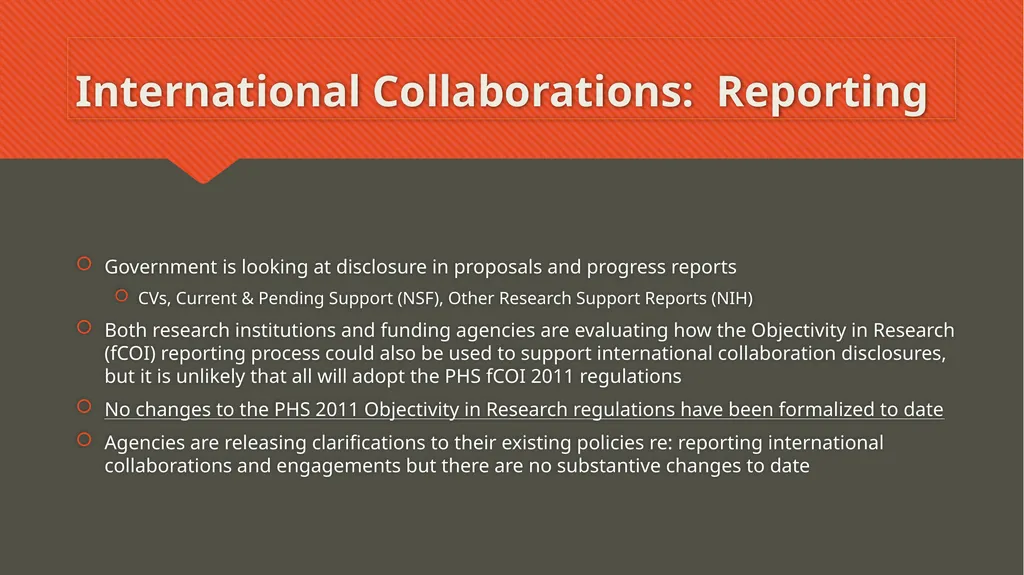
International Collaborations: Reporting Government is looking at disclosure in proposals and progress reports
CVs, Current & Pending Support (NSF), Other Research Support Reports (NIH)
Both research institutions and funding agencies are evaluating how the Objectivity in Research (fCOI) reporting process could also be used to support international collaboration disclosures, but it is unlikely that all will adopt the PHS fCOI 2011 regulations
No changes to the PHS 2011 Objectivity in Research regulations have been formalized to date
Agencies are releasing clarifications to their existing policies re: reporting international collaborations and engagements but there are no substantive changes to date<br>
CVs, Current & Pending Support (NSF), Other Research Support Reports (NIH)
Both research institutions and funding agencies are evaluating how the Objectivity in Research (fCOI) reporting process could also be used to support international collaboration disclosures, but it is unlikely that all will adopt the PHS fCOI 2011 regulations
No changes to the PHS 2011 Objectivity in Research regulations have been formalized to date
Agencies are releasing clarifications to their existing policies re: reporting international collaborations and engagements but there are no substantive changes to date<br>
10
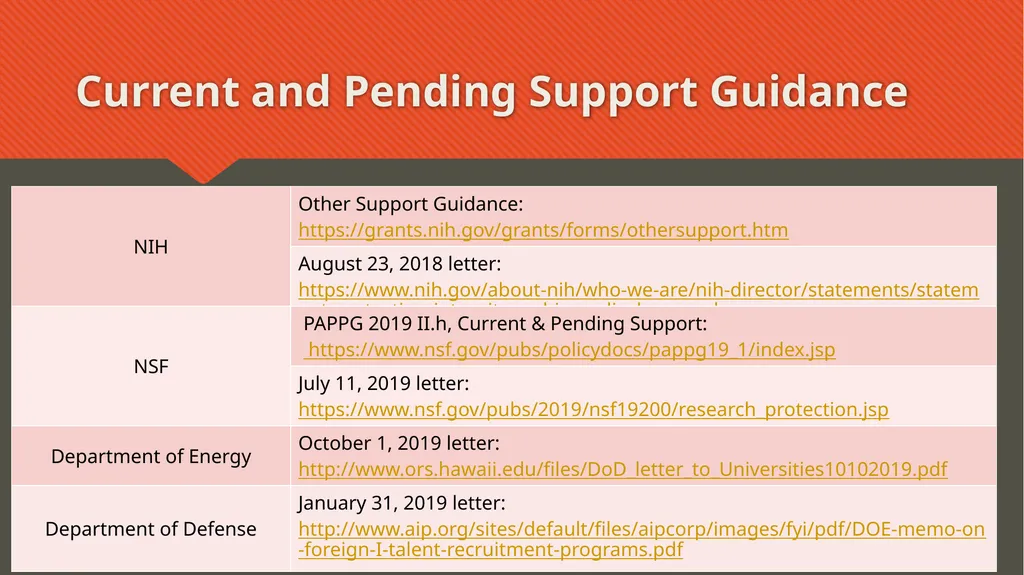
Current and Pending Support Guidance<br>
11
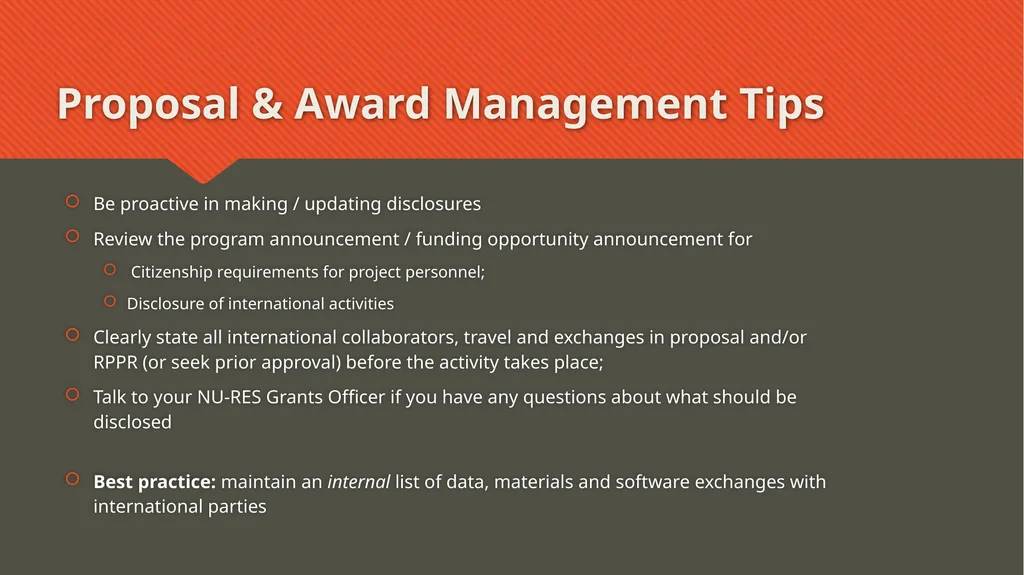
Proposal & Award Management Tips Be proactive in making / updating disclosures
Review the program announcement / funding opportunity announcement for
Citizenship requirements for project personnel;
Disclosure of international activities
Clearly state all international collaborators, travel and exchanges in proposal and/or RPPR (or seek prior approval) before the activity takes place;
Talk to your NU-RES Grants Officer if you have any questions about what should be disclosed
Best practice: maintain an internal list of data, materials and software exchanges with international parties<br>
Review the program announcement / funding opportunity announcement for
Citizenship requirements for project personnel;
Disclosure of international activities
Clearly state all international collaborators, travel and exchanges in proposal and/or RPPR (or seek prior approval) before the activity takes place;
Talk to your NU-RES Grants Officer if you have any questions about what should be disclosed
Best practice: maintain an internal list of data, materials and software exchanges with international parties<br>
12
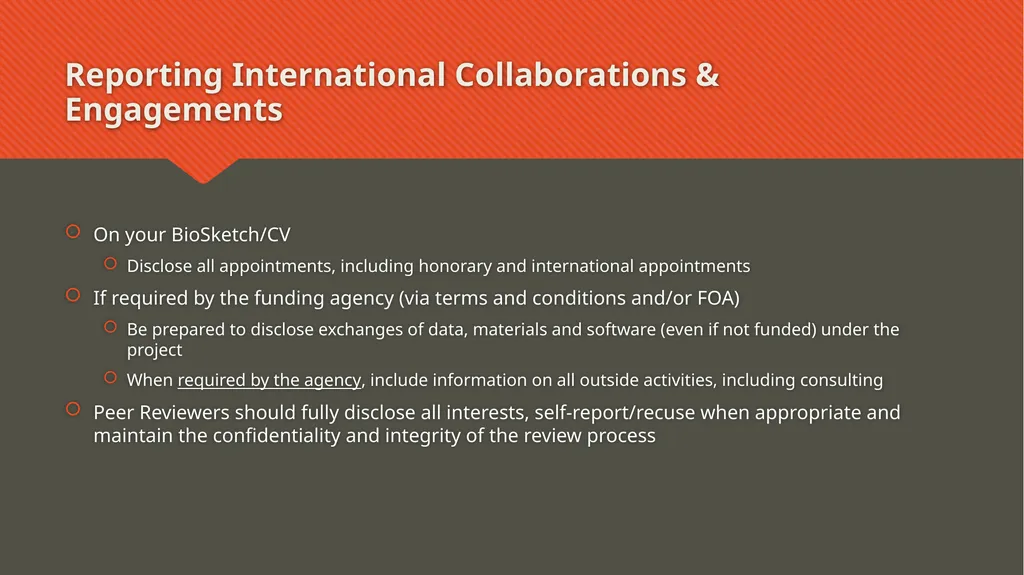
Reporting International Collaborations & Engagements On your BioSketch/CV
Disclose all appointments, including honorary and international appointments
If required by the funding agency (via terms and conditions and/or FOA)
Be prepared to disclose exchanges of data, materials and software (even if not funded) under the project
When required by the agency, include information on all outside activities, including consulting
Peer Reviewers should fully disclose all interests, self-report/recuse when appropriate and maintain the confidentiality and integrity of the review process<br>
Disclose all appointments, including honorary and international appointments
If required by the funding agency (via terms and conditions and/or FOA)
Be prepared to disclose exchanges of data, materials and software (even if not funded) under the project
When required by the agency, include information on all outside activities, including consulting
Peer Reviewers should fully disclose all interests, self-report/recuse when appropriate and maintain the confidentiality and integrity of the review process<br>
13
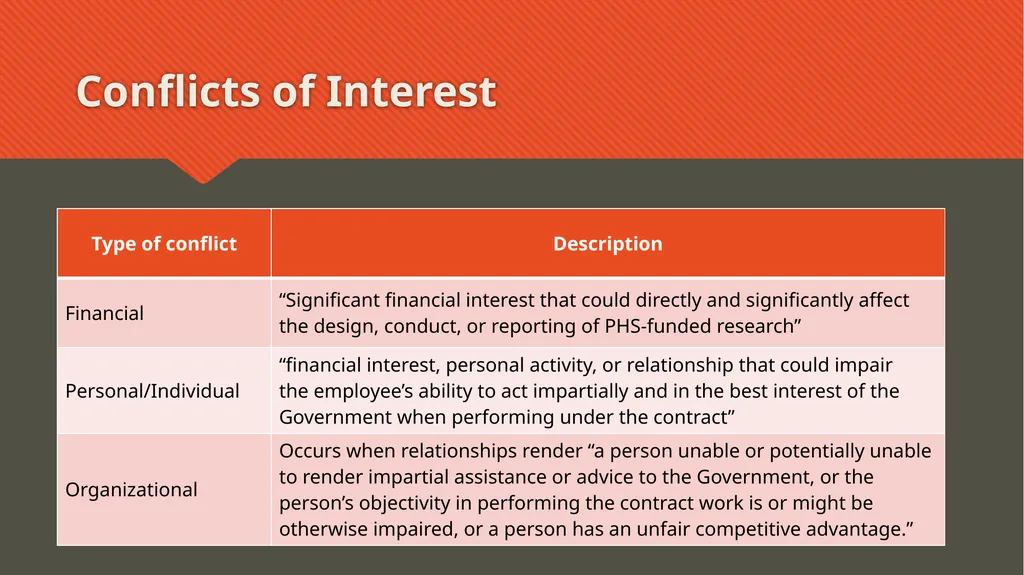
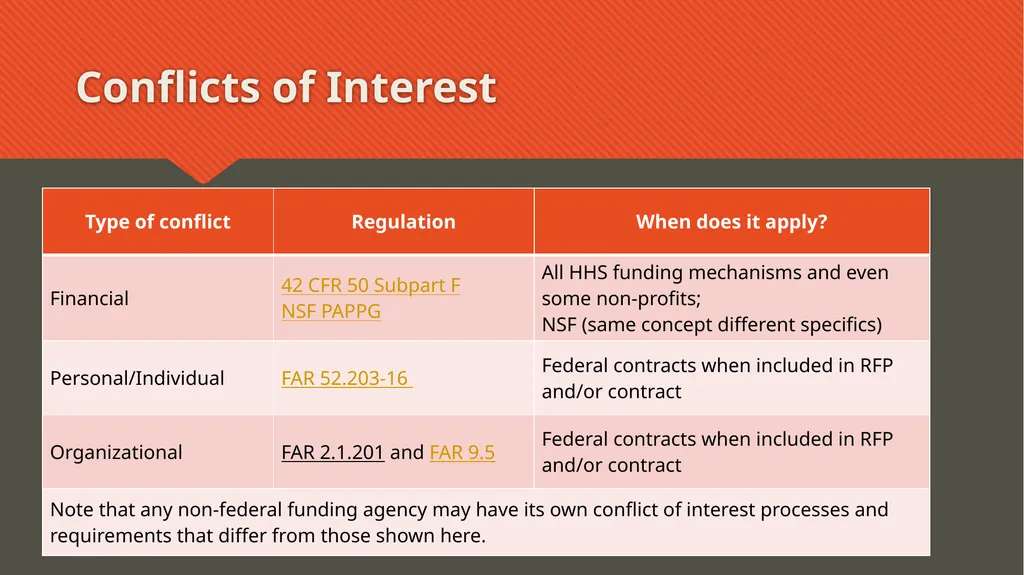
Conflicts of Interest<br>
14
Conflicts of Interest<br>
15
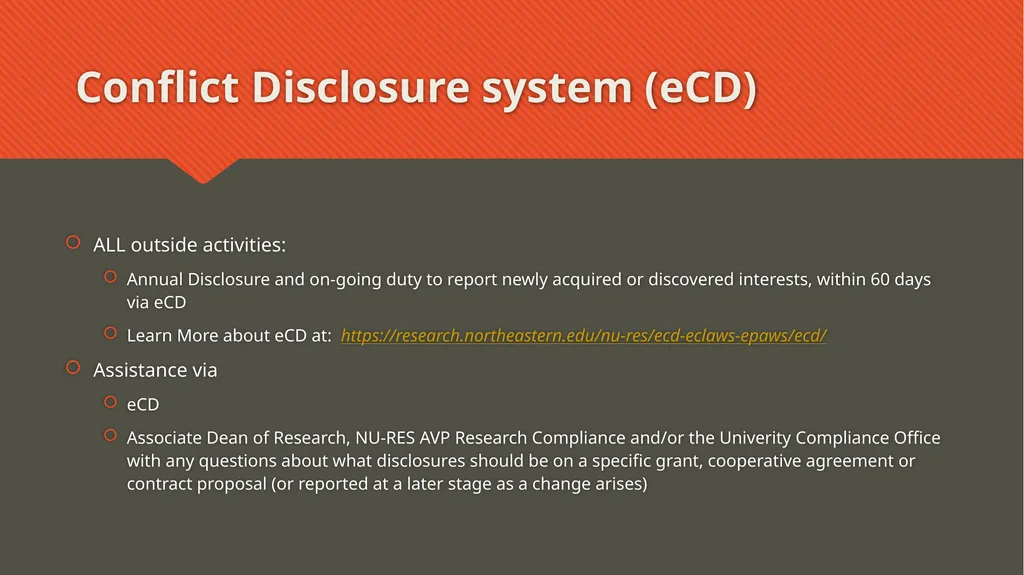
Conflict Disclosure system (eCD) ALL outside activities:
Annual Disclosure and on-going duty to report newly acquired or discovered interests, within 60 days via eCD
Learn More about eCD at: https://research.northeastern.edu/nu-res/ecd-eclaws-epaws/ecd/
Assistance via
eCD
Associate Dean of Research, NU-RES AVP Research Compliance and/or the Univerity Compliance Office with any questions about what disclosures should be on a specific grant, cooperative agreement or contract proposal (or reported at a later stage as a change arises)<br>
Annual Disclosure and on-going duty to report newly acquired or discovered interests, within 60 days via eCD
Learn More about eCD at: https://research.northeastern.edu/nu-res/ecd-eclaws-epaws/ecd/
Assistance via
eCD
Associate Dean of Research, NU-RES AVP Research Compliance and/or the Univerity Compliance Office with any questions about what disclosures should be on a specific grant, cooperative agreement or contract proposal (or reported at a later stage as a change arises)<br>
16
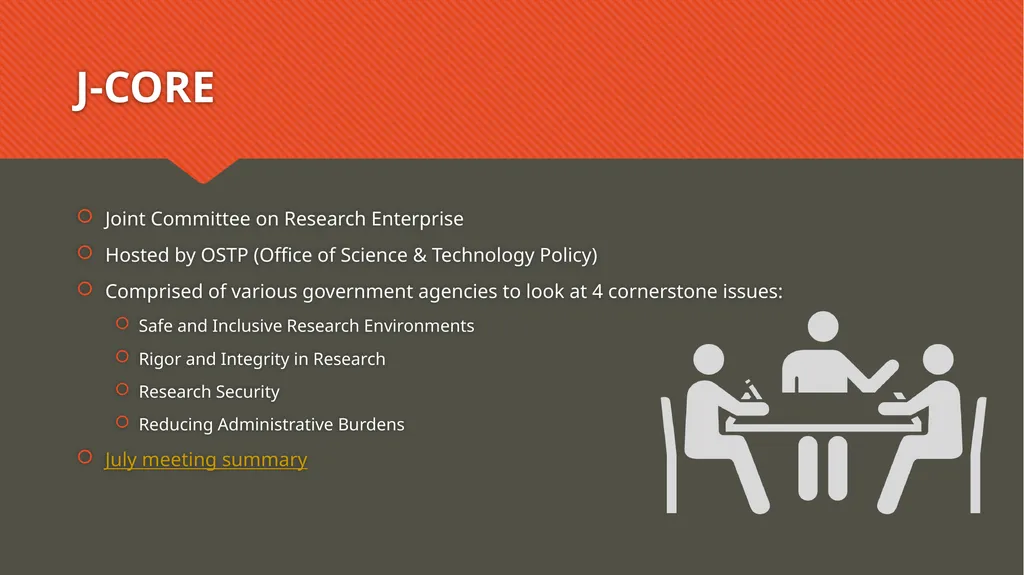
J-CORE Joint Committee on Research Enterprise
Hosted by OSTP (Office of Science & Technology Policy)
Comprised of various government agencies to look at 4 cornerstone issues:
Safe and Inclusive Research Environments
Rigor and Integrity in Research
Research Security
Reducing Administrative Burdens
July meeting summary<br>
Hosted by OSTP (Office of Science & Technology Policy)
Comprised of various government agencies to look at 4 cornerstone issues:
Safe and Inclusive Research Environments
Rigor and Integrity in Research
Research Security
Reducing Administrative Burdens
July meeting summary<br>
17
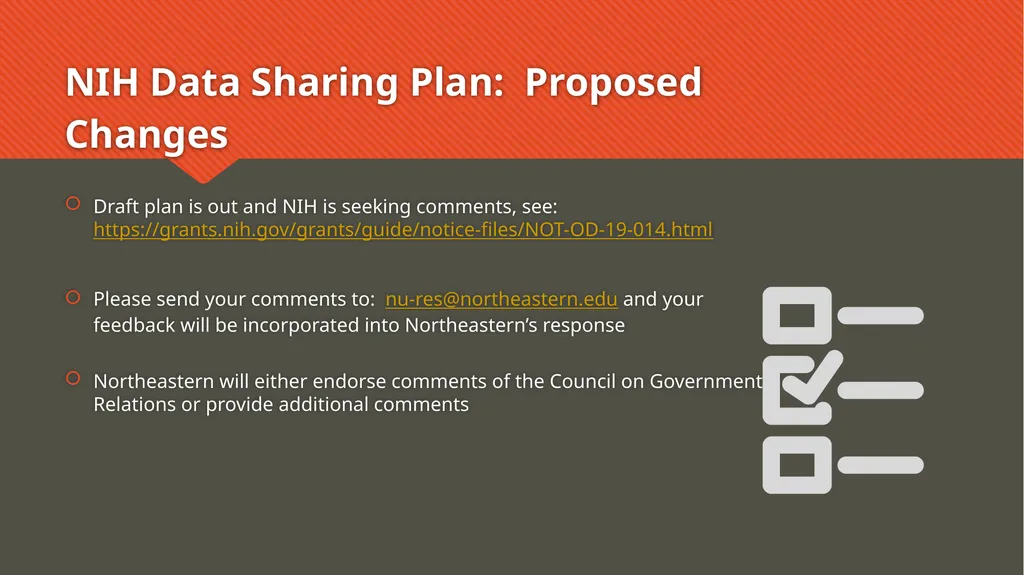
NIH Data Sharing Plan: Proposed Changes Draft plan is out and NIH is seeking comments, see: https://grants.nih.gov/grants/guide/notice-files/NOT-OD-19-014.html
Please send your comments to: nu-res@northeastern.edu and your feedback will be incorporated into Northeastern’s response
Northeastern will either endorse comments of the Council on Government Relations or provide additional comments<br>
Please send your comments to: nu-res@northeastern.edu and your feedback will be incorporated into Northeastern’s response
Northeastern will either endorse comments of the Council on Government Relations or provide additional comments<br>
18
Human Subject Research Training Northeastern has moved from the NIH human subjects research training module to the CITI module
https://research.northeastern.edu/hsrp/get-started/training/
Use of CITI allows us to track and verify completion with less information needed from the individual
Additionally, CITI training can be used to meet other required research-related training, (i.e. introductory RCR and required PHS fCOI training)
Use of CITI allows individuals to track what trainings they have completed and when, including required refreshers, as required by funding agencies and Northeastern<br>
https://research.northeastern.edu/hsrp/get-started/training/
Use of CITI allows us to track and verify completion with less information needed from the individual
Additionally, CITI training can be used to meet other required research-related training, (i.e. introductory RCR and required PHS fCOI training)
Use of CITI allows individuals to track what trainings they have completed and when, including required refreshers, as required by funding agencies and Northeastern<br>
19
Human Subject Research: Common Rule Updates The revised Common Rule overseeing human subject research broadens the type of research that may fall under the Exempt Category of review (45 CFR 46.104) to include self-determined exempt activities. These may include:
Educational Studies
Surveys, Interviews, Educational Tests & Observation of Public Behavior
Benign Behavioral Interventions
Secondary Research Projects
Federal Demonstration Projects
Reminder: Northeastern’s Human Subject Research Protection Office must review and concur with the self-determined exempt status prior to beginning the research activity (including secondary data analysis)
For more information see: https://research.northeastern.edu/hsrp/get-started/training/ and https://research.northeastern.edu/hsrp/forms/<br>
Educational Studies
Surveys, Interviews, Educational Tests & Observation of Public Behavior
Benign Behavioral Interventions
Secondary Research Projects
Federal Demonstration Projects
Reminder: Northeastern’s Human Subject Research Protection Office must review and concur with the self-determined exempt status prior to beginning the research activity (including secondary data analysis)
For more information see: https://research.northeastern.edu/hsrp/get-started/training/ and https://research.northeastern.edu/hsrp/forms/<br>
20
Human Subjects Research: Common Rule Updates & Resources NIH has webpage dedicated to the updates: https://www.hhs.gov/ohrp/regulations-and-policy/regulations/finalized-revisions-common-rule/index.html
NU-RES learn more presentation: https://research.northeastern.edu/app/uploads/sites/2/2019/03/Learn-More-IRB-Updates-Dec-2018.pdf
NU-RES HSRP Office (IRB): https://research.northeastern.edu/hsrp/
When in doubt, please ask!<br>
NU-RES learn more presentation: https://research.northeastern.edu/app/uploads/sites/2/2019/03/Learn-More-IRB-Updates-Dec-2018.pdf
NU-RES HSRP Office (IRB): https://research.northeastern.edu/hsrp/
When in doubt, please ask!<br>
21
NIH Changes: Human Fetal Tissue (HFT) HFT is defined as research involving the study, analysis, or use of primary HFT, cells, and derivatives, and human fetal primary cell cultures obtained from elective abortions and includes the following:
human fetal primary or secondary cell cultures, whether derived by the investigator or obtained from a vendor
animal models incorporating HFT from elective abortions, including obtaining such models from a vendor
derivative products from elective abortion tissues or cells such as protein or nucleic acid extracts
any human extra-embryonic cells and tissue, such as umbilical cord tissue, cord blood, placenta, amniotic fluid, and chorionic villi, if obtained from the process of elective abortion<br>
human fetal primary or secondary cell cultures, whether derived by the investigator or obtained from a vendor
animal models incorporating HFT from elective abortions, including obtaining such models from a vendor
derivative products from elective abortion tissues or cells such as protein or nucleic acid extracts
any human extra-embryonic cells and tissue, such as umbilical cord tissue, cord blood, placenta, amniotic fluid, and chorionic villi, if obtained from the process of elective abortion<br>
22
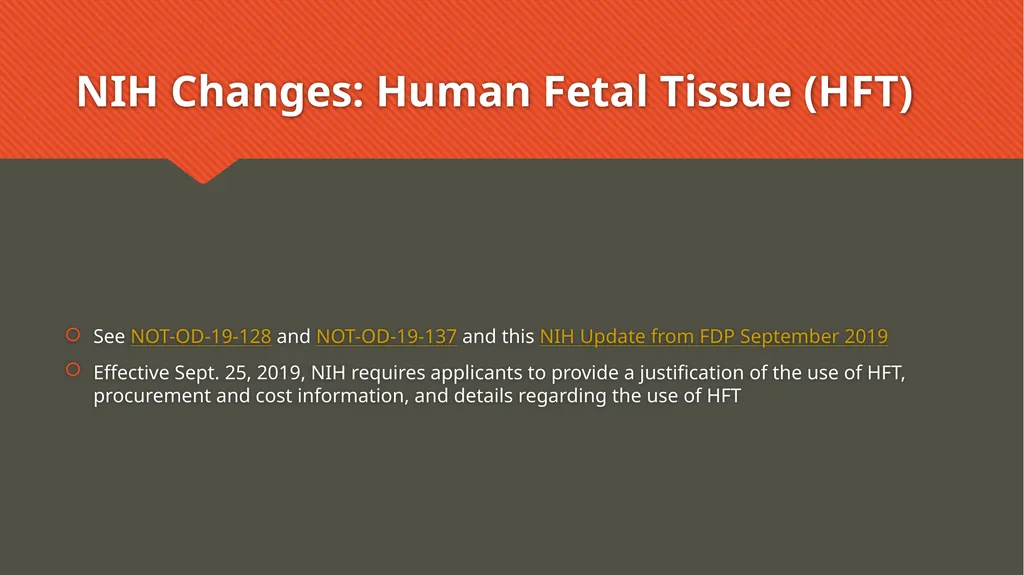
NIH Changes: Human Fetal Tissue (HFT) See NOT-OD-19-128 and NOT-OD-19-137 and this NIH Update from FDP September 2019
Effective Sept. 25, 2019, NIH requires applicants to provide a justification of the use of HFT, procurement and cost information, and details regarding the use of HFT<br>
Effective Sept. 25, 2019, NIH requires applicants to provide a justification of the use of HFT, procurement and cost information, and details regarding the use of HFT<br>
23
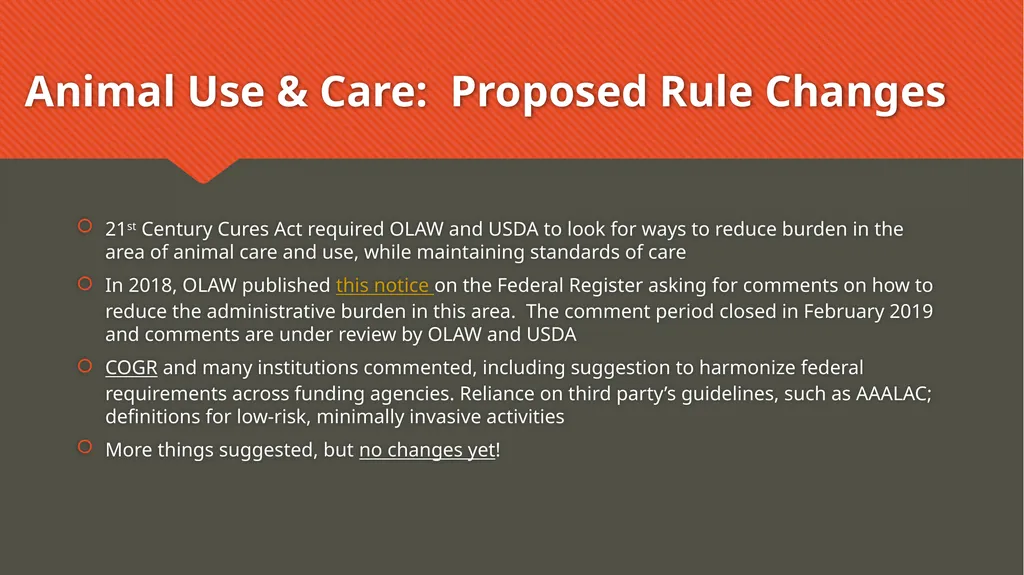
Animal Use & Care: Proposed Rule Changes 21st Century Cures Act required OLAW and USDA to look for ways to reduce burden in the area of animal care and use, while maintaining standards of care
In 2018, OLAW published this notice on the Federal Register asking for comments on how to reduce the administrative burden in this area. The comment period closed in February 2019 and comments are under review by OLAW and USDA
COGR and many institutions commented, including suggestion to harmonize federal requirements across funding agencies. Reliance on third party’s guidelines, such as AAALAC; definitions for low-risk, minimally invasive activities
More things suggested, but no changes yet!<br>
In 2018, OLAW published this notice on the Federal Register asking for comments on how to reduce the administrative burden in this area. The comment period closed in February 2019 and comments are under review by OLAW and USDA
COGR and many institutions commented, including suggestion to harmonize federal requirements across funding agencies. Reliance on third party’s guidelines, such as AAALAC; definitions for low-risk, minimally invasive activities
More things suggested, but no changes yet!<br>
24
Thank you!<br>