
Learning aim C: Managing human resources C2 Human
TA
Published · 25 slides · 0 views
1 / 1


Description
Learning aim C: Managing human resources C2 Human resource planning When did you last attend an event? Make a list of different skills and experience that employees required. Human resource planning In this topic you will learn about The
Related Topics
Share
Embed code
Download this presentation From Below
"Learning aim C: Managing human resources C2 Human" is the property of its rightful owner. Permission is granted to download and print the materials on this website for personal, non-commercial use only, and to display it on your personal computer provided you do not modify the materials and that you retain all copyright notices contained in the materials. By downloading content from our website, you accept the terms of this agreement.
Presentation Transcript
01
Learning aim C:
Managing human resources C2
Human resource planning When did you last attend an event?
Make a list of different skills and experience that employees required.<br>
Human resource planning When did you last attend an event?
Make a list of different skills and experience that employees required.<br>
02
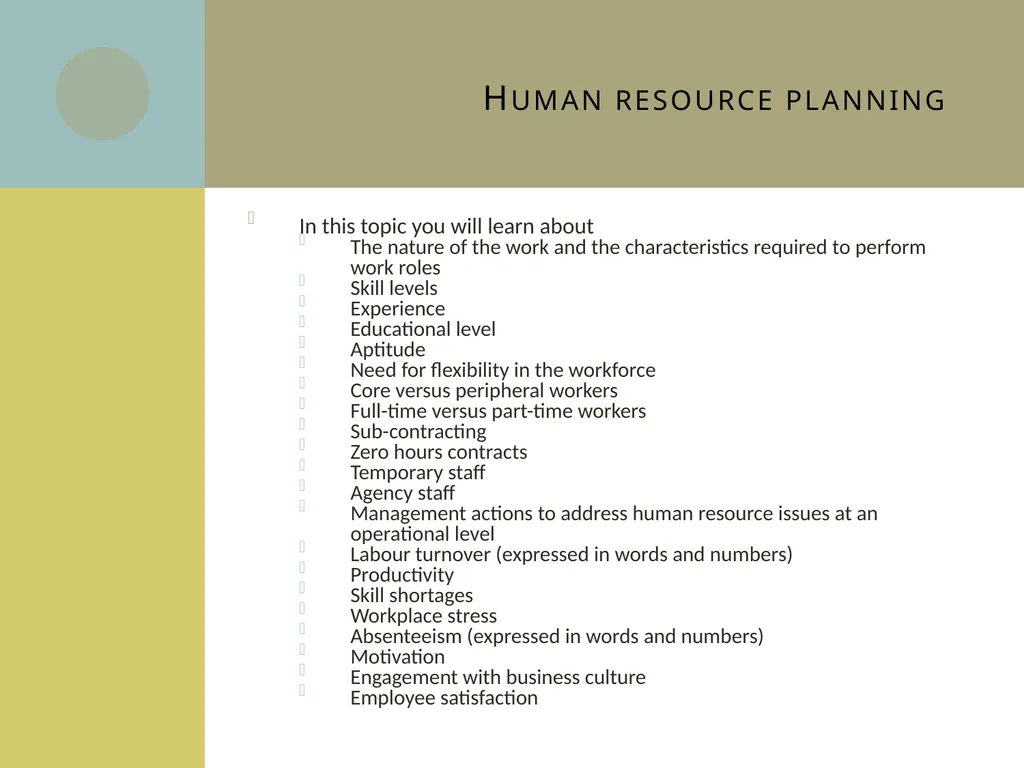
Human resource planning In this topic you will learn about
The nature of the work and the characteristics required to perform work roles
Skill levels
Experience
Educational level
Aptitude
Need for flexibility in the workforce
Core versus peripheral workers
Full-time versus part-time workers
Sub-contracting
Zero hours contracts
Temporary staff
Agency staff
Management actions to address human resource issues at an operational level
Labour turnover (expressed in words and numbers)
Productivity
Skill shortages
Workplace stress
Absenteeism (expressed in words and numbers)
Motivation
Engagement with business culture
Employee satisfaction<br>
The nature of the work and the characteristics required to perform work roles
Skill levels
Experience
Educational level
Aptitude
Need for flexibility in the workforce
Core versus peripheral workers
Full-time versus part-time workers
Sub-contracting
Zero hours contracts
Temporary staff
Agency staff
Management actions to address human resource issues at an operational level
Labour turnover (expressed in words and numbers)
Productivity
Skill shortages
Workplace stress
Absenteeism (expressed in words and numbers)
Motivation
Engagement with business culture
Employee satisfaction<br>
03
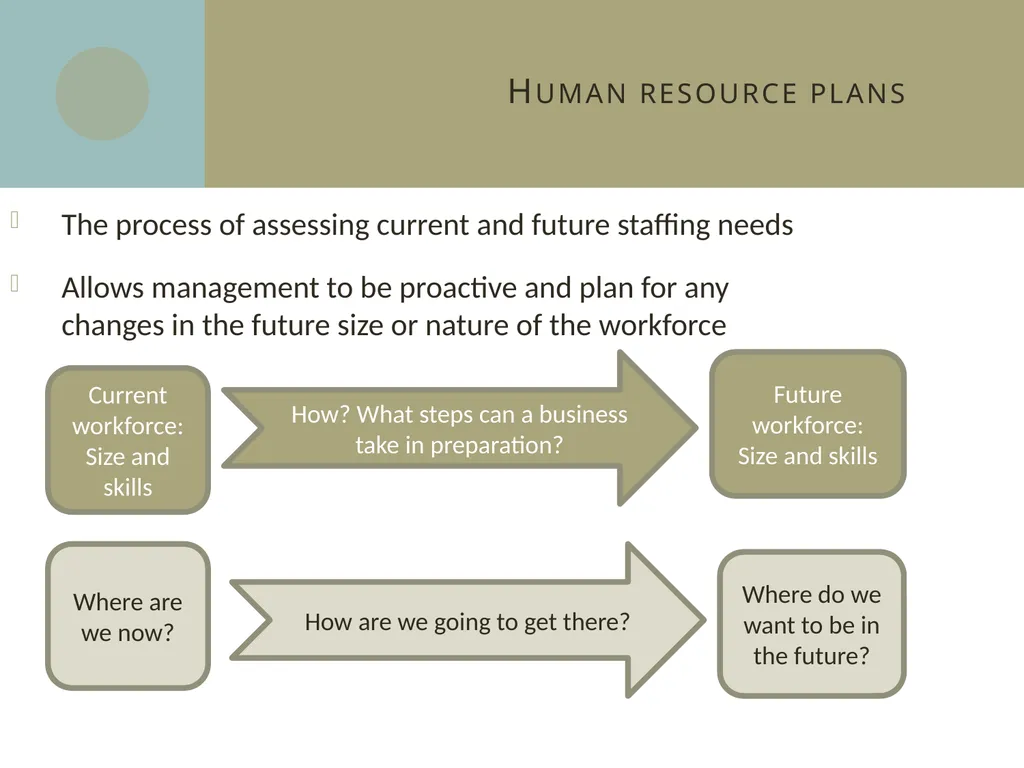
Human resource plans The process of assessing current and future staffing needs
Allows management to be proactive and plan for any changes in the future size or nature of the workforce Current workforce:
Size and skills Future workforce:
Size and skills How? What steps can a business take in preparation? Where are we now? Where do we want to be in the future? How are we going to get there?<br>
Allows management to be proactive and plan for any changes in the future size or nature of the workforce Current workforce:
Size and skills Future workforce:
Size and skills How? What steps can a business take in preparation? Where are we now? Where do we want to be in the future? How are we going to get there?<br>
04
Human resource Plans A detailed plan of the strategies that the HR department will undertake to ensure that future workforce needs are met
Future workforce needs may be more or less than the current provision
Key considerations include:
The nature of the work and the characteristics required to perform work roles
Physical, manual, sector i.e. primary, secondary or tertiary, indoor or outdoor, repetitive or varied, technical, regular hours, unsocial hours or shift work etc.
Skill levels
Unskilled, semi-skilled or skilled
Specific skills required e.g. computer literate
Experience
Amount and type of previous experience required
Educational level
In the UK these are shown from level 1 – 8
You are currently studying for a level 3 qualification, a degree is level 6
Aptitude
Ability to naturally do certain things e.g. spelling or numeracy, logical problem solving, working accurately UK education levels.<br>
Future workforce needs may be more or less than the current provision
Key considerations include:
The nature of the work and the characteristics required to perform work roles
Physical, manual, sector i.e. primary, secondary or tertiary, indoor or outdoor, repetitive or varied, technical, regular hours, unsocial hours or shift work etc.
Skill levels
Unskilled, semi-skilled or skilled
Specific skills required e.g. computer literate
Experience
Amount and type of previous experience required
Educational level
In the UK these are shown from level 1 – 8
You are currently studying for a level 3 qualification, a degree is level 6
Aptitude
Ability to naturally do certain things e.g. spelling or numeracy, logical problem solving, working accurately UK education levels.<br>
05
Human resource plans Need for flexibility in the workforce
It is important to be able to match workforce skills, size and location to business needs
This is necessary for a business to run smoothly and be able to match supply to demand
Enabling all aspects of the business to function
Meet new challenges to the business
Meet seasonal fluctuations
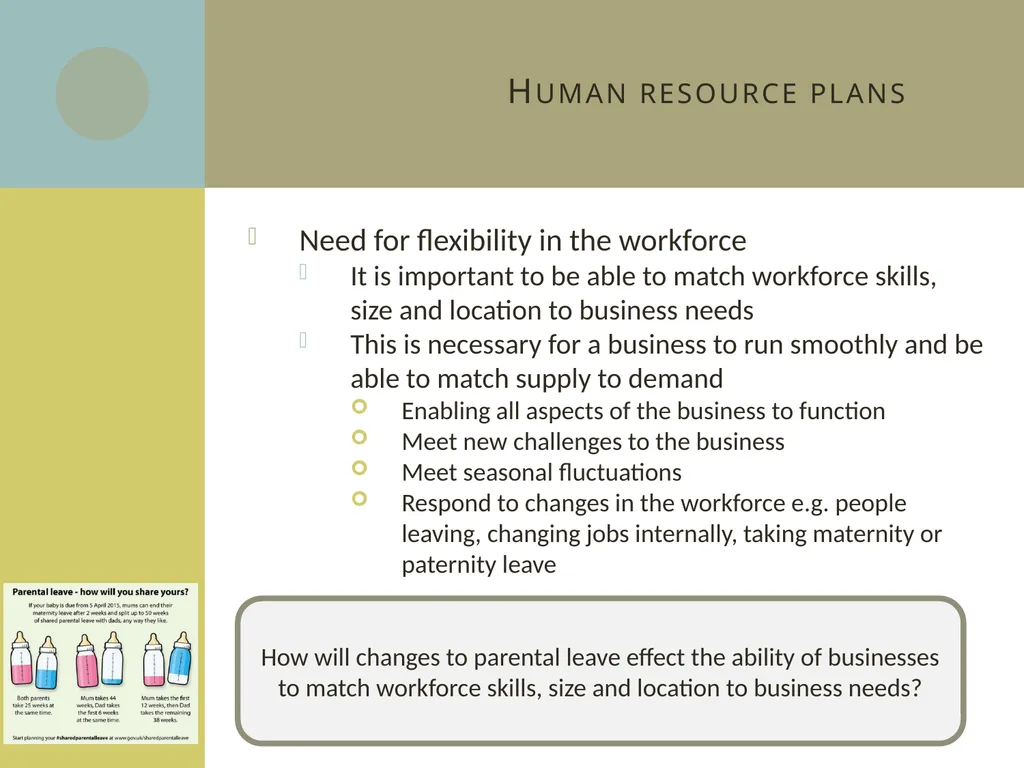
Respond to changes in the workforce e.g. people leaving, changing jobs internally, taking maternity or paternity leave How will changes to parental leave effect the ability of businesses to match workforce skills, size and location to business needs?<br>
It is important to be able to match workforce skills, size and location to business needs
This is necessary for a business to run smoothly and be able to match supply to demand
Enabling all aspects of the business to function
Meet new challenges to the business
Meet seasonal fluctuations
Respond to changes in the workforce e.g. people leaving, changing jobs internally, taking maternity or paternity leave How will changes to parental leave effect the ability of businesses to match workforce skills, size and location to business needs?<br>
06
Human resource plans Core versus peripheral workers
Core workers are those whose job roles are crucial to the smooth operations of a business i.e. the key personnel
These are likely to be treated well, on permanent contracts, receive training and promotion opportunities, may be salaried and receive additional incentives
Peripheral workers offer support roles to the core workers e.g. cleaning services or technical support
These are likely to be treated less well, contracts maybe flexible or zero hours, these roles may be subcontracted<br>
Core workers are those whose job roles are crucial to the smooth operations of a business i.e. the key personnel
These are likely to be treated well, on permanent contracts, receive training and promotion opportunities, may be salaried and receive additional incentives
Peripheral workers offer support roles to the core workers e.g. cleaning services or technical support
These are likely to be treated less well, contracts maybe flexible or zero hours, these roles may be subcontracted<br>
07
Human resource plans Part-time workers
Part-time employees are contracted to work less hours than a full time employee e.g. 3 days a week
Offer greater flexibility to a business and may be a more affordable option
Hours can be increased if there is an increase in demand and the firm requires more workers
Legally, part-time workers should not be treated less favourably than full time workers
Offering part-time work increases the number of applicants for a position e.g. parents and retired workers may be more likely to be interested in part time work
A business can retain valued workers that no longer wish to work full-time by offering part time work
In the UK job sharing has increased where employees share a full-time position In pairs write a list of 4 points about full-time workers.
Draw a table of the advantages and disadvantages of full-time versus part-time.<br>
Part-time employees are contracted to work less hours than a full time employee e.g. 3 days a week
Offer greater flexibility to a business and may be a more affordable option
Hours can be increased if there is an increase in demand and the firm requires more workers
Legally, part-time workers should not be treated less favourably than full time workers
Offering part-time work increases the number of applicants for a position e.g. parents and retired workers may be more likely to be interested in part time work
A business can retain valued workers that no longer wish to work full-time by offering part time work
In the UK job sharing has increased where employees share a full-time position In pairs write a list of 4 points about full-time workers.
Draw a table of the advantages and disadvantages of full-time versus part-time.<br>
08
Human resource plans Sub-contracting
The practise of using the services of other organisations to complete all or parts of the manufacturing process
The value of outsourcing includes:
Provides flexibility in supply
Can increase capacity without high capital expenditure
Can buy in expertise
However
Quality must be maintained
Sub-contractor will also want to be making a profit<br>
The practise of using the services of other organisations to complete all or parts of the manufacturing process
The value of outsourcing includes:
Provides flexibility in supply
Can increase capacity without high capital expenditure
Can buy in expertise
However
Quality must be maintained
Sub-contractor will also want to be making a profit<br>
09
Human resource plans Zero hour contracts
Employees are not given any fixed or guaranteed hours, they are called in, and paid, only as and when needed Should businesses be allowed to use zero hour contracts to increase flexibility?<br>
Employees are not given any fixed or guaranteed hours, they are called in, and paid, only as and when needed Should businesses be allowed to use zero hour contracts to increase flexibility?<br>
10
Human resource plans Temporary employees
A person who is contracted to work for a business for a specified period of time e.g. 6 months to cover maternity leave
Temporary employees can be full-time or part-time and help meet the short term needs of a business
They do not have the security that a permanent employee has
Often, they are agency workers and are brought in to fill gaps at peak times e.g. seasonal work or to cover peak holiday periods<br>
A person who is contracted to work for a business for a specified period of time e.g. 6 months to cover maternity leave
Temporary employees can be full-time or part-time and help meet the short term needs of a business
They do not have the security that a permanent employee has
Often, they are agency workers and are brought in to fill gaps at peak times e.g. seasonal work or to cover peak holiday periods<br>
11
Human resource plans Agency staff
Workers are supplied to a business through a third party, the agency
Often used to fill low skilled jobs where demand fluctuates e.g. production operatives in the run up to Christmas
The agency is responsible for paying the worker and bills the business
Can be expensive for a business as they are also paying the agency for their services Further reading on your rights as an agency worker.<br>
Workers are supplied to a business through a third party, the agency
Often used to fill low skilled jobs where demand fluctuates e.g. production operatives in the run up to Christmas
The agency is responsible for paying the worker and bills the business
Can be expensive for a business as they are also paying the agency for their services Further reading on your rights as an agency worker.<br>
12
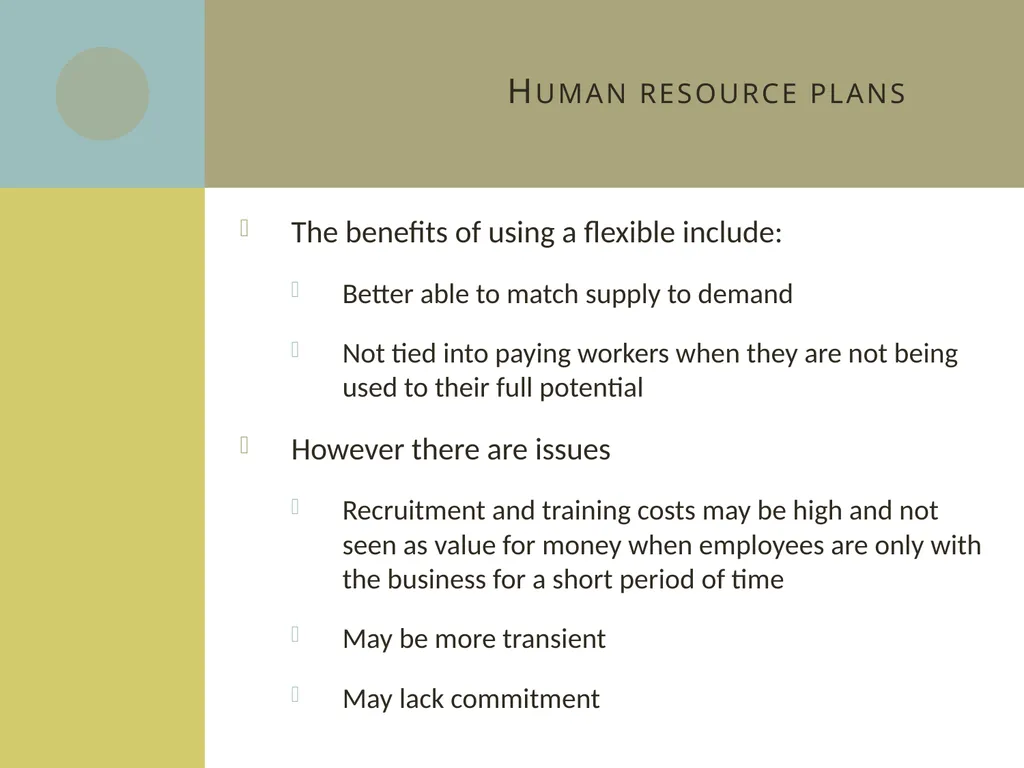
Human resource plans The benefits of using a flexible include:
Better able to match supply to demand
Not tied into paying workers when they are not being used to their full potential
However there are issues
Recruitment and training costs may be high and not seen as value for money when employees are only with the business for a short period of time
May be more transient
May lack commitment<br>
Better able to match supply to demand
Not tied into paying workers when they are not being used to their full potential
However there are issues
Recruitment and training costs may be high and not seen as value for money when employees are only with the business for a short period of time
May be more transient
May lack commitment<br>
13
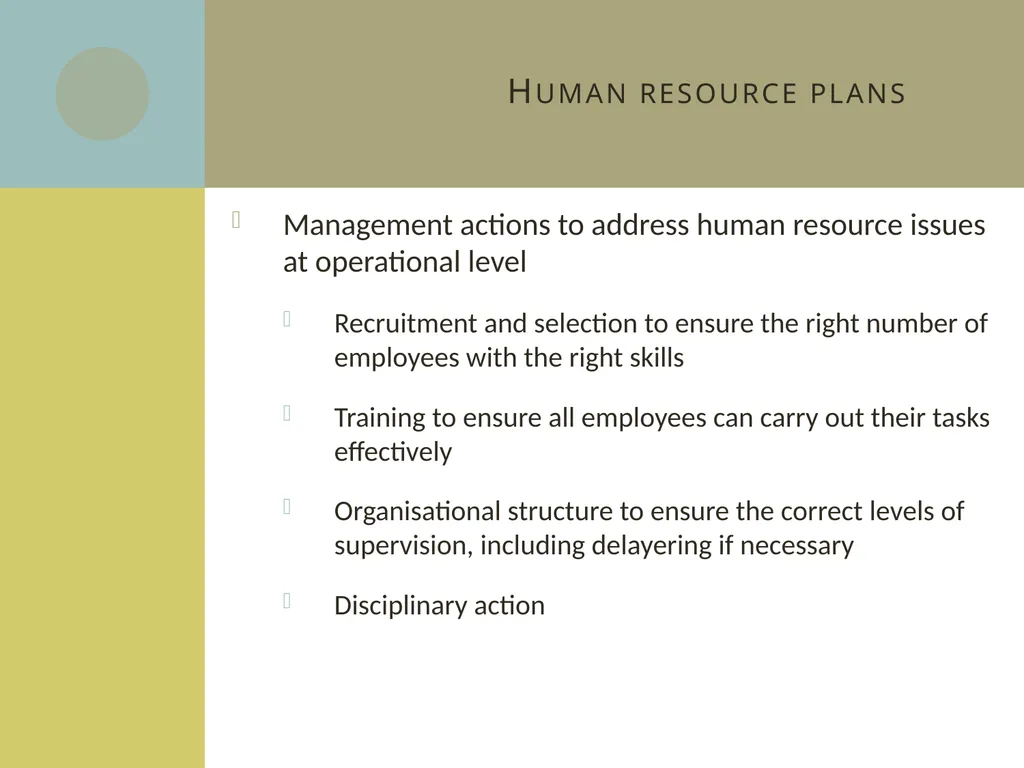
Human resource plans Management actions to address human resource issues at operational level
Recruitment and selection to ensure the right number of employees with the right skills
Training to ensure all employees can carry out their tasks effectively
Organisational structure to ensure the correct levels of supervision, including delayering if necessary
Disciplinary action<br>
Recruitment and selection to ensure the right number of employees with the right skills
Training to ensure all employees can carry out their tasks effectively
Organisational structure to ensure the correct levels of supervision, including delayering if necessary
Disciplinary action<br>
14
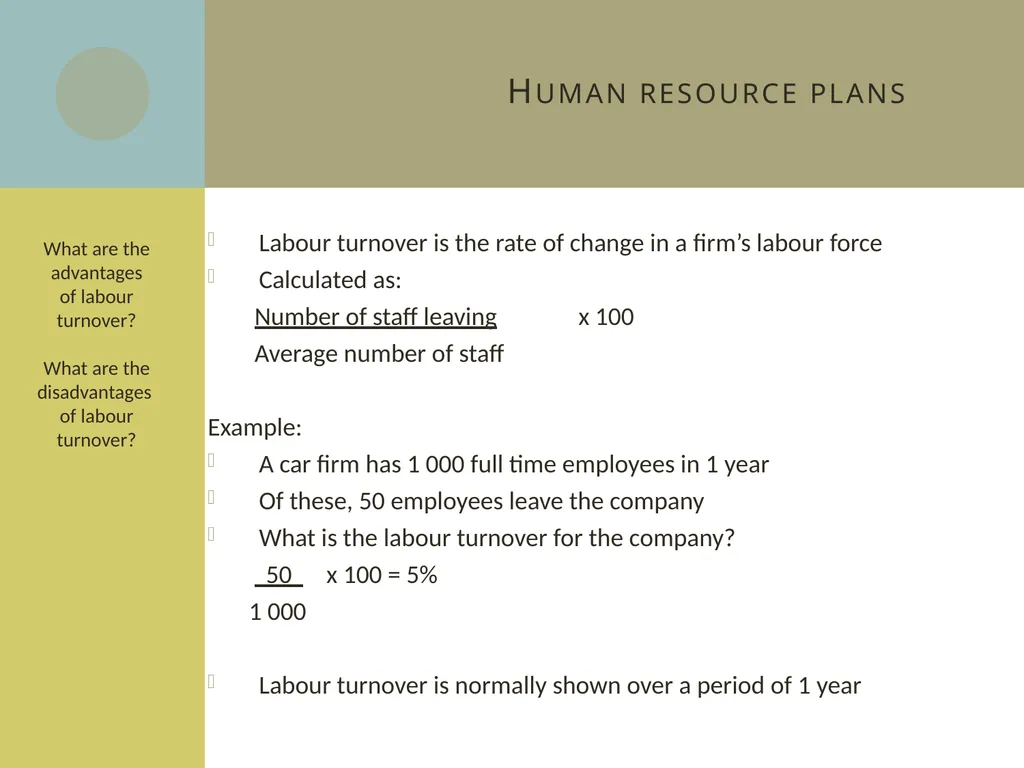
Human resource plans Labour turnover is the rate of change in a firm’s labour force
Calculated as:
Number of staff leaving x 100
Average number of staff
Example:
A car firm has 1 000 full time employees in 1 year
Of these, 50 employees leave the company
What is the labour turnover for the company?
50 x 100 = 5%
1 000
Labour turnover is normally shown over a period of 1 year What are the advantages
of labour turnover?
What are the disadvantages
of labour turnover?<br>
Calculated as:
Number of staff leaving x 100
Average number of staff
Example:
A car firm has 1 000 full time employees in 1 year
Of these, 50 employees leave the company
What is the labour turnover for the company?
50 x 100 = 5%
1 000
Labour turnover is normally shown over a period of 1 year What are the advantages
of labour turnover?
What are the disadvantages
of labour turnover?<br>
15
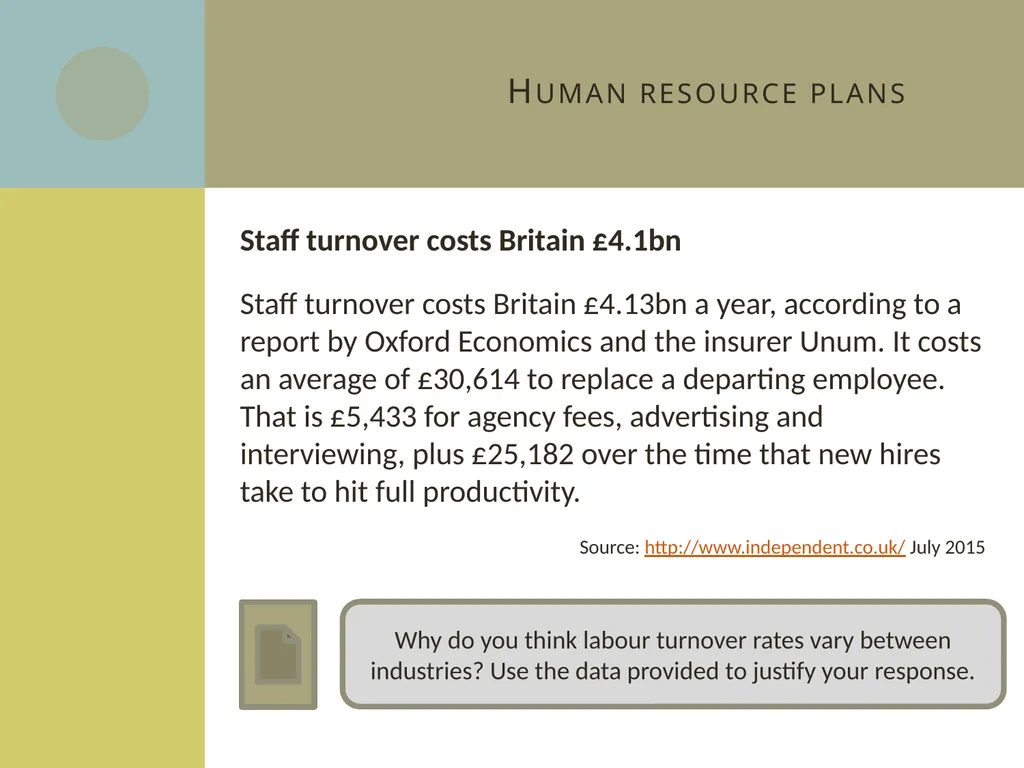
Human resource plans Staff turnover costs Britain £4.1bn
Staff turnover costs Britain £4.13bn a year, according to a report by Oxford Economics and the insurer Unum. It costs an average of £30,614 to replace a departing employee. That is £5,433 for agency fees, advertising and interviewing, plus £25,182 over the time that new hires take to hit full productivity.
Source: http://www.independent.co.uk/ July 2015 Why do you think labour turnover rates vary between industries? Use the data provided to justify your response.<br>
Staff turnover costs Britain £4.13bn a year, according to a report by Oxford Economics and the insurer Unum. It costs an average of £30,614 to replace a departing employee. That is £5,433 for agency fees, advertising and interviewing, plus £25,182 over the time that new hires take to hit full productivity.
Source: http://www.independent.co.uk/ July 2015 Why do you think labour turnover rates vary between industries? Use the data provided to justify your response.<br>
16
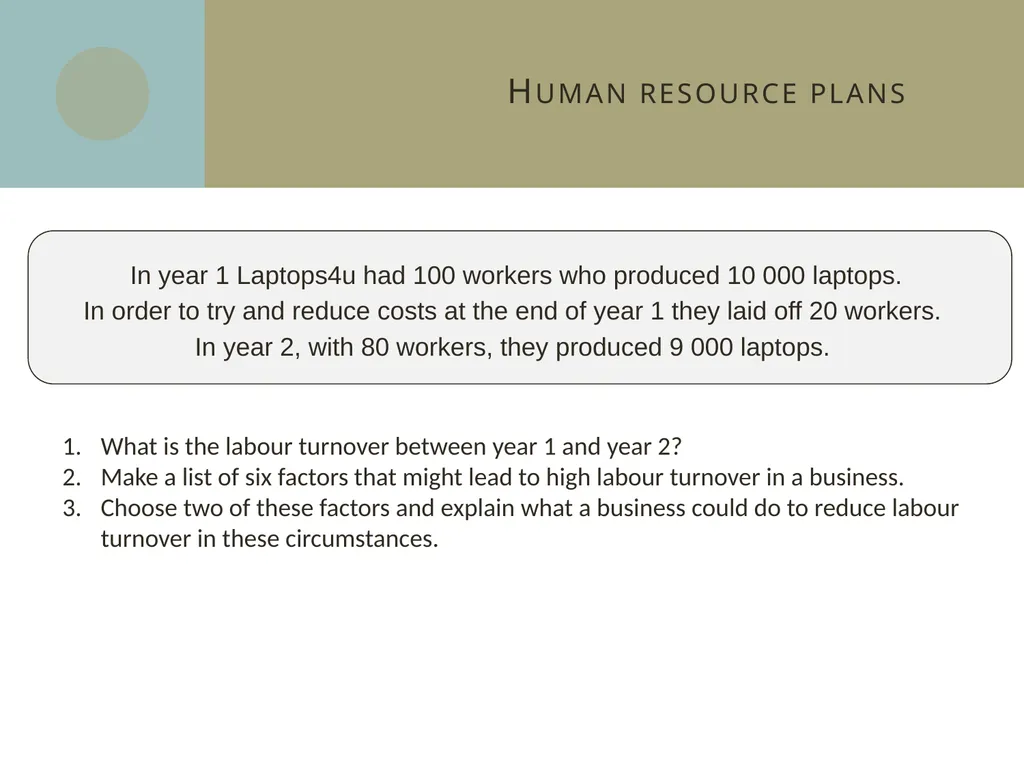
Human resource plans In year 1 Laptops4u had 100 workers who produced 10 000 laptops.
In order to try and reduce costs at the end of year 1 they laid off 20 workers.
In year 2, with 80 workers, they produced 9 000 laptops. What is the labour turnover between year 1 and year 2?
Make a list of six factors that might lead to high labour turnover in a business.
Choose two of these factors and explain what a business could do to reduce labour turnover in these circumstances.<br>
In order to try and reduce costs at the end of year 1 they laid off 20 workers.
In year 2, with 80 workers, they produced 9 000 laptops. What is the labour turnover between year 1 and year 2?
Make a list of six factors that might lead to high labour turnover in a business.
Choose two of these factors and explain what a business could do to reduce labour turnover in these circumstances.<br>
17
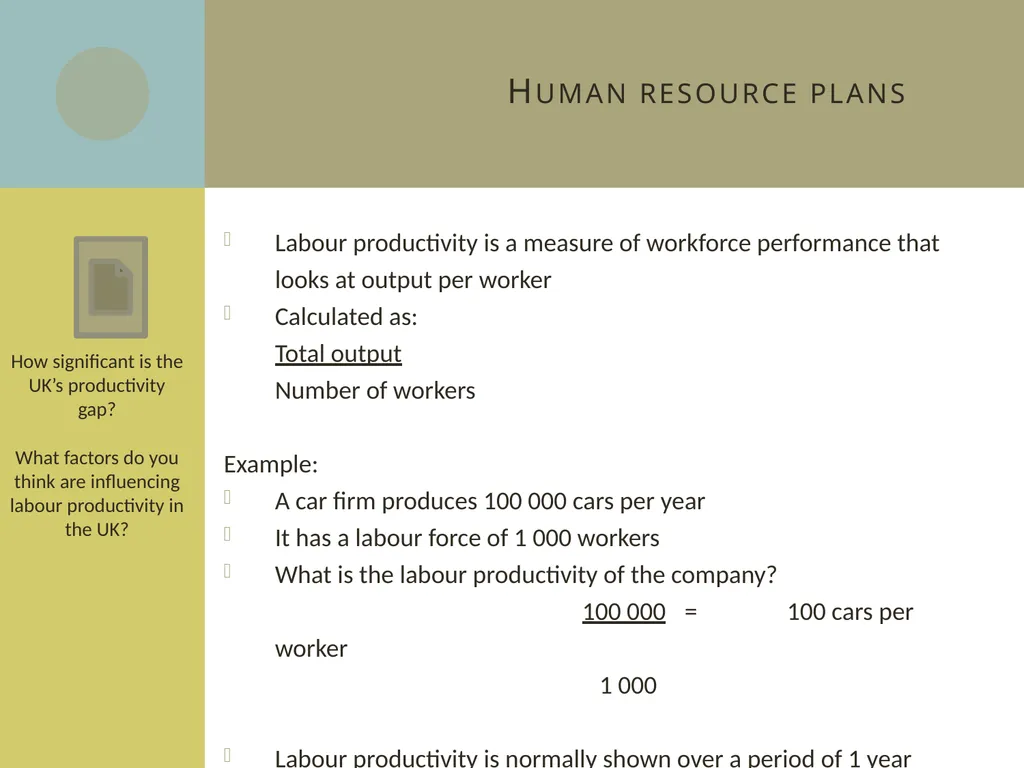
Human resource plans Labour productivity is a measure of workforce performance that looks at output per worker
Calculated as:
Total output
Number of workers
Example:
A car firm produces 100 000 cars per year
It has a labour force of 1 000 workers
What is the labour productivity of the company?
100 000 = 100 cars per worker
1 000
Labour productivity is normally shown over a period of 1 year How significant is the UK’s productivity gap?
What factors do you think are influencing labour productivity in the UK?<br>
Calculated as:
Total output
Number of workers
Example:
A car firm produces 100 000 cars per year
It has a labour force of 1 000 workers
What is the labour productivity of the company?
100 000 = 100 cars per worker
1 000
Labour productivity is normally shown over a period of 1 year How significant is the UK’s productivity gap?
What factors do you think are influencing labour productivity in the UK?<br>
18
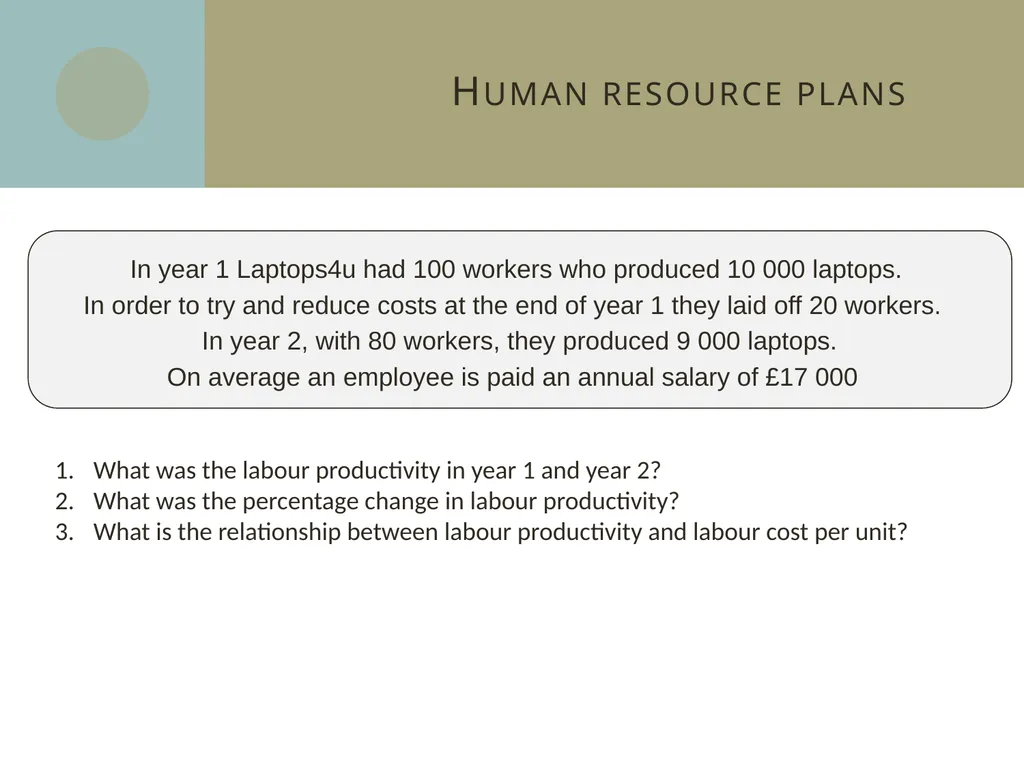
Human resource plans In year 1 Laptops4u had 100 workers who produced 10 000 laptops.
In order to try and reduce costs at the end of year 1 they laid off 20 workers.
In year 2, with 80 workers, they produced 9 000 laptops.
On average an employee is paid an annual salary of £17 000 What was the labour productivity in year 1 and year 2?
What was the percentage change in labour productivity?
What is the relationship between labour productivity and labour cost per unit?<br>
In order to try and reduce costs at the end of year 1 they laid off 20 workers.
In year 2, with 80 workers, they produced 9 000 laptops.
On average an employee is paid an annual salary of £17 000 What was the labour productivity in year 1 and year 2?
What was the percentage change in labour productivity?
What is the relationship between labour productivity and labour cost per unit?<br>
19
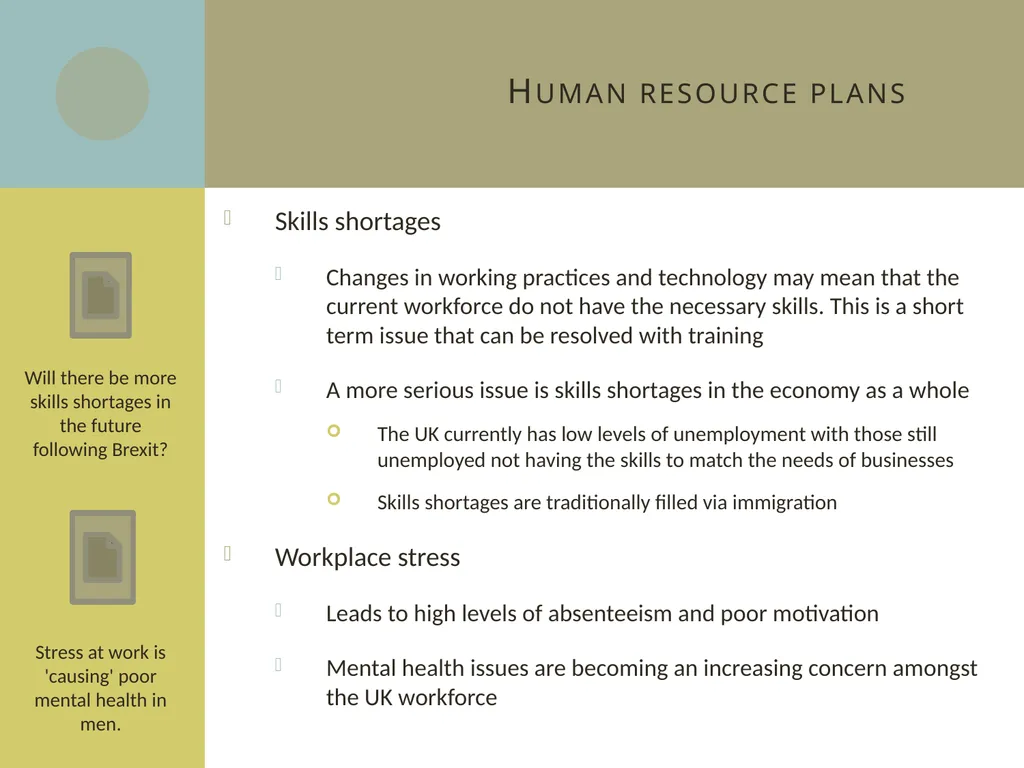
Human resource plans Skills shortages
Changes in working practices and technology may mean that the current workforce do not have the necessary skills. This is a short term issue that can be resolved with training
A more serious issue is skills shortages in the economy as a whole
The UK currently has low levels of unemployment with those still unemployed not having the skills to match the needs of businesses
Skills shortages are traditionally filled via immigration
Workplace stress
Leads to high levels of absenteeism and poor motivation
Mental health issues are becoming an increasing concern amongst the UK workforce Will there be more skills shortages in the future following Brexit? Stress at work is 'causing' poor mental health in men.<br>
Changes in working practices and technology may mean that the current workforce do not have the necessary skills. This is a short term issue that can be resolved with training
A more serious issue is skills shortages in the economy as a whole
The UK currently has low levels of unemployment with those still unemployed not having the skills to match the needs of businesses
Skills shortages are traditionally filled via immigration
Workplace stress
Leads to high levels of absenteeism and poor motivation
Mental health issues are becoming an increasing concern amongst the UK workforce Will there be more skills shortages in the future following Brexit? Stress at work is 'causing' poor mental health in men.<br>
20
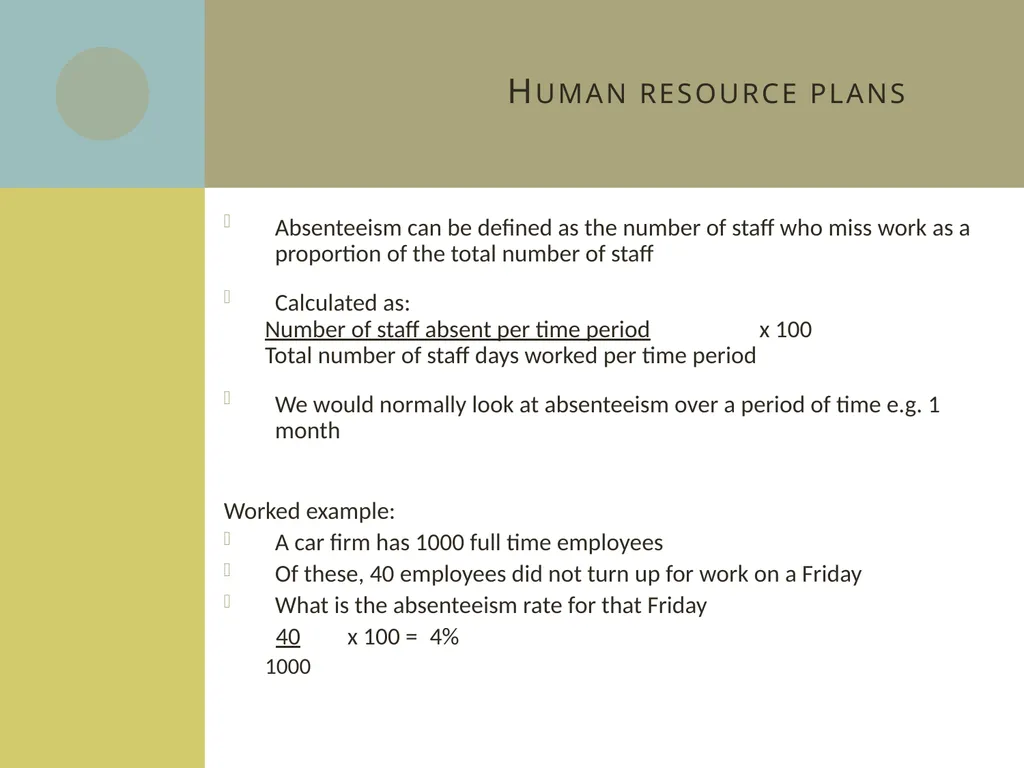
Human resource plans Absenteeism can be defined as the number of staff who miss work as a proportion of the total number of staff
Calculated as:
Number of staff absent per time period x 100
Total number of staff days worked per time period
We would normally look at absenteeism over a period of time e.g. 1 month
Worked example:
A car firm has 1000 full time employees
Of these, 40 employees did not turn up for work on a Friday
What is the absenteeism rate for that Friday
40 x 100 = 4%
1000<br>
Calculated as:
Number of staff absent per time period x 100
Total number of staff days worked per time period
We would normally look at absenteeism over a period of time e.g. 1 month
Worked example:
A car firm has 1000 full time employees
Of these, 40 employees did not turn up for work on a Friday
What is the absenteeism rate for that Friday
40 x 100 = 4%
1000<br>
21
Human resource plans At Laptops4u absenteeism was seen as a problem. In 2016 there were 100 workers who worked an average of 225 days each a year. Altogether, the workforce took 4500 days off.
What was the absenteeism rate for 2016?
In small groups think of 3 different ways to reduce the absenteeism rate. How will these methods reduce absenteeism?
What are the costs to a business of absenteeism:
In the short term?
In the long term?<br>
What was the absenteeism rate for 2016?
In small groups think of 3 different ways to reduce the absenteeism rate. How will these methods reduce absenteeism?
What are the costs to a business of absenteeism:
In the short term?
In the long term?<br>
22
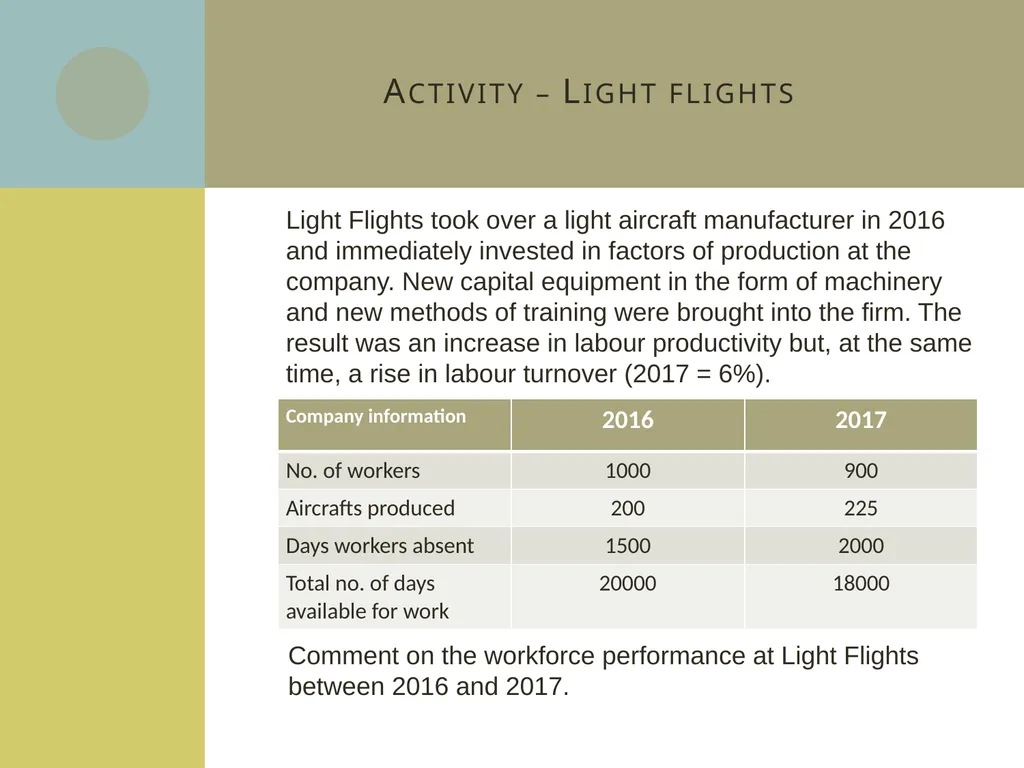
Activity – Light flights Light Flights took over a light aircraft manufacturer in 2016 and immediately invested in factors of production at the company. New capital equipment in the form of machinery and new methods of training were brought into the firm. The result was an increase in labour productivity but, at the same time, a rise in labour turnover (2017 = 6%). Comment on the workforce performance at Light Flights between 2016 and 2017.<br>
23
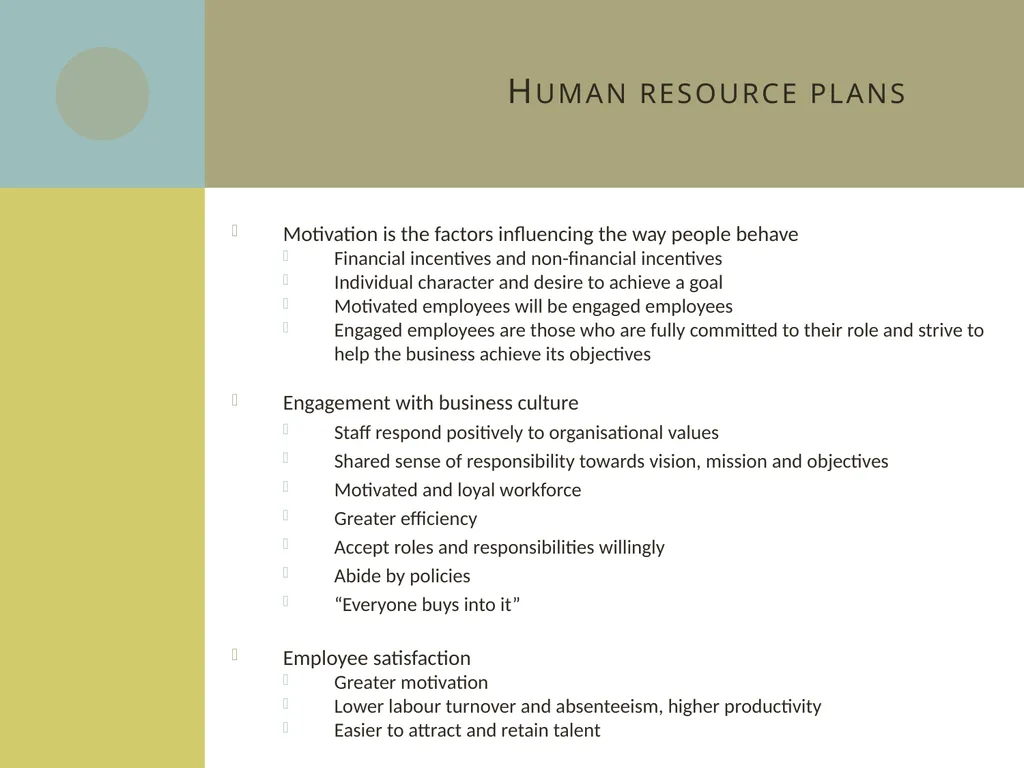
Human resource plans Motivation is the factors influencing the way people behave
Financial incentives and non-financial incentives
Individual character and desire to achieve a goal
Motivated employees will be engaged employees
Engaged employees are those who are fully committed to their role and strive to help the business achieve its objectives
Engagement with business culture
Staff respond positively to organisational values
Shared sense of responsibility towards vision, mission and objectives
Motivated and loyal workforce
Greater efficiency
Accept roles and responsibilities willingly
Abide by policies
“Everyone buys into it”
Employee satisfaction
Greater motivation
Lower labour turnover and absenteeism, higher productivity
Easier to attract and retain talent<br>
Financial incentives and non-financial incentives
Individual character and desire to achieve a goal
Motivated employees will be engaged employees
Engaged employees are those who are fully committed to their role and strive to help the business achieve its objectives
Engagement with business culture
Staff respond positively to organisational values
Shared sense of responsibility towards vision, mission and objectives
Motivated and loyal workforce
Greater efficiency
Accept roles and responsibilities willingly
Abide by policies
“Everyone buys into it”
Employee satisfaction
Greater motivation
Lower labour turnover and absenteeism, higher productivity
Easier to attract and retain talent<br>
24
Human resource plans How does Zappos achieve effective work force planning?
Watch these 2 video clips and look for evidence of as many of the topics covered in this unit as you can find.
Draw a mind map to show details of human resource planning at Zappos.<br>
Watch these 2 video clips and look for evidence of as many of the topics covered in this unit as you can find.
Draw a mind map to show details of human resource planning at Zappos.<br>
25
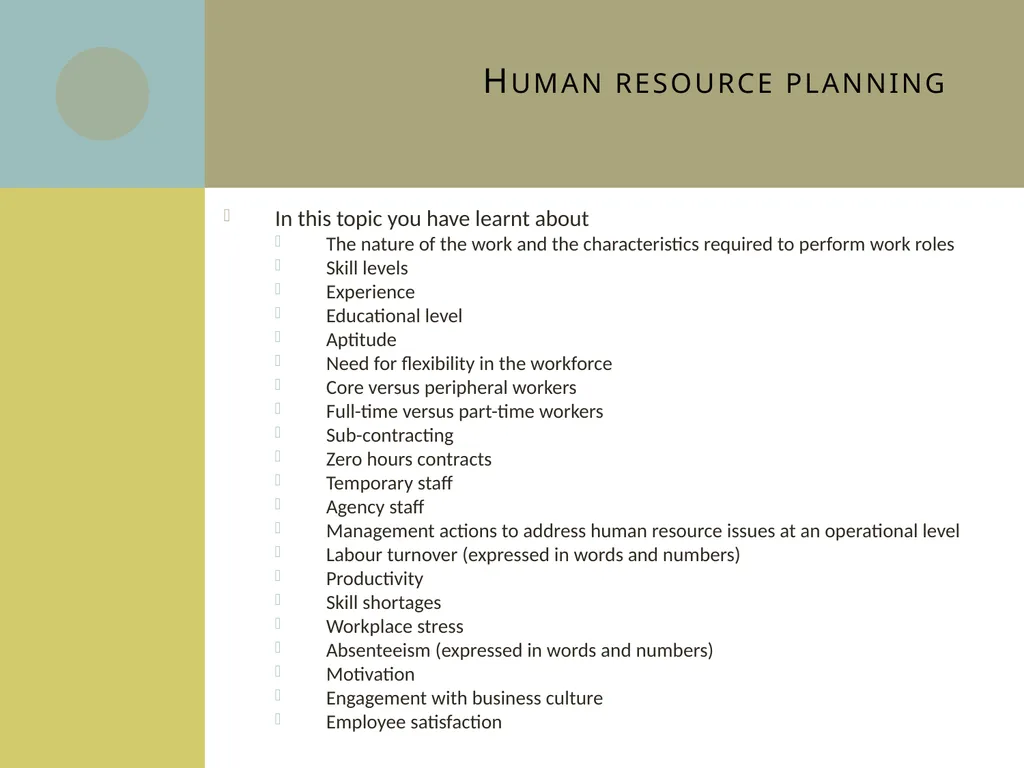
Human resource planning In this topic you have learnt about
The nature of the work and the characteristics required to perform work roles
Skill levels
Experience
Educational level
Aptitude
Need for flexibility in the workforce
Core versus peripheral workers
Full-time versus part-time workers
Sub-contracting
Zero hours contracts
Temporary staff
Agency staff
Management actions to address human resource issues at an operational level
Labour turnover (expressed in words and numbers)
Productivity
Skill shortages
Workplace stress
Absenteeism (expressed in words and numbers)
Motivation
Engagement with business culture
Employee satisfaction<br>
The nature of the work and the characteristics required to perform work roles
Skill levels
Experience
Educational level
Aptitude
Need for flexibility in the workforce
Core versus peripheral workers
Full-time versus part-time workers
Sub-contracting
Zero hours contracts
Temporary staff
Agency staff
Management actions to address human resource issues at an operational level
Labour turnover (expressed in words and numbers)
Productivity
Skill shortages
Workplace stress
Absenteeism (expressed in words and numbers)
Motivation
Engagement with business culture
Employee satisfaction<br>