Learning Objective: AO2: Analyse the language, form and structure used by a writer to create meanings and effects, using relevant subject terminology where appropriate. LO: To develop poetry analysis skills. ST: I can understand writers
"Learning Objective: AO2: Analyse the language," is the property of its rightful owner. Permission is granted to
download and print the materials on this website for personal, non-commercial use only, and to display it
on your personal computer provided you do not modify the materials and that you retain all copyright
notices contained in the materials. By downloading content from our website, you accept the terms of this
agreement.
Presentation Transcript
01
Learning Objective:
AO2: Analyse the language, form and structure used by a writer to create meanings and effects, using relevant subject terminology where appropriate. LO: To develop poetry analysis skills. ST: I can understand writers’ methods and use subject terminology. ‘Love Poems’
Sonnet 43<br>
02
Learning Objective:
AO2: Analyse the language, form and structure used by a writer to create meanings and effects, using relevant subject terminology where appropriate. How would you show someone that you loved them?
Can love be seen as spiritual and sacred? Key Words:
Hyperbole
Octave
Sestet
anaphora<br>
03
Learning Objective:
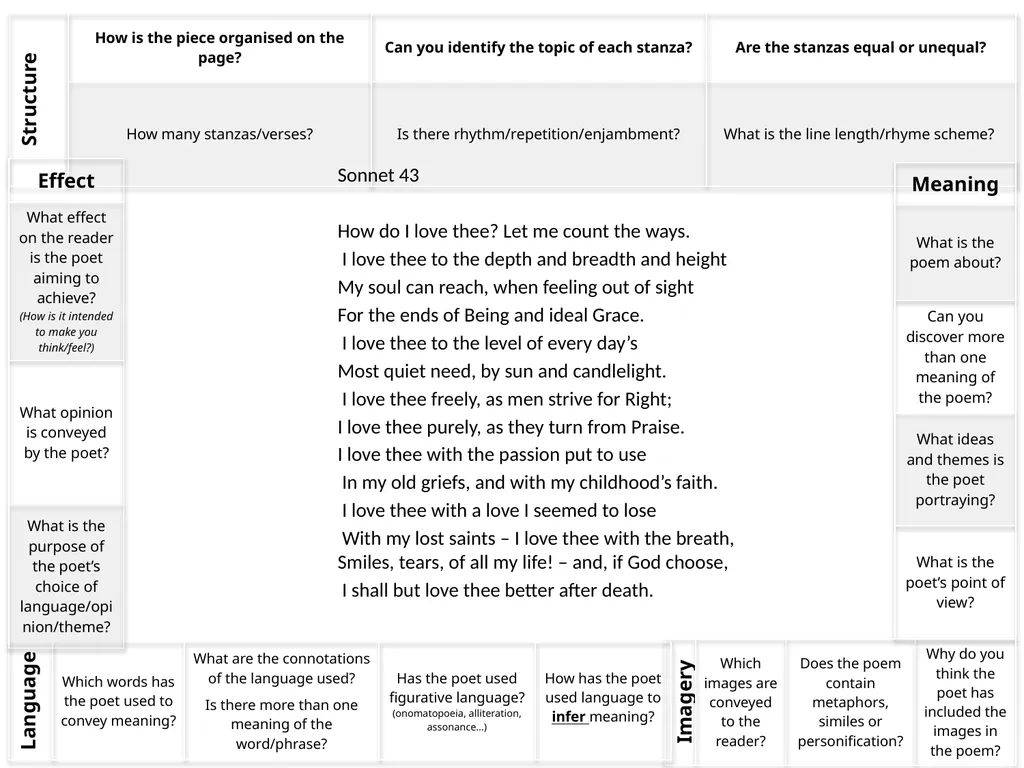
AO2: Analyse the language, form and structure used by a writer to create meanings and effects, using relevant subject terminology where appropriate. How do I love thee? Let me count the ways.
I love thee to the depth and breadth and height
My soul can reach, when feeling out of sight
For the ends of Being and ideal Grace.
I love thee to the level of every day’s
Most quiet need, by sun and candlelight.
I love thee freely, as men strive for Right;
I love thee purely, as they turn from Praise.
I love thee with the passion put to use
In my old griefs, and with my childhood’s faith.
I love thee with a love I seemed to lose
With my lost saints – I love thee with the breath, Smiles, tears, of all my life! – and, if God choose,
I shall but love thee better after death.
Elizabeth Barrett Browning Let’s read the poem by Elizabeth Barrett Browning Start with the title, Sonnet 43 What are your initial thoughts? Challenge:
How can we see this is intense love? Key Words:
Hyperbole
Octave
Sestet
anaphora<br>
04
Learning Objective:
AO2: Analyse the language, form and structure used by a writer to create meanings and effects, using relevant subject terminology where appropriate. Let’s have some feedback! Key Words:
Hyperbole
Octave
Sestet
anaphora<br>
05
Sonnet 43
How do I love thee? Let me count the ways.
I love thee to the depth and breadth and height
My soul can reach, when feeling out of sight
For the ends of Being and ideal Grace.
I love thee to the level of every day’s
Most quiet need, by sun and candlelight.
I love thee freely, as men strive for Right;
I love thee purely, as they turn from Praise.
I love thee with the passion put to use
In my old griefs, and with my childhood’s faith.
I love thee with a love I seemed to lose
With my lost saints – I love thee with the breath, Smiles, tears, of all my life! – and, if God choose,
I shall but love thee better after death.<br>
06
Sonnet 43
How do I love thee? Let me count the ways.
I love thee to the depth and breadth and height
My soul can reach, when feeling out of sight
For the ends of Being and ideal Grace.
I love thee to the level of every day’s
Most quiet need, by sun and candlelight.
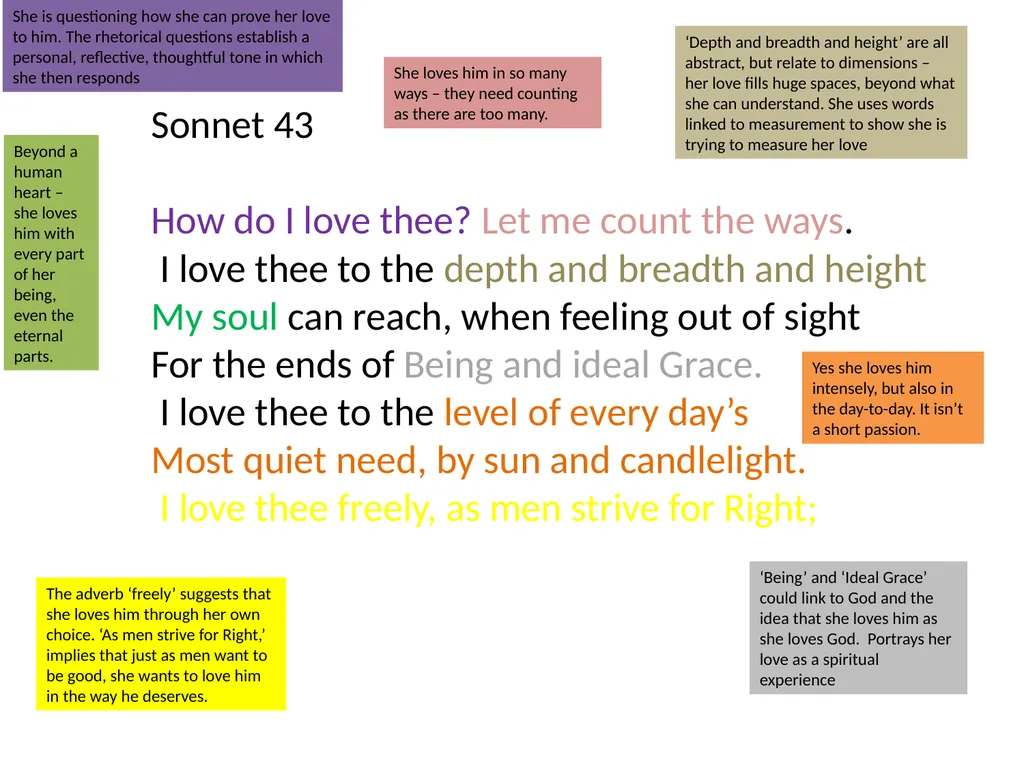
I love thee freely, as men strive for Right; She is questioning how she can prove her love to him. The rhetorical questions establish a personal, reflective, thoughtful tone in which she then responds She loves him in so many ways – they need counting as there are too many. ‘Depth and breadth and height’ are all abstract, but relate to dimensions – her love fills huge spaces, beyond what she can understand. She uses words linked to measurement to show she is trying to measure her love Beyond a human heart – she loves him with every part of her being, even the eternal parts. Yes she loves him intensely, but also in the day-to-day. It isn’t a short passion. ‘Being’ and ‘Ideal Grace’ could link to God and the idea that she loves him as she loves God. Portrays her love as a spiritual experience The adverb ‘freely’ suggests that she loves him through her own choice. ‘As men strive for Right,’ implies that just as men want to be good, she wants to love him in the way he deserves.<br>
07
I love thee purely, as they turn from Praise.
I love thee with the passion put to use
In my old griefs, and with my childhood’s faith.
I love thee with a love I seemed to lose
With my lost saints – I love thee with the breath, Smiles, tears, of all my life! – and, if God choose,
I shall but love thee better after death. She has taken all the bitterness and anger she may have felt before and replaced it with her love for him. She loves him throughout every emotion she experiences – whether she is happy, sad or simply being. Her love for Browning will go beyond death. Her love is eternal and her dying cannot stop it as it is such a powerful force.<br>
08
Learning Objective:
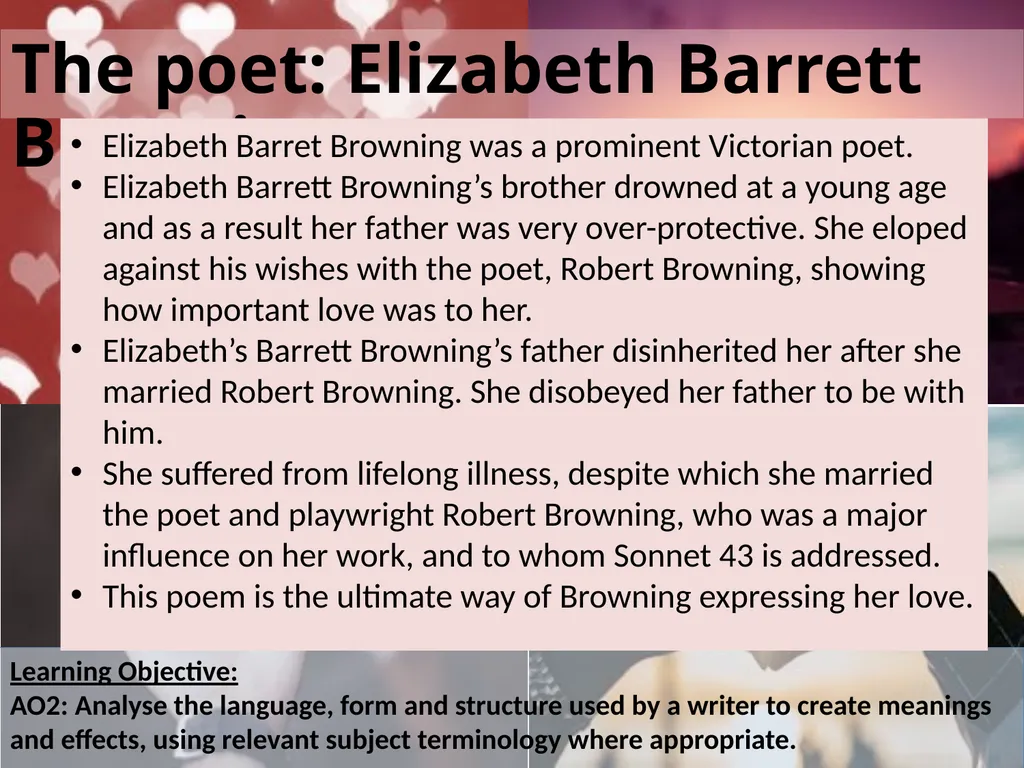
AO2: Analyse the language, form and structure used by a writer to create meanings and effects, using relevant subject terminology where appropriate. The poet: Elizabeth Barrett Browning Elizabeth Barret Browning was a prominent Victorian poet.
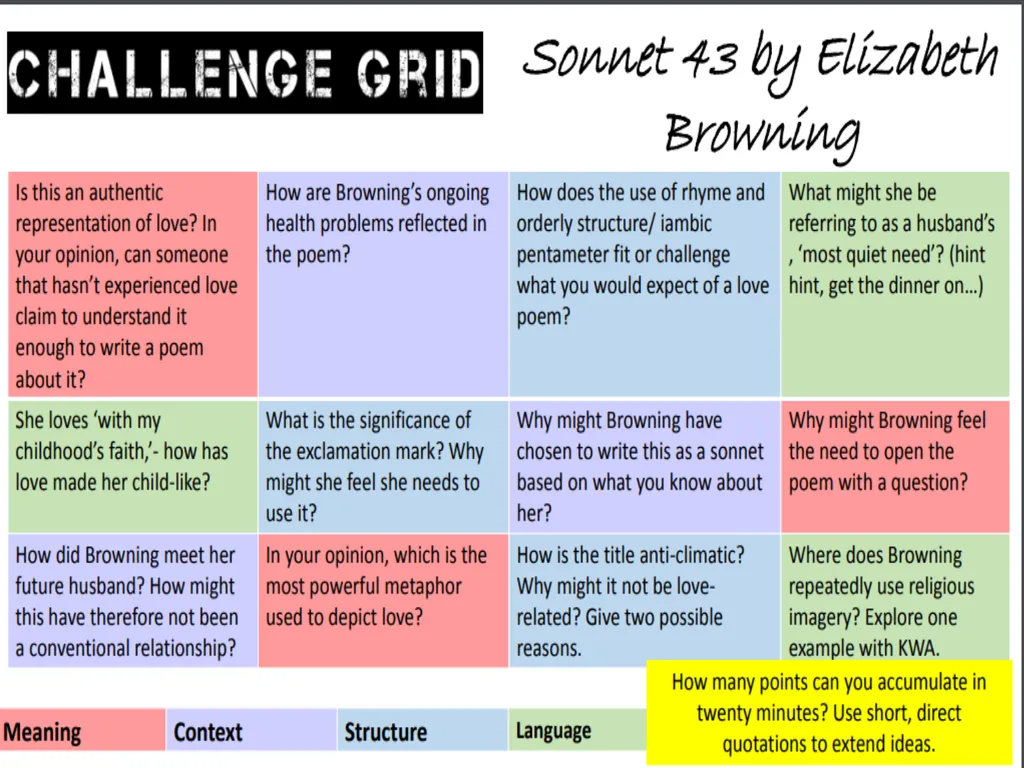
Elizabeth Barrett Browning’s brother drowned at a young age and as a result her father was very over-protective. She eloped against his wishes with the poet, Robert Browning, showing how important love was to her.
Elizabeth’s Barrett Browning’s father disinherited her after she married Robert Browning. She disobeyed her father to be with him.
She suffered from lifelong illness, despite which she married the poet and playwright Robert Browning, who was a major influence on her work, and to whom Sonnet 43 is addressed.
This poem is the ultimate way of Browning expressing her love.<br>
09
Learning Objective:
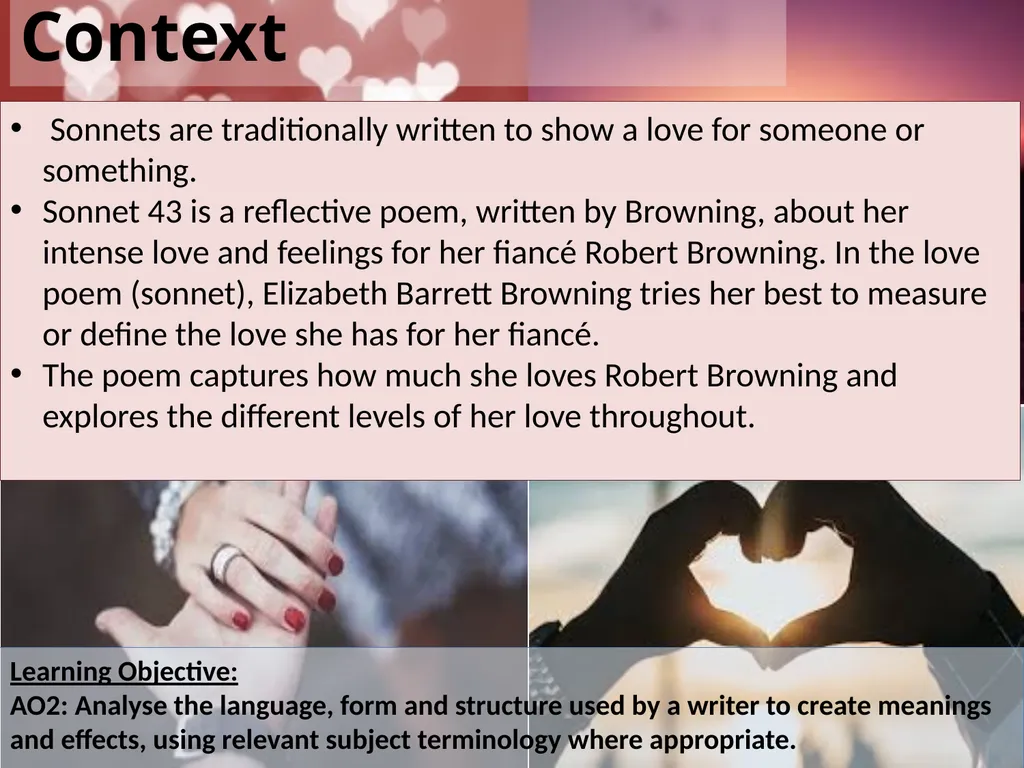
AO2: Analyse the language, form and structure used by a writer to create meanings and effects, using relevant subject terminology where appropriate. Context Sonnets are traditionally written to show a love for someone or something.
Sonnet 43 is a reflective poem, written by Browning, about her intense love and feelings for her fiancé Robert Browning. In the love poem (sonnet), Elizabeth Barrett Browning tries her best to measure or define the love she has for her fiancé.
The poem captures how much she loves Robert Browning and explores the different levels of her love throughout.<br>
10
Learning Objective:
AO2: Analyse the language, form and structure used by a writer to create meanings and effects, using relevant subject terminology where appropriate. Form In the form of a Petrarchan Sonnet
This means it conforms to a specific rhyme scheme.
Written in iambic pentameter to mirror normal speech.
BUT the meter is disrupted by pauses and repetition to make the speaker sound passionate.
First person to give a personal feel Be proactive take your own notes!<br>
11
Learning Objective:
AO2: Analyse the language, form and structure used by a writer to create meanings and effects, using relevant subject terminology where appropriate. Structure and tone Octave – first EIGHT lines introduce poem’s main theme – love is intense almost divine
Sestet – remaining SIX lines develop theme loves him for an entire lifetime – even past death
Tone is passionate – unconditional love – exaggerates to emphasise strength/scale of love Be proactive take your own notes!<br>
12
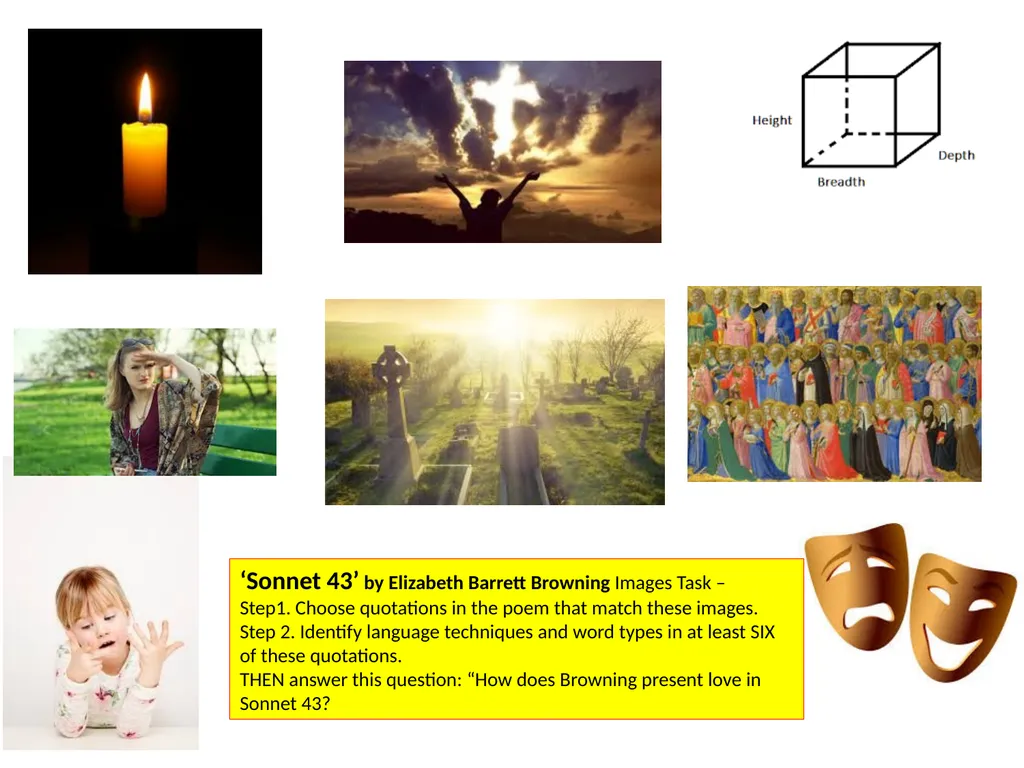
‘Sonnet 43’ by Elizabeth Barrett Browning Images Task –
Step1. Choose quotations in the poem that match these images.
Step 2. Identify language techniques and word types in at least SIX of these quotations.
THEN answer this question: “How does Browning present love in Sonnet 43?<br>