
Learning to Detect Phishing Emails Ian Fette



Description: Learning to Detect Phishing Emails Ian Fette Norman Sadeh Anthony Tomasic Presented by Bhavin Madhani Authors Bhavin Madhani - UC Irvine - 2009 Anthony Tomasic: - Director of the Carnegie Mellon University. - Masters of science in
Related Topics
Download Presentation
"Learning to Detect Phishing Emails Ian Fette" is the property of its rightful owner. Permission is granted to download and print the materials on this website for personal, non-commercial use only, and to display it on your personal computer provided you do not modify the materials and that you retain all copyright notices contained in the materials. By downloading content from our website, you accept the terms of this agreement.
Presentation Transcript
slide1. Learning to Detect Phishing Emails Ian Fette
Norman Sadeh
Anthony Tomasic
Presented by – Bhavin Madhani<br>
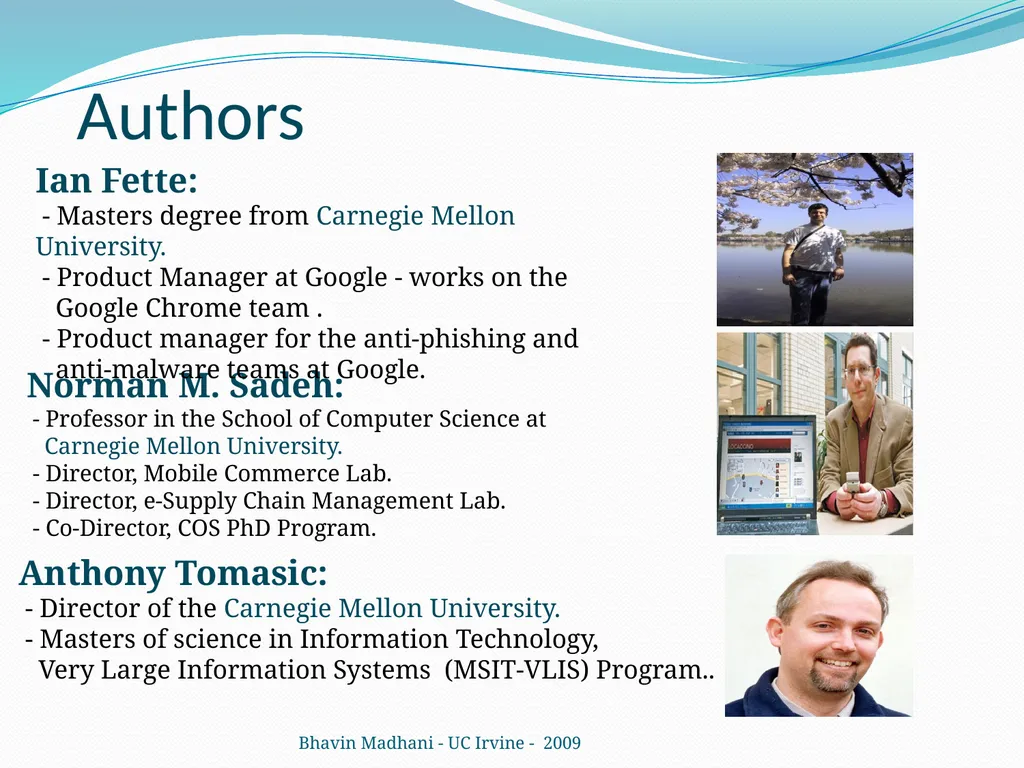
slide2. Authors Bhavin Madhani - UC Irvine - 2009 Anthony Tomasic:
- Director of the Carnegie Mellon University.
- Masters of science in Information Technology,
Very Large Information Systems (MSIT-VLIS) Program.. Norman M. Sadeh:
- Professor in the School of Computer Science at
Carnegie Mellon University.
- Director, Mobile Commerce Lab.
- Director, e-Supply Chain Management Lab. - Co-Director, COS PhD Program. Ian Fette:
- Masters degree from Carnegie Mellon University.
- Product Manager at Google - works on the
Google Chrome team .
- Product manager for the anti-phishing and
anti-malware teams at Google.<br>
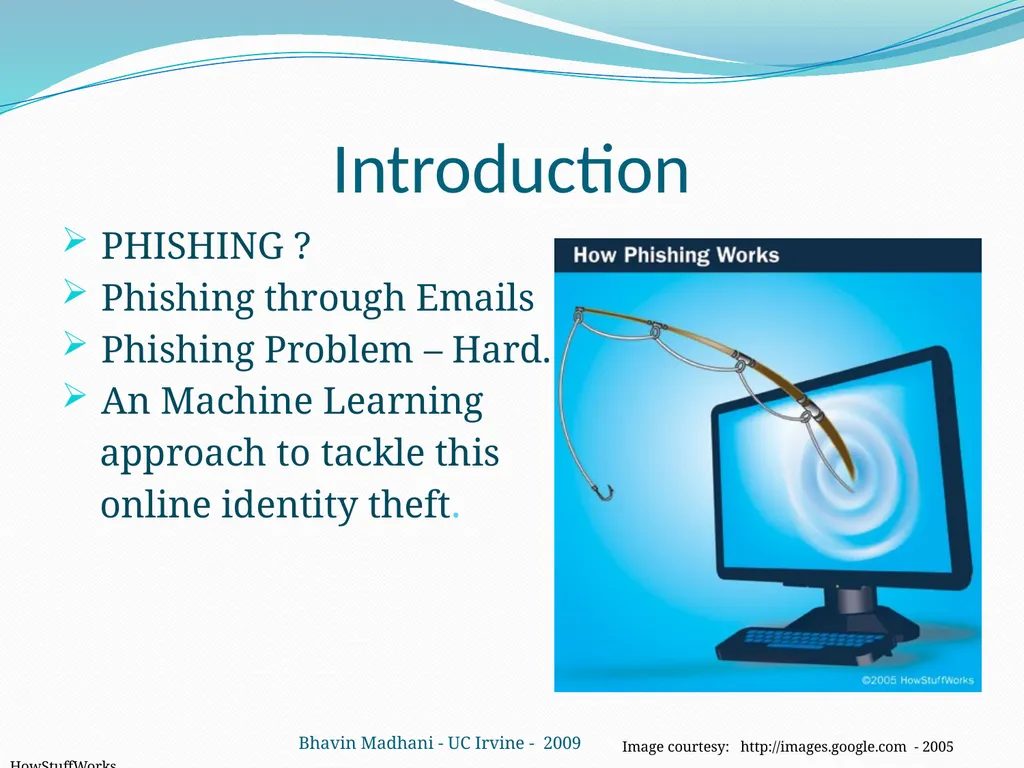
slide3. Introduction PHISHING ?
Phishing through Emails
Phishing Problem – Hard.
An Machine Learning
approach to tackle this
online identity theft. Bhavin Madhani - UC Irvine - 2009 Image courtesy: http://images.google.com - 2005 HowStuffWorks<br>
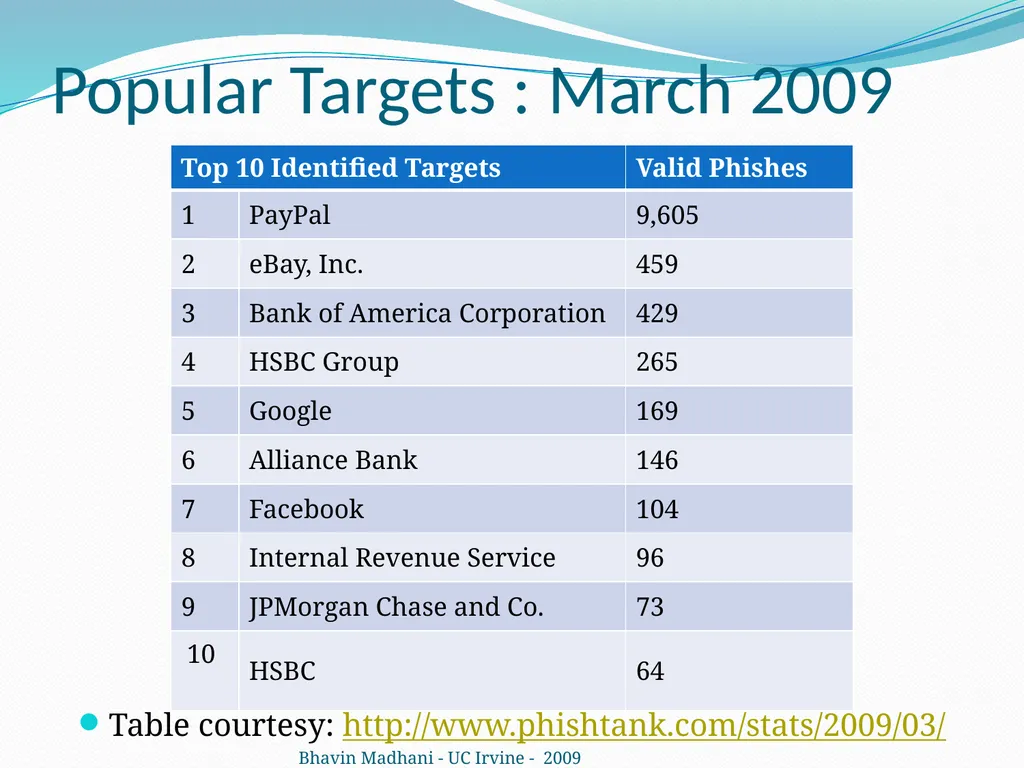
slide4. Popular Targets : March 2009 Table courtesy: http://www.phishtank.com/stats/2009/03/ Bhavin Madhani - UC Irvine - 2009<br>
slide5. Background Toolbars
SpoofGuard
NetCraft
Email Filtering
SpamAssassin
Spamato Bhavin Madhani - UC Irvine - 2009 Image courtesy: http://images.google.com - www.glasbergen.com<br>
slide6. Method PILFER – A Machine Learning based approach to classification.
phishing emails / ham (good) emails
Feature Set
Features as used in email classification
Features as used in webpage classification Bhavin Madhani - UC Irvine - 2009<br>
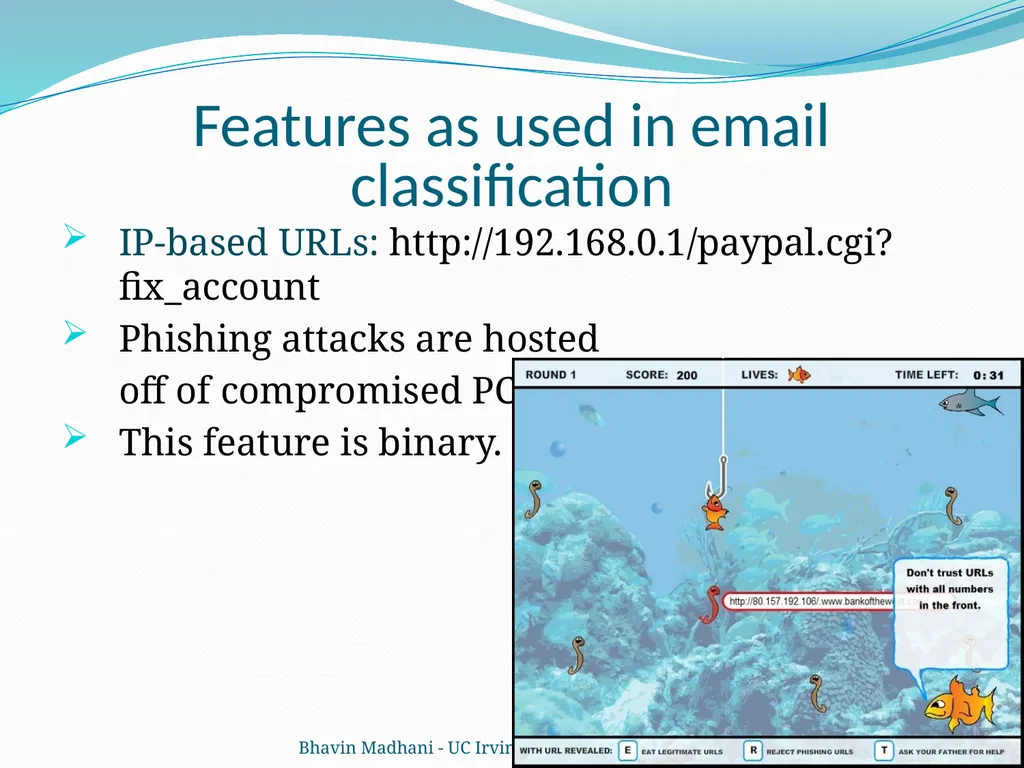
slide7. Features as used in email classification IP-based URLs: http://192.168.0.1/paypal.cgi?fix_account
Phishing attacks are hosted
off of compromised PCs.
This feature is binary. Bhavin Madhani - UC Irvine - 2009<br>
slide8. Age of linked-to domain names:
‘playpal.com’ or ‘paypal-update.com’
These domains often have a limited life
WHOIS query
date is within 60 days of the date the email was sent – “fresh” domain. This is a binary feature Bhavin Madhani - UC Irvine - 2009<br>
slide9. Nonmatching URLs
This is a case of a link that says paypal.com but actually links to badsite.com.
Such a link looks like <a href="badsite.com"> paypal.com</a>. This is a binary feature. Bhavin Madhani - UC Irvine - 2009<br>
slide10. “Here” links to non-modal domain
“Click here to restore your account access”
Link with the text “link”, “click”, or “here” that links to a domain other than this “modal domain”
This is a binary feature. Image courtesy: http://www.bbcchannelpartners.com/worldnews/programmes/1000001/ Bhavin Madhani - UC Irvine - 2009<br>
slide11. HTML emails
Emails are sent as either plain text, HTML, or a combination of the two - multipart/alternative format
To launch an attack without using HTML is difficult
This is a binary feature. Image courtesy: http://srtsolutions.com/blogs/marinafedner/ Bhavin Madhani - UC Irvine - 2009<br>
slide12. Number of links
The number of links present in an email.
This is a continuous feature.
Eg. Bankofamerica statement. Bhavin Madhani - UC Irvine - 2009<br>
slide13. Number of domains
Simply take the domain names previously extracted from all of the links, and simply count the number of distinct domains.
Look at the “main” part of a domain
https://www.cs.university.edu/
http://www.company.co.jp/
This is a continuous feature. Bhavin Madhani - UC Irvine - 2009<br>
slide14. Number of dots
Subdomains like
http://www.my-bank.update.data.com.
Redirection script, such as http://www.google.com/url?q=http://www.badsite.com
This feature is simply the maximum number of dots (`.') contained in any of the links present in the email, and is a continuous feature. Bhavin Madhani - UC Irvine - 2009 Image courtesy: http://www.roslynoxley9.com.au/artists/49/Yayoi_Kusama/38/24460/<br>
slide15. Contains javascript
Attackers can use JavaScript to hide information from the user, and potentially launch sophisticated attacks.
An email is flagged with the “contains javascript” feature if the string “javascript” appears in the email, regardless of whether it is actually in a <script> or <a> tag
This is a binary feature. Bhavin Madhani - UC Irvine - 2009 Image courtesy: http://webdevargentina.ning.com/<br>
slide16. Spam-filter output
This is a binary feature, using the trained version of SpamAssassin with the default rule weights and threshold.
“Ham” or “Spam”
This is a Binary feature. Image courtesy: http://www.suremail.us/spam-filter.shtml Bhavin Madhani - UC Irvine - 2009<br>
slide17. Features as used in webpage classification Most of the features discussed earlier can also be applied towards classifiying a webpage in a browser environment.
Other Features include:
Site in browser history
Redirected site
tf-idf Bhavin Madhani - UC Irvine - 2009<br>
slide18. Empirical Evaluation Machine-Learning Implementation
Run a set of scripts to extract all the features.
Train and test a classifier using 10-fold cross validation.
Random forest as a classifier.
Random forests create a number of decision trees and each decision tree is made by randomly choosing an attribute to split on at each level, and then pruning the tree. Bhavin Madhani - UC Irvine - 2009 Image courtesy: http://meds.queensu.ca/postgraduate/policies/evaluation__promotion___appeals<br>
slide19. Datasets
Two publicly available datasets used.
The ham corpora from the SpamAssassin project (both the 2002 and 2003 ham collections, easy and hard, for a total of approximately 6950 non-phishing non-spam emails)
The publicly available phishingcorpus (approximately 860 email messages). Bhavin Madhani - UC Irvine - 2009<br>
slide20. Testing SpamAssassin
For comparison against PILFER, we classify the exact same dataset using SpamAssassin version 3.1.0, using the default thresholds and rules.
“untrained” SpamAssassin
“trained” SpamAssassin Bhavin Madhani - UC Irvine - 2009<br>
slide21. Additional Challenges
The age of the dataset
Phishing websites are short-lived, often lasting only on the order of 48 hours
Domains are no longer live at the time of our testing, resulting in missing information
The disappearance of domain names, combined with difficulty in parsing results from a large number of WHOIS servers Bhavin Madhani - UC Irvine - 2009 Image courtesy: http://illuminatepr.wordpress.com/2008/07/01/challenges/<br>
slide22. False Positives vs. False Negatives
Misclassifying a phishing email may have a different impact than misclassifying a good email.
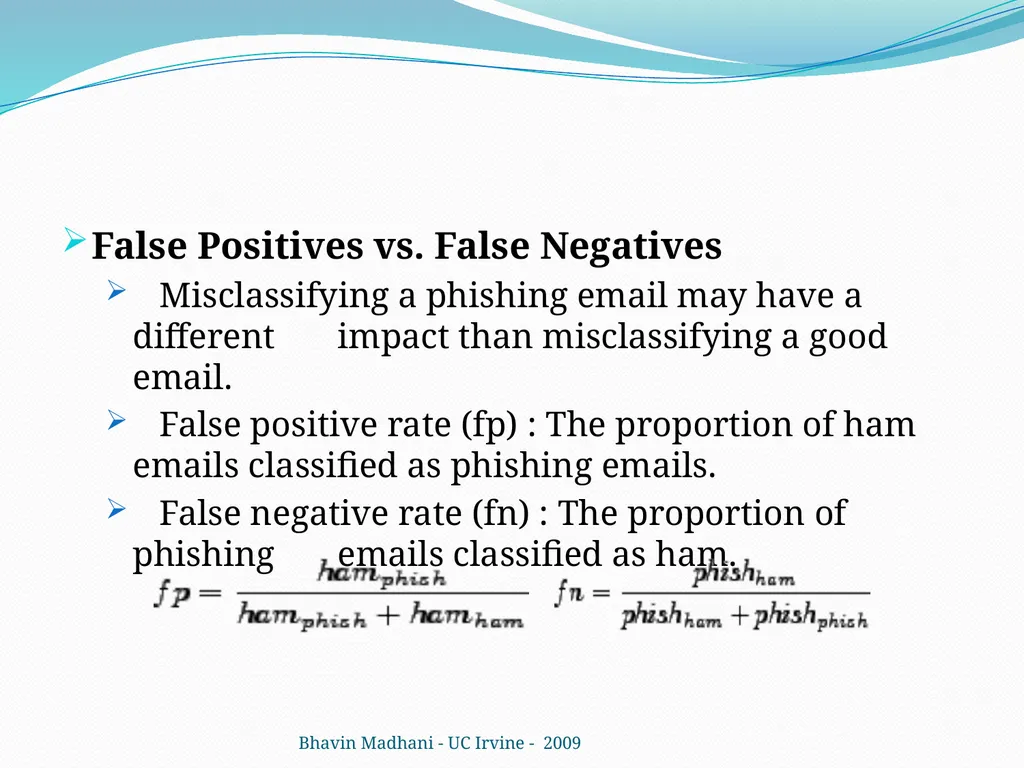
False positive rate (fp) : The proportion of ham emails classified as phishing emails.
False negative rate (fn) : The proportion of phishing emails classified as ham. Bhavin Madhani - UC Irvine - 2009<br>
slide23. Bhavin Madhani - UC Irvine - 2009<br>
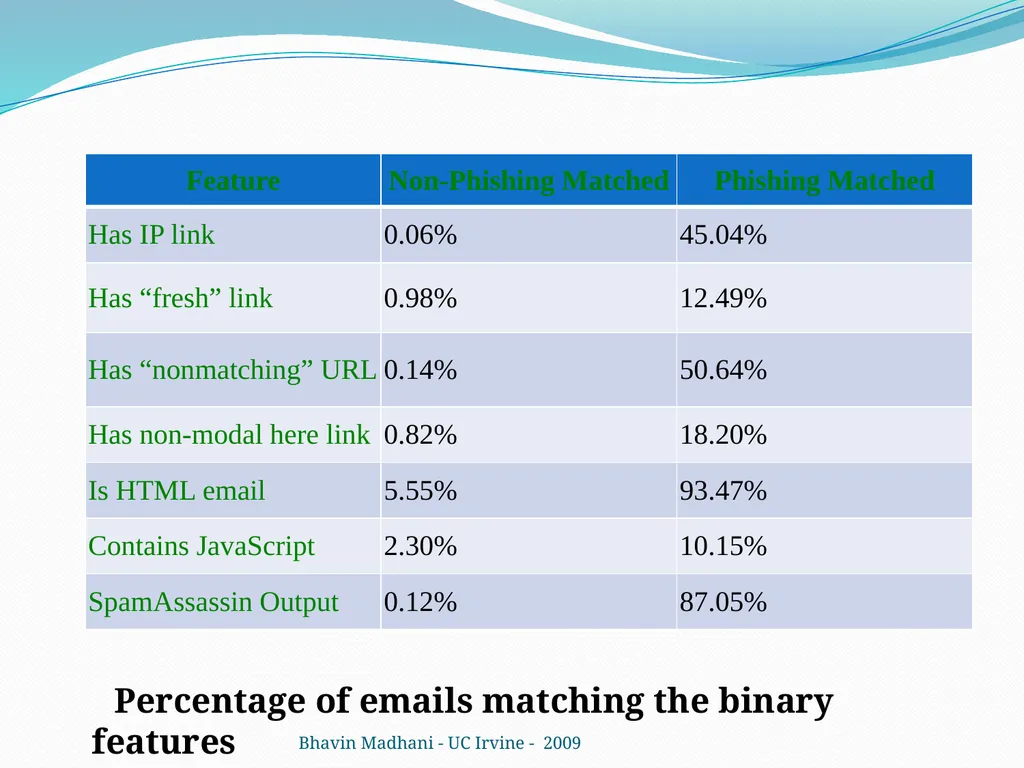
slide24. Percentage of emails matching the binary features Bhavin Madhani - UC Irvine - 2009<br>
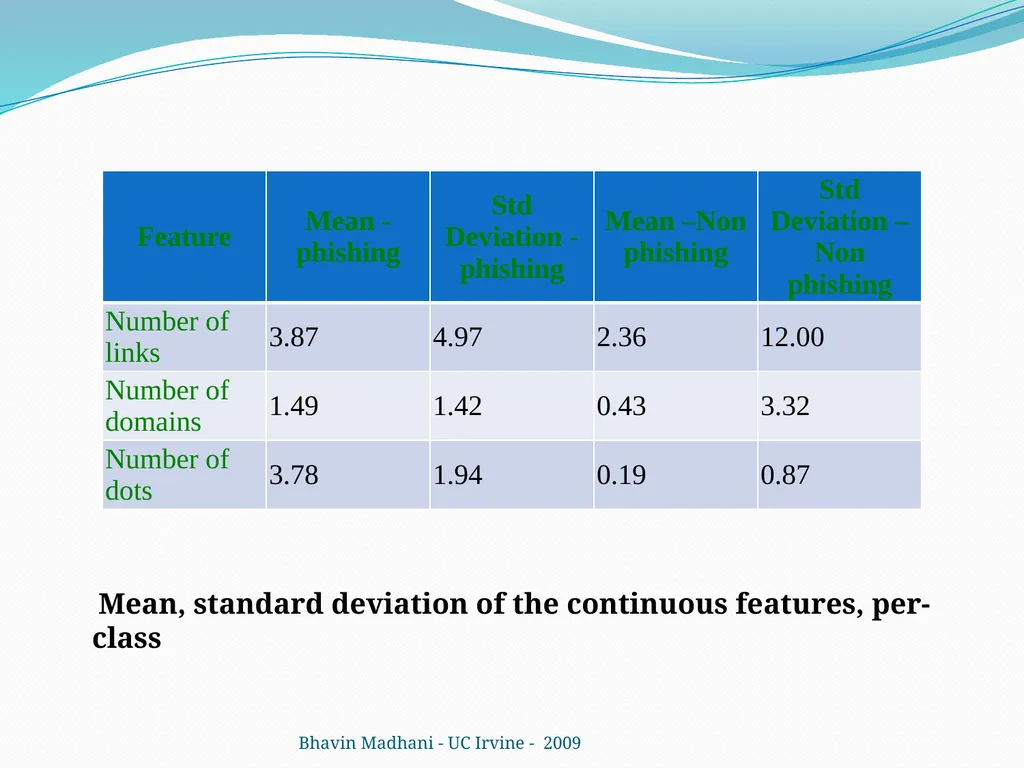
slide25. Mean, standard deviation of the continuous features, per-class Bhavin Madhani - UC Irvine - 2009<br>
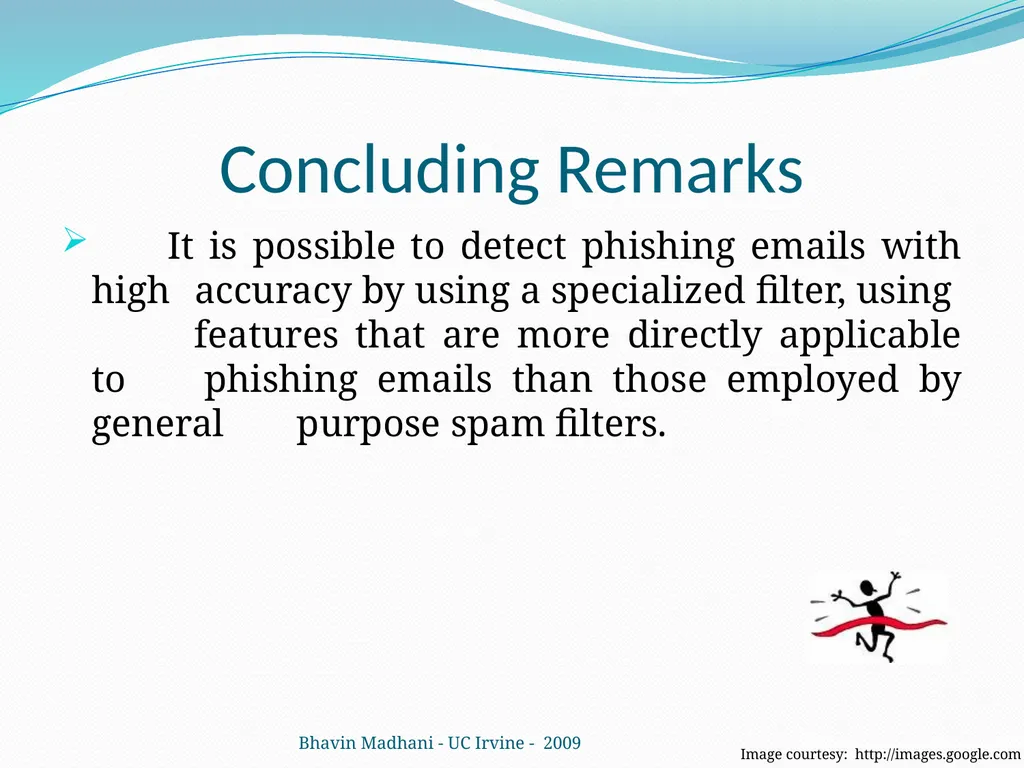
slide26. Concluding Remarks It is possible to detect phishing emails with high accuracy by using a specialized filter, using features that are more directly applicable to phishing emails than those employed by general purpose spam filters. Bhavin Madhani - UC Irvine - 2009 Image courtesy: http://images.google.com<br>
slide27. Gone Phishing? Protect Yourself - Stop · Think · Click THANK YOU Image courtesy: http://images.google.com Bhavin Madhani - UC Irvine - 2009<br>
slide28. Anti-Phishing Phil http://cups.cs.cmu.edu/antiphishing_phil/
http://cups.cs.cmu.edu/antiphishing_phil/new/index.html Image Courtesy: http://cups.cs.cmu.edu/antiphishing_phil/ Bhavin Madhani - UC Irvine - 2009<br>
Norman Sadeh
Anthony Tomasic
Presented by – Bhavin Madhani<br>
slide2. Authors Bhavin Madhani - UC Irvine - 2009 Anthony Tomasic:
- Director of the Carnegie Mellon University.
- Masters of science in Information Technology,
Very Large Information Systems (MSIT-VLIS) Program.. Norman M. Sadeh:
- Professor in the School of Computer Science at
Carnegie Mellon University.
- Director, Mobile Commerce Lab.
- Director, e-Supply Chain Management Lab. - Co-Director, COS PhD Program. Ian Fette:
- Masters degree from Carnegie Mellon University.
- Product Manager at Google - works on the
Google Chrome team .
- Product manager for the anti-phishing and
anti-malware teams at Google.<br>
slide3. Introduction PHISHING ?
Phishing through Emails
Phishing Problem – Hard.
An Machine Learning
approach to tackle this
online identity theft. Bhavin Madhani - UC Irvine - 2009 Image courtesy: http://images.google.com - 2005 HowStuffWorks<br>
slide4. Popular Targets : March 2009 Table courtesy: http://www.phishtank.com/stats/2009/03/ Bhavin Madhani - UC Irvine - 2009<br>
slide5. Background Toolbars
SpoofGuard
NetCraft
Email Filtering
SpamAssassin
Spamato Bhavin Madhani - UC Irvine - 2009 Image courtesy: http://images.google.com - www.glasbergen.com<br>
slide6. Method PILFER – A Machine Learning based approach to classification.
phishing emails / ham (good) emails
Feature Set
Features as used in email classification
Features as used in webpage classification Bhavin Madhani - UC Irvine - 2009<br>
slide7. Features as used in email classification IP-based URLs: http://192.168.0.1/paypal.cgi?fix_account
Phishing attacks are hosted
off of compromised PCs.
This feature is binary. Bhavin Madhani - UC Irvine - 2009<br>
slide8. Age of linked-to domain names:
‘playpal.com’ or ‘paypal-update.com’
These domains often have a limited life
WHOIS query
date is within 60 days of the date the email was sent – “fresh” domain. This is a binary feature Bhavin Madhani - UC Irvine - 2009<br>
slide9. Nonmatching URLs
This is a case of a link that says paypal.com but actually links to badsite.com.
Such a link looks like <a href="badsite.com"> paypal.com</a>. This is a binary feature. Bhavin Madhani - UC Irvine - 2009<br>
slide10. “Here” links to non-modal domain
“Click here to restore your account access”
Link with the text “link”, “click”, or “here” that links to a domain other than this “modal domain”
This is a binary feature. Image courtesy: http://www.bbcchannelpartners.com/worldnews/programmes/1000001/ Bhavin Madhani - UC Irvine - 2009<br>
slide11. HTML emails
Emails are sent as either plain text, HTML, or a combination of the two - multipart/alternative format
To launch an attack without using HTML is difficult
This is a binary feature. Image courtesy: http://srtsolutions.com/blogs/marinafedner/ Bhavin Madhani - UC Irvine - 2009<br>
slide12. Number of links
The number of links present in an email.
This is a continuous feature.
Eg. Bankofamerica statement. Bhavin Madhani - UC Irvine - 2009<br>
slide13. Number of domains
Simply take the domain names previously extracted from all of the links, and simply count the number of distinct domains.
Look at the “main” part of a domain
https://www.cs.university.edu/
http://www.company.co.jp/
This is a continuous feature. Bhavin Madhani - UC Irvine - 2009<br>
slide14. Number of dots
Subdomains like
http://www.my-bank.update.data.com.
Redirection script, such as http://www.google.com/url?q=http://www.badsite.com
This feature is simply the maximum number of dots (`.') contained in any of the links present in the email, and is a continuous feature. Bhavin Madhani - UC Irvine - 2009 Image courtesy: http://www.roslynoxley9.com.au/artists/49/Yayoi_Kusama/38/24460/<br>
slide15. Contains javascript
Attackers can use JavaScript to hide information from the user, and potentially launch sophisticated attacks.
An email is flagged with the “contains javascript” feature if the string “javascript” appears in the email, regardless of whether it is actually in a <script> or <a> tag
This is a binary feature. Bhavin Madhani - UC Irvine - 2009 Image courtesy: http://webdevargentina.ning.com/<br>
slide16. Spam-filter output
This is a binary feature, using the trained version of SpamAssassin with the default rule weights and threshold.
“Ham” or “Spam”
This is a Binary feature. Image courtesy: http://www.suremail.us/spam-filter.shtml Bhavin Madhani - UC Irvine - 2009<br>
slide17. Features as used in webpage classification Most of the features discussed earlier can also be applied towards classifiying a webpage in a browser environment.
Other Features include:
Site in browser history
Redirected site
tf-idf Bhavin Madhani - UC Irvine - 2009<br>
slide18. Empirical Evaluation Machine-Learning Implementation
Run a set of scripts to extract all the features.
Train and test a classifier using 10-fold cross validation.
Random forest as a classifier.
Random forests create a number of decision trees and each decision tree is made by randomly choosing an attribute to split on at each level, and then pruning the tree. Bhavin Madhani - UC Irvine - 2009 Image courtesy: http://meds.queensu.ca/postgraduate/policies/evaluation__promotion___appeals<br>
slide19. Datasets
Two publicly available datasets used.
The ham corpora from the SpamAssassin project (both the 2002 and 2003 ham collections, easy and hard, for a total of approximately 6950 non-phishing non-spam emails)
The publicly available phishingcorpus (approximately 860 email messages). Bhavin Madhani - UC Irvine - 2009<br>
slide20. Testing SpamAssassin
For comparison against PILFER, we classify the exact same dataset using SpamAssassin version 3.1.0, using the default thresholds and rules.
“untrained” SpamAssassin
“trained” SpamAssassin Bhavin Madhani - UC Irvine - 2009<br>
slide21. Additional Challenges
The age of the dataset
Phishing websites are short-lived, often lasting only on the order of 48 hours
Domains are no longer live at the time of our testing, resulting in missing information
The disappearance of domain names, combined with difficulty in parsing results from a large number of WHOIS servers Bhavin Madhani - UC Irvine - 2009 Image courtesy: http://illuminatepr.wordpress.com/2008/07/01/challenges/<br>
slide22. False Positives vs. False Negatives
Misclassifying a phishing email may have a different impact than misclassifying a good email.
False positive rate (fp) : The proportion of ham emails classified as phishing emails.
False negative rate (fn) : The proportion of phishing emails classified as ham. Bhavin Madhani - UC Irvine - 2009<br>
slide23. Bhavin Madhani - UC Irvine - 2009<br>
slide24. Percentage of emails matching the binary features Bhavin Madhani - UC Irvine - 2009<br>
slide25. Mean, standard deviation of the continuous features, per-class Bhavin Madhani - UC Irvine - 2009<br>
slide26. Concluding Remarks It is possible to detect phishing emails with high accuracy by using a specialized filter, using features that are more directly applicable to phishing emails than those employed by general purpose spam filters. Bhavin Madhani - UC Irvine - 2009 Image courtesy: http://images.google.com<br>
slide27. Gone Phishing? Protect Yourself - Stop · Think · Click THANK YOU Image courtesy: http://images.google.com Bhavin Madhani - UC Irvine - 2009<br>
slide28. Anti-Phishing Phil http://cups.cs.cmu.edu/antiphishing_phil/
http://cups.cs.cmu.edu/antiphishing_phil/new/index.html Image Courtesy: http://cups.cs.cmu.edu/antiphishing_phil/ Bhavin Madhani - UC Irvine - 2009<br>