Lecture 1 : Full-text Indexing 楊立偉教授 台灣科大資管系
Description: Lecture 1 : Full-text Indexing 楊立偉教授 台灣科大資管系 wyangntu.edu.tw 本投影片修改自Introduction to Information Retrieval一書之投影片 Ch 1 2 1 2 Definition of information retrieval Information retrieval (IR) is finding material (usually documents) of an
Related Topics
Download Presentation
"Lecture 1 : Full-text Indexing 楊立偉教授 台灣科大資管系" is the property of its rightful owner. Permission is granted to download and print the materials on this website for personal, non-commercial use only, and to display it on your personal computer provided you do not modify the materials and that you retain all copyright notices contained in the materials. By downloading content from our website, you accept the terms of this agreement.
Presentation Transcript
slide1. Lecture 1 : Full-text Indexing 楊立偉教授
台灣科大資管系
wyang@ntu.edu.tw
本投影片修改自Introduction to Information Retrieval一書之投影片 Ch 1 & 2 1<br>
slide2. 2 Definition of information retrieval Information retrieval (IR) is finding material (usually documents) of
an unstructured nature (usually text) that satisfies an information
need from within large collections (usually stored on computers). 2<br>
slide3. 3 Boolean retrieval The Boolean model is arguably the simplest model to base an information retrieval system on.
Queries are Boolean expressions, e.g., CAESAR AND BRUTUS
The search engine returns all documents that satisfy the
Boolean expression. 3<br>
slide4. Inverted Index 4<br>
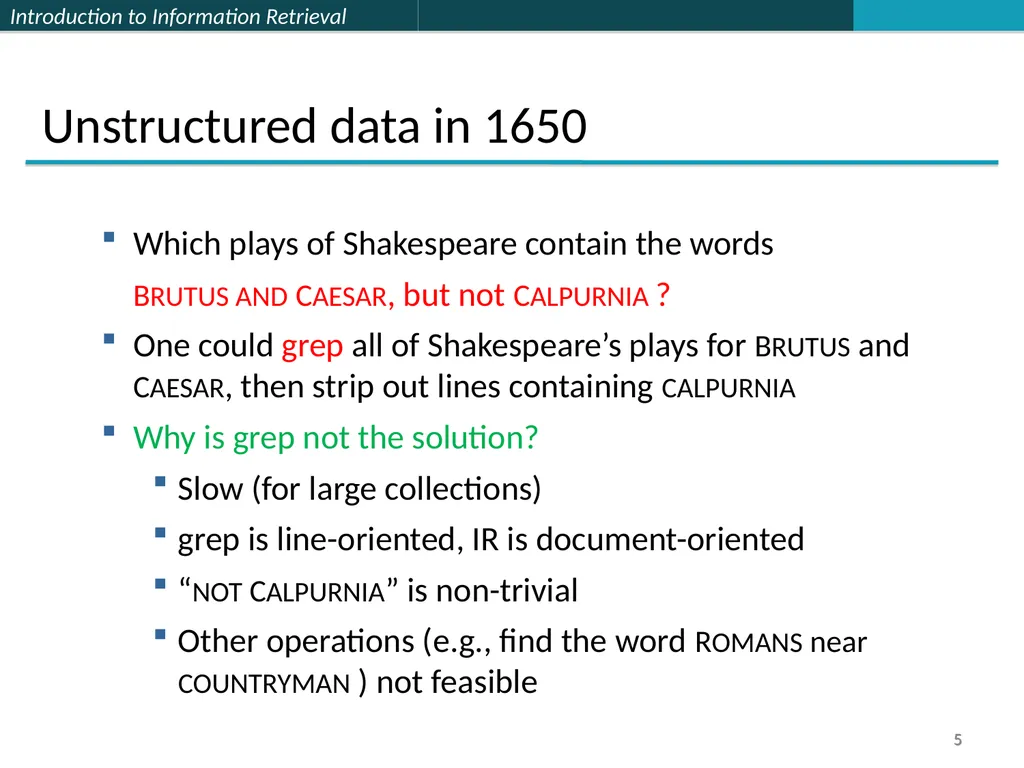
slide5. 5 Unstructured data in 1650 Which plays of Shakespeare contain the words
BRUTUS AND CAESAR, but not CALPURNIA ?
One could grep all of Shakespeare’s plays for BRUTUS and CAESAR, then strip out lines containing CALPURNIA
Why is grep not the solution?
Slow (for large collections)
grep is line-oriented, IR is document-oriented
“NOT CALPURNIA” is non-trivial
Other operations (e.g., find the word ROMANS near COUNTRYMAN ) not feasible 5<br>
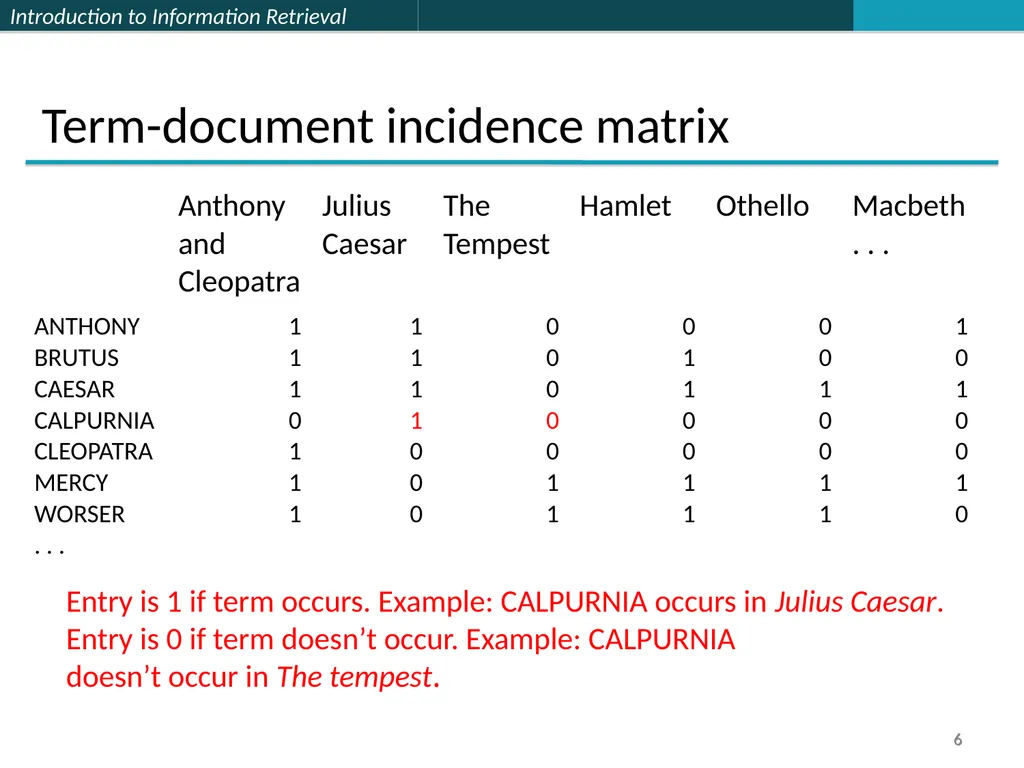
slide6. 6 Term-document incidence matrix Entry is 1 if term occurs. Example: CALPURNIA occurs in Julius Caesar. Entry is 0 if term doesn’t occur. Example: CALPURNIA
doesn’t occur in The tempest. 6<br>
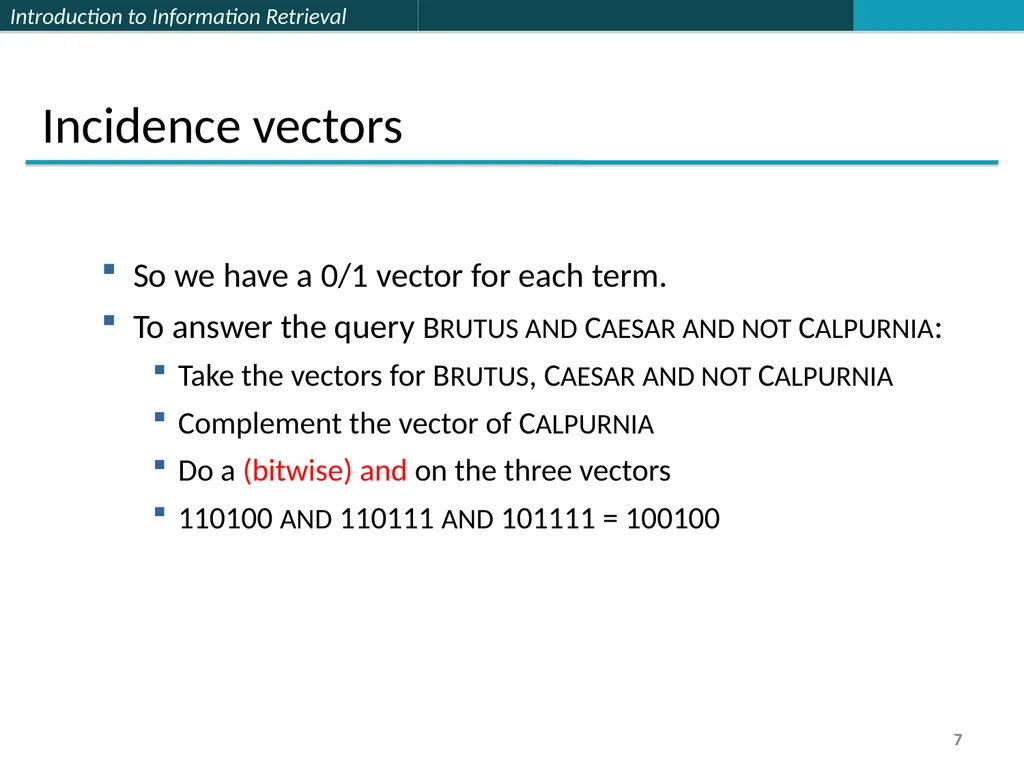
slide7. 7 Incidence vectors So we have a 0/1 vector for each term.
To answer the query BRUTUS AND CAESAR AND NOT CALPURNIA:
Take the vectors for BRUTUS, CAESAR AND NOT CALPURNIA
Complement the vector of CALPURNIA
Do a (bitwise) and on the three vectors
110100 AND 110111 AND 101111 = 100100 7<br>
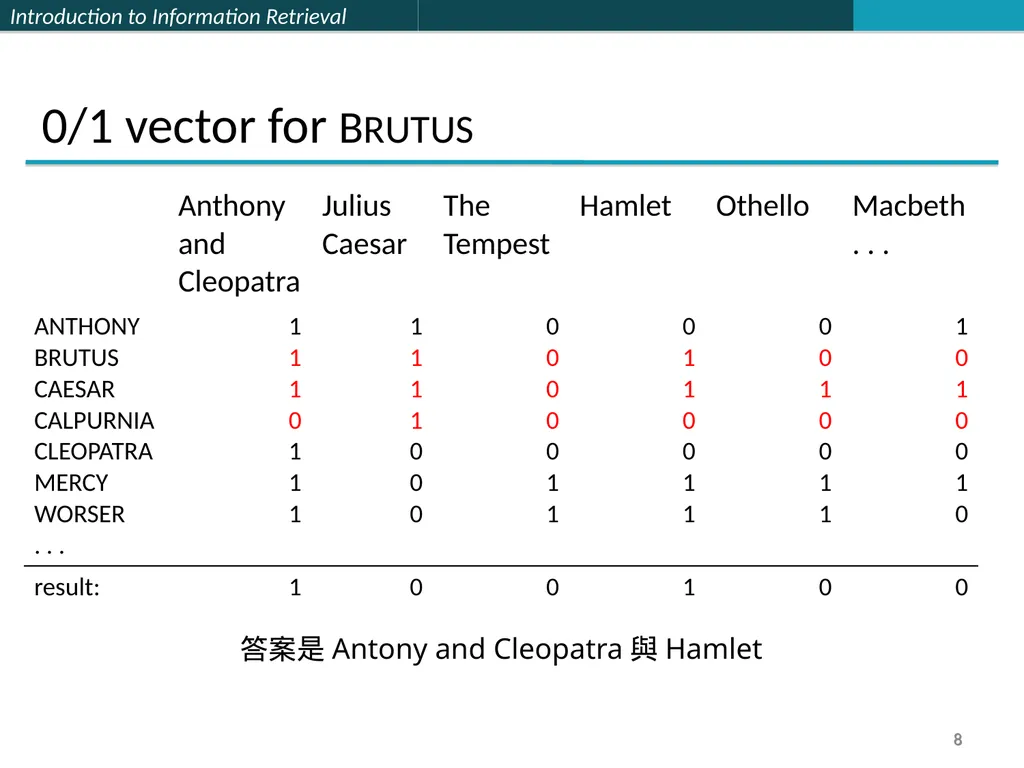
slide8. 8 0/1 vector for BRUTUS 8 答案是Antony and Cleopatra與Hamlet<br>
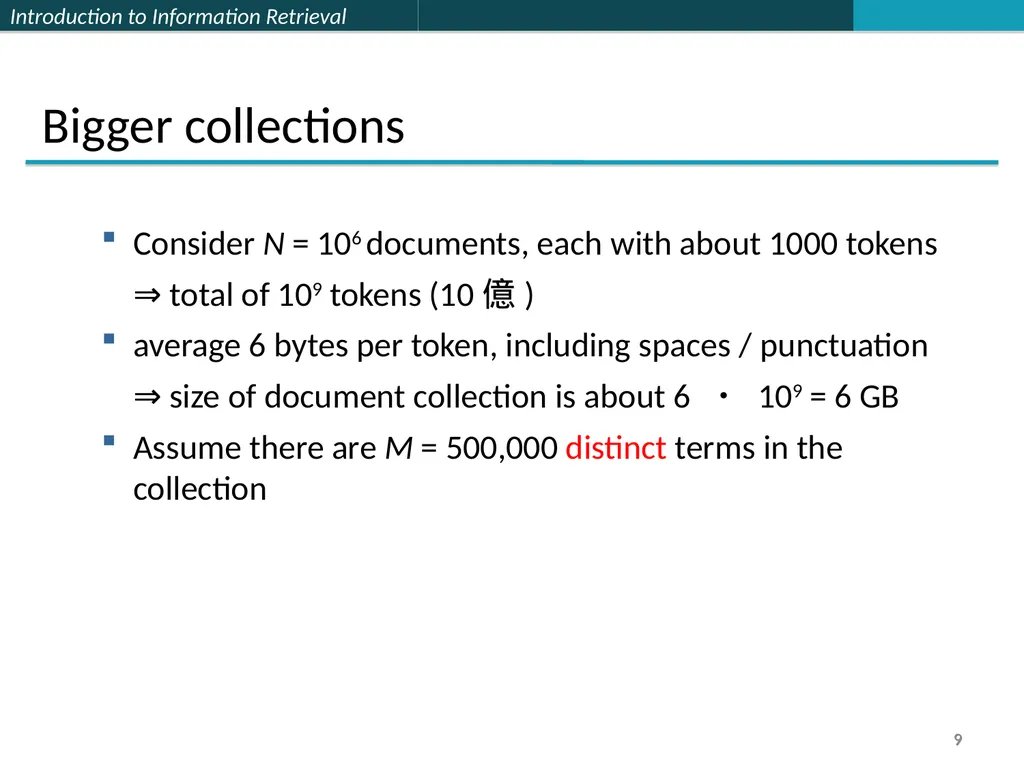
slide9. 9 Bigger collections Consider N = 106 documents, each with about 1000 tokens
⇒ total of 109 tokens (10億)
average 6 bytes per token, including spaces / punctuation
⇒ size of document collection is about 6 ・ 109 = 6 GB
Assume there are M = 500,000 distinct terms in the collection 9<br>
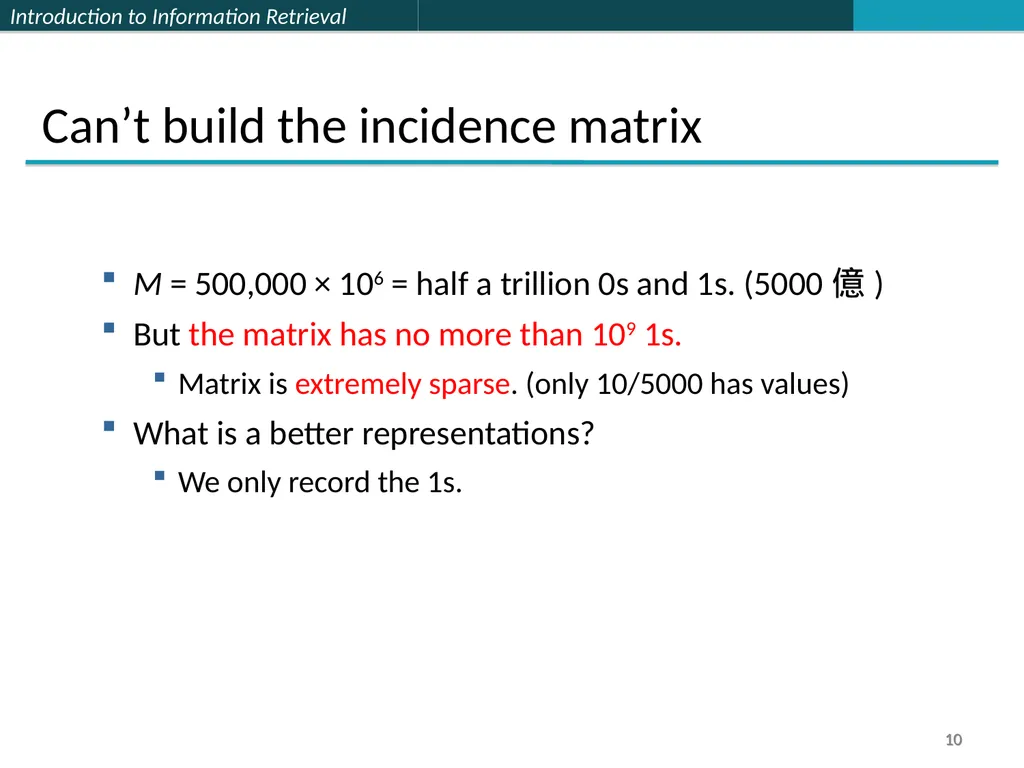
slide10. 10 Can’t build the incidence matrix M = 500,000 × 106 = half a trillion 0s and 1s. (5000億)
But the matrix has no more than 109 1s.
Matrix is extremely sparse. (only 10/5000 has values)
What is a better representations?
We only record the 1s. 10<br>
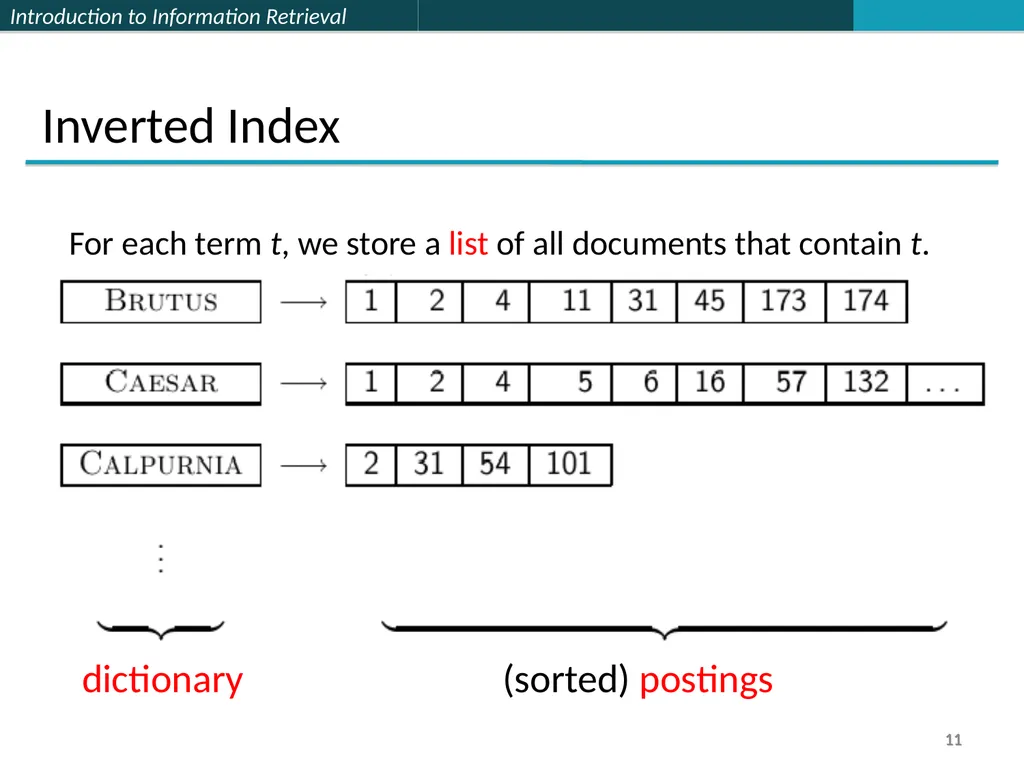
slide11. 11 Inverted Index For each term t, we store a list of all documents that contain t. 11 dictionary (sorted) postings<br>
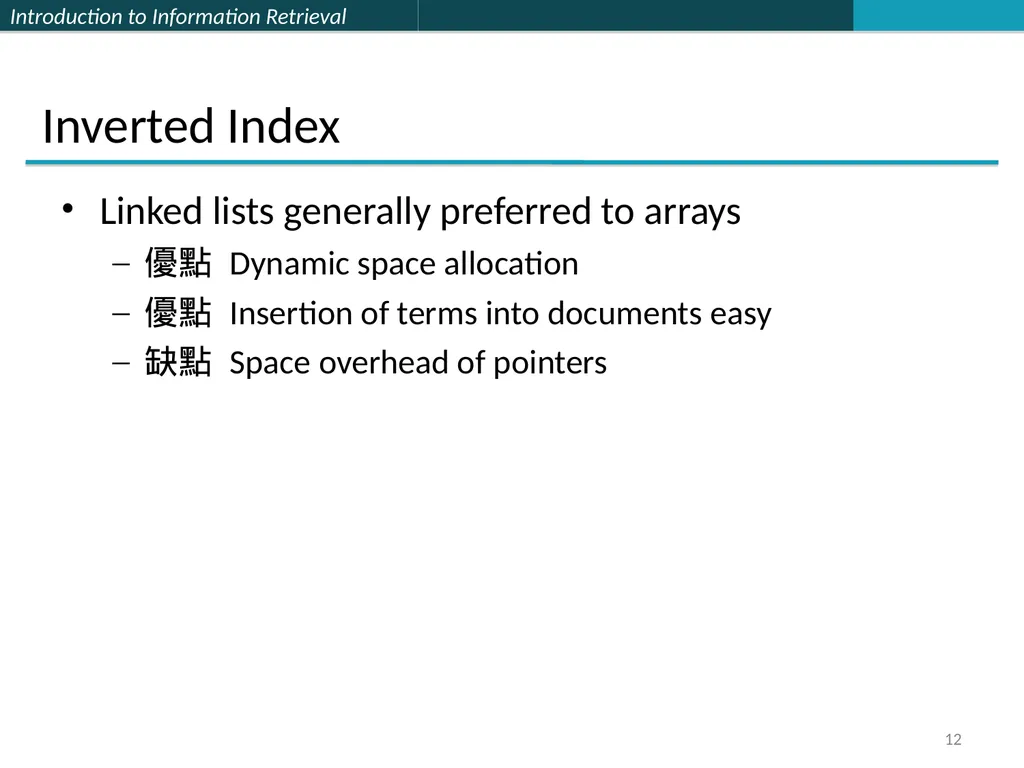
slide12. Linked lists generally preferred to arrays
優點 Dynamic space allocation
優點 Insertion of terms into documents easy
缺點 Space overhead of pointers 12 Inverted Index<br>
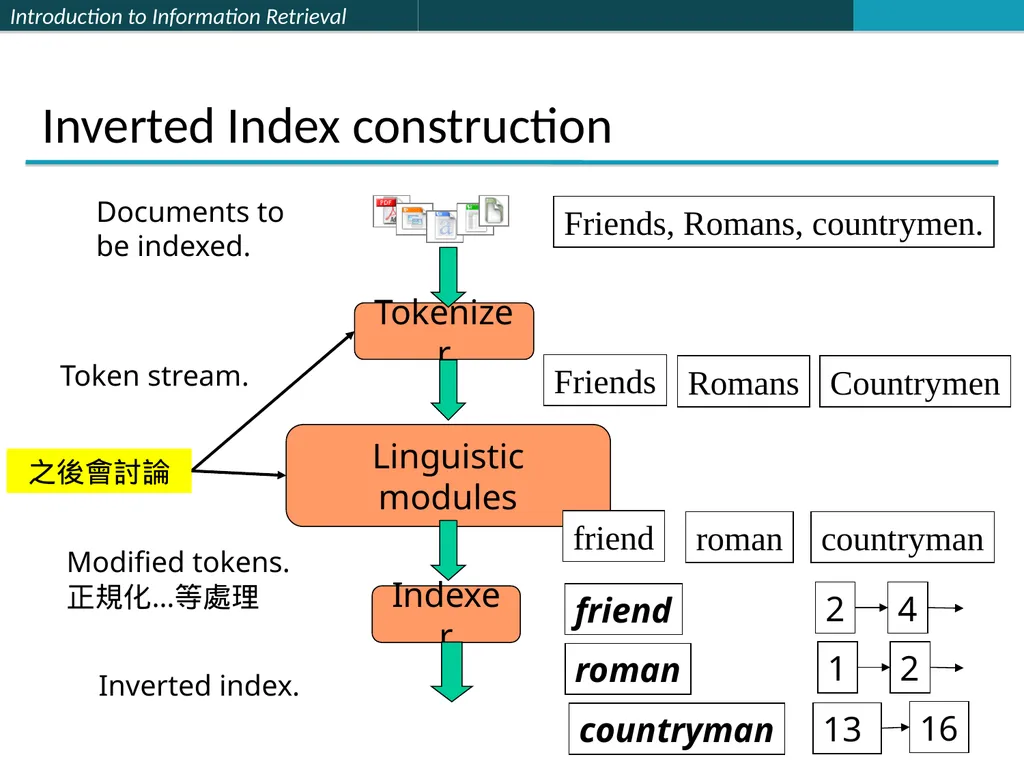
slide13. Tokenizer Token stream. Friends Romans Countrymen Linguistic modules Modified tokens.
正規化…等處理 friend roman countryman Indexer Inverted index. friend roman countryman 2 4 2 13 16 1 Documents to
be indexed. Friends, Romans, countrymen. Inverted Index construction<br>
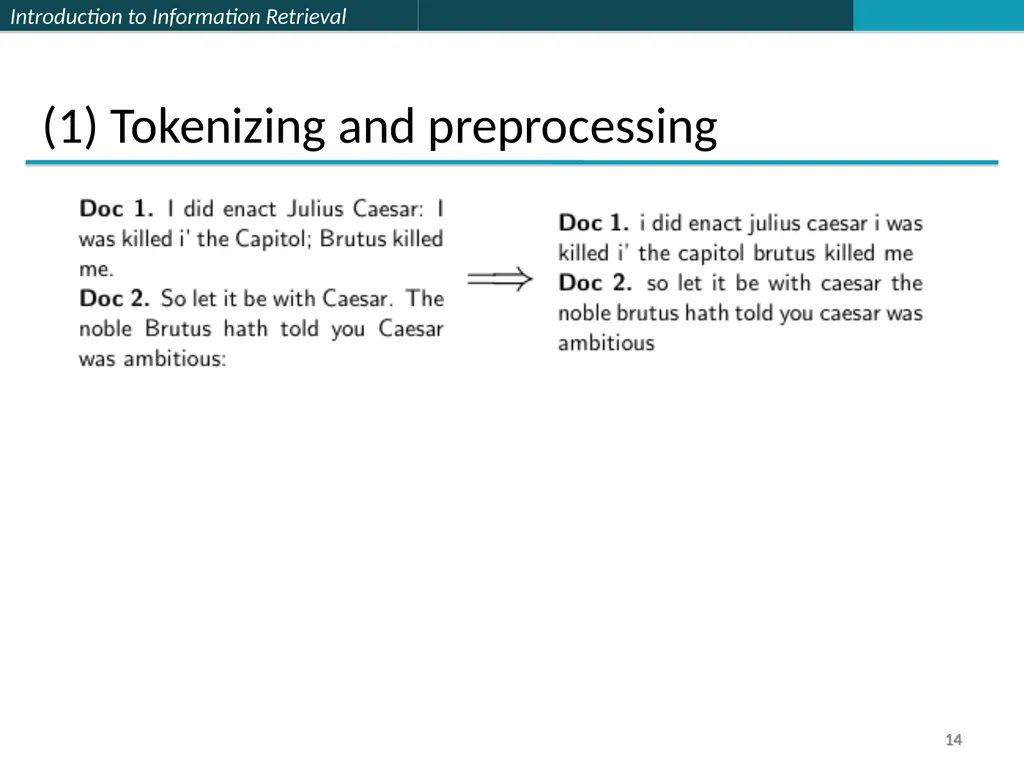
slide14. 14 (1) Tokenizing and preprocessing 14<br>
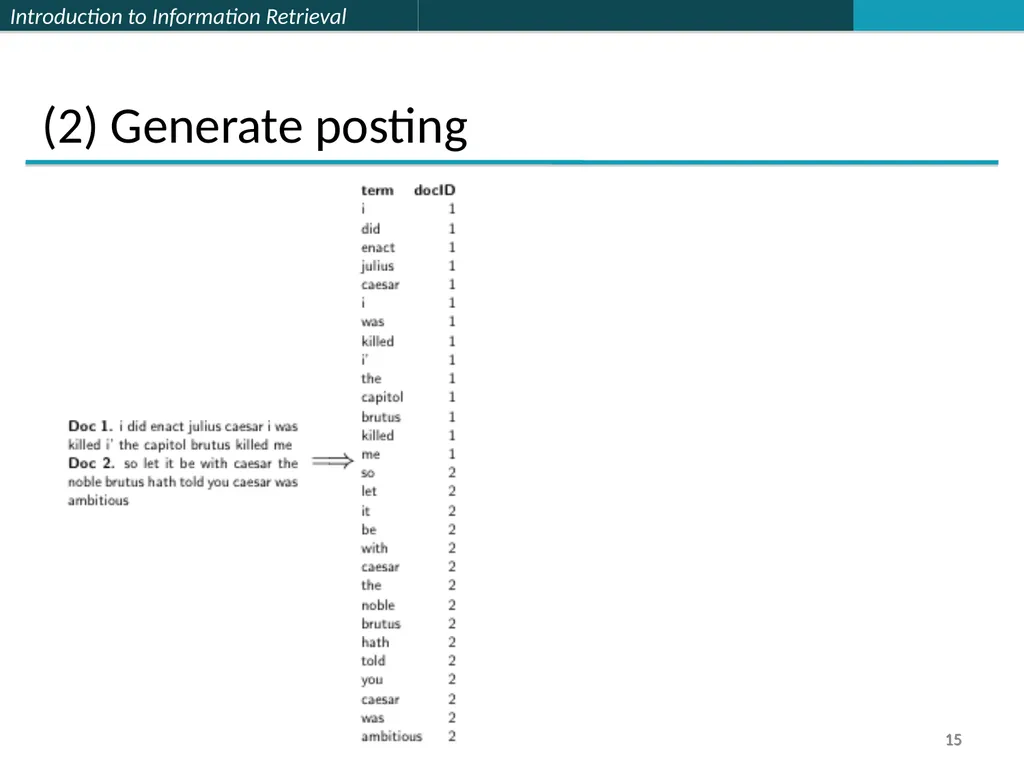
slide15. 15 (2) Generate posting 15<br>
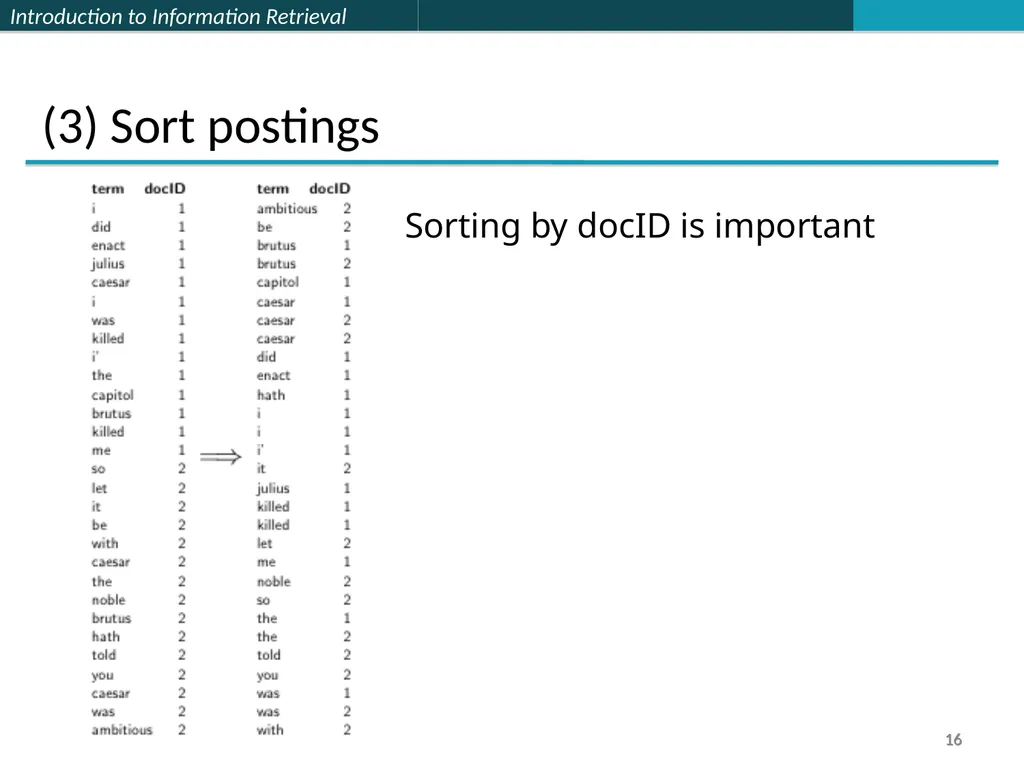
slide16. 16 (3) Sort postings 16 Sorting by docID is important<br>
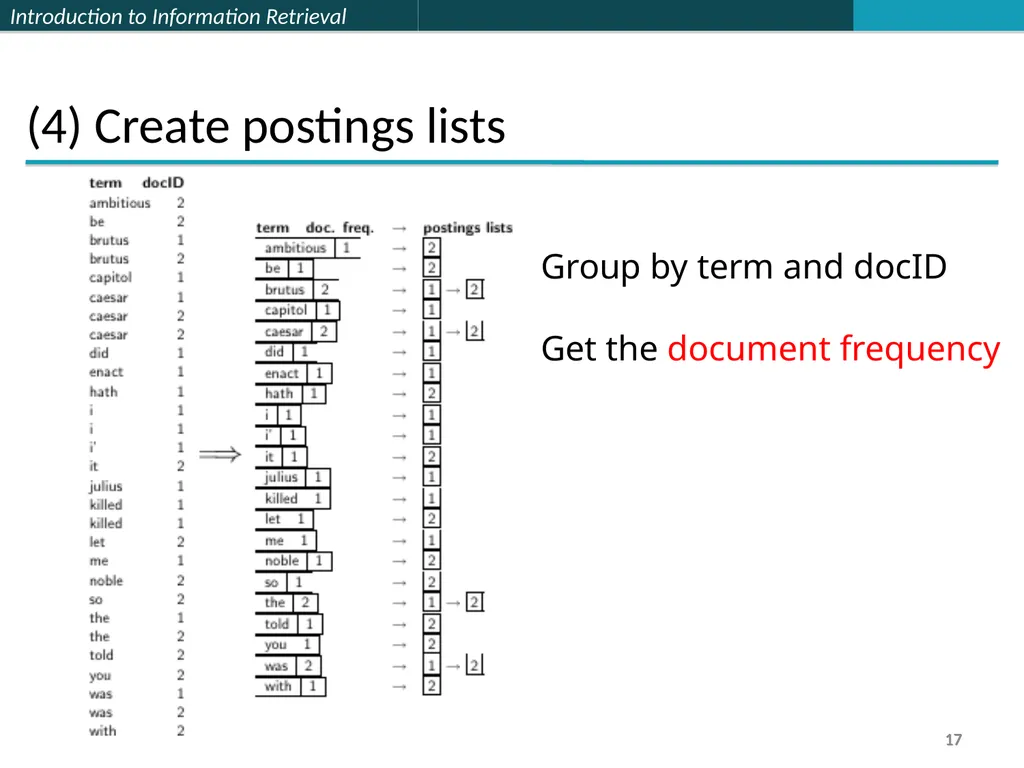
slide17. 17 (4) Create postings lists 17 Group by term and docID
Get the document frequency<br>
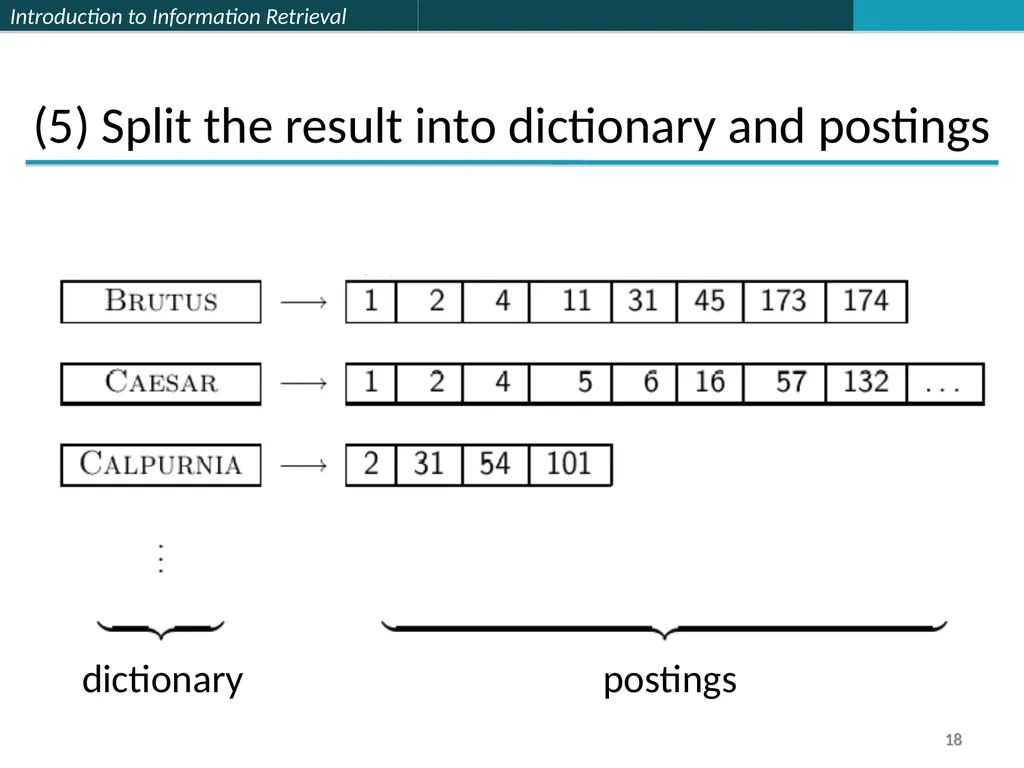
slide18. 18 (5) Split the result into dictionary and postings 18 dictionary postings<br>
slide19. Processing Boolean queries 19<br>
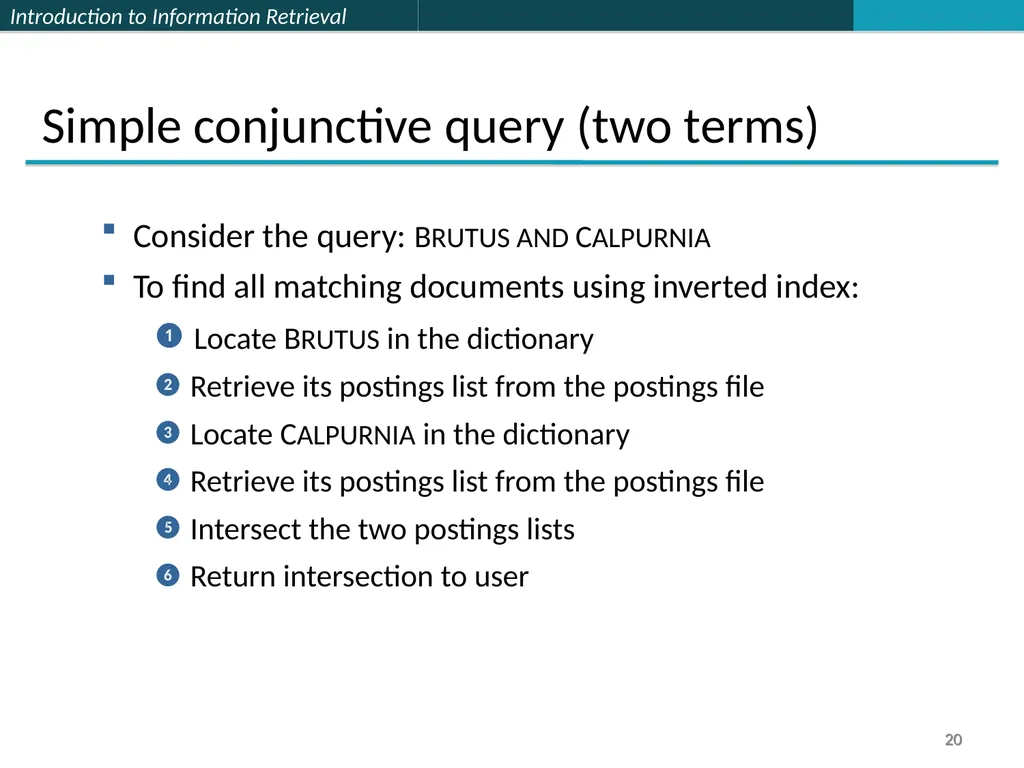
slide20. 20 Simple conjunctive query (two terms) Consider the query: BRUTUS AND CALPURNIA
To find all matching documents using inverted index:
Locate BRUTUS in the dictionary
Retrieve its postings list from the postings file
Locate CALPURNIA in the dictionary
Retrieve its postings list from the postings file
Intersect the two postings lists
Return intersection to user 20<br>
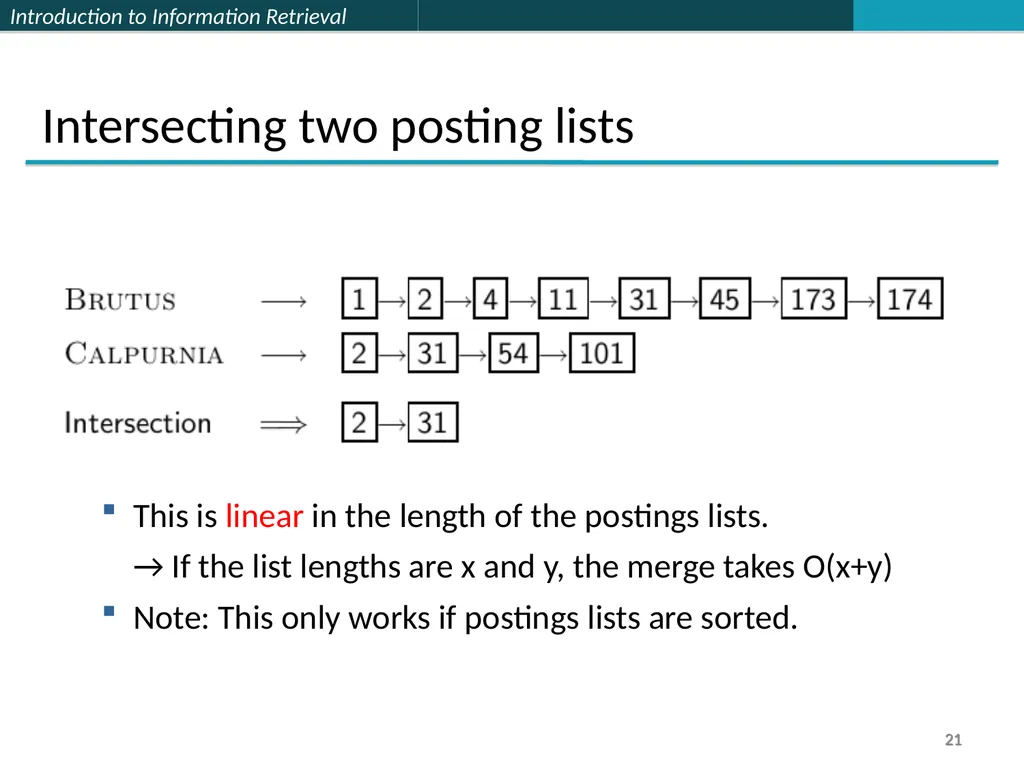
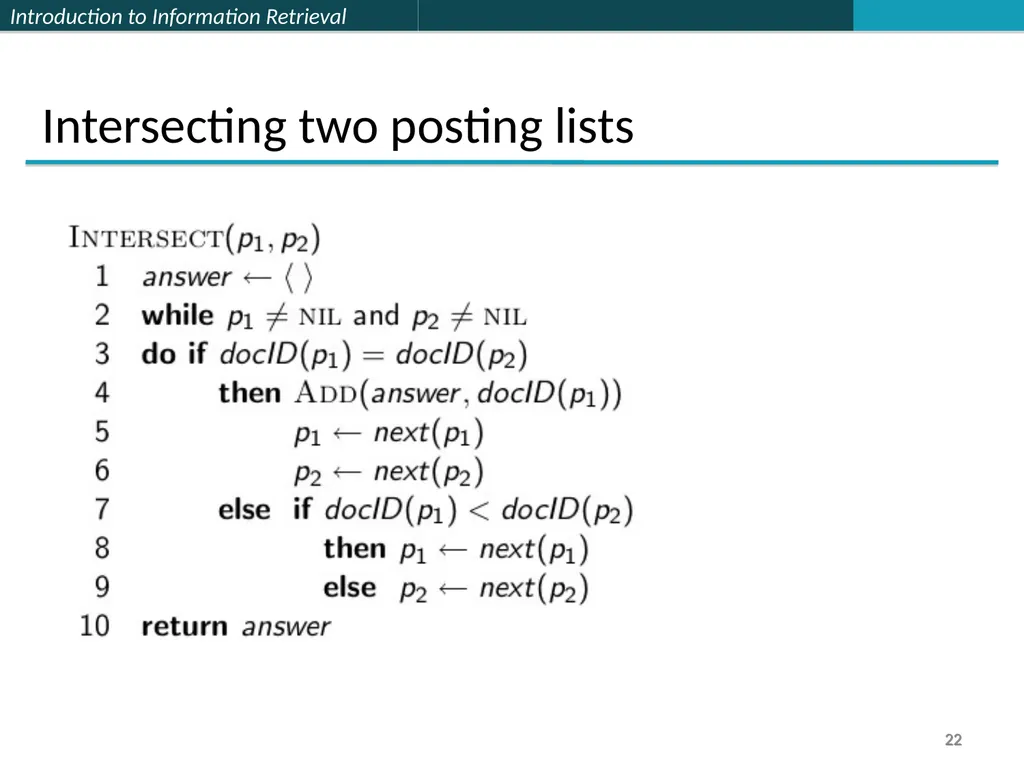
slide21. 21 Intersecting two posting lists This is linear in the length of the postings lists.
→ If the list lengths are x and y, the merge takes O(x+y)
Note: This only works if postings lists are sorted. 21<br>
slide22. 22 Intersecting two posting lists 22<br>
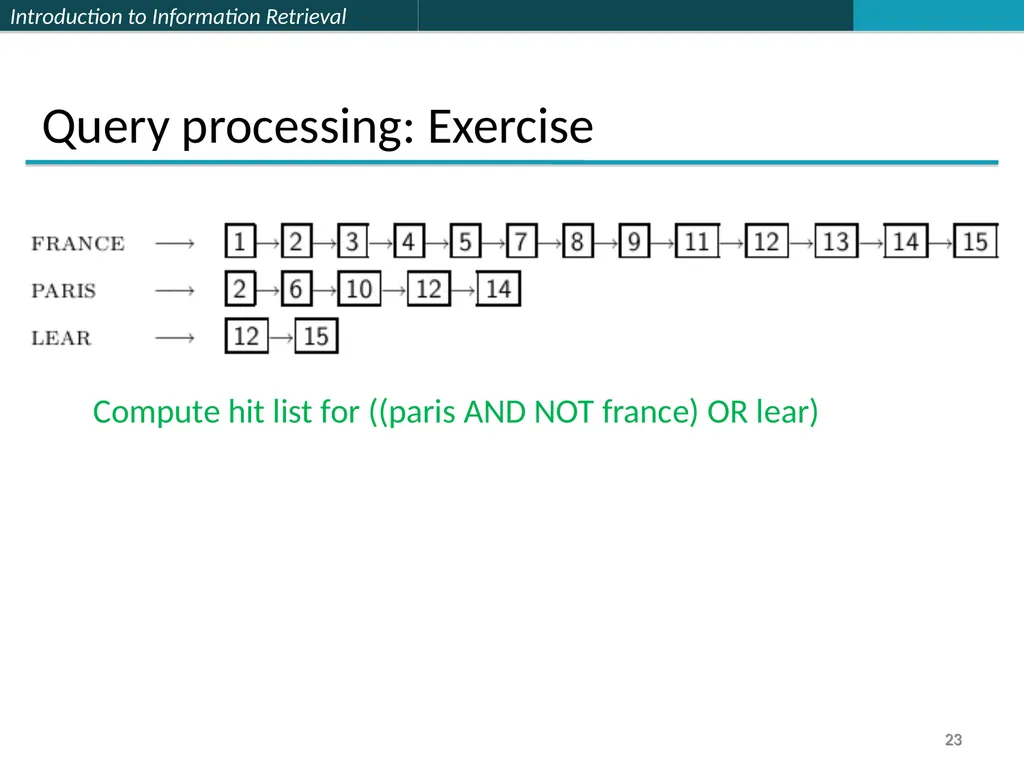
slide23. 23 Query processing: Exercise Compute hit list for ((paris AND NOT france) OR lear) 23<br>
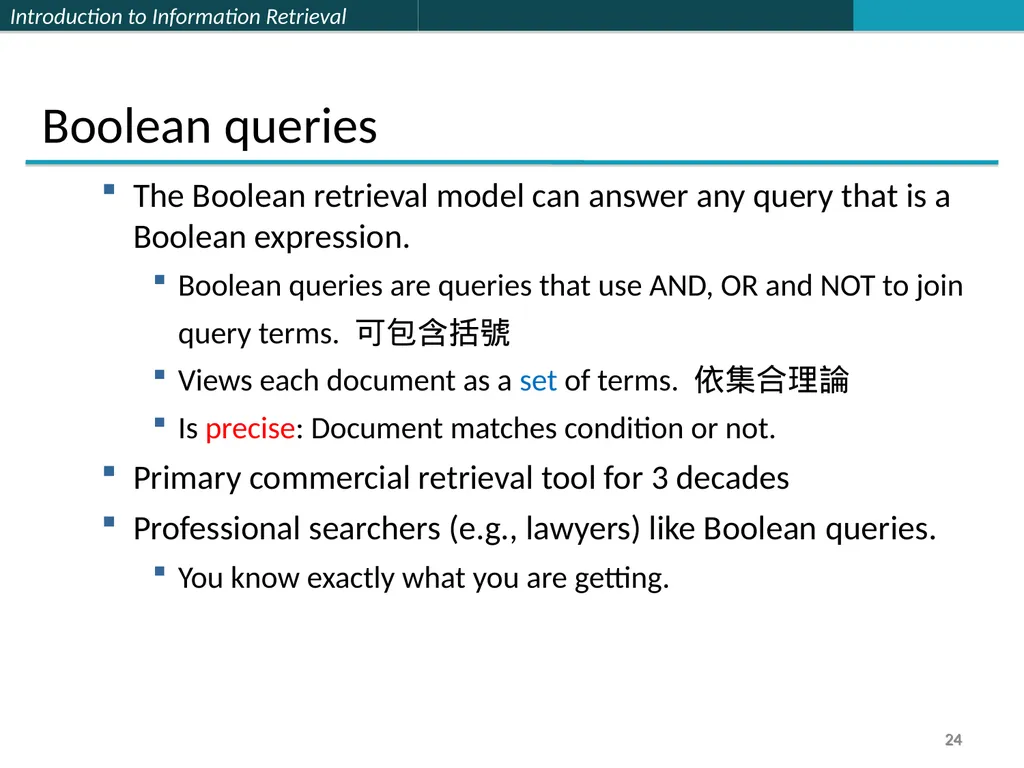
slide24. 24 Boolean queries The Boolean retrieval model can answer any query that is a Boolean expression.
Boolean queries are queries that use AND, OR and NOT to join
query terms. 可包含括號
Views each document as a set of terms. 依集合理論
Is precise: Document matches condition or not.
Primary commercial retrieval tool for 3 decades
Professional searchers (e.g., lawyers) like Boolean queries.
You know exactly what you are getting. 24<br>
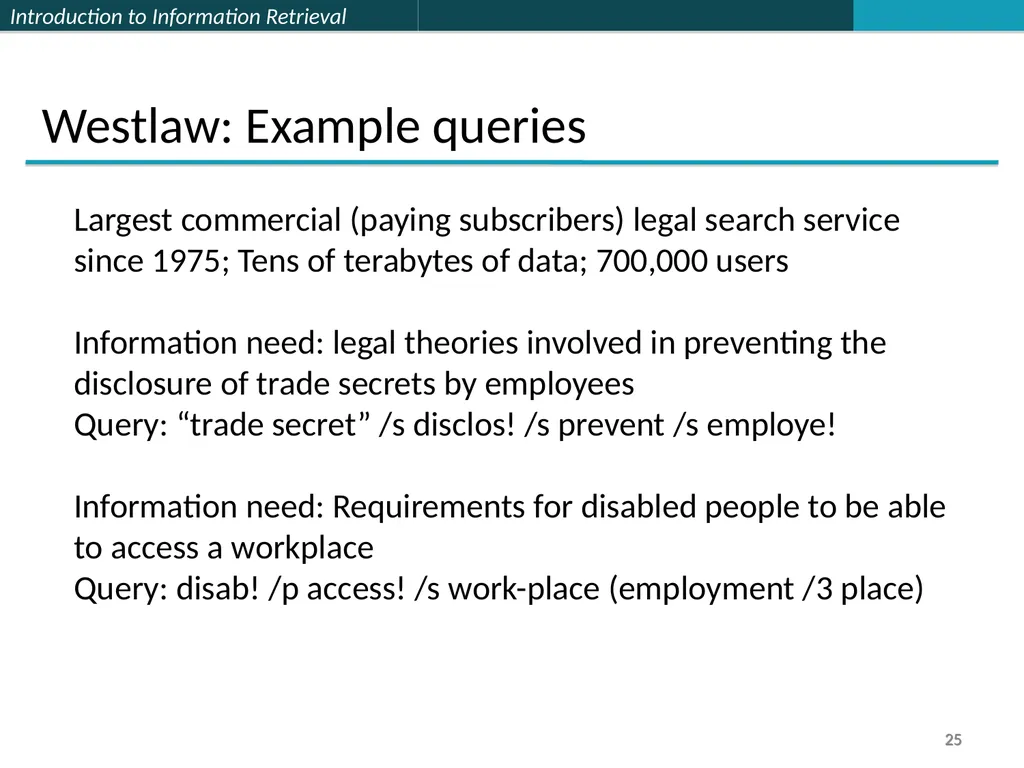
slide25. 25 Westlaw: Example queries Largest commercial (paying subscribers) legal search service since 1975; Tens of terabytes of data; 700,000 users
Information need: legal theories involved in preventing the disclosure of trade secrets by employees
Query: “trade secret” /s disclos! /s prevent /s employe!
Information need: Requirements for disabled people to be able to access a workplace
Query: disab! /p access! /s work-place (employment /3 place) 25<br>
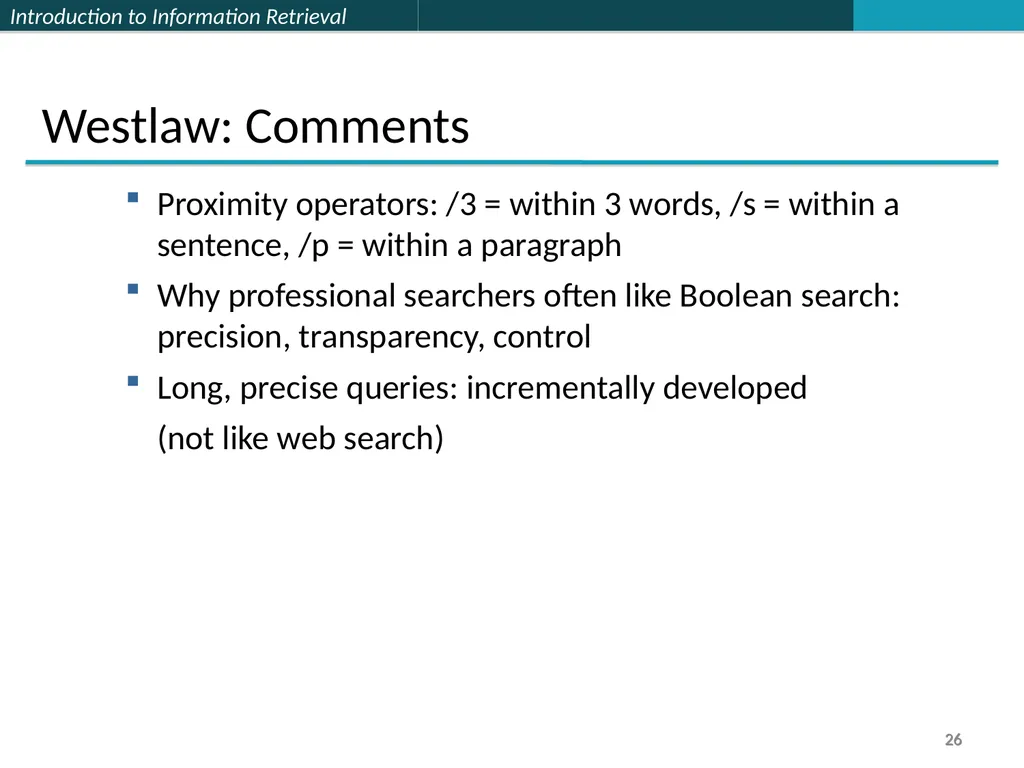
slide26. 26 Westlaw: Comments Proximity operators: /3 = within 3 words, /s = within a sentence, /p = within a paragraph
Why professional searchers often like Boolean search: precision, transparency, control
Long, precise queries: incrementally developed
(not like web search) 26<br>
slide27. Query optimization 27<br>
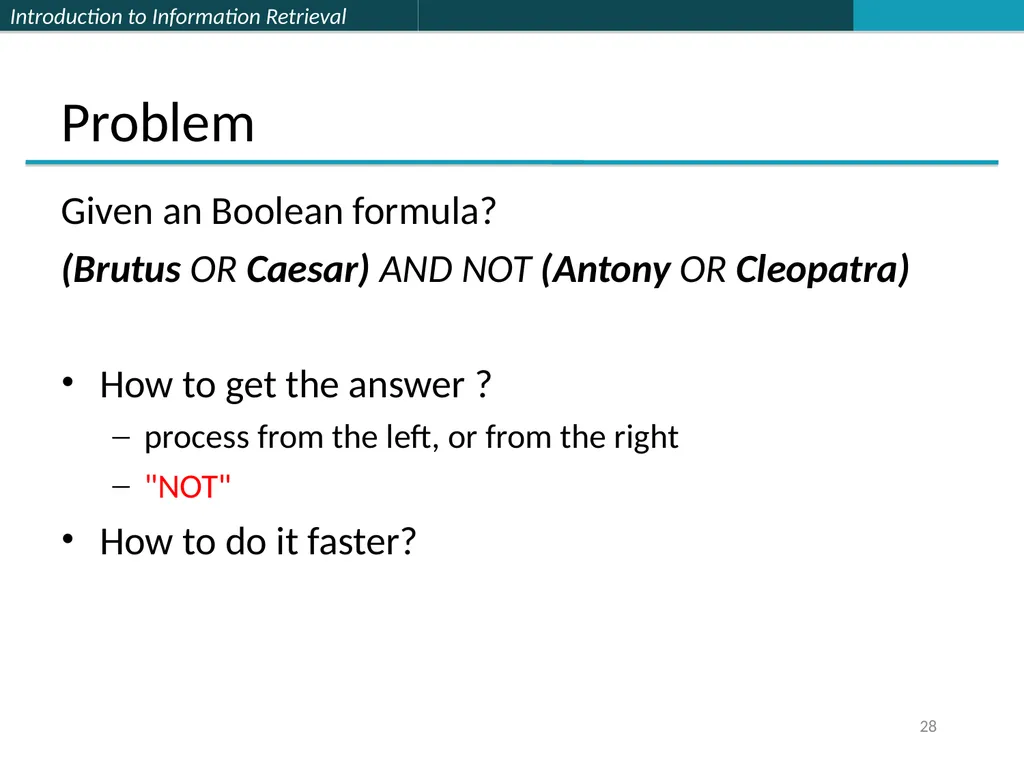
slide28. 28 Problem Given an Boolean formula?
(Brutus OR Caesar) AND NOT (Antony OR Cleopatra)
How to get the answer ?
process from the left, or from the right
"NOT"
How to do it faster?<br>
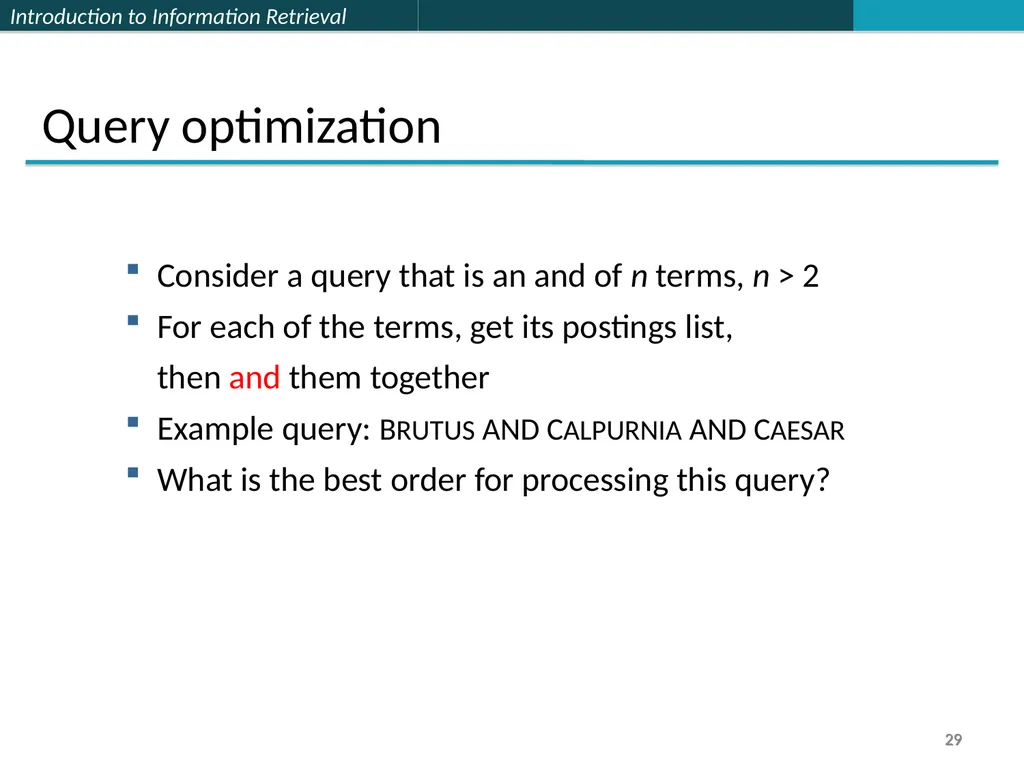
slide29. 29 Query optimization Consider a query that is an and of n terms, n > 2
For each of the terms, get its postings list,
then and them together
Example query: BRUTUS AND CALPURNIA AND CAESAR
What is the best order for processing this query? 29<br>
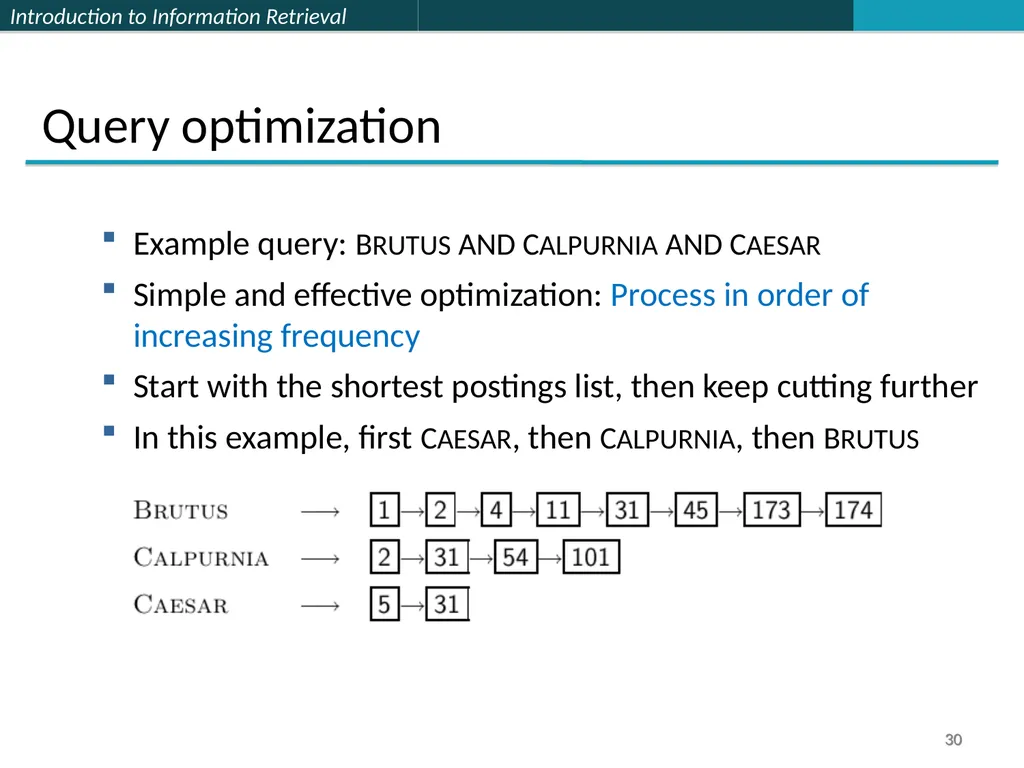
slide30. 30 Query optimization Example query: BRUTUS AND CALPURNIA AND CAESAR
Simple and effective optimization: Process in order of increasing frequency
Start with the shortest postings list, then keep cutting further
In this example, first CAESAR, then CALPURNIA, then BRUTUS 30<br>
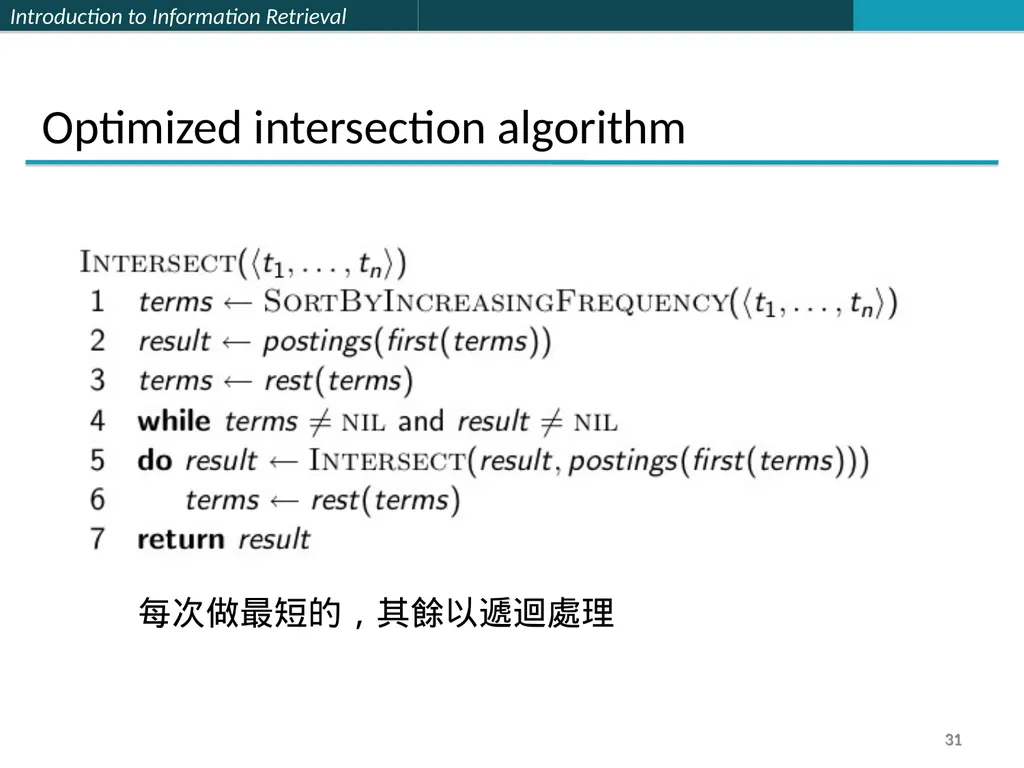
slide31. 31 Optimized intersection algorithm 31 每次做最短的,其餘以遞迴處理<br>
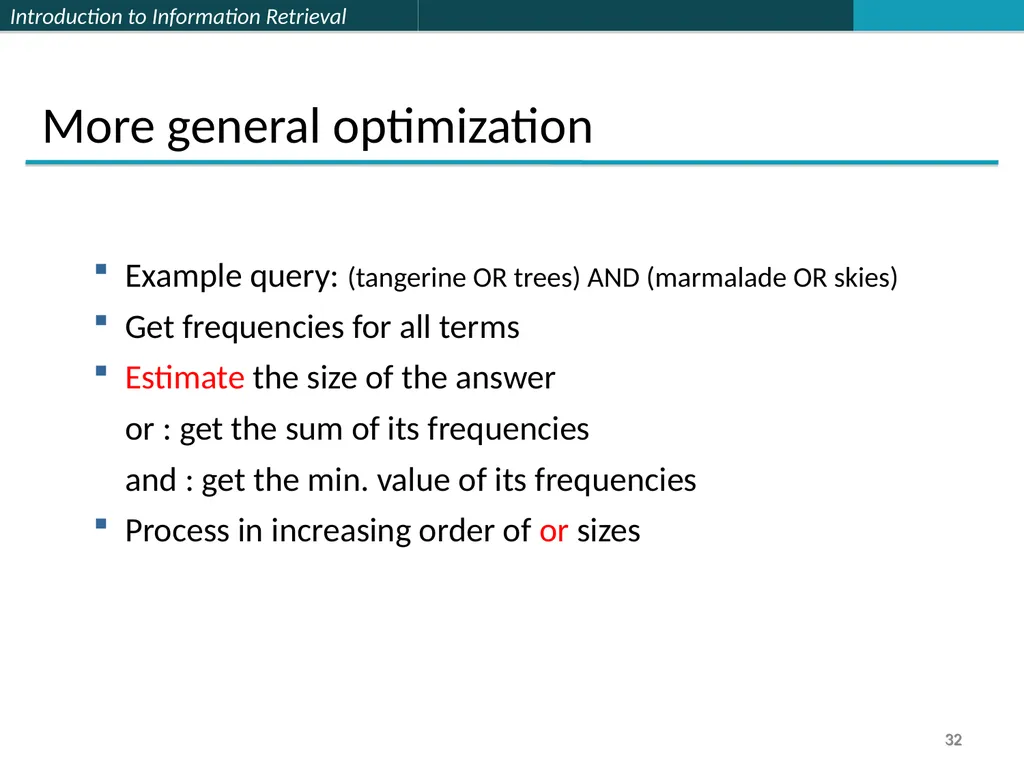
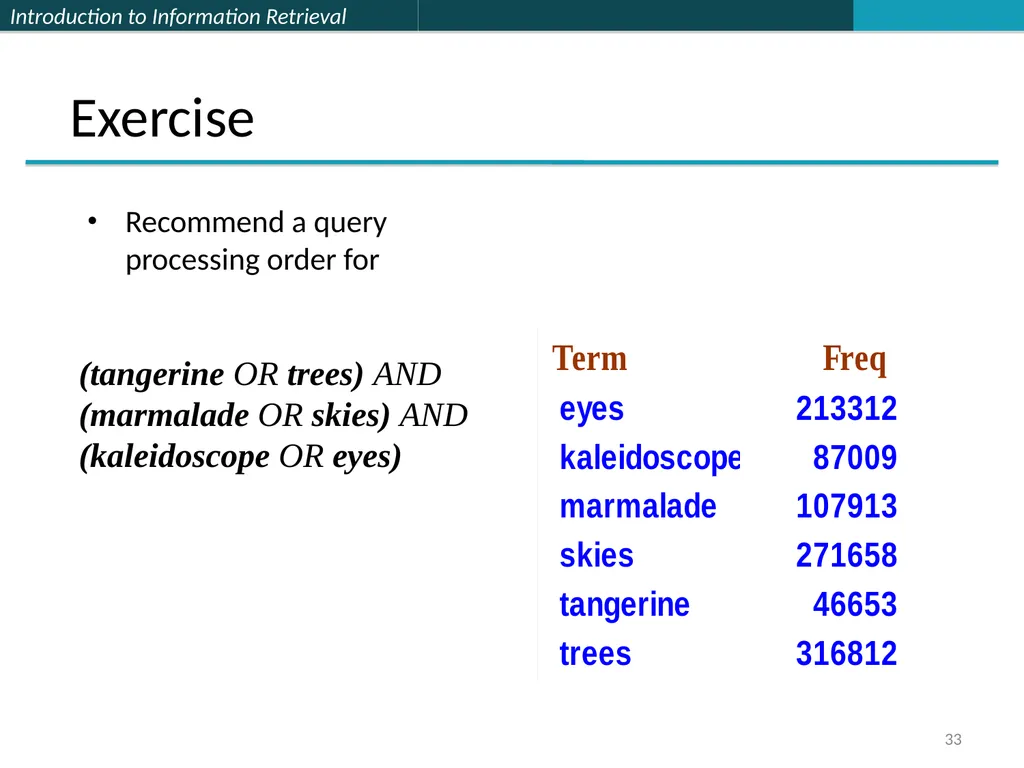
slide32. 32 More general optimization Example query: (tangerine OR trees) AND (marmalade OR skies)
Get frequencies for all terms
Estimate the size of the answer
or : get the sum of its frequencies
and : get the min. value of its frequencies
Process in increasing order of or sizes 32<br>
slide33. 33 Exercise Recommend a query processing order for (tangerine OR trees) AND
(marmalade OR skies) AND
(kaleidoscope OR eyes)<br>
slide34. Excerise 34<br>
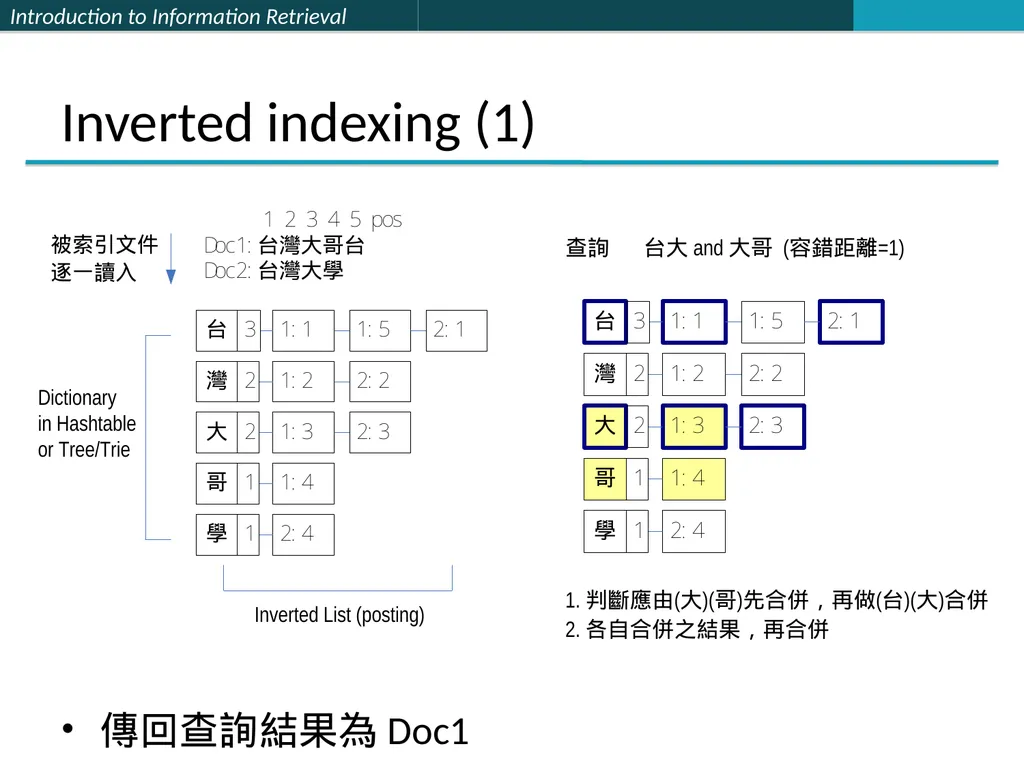
slide35. Inverted indexing (1) 傳回查詢結果為Doc1<br>
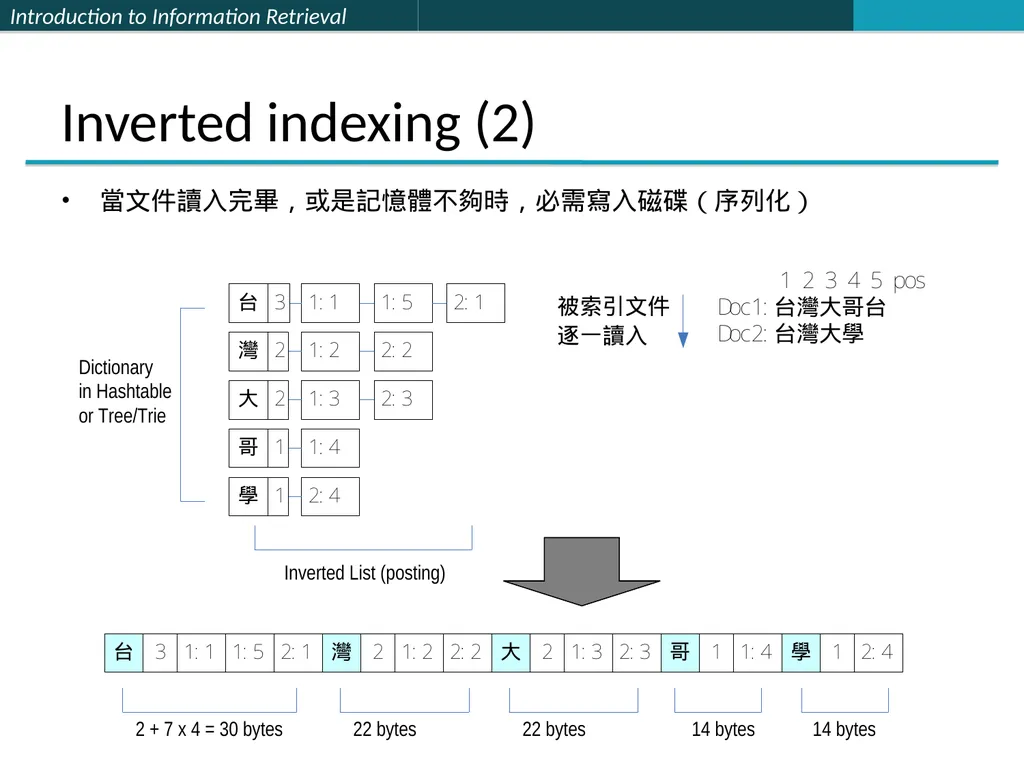
slide36. Inverted indexing (2) 當文件讀入完畢,或是記憶體不夠時,必需寫入磁碟(序列化)<br>
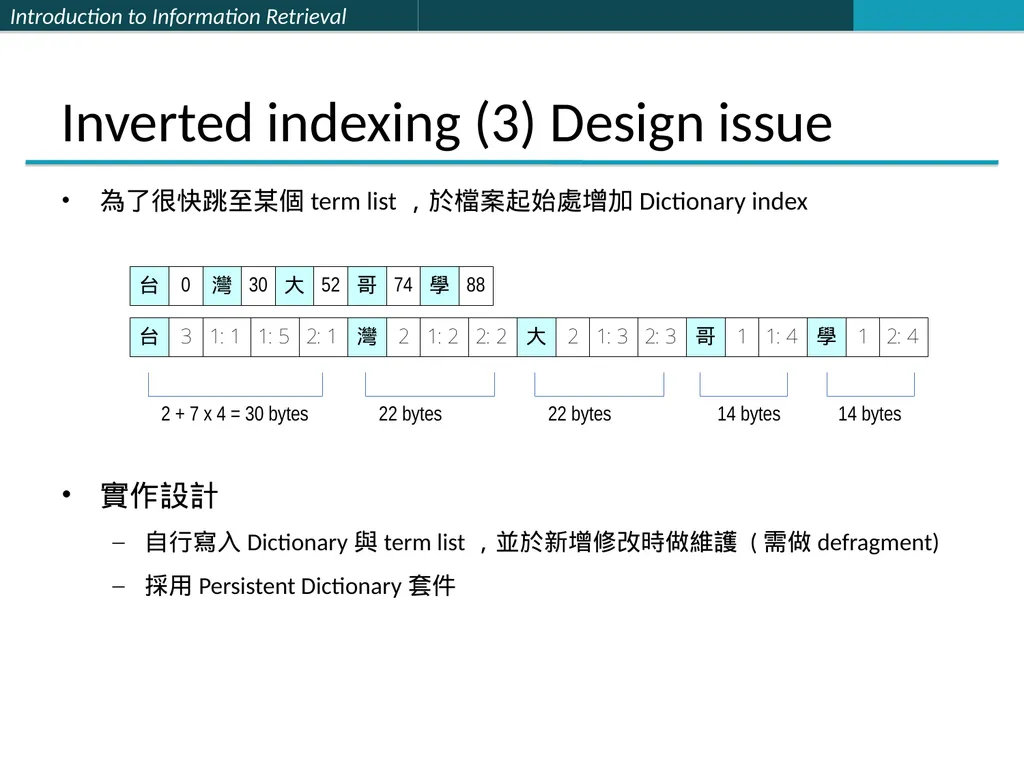
slide37. Inverted indexing (3) Design issue 為了很快跳至某個term list,於檔案起始處增加Dictionary index
實作設計
自行寫入Dictionary與term list,並於新增修改時做維護 (需做defragment)
採用Persistent Dictionary套件<br>
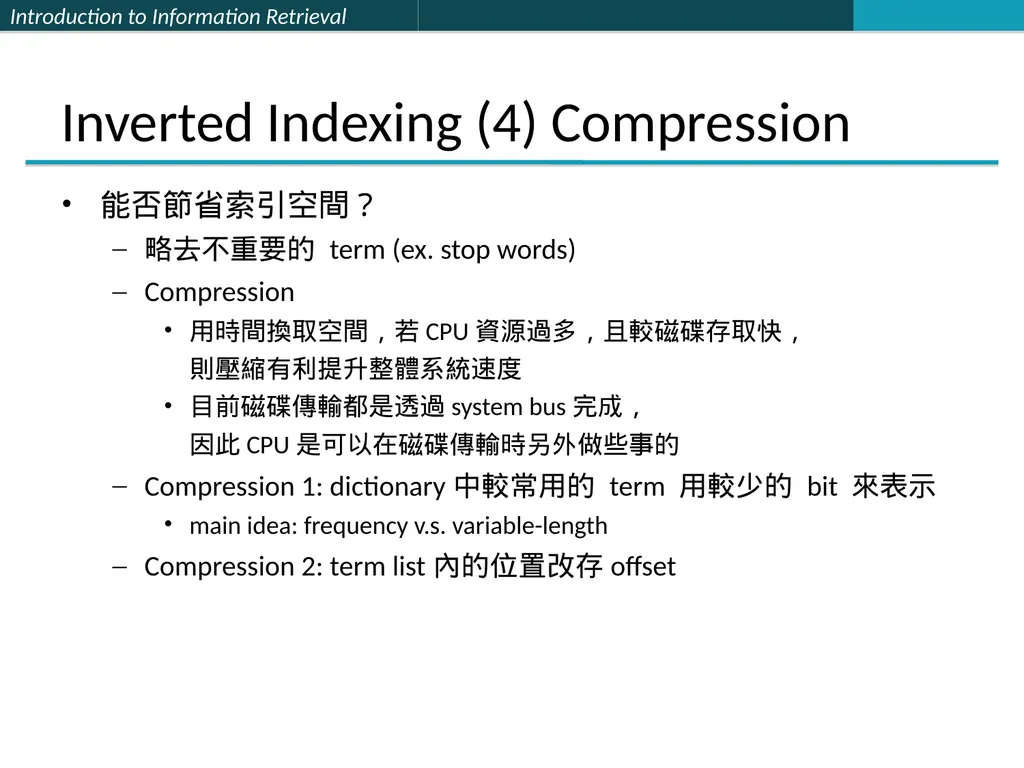
slide38. Inverted Indexing (4) Compression 能否節省索引空間?
略去不重要的 term (ex. stop words)
Compression
用時間換取空間,若CPU資源過多,且較磁碟存取快,
則壓縮有利提升整體系統速度
目前磁碟傳輸都是透過system bus完成,
因此CPU是可以在磁碟傳輸時另外做些事的
Compression 1: dictionary中較常用的 term 用較少的 bit 來表示
main idea: frequency v.s. variable-length
Compression 2: term list內的位置改存offset<br>
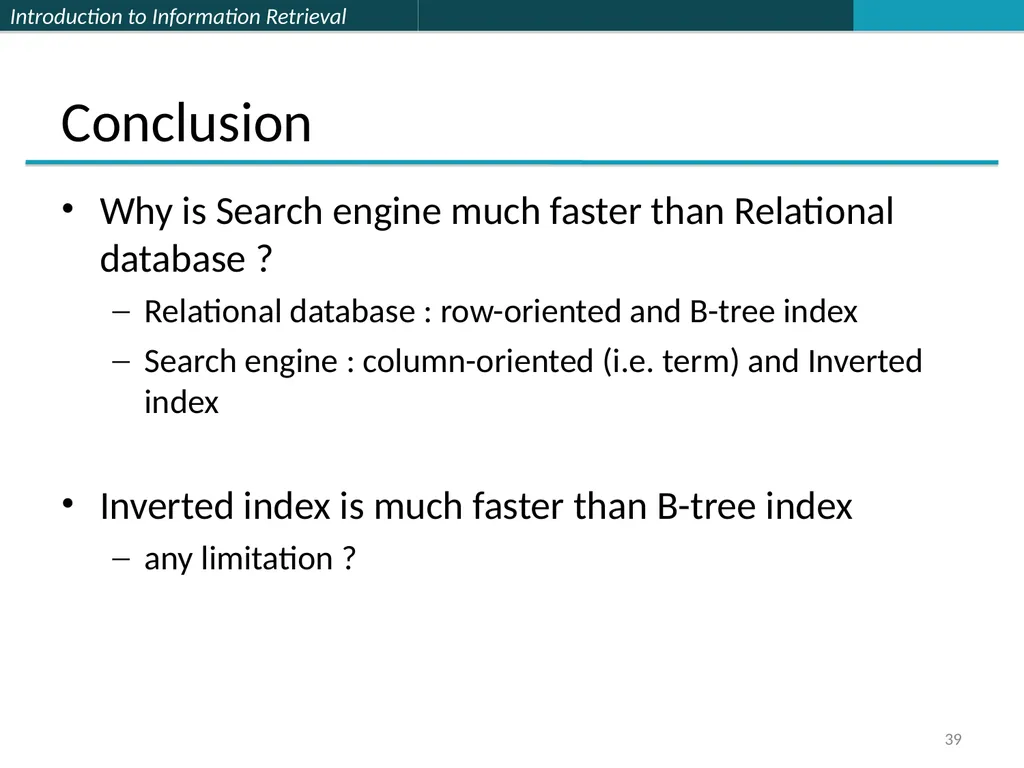
slide39. Conclusion Why is Search engine much faster than Relational database ?
Relational database : row-oriented and B-tree index
Search engine : column-oriented (i.e. term) and Inverted index
Inverted index is much faster than B-tree index
any limitation ? 39<br>

台灣科大資管系
wyang@ntu.edu.tw
本投影片修改自Introduction to Information Retrieval一書之投影片 Ch 1 & 2 1<br>
slide2. 2 Definition of information retrieval Information retrieval (IR) is finding material (usually documents) of
an unstructured nature (usually text) that satisfies an information
need from within large collections (usually stored on computers). 2<br>
slide3. 3 Boolean retrieval The Boolean model is arguably the simplest model to base an information retrieval system on.
Queries are Boolean expressions, e.g., CAESAR AND BRUTUS
The search engine returns all documents that satisfy the
Boolean expression. 3<br>
slide4. Inverted Index 4<br>
slide5. 5 Unstructured data in 1650 Which plays of Shakespeare contain the words
BRUTUS AND CAESAR, but not CALPURNIA ?
One could grep all of Shakespeare’s plays for BRUTUS and CAESAR, then strip out lines containing CALPURNIA
Why is grep not the solution?
Slow (for large collections)
grep is line-oriented, IR is document-oriented
“NOT CALPURNIA” is non-trivial
Other operations (e.g., find the word ROMANS near COUNTRYMAN ) not feasible 5<br>
slide6. 6 Term-document incidence matrix Entry is 1 if term occurs. Example: CALPURNIA occurs in Julius Caesar. Entry is 0 if term doesn’t occur. Example: CALPURNIA
doesn’t occur in The tempest. 6<br>
slide7. 7 Incidence vectors So we have a 0/1 vector for each term.
To answer the query BRUTUS AND CAESAR AND NOT CALPURNIA:
Take the vectors for BRUTUS, CAESAR AND NOT CALPURNIA
Complement the vector of CALPURNIA
Do a (bitwise) and on the three vectors
110100 AND 110111 AND 101111 = 100100 7<br>
slide8. 8 0/1 vector for BRUTUS 8 答案是Antony and Cleopatra與Hamlet<br>
slide9. 9 Bigger collections Consider N = 106 documents, each with about 1000 tokens
⇒ total of 109 tokens (10億)
average 6 bytes per token, including spaces / punctuation
⇒ size of document collection is about 6 ・ 109 = 6 GB
Assume there are M = 500,000 distinct terms in the collection 9<br>
slide10. 10 Can’t build the incidence matrix M = 500,000 × 106 = half a trillion 0s and 1s. (5000億)
But the matrix has no more than 109 1s.
Matrix is extremely sparse. (only 10/5000 has values)
What is a better representations?
We only record the 1s. 10<br>
slide11. 11 Inverted Index For each term t, we store a list of all documents that contain t. 11 dictionary (sorted) postings<br>
slide12. Linked lists generally preferred to arrays
優點 Dynamic space allocation
優點 Insertion of terms into documents easy
缺點 Space overhead of pointers 12 Inverted Index<br>
slide13. Tokenizer Token stream. Friends Romans Countrymen Linguistic modules Modified tokens.
正規化…等處理 friend roman countryman Indexer Inverted index. friend roman countryman 2 4 2 13 16 1 Documents to
be indexed. Friends, Romans, countrymen. Inverted Index construction<br>
slide14. 14 (1) Tokenizing and preprocessing 14<br>
slide15. 15 (2) Generate posting 15<br>
slide16. 16 (3) Sort postings 16 Sorting by docID is important<br>
slide17. 17 (4) Create postings lists 17 Group by term and docID
Get the document frequency<br>
slide18. 18 (5) Split the result into dictionary and postings 18 dictionary postings<br>
slide19. Processing Boolean queries 19<br>
slide20. 20 Simple conjunctive query (two terms) Consider the query: BRUTUS AND CALPURNIA
To find all matching documents using inverted index:
Locate BRUTUS in the dictionary
Retrieve its postings list from the postings file
Locate CALPURNIA in the dictionary
Retrieve its postings list from the postings file
Intersect the two postings lists
Return intersection to user 20<br>
slide21. 21 Intersecting two posting lists This is linear in the length of the postings lists.
→ If the list lengths are x and y, the merge takes O(x+y)
Note: This only works if postings lists are sorted. 21<br>
slide22. 22 Intersecting two posting lists 22<br>
slide23. 23 Query processing: Exercise Compute hit list for ((paris AND NOT france) OR lear) 23<br>
slide24. 24 Boolean queries The Boolean retrieval model can answer any query that is a Boolean expression.
Boolean queries are queries that use AND, OR and NOT to join
query terms. 可包含括號
Views each document as a set of terms. 依集合理論
Is precise: Document matches condition or not.
Primary commercial retrieval tool for 3 decades
Professional searchers (e.g., lawyers) like Boolean queries.
You know exactly what you are getting. 24<br>
slide25. 25 Westlaw: Example queries Largest commercial (paying subscribers) legal search service since 1975; Tens of terabytes of data; 700,000 users
Information need: legal theories involved in preventing the disclosure of trade secrets by employees
Query: “trade secret” /s disclos! /s prevent /s employe!
Information need: Requirements for disabled people to be able to access a workplace
Query: disab! /p access! /s work-place (employment /3 place) 25<br>
slide26. 26 Westlaw: Comments Proximity operators: /3 = within 3 words, /s = within a sentence, /p = within a paragraph
Why professional searchers often like Boolean search: precision, transparency, control
Long, precise queries: incrementally developed
(not like web search) 26<br>
slide27. Query optimization 27<br>
slide28. 28 Problem Given an Boolean formula?
(Brutus OR Caesar) AND NOT (Antony OR Cleopatra)
How to get the answer ?
process from the left, or from the right
"NOT"
How to do it faster?<br>
slide29. 29 Query optimization Consider a query that is an and of n terms, n > 2
For each of the terms, get its postings list,
then and them together
Example query: BRUTUS AND CALPURNIA AND CAESAR
What is the best order for processing this query? 29<br>
slide30. 30 Query optimization Example query: BRUTUS AND CALPURNIA AND CAESAR
Simple and effective optimization: Process in order of increasing frequency
Start with the shortest postings list, then keep cutting further
In this example, first CAESAR, then CALPURNIA, then BRUTUS 30<br>
slide31. 31 Optimized intersection algorithm 31 每次做最短的,其餘以遞迴處理<br>
slide32. 32 More general optimization Example query: (tangerine OR trees) AND (marmalade OR skies)
Get frequencies for all terms
Estimate the size of the answer
or : get the sum of its frequencies
and : get the min. value of its frequencies
Process in increasing order of or sizes 32<br>
slide33. 33 Exercise Recommend a query processing order for (tangerine OR trees) AND
(marmalade OR skies) AND
(kaleidoscope OR eyes)<br>
slide34. Excerise 34<br>
slide35. Inverted indexing (1) 傳回查詢結果為Doc1<br>
slide36. Inverted indexing (2) 當文件讀入完畢,或是記憶體不夠時,必需寫入磁碟(序列化)<br>
slide37. Inverted indexing (3) Design issue 為了很快跳至某個term list,於檔案起始處增加Dictionary index
實作設計
自行寫入Dictionary與term list,並於新增修改時做維護 (需做defragment)
採用Persistent Dictionary套件<br>
slide38. Inverted Indexing (4) Compression 能否節省索引空間?
略去不重要的 term (ex. stop words)
Compression
用時間換取空間,若CPU資源過多,且較磁碟存取快,
則壓縮有利提升整體系統速度
目前磁碟傳輸都是透過system bus完成,
因此CPU是可以在磁碟傳輸時另外做些事的
Compression 1: dictionary中較常用的 term 用較少的 bit 來表示
main idea: frequency v.s. variable-length
Compression 2: term list內的位置改存offset<br>
slide39. Conclusion Why is Search engine much faster than Relational database ?
Relational database : row-oriented and B-tree index
Search engine : column-oriented (i.e. term) and Inverted index
Inverted index is much faster than B-tree index
any limitation ? 39<br>