
Lecture 1. Genetics (February 18) Lecture 2:
OM
Published · 110 slides · 0 views

1 / 1


















Description
Lecture 1. Genetics (February 18) Lecture 2: Molecular Genetics (February 18) Lecture 3 Recent Advances in Plant Breeding (February 19) Madan K. Bhattacharyya, Ph.D. Professor, Iowa State University Adjunct Prof., Assam Agricultural
Related Topics
Download this presentation From Below
"Lecture 1. Genetics (February 18) Lecture 2:" is the property of its rightful owner. Permission is granted to download and print the materials on this website for personal, non-commercial use only, and to display it on your personal computer provided you do not modify the materials and that you retain all copyright notices contained in the materials. By downloading content from our website, you accept the terms of this agreement.
Share
Embed code
Presentation Transcript
01
Lecture 1. Genetics (February 18)
Lecture 2: Molecular Genetics (February 18)
Lecture 3 Recent Advances in Plant Breeding (February 19) Madan K. Bhattacharyya, Ph.D.
Professor, Iowa State University
Adjunct Prof., Assam Agricultural University
mbhattac@iastate.edu<br>
Lecture 2: Molecular Genetics (February 18)
Lecture 3 Recent Advances in Plant Breeding (February 19) Madan K. Bhattacharyya, Ph.D.
Professor, Iowa State University
Adjunct Prof., Assam Agricultural University
mbhattac@iastate.edu<br>
02
http://aau.ac.in/NAHEP/ Website for the presentations and some of the resources used<br>
03
Lecture 3: Recent Advances in Plant Breeding (February 19) Molecular Markers & Marker Assisted Selection
Speed Breeding
Doubled-haploid
TILLING Genome
CRISPR Cas9
Fixing Heterosis in Rice<br>
Speed Breeding
Doubled-haploid
TILLING Genome
CRISPR Cas9
Fixing Heterosis in Rice<br>
04
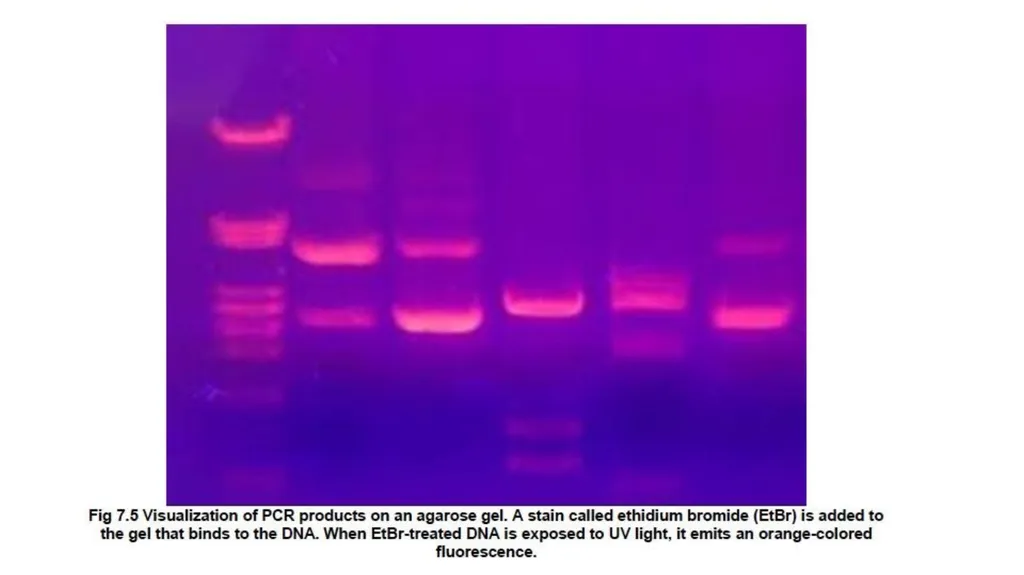
RFLP gel showing DNA fragment length polymorphisms.<br>
05
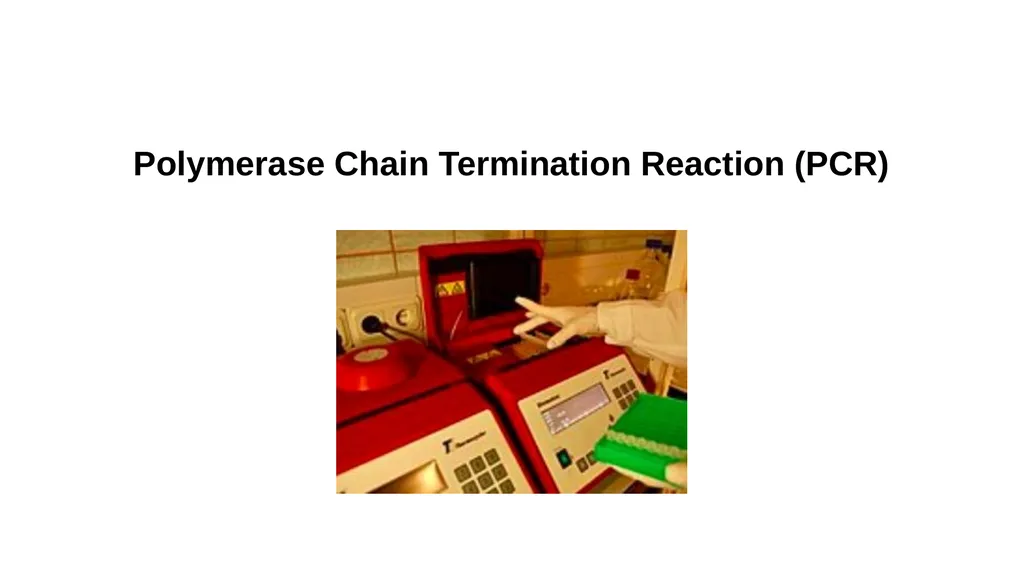
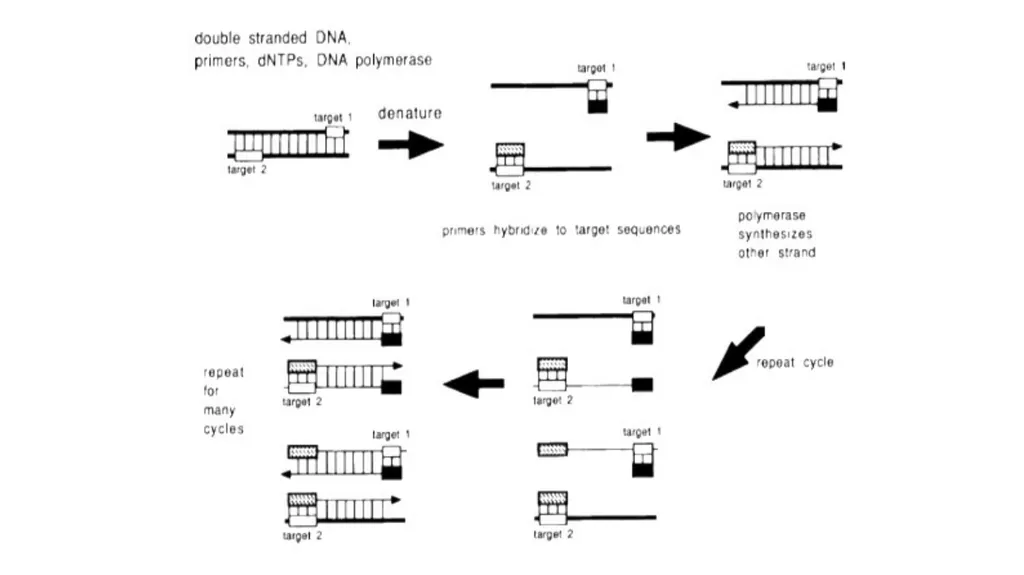
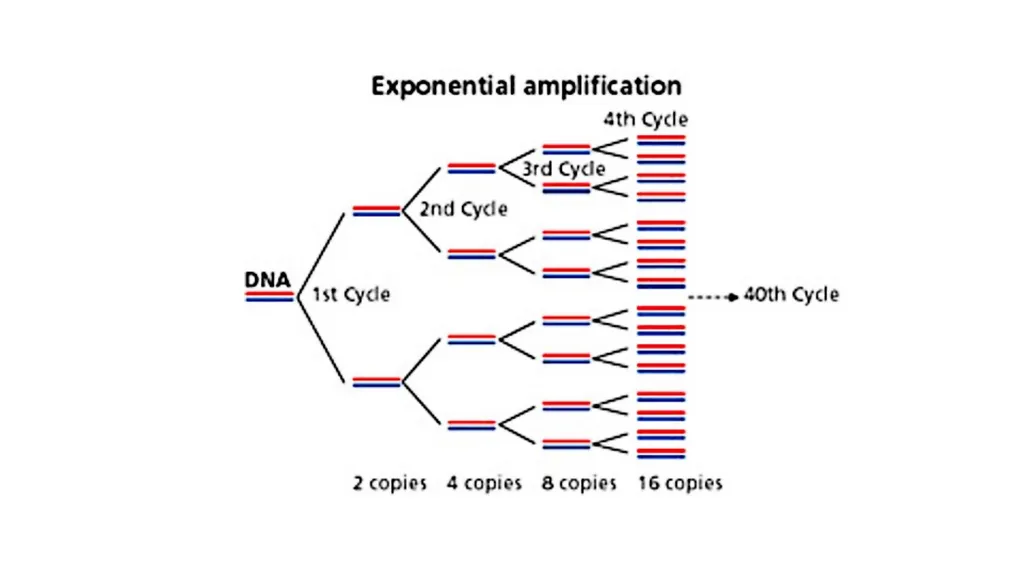
Polymerase Chain Termination Reaction (PCR)<br>
06
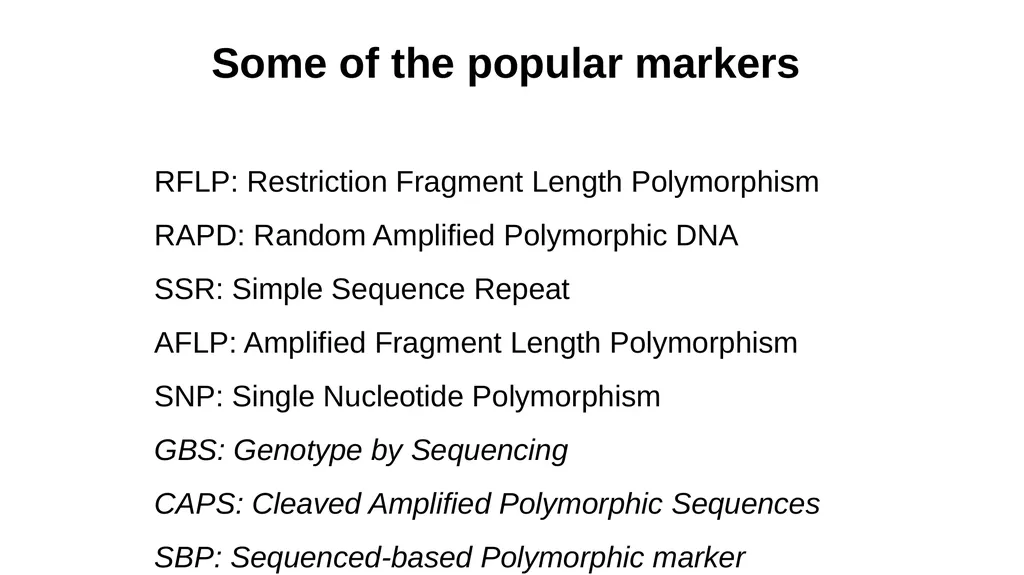
RFLP: Restriction Fragment Length Polymorphism
RAPD: Random Amplified Polymorphic DNA
SSR: Simple Sequence Repeat
AFLP: Amplified Fragment Length Polymorphism
SNP: Single Nucleotide Polymorphism
GBS: Genotype by Sequencing
CAPS: Cleaved Amplified Polymorphic Sequences
SBP: Sequenced-based Polymorphic marker Some of the popular markers<br>
RAPD: Random Amplified Polymorphic DNA
SSR: Simple Sequence Repeat
AFLP: Amplified Fragment Length Polymorphism
SNP: Single Nucleotide Polymorphism
GBS: Genotype by Sequencing
CAPS: Cleaved Amplified Polymorphic Sequences
SBP: Sequenced-based Polymorphic marker Some of the popular markers<br>
07
Restriction Fragment Length Polymorphism (RFLP)<br>
08
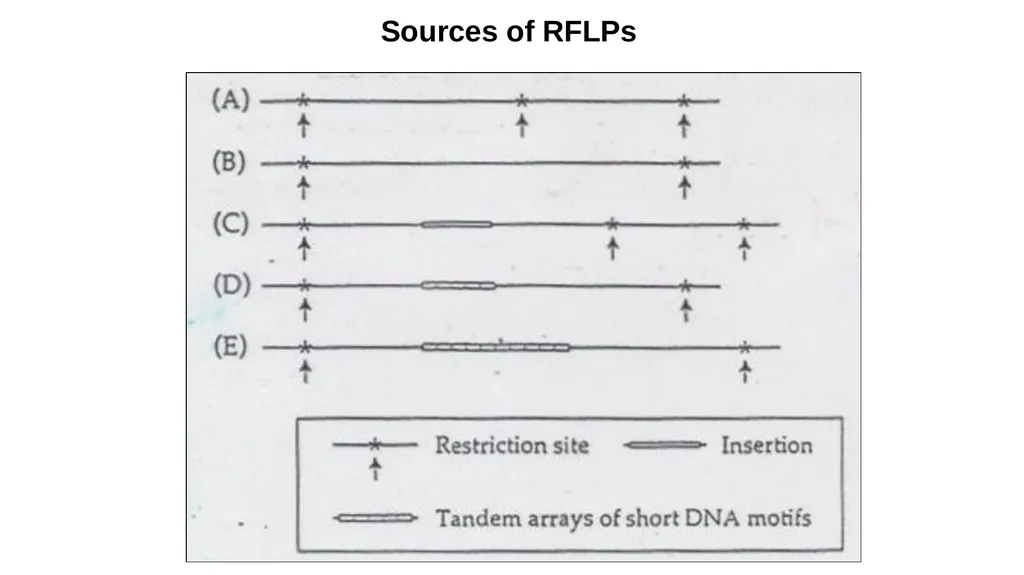
Sources of RFLPs<br>
09
RFLPs among three Arabidopsis ecotypes<br>
10
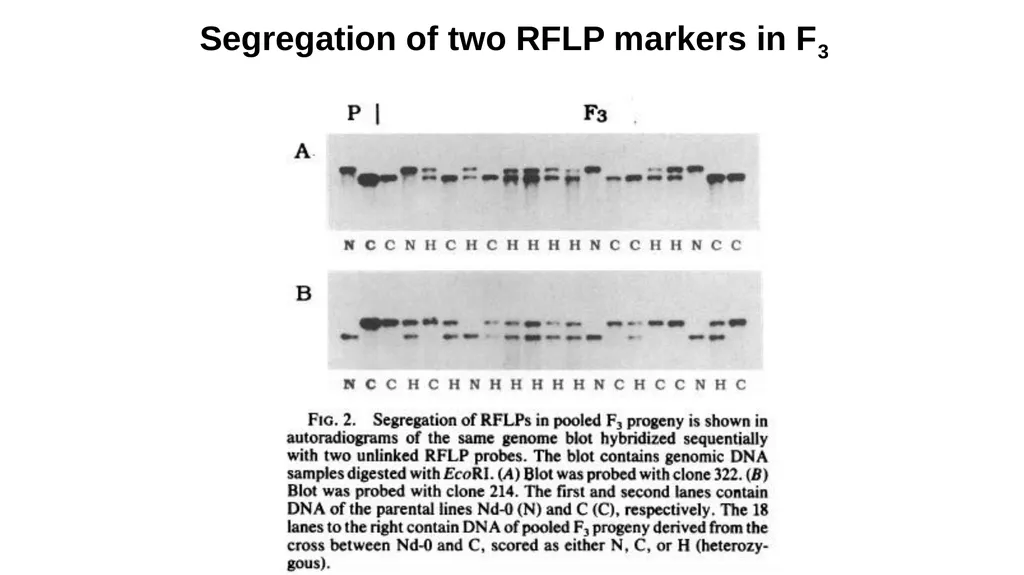
Segregation of two RFLP markers in F3<br>
11
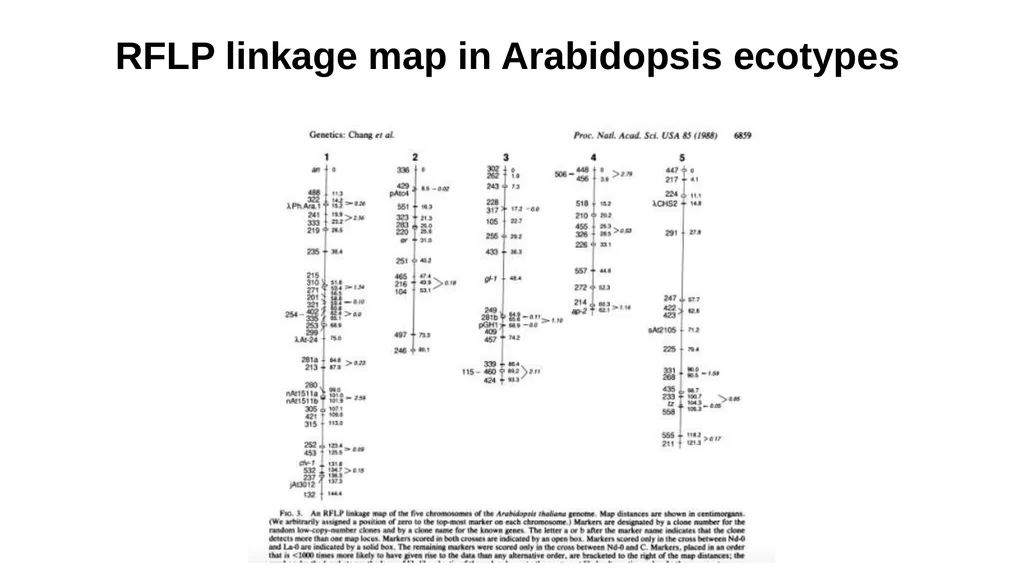
RFLP linkage map in Arabidopsis ecotypes<br>
12
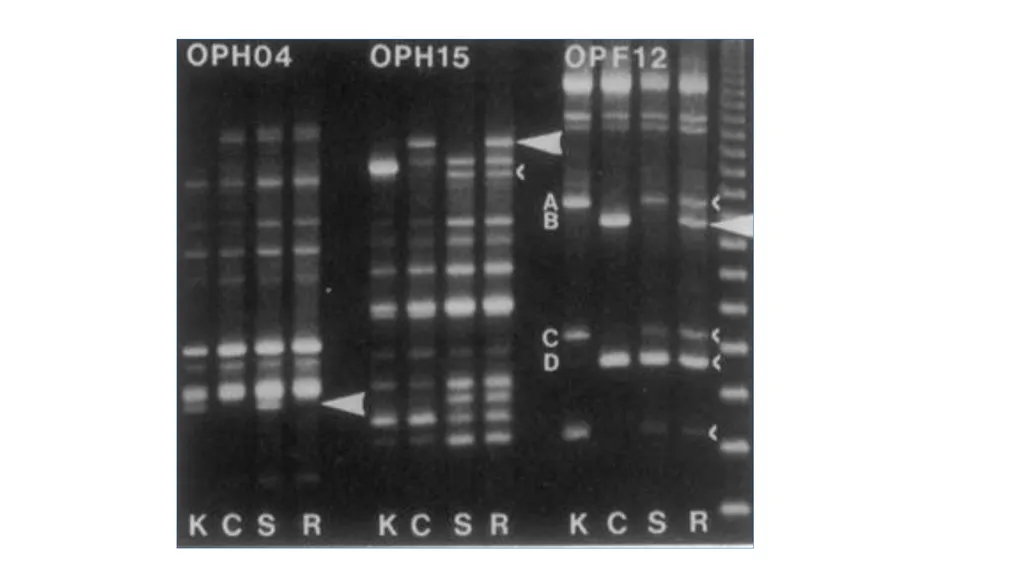
Random Amplified Polymorphic DNA (RAPD)<br>
13
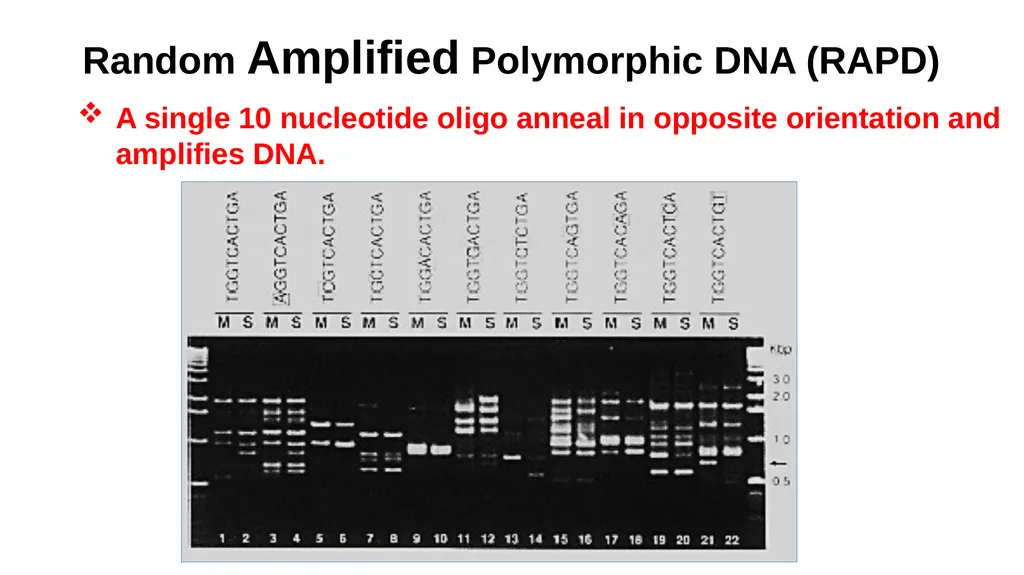
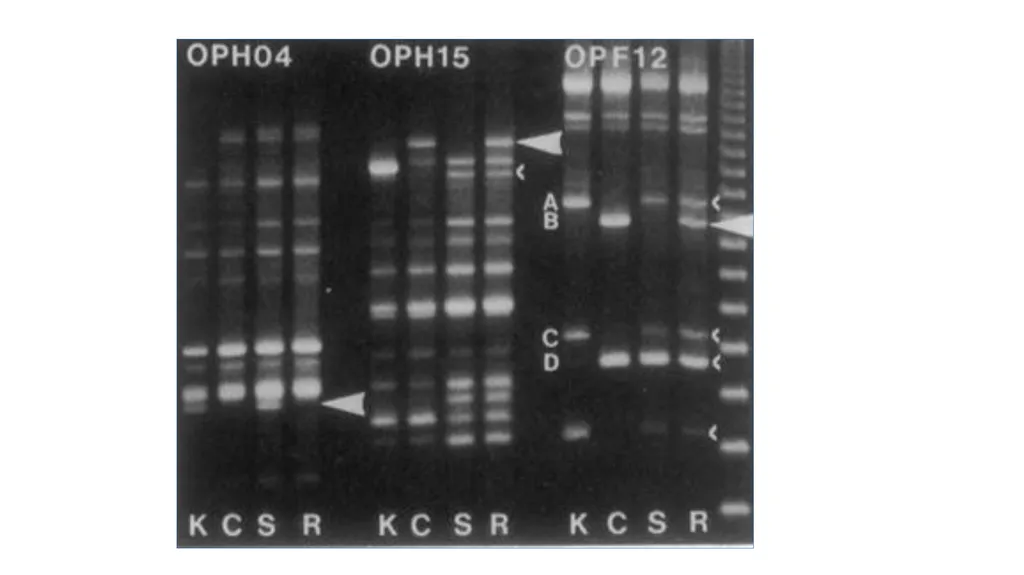
Random Amplified Polymorphic DNA (RAPD) A single 10 nucleotide oligo anneal in opposite orientation and amplifies DNA.<br>
14
Simple Sequence Repeat (SSR)<br>
15
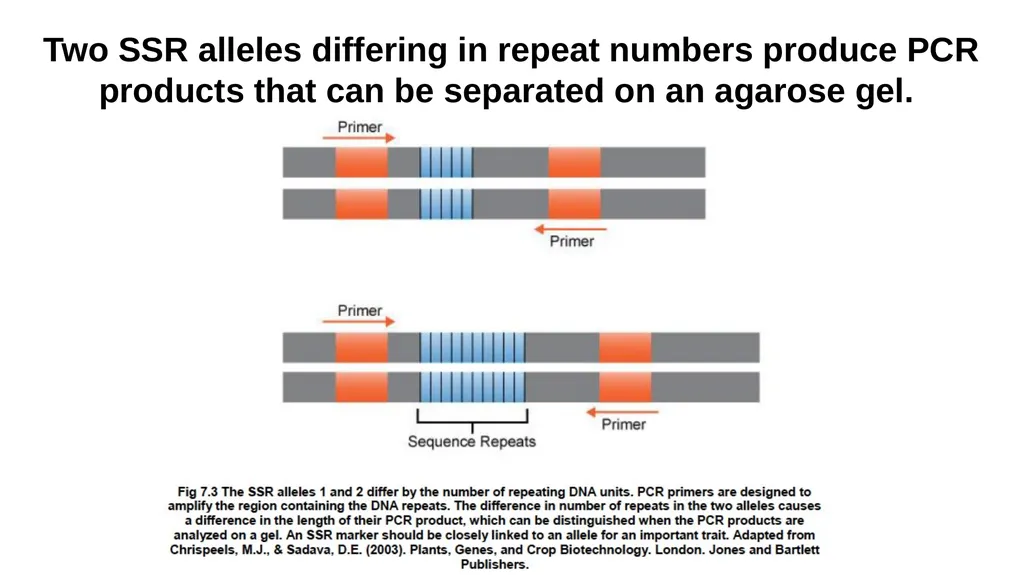
Two SSR alleles differing in repeat numbers produce PCR products that can be separated on an agarose gel.<br>
16
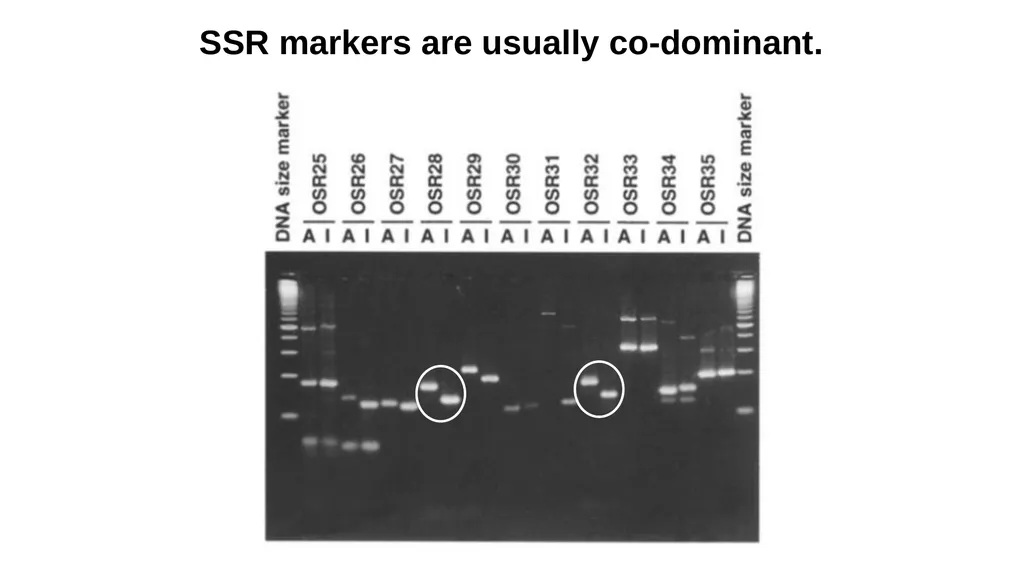
SSR markers are usually co-dominant.<br>
17
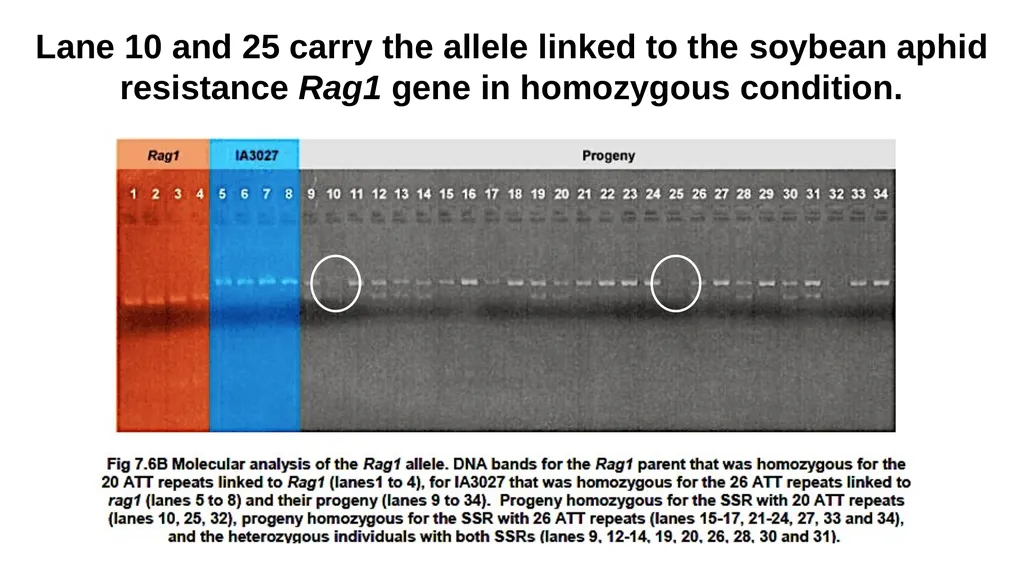
Lane 10 and 25 carry the allele linked to the soybean aphid resistance Rag1 gene in homozygous condition.<br>
18
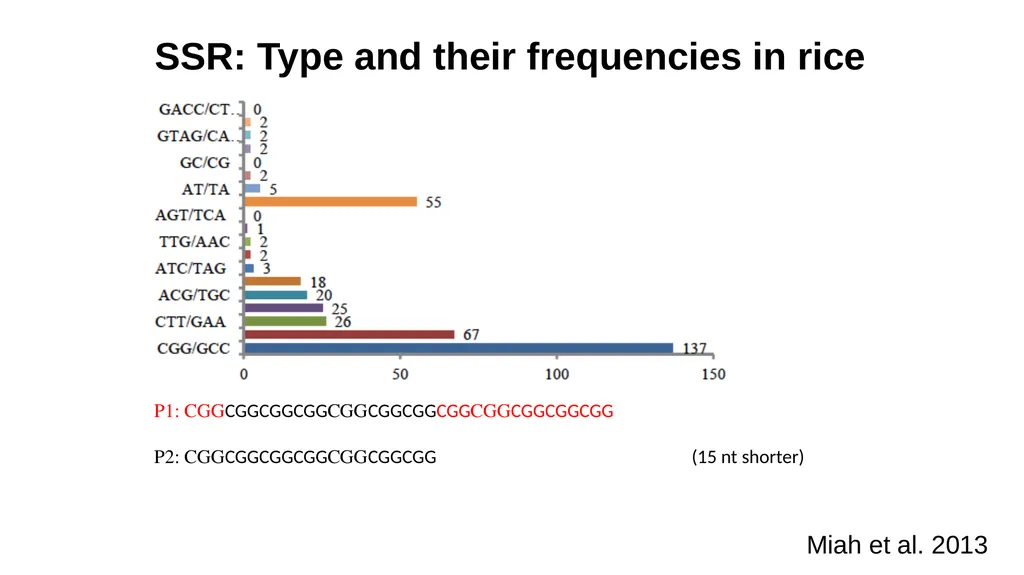
P1: CGGCGGCGGCGGCGGCGGCGGCGGCGGCGGCGGCGG
P2: CGGCGGCGGCGGCGGCGGCGG (15 nt shorter) SSR: Type and their frequencies in rice Miah et al. 2013<br>
P2: CGGCGGCGGCGGCGGCGGCGG (15 nt shorter) SSR: Type and their frequencies in rice Miah et al. 2013<br>
19
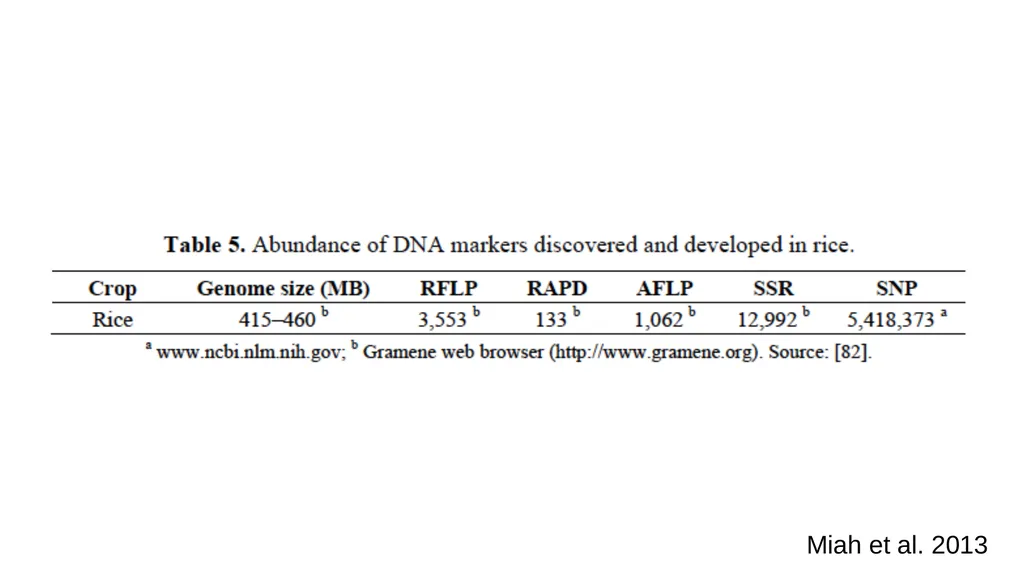
Miah et al. 2013<br>
20
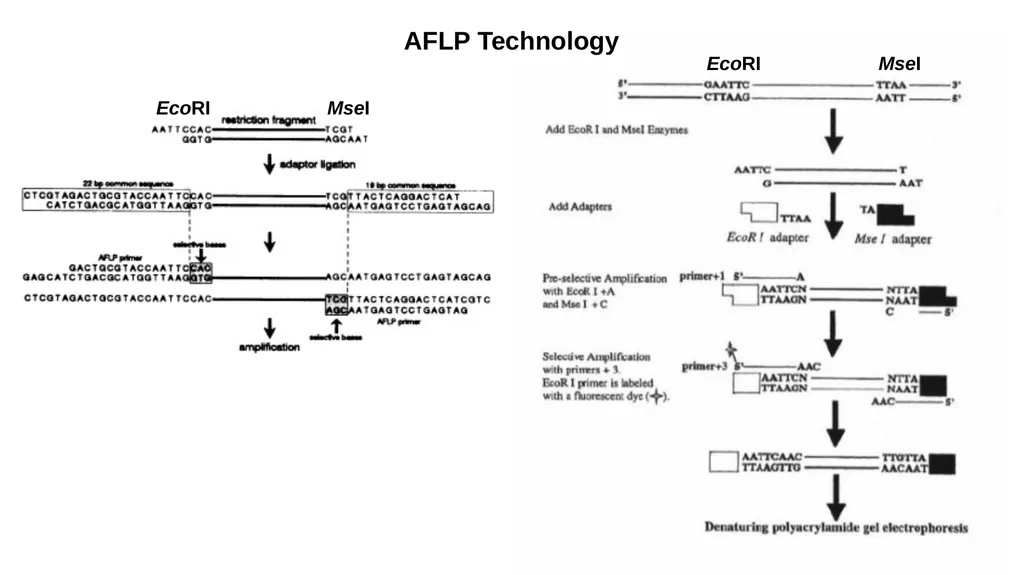
AFLP: Amplified Fragment Length Polymorphism<br>
21
AFLP Technology<br>
22
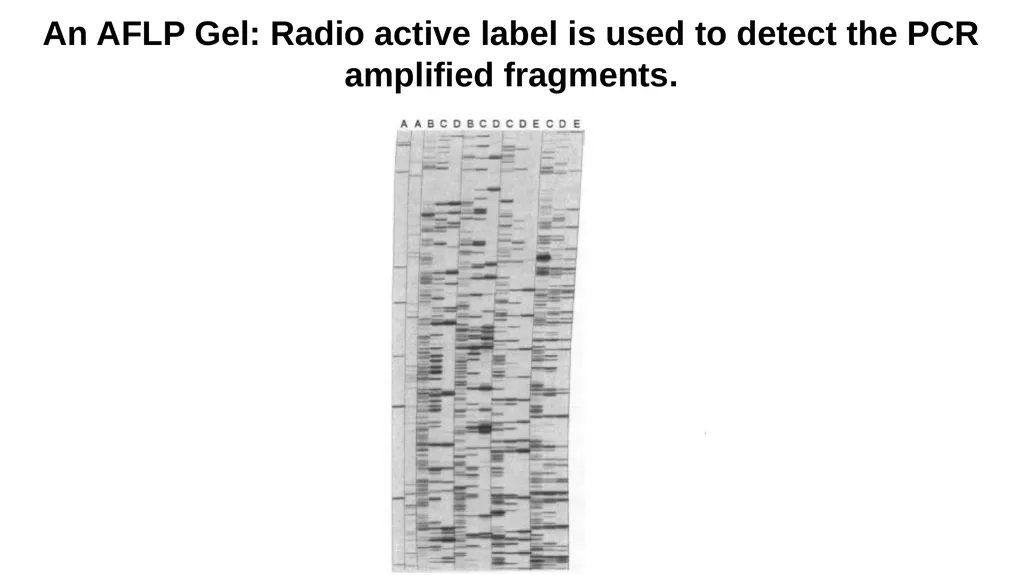
An AFLP Gel: Radio active label is used to detect the PCR amplified fragments.<br>
23
Single Nucleotide Polymorphism (SNP)<br>
24
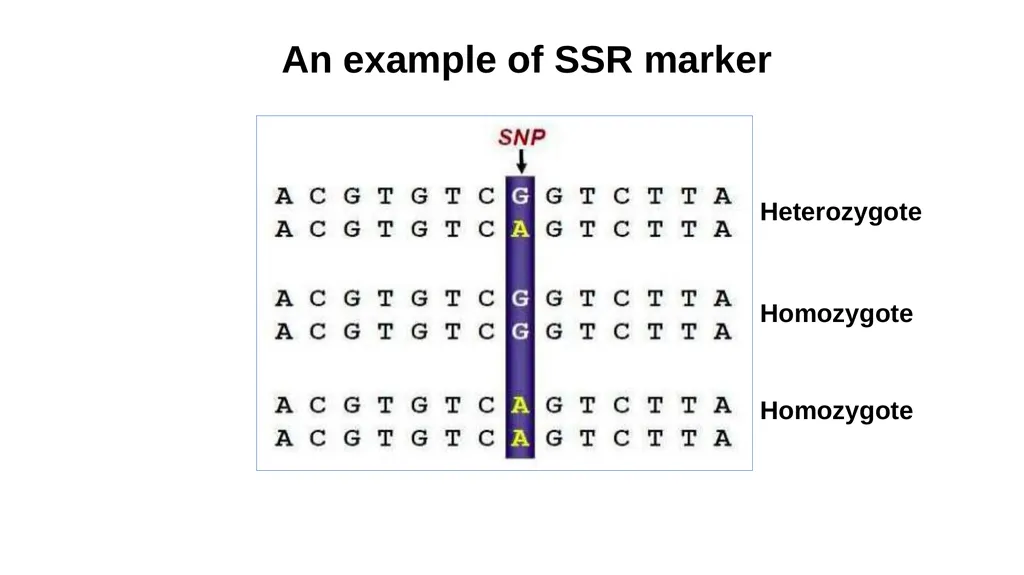
An example of SSR marker<br>
25
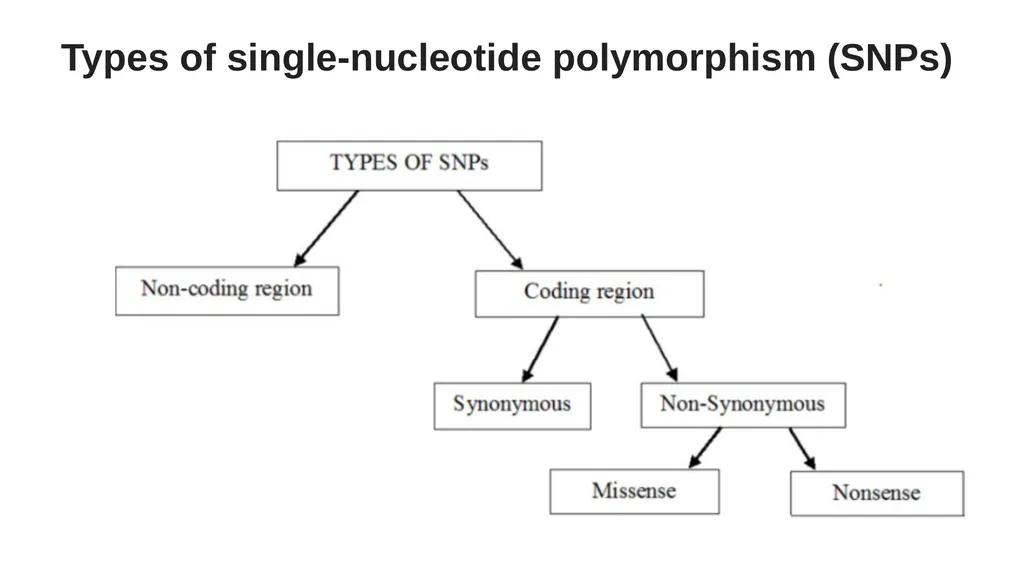
Types of single-nucleotide polymorphism (SNPs)<br>
26
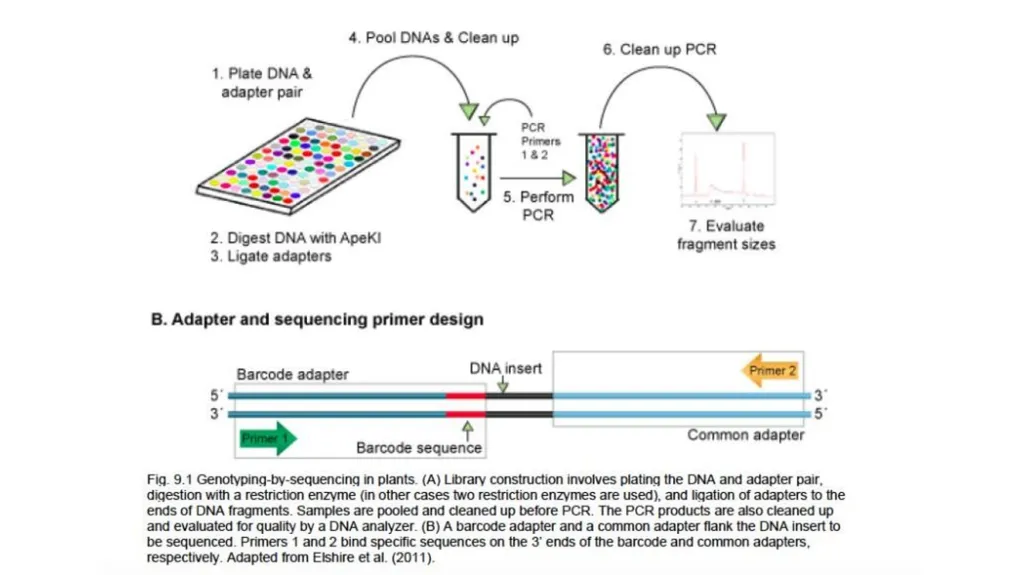
Genotype by Sequencing<br>
27
SBP: Sequenced-based Polymorphic marker<br>
28
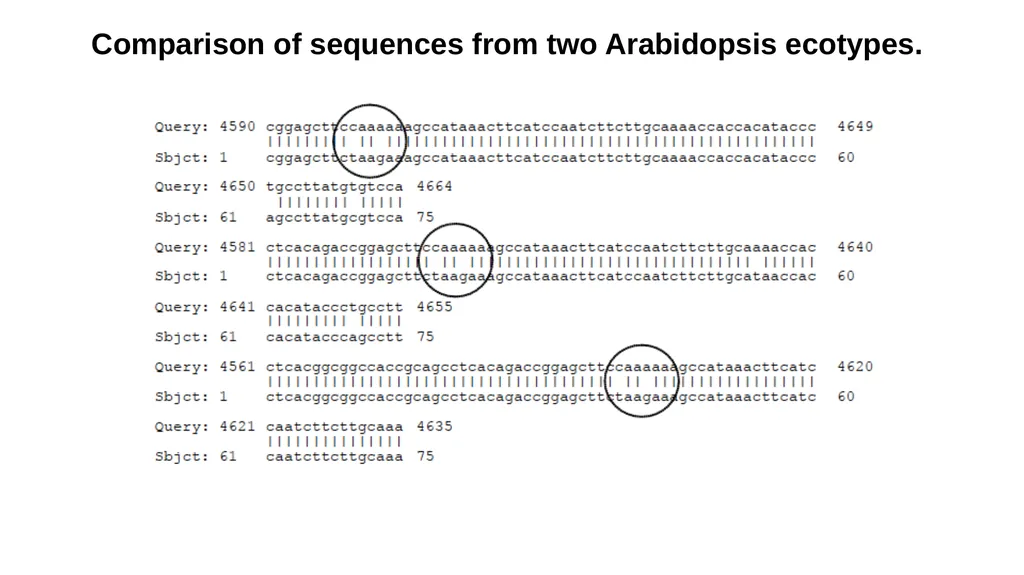
Comparison of sequences from two Arabidopsis ecotypes.<br>
29
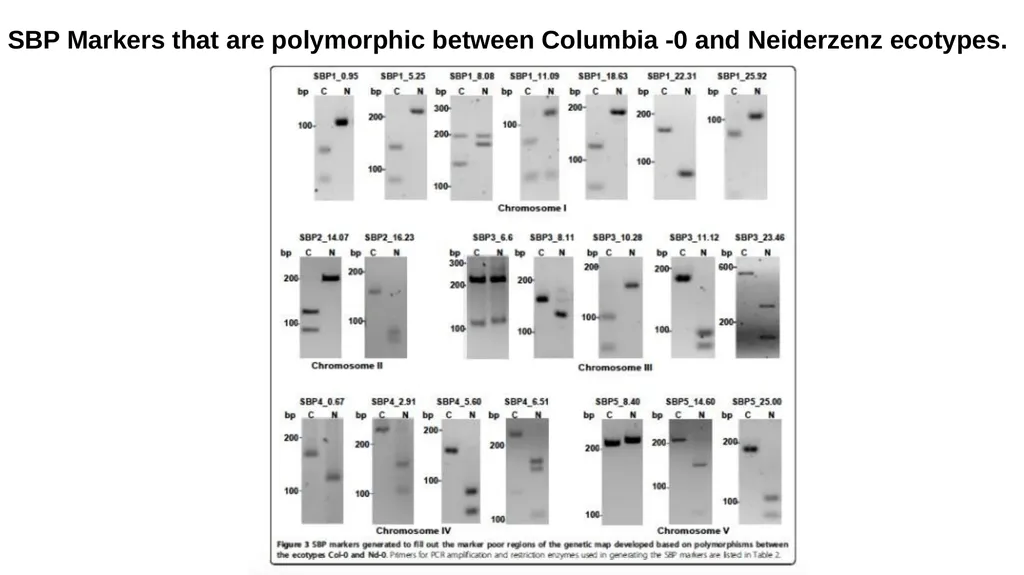
SBP Markers that are polymorphic between Columbia -0 and Neiderzenz ecotypes.<br>
30
Rapid Identification of Linked Molecular Markers<br>
31
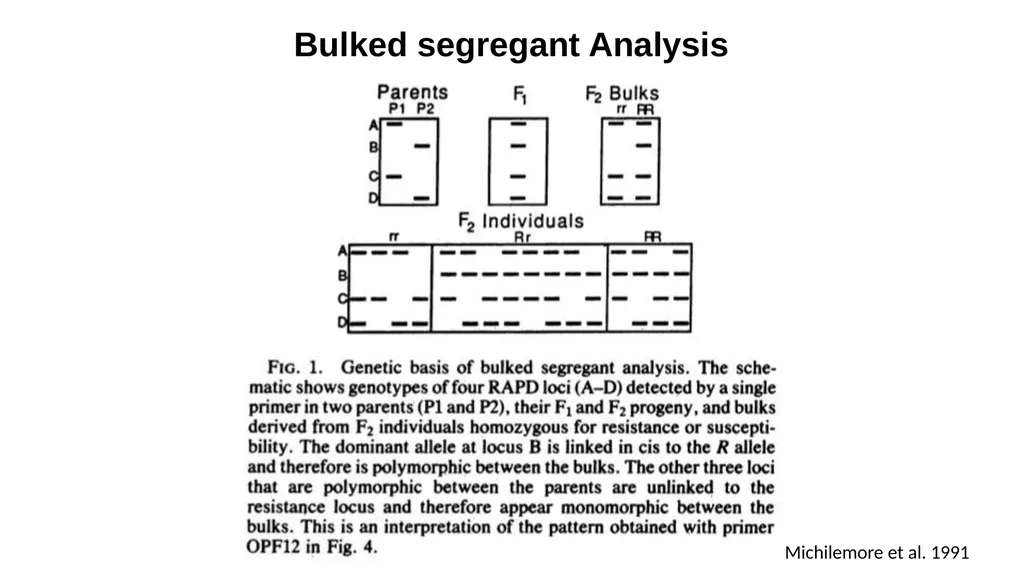
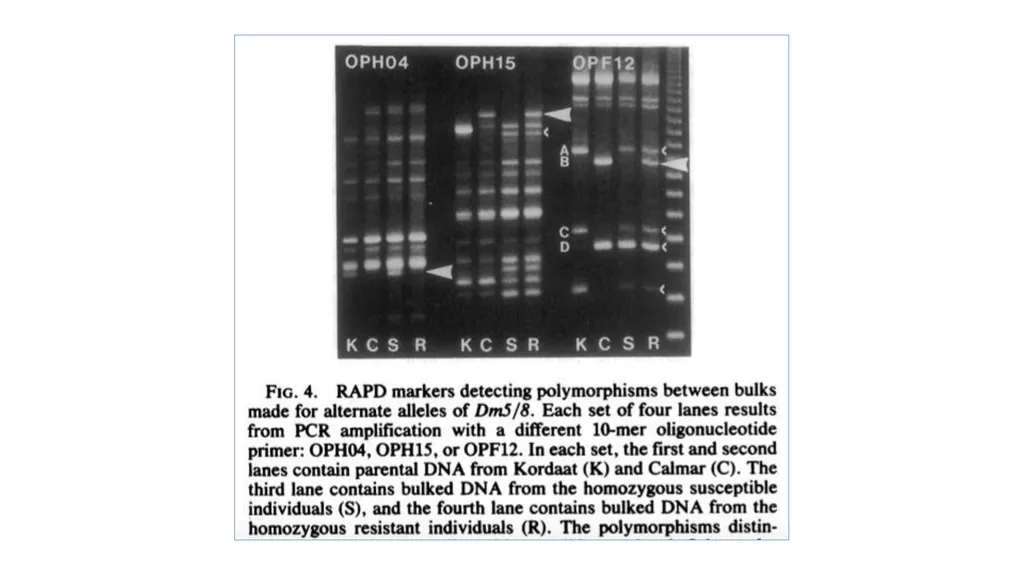
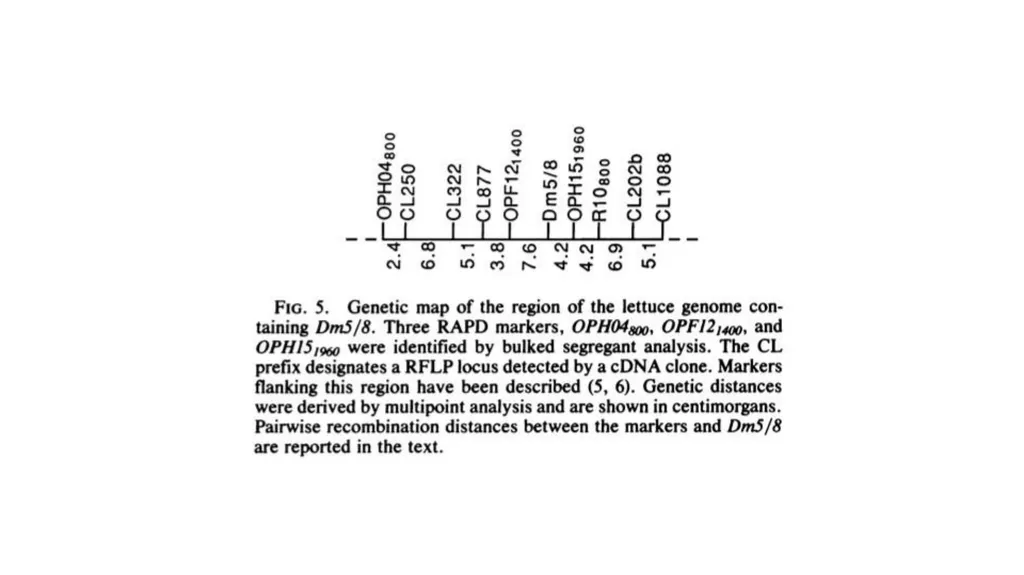
Bulked segregant Analysis Michilemore et al. 1991<br>
32
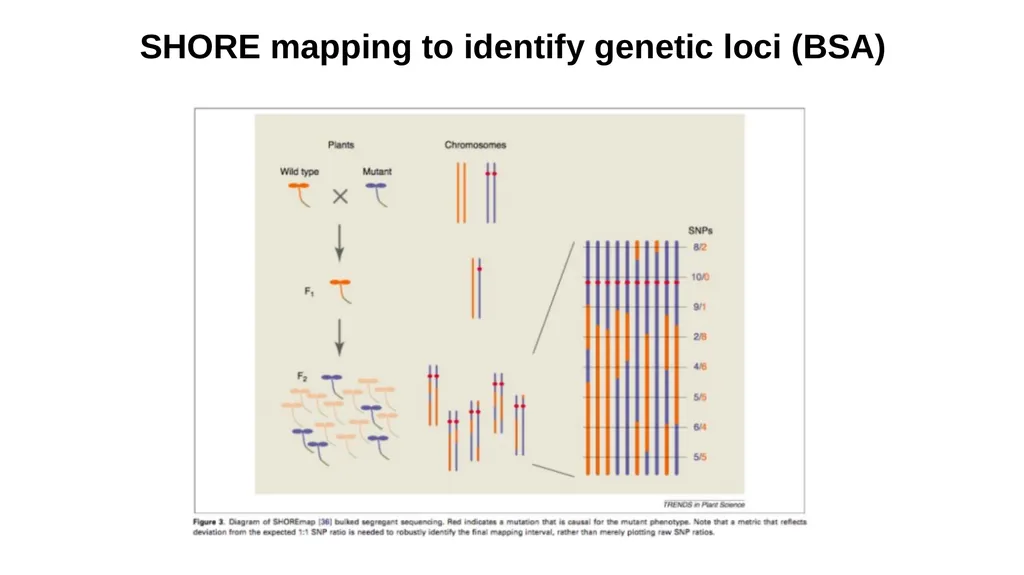
SHORE mapping to identify genetic loci (BSA)<br>
33
Molecular marker assisted selection<br>
34
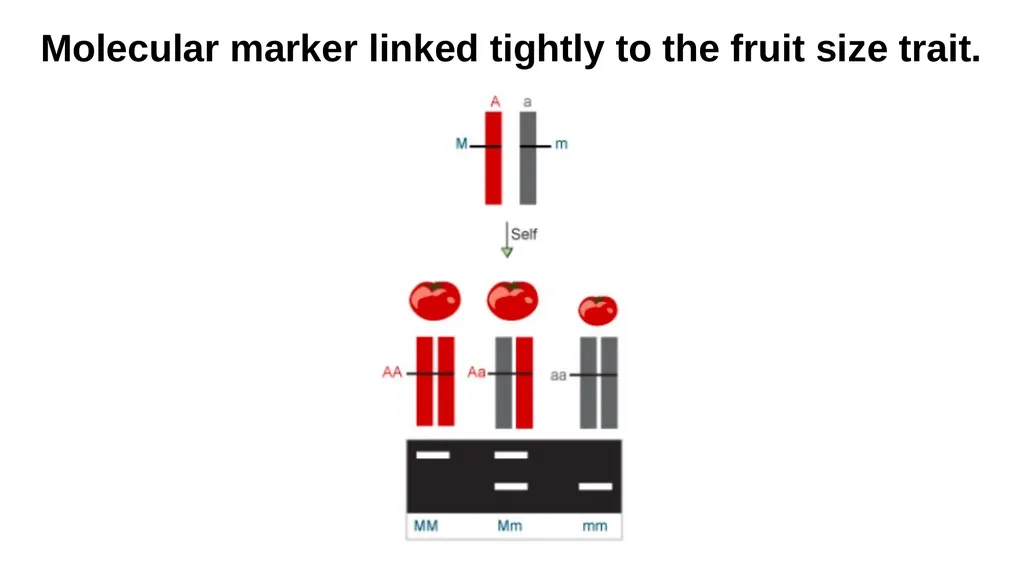
Molecular marker linked tightly to the fruit size trait.<br>
35
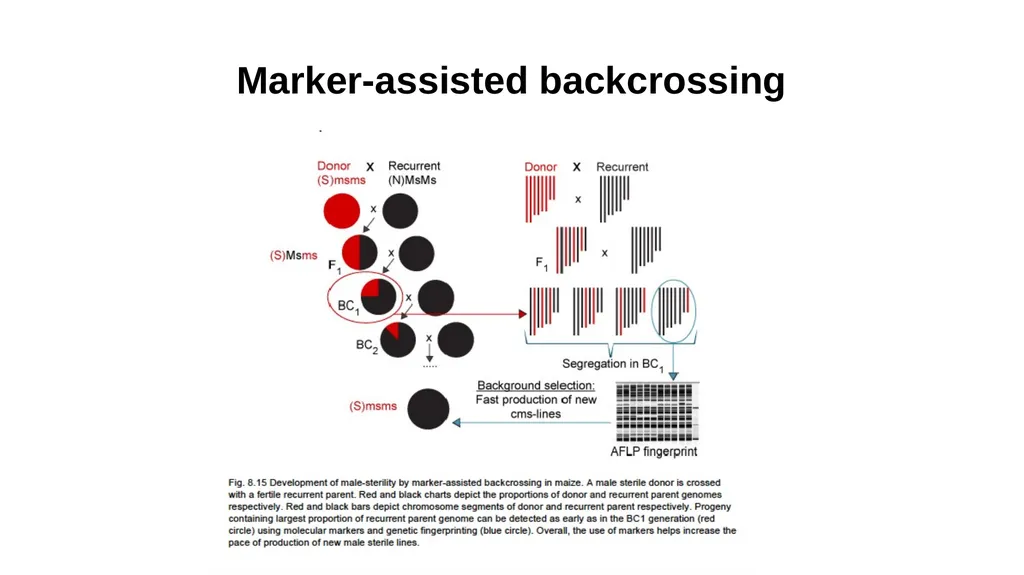
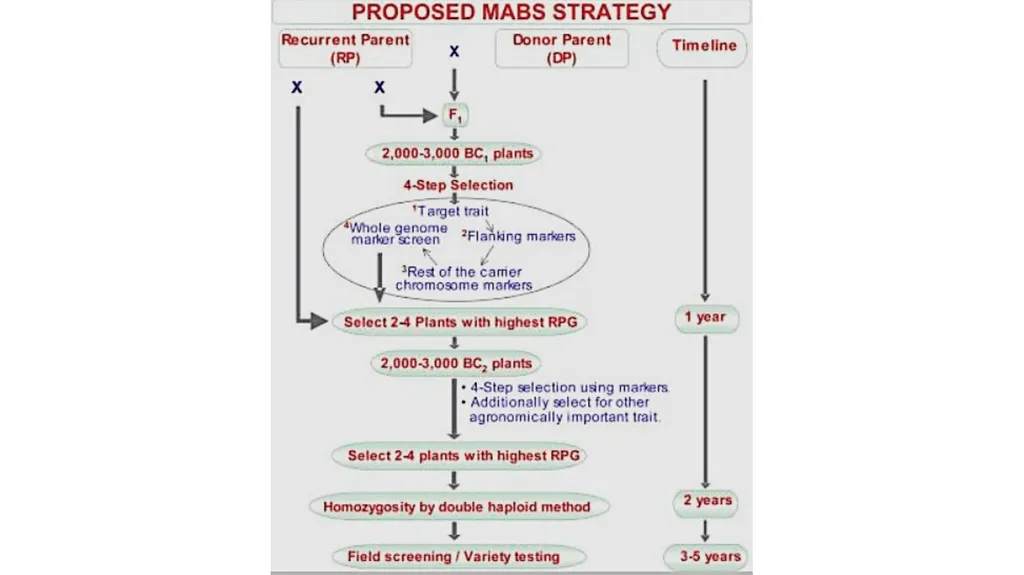
Marker-assisted backcrossing<br>
36
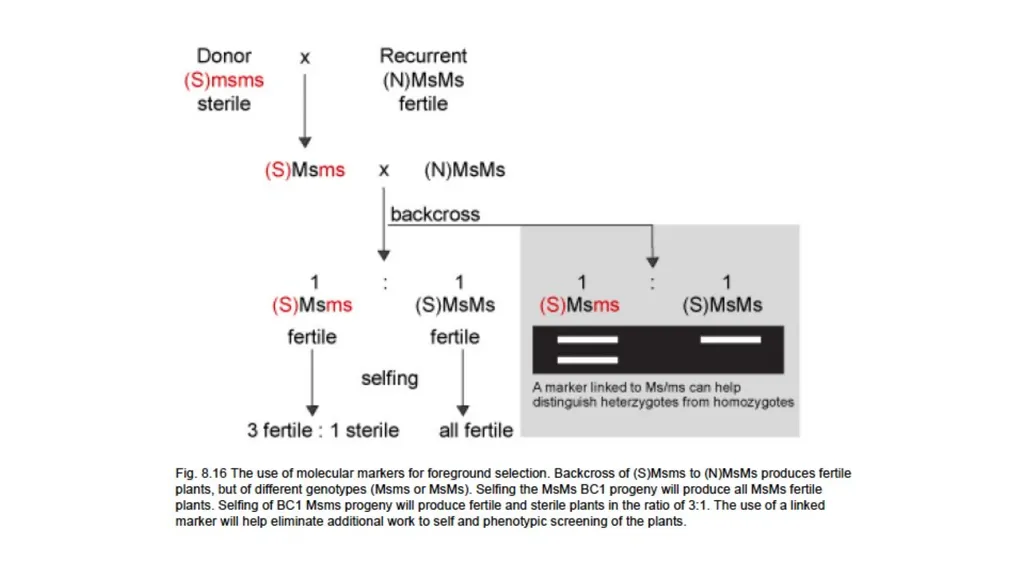
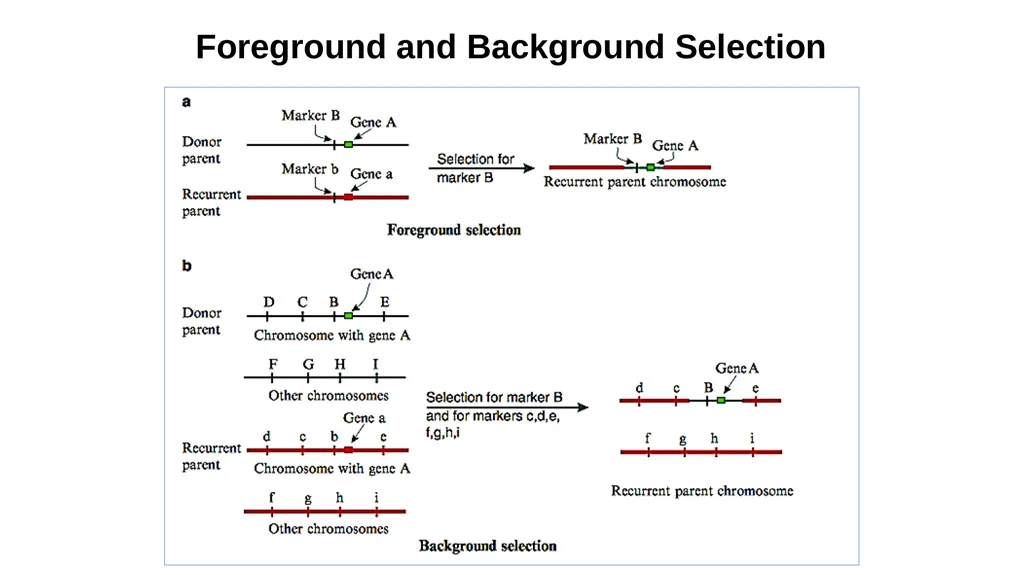
Foreground and Background Selection<br>
37
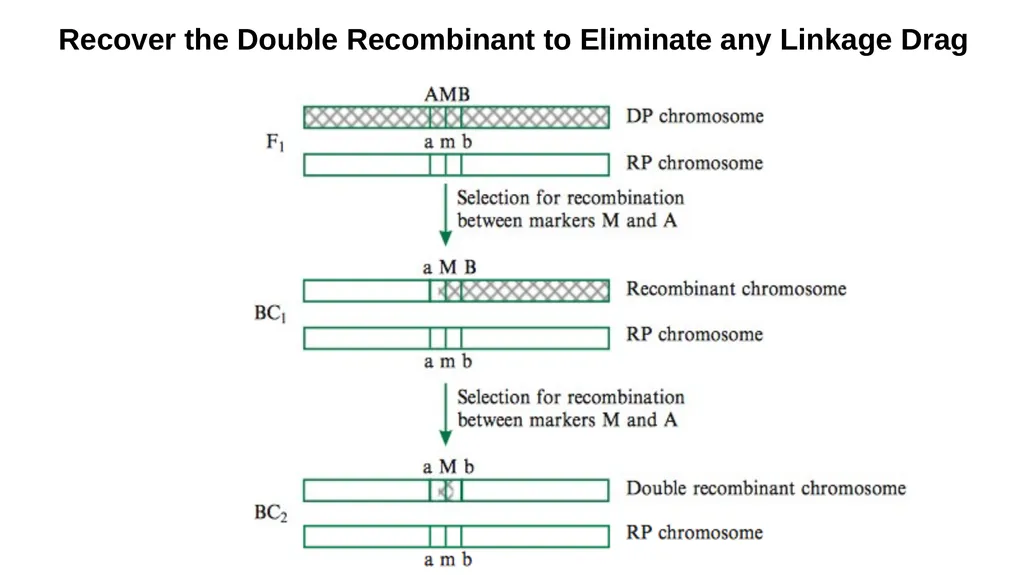
Recover the Double Recombinant to Eliminate any Linkage Drag<br>
38
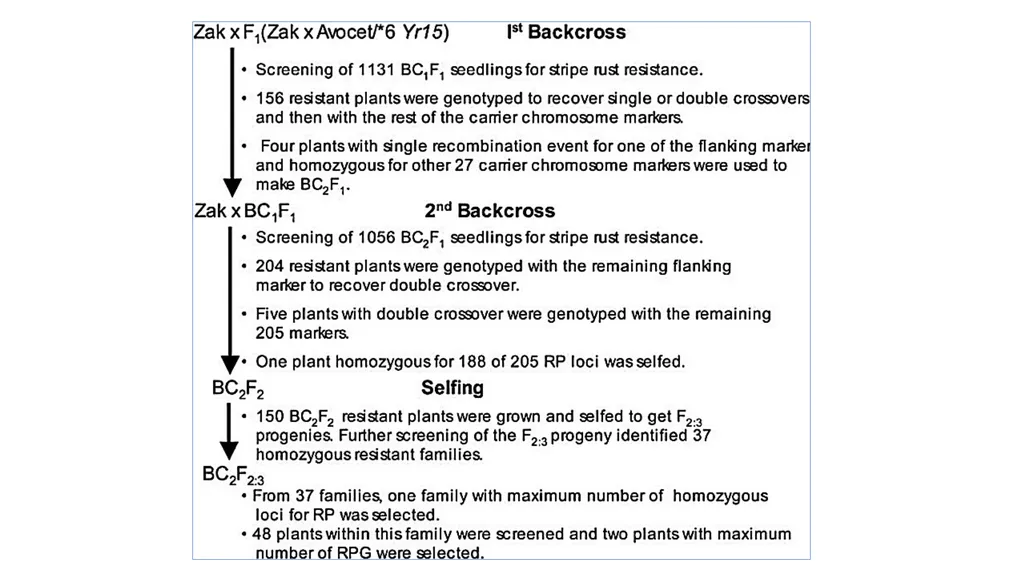
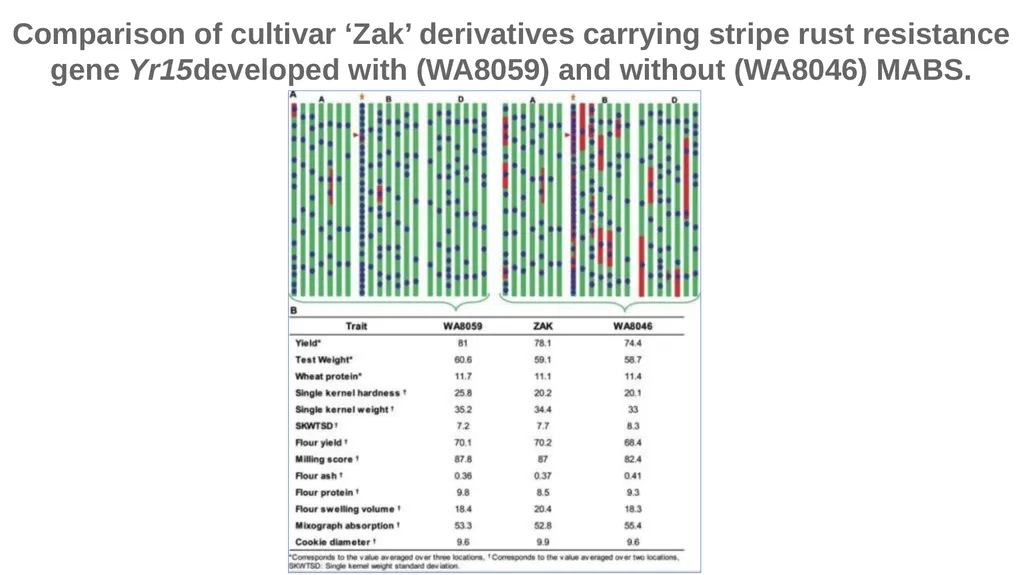
Comparison of cultivar ‘Zak’ derivatives carrying stripe rust resistance gene Yr15developed with (WA8059) and without (WA8046) MABS.<br>
39
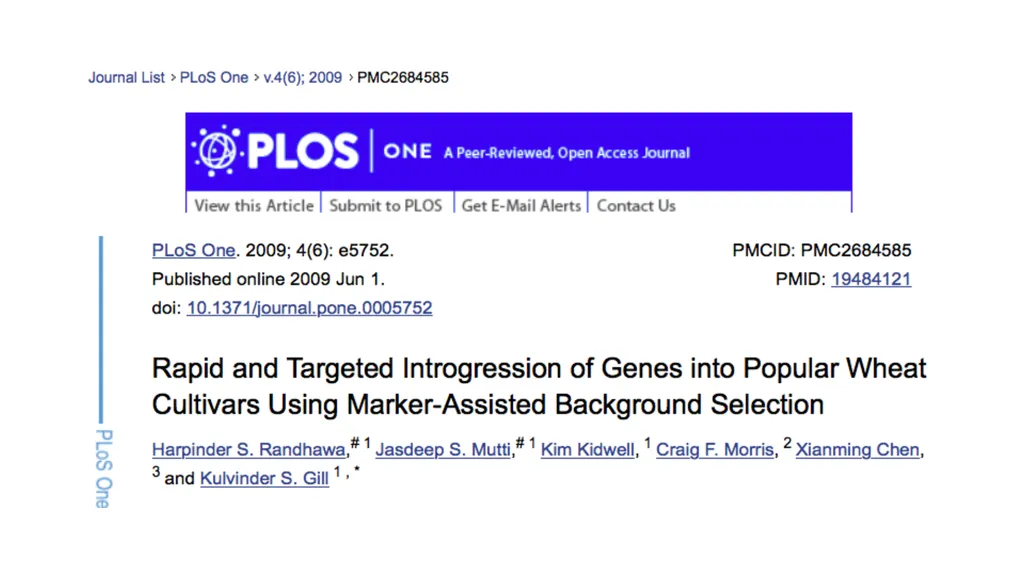
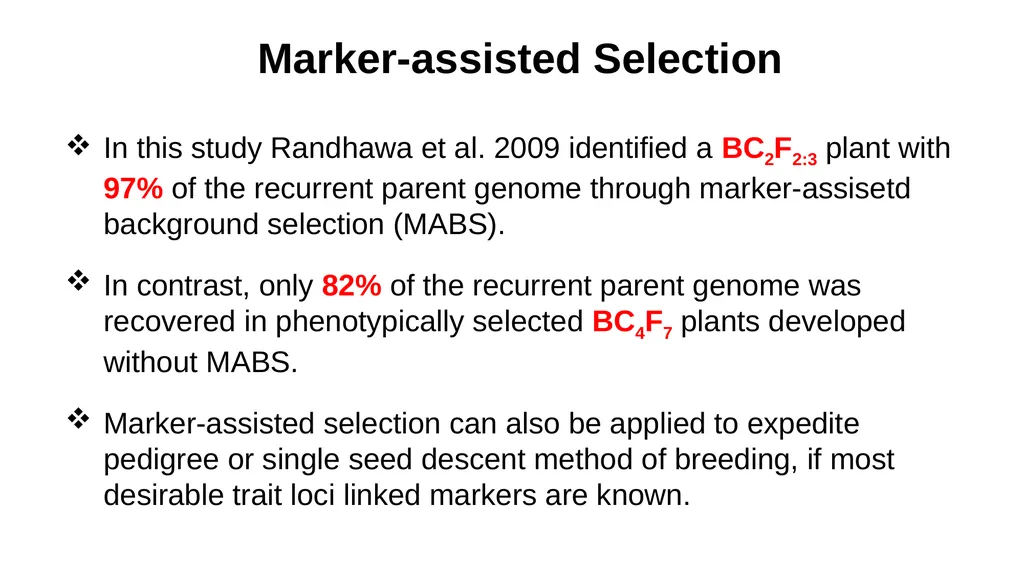
In this study Randhawa et al. 2009 identified a BC2F2:3 plant with 97% of the recurrent parent genome through marker-assisetd background selection (MABS).
In contrast, only 82% of the recurrent parent genome was recovered in phenotypically selected BC4F7 plants developed without MABS.
Marker-assisted selection can also be applied to expedite pedigree or single seed descent method of breeding, if most desirable trait loci linked markers are known. Marker-assisted Selection<br>
In contrast, only 82% of the recurrent parent genome was recovered in phenotypically selected BC4F7 plants developed without MABS.
Marker-assisted selection can also be applied to expedite pedigree or single seed descent method of breeding, if most desirable trait loci linked markers are known. Marker-assisted Selection<br>
40
Lecture 3: Recent Advances in Plant Breeding (February 19) Molecular Markers & Marker Assisted Selection
Speed Breeding
Doubled-haploid
TILLING Genome
CRISPR Cas9
Fixing Heterosis in Rice<br>
Speed Breeding
Doubled-haploid
TILLING Genome
CRISPR Cas9
Fixing Heterosis in Rice<br>
41
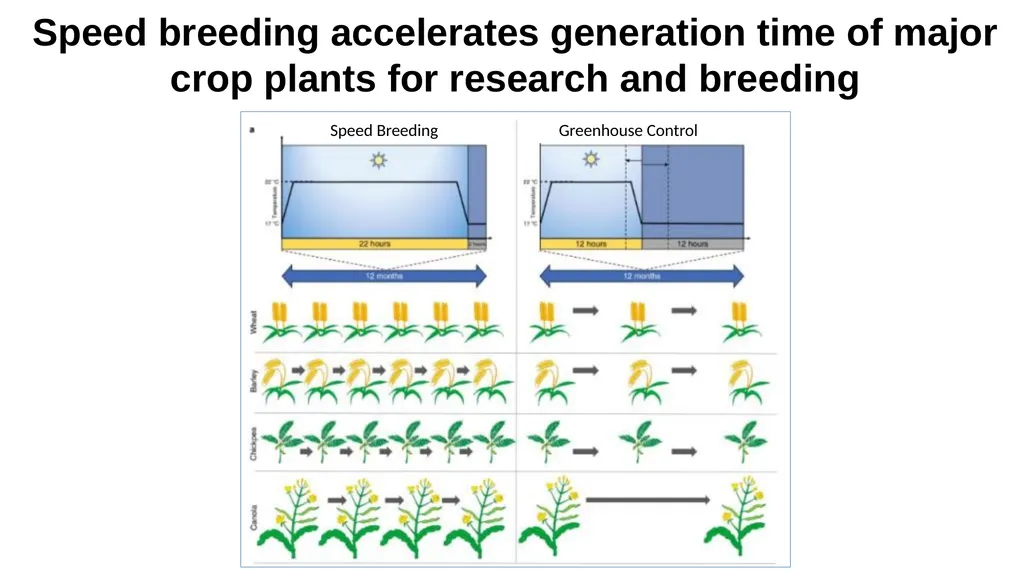
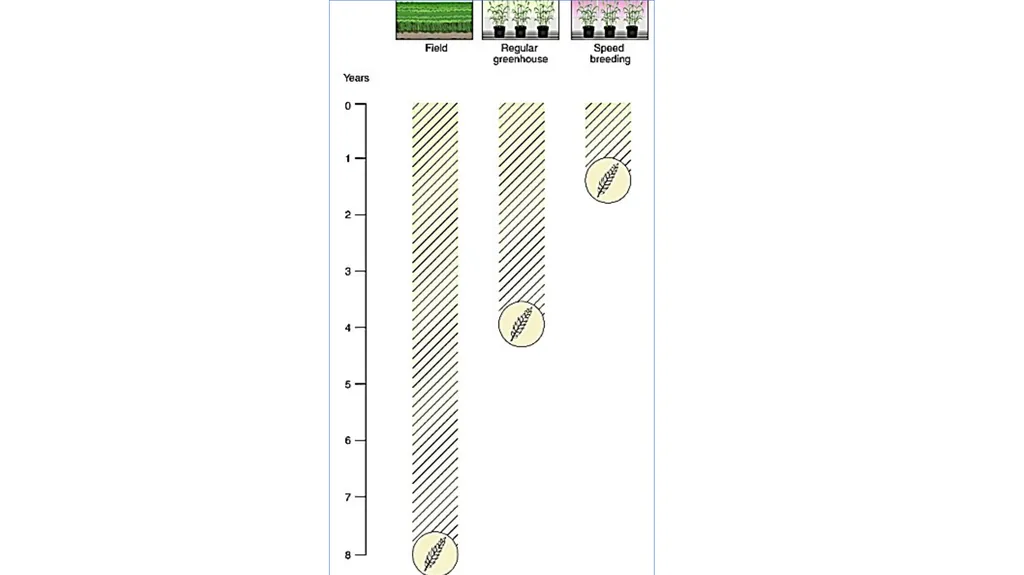
Speed breeding accelerates generation time of major crop plants for research and breeding Speed Breeding Greenhouse Control<br>
42
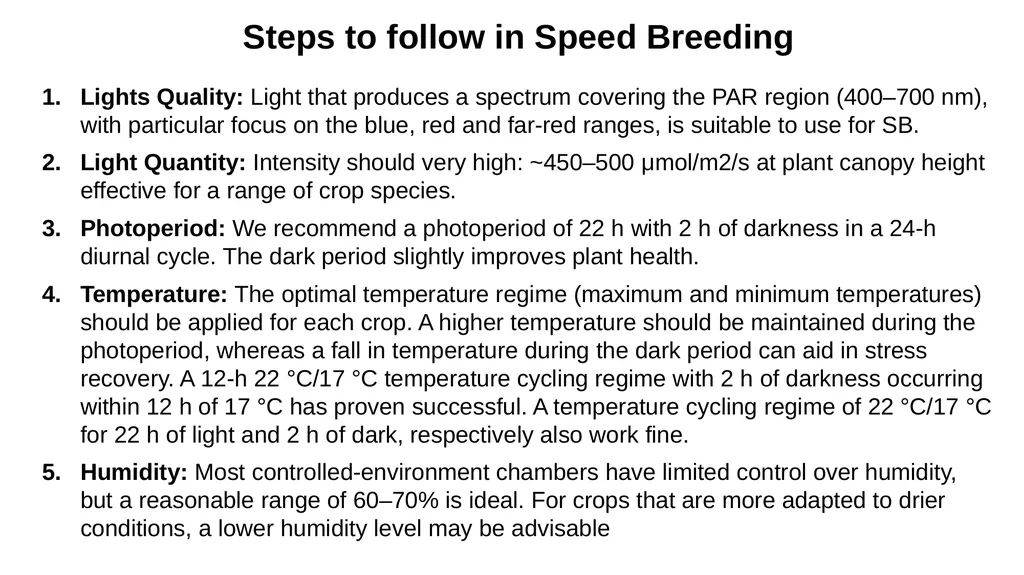
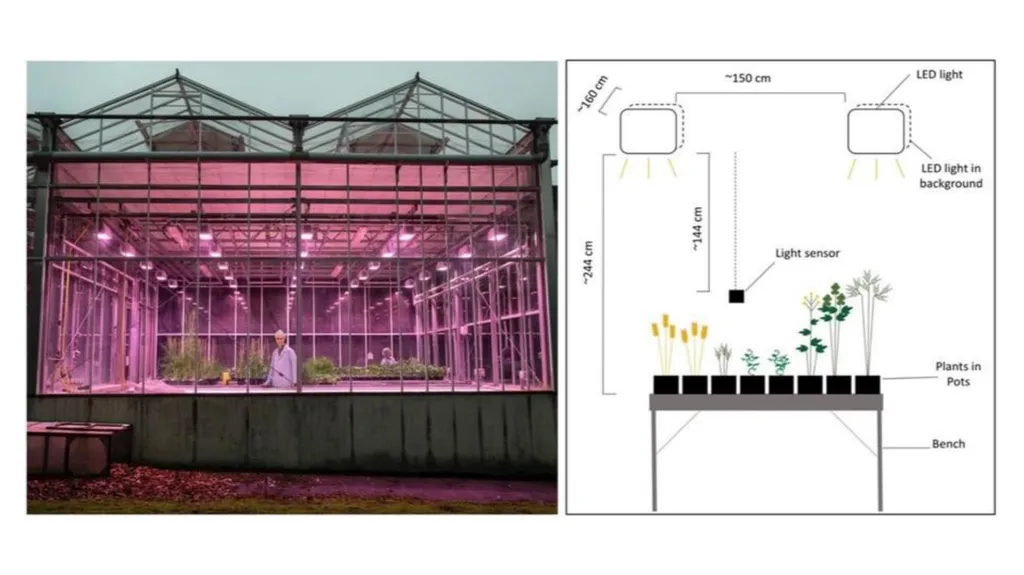
Lights Quality: Light that produces a spectrum covering the PAR region (400–700 nm), with particular focus on the blue, red and far-red ranges, is suitable to use for SB.
Light Quantity: Intensity should very high: ~450–500 μmol/m2/s at plant canopy height effective for a range of crop species.
Photoperiod: We recommend a photoperiod of 22 h with 2 h of darkness in a 24-h diurnal cycle. The dark period slightly improves plant health.
Temperature: The optimal temperature regime (maximum and minimum temperatures) should be applied for each crop. A higher temperature should be maintained during the photoperiod, whereas a fall in temperature during the dark period can aid in stress recovery. A 12-h 22 °C/17 °C temperature cycling regime with 2 h of darkness occurring within 12 h of 17 °C has proven successful. A temperature cycling regime of 22 °C/17 °C for 22 h of light and 2 h of dark, respectively also work fine.
Humidity: Most controlled-environment chambers have limited control over humidity, but a reasonable range of 60–70% is ideal. For crops that are more adapted to drier conditions, a lower humidity level may be advisable Steps to follow in Speed Breeding<br>
Light Quantity: Intensity should very high: ~450–500 μmol/m2/s at plant canopy height effective for a range of crop species.
Photoperiod: We recommend a photoperiod of 22 h with 2 h of darkness in a 24-h diurnal cycle. The dark period slightly improves plant health.
Temperature: The optimal temperature regime (maximum and minimum temperatures) should be applied for each crop. A higher temperature should be maintained during the photoperiod, whereas a fall in temperature during the dark period can aid in stress recovery. A 12-h 22 °C/17 °C temperature cycling regime with 2 h of darkness occurring within 12 h of 17 °C has proven successful. A temperature cycling regime of 22 °C/17 °C for 22 h of light and 2 h of dark, respectively also work fine.
Humidity: Most controlled-environment chambers have limited control over humidity, but a reasonable range of 60–70% is ideal. For crops that are more adapted to drier conditions, a lower humidity level may be advisable Steps to follow in Speed Breeding<br>
43
Harvesting of immature spikes and drying them in an oven/dehydrator saves 12 days (3 vs. 15 days) ~ 3 Days ~ 15 Days<br>
44
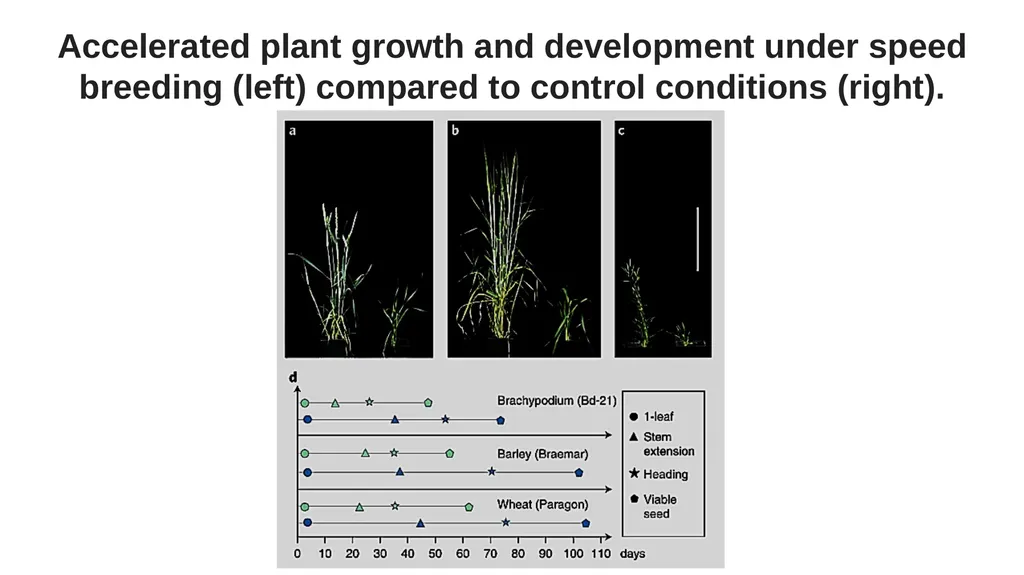
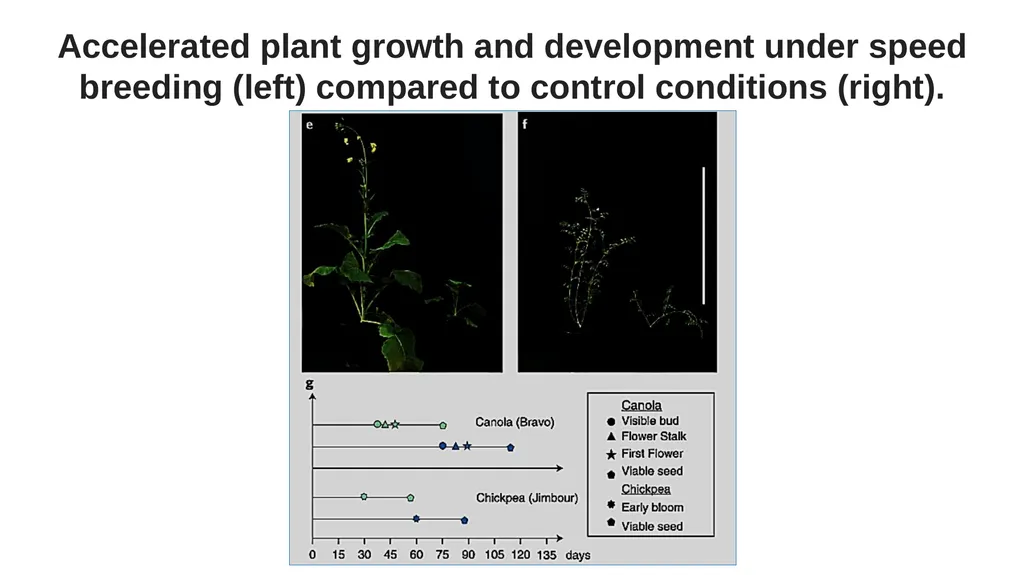
Accelerated plant growth and development under speed breeding (left) compared to control conditions (right).<br>
45
Accelerated plant growth and development under speed breeding (left) compared to control conditions (right).<br>
46
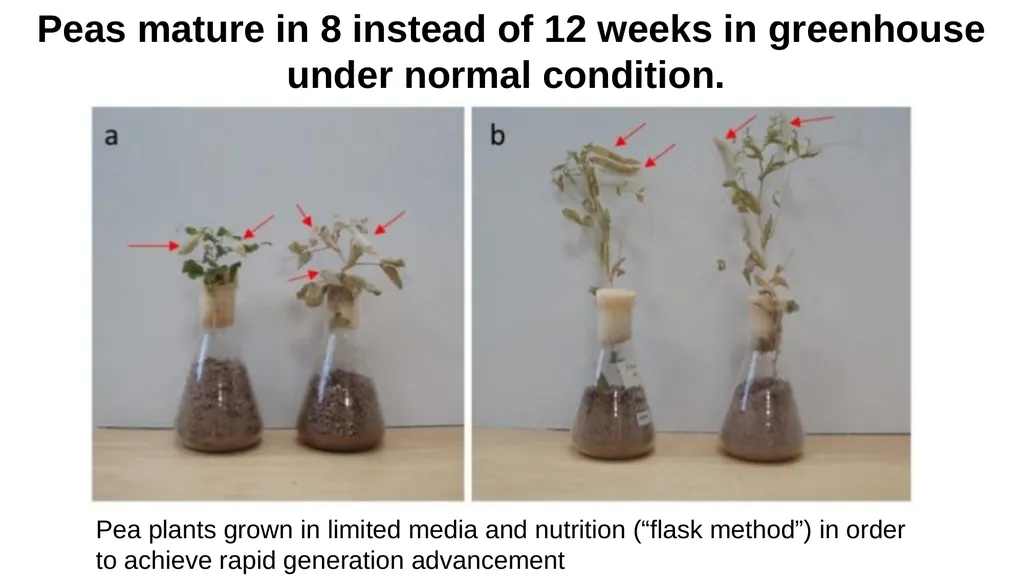
Peas mature in 8 instead of 12 weeks in greenhouse under normal condition. Pea plants grown in limited media and nutrition (“flask method”) in order to achieve rapid generation advancement<br>
47
Pods harvested from Brassica napus RV31 grown in LED-supplemented glasshouses at the John Innes Centre, UK. 22-hour photoperiod 16-hour photoperiod<br>
48
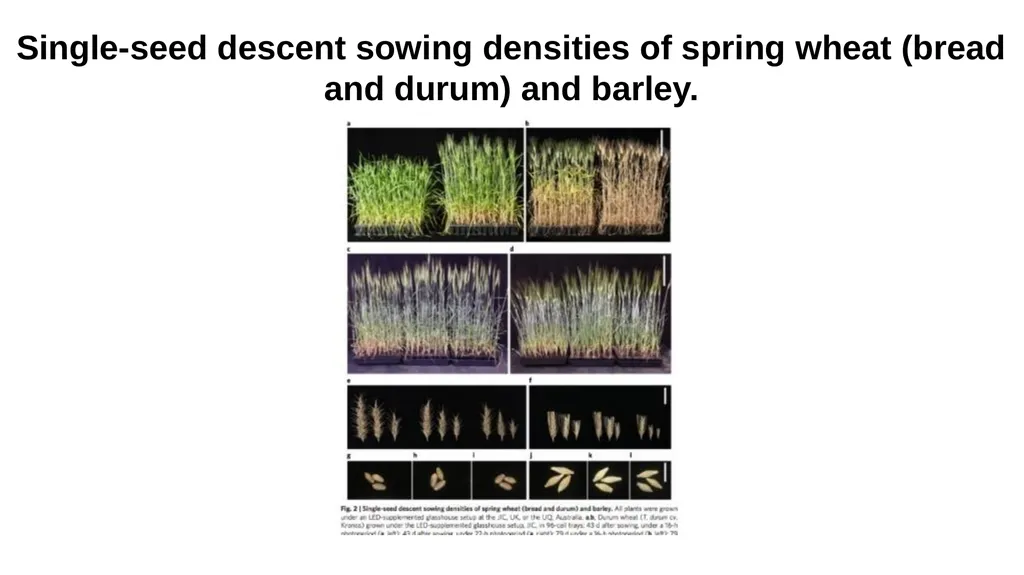
Fig. 2 | Single-seed descent sowing densities of spring wheat (bread and durum) and barley. All plants were grown under an LED-supplemented glasshouse setup at the JIC, UK, or the UQ, Australia. a,b, Durum wheat (T. durum cv. Kronos) grown under the LED-supplemented glasshouse setup, JIC, in 96-cell trays: 43 d after sowing, under a 16-h photoperiod (a, left); 43 d after sowing, under 22-h photoperiod (a, right); 79 d under a 16-h photoperiod (b, left); 79 d under a 22-h photoperiod (b, right). Scale bar, 20 cm (applies to a,b). c, Spring wheat (T. aestivum cv. Suntop) grown under an LED-supplemented glasshouse setup, at the UQ, at 37 d after sowing: plants in a 30-cell tray (left); plants in a 64-cell tray (center); plants in a 100-cell tray (right). d, Barley (H. vulgare cv. Commander) grown under an LED-supplemented glasshouse setup, at the UQ, at 34 d after sowing: plants in a 30-cell tray (left); plants in a 64-cell tray (center); plants in a 100-cell tray (right). Scale bar, 20 cm (applies to c,d). e, Mature spikes of spring wheat (T. aestivum cv. Suntop) grown under LED-supplemented glasshouse setup, at the UQ: spikes from plants in a 30-cell tray (e, left); spikes from plants in a 64-cell tray (e, center); spikes from plants in a 100-cell tray (e, right). f, Mature spikes of barley (H. vulgare cv. Commander) grown under an LED-supplemented glasshouse setup, at the UQ: spikes from plants in a 30-cell tray (f, left); spikes from plants in a 64-cell tray (f, center); spikes from plants in a 100-cell tray (f, right). Scale bar, 3 cm (applies to e,f). g–i, Mature seeds of spring wheat (T. aestivum cv. Suntop) grown under an LED-supplemented glasshouse setup, at the UQ: seeds from plants in a 30-cell tray (g); seeds from plants in a 64-cell tray (h); seeds from plants in a 100-cell tray (i). j–l, Mature seeds of barley (H. vulgare cv. Commander) grown under an LED-supplemented glasshouse setup, at the UQ: seeds from plants in a 30-cell tray (j); seeds from plants in a 64-cell tray (k); seeds from plants in a 100-cell tray (l). Scale bar, 1 cm (applies to g–l). Single-seed descent sowing densities of spring wheat (bread and durum) and barley.<br>
49
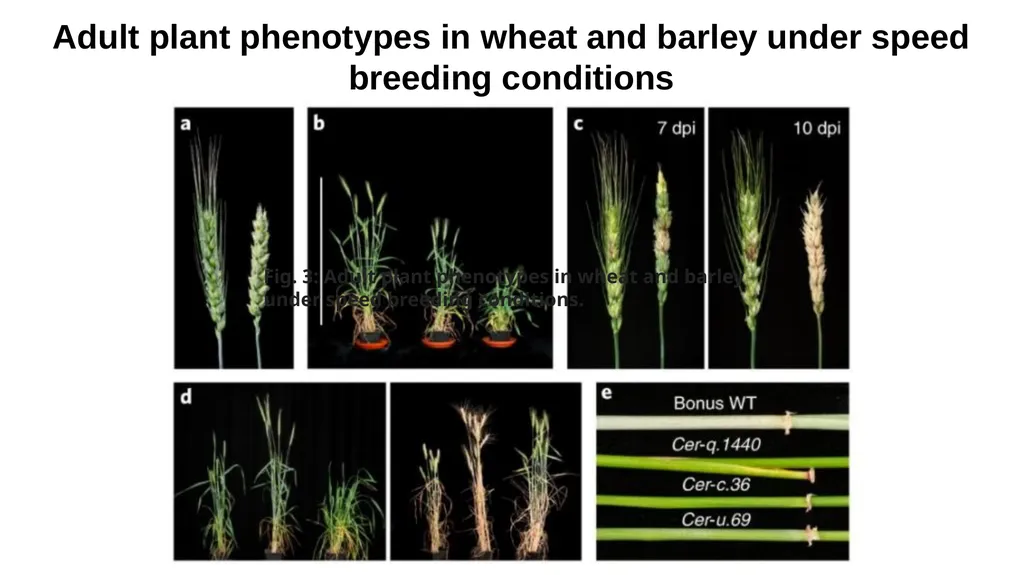
Fig. 3: Adult plant phenotypes in wheat and barley under speed breeding conditions. Adult plant phenotypes in wheat and barley under speed breeding conditions<br>
50
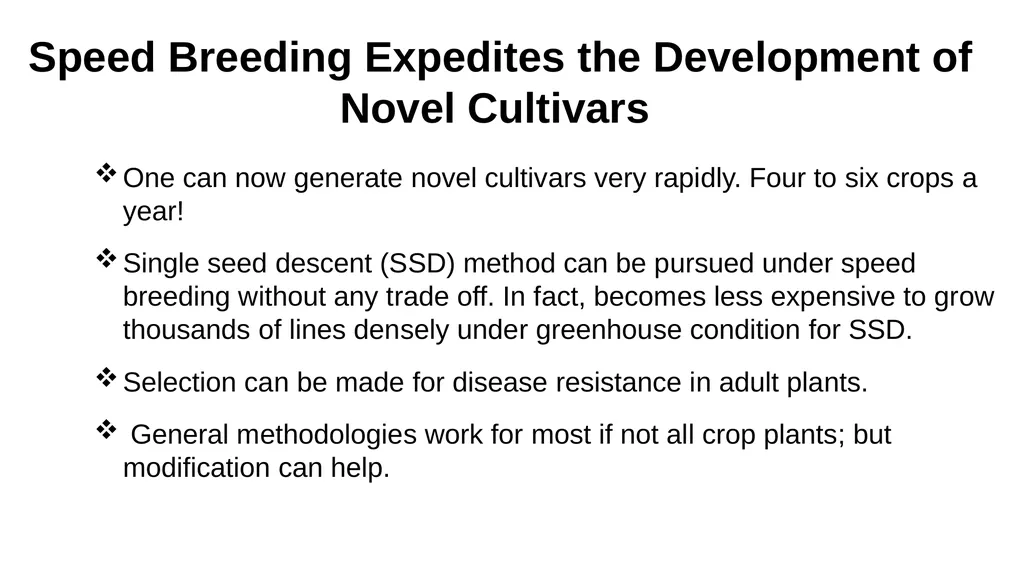
Speed Breeding Expedites the Development of Novel Cultivars One can now generate novel cultivars very rapidly. Four to six crops a year!
Single seed descent (SSD) method can be pursued under speed breeding without any trade off. In fact, becomes less expensive to grow thousands of lines densely under greenhouse condition for SSD.
Selection can be made for disease resistance in adult plants.
General methodologies work for most if not all crop plants; but modification can help.<br>
Single seed descent (SSD) method can be pursued under speed breeding without any trade off. In fact, becomes less expensive to grow thousands of lines densely under greenhouse condition for SSD.
Selection can be made for disease resistance in adult plants.
General methodologies work for most if not all crop plants; but modification can help.<br>
51
Lecture 3: Recent Advances in Plant Breeding (February 19) Molecular Markers & Marker Assisted Selection
Speed Breeding
Doubled-haploid
TILLING Genome
CRISPR Cas9
Fixing Heterosis in Rice<br>
Speed Breeding
Doubled-haploid
TILLING Genome
CRISPR Cas9
Fixing Heterosis in Rice<br>
52
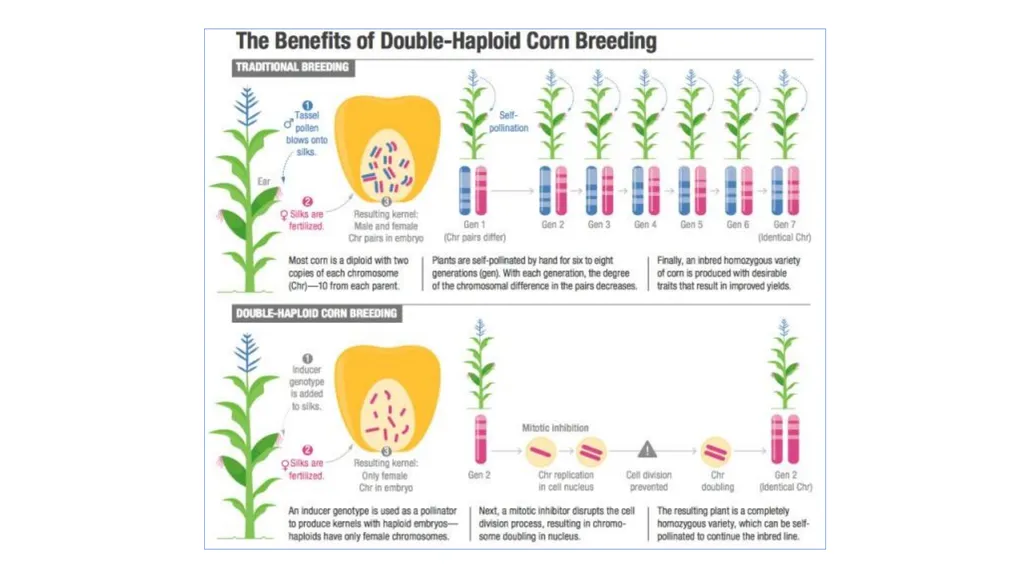
Doubled-haploid to Expedite the Breeding Program We need to fix the inbred lines for heterosis breeding.
Doubled-haploid approach fix the genome in one generation.
Process is labor-intensive.
Recombination in one step as opposed to additional recombination in selfing generations of the pedigree/SSD method.<br>
Doubled-haploid approach fix the genome in one generation.
Process is labor-intensive.
Recombination in one step as opposed to additional recombination in selfing generations of the pedigree/SSD method.<br>
53
Lecture 3: Recent Advances in Plant Breeding (February 19) Molecular Markers & Marker Assisted Selection
Speed Breeding
Doubled-haploid
TILLING Genome
CRISPR Cas9
Fixing Heterosis in Rice<br>
Speed Breeding
Doubled-haploid
TILLING Genome
CRISPR Cas9
Fixing Heterosis in Rice<br>
54
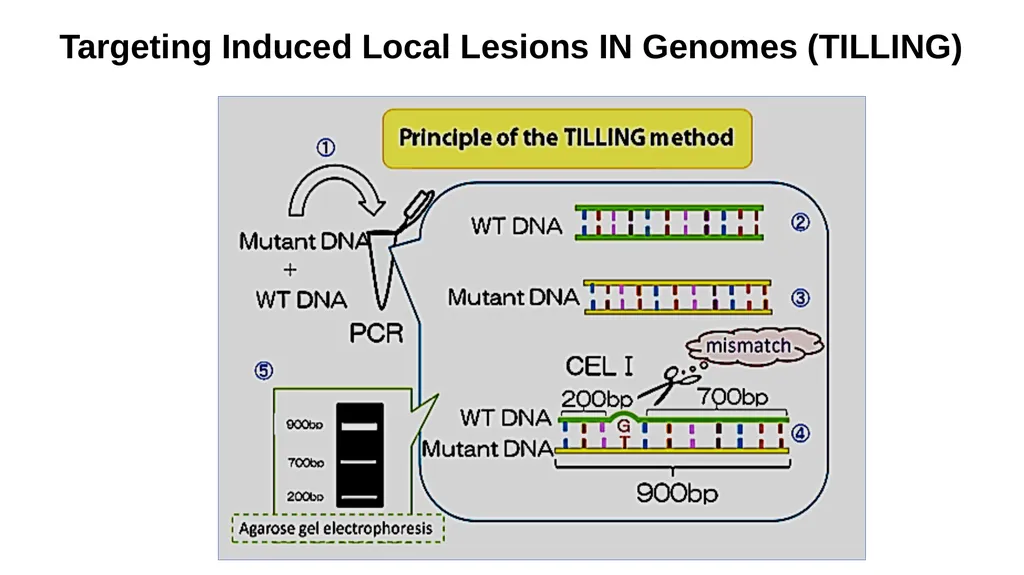
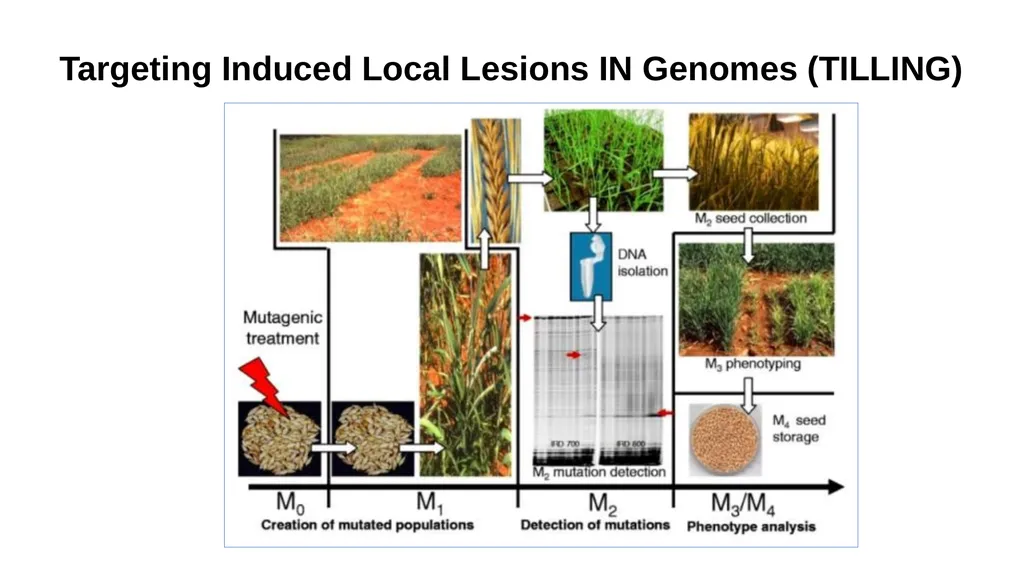
Targeting Induced Local Lesions IN Genomes (TILLING)<br>
55
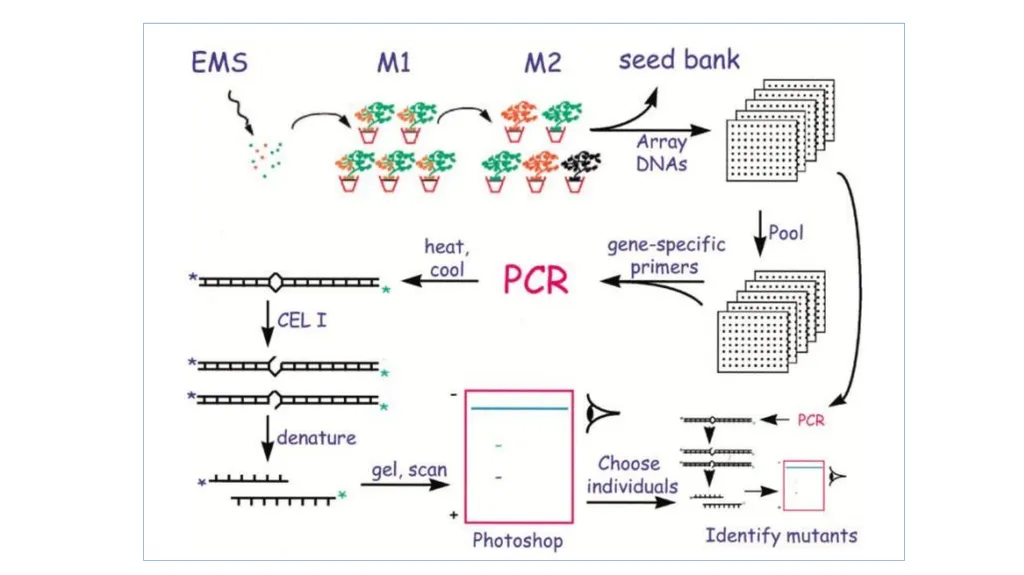
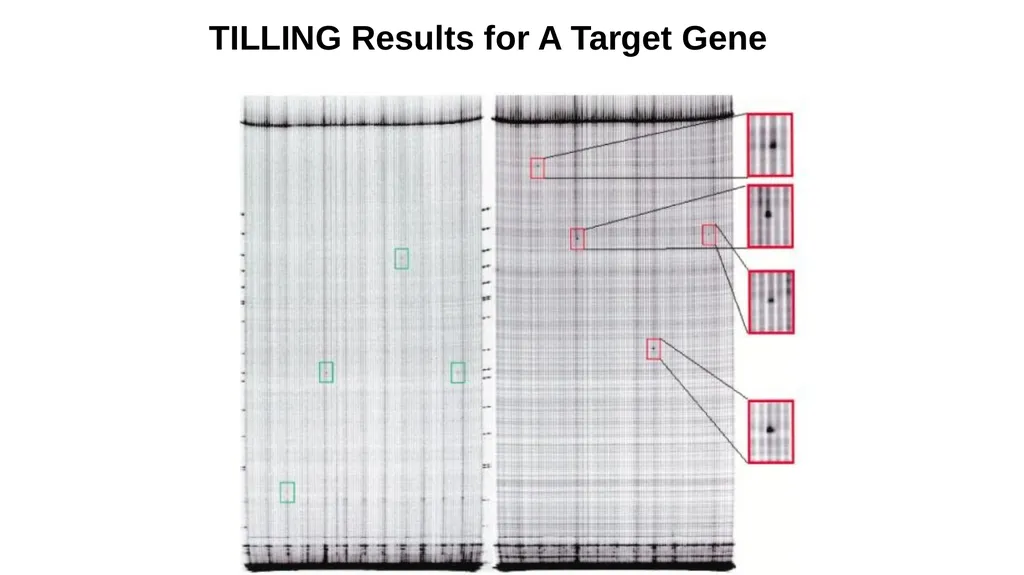
TILLING Results for A Target Gene<br>
56
Targeting Induced Local Lesions IN Genomes (TILLING)<br>
57
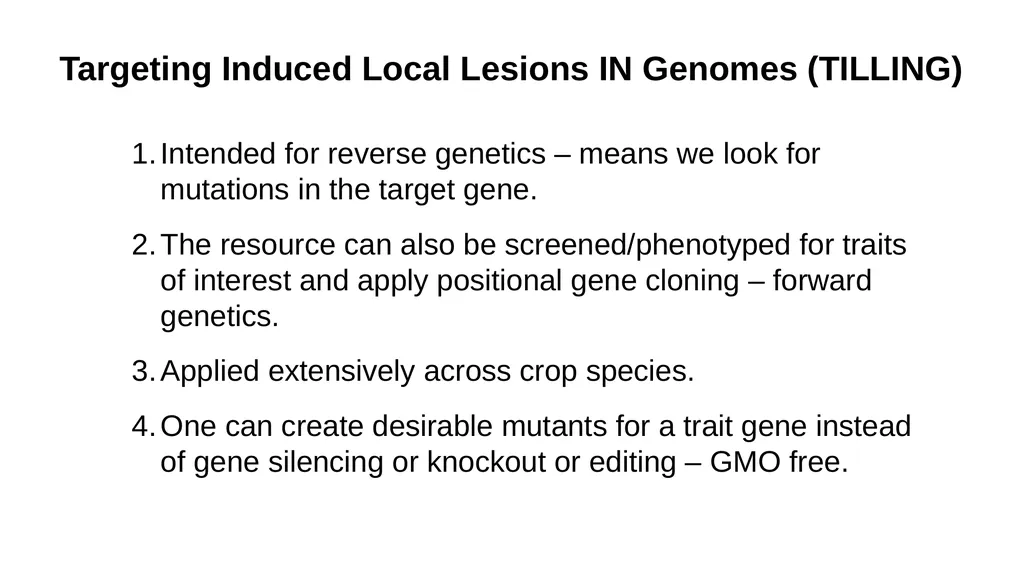
Targeting Induced Local Lesions IN Genomes (TILLING) Intended for reverse genetics – means we look for mutations in the target gene.
The resource can also be screened/phenotyped for traits of interest and apply positional gene cloning – forward genetics.
Applied extensively across crop species.
One can create desirable mutants for a trait gene instead of gene silencing or knockout or editing – GMO free.<br>
The resource can also be screened/phenotyped for traits of interest and apply positional gene cloning – forward genetics.
Applied extensively across crop species.
One can create desirable mutants for a trait gene instead of gene silencing or knockout or editing – GMO free.<br>
58
Lecture 3: Recent Advances in Plant Breeding (February 19) Molecular Markers & Marker Assisted Selection
Speed Breeding
Doubled-haploid
TILLING Genome
CRISPR Cas9
Fixing Heterosis in Rice<br>
Speed Breeding
Doubled-haploid
TILLING Genome
CRISPR Cas9
Fixing Heterosis in Rice<br>
59
CRISPR-Cas9 mediated gene editing<br>
60
https://www.youtube.com/watch?v=TdBAHexVYzc&t=26s Please watch this video:<br>
61
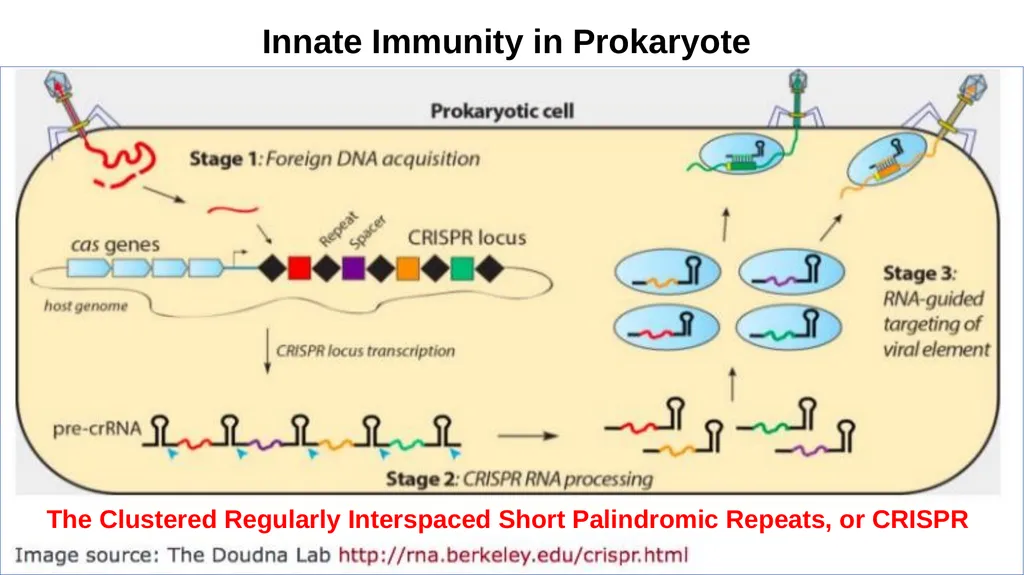
Innate Immunity in Prokaryote The Clustered Regularly Interspaced Short Palindromic Repeats, or CRISPR<br>
62
The Clustered Regularly Interspaced Short Palindromic Repeats, or CRISPR was first discovered in 1993 through sequence analyses.
Significance of CRISPR was unknown until 2007, when immunity function of this element was uncovered.
The mechanism used by the element to confer immunity became known after five years
The bacteria and archaea use CRISPR to defend against the invading viruses termed as bacteriophages. Following viral infection, they employ a special CRISPR-associated nuclease 9 (Cas9) to generate a double-strand break (DSB) in its target loci of the bacteriophages’ DNA molecules. Thus, viruses become ineffective. Cas9 is directed to the target sequence by a short RNA fragment known as a guide RNA (gRNA), complementary to a segment of the viral genome for generating DSB. Parallel to viral DNA cleavage, a short viral DNA is stored between the palindromic CRISPR sequences. This sequence is being used to generate the gRNA for rapid activation of this defense mechanism against any subsequent infection by the same bacteriophage. This system is kind of similar to antibody production in humans.<br>
Significance of CRISPR was unknown until 2007, when immunity function of this element was uncovered.
The mechanism used by the element to confer immunity became known after five years
The bacteria and archaea use CRISPR to defend against the invading viruses termed as bacteriophages. Following viral infection, they employ a special CRISPR-associated nuclease 9 (Cas9) to generate a double-strand break (DSB) in its target loci of the bacteriophages’ DNA molecules. Thus, viruses become ineffective. Cas9 is directed to the target sequence by a short RNA fragment known as a guide RNA (gRNA), complementary to a segment of the viral genome for generating DSB. Parallel to viral DNA cleavage, a short viral DNA is stored between the palindromic CRISPR sequences. This sequence is being used to generate the gRNA for rapid activation of this defense mechanism against any subsequent infection by the same bacteriophage. This system is kind of similar to antibody production in humans.<br>
63
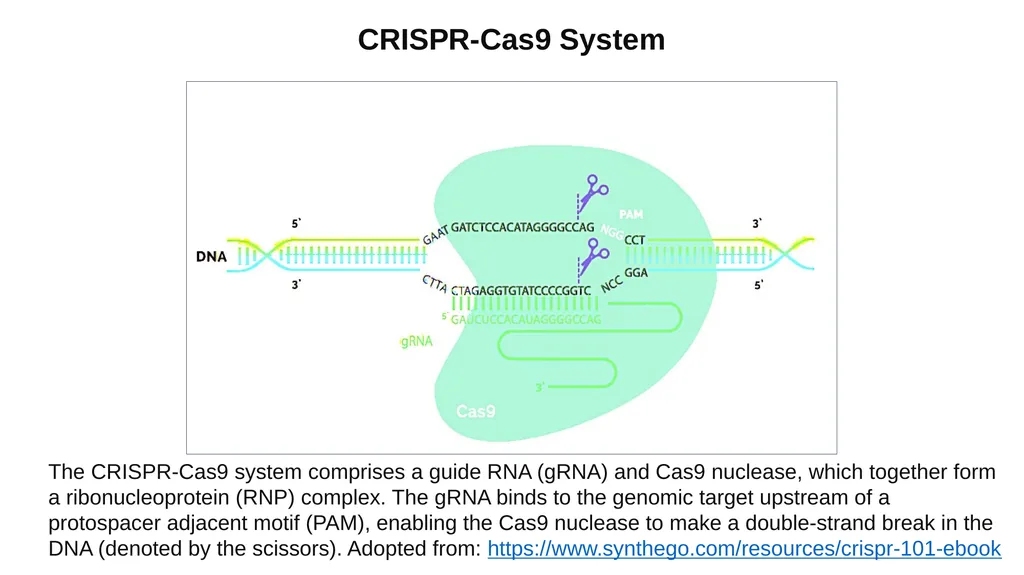
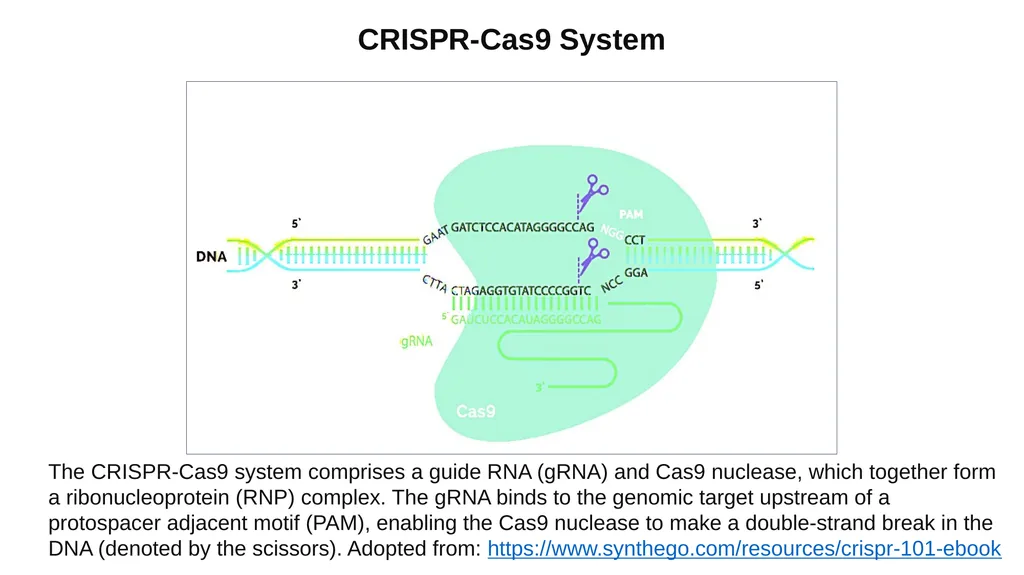
The CRISPR-Cas9 system comprises a guide RNA (gRNA) and Cas9 nuclease, which together form a ribonucleoprotein (RNP) complex. The gRNA binds to the genomic target upstream of a protospacer adjacent motif (PAM), enabling the Cas9 nuclease to make a double-strand break in the DNA (denoted by the scissors). Adopted from: https://www.synthego.com/resources/crispr-101-ebook CRISPR-Cas9 System<br>
64
Two steps to consider in designing a CRISPR-Cas9 system for editing a gene:
The design of guide RNA (gRNA)
Choice of the nuclease depends on the desired application – Cas9 for plant work.
The gRNA that targets specifically to your gene of intertest should be designed. Best scenario would be 0 non-specific cut and highly specific to the target site in exons. You can edit members of a gene family simultaneously. Following double stranded breaks (DSB), cells repair the DNA by non-homologous end joining (NHEJ) mechanism. During this process indels (insertions and deletions) are created leading to frameshift mutations and gene knockouts (KO).<br>
The design of guide RNA (gRNA)
Choice of the nuclease depends on the desired application – Cas9 for plant work.
The gRNA that targets specifically to your gene of intertest should be designed. Best scenario would be 0 non-specific cut and highly specific to the target site in exons. You can edit members of a gene family simultaneously. Following double stranded breaks (DSB), cells repair the DNA by non-homologous end joining (NHEJ) mechanism. During this process indels (insertions and deletions) are created leading to frameshift mutations and gene knockouts (KO).<br>
65
We can also conduct knock-in (KI) mutation by repairing the DSB through homology directed repair (HDR) mechanism.
To facilitate or induce HDR-mediated repair, copies of homologous DNA molecules with a desirable mutation are provided to use as a template. The mutation can be a single point mutation to change an amino acid.
It can be used to correct a disease-causing mutation in humans and generating herbicide resistance in plants.
For example in plants, we can replace an amino acid in the gene encoding acetolactate synthase (ALS) involved in biosynthesis of branched-chain amino acids to make the enzyme resistant to several herbicides, including imidazolinones and sulfonylureas. Out come herbicide resistant plants.<br>
To facilitate or induce HDR-mediated repair, copies of homologous DNA molecules with a desirable mutation are provided to use as a template. The mutation can be a single point mutation to change an amino acid.
It can be used to correct a disease-causing mutation in humans and generating herbicide resistance in plants.
For example in plants, we can replace an amino acid in the gene encoding acetolactate synthase (ALS) involved in biosynthesis of branched-chain amino acids to make the enzyme resistant to several herbicides, including imidazolinones and sulfonylureas. Out come herbicide resistant plants.<br>
66
You can also generate gRNA and Cas9 protein in test tubes and apply the two as ribonucleoprotein (RNP) complexes into the cells; this approach has recently been reported to be the most effective strategy (Liang et al. 2015). The complex is unstable and does not continue to function to cause additional off-target mutations.
Alteration of function through homologous recombination can also be accomplished through Crispr/Cas9 system.
Point or deletion mutations through Crispr/Cas9 is predictable. The only weakness is the mutations caused by the system in non-targeted genomic regions. There are many sequences similar to 16 bp target sequence in complex genome. Therefore, we have to investigate the genome sequence for target sequence just to make sure that the target site is either absent or is not present in coding sequences. One can always breed the desirable Crispr/Cas9-induced mutations through backcrossing.<br>
Alteration of function through homologous recombination can also be accomplished through Crispr/Cas9 system.
Point or deletion mutations through Crispr/Cas9 is predictable. The only weakness is the mutations caused by the system in non-targeted genomic regions. There are many sequences similar to 16 bp target sequence in complex genome. Therefore, we have to investigate the genome sequence for target sequence just to make sure that the target site is either absent or is not present in coding sequences. One can always breed the desirable Crispr/Cas9-induced mutations through backcrossing.<br>
67
The CRISPR-Cas9 system comprises a guide RNA (gRNA) and Cas9 nuclease, which together form a ribonucleoprotein (RNP) complex. The gRNA binds to the genomic target upstream of a protospacer adjacent motif (PAM), enabling the Cas9 nuclease to make a double-strand break in the DNA (denoted by the scissors). Adopted from: https://www.synthego.com/resources/crispr-101-ebook CRISPR-Cas9 System<br>
68
Will There be a CRISPR Nobel Prize?
A CRISPR research project or experiment has not yet won a Nobel Prize, but given its popularity, it sure seems to be on the path to one. CRISPR is a novel DNA editing tool that is faster, more cost-efficient, and more accurate than any previous gene editing techniques. CRISPR has proven to be a powerful research tool contributing significantly to genetic research by allowing scientists to better understand biological processes associated with certain diseases. Given these significant breakthrough raises the obvious question: “Will there be a Nobel Prize for CRISPR research in the future?”
One thing is sure- if there were to be one, many CRISPR scientists, who played a vital role in the development of this technology, are strong contenders for the award. Listed below are some of the big names in CRISPR that would be the likely front runners for the prize.
Jennifer Doudna: The most celebrated name in CRISPR
Jennifer Doudna is one of the biggest names in CRISPR, as she is credited as the co-inventor of CRISPR. She was also the first to propose that enzymes from bacteria that control microbial immunity (CRISPR-Cas9) could be used for programmable editing of genomes. This is considered one of the most significant discoveries in recent history, as this technique is much faster and more accurate than any of the previous gene editing tools. Many people believe that Jennifer Doudna would be a top contender for a Nobel Prize for CRISPR.
Emmaneulle Charpentier: The co-founder of CRISPR
Emmanuelle Charpentier is the co-founder of CRISPR, along with Doudna. Charpentier first began biochemical characterization of CRISPR with her colleague in Vienna. She met Doudna in 2011, and they began working together soon after on what would go on to become one of the greatest inventions in the history of genetics.
Feng Zhang: The man who showed CRISPR could work in mammalian systems
Feng Zhang was the first to successfully adapt CRISPR-Cas9 for gene editing in eukaryotic cells. He further expanded his research beyond the technology itself to show how versatile it was, and demonstrated that it could be used in mammalian cells for the first time. His current focus is on developing tools that can be applied to study genetic diseases, and develop diagnostics and therapeutics. His team was also the first to show CRISPR systems that can target RNA.
Virginijus Šikšnys: The overshadowed independent CRISPR inventor
Virginijus Šikšnys was also one of the first researchers to show how CRISPR works. Šikšnys is biochemist from Lithuania who independently figured out how certain bacteria are able to cut and paste specific genes from other organisms. He and his colleagues also found a way to control the process.
Luck played a huge role in his research not getting as much attention as Doudna’s did. The paper he submitted to Cell in April 2012 was rejected, while Doudna’s paper was published in Science two months later, fetching her celebrity status in the CRISPR field.<br>
A CRISPR research project or experiment has not yet won a Nobel Prize, but given its popularity, it sure seems to be on the path to one. CRISPR is a novel DNA editing tool that is faster, more cost-efficient, and more accurate than any previous gene editing techniques. CRISPR has proven to be a powerful research tool contributing significantly to genetic research by allowing scientists to better understand biological processes associated with certain diseases. Given these significant breakthrough raises the obvious question: “Will there be a Nobel Prize for CRISPR research in the future?”
One thing is sure- if there were to be one, many CRISPR scientists, who played a vital role in the development of this technology, are strong contenders for the award. Listed below are some of the big names in CRISPR that would be the likely front runners for the prize.
Jennifer Doudna: The most celebrated name in CRISPR
Jennifer Doudna is one of the biggest names in CRISPR, as she is credited as the co-inventor of CRISPR. She was also the first to propose that enzymes from bacteria that control microbial immunity (CRISPR-Cas9) could be used for programmable editing of genomes. This is considered one of the most significant discoveries in recent history, as this technique is much faster and more accurate than any of the previous gene editing tools. Many people believe that Jennifer Doudna would be a top contender for a Nobel Prize for CRISPR.
Emmaneulle Charpentier: The co-founder of CRISPR
Emmanuelle Charpentier is the co-founder of CRISPR, along with Doudna. Charpentier first began biochemical characterization of CRISPR with her colleague in Vienna. She met Doudna in 2011, and they began working together soon after on what would go on to become one of the greatest inventions in the history of genetics.
Feng Zhang: The man who showed CRISPR could work in mammalian systems
Feng Zhang was the first to successfully adapt CRISPR-Cas9 for gene editing in eukaryotic cells. He further expanded his research beyond the technology itself to show how versatile it was, and demonstrated that it could be used in mammalian cells for the first time. His current focus is on developing tools that can be applied to study genetic diseases, and develop diagnostics and therapeutics. His team was also the first to show CRISPR systems that can target RNA.
Virginijus Šikšnys: The overshadowed independent CRISPR inventor
Virginijus Šikšnys was also one of the first researchers to show how CRISPR works. Šikšnys is biochemist from Lithuania who independently figured out how certain bacteria are able to cut and paste specific genes from other organisms. He and his colleagues also found a way to control the process.
Luck played a huge role in his research not getting as much attention as Doudna’s did. The paper he submitted to Cell in April 2012 was rejected, while Doudna’s paper was published in Science two months later, fetching her celebrity status in the CRISPR field.<br>
69
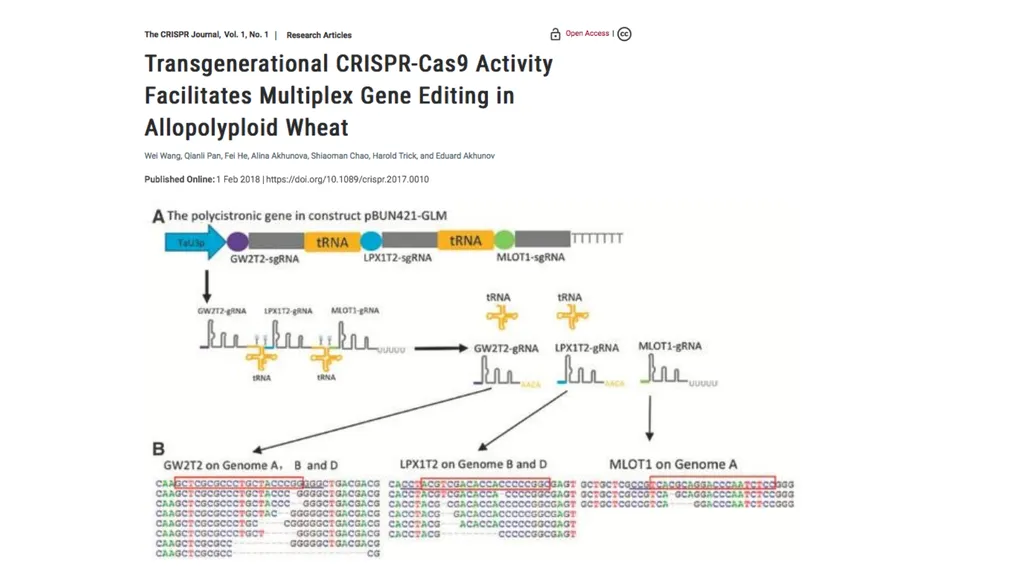
Establishing a CRISPR–Cas-like immune system conferring DNA virus resistance in plants Ji et al. 2015<br>
70
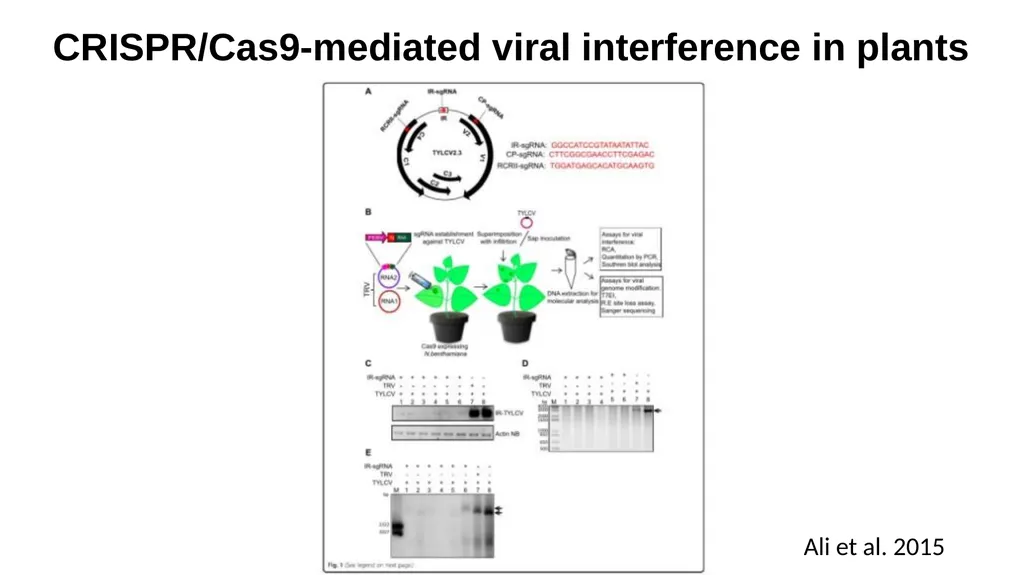
Ali et al. 2015 CRISPR/Cas9-mediated viral interference in plants<br>
71
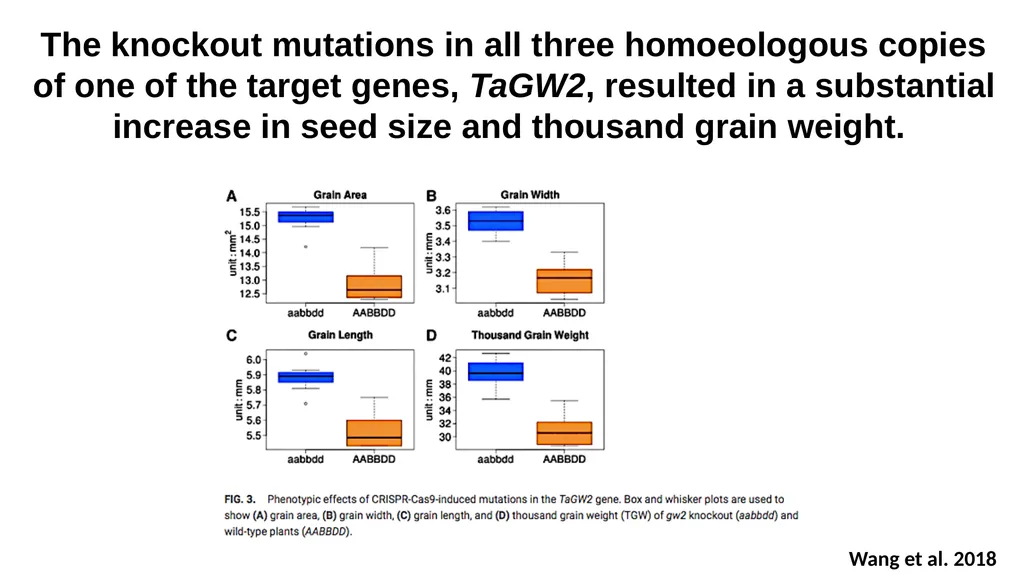
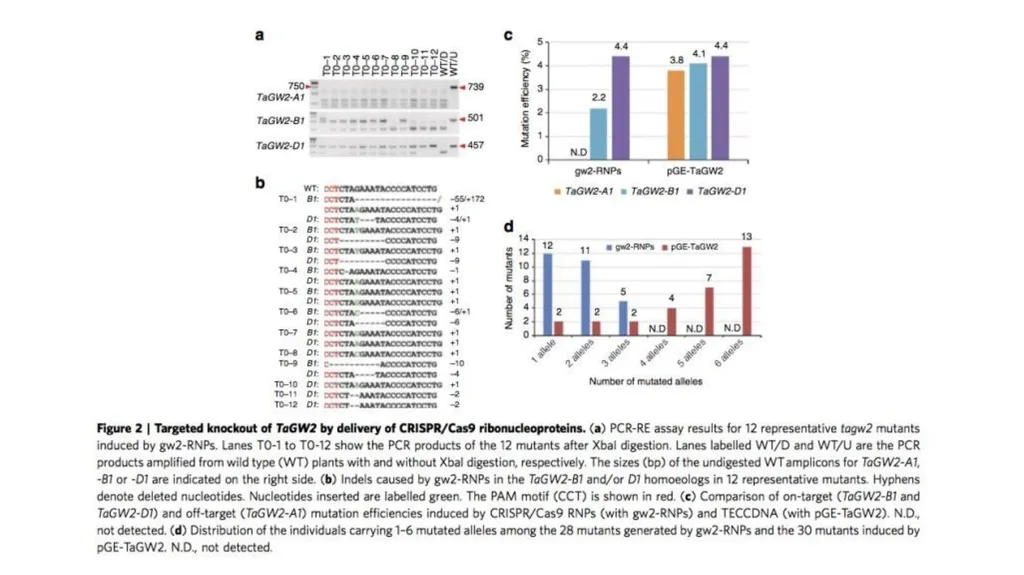
The knockout mutations in all three homoeologous copies of one of the target genes, TaGW2, resulted in a substantial increase in seed size and thousand grain weight. Wang et al. 2018<br>
72
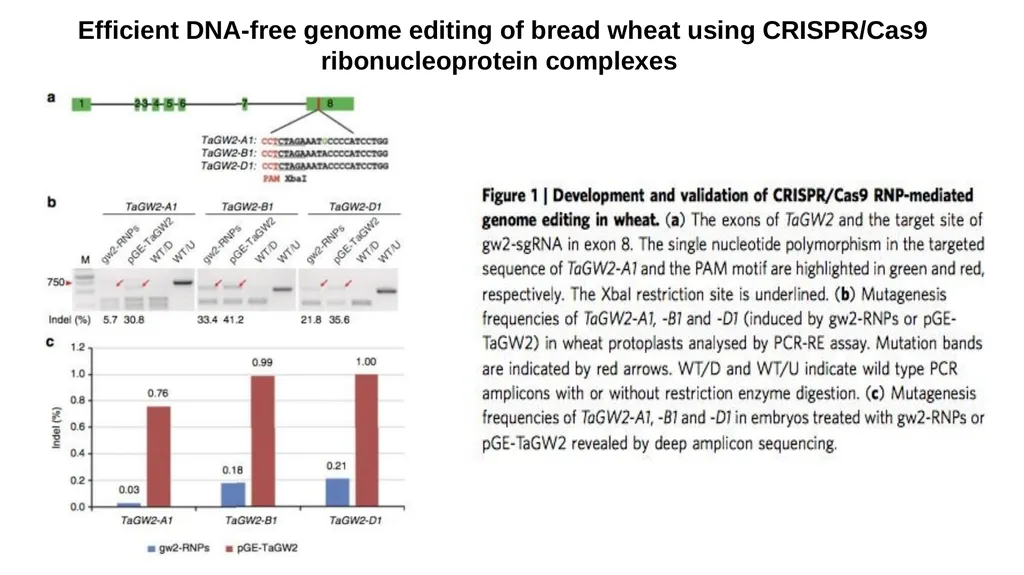
Efficient DNA-free genome editing of bread wheat using CRISPR/Cas9 ribonucleoprotein complexes<br>
73
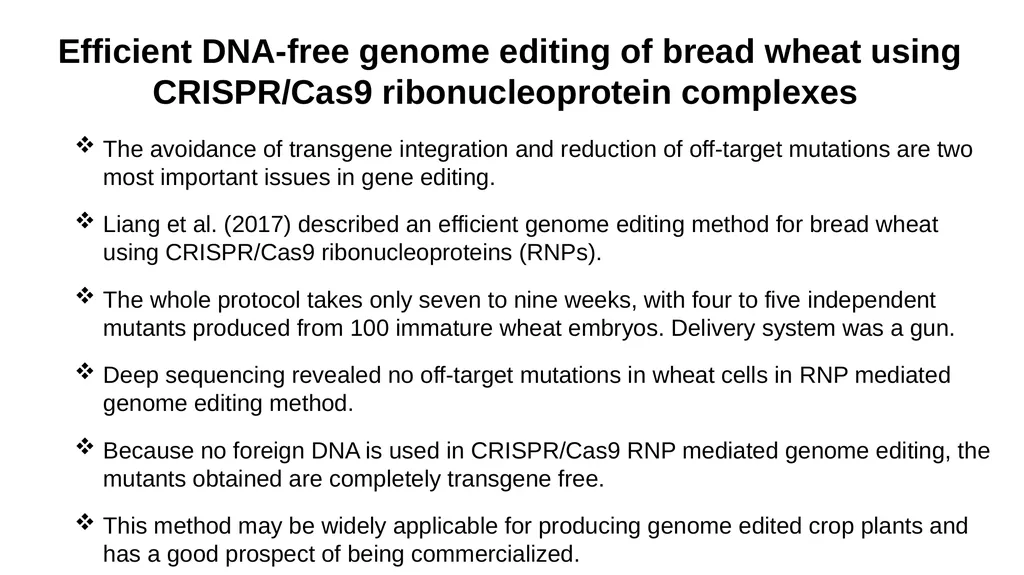
The avoidance of transgene integration and reduction of off-target mutations are two most important issues in gene editing.
Liang et al. (2017) described an efficient genome editing method for bread wheat using CRISPR/Cas9 ribonucleoproteins (RNPs).
The whole protocol takes only seven to nine weeks, with four to five independent mutants produced from 100 immature wheat embryos. Delivery system was a gun.
Deep sequencing revealed no off-target mutations in wheat cells in RNP mediated genome editing method.
Because no foreign DNA is used in CRISPR/Cas9 RNP mediated genome editing, the mutants obtained are completely transgene free.
This method may be widely applicable for producing genome edited crop plants and has a good prospect of being commercialized. Efficient DNA-free genome editing of bread wheat using CRISPR/Cas9 ribonucleoprotein complexes<br>
Liang et al. (2017) described an efficient genome editing method for bread wheat using CRISPR/Cas9 ribonucleoproteins (RNPs).
The whole protocol takes only seven to nine weeks, with four to five independent mutants produced from 100 immature wheat embryos. Delivery system was a gun.
Deep sequencing revealed no off-target mutations in wheat cells in RNP mediated genome editing method.
Because no foreign DNA is used in CRISPR/Cas9 RNP mediated genome editing, the mutants obtained are completely transgene free.
This method may be widely applicable for producing genome edited crop plants and has a good prospect of being commercialized. Efficient DNA-free genome editing of bread wheat using CRISPR/Cas9 ribonucleoprotein complexes<br>
74
Lecture 3: Recent Advances in Plant Breeding (February 14) Speed Breeding
Marker Assisted Selection
Doubled-haploid
TILLING Genome
CRISPR Cas9
Fixing Heterosis in Rice<br>
Marker Assisted Selection
Doubled-haploid
TILLING Genome
CRISPR Cas9
Fixing Heterosis in Rice<br>
75
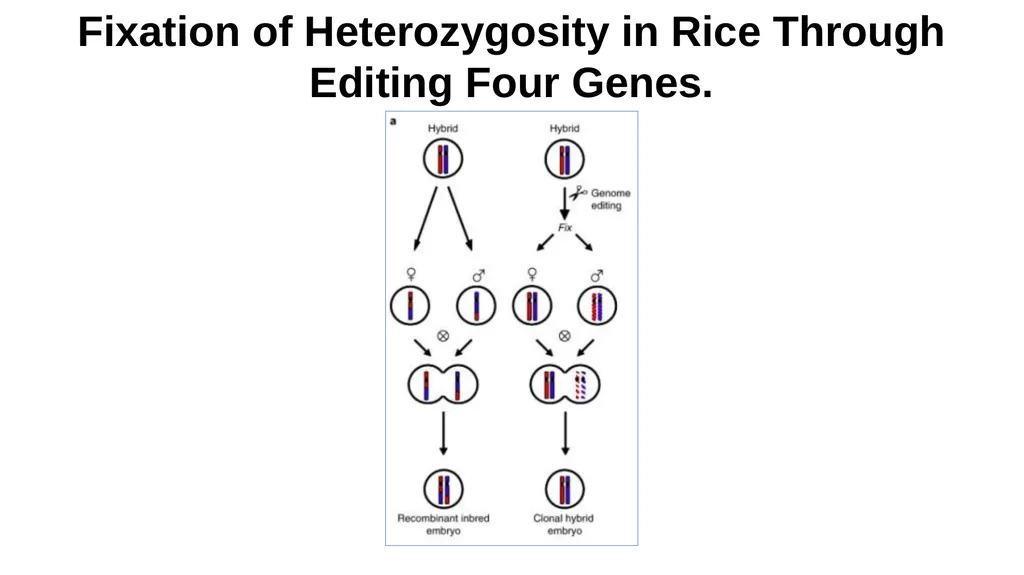
Fixation of Heterozygosity in Rice Through Editing Four Genes.<br>
76
Heterosis or hybrid vigor enhances crop yield. Example; maize
Unfortunately, most staple food and legume crops are self-pollinated.
Generation and identification of male sterility gene have been long attempted with a view to exploit heterosis.
Clonal propagation through seeds would enable self-propagation of F1 hybrids in self or cross pollinated crop species.
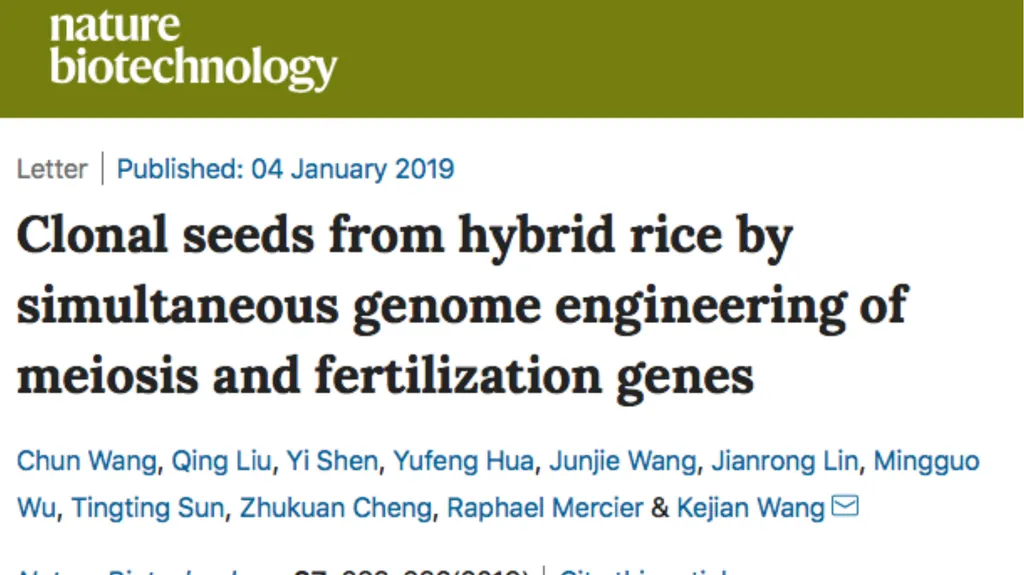
Wang et al. (2019) reported a strategy to enable clonal reproduction of F1 rice hybrids through seeds.
Conducted multiplex CRISPR–Cas9 genome editing of the REC8, PAIR1 and OSD1 meiotic genes to produce clonal diploid gametes and tetraploid seeds.
Next, they editing the MATRILINEAL (MTL) gene (involved in fertilization) to induce formation of haploid seeds in hybrid rice.
Finally, simultaneous editing of all four genes (REC8, PAIR1, OSD1 and MTL) in hybrid rice led them to propagate F1s clonally through seeds.<br>
Unfortunately, most staple food and legume crops are self-pollinated.
Generation and identification of male sterility gene have been long attempted with a view to exploit heterosis.
Clonal propagation through seeds would enable self-propagation of F1 hybrids in self or cross pollinated crop species.
Wang et al. (2019) reported a strategy to enable clonal reproduction of F1 rice hybrids through seeds.
Conducted multiplex CRISPR–Cas9 genome editing of the REC8, PAIR1 and OSD1 meiotic genes to produce clonal diploid gametes and tetraploid seeds.
Next, they editing the MATRILINEAL (MTL) gene (involved in fertilization) to induce formation of haploid seeds in hybrid rice.
Finally, simultaneous editing of all four genes (REC8, PAIR1, OSD1 and MTL) in hybrid rice led them to propagate F1s clonally through seeds.<br>
77
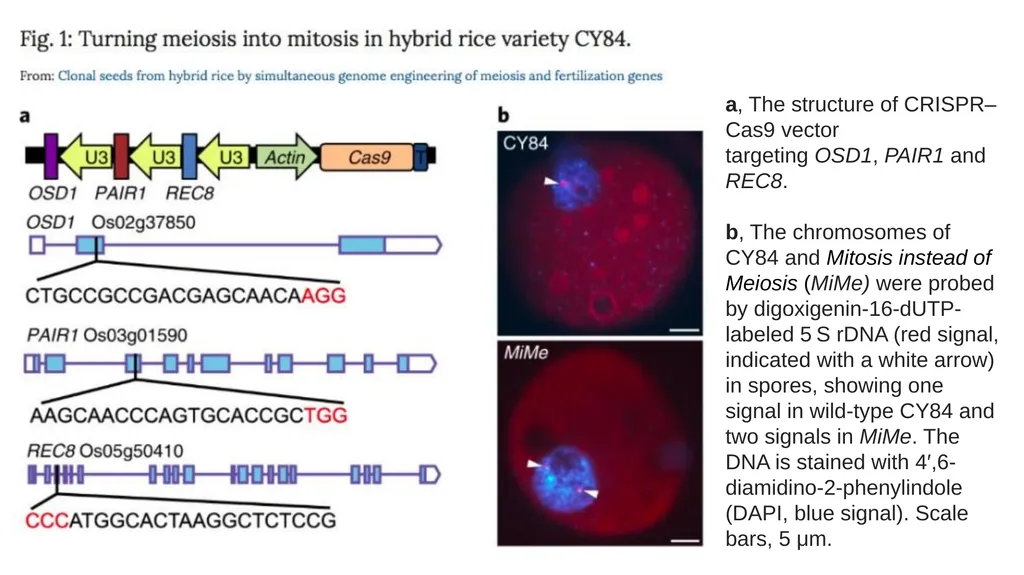
a, The structure of CRISPR–Cas9 vector targeting OSD1, PAIR1 and REC8.
b, The chromosomes of CY84 and Mitosis instead of Meiosis (MiMe) were probed by digoxigenin-16-dUTP-labeled 5 S rDNA (red signal, indicated with a white arrow) in spores, showing one signal in wild-type CY84 and two signals in MiMe. The DNA is stained with 4′,6-diamidino-2-phenylindole (DAPI, blue signal). Scale bars, 5 μm.<br>
b, The chromosomes of CY84 and Mitosis instead of Meiosis (MiMe) were probed by digoxigenin-16-dUTP-labeled 5 S rDNA (red signal, indicated with a white arrow) in spores, showing one signal in wild-type CY84 and two signals in MiMe. The DNA is stained with 4′,6-diamidino-2-phenylindole (DAPI, blue signal). Scale bars, 5 μm.<br>
78
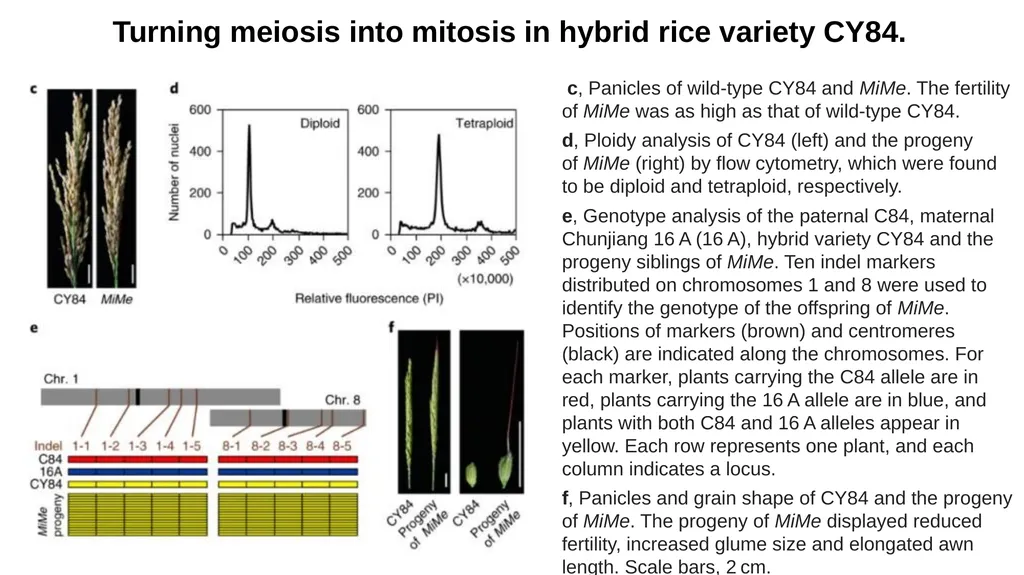
c, Panicles of wild-type CY84 and MiMe. The fertility of MiMe was as high as that of wild-type CY84.
d, Ploidy analysis of CY84 (left) and the progeny of MiMe (right) by flow cytometry, which were found to be diploid and tetraploid, respectively.
e, Genotype analysis of the paternal C84, maternal Chunjiang 16 A (16 A), hybrid variety CY84 and the progeny siblings of MiMe. Ten indel markers distributed on chromosomes 1 and 8 were used to identify the genotype of the offspring of MiMe. Positions of markers (brown) and centromeres (black) are indicated along the chromosomes. For each marker, plants carrying the C84 allele are in red, plants carrying the 16 A allele are in blue, and plants with both C84 and 16 A alleles appear in yellow. Each row represents one plant, and each column indicates a locus.
f, Panicles and grain shape of CY84 and the progeny of MiMe. The progeny of MiMe displayed reduced fertility, increased glume size and elongated awn length. Scale bars, 2 cm. Turning meiosis into mitosis in hybrid rice variety CY84.<br>
d, Ploidy analysis of CY84 (left) and the progeny of MiMe (right) by flow cytometry, which were found to be diploid and tetraploid, respectively.
e, Genotype analysis of the paternal C84, maternal Chunjiang 16 A (16 A), hybrid variety CY84 and the progeny siblings of MiMe. Ten indel markers distributed on chromosomes 1 and 8 were used to identify the genotype of the offspring of MiMe. Positions of markers (brown) and centromeres (black) are indicated along the chromosomes. For each marker, plants carrying the C84 allele are in red, plants carrying the 16 A allele are in blue, and plants with both C84 and 16 A alleles appear in yellow. Each row represents one plant, and each column indicates a locus.
f, Panicles and grain shape of CY84 and the progeny of MiMe. The progeny of MiMe displayed reduced fertility, increased glume size and elongated awn length. Scale bars, 2 cm. Turning meiosis into mitosis in hybrid rice variety CY84.<br>
79
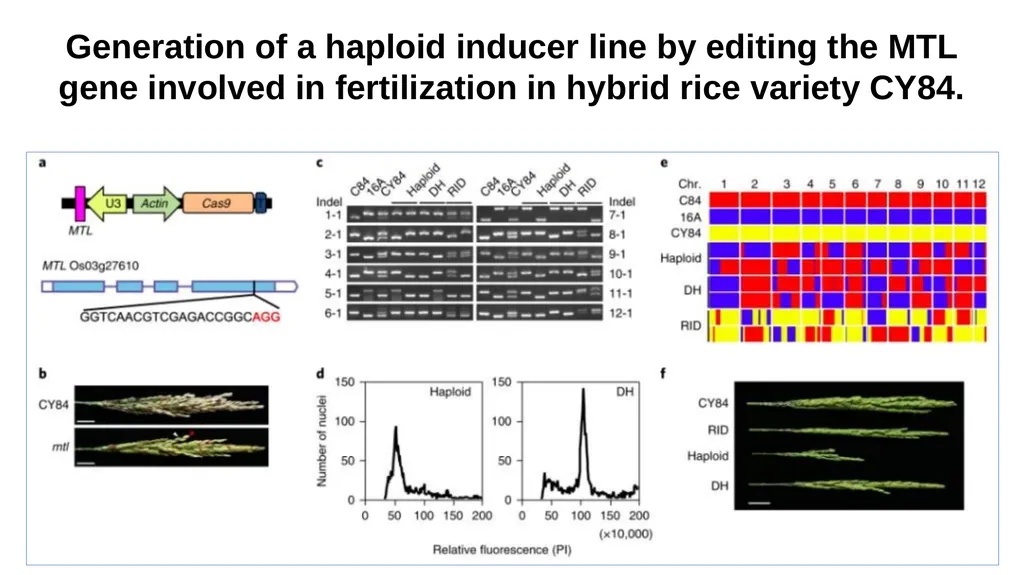
Generation of a haploid inducer line by editing the MTL gene involved in fertilization in hybrid rice variety CY84.<br>
80
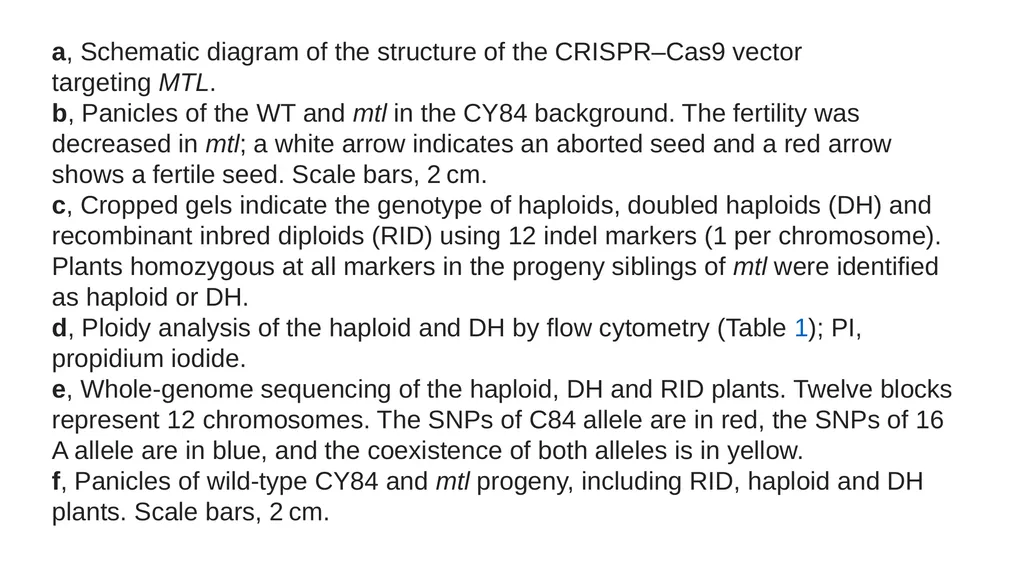
a, Schematic diagram of the structure of the CRISPR–Cas9 vector targeting MTL.
b, Panicles of the WT and mtl in the CY84 background. The fertility was decreased in mtl; a white arrow indicates an aborted seed and a red arrow shows a fertile seed. Scale bars, 2 cm.
c, Cropped gels indicate the genotype of haploids, doubled haploids (DH) and recombinant inbred diploids (RID) using 12 indel markers (1 per chromosome). Plants homozygous at all markers in the progeny siblings of mtl were identified as haploid or DH.
d, Ploidy analysis of the haploid and DH by flow cytometry (Table 1); PI, propidium iodide.
e, Whole-genome sequencing of the haploid, DH and RID plants. Twelve blocks represent 12 chromosomes. The SNPs of C84 allele are in red, the SNPs of 16 A allele are in blue, and the coexistence of both alleles is in yellow.
f, Panicles of wild-type CY84 and mtl progeny, including RID, haploid and DH plants. Scale bars, 2 cm.<br>
b, Panicles of the WT and mtl in the CY84 background. The fertility was decreased in mtl; a white arrow indicates an aborted seed and a red arrow shows a fertile seed. Scale bars, 2 cm.
c, Cropped gels indicate the genotype of haploids, doubled haploids (DH) and recombinant inbred diploids (RID) using 12 indel markers (1 per chromosome). Plants homozygous at all markers in the progeny siblings of mtl were identified as haploid or DH.
d, Ploidy analysis of the haploid and DH by flow cytometry (Table 1); PI, propidium iodide.
e, Whole-genome sequencing of the haploid, DH and RID plants. Twelve blocks represent 12 chromosomes. The SNPs of C84 allele are in red, the SNPs of 16 A allele are in blue, and the coexistence of both alleles is in yellow.
f, Panicles of wild-type CY84 and mtl progeny, including RID, haploid and DH plants. Scale bars, 2 cm.<br>
81
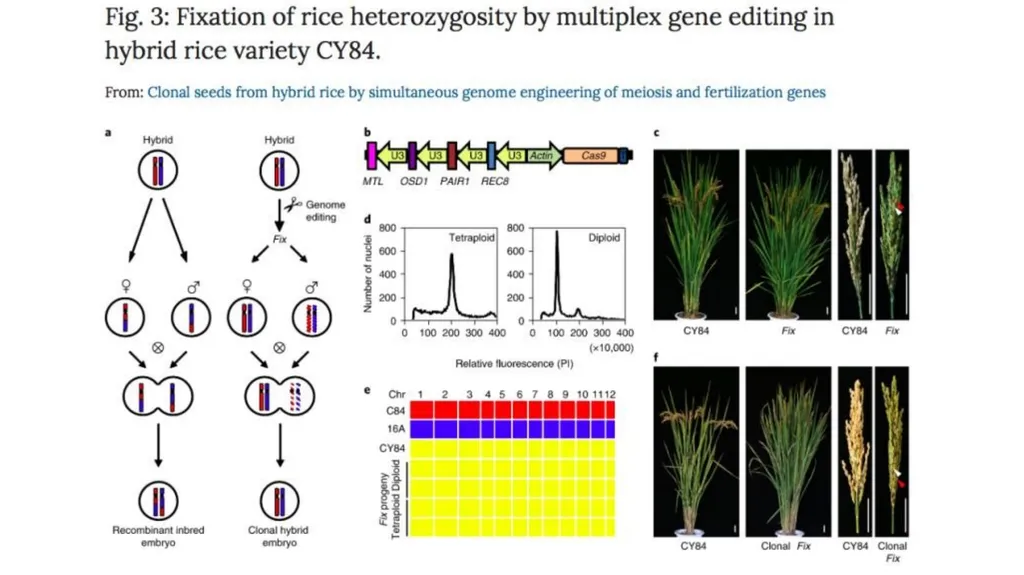
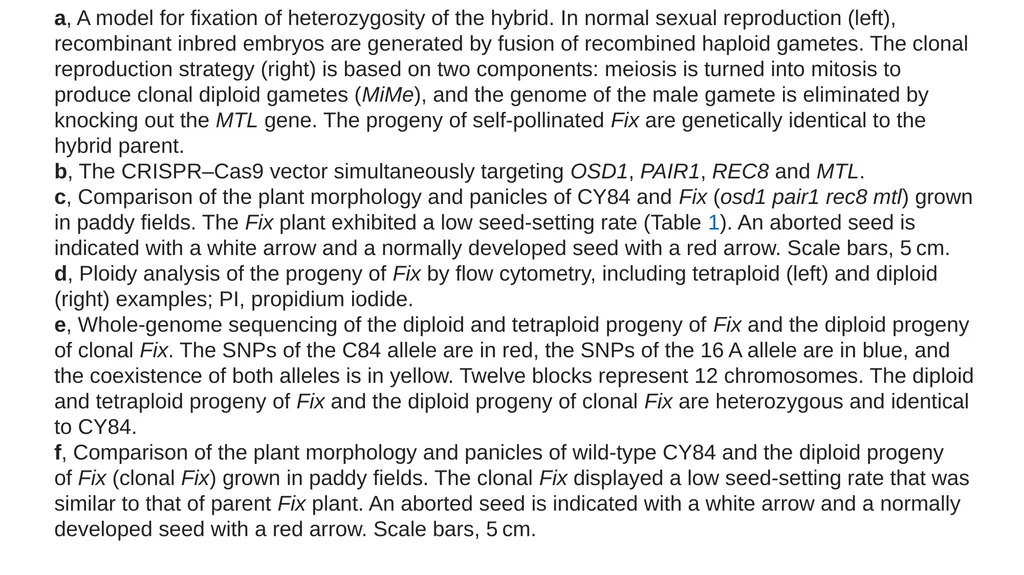
a, A model for fixation of heterozygosity of the hybrid. In normal sexual reproduction (left), recombinant inbred embryos are generated by fusion of recombined haploid gametes. The clonal reproduction strategy (right) is based on two components: meiosis is turned into mitosis to produce clonal diploid gametes (MiMe), and the genome of the male gamete is eliminated by knocking out the MTL gene. The progeny of self-pollinated Fix are genetically identical to the hybrid parent.
b, The CRISPR–Cas9 vector simultaneously targeting OSD1, PAIR1, REC8 and MTL.
c, Comparison of the plant morphology and panicles of CY84 and Fix (osd1 pair1 rec8 mtl) grown in paddy fields. The Fix plant exhibited a low seed-setting rate (Table 1). An aborted seed is indicated with a white arrow and a normally developed seed with a red arrow. Scale bars, 5 cm.
d, Ploidy analysis of the progeny of Fix by flow cytometry, including tetraploid (left) and diploid (right) examples; PI, propidium iodide.
e, Whole-genome sequencing of the diploid and tetraploid progeny of Fix and the diploid progeny of clonal Fix. The SNPs of the C84 allele are in red, the SNPs of the 16 A allele are in blue, and the coexistence of both alleles is in yellow. Twelve blocks represent 12 chromosomes. The diploid and tetraploid progeny of Fix and the diploid progeny of clonal Fix are heterozygous and identical to CY84.
f, Comparison of the plant morphology and panicles of wild-type CY84 and the diploid progeny of Fix (clonal Fix) grown in paddy fields. The clonal Fix displayed a low seed-setting rate that was similar to that of parent Fix plant. An aborted seed is indicated with a white arrow and a normally developed seed with a red arrow. Scale bars, 5 cm.<br>
b, The CRISPR–Cas9 vector simultaneously targeting OSD1, PAIR1, REC8 and MTL.
c, Comparison of the plant morphology and panicles of CY84 and Fix (osd1 pair1 rec8 mtl) grown in paddy fields. The Fix plant exhibited a low seed-setting rate (Table 1). An aborted seed is indicated with a white arrow and a normally developed seed with a red arrow. Scale bars, 5 cm.
d, Ploidy analysis of the progeny of Fix by flow cytometry, including tetraploid (left) and diploid (right) examples; PI, propidium iodide.
e, Whole-genome sequencing of the diploid and tetraploid progeny of Fix and the diploid progeny of clonal Fix. The SNPs of the C84 allele are in red, the SNPs of the 16 A allele are in blue, and the coexistence of both alleles is in yellow. Twelve blocks represent 12 chromosomes. The diploid and tetraploid progeny of Fix and the diploid progeny of clonal Fix are heterozygous and identical to CY84.
f, Comparison of the plant morphology and panicles of wild-type CY84 and the diploid progeny of Fix (clonal Fix) grown in paddy fields. The clonal Fix displayed a low seed-setting rate that was similar to that of parent Fix plant. An aborted seed is indicated with a white arrow and a normally developed seed with a red arrow. Scale bars, 5 cm.<br>
82
Fixation of Heterozygosity in Rice Through Editing Four Genes. Two biological steps were modified to fix heterozygosity in rice.
In step 1, three genes edited to generate a mutant known as “Mitosis instead of Meiosis (MiME).”
In the Step 2, a single mutation to avoid fertilization is generated.
Gene editing for all four genes resulted in seeds that carry the genotype of the F1.
You end up two copies of the haploid F1 genome; without going through meiosis (crossing over, etc.).
The gametes are as a result diploids.
Mutation in the fertilization gene suppressed the fusion of male gamete with the novel diploid ovum.
The diploid ovum generates the embryo and then the seeds as in apospory.
Poor seed setting of these novel F1s will require some more work to improve fertility. Okay to use in fodder crops grown for foliage only.<br>
In step 1, three genes edited to generate a mutant known as “Mitosis instead of Meiosis (MiME).”
In the Step 2, a single mutation to avoid fertilization is generated.
Gene editing for all four genes resulted in seeds that carry the genotype of the F1.
You end up two copies of the haploid F1 genome; without going through meiosis (crossing over, etc.).
The gametes are as a result diploids.
Mutation in the fertilization gene suppressed the fusion of male gamete with the novel diploid ovum.
The diploid ovum generates the embryo and then the seeds as in apospory.
Poor seed setting of these novel F1s will require some more work to improve fertility. Okay to use in fodder crops grown for foliage only.<br>
83
Questions if any? Thank you!<br>