
Lecture 10: Money, Inflation, and Output
MJ
Published · 85 slides · 0 views

1 / 1


Description
Lecture 10: Money, Inflation, and Output Macroeconomics (Quantitative) Econ 101B Jón Steinsson University of California, Berkeley 1 Monetary Economics The role of money in the economy is one of the most mysterious aspects of economics Key
Related Topics
Share
Embed code
Download this presentation From Below
"Lecture 10: Money, Inflation, and Output" is the property of its rightful owner. Permission is granted to download and print the materials on this website for personal, non-commercial use only, and to display it on your personal computer provided you do not modify the materials and that you retain all copyright notices contained in the materials. By downloading content from our website, you accept the terms of this agreement.
Presentation Transcript
01
Lecture 10:
Money, Inflation, and Output
Macroeconomics (Quantitative)
Econ 101B Jón Steinsson
University of California, Berkeley 1<br>
University of California, Berkeley 1<br>
02
Monetary Economics The role of money in the economy is one of the most mysterious aspects of economics
Key questions:
What gives money value?
Why does its value change over time?
How and why does monetary policy affect output and employment?
Keynesian economics / financial crises
But we start with a parable 2<br>
Key questions:
What gives money value?
Why does its value change over time?
How and why does monetary policy affect output and employment?
Keynesian economics / financial crises
But we start with a parable 2<br>
03
Great Babysitting Co-op Crisis Capitol Hill Babysitting Co-op
150 couples
Exchange babysitting services
Use coupons (“scrip”) to keep track of things
Coupons are the “money” in the babysitting economy
Each coupon pays for ½ hour of baby sitting
“Constitutionally fixed” price 3<br>
150 couples
Exchange babysitting services
Use coupons (“scrip”) to keep track of things
Coupons are the “money” in the babysitting economy
Each coupon pays for ½ hour of baby sitting
“Constitutionally fixed” price 3<br>
04
“Money” in the Babysitting Economy Early on:
Couples got 20 coupons upon entry
Must give back 20 coupons upon exit
Everything worked well for a while
But … quantity of coupons fell over time:
Some coupons lost in washing machine
Dues exceeded expenses
Each couple had less and less coupons 4<br>
Couples got 20 coupons upon entry
Must give back 20 coupons upon exit
Everything worked well for a while
But … quantity of coupons fell over time:
Some coupons lost in washing machine
Dues exceeded expenses
Each couple had less and less coupons 4<br>
05
Crisis in Babysitting Economy Each couple felt it didn’t have enough coupons and
started to try to acquire more
Everyone wanted to sit, but no one wanted to go out
Does this work in the aggregate?
No! For someone to sit, someone else must go out.
So, the baby-sitting economy fell into recession. There was a fall in GBP (Gross Babysitting Product)
Lots of workers wanted to work but no one wanted buy what they produced 5<br>
Everyone wanted to sit, but no one wanted to go out
Does this work in the aggregate?
No! For someone to sit, someone else must go out.
So, the baby-sitting economy fell into recession. There was a fall in GBP (Gross Babysitting Product)
Lots of workers wanted to work but no one wanted buy what they produced 5<br>
06
Crisis in the Babysitting Economy Being a bunch of lawyers, they:
Passed a bylaw: Everyone must go out at least every six months.
Didn’t work
Finally, they resorted to monetary policy:
Everyone got 10 additional pieces of scrip
Each new couple gets 30 upon entering
Must give back 20 upon leaving
Miraculously: Gross Babysitting Product boomed!! 6<br>
Passed a bylaw: Everyone must go out at least every six months.
Didn’t work
Finally, they resorted to monetary policy:
Everyone got 10 additional pieces of scrip
Each new couple gets 30 upon entering
Must give back 20 upon leaving
Miraculously: Gross Babysitting Product boomed!! 6<br>
07
New Problem in Babysitting Economy Balance of money supply:
New system implied that turnover of couples increased “money supply”
Dues and natural loss decreases money supply
If there is “too much” turnover, couples will have more coupons than they need
How do they react to this?
Everyone wants to go out.
No one wants to sit
Goods shortages 7<br>
New system implied that turnover of couples increased “money supply”
Dues and natural loss decreases money supply
If there is “too much” turnover, couples will have more coupons than they need
How do they react to this?
Everyone wants to go out.
No one wants to sit
Goods shortages 7<br>
08
Lessons from the Babysitting Economy Too little money: Recession (too little demand)
Too much money: Shortages (too much demand)
Goldilocks economy:
Just the right amount of money
Balance between desire to produce and desire to consume
What is the market failure? 8<br>
Too much money: Shortages (too much demand)
Goldilocks economy:
Just the right amount of money
Balance between desire to produce and desire to consume
What is the market failure? 8<br>
09
What is Money? Lay English: “That person has a lot of money”
“That person is wealthy”
In Economics:
“Money” has more specific meaning
Roughly: The asset that people use as a medium of exchange (whatever they use to make payment) and unit of account (post prices and wages in terms of) 9<br>
“That person is wealthy”
In Economics:
“Money” has more specific meaning
Roughly: The asset that people use as a medium of exchange (whatever they use to make payment) and unit of account (post prices and wages in terms of) 9<br>
10
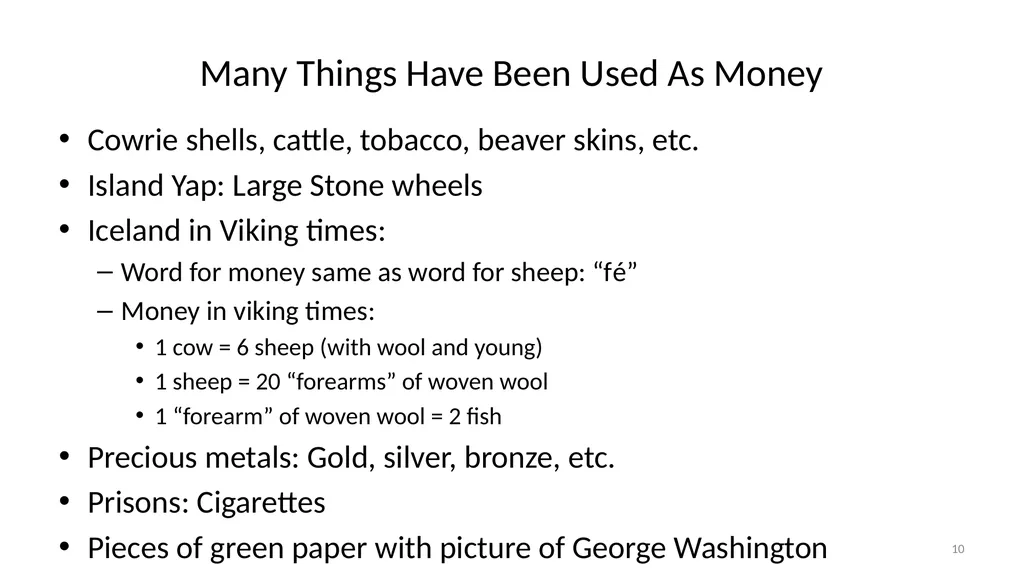
Many Things Have Been Used As Money Cowrie shells, cattle, tobacco, beaver skins, etc.
Island Yap: Large Stone wheels
Iceland in Viking times:
Word for money same as word for sheep: “fé”
Money in viking times:
1 cow = 6 sheep (with wool and young)
1 sheep = 20 “forearms” of woven wool
1 “forearm” of woven wool = 2 fish
Precious metals: Gold, silver, bronze, etc.
Prisons: Cigarettes
Pieces of green paper with picture of George Washington 10<br>
Island Yap: Large Stone wheels
Iceland in Viking times:
Word for money same as word for sheep: “fé”
Money in viking times:
1 cow = 6 sheep (with wool and young)
1 sheep = 20 “forearms” of woven wool
1 “forearm” of woven wool = 2 fish
Precious metals: Gold, silver, bronze, etc.
Prisons: Cigarettes
Pieces of green paper with picture of George Washington 10<br>
11
Traditional Functions of Money Medium of Exchange
People can pay for things they purchase using money
Unit of Account
People generally quote prices and wages in terms of units of money (e.g., in dollar in the U.S. today)
Store of Value
People may hold money so as to be able to buy something tomorrow or later 11<br>
People can pay for things they purchase using money
Unit of Account
People generally quote prices and wages in terms of units of money (e.g., in dollar in the U.S. today)
Store of Value
People may hold money so as to be able to buy something tomorrow or later 11<br>
12
Money in the U.S. Today Unit of Account:
Prices and wages are posted in “US dollars”
US dollar is clearly the unit of account in the US
Medium of Exchange:
Complicated! Coins and bills not only medium of exchange
Debit cards, checks, credit cards, Venmo, Paypal, etc.
In most cases a bank deposit is real medium of exchange
Store of value:
Coins and bills not important store of value (don’t pay interest)
Many other better stores of value (stocks, bonds, real estate, etc.) 12<br>
Prices and wages are posted in “US dollars”
US dollar is clearly the unit of account in the US
Medium of Exchange:
Complicated! Coins and bills not only medium of exchange
Debit cards, checks, credit cards, Venmo, Paypal, etc.
In most cases a bank deposit is real medium of exchange
Store of value:
Coins and bills not important store of value (don’t pay interest)
Many other better stores of value (stocks, bonds, real estate, etc.) 12<br>
13
The Purpose of Money Money is a device to lower transactions costs
Instructive to start by thinking about money in a “primitive” society (i.e., one that involves little trade and specialization)
Helps us think about basic properties of monetary economics
We will then add more and more “modern” elements until we arrive at a fully modern setting 13<br>
Instructive to start by thinking about money in a “primitive” society (i.e., one that involves little trade and specialization)
Helps us think about basic properties of monetary economics
We will then add more and more “modern” elements until we arrive at a fully modern setting 13<br>
14
Society of Yeomen Farmers Each household is self-sufficient in everything
Produce everything they consume
Make their own food, clothing, shelter, etc.
No trade
What is the role of money in such a society?
Money has no role!
If there is no trade, no need for money
Money is a device for lowering transactions costs 14<br>
Produce everything they consume
Make their own food, clothing, shelter, etc.
No trade
What is the role of money in such a society?
Money has no role!
If there is no trade, no need for money
Money is a device for lowering transactions costs 14<br>
15
Society of Yeomen Farmers At some point someone realizes they are particularly good
at making, say, shoes
Specializes in making shoes
Sells shoes to others in exchange for other things
Over time, more and more people specialize
Important question arises:
How will trade work? 15<br>
Specializes in making shoes
Sells shoes to others in exchange for other things
Over time, more and more people specialize
Important question arises:
How will trade work? 15<br>
16
Specialization and Trade Baker makes bread, Shoemaker makes shoes, Janitor cleans, Teacher teaches, etc.
How does trade work?
Barter trade: Baker and shoemaker exchange bread for shoes
Problem: If teacher wants bread but baker doesn’t want a math lesson, no scope for trade.
Lack of double coincidence of wants
What needs to happen? 16<br>
How does trade work?
Barter trade: Baker and shoemaker exchange bread for shoes
Problem: If teacher wants bread but baker doesn’t want a math lesson, no scope for trade.
Lack of double coincidence of wants
What needs to happen? 16<br>
17
Something Becomes Money Shoemaker may take bread as payment for shoes even if
she doesn’t want bread (Why?)
Bread may thus becomes “money”
Bread not ideal money (Why?)
Baker can solve this problem by issuing bread tokens
Pieces of paper that entitle bearer to one loaf of bread
Bread tokens circulate and become medium of exchange, i.e., become money 17<br>
Bread may thus becomes “money”
Bread not ideal money (Why?)
Baker can solve this problem by issuing bread tokens
Pieces of paper that entitle bearer to one loaf of bread
Bread tokens circulate and become medium of exchange, i.e., become money 17<br>
18
Bread Tokens as Money What are potential problems with this?
Counterfeiting! (Huge problem through the ages)
Baker may issue “too many” tokens (issuing tokens likely to be highly profitable)
Baker may “default” on tokens (i.e., not be able to deliver loaves of break on demand)
If people doubt baker’s ability to deliver, the may rush to convert tokens into bread (i.e., run on the baker (financial crisis))
Value of tokens depends on people’s confidence in baker 18<br>
Counterfeiting! (Huge problem through the ages)
Baker may issue “too many” tokens (issuing tokens likely to be highly profitable)
Baker may “default” on tokens (i.e., not be able to deliver loaves of break on demand)
If people doubt baker’s ability to deliver, the may rush to convert tokens into bread (i.e., run on the baker (financial crisis))
Value of tokens depends on people’s confidence in baker 18<br>
19
What Characteristics Should Money Have? Durable
Easily measured
Easily transferable
Easily divisible
Have stable value
The point of “money” is to lower transaction costs 19<br>
Easily measured
Easily transferable
Easily divisible
Have stable value
The point of “money” is to lower transaction costs 19<br>
20
Stable Quantity of Money Many people think that stable quantity is a desirable characteristic for money
E.g., Satoshi Nakamoto (creator of bitcoin)
Not clear that this is true
Stable value is what we are really after!
If demand for money fluctuates, while quantity is fixed, then price of money will fluctuate (e.g., bitcoin)
This will mean value is not stable 20<br>
E.g., Satoshi Nakamoto (creator of bitcoin)
Not clear that this is true
Stable value is what we are really after!
If demand for money fluctuates, while quantity is fixed, then price of money will fluctuate (e.g., bitcoin)
This will mean value is not stable 20<br>
21
Why Gold and Silver? Gold and Silver were dominant forms of money for many centuries. Why?
They are durable
Easily measured (Especially after advent of coinage)
Easily transferable (high value relative to volume and weight)
Stable value? 21<br>
They are durable
Easily measured (Especially after advent of coinage)
Easily transferable (high value relative to volume and weight)
Stable value? 21<br>
22
Our First Monetary / Business Cycle Model Goal: Understand influence of money on output and inflation
Complicated subject. We do this in steps.
First model: Medieval Economy
Contains certain central ideas in simple form
Leaves out many aspects of reality
We will add these one-by-one over the next few weeks 22<br>
Complicated subject. We do this in steps.
First model: Medieval Economy
Contains certain central ideas in simple form
Leaves out many aspects of reality
We will add these one-by-one over the next few weeks 22<br>
23
Money and Transactions Only medium of exchange: gold coins
All payments made with gold coins
Gold is only asset people accept as payment in transactions
In every transaction, gold coins much change hands
People hold money to be able to engage in transactions
Just like scrip in babysitting economy
Transactions based demand for gold coins 23<br>
All payments made with gold coins
Gold is only asset people accept as payment in transactions
In every transaction, gold coins much change hands
People hold money to be able to engage in transactions
Just like scrip in babysitting economy
Transactions based demand for gold coins 23<br>
24
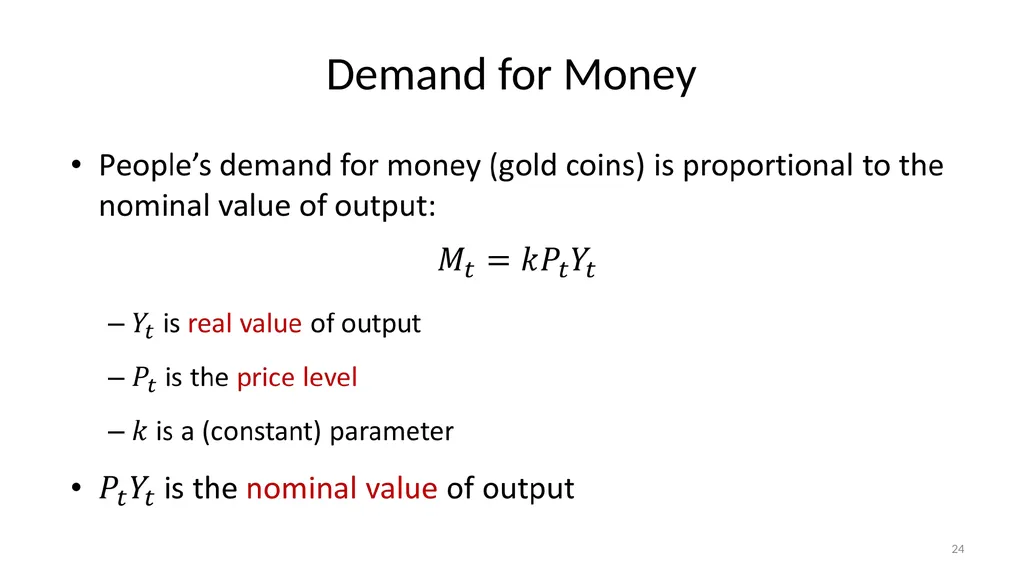
Demand for Money 24<br>
25
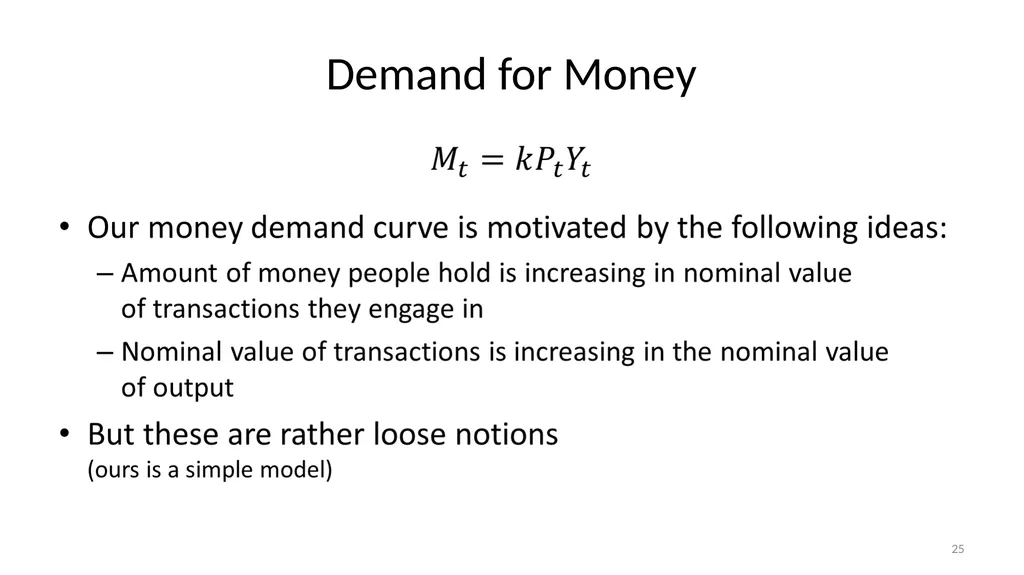
Demand for Money 25<br>
26
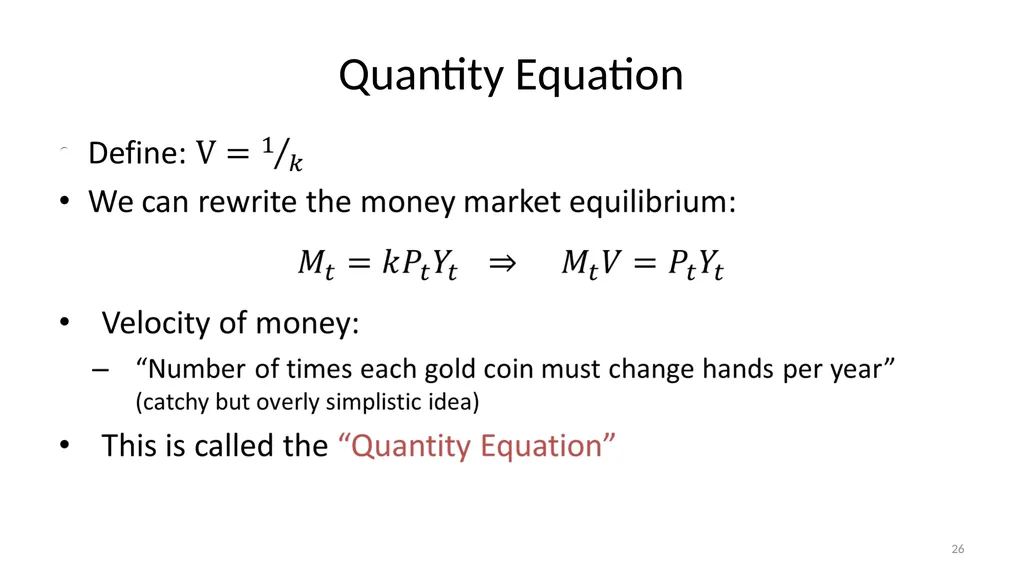
Quantity Equation 26<br>
27
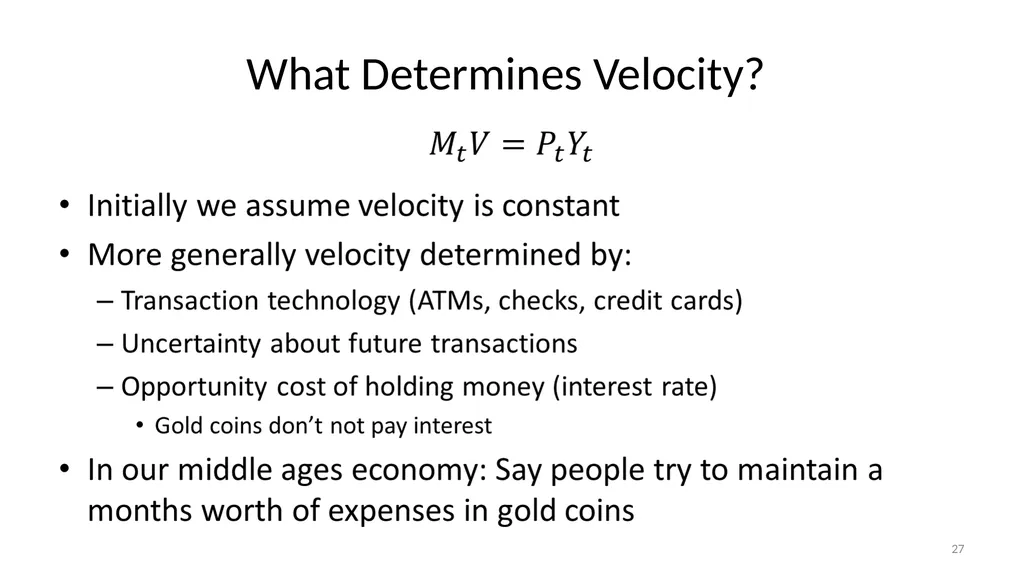
What Determines Velocity? 27<br>
28
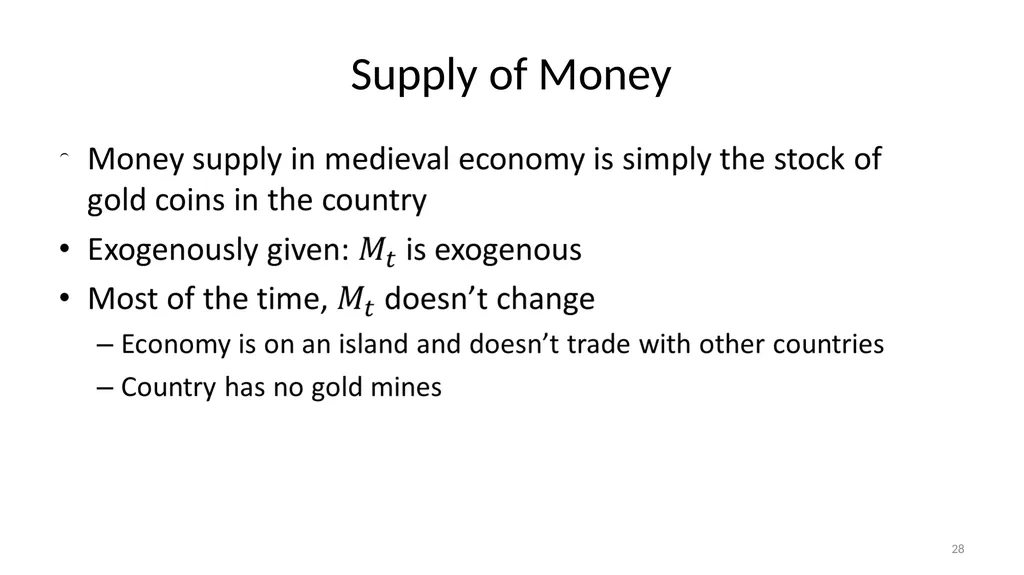
Supply of Money 28<br>
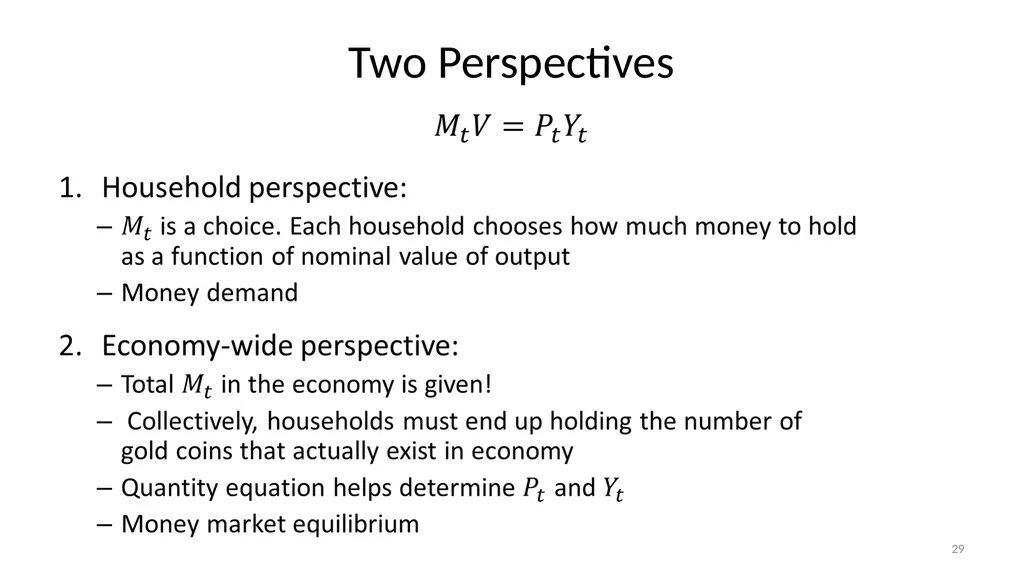
29
Two Perspectives 29<br>
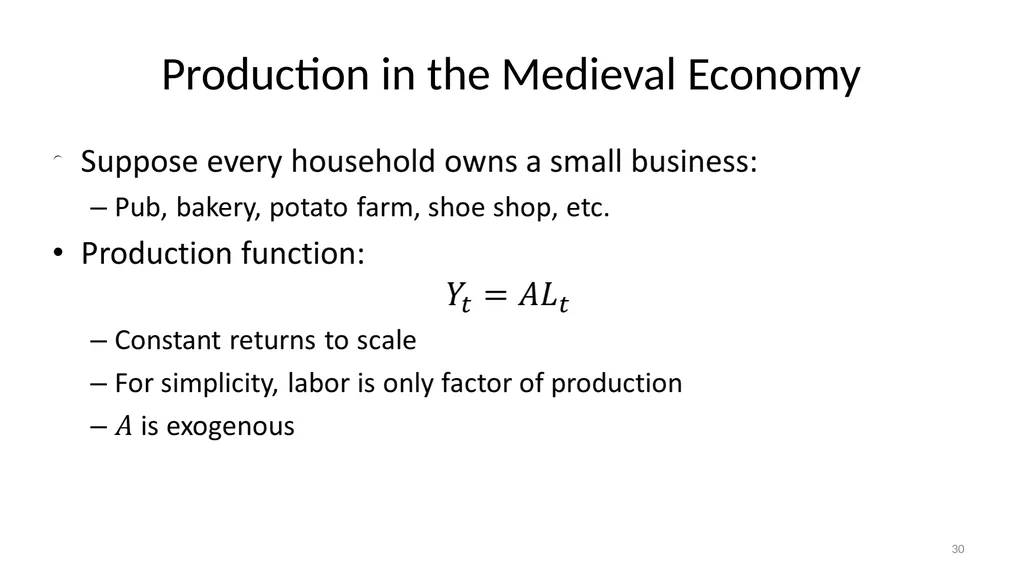
30
Production in the Medieval Economy 30<br>
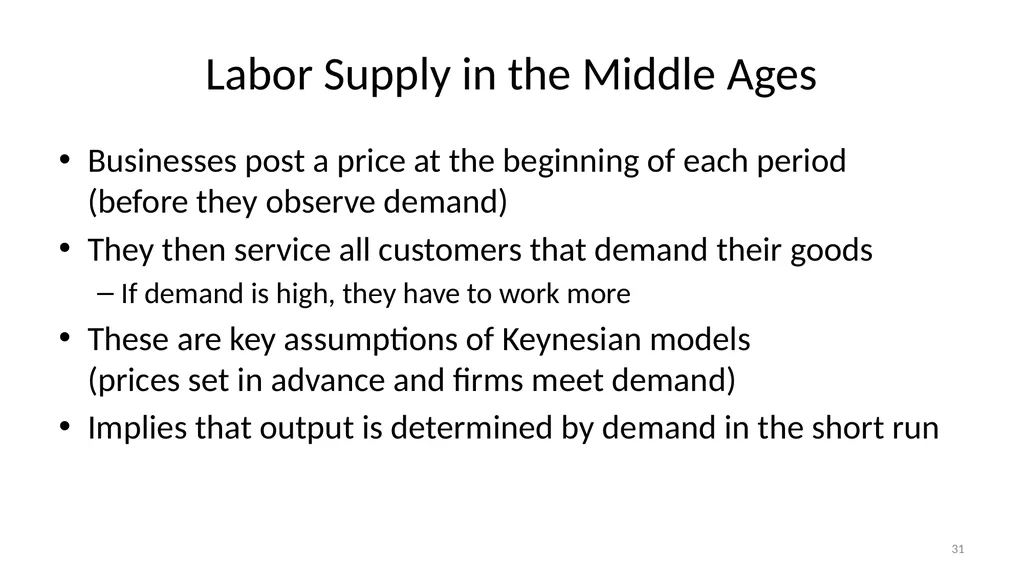
31
Labor Supply in the Middle Ages Businesses post a price at the beginning of each period
(before they observe demand)
They then service all customers that demand their goods
If demand is high, they have to work more
These are key assumptions of Keynesian models (prices set in advance and firms meet demand)
Implies that output is determined by demand in the short run 31<br>
They then service all customers that demand their goods
If demand is high, they have to work more
These are key assumptions of Keynesian models (prices set in advance and firms meet demand)
Implies that output is determined by demand in the short run 31<br>
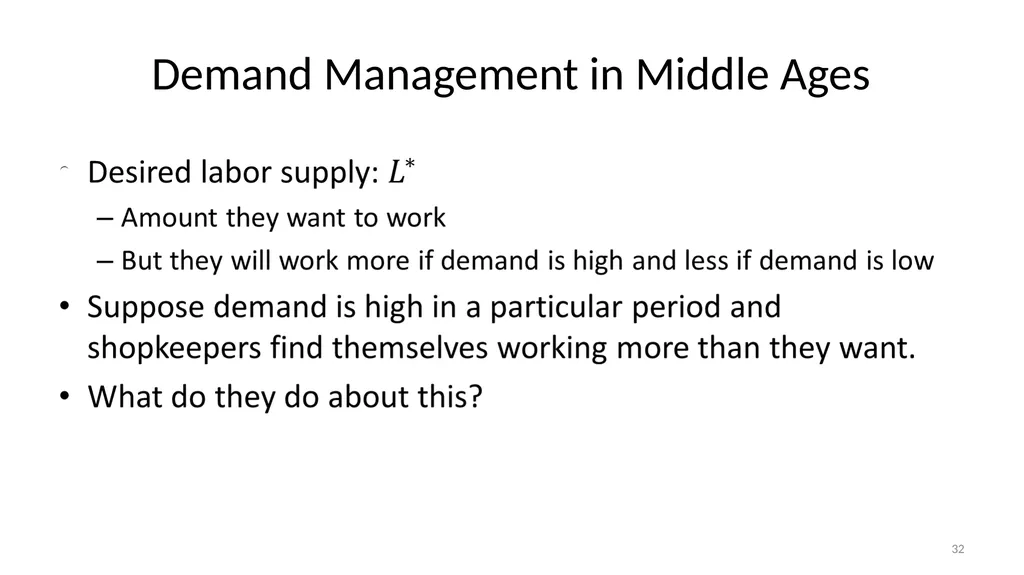
32
Demand Management in Middle Ages 32<br>
33
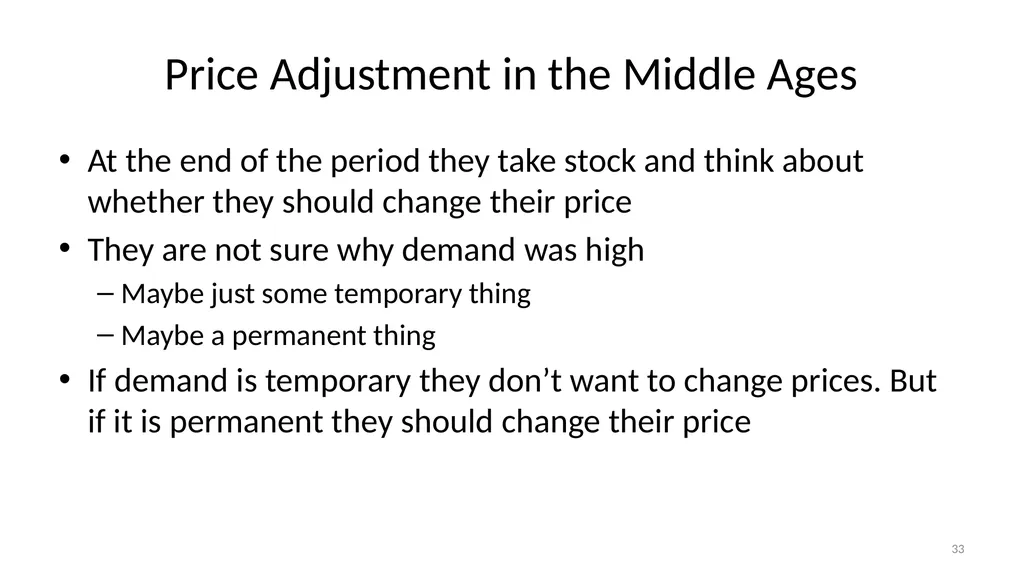
Price Adjustment in the Middle Ages At the end of the period they take stock and think about whether they should change their price
They are not sure why demand was high
Maybe just some temporary thing
Maybe a permanent thing
If demand is temporary they don’t want to change prices. But if it is permanent they should change their price 33<br>
They are not sure why demand was high
Maybe just some temporary thing
Maybe a permanent thing
If demand is temporary they don’t want to change prices. But if it is permanent they should change their price 33<br>
34
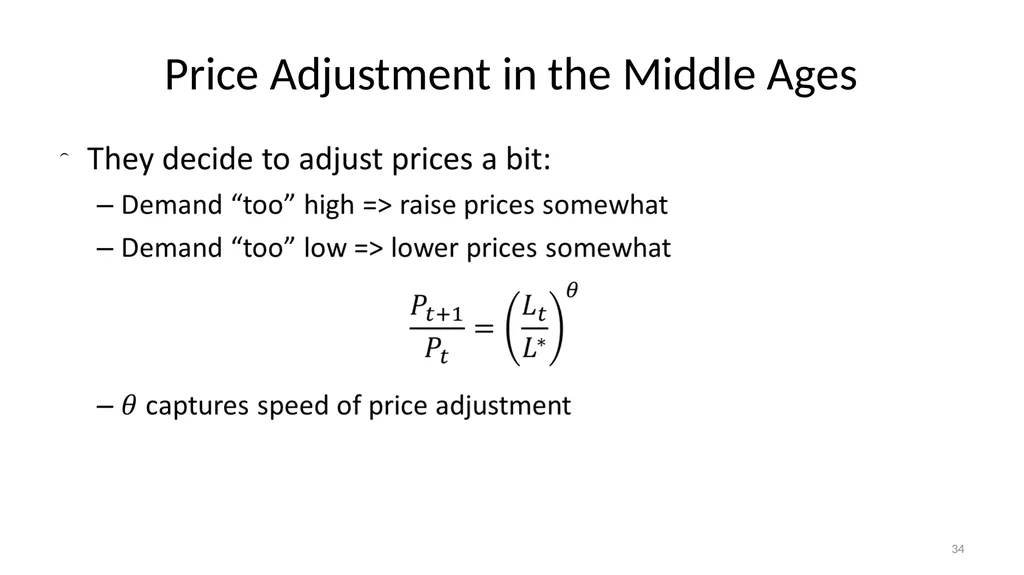
Price Adjustment in the Middle Ages 34<br>
35
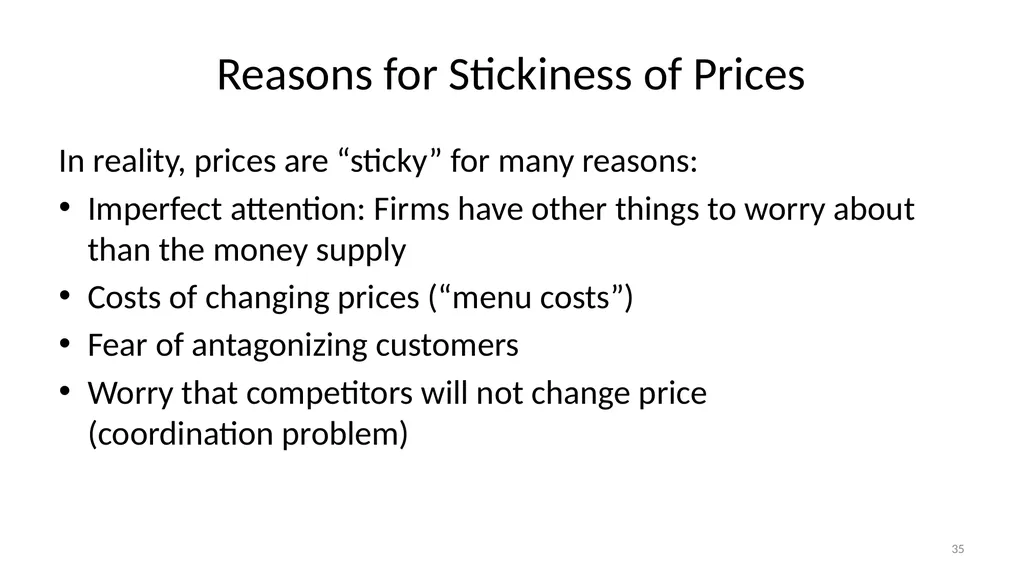
Reasons for Stickiness of Prices In reality, prices are “sticky” for many reasons:
Imperfect attention: Firms have other things to worry about than the money supply
Costs of changing prices (“menu costs”)
Fear of antagonizing customers
Worry that competitors will not change price (coordination problem) 35<br>
Imperfect attention: Firms have other things to worry about than the money supply
Costs of changing prices (“menu costs”)
Fear of antagonizing customers
Worry that competitors will not change price (coordination problem) 35<br>
36
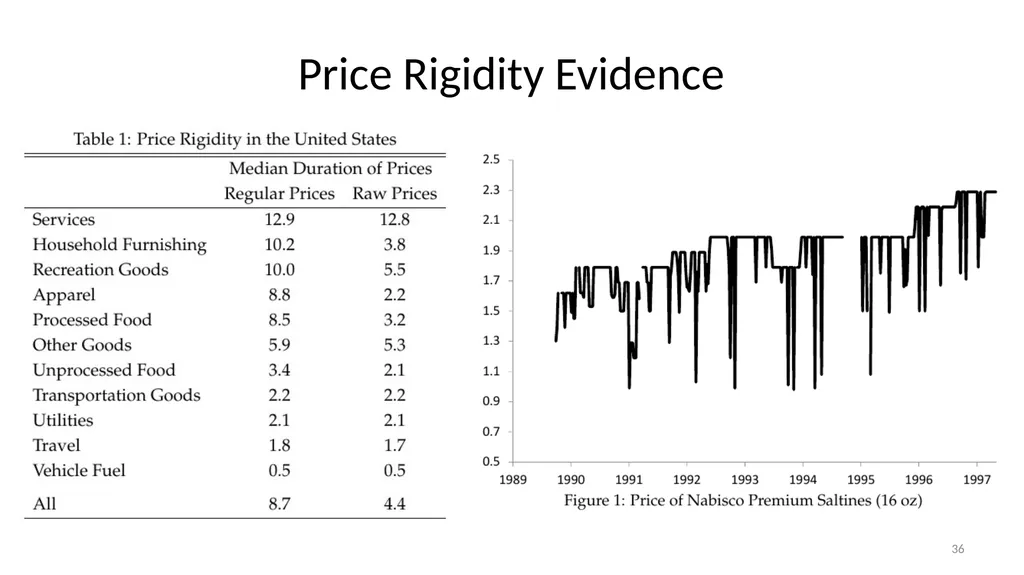
Price Rigidity Evidence 36<br>
37
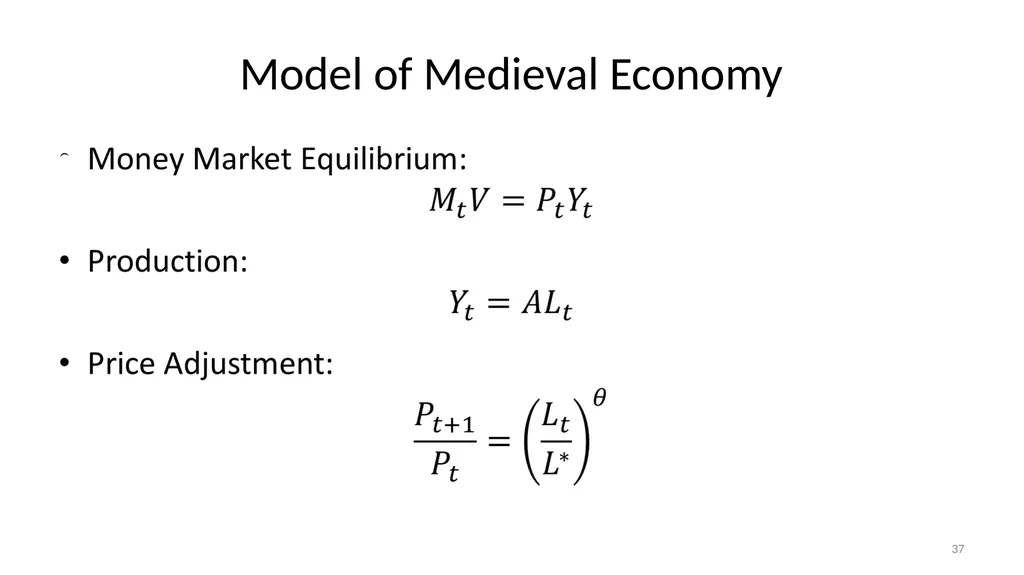
Model of Medieval Economy 37<br>
38
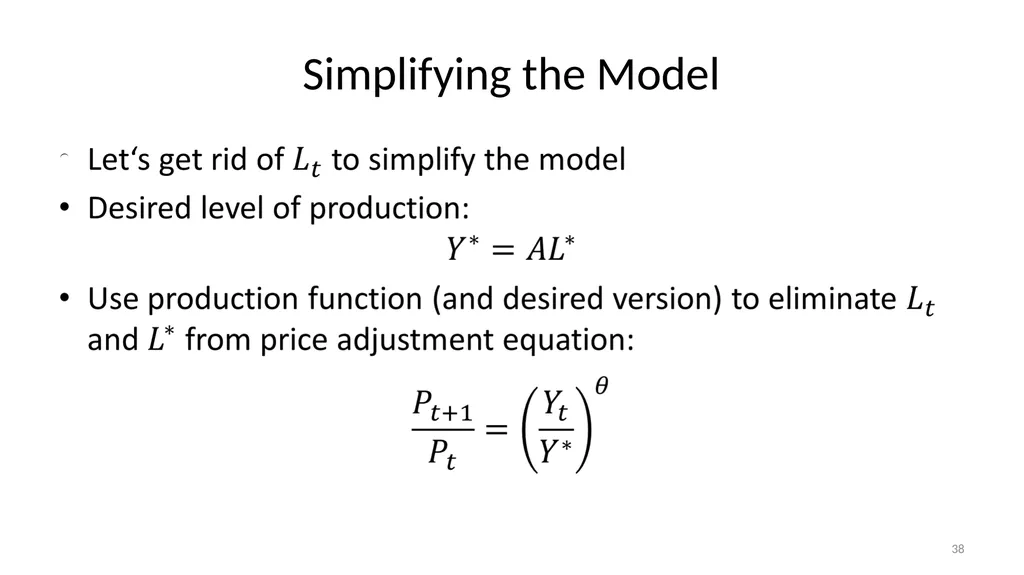
Simplifying the Model 38<br>
39
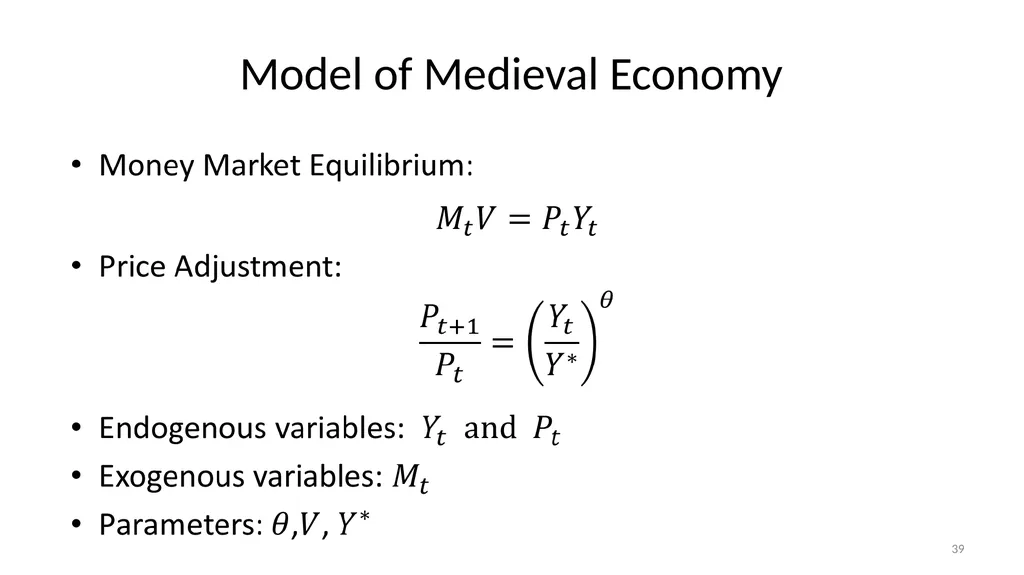
Model of Medieval Economy 39<br>
40
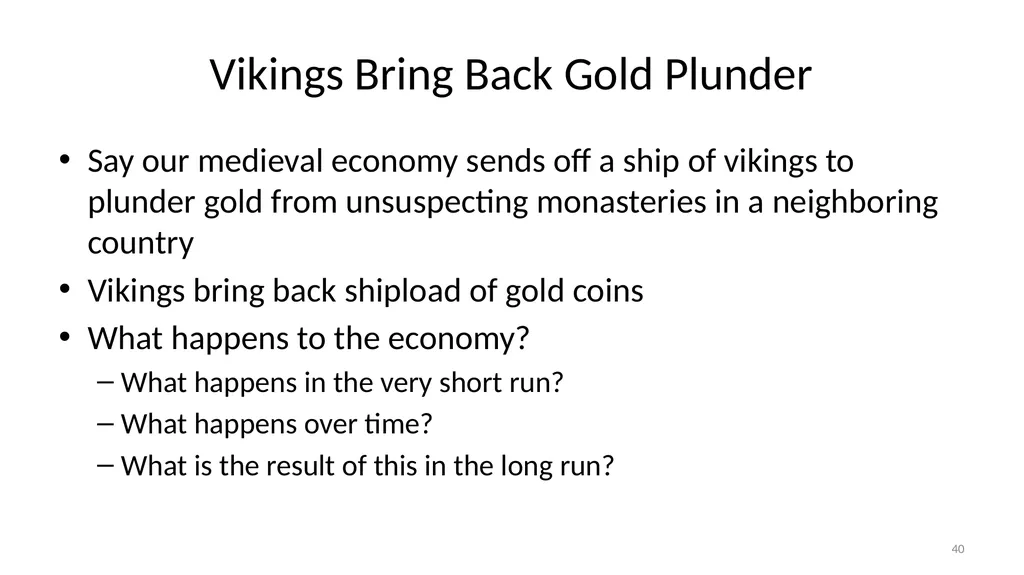
Vikings Bring Back Gold Plunder Say our medieval economy sends off a ship of vikings to plunder gold from unsuspecting monasteries in a neighboring country
Vikings bring back shipload of gold coins
What happens to the economy?
What happens in the very short run?
What happens over time?
What is the result of this in the long run? 40<br>
Vikings bring back shipload of gold coins
What happens to the economy?
What happens in the very short run?
What happens over time?
What is the result of this in the long run? 40<br>
41
Vikings Bring Back Gold Plunder At first: Vikings go on a spending spree
Gold coins slowly diffuse through the economy
Everyone has more gold coins than before
People have more gold coins than they want
So, what do they do?
Try to spend them. Boom time!!
On aggregate this doesn’t help
If one person spends someone else gets a gold coin
“Too much money chasing too few goods” 41<br>
Gold coins slowly diffuse through the economy
Everyone has more gold coins than before
People have more gold coins than they want
So, what do they do?
Try to spend them. Boom time!!
On aggregate this doesn’t help
If one person spends someone else gets a gold coin
“Too much money chasing too few goods” 41<br>
42
Boom Time in the Middle Ages Producers face increased demand for their goods
How do they respond to this?
Prices start to rise
How much do prices rise?
How does this affect the boom in output?
Not clear
Helpful to use our formal model 42<br>
How do they respond to this?
Prices start to rise
How much do prices rise?
How does this affect the boom in output?
Not clear
Helpful to use our formal model 42<br>
43
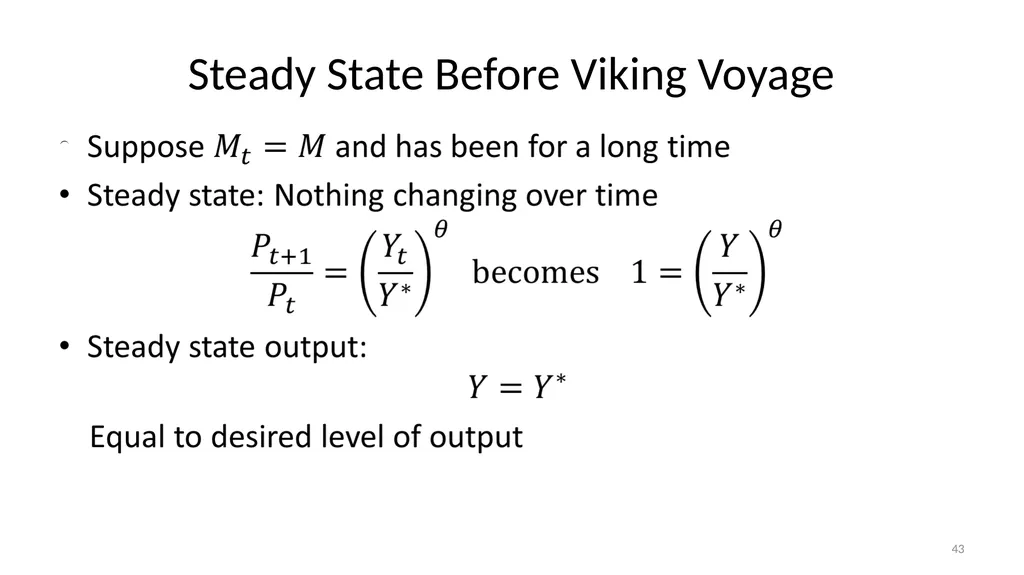
Steady State Before Viking Voyage 43<br>
44
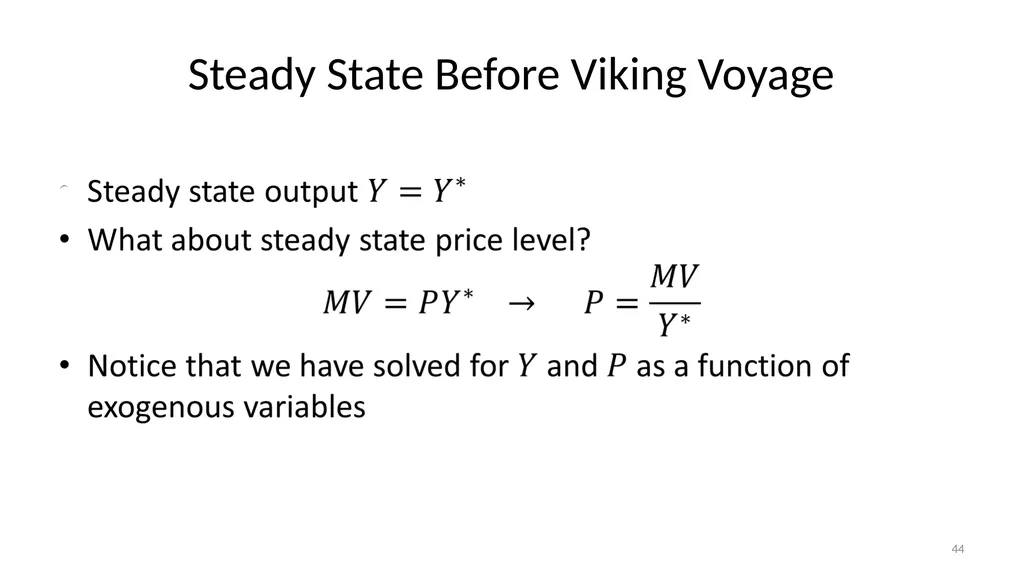
Steady State Before Viking Voyage 44<br>
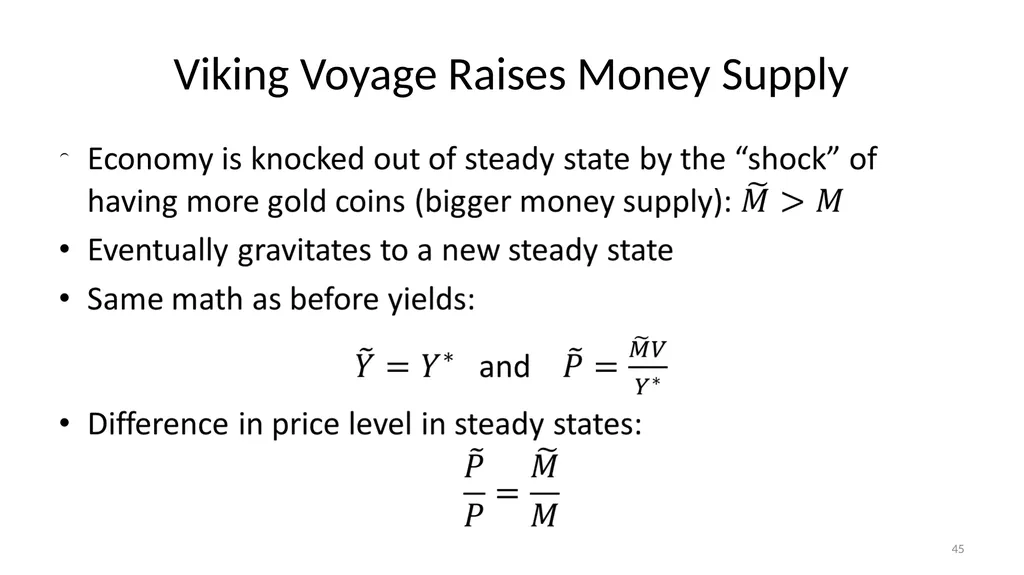
45
Viking Voyage Raises Money Supply 45<br>
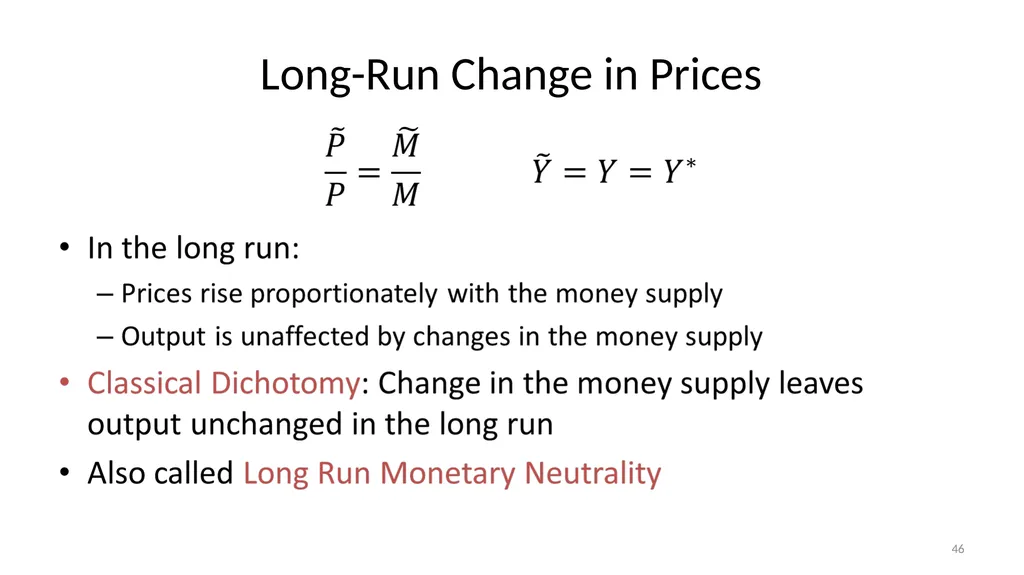
46
Long-Run Change in Prices 46<br>
47
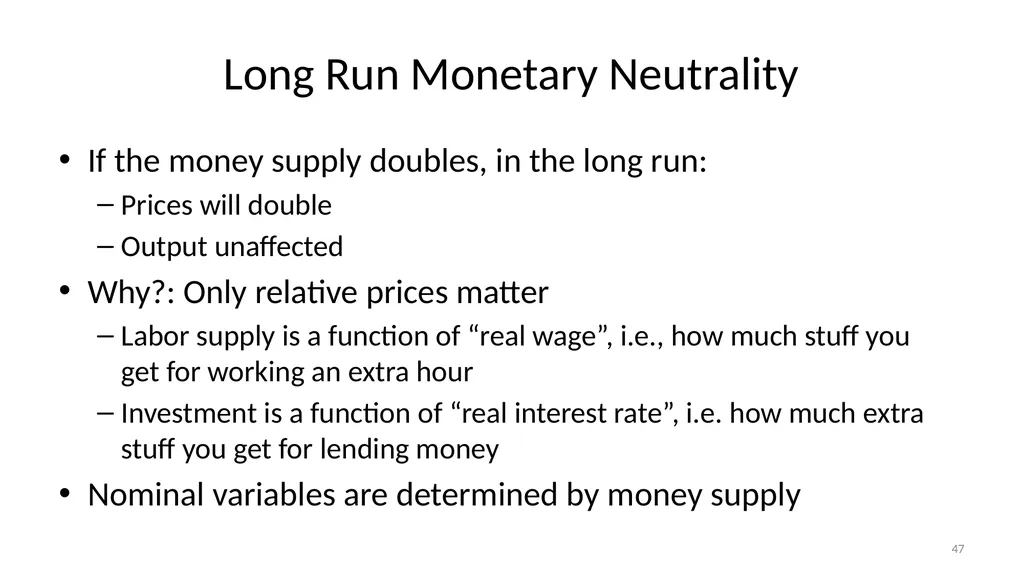
Long Run Monetary Neutrality If the money supply doubles, in the long run:
Prices will double
Output unaffected
Why?: Only relative prices matter
Labor supply is a function of “real wage”, i.e., how much stuff you get for working an extra hour
Investment is a function of “real interest rate”, i.e. how much extra stuff you get for lending money
Nominal variables are determined by money supply 47<br>
Prices will double
Output unaffected
Why?: Only relative prices matter
Labor supply is a function of “real wage”, i.e., how much stuff you get for working an extra hour
Investment is a function of “real interest rate”, i.e. how much extra stuff you get for lending money
Nominal variables are determined by money supply 47<br>
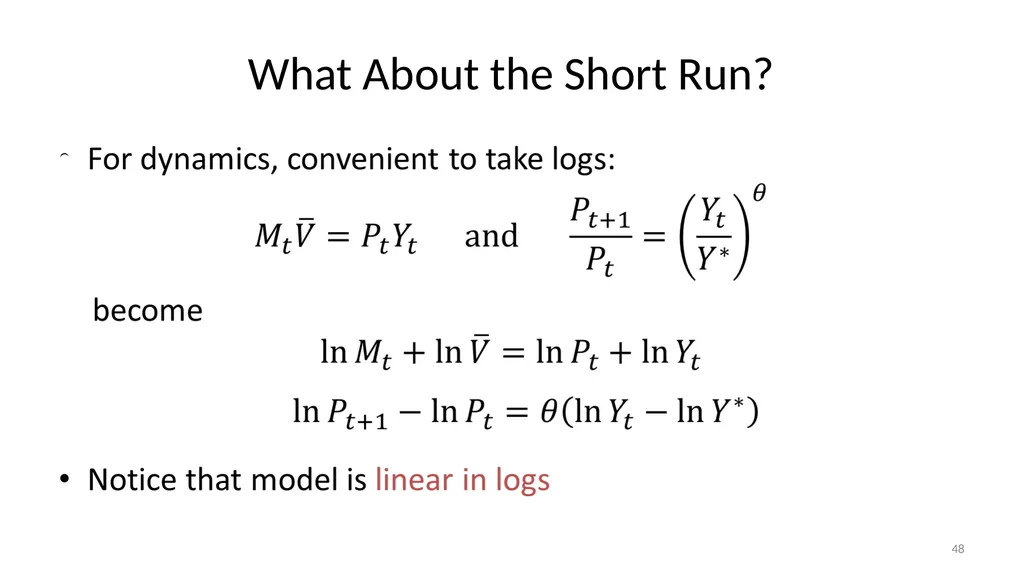
48
What About the Short Run? 48<br>
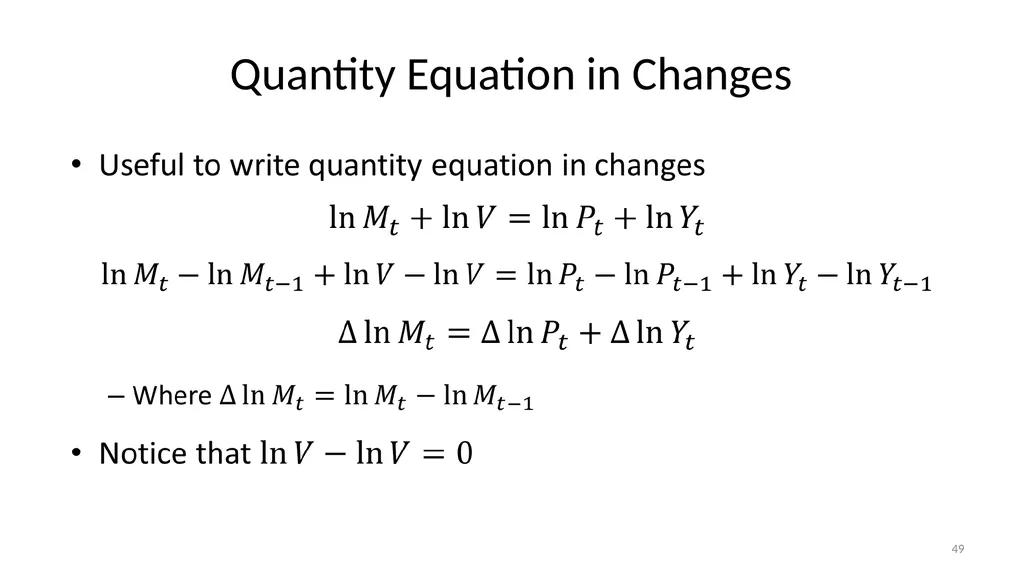
49
Quantity Equation in Changes 49<br>
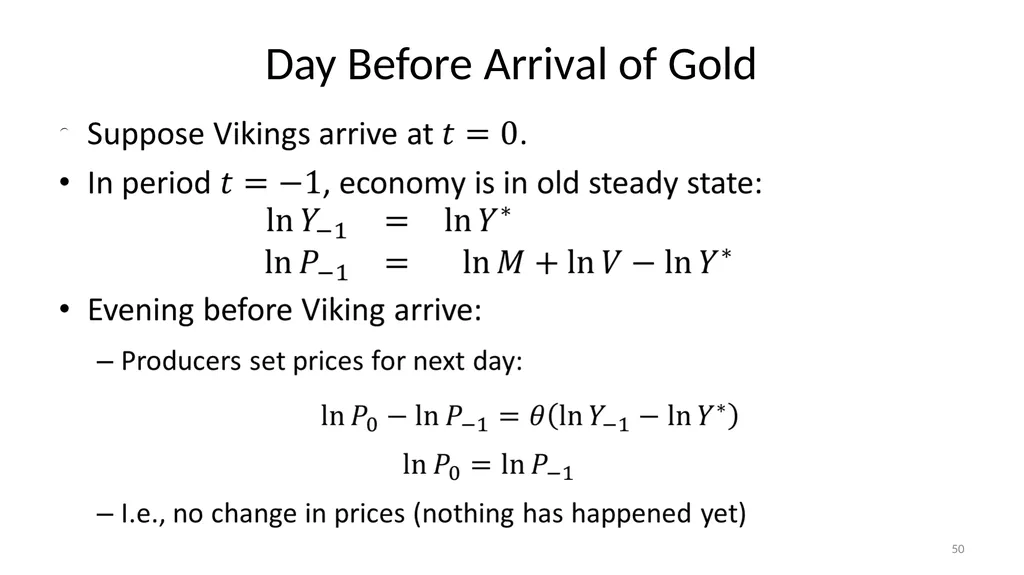
50
Day Before Arrival of Gold 50<br>
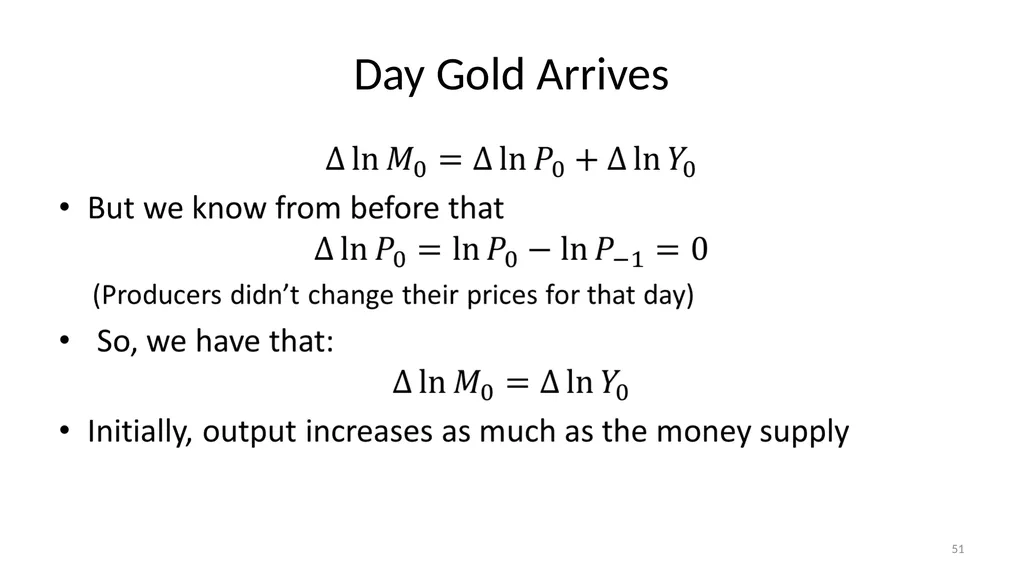
51
Day Gold Arrives 51<br>
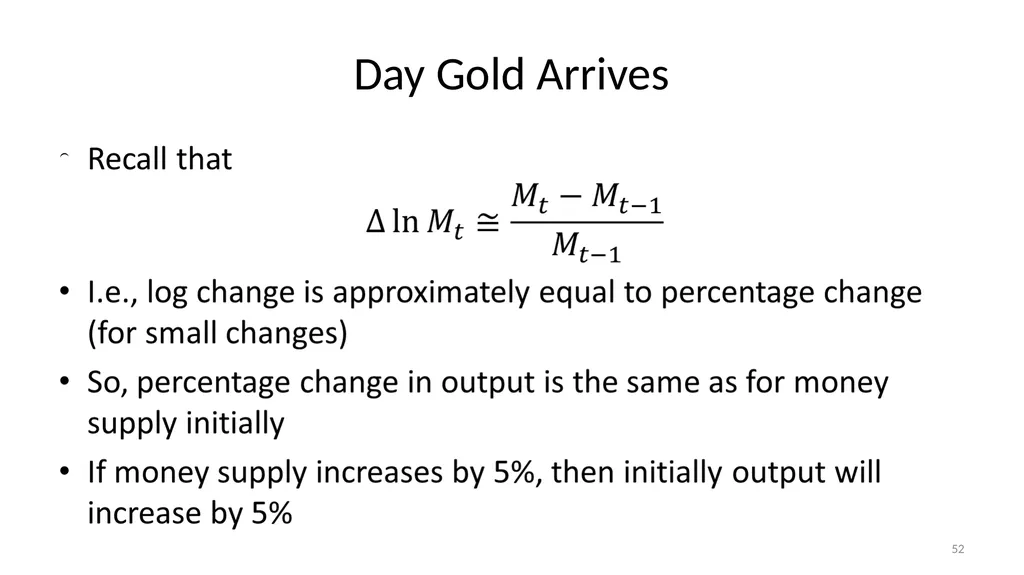
52
Day Gold Arrives 52<br>
53
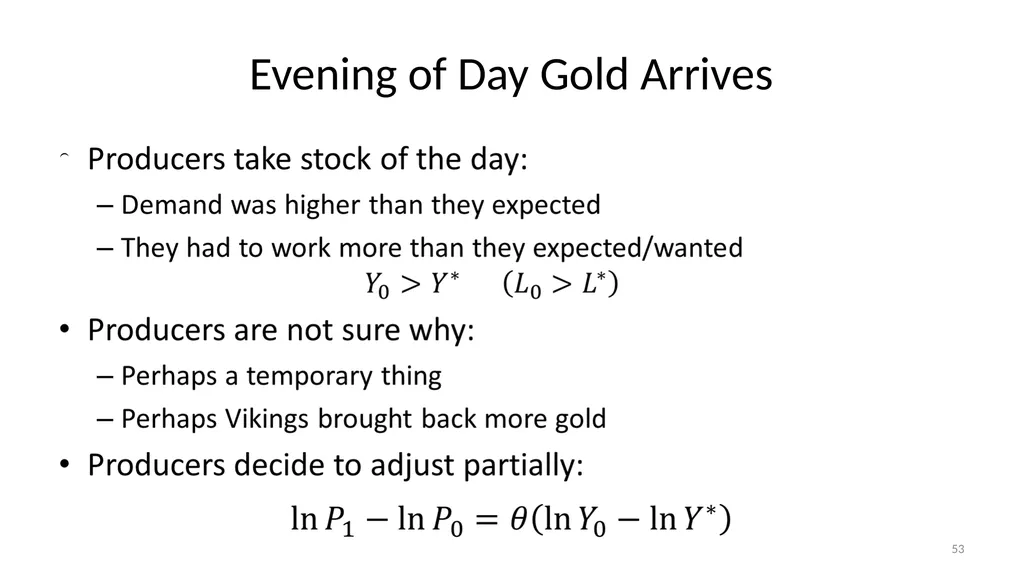
Evening of Day Gold Arrives 53<br>
54
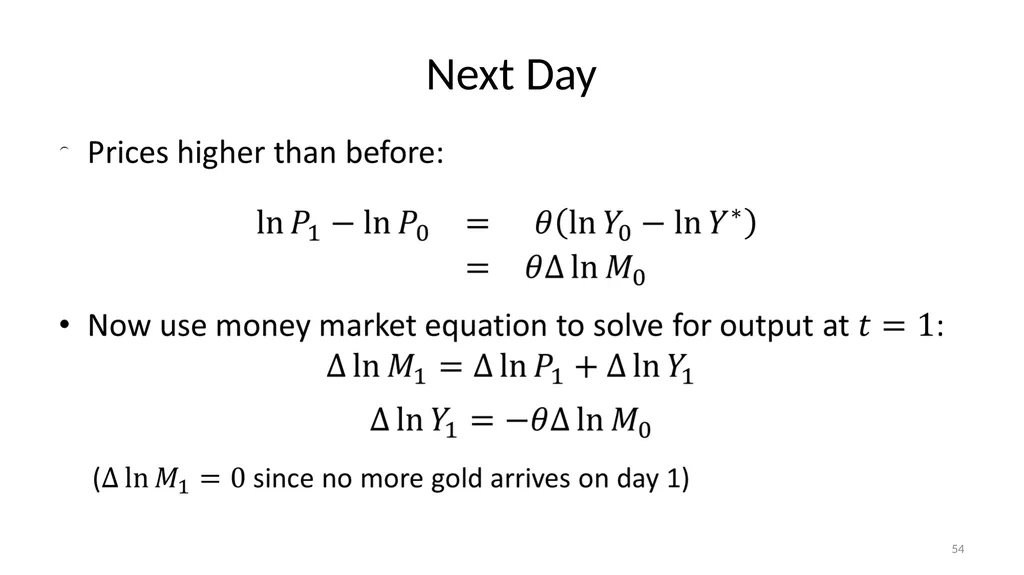
Next Day 54<br>
55
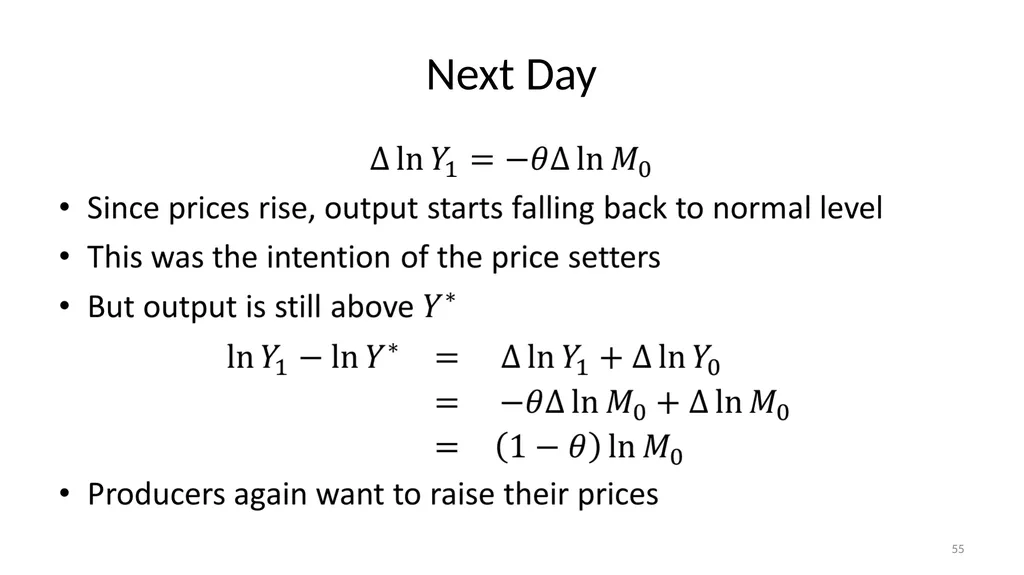
Next Day 55<br>
56
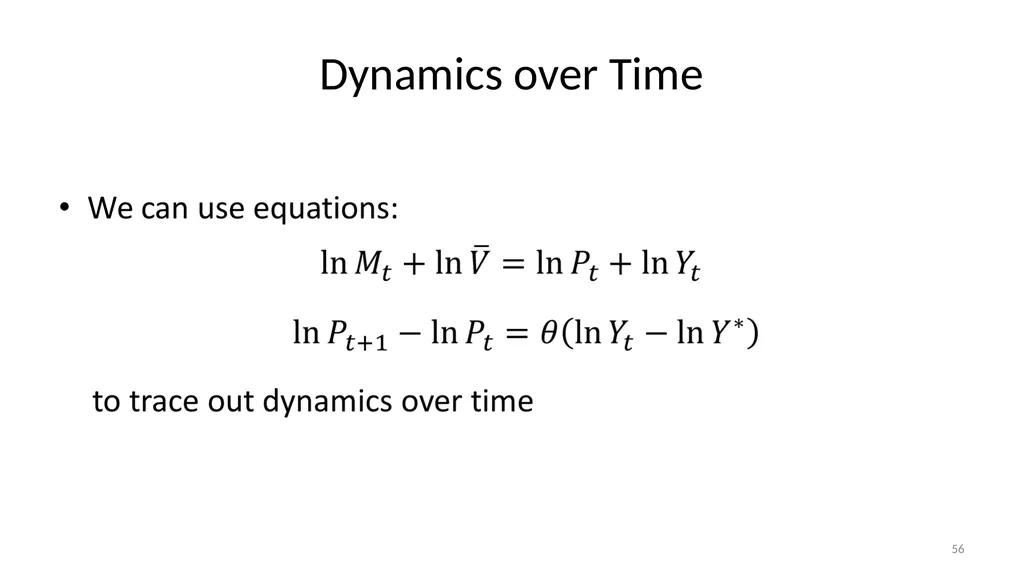
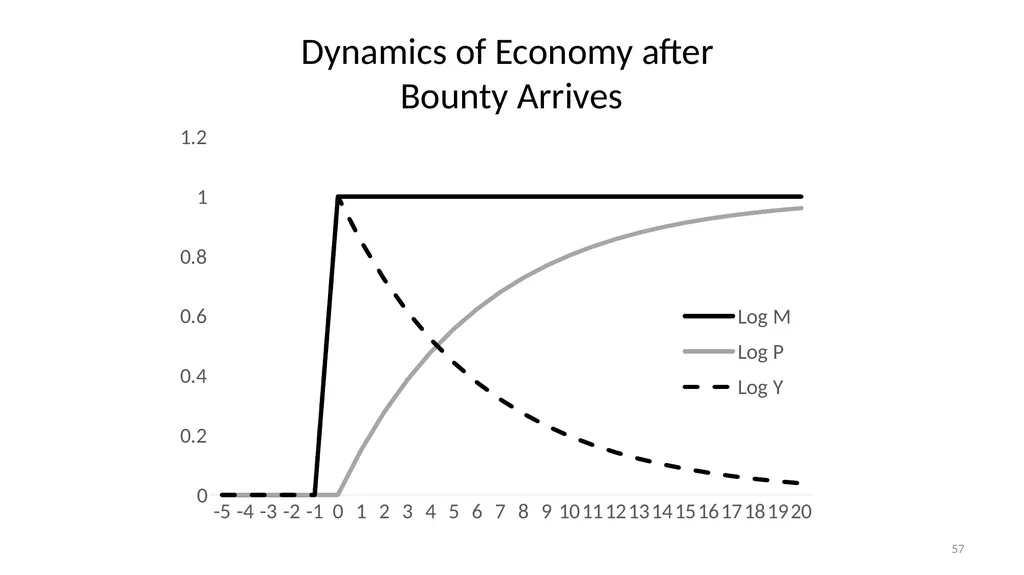
Dynamics over Time 56<br>
57
Dynamics of Economy after
Bounty Arrives 57<br>
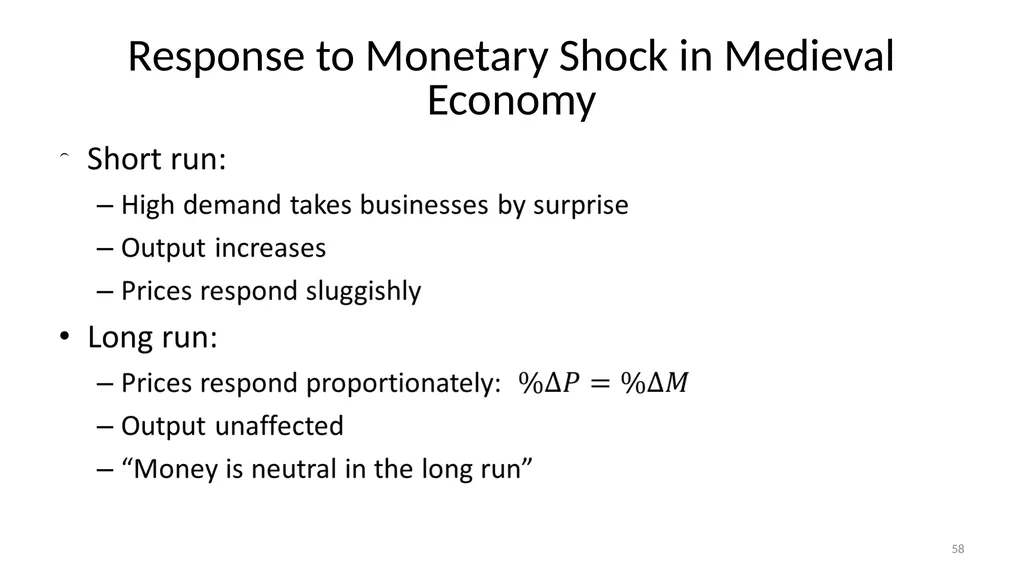
58
Response to Monetary Shock in Medieval Economy 58<br>
59
Did the Gold Plunder Make People Better Off? In the short run?
Boom in output
But they had to work more to create the output
Actually, they worked more than they wanted
In the long run?
Output the same as before
Prices higher
Striking gold is good for the individual but perhaps not for society as a whole. 59<br>
Boom in output
But they had to work more to create the output
Actually, they worked more than they wanted
In the long run?
Output the same as before
Prices higher
Striking gold is good for the individual but perhaps not for society as a whole. 59<br>
60
Change in the Supply of Gold Coins Neoclassical Economics:
All prices rise immediately (by same fraction as money supply)
Output unchanged
Money “neutral” (no effect on output)
Keynesian Economics:
Prices slow to react
Output responds to monetary shocks
Recessions and booms can be caused and alleviated by monetary policy 60<br>
All prices rise immediately (by same fraction as money supply)
Output unchanged
Money “neutral” (no effect on output)
Keynesian Economics:
Prices slow to react
Output responds to monetary shocks
Recessions and booms can be caused and alleviated by monetary policy 60<br>
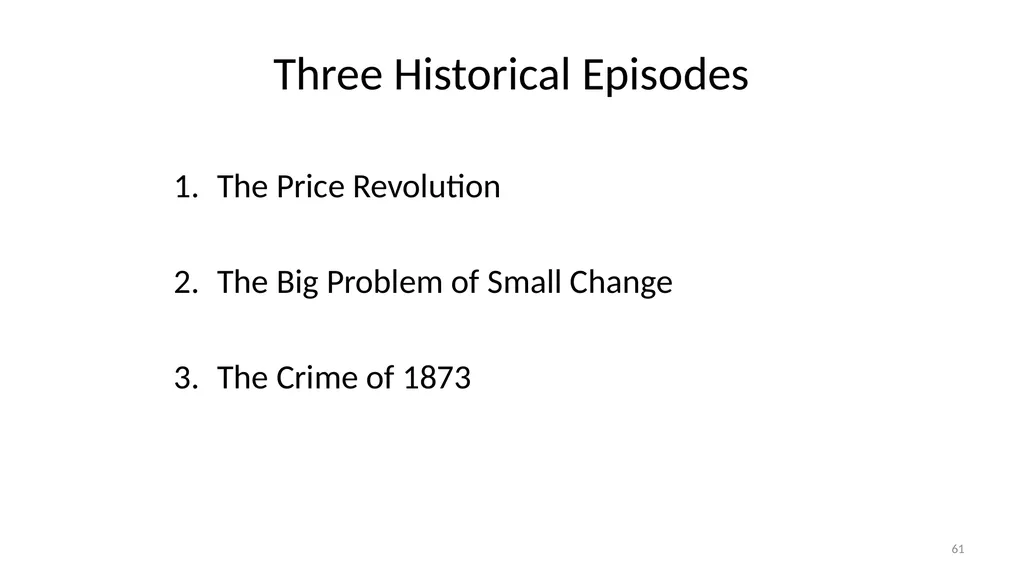
61
Three Historical Episodes The Price Revolution
The Big Problem of Small Change
The Crime of 1873 61<br>
The Big Problem of Small Change
The Crime of 1873 61<br>
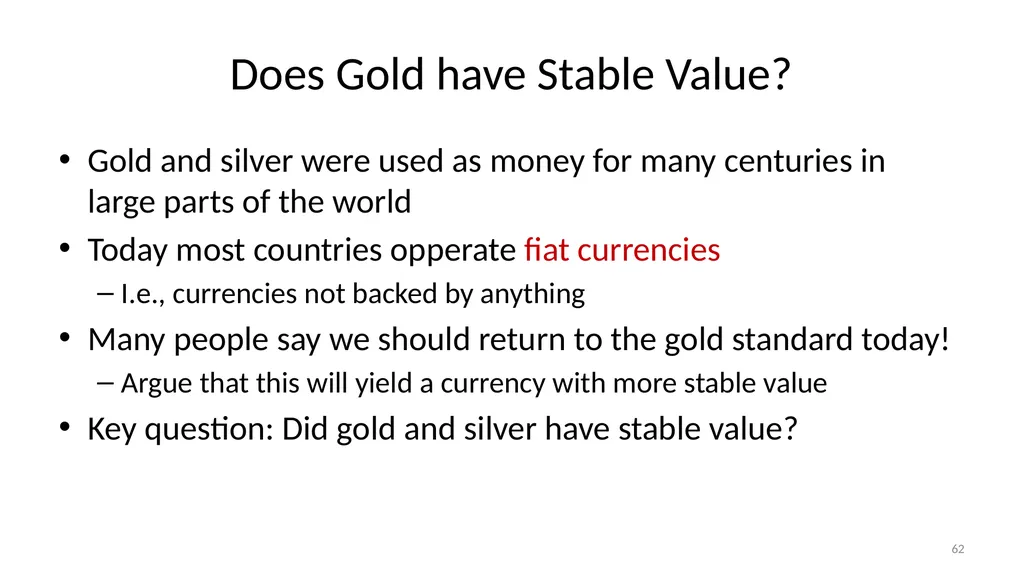
62
Does Gold have Stable Value? Gold and silver were used as money for many centuries in
large parts of the world
Today most countries opperate fiat currencies
I.e., currencies not backed by anything
Many people say we should return to the gold standard today!
Argue that this will yield a currency with more stable value
Key question: Did gold and silver have stable value? 62<br>
Today most countries opperate fiat currencies
I.e., currencies not backed by anything
Many people say we should return to the gold standard today!
Argue that this will yield a currency with more stable value
Key question: Did gold and silver have stable value? 62<br>
63
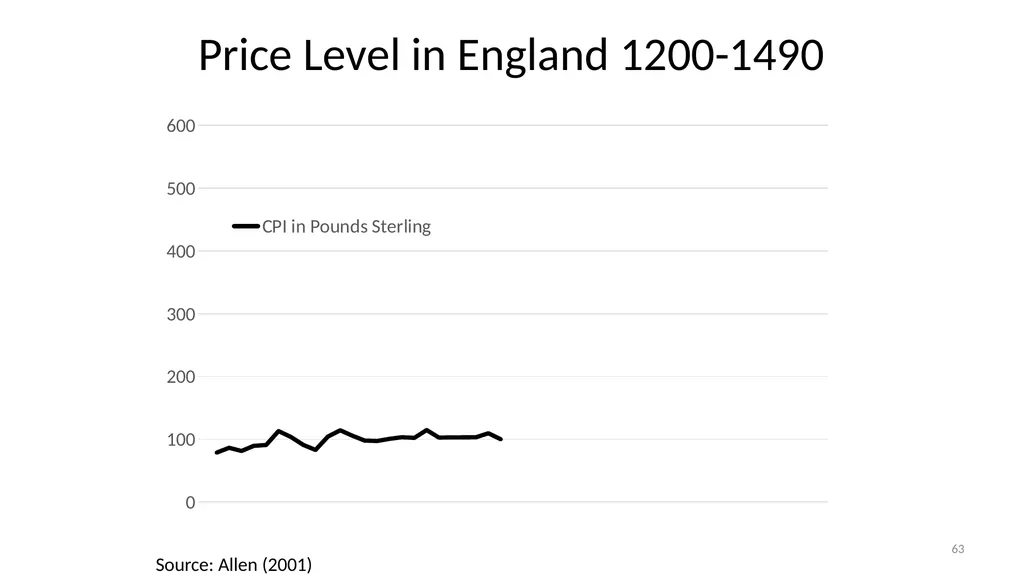
Price Level in England 1200-1490 63 Source: Allen (2001)<br>
64
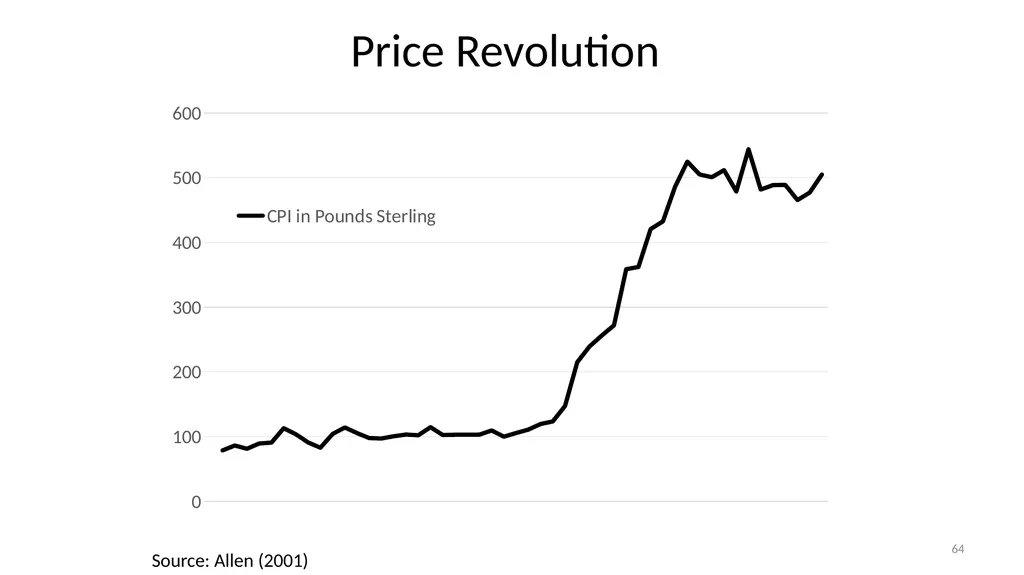
Price Revolution 64 Source: Allen (2001)<br>
65
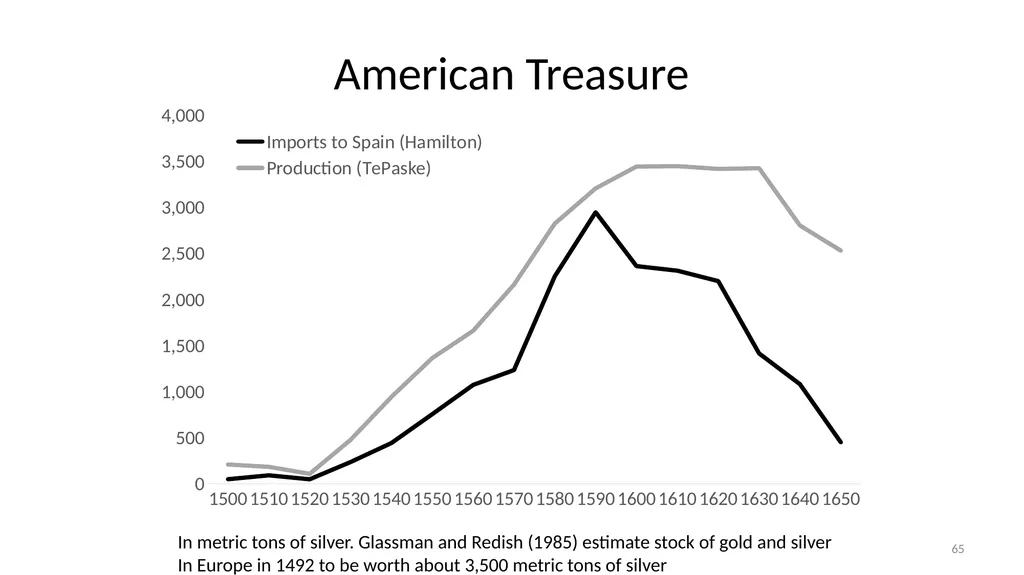
American Treasure 65 In metric tons of silver. Glassman and Redish (1985) estimate stock of gold and silver
In Europe in 1492 to be worth about 3,500 metric tons of silver<br>
In Europe in 1492 to be worth about 3,500 metric tons of silver<br>
66
Popular Culprits for Inflation During Price Revolution, many believe inflation is due to:
Middlemen, speculators, and monopoly profits
Such discussion often fails to understand difference between one particlar price being high and the overall price level being high
Monopoly power leads to a high relative price of a paricular product, not a high overall price level 66<br>
Middlemen, speculators, and monopoly profits
Such discussion often fails to understand difference between one particlar price being high and the overall price level being high
Monopoly power leads to a high relative price of a paricular product, not a high overall price level 66<br>
67
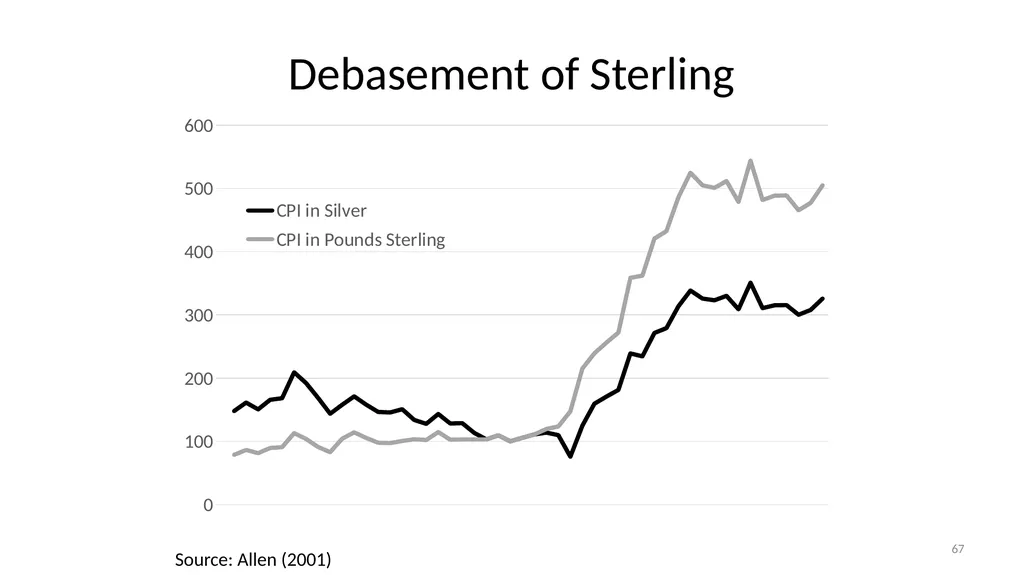
Debasement of Sterling 67 Source: Allen (2001)<br>
68
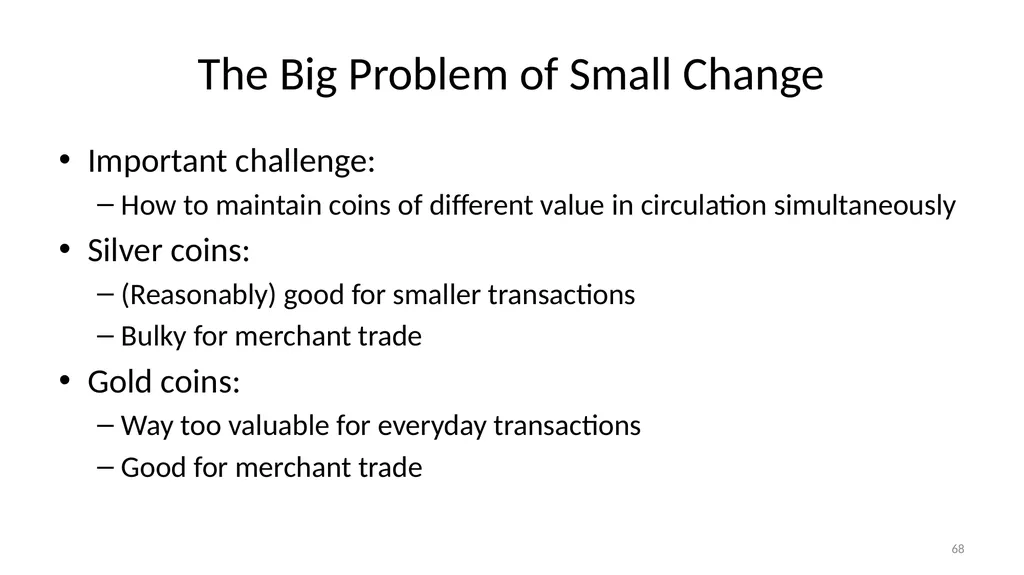
The Big Problem of Small Change Important challenge:
How to maintain coins of different value in circulation simultaneously
Silver coins:
(Reasonably) good for smaller transactions
Bulky for merchant trade
Gold coins:
Way too valuable for everyday transactions
Good for merchant trade 68<br>
How to maintain coins of different value in circulation simultaneously
Silver coins:
(Reasonably) good for smaller transactions
Bulky for merchant trade
Gold coins:
Way too valuable for everyday transactions
Good for merchant trade 68<br>
69
Bimetallism Bimetallism is a monetary system based on a combination of silver and gold coins
Benefit: Coins with a wide range of value
Drawback: Difficult to maintain silver and gold coins in circulation simultaneously
Why difficult? 69<br>
Benefit: Coins with a wide range of value
Drawback: Difficult to maintain silver and gold coins in circulation simultaneously
Why difficult? 69<br>
70
Difficulties with Bimetallism Two reasons why it was difficult to maintain gold and silver coins in circulation simultaneously:
The relative price of silver vs. gold changed over time
Silver coins were clipped and got worn (silver content fell)
Suppose market price of gold for silver is 13 (i.e., 13g of silver buy 1g of gold)
If silver and gold coins are minted with this weight ratio, both will circulate 70<br>
The relative price of silver vs. gold changed over time
Silver coins were clipped and got worn (silver content fell)
Suppose market price of gold for silver is 13 (i.e., 13g of silver buy 1g of gold)
If silver and gold coins are minted with this weight ratio, both will circulate 70<br>
71
Undervalued Coins Suppose market price of gold rises to 14-to-1 vs. silver
Gold becomes “undervalued” at the Mint
You get 13 pennies per gram of gold at the Mint
You get 14 pennies worth of silver per gram of gold on the market!
Consequence:
No one brings gold to the Mint
Gold coins start being exported / melted down
Eventually no more gold coins! 71<br>
Gold becomes “undervalued” at the Mint
You get 13 pennies per gram of gold at the Mint
You get 14 pennies worth of silver per gram of gold on the market!
Consequence:
No one brings gold to the Mint
Gold coins start being exported / melted down
Eventually no more gold coins! 71<br>
72
Undervalued Coins Another problem:
Silver coins are clipped or get worn
Silver coins no longer 1g. Rather (say) 0.8g
Consequences:
Profitable to create counterfeit “worn” coins (i.e., 0.8g coins)
Value of coins falls to reflect lower weight
But then market price of silver in pence rises above price at the mint
New silver coins become undervalued at the Mint
Eventually sovereign decides to debase 72<br>
Silver coins are clipped or get worn
Silver coins no longer 1g. Rather (say) 0.8g
Consequences:
Profitable to create counterfeit “worn” coins (i.e., 0.8g coins)
Value of coins falls to reflect lower weight
But then market price of silver in pence rises above price at the mint
New silver coins become undervalued at the Mint
Eventually sovereign decides to debase 72<br>
73
Big Problem of Small Change Huge problem for hundreds of years
One example: In 1717 Isaac Newton as Master of the Mint, overvalued gold coins (undervalued silver coins)
Consequence: Chronic shortage of small change (silver coins) in Britain throughout 18th century 73<br>
One example: In 1717 Isaac Newton as Master of the Mint, overvalued gold coins (undervalued silver coins)
Consequence: Chronic shortage of small change (silver coins) in Britain throughout 18th century 73<br>
74
Big Problem of Small Change Solution: Adopt token coins
I.e., coins worth more than their metallic content
Britain did this first in 1816 (U.S. in 1853, France in 1865)
Why not earlier?
Widespread metallist fallacy
Needed high quality coins to avoid counterfeiting
Needed government to guarantee value of coins 74<br>
I.e., coins worth more than their metallic content
Britain did this first in 1816 (U.S. in 1853, France in 1865)
Why not earlier?
Widespread metallist fallacy
Needed high quality coins to avoid counterfeiting
Needed government to guarantee value of coins 74<br>
75
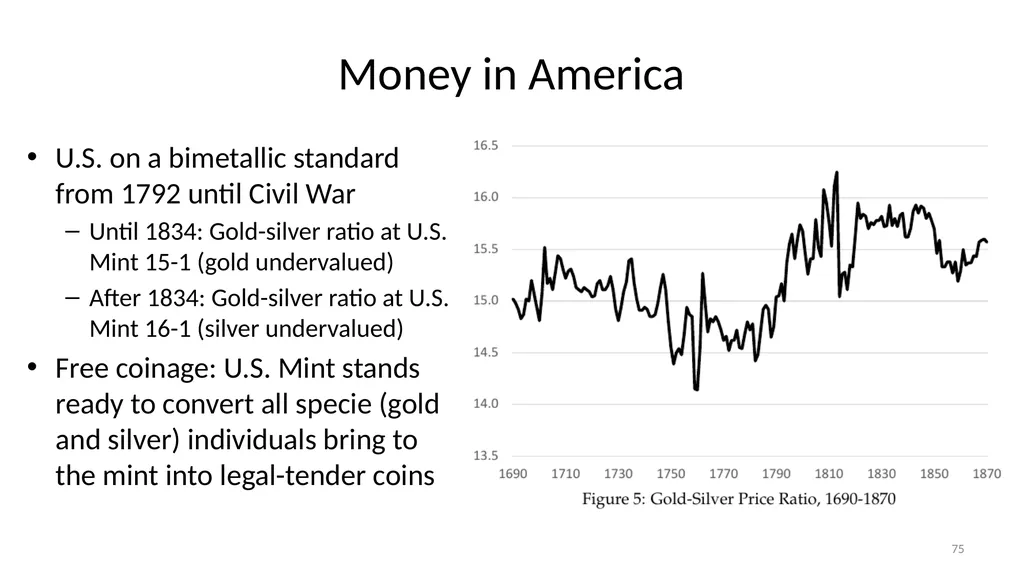
Money in America U.S. on a bimetallic standard from 1792 until Civil War
Until 1834: Gold-silver ratio at U.S. Mint 15-1 (gold undervalued)
After 1834: Gold-silver ratio at U.S. Mint 16-1 (silver undervalued)
Free coinage: U.S. Mint stands ready to convert all specie (gold and silver) individuals bring to the mint into legal-tender coins 75<br>
Until 1834: Gold-silver ratio at U.S. Mint 15-1 (gold undervalued)
After 1834: Gold-silver ratio at U.S. Mint 16-1 (silver undervalued)
Free coinage: U.S. Mint stands ready to convert all specie (gold and silver) individuals bring to the mint into legal-tender coins 75<br>
76
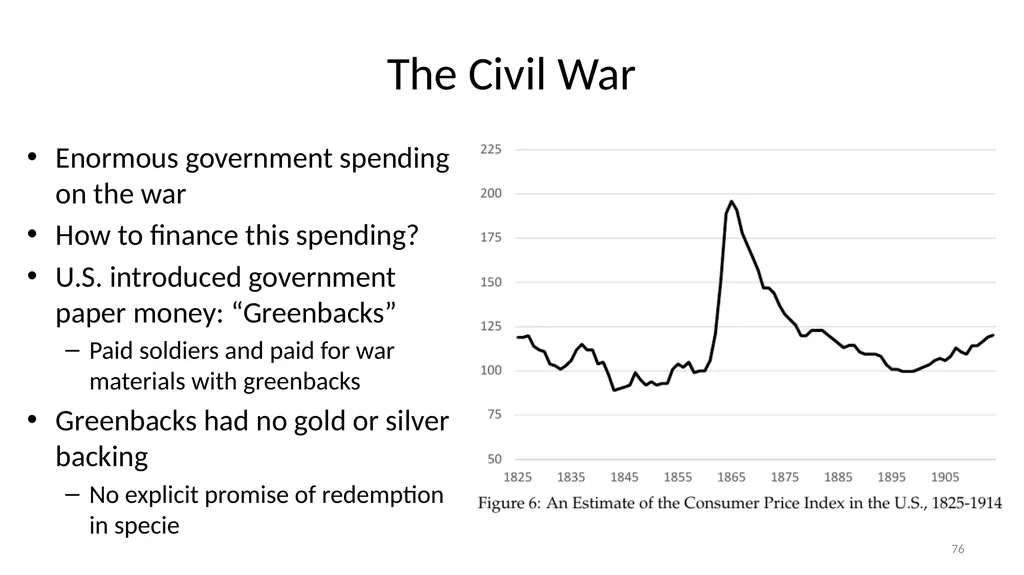
The Civil War Enormous government spending on the war
How to finance this spending?
U.S. introduced government paper money: “Greenbacks”
Paid soldiers and paid for war materials with greenbacks
Greenbacks had no gold or silver backing
No explicit promise of redemption in specie 76<br>
How to finance this spending?
U.S. introduced government paper money: “Greenbacks”
Paid soldiers and paid for war materials with greenbacks
Greenbacks had no gold or silver backing
No explicit promise of redemption in specie 76<br>
77
Back to a Gold Standard Wartime inflation doubled price level (in Greenbacks)
After war: Widespread desire to return to a commodity standard (“sound money”)
Many people think:
We went off the gold standard and we had a lot of inflation. So, being off gold standard causes inflation.
Is this a sound argument? 77<br>
After war: Widespread desire to return to a commodity standard (“sound money”)
Many people think:
We went off the gold standard and we had a lot of inflation. So, being off gold standard causes inflation.
Is this a sound argument? 77<br>
78
Back to Gold Standard Resumption Act of 1875:
Full convertibility of paper money into gold and vice-versa (at pre-war rate)
Should take place Jan 1, 1879
Many other countries adopted gold at similar time
Britain (de facto 1717)
France (1865), Germany (1873)
1870s-1914: International Gold Standard 78<br>
Full convertibility of paper money into gold and vice-versa (at pre-war rate)
Should take place Jan 1, 1879
Many other countries adopted gold at similar time
Britain (de facto 1717)
France (1865), Germany (1873)
1870s-1914: International Gold Standard 78<br>
79
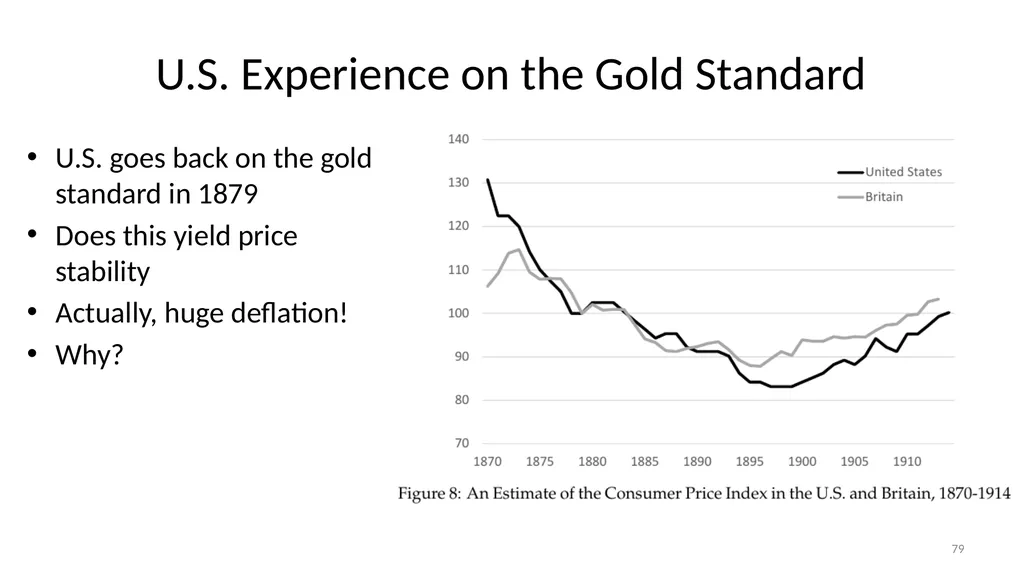
U.S. Experience on the Gold Standard U.S. goes back on the gold standard in 1879
Does this yield price stability
Actually, huge deflation!
Why? 79<br>
Does this yield price stability
Actually, huge deflation!
Why? 79<br>
80
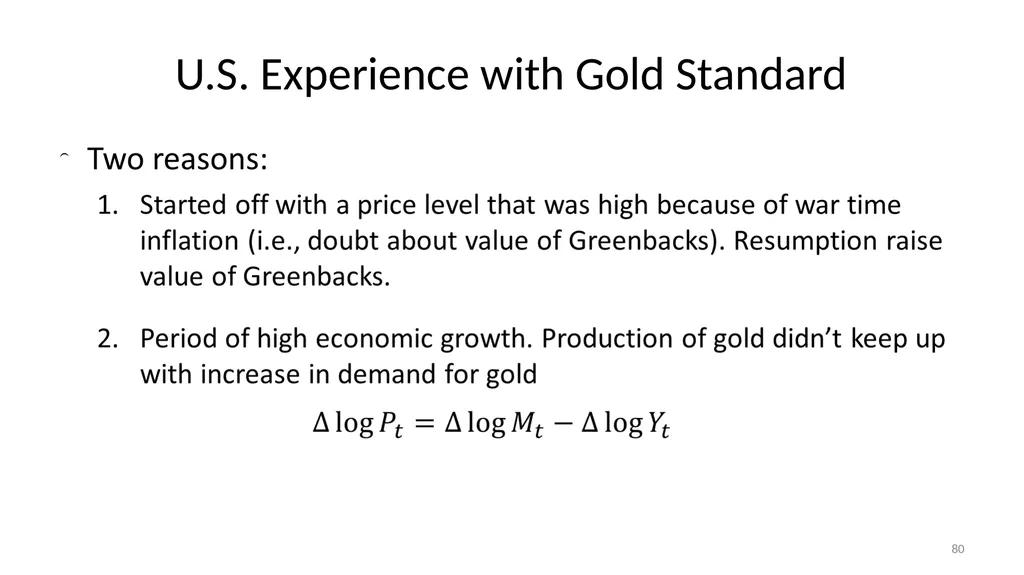
U.S. Experience with Gold Standard 80<br>
81
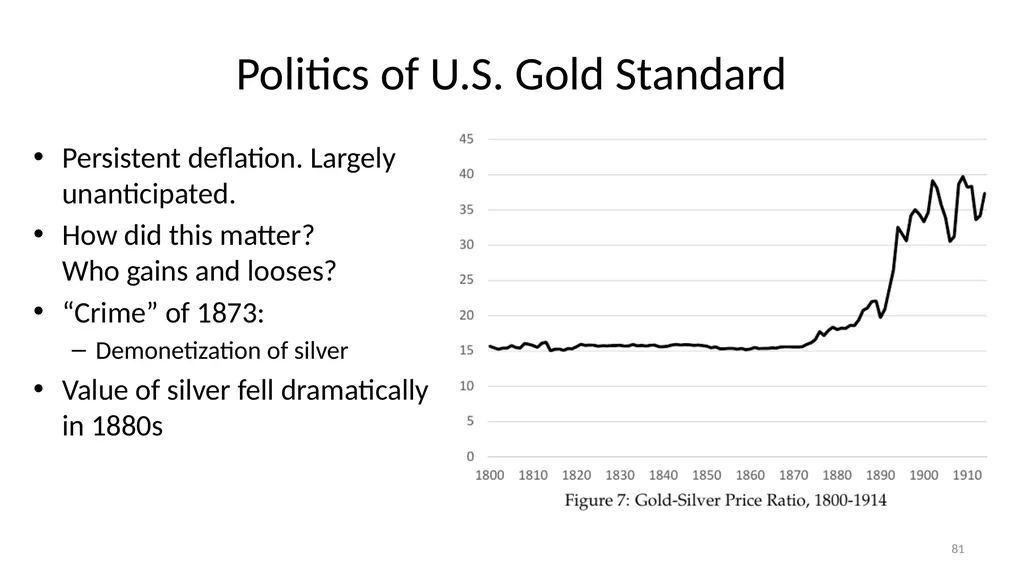
Politics of U.S. Gold Standard Persistent deflation. Largely unanticipated.
How did this matter? Who gains and looses?
“Crime” of 1873:
Demonetization of silver
Value of silver fell dramatically in 1880s 81<br>
How did this matter? Who gains and looses?
“Crime” of 1873:
Demonetization of silver
Value of silver fell dramatically in 1880s 81<br>
82
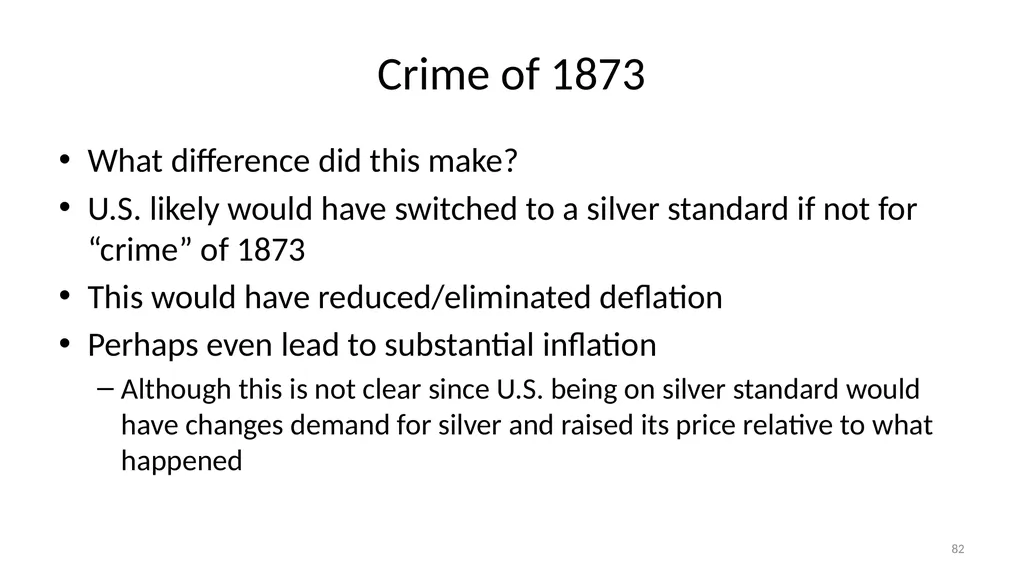
Crime of 1873 What difference did this make?
U.S. likely would have switched to a silver standard if not for “crime” of 1873
This would have reduced/eliminated deflation
Perhaps even lead to substantial inflation
Although this is not clear since U.S. being on silver standard would have changes demand for silver and raised its price relative to what happened 82<br>
U.S. likely would have switched to a silver standard if not for “crime” of 1873
This would have reduced/eliminated deflation
Perhaps even lead to substantial inflation
Although this is not clear since U.S. being on silver standard would have changes demand for silver and raised its price relative to what happened 82<br>
83
Politics of U.S. Gold Standard Deflation implied that monetary policy was the major election issue in the presidential election of 1896
William Jennings Bryan: “You shall not crucify mankind upon a cross of gold”
Bryan lost. Lost by bigger margin in 1900.
Movement petered out
What solved the “problem”? 83<br>
William Jennings Bryan: “You shall not crucify mankind upon a cross of gold”
Bryan lost. Lost by bigger margin in 1900.
Movement petered out
What solved the “problem”? 83<br>
84
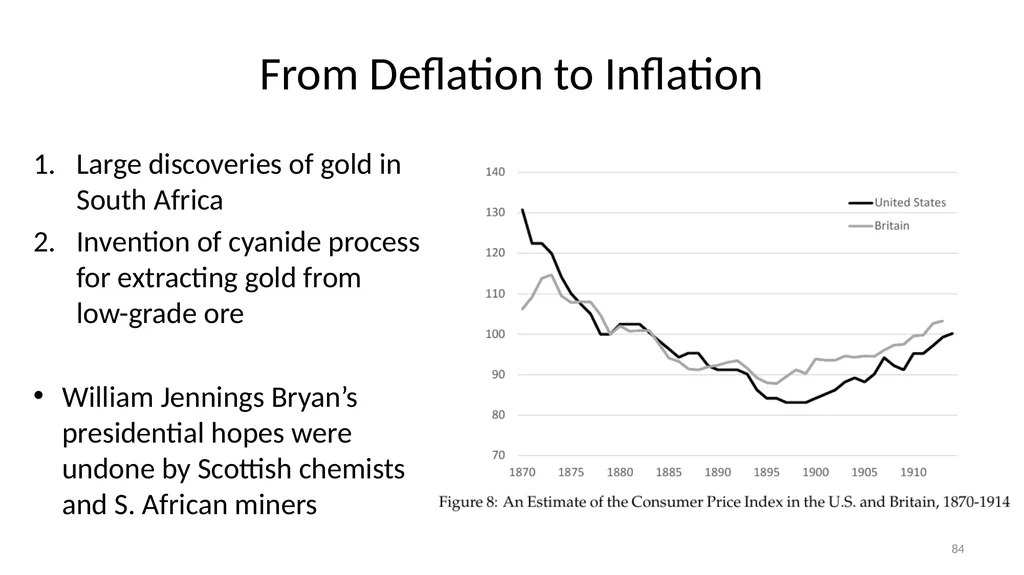
From Deflation to Inflation 84 Large discoveries of gold in South Africa
Invention of cyanide process for extracting gold from low-grade ore
William Jennings Bryan’s presidential hopes were undone by Scottish chemists and S. African miners<br>
Invention of cyanide process for extracting gold from low-grade ore
William Jennings Bryan’s presidential hopes were undone by Scottish chemists and S. African miners<br>
85
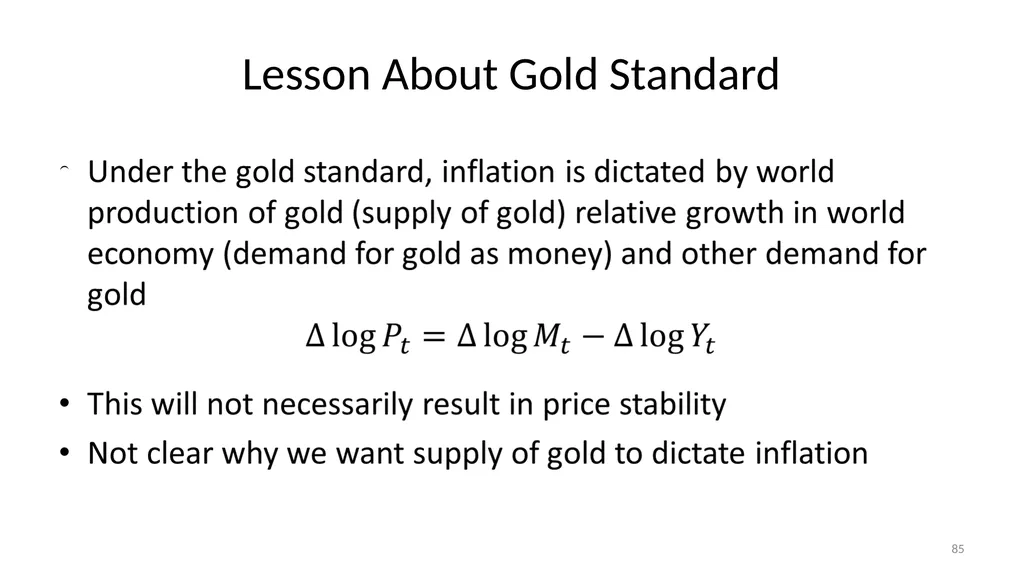
Lesson About Gold Standard 85<br>