
Lecture 12. Australia and Canada uranium markets
AS
Published · 26 slides · 0 views

1 / 1

Description
Lecture 12. Australia and Canada uranium markets Canada was the worlds largest uranium producer for many years, accounting for about 22 of world output, but in 2009 was overtaken by Kazakhstan. Production comes mainly from the McArthur
Related Topics
Share
Embed code
Download this presentation From Below
"Lecture 12. Australia and Canada uranium markets" is the property of its rightful owner. Permission is granted to download and print the materials on this website for personal, non-commercial use only, and to display it on your personal computer provided you do not modify the materials and that you retain all copyright notices contained in the materials. By downloading content from our website, you accept the terms of this agreement.
Presentation Transcript
01
Lecture 12.
Australia and Canada uranium markets<br>
02
Canada was the world's largest uranium producer for many years, accounting for about 22% of world output, but in 2009 was overtaken by Kazakhstan.
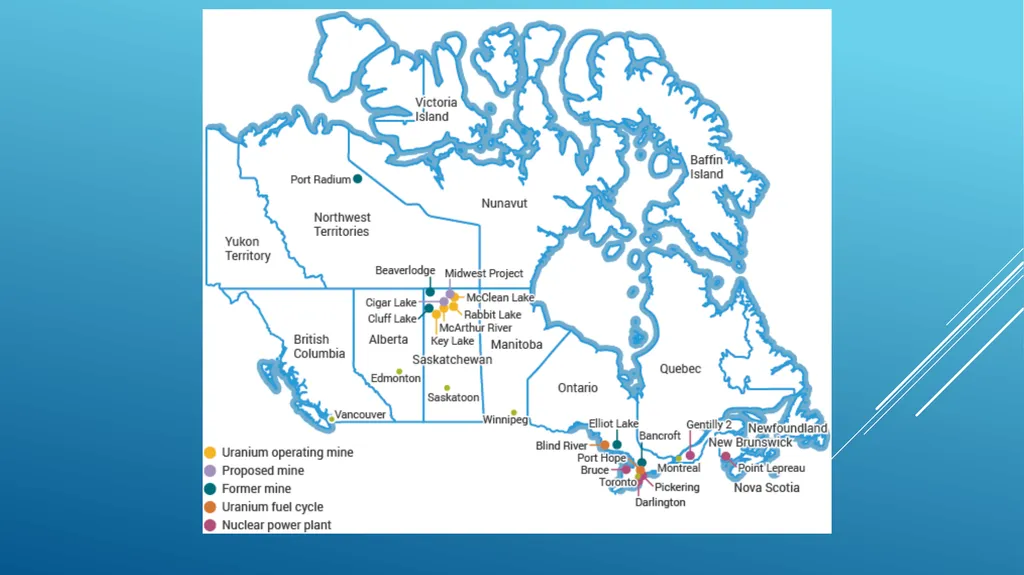
Production comes mainly from the McArthur River and Cigar Lake mines in northern Saskatchewan province, which are the largest and highest-grade in the world.
With known uranium resources of 582,500 tonnes of U3O8 (493,900 tU), as well as much continuing exploration, Canada has a significant role in meeting future world demand.
Canada is a country rich in uranium resources and a long history of exploration, mining and generation of nuclear power (for coverage of nuclear power, see Nuclear Power in Canada). To 2014, more uranium had been mined in Canada than any other country – 485,000 tU, about one-fifth of world total.<br>
Production comes mainly from the McArthur River and Cigar Lake mines in northern Saskatchewan province, which are the largest and highest-grade in the world.
With known uranium resources of 582,500 tonnes of U3O8 (493,900 tU), as well as much continuing exploration, Canada has a significant role in meeting future world demand.
Canada is a country rich in uranium resources and a long history of exploration, mining and generation of nuclear power (for coverage of nuclear power, see Nuclear Power in Canada). To 2014, more uranium had been mined in Canada than any other country – 485,000 tU, about one-fifth of world total.<br>
03
North America's uranium mines Canada
In Canada, uranium ores first came to public attention in the early 1930s when the Eldorado Gold Mining Company began operations at Port Radium, Northwest Territories, to recover radium. A refinery to produce radium was built at Port Hope, Ontario, some 5000 km away. Radium is one of the decay products of uranium and is therefore found in all uranium ores. As its name suggests it is highly radioactive. It had niche applications in the early part of the 20th century, for example as luminous paint, before the dangers of radiation became widely known. Hence a market for radium existed before uranium was in demand.
Exploration for uranium began in earnest in 1942, in response to a demand for defence purposes. By 1956 thousands of radioactive occurrences had been discovered and three years later 23 uranium mines with 19 treatment plants were in operation. The main production centre was around Elliot Lake in Ontario, but northern Saskatchewan hosted some plants. This first phase of Canadian uranium production peaked in 1959 when more than 12,000 tonnes of uranium was produced. This uranium yielded more in export revenue than any other mineral export from Canada that year.
In response to the development of civil nuclear power, uranium exploration revived during the 1970s, with the focus on in northern Saskatchewan’s Athabasca Basin. The Rabbit Lake, Cluff Lake and Key Lake mines started up 1975 to 1983. Exploration expenditure in the region peaked at this time, resulting in the discoveries of Midwest, McClean Lake and Cigar Lake. Then in 1988 the newly-formed Cameco Corporation discovered the massive McArthur River deposit. As earlier in Australia, there was a period in the early 1990s when the Saskatchewan government considered phasing out uranium mining in the province, but this policy was abandoned after a joint federal-Saskatchewan study found that the benefits of mining outweighed the impacts, and that any impacts could indeed be minimized. Today the government actively supports uranium mining in the province.
Canada's share of known world uranium resources is currently about 8%, but it produces about 16% of the mined uranium supply making it the second largest producer in the world behind Kazakhstan. Most uranium is exported, but about one fifth is used domestically.<br>
In Canada, uranium ores first came to public attention in the early 1930s when the Eldorado Gold Mining Company began operations at Port Radium, Northwest Territories, to recover radium. A refinery to produce radium was built at Port Hope, Ontario, some 5000 km away. Radium is one of the decay products of uranium and is therefore found in all uranium ores. As its name suggests it is highly radioactive. It had niche applications in the early part of the 20th century, for example as luminous paint, before the dangers of radiation became widely known. Hence a market for radium existed before uranium was in demand.
Exploration for uranium began in earnest in 1942, in response to a demand for defence purposes. By 1956 thousands of radioactive occurrences had been discovered and three years later 23 uranium mines with 19 treatment plants were in operation. The main production centre was around Elliot Lake in Ontario, but northern Saskatchewan hosted some plants. This first phase of Canadian uranium production peaked in 1959 when more than 12,000 tonnes of uranium was produced. This uranium yielded more in export revenue than any other mineral export from Canada that year.
In response to the development of civil nuclear power, uranium exploration revived during the 1970s, with the focus on in northern Saskatchewan’s Athabasca Basin. The Rabbit Lake, Cluff Lake and Key Lake mines started up 1975 to 1983. Exploration expenditure in the region peaked at this time, resulting in the discoveries of Midwest, McClean Lake and Cigar Lake. Then in 1988 the newly-formed Cameco Corporation discovered the massive McArthur River deposit. As earlier in Australia, there was a period in the early 1990s when the Saskatchewan government considered phasing out uranium mining in the province, but this policy was abandoned after a joint federal-Saskatchewan study found that the benefits of mining outweighed the impacts, and that any impacts could indeed be minimized. Today the government actively supports uranium mining in the province.
Canada's share of known world uranium resources is currently about 8%, but it produces about 16% of the mined uranium supply making it the second largest producer in the world behind Kazakhstan. Most uranium is exported, but about one fifth is used domestically.<br>
04
Canada has made a transition from second-generation uranium mines (started 1975-83) to new high-grade ones, all in northern Saskatchewan, making its uranium mining operations among the most advanced in the world.
Cameco operates the McArthur River mine, which started production at the end of 1999. Its ore is milled at Key Lake, which once contributed 15% of world uranium production but is now mined out. Its other former mainstay is Rabbit Lake. Areva's Cluff Lake mine is now closed, and is being decommissioned.
Cameco's Rabbit Lake mine was brought into production in 1975. Most of the deposit has been mined out. Production from underground mining continues at over 1000 tU/yr but will phase out in the next few years.
McArthur River has enormous high-grade reserves of over 20% uranium ore at a depth of about 600 metres. It opened at the end of 1999 and is now the largest uranium mine in the world by a wide margin. Remote-control raise-boring methods are used for mining and the ore is trucked 80 km south to the modified Key Lake mill, where it is blended with 'special waste rock' to produce 7400 tU/yr. Tailings are deposited in a mined-out pit. Cameco is the operator and majority owner, with Areva (30.2%) as partner.
Areva Resources operated the McClean Lake mine which commenced operation in mid-1999. It has new plant and other infrastructure and uses the first mined-out pit for tailings disposal (the ore having been stockpiled). The McClean Lake mill is the only one in the world able to process very high grade ore without dilution, and it now treats all Cigar Lake ore.
Cigar Lake is a 450 m deep underground mine in poor ground conditions, using ground freezing and high-pressure water jets for excavation of ore. High-grade ore slurry from remote mining is trucked for treatment at Areva's expanded McClean Lake mill, 70 km northeast, and to Cameco's Rabbit Lake mill 70 km east, to produce 7000 tU/yr from about 2018. A major flood in 2006 and another in 2008 set the project back several years and pushed costs up from C$660 million to more than C$2.6 billion. The joint venture is managed by Cameco which holds 50%, and Areva holds 37%.
Areva's large Kiggavik deposit in the Nunavut Territory has evident potential, as do several other significant deposits.<br>
Cameco operates the McArthur River mine, which started production at the end of 1999. Its ore is milled at Key Lake, which once contributed 15% of world uranium production but is now mined out. Its other former mainstay is Rabbit Lake. Areva's Cluff Lake mine is now closed, and is being decommissioned.
Cameco's Rabbit Lake mine was brought into production in 1975. Most of the deposit has been mined out. Production from underground mining continues at over 1000 tU/yr but will phase out in the next few years.
McArthur River has enormous high-grade reserves of over 20% uranium ore at a depth of about 600 metres. It opened at the end of 1999 and is now the largest uranium mine in the world by a wide margin. Remote-control raise-boring methods are used for mining and the ore is trucked 80 km south to the modified Key Lake mill, where it is blended with 'special waste rock' to produce 7400 tU/yr. Tailings are deposited in a mined-out pit. Cameco is the operator and majority owner, with Areva (30.2%) as partner.
Areva Resources operated the McClean Lake mine which commenced operation in mid-1999. It has new plant and other infrastructure and uses the first mined-out pit for tailings disposal (the ore having been stockpiled). The McClean Lake mill is the only one in the world able to process very high grade ore without dilution, and it now treats all Cigar Lake ore.
Cigar Lake is a 450 m deep underground mine in poor ground conditions, using ground freezing and high-pressure water jets for excavation of ore. High-grade ore slurry from remote mining is trucked for treatment at Areva's expanded McClean Lake mill, 70 km northeast, and to Cameco's Rabbit Lake mill 70 km east, to produce 7000 tU/yr from about 2018. A major flood in 2006 and another in 2008 set the project back several years and pushed costs up from C$660 million to more than C$2.6 billion. The joint venture is managed by Cameco which holds 50%, and Areva holds 37%.
Areva's large Kiggavik deposit in the Nunavut Territory has evident potential, as do several other significant deposits.<br>
05
Early uranium mining
In Canada, uranium ores first came to public attention in the early 1930s when the Eldorado Gold Mining Company began operations at Port Radium, Northwest Territories, to recover radium. A refinery to produce radium was built the following year at Port Hope, Ontario, some 5000 km away.
Exploration for uranium began in earnest in 1942, in response to a demand for military purposes. The strategic nature of such material resulted in a ban on prospecting and mining of all radioactive materials across Canada. In 1944, the federal government took over the Eldorado company and formed a new Crown corporation which later became Eldorado Nuclear Ltd. Uranium exploration was restricted to the joint efforts of Eldorado and the Geological Survey of Canada.
Postwar, uranium exploration gathered pace when the wartime ban on private prospecting was lifted in 1947. Deposits around the Bancroft, Ontario, area were discovered by the early 1950s, and the first discovery in Ontario's Elliot Lake region was in 1953. The northern Saskatchewan uranium province was also discovered in the 1950s and Eldorado Nuclear began mining at Beaverlodge in 1953.
By 1956 thousands of radioactive occurrences had been discovered. Several proved to be viable deposits, and by 1959, 23 mines with 19 treatment plants were in operation in five districts. Of these 19, about 11 in the Elliot Lake area, including the largest plants, would come to be operated by Rio Algom and Denison Mines. Three other plants were located near Bancroft, three in northern Saskatchewan and two in Northwest Territories.
This first phase of Canadian uranium production peaked in 1959 when more than 12,000 tonnes of uranium were produced. The uranium yielded C$ 330 million in export revenue, more than for any other mineral export from Canada that year. However, this period marked the end of cost-plus production for export, and over the next few years the number of mines declined to four. Uranium production in the Bancroft area and at Beaverlodge ceased in 1982 and the last of the labour-intensive, lower-grade Elliot Lake mines closed in 1996.
During the 1960s the federal government supported the domestic uranium industry by initiating a stockpiling program which ended in 1974, after some 7000 tonnes of uranium were purchased at a cost of C$ 100 million. Uranium exploration was revived by expectations of nuclear power growth, and as a result several new uranium deposits were discovered in northern Saskatchewan’s Athabasca Basin, starting in the late 1960s.<br>
In Canada, uranium ores first came to public attention in the early 1930s when the Eldorado Gold Mining Company began operations at Port Radium, Northwest Territories, to recover radium. A refinery to produce radium was built the following year at Port Hope, Ontario, some 5000 km away.
Exploration for uranium began in earnest in 1942, in response to a demand for military purposes. The strategic nature of such material resulted in a ban on prospecting and mining of all radioactive materials across Canada. In 1944, the federal government took over the Eldorado company and formed a new Crown corporation which later became Eldorado Nuclear Ltd. Uranium exploration was restricted to the joint efforts of Eldorado and the Geological Survey of Canada.
Postwar, uranium exploration gathered pace when the wartime ban on private prospecting was lifted in 1947. Deposits around the Bancroft, Ontario, area were discovered by the early 1950s, and the first discovery in Ontario's Elliot Lake region was in 1953. The northern Saskatchewan uranium province was also discovered in the 1950s and Eldorado Nuclear began mining at Beaverlodge in 1953.
By 1956 thousands of radioactive occurrences had been discovered. Several proved to be viable deposits, and by 1959, 23 mines with 19 treatment plants were in operation in five districts. Of these 19, about 11 in the Elliot Lake area, including the largest plants, would come to be operated by Rio Algom and Denison Mines. Three other plants were located near Bancroft, three in northern Saskatchewan and two in Northwest Territories.
This first phase of Canadian uranium production peaked in 1959 when more than 12,000 tonnes of uranium were produced. The uranium yielded C$ 330 million in export revenue, more than for any other mineral export from Canada that year. However, this period marked the end of cost-plus production for export, and over the next few years the number of mines declined to four. Uranium production in the Bancroft area and at Beaverlodge ceased in 1982 and the last of the labour-intensive, lower-grade Elliot Lake mines closed in 1996.
During the 1960s the federal government supported the domestic uranium industry by initiating a stockpiling program which ended in 1974, after some 7000 tonnes of uranium were purchased at a cost of C$ 100 million. Uranium exploration was revived by expectations of nuclear power growth, and as a result several new uranium deposits were discovered in northern Saskatchewan’s Athabasca Basin, starting in the late 1960s.<br>
06
Canada, Cameco
In May 2007 Canada's Cameco Corporation signed an agreement with Kazatomprom to investigate setting up a uranium conversion plant, using its technology, and also increasing uranium production at its 60% owned Inkai mine.
In May 2016 Cameco and Kazatomprom agreed to restructure the Inkai JV, extending it to 2045 but with Cameco becoming a minority owner, with 40%. Production is to be ramped up to 4000 tU per year by about 2021.
In June 2008 Cameco and Kazatomprom announced the formation of a new company – Ulba Conversion LLP – to build a 12,000 t/yr uranium hexafluoride conversion plant at the Ulba Metallurgical Plant (UMZ) in Ust-Kamenogorsk. Cameco would provide the technology and hold 49% of the project. A preliminary feasibility study was undertaken jointly by Kazatomprom and UMZ, then the project was put on hold. In mid-2013 Cameco announced that subject to a feasibility study, construction of 6000 t/yr capacity would start in 2018, for 2020 operation. A May 2016 agreement grants Kazatomprom a five-year option to license Cameco's uranium conversion technology for constructing and operating a uranium conversion plant in Kazakhstan.
In December 2013, a prefeasibility study (PFS) for a uranium refinery in Kazakhstan was completed, to produce UO3for further processing in Canada. The project will require government approvals for the transfer of Cameco’s proprietary uranium refining technology from Canada. In January 2014 the government referred to the proposed plant as a ‘strategic goal’, and in May 2016 the two companies agreed to complete a feasibility study on a uranium refinery producing 6000 tU per year as UO3. This would initially be owned 71.67% by Kazatomprom and 28.33% by Cameco, and Cameco's interest in JV Inkai would increase from 40% to 42.5% on commissioning of the refinery. Should the refinery be built, Kazatomprom will also be given an option to obtain UF6 conversion services at Cameco's Port Hope facility and to receive other commercial support from Cameco, whose equity in both operations might increase slightly as a result.
In November 2013 Canada and Kazakhstan signed a nuclear cooperation agreement.<br>
In May 2007 Canada's Cameco Corporation signed an agreement with Kazatomprom to investigate setting up a uranium conversion plant, using its technology, and also increasing uranium production at its 60% owned Inkai mine.
In May 2016 Cameco and Kazatomprom agreed to restructure the Inkai JV, extending it to 2045 but with Cameco becoming a minority owner, with 40%. Production is to be ramped up to 4000 tU per year by about 2021.
In June 2008 Cameco and Kazatomprom announced the formation of a new company – Ulba Conversion LLP – to build a 12,000 t/yr uranium hexafluoride conversion plant at the Ulba Metallurgical Plant (UMZ) in Ust-Kamenogorsk. Cameco would provide the technology and hold 49% of the project. A preliminary feasibility study was undertaken jointly by Kazatomprom and UMZ, then the project was put on hold. In mid-2013 Cameco announced that subject to a feasibility study, construction of 6000 t/yr capacity would start in 2018, for 2020 operation. A May 2016 agreement grants Kazatomprom a five-year option to license Cameco's uranium conversion technology for constructing and operating a uranium conversion plant in Kazakhstan.
In December 2013, a prefeasibility study (PFS) for a uranium refinery in Kazakhstan was completed, to produce UO3for further processing in Canada. The project will require government approvals for the transfer of Cameco’s proprietary uranium refining technology from Canada. In January 2014 the government referred to the proposed plant as a ‘strategic goal’, and in May 2016 the two companies agreed to complete a feasibility study on a uranium refinery producing 6000 tU per year as UO3. This would initially be owned 71.67% by Kazatomprom and 28.33% by Cameco, and Cameco's interest in JV Inkai would increase from 40% to 42.5% on commissioning of the refinery. Should the refinery be built, Kazatomprom will also be given an option to obtain UF6 conversion services at Cameco's Port Hope facility and to receive other commercial support from Cameco, whose equity in both operations might increase slightly as a result.
In November 2013 Canada and Kazakhstan signed a nuclear cooperation agreement.<br>
07
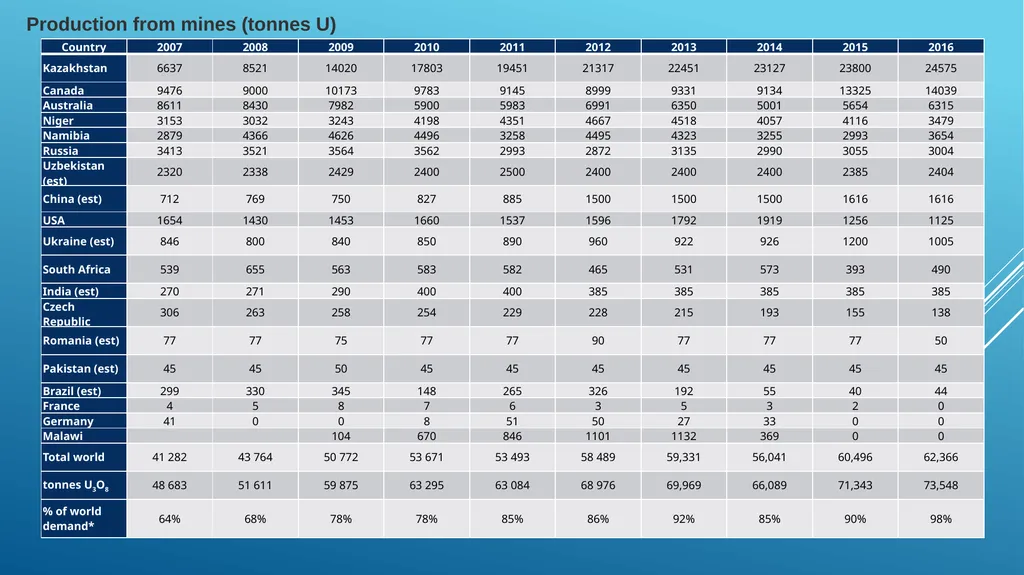
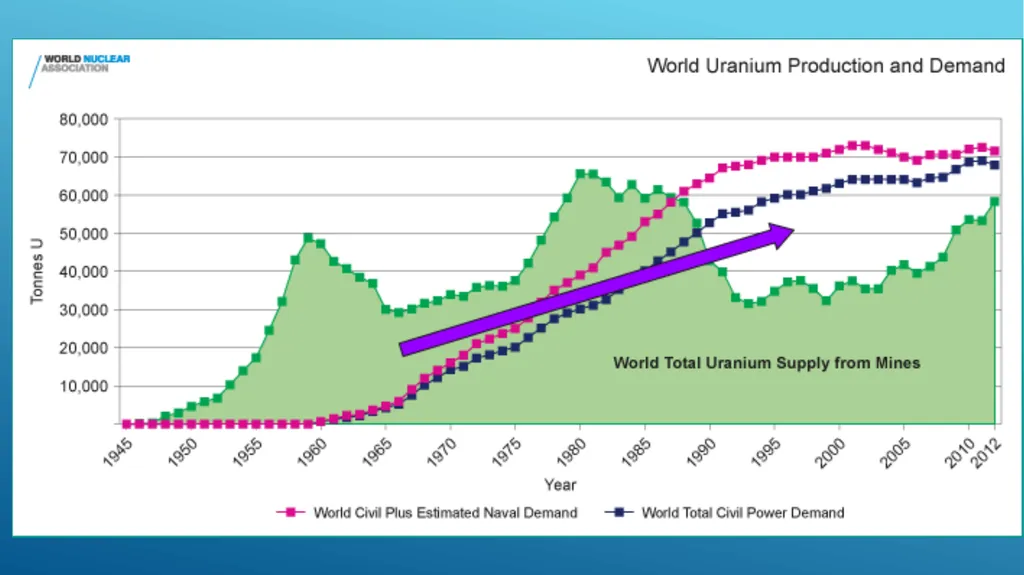
Production from mines (tonnes U)<br>
08
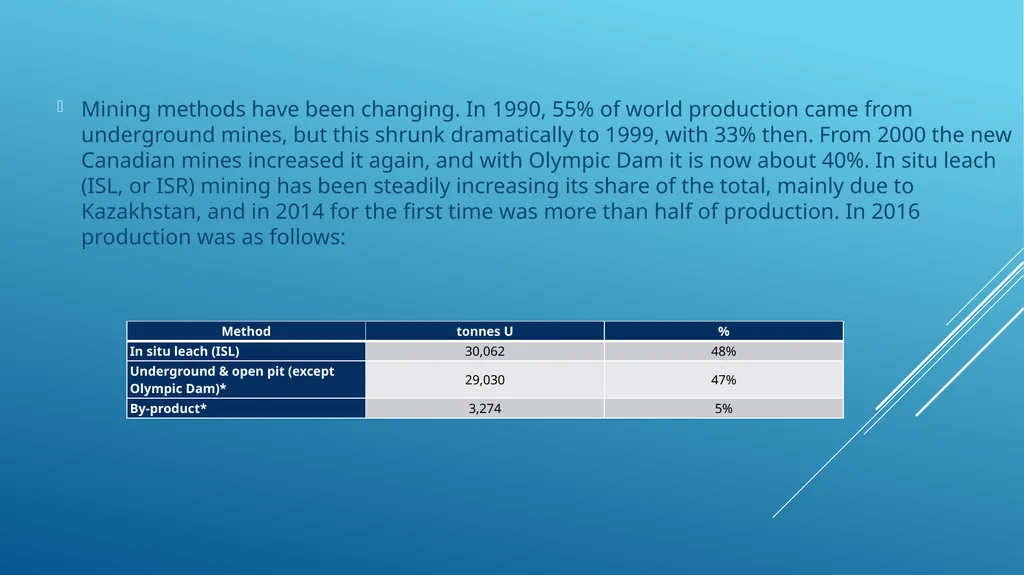
Mining methods have been changing. In 1990, 55% of world production came from underground mines, but this shrunk dramatically to 1999, with 33% then. From 2000 the new Canadian mines increased it again, and with Olympic Dam it is now about 40%. In situ leach (ISL, or ISR) mining has been steadily increasing its share of the total, mainly due to Kazakhstan, and in 2014 for the first time was more than half of production. In 2016 production was as follows:<br>
09
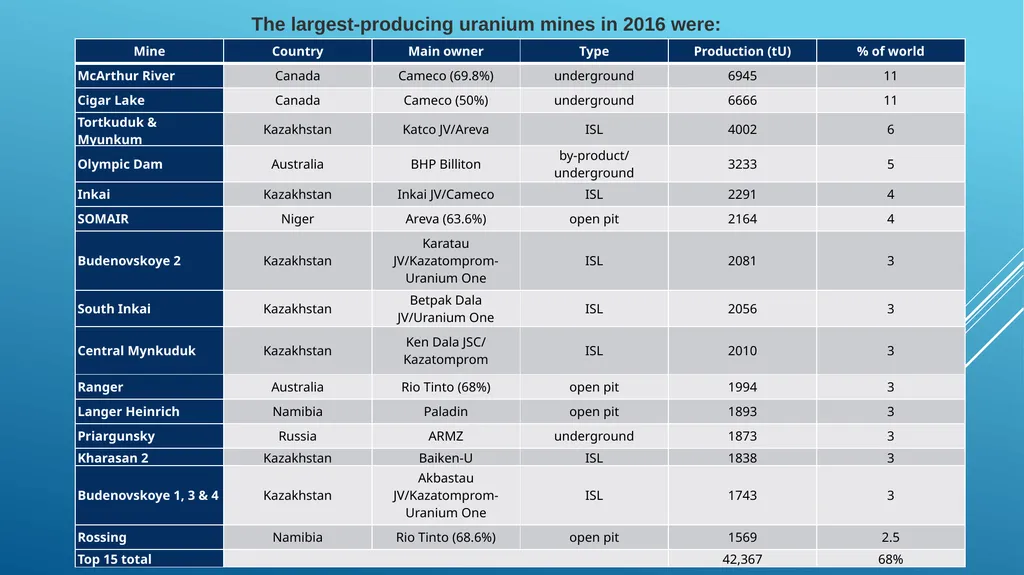
The largest-producing uranium mines in 2016 were:<br>
10
Current production
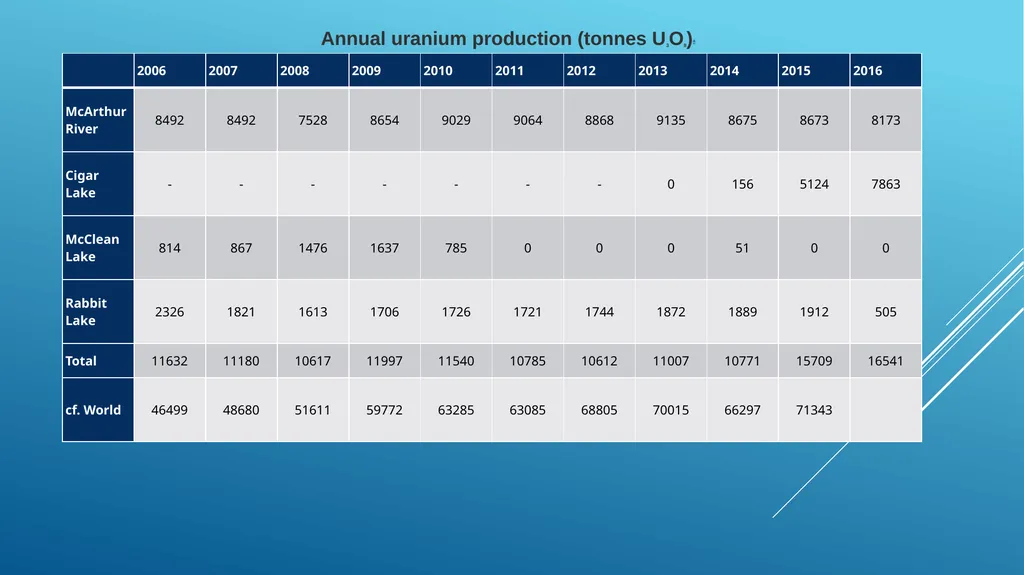
Canada’s uranium production is tabulated below, and while relatively constant over the last few years, its share of world production dropped from about 20% to 15% before recovering to about 22% in 2016, worth about $2 billion. Over 85% is exported.
The majority of Canada’s uranium resources are in high-grade deposits, some one hundred times the world average. Many of these have difficult mining conditions which require ground freezing.
The main uranium producers are Cameco and Areva Resources Canada. Cameco was formed in the 1988 merger of Saskatchewan Mining Development Corporation and the government-owned Eldorado Nuclear Ltd. The company issued its first public shares in 1991 and was fully privatized in 2002.
In the early 1990s, the Saskatchewan government had considered phasing out uranium mining in the province. This policy was later reversed after a joint Federal-Saskatchewan study panel on health, safety, environment and socio-economic impact found that the jobs provided by the industry would be hard to replace and that the environmental impact of mining could be minimized. Today, the provincial government actively supports uranium mining, and all new Saskatchewan uranium mines have international ISO 14001 environmental certification.<br>
Canada’s uranium production is tabulated below, and while relatively constant over the last few years, its share of world production dropped from about 20% to 15% before recovering to about 22% in 2016, worth about $2 billion. Over 85% is exported.
The majority of Canada’s uranium resources are in high-grade deposits, some one hundred times the world average. Many of these have difficult mining conditions which require ground freezing.
The main uranium producers are Cameco and Areva Resources Canada. Cameco was formed in the 1988 merger of Saskatchewan Mining Development Corporation and the government-owned Eldorado Nuclear Ltd. The company issued its first public shares in 1991 and was fully privatized in 2002.
In the early 1990s, the Saskatchewan government had considered phasing out uranium mining in the province. This policy was later reversed after a joint Federal-Saskatchewan study panel on health, safety, environment and socio-economic impact found that the jobs provided by the industry would be hard to replace and that the environmental impact of mining could be minimized. Today, the provincial government actively supports uranium mining, and all new Saskatchewan uranium mines have international ISO 14001 environmental certification.<br>
11
Annual uranium production (tonnes U3O8)a<br>
12
Rabbit Lake
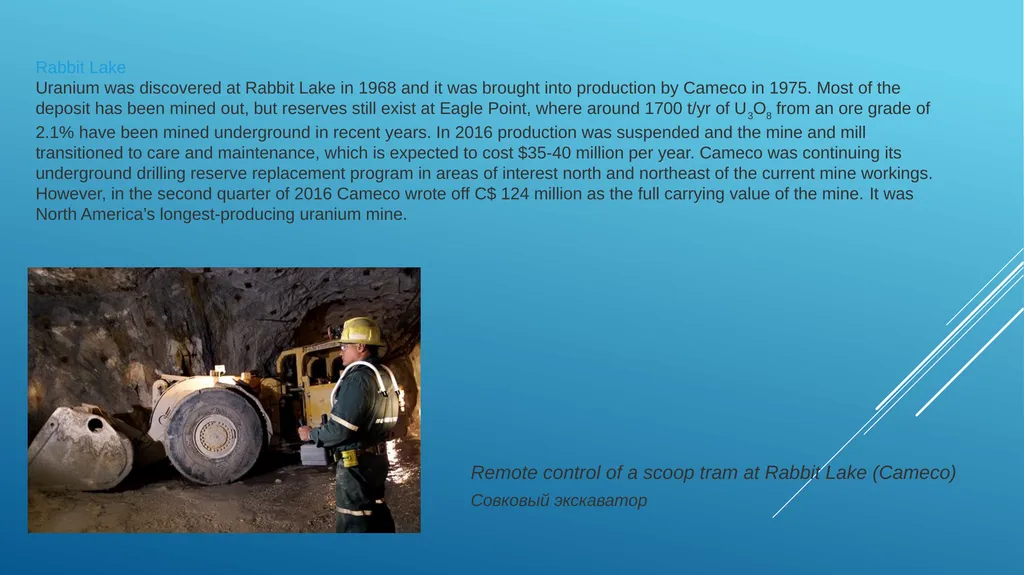
Uranium was discovered at Rabbit Lake in 1968 and it was brought into production by Cameco in 1975. Most of the deposit has been mined out, but reserves still exist at Eagle Point, where around 1700 t/yr of U3O8 from an ore grade of 2.1% have been mined underground in recent years. In 2016 production was suspended and the mine and mill transitioned to care and maintenance, which is expected to cost $35-40 million per year. Cameco was continuing its underground drilling reserve replacement program in areas of interest north and northeast of the current mine workings. However, in the second quarter of 2016 Cameco wrote off C$ 124 million as the full carrying value of the mine. It was North America’s longest-producing uranium mine. Remote control of a scoop tram at Rabbit Lake (Cameco)
Совковый экскаватор<br>
Uranium was discovered at Rabbit Lake in 1968 and it was brought into production by Cameco in 1975. Most of the deposit has been mined out, but reserves still exist at Eagle Point, where around 1700 t/yr of U3O8 from an ore grade of 2.1% have been mined underground in recent years. In 2016 production was suspended and the mine and mill transitioned to care and maintenance, which is expected to cost $35-40 million per year. Cameco was continuing its underground drilling reserve replacement program in areas of interest north and northeast of the current mine workings. However, in the second quarter of 2016 Cameco wrote off C$ 124 million as the full carrying value of the mine. It was North America’s longest-producing uranium mine. Remote control of a scoop tram at Rabbit Lake (Cameco)
Совковый экскаватор<br>
13
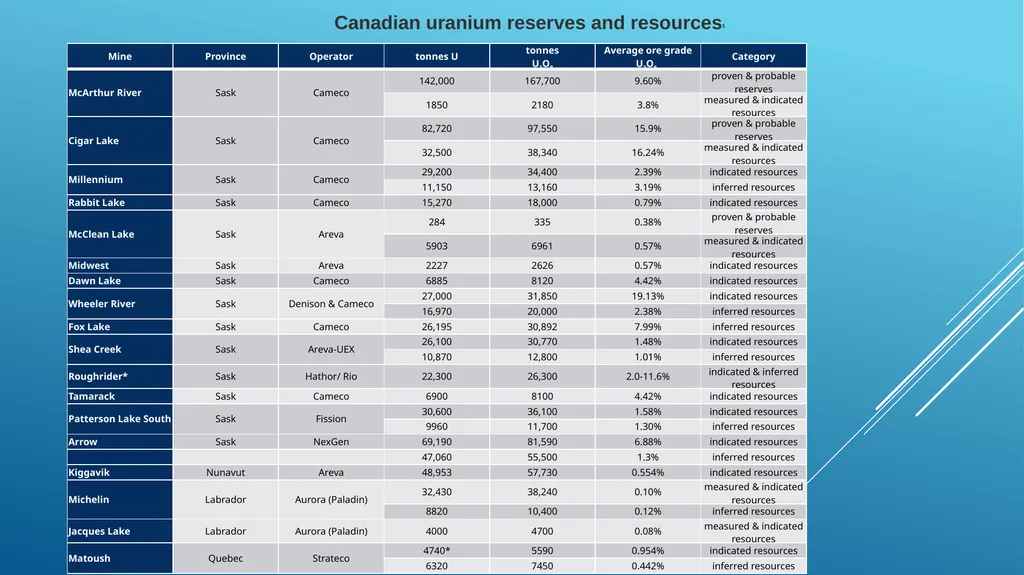
Canadian uranium reserves and resourcesc<br>
14
Australia's Uranium
(Updated July 2017)
Australia's uranium has been mined since 1954, and three mines are currently operating. More are planned.
Australia's known uranium resources are the world's largest – almost one-third of the world total.
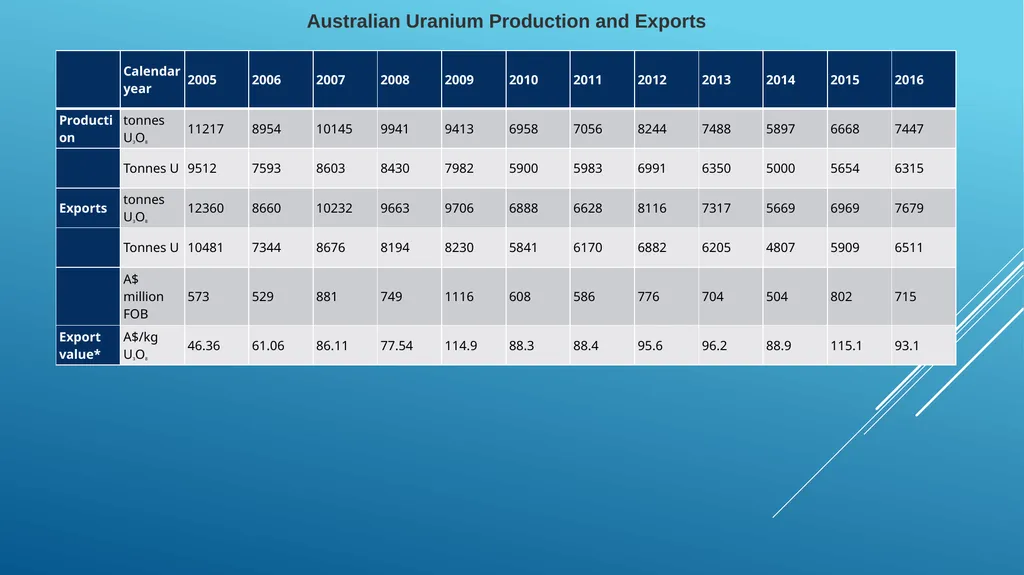
In 2016 Australia produced 7447 tonnes of U3O8 (6315 tU). It is the world's third-ranking producer, behind Kazakhstan and Canada. All production is exported. Uranium comprises about one-quarter of energy exports.
Australia uses no nuclear power, but with high reliance on coal any likely carbon constraints on electricity generation will make it a strong possibility.
In May 2016 the South Australian government's royal commission on the nuclear fuel cycle reported. Its main recommendation was for an international high-level nuclear waste repository, though this was not accepted.<br>
(Updated July 2017)
Australia's uranium has been mined since 1954, and three mines are currently operating. More are planned.
Australia's known uranium resources are the world's largest – almost one-third of the world total.
In 2016 Australia produced 7447 tonnes of U3O8 (6315 tU). It is the world's third-ranking producer, behind Kazakhstan and Canada. All production is exported. Uranium comprises about one-quarter of energy exports.
Australia uses no nuclear power, but with high reliance on coal any likely carbon constraints on electricity generation will make it a strong possibility.
In May 2016 the South Australian government's royal commission on the nuclear fuel cycle reported. Its main recommendation was for an international high-level nuclear waste repository, though this was not accepted.<br>
15
The Australian economy is unique in the OECD in that about 20% of GDP is accounted for by mining and mining services (in 2012). Uranium is a small part of this economically, but in energy terms, uranium (4200 PJ in 2015-16) comprises about one-quarter of energy exports.
In the 1930s ores were mined at Radium Hill and Mount Painter in SA to recover radium for medical purposes. As a result a few hundred kilograms of uranium were also produced.
Uranium ores as such were mined and treated in Australia initially from the 1950s until 1971. Radium Hill, SA, Rum Jungle, NT, and Mary Kathleen, Queensland, were the largest producers of uranium (as yellowcake). Production ceased either when ore reserves were exhausted or contracts were filled. Sales were to supply material primarily intended for USA and UK weapons programs at that time. However, much of it was used for electricity production.
The development of civil nuclear power stimulated a second wave of exploration activity in the late 1960s. A total of some 60 uranium deposits were identified from the 1950s through to the late 1970s, many by big companies with big budgets. (Since then only two significant new ones have been found: Kintyre and Beverley Four Mile. The minor exploration boom 2002-07 was driven by small companies focused on proving up known deposits.)
Mary Kathleen began recommissioning its mine and mill in 1974. Other developments were deferred pending the findings of the Ranger Uranium Environmental Inquiry, and its decision in the light of these. Mary Kathleen's second production phase was1976 to the end of 1982.
The Commonwealth Government announced in 1977 that new uranium mining was to proceed, commencing with the Ranger project in the Northern Territory. This mine opened in 1981. In 1979, Queensland Mines opened Nabarlekin the same region of Northern Territory. The orebody was mined out in one dry season and the ore stockpiled for treatment from 1980. The mine site is now rehabilitated.<br>
In the 1930s ores were mined at Radium Hill and Mount Painter in SA to recover radium for medical purposes. As a result a few hundred kilograms of uranium were also produced.
Uranium ores as such were mined and treated in Australia initially from the 1950s until 1971. Radium Hill, SA, Rum Jungle, NT, and Mary Kathleen, Queensland, were the largest producers of uranium (as yellowcake). Production ceased either when ore reserves were exhausted or contracts were filled. Sales were to supply material primarily intended for USA and UK weapons programs at that time. However, much of it was used for electricity production.
The development of civil nuclear power stimulated a second wave of exploration activity in the late 1960s. A total of some 60 uranium deposits were identified from the 1950s through to the late 1970s, many by big companies with big budgets. (Since then only two significant new ones have been found: Kintyre and Beverley Four Mile. The minor exploration boom 2002-07 was driven by small companies focused on proving up known deposits.)
Mary Kathleen began recommissioning its mine and mill in 1974. Other developments were deferred pending the findings of the Ranger Uranium Environmental Inquiry, and its decision in the light of these. Mary Kathleen's second production phase was1976 to the end of 1982.
The Commonwealth Government announced in 1977 that new uranium mining was to proceed, commencing with the Ranger project in the Northern Territory. This mine opened in 1981. In 1979, Queensland Mines opened Nabarlekin the same region of Northern Territory. The orebody was mined out in one dry season and the ore stockpiled for treatment from 1980. The mine site is now rehabilitated.<br>
16
Australian Uranium Production and Exports<br>
17
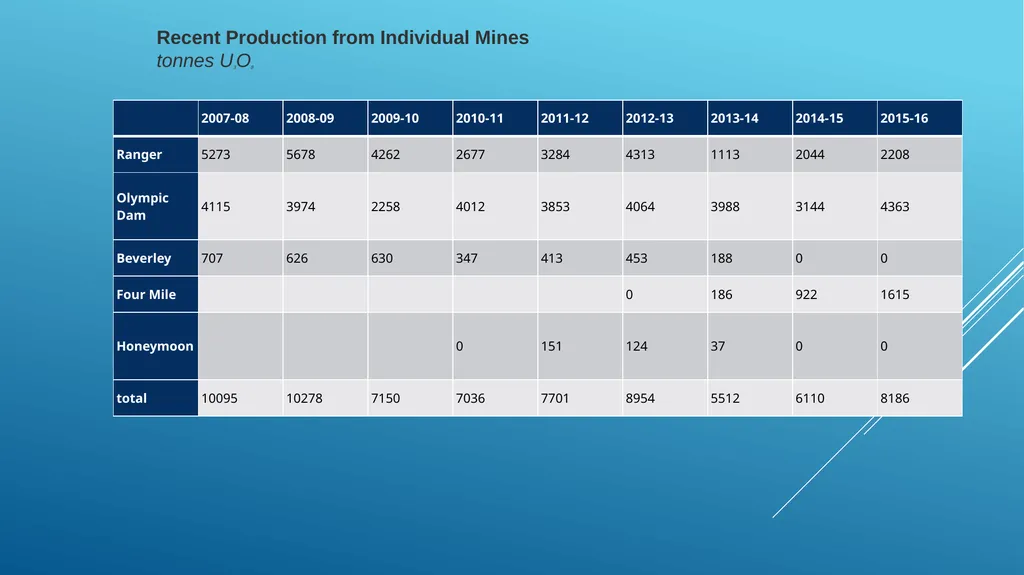
Recent Production from Individual Mines
tonnes U3O8<br>
18
Operating Mines
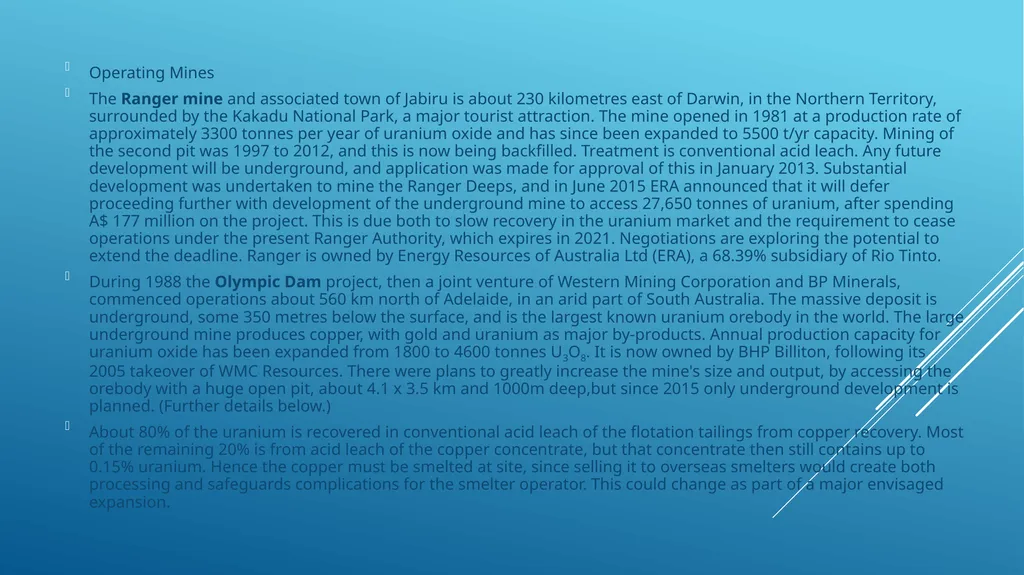
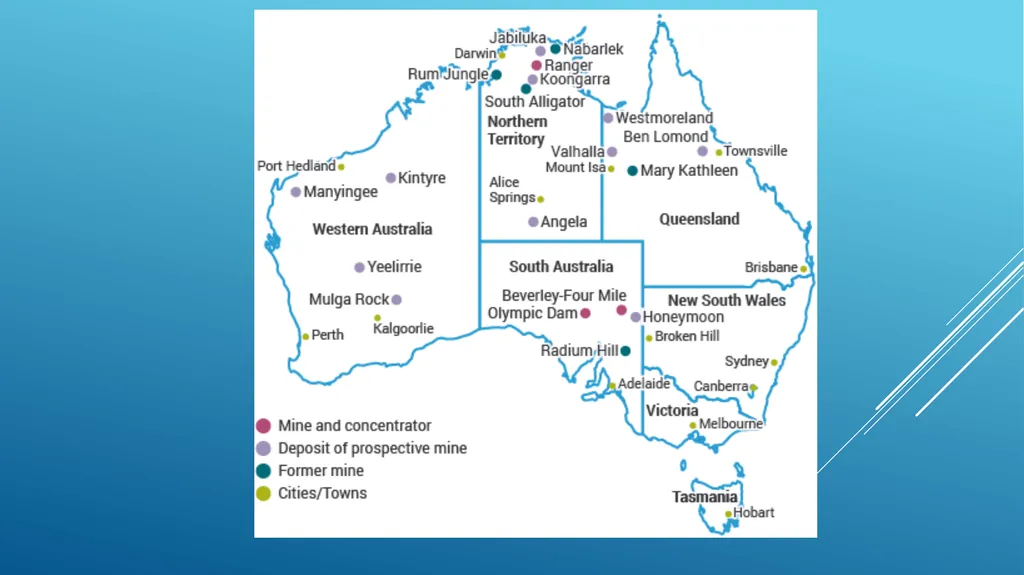
The Ranger mine and associated town of Jabiru is about 230 kilometres east of Darwin, in the Northern Territory, surrounded by the Kakadu National Park, a major tourist attraction. The mine opened in 1981 at a production rate of approximately 3300 tonnes per year of uranium oxide and has since been expanded to 5500 t/yr capacity. Mining of the second pit was 1997 to 2012, and this is now being backfilled. Treatment is conventional acid leach. Any future development will be underground, and application was made for approval of this in January 2013. Substantial development was undertaken to mine the Ranger Deeps, and in June 2015 ERA announced that it will defer proceeding further with development of the underground mine to access 27,650 tonnes of uranium, after spending A$ 177 million on the project. This is due both to slow recovery in the uranium market and the requirement to cease operations under the present Ranger Authority, which expires in 2021. Negotiations are exploring the potential to extend the deadline. Ranger is owned by Energy Resources of Australia Ltd (ERA), a 68.39% subsidiary of Rio Tinto.
During 1988 the Olympic Dam project, then a joint venture of Western Mining Corporation and BP Minerals, commenced operations about 560 km north of Adelaide, in an arid part of South Australia. The massive deposit is underground, some 350 metres below the surface, and is the largest known uranium orebody in the world. The large underground mine produces copper, with gold and uranium as major by-products. Annual production capacity for uranium oxide has been expanded from 1800 to 4600 tonnes U3O8. It is now owned by BHP Billiton, following its 2005 takeover of WMC Resources. There were plans to greatly increase the mine's size and output, by accessing the orebody with a huge open pit, about 4.1 x 3.5 km and 1000m deep,but since 2015 only underground development is planned. (Further details below.)
About 80% of the uranium is recovered in conventional acid leach of the flotation tailings from copper recovery. Most of the remaining 20% is from acid leach of the copper concentrate, but that concentrate then still contains up to 0.15% uranium. Hence the copper must be smelted at site, since selling it to overseas smelters would create both processing and safeguards complications for the smelter operator. This could change as part of a major envisaged expansion.<br>
The Ranger mine and associated town of Jabiru is about 230 kilometres east of Darwin, in the Northern Territory, surrounded by the Kakadu National Park, a major tourist attraction. The mine opened in 1981 at a production rate of approximately 3300 tonnes per year of uranium oxide and has since been expanded to 5500 t/yr capacity. Mining of the second pit was 1997 to 2012, and this is now being backfilled. Treatment is conventional acid leach. Any future development will be underground, and application was made for approval of this in January 2013. Substantial development was undertaken to mine the Ranger Deeps, and in June 2015 ERA announced that it will defer proceeding further with development of the underground mine to access 27,650 tonnes of uranium, after spending A$ 177 million on the project. This is due both to slow recovery in the uranium market and the requirement to cease operations under the present Ranger Authority, which expires in 2021. Negotiations are exploring the potential to extend the deadline. Ranger is owned by Energy Resources of Australia Ltd (ERA), a 68.39% subsidiary of Rio Tinto.
During 1988 the Olympic Dam project, then a joint venture of Western Mining Corporation and BP Minerals, commenced operations about 560 km north of Adelaide, in an arid part of South Australia. The massive deposit is underground, some 350 metres below the surface, and is the largest known uranium orebody in the world. The large underground mine produces copper, with gold and uranium as major by-products. Annual production capacity for uranium oxide has been expanded from 1800 to 4600 tonnes U3O8. It is now owned by BHP Billiton, following its 2005 takeover of WMC Resources. There were plans to greatly increase the mine's size and output, by accessing the orebody with a huge open pit, about 4.1 x 3.5 km and 1000m deep,but since 2015 only underground development is planned. (Further details below.)
About 80% of the uranium is recovered in conventional acid leach of the flotation tailings from copper recovery. Most of the remaining 20% is from acid leach of the copper concentrate, but that concentrate then still contains up to 0.15% uranium. Hence the copper must be smelted at site, since selling it to overseas smelters would create both processing and safeguards complications for the smelter operator. This could change as part of a major envisaged expansion.<br>
19
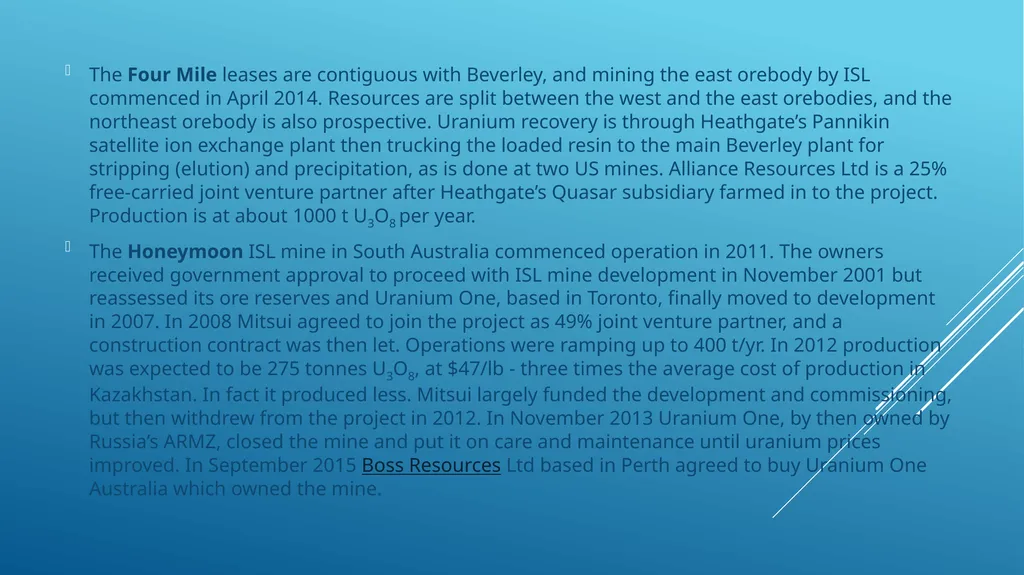
The Four Mile leases are contiguous with Beverley, and mining the east orebody by ISL commenced in April 2014. Resources are split between the west and the east orebodies, and the northeast orebody is also prospective. Uranium recovery is through Heathgate’s Pannikin satellite ion exchange plant then trucking the loaded resin to the main Beverley plant for stripping (elution) and precipitation, as is done at two US mines. Alliance Resources Ltd is a 25% free-carried joint venture partner after Heathgate’s Quasar subsidiary farmed in to the project. Production is at about 1000 t U3O8 per year.
The Honeymoon ISL mine in South Australia commenced operation in 2011. The owners received government approval to proceed with ISL mine development in November 2001 but reassessed its ore reserves and Uranium One, based in Toronto, finally moved to development in 2007. In 2008 Mitsui agreed to join the project as 49% joint venture partner, and a construction contract was then let. Operations were ramping up to 400 t/yr. In 2012 production was expected to be 275 tonnes U3O8, at $47/lb - three times the average cost of production in Kazakhstan. In fact it produced less. Mitsui largely funded the development and commissioning, but then withdrew from the project in 2012. In November 2013 Uranium One, by then owned by Russia’s ARMZ, closed the mine and put it on care and maintenance until uranium prices improved. In September 2015 Boss Resources Ltd based in Perth agreed to buy Uranium One Australia which owned the mine.<br>
The Honeymoon ISL mine in South Australia commenced operation in 2011. The owners received government approval to proceed with ISL mine development in November 2001 but reassessed its ore reserves and Uranium One, based in Toronto, finally moved to development in 2007. In 2008 Mitsui agreed to join the project as 49% joint venture partner, and a construction contract was then let. Operations were ramping up to 400 t/yr. In 2012 production was expected to be 275 tonnes U3O8, at $47/lb - three times the average cost of production in Kazakhstan. In fact it produced less. Mitsui largely funded the development and commissioning, but then withdrew from the project in 2012. In November 2013 Uranium One, by then owned by Russia’s ARMZ, closed the mine and put it on care and maintenance until uranium prices improved. In September 2015 Boss Resources Ltd based in Perth agreed to buy Uranium One Australia which owned the mine.<br>
20
Uranium resources
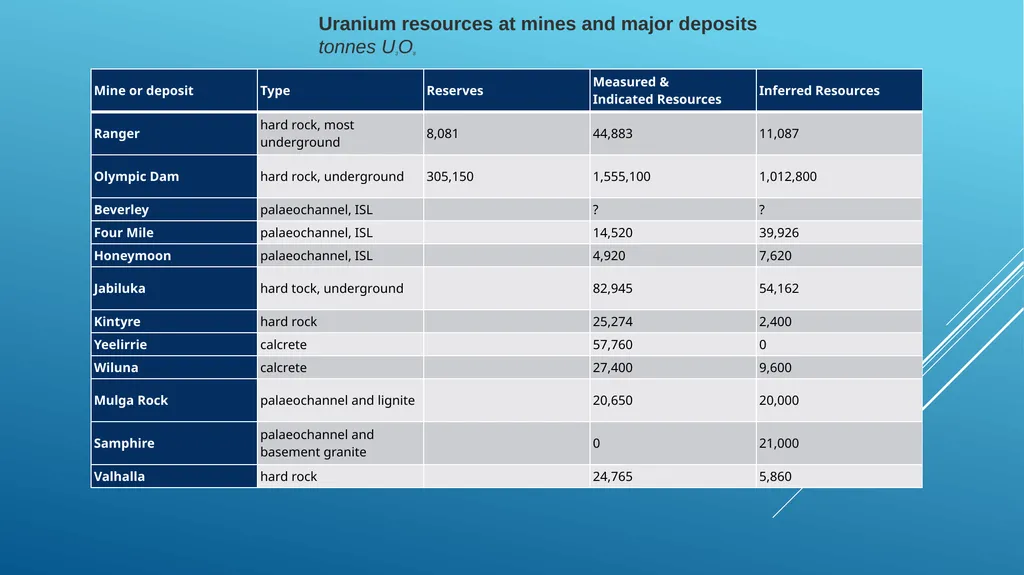
On the basis of December 2012 data Australia has 29% of the world's uranium resources (under US$ 130/kg) – 1.7 million tonnes of uranium. Almost half of Australia's 1.174 million tonnes of reasonably assured resources of uranium in this price category were actually in the under $80/kg U category when this was last reported. The vast majority of Australia's uranium resources (to $130/kgU) are within five deposits: Olympic Dam (the world's largest known uranium deposit), Ranger, Jabiluka, Kintyre and Yeelirrie.
The world’s Reasonably Assured plus Inferred Resources in the $130/kg category are tabulated in the Supply of Uranium information paper.
A review of Australia’s uranium is provided in Australia’s Uranium: Resources, Geology and Development of Deposits from Geoscience Australia.<br>
On the basis of December 2012 data Australia has 29% of the world's uranium resources (under US$ 130/kg) – 1.7 million tonnes of uranium. Almost half of Australia's 1.174 million tonnes of reasonably assured resources of uranium in this price category were actually in the under $80/kg U category when this was last reported. The vast majority of Australia's uranium resources (to $130/kgU) are within five deposits: Olympic Dam (the world's largest known uranium deposit), Ranger, Jabiluka, Kintyre and Yeelirrie.
The world’s Reasonably Assured plus Inferred Resources in the $130/kg category are tabulated in the Supply of Uranium information paper.
A review of Australia’s uranium is provided in Australia’s Uranium: Resources, Geology and Development of Deposits from Geoscience Australia.<br>
21
Uranium resources at mines and major deposits
tonnes U3O8<br>
22
Economic benefits of mining uranium
About 1200 people are employed in uranium mining, at least 500 in uranium exploration, and 60 jobs are in regulation of uranium mining.
Uranium mines generate about A$ 21 million in royalties each year (in 2005: Ranger $13.1 million, Beverley $1.0 million and Olympic Dam $6.9 million attributable to uranium). Corporate taxes amount to over $42 million per year.
Uranium exports from Australia
Australian production is all exported, and over the six years has averaged over 8600 t/yr U3O8, and in 2012 provided 12% of world uranium supply from mines. Uranium comprises about 35% of the country's energy exports (4150 PJ av) in thermal terms.
Australia's uranium is sold strictly for electrical power generation only, and safeguards are in place to ensure this. Australia is a party to the Nuclear Non-Proliferation Treaty (NPT) as a non-nuclear weapons state. Its safeguards agreement under the NPT came into force in 1974 and it was the first country in the world to bring into force the Additional Protocol in relation to this – in 1997. In addition to these international arrangements Australia requires customer countries to have entered a bilateral safeguards treaty which is more rigorous than NPT arrangements.
The value of Australia's uranium oxide concentrate exports is considerable, and in 2009 they reached a value of over A$ 1.1 billion. However, production problems at Olympic Dam from late 2009 into 2010 set production back considerably over those two years, then the Fukushima accident in March 2011 softened prices.
In 2014, U3O8 sales were to North America (mainly USA) 2668 t (39.0%), Europe 2354 t (34.4%) and Asia 1822 t (26.6%), total 6844 tonnes. (These figures are deliveries of Australian product to customers’ converter accounts and exclude third party material purchased to fulfill contract obligations. There is a time lag relative to export figures tabulated above.)
The nations which currently purchase Australia's uranium are set out below, though up to date details on country destinations is not available. All have a large commitment to nuclear power.
The USA generates around 30% of the world's nuclear power. Much of its uranium comes from Canada, but Australia is a major source. Europe depends heavily on nuclear power and EU countries are also major customers. In 2015, 1910 tU or 12% of EU uranium was from Australia. Japan, South Korea and now China are important customers due to their increasing dependence on nuclear energy.<br>
About 1200 people are employed in uranium mining, at least 500 in uranium exploration, and 60 jobs are in regulation of uranium mining.
Uranium mines generate about A$ 21 million in royalties each year (in 2005: Ranger $13.1 million, Beverley $1.0 million and Olympic Dam $6.9 million attributable to uranium). Corporate taxes amount to over $42 million per year.
Uranium exports from Australia
Australian production is all exported, and over the six years has averaged over 8600 t/yr U3O8, and in 2012 provided 12% of world uranium supply from mines. Uranium comprises about 35% of the country's energy exports (4150 PJ av) in thermal terms.
Australia's uranium is sold strictly for electrical power generation only, and safeguards are in place to ensure this. Australia is a party to the Nuclear Non-Proliferation Treaty (NPT) as a non-nuclear weapons state. Its safeguards agreement under the NPT came into force in 1974 and it was the first country in the world to bring into force the Additional Protocol in relation to this – in 1997. In addition to these international arrangements Australia requires customer countries to have entered a bilateral safeguards treaty which is more rigorous than NPT arrangements.
The value of Australia's uranium oxide concentrate exports is considerable, and in 2009 they reached a value of over A$ 1.1 billion. However, production problems at Olympic Dam from late 2009 into 2010 set production back considerably over those two years, then the Fukushima accident in March 2011 softened prices.
In 2014, U3O8 sales were to North America (mainly USA) 2668 t (39.0%), Europe 2354 t (34.4%) and Asia 1822 t (26.6%), total 6844 tonnes. (These figures are deliveries of Australian product to customers’ converter accounts and exclude third party material purchased to fulfill contract obligations. There is a time lag relative to export figures tabulated above.)
The nations which currently purchase Australia's uranium are set out below, though up to date details on country destinations is not available. All have a large commitment to nuclear power.
The USA generates around 30% of the world's nuclear power. Much of its uranium comes from Canada, but Australia is a major source. Europe depends heavily on nuclear power and EU countries are also major customers. In 2015, 1910 tU or 12% of EU uranium was from Australia. Japan, South Korea and now China are important customers due to their increasing dependence on nuclear energy.<br>
23
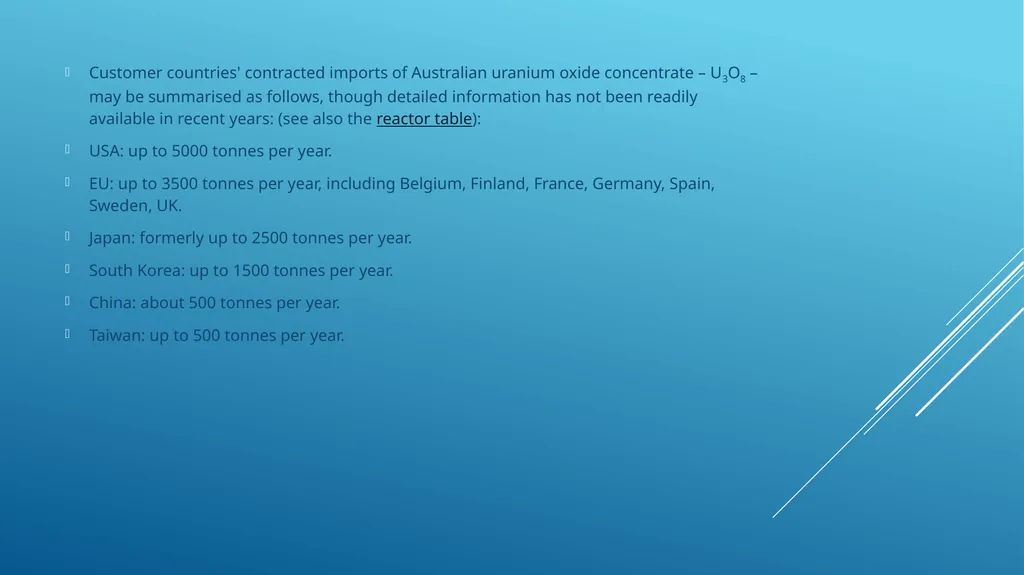
Customer countries' contracted imports of Australian uranium oxide concentrate – U3O8 – may be summarised as follows, though detailed information has not been readily available in recent years: (see also the reactor table):
USA: up to 5000 tonnes per year.
EU: up to 3500 tonnes per year, including Belgium, Finland, France, Germany, Spain, Sweden, UK.
Japan: formerly up to 2500 tonnes per year.
South Korea: up to 1500 tonnes per year.
China: about 500 tonnes per year.
Taiwan: up to 500 tonnes per year.<br>
USA: up to 5000 tonnes per year.
EU: up to 3500 tonnes per year, including Belgium, Finland, France, Germany, Spain, Sweden, UK.
Japan: formerly up to 2500 tonnes per year.
South Korea: up to 1500 tonnes per year.
China: about 500 tonnes per year.
Taiwan: up to 500 tonnes per year.<br>