
Lecture 9 Analysis of uranium production
LD
Published · 26 slides · 0 views

1 / 1





Description
Lecture 9 Analysis of uranium production Kazakhstan has been an important source of uranium for more than fifty years. Uranium exploration started in 1948 and economic mineralisation was found in several parts of the country. This supported
Related Topics
Share
Embed code
Download this presentation From Below
"Lecture 9 Analysis of uranium production" is the property of its rightful owner. Permission is granted to download and print the materials on this website for personal, non-commercial use only, and to display it on your personal computer provided you do not modify the materials and that you retain all copyright notices contained in the materials. By downloading content from our website, you accept the terms of this agreement.
Presentation Transcript
01
Lecture 9
Analysis of uranium production<br>
02
Kazakhstan has been an important source of uranium for more than fifty years. Uranium exploration started in 1948 and economic mineralisation was found in several parts of the country. This supported various mines in hard rock deposits. Some 50 uranium deposits are known, in six uranium provinces. In the early 1970s, successful tests on in situ leaching (ISL) led to further exploration being focused on two sedimentary basins with ISL potential. Up to 2000 twice as much uranium was mined from hard rock deposits as sedimentary ISL sands, but almost all production is now from ISL mines, some relatively small. Over 2001-2010 production rose from 2000 to 17,800 tU/yr, making Kazakhstan the world's leading uranium producer (33% of total in 2010), and further mine development is under way with a view to increasing production. All uranium is exported. Kazatomprom is the national atomic company set up in 1997 and owned by the government. It controls all uranium exploration and mining as well as other nuclear-related activities. It aims to add value to the fuel chain and it is developing its fuel fabrication facilities so that fuel assemblies, rather than just fuel, could account for most sales eventually. Kazatomprom has forged many international agreements on all aspects of nuclear power, and many of the mining operations are run as joint ventures with Russian, Chinese, Canadian and French companies. Central Asia's uranium mines
Kazakhstan. Russia<br>
03
In the Caspian province, the Prikaspisky Combine operated a major mining and processing complex in the 1960s, the first major mine in Kazakhstan. It was privatised as Kaskor in 1992 and operations ceased in 1994.
All except one of the operating and planned ISL mines are in the central south of the country. Mines in the Stepnoye area have been operating since 1978, those in the Tsentralnoye area since 1982 – both in the Chu-Sarysu basin/province, which has more than half the country's known resources. There are 14 mines here. Mines in the Western (No.6) area of the Syrdarya basin/ province have operated since 1985, and today it has seven mines. One further ISL mine is in the Northern province.
The diversity, complexity and size of Kazakh uranium mining can be seen from the information paper on Kazakhstan.<br>
All except one of the operating and planned ISL mines are in the central south of the country. Mines in the Stepnoye area have been operating since 1978, those in the Tsentralnoye area since 1982 – both in the Chu-Sarysu basin/province, which has more than half the country's known resources. There are 14 mines here. Mines in the Western (No.6) area of the Syrdarya basin/ province have operated since 1985, and today it has seven mines. One further ISL mine is in the Northern province.
The diversity, complexity and size of Kazakh uranium mining can be seen from the information paper on Kazakhstan.<br>
04
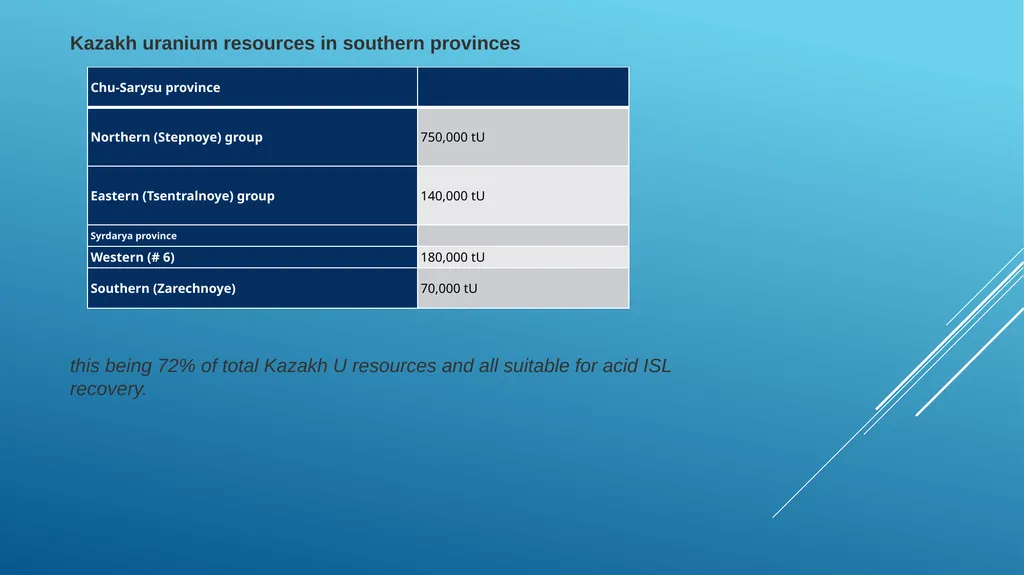
Kazakh uranium resources in southern provinces this being 72% of total Kazakh U resources and all suitable for acid ISL recovery.<br>
05
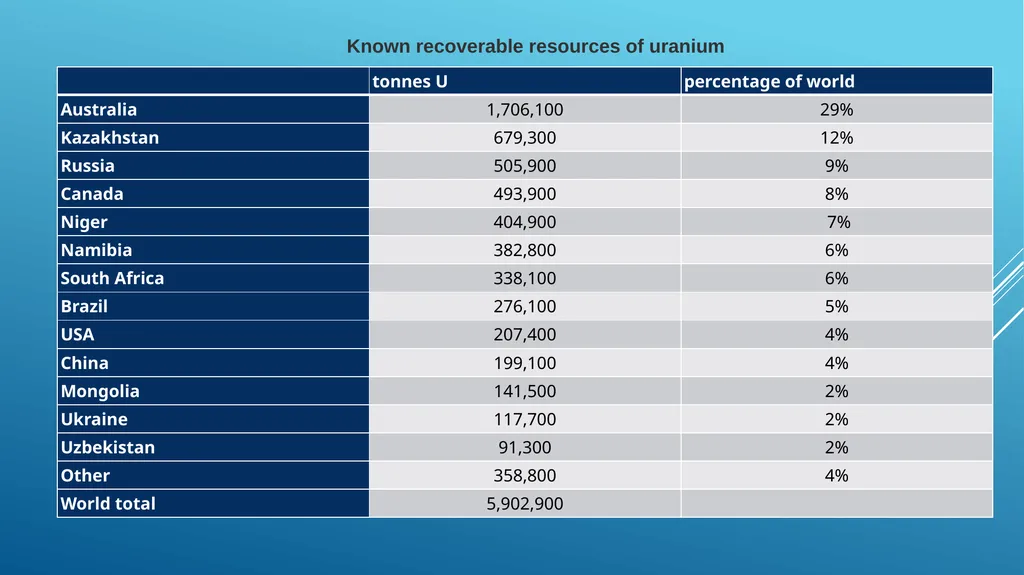
Known recoverable resources of uranium<br>
06
Russia
AtomRedMetZoloto (ARMZ) is the state corporation which took over all uranium exploration and mining assets in 2007, as a subsidiary of Atomenergoprom, the state-owned Russian atomic energy company. It inherited 19 projects with a total uranium resource of about 400,000 tonnes, of which 340,000 tonnes are in Elkon uranium region and 60,000 tonnes in the Streltsovskiy and Vitimskiy regions.
Uranium production is planned to increase. In 2014 Russia produced some 3000 tonnes of uranium, mostly from several large underground mines operated by Priargunsky in the Streltsovskiy district of the Transbaikal or Chita region of SE Siberia near the Chinese and Mongolian borders. These deposits were discovered in 1967 and have been the major source of production since.
A lesser amount of production is from new operations at Khiagda in Buryatiya about 500 km northwest of Priargunsky's operations, and Dalur in the Kurgan region between Chelyabinsk and Omsk, just east of the Urals. Both are low-cost in situ leach (ISL) operations Most of the future production is set to come from the massive Elkon project with several mines in the Sakha Republic (Yakutia) some 1200 km north-northeast of the Chita region. There is huge investment to bring these into production, which could ramp up to 5000 tU/yr by 2024.<br>
AtomRedMetZoloto (ARMZ) is the state corporation which took over all uranium exploration and mining assets in 2007, as a subsidiary of Atomenergoprom, the state-owned Russian atomic energy company. It inherited 19 projects with a total uranium resource of about 400,000 tonnes, of which 340,000 tonnes are in Elkon uranium region and 60,000 tonnes in the Streltsovskiy and Vitimskiy regions.
Uranium production is planned to increase. In 2014 Russia produced some 3000 tonnes of uranium, mostly from several large underground mines operated by Priargunsky in the Streltsovskiy district of the Transbaikal or Chita region of SE Siberia near the Chinese and Mongolian borders. These deposits were discovered in 1967 and have been the major source of production since.
A lesser amount of production is from new operations at Khiagda in Buryatiya about 500 km northwest of Priargunsky's operations, and Dalur in the Kurgan region between Chelyabinsk and Omsk, just east of the Urals. Both are low-cost in situ leach (ISL) operations Most of the future production is set to come from the massive Elkon project with several mines in the Sakha Republic (Yakutia) some 1200 km north-northeast of the Chita region. There is huge investment to bring these into production, which could ramp up to 5000 tU/yr by 2024.<br>
07
Uranium and Nuclear Power in Kazakhstan
Kazakhstan has 12% of the world's uranium resources and an expanding mining sector, producing about 24,575 tU in 2016, but then reducing slightly.
In 2009 it became the world's leading uranium producer, with almost 28% of world production, then 33% in 2010, rising to 41% in 2014, and 39% in 2015 and 2016.
A single Russian nuclear power reactor operated from 1972 to 1999, generating electricity and desalinating water.
Kazakhstan has a major plant making nuclear fuel pellets and aims eventually to sell value-added fuel rather than just uranium. A fuel fabrication plant is being built with 49% Chinese equity.
The government is committed to a high level of uranium exports, and was planning to build a Russian nuclear power reactor probably at Kurchatov by 2025.<br>
Kazakhstan has 12% of the world's uranium resources and an expanding mining sector, producing about 24,575 tU in 2016, but then reducing slightly.
In 2009 it became the world's leading uranium producer, with almost 28% of world production, then 33% in 2010, rising to 41% in 2014, and 39% in 2015 and 2016.
A single Russian nuclear power reactor operated from 1972 to 1999, generating electricity and desalinating water.
Kazakhstan has a major plant making nuclear fuel pellets and aims eventually to sell value-added fuel rather than just uranium. A fuel fabrication plant is being built with 49% Chinese equity.
The government is committed to a high level of uranium exports, and was planning to build a Russian nuclear power reactor probably at Kurchatov by 2025.<br>
08
Kazakhstan has been an important source of uranium for more than 50 years. Over 2001 to 2013 production rose from 2022 to about 22,550 tonnes U per year, making Kazakhstan the world's leading uranium producer. Mine development has continued with a view to further increasing annual production by 2018. Capacity is around 25,000 tU/yr, but in October 2011 Kazatoprom announced a cap on production of 20,000 tU/yr, which was evidently disregarded. Of its 17 mine projects, five are wholly owned by Kazatomprom and 12 are joint ventures with foreign equity holders, and some of these are producing under nominal capacity. In 2016, 12,986 tU was attributable to Kazatomprom itself – 21% of world production, putting it ahead of Cameco, followed by Areva and ARMZ-Uranium One. The country's total production in 2016 was 24,575 tU. In January 2017 Kazatomprom said that production would be reduced by about 10%, due to low prices.
Kazakhstan has northern and southern electricity grids with some connection, and links to Russia and Kyrgystan and Uzbekistan respectively. Electricity production was 91 TWh in 2015, 74 TWh (81%) from coal and gas thermal, 7 TWh from gas turbine, 9 TWh from hydro and 0.2 TWh from wind, according to KEGOC (Kazakhstan Electricity Grid Operating Company). Net imports from Russia was 471 GWh, net exports to Kyrgystan was 421 GWh. In 2015 capacity was 21 GWe with 17.5 GWe available, but maximum output was 12.5 GWe. In 2012 the government's energy system development plan had 150 TWh/yr production in 2030, with 4.5% of this from nuclear and 10% from renewables. The government planned investment in electricity production and grid of $7.8 billion by 2015, and foresees $64 billion by 2030.
Future electricity demand will depend to some extent on the country’s role from 2019 in the Eurasian Economic Community energy market. Also the State Grid Corporation of China (SGCC) is planning transmission links from China. The state-owned Kazakhstan Electricity Grid Operating Company (KEGOC) was set up in 1997. The question of nuclear power in Kazakhstan has been discussed for many years, notably since 2006 with Russia, and a national nuclear strategy is expected in 2018.<br>
Kazakhstan has northern and southern electricity grids with some connection, and links to Russia and Kyrgystan and Uzbekistan respectively. Electricity production was 91 TWh in 2015, 74 TWh (81%) from coal and gas thermal, 7 TWh from gas turbine, 9 TWh from hydro and 0.2 TWh from wind, according to KEGOC (Kazakhstan Electricity Grid Operating Company). Net imports from Russia was 471 GWh, net exports to Kyrgystan was 421 GWh. In 2015 capacity was 21 GWe with 17.5 GWe available, but maximum output was 12.5 GWe. In 2012 the government's energy system development plan had 150 TWh/yr production in 2030, with 4.5% of this from nuclear and 10% from renewables. The government planned investment in electricity production and grid of $7.8 billion by 2015, and foresees $64 billion by 2030.
Future electricity demand will depend to some extent on the country’s role from 2019 in the Eurasian Economic Community energy market. Also the State Grid Corporation of China (SGCC) is planning transmission links from China. The state-owned Kazakhstan Electricity Grid Operating Company (KEGOC) was set up in 1997. The question of nuclear power in Kazakhstan has been discussed for many years, notably since 2006 with Russia, and a national nuclear strategy is expected in 2018.<br>
09
Kazatomprom is the national atomic company set up in 1997 and owned by the government. It controls all uranium exploration and mining as well as other nuclear-related activities, including imports and exports of nuclear materials. It announced in 2008 that it aimed to supply 30% of the world's uranium by 2015 (it produced 39% in fact), and through joint ventures: 12% of the uranium conversion market, 6% of enrichment, and 30% of the fuel fabrication market by then.
Prior to Kazatomprom’s establishment, other arrangements pertained for uranium development. One of these was with Canada-based World-Wide Minerals Ltd (WWM), under a 1989 bilateral investment treaty between Canada and the USSR.*
* WWM invested heavily in the country over 1996-97, upgrading and operating the Tselinny (TGK) uranium mining and processing facilities at Stepnogorsk, with an option to acquire 90% equity in them as well as developing additional mines. WWM and subsidiaries entered into agreements with the Kazakh government, but claims that the government frustrated its endeavours, leading to a loss of more than $50 million and its exit from the country. In January 2016 an international arbitral tribunal upheld WWM’s claims under investor-state arbitration and dismissed Kazakh objections. WWM is seeking $5 billion settlement.<br>
Prior to Kazatomprom’s establishment, other arrangements pertained for uranium development. One of these was with Canada-based World-Wide Minerals Ltd (WWM), under a 1989 bilateral investment treaty between Canada and the USSR.*
* WWM invested heavily in the country over 1996-97, upgrading and operating the Tselinny (TGK) uranium mining and processing facilities at Stepnogorsk, with an option to acquire 90% equity in them as well as developing additional mines. WWM and subsidiaries entered into agreements with the Kazakh government, but claims that the government frustrated its endeavours, leading to a loss of more than $50 million and its exit from the country. In January 2016 an international arbitral tribunal upheld WWM’s claims under investor-state arbitration and dismissed Kazakh objections. WWM is seeking $5 billion settlement.<br>
10
International collaboration
Kazatomprom has forged major strategic links with Russia, Japan and China, as well as taking a significant share in the international nuclear company Westinghouse. Canadian and French companies are involved with uranium mining and other aspects of the fuel cycle.<br>
Kazatomprom has forged major strategic links with Russia, Japan and China, as well as taking a significant share in the international nuclear company Westinghouse. Canadian and French companies are involved with uranium mining and other aspects of the fuel cycle.<br>
11
Russia
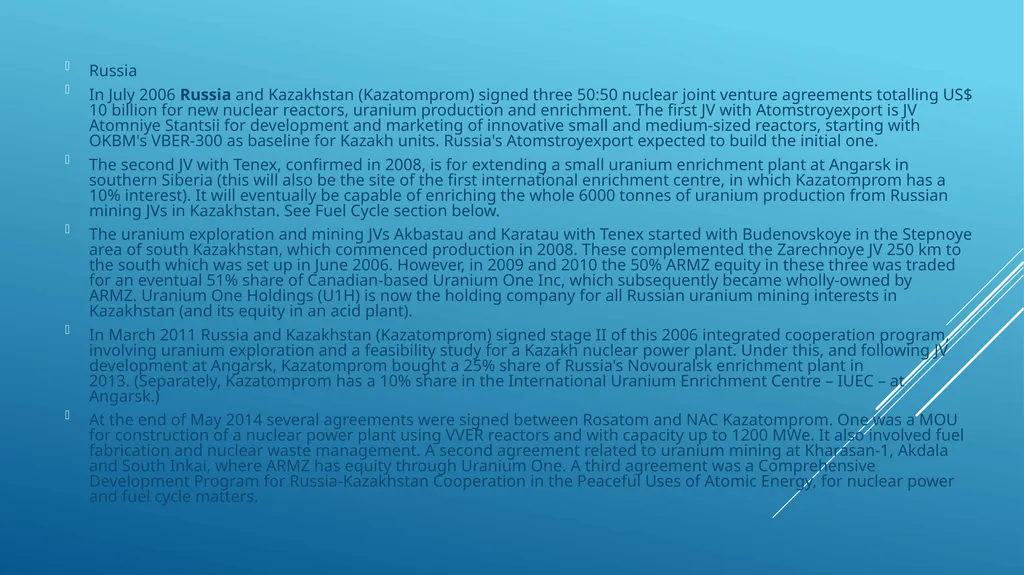
In July 2006 Russia and Kazakhstan (Kazatomprom) signed three 50:50 nuclear joint venture agreements totalling US$ 10 billion for new nuclear reactors, uranium production and enrichment. The first JV with Atomstroyexport is JV Atomniye Stantsii for development and marketing of innovative small and medium-sized reactors, starting with OKBM's VBER-300 as baseline for Kazakh units. Russia's Atomstroyexport expected to build the initial one.
The second JV with Tenex, confirmed in 2008, is for extending a small uranium enrichment plant at Angarsk in southern Siberia (this will also be the site of the first international enrichment centre, in which Kazatomprom has a 10% interest). It will eventually be capable of enriching the whole 6000 tonnes of uranium production from Russian mining JVs in Kazakhstan. See Fuel Cycle section below.
The uranium exploration and mining JVs Akbastau and Karatau with Tenex started with Budenovskoye in the Stepnoye area of south Kazakhstan, which commenced production in 2008. These complemented the Zarechnoye JV 250 km to the south which was set up in June 2006. However, in 2009 and 2010 the 50% ARMZ equity in these three was traded for an eventual 51% share of Canadian-based Uranium One Inc, which subsequently became wholly-owned by ARMZ. Uranium One Holdings (U1H) is now the holding company for all Russian uranium mining interests in Kazakhstan (and its equity in an acid plant).
In March 2011 Russia and Kazakhstan (Kazatomprom) signed stage II of this 2006 integrated cooperation program, involving uranium exploration and a feasibility study for a Kazakh nuclear power plant. Under this, and following JV development at Angarsk, Kazatomprom bought a 25% share of Russia's Novouralsk enrichment plant in 2013. (Separately, Kazatomprom has a 10% share in the International Uranium Enrichment Centre – IUEC – at Angarsk.)
At the end of May 2014 several agreements were signed between Rosatom and NAC Kazatomprom. One was a MOU for construction of a nuclear power plant using VVER reactors and with capacity up to 1200 MWe. It also involved fuel fabrication and nuclear waste management. A second agreement related to uranium mining at Kharasan-1, Akdala and South Inkai, where ARMZ has equity through Uranium One. A third agreement was a Comprehensive Development Program for Russia-Kazakhstan Cooperation in the Peaceful Uses of Atomic Energy, for nuclear power and fuel cycle matters.<br>
In July 2006 Russia and Kazakhstan (Kazatomprom) signed three 50:50 nuclear joint venture agreements totalling US$ 10 billion for new nuclear reactors, uranium production and enrichment. The first JV with Atomstroyexport is JV Atomniye Stantsii for development and marketing of innovative small and medium-sized reactors, starting with OKBM's VBER-300 as baseline for Kazakh units. Russia's Atomstroyexport expected to build the initial one.
The second JV with Tenex, confirmed in 2008, is for extending a small uranium enrichment plant at Angarsk in southern Siberia (this will also be the site of the first international enrichment centre, in which Kazatomprom has a 10% interest). It will eventually be capable of enriching the whole 6000 tonnes of uranium production from Russian mining JVs in Kazakhstan. See Fuel Cycle section below.
The uranium exploration and mining JVs Akbastau and Karatau with Tenex started with Budenovskoye in the Stepnoye area of south Kazakhstan, which commenced production in 2008. These complemented the Zarechnoye JV 250 km to the south which was set up in June 2006. However, in 2009 and 2010 the 50% ARMZ equity in these three was traded for an eventual 51% share of Canadian-based Uranium One Inc, which subsequently became wholly-owned by ARMZ. Uranium One Holdings (U1H) is now the holding company for all Russian uranium mining interests in Kazakhstan (and its equity in an acid plant).
In March 2011 Russia and Kazakhstan (Kazatomprom) signed stage II of this 2006 integrated cooperation program, involving uranium exploration and a feasibility study for a Kazakh nuclear power plant. Under this, and following JV development at Angarsk, Kazatomprom bought a 25% share of Russia's Novouralsk enrichment plant in 2013. (Separately, Kazatomprom has a 10% share in the International Uranium Enrichment Centre – IUEC – at Angarsk.)
At the end of May 2014 several agreements were signed between Rosatom and NAC Kazatomprom. One was a MOU for construction of a nuclear power plant using VVER reactors and with capacity up to 1200 MWe. It also involved fuel fabrication and nuclear waste management. A second agreement related to uranium mining at Kharasan-1, Akdala and South Inkai, where ARMZ has equity through Uranium One. A third agreement was a Comprehensive Development Program for Russia-Kazakhstan Cooperation in the Peaceful Uses of Atomic Energy, for nuclear power and fuel cycle matters.<br>
12
Mines
At a corporate and project level in mining, the following table summarises international equity links:<br>
At a corporate and project level in mining, the following table summarises international equity links:<br>
13
Kazakh Uranium Production and Revenue In 2009 Kazakhstan became the world's leading source of mined uranium, producing almost 28% then, 33% in 2010, 36% in 2011, 36.5% in 2012 and 38% in 2013.<br>
14
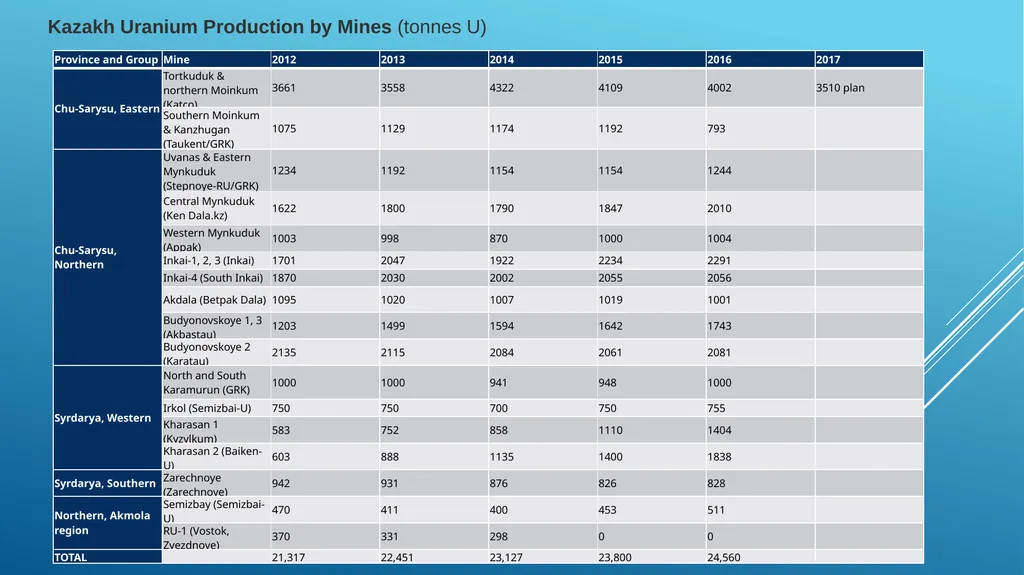
Kazakh Uranium Production by Mines (tonnes U)<br>
15
Acid production
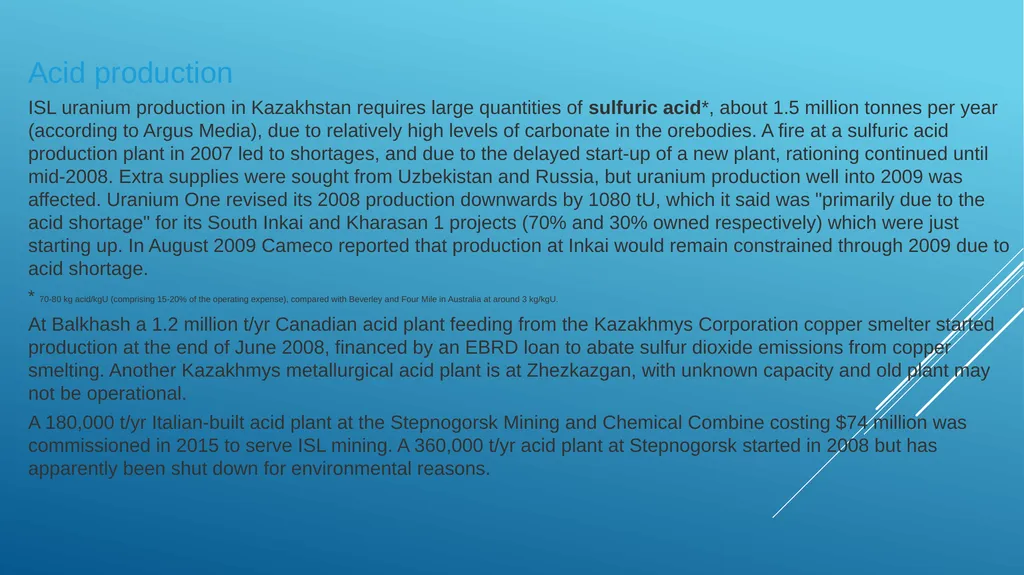
ISL uranium production in Kazakhstan requires large quantities of sulfuric acid*, about 1.5 million tonnes per year (according to Argus Media), due to relatively high levels of carbonate in the orebodies. A fire at a sulfuric acid production plant in 2007 led to shortages, and due to the delayed start-up of a new plant, rationing continued until mid-2008. Extra supplies were sought from Uzbekistan and Russia, but uranium production well into 2009 was affected. Uranium One revised its 2008 production downwards by 1080 tU, which it said was "primarily due to the acid shortage" for its South Inkai and Kharasan 1 projects (70% and 30% owned respectively) which were just starting up. In August 2009 Cameco reported that production at Inkai would remain constrained through 2009 due to acid shortage.
* 70-80 kg acid/kgU (comprising 15-20% of the operating expense), compared with Beverley and Four Mile in Australia at around 3 kg/kgU.
At Balkhash a 1.2 million t/yr Canadian acid plant feeding from the Kazakhmys Corporation copper smelter started production at the end of June 2008, financed by an EBRD loan to abate sulfur dioxide emissions from copper smelting. Another Kazakhmys metallurgical acid plant is at Zhezkazgan, with unknown capacity and old plant may not be operational.
A 180,000 t/yr Italian-built acid plant at the Stepnogorsk Mining and Chemical Combine costing $74 million was commissioned in 2015 to serve ISL mining. A 360,000 t/yr acid plant at Stepnogorsk started in 2008 but has apparently been shut down for environmental reasons.<br>
ISL uranium production in Kazakhstan requires large quantities of sulfuric acid*, about 1.5 million tonnes per year (according to Argus Media), due to relatively high levels of carbonate in the orebodies. A fire at a sulfuric acid production plant in 2007 led to shortages, and due to the delayed start-up of a new plant, rationing continued until mid-2008. Extra supplies were sought from Uzbekistan and Russia, but uranium production well into 2009 was affected. Uranium One revised its 2008 production downwards by 1080 tU, which it said was "primarily due to the acid shortage" for its South Inkai and Kharasan 1 projects (70% and 30% owned respectively) which were just starting up. In August 2009 Cameco reported that production at Inkai would remain constrained through 2009 due to acid shortage.
* 70-80 kg acid/kgU (comprising 15-20% of the operating expense), compared with Beverley and Four Mile in Australia at around 3 kg/kgU.
At Balkhash a 1.2 million t/yr Canadian acid plant feeding from the Kazakhmys Corporation copper smelter started production at the end of June 2008, financed by an EBRD loan to abate sulfur dioxide emissions from copper smelting. Another Kazakhmys metallurgical acid plant is at Zhezkazgan, with unknown capacity and old plant may not be operational.
A 180,000 t/yr Italian-built acid plant at the Stepnogorsk Mining and Chemical Combine costing $74 million was commissioned in 2015 to serve ISL mining. A 360,000 t/yr acid plant at Stepnogorsk started in 2008 but has apparently been shut down for environmental reasons.<br>
16
Another new acid plant of 500,000 t/yr capacity, was commissioned in December 2011 at Zhanakorgan, next to the Kharasan mines in the Western (#6) mining group or Kyzlorda region, to serve those mines from 2011, reaching design capacity in 2012. In 2013 it produced 356,600 t of acid and 16.9 MWh of power. At full capacity it burns 170,000 t/yr of solid sulfur derived from oil and gas production by Tengizhevroil in western Kazakhstan. This is the SKZ-U LLP/SAP-U* joint venture, with Kazatomprom (49%), Japanese interests (32%) and Uranium One (19%). It is a US$ 216 million project, and supplies all the Western region mines: Kharasan, Irkol and Karamurun.
* Construction of the plant was being carried out by SKZ-U LLP joint venture, in which Baiken-U LLP (40%) and Kyzylkum LLP (60%) are the stakeholders. Uranium One declares a 19% "joint control interest" in SKZ-U from 2009.
KazZinc has a 320,000 t/yr metallurgical acid plant operating since 2004 at Ust-Kamenogorsk Metallurgical Complex, taking gas from a zinc roaster and lead smelter, and another of unknown capacity operating there since 2011, taking gas from an IsaSmelt lead furnace. Both are primarily to abate sulfur dioxide emissions from smelting.
A further acid plant of 180,000 t/yr capacity is planned in connection with the Pavlodar Oil Refinery in northeast Kazakhstan, using 60,000 t/yr of sulfur from the refinery.
In 2009 Kazatomprom with other mining companies and two acid producers, KazZinc JSC and Kazakhmys, set up a coordinating council to regulate acid supplies and infrastructure. Cameco reported that acid supply was adequate through 2010.<br>
* Construction of the plant was being carried out by SKZ-U LLP joint venture, in which Baiken-U LLP (40%) and Kyzylkum LLP (60%) are the stakeholders. Uranium One declares a 19% "joint control interest" in SKZ-U from 2009.
KazZinc has a 320,000 t/yr metallurgical acid plant operating since 2004 at Ust-Kamenogorsk Metallurgical Complex, taking gas from a zinc roaster and lead smelter, and another of unknown capacity operating there since 2011, taking gas from an IsaSmelt lead furnace. Both are primarily to abate sulfur dioxide emissions from smelting.
A further acid plant of 180,000 t/yr capacity is planned in connection with the Pavlodar Oil Refinery in northeast Kazakhstan, using 60,000 t/yr of sulfur from the refinery.
In 2009 Kazatomprom with other mining companies and two acid producers, KazZinc JSC and Kazakhmys, set up a coordinating council to regulate acid supplies and infrastructure. Cameco reported that acid supply was adequate through 2010.<br>
17
Kazakh ISL uranium mines<br>
18
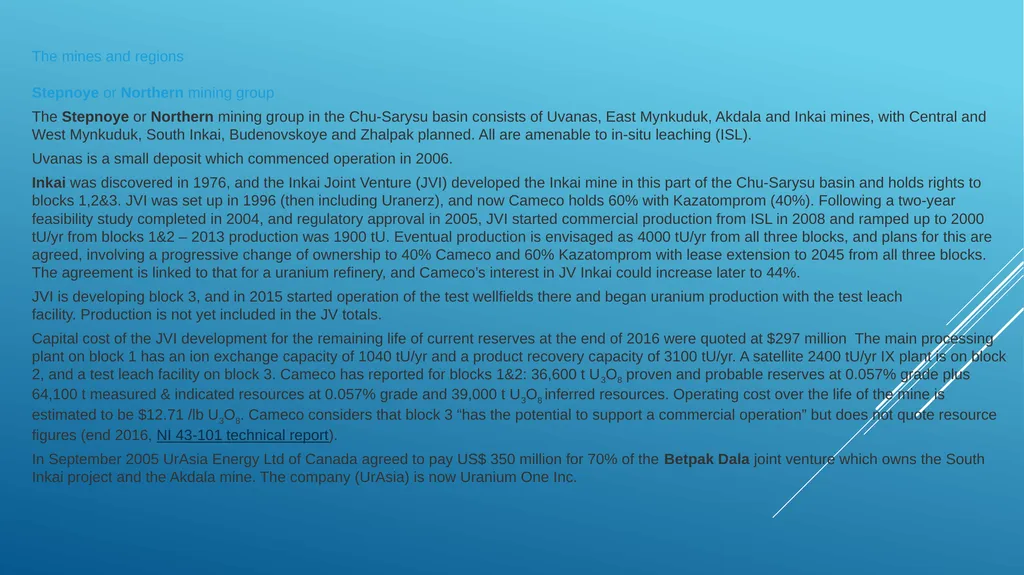
The mines and regions
Stepnoye or Northern mining group
The Stepnoye or Northern mining group in the Chu-Sarysu basin consists of Uvanas, East Mynkuduk, Akdala and Inkai mines, with Central and West Mynkuduk, South Inkai, Budenovskoye and Zhalpak planned. All are amenable to in-situ leaching (ISL).
Uvanas is a small deposit which commenced operation in 2006.
Inkai was discovered in 1976, and the Inkai Joint Venture (JVI) developed the Inkai mine in this part of the Chu-Sarysu basin and holds rights to blocks 1,2&3. JVI was set up in 1996 (then including Uranerz), and now Cameco holds 60% with Kazatomprom (40%). Following a two-year feasibility study completed in 2004, and regulatory approval in 2005, JVI started commercial production from ISL in 2008 and ramped up to 2000 tU/yr from blocks 1&2 – 2013 production was 1900 tU. Eventual production is envisaged as 4000 tU/yr from all three blocks, and plans for this are agreed, involving a progressive change of ownership to 40% Cameco and 60% Kazatomprom with lease extension to 2045 from all three blocks. The agreement is linked to that for a uranium refinery, and Cameco’s interest in JV Inkai could increase later to 44%.
JVI is developing block 3, and in 2015 started operation of the test wellfields there and began uranium production with the test leach facility. Production is not yet included in the JV totals.
Capital cost of the JVI development for the remaining life of current reserves at the end of 2016 were quoted at $297 million The main processing plant on block 1 has an ion exchange capacity of 1040 tU/yr and a product recovery capacity of 3100 tU/yr. A satellite 2400 tU/yr IX plant is on block 2, and a test leach facility on block 3. Cameco has reported for blocks 1&2: 36,600 t U3O8 proven and probable reserves at 0.057% grade plus 64,100 t measured & indicated resources at 0.057% grade and 39,000 t U3O8 inferred resources. Operating cost over the life of the mine is estimated to be $12.71 /lb U3O8. Cameco considers that block 3 “has the potential to support a commercial operation” but does not quote resource figures (end 2016, NI 43-101 technical report).
In September 2005 UrAsia Energy Ltd of Canada agreed to pay US$ 350 million for 70% of the Betpak Dala joint venture which owns the South Inkai project and the Akdala mine. The company (UrAsia) is now Uranium One Inc.<br>
Stepnoye or Northern mining group
The Stepnoye or Northern mining group in the Chu-Sarysu basin consists of Uvanas, East Mynkuduk, Akdala and Inkai mines, with Central and West Mynkuduk, South Inkai, Budenovskoye and Zhalpak planned. All are amenable to in-situ leaching (ISL).
Uvanas is a small deposit which commenced operation in 2006.
Inkai was discovered in 1976, and the Inkai Joint Venture (JVI) developed the Inkai mine in this part of the Chu-Sarysu basin and holds rights to blocks 1,2&3. JVI was set up in 1996 (then including Uranerz), and now Cameco holds 60% with Kazatomprom (40%). Following a two-year feasibility study completed in 2004, and regulatory approval in 2005, JVI started commercial production from ISL in 2008 and ramped up to 2000 tU/yr from blocks 1&2 – 2013 production was 1900 tU. Eventual production is envisaged as 4000 tU/yr from all three blocks, and plans for this are agreed, involving a progressive change of ownership to 40% Cameco and 60% Kazatomprom with lease extension to 2045 from all three blocks. The agreement is linked to that for a uranium refinery, and Cameco’s interest in JV Inkai could increase later to 44%.
JVI is developing block 3, and in 2015 started operation of the test wellfields there and began uranium production with the test leach facility. Production is not yet included in the JV totals.
Capital cost of the JVI development for the remaining life of current reserves at the end of 2016 were quoted at $297 million The main processing plant on block 1 has an ion exchange capacity of 1040 tU/yr and a product recovery capacity of 3100 tU/yr. A satellite 2400 tU/yr IX plant is on block 2, and a test leach facility on block 3. Cameco has reported for blocks 1&2: 36,600 t U3O8 proven and probable reserves at 0.057% grade plus 64,100 t measured & indicated resources at 0.057% grade and 39,000 t U3O8 inferred resources. Operating cost over the life of the mine is estimated to be $12.71 /lb U3O8. Cameco considers that block 3 “has the potential to support a commercial operation” but does not quote resource figures (end 2016, NI 43-101 technical report).
In September 2005 UrAsia Energy Ltd of Canada agreed to pay US$ 350 million for 70% of the Betpak Dala joint venture which owns the South Inkai project and the Akdala mine. The company (UrAsia) is now Uranium One Inc.<br>
19
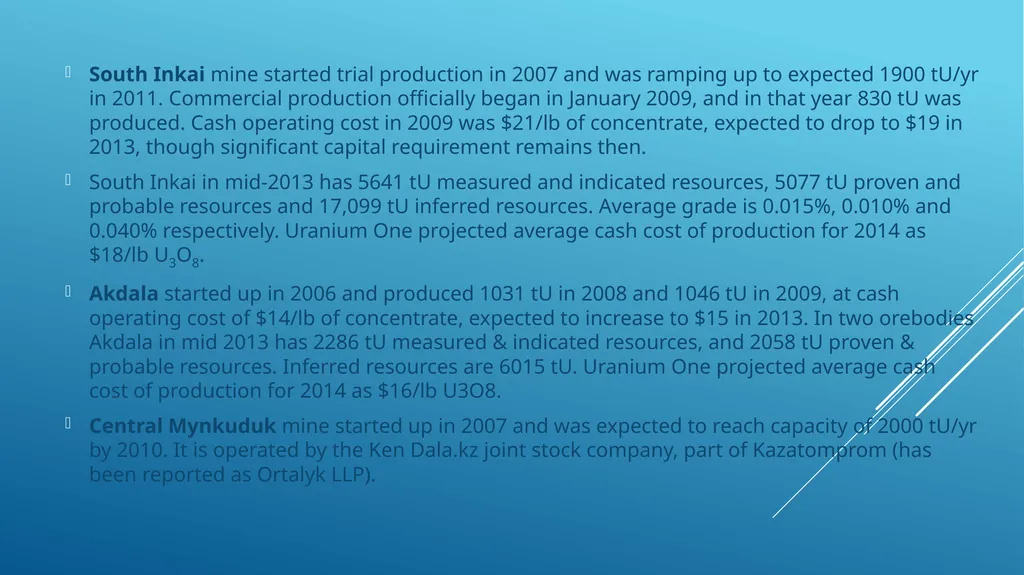
South Inkai mine started trial production in 2007 and was ramping up to expected 1900 tU/yr in 2011. Commercial production officially began in January 2009, and in that year 830 tU was produced. Cash operating cost in 2009 was $21/lb of concentrate, expected to drop to $19 in 2013, though significant capital requirement remains then.
South Inkai in mid-2013 has 5641 tU measured and indicated resources, 5077 tU proven and probable resources and 17,099 tU inferred resources. Average grade is 0.015%, 0.010% and 0.040% respectively. Uranium One projected average cash cost of production for 2014 as $18/lb U3O8.
Akdala started up in 2006 and produced 1031 tU in 2008 and 1046 tU in 2009, at cash operating cost of $14/lb of concentrate, expected to increase to $15 in 2013. In two orebodies Akdala in mid 2013 has 2286 tU measured & indicated resources, and 2058 tU proven & probable resources. Inferred resources are 6015 tU. Uranium One projected average cash cost of production for 2014 as $16/lb U3O8.
Central Mynkuduk mine started up in 2007 and was expected to reach capacity of 2000 tU/yr by 2010. It is operated by the Ken Dala.kz joint stock company, part of Kazatomprom (has been reported as Ortalyk LLP).<br>
South Inkai in mid-2013 has 5641 tU measured and indicated resources, 5077 tU proven and probable resources and 17,099 tU inferred resources. Average grade is 0.015%, 0.010% and 0.040% respectively. Uranium One projected average cash cost of production for 2014 as $18/lb U3O8.
Akdala started up in 2006 and produced 1031 tU in 2008 and 1046 tU in 2009, at cash operating cost of $14/lb of concentrate, expected to increase to $15 in 2013. In two orebodies Akdala in mid 2013 has 2286 tU measured & indicated resources, and 2058 tU proven & probable resources. Inferred resources are 6015 tU. Uranium One projected average cash cost of production for 2014 as $16/lb U3O8.
Central Mynkuduk mine started up in 2007 and was expected to reach capacity of 2000 tU/yr by 2010. It is operated by the Ken Dala.kz joint stock company, part of Kazatomprom (has been reported as Ortalyk LLP).<br>
20
West Mynkuduk: Early in 2006 KazAtomProm signed a US$ 100 million joint venture agreement with Sumitomo Corp (25%) and Kansai Electric Power Co (10%) to develop the deposit. First production from the Appak JV was in June 2008 with design capacity of 1000 t/yr expected in 2010. Sumitomo will supply uranium from the mine to Japanese power utilities.
The East Mynkuduk mine was launched in May 2006 by Kazatomprom to achieve its planned 1000 t/yr production in 2007.
The Karatau mine at the south end of the Budenovskoye deposit started production in 2008 (655 tU), and ramped up to a capacity of 2000 tU/yr by 2011. Capacity of the Budenovskoye 2 uranium recovery plant reached 3000 tU/yr in 2011, serving both Karatau and Akbastau. Karatau in mid-2013 has reserves of 52,000 tU in measured and indicated resources of 63,839 tU and proven and probable resources of 51,960 tU. Average resource grade is 0.074% and 0.035% respectively. Uranium One projected average cash cost of production for 2014 as $11/lb U3O8. In 2016 wells were drilled to 700 metres and production tests commenced.
The Akbastau mine (Budenovskoye 1, 3, 4) just north of this started production at the end of 2009 and produced 385 tU that year, with recovery from pregnant liquor being at Karatau. It expected almost 1000 tU production in 2011 and ramping up to 3000 tU/yr by 2015, with $200 million being spent to achieve that. Akbastau 1-3 in mid 2013 have reserves of 31,600 tU, in combined measured and indicated resources of 47,293 tU, and proven and probable resources of 31,598 tU. Uranium One projected average cash cost of production for 2014 as $13/lb U3O8.
In July 2006 both Budenovskoye operations became 50:50 JVs with Russia, complementing Zarechnoye, but in 2009 ARMZ's share in Karatau was sold to Uranium One. In 2010 ARMZ's share in Akbastau was also transferred to Uranium One.
Zhalpak: A Chinese (CNNC)-Kazatomprom joint venture was set up to develop the deposit. This could produce up to 1000 tU/yr from resources of 15,000 tU.<br>
The East Mynkuduk mine was launched in May 2006 by Kazatomprom to achieve its planned 1000 t/yr production in 2007.
The Karatau mine at the south end of the Budenovskoye deposit started production in 2008 (655 tU), and ramped up to a capacity of 2000 tU/yr by 2011. Capacity of the Budenovskoye 2 uranium recovery plant reached 3000 tU/yr in 2011, serving both Karatau and Akbastau. Karatau in mid-2013 has reserves of 52,000 tU in measured and indicated resources of 63,839 tU and proven and probable resources of 51,960 tU. Average resource grade is 0.074% and 0.035% respectively. Uranium One projected average cash cost of production for 2014 as $11/lb U3O8. In 2016 wells were drilled to 700 metres and production tests commenced.
The Akbastau mine (Budenovskoye 1, 3, 4) just north of this started production at the end of 2009 and produced 385 tU that year, with recovery from pregnant liquor being at Karatau. It expected almost 1000 tU production in 2011 and ramping up to 3000 tU/yr by 2015, with $200 million being spent to achieve that. Akbastau 1-3 in mid 2013 have reserves of 31,600 tU, in combined measured and indicated resources of 47,293 tU, and proven and probable resources of 31,598 tU. Uranium One projected average cash cost of production for 2014 as $13/lb U3O8.
In July 2006 both Budenovskoye operations became 50:50 JVs with Russia, complementing Zarechnoye, but in 2009 ARMZ's share in Karatau was sold to Uranium One. In 2010 ARMZ's share in Akbastau was also transferred to Uranium One.
Zhalpak: A Chinese (CNNC)-Kazatomprom joint venture was set up to develop the deposit. This could produce up to 1000 tU/yr from resources of 15,000 tU.<br>
21
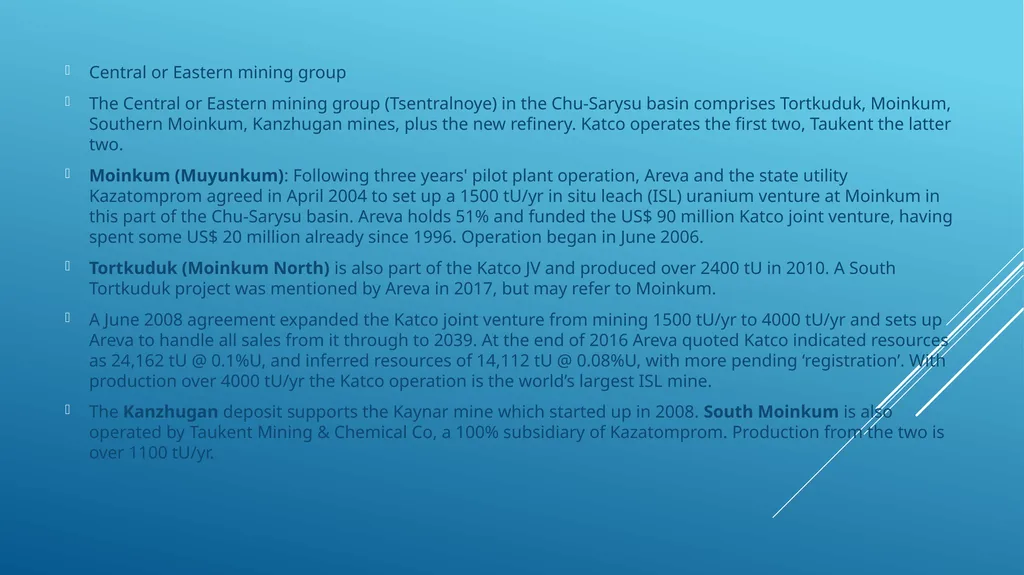
Central or Eastern mining group
The Central or Eastern mining group (Tsentralnoye) in the Chu-Sarysu basin comprises Tortkuduk, Moinkum, Southern Moinkum, Kanzhugan mines, plus the new refinery. Katco operates the first two, Taukent the latter two.
Moinkum (Muyunkum): Following three years' pilot plant operation, Areva and the state utility Kazatomprom agreed in April 2004 to set up a 1500 tU/yr in situ leach (ISL) uranium venture at Moinkum in this part of the Chu-Sarysu basin. Areva holds 51% and funded the US$ 90 million Katco joint venture, having spent some US$ 20 million already since 1996. Operation began in June 2006.
Tortkuduk (Moinkum North) is also part of the Katco JV and produced over 2400 tU in 2010. A South Tortkuduk project was mentioned by Areva in 2017, but may refer to Moinkum.
A June 2008 agreement expanded the Katco joint venture from mining 1500 tU/yr to 4000 tU/yr and sets up Areva to handle all sales from it through to 2039. At the end of 2016 Areva quoted Katco indicated resources as 24,162 tU @ 0.1%U, and inferred resources of 14,112 tU @ 0.08%U, with more pending ‘registration’. With production over 4000 tU/yr the Katco operation is the world’s largest ISL mine.
The Kanzhugan deposit supports the Kaynar mine which started up in 2008. South Moinkum is also operated by Taukent Mining & Chemical Co, a 100% subsidiary of Kazatomprom. Production from the two is over 1100 tU/yr.<br>
The Central or Eastern mining group (Tsentralnoye) in the Chu-Sarysu basin comprises Tortkuduk, Moinkum, Southern Moinkum, Kanzhugan mines, plus the new refinery. Katco operates the first two, Taukent the latter two.
Moinkum (Muyunkum): Following three years' pilot plant operation, Areva and the state utility Kazatomprom agreed in April 2004 to set up a 1500 tU/yr in situ leach (ISL) uranium venture at Moinkum in this part of the Chu-Sarysu basin. Areva holds 51% and funded the US$ 90 million Katco joint venture, having spent some US$ 20 million already since 1996. Operation began in June 2006.
Tortkuduk (Moinkum North) is also part of the Katco JV and produced over 2400 tU in 2010. A South Tortkuduk project was mentioned by Areva in 2017, but may refer to Moinkum.
A June 2008 agreement expanded the Katco joint venture from mining 1500 tU/yr to 4000 tU/yr and sets up Areva to handle all sales from it through to 2039. At the end of 2016 Areva quoted Katco indicated resources as 24,162 tU @ 0.1%U, and inferred resources of 14,112 tU @ 0.08%U, with more pending ‘registration’. With production over 4000 tU/yr the Katco operation is the world’s largest ISL mine.
The Kanzhugan deposit supports the Kaynar mine which started up in 2008. South Moinkum is also operated by Taukent Mining & Chemical Co, a 100% subsidiary of Kazatomprom. Production from the two is over 1100 tU/yr.<br>
22
Western mining group (#6)
The Western mining group (#6) is in the Syrdarya basin and comprises the North and South Karamurun mines operated by Mining Company #6, with Irkol and (North) Kharasan 1&2.
Kharasan: In 2005 UrAsia Energy Ltd (now Uranium One Inc) of Canada paid US$ 75 million for a 30% share of the Kyzylkum joint venture which owns the (North) Kharasan project. Kharasan 1 in mid-2013 had measured & indicated resources of 8561 tU, and proven and probable resources of 7132 tU. Inferred resources were 17,940 tU. Uranium One projected average cash cost of production for 2014 was $24/lb U3O8.
Kharasan 2 is to the south of this and was owned by Kazatomprom but is now controlled by the Baiken-U joint venture, including 95% Japanese equity. Pilot production commenced in 2009.
In April 2007 several Japanese companies – the Energy Asia consortium led by Marubeni – bought 40% of the Kharasan project to directly take 2000 tU/yr when it was in full production at 5000 tU/yr, planned to be about 2014. Project funding was $70 million from the Japan Bank for International Cooperation and $30 million from Citibank. Uranium One retains 30% equity of (north) Kharasan 1 through Kyzylkum JV.
A 2000 tU per year processing facility is matched with a 1000 tU/yr satellite plant. Pilot production commenced in April 2009 with Kharasan 1 to reach 3000 tU/yr by 2014, and Kharasan 2 to reach 2000 tU/yr in 2014. In fact production from both mines together reached only 2500 tU in 2015. Pre-commercial mining commenced in 2008 first significant production for both was early 2010. Production from the $430 million project will primarily supply Japanese utilities. In August 2009 Kazatomprom announced that a wrong technological decision in 2006 regarding development of the deposits had "led to a failure of the 2008-09 production program" and consequent lack of funds, but this was being rectified. Uranium One said that bore holes had been drilled incorrectly and that organic matter was increasing acid consumption.
Irkol started up in 2008, and ramped up for 750 tU/yr by 2010. In October 2008 China's CGN-URC took a 49% share of it through the Semizbai-U JV (see introductory section and below). China Nuclear Energy Industrial Corp (CNEIC) is also involved, possibly as customer for part of the Chinese share of production. The mine was formally opened in April 2009 with some fanfare, as the first mine to be put into commercial operation within the framework of the Kazakhstan-CGNPC nuclear power agreement. All the production is sold to CGN.
Karamurun: North Karamurun was expected to start up in 2007, South Karamurun in 2009.<br>
The Western mining group (#6) is in the Syrdarya basin and comprises the North and South Karamurun mines operated by Mining Company #6, with Irkol and (North) Kharasan 1&2.
Kharasan: In 2005 UrAsia Energy Ltd (now Uranium One Inc) of Canada paid US$ 75 million for a 30% share of the Kyzylkum joint venture which owns the (North) Kharasan project. Kharasan 1 in mid-2013 had measured & indicated resources of 8561 tU, and proven and probable resources of 7132 tU. Inferred resources were 17,940 tU. Uranium One projected average cash cost of production for 2014 was $24/lb U3O8.
Kharasan 2 is to the south of this and was owned by Kazatomprom but is now controlled by the Baiken-U joint venture, including 95% Japanese equity. Pilot production commenced in 2009.
In April 2007 several Japanese companies – the Energy Asia consortium led by Marubeni – bought 40% of the Kharasan project to directly take 2000 tU/yr when it was in full production at 5000 tU/yr, planned to be about 2014. Project funding was $70 million from the Japan Bank for International Cooperation and $30 million from Citibank. Uranium One retains 30% equity of (north) Kharasan 1 through Kyzylkum JV.
A 2000 tU per year processing facility is matched with a 1000 tU/yr satellite plant. Pilot production commenced in April 2009 with Kharasan 1 to reach 3000 tU/yr by 2014, and Kharasan 2 to reach 2000 tU/yr in 2014. In fact production from both mines together reached only 2500 tU in 2015. Pre-commercial mining commenced in 2008 first significant production for both was early 2010. Production from the $430 million project will primarily supply Japanese utilities. In August 2009 Kazatomprom announced that a wrong technological decision in 2006 regarding development of the deposits had "led to a failure of the 2008-09 production program" and consequent lack of funds, but this was being rectified. Uranium One said that bore holes had been drilled incorrectly and that organic matter was increasing acid consumption.
Irkol started up in 2008, and ramped up for 750 tU/yr by 2010. In October 2008 China's CGN-URC took a 49% share of it through the Semizbai-U JV (see introductory section and below). China Nuclear Energy Industrial Corp (CNEIC) is also involved, possibly as customer for part of the Chinese share of production. The mine was formally opened in April 2009 with some fanfare, as the first mine to be put into commercial operation within the framework of the Kazakhstan-CGNPC nuclear power agreement. All the production is sold to CGN.
Karamurun: North Karamurun was expected to start up in 2007, South Karamurun in 2009.<br>
23
Southern mining group
The Southern mining group in the same Syrdarya basin has the Zarechnoye mine.
Zarechnoye, discovered in 1977, started production early in 2009. Reserves were earlier quoted at 19,000 tU, but in mid-2013 measured & indicated resources are 7988 tU and proven and probable resources 4510 tU. Inferred resources are 4500 tU. The US$ 60 million Zarechnoye joint venture involved Kazatomprom (49.67%), ARMZ (49.67% – to provide finance) and Kyrgyzstan's Kara Baltinski Mining Combine (0.66%), which finally treats and calcines the product there, 400 km east. The mine produces over 930 tU/yr. In mid-2010 ARMZ agreed to transfer its share to Uranium One. Uranium One projected average cash cost of production for 2014 as $28/lb U3O8.
South Zarechnoye was discovered in 1989 and was being developed by the same joint venture to commence production in 2014, eventually at 620 tU/yr. However, the project was put on hold in 202 due to low uranium price and a reduced resource estimate. In November 2013 Uranium One reported that “mineral resources on this property are insufficient to support development”.
In June 2006 Tenex signed a US$ 1 billion uranium supply contract with Zarechnoye JV for up to 6000 tU per year from 2007 to 2022. Initially this will come from Zarechnoye mine, but Budenovskoye will also contribute.
Northern Kazakhstan province
Outside of these two basins, in the Northern Kazakhstan province, the Vostok underground mine continues in production, with Zvezdnoye. The Semyibai ISL mine was commissioned at the end of 2009 with a capacity of 500 tU/yr from a uranium-rare earths deposit, and the second stage 200 tU/yr came on line in 2011. In 2008 China's CGN-URC took a 49% share of it and in 2015 this equity passed to CGN Mining Co Ltd. It is managed, with Irkol, by Semizbai-U LLP, a joint venture. China Nuclear Energy Industrial Corp (CNEIC) is also involved, possibly as customer for part of the Chinese share of production.
Earlier, Itochu Corp of Japan has signed a uranium purchase agreement with KazAtomProm for some 3000 tonnes of uranium over 10 years to be marketed in Japan and the USA. KazAtomProm intends to use a US$60 million loan from Japan¹s Mizuho Corporate Bank to raise uranium production at the Central Mynkuduk deposit to 1000 tU/yr, of which Itochu Corp will receive 300t.<br>
The Southern mining group in the same Syrdarya basin has the Zarechnoye mine.
Zarechnoye, discovered in 1977, started production early in 2009. Reserves were earlier quoted at 19,000 tU, but in mid-2013 measured & indicated resources are 7988 tU and proven and probable resources 4510 tU. Inferred resources are 4500 tU. The US$ 60 million Zarechnoye joint venture involved Kazatomprom (49.67%), ARMZ (49.67% – to provide finance) and Kyrgyzstan's Kara Baltinski Mining Combine (0.66%), which finally treats and calcines the product there, 400 km east. The mine produces over 930 tU/yr. In mid-2010 ARMZ agreed to transfer its share to Uranium One. Uranium One projected average cash cost of production for 2014 as $28/lb U3O8.
South Zarechnoye was discovered in 1989 and was being developed by the same joint venture to commence production in 2014, eventually at 620 tU/yr. However, the project was put on hold in 202 due to low uranium price and a reduced resource estimate. In November 2013 Uranium One reported that “mineral resources on this property are insufficient to support development”.
In June 2006 Tenex signed a US$ 1 billion uranium supply contract with Zarechnoye JV for up to 6000 tU per year from 2007 to 2022. Initially this will come from Zarechnoye mine, but Budenovskoye will also contribute.
Northern Kazakhstan province
Outside of these two basins, in the Northern Kazakhstan province, the Vostok underground mine continues in production, with Zvezdnoye. The Semyibai ISL mine was commissioned at the end of 2009 with a capacity of 500 tU/yr from a uranium-rare earths deposit, and the second stage 200 tU/yr came on line in 2011. In 2008 China's CGN-URC took a 49% share of it and in 2015 this equity passed to CGN Mining Co Ltd. It is managed, with Irkol, by Semizbai-U LLP, a joint venture. China Nuclear Energy Industrial Corp (CNEIC) is also involved, possibly as customer for part of the Chinese share of production.
Earlier, Itochu Corp of Japan has signed a uranium purchase agreement with KazAtomProm for some 3000 tonnes of uranium over 10 years to be marketed in Japan and the USA. KazAtomProm intends to use a US$60 million loan from Japan¹s Mizuho Corporate Bank to raise uranium production at the Central Mynkuduk deposit to 1000 tU/yr, of which Itochu Corp will receive 300t.<br>
24
Fuel cycle: front end
The internationally-significant Ulba Metallurgical Plant (UMP) at Oskomen also known as Ust Kamenogorsk in the east of the country was commissioned in 1949. It has a variety of functions relevant to uranium. (It also produces beryllium, niobium and tanatalum.)
In June 2008 the formation of a new company – Ulba Conversion LLP – was announced, to build a 12,000 t/yr uranium hexafluoride conversion plant here, with Cameco providing the technology and holding 49% of the project. Ulba has produced HF since 1952, and the new conversion subsidiary would fit in with Russian JV enrichment arrangements. In May 2013 Cameco said that it expected construction of the plant with 6000 t/yr capacity to commence in 2018, with first production in 2020, subject to a feasibility study from 2014. This plant will produce UO3 for conversion to UF6 at Port Hope in Canada.
Kazatomprom has a JV with Russia's TVEL for uranium enrichment, (agreed with Tenex in 2006 and set up in 2008). Initially this envisaged adding to the enrichment plant at Angarsk in southern Siberia where Russia has its main conversion plant and a small enrichment plant now being expanded to 4.2 million SWU/yr. Kazatomprom and Tenex agreed to finance a 5 million SWU/yr increment to this. Each party would contribute about US$ 1.6 billion and Kazatomprom would hold 50% equity. When this looked uneconomic due to surplus enrichment capacity, in March 2011 Russian equity in the JV was transferred from Tenex to TVEL and the Kazatomprom-TVEL JV Uranium Enrichment Centre (Closed Joint Stock Company UEC) was offered a share in the Urals Electrochemical Combine (Open Joint Stock Company UECC) which has a 10 million SWU/yr plant at Novouralsk instead. The Kazakh share in UEC would be 50%, related to the need to enrich 6000 tU/yr, and estimated to cost up to $500 million (though amount not disclosed). In the event the joint venture CJSC UEC took up a 25% share of UECC in September 2013 and became entitled to half its output – 5 million SWU/yr. In 2014 the UEC CJSC share was 4.99 million SWU, and in 2015 it was 5.11 million SWU. This is distinct from the International Uranium Enrichment Centre (IUEC).
In September 2007 the joint stock company Angarsk International Uranium Enrichment Centre (IUEC) was registered with 10% Kazatomprom ownership and the balance Techsnabexport (Tenex). This share is being sold down to other partners – Ukraine confirmed 10% share in 2008, and Tenex is to hold only 51% eventually.
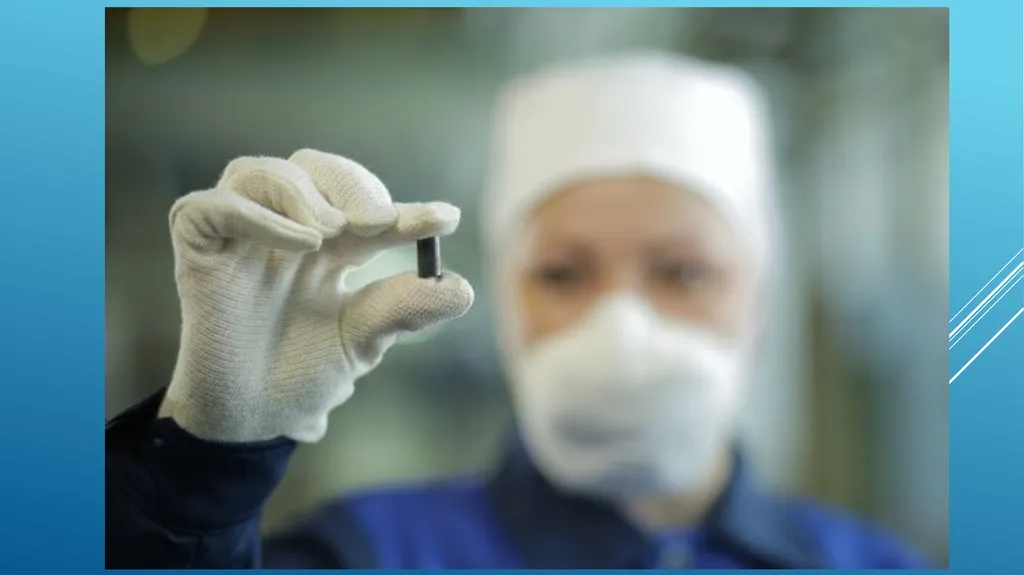
Since 1973 Ulba has produced nuclear fuel pellets from Russian-enriched uranium which are used in Russian and Ukrainian VVER and RBMK reactors. Some of this product incorporates gadolinium and erbium burnable poisons. Other exports are to the USA and Asia. Ulba briefly produced fuel for submarines (from 1968) and satellite reactors. Since 1985 it has been able to handle reprocessed uranium, and it has been making fuel pellets incorporating this for western reactors, supplied through TVEL. It is a major supplier to China.<br>
The internationally-significant Ulba Metallurgical Plant (UMP) at Oskomen also known as Ust Kamenogorsk in the east of the country was commissioned in 1949. It has a variety of functions relevant to uranium. (It also produces beryllium, niobium and tanatalum.)
In June 2008 the formation of a new company – Ulba Conversion LLP – was announced, to build a 12,000 t/yr uranium hexafluoride conversion plant here, with Cameco providing the technology and holding 49% of the project. Ulba has produced HF since 1952, and the new conversion subsidiary would fit in with Russian JV enrichment arrangements. In May 2013 Cameco said that it expected construction of the plant with 6000 t/yr capacity to commence in 2018, with first production in 2020, subject to a feasibility study from 2014. This plant will produce UO3 for conversion to UF6 at Port Hope in Canada.
Kazatomprom has a JV with Russia's TVEL for uranium enrichment, (agreed with Tenex in 2006 and set up in 2008). Initially this envisaged adding to the enrichment plant at Angarsk in southern Siberia where Russia has its main conversion plant and a small enrichment plant now being expanded to 4.2 million SWU/yr. Kazatomprom and Tenex agreed to finance a 5 million SWU/yr increment to this. Each party would contribute about US$ 1.6 billion and Kazatomprom would hold 50% equity. When this looked uneconomic due to surplus enrichment capacity, in March 2011 Russian equity in the JV was transferred from Tenex to TVEL and the Kazatomprom-TVEL JV Uranium Enrichment Centre (Closed Joint Stock Company UEC) was offered a share in the Urals Electrochemical Combine (Open Joint Stock Company UECC) which has a 10 million SWU/yr plant at Novouralsk instead. The Kazakh share in UEC would be 50%, related to the need to enrich 6000 tU/yr, and estimated to cost up to $500 million (though amount not disclosed). In the event the joint venture CJSC UEC took up a 25% share of UECC in September 2013 and became entitled to half its output – 5 million SWU/yr. In 2014 the UEC CJSC share was 4.99 million SWU, and in 2015 it was 5.11 million SWU. This is distinct from the International Uranium Enrichment Centre (IUEC).
In September 2007 the joint stock company Angarsk International Uranium Enrichment Centre (IUEC) was registered with 10% Kazatomprom ownership and the balance Techsnabexport (Tenex). This share is being sold down to other partners – Ukraine confirmed 10% share in 2008, and Tenex is to hold only 51% eventually.
Since 1973 Ulba has produced nuclear fuel pellets from Russian-enriched uranium which are used in Russian and Ukrainian VVER and RBMK reactors. Some of this product incorporates gadolinium and erbium burnable poisons. Other exports are to the USA and Asia. Ulba briefly produced fuel for submarines (from 1968) and satellite reactors. Since 1985 it has been able to handle reprocessed uranium, and it has been making fuel pellets incorporating this for western reactors, supplied through TVEL. It is a major supplier to China.<br>
25
Ulba Metallurgical Plant (UMP) is majority owned by Kazatomprom and 34% by Russia's TVEL and has major new investment under way. It has secured both ISO 9001 and ISO 14001 accreditation. In 2007 a technological assistance agreement was signed with Japan apparently in line with government announcements that it would move towards selling its uranium as fabricated fuel or at least fuel pellets rather than just raw material. (One agreement is on fabrication of nuclear fuel components, between Kazatomprom, Kansai Electric and Sumitomo Corp.) In 2010, UO2 powder for Japan was certified by Japan's Nuclear Fuel Industries, and fuel pellets for China by CNNC's China Jianzhong Nuclear Fuel.
Kazatomprom has said that it aims to supply up to one third of the world fuel fabrication market by 2030, with China to be an early major customer. In June 2008 Areva signed a memorandum of understanding to provide engineering expertise to build a 1200 t/yr fuel fabrication plant as part of the Ulba complex, utilising fuel pellets from it. In October 2010 and November 2011 further agreements focused on a dedicated 400 t/yr line (51% owned by Kazatomprom, 49% Areva) specifically for fuel for French-designed reactors, including those in China. Another 800 t/yr line would be wholly owned by Kazatomprom. These plans with Areva appear to have stalled.
In December 2014 Kazatomprom signed an agreement with China General Nuclear Corp (CGN) focused on establishing the Ulba-FA joint venture to build a fuel fabrication plant for the production of 200 t/yr of fuel assemblies at the Ulba Metallurgical Plant. In December 2015 and September 2016 further agreements on this were signed, with UMP to have 51% and CGN-URC 49% shares in the $147 million project. In March 2016 Areva was awarded a contract for equipment and support to the Ulba-FA plant for the fabrication of AFA 3G fuel assemblies for CGN reactors. In December 2016 construction of the plant by Kazatomprom and CGN began. It is due for completion in 2018, and first shipments to China are expected in 2020, at 200 t/yr (about 400 fuel assemblies).
Kazatomprom is also negotiating technology transfer agreements to enable it to supply fabricated fuel for Westinghouse reactors, now that it owns a 10% stake in Westinghouse.<br>
Kazatomprom has said that it aims to supply up to one third of the world fuel fabrication market by 2030, with China to be an early major customer. In June 2008 Areva signed a memorandum of understanding to provide engineering expertise to build a 1200 t/yr fuel fabrication plant as part of the Ulba complex, utilising fuel pellets from it. In October 2010 and November 2011 further agreements focused on a dedicated 400 t/yr line (51% owned by Kazatomprom, 49% Areva) specifically for fuel for French-designed reactors, including those in China. Another 800 t/yr line would be wholly owned by Kazatomprom. These plans with Areva appear to have stalled.
In December 2014 Kazatomprom signed an agreement with China General Nuclear Corp (CGN) focused on establishing the Ulba-FA joint venture to build a fuel fabrication plant for the production of 200 t/yr of fuel assemblies at the Ulba Metallurgical Plant. In December 2015 and September 2016 further agreements on this were signed, with UMP to have 51% and CGN-URC 49% shares in the $147 million project. In March 2016 Areva was awarded a contract for equipment and support to the Ulba-FA plant for the fabrication of AFA 3G fuel assemblies for CGN reactors. In December 2016 construction of the plant by Kazatomprom and CGN began. It is due for completion in 2018, and first shipments to China are expected in 2020, at 200 t/yr (about 400 fuel assemblies).
Kazatomprom is also negotiating technology transfer agreements to enable it to supply fabricated fuel for Westinghouse reactors, now that it owns a 10% stake in Westinghouse.<br>