Lecture 13 – Queues COMPSCI 107 Computer Science
Description: Lecture 13 Queues COMPSCI 107 Computer Science Fundamentals Ordered collection of data Items are added to the back of the queue Items are removed from the front of the queue Remove data in the same order as the data added First in, first
Related Topics
Download Presentation
"Lecture 13 – Queues COMPSCI 107 Computer Science" is the property of its rightful owner. Permission is granted to download and print the materials on this website for personal, non-commercial use only, and to display it on your personal computer provided you do not modify the materials and that you retain all copyright notices contained in the materials. By downloading content from our website, you accept the terms of this agreement.
Presentation Transcript
slide1. Lecture 13 – Queues COMPSCI 107Computer Science Fundamentals<br>
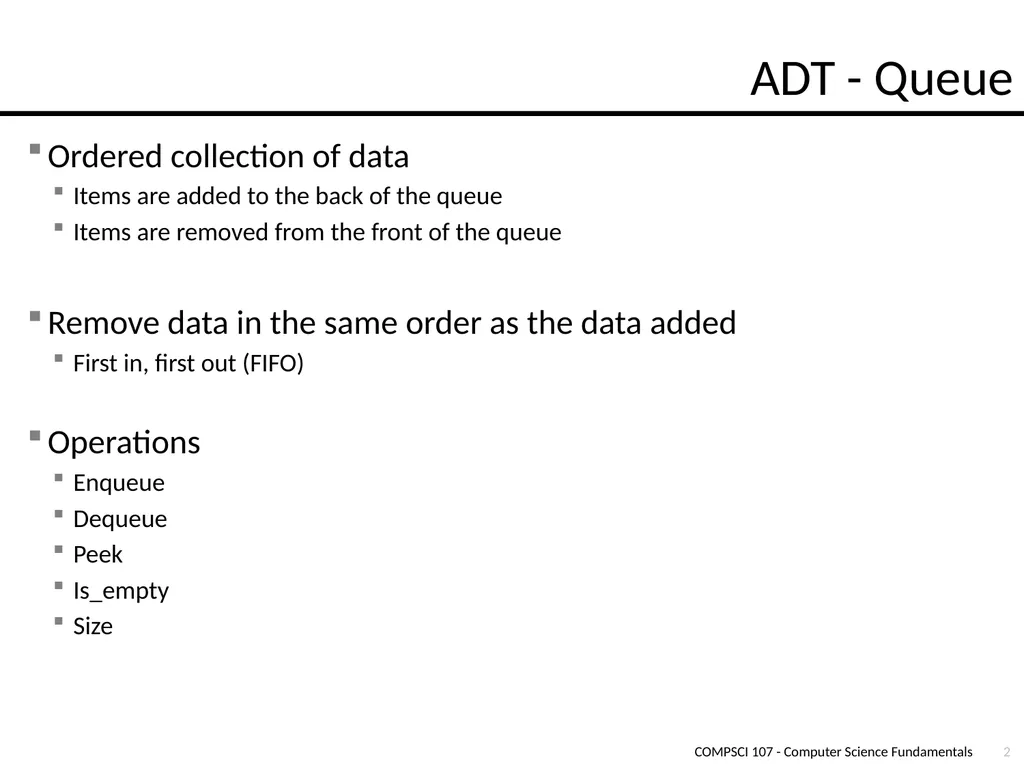
slide2. Ordered collection of data
Items are added to the back of the queue
Items are removed from the front of the queue
Remove data in the same order as the data added
First in, first out (FIFO)
Operations
Enqueue
Dequeue
Peek
Is_empty
Size ADT - Queue 2 COMPSCI 107 - Computer Science Fundamentals<br>
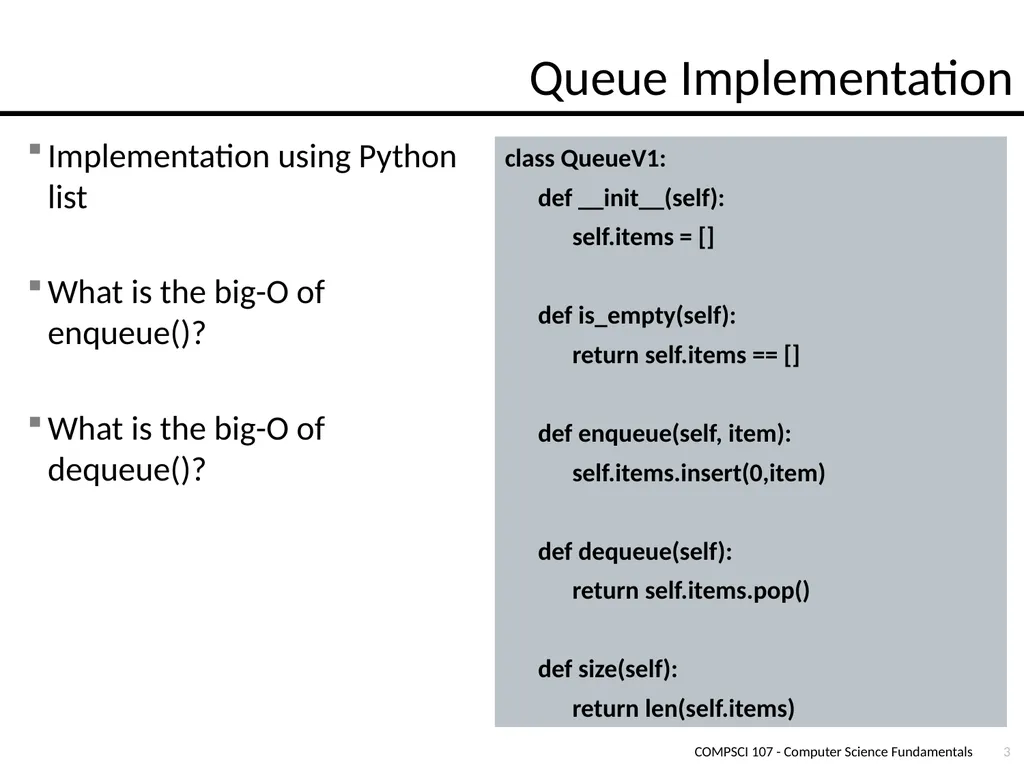
slide3. Implementation using Python list
What is the big-O of enqueue()?
What is the big-O of dequeue()? Queue Implementation 3 COMPSCI 107 - Computer Science Fundamentals class QueueV1:
def __init__(self):
self.items = []
def is_empty(self):
return self.items == []
def enqueue(self, item):
self.items.insert(0,item)
def dequeue(self):
return self.items.pop()
def size(self):
return len(self.items)<br>
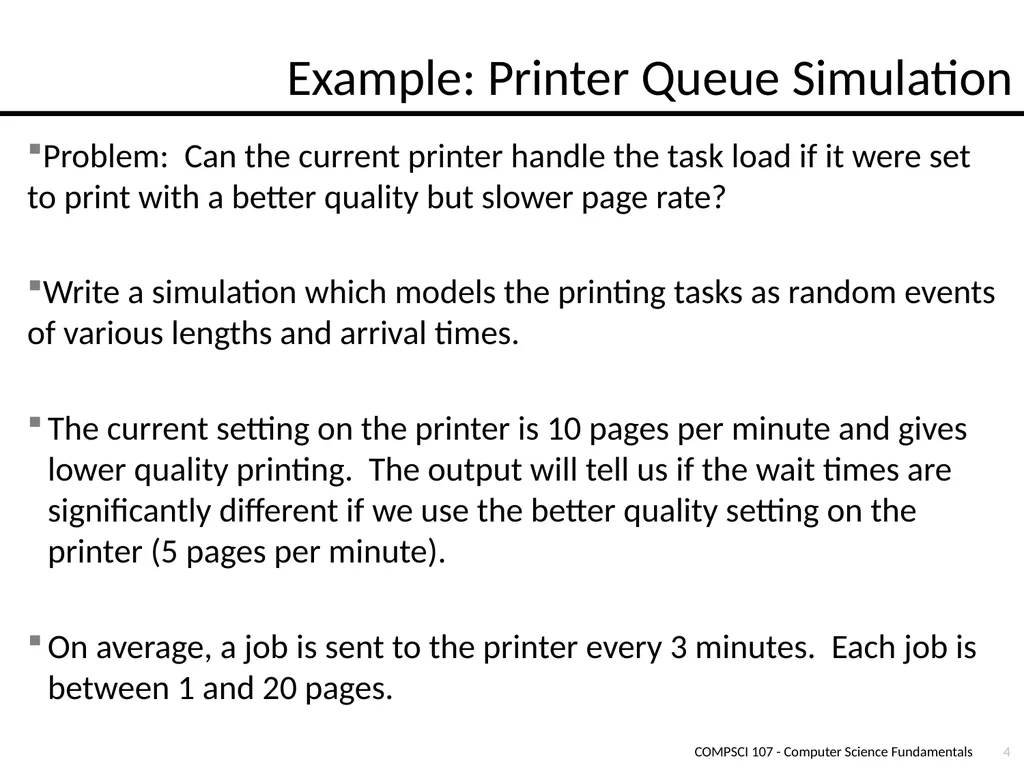
slide4. Problem: Can the current printer handle the task load if it were set to print with a better quality but slower page rate?
Write a simulation which models the printing tasks as random events of various lengths and arrival times.
The current setting on the printer is 10 pages per minute and gives lower quality printing. The output will tell us if the wait times are significantly different if we use the better quality setting on the printer (5 pages per minute).
On average, a job is sent to the printer every 3 minutes. Each job is between 1 and 20 pages. Example: Printer Queue Simulation 4 COMPSCI 107 - Computer Science Fundamentals<br>
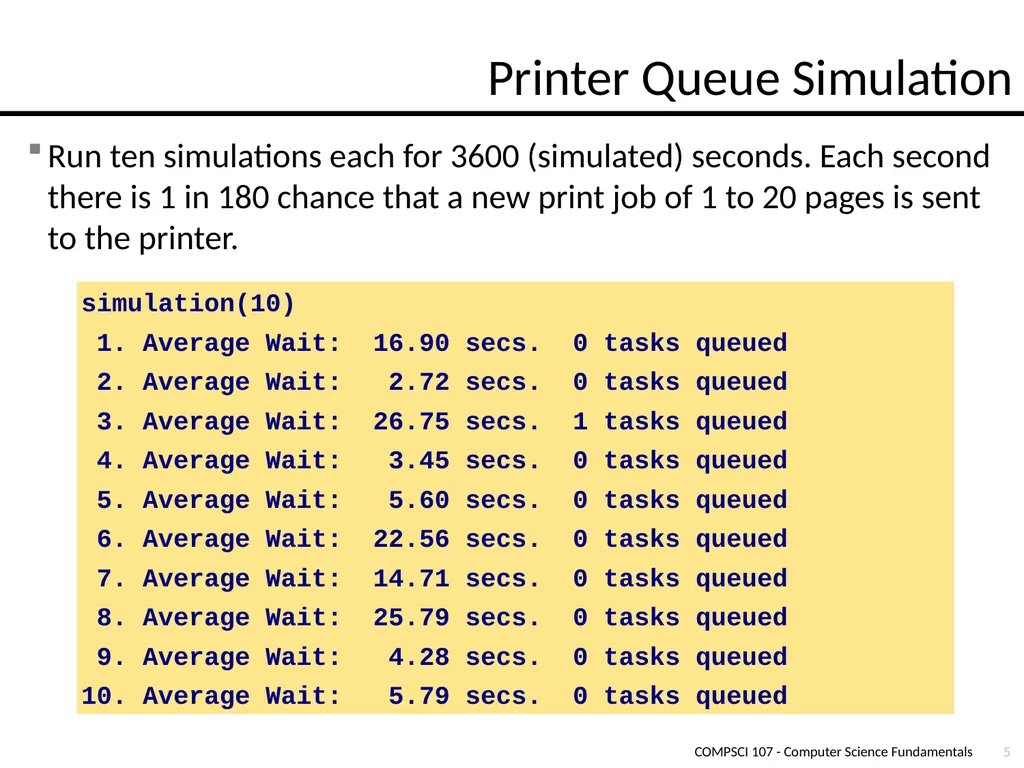
slide5. Run ten simulations each for 3600 (simulated) seconds. Each second there is 1 in 180 chance that a new print job of 1 to 20 pages is sent to the printer. Printer Queue Simulation 5 COMPSCI 107 - Computer Science Fundamentals simulation(10)
1. Average Wait: 16.90 secs. 0 tasks queued
2. Average Wait: 2.72 secs. 0 tasks queued
3. Average Wait: 26.75 secs. 1 tasks queued
4. Average Wait: 3.45 secs. 0 tasks queued
5. Average Wait: 5.60 secs. 0 tasks queued
6. Average Wait: 22.56 secs. 0 tasks queued
7. Average Wait: 14.71 secs. 0 tasks queued
8. Average Wait: 25.79 secs. 0 tasks queued
9. Average Wait: 4.28 secs. 0 tasks queued
10. Average Wait: 5.79 secs. 0 tasks queued<br>
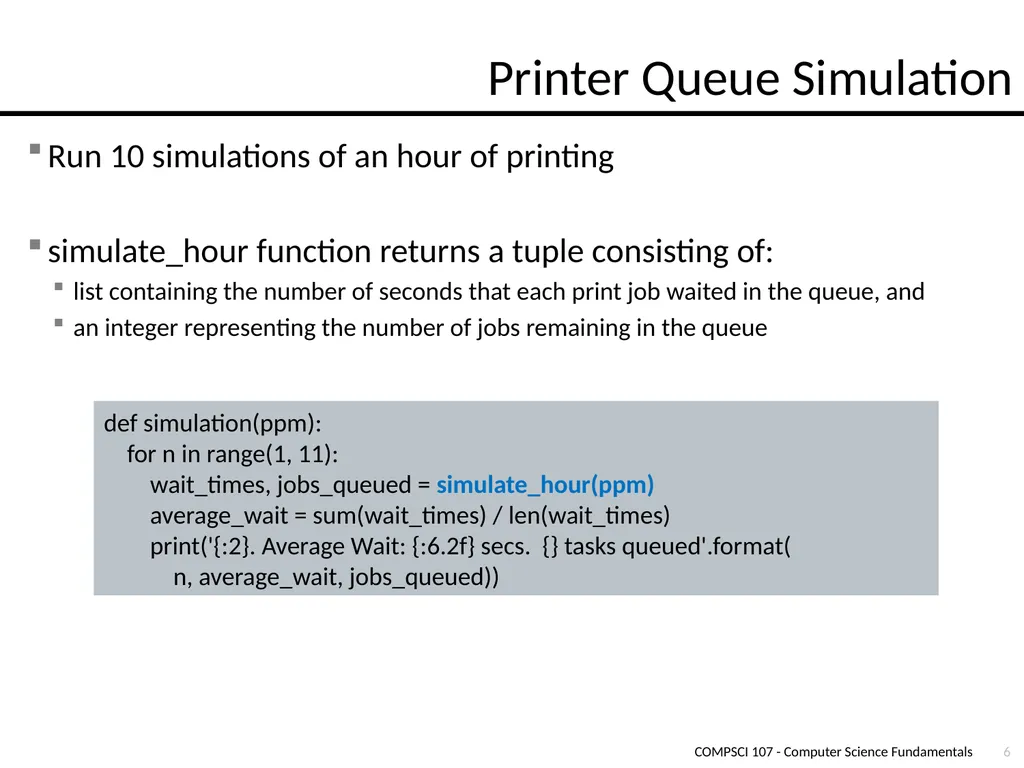
slide6. Run 10 simulations of an hour of printing
simulate_hour function returns a tuple consisting of:
list containing the number of seconds that each print job waited in the queue, and
an integer representing the number of jobs remaining in the queue Printer Queue Simulation 6 COMPSCI 107 - Computer Science Fundamentals def simulation(ppm):
for n in range(1, 11):
wait_times, jobs_queued = simulate_hour(ppm)
average_wait = sum(wait_times) / len(wait_times)
print('{:2}. Average Wait: {:6.2f} secs. {} tasks queued'.format(
n, average_wait, jobs_queued))<br>
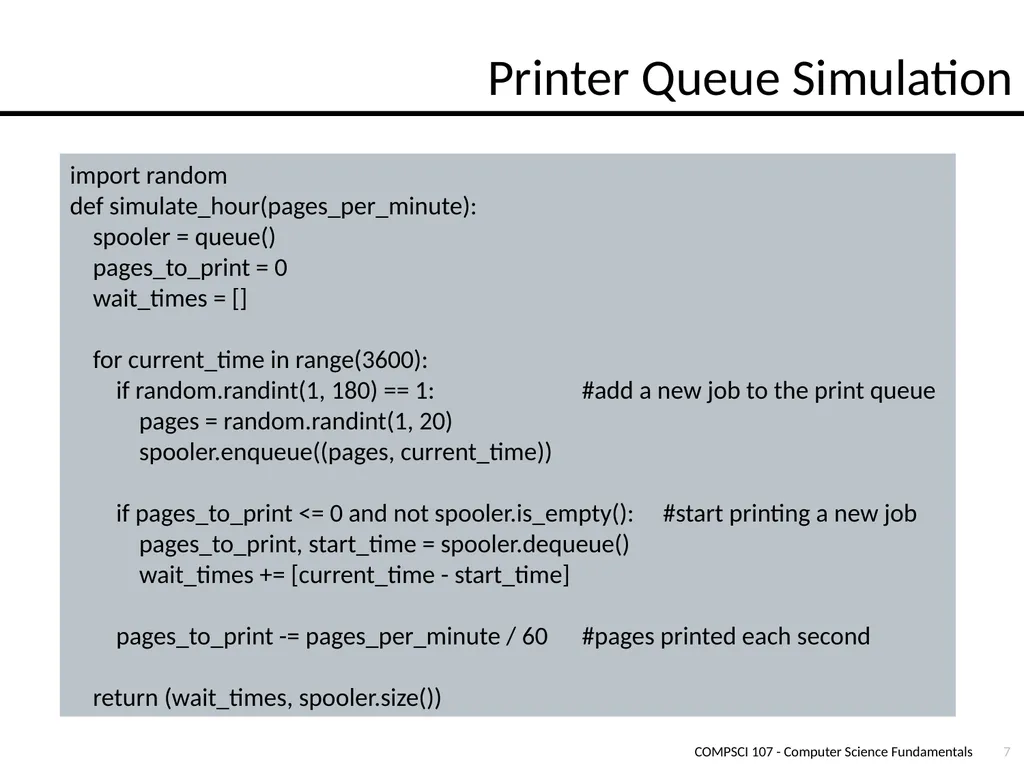
slide7. Printer Queue Simulation 7 COMPSCI 107 - Computer Science Fundamentals import random
def simulate_hour(pages_per_minute):
spooler = queue()
pages_to_print = 0
wait_times = []
for current_time in range(3600):
if random.randint(1, 180) == 1: #add a new job to the print queue
pages = random.randint(1, 20)
spooler.enqueue((pages, current_time))
if pages_to_print <= 0 and not spooler.is_empty(): #start printing a new job
pages_to_print, start_time = spooler.dequeue()
wait_times += [current_time - start_time]
pages_to_print -= pages_per_minute / 60 #pages printed each second
return (wait_times, spooler.size())<br>
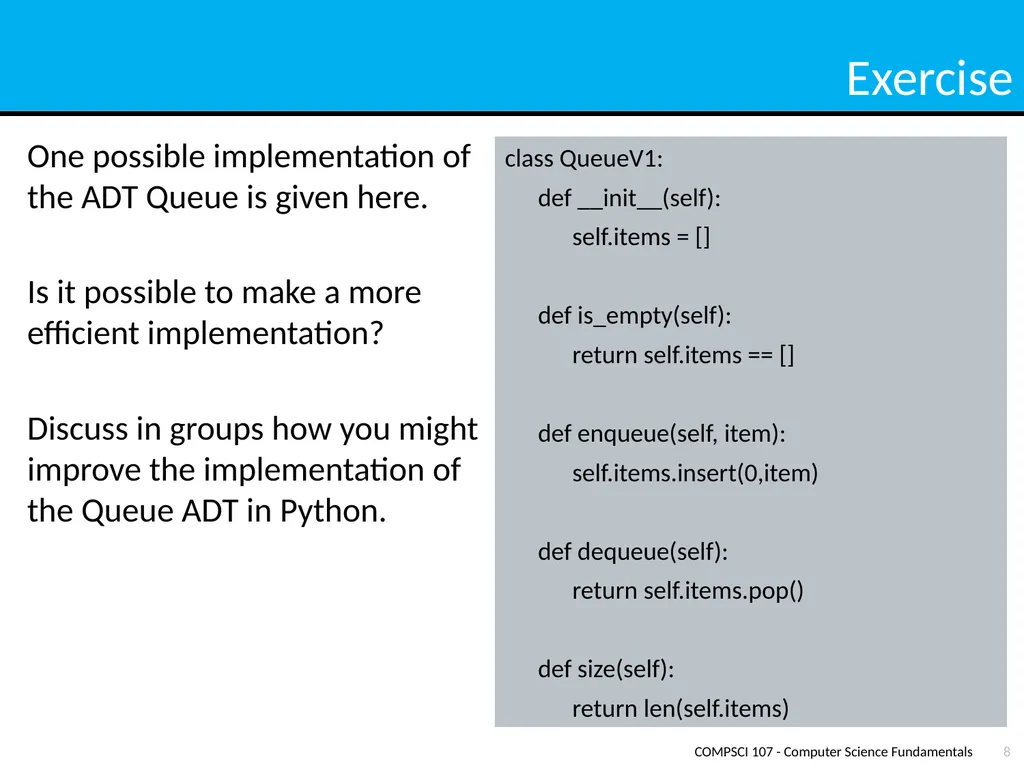
slide8. One possible implementation of the ADT Queue is given here.
Is it possible to make a more efficient implementation?
Discuss in groups how you might improve the implementation of the Queue ADT in Python. Exercise 8 COMPSCI 107 - Computer Science Fundamentals class QueueV1:
def __init__(self):
self.items = []
def is_empty(self):
return self.items == []
def enqueue(self, item):
self.items.insert(0,item)
def dequeue(self):
return self.items.pop()
def size(self):
return len(self.items)<br>
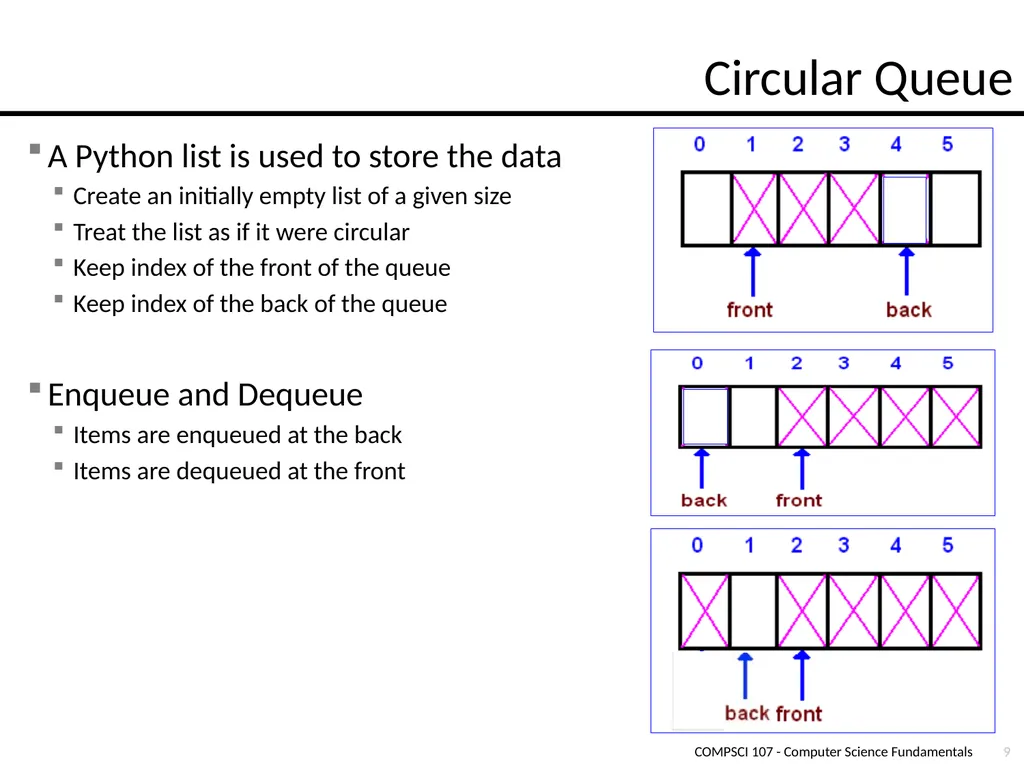
slide9. A Python list is used to store the data
Create an initially empty list of a given size
Treat the list as if it were circular
Keep index of the front of the queue
Keep index of the back of the queue
Enqueue and Dequeue
Items are enqueued at the back
Items are dequeued at the front Circular Queue 9 COMPSCI 107 - Computer Science Fundamentals<br>
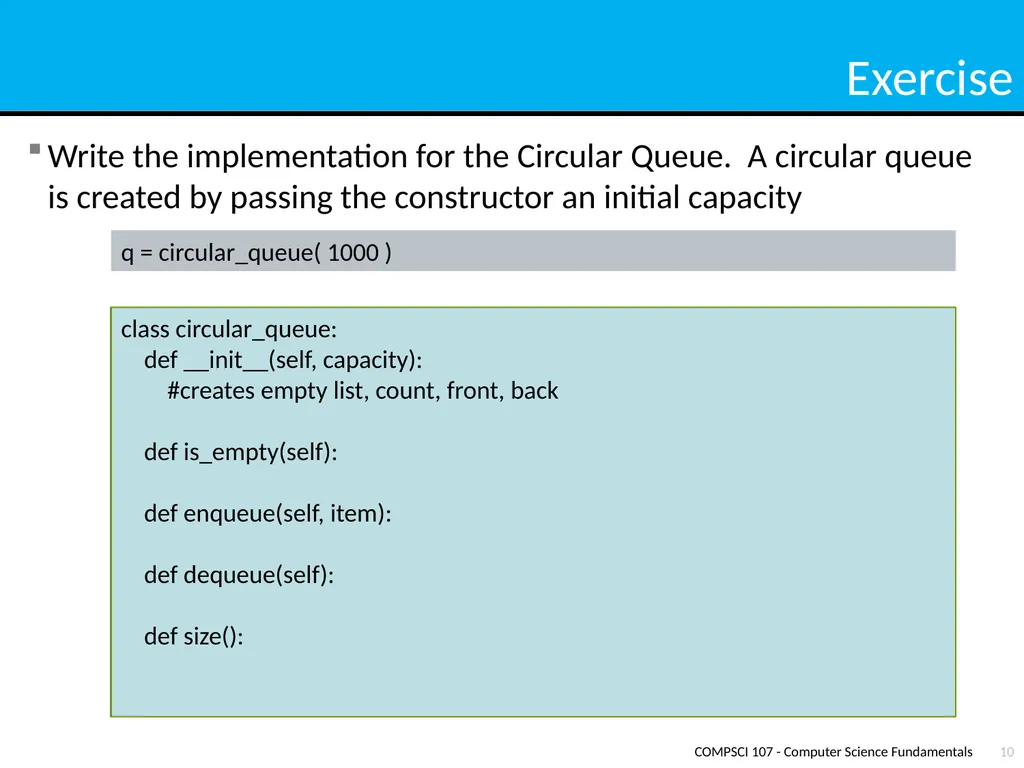
slide10. Write the implementation for the Circular Queue. A circular queue is created by passing the constructor an initial capacity Exercise 10 COMPSCI 107 - Computer Science Fundamentals q = circular_queue( 1000 ) class circular_queue:
def __init__(self, capacity):
#creates empty list, count, front, back
def is_empty(self):
def enqueue(self, item):
def dequeue(self):
def size():<br>
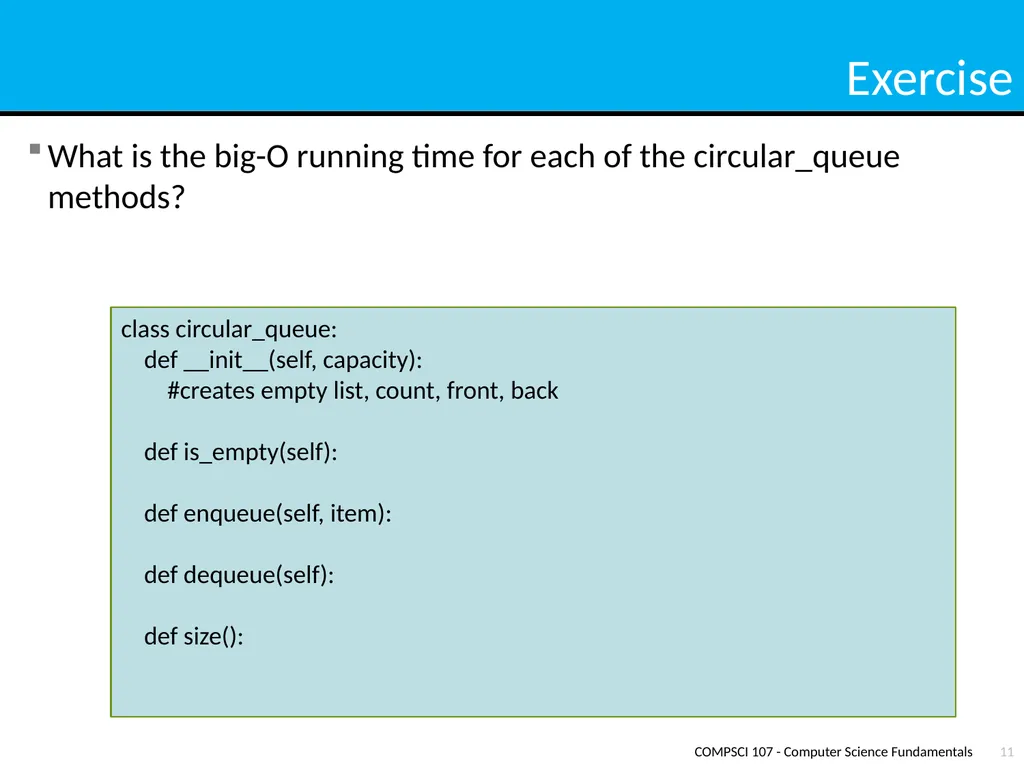
slide11. What is the big-O running time for each of the circular_queue methods? Exercise 11 COMPSCI 107 - Computer Science Fundamentals class circular_queue:
def __init__(self, capacity):
#creates empty list, count, front, back
def is_empty(self):
def enqueue(self, item):
def dequeue(self):
def size():<br>
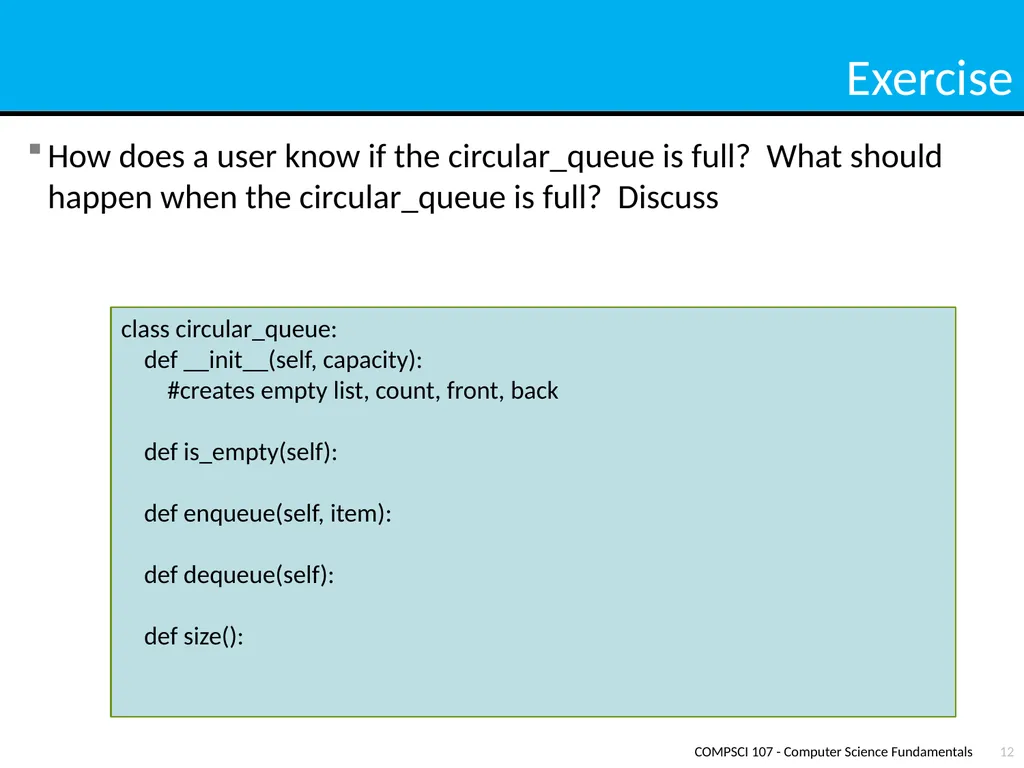
slide12. How does a user know if the circular_queue is full? What should happen when the circular_queue is full? Discuss Exercise 12 COMPSCI 107 - Computer Science Fundamentals class circular_queue:
def __init__(self, capacity):
#creates empty list, count, front, back
def is_empty(self):
def enqueue(self, item):
def dequeue(self):
def size():<br>
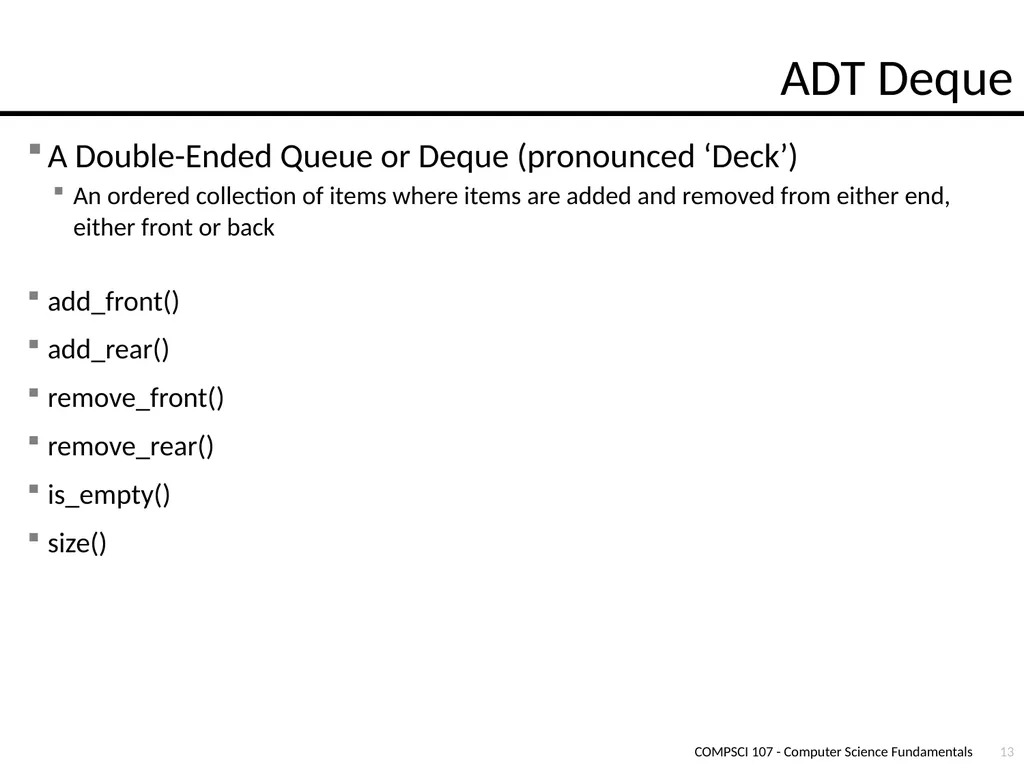
slide13. A Double-Ended Queue or Deque (pronounced ‘Deck’)
An ordered collection of items where items are added and removed from either end, either front or back
add_front()
add_rear()
remove_front()
remove_rear()
is_empty()
size() ADT Deque 13 COMPSCI 107 - Computer Science Fundamentals<br>
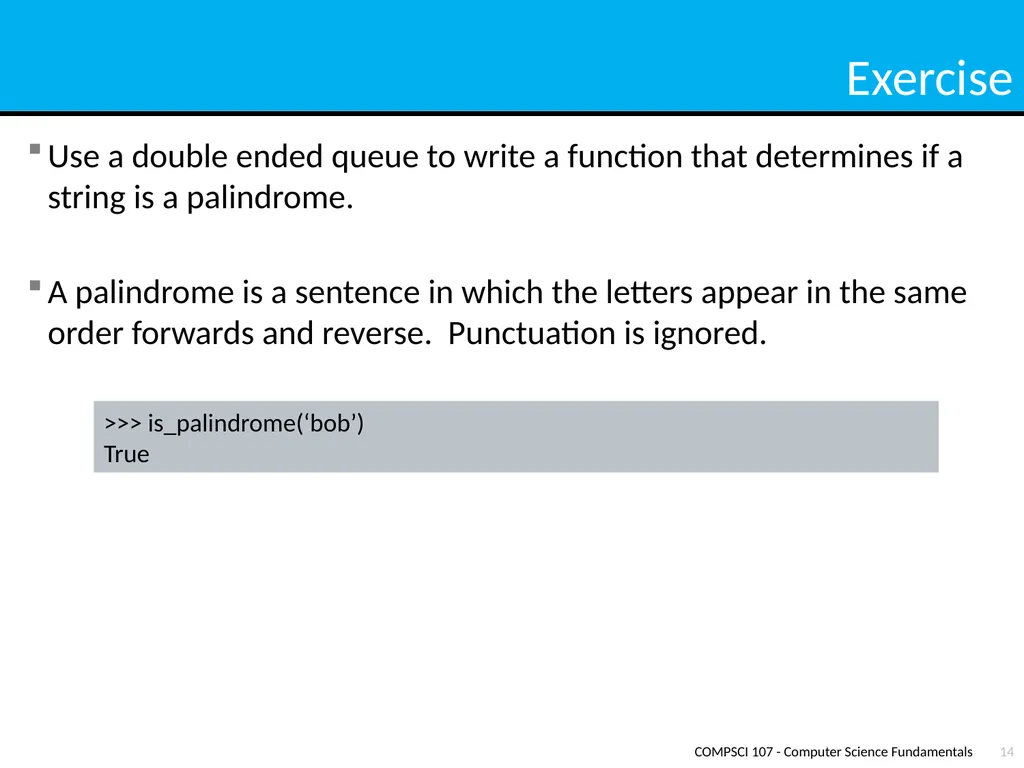
slide14. Use a double ended queue to write a function that determines if a string is a palindrome.
A palindrome is a sentence in which the letters appear in the same order forwards and reverse. Punctuation is ignored. Exercise 14 COMPSCI 107 - Computer Science Fundamentals >>> is_palindrome(‘bob’)
True<br>
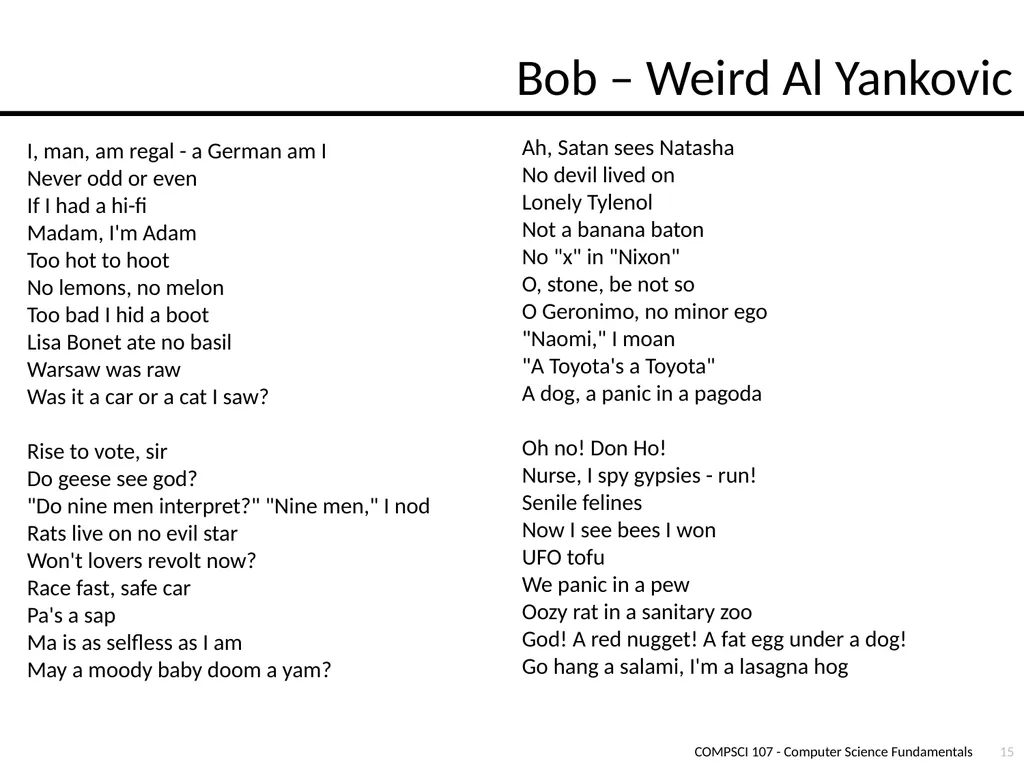
slide15. Bob – Weird Al Yankovic 15 COMPSCI 107 - Computer Science Fundamentals I, man, am regal - a German am INever odd or evenIf I had a hi-fiMadam, I'm AdamToo hot to hootNo lemons, no melonToo bad I hid a bootLisa Bonet ate no basilWarsaw was rawWas it a car or a cat I saw?
Rise to vote, sirDo geese see god?"Do nine men interpret?" "Nine men," I nodRats live on no evil starWon't lovers revolt now?Race fast, safe carPa's a sapMa is as selfless as I amMay a moody baby doom a yam? Ah, Satan sees NatashaNo devil lived onLonely TylenolNot a banana batonNo "x" in "Nixon"O, stone, be not soO Geronimo, no minor ego"Naomi," I moan"A Toyota's a Toyota"A dog, a panic in a pagoda
Oh no! Don Ho!Nurse, I spy gypsies - run!Senile felinesNow I see bees I wonUFO tofuWe panic in a pewOozy rat in a sanitary zooGod! A red nugget! A fat egg under a dog!Go hang a salami, I'm a lasagna hog<br>

slide2. Ordered collection of data
Items are added to the back of the queue
Items are removed from the front of the queue
Remove data in the same order as the data added
First in, first out (FIFO)
Operations
Enqueue
Dequeue
Peek
Is_empty
Size ADT - Queue 2 COMPSCI 107 - Computer Science Fundamentals<br>
slide3. Implementation using Python list
What is the big-O of enqueue()?
What is the big-O of dequeue()? Queue Implementation 3 COMPSCI 107 - Computer Science Fundamentals class QueueV1:
def __init__(self):
self.items = []
def is_empty(self):
return self.items == []
def enqueue(self, item):
self.items.insert(0,item)
def dequeue(self):
return self.items.pop()
def size(self):
return len(self.items)<br>
slide4. Problem: Can the current printer handle the task load if it were set to print with a better quality but slower page rate?
Write a simulation which models the printing tasks as random events of various lengths and arrival times.
The current setting on the printer is 10 pages per minute and gives lower quality printing. The output will tell us if the wait times are significantly different if we use the better quality setting on the printer (5 pages per minute).
On average, a job is sent to the printer every 3 minutes. Each job is between 1 and 20 pages. Example: Printer Queue Simulation 4 COMPSCI 107 - Computer Science Fundamentals<br>
slide5. Run ten simulations each for 3600 (simulated) seconds. Each second there is 1 in 180 chance that a new print job of 1 to 20 pages is sent to the printer. Printer Queue Simulation 5 COMPSCI 107 - Computer Science Fundamentals simulation(10)
1. Average Wait: 16.90 secs. 0 tasks queued
2. Average Wait: 2.72 secs. 0 tasks queued
3. Average Wait: 26.75 secs. 1 tasks queued
4. Average Wait: 3.45 secs. 0 tasks queued
5. Average Wait: 5.60 secs. 0 tasks queued
6. Average Wait: 22.56 secs. 0 tasks queued
7. Average Wait: 14.71 secs. 0 tasks queued
8. Average Wait: 25.79 secs. 0 tasks queued
9. Average Wait: 4.28 secs. 0 tasks queued
10. Average Wait: 5.79 secs. 0 tasks queued<br>
slide6. Run 10 simulations of an hour of printing
simulate_hour function returns a tuple consisting of:
list containing the number of seconds that each print job waited in the queue, and
an integer representing the number of jobs remaining in the queue Printer Queue Simulation 6 COMPSCI 107 - Computer Science Fundamentals def simulation(ppm):
for n in range(1, 11):
wait_times, jobs_queued = simulate_hour(ppm)
average_wait = sum(wait_times) / len(wait_times)
print('{:2}. Average Wait: {:6.2f} secs. {} tasks queued'.format(
n, average_wait, jobs_queued))<br>
slide7. Printer Queue Simulation 7 COMPSCI 107 - Computer Science Fundamentals import random
def simulate_hour(pages_per_minute):
spooler = queue()
pages_to_print = 0
wait_times = []
for current_time in range(3600):
if random.randint(1, 180) == 1: #add a new job to the print queue
pages = random.randint(1, 20)
spooler.enqueue((pages, current_time))
if pages_to_print <= 0 and not spooler.is_empty(): #start printing a new job
pages_to_print, start_time = spooler.dequeue()
wait_times += [current_time - start_time]
pages_to_print -= pages_per_minute / 60 #pages printed each second
return (wait_times, spooler.size())<br>
slide8. One possible implementation of the ADT Queue is given here.
Is it possible to make a more efficient implementation?
Discuss in groups how you might improve the implementation of the Queue ADT in Python. Exercise 8 COMPSCI 107 - Computer Science Fundamentals class QueueV1:
def __init__(self):
self.items = []
def is_empty(self):
return self.items == []
def enqueue(self, item):
self.items.insert(0,item)
def dequeue(self):
return self.items.pop()
def size(self):
return len(self.items)<br>
slide9. A Python list is used to store the data
Create an initially empty list of a given size
Treat the list as if it were circular
Keep index of the front of the queue
Keep index of the back of the queue
Enqueue and Dequeue
Items are enqueued at the back
Items are dequeued at the front Circular Queue 9 COMPSCI 107 - Computer Science Fundamentals<br>
slide10. Write the implementation for the Circular Queue. A circular queue is created by passing the constructor an initial capacity Exercise 10 COMPSCI 107 - Computer Science Fundamentals q = circular_queue( 1000 ) class circular_queue:
def __init__(self, capacity):
#creates empty list, count, front, back
def is_empty(self):
def enqueue(self, item):
def dequeue(self):
def size():<br>
slide11. What is the big-O running time for each of the circular_queue methods? Exercise 11 COMPSCI 107 - Computer Science Fundamentals class circular_queue:
def __init__(self, capacity):
#creates empty list, count, front, back
def is_empty(self):
def enqueue(self, item):
def dequeue(self):
def size():<br>
slide12. How does a user know if the circular_queue is full? What should happen when the circular_queue is full? Discuss Exercise 12 COMPSCI 107 - Computer Science Fundamentals class circular_queue:
def __init__(self, capacity):
#creates empty list, count, front, back
def is_empty(self):
def enqueue(self, item):
def dequeue(self):
def size():<br>
slide13. A Double-Ended Queue or Deque (pronounced ‘Deck’)
An ordered collection of items where items are added and removed from either end, either front or back
add_front()
add_rear()
remove_front()
remove_rear()
is_empty()
size() ADT Deque 13 COMPSCI 107 - Computer Science Fundamentals<br>
slide14. Use a double ended queue to write a function that determines if a string is a palindrome.
A palindrome is a sentence in which the letters appear in the same order forwards and reverse. Punctuation is ignored. Exercise 14 COMPSCI 107 - Computer Science Fundamentals >>> is_palindrome(‘bob’)
True<br>
slide15. Bob – Weird Al Yankovic 15 COMPSCI 107 - Computer Science Fundamentals I, man, am regal - a German am INever odd or evenIf I had a hi-fiMadam, I'm AdamToo hot to hootNo lemons, no melonToo bad I hid a bootLisa Bonet ate no basilWarsaw was rawWas it a car or a cat I saw?
Rise to vote, sirDo geese see god?"Do nine men interpret?" "Nine men," I nodRats live on no evil starWon't lovers revolt now?Race fast, safe carPa's a sapMa is as selfless as I amMay a moody baby doom a yam? Ah, Satan sees NatashaNo devil lived onLonely TylenolNot a banana batonNo "x" in "Nixon"O, stone, be not soO Geronimo, no minor ego"Naomi," I moan"A Toyota's a Toyota"A dog, a panic in a pagoda
Oh no! Don Ho!Nurse, I spy gypsies - run!Senile felinesNow I see bees I wonUFO tofuWe panic in a pewOozy rat in a sanitary zooGod! A red nugget! A fat egg under a dog!Go hang a salami, I'm a lasagna hog<br>