
LECTURE 15 INDIVIDUAL DIFFERENCES Sadia Bashir
MY
Published · 28 slides · 0 views

1 / 1


Description
LECTURE 15 INDIVIDUAL DIFFERENCES Sadia Bashir M.A, M.Phil (ELM), M.Phil (Education) Students with Emotional Impairments Children with emotional disturbance are also termed as children with social maladjustment and children with behaviour
Related Topics
Share
Embed code
Download this presentation From Below
"LECTURE 15 INDIVIDUAL DIFFERENCES Sadia Bashir" is the property of its rightful owner. Permission is granted to download and print the materials on this website for personal, non-commercial use only, and to display it on your personal computer provided you do not modify the materials and that you retain all copyright notices contained in the materials. By downloading content from our website, you accept the terms of this agreement.
Presentation Transcript
01
LECTURE 15
INDIVIDUAL DIFFERENCES Sadia Bashir
M.A, M.Phil (ELM), M.Phil (Education)<br>
M.A, M.Phil (ELM), M.Phil (Education)<br>
02
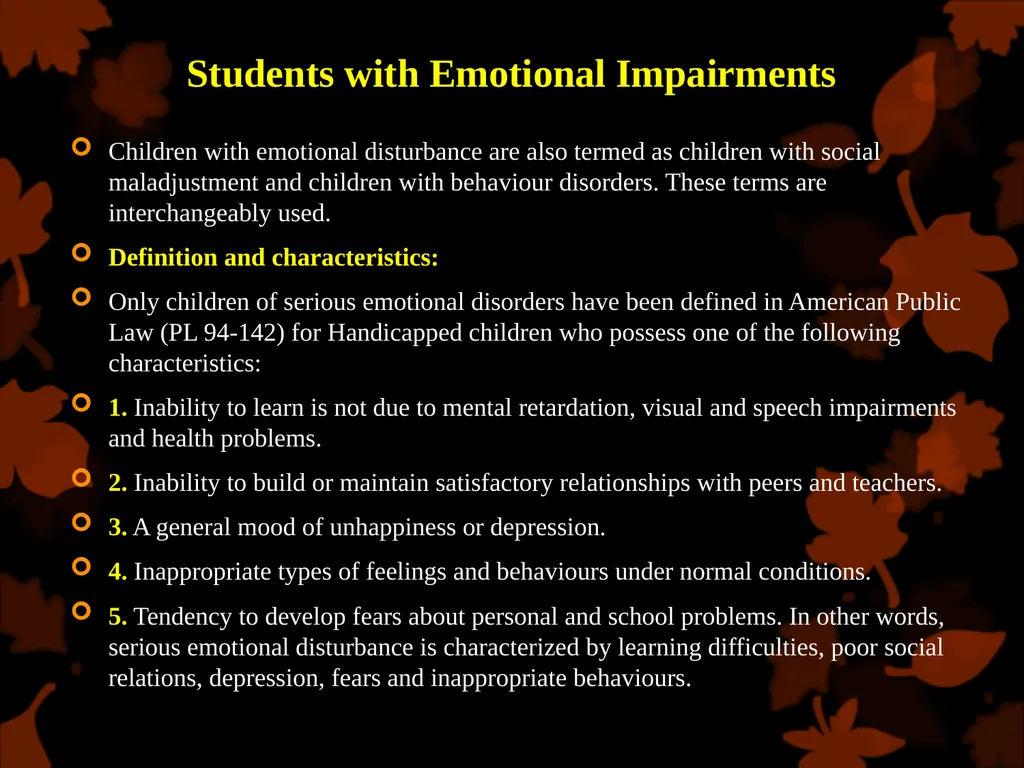
Students with Emotional Impairments Children with emotional disturbance are also termed as children with social maladjustment and children with behaviour disorders. These terms are interchangeably used.
Definition and characteristics:
Only children of serious emotional disorders have been defined in American Public Law (PL 94-142) for Handicapped children who possess one of the following characteristics:
1. Inability to learn is not due to mental retardation, visual and speech impairments and health problems.
2. Inability to build or maintain satisfactory relationships with peers and teachers.
3. A general mood of unhappiness or depression.
4. Inappropriate types of feelings and behaviours under normal conditions.
5. Tendency to develop fears about personal and school problems. In other words, serious emotional disturbance is characterized by learning difficulties, poor social relations, depression, fears and inappropriate behaviours.<br>
Definition and characteristics:
Only children of serious emotional disorders have been defined in American Public Law (PL 94-142) for Handicapped children who possess one of the following characteristics:
1. Inability to learn is not due to mental retardation, visual and speech impairments and health problems.
2. Inability to build or maintain satisfactory relationships with peers and teachers.
3. A general mood of unhappiness or depression.
4. Inappropriate types of feelings and behaviours under normal conditions.
5. Tendency to develop fears about personal and school problems. In other words, serious emotional disturbance is characterized by learning difficulties, poor social relations, depression, fears and inappropriate behaviours.<br>
03
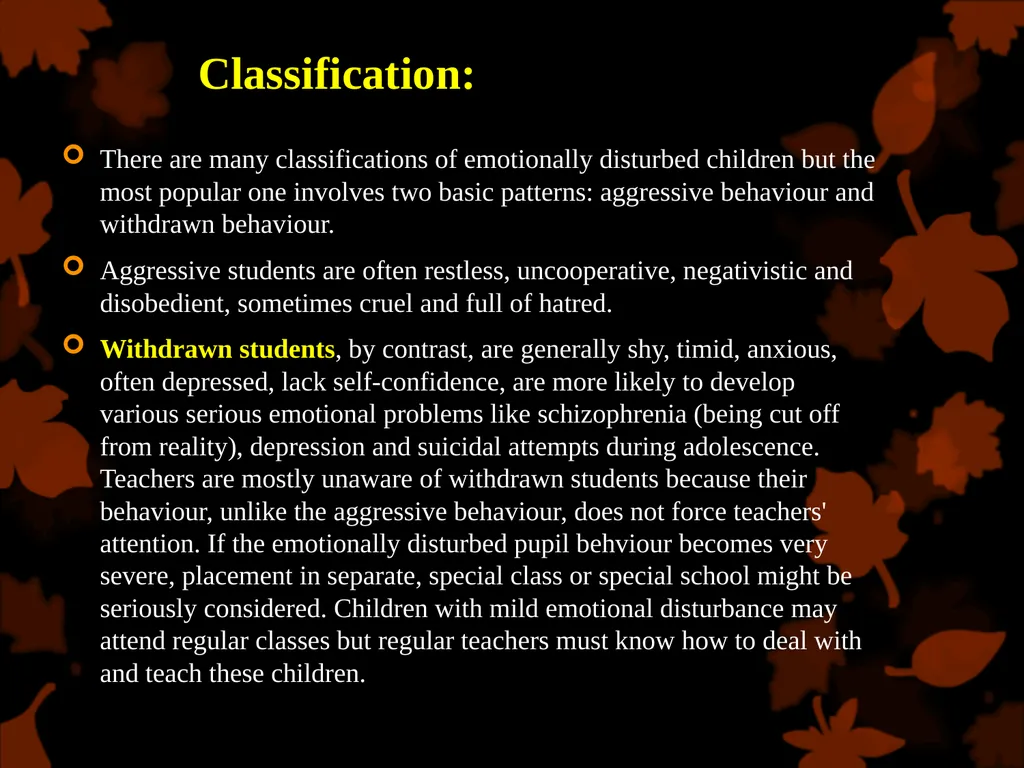
Classification: There are many classifications of emotionally disturbed children but the most popular one involves two basic patterns: aggressive behaviour and withdrawn behaviour.
Aggressive students are often restless, uncooperative, negativistic and disobedient, sometimes cruel and full of hatred.
Withdrawn students, by contrast, are generally shy, timid, anxious, often depressed, lack self-confidence, are more likely to develop various serious emotional problems like schizophrenia (being cut off from reality), depression and suicidal attempts during adolescence. Teachers are mostly unaware of withdrawn students because their behaviour, unlike the aggressive behaviour, does not force teachers' attention. If the emotionally disturbed pupil behviour becomes very severe, placement in separate, special class or special school might be seriously considered. Children with mild emotional disturbance may attend regular classes but regular teachers must know how to deal with and teach these children.<br>
Aggressive students are often restless, uncooperative, negativistic and disobedient, sometimes cruel and full of hatred.
Withdrawn students, by contrast, are generally shy, timid, anxious, often depressed, lack self-confidence, are more likely to develop various serious emotional problems like schizophrenia (being cut off from reality), depression and suicidal attempts during adolescence. Teachers are mostly unaware of withdrawn students because their behaviour, unlike the aggressive behaviour, does not force teachers' attention. If the emotionally disturbed pupil behviour becomes very severe, placement in separate, special class or special school might be seriously considered. Children with mild emotional disturbance may attend regular classes but regular teachers must know how to deal with and teach these children.<br>
04
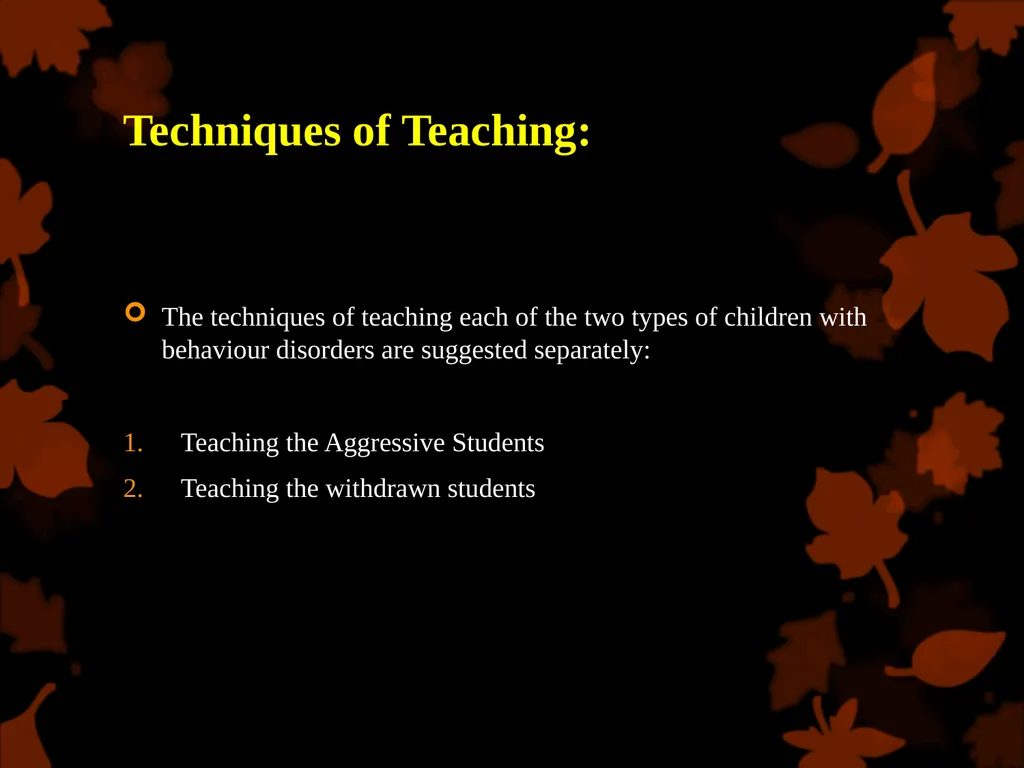
Techniques of Teaching: The techniques of teaching each of the two types of children with behaviour disorders are suggested separately:
Teaching the Aggressive Students
Teaching the withdrawn students<br>
Teaching the Aggressive Students
Teaching the withdrawn students<br>
05
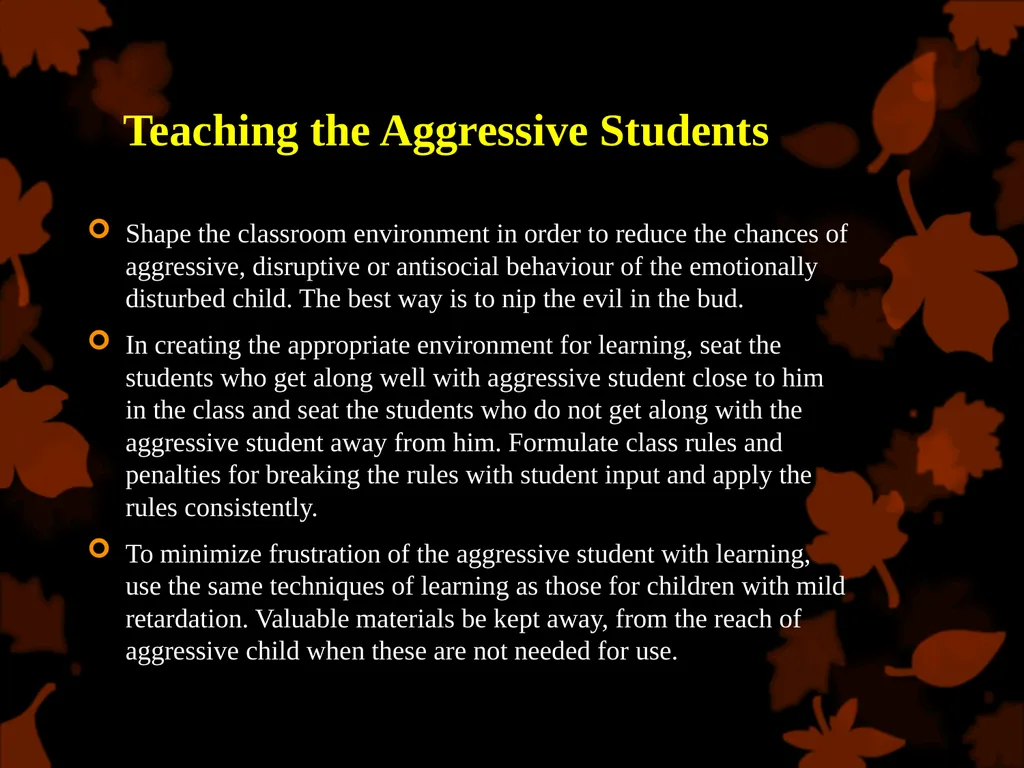
Teaching the Aggressive Students Shape the classroom environment in order to reduce the chances of aggressive, disruptive or antisocial behaviour of the emotionally disturbed child. The best way is to nip the evil in the bud.
In creating the appropriate environment for learning, seat the students who get along well with aggressive student close to him in the class and seat the students who do not get along with the aggressive student away from him. Formulate class rules and penalties for breaking the rules with student input and apply the rules consistently.
To minimize frustration of the aggressive student with learning, use the same techniques of learning as those for children with mild retardation. Valuable materials be kept away, from the reach of aggressive child when these are not needed for use.<br>
In creating the appropriate environment for learning, seat the students who get along well with aggressive student close to him in the class and seat the students who do not get along with the aggressive student away from him. Formulate class rules and penalties for breaking the rules with student input and apply the rules consistently.
To minimize frustration of the aggressive student with learning, use the same techniques of learning as those for children with mild retardation. Valuable materials be kept away, from the reach of aggressive child when these are not needed for use.<br>
06
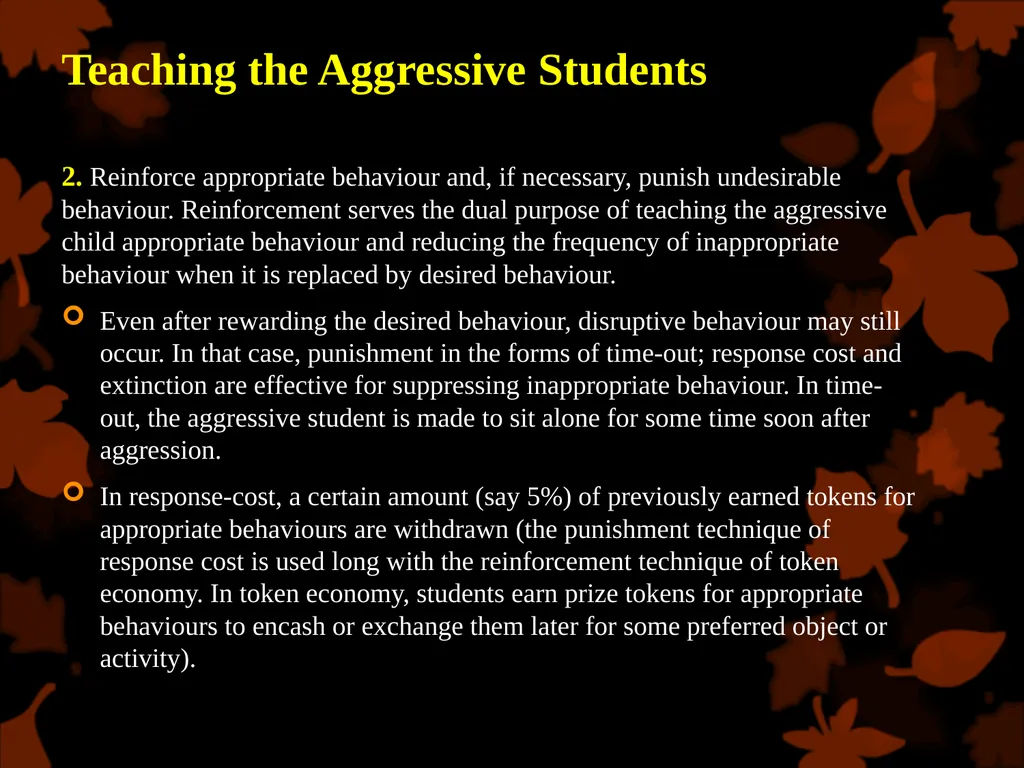
Teaching the Aggressive Students 2. Reinforce appropriate behaviour and, if necessary, punish undesirable behaviour. Reinforcement serves the dual purpose of teaching the aggressive child appropriate behaviour and reducing the frequency of inappropriate behaviour when it is replaced by desired behaviour.
Even after rewarding the desired behaviour, disruptive behaviour may still occur. In that case, punishment in the forms of time-out; response cost and extinction are effective for suppressing inappropriate behaviour. In time-out, the aggressive student is made to sit alone for some time soon after aggression.
In response-cost, a certain amount (say 5%) of previously earned tokens for appropriate behaviours are withdrawn (the punishment technique of response cost is used long with the reinforcement technique of token economy. In token economy, students earn prize tokens for appropriate behaviours to encash or exchange them later for some preferred object or activity).<br>
Even after rewarding the desired behaviour, disruptive behaviour may still occur. In that case, punishment in the forms of time-out; response cost and extinction are effective for suppressing inappropriate behaviour. In time-out, the aggressive student is made to sit alone for some time soon after aggression.
In response-cost, a certain amount (say 5%) of previously earned tokens for appropriate behaviours are withdrawn (the punishment technique of response cost is used long with the reinforcement technique of token economy. In token economy, students earn prize tokens for appropriate behaviours to encash or exchange them later for some preferred object or activity).<br>
07
Teaching the Aggressive Students Students Use group contingency management techniques also in addition to the methods of dealing directly with the aggressive students. Through group management, teacher may want to reward the entire class when the aggressive student behaves. Such rewards may be free time, special classroom events or certain privileges that tend to make the aggressive student class 'hero' and foster good class relationships with the child.<br>
08
Teaching the Withdrawn Students Design the classroom environment and plan lessons that encourage social interaction and cooperation between socially withdrawn child and his class fellows. Withdrawn child may stay away from others because he finds social contacts threatening or because he thinks others stay away from him due to his poor social skills. Whatever may be the reason, teachers should get the shy children closer to others.
For example, preschool: and primary class teachers should urge the child to cooperative play instead of isolated play. Elementary class teachers should emphasize organized plays sports, games and team oriented learning activities like Team Accelerated Instruction.. The first step, for instance, in maths instruction is to form student groups of four or five members with varying ability levels and social backgrounds. Each group works individually on problems at their own level of understanding. Tearnmates then check each others' work against correct answer sheets. Team scores are calculated on the basis of units successfully completed by the team members each week. The teams may be rewarded by the amount and quality of work completed by each team cooperative learning is also useful for normal children.<br>
For example, preschool: and primary class teachers should urge the child to cooperative play instead of isolated play. Elementary class teachers should emphasize organized plays sports, games and team oriented learning activities like Team Accelerated Instruction.. The first step, for instance, in maths instruction is to form student groups of four or five members with varying ability levels and social backgrounds. Each group works individually on problems at their own level of understanding. Tearnmates then check each others' work against correct answer sheets. Team scores are calculated on the basis of units successfully completed by the team members each week. The teams may be rewarded by the amount and quality of work completed by each team cooperative learning is also useful for normal children.<br>
09
Teaching the Withdrawn Students Prompt and positively reinforce- social interactions. A prompt is a stimulus that draws a desired response. Positive reinforcement involves giving the student something that student wants after the desired response.
The aim of prompting and positive reinforcement is to get the child behave that way again. The positive reinforces can be verbal praise, stickers like gold stars or smiley faces and small prizes like pencils, exercise books etc. To illustrate this suggestion, a cooperative tasks may be assigned to a student who is good in interaction skills to help two other withdrawn students paint a scenery for the classroom. The teacher can assign painting of trees in the scenery to one child, painting of grass to the second and painting people to the third: After sometime, the teacher may say something like this "that is good work. I am really pleased to see you all working well together." Similar comments can be made at intervals till completion of task.<br>
The aim of prompting and positive reinforcement is to get the child behave that way again. The positive reinforces can be verbal praise, stickers like gold stars or smiley faces and small prizes like pencils, exercise books etc. To illustrate this suggestion, a cooperative tasks may be assigned to a student who is good in interaction skills to help two other withdrawn students paint a scenery for the classroom. The teacher can assign painting of trees in the scenery to one child, painting of grass to the second and painting people to the third: After sometime, the teacher may say something like this "that is good work. I am really pleased to see you all working well together." Similar comments can be made at intervals till completion of task.<br>
10
Teaching the Withdrawn Students Train other students to initiate social interactions. Since it is difficult for the teacher himself to interact with a withdrawn child due to many other class responsibilities, it is better to train such children who are good at social interactions. Explain to the helping student the goal of working with the withdrawn child, prepare the helping child to expect initial rejection by the withdrawn child and emphasize the importance of making periodic attempts at interaction. Instruct the helping child to suggest games and activities that are appealing to withdrawn child and the helper's attempts to interact with the withdrawn child must be reinforced.<br>
11
Student with Attention Deficit/Hyperactivity Disorder Some students have short attention span and are excessively restless whose main problem is directing and maintaining their restlessness and physical activity. The American Psychological Association has lately established this category called `attention deficit/hyperactivity disorders' (ADHD) to identify these children.. These children are mostly boys than girls whose disorder may even persist in adulthood. In our environment, children with ADHD are branded as naughty, non-serious and destructive. Due to this condition, despite -being intelligent, they have difficulty responding appropriately and working steadily towards even their own goals. They may not even be able to control their behaviour when ordered to do so, even for a brief period.<br>
12
Student with Attention Deficit/Hyperactivity Disorder Today, there is much reliance on drug therapy. Ritaline and Dexedrine have positive short-tern effects. There is improvement in such social behaviours of these children as attention, cooperation and compliance. Besides negative side effects on some children, the drug therapy does not seem to cure the problem permanently. The child still needs special help in learning because the drugs have not shown any improvement in academic and social learning of these children. These two areas are the great problem areas for these children. In addition to medication, they require special help in learning through behaviour modification techniques based upon behvioural and cognitive principles of learning. One promising approach to help these children combines instruction in learning and memory strategies with motivational training. The goal is to give these students the 'skill' as well as the 'will' to improve their achievement. These students should learn- how and when to apply learning aria study skills. They must also encouraged to be persistent and see themselves as able to control their behaviour.
Even if 'the medication improves the behaviour of these children, they still need to learn academic and social skills to show better academic performance.<br>
Even if 'the medication improves the behaviour of these children, they still need to learn academic and social skills to show better academic performance.<br>
13
Disadvantaged or Culturally Different Students Those students in the classroom who come from poor cultural background are not properly equipped with experiences which are necessary to perform well in school. Let us review a few factors leading to disadvantaged status of the child. It will then be possible to derive general guidelines for teaching such pupils:
Many poor children are disadvantaged due to Untreated illnesses they bring with them to the. classroom. .These diseases may be due to inadequate prenatal care and absence of treatment facilities during postnatal period.
These children may belong to poor social and psychological. environment. Most lower-class parents use ways of child care that work against their success in school. For instance, mothers are inattentive and unresponsive to the child who use poor language when interacting with the child. Consequently, his language and intellectual development is inferior to other children of their age.<br>
Many poor children are disadvantaged due to Untreated illnesses they bring with them to the. classroom. .These diseases may be due to inadequate prenatal care and absence of treatment facilities during postnatal period.
These children may belong to poor social and psychological. environment. Most lower-class parents use ways of child care that work against their success in school. For instance, mothers are inattentive and unresponsive to the child who use poor language when interacting with the child. Consequently, his language and intellectual development is inferior to other children of their age.<br>
14
Disadvantaged or Culturally Different Students 3. Children from poor families are not exposed to wide variety of experiences. Their parents do not tutor them, talk less and do not answer their questions. Due to lack of resources, they can't afford to provide them with educational toys and other reading material. They take them less on trips. Therefore, these children remain at a disadvantage in the competitive school environment.
4. These pupils may not be -strongly motivated to do well in school. They may not know the techniques of becoming successful in school. As their parents have not been successful as students, they might have developed negative attitude, toward school. The parents, therefore, are unable to motivate and inspire them for learning.
5. Lower class children generally have low career aspirations who expect petty jobs after schooling. Due to a history of failures, these children do not have challenging, long-term education plans. Nor do their parents encourage them to pursue higher education due to their own past negative experiences of having been dropped out of school.<br>
4. These pupils may not be -strongly motivated to do well in school. They may not know the techniques of becoming successful in school. As their parents have not been successful as students, they might have developed negative attitude, toward school. The parents, therefore, are unable to motivate and inspire them for learning.
5. Lower class children generally have low career aspirations who expect petty jobs after schooling. Due to a history of failures, these children do not have challenging, long-term education plans. Nor do their parents encourage them to pursue higher education due to their own past negative experiences of having been dropped out of school.<br>
15
Disadvantaged or Culturally Different Students 6. The adolescents from poor homes tend to have to low need for achievement and role confusion of and negative self-concept. After obtaining a certificate or without it, when they experience unemployment, they are more likely to have low self-esteem which may contribute to role confusion and a tendency to form a negative identity leading to antisocial activities.<br>
16
Suggestions for Teaching Avoid labeling the child. Instead of thinking that a disadvantaged child is beyond help, teacher might ask herself what kinds of disadvantages of the child are needed to be overcome, what kinds of strengths the child possesses. Concentrate on individuals in order to overcome the dangers of stereotyping or labeling. Once Samuel Jahnson was asked, "Are men more intelligent than women" He replied, "Which man? Which Women?” Thinking in this way helps avoid the error of assigning to individuals characteristics attributed to a group.
Allow for the possibility that disadvantaged child may have inadequate diet and insufficient medical care. These causes might be creating learning difficulties for him. If so, search be made to contact philanthropic individuals or agencies for securing the necessary financial aid.<br>
Allow for the possibility that disadvantaged child may have inadequate diet and insufficient medical care. These causes might be creating learning difficulties for him. If so, search be made to contact philanthropic individuals or agencies for securing the necessary financial aid.<br>
17
Suggestions for Teaching Try to supply the experiences the disadvantaged students have missed. These children may not have the experience of every day objects and situations assumed in the textbook and instructional material. The urban child may not comprehend a simple rural scene and vice versa. This lack of experience can be met through a film or a field trip. Try to supply familiarity directly or in pictorial form, where necessary.
Use all possible means to motivate the disadvantaged child. Lack of ability might not always be the cause of 'learning difficulties but lack of interest may be the reason. As already mentioned, a number of circumstances are, considered to prevent lower-class students from acquiring a desire to do well in school: lack of encouragement from parents, absence of models, low level of aspiration, low need for achievement.
Teach these children learning and test taking skills. To earn good grades consistently, all students, irrespective of their background, must develop specialized learning skills. This will create and maintain a strong desire to achieve in school. Teacher must, therefore, give students many practice exams for answering questions. After each test, their satisfactory and unsatisfactory answers must be discussed. They may be given specific tips for writing good answers.<br>
Use all possible means to motivate the disadvantaged child. Lack of ability might not always be the cause of 'learning difficulties but lack of interest may be the reason. As already mentioned, a number of circumstances are, considered to prevent lower-class students from acquiring a desire to do well in school: lack of encouragement from parents, absence of models, low level of aspiration, low need for achievement.
Teach these children learning and test taking skills. To earn good grades consistently, all students, irrespective of their background, must develop specialized learning skills. This will create and maintain a strong desire to achieve in school. Teacher must, therefore, give students many practice exams for answering questions. After each test, their satisfactory and unsatisfactory answers must be discussed. They may be given specific tips for writing good answers.<br>
18
Suggestions for teaching Give them specific assignments, arrange, abundant practice, supply immediate feedback and emphasize over-learning. The disadvantaged students require direct and close supervision while they work individually or in small groups on specific assignments. Teachers should ask them specific questions that have specific answers and make all the decisions about what will be learnt. Over teach the disadvantaged and ask them to overlearn. First, have them study the material under your close supervision and then in small groups. Just before- exams, have them study in small groups.<br>
19
Students with Learning Disabilities How will we explain what is wrong with a student who is not mentally retarded and educationally deprived, who has normal vision, hearing and language capabilities but who still can't learn to read, write and compute? One possible explanation would be that he has learning disability (he is learning disabled). This category is again relatively new as well as controversial. There is no common1:- and fully agreed upon definition. There are many definitions (about 40). One widely used definition is as follows: -
"Learning disabilities is a generic (general) term that refers to a heterogeneous group of disorders manifested by significant difficulties in the acquisition and use of listening, speaking, reading, writing, reasoning, and mathematical abilities. These disorders are intrinsic to the individual and presumed to be due to central nervous system dysfunction. Even though a learning disability may occur concomitantly with other handicapping conditions and environmental influences, it is not the direct result)of these conditions or influences."<br>
"Learning disabilities is a generic (general) term that refers to a heterogeneous group of disorders manifested by significant difficulties in the acquisition and use of listening, speaking, reading, writing, reasoning, and mathematical abilities. These disorders are intrinsic to the individual and presumed to be due to central nervous system dysfunction. Even though a learning disability may occur concomitantly with other handicapping conditions and environmental influences, it is not the direct result)of these conditions or influences."<br>
20
Students with Learning Disabilities Important points in the above definition of learning disabilities are repeated below:
Learning disability is a heterogeneous group of disorders. It includes many kinds of problems.
The disorders are intrinsic, that is, the disorders are due to internal and not external factors like environment or educational system.
The learning disability is believed to be due to biological malfunctioning in central nervous system.
The learning disability may exist along with other disabilities like mental retardation, emotional disturbance and external factors like poor teaching but these conditions don't seem to be the causes of learning disability. What are then the causes of mental disability? Psychologists do not agree on it.
Some educators were critical of this category who hold that it is rather an overused or misused label. These students, actually, are slow learners.<br>
Learning disability is a heterogeneous group of disorders. It includes many kinds of problems.
The disorders are intrinsic, that is, the disorders are due to internal and not external factors like environment or educational system.
The learning disability is believed to be due to biological malfunctioning in central nervous system.
The learning disability may exist along with other disabilities like mental retardation, emotional disturbance and external factors like poor teaching but these conditions don't seem to be the causes of learning disability. What are then the causes of mental disability? Psychologists do not agree on it.
Some educators were critical of this category who hold that it is rather an overused or misused label. These students, actually, are slow learners.<br>
21
Characteristics As with all categories of special children, all the learning disabled are not alike. The most common characteristics are:
Specific difficulties is one or more subjects. They are underachievers only in a few subjects.
Poor eye-hand coordination.
Problem in paying attention.
Hyperactivity in the form of excessive restlessness and., inattentiveness.
Impulsively, that is, working very quickly and incorrectly.
Problem in organizing and interpreting information.
Disorders in—hearing, speech, memory and thinking.
Difficulty in making and keeping friends.
Many normal children may have some . of the above characteristics. Not all the students with learning disabilities will have these characteristics. Some of them, however, may have all the above characteristics.<br>
Specific difficulties is one or more subjects. They are underachievers only in a few subjects.
Poor eye-hand coordination.
Problem in paying attention.
Hyperactivity in the form of excessive restlessness and., inattentiveness.
Impulsively, that is, working very quickly and incorrectly.
Problem in organizing and interpreting information.
Disorders in—hearing, speech, memory and thinking.
Difficulty in making and keeping friends.
Many normal children may have some . of the above characteristics. Not all the students with learning disabilities will have these characteristics. Some of them, however, may have all the above characteristics.<br>
22
Difficulties Most of the learning disabled children have difficulties in reading and mathematics. They have difficulty in reading because they can't relate sounds to letters that make up words, thus learning spelling is hard as well. Math (both computation and reasoning) is the second most common area of difficulty.
The writing of some learning disabled is virtually unreadable.
Their spoken language can be halting and disorganized.<br>
The writing of some learning disabled is virtually unreadable.
Their spoken language can be halting and disorganized.<br>
23
Difficulties Many researchers trace these problems to using ineffective learning skills such as:
Lacking effective ways to approach academic tasks that is, they do not know how to focus on relevant information, get organized change a learning approach when it is not working or evaluate their learning.
Being passive learners due to being unaware of knowing; how to learn.
Inability to work independently, resulting in poor class work and homework. .
Early diagnosis and help of these children is necessary so that they may not fall victim to 'learnt helplessness' out of frustration and discouragement. Learnt helplessness is a very powerful belief- of the students that they can't learn despite hard work.<br>
Lacking effective ways to approach academic tasks that is, they do not know how to focus on relevant information, get organized change a learning approach when it is not working or evaluate their learning.
Being passive learners due to being unaware of knowing; how to learn.
Inability to work independently, resulting in poor class work and homework. .
Early diagnosis and help of these children is necessary so that they may not fall victim to 'learnt helplessness' out of frustration and discouragement. Learnt helplessness is a very powerful belief- of the students that they can't learn despite hard work.<br>
24
Causes of Learning Disability There are three deficits, causing difficulty in learning:
Attention Deficits. They have difficulty in attending to relevant information and getting distracted by irrelevant information.
Perceptual Deficits. There is no difficulty in seeing and. hearing but in interpreting what is seen and heard and lack of eye-hand coordination.
Rehearsal and Metacognitive Deficits. They do not understand that actually trying to learn increases learning. They do not rehearse the material and do not possess metacognitive skills to monitor and improve their learning.<br>
Attention Deficits. They have difficulty in attending to relevant information and getting distracted by irrelevant information.
Perceptual Deficits. There is no difficulty in seeing and. hearing but in interpreting what is seen and heard and lack of eye-hand coordination.
Rehearsal and Metacognitive Deficits. They do not understand that actually trying to learn increases learning. They do not rehearse the material and do not possess metacognitive skills to monitor and improve their learning.<br>
25
Teaching Techniques 1. As it is often difficult to find whether the learning problem is due to mild retardation or learning difficulty, use many of the techniques useful for mentally retarded children. They may experience more frustration and lack of self-esteem than mentally retarded children due to lagging behind. others in some area only. Therefore, they need learning tasks within their capability to experience success. Teach them lessons of short duration with immediate feedback as a tangible evidence of their progress.
2. Find out ways to help them compensate for their weakness in psychological processes, as they improve achievement in specific subject areas. Arrange classroom environment to facilitate learning. Help them learn to reduce distractions, give attention and form right perceptions.<br>
2. Find out ways to help them compensate for their weakness in psychological processes, as they improve achievement in specific subject areas. Arrange classroom environment to facilitate learning. Help them learn to reduce distractions, give attention and form right perceptions.<br>
26
Teaching Techniques To increase their attention, classrooms be equipped with opaque or translucent windows, carpeting, soundproofing. In ordinary classrooms, reduce distracting sounds and sights with front side closed. When preparing written material for the' student, highlight relevant stimuli and eliminate competing irrelevant stimuli, use capital letters, underline in a different colour. In lessons, highlight important information and eliminate unnecessary talk. Tell them while you are giving important information, repeat information, stress importance, explain how the information relates to 'other aspects of the lesson and to what they already know. Suggest use of marker under each line while reading so that they evaluate one sentence at a time.
To those students who have short attention span, give short assignments and divide complex material into small segments.
For those students who have difficulty in writing legibly, use cut-out stencils so that students trace the form of a letter. Then ask the student to write the letter without stencil.<br>
To those students who have short attention span, give short assignments and divide complex material into small segments.
For those students who have difficulty in writing legibly, use cut-out stencils so that students trace the form of a letter. Then ask the student to write the letter without stencil.<br>
27
Teaching Techniques 3. To overcome the deficiencies in specific areas, use direct instruction. For instance, if the student has difficulty in reading printed words, teach him how the read printed word. This method emphasizes mastery of specific skills and follow highly structured format. Teachers use Detailed written script of step- by-step instruction that emphasizes repetition student participation, and teacher feedback without correcting underlying cognitive deficits.
4. Teach them study skills, methods of processing information and principles of cognitive learning to improve their attention and memory. In fact, teaching learning disabled students, like all exceptional children, does not require a unique set of skills. It is combination of good teaching practices and sensitivity to all students.<br>
4. Teach them study skills, methods of processing information and principles of cognitive learning to improve their attention and memory. In fact, teaching learning disabled students, like all exceptional children, does not require a unique set of skills. It is combination of good teaching practices and sensitivity to all students.<br>