
Lecture 21: LLM & Tool Augmentation Presenters:
TA
Published · 104 slides · 0 views

1 / 1

Description
Lecture 21: LLM Tool Augmentation Presenters: Zhiying Yu Mohammad Mahdi Abdollahpour 2024-03-27 Slides created for CS886 at UWaterloo 1 LLMs Using External Tools LLMs excels at several natural language processing tasks, but shows
Related Topics
Share
Embed code
Download this presentation From Below
"Lecture 21: LLM & Tool Augmentation Presenters:" is the property of its rightful owner. Permission is granted to download and print the materials on this website for personal, non-commercial use only, and to display it on your personal computer provided you do not modify the materials and that you retain all copyright notices contained in the materials. By downloading content from our website, you accept the terms of this agreement.
Presentation Transcript
01
Lecture 21: LLM & Tool Augmentation Presenters: Zhiying Yu & Mohammad Mahdi Abdollahpour 2024-03-27 Slides created for CS886 at UWaterloo 1<br>
02
LLMs Using External Tools LLMs excels at several natural language processing tasks, but shows several limitations including:
Access up-to-date information
Hallucinating facts
Multi-step reasoning
Lack of mathematical skills for precise calculation
Unawareness of the progression of time
There are growing interest in overcoming LLM limitations with external tool use.
calendar, calculator, program interpreter, etc.
search engine, external database for retrieval. 2<br>
Access up-to-date information
Hallucinating facts
Multi-step reasoning
Lack of mathematical skills for precise calculation
Unawareness of the progression of time
There are growing interest in overcoming LLM limitations with external tool use.
calendar, calculator, program interpreter, etc.
search engine, external database for retrieval. 2<br>
03
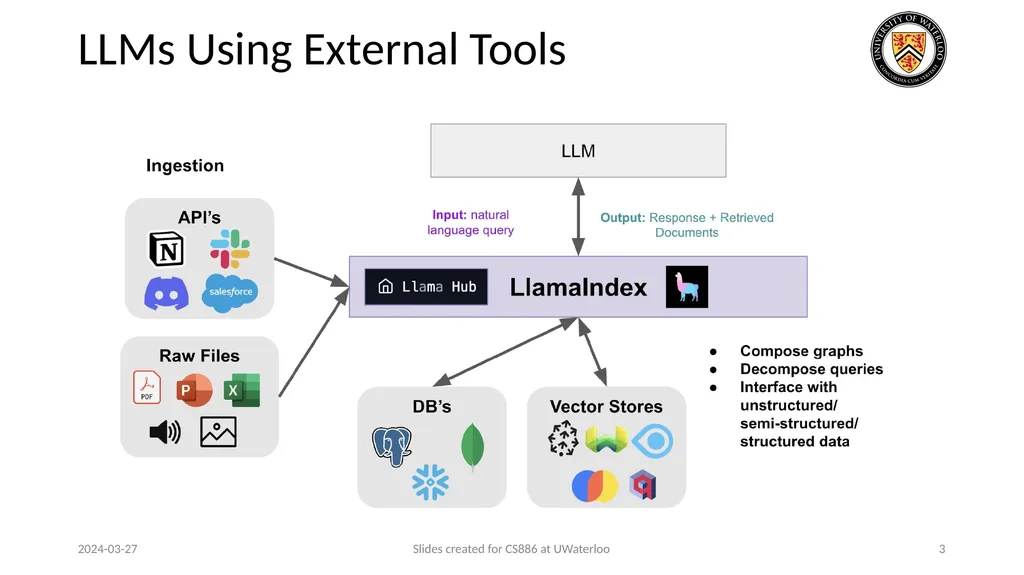
LLMs Using External Tools 2024-03-27 Slides created for CS886 at UWaterloo 3<br>
04
Coverage of Tool LLMs Toolformer
ART
AgentBench
ToolLLM
ToolkenGPT
CogAgent 2024-03-27 Slides created for CS886 at UWaterloo 4<br>
ART
AgentBench
ToolLLM
ToolkenGPT
CogAgent 2024-03-27 Slides created for CS886 at UWaterloo 4<br>
05
5 Toolformer: Language Models Can Teach Themselves to Use Tools Timo Schick, Jane Dwivedi-Yu, Roberto Dessì, Roberta Raileanu, Maria Lomeli, Luke Zettlemoyer, Nicola Cancedda, and Thomas Scialom.<br>
06
Issue with existing approach Approach:
Using human annotation
Limited tool use for task specific setting
Issues:
High cost for large amount of human annotation
Restricted use of tools
Lack of generality, prompts needs to be tailored to specific task or specific tools. 6<br>
Using human annotation
Limited tool use for task specific setting
Issues:
High cost for large amount of human annotation
Restricted use of tools
Lack of generality, prompts needs to be tailored to specific task or specific tools. 6<br>
07
Toolformer Giving models the ability to use APIs that have access to external database.
Toolformer aims to allow the model to decide when and how to call which of the available tools.
The use of tools should be learned in a self-supervised manner without large amount of human annotations.
The approach should not hurt the model’s core language ability. 2024-03-27 Slides created for CS886 at UWaterloo 7<br>
Toolformer aims to allow the model to decide when and how to call which of the available tools.
The use of tools should be learned in a self-supervised manner without large amount of human annotations.
The approach should not hurt the model’s core language ability. 2024-03-27 Slides created for CS886 at UWaterloo 7<br>
08
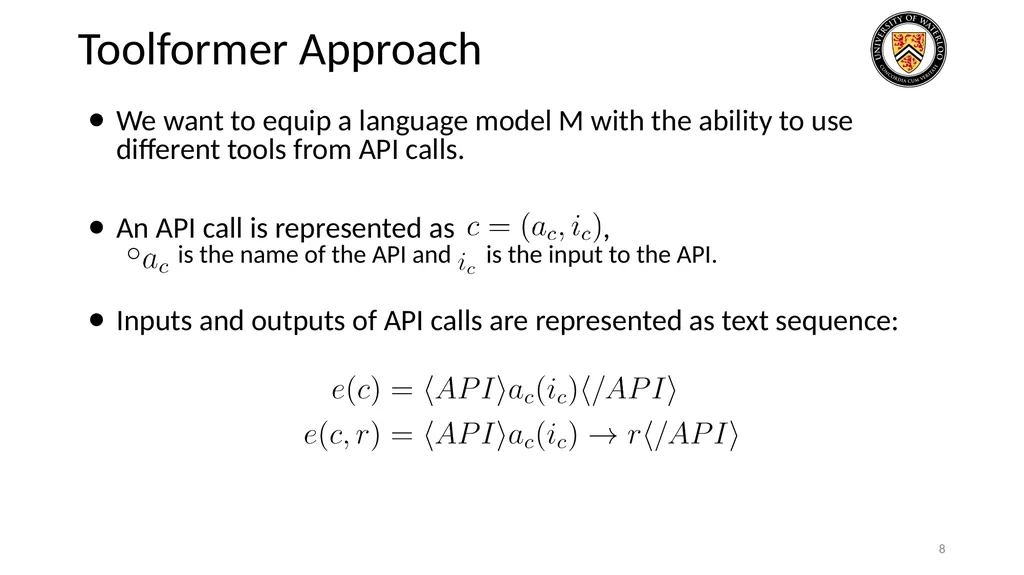
Toolformer Approach We want to equip a language model M with the ability to use different tools from API calls.
An API call is represented as ,
is the name of the API and is the input to the API.
Inputs and outputs of API calls are represented as text sequence: 8<br>
An API call is represented as ,
is the name of the API and is the input to the API.
Inputs and outputs of API calls are represented as text sequence: 8<br>
09
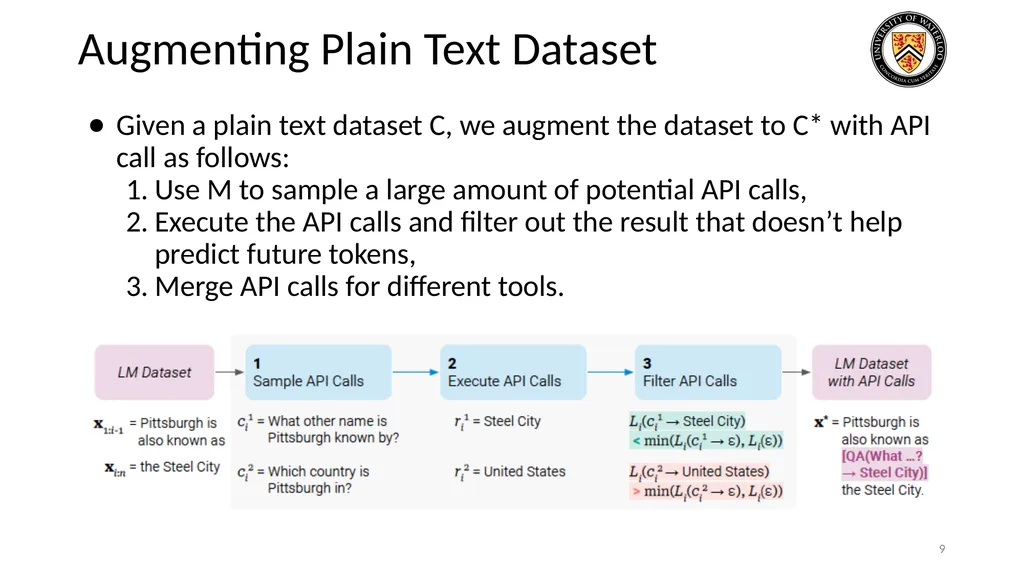
Augmenting Plain Text Dataset Given a plain text dataset C, we augment the dataset to C* with API call as follows:
Use M to sample a large amount of potential API calls,
Execute the API calls and filter out the result that doesn’t help predict future tokens,
Merge API calls for different tools. 9<br>
Use M to sample a large amount of potential API calls,
Execute the API calls and filter out the result that doesn’t help predict future tokens,
Merge API calls for different tools. 9<br>
10
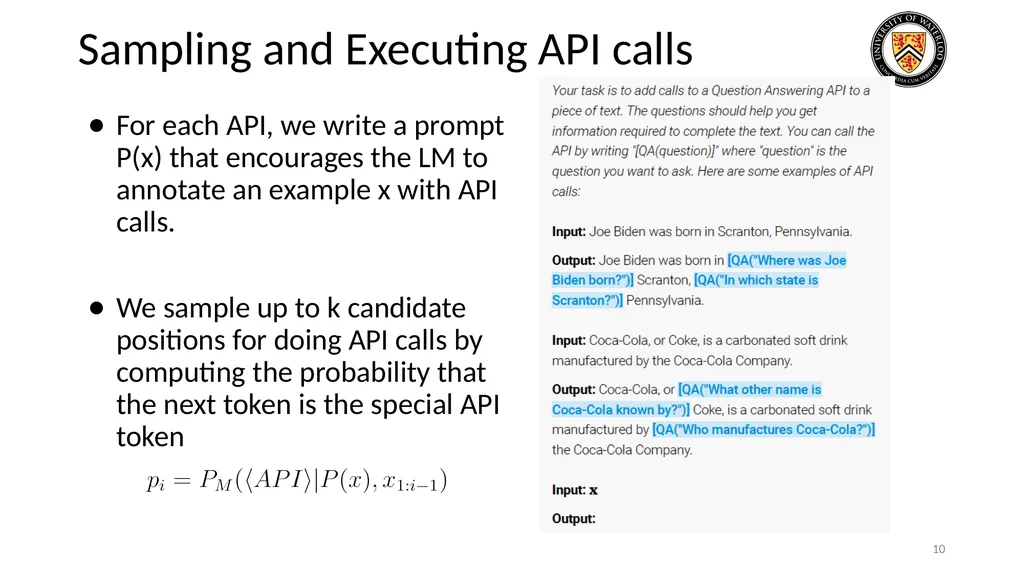
Sampling and Executing API calls For each API, we write a prompt P(x) that encourages the LM to annotate an example x with API calls.
We sample up to k candidate positions for doing API calls by computing the probability that the next token is the special API token 10<br>
We sample up to k candidate positions for doing API calls by computing the probability that the next token is the special API token 10<br>
11
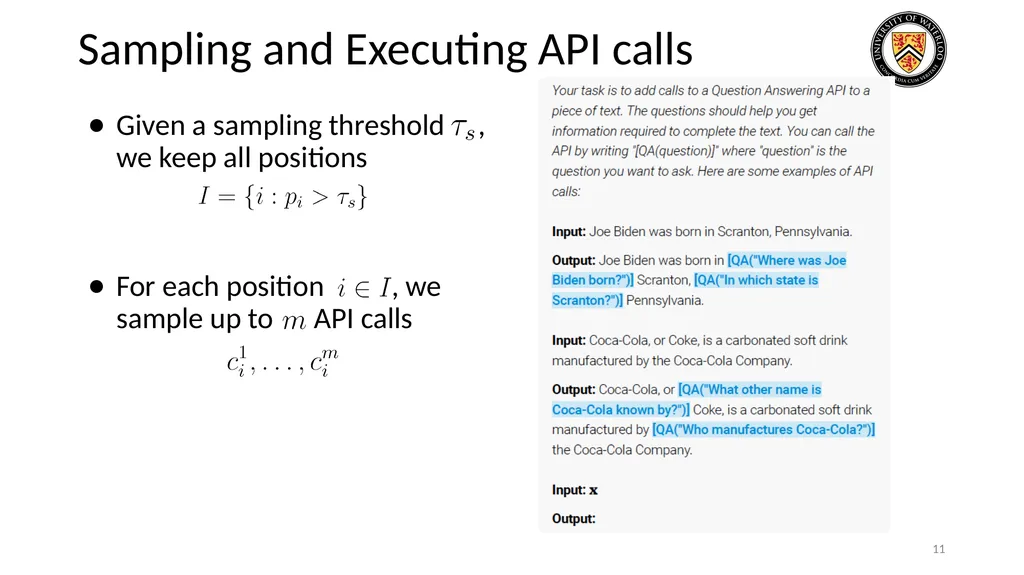
Sampling and Executing API calls Given a sampling threshold , we keep all positions
For each position , we sample up to API calls 11<br>
For each position , we sample up to API calls 11<br>
12
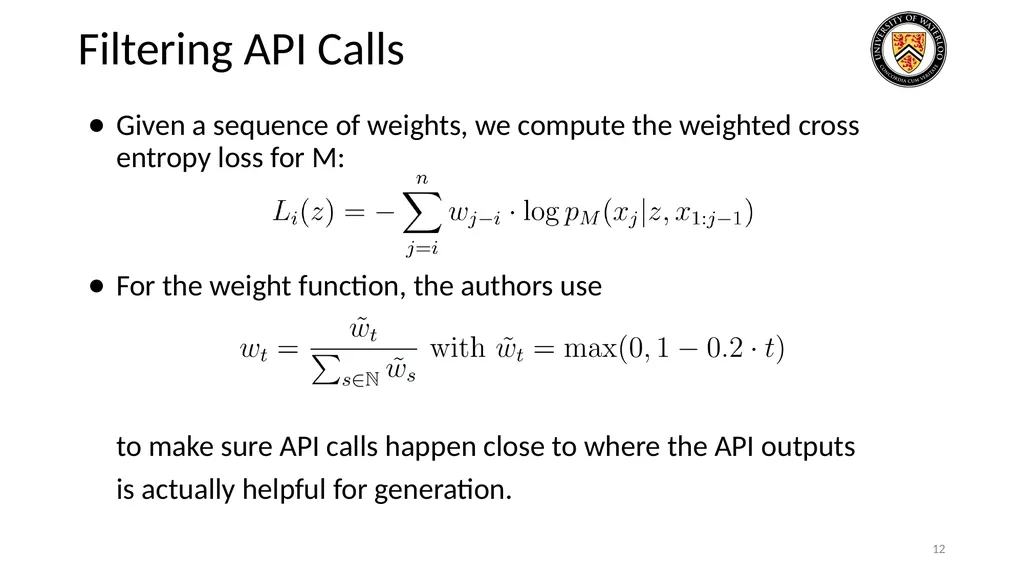
Filtering API Calls Given a sequence of weights, we compute the weighted cross entropy loss for M:
For the weight function, the authors use
to make sure API calls happen close to where the API outputs
is actually helpful for generation. 12<br>
For the weight function, the authors use
to make sure API calls happen close to where the API outputs
is actually helpful for generation. 12<br>
13
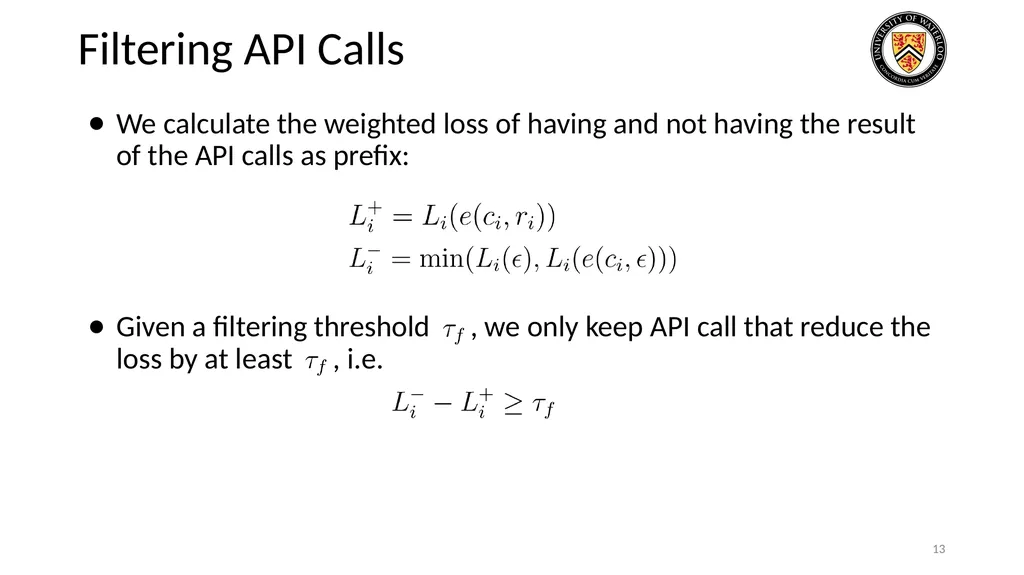
Filtering API Calls We calculate the weighted loss of having and not having the result of the API calls as prefix:
Given a filtering threshold , we only keep API call that reduce the loss by at least , i.e. 13<br>
Given a filtering threshold , we only keep API call that reduce the loss by at least , i.e. 13<br>
14
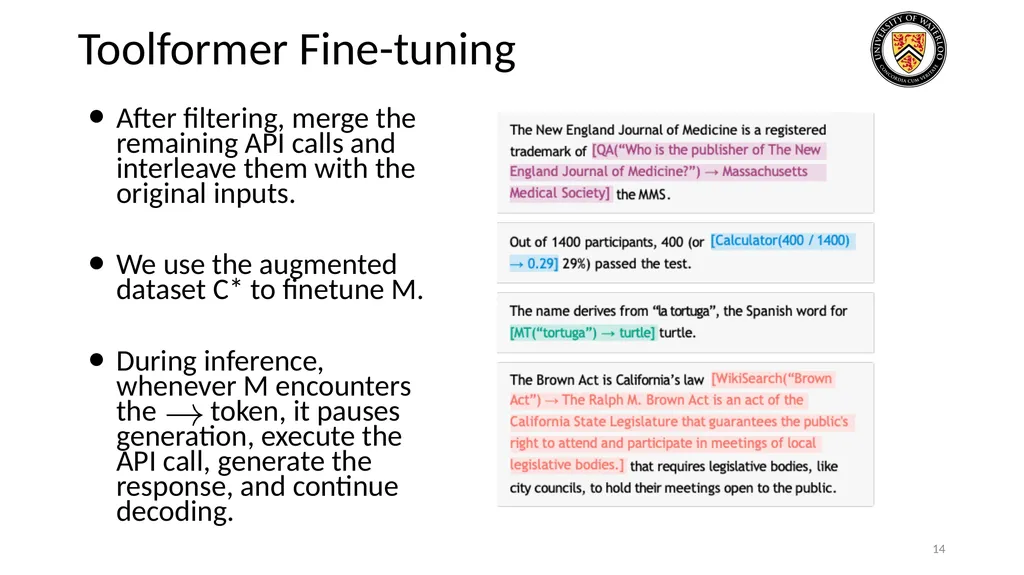
Toolformer Fine-tuning After filtering, merge the remaining API calls and interleave them with the original inputs.
We use the augmented dataset C* to finetune M.
During inference, whenever M encounters the token, it pauses generation, execute the API call, generate the response, and continue decoding. 14<br>
We use the augmented dataset C* to finetune M.
During inference, whenever M encounters the token, it pauses generation, execute the API call, generate the response, and continue decoding. 14<br>
15
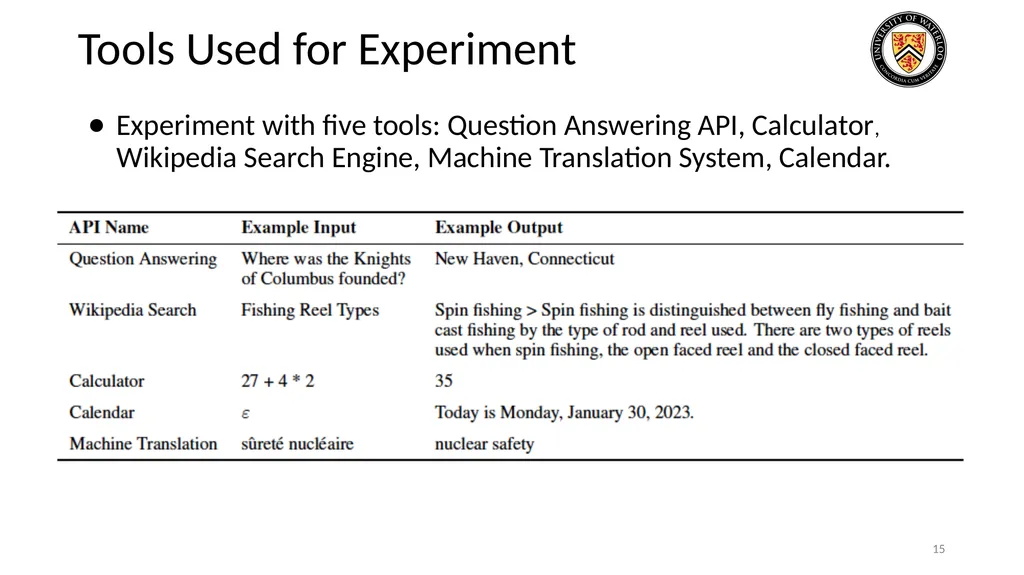
Tools Used for Experiment Experiment with five tools: Question Answering API, Calculator, Wikipedia Search Engine, Machine Translation System, Calendar. 15<br>
16
Experimental Setup Use a subset of CCNet as out language modeling dataset C and GPT-J as the language model M.
Define some heuristics for some APIs to get a subset of C for which API calls are more likely to be helpful.
We mainly compare the following models:
GPT-J: The original model without fine-tuning,
GPT-J + CC: GPT-J fine-tuned on C without any API calls,
Toolformer: GPT-J fine-tuned on C*,
Toolformer(disabled): GPT-J fine-tuned on C*, but API calls are disabled during decoding. 16<br>
Define some heuristics for some APIs to get a subset of C for which API calls are more likely to be helpful.
We mainly compare the following models:
GPT-J: The original model without fine-tuning,
GPT-J + CC: GPT-J fine-tuned on C without any API calls,
Toolformer: GPT-J fine-tuned on C*,
Toolformer(disabled): GPT-J fine-tuned on C*, but API calls are disabled during decoding. 16<br>
17
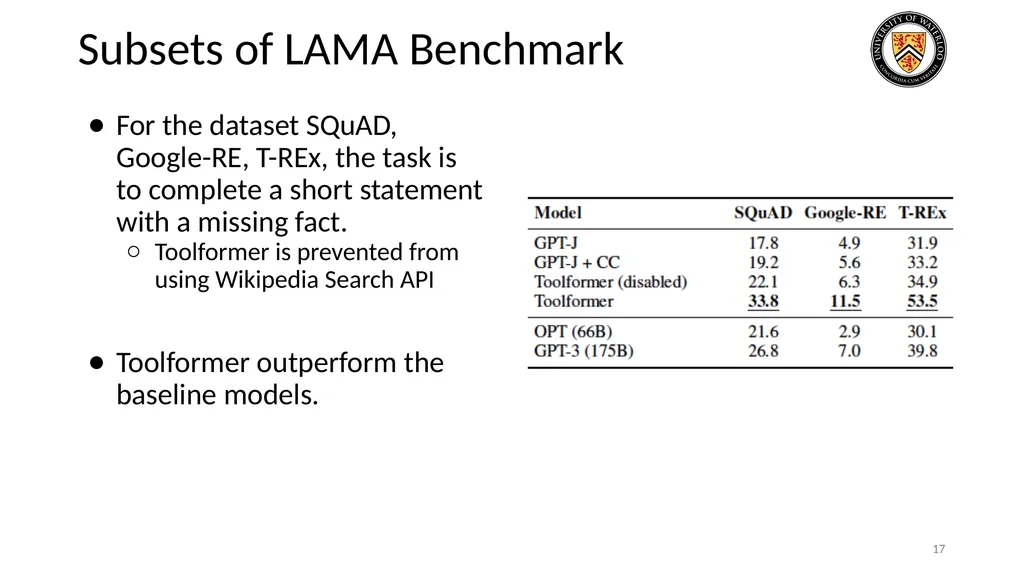
Subsets of LAMA Benchmark For the dataset SQuAD, Google-RE, T-REx, the task is to complete a short statement with a missing fact.
Toolformer is prevented from using Wikipedia Search API
Toolformer outperform the baseline models. 17<br>
Toolformer is prevented from using Wikipedia Search API
Toolformer outperform the baseline models. 17<br>
18
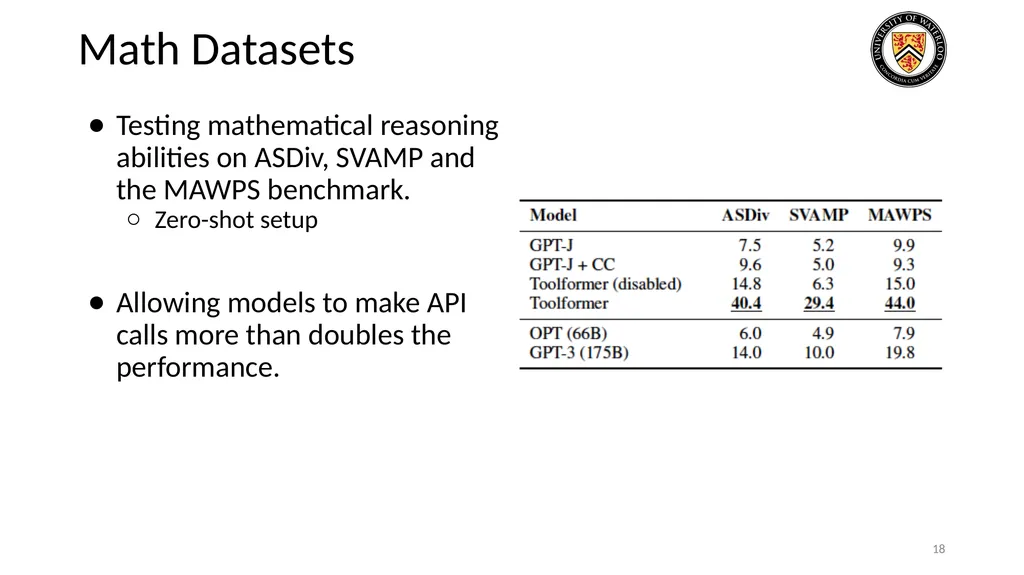
Math Datasets Testing mathematical reasoning abilities on ASDiv, SVAMP and the MAWPS benchmark.
Zero-shot setup
Allowing models to make API calls more than doubles the performance. 18<br>
Zero-shot setup
Allowing models to make API calls more than doubles the performance. 18<br>
19
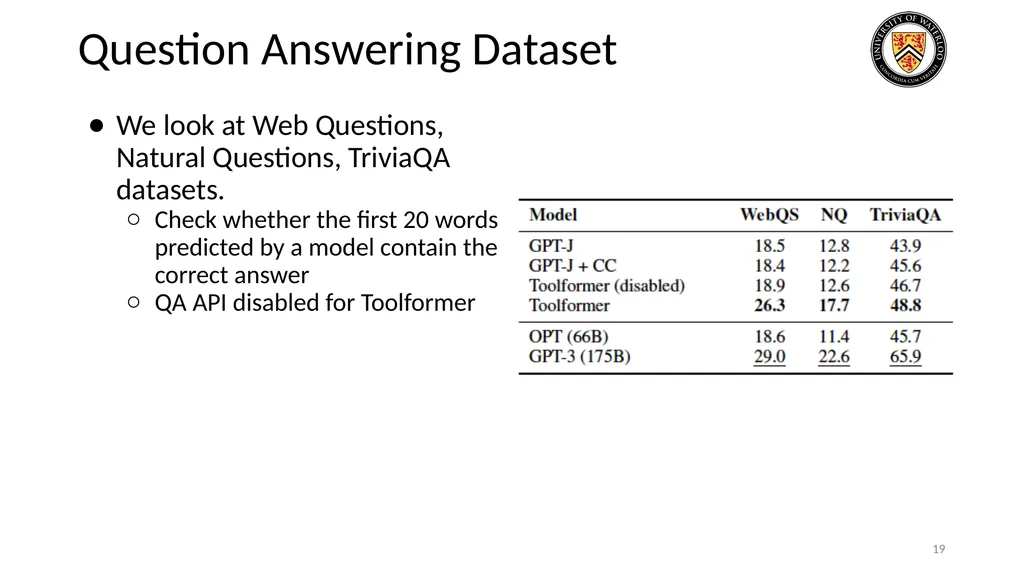
Question Answering Dataset We look at Web Questions, Natural Questions, TriviaQA datasets.
Check whether the first 20 words predicted by a model contain the correct answer
QA API disabled for Toolformer 19<br>
Check whether the first 20 words predicted by a model contain the correct answer
QA API disabled for Toolformer 19<br>
20
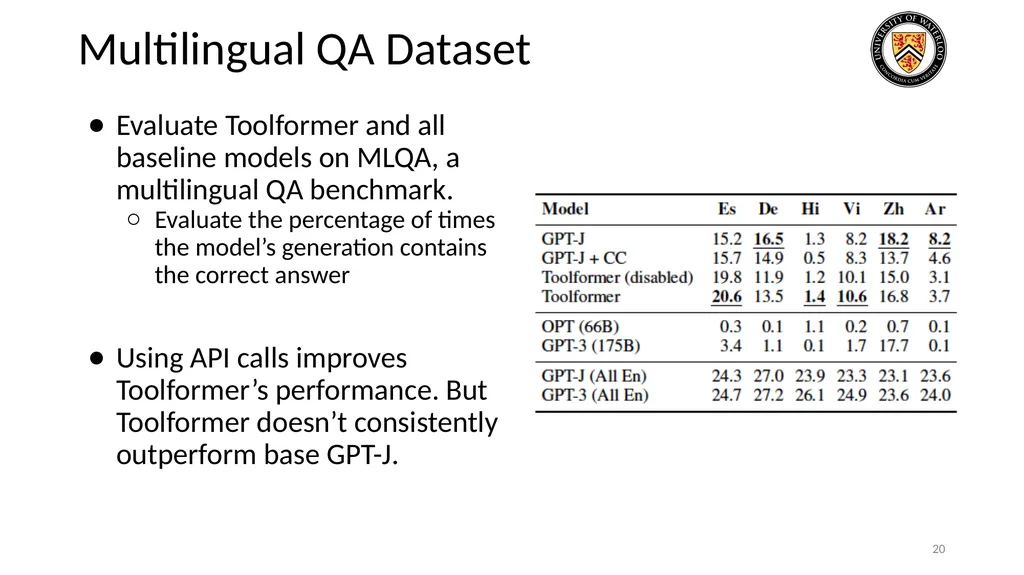
Multilingual QA Dataset Evaluate Toolformer and all baseline models on MLQA, a multilingual QA benchmark.
Evaluate the percentage of times the model’s generation contains the correct answer
Using API calls improves Toolformer’s performance. But Toolformer doesn’t consistently outperform base GPT-J. 20<br>
Evaluate the percentage of times the model’s generation contains the correct answer
Using API calls improves Toolformer’s performance. But Toolformer doesn’t consistently outperform base GPT-J. 20<br>
21
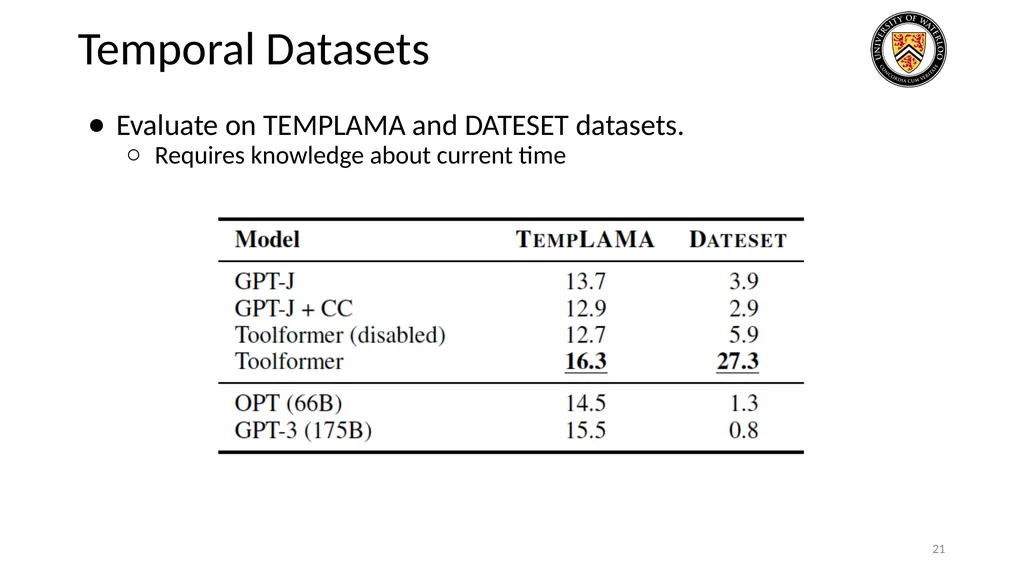
Temporal Datasets Evaluate on TEMPLAMA and DATESET datasets.
Requires knowledge about current time 21<br>
Requires knowledge about current time 21<br>
22
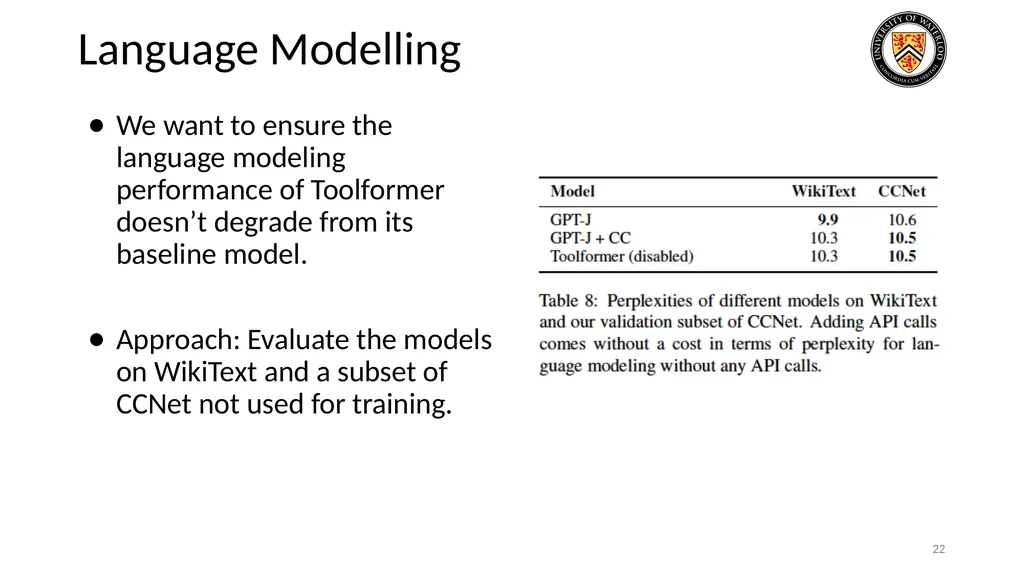
Language Modelling We want to ensure the language modeling performance of Toolformer doesn’t degrade from its baseline model.
Approach: Evaluate the models on WikiText and a subset of CCNet not used for training. 22<br>
Approach: Evaluate the models on WikiText and a subset of CCNet not used for training. 22<br>
23
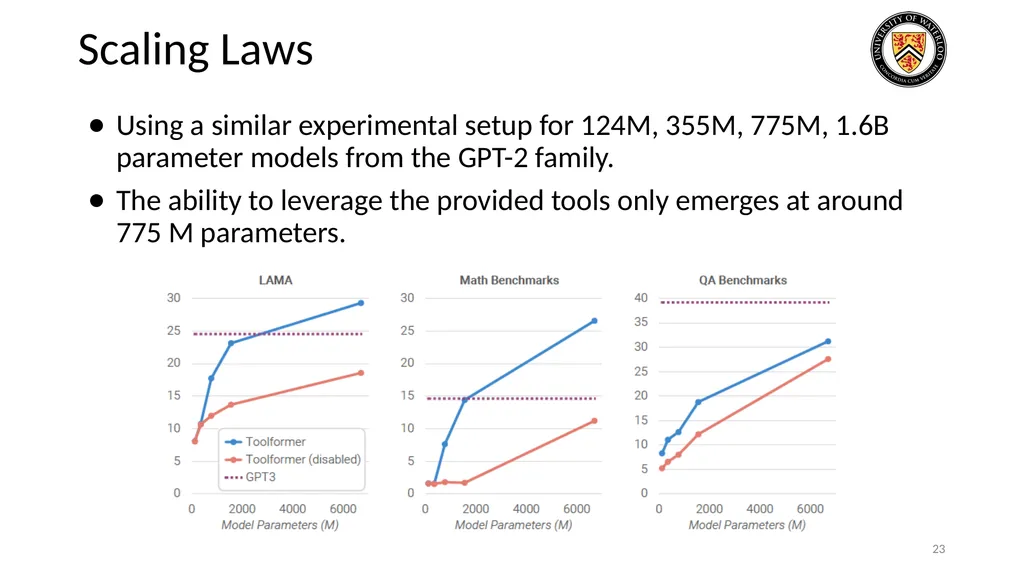
Scaling Laws Using a similar experimental setup for 124M, 355M, 775M, 1.6B parameter models from the GPT-2 family.
The ability to leverage the provided tools only emerges at around 775 M parameters. 23<br>
The ability to leverage the provided tools only emerges at around 775 M parameters. 23<br>
24
24 ART: Automatic multi-step reasoning and tool-use for large language models Bhargavi Paranjape, Scott Lundberg, Sameer Singh, Hannaneh Hajishirzi, Luke Zettlemoyer, and Marco Tulio Ribeiro.<br>
25
ART In-context learning allows LLMs to quickly adapt to new tasks using natural language instructions and a few demonstration.
However, there are severe performance limitations around multi-step reasoning, math, and other complex tasks.
ART (Automatic Reasoning and Tool-use) is a framework that automatically generates decompositions of intermediate reasoning steps for instances of new tasks.
Automatically use appropriate tools at each intermediate step. 25<br>
However, there are severe performance limitations around multi-step reasoning, math, and other complex tasks.
ART (Automatic Reasoning and Tool-use) is a framework that automatically generates decompositions of intermediate reasoning steps for instances of new tasks.
Automatically use appropriate tools at each intermediate step. 25<br>
26
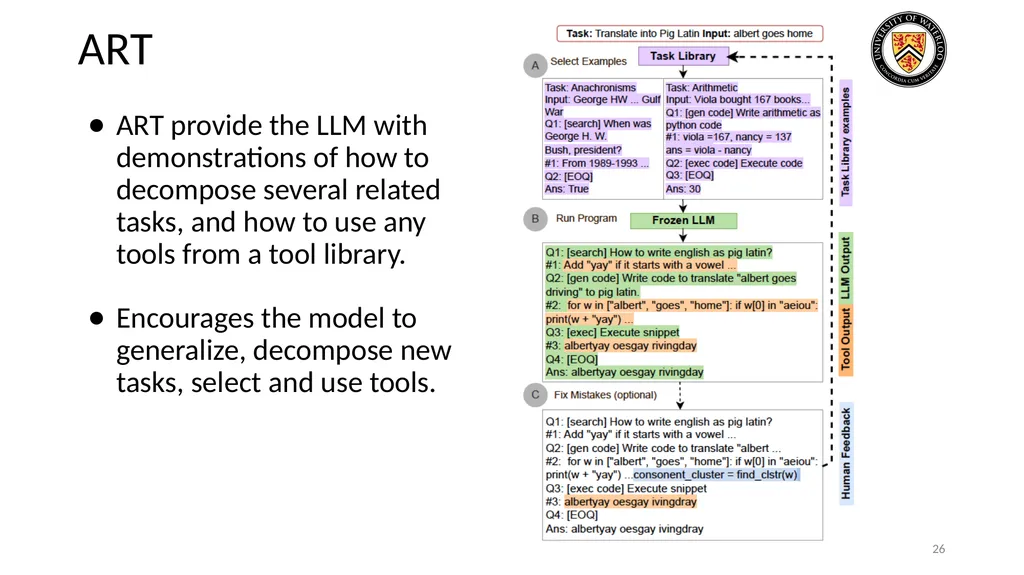
ART ART provide the LLM with demonstrations of how to decompose several related tasks, and how to use any tools from a tool library.
Encourages the model to generalize, decompose new tasks, select and use tools. 26<br>
Encourages the model to generalize, decompose new tasks, select and use tools. 26<br>
27
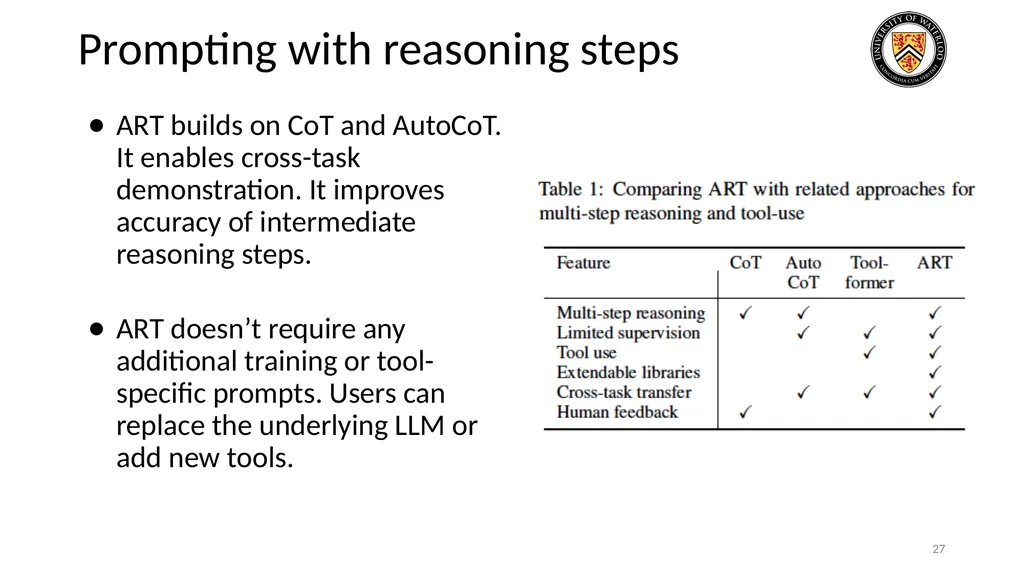
Prompting with reasoning steps ART builds on CoT and AutoCoT. It enables cross-task demonstration. It improves accuracy of intermediate reasoning steps.
ART doesn’t require any additional training or tool-specific prompts. Users can replace the underlying LLM or add new tools. 27<br>
ART doesn’t require any additional training or tool-specific prompts. Users can replace the underlying LLM or add new tools. 27<br>
28
Overview of ART framework ART uses a frozen LLM to decompose instances of a new task into multiple steps without supervision.
Prompt Building: ART retrieves similar tasks from a task library and adds instances of those tasks as demonstrations in the prompt.
Decomposition: A demonstration in the task library is written in a custom parsing expression grammar(PeG) format. This grammar helps break down each task instance into a sequence of sub-steps. Some of these sub-steps contain symbols corresponding to tool use. We refer to these decompositions as program. 28<br>
Prompt Building: ART retrieves similar tasks from a task library and adds instances of those tasks as demonstrations in the prompt.
Decomposition: A demonstration in the task library is written in a custom parsing expression grammar(PeG) format. This grammar helps break down each task instance into a sequence of sub-steps. Some of these sub-steps contain symbols corresponding to tool use. We refer to these decompositions as program. 28<br>
29
Overview of ART framework Generation: At generation time, the LLM writes it own program. ART pauses generation whenever it encounters a tool call in the generated text, calling the tool and integrate the tool’s output back to the program.
Optional Human Feedback: Humans can add new decomposition demonstrations to the task library. Humans can also add or edit tools in the tool library to improve performance on a particular task of interest. 29<br>
Optional Human Feedback: Humans can add new decomposition demonstrations to the task library. Humans can also add or edit tools in the tool library to improve performance on a particular task of interest. 29<br>
30
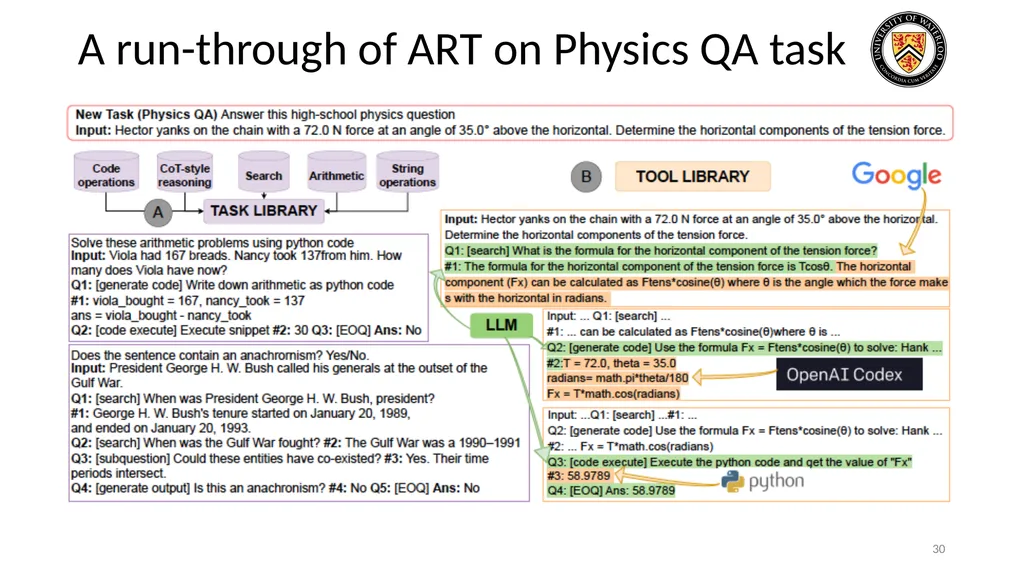
A run-through of ART on Physics QA task 30<br>
31
ART Task Library The task library consists of programs for a small seed set of tasks from Big-Bench, a benchmark that measures the capabilities and limitations of language models. The problems span categories of traditional NLP, mathematics, commonsense reasoning, and QA.
We group the five most used skills in the benchmark by:
Arithmetic
Code: Generating/Executing Python code
Search and Question Decomposition
Free-form Reasoning: Explaining step-by-step reasoning
String Operation: Reformatting/Editing String, etc.
Select 2 - 4 tasks from each group and write programs for a few instances of each tasks, including calls to external tools. 31<br>
We group the five most used skills in the benchmark by:
Arithmetic
Code: Generating/Executing Python code
Search and Question Decomposition
Free-form Reasoning: Explaining step-by-step reasoning
String Operation: Reformatting/Editing String, etc.
Select 2 - 4 tasks from each group and write programs for a few instances of each tasks, including calls to external tools. 31<br>
32
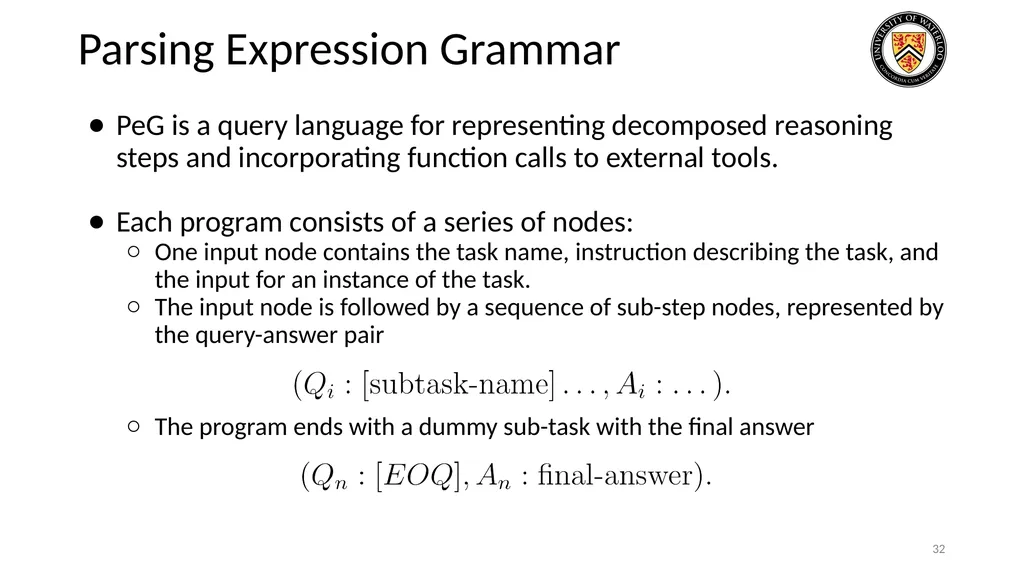
Parsing Expression Grammar PeG is a query language for representing decomposed reasoning steps and incorporating function calls to external tools.
Each program consists of a series of nodes:
One input node contains the task name, instruction describing the task, and the input for an instance of the task.
The input node is followed by a sequence of sub-step nodes, represented by the query-answer pair
The program ends with a dummy sub-task with the final answer 32<br>
Each program consists of a series of nodes:
One input node contains the task name, instruction describing the task, and the input for an instance of the task.
The input node is followed by a sequence of sub-step nodes, represented by the query-answer pair
The program ends with a dummy sub-task with the final answer 32<br>
33
ART Task Retrieval Given a new task, ART retrieves N tasks from the task library to construct a dynamic multi-task prompt.
Two strategies:
(Task-cluster based) Iterate over all five groups and select a few task programs from each group to compose the prompt. The task cluster with the highest performance on the labeled examples is chosen.
(LLM-similarity based) Craft a few-shot prompt with task pairs, each task includes a name, instructions, and a few input-output examples. For each pair , we provide a label of “Similar” or “Not similar”. At runtime, we pair the test-task with every task in the task library, and choose the task based on highest-ranked log probability ratio between “Similar” and “Not similar”. 33<br>
Two strategies:
(Task-cluster based) Iterate over all five groups and select a few task programs from each group to compose the prompt. The task cluster with the highest performance on the labeled examples is chosen.
(LLM-similarity based) Craft a few-shot prompt with task pairs, each task includes a name, instructions, and a few input-output examples. For each pair , we provide a label of “Similar” or “Not similar”. At runtime, we pair the test-task with every task in the task library, and choose the task based on highest-ranked log probability ratio between “Similar” and “Not similar”. 33<br>
34
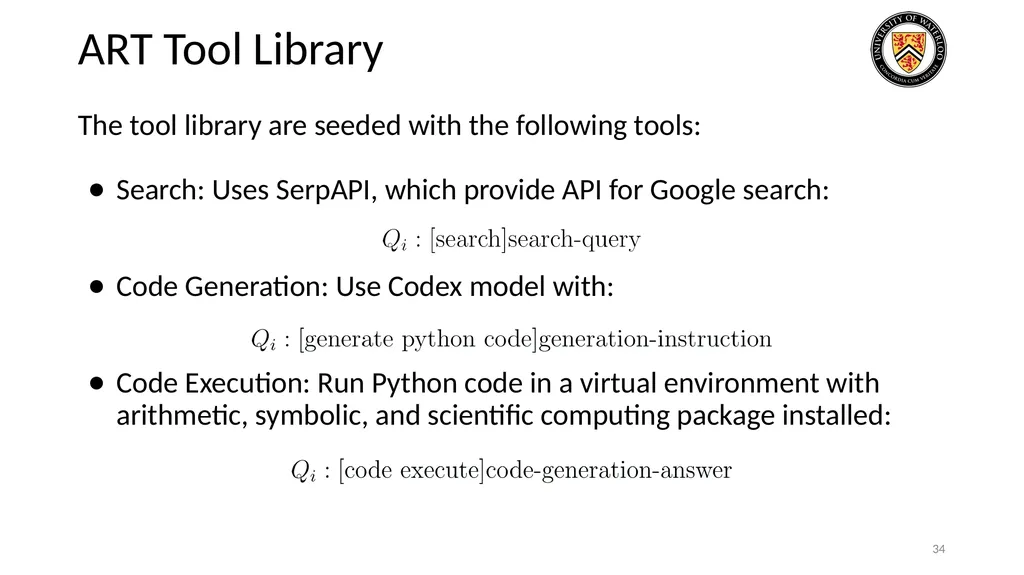
ART Tool Library The tool library are seeded with the following tools:
Search: Uses SerpAPI, which provide API for Google search:
Code Generation: Use Codex model with:
Code Execution: Run Python code in a virtual environment with arithmetic, symbolic, and scientific computing package installed: 34<br>
Search: Uses SerpAPI, which provide API for Google search:
Code Generation: Use Codex model with:
Code Execution: Run Python code in a virtual environment with arithmetic, symbolic, and scientific computing package installed: 34<br>
35
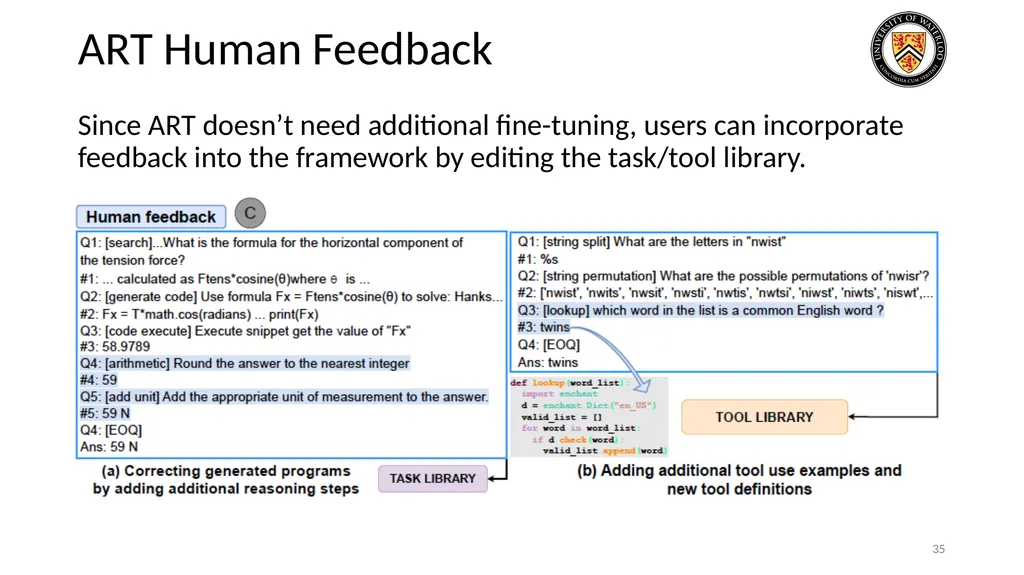
ART Human Feedback Since ART doesn’t need additional fine-tuning, users can incorporate feedback into the framework by editing the task/tool library. 35<br>
36
Experimental Setup In addition to the 15 tasks from the task library, we evaluate ART on 19 additional task from BigBench.
Further evaluate ART on the MMLU benchmark
Frozen LLM: InstructGPT (text-davinci-002)
Code Generation Tool: Codex
Use 2 demonstration programs from each task.
Report performance averaged over 5 runs. 36<br>
Further evaluate ART on the MMLU benchmark
Frozen LLM: InstructGPT (text-davinci-002)
Code Generation Tool: Codex
Use 2 demonstration programs from each task.
Report performance averaged over 5 runs. 36<br>
37
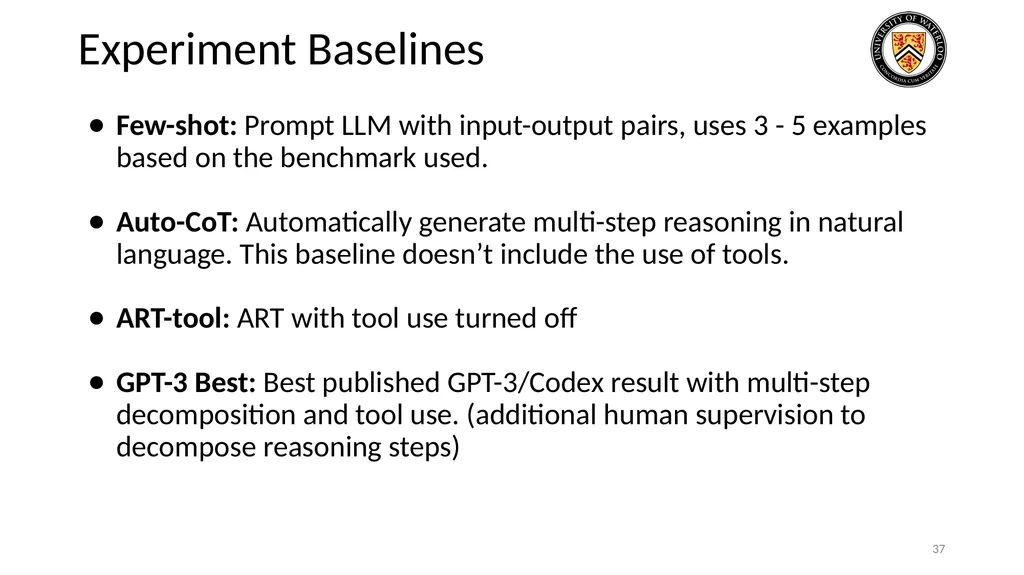
Experiment Baselines Few-shot: Prompt LLM with input-output pairs, uses 3 - 5 examples based on the benchmark used.
Auto-CoT: Automatically generate multi-step reasoning in natural language. This baseline doesn’t include the use of tools.
ART-tool: ART with tool use turned off
GPT-3 Best: Best published GPT-3/Codex result with multi-step decomposition and tool use. (additional human supervision to decompose reasoning steps) 37<br>
Auto-CoT: Automatically generate multi-step reasoning in natural language. This baseline doesn’t include the use of tools.
ART-tool: ART with tool use turned off
GPT-3 Best: Best published GPT-3/Codex result with multi-step decomposition and tool use. (additional human supervision to decompose reasoning steps) 37<br>
38
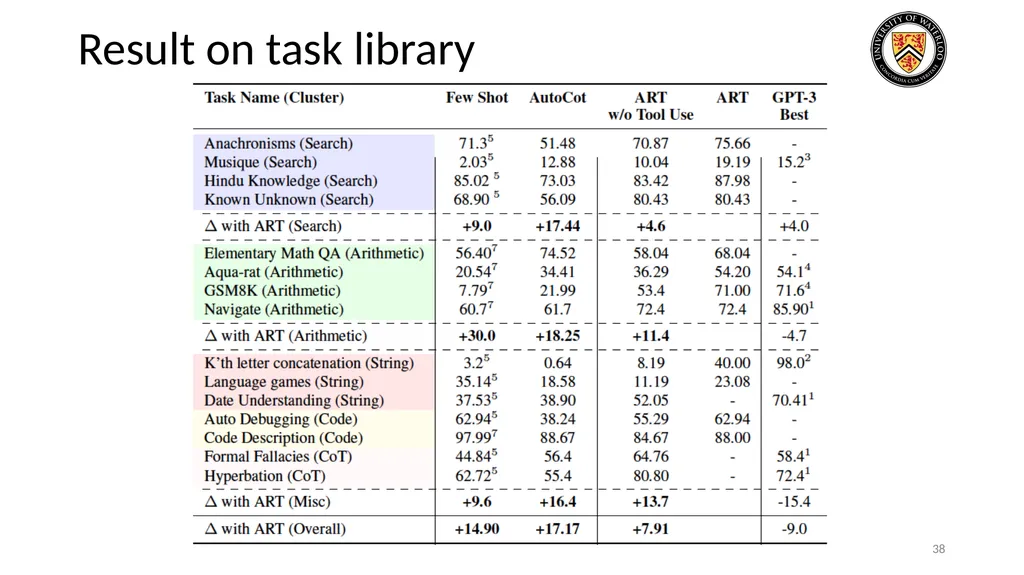
Result on task library 38<br>
39
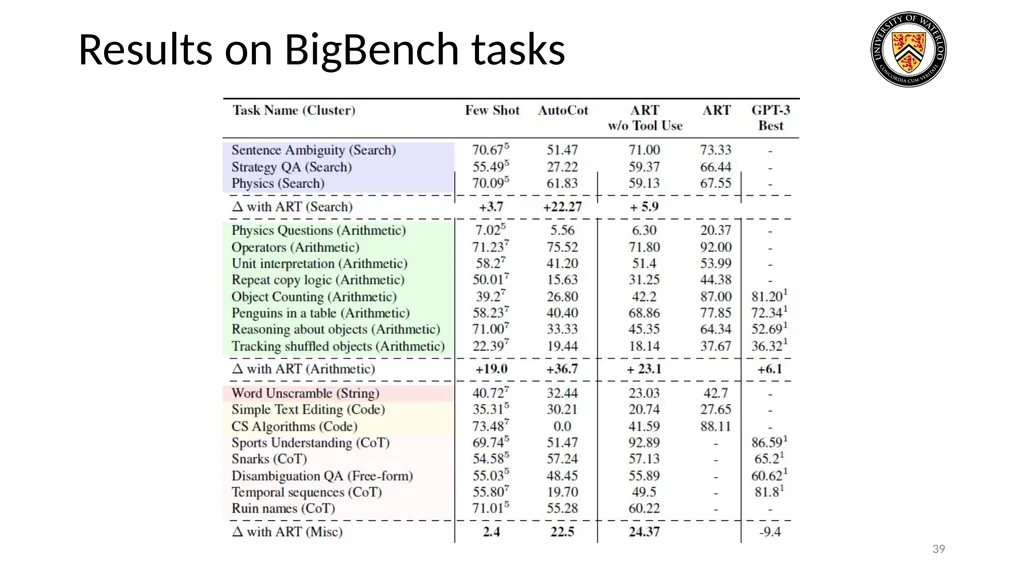
Results on BigBench tasks 39<br>
40
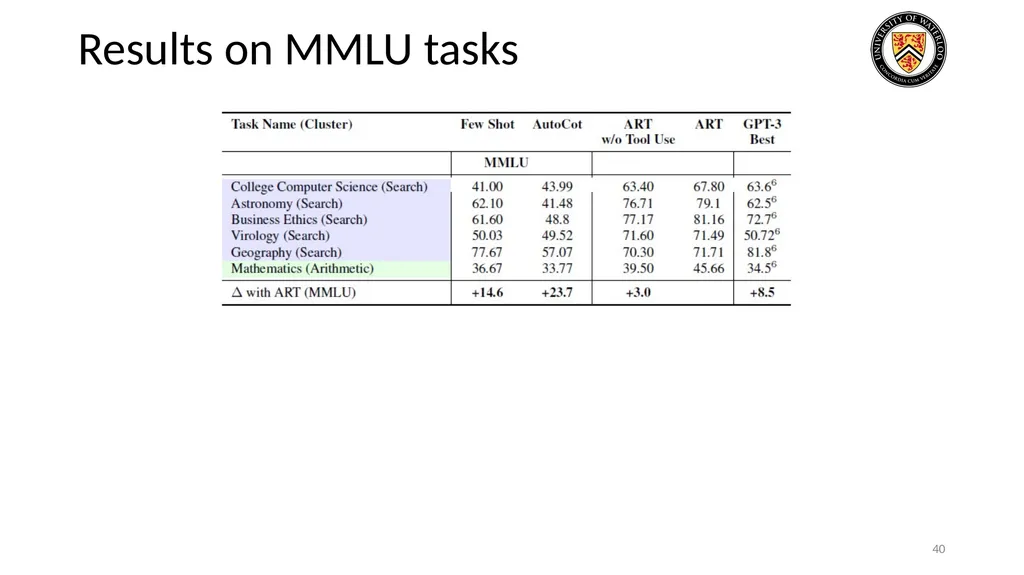
Results on MMLU tasks 40<br>
41
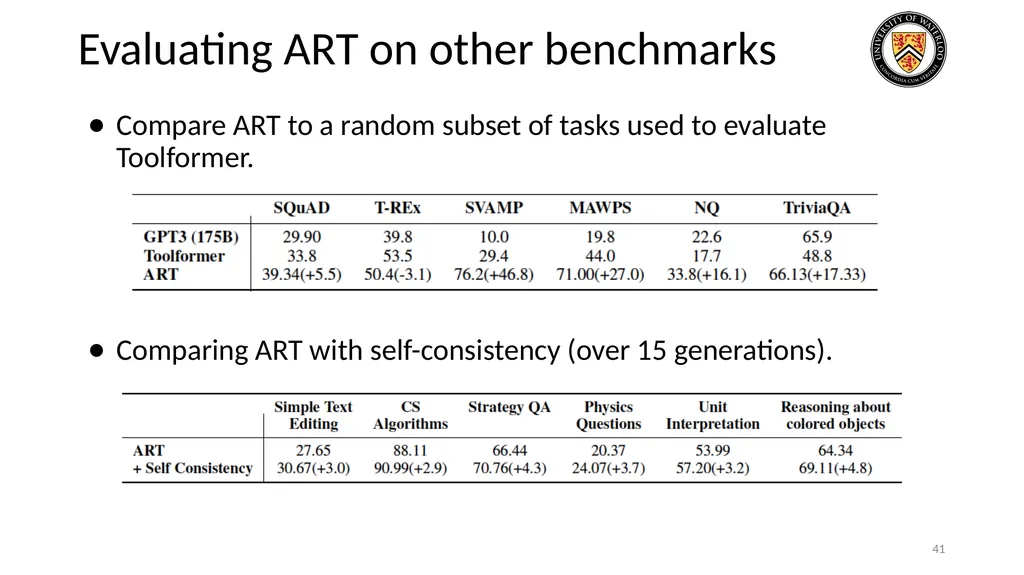
Evaluating ART on other benchmarks Compare ART to a random subset of tasks used to evaluate Toolformer.
Comparing ART with self-consistency (over 15 generations). 41<br>
Comparing ART with self-consistency (over 15 generations). 41<br>
42
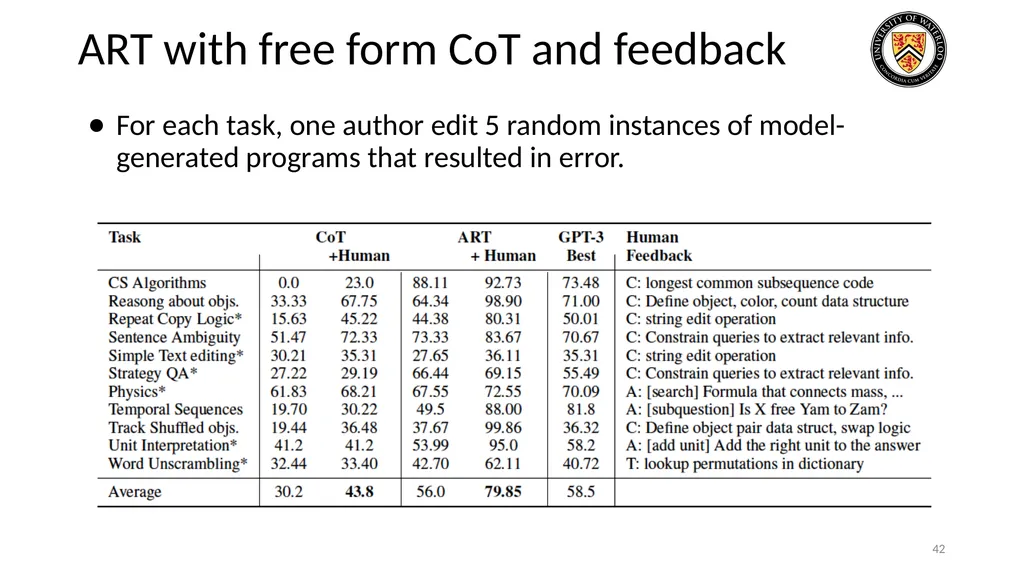
ART with free form CoT and feedback For each task, one author edit 5 random instances of model-generated programs that resulted in error. 42<br>
43
43 AgentBench: Evaluating LLMs as Agents Xiao Liu, Hao Yu, Hanchen Zhang, Yifan Xu, Xuanyu Lei, Hanyu Lai, Yu Gu, Hangliang Ding, Kaiwen Men, Kejuan Yang, Shudan Zhang, Xiang Deng, Aohan Zeng, Zhengxiao Du, Chenhui Zhang, Sheng Shen, Tianjun Zhang, Yu Su, Huan Sun, Minlie Huang, Yuxiao Dong, and Jie Tang.<br>
44
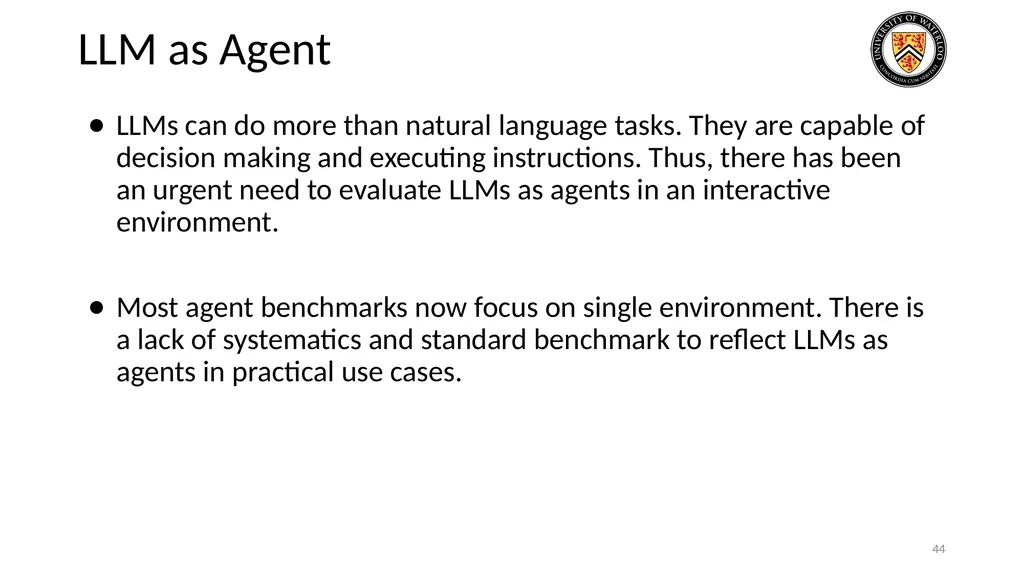
LLM as Agent LLMs can do more than natural language tasks. They are capable of decision making and executing instructions. Thus, there has been an urgent need to evaluate LLMs as agents in an interactive environment.
Most agent benchmarks now focus on single environment. There is a lack of systematics and standard benchmark to reflect LLMs as agents in practical use cases. 44<br>
Most agent benchmarks now focus on single environment. There is a lack of systematics and standard benchmark to reflect LLMs as agents in practical use cases. 44<br>
45
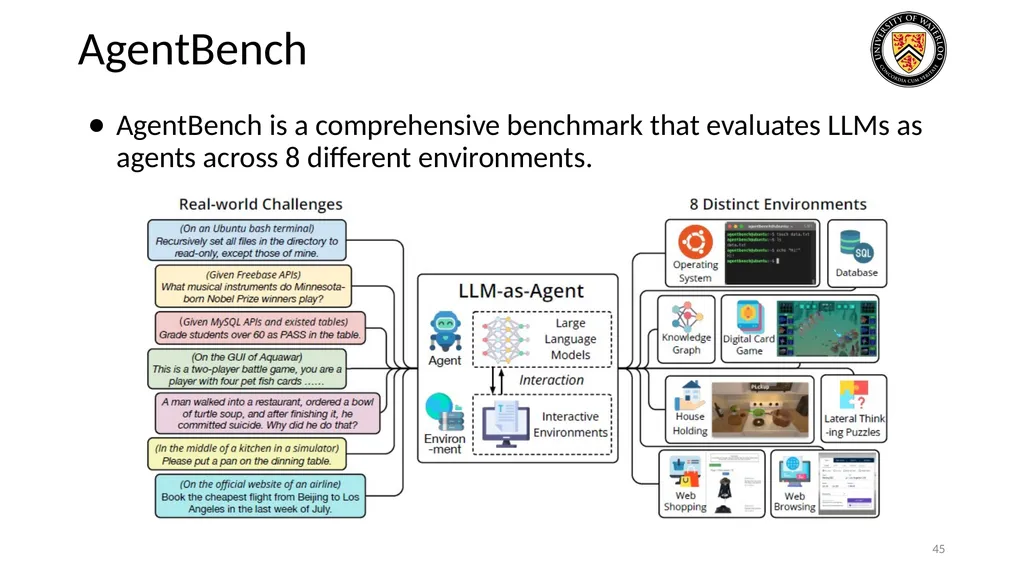
AgentBench AgentBench is a comprehensive benchmark that evaluates LLMs as agents across 8 different environments. 45<br>
46
AgentBench AgentBench concentrates on the practical evaluation of LLMs via CoT prompting.
This paper also offered an integrated toolkit that enables customization of model assessments. This toolkit is openly accessible to the research community.
AgentBench environments are categorized by 3 types of grounding: Code, Game, and Web. 46<br>
This paper also offered an integrated toolkit that enables customization of model assessments. This toolkit is openly accessible to the research community.
AgentBench environments are categorized by 3 types of grounding: Code, Game, and Web. 46<br>
47
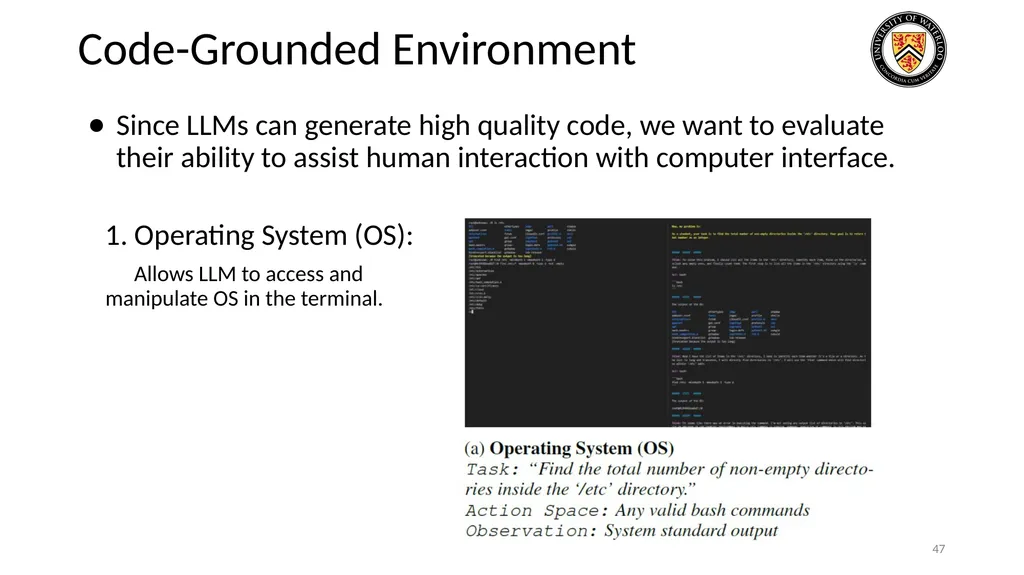
Code-Grounded Environment Since LLMs can generate high quality code, we want to evaluate their ability to assist human interaction with computer interface. 47 1. Operating System (OS):
Allows LLM to access and manipulate OS in the terminal.<br>
Allows LLM to access and manipulate OS in the terminal.<br>
48
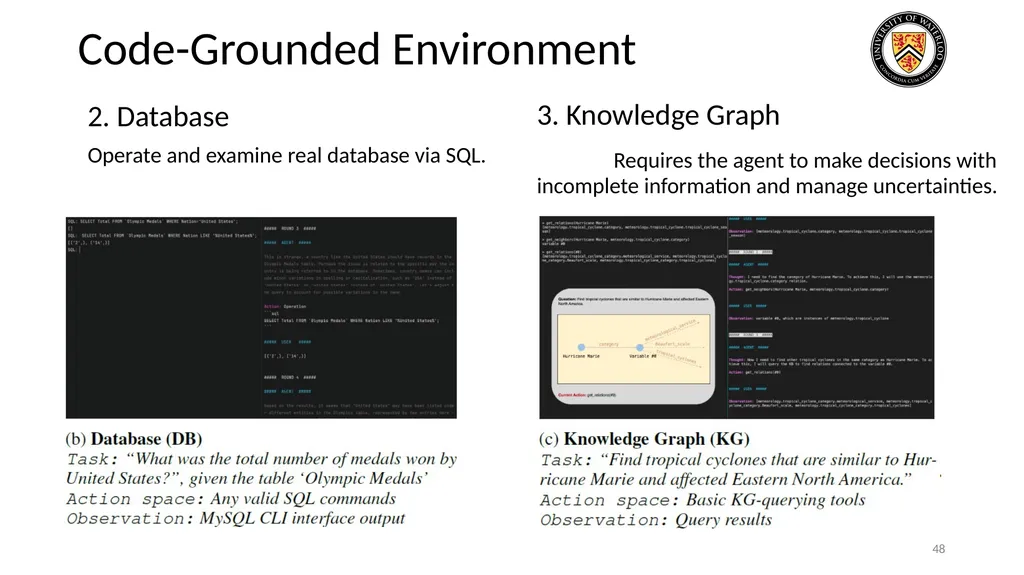
Code-Grounded Environment 2. Database
Operate and examine real database via SQL. 48 3. Knowledge Graph
Requires the agent to make decisions with incomplete information and manage uncertainties.<br>
Operate and examine real database via SQL. 48 3. Knowledge Graph
Requires the agent to make decisions with incomplete information and manage uncertainties.<br>
49
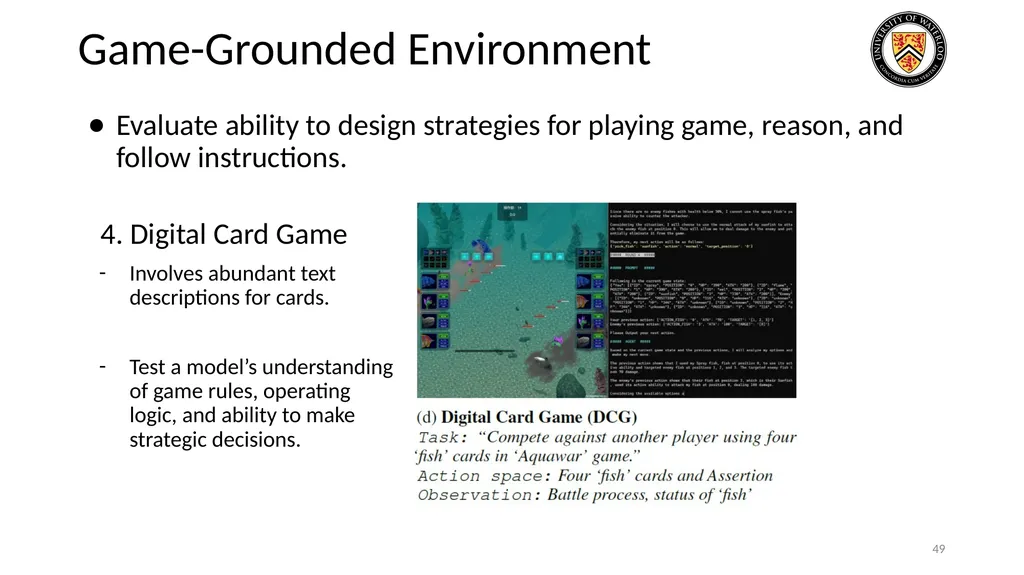
Game-Grounded Environment Evaluate ability to design strategies for playing game, reason, and follow instructions. 49 4. Digital Card Game
Involves abundant text descriptions for cards.
Test a model’s understanding of game rules, operating logic, and ability to make strategic decisions.<br>
Involves abundant text descriptions for cards.
Test a model’s understanding of game rules, operating logic, and ability to make strategic decisions.<br>
50
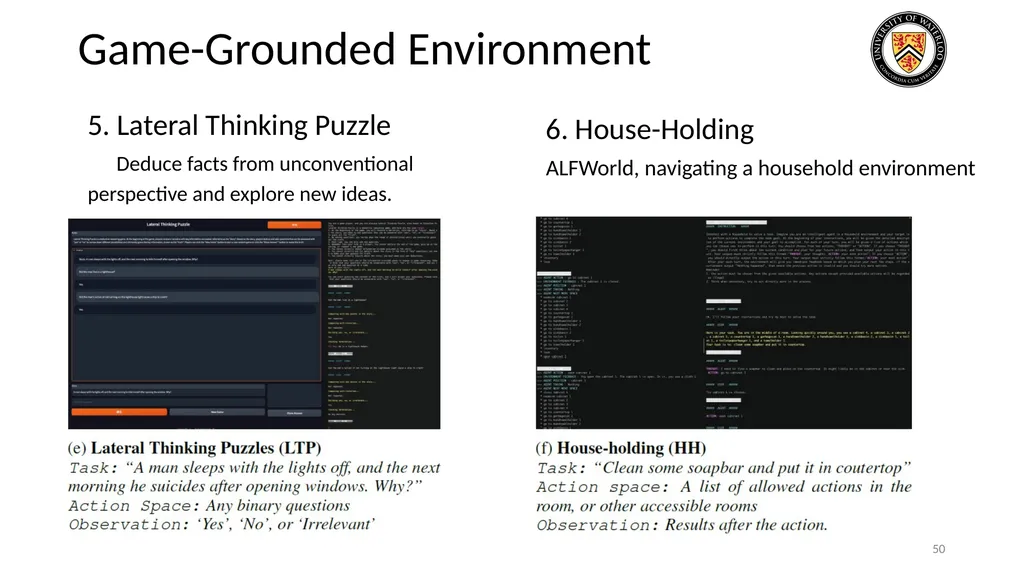
Game-Grounded Environment 5. Lateral Thinking Puzzle
Deduce facts from unconventional perspective and explore new ideas. 50 6. House-Holding
ALFWorld, navigating a household environment<br>
Deduce facts from unconventional perspective and explore new ideas. 50 6. House-Holding
ALFWorld, navigating a household environment<br>
51
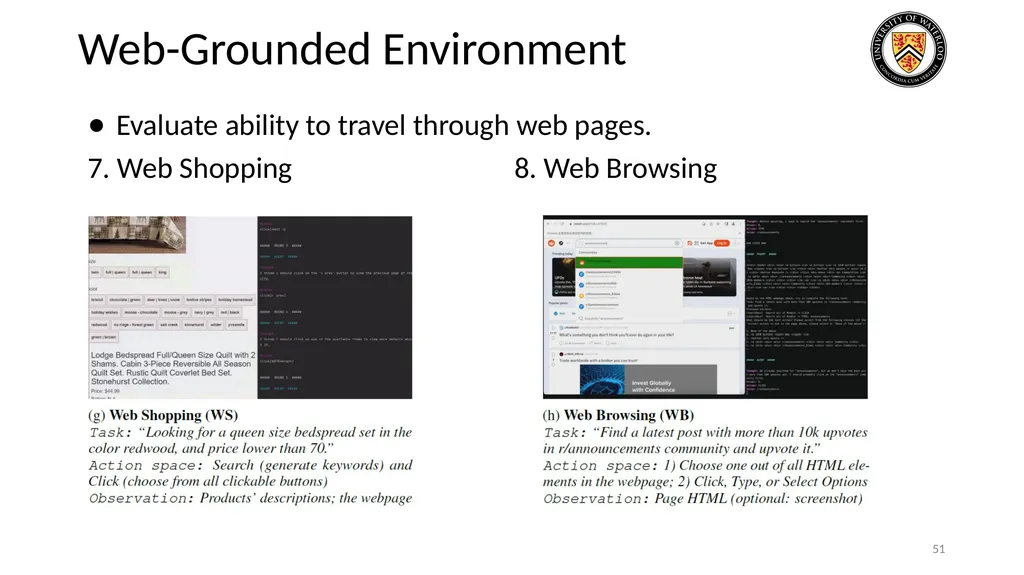
Web-Grounded Environment Evaluate ability to travel through web pages.
7. Web Shopping 8. Web Browsing 51<br>
7. Web Shopping 8. Web Browsing 51<br>
52
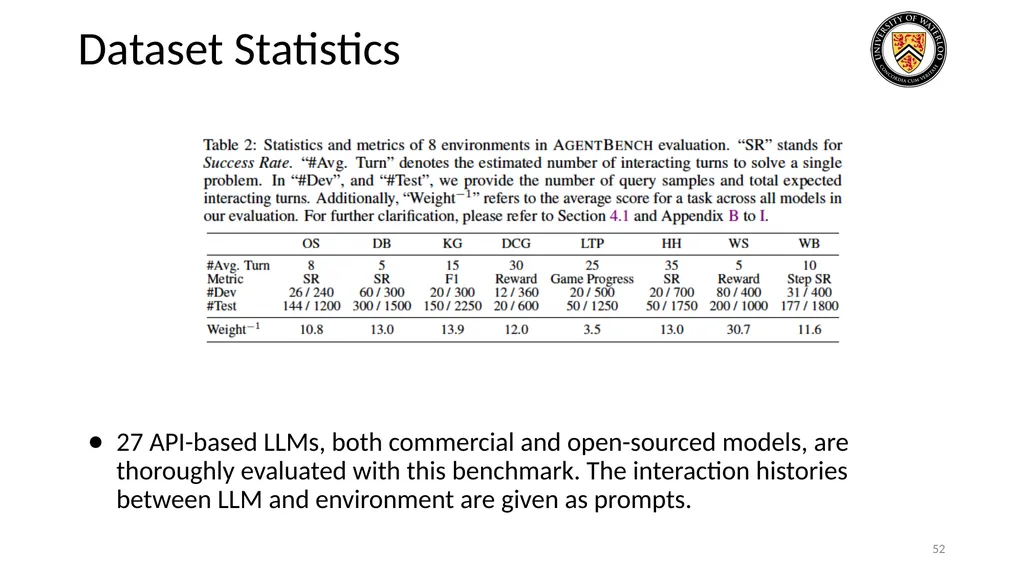
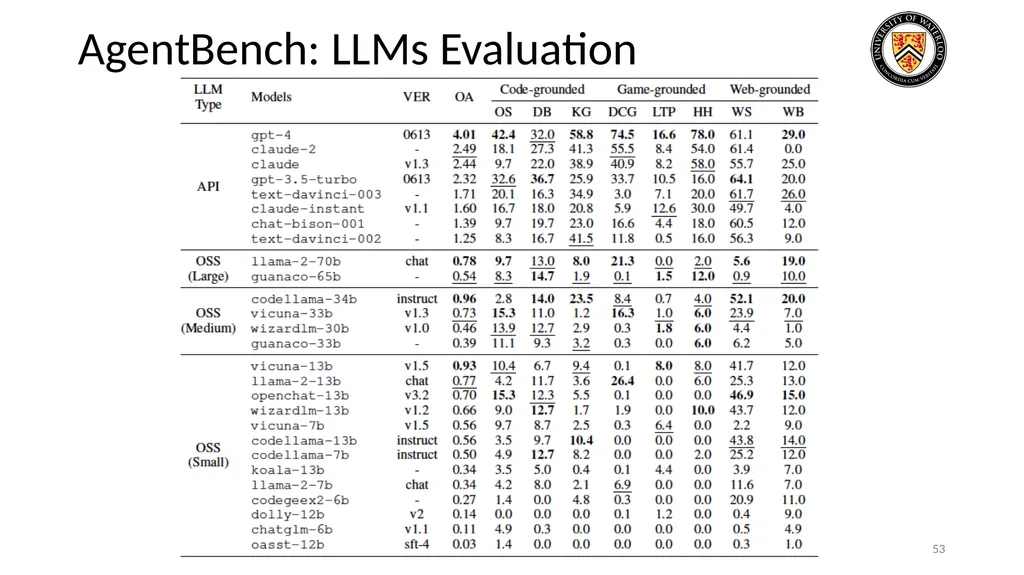
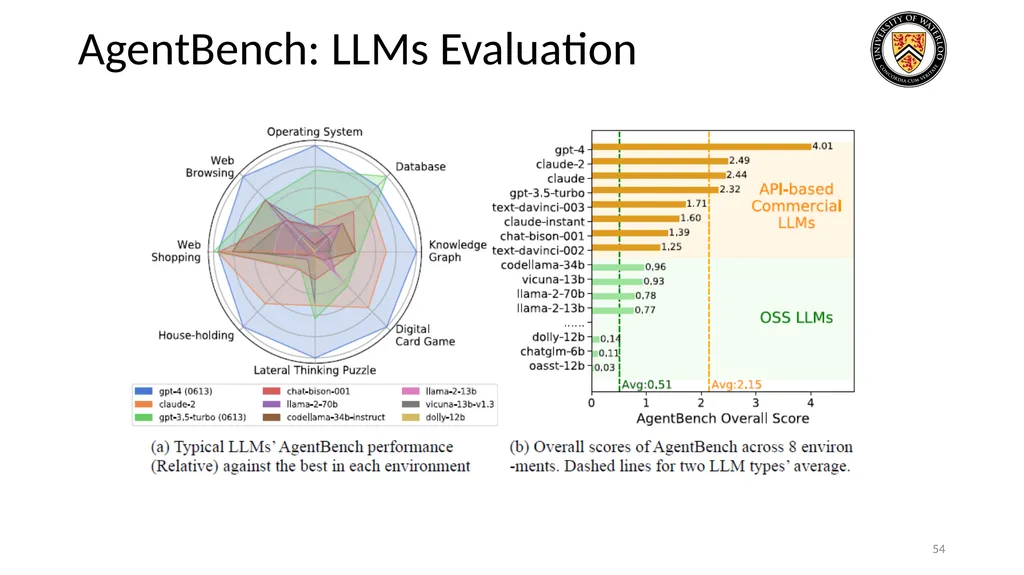
Dataset Statistics 27 API-based LLMs, both commercial and open-sourced models, are thoroughly evaluated with this benchmark. The interaction histories between LLM and environment are given as prompts. 52<br>
53
AgentBench: LLMs Evaluation 53<br>
54
AgentBench: LLMs Evaluation 54<br>
55
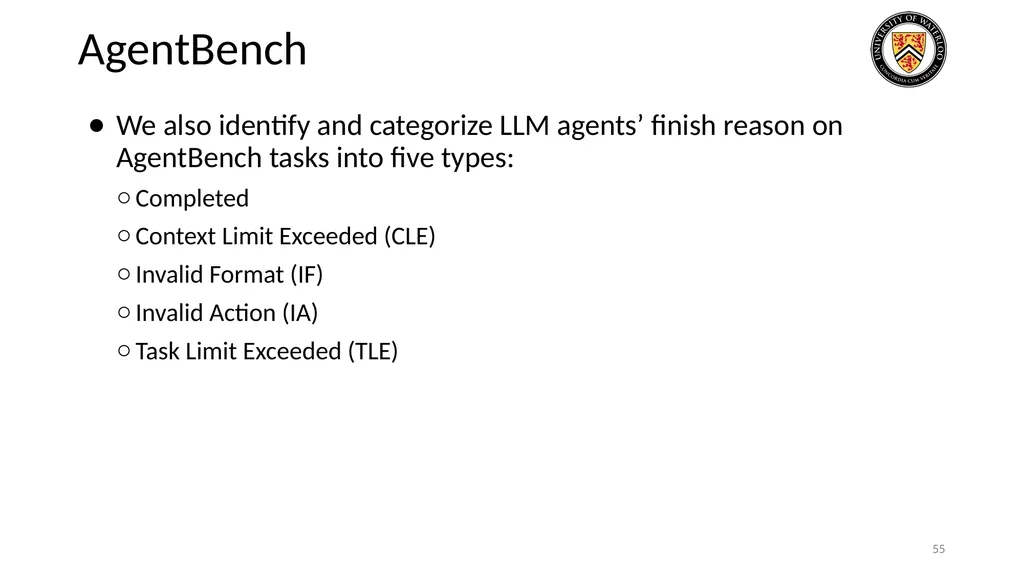
AgentBench We also identify and categorize LLM agents’ finish reason on AgentBench tasks into five types:
Completed
Context Limit Exceeded (CLE)
Invalid Format (IF)
Invalid Action (IA)
Task Limit Exceeded (TLE) 55<br>
Completed
Context Limit Exceeded (CLE)
Invalid Format (IF)
Invalid Action (IA)
Task Limit Exceeded (TLE) 55<br>
56
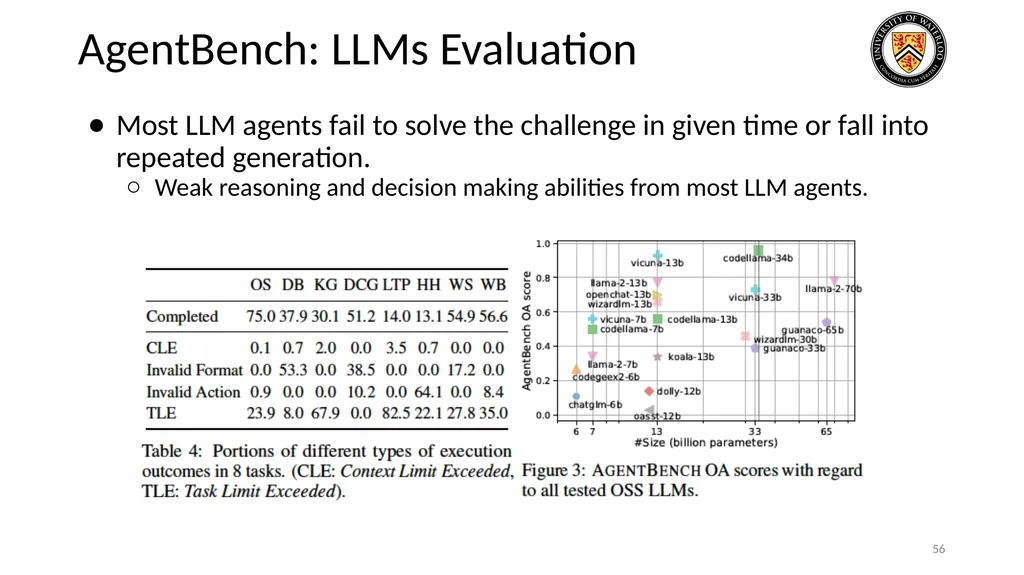
AgentBench: LLMs Evaluation Most LLM agents fail to solve the challenge in given time or fall into repeated generation.
Weak reasoning and decision making abilities from most LLM agents. 56<br>
Weak reasoning and decision making abilities from most LLM agents. 56<br>
57
ToolLLM: Facilitating Large Language Models to Master 16000+ Real-world APIs
Yujia Qin, Shihao Liang, Yining Ye, Kunlun Zhu, Lan Yan, Yaxi Lu, Yankai Lin, Xin Cong, Xiangru Tang, Bill Qian, Sihan Zhao, Lauren Hong, Runchu Tian, Ruobing Xie, Jie Zhou, Mark Gerstein, Dahai Li, Zhiyuan Liu, Maosong Sun 57<br>
Yujia Qin, Shihao Liang, Yining Ye, Kunlun Zhu, Lan Yan, Yaxi Lu, Yankai Lin, Xin Cong, Xiangru Tang, Bill Qian, Sihan Zhao, Lauren Hong, Runchu Tian, Ruobing Xie, Jie Zhou, Mark Gerstein, Dahai Li, Zhiyuan Liu, Maosong Sun 57<br>
58
Goal: use multiple APIs to fulfill a textual request
Solution: ToolLLM (a general tool use framework)
Contributions:
ToolBench: instruction-tuning dataset for tool use
DFSDT: algorithm to enhance reasoning capabilities of LLMs
ToolEval: automatic tool use evaluator
ToolLLaMA: fine-tuned LLaMA to recommend appropriate APIs ToolLLM v Slides created for CS886 at UWaterloo 58<br>
Solution: ToolLLM (a general tool use framework)
Contributions:
ToolBench: instruction-tuning dataset for tool use
DFSDT: algorithm to enhance reasoning capabilities of LLMs
ToolEval: automatic tool use evaluator
ToolLLaMA: fine-tuned LLaMA to recommend appropriate APIs ToolLLM v Slides created for CS886 at UWaterloo 58<br>
59
LLMs with competencies in utilizing tools are closed-source
Limitations with previous instruction tuning data
Limited APIs: fake APIs or small scope
Constrained Scenario: single tool or manual specification of ideal API
Inferior planning and reasoning: failure on complex instructions or not executing the APIs
ToolBench to the rescue! Tool learning v Slides created for CS886 at UWaterloo 59<br>
Limitations with previous instruction tuning data
Limited APIs: fake APIs or small scope
Constrained Scenario: single tool or manual specification of ideal API
Inferior planning and reasoning: failure on complex instructions or not executing the APIs
ToolBench to the rescue! Tool learning v Slides created for CS886 at UWaterloo 59<br>
60
Dataset constructed using gpt-3.5-turbo-16k (ChatGPT)
In 3 phases:
API Collection: 16k REST APIs from RapidAPI in 49 categories
Instruction Generation: Generate instructions for single and multi-tool scenarios
Solution Path Annotation: Use DFSDT to find the correct sequence of APIs to accomplish the task ToolBench v Slides created for CS886 at UWaterloo 60<br>
In 3 phases:
API Collection: 16k REST APIs from RapidAPI in 49 categories
Instruction Generation: Generate instructions for single and multi-tool scenarios
Solution Path Annotation: Use DFSDT to find the correct sequence of APIs to accomplish the task ToolBench v Slides created for CS886 at UWaterloo 60<br>
61
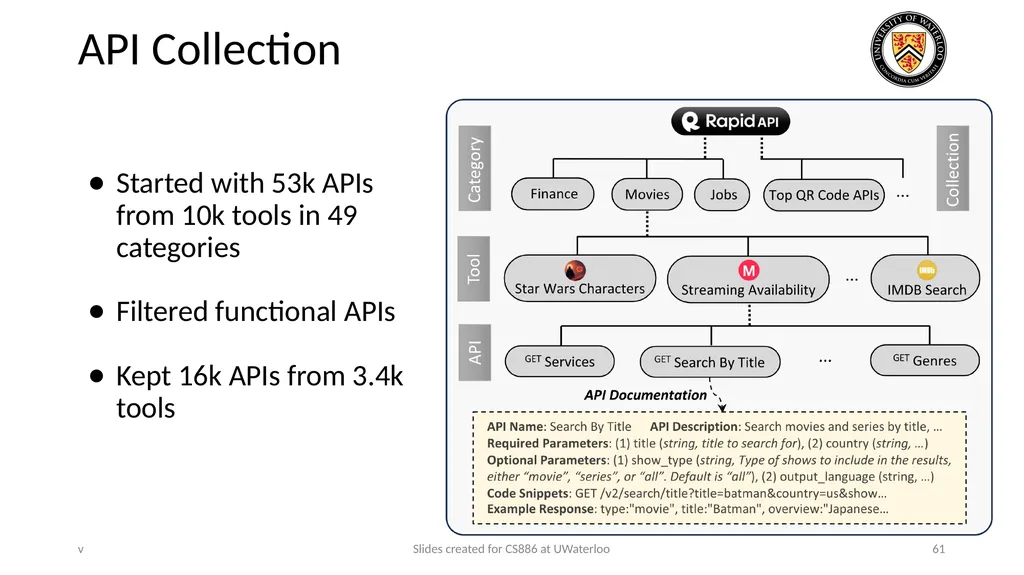
Started with 53k APIs from 10k tools in 49 categories
Filtered functional APIs
Kept 16k APIs from 3.4k tools API Collection v Slides created for CS886 at UWaterloo 61<br>
Filtered functional APIs
Kept 16k APIs from 3.4k tools API Collection v Slides created for CS886 at UWaterloo 61<br>
62
Core idea:
Select a subset of APIs
Prompt ChatGPT to generate possible instructions and relevant APIs
Prompt includes:
General description of the instruction generation task
Documentation for each of the selected APIs
Three in-context seed examples written by human experts Instruction Generation - Overview v Slides created for CS886 at UWaterloo 62<br>
Select a subset of APIs
Prompt ChatGPT to generate possible instructions and relevant APIs
Prompt includes:
General description of the instruction generation task
Documentation for each of the selected APIs
Three in-context seed examples written by human experts Instruction Generation - Overview v Slides created for CS886 at UWaterloo 62<br>
63
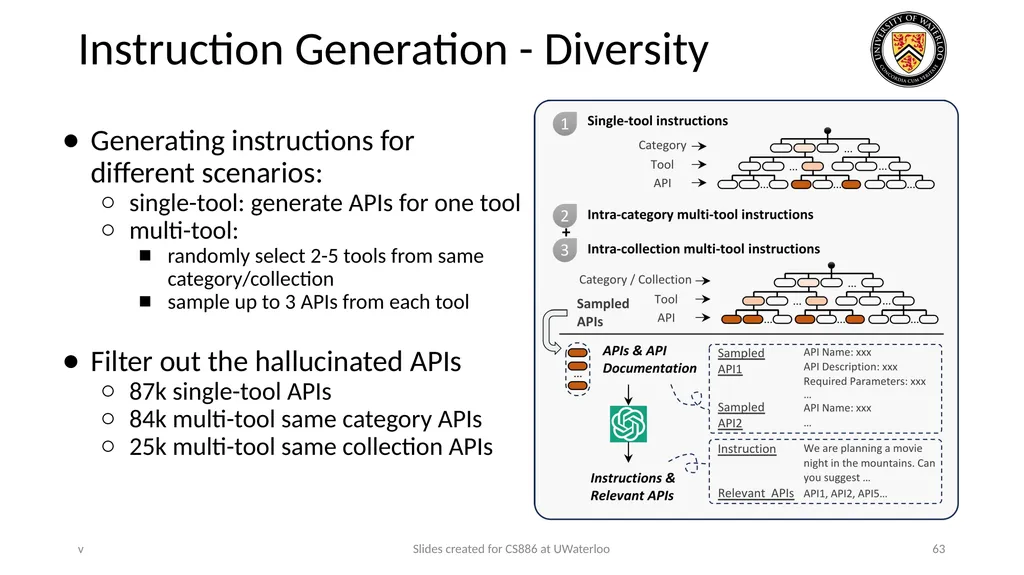
Generating instructions for different scenarios:
single-tool: generate APIs for one tool
multi-tool:
randomly select 2-5 tools from same category/collection
sample up to 3 APIs from each tool
Filter out the hallucinated APIs
87k single-tool APIs
84k multi-tool same category APIs
25k multi-tool same collection APIs Instruction Generation - Diversity v Slides created for CS886 at UWaterloo 63<br>
single-tool: generate APIs for one tool
multi-tool:
randomly select 2-5 tools from same category/collection
sample up to 3 APIs from each tool
Filter out the hallucinated APIs
87k single-tool APIs
84k multi-tool same category APIs
25k multi-tool same collection APIs Instruction Generation - Diversity v Slides created for CS886 at UWaterloo 63<br>
64
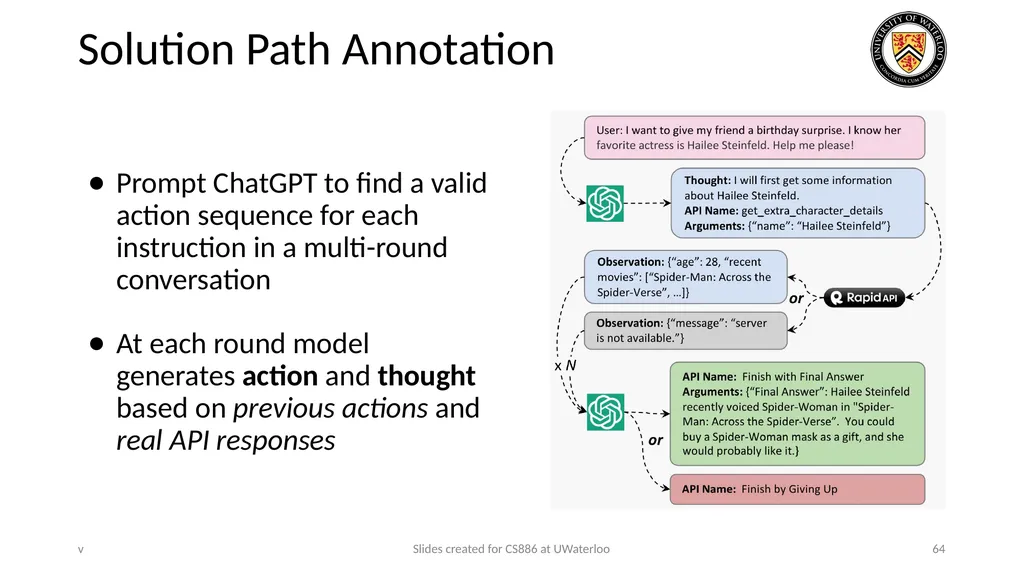
Prompt ChatGPT to find a valid action sequence for each instruction in a multi-round conversation
At each round model generates action and thought based on previous actions and real API responses Solution Path Annotation v Slides created for CS886 at UWaterloo 64<br>
At each round model generates action and thought based on previous actions and real API responses Solution Path Annotation v Slides created for CS886 at UWaterloo 64<br>
65
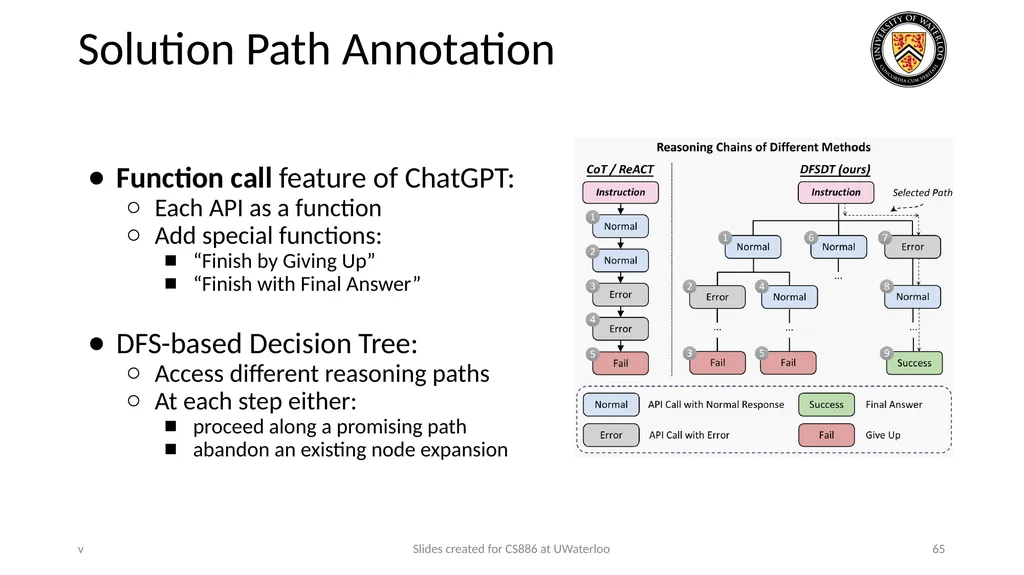
Function call feature of ChatGPT:
Each API as a function
Add special functions:
“Finish by Giving Up”
“Finish with Final Answer”
DFS-based Decision Tree:
Access different reasoning paths
At each step either:
proceed along a promising path
abandon an existing node expansion Solution Path Annotation v Slides created for CS886 at UWaterloo 65<br>
Each API as a function
Add special functions:
“Finish by Giving Up”
“Finish with Final Answer”
DFS-based Decision Tree:
Access different reasoning paths
At each step either:
proceed along a promising path
abandon an existing node expansion Solution Path Annotation v Slides created for CS886 at UWaterloo 65<br>
66
Infeasible to annotate a fixed ground-truth solution path for each test instruction:
Temporal variability on RapidAPI
Infinite potential solution paths for an instruction
Evaluation metrics in ToolEval:
Pass Rate: Executability of instructions for an LLM within limited budgets
87.1% agreement with human eval
Win Rate: Comparison of the quality and usefulness of two solution paths
Ask ChatGPT’s preference
Pre-defined criteria through prompting
Average of multiple evaluations
80.3% agreement with human eval ToolEval v Slides created for CS886 at UWaterloo 66<br>
Temporal variability on RapidAPI
Infinite potential solution paths for an instruction
Evaluation metrics in ToolEval:
Pass Rate: Executability of instructions for an LLM within limited budgets
87.1% agreement with human eval
Win Rate: Comparison of the quality and usefulness of two solution paths
Ask ChatGPT’s preference
Pre-defined criteria through prompting
Average of multiple evaluations
80.3% agreement with human eval ToolEval v Slides created for CS886 at UWaterloo 66<br>
67
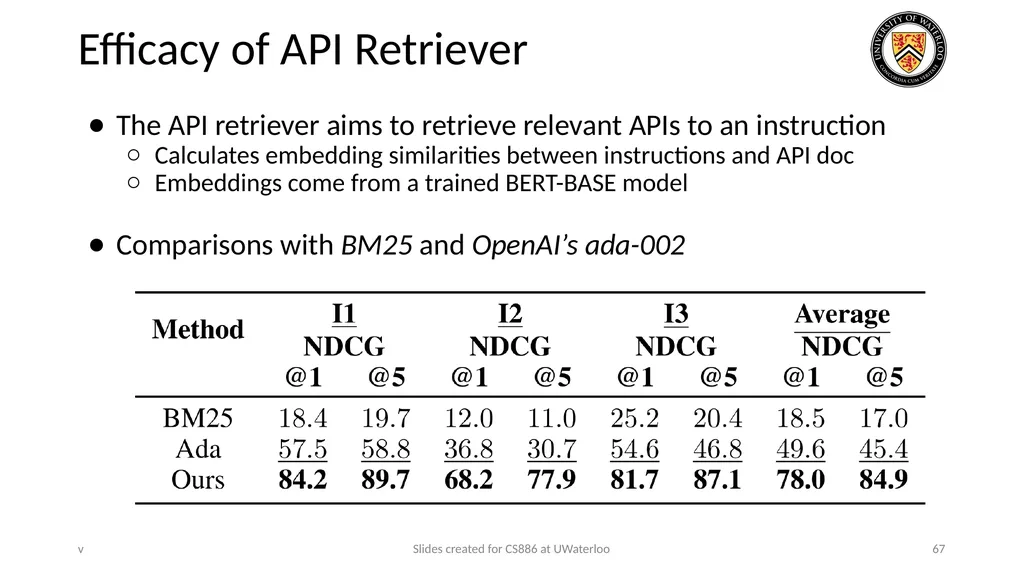
The API retriever aims to retrieve relevant APIs to an instruction
Calculates embedding similarities between instructions and API doc
Embeddings come from a trained BERT-BASE model
Comparisons with BM25 and OpenAI’s ada-002 Efficacy of API Retriever v Slides created for CS886 at UWaterloo 67<br>
Calculates embedding similarities between instructions and API doc
Embeddings come from a trained BERT-BASE model
Comparisons with BM25 and OpenAI’s ada-002 Efficacy of API Retriever v Slides created for CS886 at UWaterloo 67<br>
68
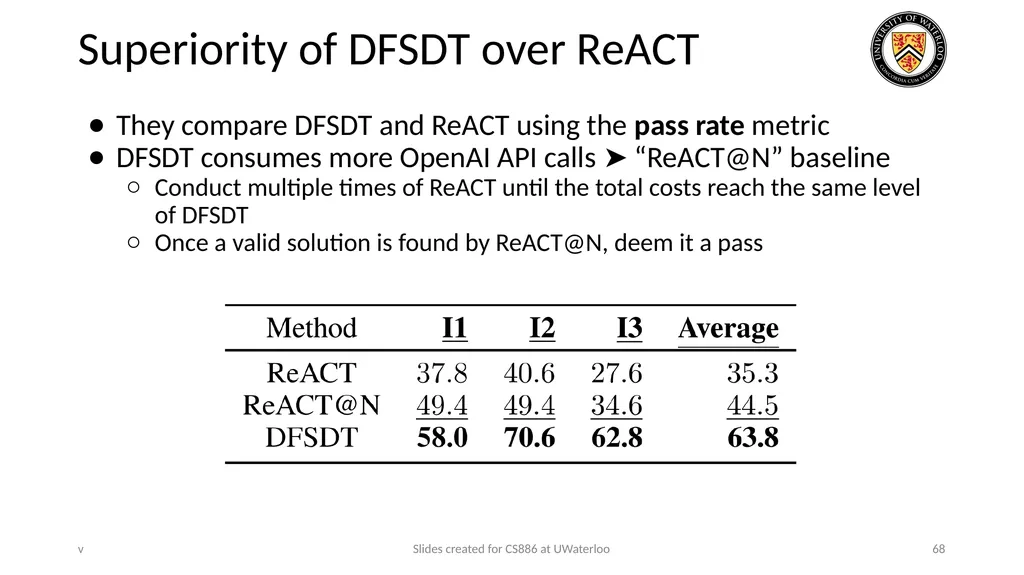
They compare DFSDT and ReACT using the pass rate metric
DFSDT consumes more OpenAI API calls ➤ “ReACT@N” baseline
Conduct multiple times of ReACT until the total costs reach the same level of DFSDT
Once a valid solution is found by ReACT@N, deem it a pass Superiority of DFSDT over ReACT v Slides created for CS886 at UWaterloo 68<br>
DFSDT consumes more OpenAI API calls ➤ “ReACT@N” baseline
Conduct multiple times of ReACT until the total costs reach the same level of DFSDT
Once a valid solution is found by ReACT@N, deem it a pass Superiority of DFSDT over ReACT v Slides created for CS886 at UWaterloo 68<br>
69
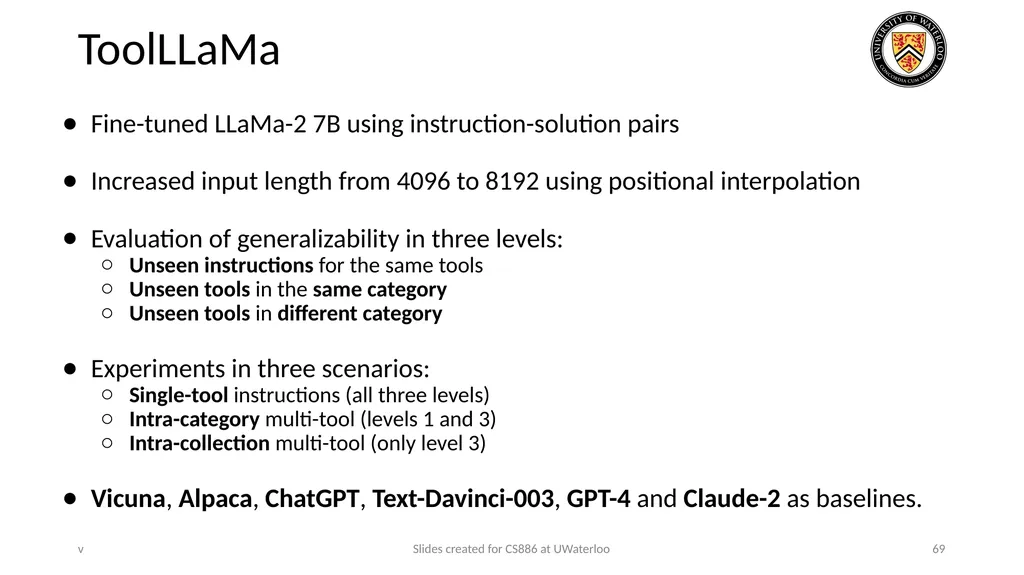
Fine-tuned LLaMa-2 7B using instruction-solution pairs
Increased input length from 4096 to 8192 using positional interpolation
Evaluation of generalizability in three levels:
Unseen instructions for the same tools
Unseen tools in the same category
Unseen tools in different category
Experiments in three scenarios:
Single-tool instructions (all three levels)
Intra-category multi-tool (levels 1 and 3)
Intra-collection multi-tool (only level 3)
Vicuna, Alpaca, ChatGPT, Text-Davinci-003, GPT-4 and Claude-2 as baselines. ToolLLaMa v Slides created for CS886 at UWaterloo 69<br>
Increased input length from 4096 to 8192 using positional interpolation
Evaluation of generalizability in three levels:
Unseen instructions for the same tools
Unseen tools in the same category
Unseen tools in different category
Experiments in three scenarios:
Single-tool instructions (all three levels)
Intra-category multi-tool (levels 1 and 3)
Intra-collection multi-tool (only level 3)
Vicuna, Alpaca, ChatGPT, Text-Davinci-003, GPT-4 and Claude-2 as baselines. ToolLLaMa v Slides created for CS886 at UWaterloo 69<br>
70
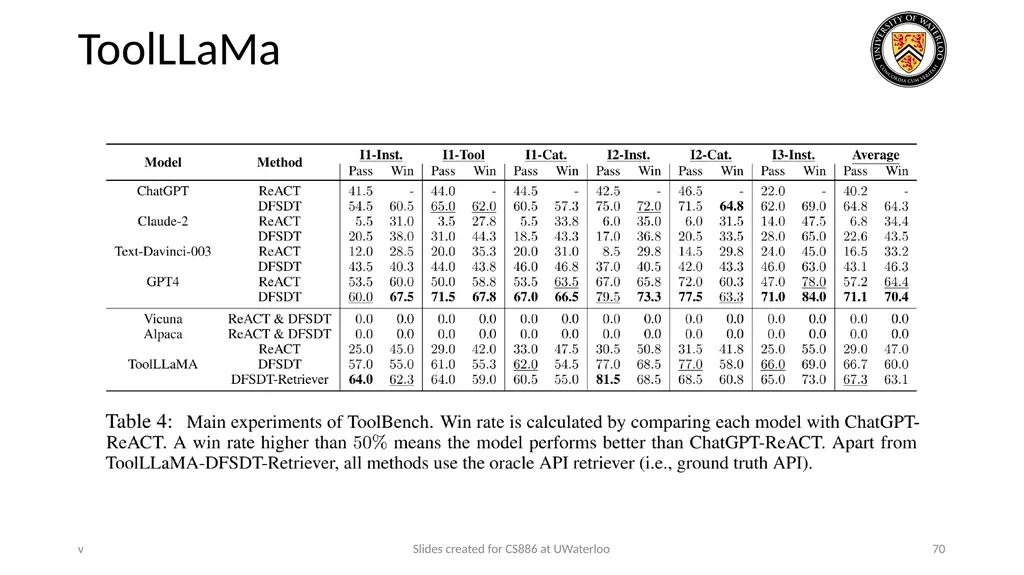
ToolLLaMa v Slides created for CS886 at UWaterloo 70<br>
71
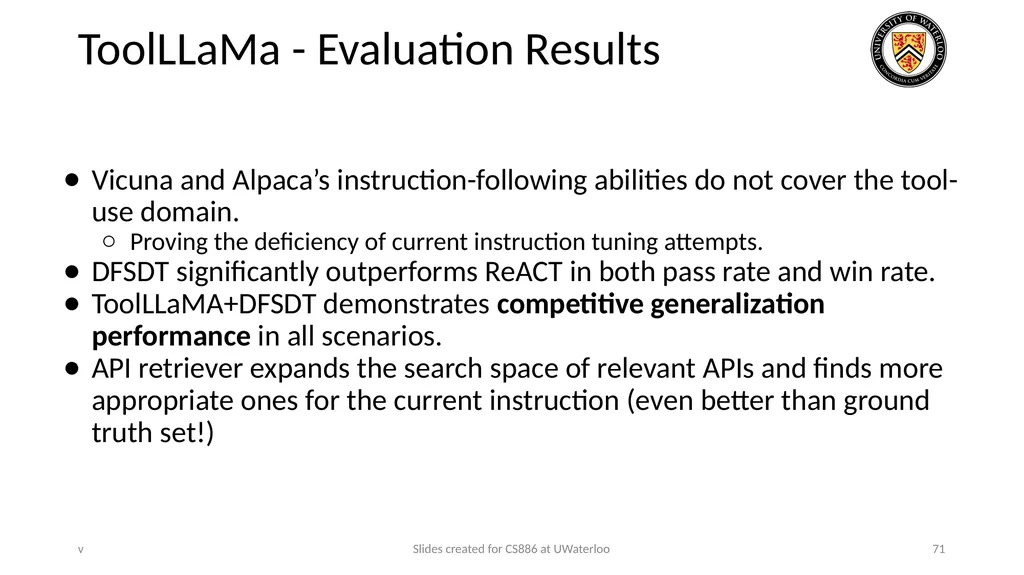
Vicuna and Alpaca’s instruction-following abilities do not cover the tool-use domain.
Proving the deficiency of current instruction tuning attempts.
DFSDT significantly outperforms ReACT in both pass rate and win rate.
ToolLLaMA+DFSDT demonstrates competitive generalization performance in all scenarios.
API retriever expands the search space of relevant APIs and finds more appropriate ones for the current instruction (even better than ground truth set!) ToolLLaMa - Evaluation Results v Slides created for CS886 at UWaterloo 71<br>
Proving the deficiency of current instruction tuning attempts.
DFSDT significantly outperforms ReACT in both pass rate and win rate.
ToolLLaMA+DFSDT demonstrates competitive generalization performance in all scenarios.
API retriever expands the search space of relevant APIs and finds more appropriate ones for the current instruction (even better than ground truth set!) ToolLLaMa - Evaluation Results v Slides created for CS886 at UWaterloo 71<br>
72
Evaluated the out-of-distribution generalizability of ToolLLaMA.
Experiments on APIBench
Oracle (ground-truth) retriever vs. their API retriever
ToolLLaMA vs. Gorilla (ZS & RS) ToolLLaMA - Generalization v Slides created for CS886 at UWaterloo 72<br>
Experiments on APIBench
Oracle (ground-truth) retriever vs. their API retriever
ToolLLaMA vs. Gorilla (ZS & RS) ToolLLaMA - Generalization v Slides created for CS886 at UWaterloo 72<br>
73
ToolkenGPT: Augmenting Frozen Language Models with Massive Tools via Tool Embeddings
Shibo Hao , Tianyang Liu , Zhen Wang , Zhiting Hu 73<br>
Shibo Hao , Tianyang Liu , Zhen Wang , Zhiting Hu 73<br>
74
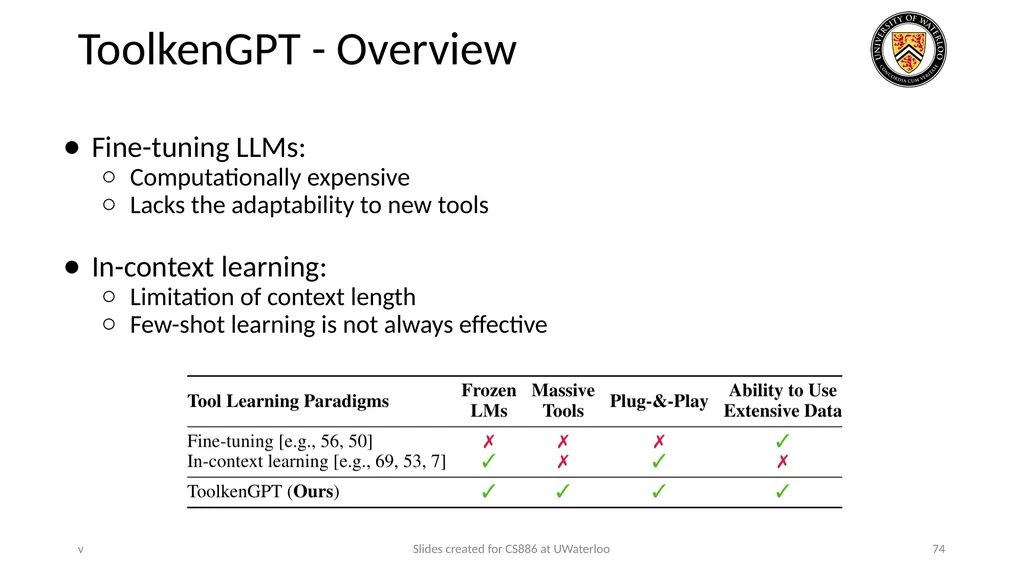
Fine-tuning LLMs:
Computationally expensive
Lacks the adaptability to new tools
In-context learning:
Limitation of context length
Few-shot learning is not always effective ToolkenGPT - Overview v Slides created for CS886 at UWaterloo 74<br>
Computationally expensive
Lacks the adaptability to new tools
In-context learning:
Limitation of context length
Few-shot learning is not always effective ToolkenGPT - Overview v Slides created for CS886 at UWaterloo 74<br>
75
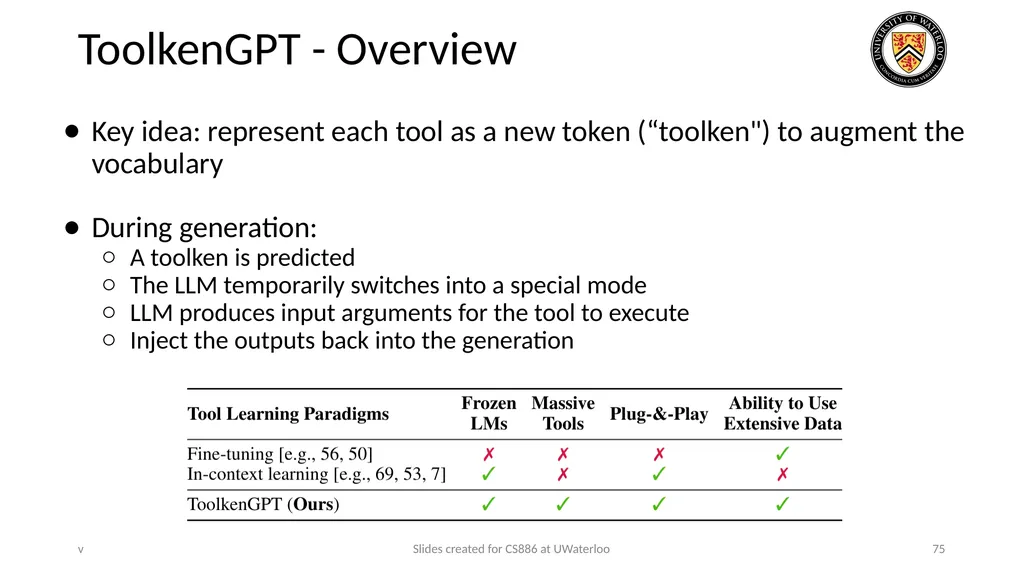
Key idea: represent each tool as a new token (“toolken") to augment the vocabulary
During generation:
A toolken is predicted
The LLM temporarily switches into a special mode
LLM produces input arguments for the tool to execute
Inject the outputs back into the generation ToolkenGPT - Overview v Slides created for CS886 at UWaterloo 75<br>
During generation:
A toolken is predicted
The LLM temporarily switches into a special mode
LLM produces input arguments for the tool to execute
Inject the outputs back into the generation ToolkenGPT - Overview v Slides created for CS886 at UWaterloo 75<br>
76
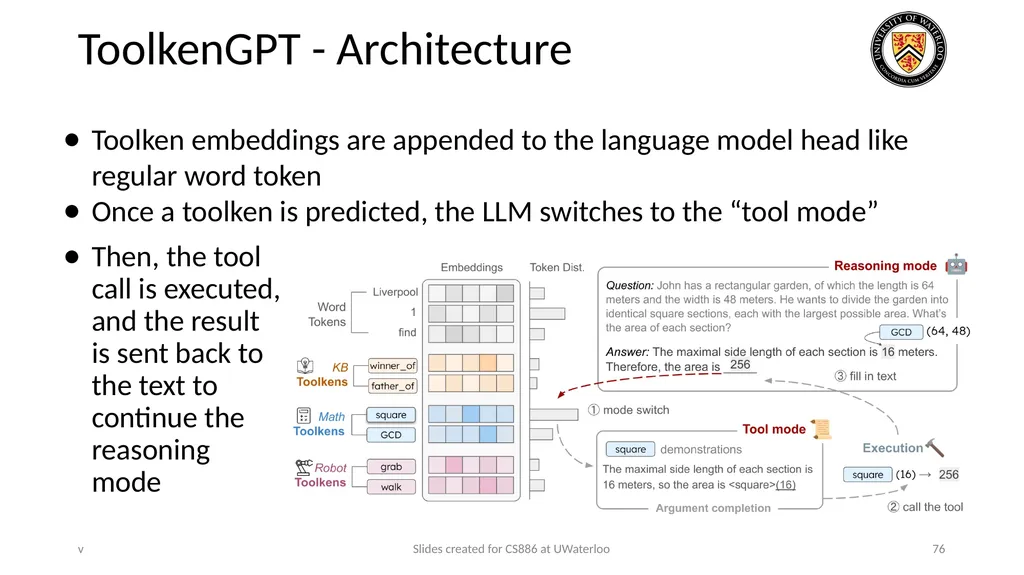
Toolken embeddings are appended to the language model head like regular word token
Once a toolken is predicted, the LLM switches to the “tool mode” ToolkenGPT - Architecture v Slides created for CS886 at UWaterloo 76 Then, the tool call is executed, and the result is sent back to the text to continue the reasoning mode<br>
Once a toolken is predicted, the LLM switches to the “tool mode” ToolkenGPT - Architecture v Slides created for CS886 at UWaterloo 76 Then, the tool call is executed, and the result is sent back to the text to continue the reasoning mode<br>
77
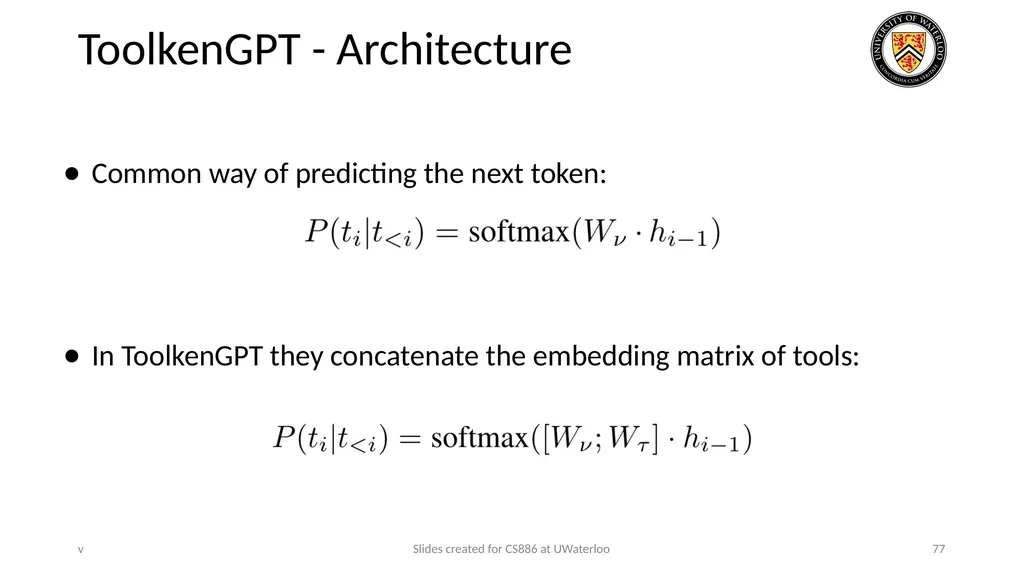
Common way of predicting the next token: ToolkenGPT - Architecture v Slides created for CS886 at UWaterloo 77 In ToolkenGPT they concatenate the embedding matrix of tools:<br>
78
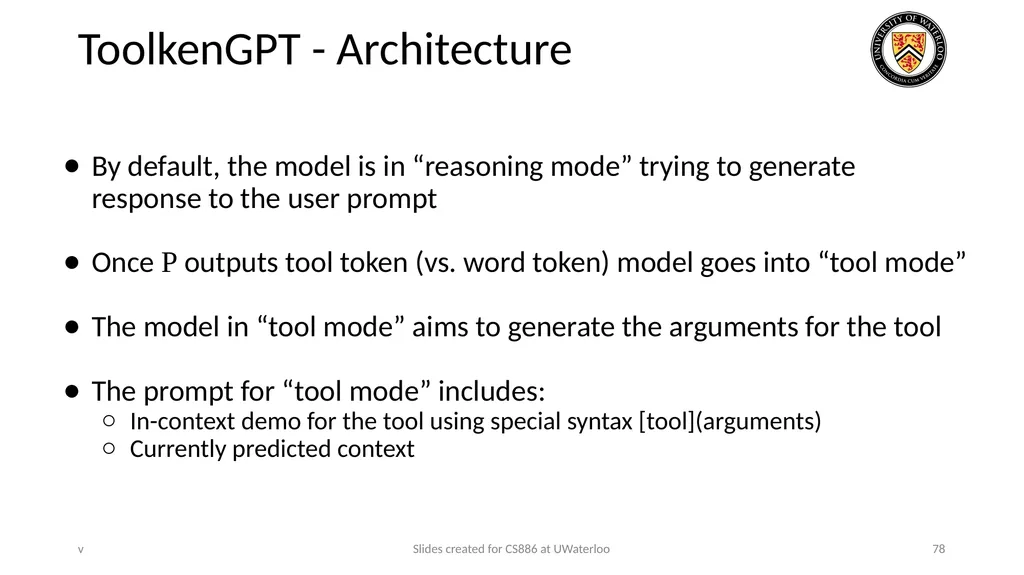
By default, the model is in “reasoning mode” trying to generate response to the user prompt
Once P outputs tool token (vs. word token) model goes into “tool mode”
The model in “tool mode” aims to generate the arguments for the tool
The prompt for “tool mode” includes:
In-context demo for the tool using special syntax [tool](arguments)
Currently predicted context ToolkenGPT - Architecture v Slides created for CS886 at UWaterloo 78<br>
Once P outputs tool token (vs. word token) model goes into “tool mode”
The model in “tool mode” aims to generate the arguments for the tool
The prompt for “tool mode” includes:
In-context demo for the tool using special syntax [tool](arguments)
Currently predicted context ToolkenGPT - Architecture v Slides created for CS886 at UWaterloo 78<br>
79
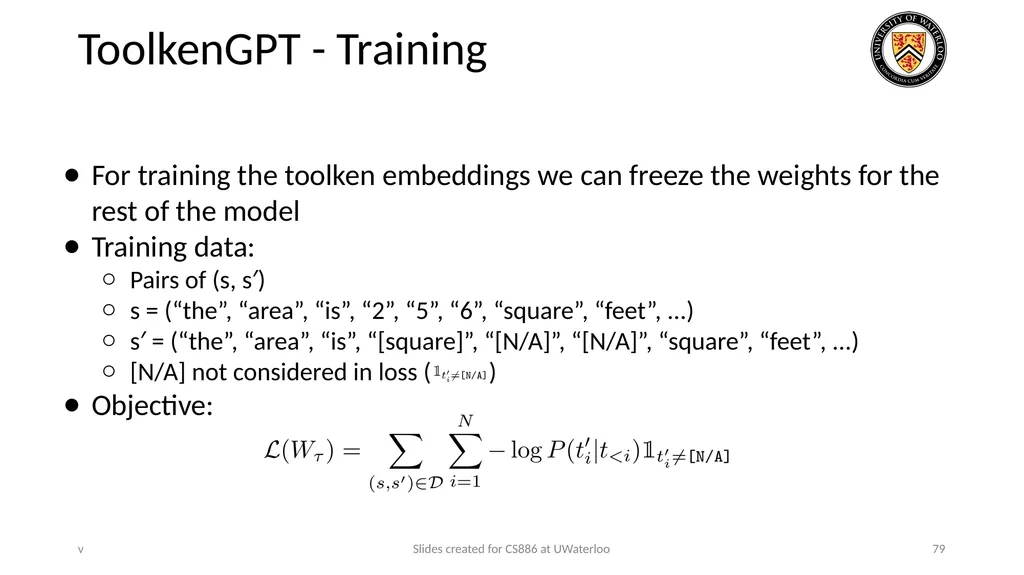
For training the toolken embeddings we can freeze the weights for the rest of the model
Training data:
Pairs of (s, s′)
s = (“the”, “area”, “is”, “2”, “5”, “6”, “square”, “feet”, ...)
s′ = (“the”, “area”, “is”, “[square]”, “[N/A]”, “[N/A]”, “square”, “feet”, ...)
[N/A] not considered in loss ( )
Objective: ToolkenGPT - Training v Slides created for CS886 at UWaterloo 79<br>
Training data:
Pairs of (s, s′)
s = (“the”, “area”, “is”, “2”, “5”, “6”, “square”, “feet”, ...)
s′ = (“the”, “area”, “is”, “[square]”, “[N/A]”, “[N/A]”, “square”, “feet”, ...)
[N/A] not considered in loss ( )
Objective: ToolkenGPT - Training v Slides created for CS886 at UWaterloo 79<br>
80
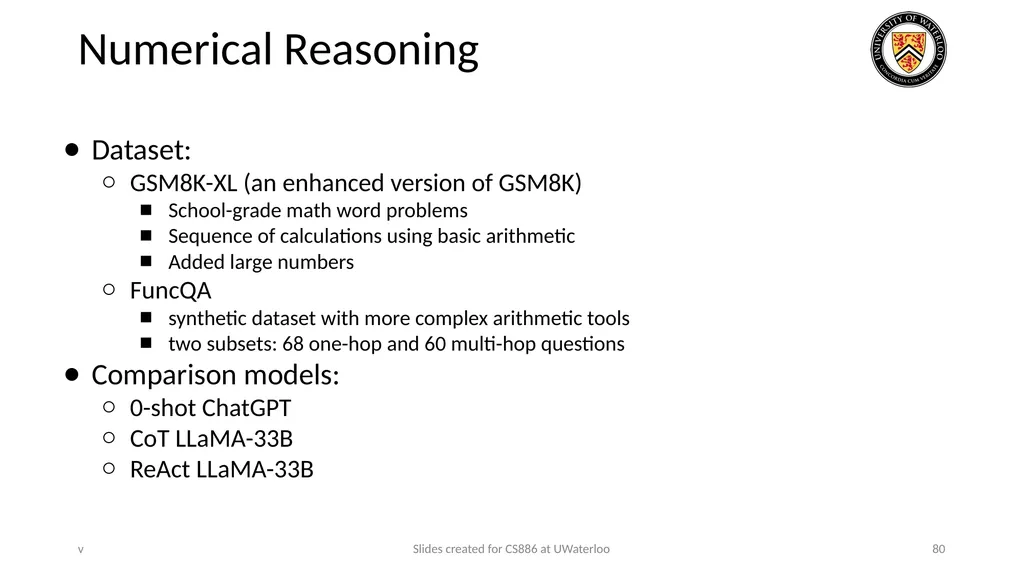
Dataset:
GSM8K-XL (an enhanced version of GSM8K)
School-grade math word problems
Sequence of calculations using basic arithmetic
Added large numbers
FuncQA
synthetic dataset with more complex arithmetic tools
two subsets: 68 one-hop and 60 multi-hop questions
Comparison models:
0-shot ChatGPT
CoT LLaMA-33B
ReAct LLaMA-33B Numerical Reasoning v Slides created for CS886 at UWaterloo 80<br>
GSM8K-XL (an enhanced version of GSM8K)
School-grade math word problems
Sequence of calculations using basic arithmetic
Added large numbers
FuncQA
synthetic dataset with more complex arithmetic tools
two subsets: 68 one-hop and 60 multi-hop questions
Comparison models:
0-shot ChatGPT
CoT LLaMA-33B
ReAct LLaMA-33B Numerical Reasoning v Slides created for CS886 at UWaterloo 80<br>
81
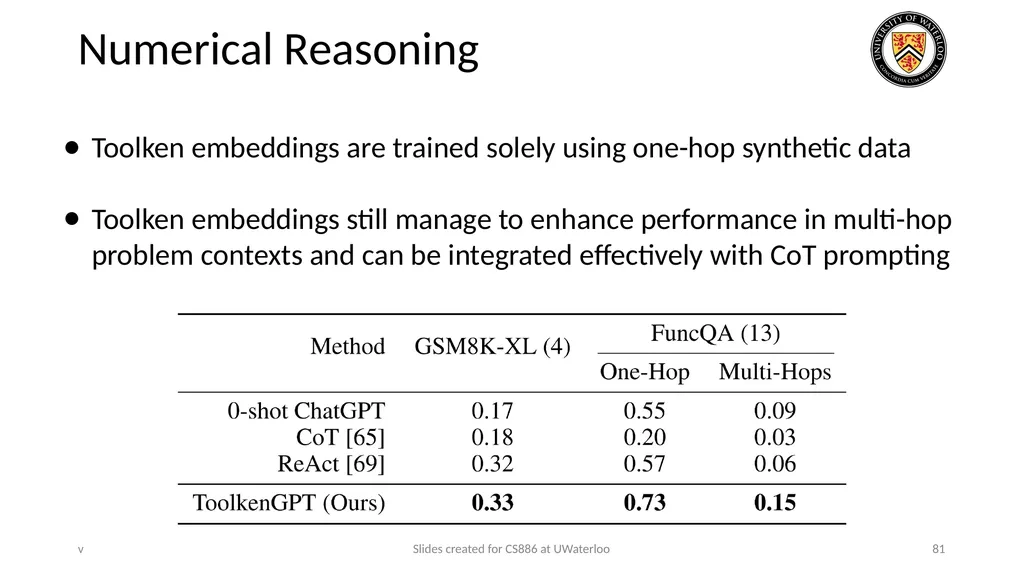
Toolken embeddings are trained solely using one-hop synthetic data
Toolken embeddings still manage to enhance performance in multi-hop problem contexts and can be integrated effectively with CoT prompting Numerical Reasoning v Slides created for CS886 at UWaterloo 81<br>
Toolken embeddings still manage to enhance performance in multi-hop problem contexts and can be integrated effectively with CoT prompting Numerical Reasoning v Slides created for CS886 at UWaterloo 81<br>
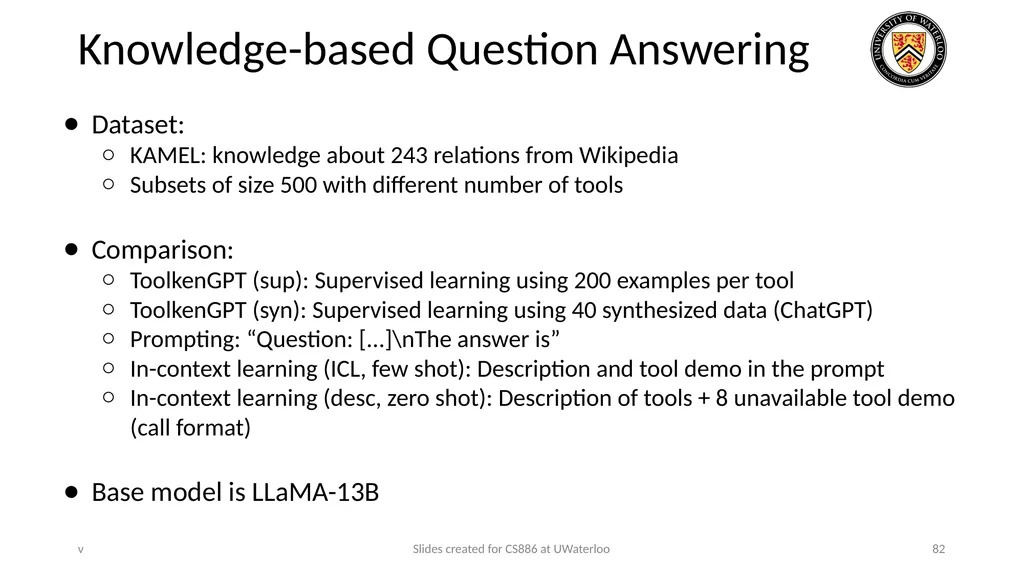
82
Knowledge-based Question Answering Dataset:
KAMEL: knowledge about 243 relations from Wikipedia
Subsets of size 500 with different number of tools
Comparison:
ToolkenGPT (sup): Supervised learning using 200 examples per tool
ToolkenGPT (syn): Supervised learning using 40 synthesized data (ChatGPT)
Prompting: “Question: [...]\nThe answer is”
In-context learning (ICL, few shot): Description and tool demo in the prompt
In-context learning (desc, zero shot): Description of tools + 8 unavailable tool demo (call format)
Base model is LLaMA-13B v Slides created for CS886 at UWaterloo 82<br>
KAMEL: knowledge about 243 relations from Wikipedia
Subsets of size 500 with different number of tools
Comparison:
ToolkenGPT (sup): Supervised learning using 200 examples per tool
ToolkenGPT (syn): Supervised learning using 40 synthesized data (ChatGPT)
Prompting: “Question: [...]\nThe answer is”
In-context learning (ICL, few shot): Description and tool demo in the prompt
In-context learning (desc, zero shot): Description of tools + 8 unavailable tool demo (call format)
Base model is LLaMA-13B v Slides created for CS886 at UWaterloo 82<br>
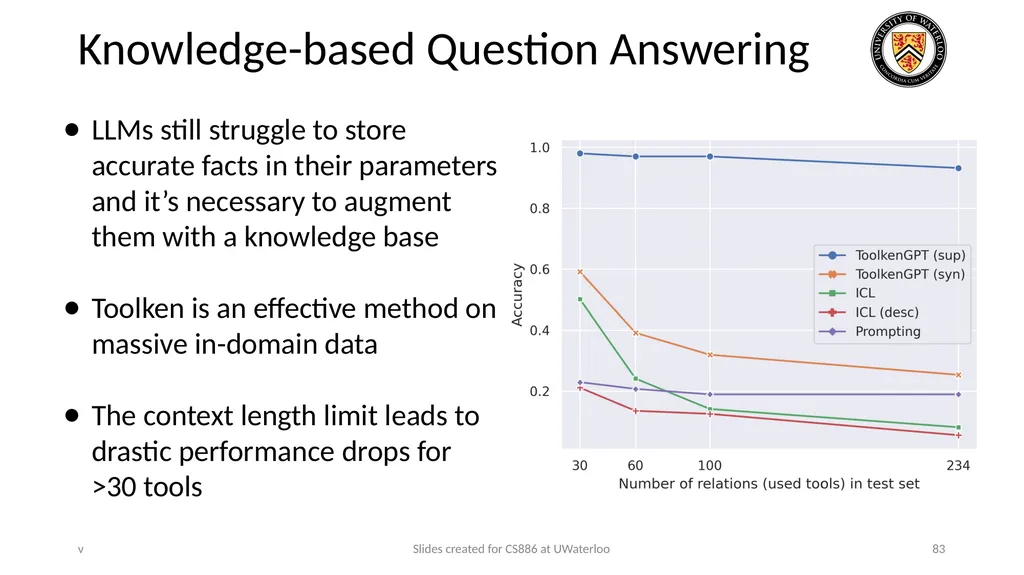
83
Knowledge-based Question Answering LLMs still struggle to store accurate facts in their parameters and it’s necessary to augment them with a knowledge base
Toolken is an effective method on massive in-domain data
The context length limit leads to drastic performance drops for >30 tools v Slides created for CS886 at UWaterloo 83<br>
Toolken is an effective method on massive in-domain data
The context length limit leads to drastic performance drops for >30 tools v Slides created for CS886 at UWaterloo 83<br>
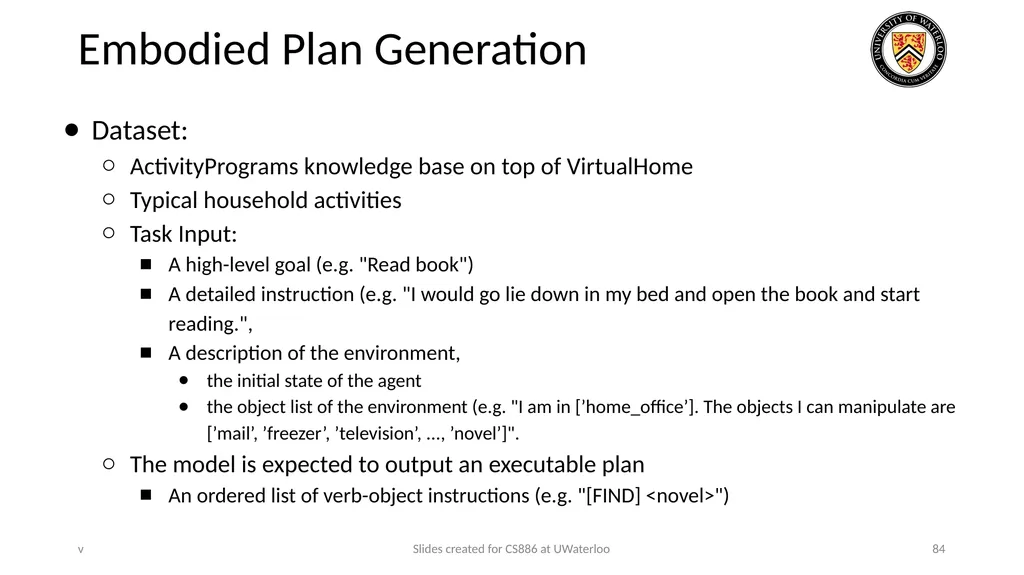
84
Dataset:
ActivityPrograms knowledge base on top of VirtualHome
Typical household activities
Task Input:
A high-level goal (e.g. "Read book")
A detailed instruction (e.g. "I would go lie down in my bed and open the book and start reading.",
A description of the environment,
the initial state of the agent
the object list of the environment (e.g. "I am in [’home_office’]. The objects I can manipulate are [’mail’, ’freezer’, ’television’, ..., ’novel’]".
The model is expected to output an executable plan
An ordered list of verb-object instructions (e.g. "[FIND] <novel>") Embodied Plan Generation v Slides created for CS886 at UWaterloo 84<br>
ActivityPrograms knowledge base on top of VirtualHome
Typical household activities
Task Input:
A high-level goal (e.g. "Read book")
A detailed instruction (e.g. "I would go lie down in my bed and open the book and start reading.",
A description of the environment,
the initial state of the agent
the object list of the environment (e.g. "I am in [’home_office’]. The objects I can manipulate are [’mail’, ’freezer’, ’television’, ..., ’novel’]".
The model is expected to output an executable plan
An ordered list of verb-object instructions (e.g. "[FIND] <novel>") Embodied Plan Generation v Slides created for CS886 at UWaterloo 84<br>
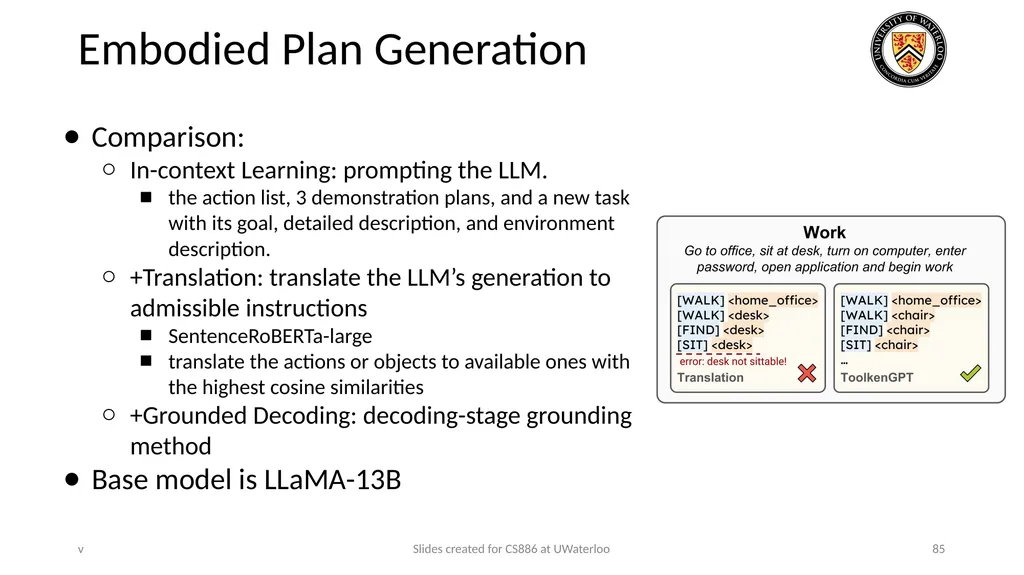
85
Comparison:
In-context Learning: prompting the LLM.
the action list, 3 demonstration plans, and a new task with its goal, detailed description, and environment description.
+Translation: translate the LLM’s generation to admissible instructions
SentenceRoBERTa-large
translate the actions or objects to available ones with the highest cosine similarities
+Grounded Decoding: decoding-stage grounding method
Base model is LLaMA-13B Embodied Plan Generation v Slides created for CS886 at UWaterloo 85<br>
In-context Learning: prompting the LLM.
the action list, 3 demonstration plans, and a new task with its goal, detailed description, and environment description.
+Translation: translate the LLM’s generation to admissible instructions
SentenceRoBERTa-large
translate the actions or objects to available ones with the highest cosine similarities
+Grounded Decoding: decoding-stage grounding method
Base model is LLaMA-13B Embodied Plan Generation v Slides created for CS886 at UWaterloo 85<br>
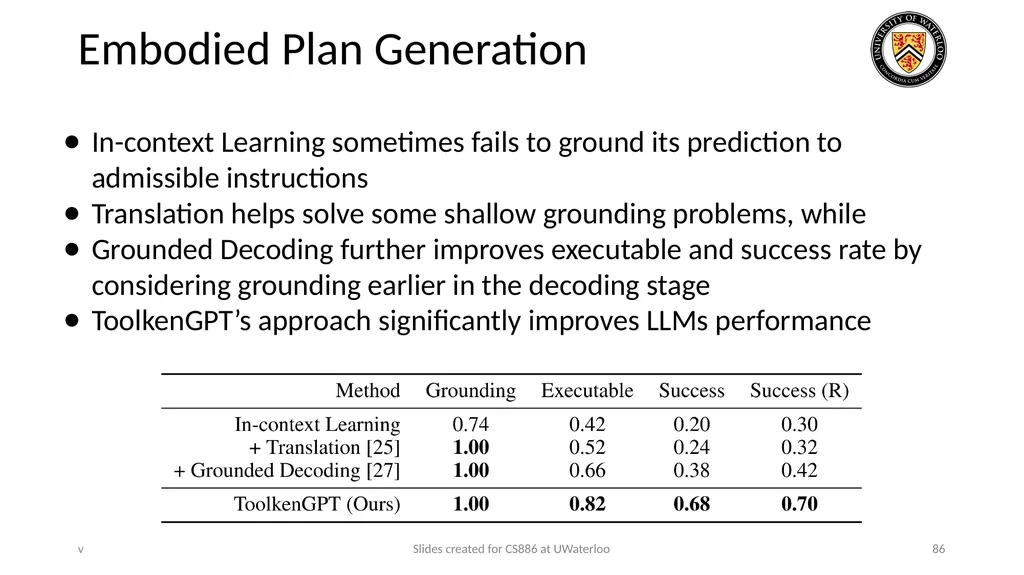
86
In-context Learning sometimes fails to ground its prediction to admissible instructions
Translation helps solve some shallow grounding problems, while
Grounded Decoding further improves executable and success rate by considering grounding earlier in the decoding stage
ToolkenGPT’s approach significantly improves LLMs performance Embodied Plan Generation v Slides created for CS886 at UWaterloo 86<br>
Translation helps solve some shallow grounding problems, while
Grounded Decoding further improves executable and success rate by considering grounding earlier in the decoding stage
ToolkenGPT’s approach significantly improves LLMs performance Embodied Plan Generation v Slides created for CS886 at UWaterloo 86<br>
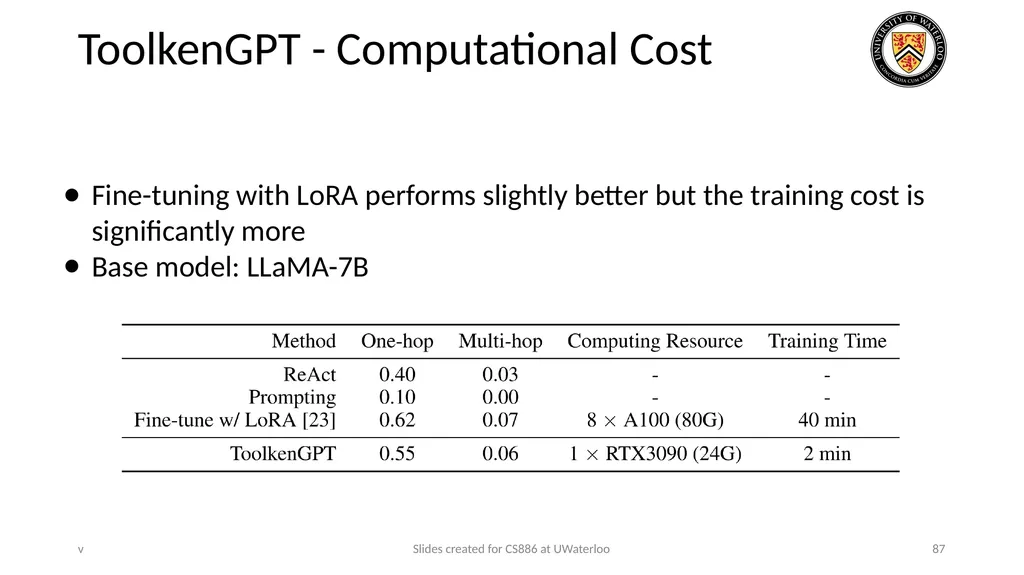
87
Fine-tuning with LoRA performs slightly better but the training cost is significantly more
Base model: LLaMA-7B ToolkenGPT - Computational Cost v Slides created for CS886 at UWaterloo 87<br>
Base model: LLaMA-7B ToolkenGPT - Computational Cost v Slides created for CS886 at UWaterloo 87<br>
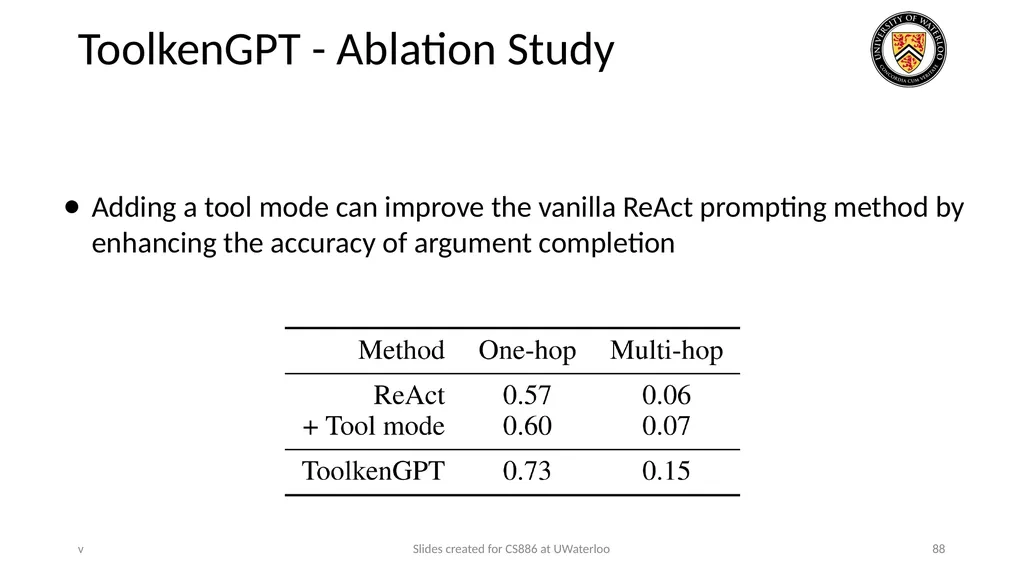
88
Adding a tool mode can improve the vanilla ReAct prompting method by enhancing the accuracy of argument completion ToolkenGPT - Ablation Study v Slides created for CS886 at UWaterloo 88<br>
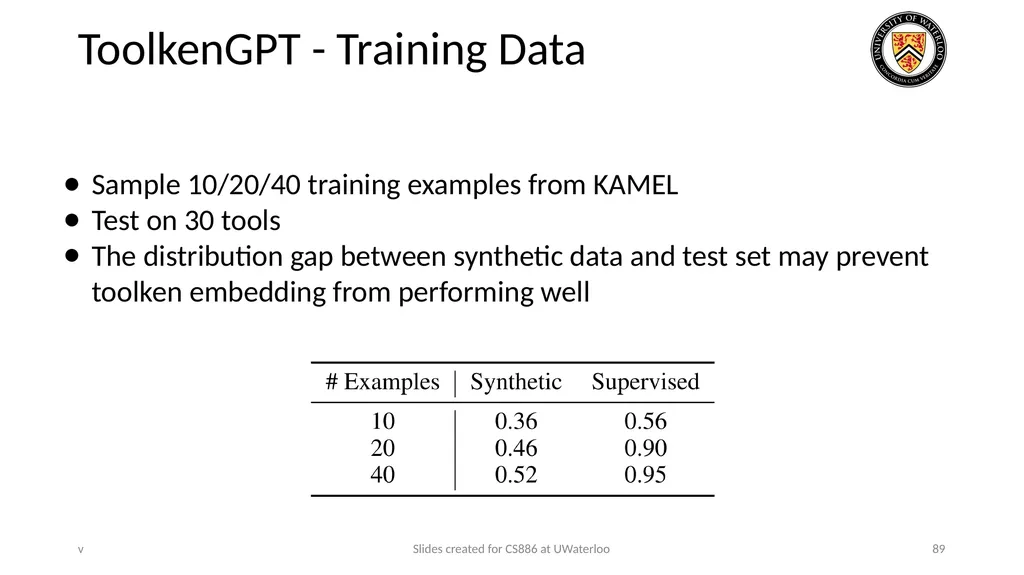
89
Sample 10/20/40 training examples from KAMEL
Test on 30 tools
The distribution gap between synthetic data and test set may prevent toolken embedding from performing well ToolkenGPT - Training Data v Slides created for CS886 at UWaterloo 89<br>
Test on 30 tools
The distribution gap between synthetic data and test set may prevent toolken embedding from performing well ToolkenGPT - Training Data v Slides created for CS886 at UWaterloo 89<br>
90
CogAgent: A Visual Language Model for GUI Agents
Wenyi Hong, Weihan Wang, Qingsong Lv, Jiazheng Xu, Wenmeng Yu, Junhui Ji, Yan Wang, Zihan Wang, Yuxuan Zhang, Juanzi Li 90<br>
Wenyi Hong, Weihan Wang, Qingsong Lv, Jiazheng Xu, Wenmeng Yu, Junhui Ji, Yan Wang, Zihan Wang, Yuxuan Zhang, Juanzi Li 90<br>
91
CogAgent: visual language model
specializing in GUI understanding and planning
also have ability for general cross-modality tasks
Other contributions:
Large-scale annotated dataset about GUIs and OCR
Separate model to extract features from high-resolution (1120x1120) CogAgent v Slides created for CS886 at UWaterloo 91<br>
specializing in GUI understanding and planning
also have ability for general cross-modality tasks
Other contributions:
Large-scale annotated dataset about GUIs and OCR
Separate model to extract features from high-resolution (1120x1120) CogAgent v Slides created for CS886 at UWaterloo 91<br>
92
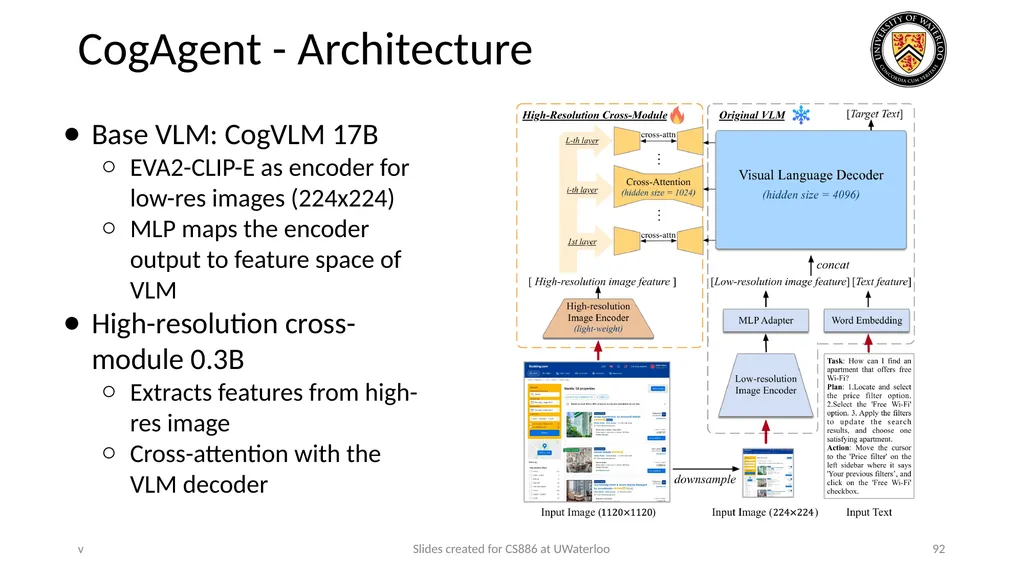
CogAgent - Architecture Base VLM: CogVLM 17B
EVA2-CLIP-E as encoder for low-res images (224x224)
MLP maps the encoder output to feature space of VLM
High-resolution cross-module 0.3B
Extracts features from high-res image
Cross-attention with the VLM decoder v Slides created for CS886 at UWaterloo 92<br>
EVA2-CLIP-E as encoder for low-res images (224x224)
MLP maps the encoder output to feature space of VLM
High-resolution cross-module 0.3B
Extracts features from high-res image
Cross-attention with the VLM decoder v Slides created for CS886 at UWaterloo 92<br>
93
Text Recognition
Synthetic renderings with text from language pre-training dataset (80M)
Text of varying font, size, color, orientation, diverse image background from LAION-2B
Optical Character Recognition (OCR) of natural images (18M)
Natural images from COYO and LAION-2B with extracted text and bounding boxes
Academic documents (9M):
Image-text pairs from arXiv
Visual Grounding
Image-caption pairs from LAION-115M with bounding boxes of entities in caption CogAgent - Pre-train v Slides created for CS886 at UWaterloo 93<br>
Synthetic renderings with text from language pre-training dataset (80M)
Text of varying font, size, color, orientation, diverse image background from LAION-2B
Optical Character Recognition (OCR) of natural images (18M)
Natural images from COYO and LAION-2B with extracted text and bounding boxes
Academic documents (9M):
Image-text pairs from arXiv
Visual Grounding
Image-caption pairs from LAION-115M with bounding boxes of entities in caption CogAgent - Pre-train v Slides created for CS886 at UWaterloo 93<br>
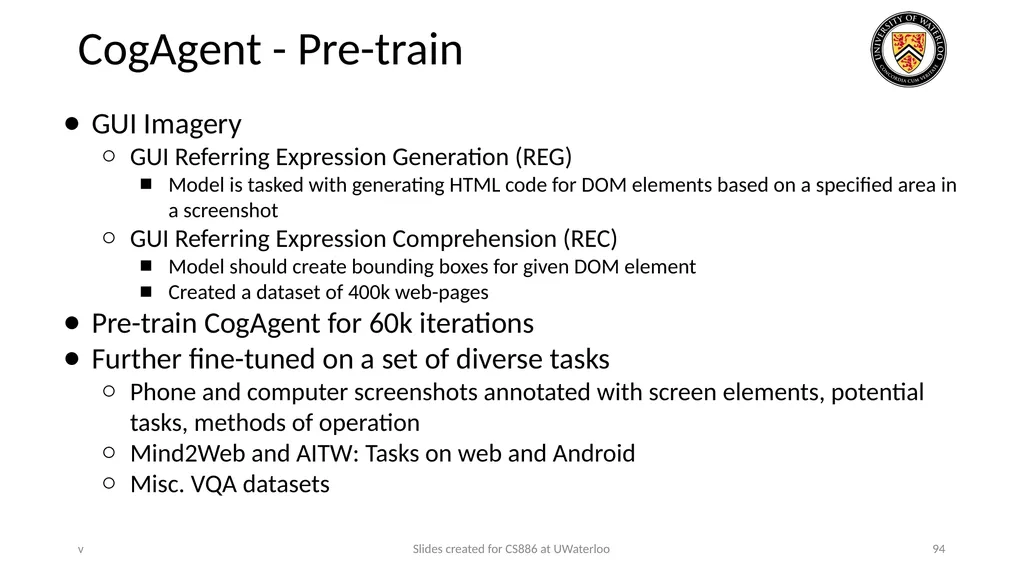
94
GUI Imagery
GUI Referring Expression Generation (REG)
Model is tasked with generating HTML code for DOM elements based on a specified area in a screenshot
GUI Referring Expression Comprehension (REC)
Model should create bounding boxes for given DOM element
Created a dataset of 400k web-pages
Pre-train CogAgent for 60k iterations
Further fine-tuned on a set of diverse tasks
Phone and computer screenshots annotated with screen elements, potential tasks, methods of operation
Mind2Web and AITW: Tasks on web and Android
Misc. VQA datasets CogAgent - Pre-train v Slides created for CS886 at UWaterloo 94<br>
GUI Referring Expression Generation (REG)
Model is tasked with generating HTML code for DOM elements based on a specified area in a screenshot
GUI Referring Expression Comprehension (REC)
Model should create bounding boxes for given DOM element
Created a dataset of 400k web-pages
Pre-train CogAgent for 60k iterations
Further fine-tuned on a set of diverse tasks
Phone and computer screenshots annotated with screen elements, potential tasks, methods of operation
Mind2Web and AITW: Tasks on web and Android
Misc. VQA datasets CogAgent - Pre-train v Slides created for CS886 at UWaterloo 94<br>
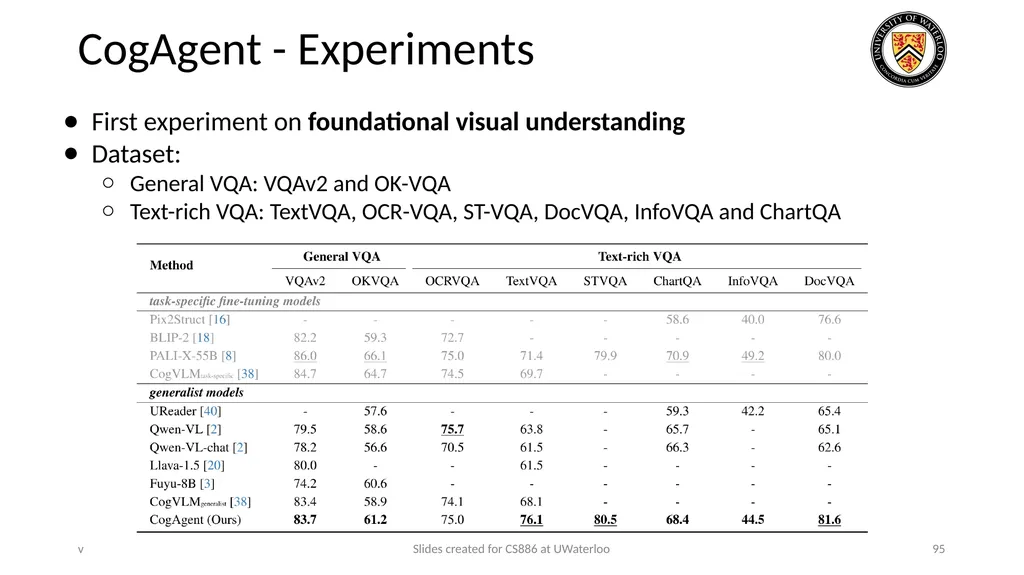
95
First experiment on foundational visual understanding
Dataset:
General VQA: VQAv2 and OK-VQA
Text-rich VQA: TextVQA, OCR-VQA, ST-VQA, DocVQA, InfoVQA and ChartQA CogAgent - Experiments v Slides created for CS886 at UWaterloo 95<br>
Dataset:
General VQA: VQAv2 and OK-VQA
Text-rich VQA: TextVQA, OCR-VQA, ST-VQA, DocVQA, InfoVQA and ChartQA CogAgent - Experiments v Slides created for CS886 at UWaterloo 95<br>
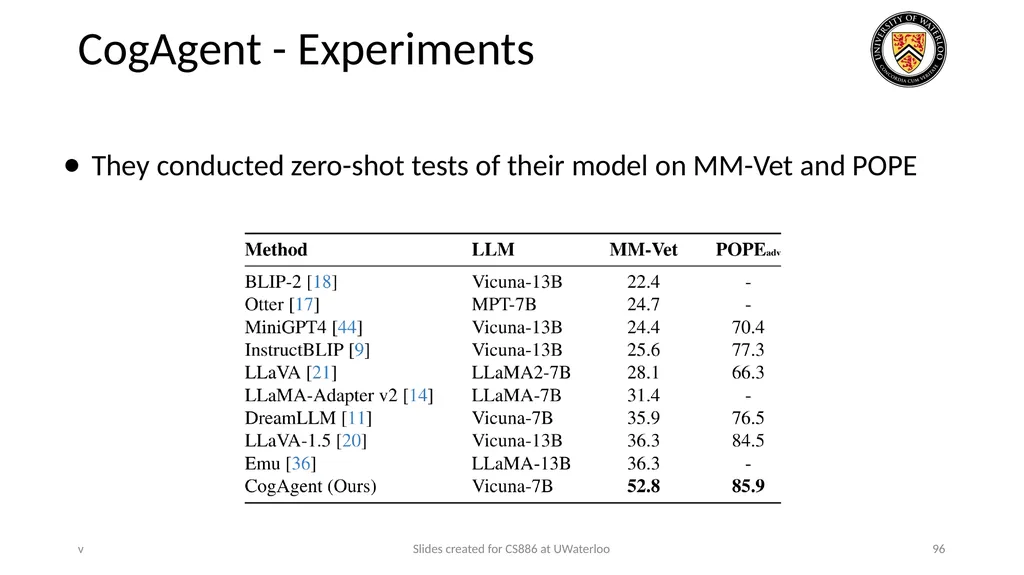
96
They conducted zero-shot tests of their model on MM-Vet and POPE CogAgent - Experiments v Slides created for CS886 at UWaterloo 96<br>
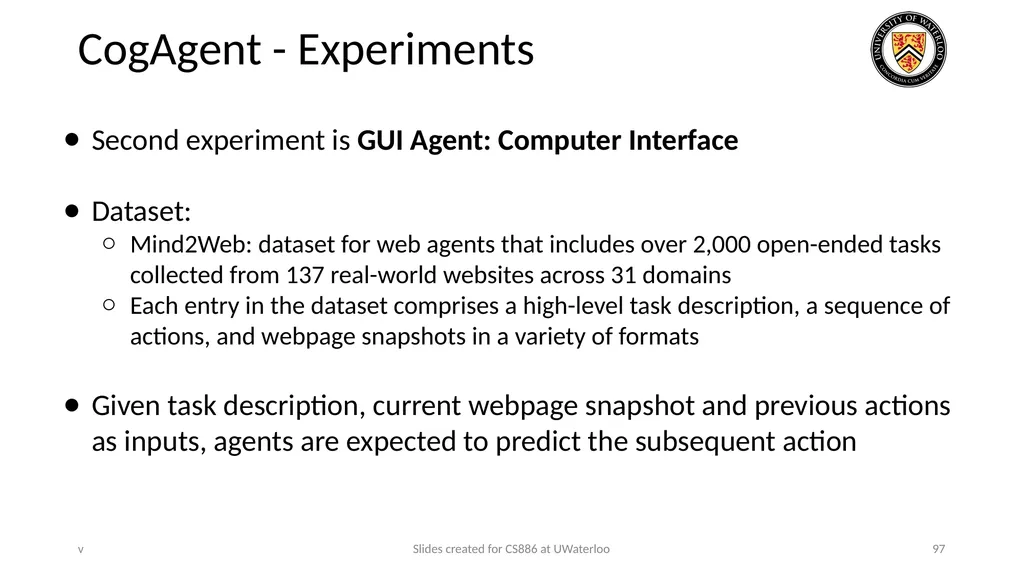
97
Second experiment is GUI Agent: Computer Interface
Dataset:
Mind2Web: dataset for web agents that includes over 2,000 open-ended tasks collected from 137 real-world websites across 31 domains
Each entry in the dataset comprises a high-level task description, a sequence of actions, and webpage snapshots in a variety of formats
Given task description, current webpage snapshot and previous actions as inputs, agents are expected to predict the subsequent action CogAgent - Experiments v Slides created for CS886 at UWaterloo 97<br>
Dataset:
Mind2Web: dataset for web agents that includes over 2,000 open-ended tasks collected from 137 real-world websites across 31 domains
Each entry in the dataset comprises a high-level task description, a sequence of actions, and webpage snapshots in a variety of formats
Given task description, current webpage snapshot and previous actions as inputs, agents are expected to predict the subsequent action CogAgent - Experiments v Slides created for CS886 at UWaterloo 97<br>
98
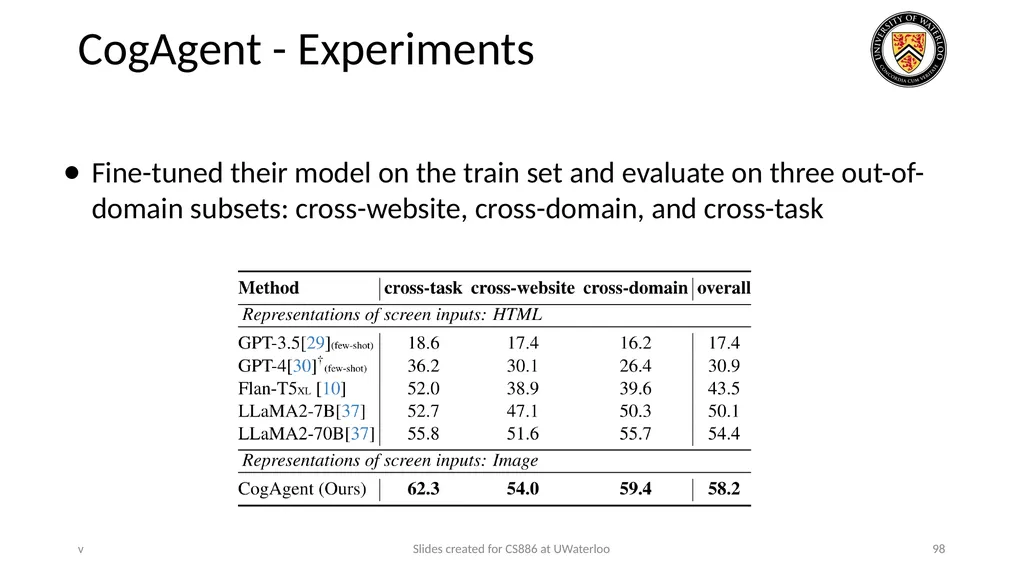
Fine-tuned their model on the train set and evaluate on three out-of-domain subsets: cross-website, cross-domain, and cross-task CogAgent - Experiments v Slides created for CS886 at UWaterloo 98<br>
99
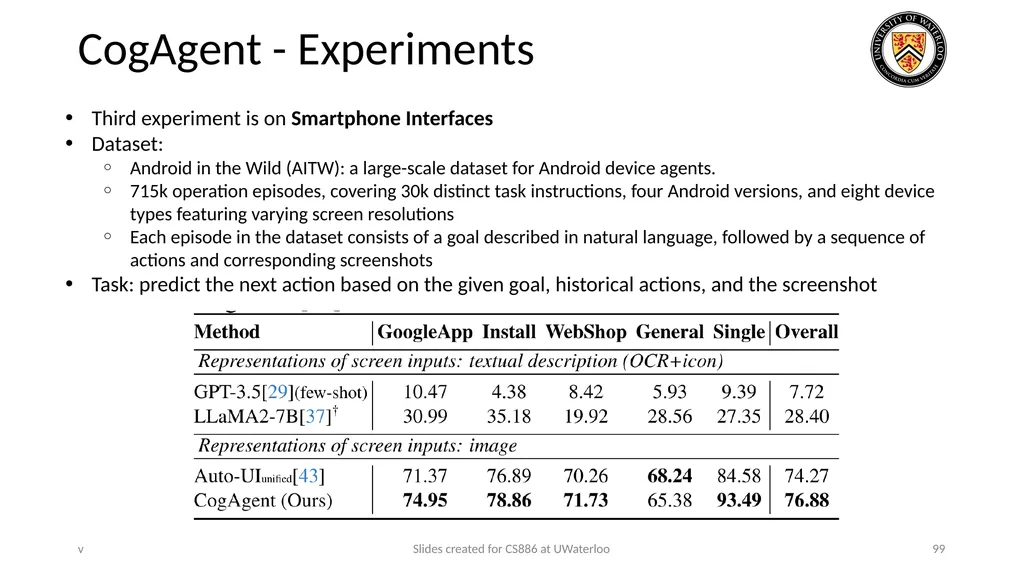
Third experiment is on Smartphone Interfaces
Dataset:
Android in the Wild (AITW): a large-scale dataset for Android device agents.
715k operation episodes, covering 30k distinct task instructions, four Android versions, and eight device types featuring varying screen resolutions
Each episode in the dataset consists of a goal described in natural language, followed by a sequence of actions and corresponding screenshots
Task: predict the next action based on the given goal, historical actions, and the screenshot CogAgent - Experiments v Slides created for CS886 at UWaterloo 99<br>
Dataset:
Android in the Wild (AITW): a large-scale dataset for Android device agents.
715k operation episodes, covering 30k distinct task instructions, four Android versions, and eight device types featuring varying screen resolutions
Each episode in the dataset consists of a goal described in natural language, followed by a sequence of actions and corresponding screenshots
Task: predict the next action based on the given goal, historical actions, and the screenshot CogAgent - Experiments v Slides created for CS886 at UWaterloo 99<br>
100
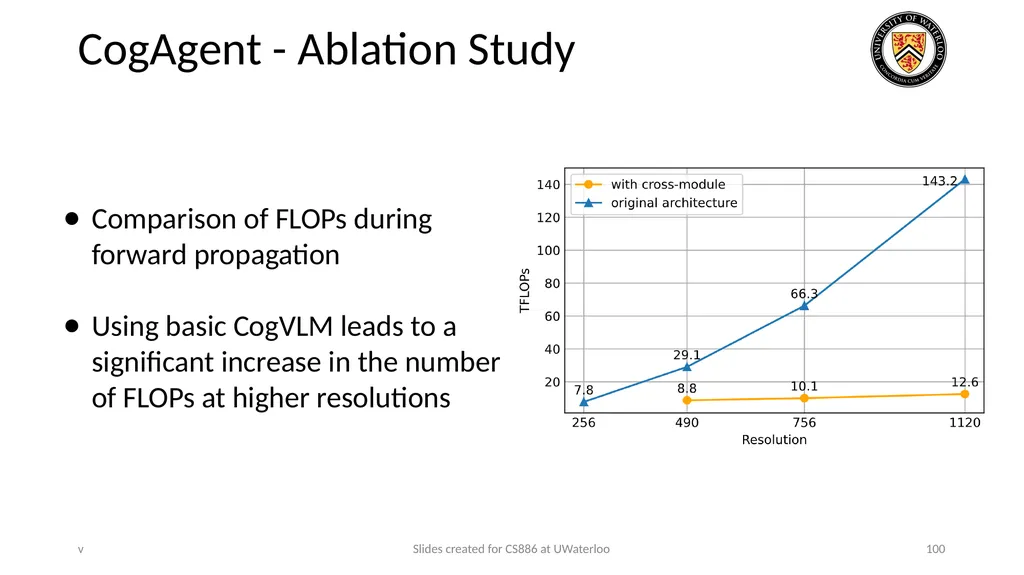
Comparison of FLOPs during forward propagation
Using basic CogVLM leads to a significant increase in the number of FLOPs at higher resolutions CogAgent - Ablation Study v Slides created for CS886 at UWaterloo 100<br>
Using basic CogVLM leads to a significant increase in the number of FLOPs at higher resolutions CogAgent - Ablation Study v Slides created for CS886 at UWaterloo 100<br>
101
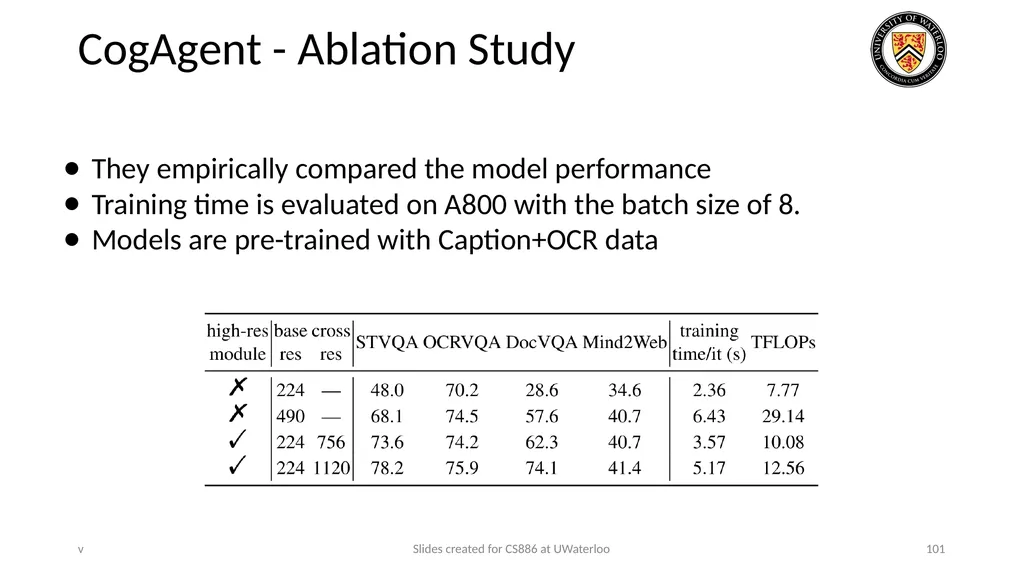
They empirically compared the model performance
Training time is evaluated on A800 with the batch size of 8.
Models are pre-trained with Caption+OCR data CogAgent - Ablation Study v Slides created for CS886 at UWaterloo 101<br>
Training time is evaluated on A800 with the batch size of 8.
Models are pre-trained with Caption+OCR data CogAgent - Ablation Study v Slides created for CS886 at UWaterloo 101<br>
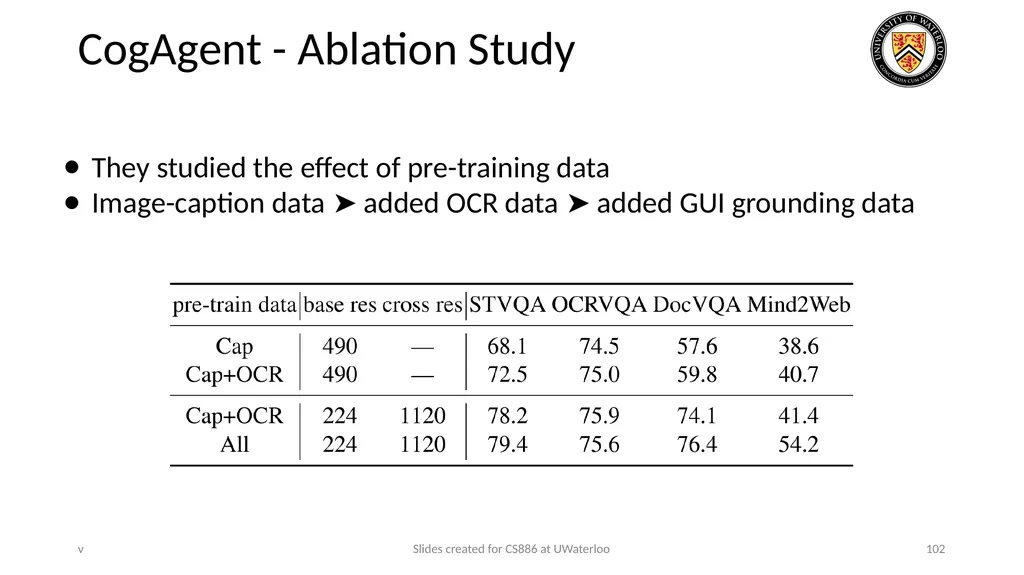
102
They studied the effect of pre-training data
Image-caption data ➤ added OCR data ➤ added GUI grounding data CogAgent - Ablation Study v Slides created for CS886 at UWaterloo 102<br>
Image-caption data ➤ added OCR data ➤ added GUI grounding data CogAgent - Ablation Study v Slides created for CS886 at UWaterloo 102<br>
103
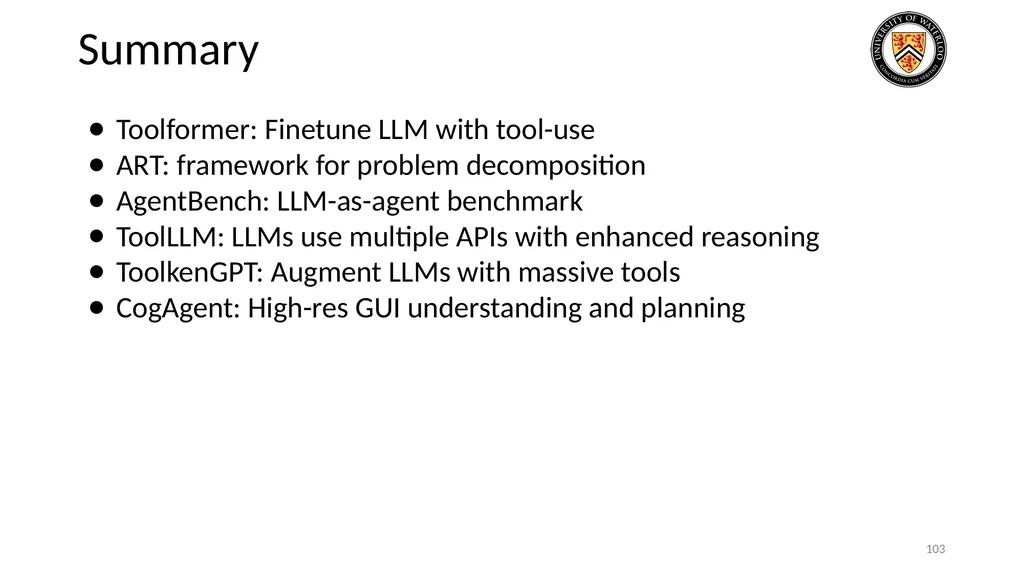
Summary Toolformer: Finetune LLM with tool-use
ART: framework for problem decomposition
AgentBench: LLM-as-agent benchmark
ToolLLM: LLMs use multiple APIs with enhanced reasoning
ToolkenGPT: Augment LLMs with massive tools
CogAgent: High-res GUI understanding and planning 103<br>
ART: framework for problem decomposition
AgentBench: LLM-as-agent benchmark
ToolLLM: LLMs use multiple APIs with enhanced reasoning
ToolkenGPT: Augment LLMs with massive tools
CogAgent: High-res GUI understanding and planning 103<br>
104
Discussion Phase Questions? 2024-03-27 Slides created for CS886 at UWaterloo 104<br>