
Lecture 3: CNN & RNN Presenters: Colby Wang &
KB
Published · 64 slides · 0 views
1 / 1
Description
Lecture 3: CNN RNN Presenters: Colby Wang Dongfu Jiang 2023-12-29 Slides created for CS886 at UWaterloo 1 What we will cover Basics of recurrent neural networks. LSTM, GRU and other variants of RNN. How the RNNs have been used in
Related Topics
Share
Embed code
Download this presentation From Below
"Lecture 3: CNN & RNN Presenters: Colby Wang &" is the property of its rightful owner. Permission is granted to download and print the materials on this website for personal, non-commercial use only, and to display it on your personal computer provided you do not modify the materials and that you retain all copyright notices contained in the materials. By downloading content from our website, you accept the terms of this agreement.
Presentation Transcript
01
Lecture 3: CNN & RNN Presenters: Colby Wang & Dongfu Jiang 2023-12-29 Slides created for CS886 at UWaterloo 1<br>
02
What we will cover Basics of recurrent neural networks.
LSTM, GRU and other variants of RNN.
How the RNNs have been used in different downstream applications.
Basics of convolutional neural networks.
ConvNext, ResNet, ResNext, DenseNet, UNet, MobileNet, etc.
How does CNNs have been used in different downstream applications. 2023-12-29 Slides created for CS886 at UWaterloo 2<br>
LSTM, GRU and other variants of RNN.
How the RNNs have been used in different downstream applications.
Basics of convolutional neural networks.
ConvNext, ResNet, ResNext, DenseNet, UNet, MobileNet, etc.
How does CNNs have been used in different downstream applications. 2023-12-29 Slides created for CS886 at UWaterloo 2<br>
03
3 Basics of Recurrent Neural Networks<br>
04
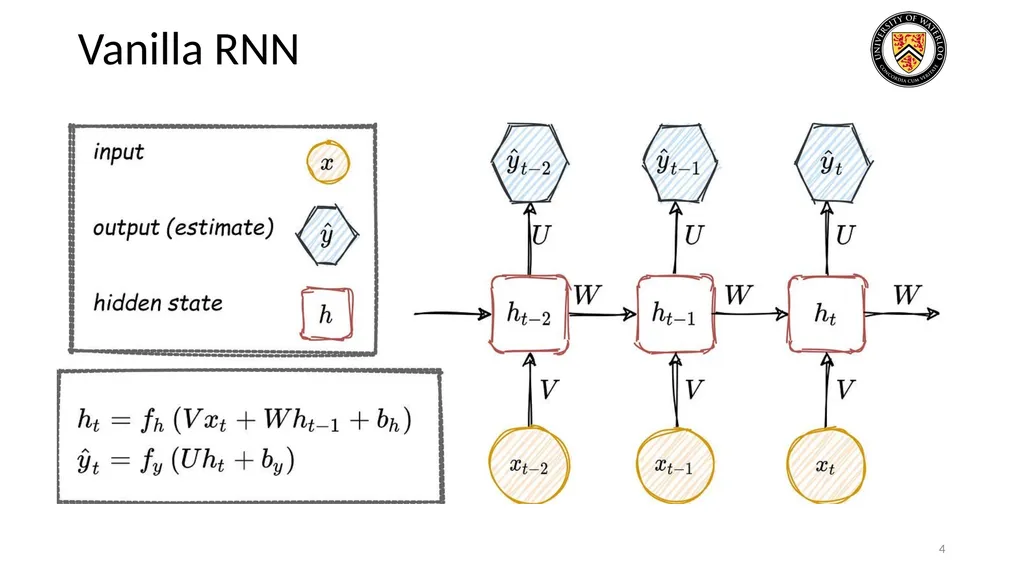
4 Vanilla RNN<br>
05
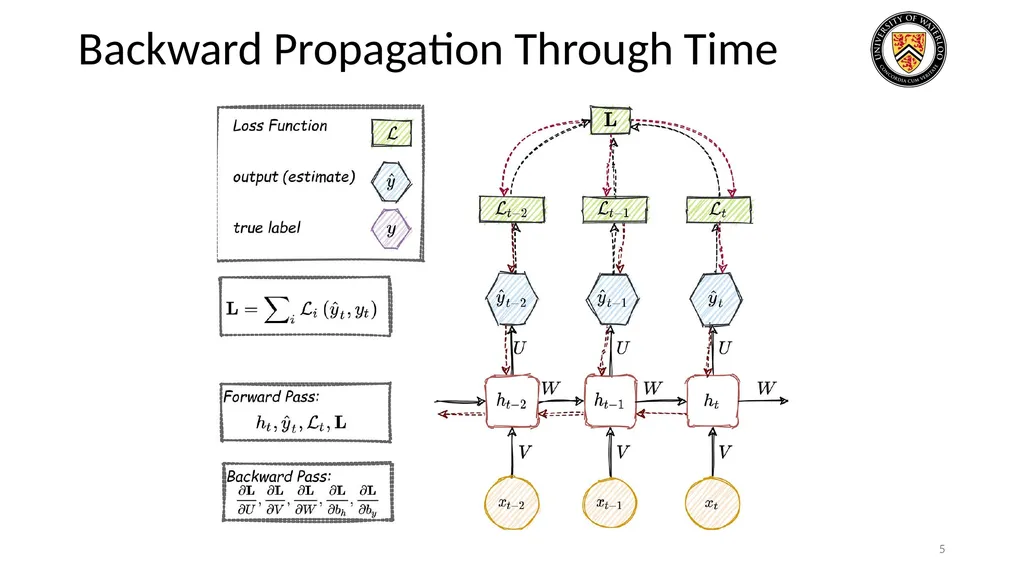
5 Backward Propagation Through Time<br>
06
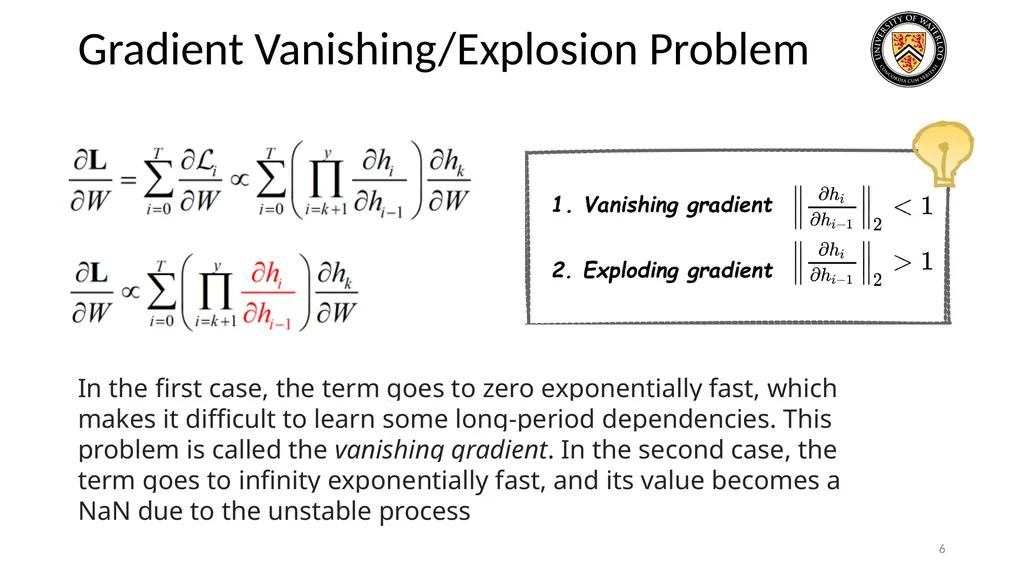
6 Gradient Vanishing/Explosion Problem In the first case, the term goes to zero exponentially fast, which makes it difficult to learn some long-period dependencies. This problem is called the vanishing gradient. In the second case, the term goes to infinity exponentially fast, and its value becomes a NaN due to the unstable process<br>
07
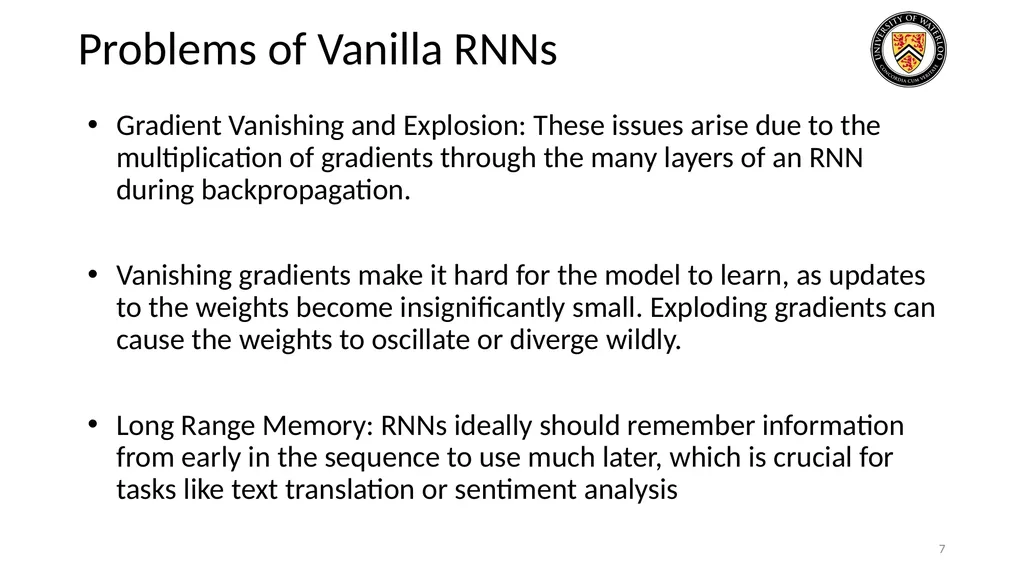
Problems of Vanilla RNNs Gradient Vanishing and Explosion: These issues arise due to the multiplication of gradients through the many layers of an RNN during backpropagation.
Vanishing gradients make it hard for the model to learn, as updates to the weights become insignificantly small. Exploding gradients can cause the weights to oscillate or diverge wildly.
Long Range Memory: RNNs ideally should remember information from early in the sequence to use much later, which is crucial for tasks like text translation or sentiment analysis 7<br>
Vanishing gradients make it hard for the model to learn, as updates to the weights become insignificantly small. Exploding gradients can cause the weights to oscillate or diverge wildly.
Long Range Memory: RNNs ideally should remember information from early in the sequence to use much later, which is crucial for tasks like text translation or sentiment analysis 7<br>
08
8 RNN Variant I: Long Short-Term Memory<br>
09
Long Short-Term Memory (LSTM) Special gated structure to control memorization and forgetting
Mitigate gradient vanishing
Facilitate long term memory
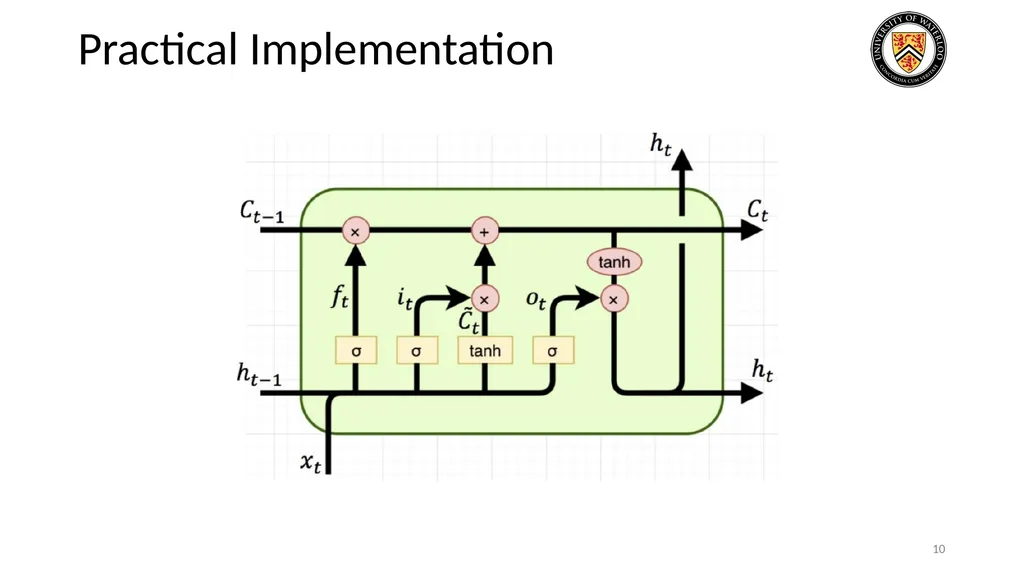
A simple diagram looks like the following:
These gates are essentially different neural networks with sigmoid activation functions (outputting values between 0 and 1). They are trained to selectively allow information to pass through, which helps in retaining the important information over longer periods and hence, mitigating the vanishing gradient problem 9<br>
Mitigate gradient vanishing
Facilitate long term memory
A simple diagram looks like the following:
These gates are essentially different neural networks with sigmoid activation functions (outputting values between 0 and 1). They are trained to selectively allow information to pass through, which helps in retaining the important information over longer periods and hence, mitigating the vanishing gradient problem 9<br>
10
Practical Implementation 10<br>
11
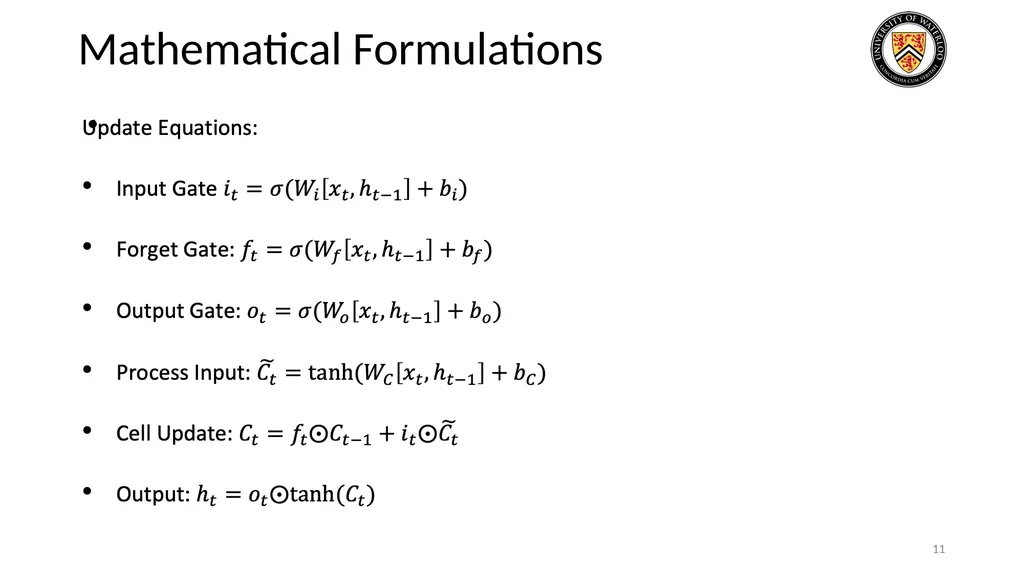
Mathematical Formulations 11<br>
12
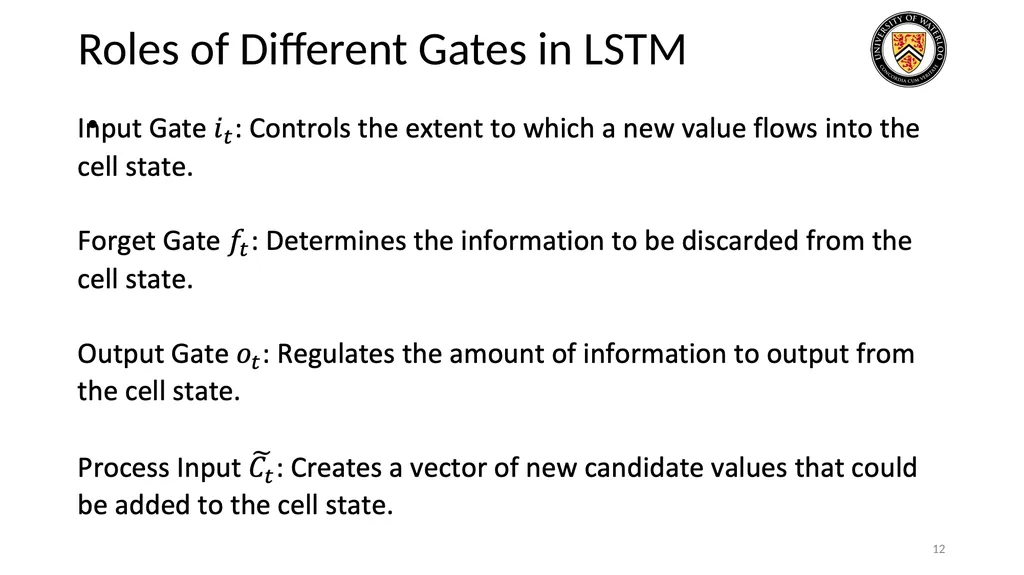
Roles of Different Gates in LSTM 12<br>
13
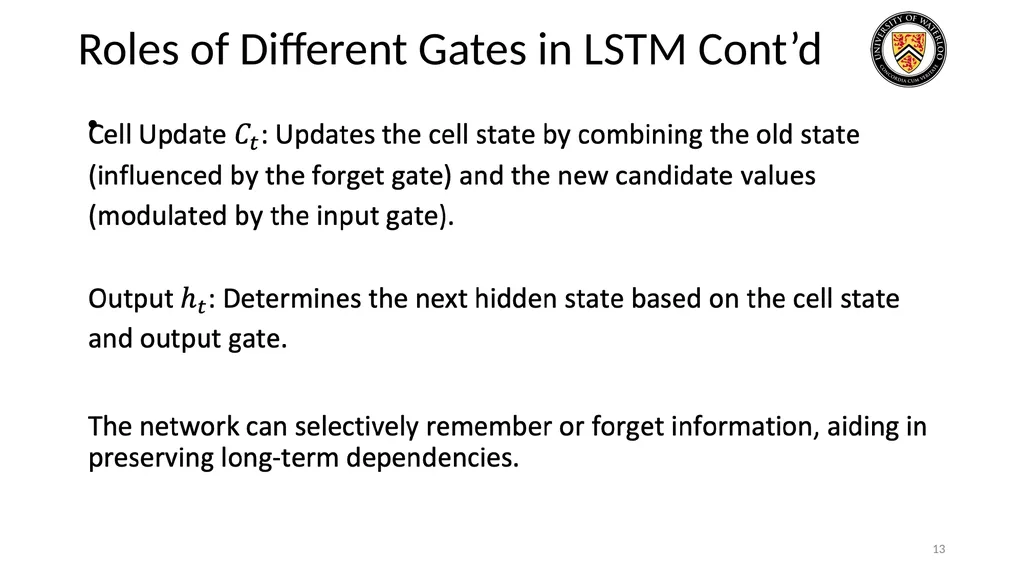
Roles of Different Gates in LSTM Cont’d 13<br>
14
14 Variant II: Gated Recurrent Unit for
Simplifying LSTM<br>
Simplifying LSTM<br>
15
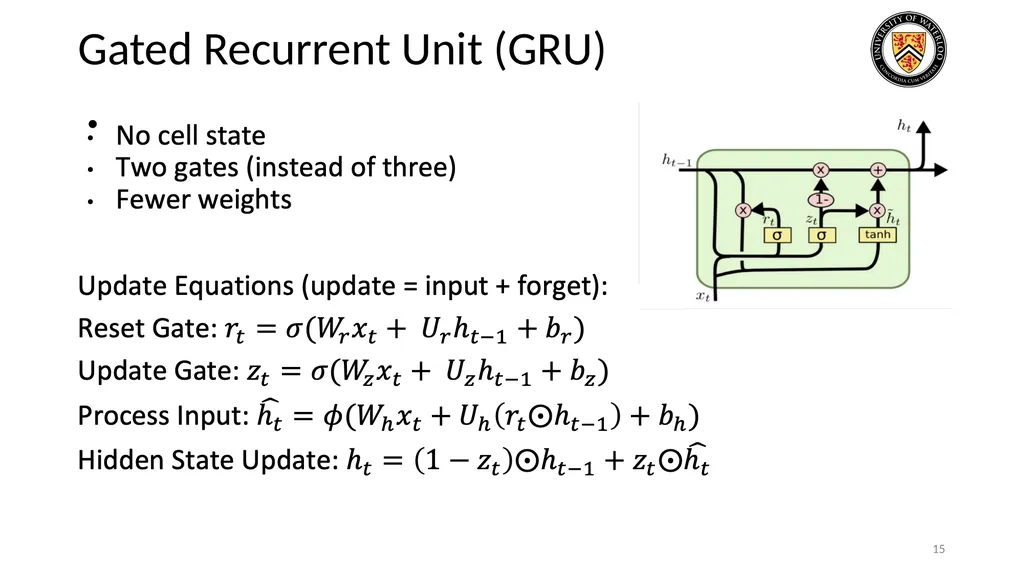
Gated Recurrent Unit (GRU) 15<br>
16
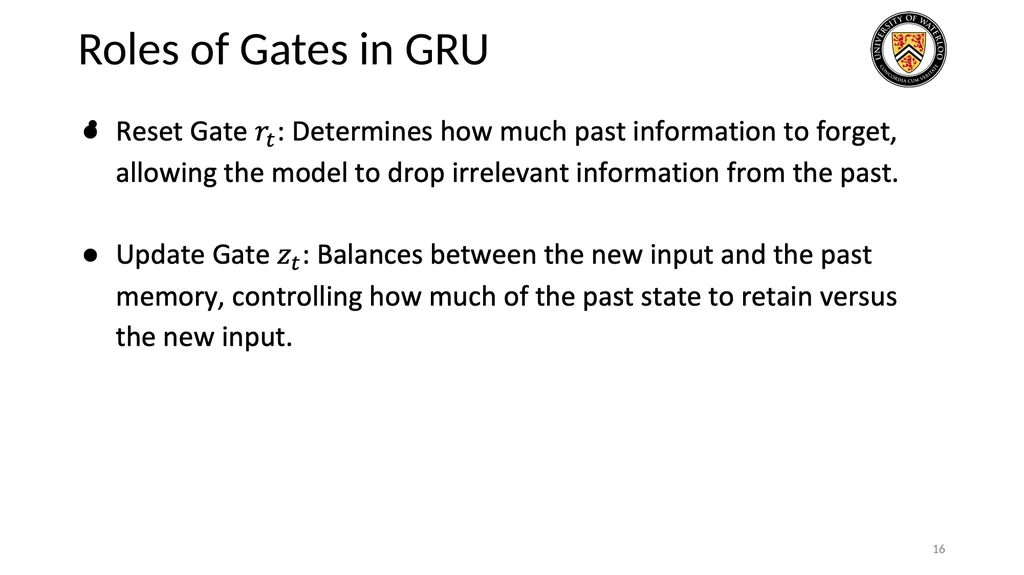
Roles of Gates in GRU 16<br>
17
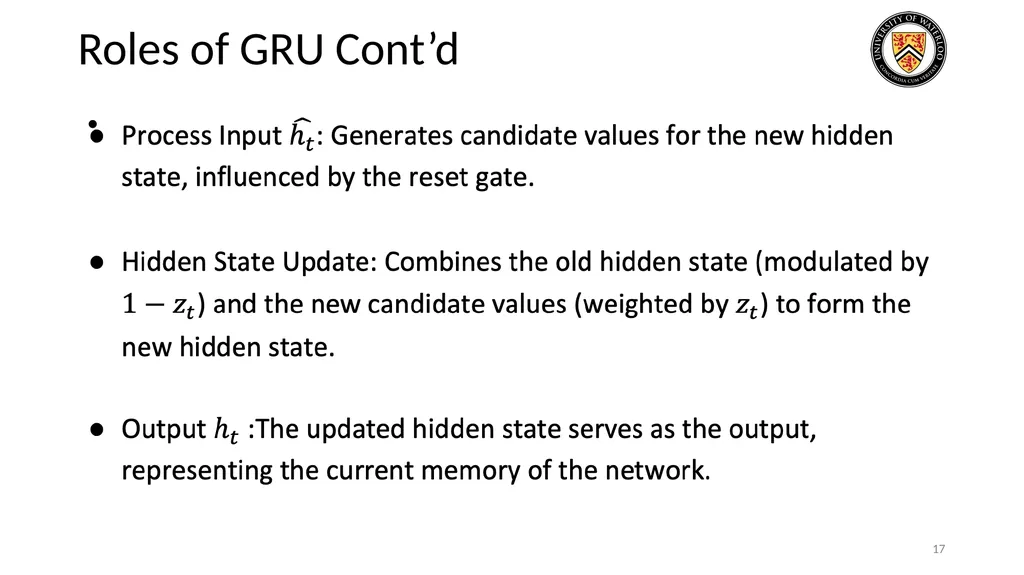
Roles of GRU Cont’d 17<br>
18
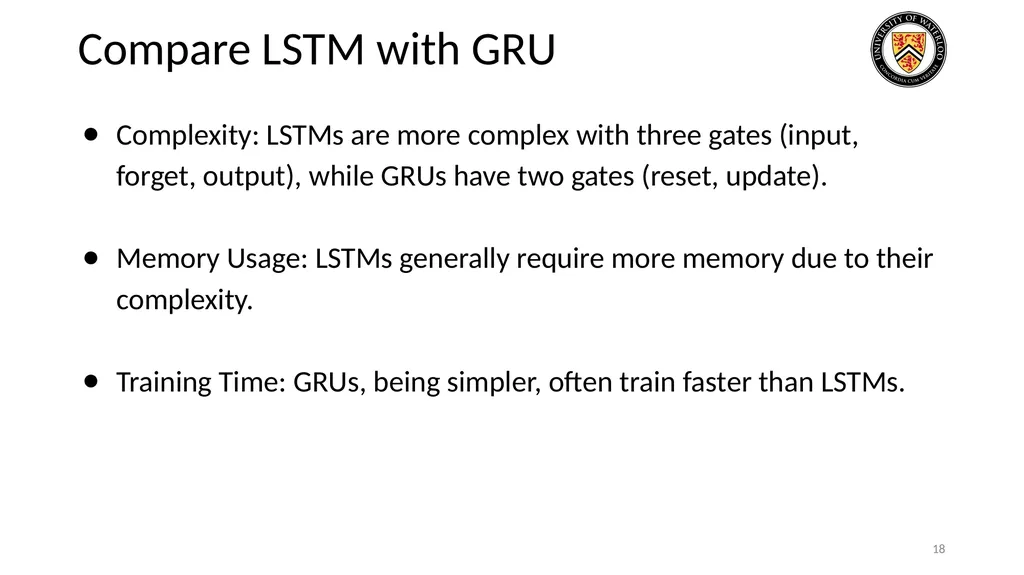
Compare LSTM with GRU Complexity: LSTMs are more complex with three gates (input, forget, output), while GRUs have two gates (reset, update).
Memory Usage: LSTMs generally require more memory due to their complexity.
Training Time: GRUs, being simpler, often train faster than LSTMs. 18<br>
Memory Usage: LSTMs generally require more memory due to their complexity.
Training Time: GRUs, being simpler, often train faster than LSTMs. 18<br>
19
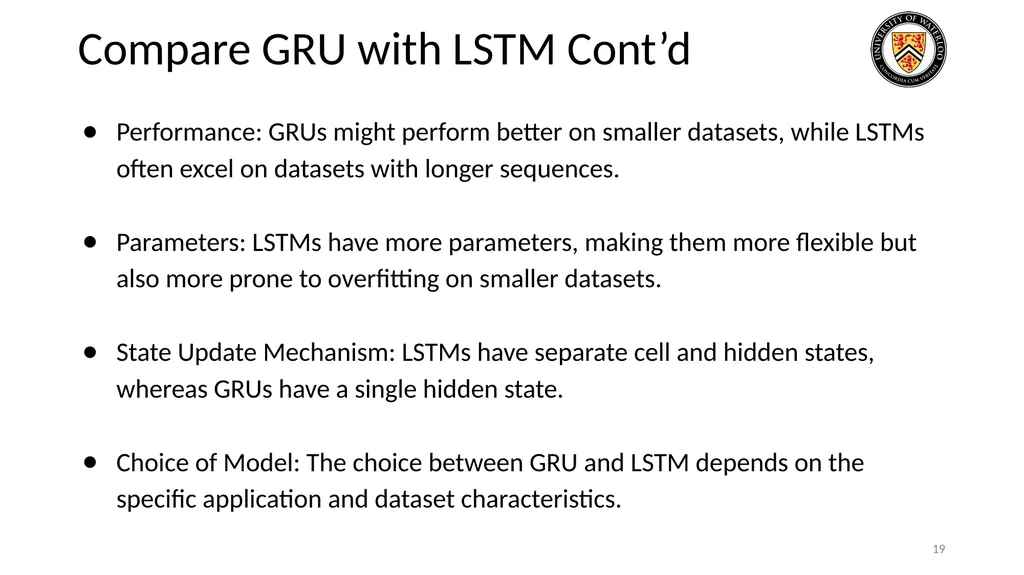
Compare GRU with LSTM Cont’d Performance: GRUs might perform better on smaller datasets, while LSTMs often excel on datasets with longer sequences.
Parameters: LSTMs have more parameters, making them more flexible but also more prone to overfitting on smaller datasets.
State Update Mechanism: LSTMs have separate cell and hidden states, whereas GRUs have a single hidden state.
Choice of Model: The choice between GRU and LSTM depends on the specific application and dataset characteristics. 19<br>
Parameters: LSTMs have more parameters, making them more flexible but also more prone to overfitting on smaller datasets.
State Update Mechanism: LSTMs have separate cell and hidden states, whereas GRUs have a single hidden state.
Choice of Model: The choice between GRU and LSTM depends on the specific application and dataset characteristics. 19<br>
20
Advantages of GRU Faster Training: Due to fewer parameters, GRUs can be faster to train, making them more efficient for smaller datasets or when computational resources are limited.
Efficient on Smaller Datasets: GRUs may perform better than LSTMs when the amount of data is not large, as they can capture dependencies without the need for extensive data.
Flexibility in Memory Management: GRUs can adapt to the use of short-term memory through their update and reset gates, potentially capturing information across various time steps efficiently. 20<br>
Efficient on Smaller Datasets: GRUs may perform better than LSTMs when the amount of data is not large, as they can capture dependencies without the need for extensive data.
Flexibility in Memory Management: GRUs can adapt to the use of short-term memory through their update and reset gates, potentially capturing information across various time steps efficiently. 20<br>
21
21 Experimental Results<br>
22
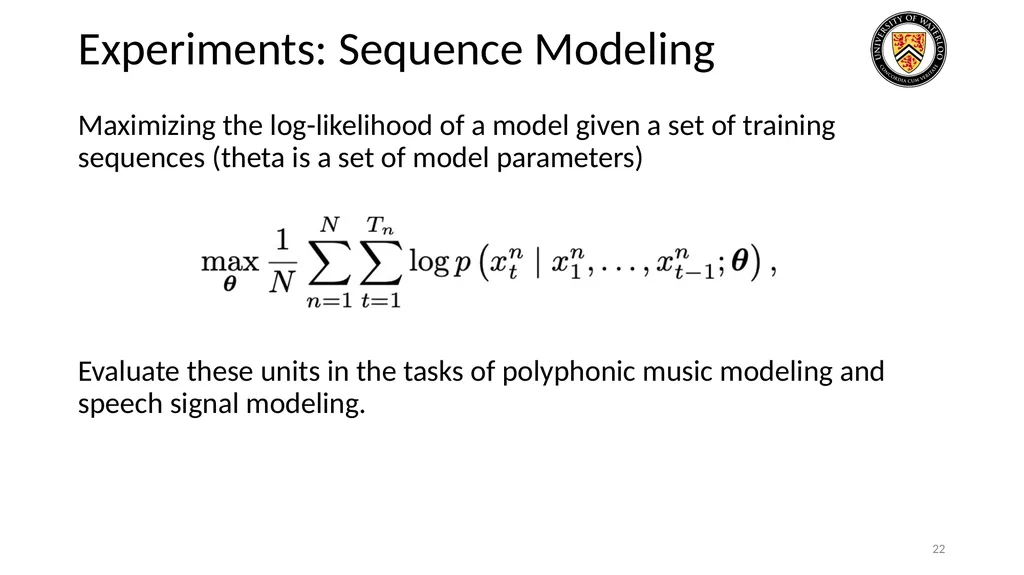
Experiments: Sequence Modeling Maximizing the log-likelihood of a model given a set of training sequences (theta is a set of model parameters)
Evaluate these units in the tasks of polyphonic music modeling and speech signal modeling. 22<br>
Evaluate these units in the tasks of polyphonic music modeling and speech signal modeling. 22<br>
23
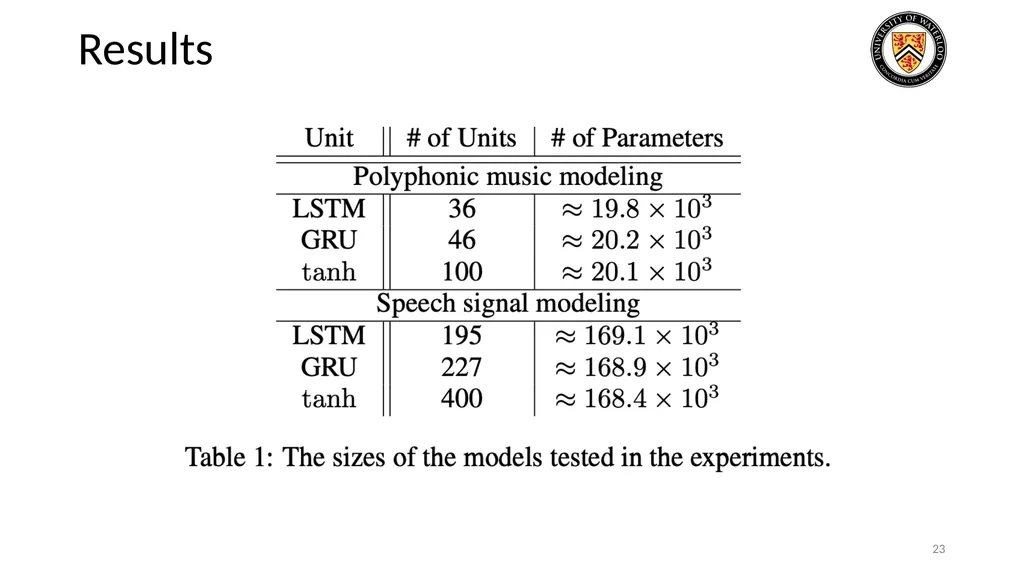
Results 23<br>
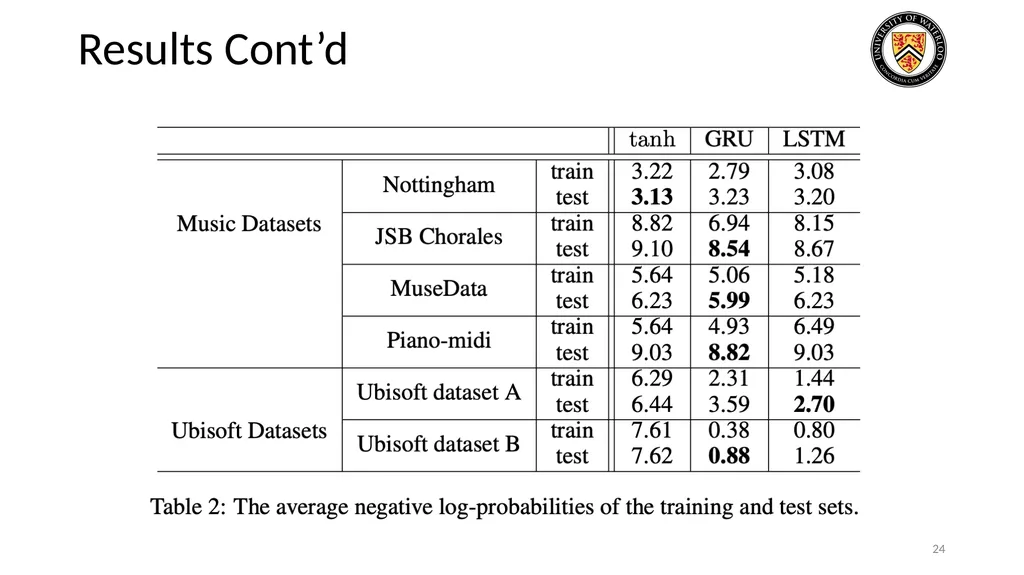
24
24 Results Cont’d<br>
25
25 RNNs with Attention Mechanism<br>
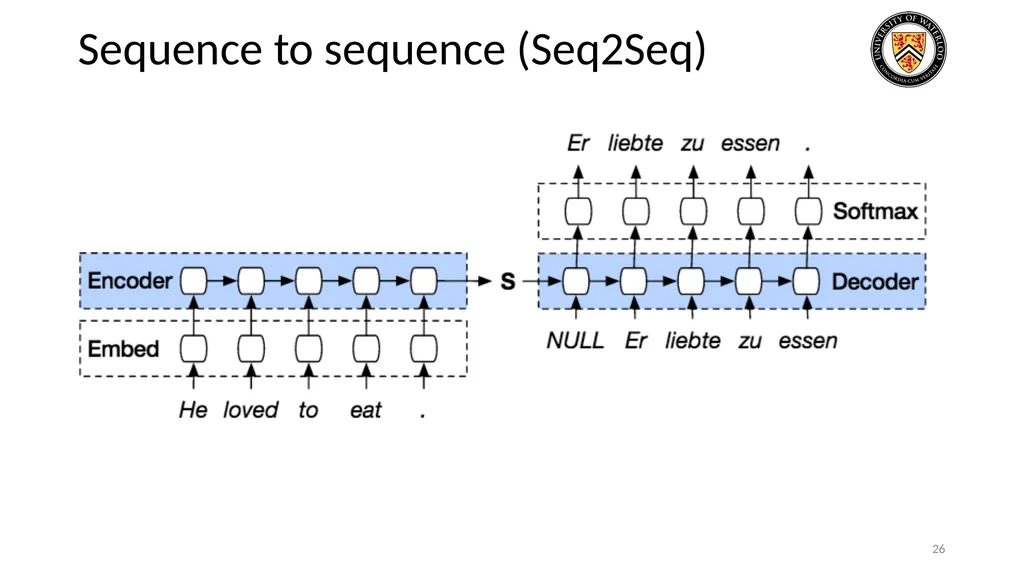
26
26 Sequence to sequence (Seq2Seq)<br>
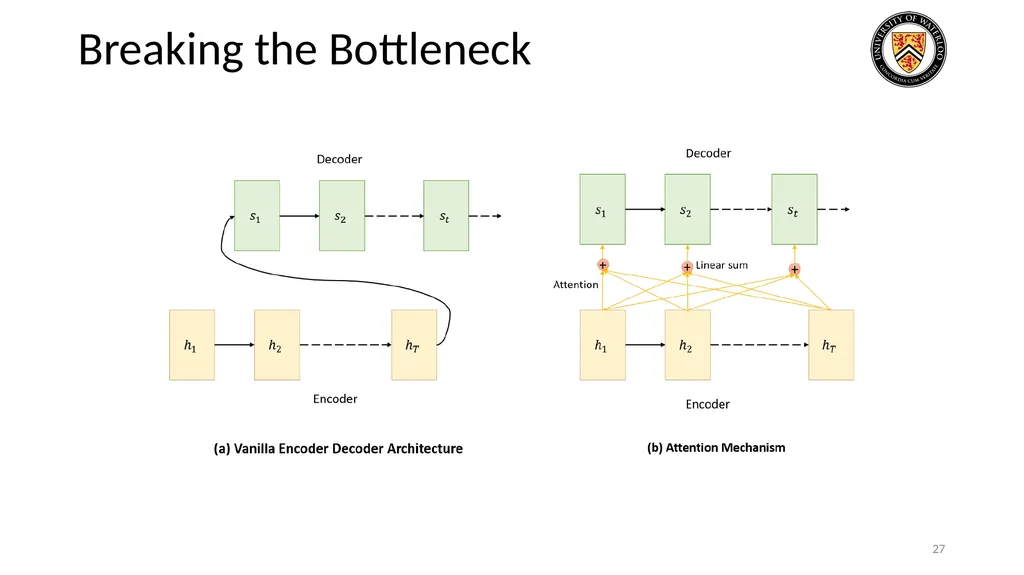
27
27 Breaking the Bottleneck<br>
28
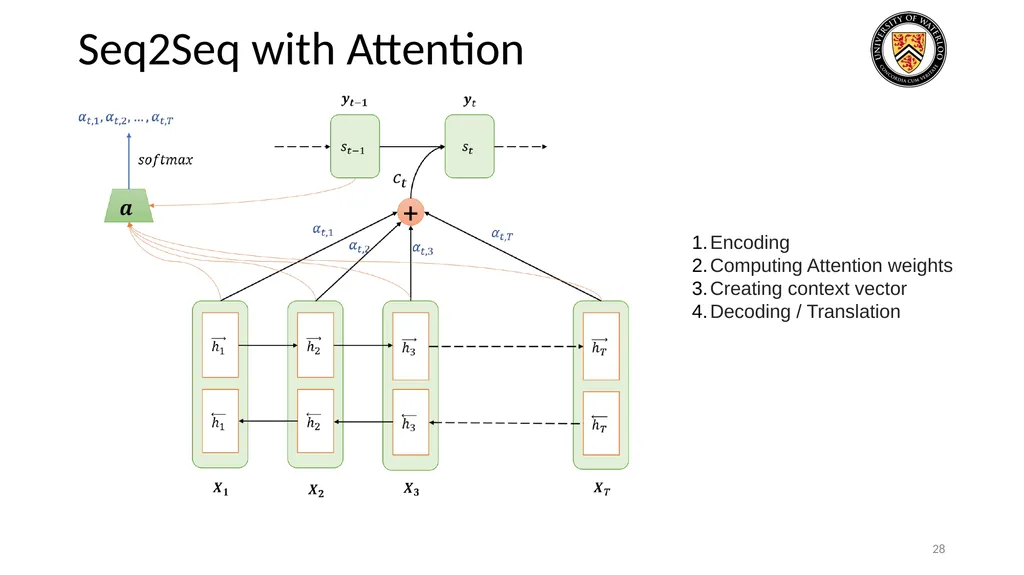
28 Seq2Seq with Attention Encoding
Computing Attention weights
Creating context vector
Decoding / Translation<br>
Computing Attention weights
Creating context vector
Decoding / Translation<br>
29
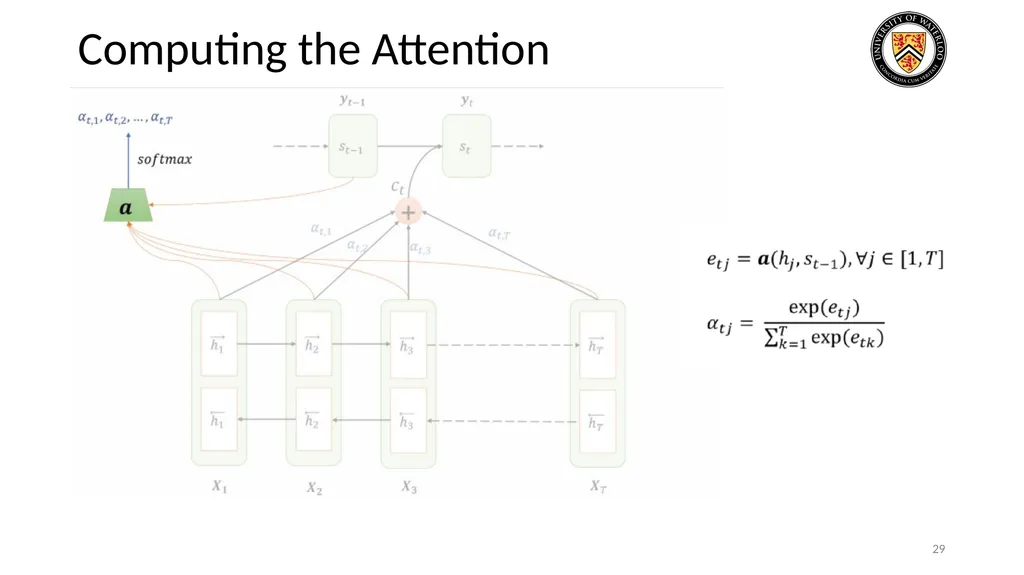
29 Computing the Attention<br>
30
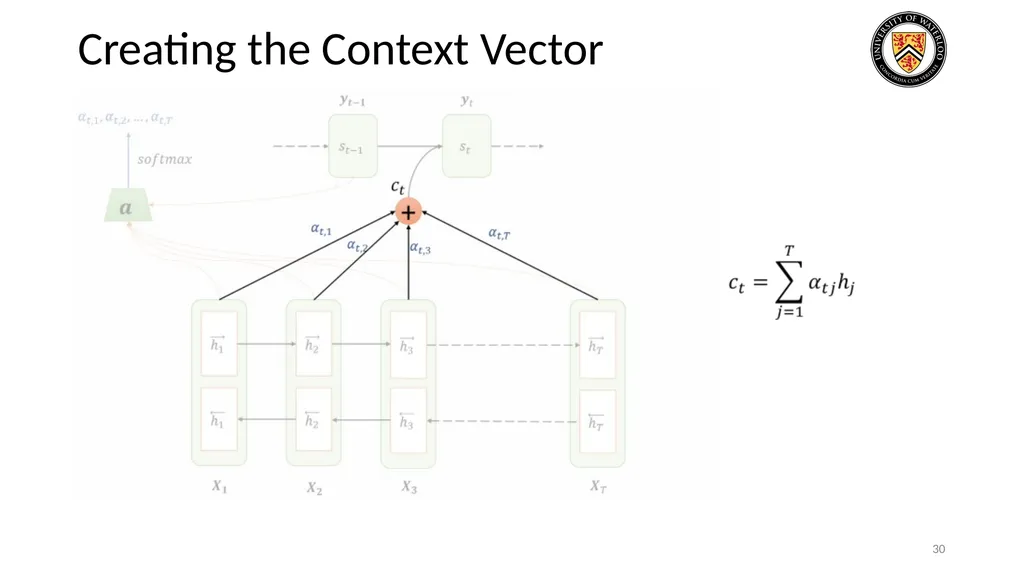
30 Creating the Context Vector<br>
31
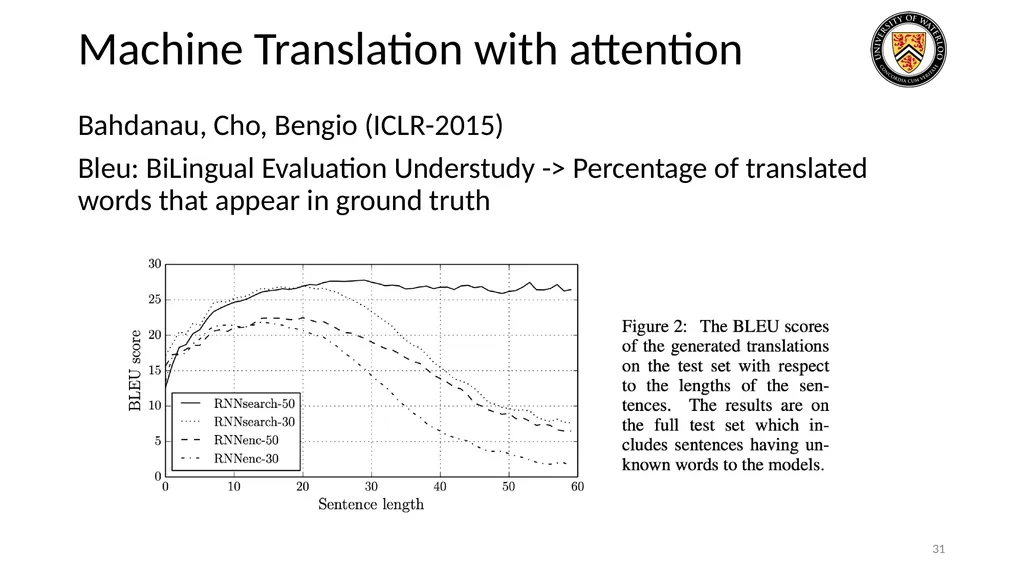
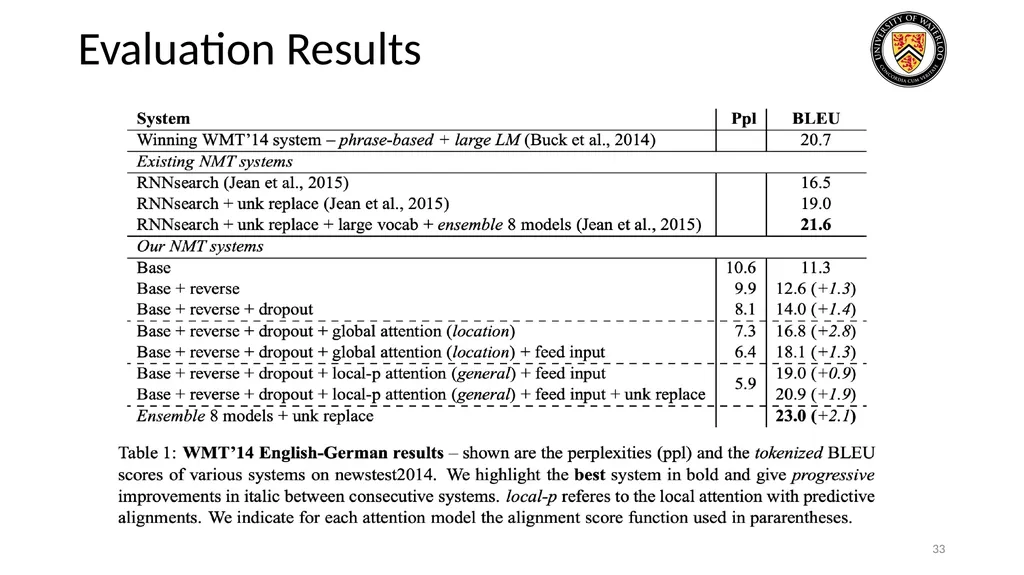
Machine Translation with attention Bahdanau, Cho, Bengio (ICLR-2015)
Bleu: BiLingual Evaluation Understudy -> Percentage of translated words that appear in ground truth 31<br>
Bleu: BiLingual Evaluation Understudy -> Percentage of translated words that appear in ground truth 31<br>
32
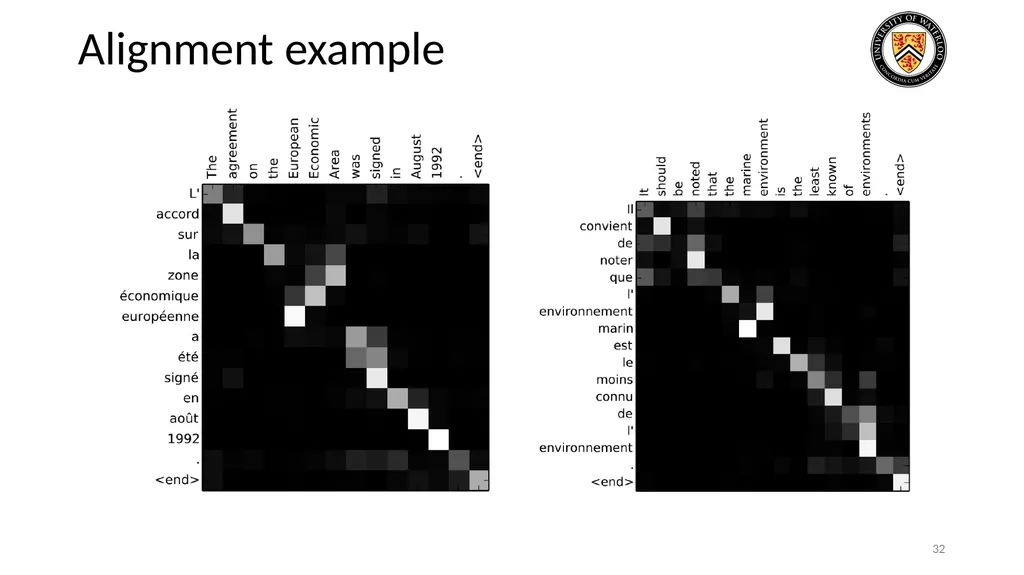
Alignment example 32<br>
33
Evaluation Results 33<br>
34
34 Convolutional Neural Networks<br>
35
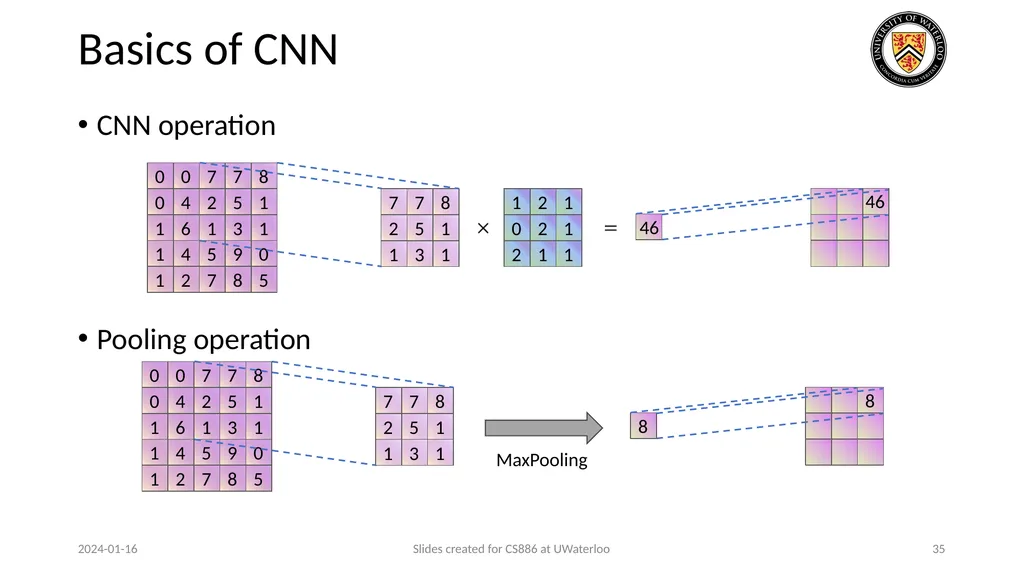
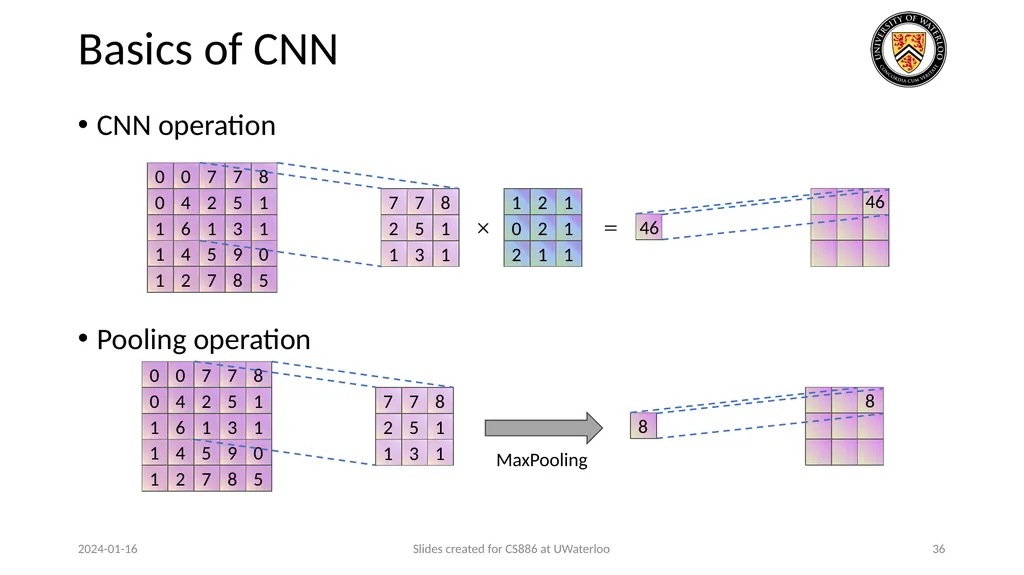
Basics of CNN CNN operation
Pooling operation 2024-01-16 Slides created for CS886 at UWaterloo 35 1 2 1 0 2 1 2 1 1 7 7 8 2 5 1 1 3 1 46 46 7 7 8 2 5 1 1 3 1 8 8 MaxPooling<br>
Pooling operation 2024-01-16 Slides created for CS886 at UWaterloo 35 1 2 1 0 2 1 2 1 1 7 7 8 2 5 1 1 3 1 46 46 7 7 8 2 5 1 1 3 1 8 8 MaxPooling<br>
36
Basics of CNN CNN operation
Pooling operation 2024-01-16 Slides created for CS886 at UWaterloo 36 1 2 1 0 2 1 2 1 1 7 7 8 2 5 1 1 3 1 46 46 7 7 8 2 5 1 1 3 1 8 8 MaxPooling<br>
Pooling operation 2024-01-16 Slides created for CS886 at UWaterloo 36 1 2 1 0 2 1 2 1 1 7 7 8 2 5 1 1 3 1 46 46 7 7 8 2 5 1 1 3 1 8 8 MaxPooling<br>
37
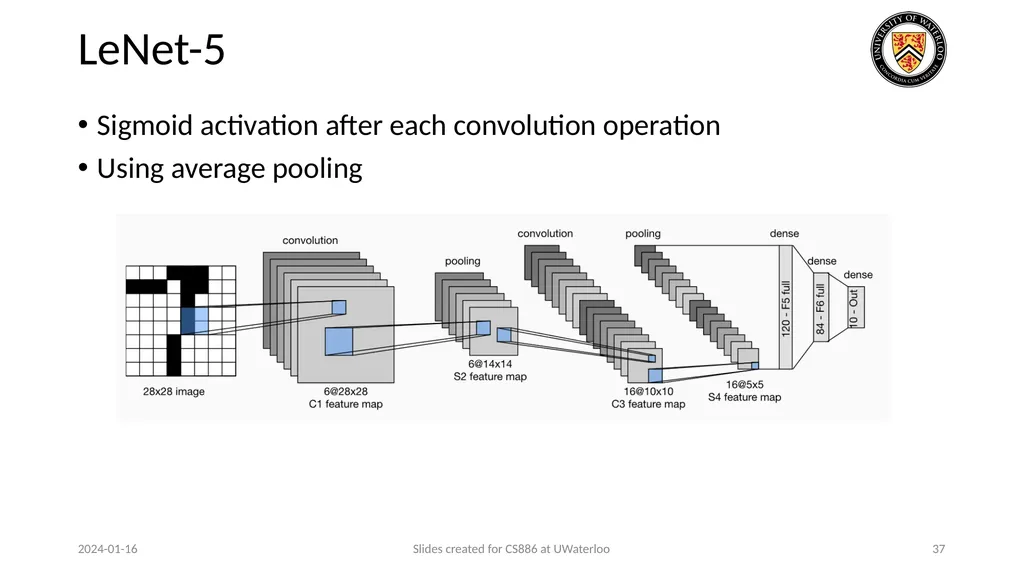
LeNet-5 2024-01-16 Slides created for CS886 at UWaterloo 37 Sigmoid activation after each convolution operation
Using average pooling<br>
Using average pooling<br>
38
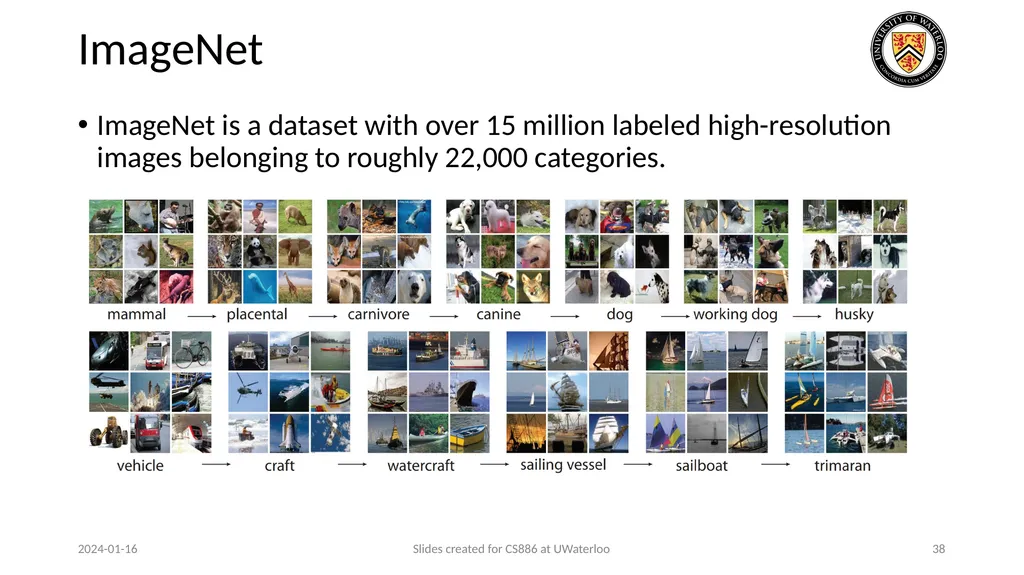
ImageNet ImageNet is a dataset with over 15 million labeled high-resolution images belonging to roughly 22,000 categories. 2024-01-16 Slides created for CS886 at UWaterloo 38<br>
39
AlexNet (2012) Can we train larger deep convolutional neural network using GPU?
Issues and solutions:
Larger Training Dataset -> ImageNet
Computation resources -> Implementation of AlexNet on GPU.
It’s the first work that uses GPU to train a deep neural network 2024-01-16 Slides created for CS886 at UWaterloo 39<br>
Issues and solutions:
Larger Training Dataset -> ImageNet
Computation resources -> Implementation of AlexNet on GPU.
It’s the first work that uses GPU to train a deep neural network 2024-01-16 Slides created for CS886 at UWaterloo 39<br>
40
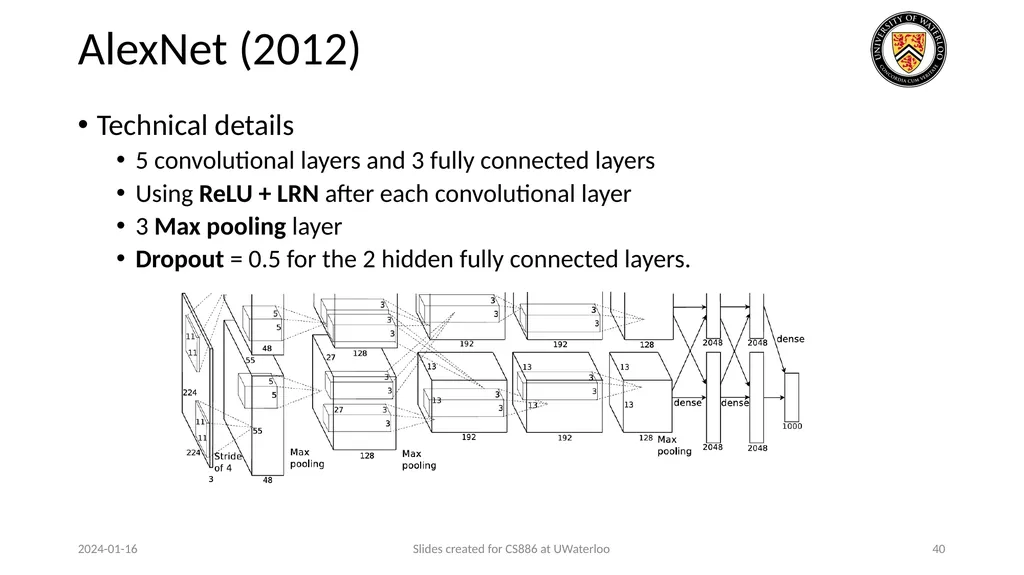
AlexNet (2012) Technical details
5 convolutional layers and 3 fully connected layers
Using ReLU + LRN after each convolutional layer
3 Max pooling layer
Dropout = 0.5 for the 2 hidden fully connected layers. 2024-01-16 Slides created for CS886 at UWaterloo 40<br>
5 convolutional layers and 3 fully connected layers
Using ReLU + LRN after each convolutional layer
3 Max pooling layer
Dropout = 0.5 for the 2 hidden fully connected layers. 2024-01-16 Slides created for CS886 at UWaterloo 40<br>
41
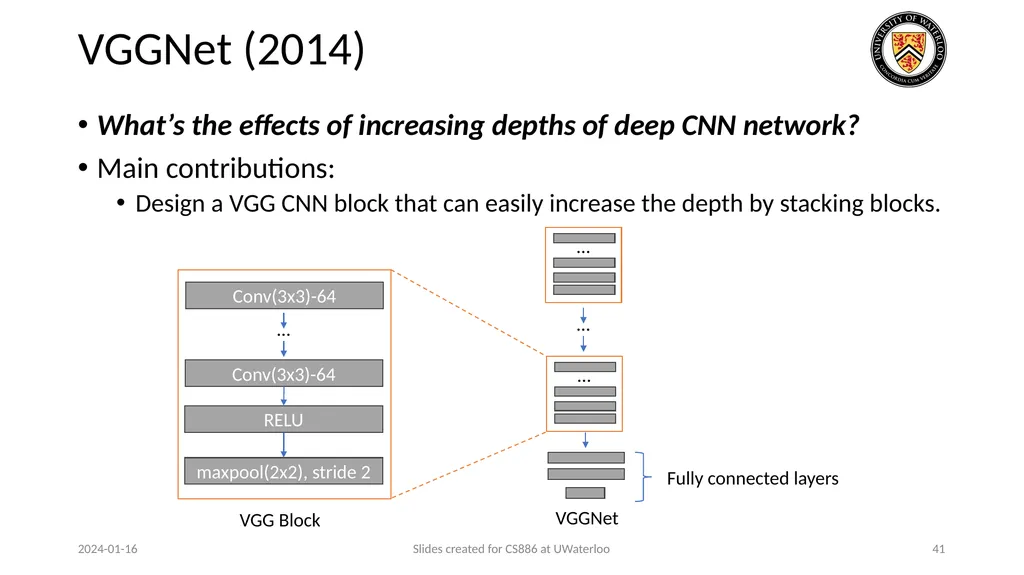
VGGNet (2014) What’s the effects of increasing depths of deep CNN network?
Main contributions:
Design a VGG CNN block that can easily increase the depth by stacking blocks. 2024-01-16 Slides created for CS886 at UWaterloo 41 Conv(3x3)-64 RELU maxpool(2x2), stride 2 … Conv(3x3)-64 … … … VGG Block VGGNet Fully connected layers<br>
Main contributions:
Design a VGG CNN block that can easily increase the depth by stacking blocks. 2024-01-16 Slides created for CS886 at UWaterloo 41 Conv(3x3)-64 RELU maxpool(2x2), stride 2 … Conv(3x3)-64 … … … VGG Block VGGNet Fully connected layers<br>
42
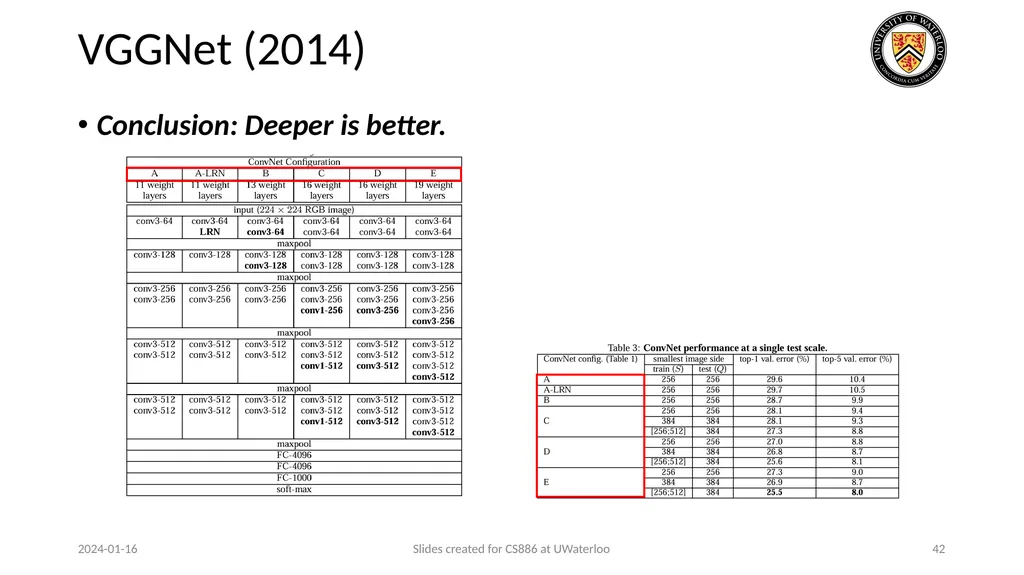
VGGNet (2014) 2024-01-16 Slides created for CS886 at UWaterloo 42 Conclusion: Deeper is better.<br>
43
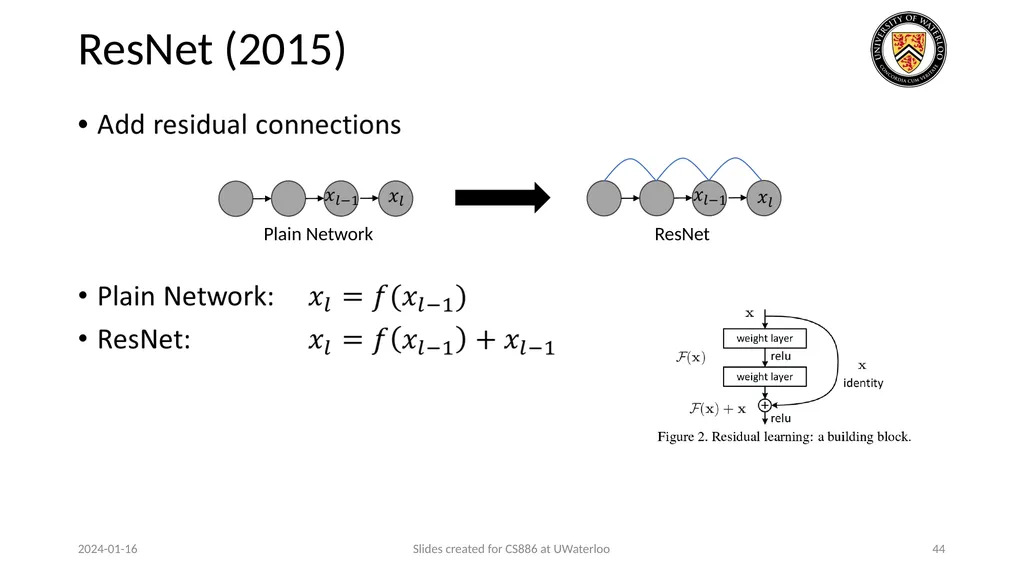
ResNet (2015) Is learning better networks as easy as stacking more layers?
Issues:
Vanishing/exploding gradients -> Well addressed by BatchNorm
Performance degeneration on deeper networks -> Open Problem
Assumption:
There exists an Identity mapping from deeper to shallower
Easier to learn the residual mapping instead of the identify mapping.
Solution:
Add residual connection to the CNN network. 2024-01-16 Slides created for CS886 at UWaterloo 43<br>
Issues:
Vanishing/exploding gradients -> Well addressed by BatchNorm
Performance degeneration on deeper networks -> Open Problem
Assumption:
There exists an Identity mapping from deeper to shallower
Easier to learn the residual mapping instead of the identify mapping.
Solution:
Add residual connection to the CNN network. 2024-01-16 Slides created for CS886 at UWaterloo 43<br>
44
ResNet (2015) 2024-01-16 Slides created for CS886 at UWaterloo 44 ResNet Plain Network<br>
45
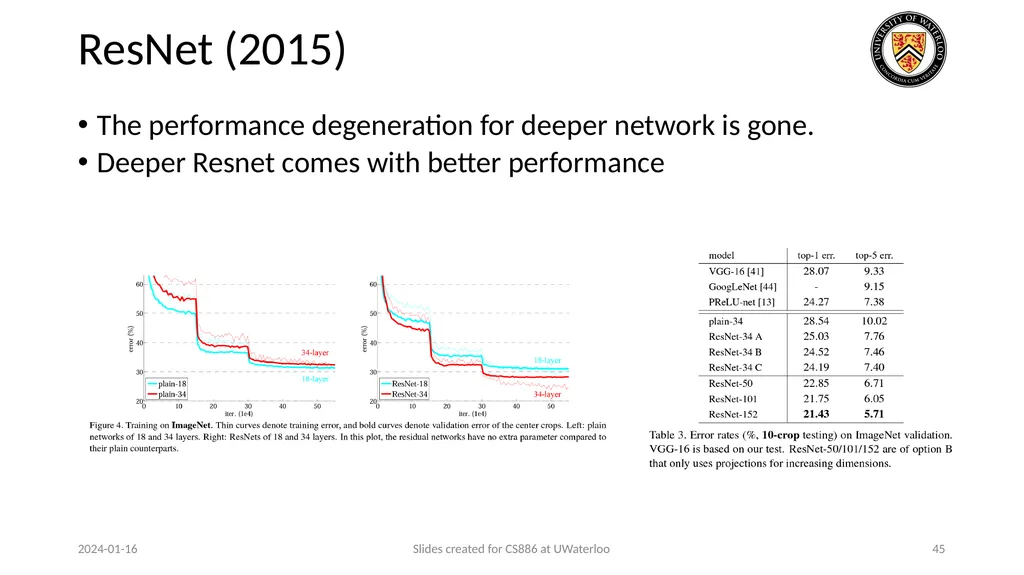
ResNet (2015) The performance degeneration for deeper network is gone.
Deeper Resnet comes with better performance 2024-01-16 Slides created for CS886 at UWaterloo 45<br>
Deeper Resnet comes with better performance 2024-01-16 Slides created for CS886 at UWaterloo 45<br>
46
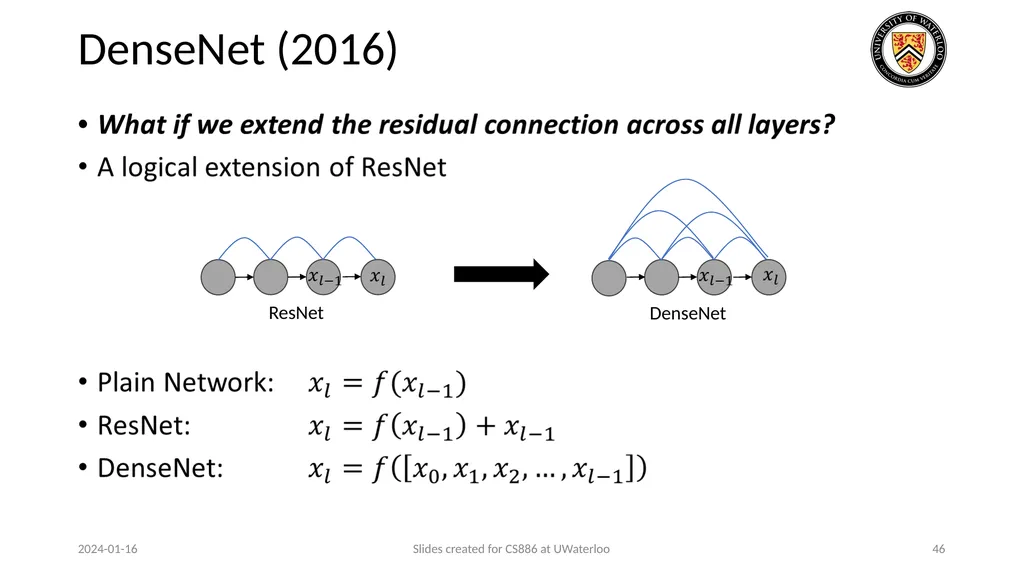
DenseNet (2016) 2024-01-16 Slides created for CS886 at UWaterloo 46<br>
47
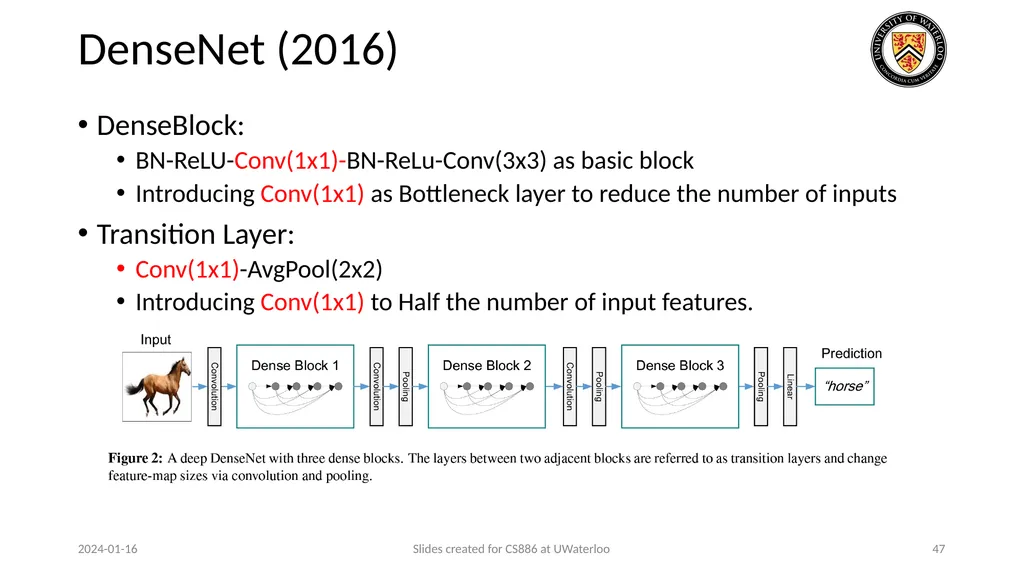
DenseNet (2016) DenseBlock:
BN-ReLU-Conv(1x1)-BN-ReLu-Conv(3x3) as basic block
Introducing Conv(1x1) as Bottleneck layer to reduce the number of inputs
Transition Layer:
Conv(1x1)-AvgPool(2x2)
Introducing Conv(1x1) to Half the number of input features. 2024-01-16 Slides created for CS886 at UWaterloo 47<br>
BN-ReLU-Conv(1x1)-BN-ReLu-Conv(3x3) as basic block
Introducing Conv(1x1) as Bottleneck layer to reduce the number of inputs
Transition Layer:
Conv(1x1)-AvgPool(2x2)
Introducing Conv(1x1) to Half the number of input features. 2024-01-16 Slides created for CS886 at UWaterloo 47<br>
48
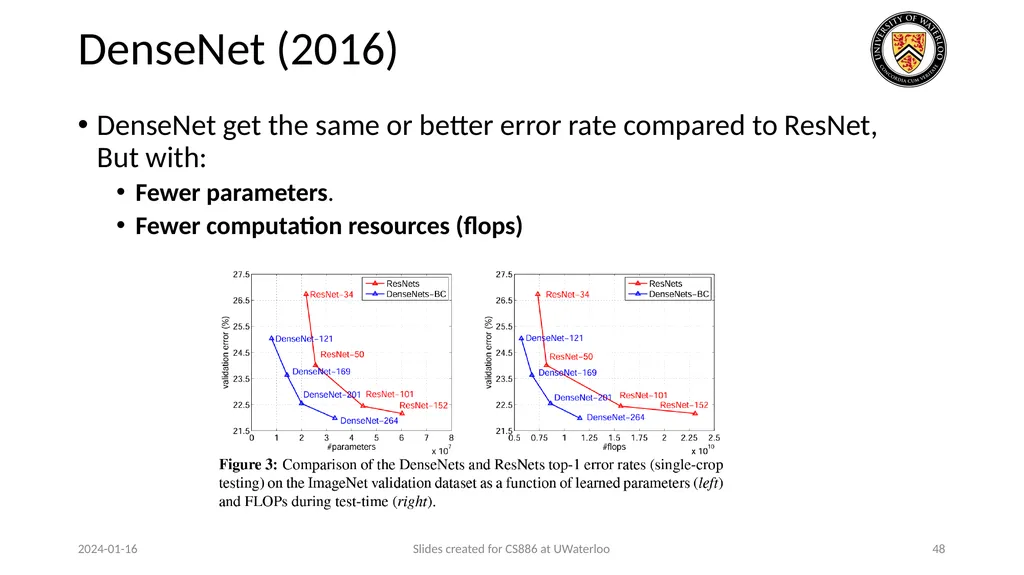
DenseNet (2016) DenseNet get the same or better error rate compared to ResNet,
But with:
Fewer parameters.
Fewer computation resources (flops) 2024-01-16 Slides created for CS886 at UWaterloo 48<br>
Fewer parameters.
Fewer computation resources (flops) 2024-01-16 Slides created for CS886 at UWaterloo 48<br>
49
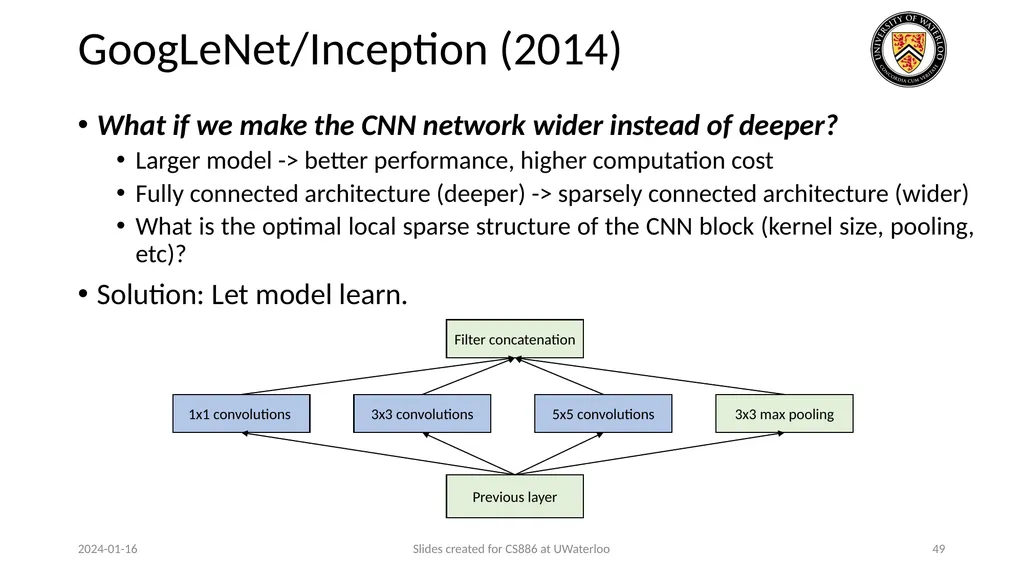
GoogLeNet/Inception (2014) What if we make the CNN network wider instead of deeper?
Larger model -> better performance, higher computation cost
Fully connected architecture (deeper) -> sparsely connected architecture (wider)
What is the optimal local sparse structure of the CNN block (kernel size, pooling, etc)?
Solution: Let model learn. 2024-01-16 Slides created for CS886 at UWaterloo 49 Previous layer Filter concatenation 1x1 convolutions 3x3 convolutions 5x5 convolutions 3x3 max pooling<br>
Larger model -> better performance, higher computation cost
Fully connected architecture (deeper) -> sparsely connected architecture (wider)
What is the optimal local sparse structure of the CNN block (kernel size, pooling, etc)?
Solution: Let model learn. 2024-01-16 Slides created for CS886 at UWaterloo 49 Previous layer Filter concatenation 1x1 convolutions 3x3 convolutions 5x5 convolutions 3x3 max pooling<br>
50
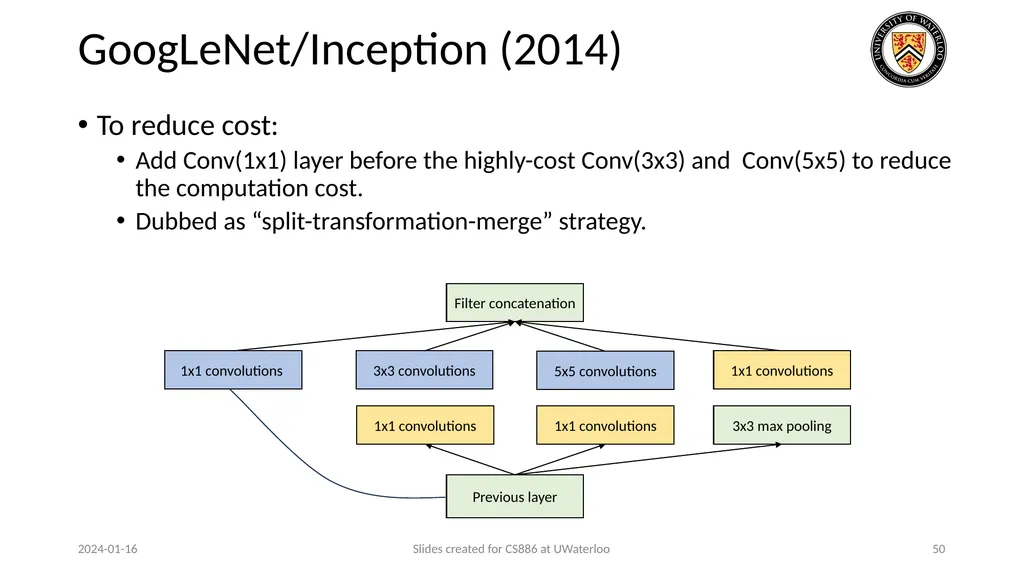
GoogLeNet/Inception (2014) To reduce cost:
Add Conv(1x1) layer before the highly-cost Conv(3x3) and Conv(5x5) to reduce the computation cost.
Dubbed as “split-transformation-merge” strategy. 2024-01-16 Slides created for CS886 at UWaterloo 50 Previous layer Filter concatenation 1x1 convolutions 3x3 convolutions 5x5 convolutions 3x3 max pooling 1x1 convolutions 1x1 convolutions 1x1 convolutions<br>
Add Conv(1x1) layer before the highly-cost Conv(3x3) and Conv(5x5) to reduce the computation cost.
Dubbed as “split-transformation-merge” strategy. 2024-01-16 Slides created for CS886 at UWaterloo 50 Previous layer Filter concatenation 1x1 convolutions 3x3 convolutions 5x5 convolutions 3x3 max pooling 1x1 convolutions 1x1 convolutions 1x1 convolutions<br>
51
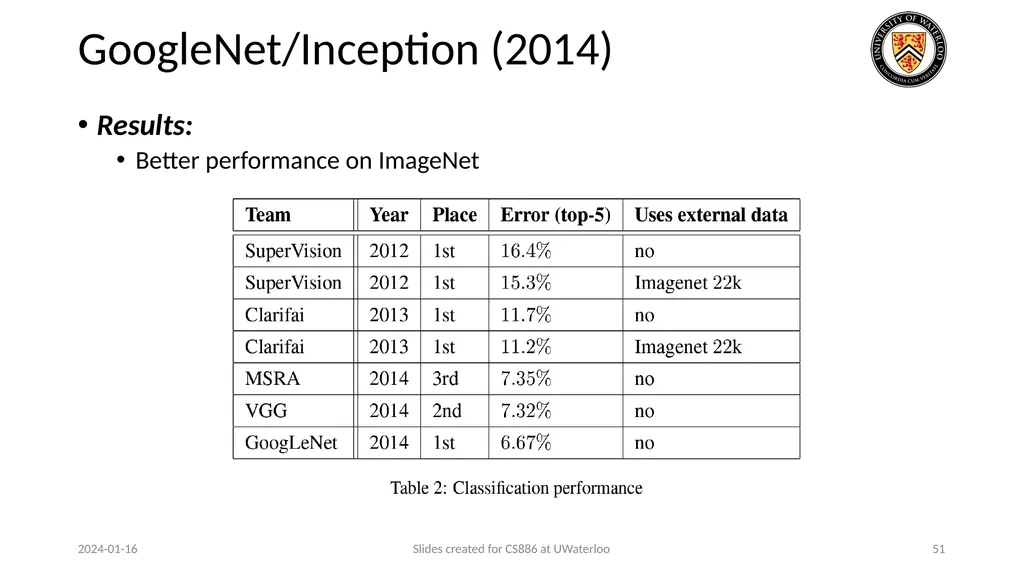
GoogleNet/Inception (2014) Results:
Better performance on ImageNet 2024-01-16 Slides created for CS886 at UWaterloo 51<br>
Better performance on ImageNet 2024-01-16 Slides created for CS886 at UWaterloo 51<br>
52
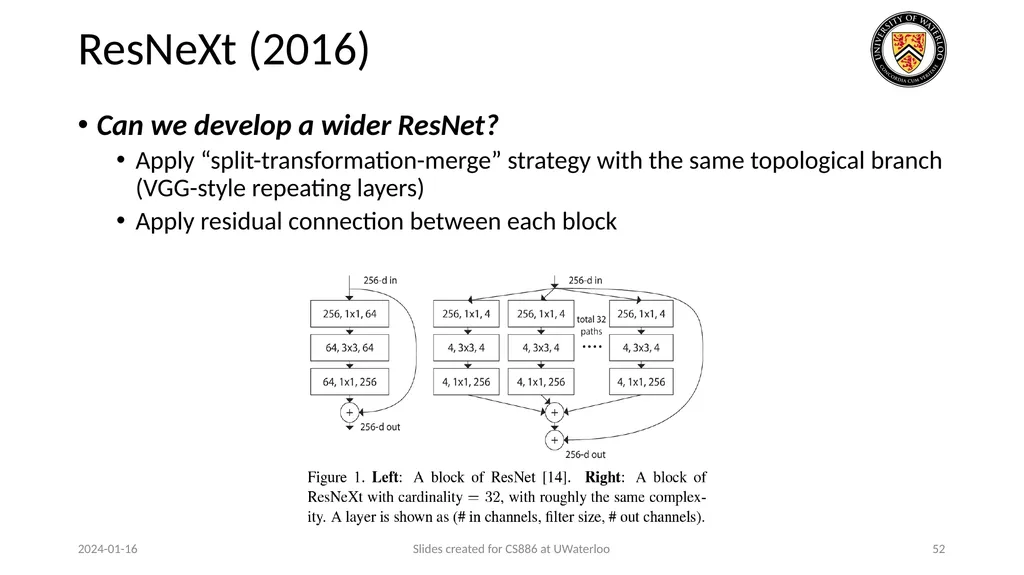
ResNeXt (2016) Can we develop a wider ResNet?
Apply “split-transformation-merge” strategy with the same topological branch (VGG-style repeating layers)
Apply residual connection between each block 2024-01-16 Slides created for CS886 at UWaterloo 52<br>
Apply “split-transformation-merge” strategy with the same topological branch (VGG-style repeating layers)
Apply residual connection between each block 2024-01-16 Slides created for CS886 at UWaterloo 52<br>
53
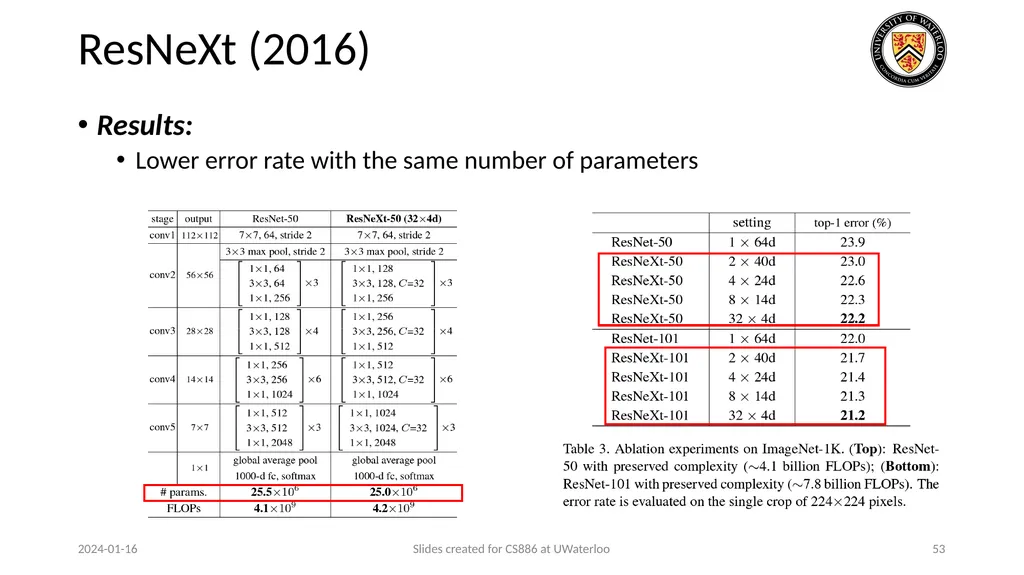
ResNeXt (2016) Results:
Lower error rate with the same number of parameters 2024-01-16 Slides created for CS886 at UWaterloo 53<br>
Lower error rate with the same number of parameters 2024-01-16 Slides created for CS886 at UWaterloo 53<br>
54
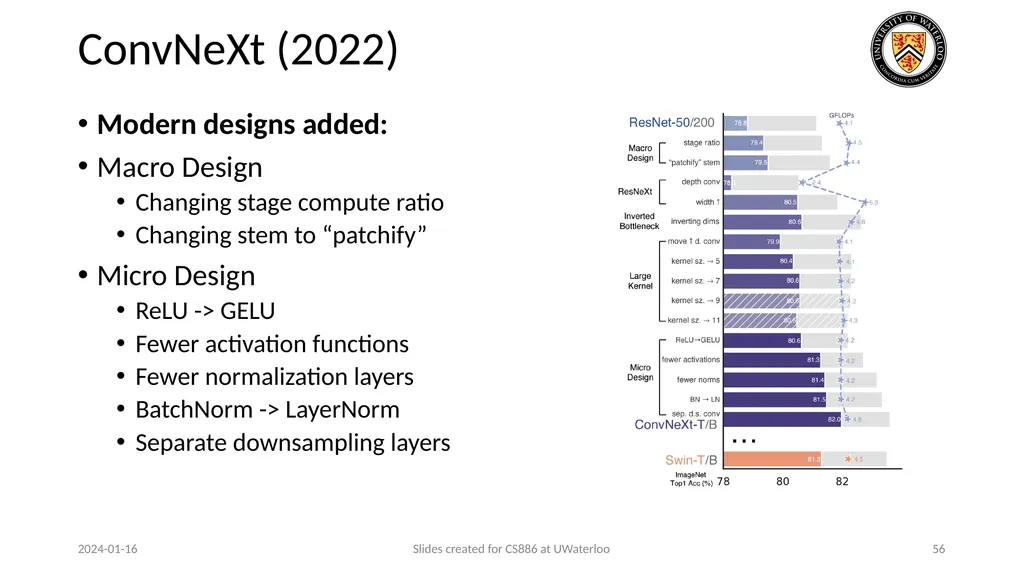
ConvNeXt (2022) To bridge the gap between the Conv Nets and ViT
ViT, Swin Transformer has been the SOTA visual model backbone
Is convolutional networks really not as good as transformer models?
Investigation
The author start with ResNet-50 and reimplement the CNN networks with modern designs
The results showing that ConvNeXt achieves beat the ViT models, again. 2024-01-16 Slides created for CS886 at UWaterloo 54<br>
ViT, Swin Transformer has been the SOTA visual model backbone
Is convolutional networks really not as good as transformer models?
Investigation
The author start with ResNet-50 and reimplement the CNN networks with modern designs
The results showing that ConvNeXt achieves beat the ViT models, again. 2024-01-16 Slides created for CS886 at UWaterloo 54<br>
55
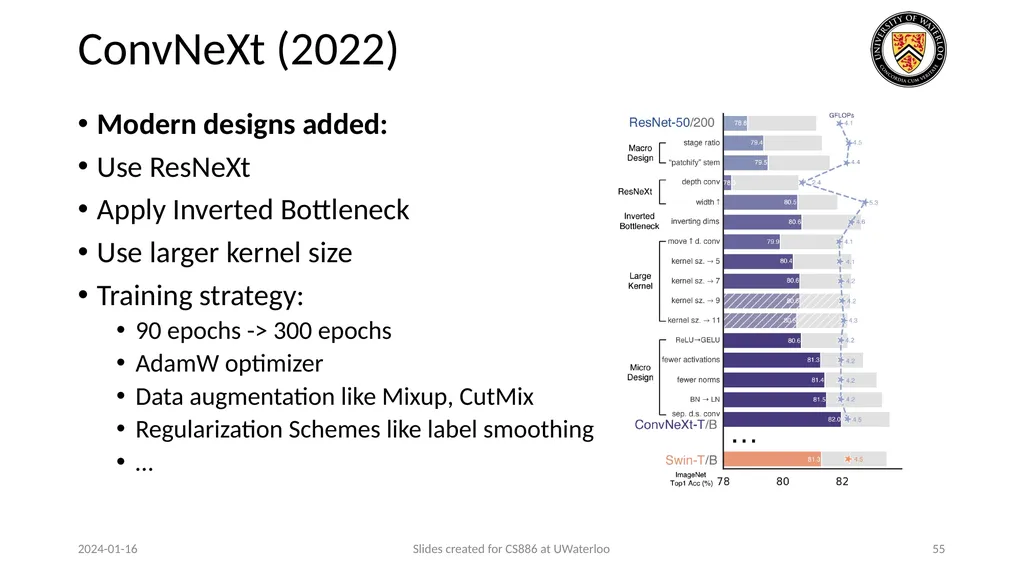
ConvNeXt (2022) 2024-01-16 Slides created for CS886 at UWaterloo 55 Modern designs added:
Use ResNeXt
Apply Inverted Bottleneck
Use larger kernel size
Training strategy:
90 epochs -> 300 epochs
AdamW optimizer
Data augmentation like Mixup, CutMix
Regularization Schemes like label smoothing
…<br>
Use ResNeXt
Apply Inverted Bottleneck
Use larger kernel size
Training strategy:
90 epochs -> 300 epochs
AdamW optimizer
Data augmentation like Mixup, CutMix
Regularization Schemes like label smoothing
…<br>
56
ConvNeXt (2022) 2024-01-16 Slides created for CS886 at UWaterloo 56 Modern designs added:
Macro Design
Changing stage compute ratio
Changing stem to “patchify”
Micro Design
ReLU -> GELU
Fewer activation functions
Fewer normalization layers
BatchNorm -> LayerNorm
Separate downsampling layers<br>
Macro Design
Changing stage compute ratio
Changing stem to “patchify”
Micro Design
ReLU -> GELU
Fewer activation functions
Fewer normalization layers
BatchNorm -> LayerNorm
Separate downsampling layers<br>
57
CNN for downstream applications Downstream tasks
Image-segmentation: U-Net
Object Detection: Yolo
…
CNNs that more cost-effective
MobileNet
SqueezeNet
… 2024-01-16 Slides created for CS886 at UWaterloo 57<br>
Image-segmentation: U-Net
Object Detection: Yolo
…
CNNs that more cost-effective
MobileNet
SqueezeNet
… 2024-01-16 Slides created for CS886 at UWaterloo 57<br>
58
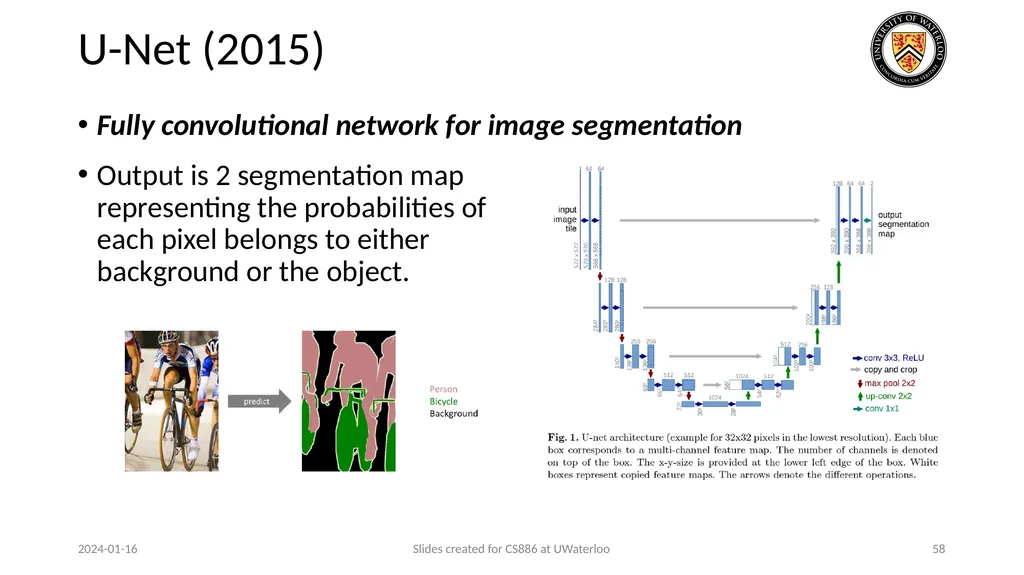
U-Net (2015) Fully convolutional network for image segmentation 2024-01-16 Slides created for CS886 at UWaterloo 58 Output is 2 segmentation map
representing the probabilities of
each pixel belongs to either background or the object.<br>
59
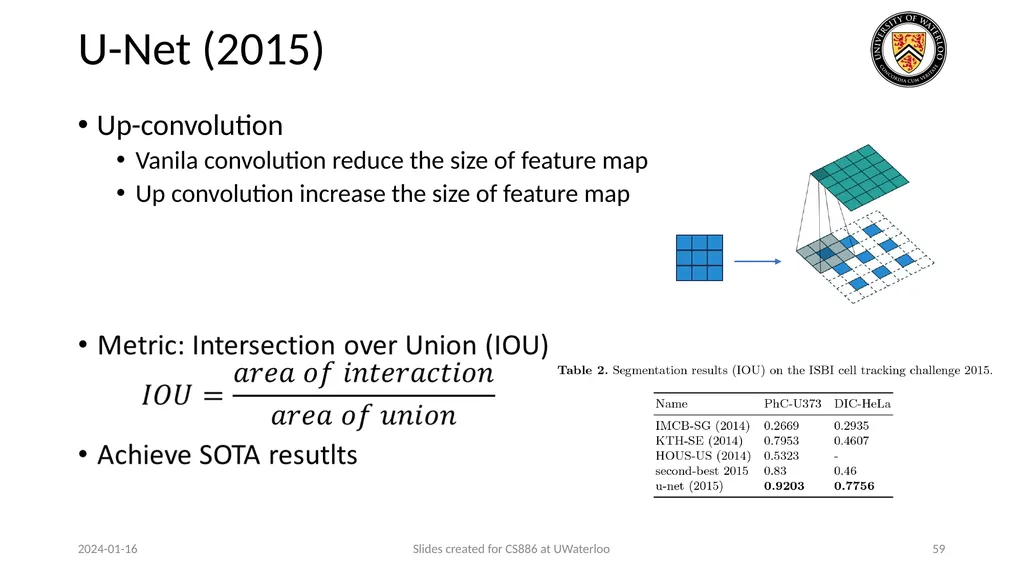
U-Net (2015) Up-convolution
Vanila convolution reduce the size of feature map
Up convolution increase the size of feature map 2024-01-16 Slides created for CS886 at UWaterloo 59<br>
Vanila convolution reduce the size of feature map
Up convolution increase the size of feature map 2024-01-16 Slides created for CS886 at UWaterloo 59<br>
60
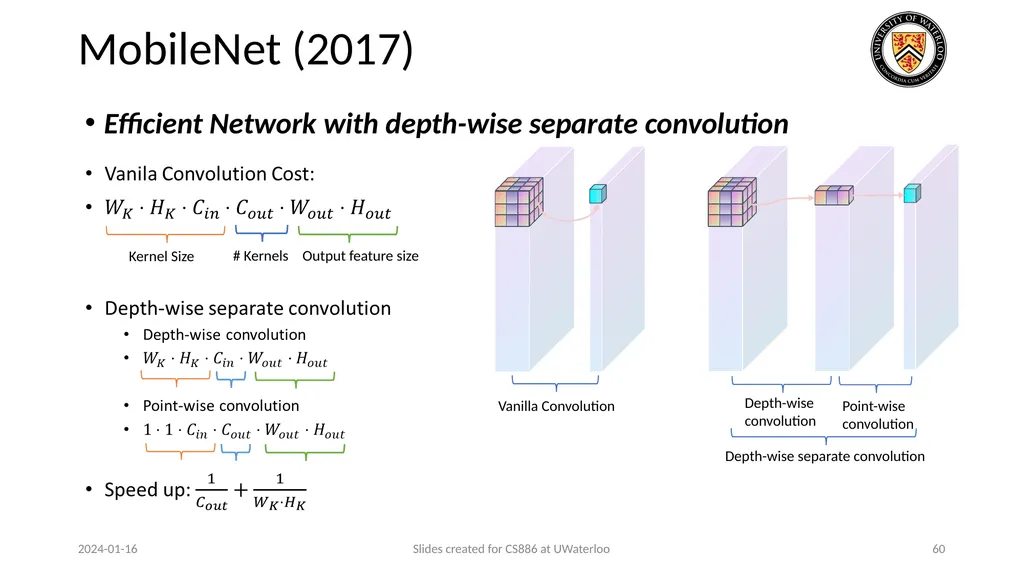
MobileNet (2017) 2024-01-16 Slides created for CS886 at UWaterloo 60 Vanilla Convolution Depth-wise separate convolution Depth-wise
convolution Point-wise
convolution Efficient Network with depth-wise separate convolution Kernel Size # Kernels Output feature size<br>
convolution Point-wise
convolution Efficient Network with depth-wise separate convolution Kernel Size # Kernels Output feature size<br>
61
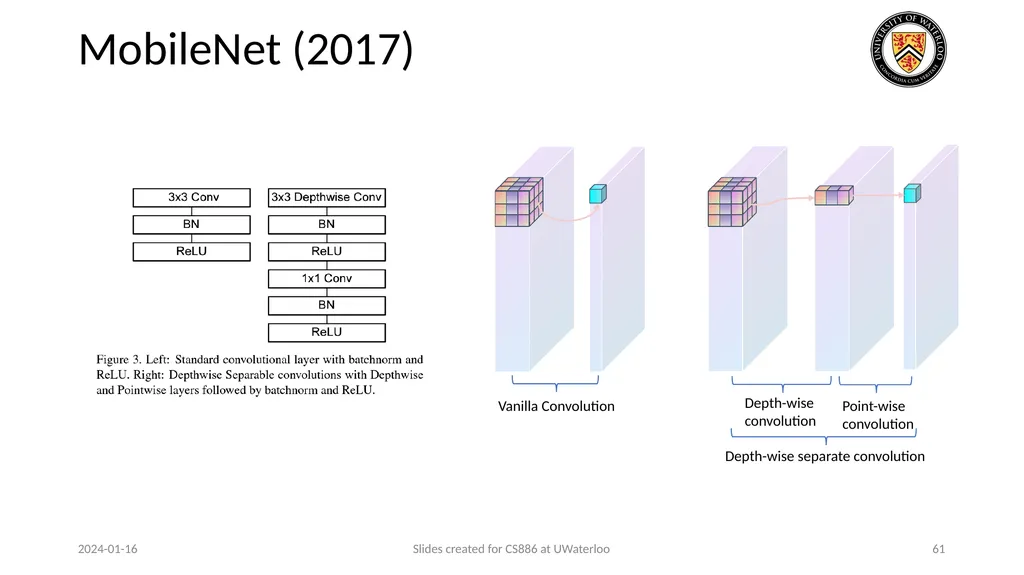
MobileNet (2017) 2024-01-16 Slides created for CS886 at UWaterloo 61 Vanilla Convolution Depth-wise separate convolution Depth-wise
convolution Point-wise
convolution<br>
convolution Point-wise
convolution<br>
62
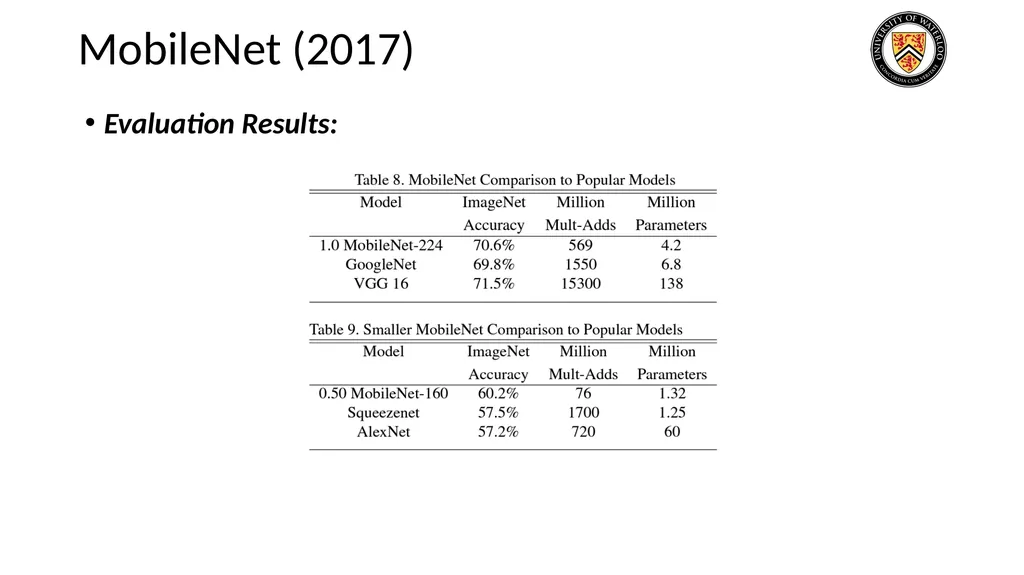
MobileNet (2017) Evaluation Results:<br>
63
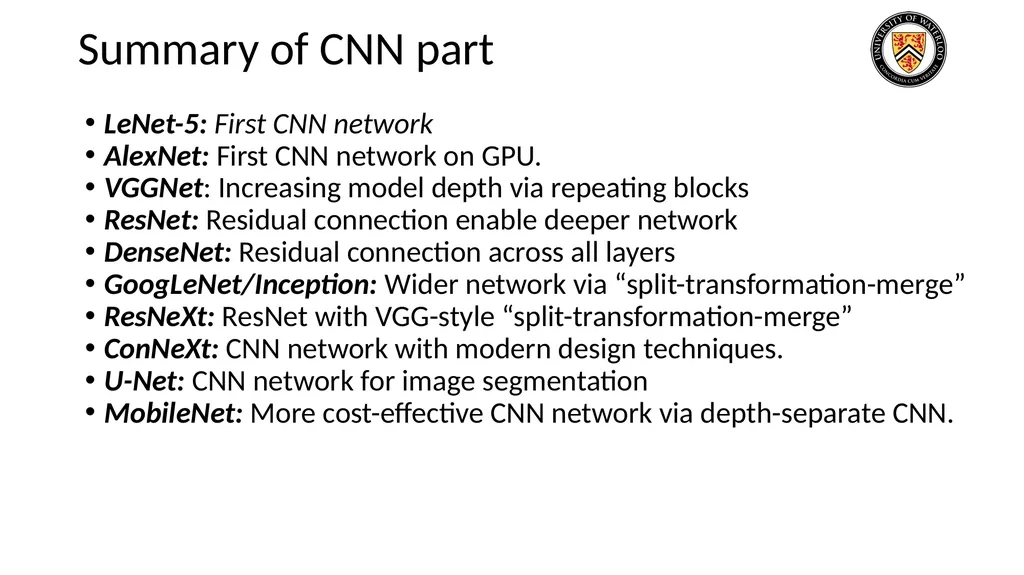
Summary of CNN part LeNet-5: First CNN network
AlexNet: First CNN network on GPU.
VGGNet: Increasing model depth via repeating blocks
ResNet: Residual connection enable deeper network
DenseNet: Residual connection across all layers
GoogLeNet/Inception: Wider network via “split-transformation-merge”
ResNeXt: ResNet with VGG-style “split-transformation-merge”
ConNeXt: CNN network with modern design techniques.
U-Net: CNN network for image segmentation
MobileNet: More cost-effective CNN network via depth-separate CNN.<br>
AlexNet: First CNN network on GPU.
VGGNet: Increasing model depth via repeating blocks
ResNet: Residual connection enable deeper network
DenseNet: Residual connection across all layers
GoogLeNet/Inception: Wider network via “split-transformation-merge”
ResNeXt: ResNet with VGG-style “split-transformation-merge”
ConNeXt: CNN network with modern design techniques.
U-Net: CNN network for image segmentation
MobileNet: More cost-effective CNN network via depth-separate CNN.<br>
64
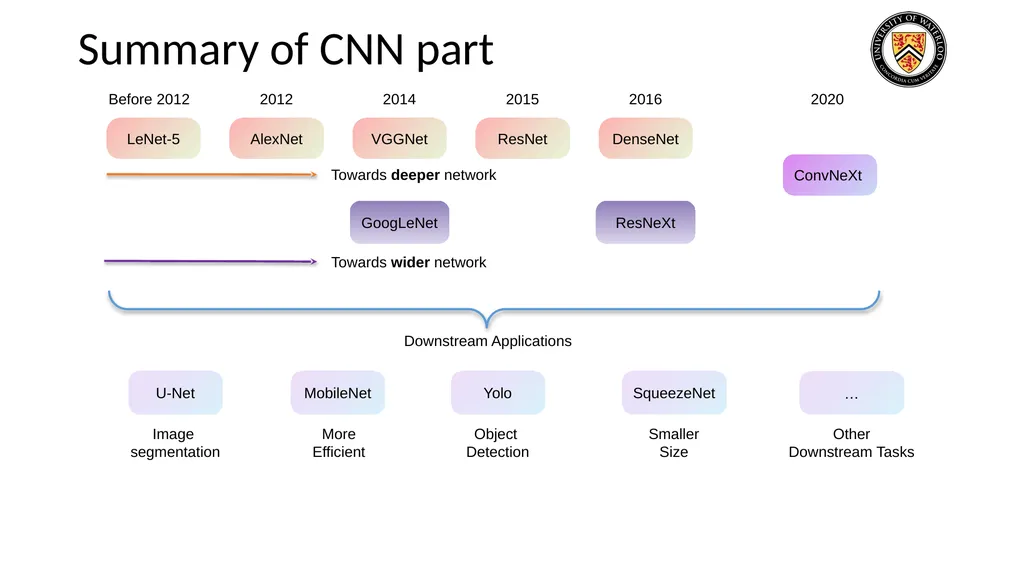
Summary of CNN part LeNet-5 AlexNet VGGNet ResNet DenseNet Before 2012 2012 2014 2015 2020 2016 ConvNeXt GoogLeNet ResNeXt U-Net Yolo MobileNet Image
segmentation Object
Detection More Efficient SqueezeNet Smaller Size … Other Downstream Tasks Towards deeper network Towards wider network Downstream Applications<br>
segmentation Object
Detection More Efficient SqueezeNet Smaller Size … Other Downstream Tasks Towards deeper network Towards wider network Downstream Applications<br>