
Lecture 4/Term 2: Human Nature, Commerce and
MS
Published · 19 slides · 0 views
1 / 1






Description
Lecture 4Term 2: Human Nature, Commerce and Corruption: The Invention of the Homo Economicus Friedrich Hayek 1899-1992 Austrian, later British economist and philosopher, best known for his defense of classical liberalism; also called
Related Topics
Share
Embed code
Download this presentation From Below
"Lecture 4/Term 2: Human Nature, Commerce and" is the property of its rightful owner. Permission is granted to download and print the materials on this website for personal, non-commercial use only, and to display it on your personal computer provided you do not modify the materials and that you retain all copyright notices contained in the materials. By downloading content from our website, you accept the terms of this agreement.
Presentation Transcript
01
Lecture 4/Term 2:
Human Nature, Commerce and Corruption: The Invention of the
'Homo Economicus’<br>
Human Nature, Commerce and Corruption: The Invention of the
'Homo Economicus’<br>
02
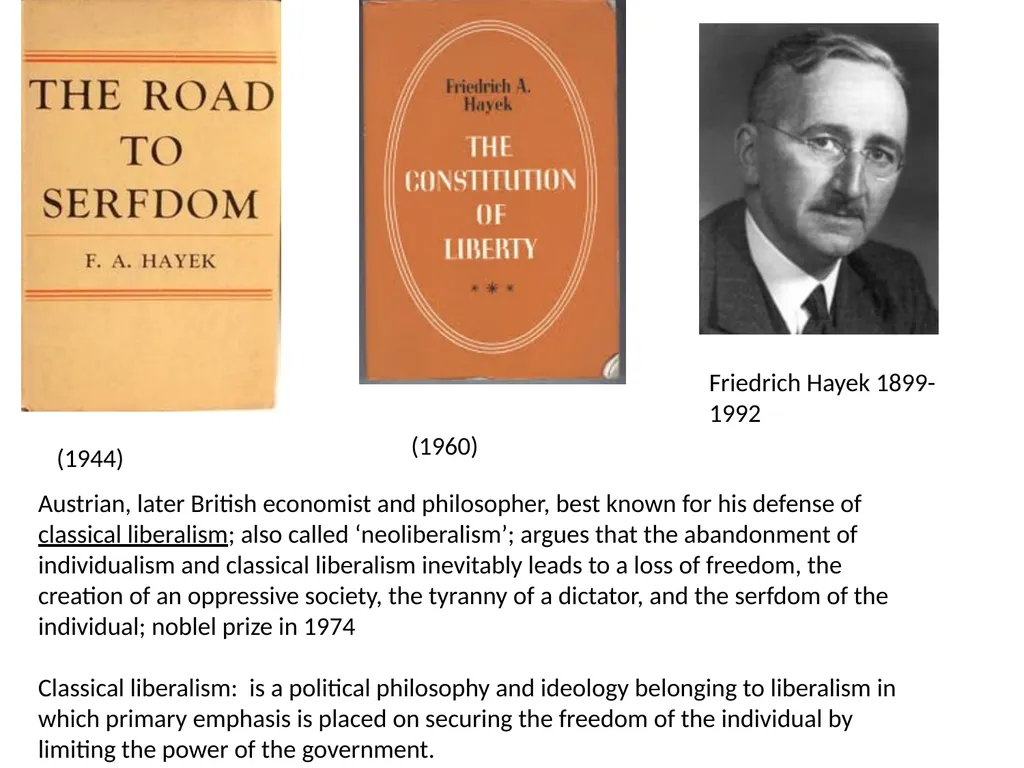
Friedrich Hayek 1899-1992 Austrian, later British economist and philosopher, best known for his defense of classical liberalism; also called ‘neoliberalism’; argues that the abandonment of individualism and classical liberalism inevitably leads to a loss of freedom, the creation of an oppressive society, the tyranny of a dictator, and the serfdom of the individual; noblel prize in 1974
Classical liberalism: is a political philosophy and ideology belonging to liberalism in which primary emphasis is placed on securing the freedom of the individual by limiting the power of the government. (1944) (1960)<br>
Classical liberalism: is a political philosophy and ideology belonging to liberalism in which primary emphasis is placed on securing the freedom of the individual by limiting the power of the government. (1944) (1960)<br>
03
“Adam Smith’s decisive contribution [to the history of liberalism] was the account of a self-generating order which formed spontaneously if the individuals were
restrained by appropriate rules of law. His Inquiry into the Nature and Causes of the Wealth of Nations marks perhaps more than any other single work the beginning of the development of modern liberalism. It made people understand that those restrictions on the powers of government which had originated from sheer distrust of all arbitrary power had become the chief cause of Britain’s economic prosperity.”
“homo economicus”, or economic man, is the concept in many current economic theories portraying humans as consistently rational and narrowly self-interested agents who usually pursue their subjectively-defined ends optimally.
(term first used in late nineteenth century) Hayek on Smith whom he celebrates as the inventor of economic liberalism:<br>
restrained by appropriate rules of law. His Inquiry into the Nature and Causes of the Wealth of Nations marks perhaps more than any other single work the beginning of the development of modern liberalism. It made people understand that those restrictions on the powers of government which had originated from sheer distrust of all arbitrary power had become the chief cause of Britain’s economic prosperity.”
“homo economicus”, or economic man, is the concept in many current economic theories portraying humans as consistently rational and narrowly self-interested agents who usually pursue their subjectively-defined ends optimally.
(term first used in late nineteenth century) Hayek on Smith whom he celebrates as the inventor of economic liberalism:<br>
04
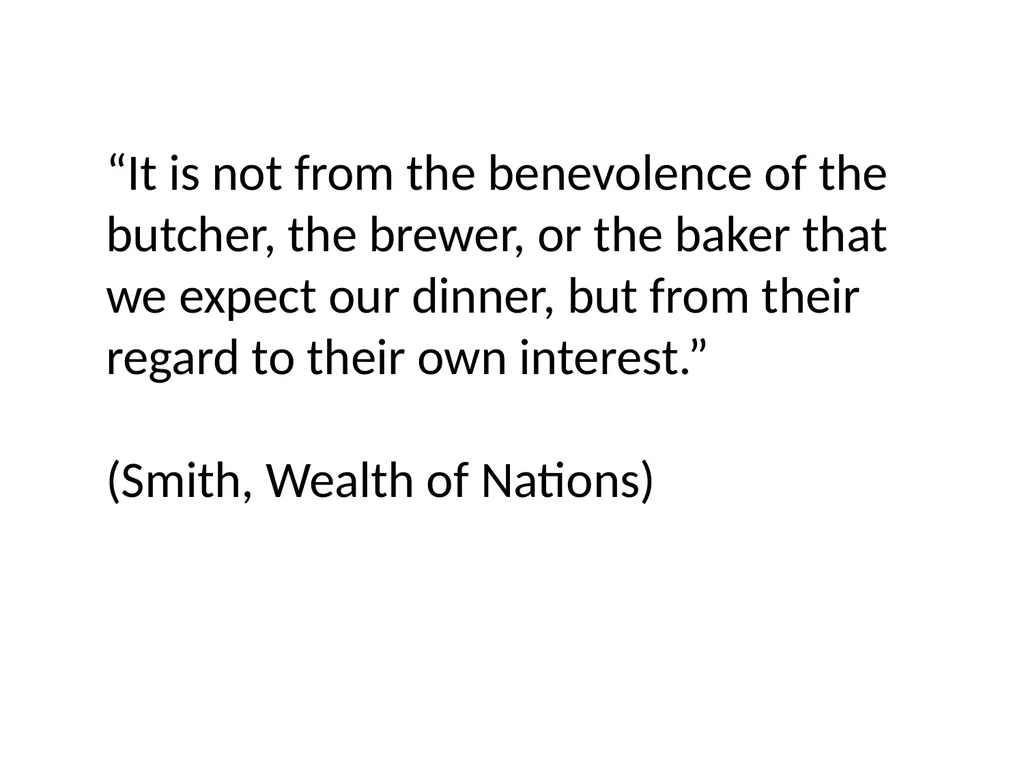
“It is not from the benevolence of the butcher, the brewer, or the baker that we expect our dinner, but from their regard to their own interest.”
(Smith, Wealth of Nations)<br>
(Smith, Wealth of Nations)<br>
05
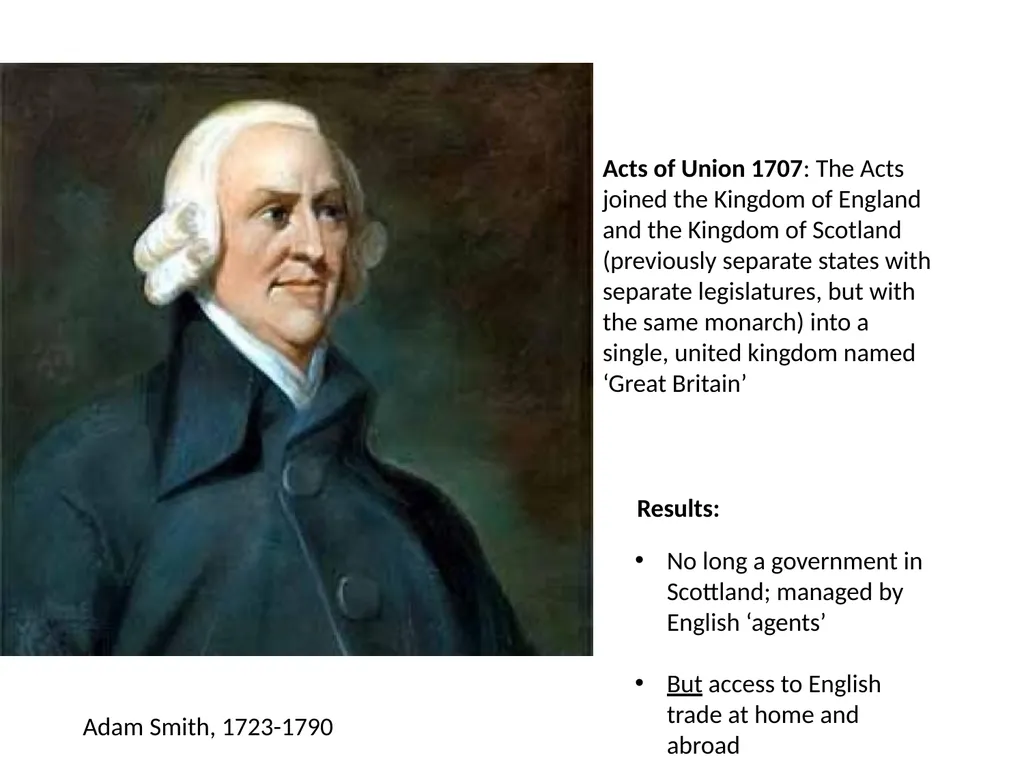
Adam Smith, Adam Smith, 1723-1790 Acts of Union 1707: The Acts joined the Kingdom of England and the Kingdom of Scotland (previously separate states with separate legislatures, but with the same monarch) into a single, united kingdom named ‘Great Britain’ No long a government in Scottland; managed by English ‘agents’
But access to English trade at home and abroad Results:<br>
But access to English trade at home and abroad Results:<br>
06
Glasgow university around 1750<br>
07
Francis Hutcheson, 1694-1747, moral philosopher Humans have benevolent AND selfish passions and affections ; he aimed at a moral theory that would yield up a very different understanding of the functions and duties of government and society<br>
08
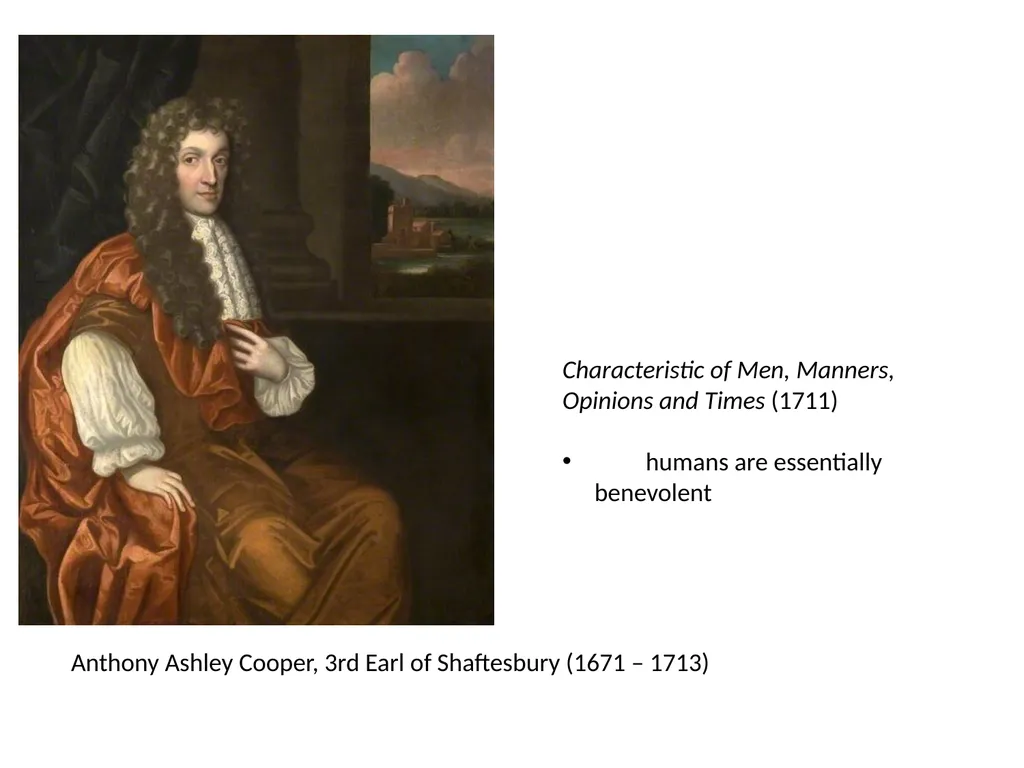
Anthony Ashley Cooper, 3rd Earl of Shaftesbury (1671 – 1713) Characteristic of Men, Manners, Opinions and Times (1711)
humans are essentially benevolent<br>
humans are essentially benevolent<br>
09
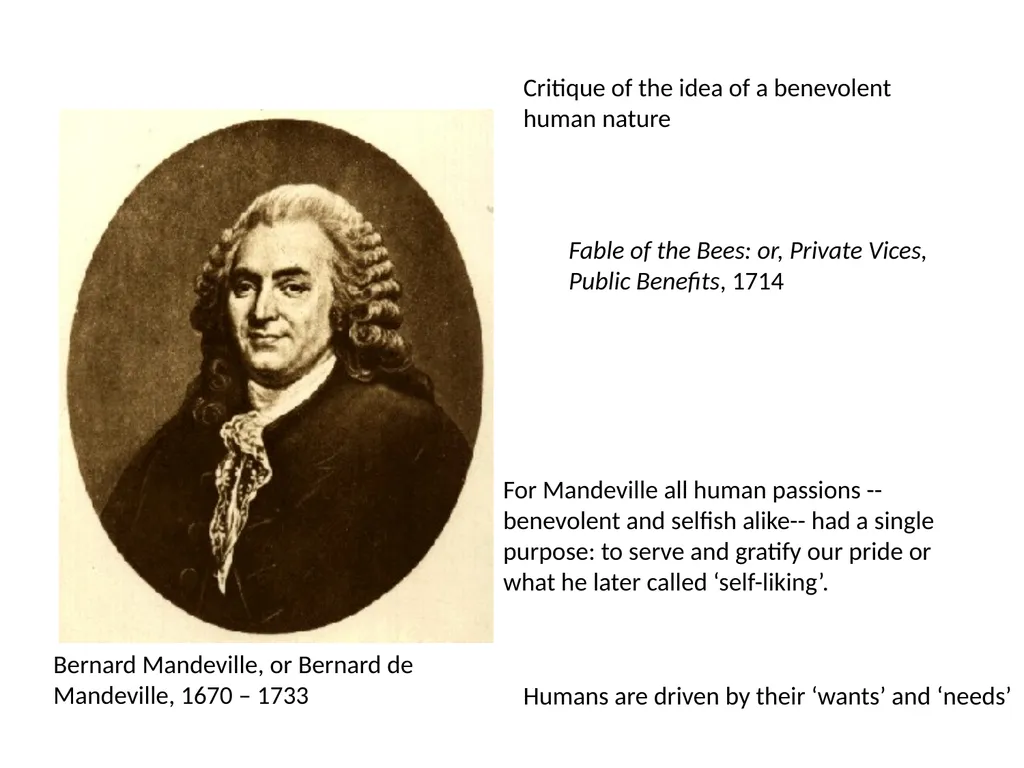
Bernard Mandeville, or Bernard de Mandeville, 1670 – 1733 Fable of the Bees: or, Private Vices, Public Benefits, 1714 For Mandeville all human passions --benevolent and selfish alike-- had a single purpose: to serve and gratify our pride or what he later called ‘self-liking’. Humans are driven by their ‘wants’ and ‘needs’ Critique of the idea of a benevolent human nature<br>
10
Francis Hutcheson, 1694-1747, moral philosopher Advocated notion of an innate ‘moral sense’ that would regulate citizens daily actions and behaviour, strengthened by the love they felt for the public and their creator.<br>
11
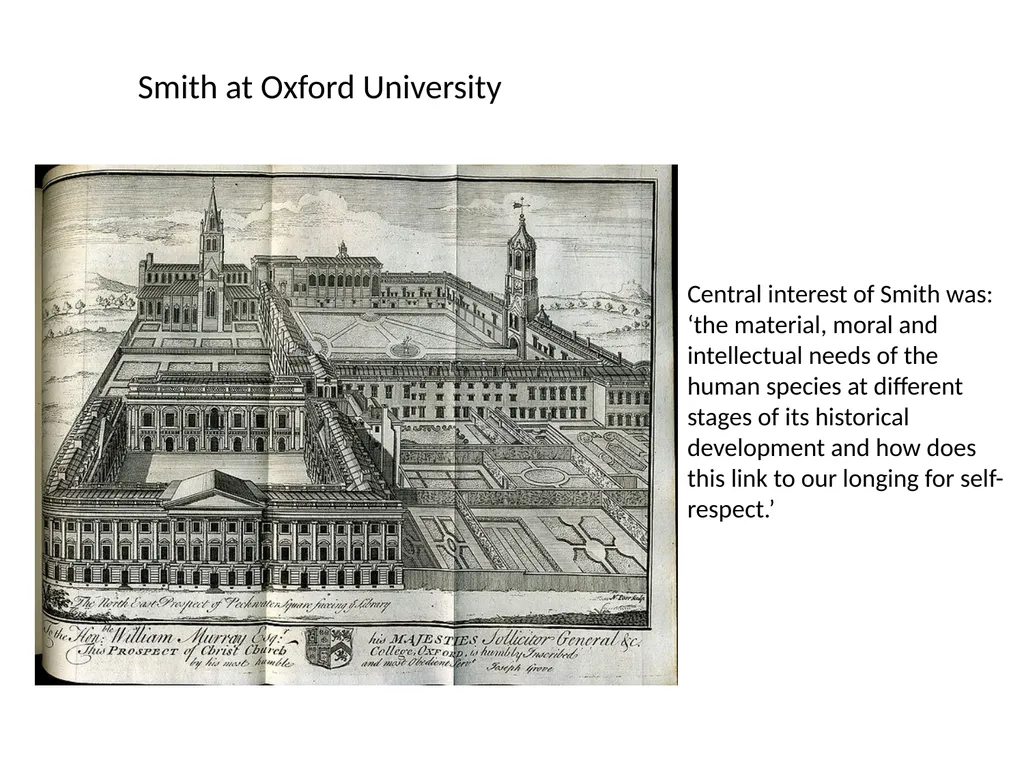
Smith at Oxford University Central interest of Smith was:
‘the material, moral and intellectual needs of the human species at different stages of its historical development and how does this link to our longing for self-respect.’<br>
‘the material, moral and intellectual needs of the human species at different stages of its historical development and how does this link to our longing for self-respect.’<br>
12
Treatise of Human Nature Being an Attempt to Introduce the Experimental Method of Reasoning into Moral Subjects’ (1738) David Hume, 1711-1776 Essays Moral, Political and Literary (1741-41)
An Enquiry Concerning Human Understanding (1748)
Political Discourses (1751)<br>
An Enquiry Concerning Human Understanding (1748)
Political Discourses (1751)<br>
13
‘Sympathy’ as a glue of all human action and interaction (which are, so Hume assumes, universal and transhistorical):
‘No quality of human nature is more remarkable, both in itself and in its consequences, than that propensity we have to sympathize with others, and to receive by communication their inclinations and sentiments, however different from, or even contrary to our own.
This is not only conspicuous in children, who implicitly embrace every opinion proposed to them; but also in men of the greatest judgment and understanding, who find it very difficult to follow their own reason or inclination, in opposition to that of their friends and daily companions. To this principle we ought to ascribe the great uniformity we may observe in humans and turn of thinking of those of the same nation; and it is much more probable, that this resemblance arises from sympathy, than from any influence of the soil and climate, which, though they continue invariably the same, are not able to preserve the character of a nation the same for a century together.’
(Hume, Treatise of Human Nature, p. 316)<br>
‘No quality of human nature is more remarkable, both in itself and in its consequences, than that propensity we have to sympathize with others, and to receive by communication their inclinations and sentiments, however different from, or even contrary to our own.
This is not only conspicuous in children, who implicitly embrace every opinion proposed to them; but also in men of the greatest judgment and understanding, who find it very difficult to follow their own reason or inclination, in opposition to that of their friends and daily companions. To this principle we ought to ascribe the great uniformity we may observe in humans and turn of thinking of those of the same nation; and it is much more probable, that this resemblance arises from sympathy, than from any influence of the soil and climate, which, though they continue invariably the same, are not able to preserve the character of a nation the same for a century together.’
(Hume, Treatise of Human Nature, p. 316)<br>
14
Central claims:
Our moral sensibility was a set of acquired sentiments that collectively shaped the understanding and personality of the individual and enabled him or her to function as a sociable agent with a respect for the principles of morality, justice and politics.
all of these sentiments were built on the sense of justice every single individual must acquire if he or she was to live sociably.
Governments have to provide framework of justice that allow a peaceful interchange between people; progress only possible in stable framework; avoidance of all interruptions
In sum: Hume constructed a philosophy that was built on the belief that the progress of society depended on the efforts of individuals to better their lot. They are driven by a ‘natural’ urge and function according to needs.<br>
Our moral sensibility was a set of acquired sentiments that collectively shaped the understanding and personality of the individual and enabled him or her to function as a sociable agent with a respect for the principles of morality, justice and politics.
all of these sentiments were built on the sense of justice every single individual must acquire if he or she was to live sociably.
Governments have to provide framework of justice that allow a peaceful interchange between people; progress only possible in stable framework; avoidance of all interruptions
In sum: Hume constructed a philosophy that was built on the belief that the progress of society depended on the efforts of individuals to better their lot. They are driven by a ‘natural’ urge and function according to needs.<br>
15
The Theory of Moral Sentiment (1759):
attempt to develop a coherent and plausible account by which we learn the principles of morality from our experience of common life without descending into wanton scepticism like Mandeville. Central concept is ‘sympathy’:
Smith great achievement is that he turned sympathy into the governing principle of a theory of sociability on which a theory of commerce could be based.
‘[The] greatest human happiness arises from the consciousness of being beloved’<br>
attempt to develop a coherent and plausible account by which we learn the principles of morality from our experience of common life without descending into wanton scepticism like Mandeville. Central concept is ‘sympathy’:
Smith great achievement is that he turned sympathy into the governing principle of a theory of sociability on which a theory of commerce could be based.
‘[The] greatest human happiness arises from the consciousness of being beloved’<br>
16
Distribution of wealth in society depends on our innate sympathy with the rich:
‘It is this deception which rouses and keeps in continual motion the industry of mankind. It is this which first prompted them to cultivate the ground, to build houses, to found cities and commonwealths, and to invent and improve all the sciences and arts, which ennoble and embellish human life; which have entirely changed the whole face of the globe, have turned the rude forests of nature into agreeable and fertile plains, and made the trackless and barren ocean a new fund of subsistence, and the great high road of communication to the different nations of the earth.’
‘led by an invisible hand to make nearly the same distribution of the necessaries of life, which would have been made, had the earth been divided into equal portions among its inhabitants’.
(the trickle-down effect): Sympathy stands at the core of all human action, including the accumulation and distribution of wealth:<br>
‘It is this deception which rouses and keeps in continual motion the industry of mankind. It is this which first prompted them to cultivate the ground, to build houses, to found cities and commonwealths, and to invent and improve all the sciences and arts, which ennoble and embellish human life; which have entirely changed the whole face of the globe, have turned the rude forests of nature into agreeable and fertile plains, and made the trackless and barren ocean a new fund of subsistence, and the great high road of communication to the different nations of the earth.’
‘led by an invisible hand to make nearly the same distribution of the necessaries of life, which would have been made, had the earth been divided into equal portions among its inhabitants’.
(the trickle-down effect): Sympathy stands at the core of all human action, including the accumulation and distribution of wealth:<br>
17
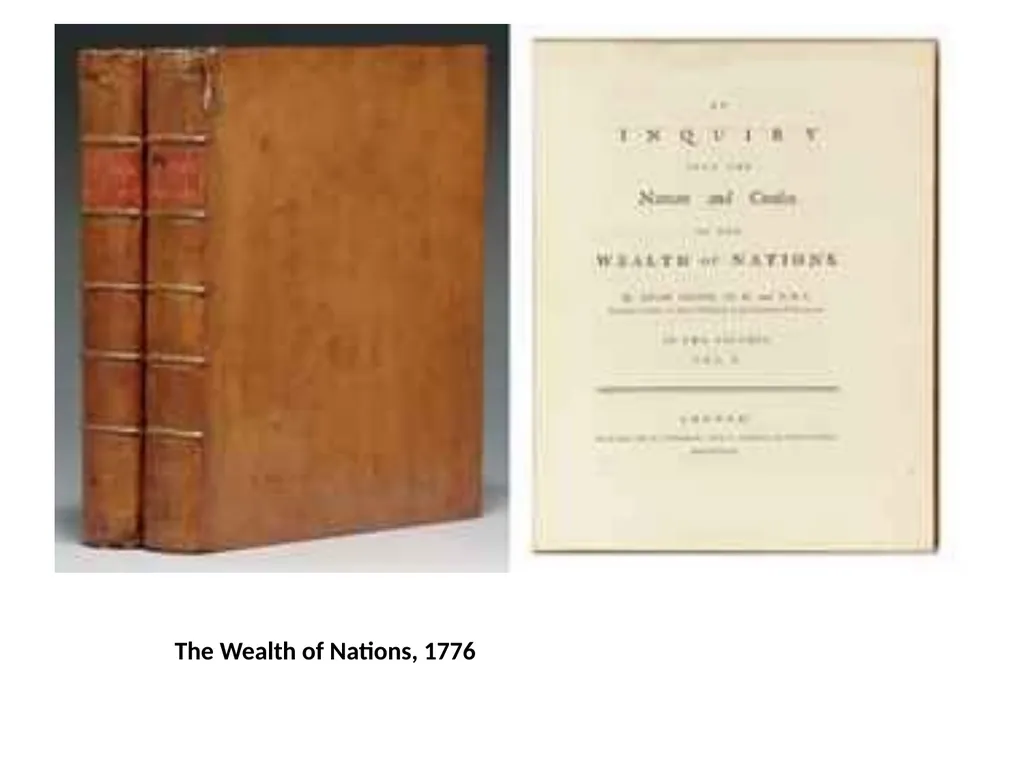
The Wealth of Nations, 1776<br>
18
The Wealth of Nations fights on two fronts:
Mercantilism: an economic theory and practice, dominant in Europe from the 16th to the 18th century which promoted the idea that a nation’s wealth was the amount of money or gold that it possessed. This implied that to become richer, a nation needed to sell as much as possible to others, in order to get as much coin as possible in return; and it needed to buy as little as possible from others, in order to prevent its cash reserves leaking abroad. The view of trade led to the creation of a vast network of important tarrifs, export subsidies, taxes and preference for domestic industries, all designed to limit imports and promote exports. It is the economic counterpart of political absolutism.
Physiocracy: (from the Greek for ‘Government of Nature’): an economic theory developed by a group of 18th-century enlightened French economists who believed that the wealth of nations was derived solely from the value of "land agriculture" or "land development" and that agricultural products should be highly priced. Moreover, it was argued that manufactures work was unproductive. The movement was particularly dominated by François Quesnay (1694–1774) and Anne-Robert-Jacques Turgot (1727–1781)<br>
Mercantilism: an economic theory and practice, dominant in Europe from the 16th to the 18th century which promoted the idea that a nation’s wealth was the amount of money or gold that it possessed. This implied that to become richer, a nation needed to sell as much as possible to others, in order to get as much coin as possible in return; and it needed to buy as little as possible from others, in order to prevent its cash reserves leaking abroad. The view of trade led to the creation of a vast network of important tarrifs, export subsidies, taxes and preference for domestic industries, all designed to limit imports and promote exports. It is the economic counterpart of political absolutism.
Physiocracy: (from the Greek for ‘Government of Nature’): an economic theory developed by a group of 18th-century enlightened French economists who believed that the wealth of nations was derived solely from the value of "land agriculture" or "land development" and that agricultural products should be highly priced. Moreover, it was argued that manufactures work was unproductive. The movement was particularly dominated by François Quesnay (1694–1774) and Anne-Robert-Jacques Turgot (1727–1781)<br>
19
Central claims:
Regulation on commerce are ill-founded and counterproductive – against mercantilism -- he focuses on agriculture and commerce.
Real measure of a nation’s wealth is the stream of goods and services that it creates. – invents ‘gross domestic product; the nations productive capacities needed to be set free.
Productive capacity rests on the division of labour and the accumulation of capital that makes it possible. (more efficient by breaking production down into small task, each undertaken by a specialist hand).
Future income depends upon this capital accumulation.
This system of accumulation is more or less automatic. Where things are scarce, people are prepared to pay more for them: there is more profit in supplying hem, so producers invest more capital in order to produce more. Where there is a glut, prices and profits are low and producers switch their capital and enterprise elsewhere. Industry thus remains focused on the nation’s most important need, without the need for central direction.
Different stages of economic progress produce different governmental institutions. (ecomomic develoment linked to the stage theory of cilivisation)<br>
Regulation on commerce are ill-founded and counterproductive – against mercantilism -- he focuses on agriculture and commerce.
Real measure of a nation’s wealth is the stream of goods and services that it creates. – invents ‘gross domestic product; the nations productive capacities needed to be set free.
Productive capacity rests on the division of labour and the accumulation of capital that makes it possible. (more efficient by breaking production down into small task, each undertaken by a specialist hand).
Future income depends upon this capital accumulation.
This system of accumulation is more or less automatic. Where things are scarce, people are prepared to pay more for them: there is more profit in supplying hem, so producers invest more capital in order to produce more. Where there is a glut, prices and profits are low and producers switch their capital and enterprise elsewhere. Industry thus remains focused on the nation’s most important need, without the need for central direction.
Different stages of economic progress produce different governmental institutions. (ecomomic develoment linked to the stage theory of cilivisation)<br>