
Lecture 5 Electron and Hole concentration at
OM
Published · 14 slides · 0 views

1 / 1

Description
Lecture 5 Electron and Hole concentration at equilibrium 1 Recap In last lecture temperature effect on extrinsic semiconductor was discussed . Both donar and acceptor ionization shows Freeze out region at low temperature. At moderate
Related Topics
Share
Embed code
Download this presentation From Below
"Lecture 5 Electron and Hole concentration at" is the property of its rightful owner. Permission is granted to download and print the materials on this website for personal, non-commercial use only, and to display it on your personal computer provided you do not modify the materials and that you retain all copyright notices contained in the materials. By downloading content from our website, you accept the terms of this agreement.
Presentation Transcript
01
Lecture 5 Electron and Hole concentration at equilibrium 1<br>
02
Recap In last lecture temperature effect on extrinsic semiconductor was discussed .
Both donar and acceptor ionization shows Freeze out region at low temperature.
At moderate temperature all donar and acceptor atoms are ionized
At very high temperatures extrinsic semiconductor becomes intrinsic due to equal number of electrons and holes are existing there. 2<br>
Both donar and acceptor ionization shows Freeze out region at low temperature.
At moderate temperature all donar and acceptor atoms are ionized
At very high temperatures extrinsic semiconductor becomes intrinsic due to equal number of electrons and holes are existing there. 2<br>
03
Charge Carriers in Semiconductors Current is the rate at which charge flows.
In a semiconductor, two types of charge carrier, the electron and the hole, can contribute to a current.
Since the current in a semiconductor is determined largely by the number of electrons in the conduction band
And the number of holes in the valence band, an important characteristic of the semiconductor is the density of these charge carriers. 3<br>
In a semiconductor, two types of charge carrier, the electron and the hole, can contribute to a current.
Since the current in a semiconductor is determined largely by the number of electrons in the conduction band
And the number of holes in the valence band, an important characteristic of the semiconductor is the density of these charge carriers. 3<br>
04
Density of states The density of states (DOS) is essentially the number of different states at a particular energy level that electrons are allowed to occupy, i.e. the number of electron states per unit volume per unit energy. The units are J−1 m−3 or eV−1 cm−3 and it provides information on how the energy states are distributed in a given solid. 4<br>
05
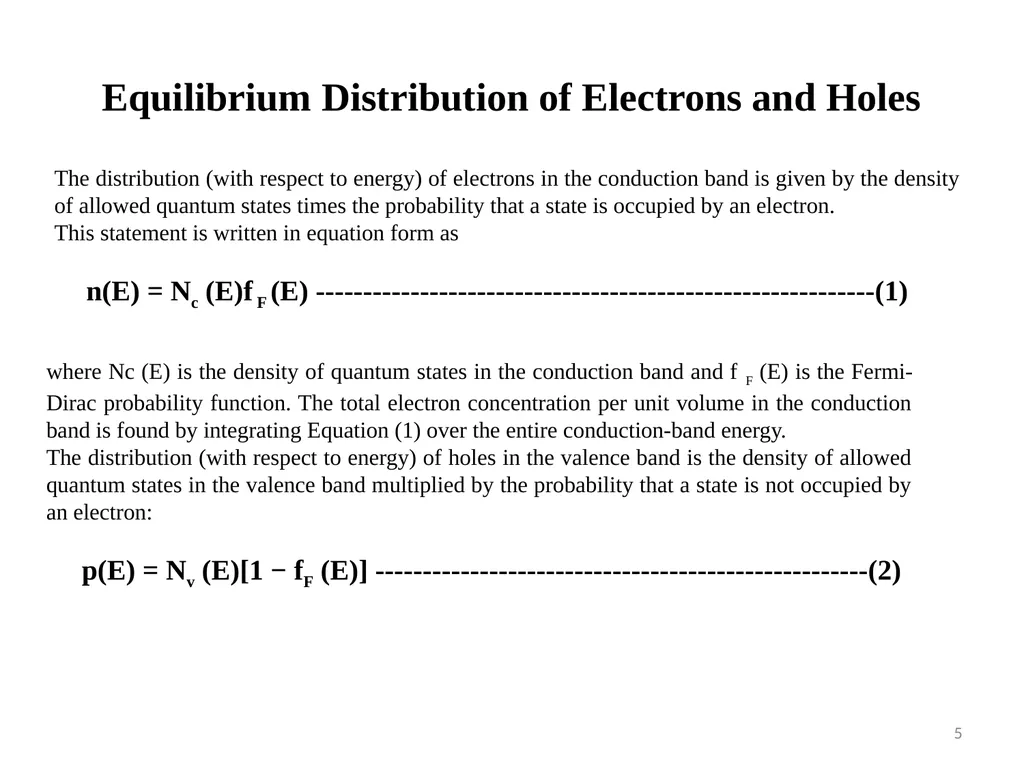
Equilibrium Distribution of Electrons and Holes The distribution (with respect to energy) of electrons in the conduction band is given by the density of allowed quantum states times the probability that a state is occupied by an electron.
This statement is written in equation form as
n(E) = Nc (E)f F (E) -----------------------------------------------------------(1) where Nc (E) is the density of quantum states in the conduction band and f F (E) is the Fermi-Dirac probability function. The total electron concentration per unit volume in the conduction band is found by integrating Equation (1) over the entire conduction-band energy.
The distribution (with respect to energy) of holes in the valence band is the density of allowed quantum states in the valence band multiplied by the probability that a state is not occupied by an electron:
p(E) = Nv (E)[1 − fF (E)] ----------------------------------------------------(2) 5<br>
This statement is written in equation form as
n(E) = Nc (E)f F (E) -----------------------------------------------------------(1) where Nc (E) is the density of quantum states in the conduction band and f F (E) is the Fermi-Dirac probability function. The total electron concentration per unit volume in the conduction band is found by integrating Equation (1) over the entire conduction-band energy.
The distribution (with respect to energy) of holes in the valence band is the density of allowed quantum states in the valence band multiplied by the probability that a state is not occupied by an electron:
p(E) = Nv (E)[1 − fF (E)] ----------------------------------------------------(2) 5<br>
06
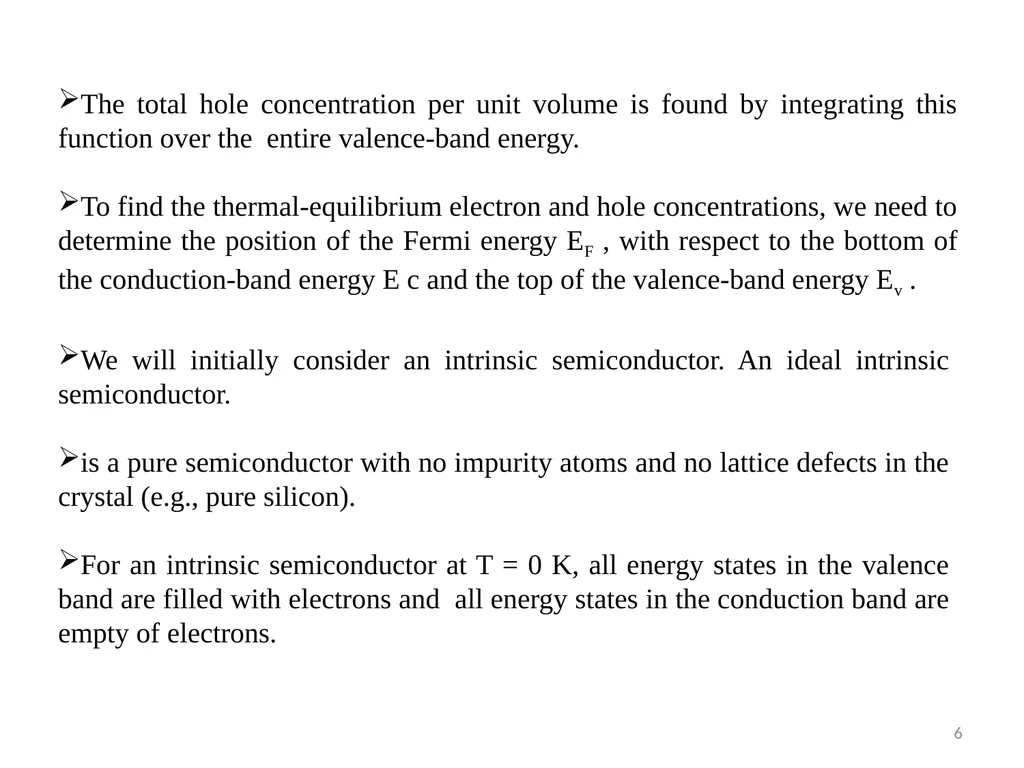
The total hole concentration per unit volume is found by integrating this function over the entire valence-band energy.
To find the thermal-equilibrium electron and hole concentrations, we need to determine the position of the Fermi energy EF , with respect to the bottom of the conduction-band energy E c and the top of the valence-band energy Ev . We will initially consider an intrinsic semiconductor. An ideal intrinsic semiconductor.
is a pure semiconductor with no impurity atoms and no lattice defects in the crystal (e.g., pure silicon).
For an intrinsic semiconductor at T = 0 K, all energy states in the valence band are filled with electrons and all energy states in the conduction band are empty of electrons. 6<br>
To find the thermal-equilibrium electron and hole concentrations, we need to determine the position of the Fermi energy EF , with respect to the bottom of the conduction-band energy E c and the top of the valence-band energy Ev . We will initially consider an intrinsic semiconductor. An ideal intrinsic semiconductor.
is a pure semiconductor with no impurity atoms and no lattice defects in the crystal (e.g., pure silicon).
For an intrinsic semiconductor at T = 0 K, all energy states in the valence band are filled with electrons and all energy states in the conduction band are empty of electrons. 6<br>
07
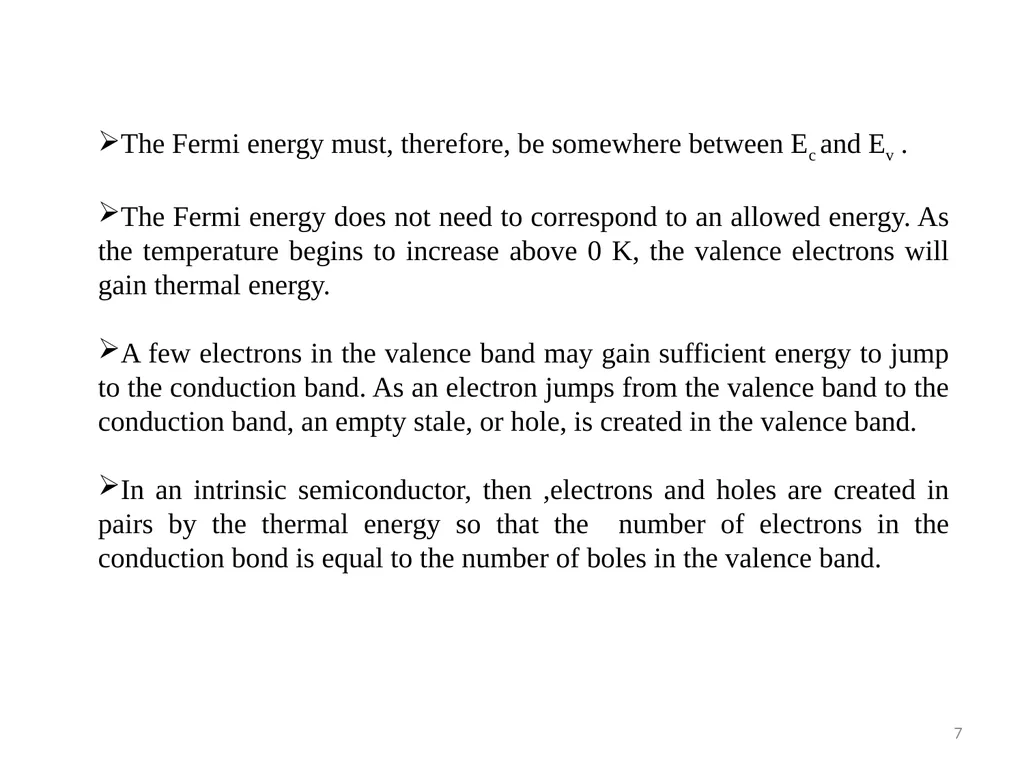
The Fermi energy must, therefore, be somewhere between Ec and Ev .
The Fermi energy does not need to correspond to an allowed energy. As the temperature begins to increase above 0 K, the valence electrons will gain thermal energy.
A few electrons in the valence band may gain sufficient energy to jump to the conduction band. As an electron jumps from the valence band to the conduction band, an empty stale, or hole, is created in the valence band.
In an intrinsic semiconductor, then ,electrons and holes are created in pairs by the thermal energy so that the number of electrons in the conduction bond is equal to the number of boles in the valence band. 7<br>
The Fermi energy does not need to correspond to an allowed energy. As the temperature begins to increase above 0 K, the valence electrons will gain thermal energy.
A few electrons in the valence band may gain sufficient energy to jump to the conduction band. As an electron jumps from the valence band to the conduction band, an empty stale, or hole, is created in the valence band.
In an intrinsic semiconductor, then ,electrons and holes are created in pairs by the thermal energy so that the number of electrons in the conduction bond is equal to the number of boles in the valence band. 7<br>
08
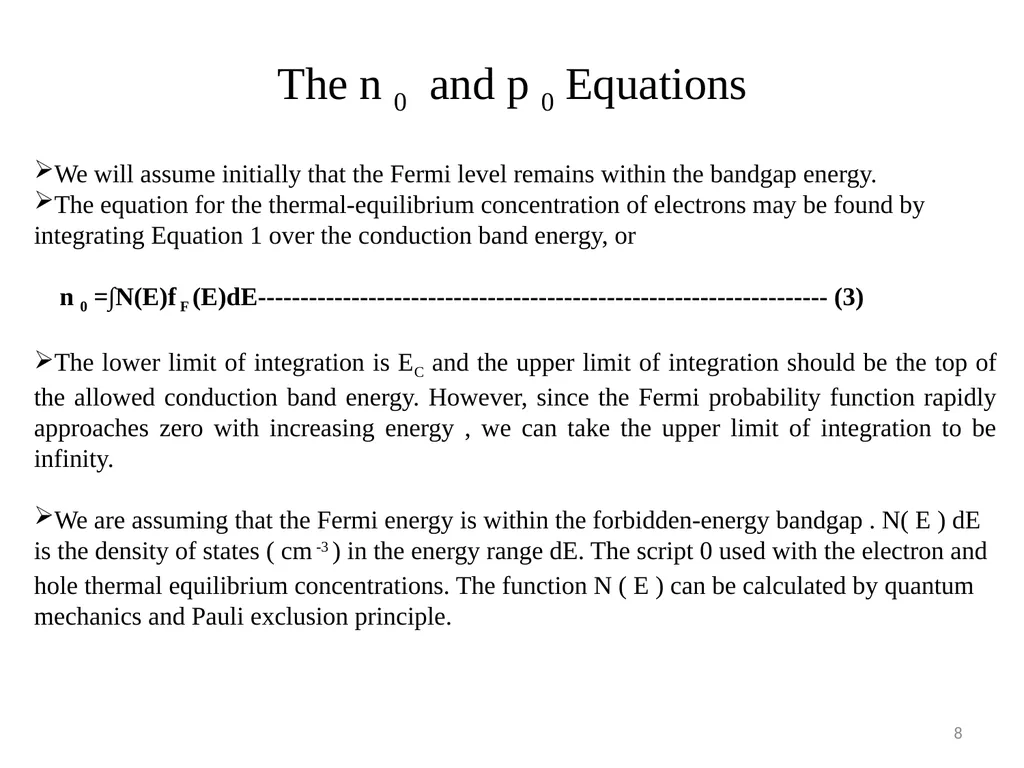
The n 0 and p 0 Equations We will assume initially that the Fermi level remains within the bandgap energy.
The equation for the thermal-equilibrium concentration of electrons may be found by integrating Equation 1 over the conduction band energy, or
n 0 =∫N(E)f F (E)dE------------------------------------------------------------------- (3)
The lower limit of integration is EC and the upper limit of integration should be the top of the allowed conduction band energy. However, since the Fermi probability function rapidly approaches zero with increasing energy , we can take the upper limit of integration to be infinity.
We are assuming that the Fermi energy is within the forbidden-energy bandgap . N( E ) dE is the density of states ( cm -3 ) in the energy range dE. The script 0 used with the electron and hole thermal equilibrium concentrations. The function N ( E ) can be calculated by quantum mechanics and Pauli exclusion principle. 8<br>
The equation for the thermal-equilibrium concentration of electrons may be found by integrating Equation 1 over the conduction band energy, or
n 0 =∫N(E)f F (E)dE------------------------------------------------------------------- (3)
The lower limit of integration is EC and the upper limit of integration should be the top of the allowed conduction band energy. However, since the Fermi probability function rapidly approaches zero with increasing energy , we can take the upper limit of integration to be infinity.
We are assuming that the Fermi energy is within the forbidden-energy bandgap . N( E ) dE is the density of states ( cm -3 ) in the energy range dE. The script 0 used with the electron and hole thermal equilibrium concentrations. The function N ( E ) can be calculated by quantum mechanics and Pauli exclusion principle. 8<br>
09
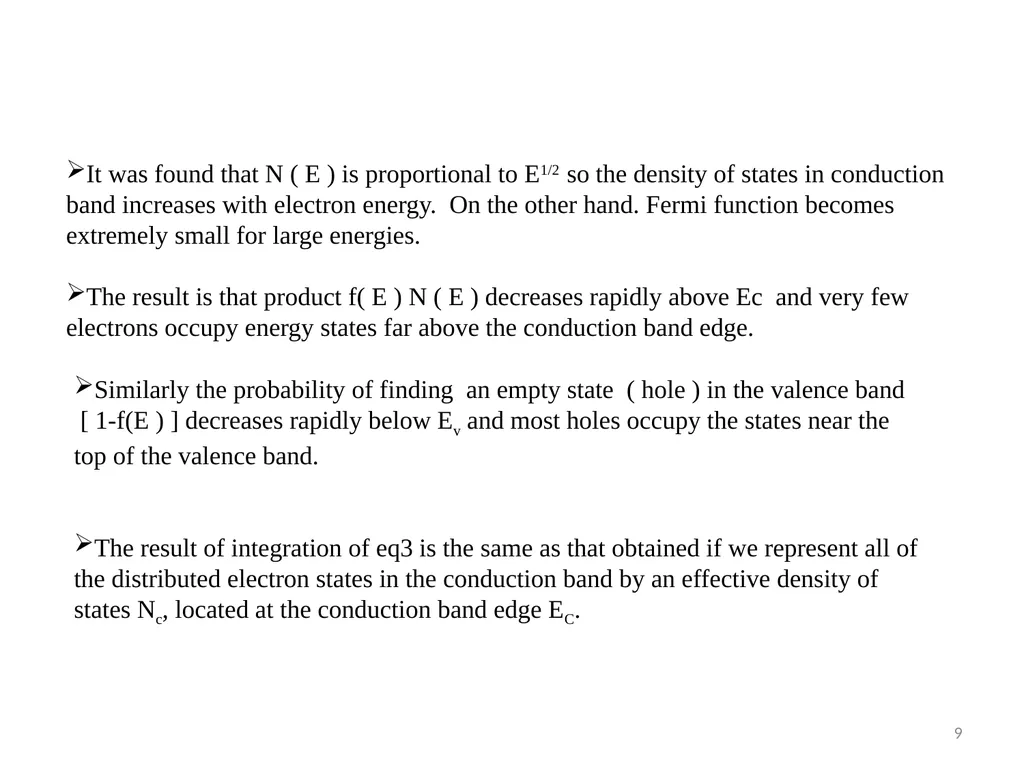
It was found that N ( E ) is proportional to E1/2 so the density of states in conduction band increases with electron energy. On the other hand. Fermi function becomes extremely small for large energies.
The result is that product f( E ) N ( E ) decreases rapidly above Ec and very few electrons occupy energy states far above the conduction band edge. Similarly the probability of finding an empty state ( hole ) in the valence band
[ 1-f(E ) ] decreases rapidly below Ev and most holes occupy the states near the top of the valence band.
The result of integration of eq3 is the same as that obtained if we represent all of the distributed electron states in the conduction band by an effective density of states Nc, located at the conduction band edge EC. 9<br>
The result is that product f( E ) N ( E ) decreases rapidly above Ec and very few electrons occupy energy states far above the conduction band edge. Similarly the probability of finding an empty state ( hole ) in the valence band
[ 1-f(E ) ] decreases rapidly below Ev and most holes occupy the states near the top of the valence band.
The result of integration of eq3 is the same as that obtained if we represent all of the distributed electron states in the conduction band by an effective density of states Nc, located at the conduction band edge EC. 9<br>
10
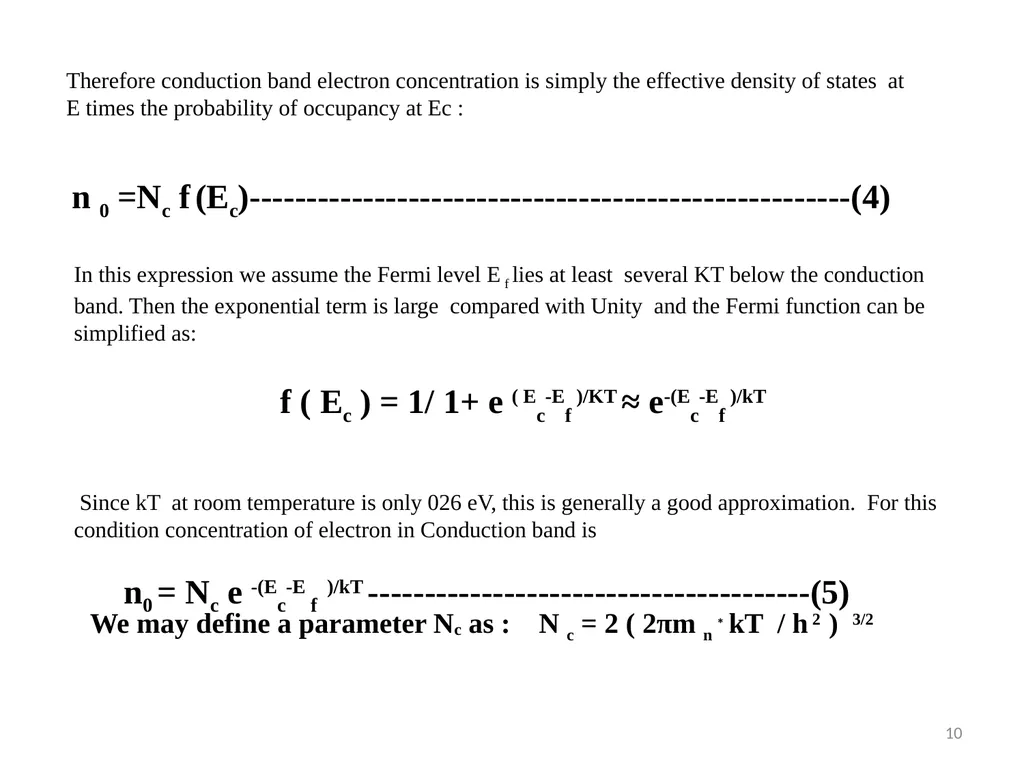
Therefore conduction band electron concentration is simply the effective density of states at E times the probability of occupancy at Ec :
n 0 =Nc f (Ec)-----------------------------------------------------(4) In this expression we assume the Fermi level E f lies at least several KT below the conduction band. Then the exponential term is large compared with Unity and the Fermi function can be simplified as:
f ( Ec ) = 1/ 1+ e ( Ec-Ef )/KT ≈ e-(Ec-Ef )/kT
Since kT at room temperature is only 026 eV, this is generally a good approximation. For this condition concentration of electron in Conduction band is
n0 = Nc e -(Ec-E f )/kT ---------------------------------------(5) We may define a parameter Nc as : N c = 2 ( 2πm n∗kT / h 2 ) 3/2 10<br>
f ( Ec ) = 1/ 1+ e ( Ec-Ef )/KT ≈ e-(Ec-Ef )/kT
Since kT at room temperature is only 026 eV, this is generally a good approximation. For this condition concentration of electron in Conduction band is
n0 = Nc e -(Ec-E f )/kT ---------------------------------------(5) We may define a parameter Nc as : N c = 2 ( 2πm n∗kT / h 2 ) 3/2 10<br>
11
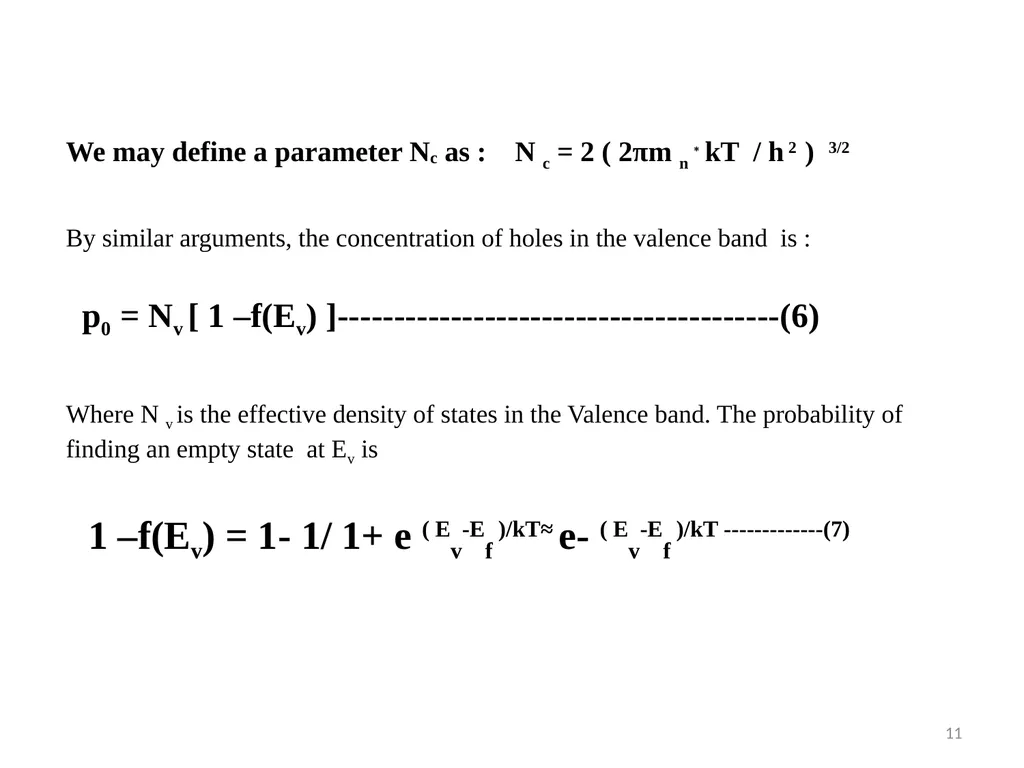
11 We may define a parameter Nc as : N c = 2 ( 2πm n∗kT / h 2 ) 3/2 By similar arguments, the concentration of holes in the valence band is : p0 = Nv [ 1 –f(Ev) ]---------------------------------------(6) Where N v is the effective density of states in the Valence band. The probability of finding an empty state at Ev is 1 –f(Ev) = 1- 1/ 1+ e ( Ev-Ef )/kT≈ e- ( Ev-Ef )/kT -------------(7)<br>
12
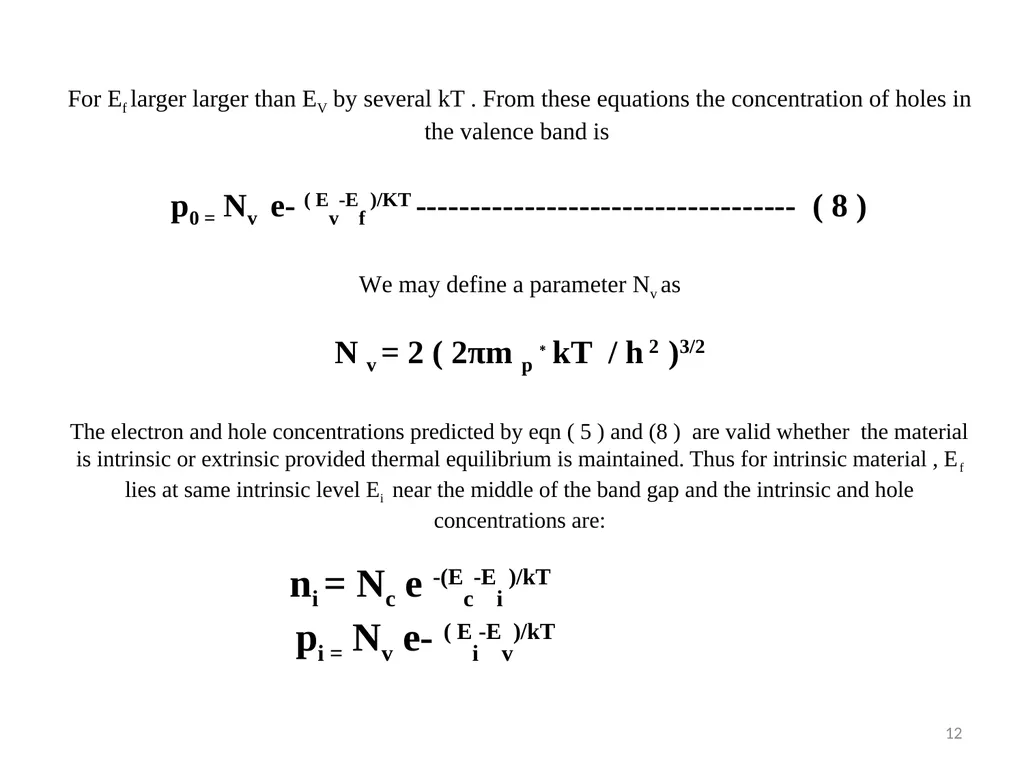
For Ef larger larger than EV by several kT . From these equations the concentration of holes in the valence band is
p0 = Nv e- ( Ev-Ef )/KT ----------------------------------- ( 8 )
We may define a parameter Nv as
N v = 2 ( 2πm p∗kT / h 2 )3/2
The electron and hole concentrations predicted by eqn ( 5 ) and (8 ) are valid whether the material is intrinsic or extrinsic provided thermal equilibrium is maintained. Thus for intrinsic material , Ef lies at same intrinsic level Ei near the middle of the band gap and the intrinsic and hole concentrations are: 12 ni = Nc e -(Ec-Ei )/kT
pi = Nv e- ( Ei-Ev)/kT<br>
13
The product of n0 and p0 at equilibrium is a constant for a particular material and temperature , even if the doping is varied:
n0 p0 = Nc e –(Ec-Ef )/kT Nv e –( Ef-Ev)/kT = Nc Nv e –( Ec –Ev )/kT
= Nc Nv e-Eg/kT --------------------------------------------------(9)
nipi = Nc e –(Ec-Ei )/kT Nv e –( Ei-Ev)/kT = Nc Nv e-Eg/kT
The intrinsic electron and hole concentration are equal ( since the carriers are created in pairs ), ni = pi , Thus the intrinsic concentration is
ni = √Nc Nv e-Eg/2kT --------------------------------------------------(10)
The constant product of electron and hole concentration is n0 p0 = ni2 13<br>
14
Summary Electron and hole concentration has been calculated at thermal equilibrium and their product is calculated.
N (E) is proportional to E1/2 so the density of states in conduction band increases with electron energy.
Fermi function becomes extremly small for large energies.
Electrons are accumulated at the bottom of the conduction band edge and holes are accumulated at the top of the valence band. 14<br>
N (E) is proportional to E1/2 so the density of states in conduction band increases with electron energy.
Fermi function becomes extremly small for large energies.
Electrons are accumulated at the bottom of the conduction band edge and holes are accumulated at the top of the valence band. 14<br>