
Lecture 7: Advanced BGP Concepts Lecturer: Venkat



Description: Lecture 7: Advanced BGP Concepts Lecturer: Venkat Arun Note: A lot of what we discuss today is not in the book. I have included references where relevant Recap ASes advertise routes to each other. Suppose A tells (advertises to) B about a
Related Topics
Download Presentation
"Lecture 7: Advanced BGP Concepts Lecturer: Venkat" is the property of its rightful owner. Permission is granted to download and print the materials on this website for personal, non-commercial use only, and to display it on your personal computer provided you do not modify the materials and that you retain all copyright notices contained in the materials. By downloading content from our website, you accept the terms of this agreement.
Presentation Transcript
slide1. Lecture 7: Advanced BGP Concepts Lecturer: Venkat Arun
Note: A lot of what we discuss today is not in the book. I have included references where relevant<br>
slide2. Recap ASes advertise routes to each other.
Suppose A tells (advertises to) B about a route to IP prefix X (e.g. 128.3.0.0/16)
The route advertisement consists of the sequence of ASes through which the packet will be sent if B were to send A an IP packet with destination address in X
An AS may have received multiple advertisements to the same IP address. For a given address (or more likely, a given IP prefix), the AS can pick any route it likes
Once it has picked a route, it starts sending packets over that route and advertises the others and withdraws previous routes if any
To a given AS B, AS A will advertise only one route to any prefix X. Exception is if the ASes are connected via multiple routers, in which case it can send one advertisement per connection point<br>
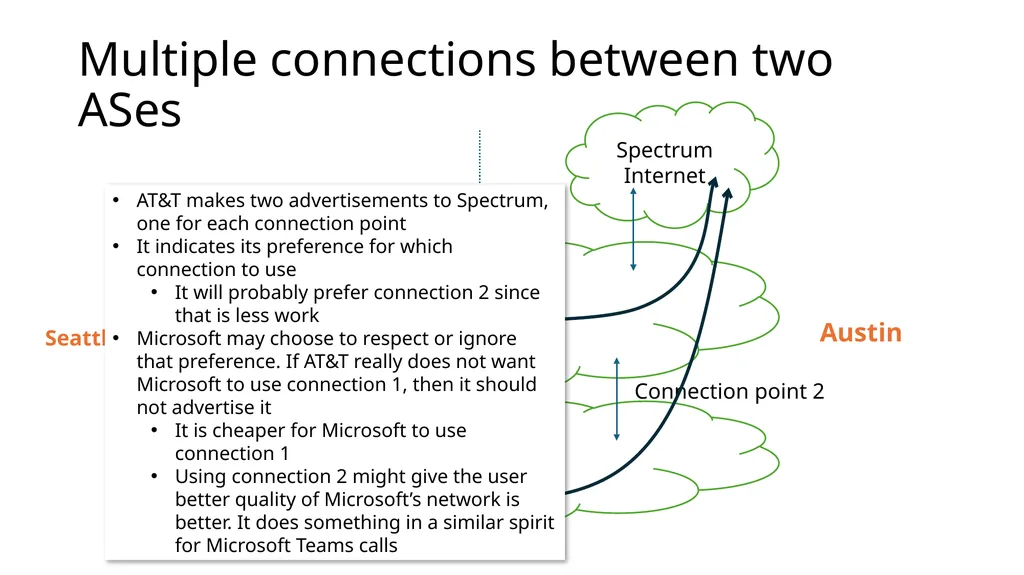
slide3. Microsoft Multiple connections between two ASes AT&T Seattle Austin Spectrum Internet Connection point 1 Connection point 2 AT&T makes two advertisements to Spectrum, one for each connection point
It indicates its preference for which connection to use
It will probably prefer connection 2 since that is less work
Microsoft may choose to respect or ignore that preference. If AT&T really does not want Microsoft to use connection 1, then it should not advertise it
It is cheaper for Microsoft to use connection 1
Using connection 2 might give the user better quality of Microsoft’s network is better. It does something in a similar spirit for Microsoft Teams calls<br>
slide4. Example algorithm to pick routes ASes are free to pick any route they like. However, most use algorithms implemented by companies like Cisco and configure it to their needs. For example:
AS Refer: https://community.cisco.com/t5/networking-knowledge-base/understanding-bgp-best-path-selection-manipulation/ta-p/3150576<br>
slide5. Will BGP routes converge? Slides borrowed from Jen Rexford’s talk: https://slideplayer.com/slide/5073626/
The paper she wrote with Lixin Gao called “Stable Internet Routing Without Global Coordination” forms a crucial part of our understanding of the internet<br>
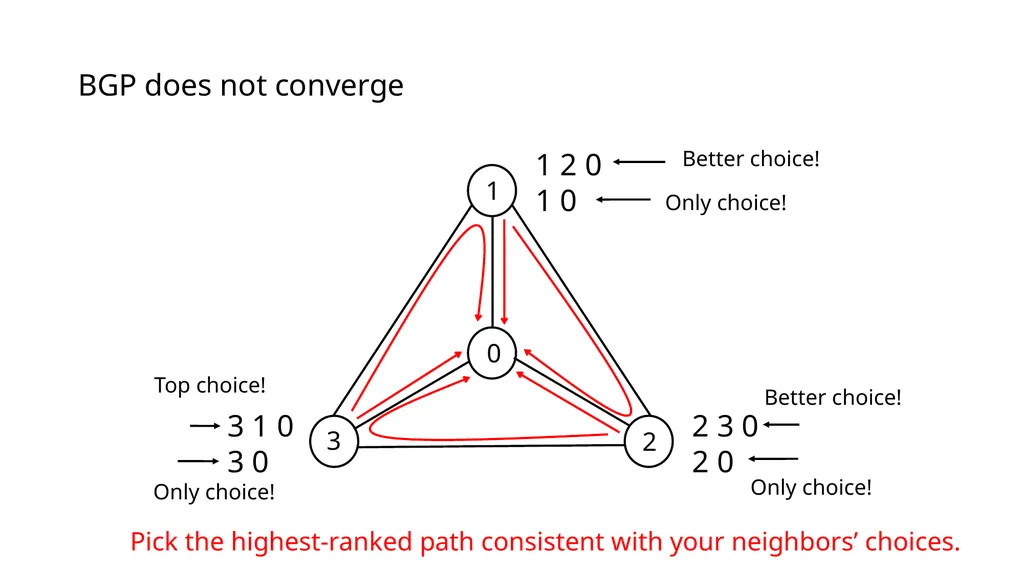
slide6. BGP does not converge 0 1 2 3 1 2 0
1 0 2 3 0
2 0 3 1 0
3 0 Pick the highest-ranked path consistent with your neighbors’ choices.<br>
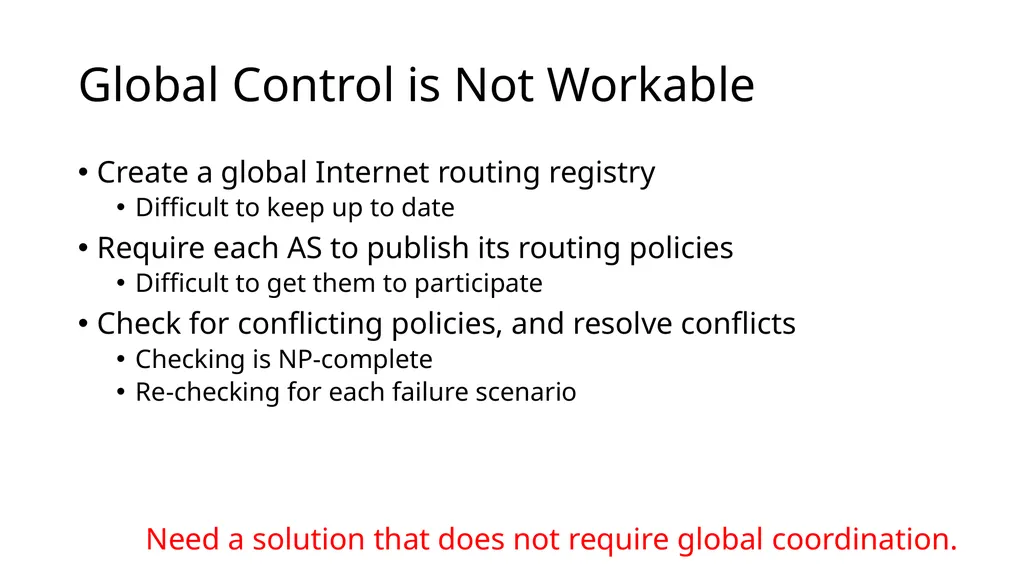
slide7. Global Control is Not Workable Create a global Internet routing registry
Difficult to keep up to date
Require each AS to publish its routing policies
Difficult to get them to participate
Check for conflicting policies, and resolve conflicts
Checking is NP-complete
Re-checking for each failure scenario Need a solution that does not require global coordination.<br>
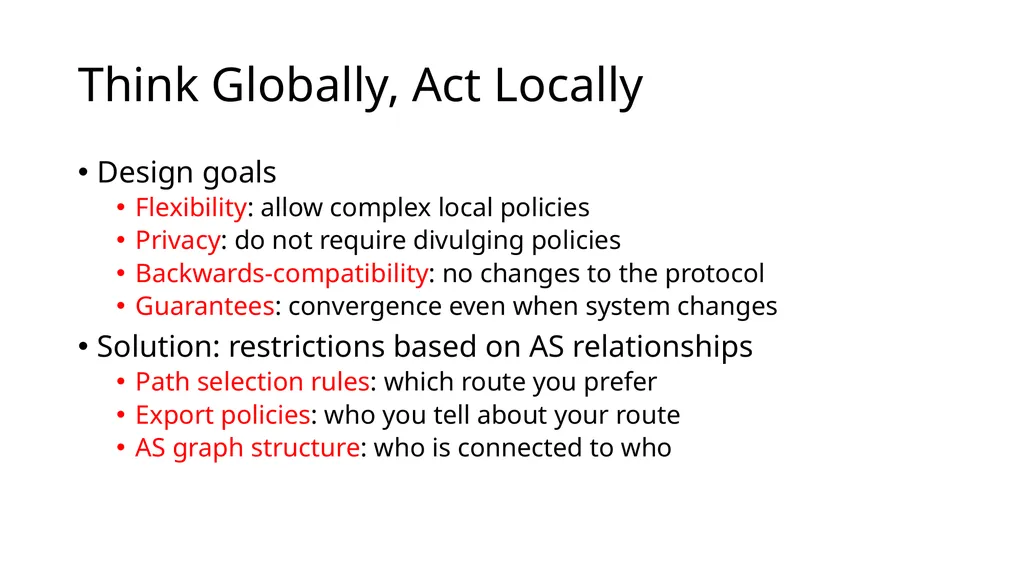
slide8. Think Globally, Act Locally Design goals
Flexibility: allow complex local policies
Privacy: do not require divulging policies
Backwards-compatibility: no changes to the protocol
Guarantees: convergence even when system changes
Solution: restrictions based on AS relationships
Path selection rules: which route you prefer
Export policies: who you tell about your route
AS graph structure: who is connected to who<br>
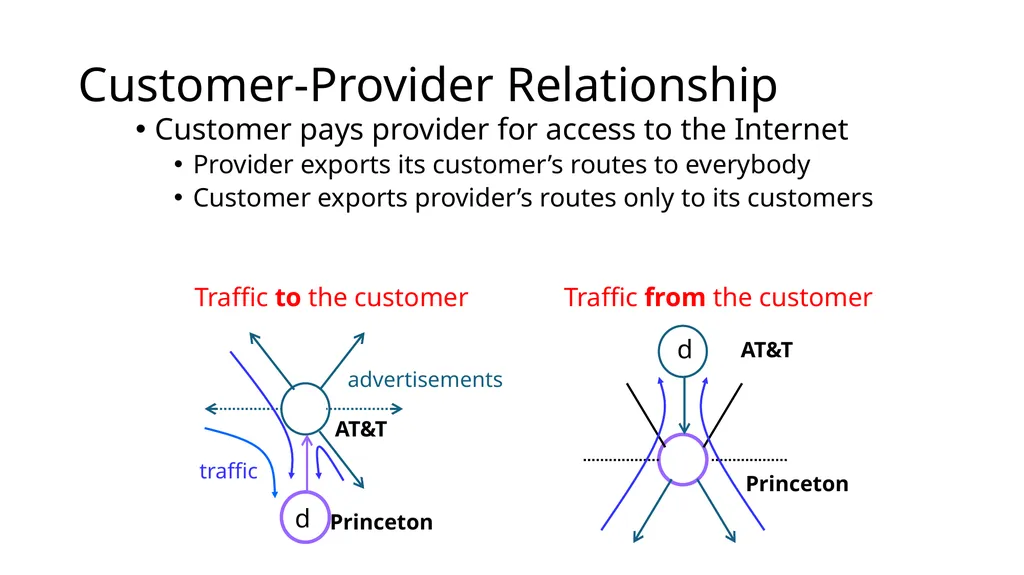
slide9. Customer-Provider Relationship Customer pays provider for access to the Internet
Provider exports its customer’s routes to everybody
Customer exports provider’s routes only to its customers d d AT&T Princeton Princeton AT&T Traffic to the customer Traffic from the customer<br>
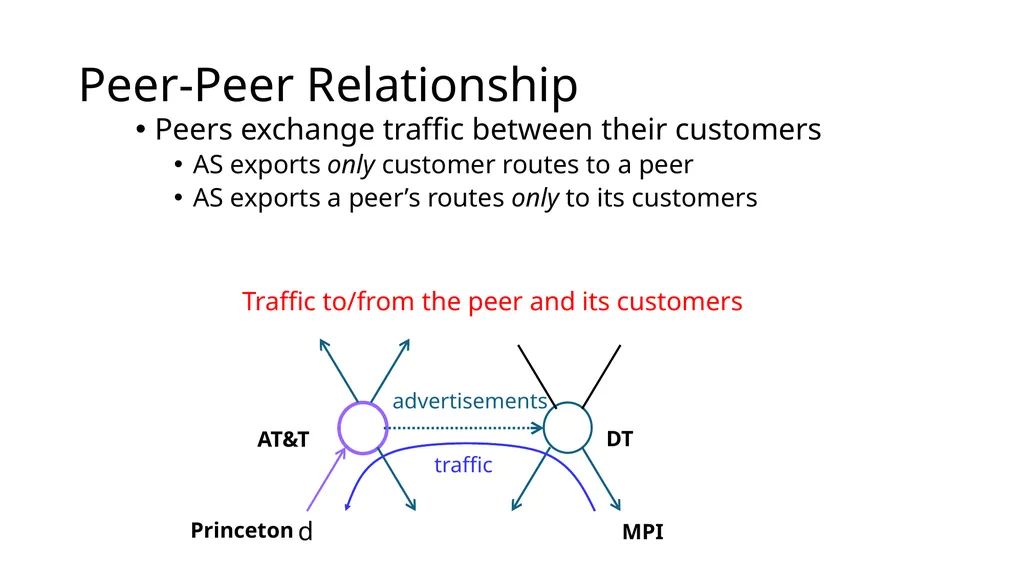
slide10. Peer-Peer Relationship Peers exchange traffic between their customers
AS exports only customer routes to a peer
AS exports a peer’s routes only to its customers DT AT&T Traffic to/from the peer and its customers d Princeton MPI<br>
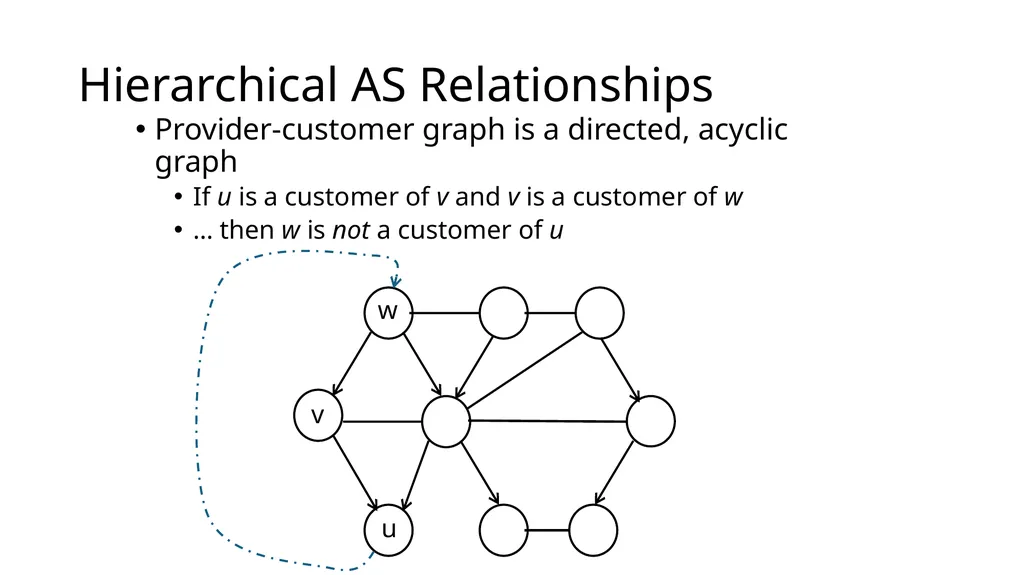
slide11. Hierarchical AS Relationships Provider-customer graph is a directed, acyclic graph
If u is a customer of v and v is a customer of w
… then w is not a customer of u u v w<br>
slide12. Proposed Local Path Selection Rules Classify routes based on next-hop AS
Customer routes, peer routes, and provider routes
Rank routes based on classification
Prefer customer routes over peer and provider routes
Allow any ranking of routes within a class
E.g., do not impose ranking among customer routes
Consistent with economic incentives
Customers pay for service, and providers are paid
Peer relationship contingent on balanced traffic load<br>
slide13. Solving the Convergence Problem Assumptions
Export policies based on AS relationships
Path selection rule that favors customer routes
Acyclic provider-customer graph
Result
Guaranteed convergence of the routing protocol
Holds under link/router failures and policy changes
Sketch of (constructive) proof
Activation sequence that leads to a stable state
Any “fair” activation sequence includes this sequence<br>
slide14. Proof, Phase 1: Selecting Customer Routes Activate ASes in customer-provider order
AS picks a customer route if one exists
Decision of one AS cannot cause an earlier AS to change its mind 0 1 2 3 d An AS picks a customer
route when one exists<br>
slide15. Proof, Phase 2: Selecting Peer and Provider Routes Activate rest of ASes in provider-customer order
Decision of one phase-2 AS cannot cause an earlier phase-2 AS to change its mind
Decision of phase-2 AS cannot affect a phase 1 AS 0 1 2 3 8 7 6 5 4 AS picks a peer or provider
route when no customer
route is available d<br>
slide16. Economic Incentives Affect Protocol Behavior ASes already follow our rules, so system is stable
High-level argument
Export and topology assumptions are reasonable
Path-selection rule matches economic incentives
Empirical results
Routes for popular destinations are stable for ~10 days
Most churn due to small number of unpopular destinations
ASes should follow our rules to make system stable
Encourage operators to obey these guidelines
… and provide configuration-checking tools
Consider more complex relationships and graphs<br>
slide17. Different Rules: More Flexible Import Policies Allowing more flexibility in ranking routes
Allow the same rank for peer and customer routes with the same AS path length
Never choose a peer route over a shorter customer route
Stricter AS graph assumptions
Hierarchical provider-customer relationship (as before)
No private peering with (direct or indirect) providers Peer-peer<br>
slide18. Backup Relationships Backups: more liberal export policies
Primary and a backup provider
Peers giving backup service to each other
Extension: prefer routes with fewest backup links backup path primary
provider backup
provider failure Backup Provider backup path failure peer provider Peer-Peer Backup<br>
slide19. Conclusions on Guaranteed Convergence Avoiding convergence problems
Hierarchical AS relationships
Export policies based on commercial relationships
Guidelines for import policies based on relationships
Salient features
No global coordination (locally implementable)
No changes to BGP protocol or decision process
Guaranteed convergence, even under failures
Guidelines consistent with economic incentives<br>
slide20. Recent Work Building on the Policy Guidelines AS relationships and BGP convergence
Design principles for policy languages
Fundamental limits on relaxing the assumptions
Internal BGP inside an AS
Sufficient conditions for iBGP convergence
“What-if” tool for traffic engineering
AS-level analysis of the Internet
Inference of AS relationships from routing data
Characterization of AS-level topology and growth
Network design and operations
Analyzing competitors and changing BGP policies
Setting protective route filters on BGP sessions<br>
slide21. Open Problems in Economic Incentives in Interdomain Routing<br>
slide22. Models of How Relationships Form and Operate Selecting a peer
Motivation: basic reachability and reducing transit costs
Making a peer pay when they need you (slightly) more
De-peering, refusing to peer, and stealing customers
Peer AS in one part of the world, but provider in another
Selecting a provider
Motivation: cost, performance, and physical proximity
Multi-homing to game one provider against another
Using third-party aggregators that negotiate with ISPs<br>
slide23. Negotiation for Better Egress Selection Better to cooperate
Negotiate where to send
Inbound and outbound
Mutual benefits
But, how to do it?
What info to exchange?
How to prioritize the many choices?
How prevent cheating? Customer A Customer B multiple
peering
points Provider A Provider B Early-exit
routing<br>
slide24. Reducing Vulnerability to Misbehaving Domains 12.34.0.0/16 12.34.0.0/16 Interdomain routing depends on trust
Vulnerable to malicious attack or accidental misconfiguration
Prefix hijacks lead to black hole, snooping, or impersonation<br>
slide25. Stepping Back: Where Should the Incentives Go? Today’s interdomain routing
Incentives do not live inside the protocol
But, rather, in how the policies are configured
However, this is indirect and perhaps even unnatural
Other possibilities…
Advertise policy preferences and options
Associate prices with route advertisements
Support negotiation between neighboring ASes
<Your solution here><br>
slide26. Bad news travels slowly in BGP too … but not as slowly as in distance vector routing since it can detect loops
We will not cover this in this course, but if you are interested, it is called “BGP path hunting”
Here is a good resource: https://www.noction.com/blog/bgp-path-hunting<br>
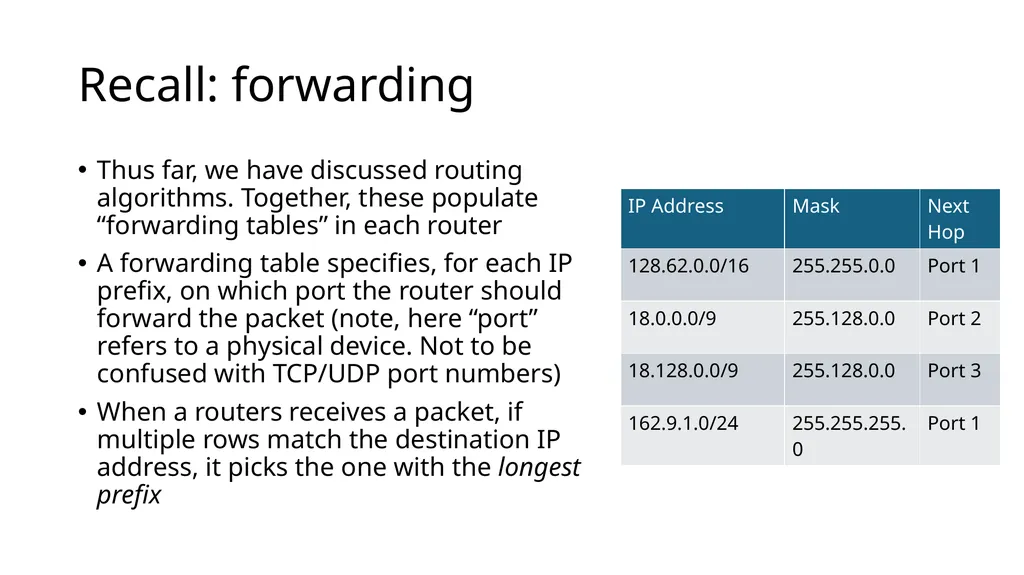
slide27. Recall: forwarding Thus far, we have discussed routing algorithms. Together, these populate “forwarding tables” in each router
A forwarding table specifies, for each IP prefix, on which port the router should forward the packet (note, here “port” refers to a physical device. Not to be confused with TCP/UDP port numbers)
When a routers receives a packet, if multiple rows match the destination IP address, it picks the one with the longest prefix<br>
slide28. Forwarding is hard too If a router supports 100 Gbit/s link, and the maximum transmission unit (MTU) is 1500 bytes, that is just 12 us/packet
If all packets are small, say 40 bytes, that is just 3.2 ns/packet!
This is not uncommon
Some routers can have a million entries in its routing table
Doing longest prefix matching at such a high rate is quite challenging. Fortunately, different packets can be matched in parallel
Often dedicated hardware is used to perform this matching
We will not discuss forwarding algorithms/datastructures further in this course<br>
slide29. Let’s recap And study a Facebook outage in 2024 (back when they were still called “Facebook”)
Slides taken from my own video: https://www.youtube.com/watch?v=7MOrJXWuE1Y&pp=ygUbdmVua2F0IGFydW4gZmFjZWJvb2sgb3V0YWdl<br>
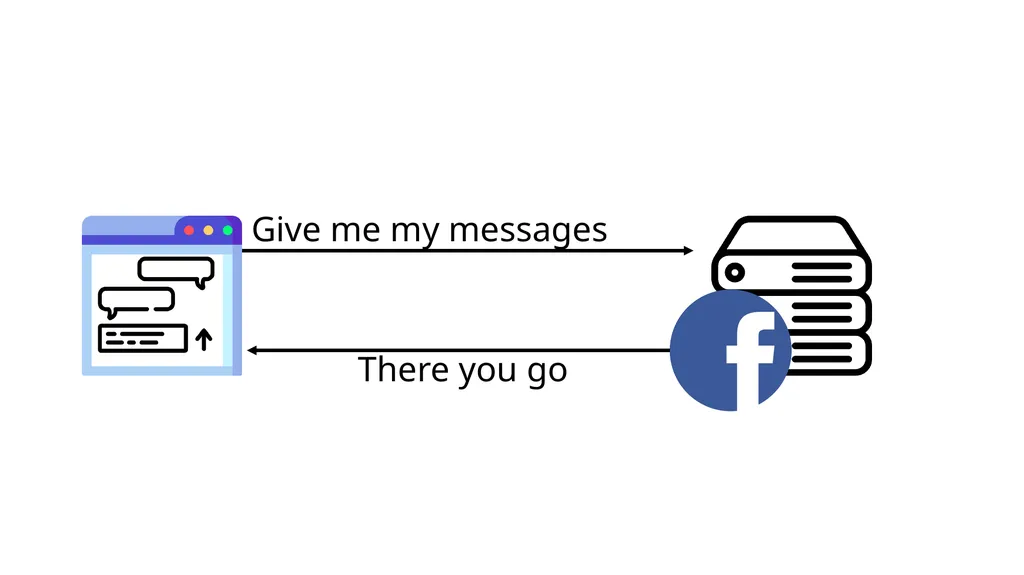
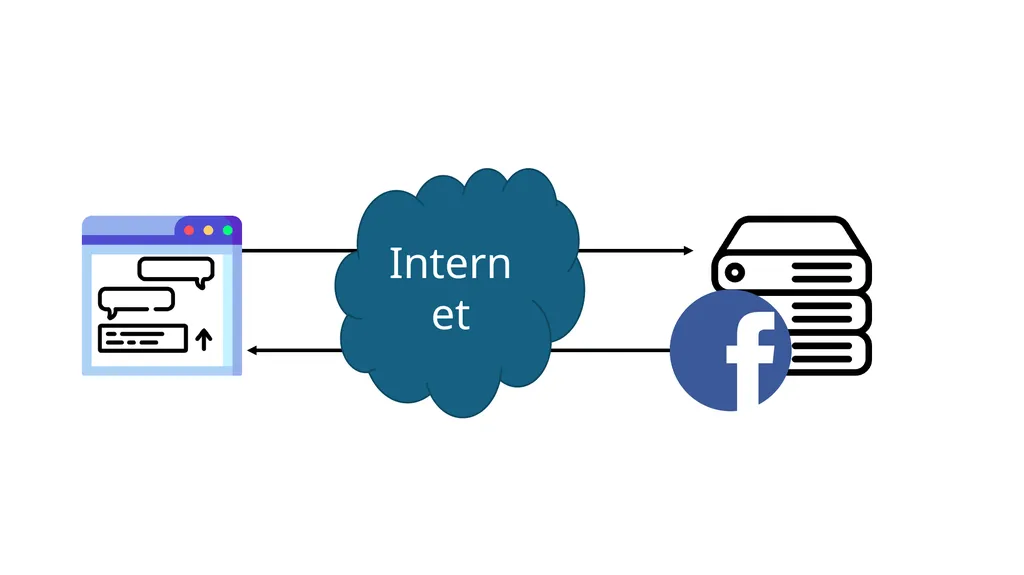
slide30. Give me my messages There you go<br>
slide31. Internet<br>
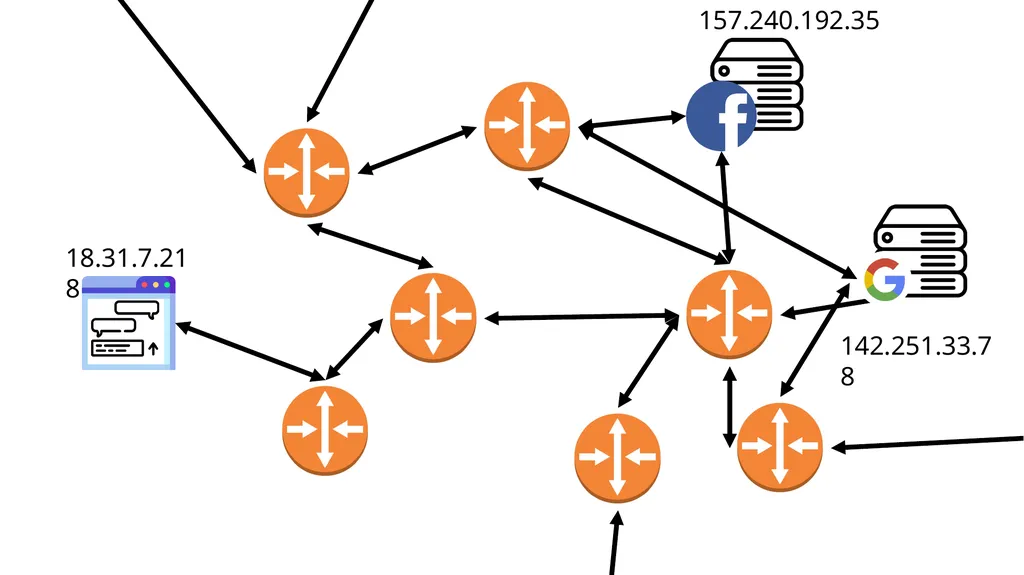
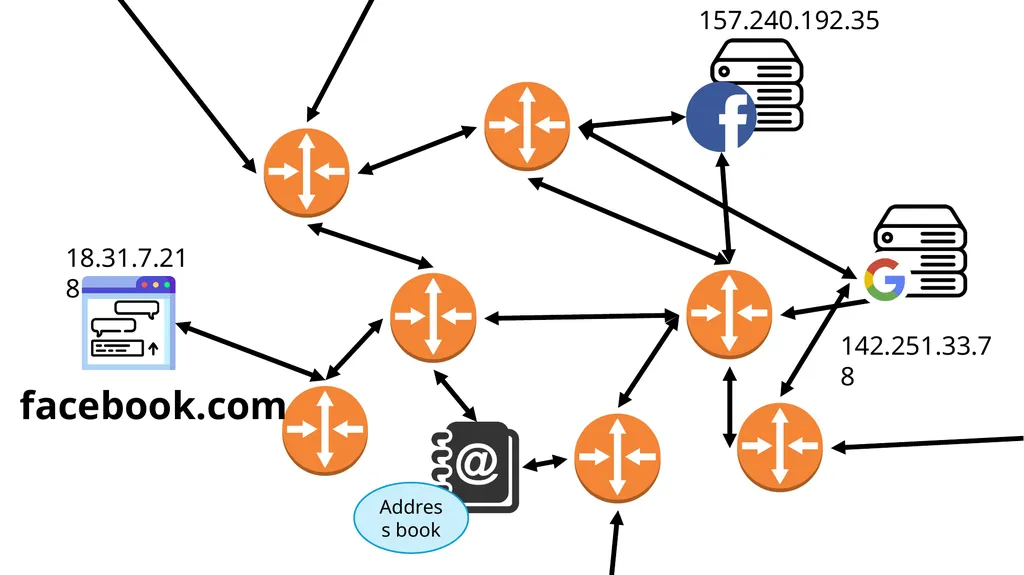
slide32. 157.240.192.35 142.251.33.78 18.31.7.218<br>
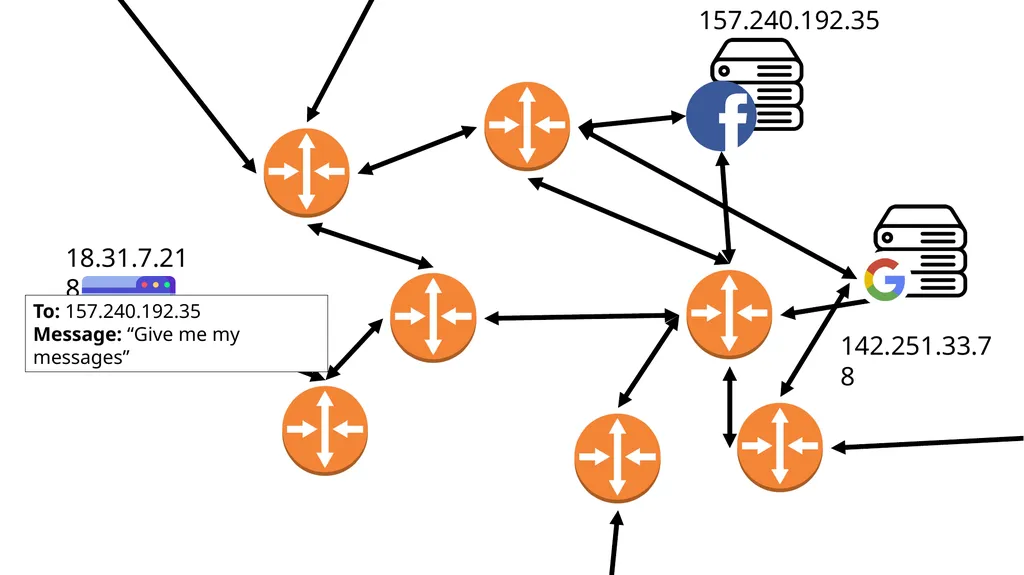
slide33. 157.240.192.35 142.251.33.78 18.31.7.218 To: 157.240.192.35
Message: “Give me my messages”<br>
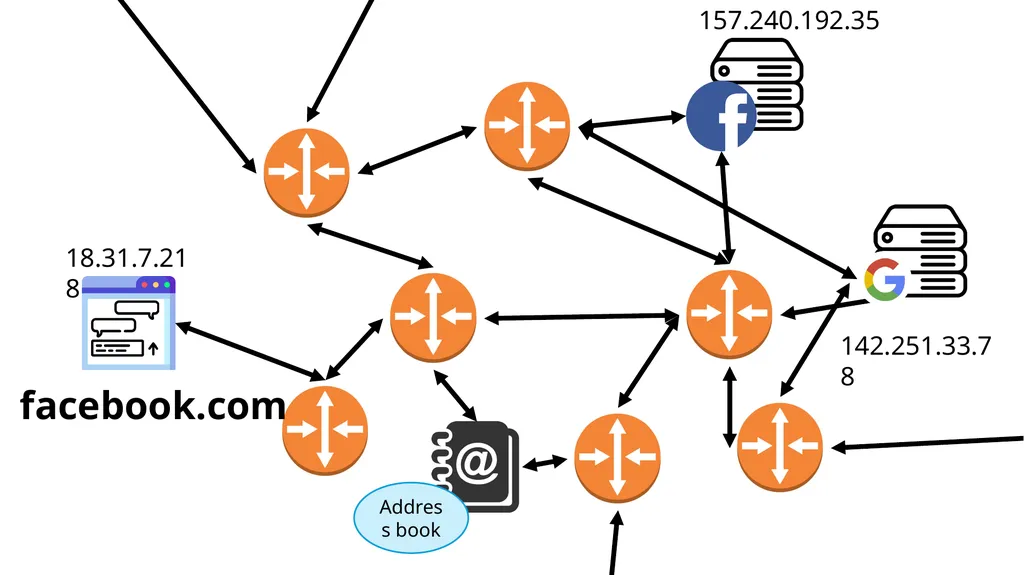
slide34. 157.240.192.35 142.251.33.78 18.31.7.218 facebook.com Address book<br>
slide35. 157.240.192.35 142.251.33.78 18.31.7.218 facebook.com Address book 157.240.192.35<br>
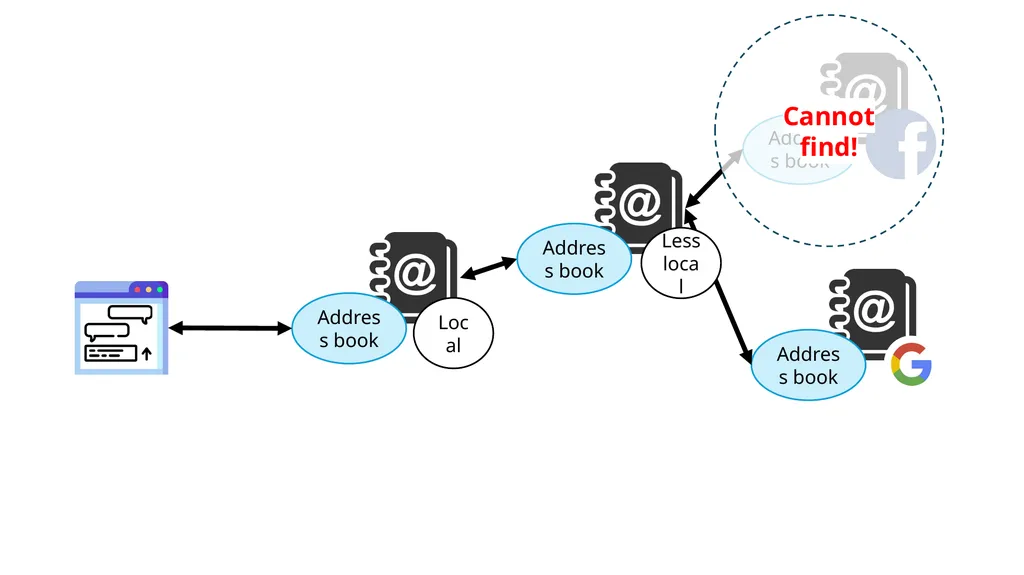
slide36. Address book Address book Address book Local Cannot find!<br>
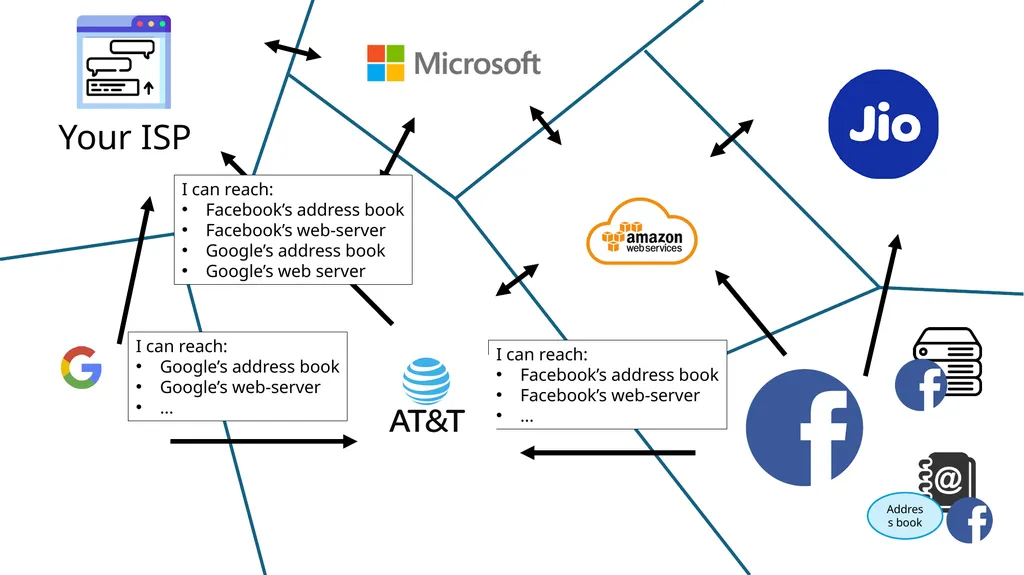
slide37. Your ISP I can reach:
Facebook’s address book
Facebook’s web-server
... I can reach:
Google’s address book
Google’s web-server
... I can reach:
Facebook’s address book
Facebook’s web-server
Google’s address book
Google’s web server<br>
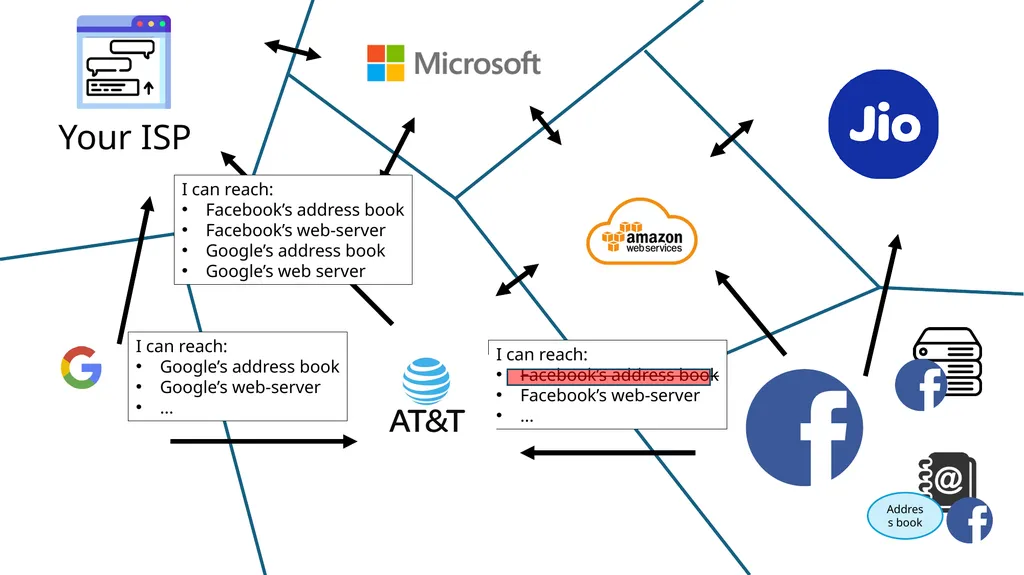
slide38. Your ISP I can reach:
Facebook’s address book
Facebook’s web-server
... I can reach:
Google’s address book
Google’s web-server
... I can reach:
Facebook’s address book
Facebook’s web-server
Google’s address book
Google’s web server<br>
slide39. Your ISP I can reach:
Facebook’s address book
Facebook’s web-server
... I can reach:
Google’s address book
Google’s web-server
... I can reach:
Facebook’s address book
Facebook’s web-server
Google’s address book
Google’s web server<br>
Note: A lot of what we discuss today is not in the book. I have included references where relevant<br>
slide2. Recap ASes advertise routes to each other.
Suppose A tells (advertises to) B about a route to IP prefix X (e.g. 128.3.0.0/16)
The route advertisement consists of the sequence of ASes through which the packet will be sent if B were to send A an IP packet with destination address in X
An AS may have received multiple advertisements to the same IP address. For a given address (or more likely, a given IP prefix), the AS can pick any route it likes
Once it has picked a route, it starts sending packets over that route and advertises the others and withdraws previous routes if any
To a given AS B, AS A will advertise only one route to any prefix X. Exception is if the ASes are connected via multiple routers, in which case it can send one advertisement per connection point<br>
slide3. Microsoft Multiple connections between two ASes AT&T Seattle Austin Spectrum Internet Connection point 1 Connection point 2 AT&T makes two advertisements to Spectrum, one for each connection point
It indicates its preference for which connection to use
It will probably prefer connection 2 since that is less work
Microsoft may choose to respect or ignore that preference. If AT&T really does not want Microsoft to use connection 1, then it should not advertise it
It is cheaper for Microsoft to use connection 1
Using connection 2 might give the user better quality of Microsoft’s network is better. It does something in a similar spirit for Microsoft Teams calls<br>
slide4. Example algorithm to pick routes ASes are free to pick any route they like. However, most use algorithms implemented by companies like Cisco and configure it to their needs. For example:
AS Refer: https://community.cisco.com/t5/networking-knowledge-base/understanding-bgp-best-path-selection-manipulation/ta-p/3150576<br>
slide5. Will BGP routes converge? Slides borrowed from Jen Rexford’s talk: https://slideplayer.com/slide/5073626/
The paper she wrote with Lixin Gao called “Stable Internet Routing Without Global Coordination” forms a crucial part of our understanding of the internet<br>
slide6. BGP does not converge 0 1 2 3 1 2 0
1 0 2 3 0
2 0 3 1 0
3 0 Pick the highest-ranked path consistent with your neighbors’ choices.<br>
slide7. Global Control is Not Workable Create a global Internet routing registry
Difficult to keep up to date
Require each AS to publish its routing policies
Difficult to get them to participate
Check for conflicting policies, and resolve conflicts
Checking is NP-complete
Re-checking for each failure scenario Need a solution that does not require global coordination.<br>
slide8. Think Globally, Act Locally Design goals
Flexibility: allow complex local policies
Privacy: do not require divulging policies
Backwards-compatibility: no changes to the protocol
Guarantees: convergence even when system changes
Solution: restrictions based on AS relationships
Path selection rules: which route you prefer
Export policies: who you tell about your route
AS graph structure: who is connected to who<br>
slide9. Customer-Provider Relationship Customer pays provider for access to the Internet
Provider exports its customer’s routes to everybody
Customer exports provider’s routes only to its customers d d AT&T Princeton Princeton AT&T Traffic to the customer Traffic from the customer<br>
slide10. Peer-Peer Relationship Peers exchange traffic between their customers
AS exports only customer routes to a peer
AS exports a peer’s routes only to its customers DT AT&T Traffic to/from the peer and its customers d Princeton MPI<br>
slide11. Hierarchical AS Relationships Provider-customer graph is a directed, acyclic graph
If u is a customer of v and v is a customer of w
… then w is not a customer of u u v w<br>
slide12. Proposed Local Path Selection Rules Classify routes based on next-hop AS
Customer routes, peer routes, and provider routes
Rank routes based on classification
Prefer customer routes over peer and provider routes
Allow any ranking of routes within a class
E.g., do not impose ranking among customer routes
Consistent with economic incentives
Customers pay for service, and providers are paid
Peer relationship contingent on balanced traffic load<br>
slide13. Solving the Convergence Problem Assumptions
Export policies based on AS relationships
Path selection rule that favors customer routes
Acyclic provider-customer graph
Result
Guaranteed convergence of the routing protocol
Holds under link/router failures and policy changes
Sketch of (constructive) proof
Activation sequence that leads to a stable state
Any “fair” activation sequence includes this sequence<br>
slide14. Proof, Phase 1: Selecting Customer Routes Activate ASes in customer-provider order
AS picks a customer route if one exists
Decision of one AS cannot cause an earlier AS to change its mind 0 1 2 3 d An AS picks a customer
route when one exists<br>
slide15. Proof, Phase 2: Selecting Peer and Provider Routes Activate rest of ASes in provider-customer order
Decision of one phase-2 AS cannot cause an earlier phase-2 AS to change its mind
Decision of phase-2 AS cannot affect a phase 1 AS 0 1 2 3 8 7 6 5 4 AS picks a peer or provider
route when no customer
route is available d<br>
slide16. Economic Incentives Affect Protocol Behavior ASes already follow our rules, so system is stable
High-level argument
Export and topology assumptions are reasonable
Path-selection rule matches economic incentives
Empirical results
Routes for popular destinations are stable for ~10 days
Most churn due to small number of unpopular destinations
ASes should follow our rules to make system stable
Encourage operators to obey these guidelines
… and provide configuration-checking tools
Consider more complex relationships and graphs<br>
slide17. Different Rules: More Flexible Import Policies Allowing more flexibility in ranking routes
Allow the same rank for peer and customer routes with the same AS path length
Never choose a peer route over a shorter customer route
Stricter AS graph assumptions
Hierarchical provider-customer relationship (as before)
No private peering with (direct or indirect) providers Peer-peer<br>
slide18. Backup Relationships Backups: more liberal export policies
Primary and a backup provider
Peers giving backup service to each other
Extension: prefer routes with fewest backup links backup path primary
provider backup
provider failure Backup Provider backup path failure peer provider Peer-Peer Backup<br>
slide19. Conclusions on Guaranteed Convergence Avoiding convergence problems
Hierarchical AS relationships
Export policies based on commercial relationships
Guidelines for import policies based on relationships
Salient features
No global coordination (locally implementable)
No changes to BGP protocol or decision process
Guaranteed convergence, even under failures
Guidelines consistent with economic incentives<br>
slide20. Recent Work Building on the Policy Guidelines AS relationships and BGP convergence
Design principles for policy languages
Fundamental limits on relaxing the assumptions
Internal BGP inside an AS
Sufficient conditions for iBGP convergence
“What-if” tool for traffic engineering
AS-level analysis of the Internet
Inference of AS relationships from routing data
Characterization of AS-level topology and growth
Network design and operations
Analyzing competitors and changing BGP policies
Setting protective route filters on BGP sessions<br>
slide21. Open Problems in Economic Incentives in Interdomain Routing<br>
slide22. Models of How Relationships Form and Operate Selecting a peer
Motivation: basic reachability and reducing transit costs
Making a peer pay when they need you (slightly) more
De-peering, refusing to peer, and stealing customers
Peer AS in one part of the world, but provider in another
Selecting a provider
Motivation: cost, performance, and physical proximity
Multi-homing to game one provider against another
Using third-party aggregators that negotiate with ISPs<br>
slide23. Negotiation for Better Egress Selection Better to cooperate
Negotiate where to send
Inbound and outbound
Mutual benefits
But, how to do it?
What info to exchange?
How to prioritize the many choices?
How prevent cheating? Customer A Customer B multiple
peering
points Provider A Provider B Early-exit
routing<br>
slide24. Reducing Vulnerability to Misbehaving Domains 12.34.0.0/16 12.34.0.0/16 Interdomain routing depends on trust
Vulnerable to malicious attack or accidental misconfiguration
Prefix hijacks lead to black hole, snooping, or impersonation<br>
slide25. Stepping Back: Where Should the Incentives Go? Today’s interdomain routing
Incentives do not live inside the protocol
But, rather, in how the policies are configured
However, this is indirect and perhaps even unnatural
Other possibilities…
Advertise policy preferences and options
Associate prices with route advertisements
Support negotiation between neighboring ASes
<Your solution here><br>
slide26. Bad news travels slowly in BGP too … but not as slowly as in distance vector routing since it can detect loops
We will not cover this in this course, but if you are interested, it is called “BGP path hunting”
Here is a good resource: https://www.noction.com/blog/bgp-path-hunting<br>
slide27. Recall: forwarding Thus far, we have discussed routing algorithms. Together, these populate “forwarding tables” in each router
A forwarding table specifies, for each IP prefix, on which port the router should forward the packet (note, here “port” refers to a physical device. Not to be confused with TCP/UDP port numbers)
When a routers receives a packet, if multiple rows match the destination IP address, it picks the one with the longest prefix<br>
slide28. Forwarding is hard too If a router supports 100 Gbit/s link, and the maximum transmission unit (MTU) is 1500 bytes, that is just 12 us/packet
If all packets are small, say 40 bytes, that is just 3.2 ns/packet!
This is not uncommon
Some routers can have a million entries in its routing table
Doing longest prefix matching at such a high rate is quite challenging. Fortunately, different packets can be matched in parallel
Often dedicated hardware is used to perform this matching
We will not discuss forwarding algorithms/datastructures further in this course<br>
slide29. Let’s recap And study a Facebook outage in 2024 (back when they were still called “Facebook”)
Slides taken from my own video: https://www.youtube.com/watch?v=7MOrJXWuE1Y&pp=ygUbdmVua2F0IGFydW4gZmFjZWJvb2sgb3V0YWdl<br>
slide30. Give me my messages There you go<br>
slide31. Internet<br>
slide32. 157.240.192.35 142.251.33.78 18.31.7.218<br>
slide33. 157.240.192.35 142.251.33.78 18.31.7.218 To: 157.240.192.35
Message: “Give me my messages”<br>
slide34. 157.240.192.35 142.251.33.78 18.31.7.218 facebook.com Address book<br>
slide35. 157.240.192.35 142.251.33.78 18.31.7.218 facebook.com Address book 157.240.192.35<br>
slide36. Address book Address book Address book Local Cannot find!<br>
slide37. Your ISP I can reach:
Facebook’s address book
Facebook’s web-server
... I can reach:
Google’s address book
Google’s web-server
... I can reach:
Facebook’s address book
Facebook’s web-server
Google’s address book
Google’s web server<br>
slide38. Your ISP I can reach:
Facebook’s address book
Facebook’s web-server
... I can reach:
Google’s address book
Google’s web-server
... I can reach:
Facebook’s address book
Facebook’s web-server
Google’s address book
Google’s web server<br>
slide39. Your ISP I can reach:
Facebook’s address book
Facebook’s web-server
... I can reach:
Google’s address book
Google’s web-server
... I can reach:
Facebook’s address book
Facebook’s web-server
Google’s address book
Google’s web server<br>