
Lecture 9: Large Language Models Presenters:
LO
Published · 83 slides · 0 views

1 / 1



Description
Lecture 9: Large Language Models Presenters: Ayinde Yakubu Jerry Gu 2024-01-17 Slides created for CS886 at UWaterloo 1 Agenda Language Model T5 In-context Learning GPT-3 Codex Llama-2 Mixtral of Experts PaLM QA Session 2024-01-17 Slides
Related Topics
Share
Embed code
Download this presentation From Below
"Lecture 9: Large Language Models Presenters:" is the property of its rightful owner. Permission is granted to download and print the materials on this website for personal, non-commercial use only, and to display it on your personal computer provided you do not modify the materials and that you retain all copyright notices contained in the materials. By downloading content from our website, you accept the terms of this agreement.
Presentation Transcript
01
Lecture 9: Large Language Models Presenters: Ayinde Yakubu & Jerry Gu 2024-01-17 Slides created for CS886 at UWaterloo 1<br>
02
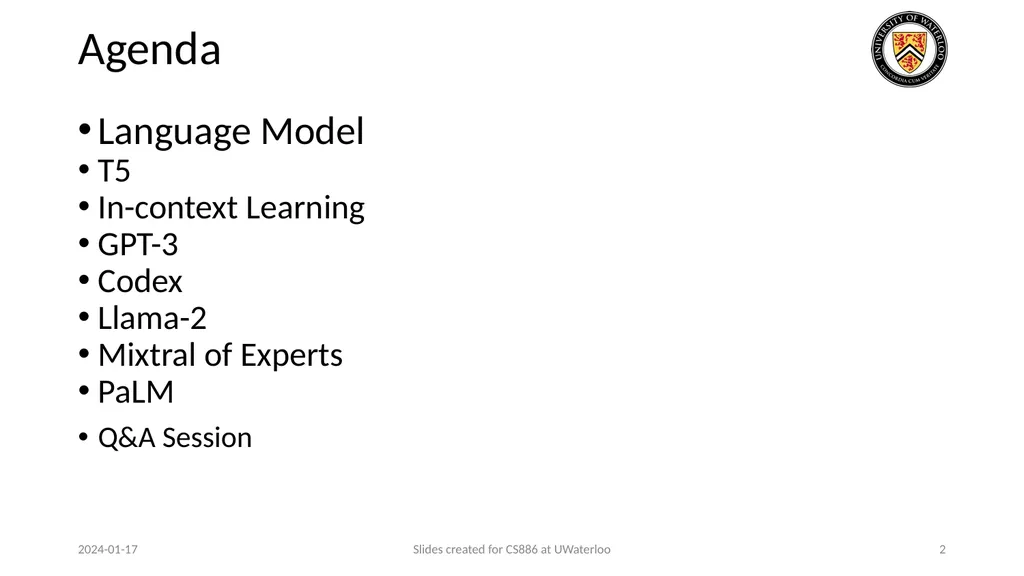
Agenda Language Model
T5
In-context Learning
GPT-3
Codex
Llama-2
Mixtral of Experts
PaLM
Q&A Session 2024-01-17 Slides created for CS886 at UWaterloo 2<br>
T5
In-context Learning
GPT-3
Codex
Llama-2
Mixtral of Experts
PaLM
Q&A Session 2024-01-17 Slides created for CS886 at UWaterloo 2<br>
03
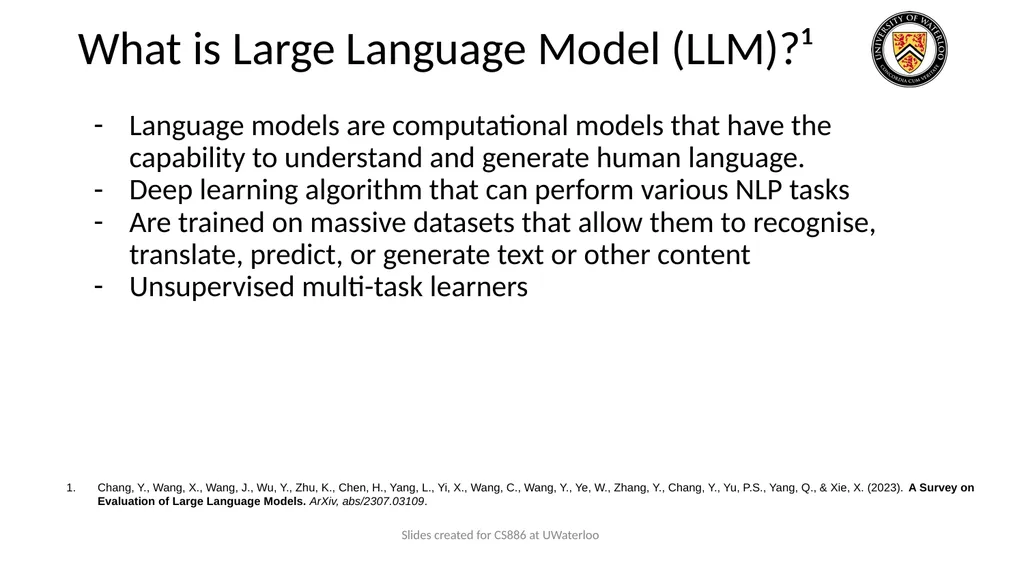
What is Large Language Model (LLM)?¹ Slides created for CS886 at UWaterloo Language models are computational models that have the capability to understand and generate human language.
Deep learning algorithm that can perform various NLP tasks
Are trained on massive datasets that allow them to recognise, translate, predict, or generate text or other content
Unsupervised multi-task learners Chang, Y., Wang, X., Wang, J., Wu, Y., Zhu, K., Chen, H., Yang, L., Yi, X., Wang, C., Wang, Y., Ye, W., Zhang, Y., Chang, Y., Yu, P.S., Yang, Q., & Xie, X. (2023). A Survey on Evaluation of Large Language Models. ArXiv, abs/2307.03109.<br>
Deep learning algorithm that can perform various NLP tasks
Are trained on massive datasets that allow them to recognise, translate, predict, or generate text or other content
Unsupervised multi-task learners Chang, Y., Wang, X., Wang, J., Wu, Y., Zhu, K., Chen, H., Yang, L., Yi, X., Wang, C., Wang, Y., Ye, W., Zhang, Y., Chang, Y., Yu, P.S., Yang, Q., & Xie, X. (2023). A Survey on Evaluation of Large Language Models. ArXiv, abs/2307.03109.<br>
04
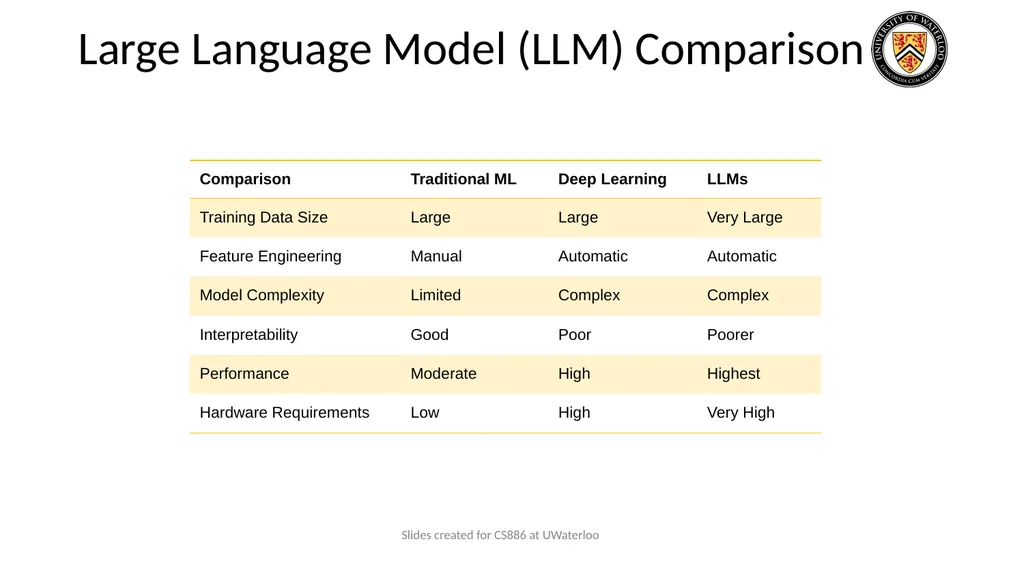
Large Language Model (LLM) Comparison Slides created for CS886 at UWaterloo<br>
05
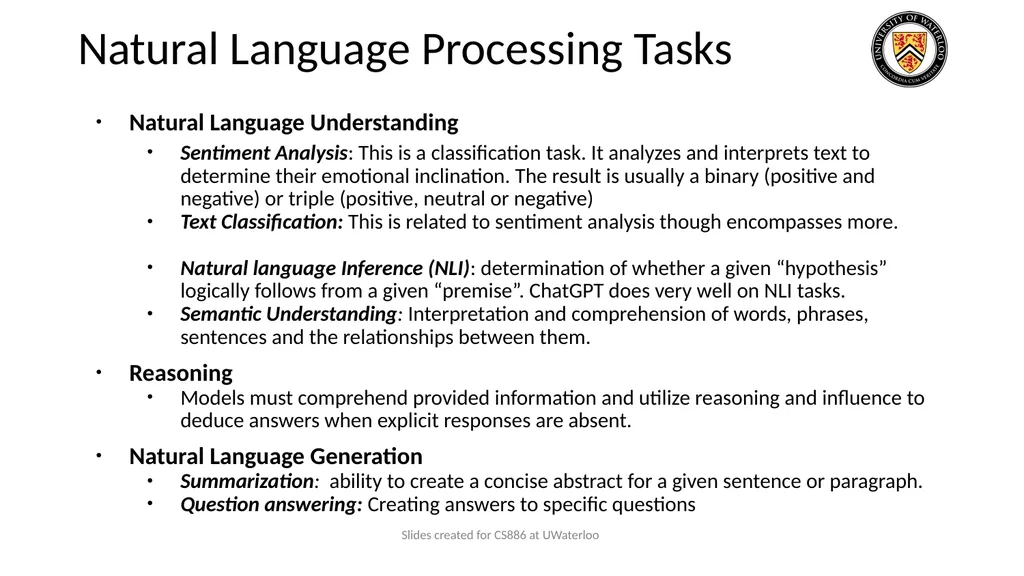
Natural Language Processing Tasks Slides created for CS886 at UWaterloo Natural Language Understanding
Sentiment Analysis: This is a classification task. It analyzes and interprets text to determine their emotional inclination. The result is usually a binary (positive and negative) or triple (positive, neutral or negative)
Text Classification: This is related to sentiment analysis though encompasses more.
Natural language Inference (NLI): determination of whether a given “hypothesis” logically follows from a given “premise”. ChatGPT does very well on NLI tasks.
Semantic Understanding: Interpretation and comprehension of words, phrases, sentences and the relationships between them.
Reasoning
Models must comprehend provided information and utilize reasoning and influence to deduce answers when explicit responses are absent.
Natural Language Generation
Summarization: ability to create a concise abstract for a given sentence or paragraph.
Question answering: Creating answers to specific questions<br>
Sentiment Analysis: This is a classification task. It analyzes and interprets text to determine their emotional inclination. The result is usually a binary (positive and negative) or triple (positive, neutral or negative)
Text Classification: This is related to sentiment analysis though encompasses more.
Natural language Inference (NLI): determination of whether a given “hypothesis” logically follows from a given “premise”. ChatGPT does very well on NLI tasks.
Semantic Understanding: Interpretation and comprehension of words, phrases, sentences and the relationships between them.
Reasoning
Models must comprehend provided information and utilize reasoning and influence to deduce answers when explicit responses are absent.
Natural Language Generation
Summarization: ability to create a concise abstract for a given sentence or paragraph.
Question answering: Creating answers to specific questions<br>
06
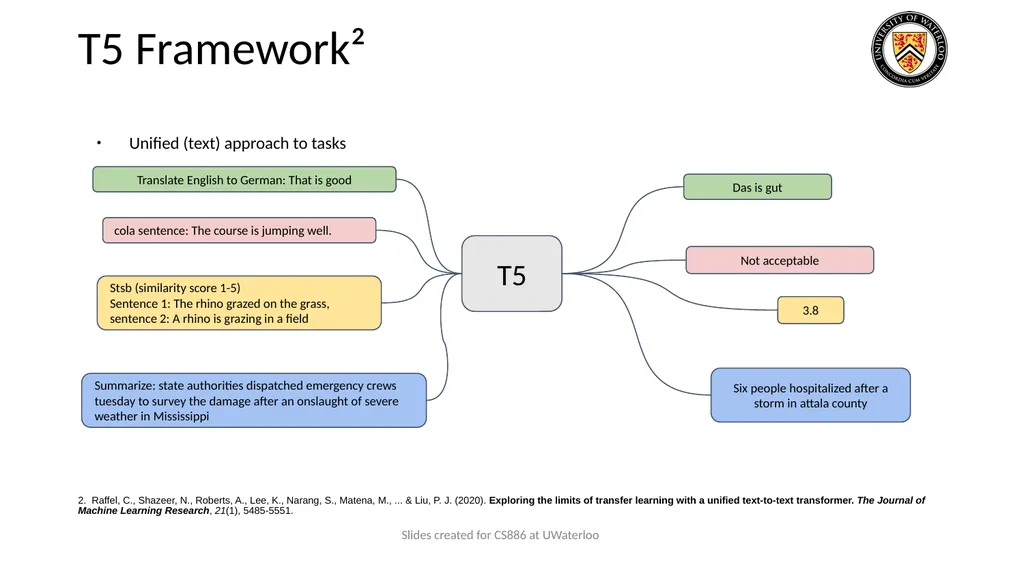
T5 Framework² Unified (text) approach to tasks
2. Raffel, C., Shazeer, N., Roberts, A., Lee, K., Narang, S., Matena, M., ... & Liu, P. J. (2020). Exploring the limits of transfer learning with a unified text-to-text transformer. The Journal of Machine Learning Research, 21(1), 5485-5551. Slides created for CS886 at UWaterloo Translate English to German: That is good cola sentence: The course is jumping well. Stsb (similarity score 1-5)
Sentence 1: The rhino grazed on the grass, sentence 2: A rhino is grazing in a field Summarize: state authorities dispatched emergency crews tuesday to survey the damage after an onslaught of severe weather in Mississippi Six people hospitalized after a storm in attala county 3.8 Not acceptable Das is gut T5<br>
2. Raffel, C., Shazeer, N., Roberts, A., Lee, K., Narang, S., Matena, M., ... & Liu, P. J. (2020). Exploring the limits of transfer learning with a unified text-to-text transformer. The Journal of Machine Learning Research, 21(1), 5485-5551. Slides created for CS886 at UWaterloo Translate English to German: That is good cola sentence: The course is jumping well. Stsb (similarity score 1-5)
Sentence 1: The rhino grazed on the grass, sentence 2: A rhino is grazing in a field Summarize: state authorities dispatched emergency crews tuesday to survey the damage after an onslaught of severe weather in Mississippi Six people hospitalized after a storm in attala county 3.8 Not acceptable Das is gut T5<br>
07
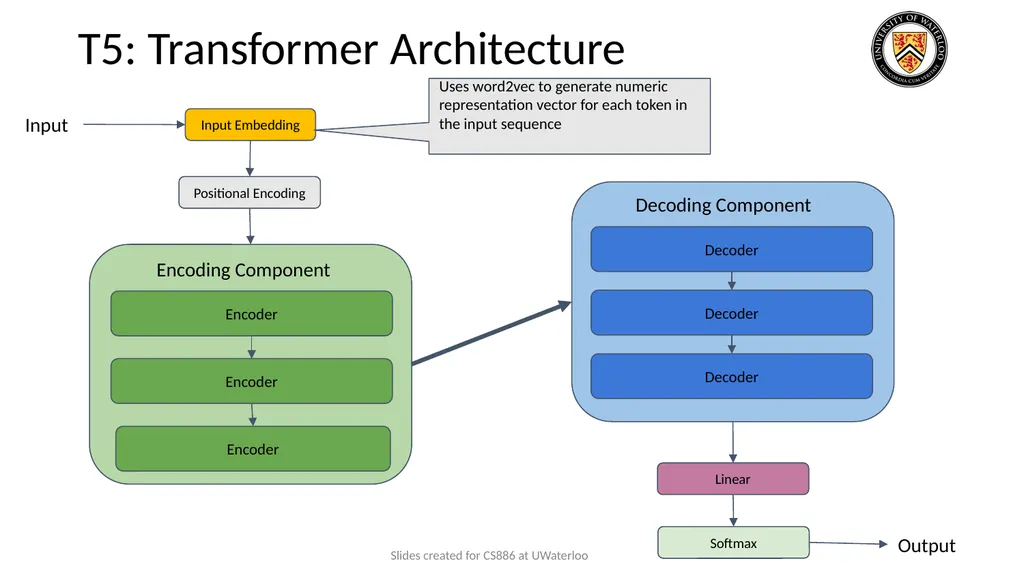
T5: Transformer Architecture Slides created for CS886 at UWaterloo Input Embedding Positional Encoding Input Encoding Component Encoder Encoder Encoder Decoding Component Decoder Decoder Decoder Linear Softmax Output Uses word2vec to generate numeric representation vector for each token in the input sequence<br>
08
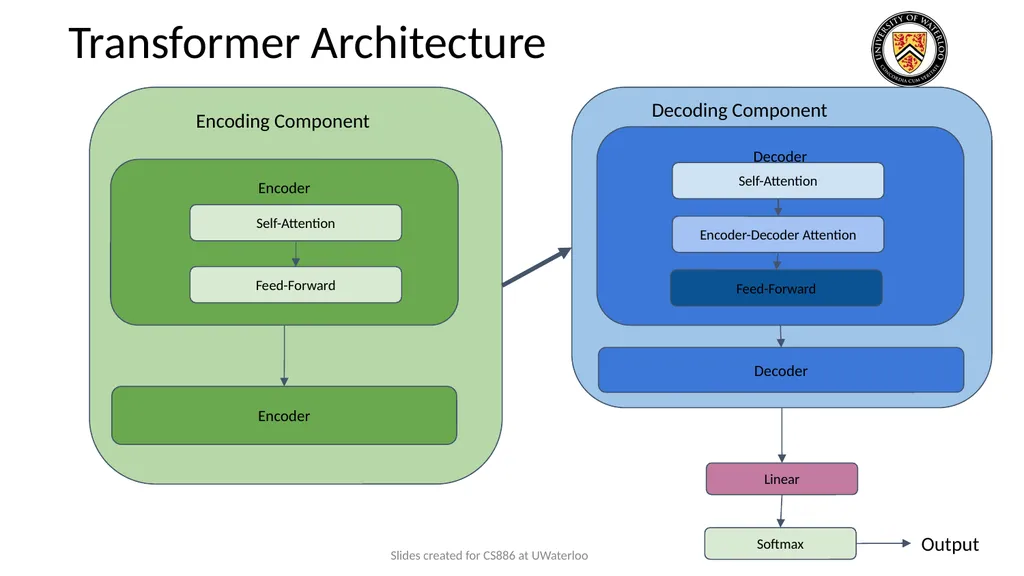
Transformer Architecture Slides created for CS886 at UWaterloo Encoding Component Encoder Encoder Decoding Component Decoder Decoder Linear Softmax Output Self-Attention Feed-Forward Self-Attention Encoder-Decoder Attention Feed-Forward<br>
09
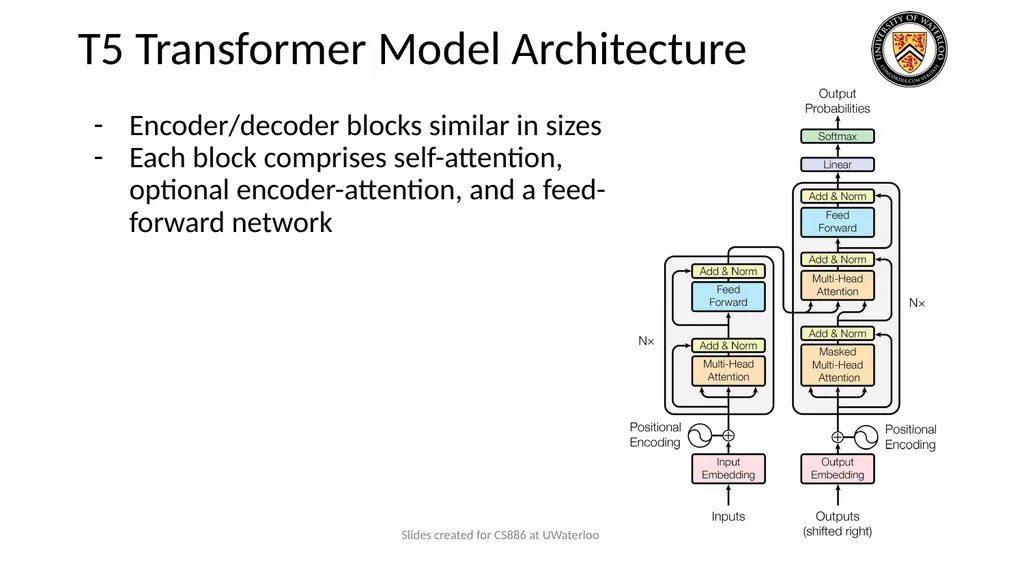
T5 Transformer Model Architecture Encoder/decoder blocks similar in sizes
Each block comprises self-attention, optional encoder-attention, and a feed-forward network Slides created for CS886 at UWaterloo<br>
Each block comprises self-attention, optional encoder-attention, and a feed-forward network Slides created for CS886 at UWaterloo<br>
10
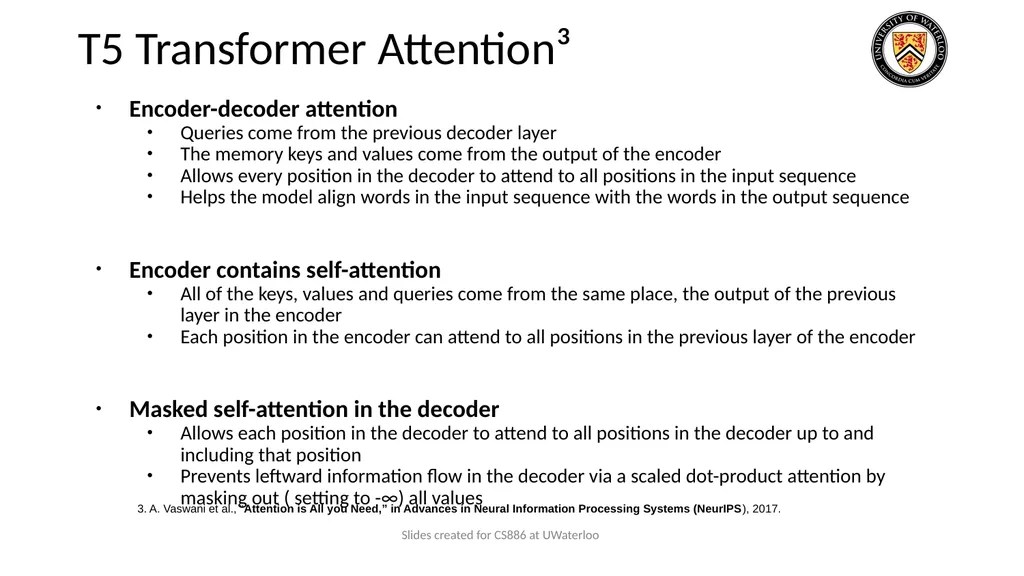
T5 Transformer Attention³ Slides created for CS886 at UWaterloo Encoder-decoder attention
Queries come from the previous decoder layer
The memory keys and values come from the output of the encoder
Allows every position in the decoder to attend to all positions in the input sequence
Helps the model align words in the input sequence with the words in the output sequence
Encoder contains self-attention
All of the keys, values and queries come from the same place, the output of the previous layer in the encoder
Each position in the encoder can attend to all positions in the previous layer of the encoder
Masked self-attention in the decoder
Allows each position in the decoder to attend to all positions in the decoder up to and including that position
Prevents leftward information flow in the decoder via a scaled dot-product attention by masking out ( setting to -∞) all values 3. A. Vaswani et al., “Attention is All you Need,” in Advances in Neural Information Processing Systems (NeurIPS), 2017.<br>
Queries come from the previous decoder layer
The memory keys and values come from the output of the encoder
Allows every position in the decoder to attend to all positions in the input sequence
Helps the model align words in the input sequence with the words in the output sequence
Encoder contains self-attention
All of the keys, values and queries come from the same place, the output of the previous layer in the encoder
Each position in the encoder can attend to all positions in the previous layer of the encoder
Masked self-attention in the decoder
Allows each position in the decoder to attend to all positions in the decoder up to and including that position
Prevents leftward information flow in the decoder via a scaled dot-product attention by masking out ( setting to -∞) all values 3. A. Vaswani et al., “Attention is All you Need,” in Advances in Neural Information Processing Systems (NeurIPS), 2017.<br>
11
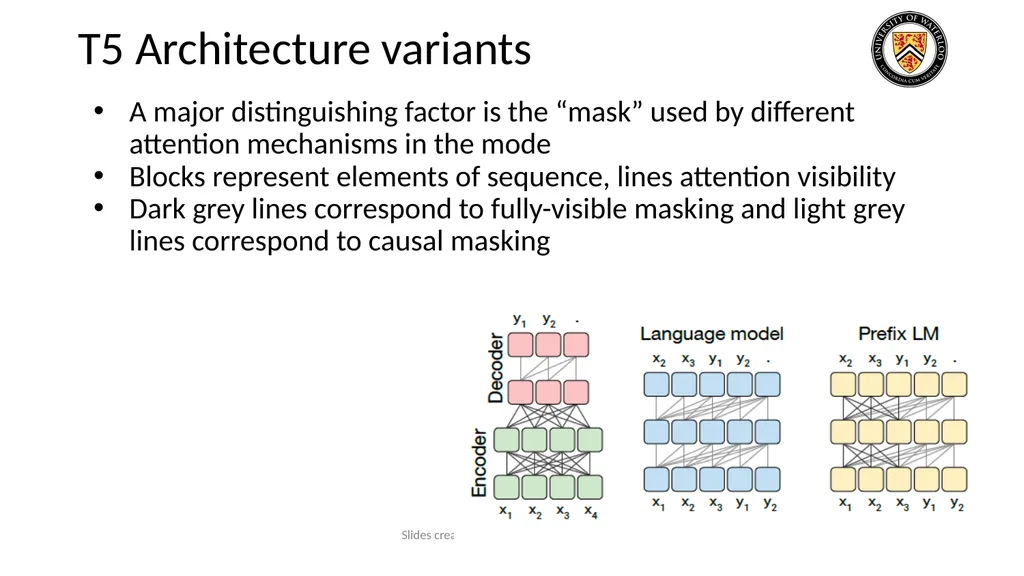
T5 Architecture variants Slides created for CS886 at UWaterloo A major distinguishing factor is the “mask” used by different attention mechanisms in the mode
Blocks represent elements of sequence, lines attention visibility
Dark grey lines correspond to fully-visible masking and light grey lines correspond to causal masking<br>
Blocks represent elements of sequence, lines attention visibility
Dark grey lines correspond to fully-visible masking and light grey lines correspond to causal masking<br>
12
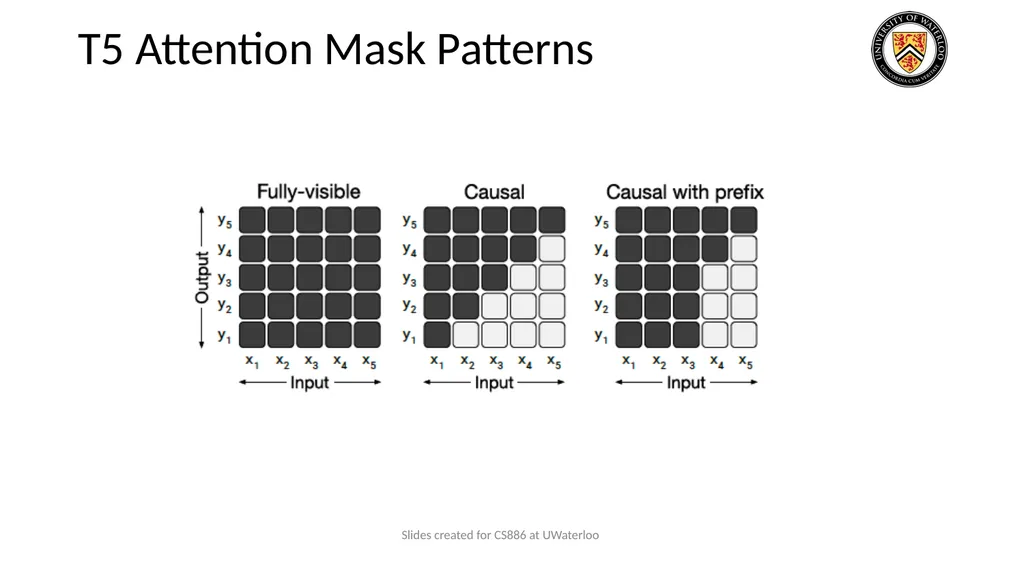
T5 Attention Mask Patterns Slides created for CS886 at UWaterloo<br>
13
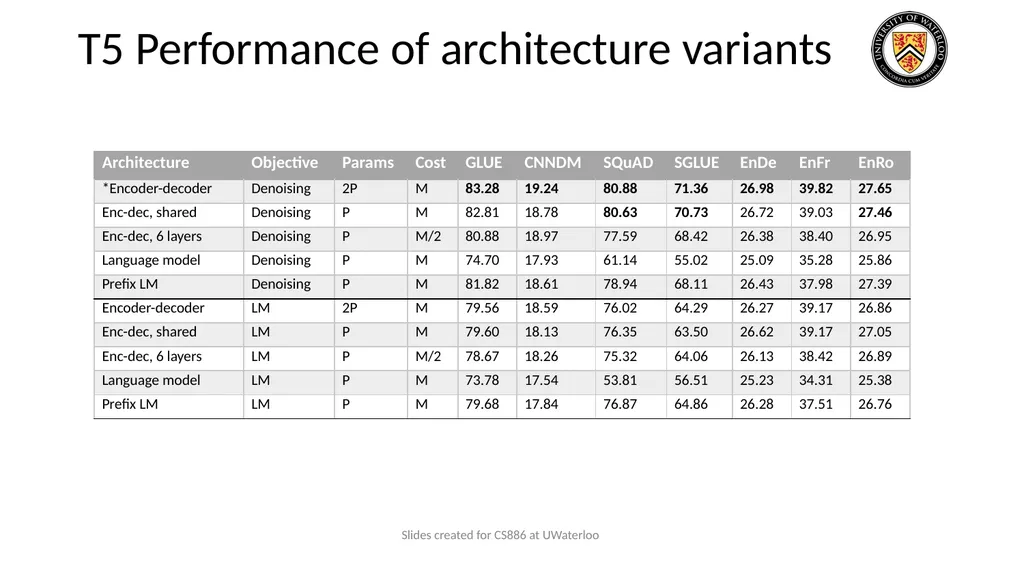
T5 Performance of architecture variants Slides created for CS886 at UWaterloo<br>
14
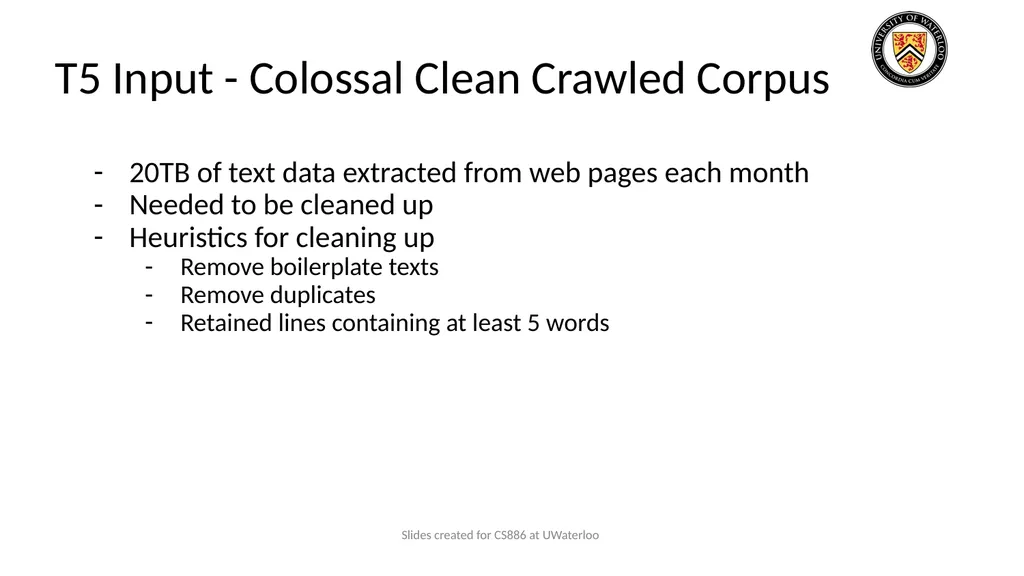
T5 Input - Colossal Clean Crawled Corpus Slides created for CS886 at UWaterloo 20TB of text data extracted from web pages each month
Needed to be cleaned up
Heuristics for cleaning up
Remove boilerplate texts
Remove duplicates
Retained lines containing at least 5 words<br>
Needed to be cleaned up
Heuristics for cleaning up
Remove boilerplate texts
Remove duplicates
Retained lines containing at least 5 words<br>
15
T5: Downstream Tasks Measure general language learning abilities
Sentence acceptability judgement
Sentiment analysis
Paraphrasing/sentence similarity
Natural language inference
Coreference resolution
Sentence completion
Word sense disambiguation
Question answering Slides created for CS886 at UWaterloo<br>
Sentence acceptability judgement
Sentiment analysis
Paraphrasing/sentence similarity
Natural language inference
Coreference resolution
Sentence completion
Word sense disambiguation
Question answering Slides created for CS886 at UWaterloo<br>
16
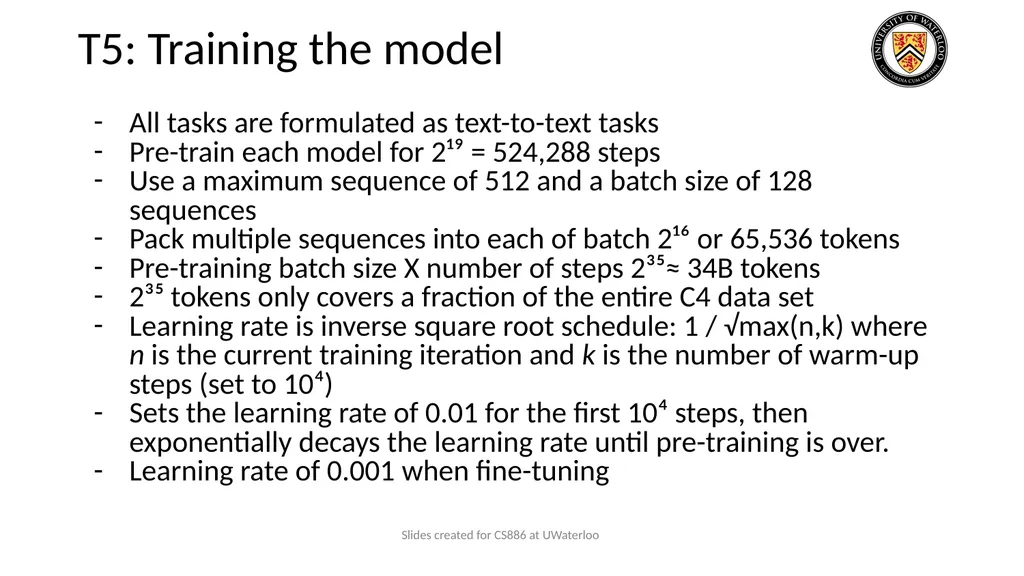
T5: Training the model All tasks are formulated as text-to-text tasks
Pre-train each model for 2¹⁹ = 524,288 steps
Use a maximum sequence of 512 and a batch size of 128 sequences
Pack multiple sequences into each of batch 2¹⁶ or 65,536 tokens
Pre-training batch size X number of steps 2³⁵≈ 34B tokens
2³⁵ tokens only covers a fraction of the entire C4 data set
Learning rate is inverse square root schedule: 1 / √max(n,k) where n is the current training iteration and k is the number of warm-up steps (set to 10⁴)
Sets the learning rate of 0.01 for the first 10⁴ steps, then exponentially decays the learning rate until pre-training is over.
Learning rate of 0.001 when fine-tuning Slides created for CS886 at UWaterloo<br>
Pre-train each model for 2¹⁹ = 524,288 steps
Use a maximum sequence of 512 and a batch size of 128 sequences
Pack multiple sequences into each of batch 2¹⁶ or 65,536 tokens
Pre-training batch size X number of steps 2³⁵≈ 34B tokens
2³⁵ tokens only covers a fraction of the entire C4 data set
Learning rate is inverse square root schedule: 1 / √max(n,k) where n is the current training iteration and k is the number of warm-up steps (set to 10⁴)
Sets the learning rate of 0.01 for the first 10⁴ steps, then exponentially decays the learning rate until pre-training is over.
Learning rate of 0.001 when fine-tuning Slides created for CS886 at UWaterloo<br>
17
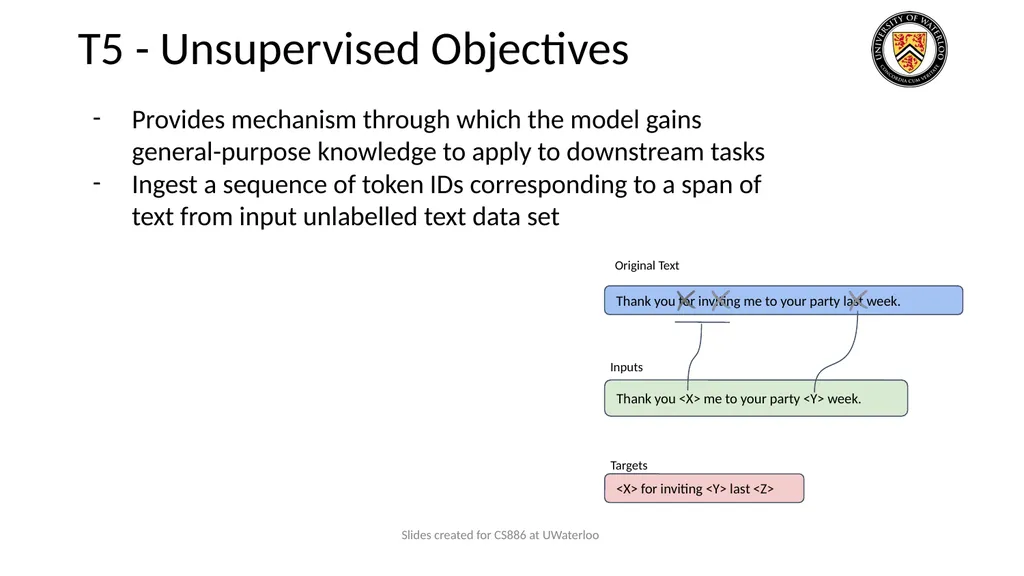
T5 - Unsupervised Objectives Slides created for CS886 at UWaterloo Thank you for inviting me to your party last week. Thank you <X> me to your party <Y> week. <X> for inviting <Y> last <Z> Original Text Inputs Targets Provides mechanism through which the model gains general-purpose knowledge to apply to downstream tasks
Ingest a sequence of token IDs corresponding to a span of text from input unlabelled text data set<br>
Ingest a sequence of token IDs corresponding to a span of text from input unlabelled text data set<br>
18
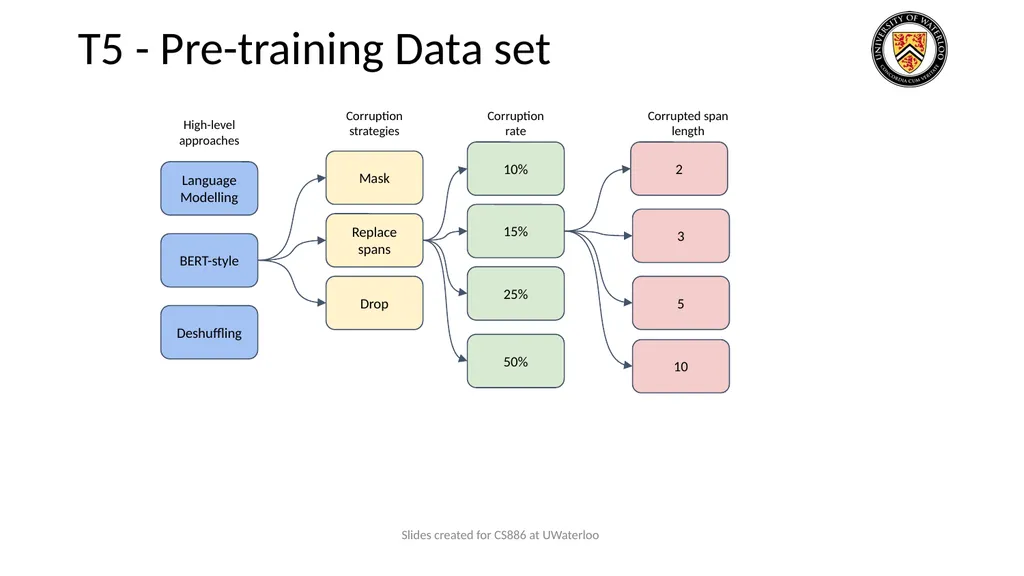
T5 - Pre-training Data set Slides created for CS886 at UWaterloo Language Modelling BERT-style Deshuffling Drop Replace spans Mask 50% 25% 15% 10% 10 5 3 2 High-level approaches Corruption strategies Corruption rate Corrupted span length<br>
19
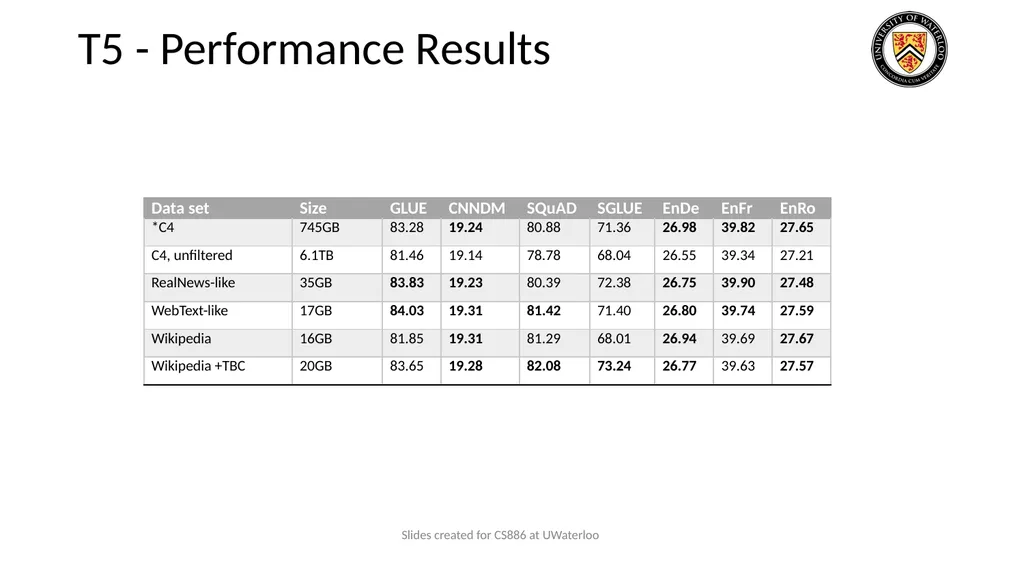
T5 - Performance Results Slides created for CS886 at UWaterloo<br>
20
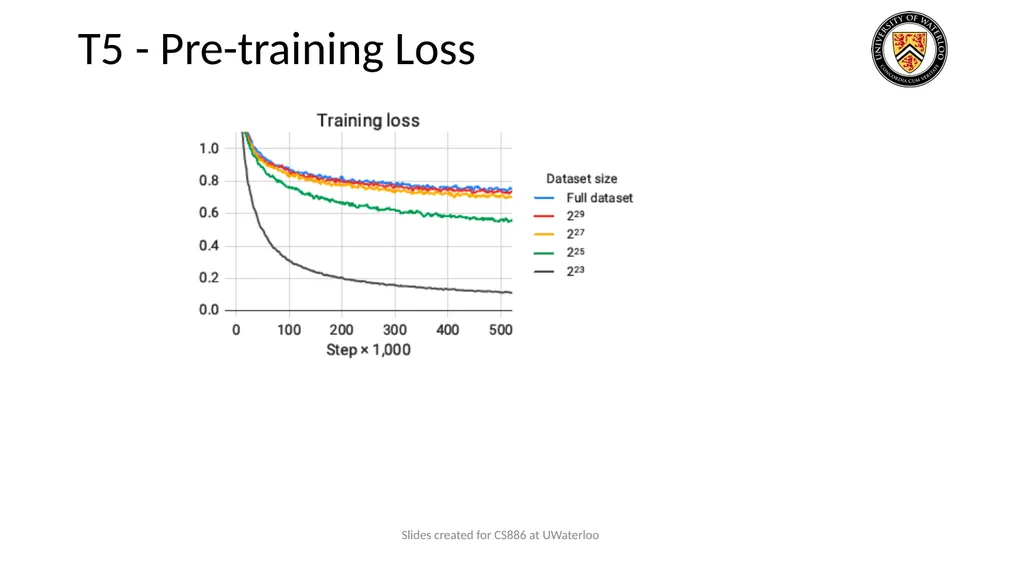
T5 - Pre-training Loss Slides created for CS886 at UWaterloo<br>
21
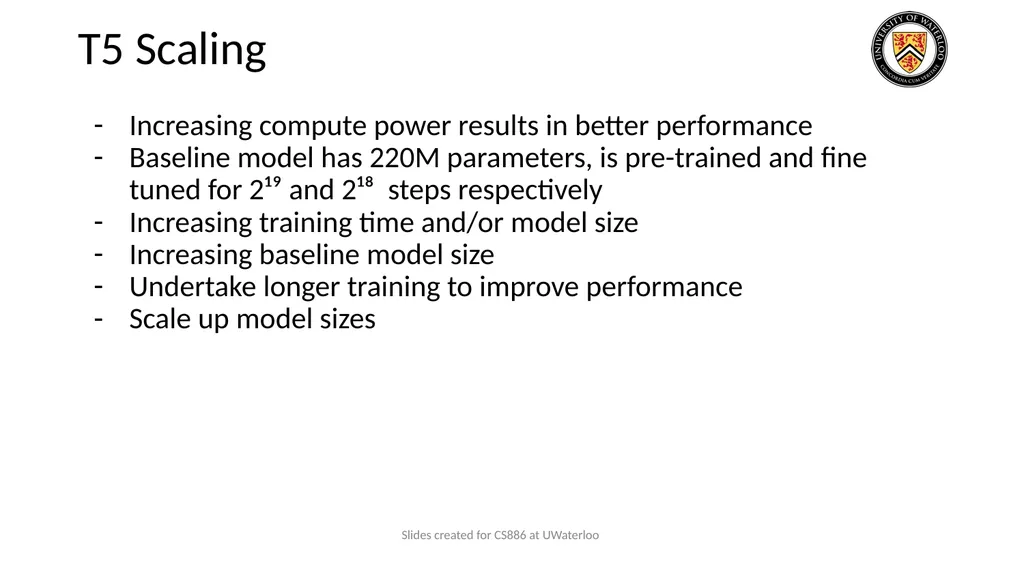
T5 Scaling Increasing compute power results in better performance
Baseline model has 220M parameters, is pre-trained and fine tuned for 2¹⁹ and 2¹⁸ steps respectively
Increasing training time and/or model size
Increasing baseline model size
Undertake longer training to improve performance
Scale up model sizes Slides created for CS886 at UWaterloo<br>
Baseline model has 220M parameters, is pre-trained and fine tuned for 2¹⁹ and 2¹⁸ steps respectively
Increasing training time and/or model size
Increasing baseline model size
Undertake longer training to improve performance
Scale up model sizes Slides created for CS886 at UWaterloo<br>
22
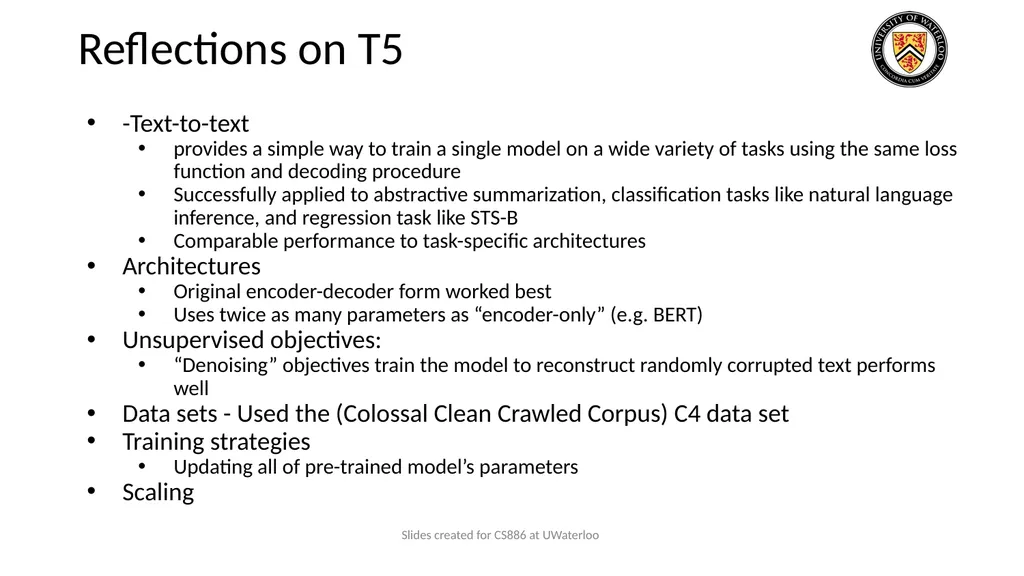
-Text-to-text
provides a simple way to train a single model on a wide variety of tasks using the same loss function and decoding procedure
Successfully applied to abstractive summarization, classification tasks like natural language inference, and regression task like STS-B
Comparable performance to task-specific architectures
Architectures
Original encoder-decoder form worked best
Uses twice as many parameters as “encoder-only” (e.g. BERT)
Unsupervised objectives:
“Denoising” objectives train the model to reconstruct randomly corrupted text performs well
Data sets - Used the (Colossal Clean Crawled Corpus) C4 data set
Training strategies
Updating all of pre-trained model’s parameters
Scaling Reflections on T5 Slides created for CS886 at UWaterloo<br>
provides a simple way to train a single model on a wide variety of tasks using the same loss function and decoding procedure
Successfully applied to abstractive summarization, classification tasks like natural language inference, and regression task like STS-B
Comparable performance to task-specific architectures
Architectures
Original encoder-decoder form worked best
Uses twice as many parameters as “encoder-only” (e.g. BERT)
Unsupervised objectives:
“Denoising” objectives train the model to reconstruct randomly corrupted text performs well
Data sets - Used the (Colossal Clean Crawled Corpus) C4 data set
Training strategies
Updating all of pre-trained model’s parameters
Scaling Reflections on T5 Slides created for CS886 at UWaterloo<br>
23
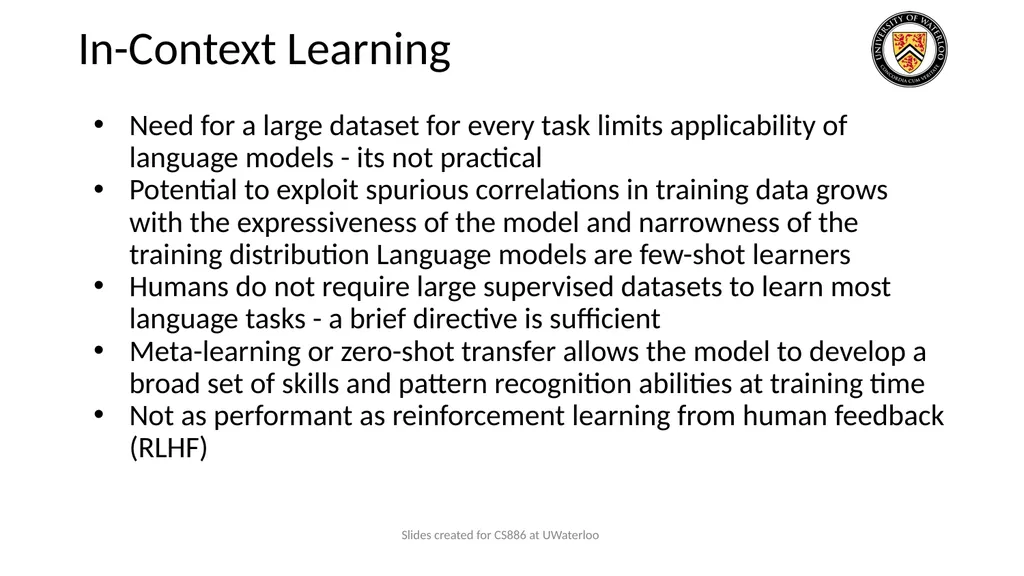
In-Context Learning Need for a large dataset for every task limits applicability of language models - its not practical
Potential to exploit spurious correlations in training data grows with the expressiveness of the model and narrowness of the training distribution Language models are few-shot learners
Humans do not require large supervised datasets to learn most language tasks - a brief directive is sufficient
Meta-learning or zero-shot transfer allows the model to develop a broad set of skills and pattern recognition abilities at training time
Not as performant as reinforcement learning from human feedback (RLHF) Slides created for CS886 at UWaterloo<br>
Potential to exploit spurious correlations in training data grows with the expressiveness of the model and narrowness of the training distribution Language models are few-shot learners
Humans do not require large supervised datasets to learn most language tasks - a brief directive is sufficient
Meta-learning or zero-shot transfer allows the model to develop a broad set of skills and pattern recognition abilities at training time
Not as performant as reinforcement learning from human feedback (RLHF) Slides created for CS886 at UWaterloo<br>
24
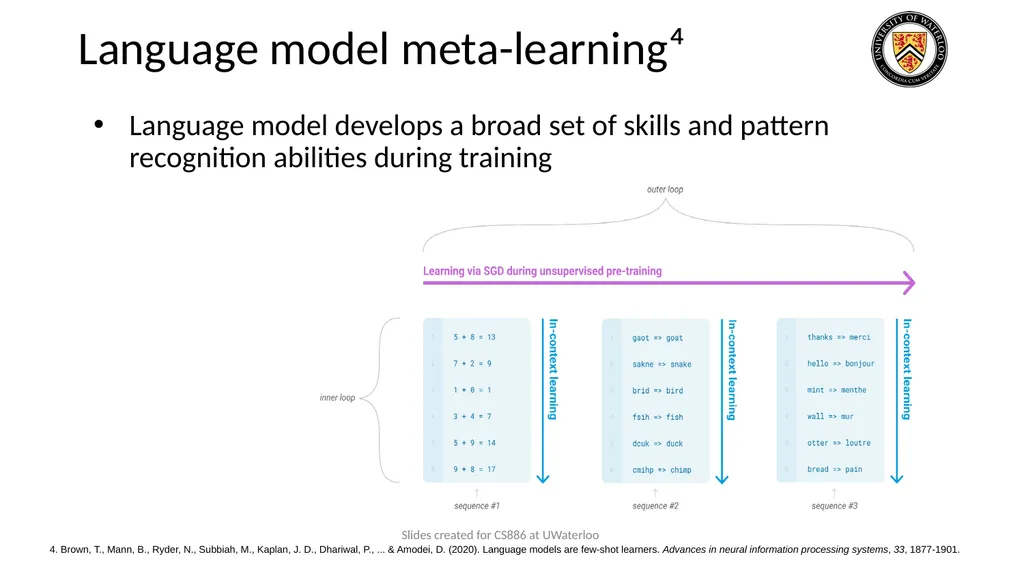
Language model meta-learning⁴ Language model develops a broad set of skills and pattern recognition abilities during training Slides created for CS886 at UWaterloo 4. Brown, T., Mann, B., Ryder, N., Subbiah, M., Kaplan, J. D., Dhariwal, P., ... & Amodei, D. (2020). Language models are few-shot learners. Advances in neural information processing systems, 33, 1877-1901.<br>
25
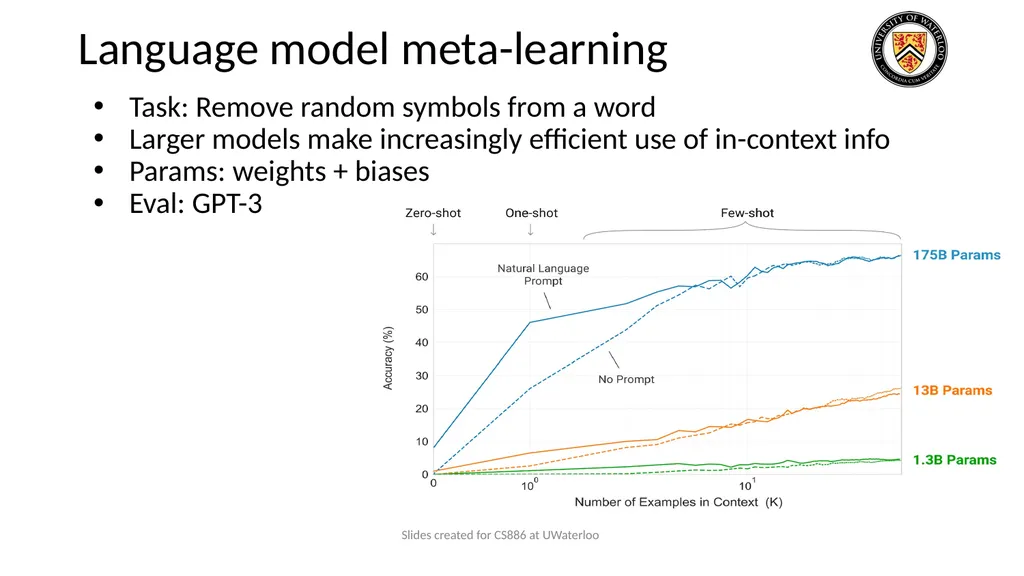
Language model meta-learning Task: Remove random symbols from a word
Larger models make increasingly efficient use of in-context info
Params: weights + biases
Eval: GPT-3 Slides created for CS886 at UWaterloo<br>
Larger models make increasingly efficient use of in-context info
Params: weights + biases
Eval: GPT-3 Slides created for CS886 at UWaterloo<br>
26
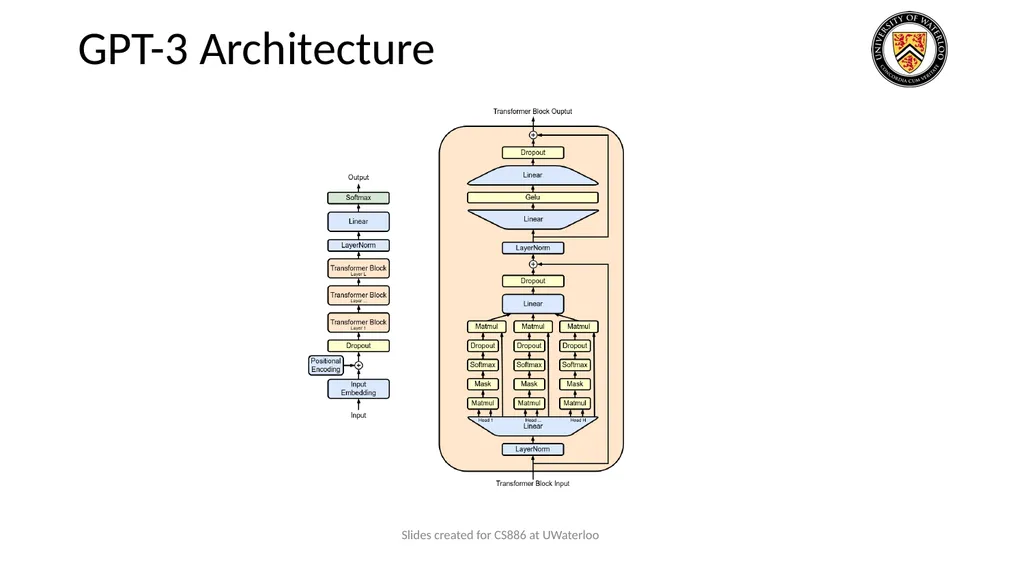
GPT-3 Architecture Slides created for CS886 at UWaterloo<br>
27
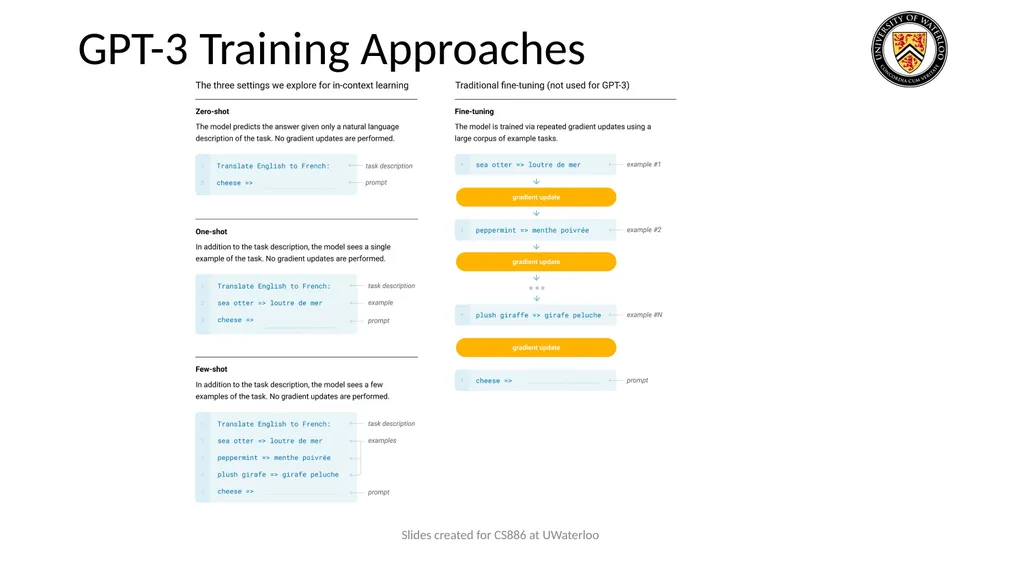
GPT-3 Training Approaches Slides created for CS886 at UWaterloo<br>
28
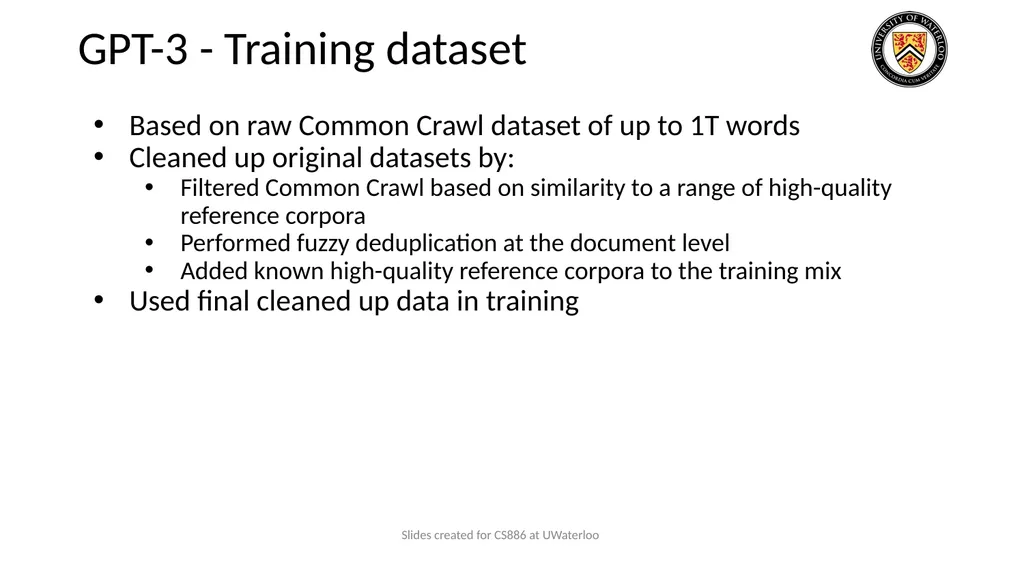
GPT-3 - Training dataset Based on raw Common Crawl dataset of up to 1T words
Cleaned up original datasets by:
Filtered Common Crawl based on similarity to a range of high-quality reference corpora
Performed fuzzy deduplication at the document level
Added known high-quality reference corpora to the training mix
Used final cleaned up data in training Slides created for CS886 at UWaterloo<br>
Cleaned up original datasets by:
Filtered Common Crawl based on similarity to a range of high-quality reference corpora
Performed fuzzy deduplication at the document level
Added known high-quality reference corpora to the training mix
Used final cleaned up data in training Slides created for CS886 at UWaterloo<br>
29
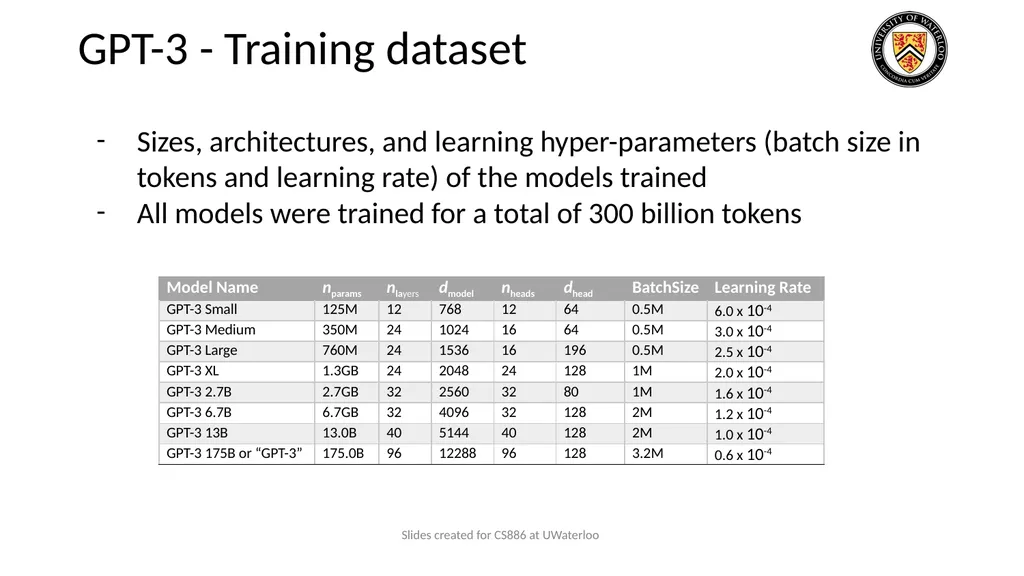
GPT-3 - Training dataset Slides created for CS886 at UWaterloo Sizes, architectures, and learning hyper-parameters (batch size in tokens and learning rate) of the models trained
All models were trained for a total of 300 billion tokens<br>
All models were trained for a total of 300 billion tokens<br>
30
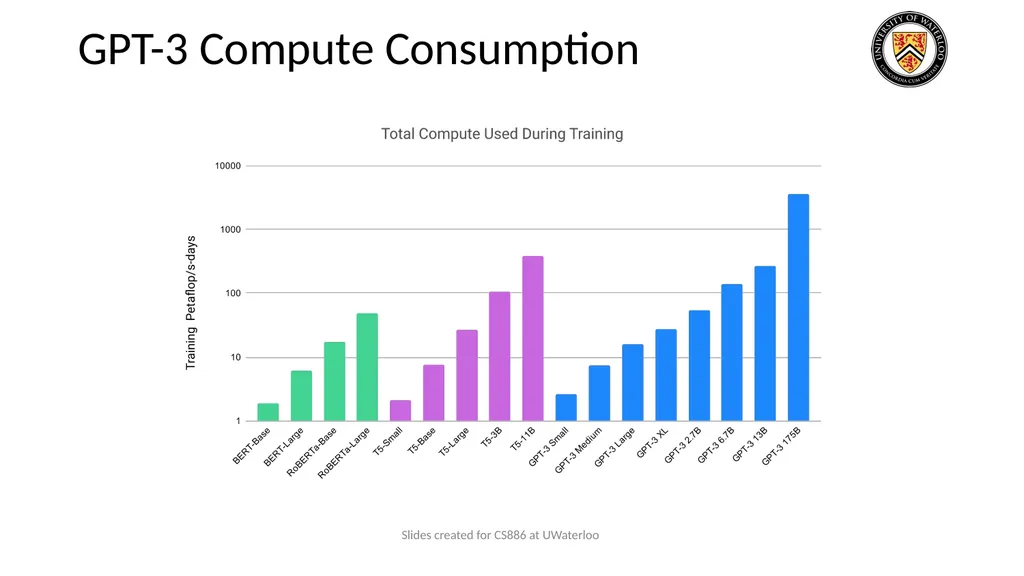
GPT-3 Compute Consumption Slides created for CS886 at UWaterloo<br>
31
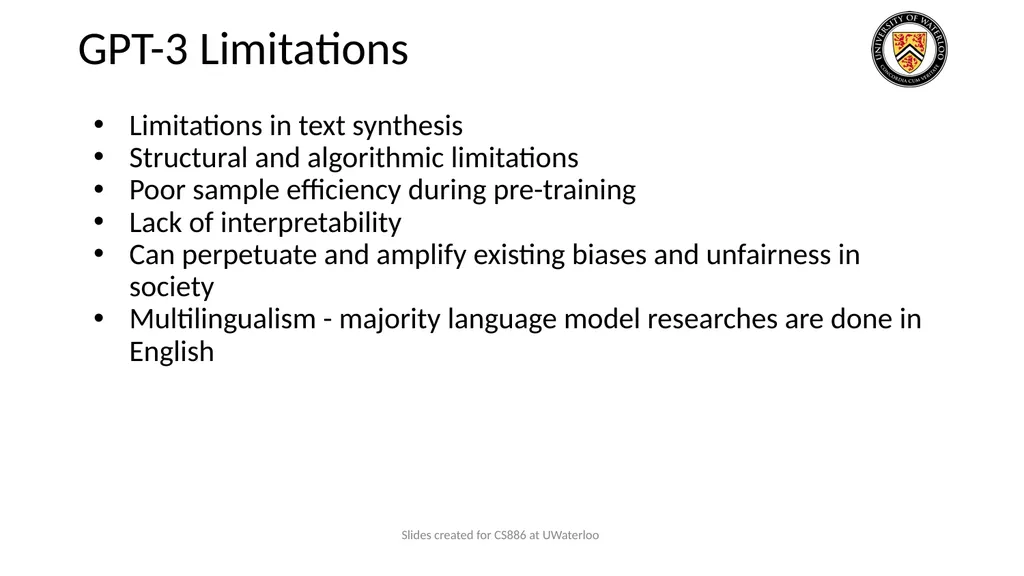
GPT-3 Limitations Limitations in text synthesis
Structural and algorithmic limitations
Poor sample efficiency during pre-training
Lack of interpretability
Can perpetuate and amplify existing biases and unfairness in society
Multilingualism - majority language model researches are done in English Slides created for CS886 at UWaterloo<br>
Structural and algorithmic limitations
Poor sample efficiency during pre-training
Lack of interpretability
Can perpetuate and amplify existing biases and unfairness in society
Multilingualism - majority language model researches are done in English Slides created for CS886 at UWaterloo<br>
32
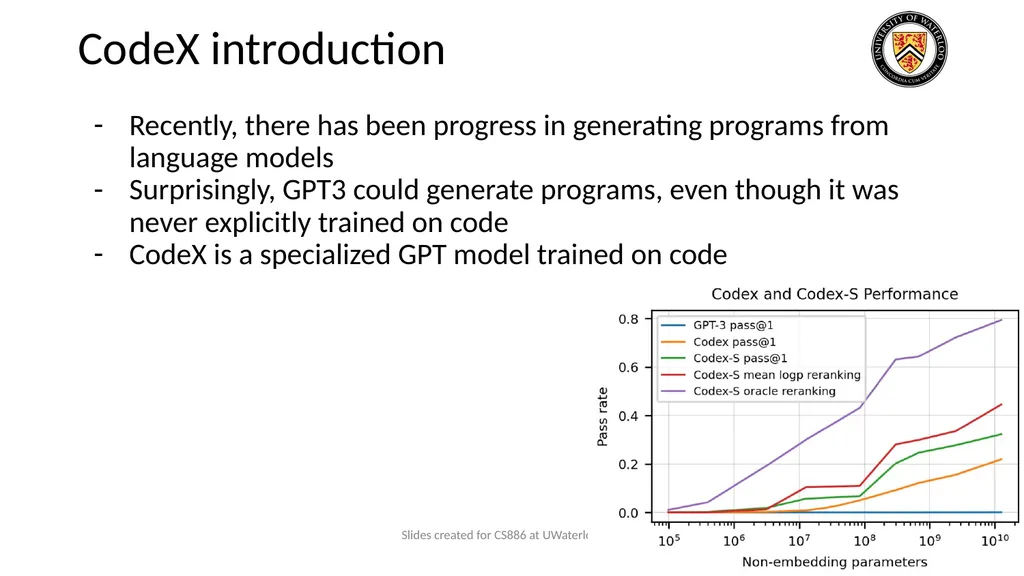
CodeX introduction Recently, there has been progress in generating programs from language models
Surprisingly, GPT3 could generate programs, even though it was never explicitly trained on code
CodeX is a specialized GPT model trained on code Slides created for CS886 at UWaterloo<br>
Surprisingly, GPT3 could generate programs, even though it was never explicitly trained on code
CodeX is a specialized GPT model trained on code Slides created for CS886 at UWaterloo<br>
33
CodeX evaluation While the performance of generative models are usually evaluated using match-based metrics by comparing output to a reference solution, there may be too many different possible output programs that are functionally equivalent to the reference solution for this metric to account for; indeed, it was found that one such metric called the BLEU score is unreliable
An alternative method is to use functional correctness instead, which runs the output code on test cases to measure performance; it is preferable similar to how humans judge code Slides created for CS886 at UWaterloo<br>
An alternative method is to use functional correctness instead, which runs the output code on test cases to measure performance; it is preferable similar to how humans judge code Slides created for CS886 at UWaterloo<br>
34
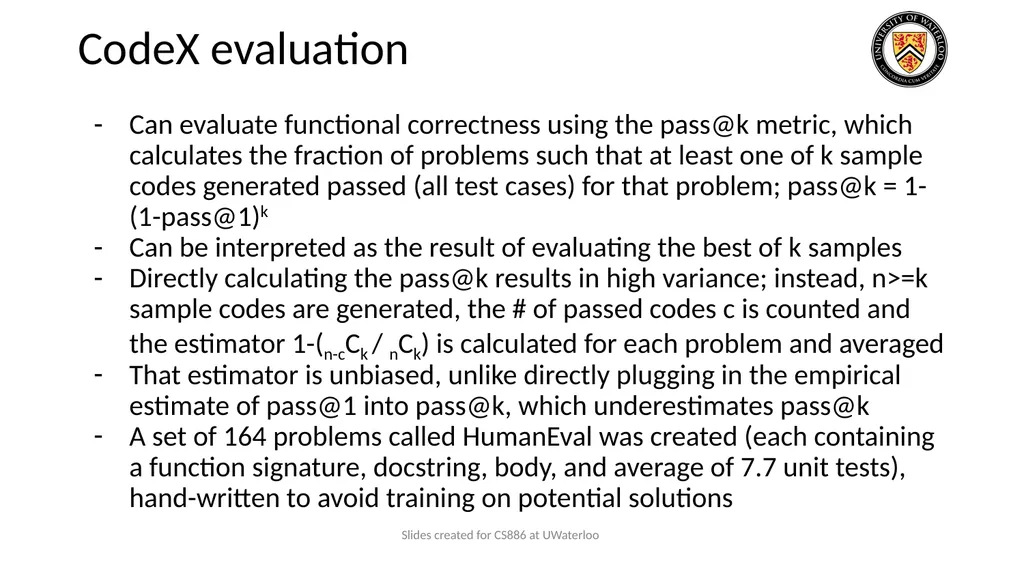
CodeX evaluation Can evaluate functional correctness using the pass@k metric, which calculates the fraction of problems such that at least one of k sample codes generated passed (all test cases) for that problem; pass@k = 1-(1-pass@1)k
Can be interpreted as the result of evaluating the best of k samples
Directly calculating the pass@k results in high variance; instead, n>=k sample codes are generated, the # of passed codes c is counted and the estimator 1-(n-cCk / nCk) is calculated for each problem and averaged
That estimator is unbiased, unlike directly plugging in the empirical estimate of pass@1 into pass@k, which underestimates pass@k
A set of 164 problems called HumanEval was created (each containing a function signature, docstring, body, and average of 7.7 unit tests), hand-written to avoid training on potential solutions Slides created for CS886 at UWaterloo<br>
Can be interpreted as the result of evaluating the best of k samples
Directly calculating the pass@k results in high variance; instead, n>=k sample codes are generated, the # of passed codes c is counted and the estimator 1-(n-cCk / nCk) is calculated for each problem and averaged
That estimator is unbiased, unlike directly plugging in the empirical estimate of pass@1 into pass@k, which underestimates pass@k
A set of 164 problems called HumanEval was created (each containing a function signature, docstring, body, and average of 7.7 unit tests), hand-written to avoid training on potential solutions Slides created for CS886 at UWaterloo<br>
35
CodeX training Fine-tuned GPT models up to 12B parameters on code
Trained on 159GB dataset of unique Python files on GitHub
Used the same learning rate as the corresponding GPT model, with a 175 step linear warmup and cosine learning rate decay. Trained on a total of 100 billion tokens, using the Adam optimizer with a weight decay coefficient of 0.1. Slides created for CS886 at UWaterloo<br>
Trained on 159GB dataset of unique Python files on GitHub
Used the same learning rate as the corresponding GPT model, with a 175 step linear warmup and cosine learning rate decay. Trained on a total of 100 billion tokens, using the Adam optimizer with a weight decay coefficient of 0.1. Slides created for CS886 at UWaterloo<br>
36
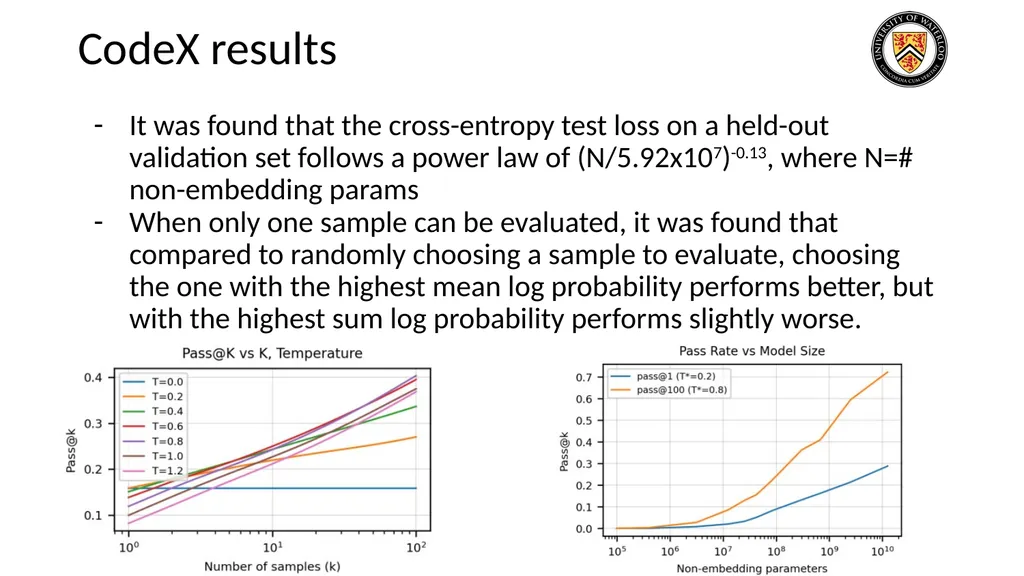
CodeX results It was found that the cross-entropy test loss on a held-out validation set follows a power law of (N/5.92x107)-0.13, where N=# non-embedding params
When only one sample can be evaluated, it was found that compared to randomly choosing a sample to evaluate, choosing the one with the highest mean log probability performs better, but with the highest sum log probability performs slightly worse.<br>
When only one sample can be evaluated, it was found that compared to randomly choosing a sample to evaluate, choosing the one with the highest mean log probability performs better, but with the highest sum log probability performs slightly worse.<br>
37
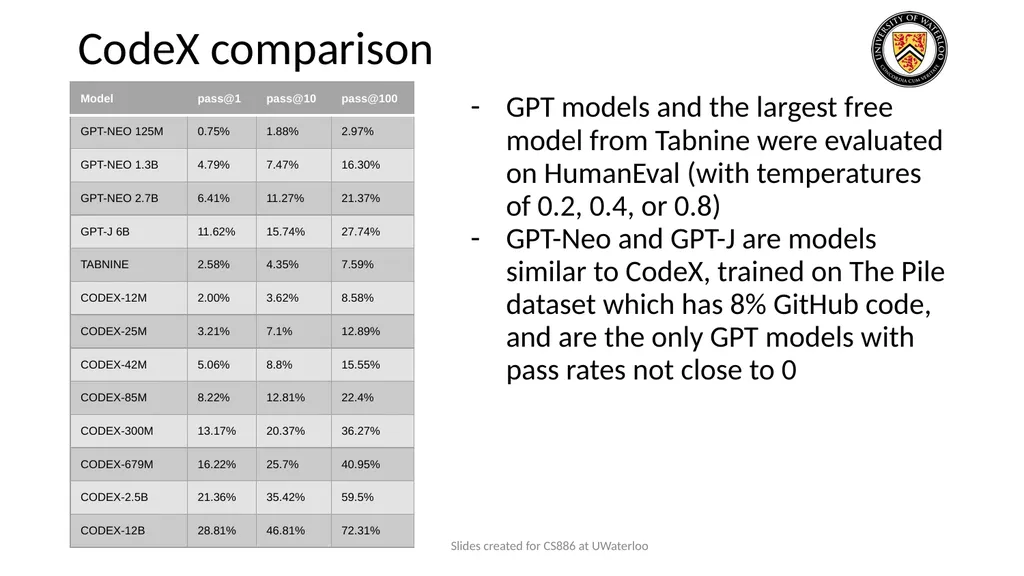
CodeX comparison GPT models and the largest free model from Tabnine were evaluated on HumanEval (with temperatures of 0.2, 0.4, or 0.8)
GPT-Neo and GPT-J are models similar to CodeX, trained on The Pile dataset which has 8% GitHub code, and are the only GPT models with pass rates not close to 0 Slides created for CS886 at UWaterloo<br>
GPT-Neo and GPT-J are models similar to CodeX, trained on The Pile dataset which has 8% GitHub code, and are the only GPT models with pass rates not close to 0 Slides created for CS886 at UWaterloo<br>
38
CodeX-S There may be code unrelated to translating natural language to code, which may lower performance
A set of training problems from relevant code was obtained from competitive programming websites and repositories with continuous integration
CodeX-S is a version of CodeX with this supervised fine-tuning and it has improved performance Slides created for CS886 at UWaterloo<br>
A set of training problems from relevant code was obtained from competitive programming websites and repositories with continuous integration
CodeX-S is a version of CodeX with this supervised fine-tuning and it has improved performance Slides created for CS886 at UWaterloo<br>
39
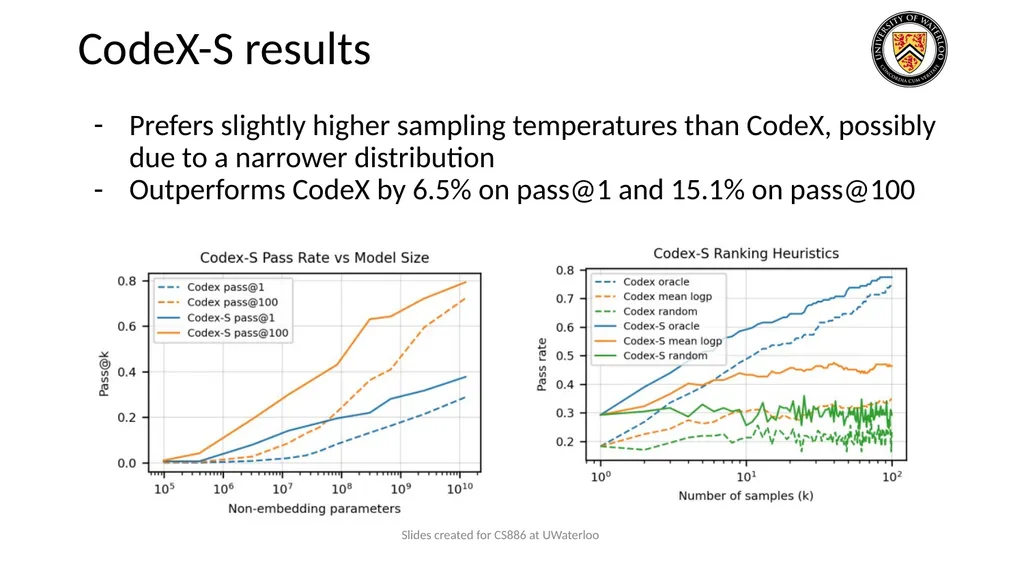
CodeX-S results Prefers slightly higher sampling temperatures than CodeX, possibly due to a narrower distribution
Outperforms CodeX by 6.5% on pass@1 and 15.1% on pass@100 Slides created for CS886 at UWaterloo<br>
Outperforms CodeX by 6.5% on pass@1 and 15.1% on pass@100 Slides created for CS886 at UWaterloo<br>
40
CodeX-D So far we have discussed how CodeX generates code from docstrings, but what about the other way around?
CodeX-D is a version of CodeX that generates docstrings from code
Each training problem contains the function signature, the reference solution, and docstring
No way to measure functional correctness for docstrings
graded only 10 samples for each of 1640 problems by hand manually
pass@1 and pass@10 are 20.3% and 46.5% respectively (which is slightly lower than that for CodeX-S: 32.2% and 59.5% respectively) Slides created for CS886 at UWaterloo<br>
CodeX-D is a version of CodeX that generates docstrings from code
Each training problem contains the function signature, the reference solution, and docstring
No way to measure functional correctness for docstrings
graded only 10 samples for each of 1640 problems by hand manually
pass@1 and pass@10 are 20.3% and 46.5% respectively (which is slightly lower than that for CodeX-S: 32.2% and 59.5% respectively) Slides created for CS886 at UWaterloo<br>
41
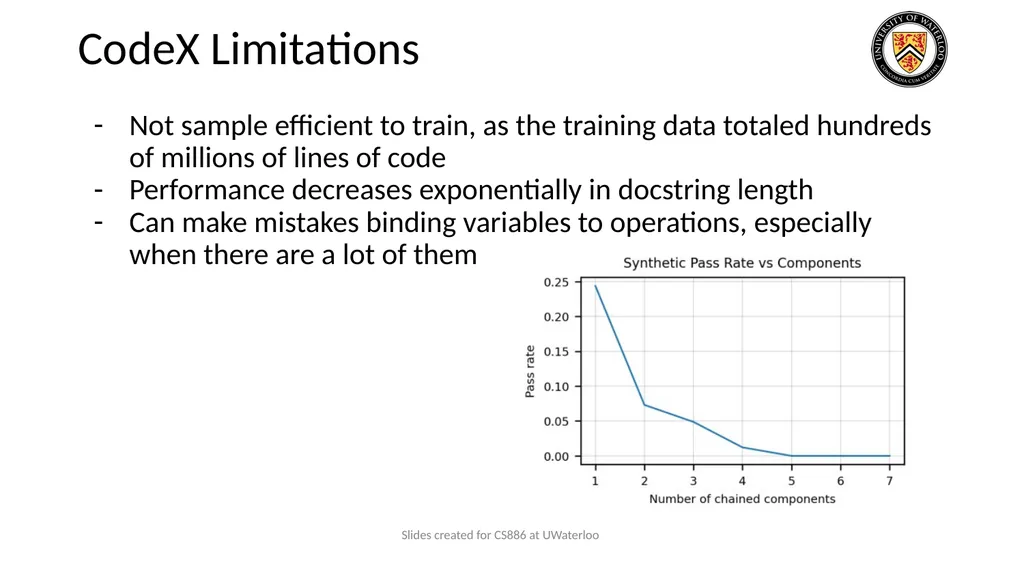
CodeX Limitations Not sample efficient to train, as the training data totaled hundreds of millions of lines of code
Performance decreases exponentially in docstring length
Can make mistakes binding variables to operations, especially when there are a lot of them Slides created for CS886 at UWaterloo<br>
Performance decreases exponentially in docstring length
Can make mistakes binding variables to operations, especially when there are a lot of them Slides created for CS886 at UWaterloo<br>
42
Llama-2 introduction -Family of pretrained and fine-tuned LLMs with billions of parameters
-Can outperform other open-source LLMs and be on par with close-sourced LLMs Slides created for CS886 at UWaterloo Slides created for CS886 at UWaterloo<br>
-Can outperform other open-source LLMs and be on par with close-sourced LLMs Slides created for CS886 at UWaterloo Slides created for CS886 at UWaterloo<br>
43
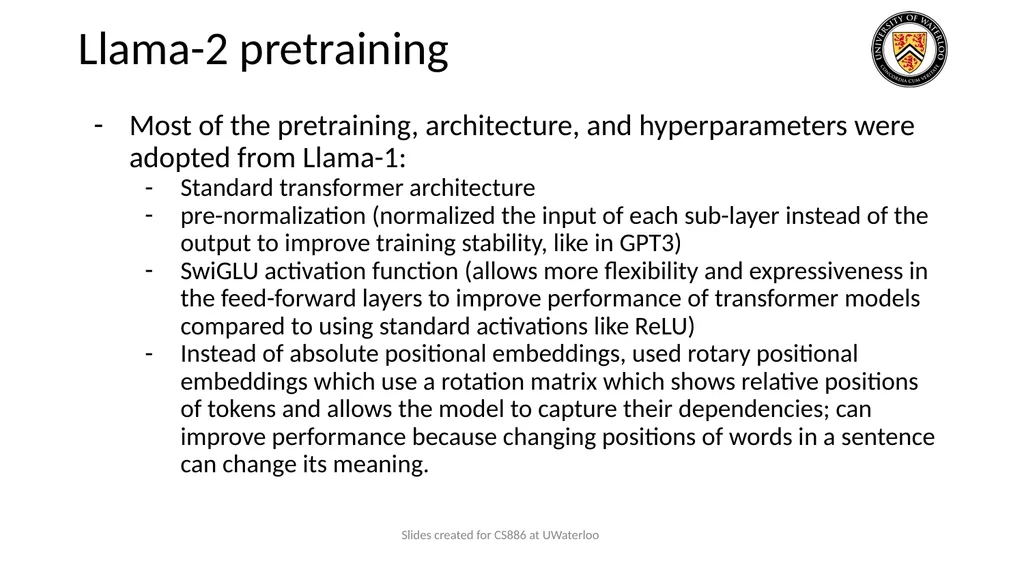
Llama-2 pretraining Most of the pretraining, architecture, and hyperparameters were adopted from Llama-1:
Standard transformer architecture
pre-normalization (normalized the input of each sub-layer instead of the output to improve training stability, like in GPT3)
SwiGLU activation function (allows more flexibility and expressiveness in the feed-forward layers to improve performance of transformer models compared to using standard activations like ReLU)
Instead of absolute positional embeddings, used rotary positional embeddings which use a rotation matrix which shows relative positions of tokens and allows the model to capture their dependencies; can improve performance because changing positions of words in a sentence can change its meaning. Slides created for CS886 at UWaterloo<br>
Standard transformer architecture
pre-normalization (normalized the input of each sub-layer instead of the output to improve training stability, like in GPT3)
SwiGLU activation function (allows more flexibility and expressiveness in the feed-forward layers to improve performance of transformer models compared to using standard activations like ReLU)
Instead of absolute positional embeddings, used rotary positional embeddings which use a rotation matrix which shows relative positions of tokens and allows the model to capture their dependencies; can improve performance because changing positions of words in a sentence can change its meaning. Slides created for CS886 at UWaterloo<br>
44
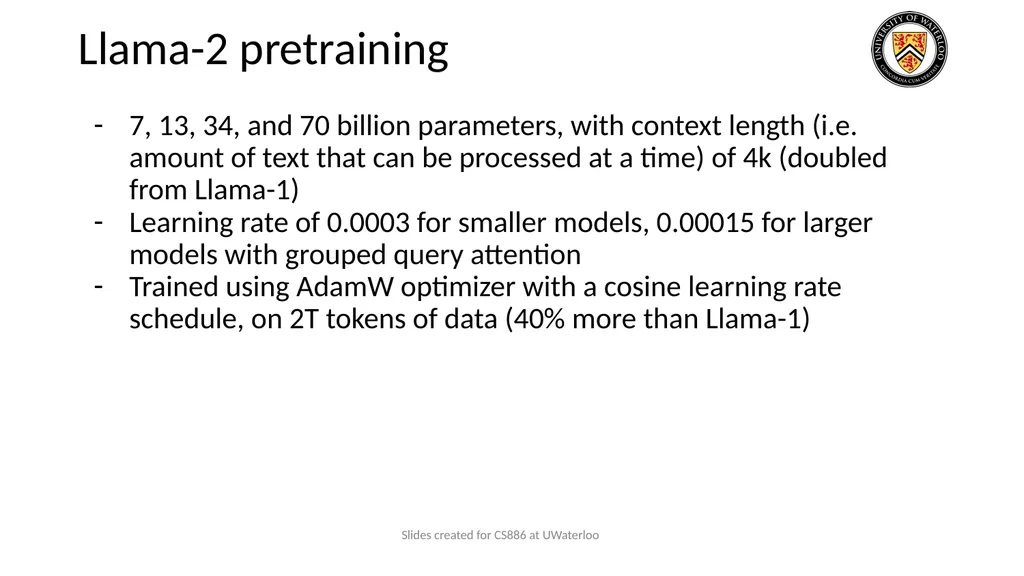
Llama-2 pretraining 7, 13, 34, and 70 billion parameters, with context length (i.e. amount of text that can be processed at a time) of 4k (doubled from Llama-1)
Learning rate of 0.0003 for smaller models, 0.00015 for larger models with grouped query attention
Trained using AdamW optimizer with a cosine learning rate schedule, on 2T tokens of data (40% more than Llama-1) Slides created for CS886 at UWaterloo<br>
Learning rate of 0.0003 for smaller models, 0.00015 for larger models with grouped query attention
Trained using AdamW optimizer with a cosine learning rate schedule, on 2T tokens of data (40% more than Llama-1) Slides created for CS886 at UWaterloo<br>
45
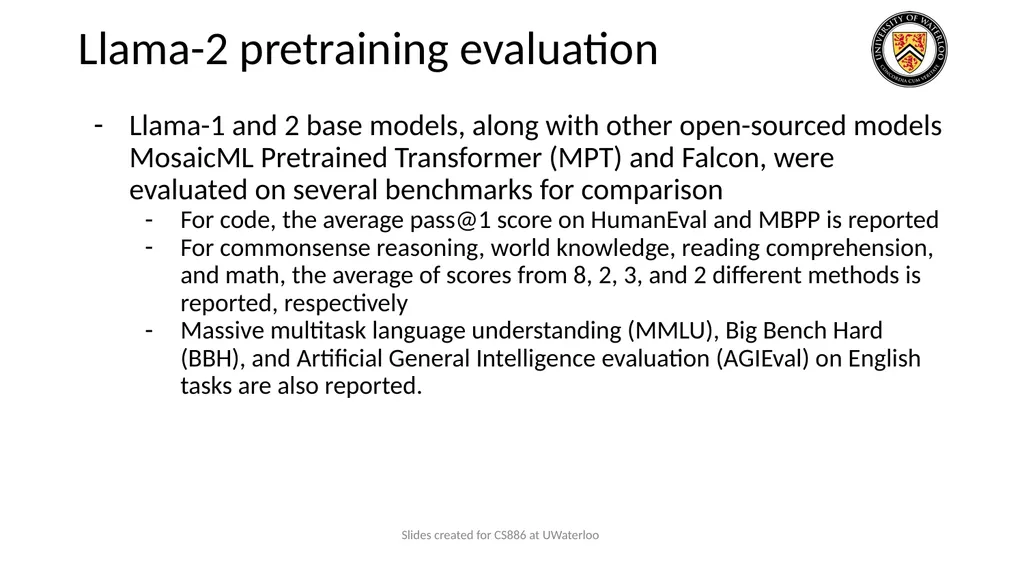
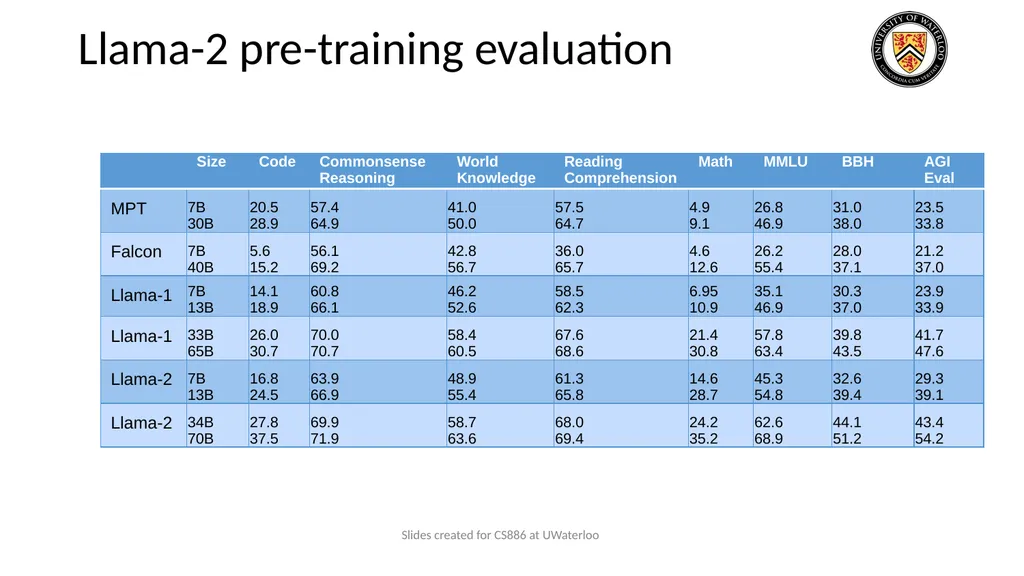
Llama-2 pretraining evaluation Llama-1 and 2 base models, along with other open-sourced models MosaicML Pretrained Transformer (MPT) and Falcon, were evaluated on several benchmarks for comparison
For code, the average pass@1 score on HumanEval and MBPP is reported
For commonsense reasoning, world knowledge, reading comprehension, and math, the average of scores from 8, 2, 3, and 2 different methods is reported, respectively
Massive multitask language understanding (MMLU), Big Bench Hard (BBH), and Artificial General Intelligence evaluation (AGIEval) on English tasks are also reported. Slides created for CS886 at UWaterloo<br>
For code, the average pass@1 score on HumanEval and MBPP is reported
For commonsense reasoning, world knowledge, reading comprehension, and math, the average of scores from 8, 2, 3, and 2 different methods is reported, respectively
Massive multitask language understanding (MMLU), Big Bench Hard (BBH), and Artificial General Intelligence evaluation (AGIEval) on English tasks are also reported. Slides created for CS886 at UWaterloo<br>
46
Llama-2 pre-training evaluation Slides created for CS886 at UWaterloo<br>
47
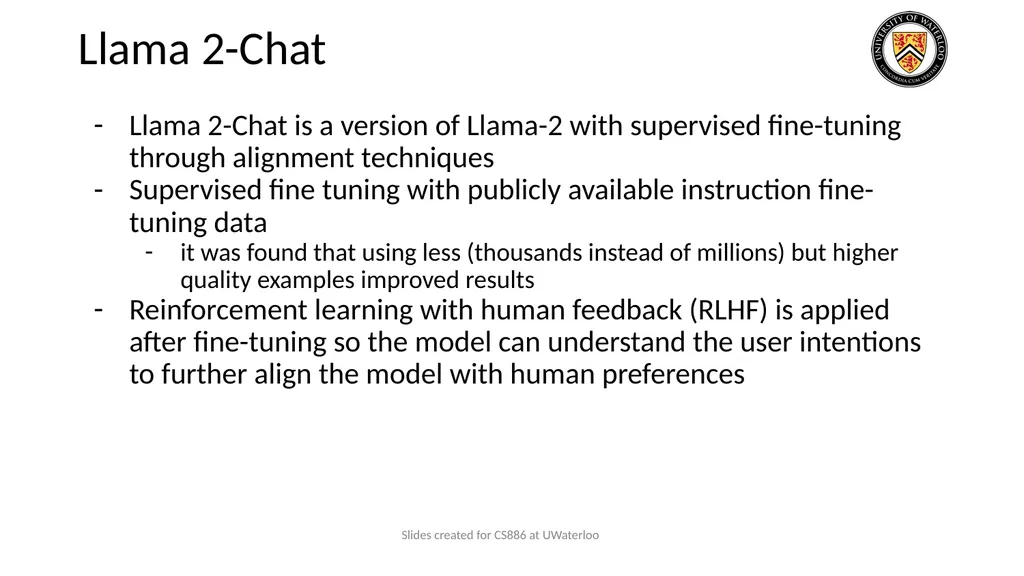
Llama 2-Chat Llama 2-Chat is a version of Llama-2 with supervised fine-tuning through alignment techniques
Supervised fine tuning with publicly available instruction fine-tuning data
it was found that using less (thousands instead of millions) but higher quality examples improved results
Reinforcement learning with human feedback (RLHF) is applied after fine-tuning so the model can understand the user intentions to further align the model with human preferences Slides created for CS886 at UWaterloo<br>
Supervised fine tuning with publicly available instruction fine-tuning data
it was found that using less (thousands instead of millions) but higher quality examples improved results
Reinforcement learning with human feedback (RLHF) is applied after fine-tuning so the model can understand the user intentions to further align the model with human preferences Slides created for CS886 at UWaterloo<br>
48
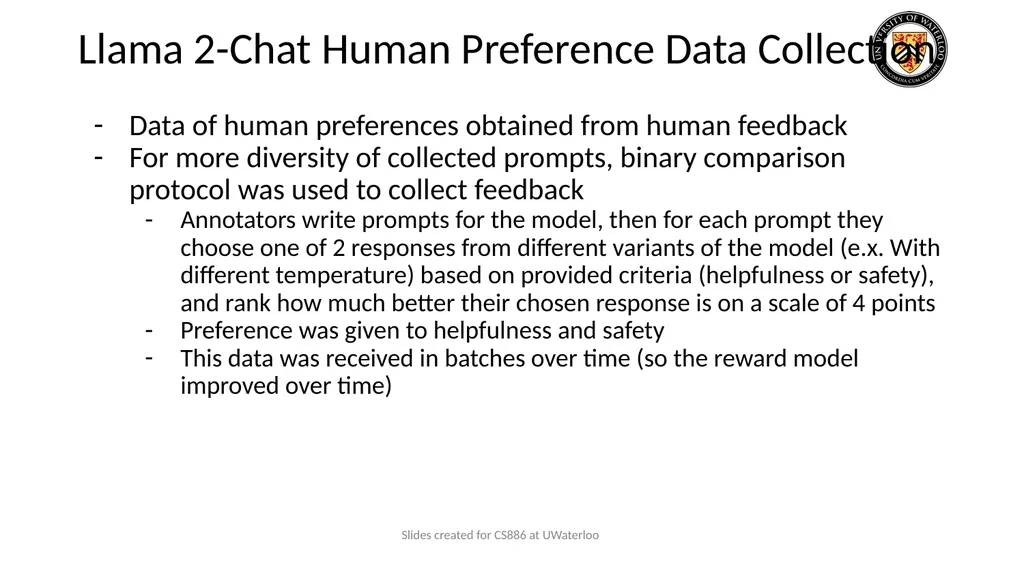
Llama 2-Chat Human Preference Data Collection Data of human preferences obtained from human feedback
For more diversity of collected prompts, binary comparison protocol was used to collect feedback
Annotators write prompts for the model, then for each prompt they choose one of 2 responses from different variants of the model (e.x. With different temperature) based on provided criteria (helpfulness or safety), and rank how much better their chosen response is on a scale of 4 points
Preference was given to helpfulness and safety
This data was received in batches over time (so the reward model improved over time) Slides created for CS886 at UWaterloo<br>
For more diversity of collected prompts, binary comparison protocol was used to collect feedback
Annotators write prompts for the model, then for each prompt they choose one of 2 responses from different variants of the model (e.x. With different temperature) based on provided criteria (helpfulness or safety), and rank how much better their chosen response is on a scale of 4 points
Preference was given to helpfulness and safety
This data was received in batches over time (so the reward model improved over time) Slides created for CS886 at UWaterloo<br>
49
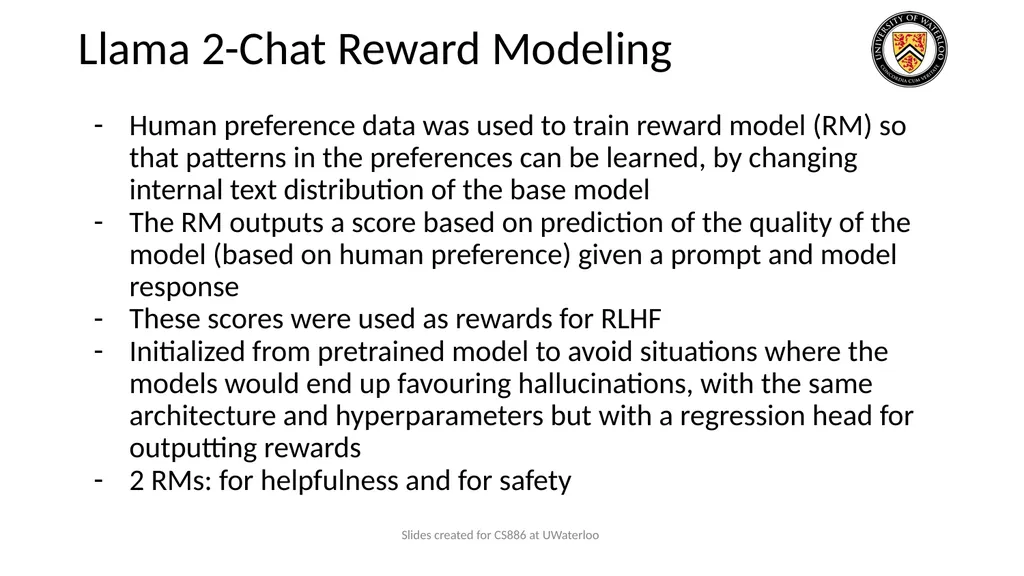
Llama 2-Chat Reward Modeling Human preference data was used to train reward model (RM) so that patterns in the preferences can be learned, by changing internal text distribution of the base model
The RM outputs a score based on prediction of the quality of the model (based on human preference) given a prompt and model response
These scores were used as rewards for RLHF
Initialized from pretrained model to avoid situations where the models would end up favouring hallucinations, with the same architecture and hyperparameters but with a regression head for outputting rewards
2 RMs: for helpfulness and for safety Slides created for CS886 at UWaterloo<br>
The RM outputs a score based on prediction of the quality of the model (based on human preference) given a prompt and model response
These scores were used as rewards for RLHF
Initialized from pretrained model to avoid situations where the models would end up favouring hallucinations, with the same architecture and hyperparameters but with a regression head for outputting rewards
2 RMs: for helpfulness and for safety Slides created for CS886 at UWaterloo<br>
50
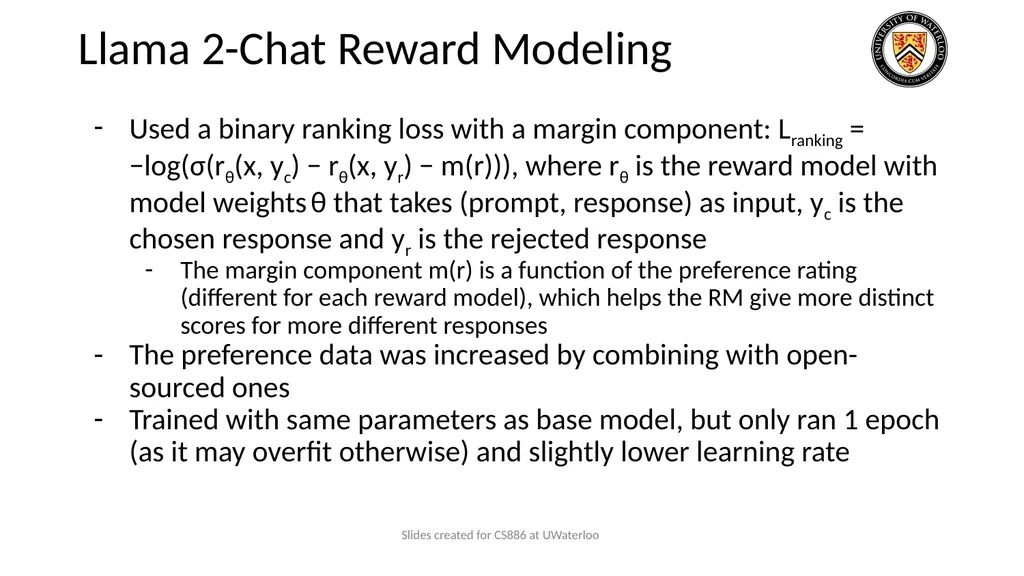
Llama 2-Chat Reward Modeling Used a binary ranking loss with a margin component: Lranking = −log(σ(rθ(x, yc) − rθ(x, yr) − m(r))), where rθ is the reward model with model weights θ that takes (prompt, response) as input, yc is the chosen response and yr is the rejected response
The margin component m(r) is a function of the preference rating (different for each reward model), which helps the RM give more distinct scores for more different responses
The preference data was increased by combining with open-sourced ones
Trained with same parameters as base model, but only ran 1 epoch (as it may overfit otherwise) and slightly lower learning rate Slides created for CS886 at UWaterloo<br>
The margin component m(r) is a function of the preference rating (different for each reward model), which helps the RM give more distinct scores for more different responses
The preference data was increased by combining with open-sourced ones
Trained with same parameters as base model, but only ran 1 epoch (as it may overfit otherwise) and slightly lower learning rate Slides created for CS886 at UWaterloo<br>
51
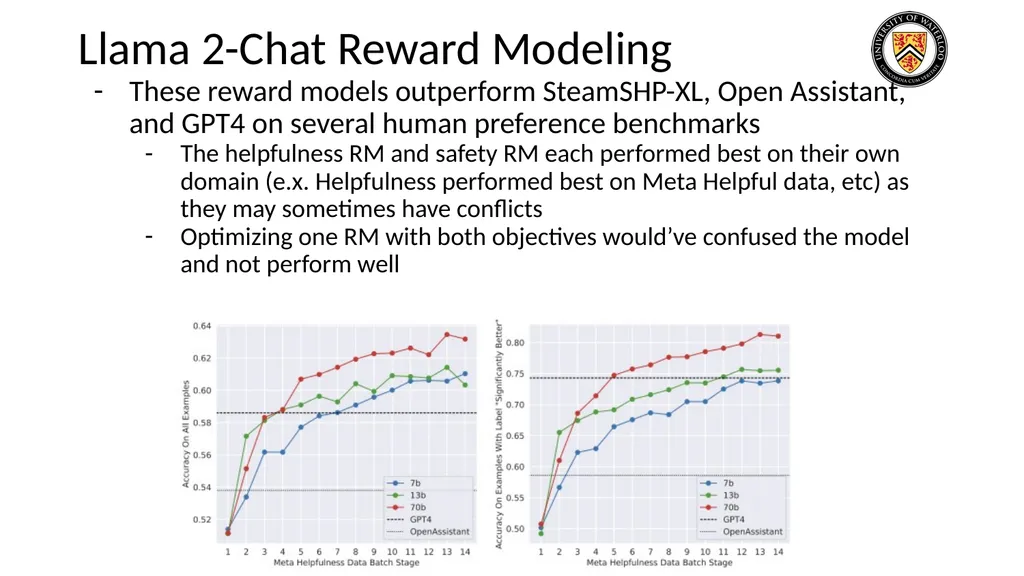
Llama 2-Chat Reward Modeling These reward models outperform SteamSHP-XL, Open Assistant, and GPT4 on several human preference benchmarks
The helpfulness RM and safety RM each performed best on their own domain (e.x. Helpfulness performed best on Meta Helpful data, etc) as they may sometimes have conflicts
Optimizing one RM with both objectives would’ve confused the model and not perform well Slides created for CS886 at UWaterloo<br>
The helpfulness RM and safety RM each performed best on their own domain (e.x. Helpfulness performed best on Meta Helpful data, etc) as they may sometimes have conflicts
Optimizing one RM with both objectives would’ve confused the model and not perform well Slides created for CS886 at UWaterloo<br>
52
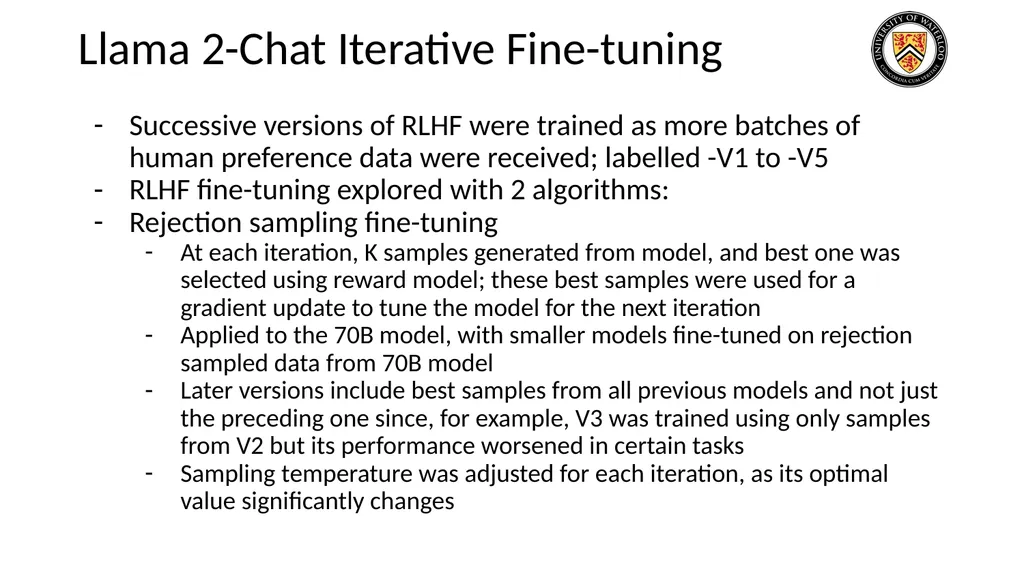
Llama 2-Chat Iterative Fine-tuning Successive versions of RLHF were trained as more batches of human preference data were received; labelled -V1 to -V5
RLHF fine-tuning explored with 2 algorithms:
Rejection sampling fine-tuning
At each iteration, K samples generated from model, and best one was selected using reward model; these best samples were used for a gradient update to tune the model for the next iteration
Applied to the 70B model, with smaller models fine-tuned on rejection sampled data from 70B model
Later versions include best samples from all previous models and not just the preceding one since, for example, V3 was trained using only samples from V2 but its performance worsened in certain tasks
Sampling temperature was adjusted for each iteration, as its optimal value significantly changes<br>
RLHF fine-tuning explored with 2 algorithms:
Rejection sampling fine-tuning
At each iteration, K samples generated from model, and best one was selected using reward model; these best samples were used for a gradient update to tune the model for the next iteration
Applied to the 70B model, with smaller models fine-tuned on rejection sampled data from 70B model
Later versions include best samples from all previous models and not just the preceding one since, for example, V3 was trained using only samples from V2 but its performance worsened in certain tasks
Sampling temperature was adjusted for each iteration, as its optimal value significantly changes<br>
53
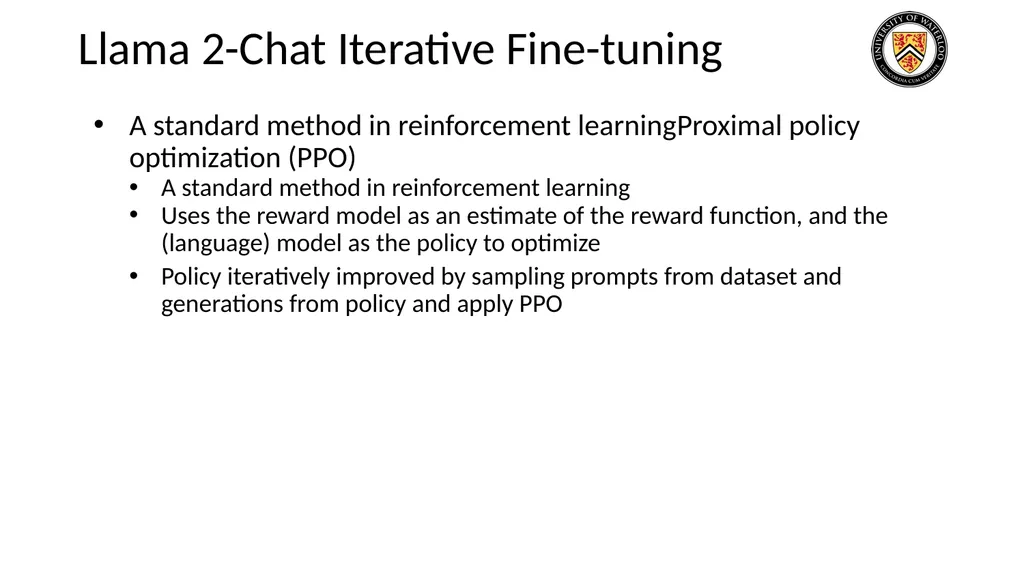
Llama 2-Chat Iterative Fine-tuning A standard method in reinforcement learningProximal policy optimization (PPO)
A standard method in reinforcement learning
Uses the reward model as an estimate of the reward function, and the (language) model as the policy to optimize
Policy iteratively improved by sampling prompts from dataset and generations from policy and apply PPO<br>
A standard method in reinforcement learning
Uses the reward model as an estimate of the reward function, and the (language) model as the policy to optimize
Policy iteratively improved by sampling prompts from dataset and generations from policy and apply PPO<br>
54
Llama 2-Chat Ghost Attention (GAtt) GAtt is a new technique from this model that helps control dialogue flow over multiple turns
Initially the RLHF models sometimes forgets instructions in a dialogue after a few turns; this can be fixed with GAtt, and was applied after RLHF-V3
The method works by synthetically concatenating the instruction to user messages once it’s defined
GAtt is consistent up to 20+ turns up to the context length Slides created for CS886 at UWaterloo<br>
Initially the RLHF models sometimes forgets instructions in a dialogue after a few turns; this can be fixed with GAtt, and was applied after RLHF-V3
The method works by synthetically concatenating the instruction to user messages once it’s defined
GAtt is consistent up to 20+ turns up to the context length Slides created for CS886 at UWaterloo<br>
55
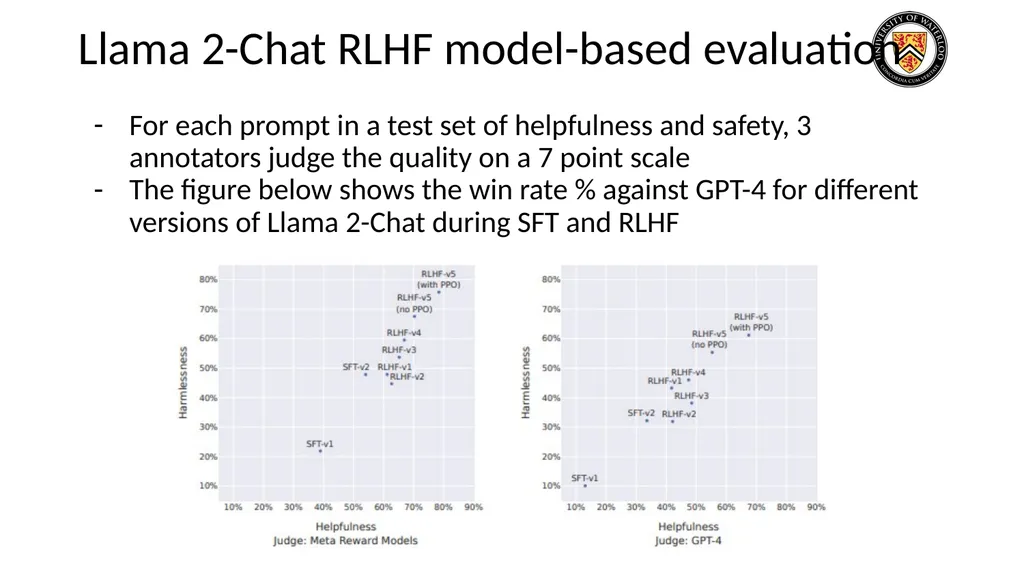
Llama 2-Chat RLHF model-based evaluation For each prompt in a test set of helpfulness and safety, 3 annotators judge the quality on a 7 point scale
The figure below shows the win rate % against GPT-4 for different versions of Llama 2-Chat during SFT and RLHF<br>
The figure below shows the win rate % against GPT-4 for different versions of Llama 2-Chat during SFT and RLHF<br>
56
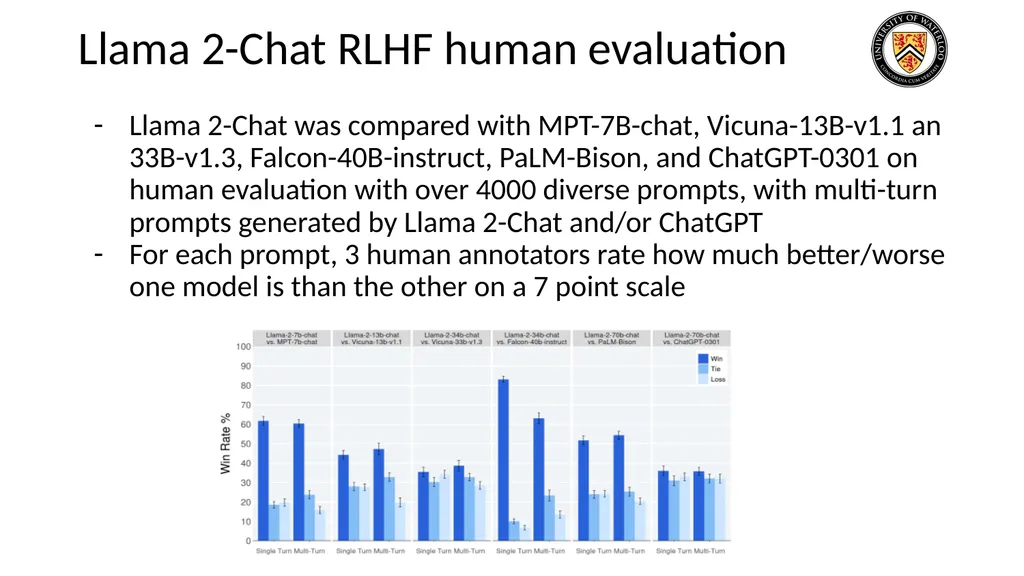
Llama 2-Chat RLHF human evaluation Llama 2-Chat was compared with MPT-7B-chat, Vicuna-13B-v1.1 an 33B-v1.3, Falcon-40B-instruct, PaLM-Bison, and ChatGPT-0301 on human evaluation with over 4000 diverse prompts, with multi-turn prompts generated by Llama 2-Chat and/or ChatGPT
For each prompt, 3 human annotators rate how much better/worse one model is than the other on a 7 point scale<br>
For each prompt, 3 human annotators rate how much better/worse one model is than the other on a 7 point scale<br>
57
Llama-2 Safety Harmful data filtered out during pretraining and fine-tuning
Compared to before fine-tuning, Llama 2-chat showed great improvement in truthfulness and toxicity
50.18% to 64.14% on TruthfulQA and 24.60 to 0.01% ToxiGen, respectively, for the 70B model
Also, lowered bias, as the BOLD scores increased overall
To test robustness against attackers, red teaming was performed
Over 350 diverse people, including experts in various fields, probed the models in various unsafe situations with simulated prompts
These insights were used for fine-tuning and feedback training to lower the rate of violating responses; for the 7B model, this rate was lowered by 4x<br>
Compared to before fine-tuning, Llama 2-chat showed great improvement in truthfulness and toxicity
50.18% to 64.14% on TruthfulQA and 24.60 to 0.01% ToxiGen, respectively, for the 70B model
Also, lowered bias, as the BOLD scores increased overall
To test robustness against attackers, red teaming was performed
Over 350 diverse people, including experts in various fields, probed the models in various unsafe situations with simulated prompts
These insights were used for fine-tuning and feedback training to lower the rate of violating responses; for the 7B model, this rate was lowered by 4x<br>
58
Llama-2 Safety Overall outperforms many other models in helpfulness and safety (Falcon, Vicuna, PaLM, ChatGPT) based on human raters judging
While these safety tuning approaches fixed most safety issues, it goes too far in some instances, which can cause the model to be overly cautious and have false refusals, although only happens 0.05% of the time on the helpfulness data<br>
While these safety tuning approaches fixed most safety issues, it goes too far in some instances, which can cause the model to be overly cautious and have false refusals, although only happens 0.05% of the time on the helpfulness data<br>
59
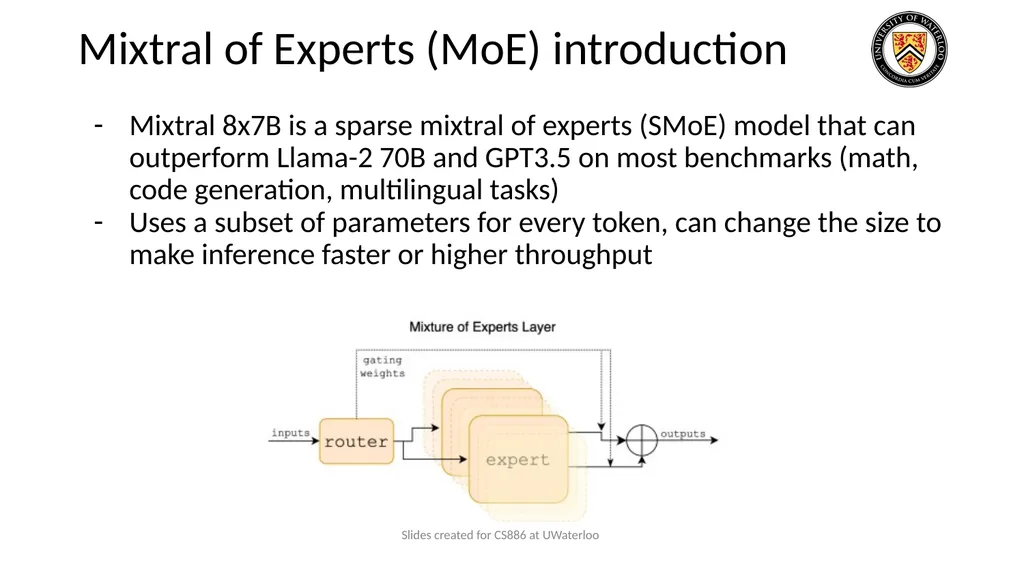
Mixtral of Experts (MoE) introduction Mixtral 8x7B is a sparse mixtral of experts (SMoE) model that can outperform Llama-2 70B and GPT3.5 on most benchmarks (math, code generation, multilingual tasks)
Uses a subset of parameters for every token, can change the size to make inference faster or higher throughput Slides created for CS886 at UWaterloo<br>
Uses a subset of parameters for every token, can change the size to make inference faster or higher throughput Slides created for CS886 at UWaterloo<br>
60
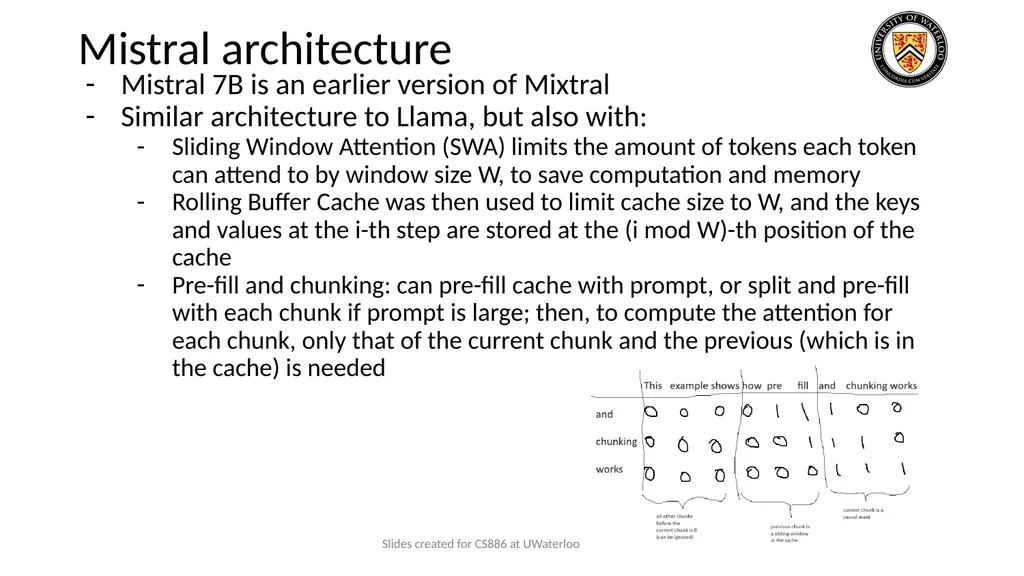
Mistral architecture Mistral 7B is an earlier version of Mixtral
Similar architecture to Llama, but also with:
Sliding Window Attention (SWA) limits the amount of tokens each token can attend to by window size W, to save computation and memory
Rolling Buffer Cache was then used to limit cache size to W, and the keys and values at the i-th step are stored at the (i mod W)-th position of the cache
Pre-fill and chunking: can pre-fill cache with prompt, or split and pre-fill with each chunk if prompt is large; then, to compute the attention for each chunk, only that of the current chunk and the previous (which is in the cache) is needed Slides created for CS886 at UWaterloo<br>
Similar architecture to Llama, but also with:
Sliding Window Attention (SWA) limits the amount of tokens each token can attend to by window size W, to save computation and memory
Rolling Buffer Cache was then used to limit cache size to W, and the keys and values at the i-th step are stored at the (i mod W)-th position of the cache
Pre-fill and chunking: can pre-fill cache with prompt, or split and pre-fill with each chunk if prompt is large; then, to compute the attention for each chunk, only that of the current chunk and the previous (which is in the cache) is needed Slides created for CS886 at UWaterloo<br>
61
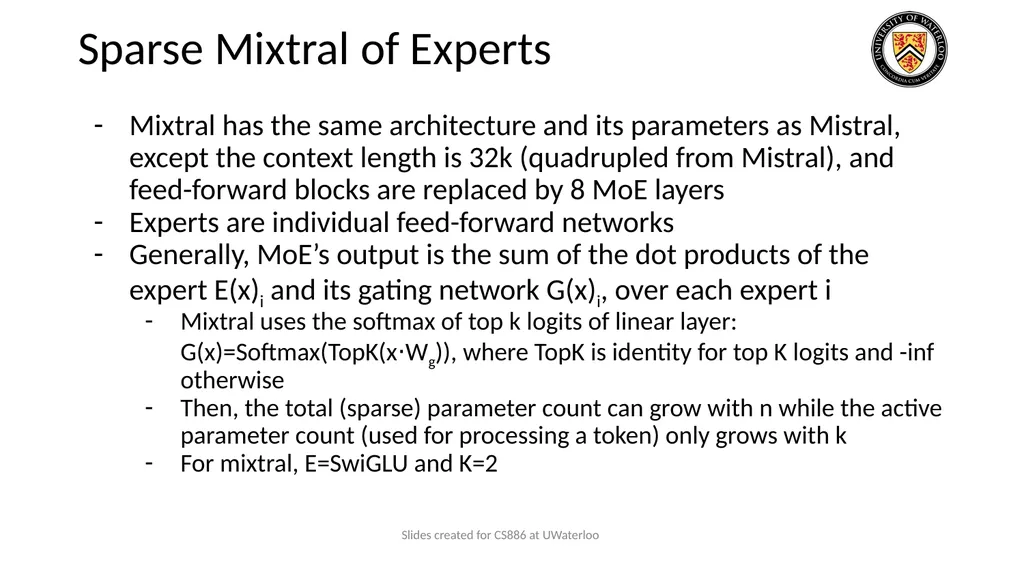
Sparse Mixtral of Experts Mixtral has the same architecture and its parameters as Mistral, except the context length is 32k (quadrupled from Mistral), and feed-forward blocks are replaced by 8 MoE layers
Experts are individual feed-forward networks
Generally, MoE’s output is the sum of the dot products of the expert E(x)i and its gating network G(x)i, over each expert i
Mixtral uses the softmax of top k logits of linear layer: G(x)=Softmax(TopK(x⋅Wg)), where TopK is identity for top K logits and -inf otherwise
Then, the total (sparse) parameter count can grow with n while the active parameter count (used for processing a token) only grows with k
For mixtral, E=SwiGLU and K=2 Slides created for CS886 at UWaterloo<br>
Experts are individual feed-forward networks
Generally, MoE’s output is the sum of the dot products of the expert E(x)i and its gating network G(x)i, over each expert i
Mixtral uses the softmax of top k logits of linear layer: G(x)=Softmax(TopK(x⋅Wg)), where TopK is identity for top K logits and -inf otherwise
Then, the total (sparse) parameter count can grow with n while the active parameter count (used for processing a token) only grows with k
For mixtral, E=SwiGLU and K=2 Slides created for CS886 at UWaterloo<br>
62
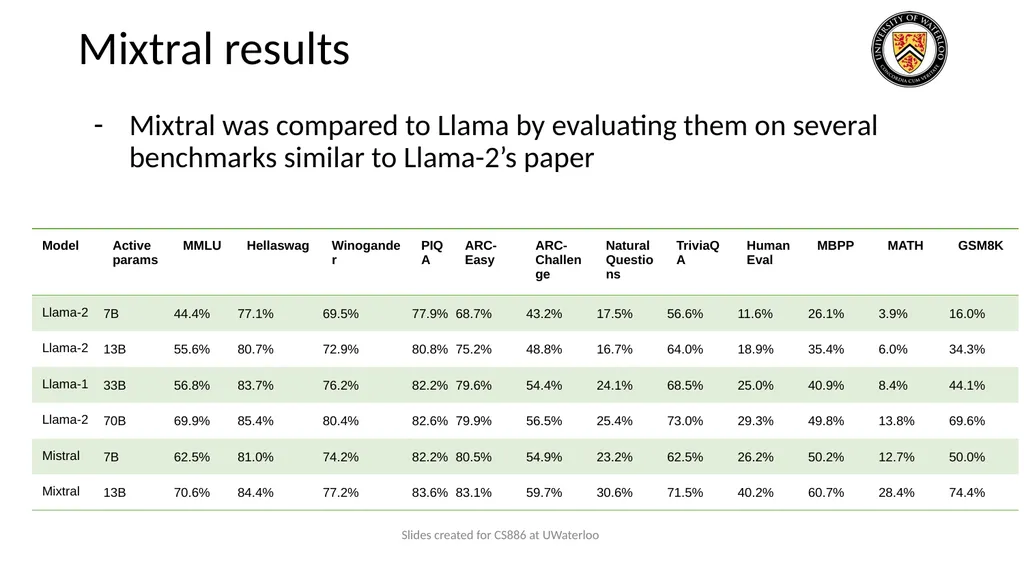
Mixtral results Mixtral was compared to Llama by evaluating them on several benchmarks similar to Llama-2’s paper Slides created for CS886 at UWaterloo<br>
63
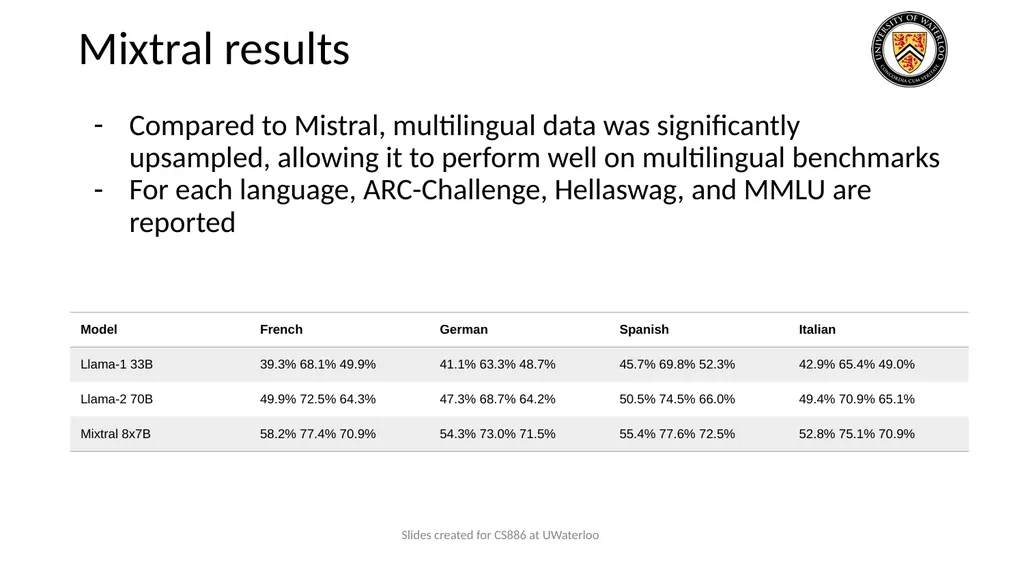
Mixtral results Compared to Mistral, multilingual data was significantly upsampled, allowing it to perform well on multilingual benchmarks
For each language, ARC-Challenge, Hellaswag, and MMLU are reported Slides created for CS886 at UWaterloo<br>
For each language, ARC-Challenge, Hellaswag, and MMLU are reported Slides created for CS886 at UWaterloo<br>
64
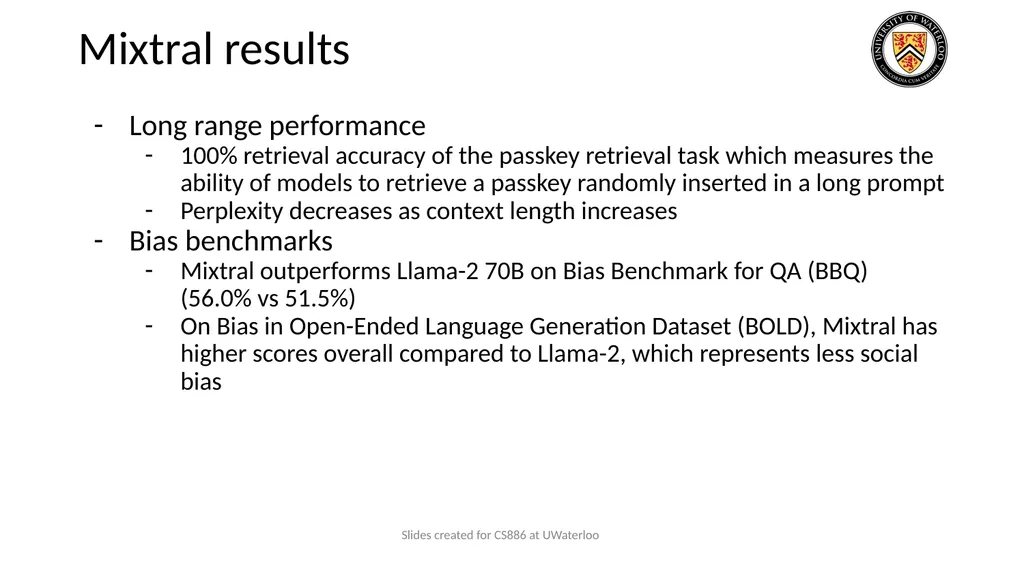
Mixtral results Long range performance
100% retrieval accuracy of the passkey retrieval task which measures the ability of models to retrieve a passkey randomly inserted in a long prompt
Perplexity decreases as context length increases
Bias benchmarks
Mixtral outperforms Llama-2 70B on Bias Benchmark for QA (BBQ) (56.0% vs 51.5%)
On Bias in Open-Ended Language Generation Dataset (BOLD), Mixtral has higher scores overall compared to Llama-2, which represents less social bias Slides created for CS886 at UWaterloo<br>
100% retrieval accuracy of the passkey retrieval task which measures the ability of models to retrieve a passkey randomly inserted in a long prompt
Perplexity decreases as context length increases
Bias benchmarks
Mixtral outperforms Llama-2 70B on Bias Benchmark for QA (BBQ) (56.0% vs 51.5%)
On Bias in Open-Ended Language Generation Dataset (BOLD), Mixtral has higher scores overall compared to Llama-2, which represents less social bias Slides created for CS886 at UWaterloo<br>
65
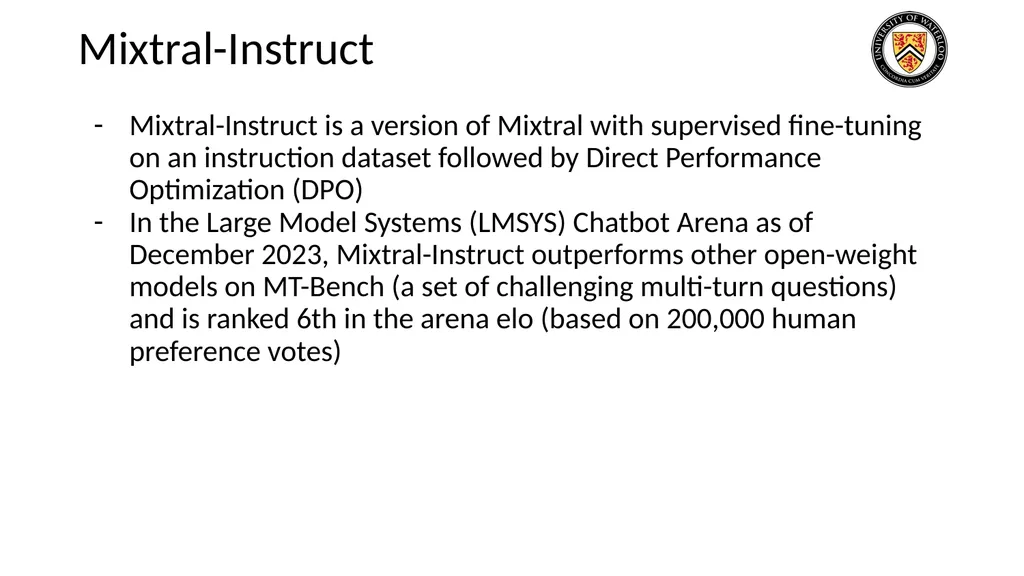
Mixtral-Instruct Mixtral-Instruct is a version of Mixtral with supervised fine-tuning on an instruction dataset followed by Direct Performance Optimization (DPO)
In the Large Model Systems (LMSYS) Chatbot Arena as of December 2023, Mixtral-Instruct outperforms other open-weight models on MT-Bench (a set of challenging multi-turn questions) and is ranked 6th in the arena elo (based on 200,000 human preference votes)<br>
In the Large Model Systems (LMSYS) Chatbot Arena as of December 2023, Mixtral-Instruct outperforms other open-weight models on MT-Bench (a set of challenging multi-turn questions) and is ranked 6th in the arena elo (based on 200,000 human preference votes)<br>
66
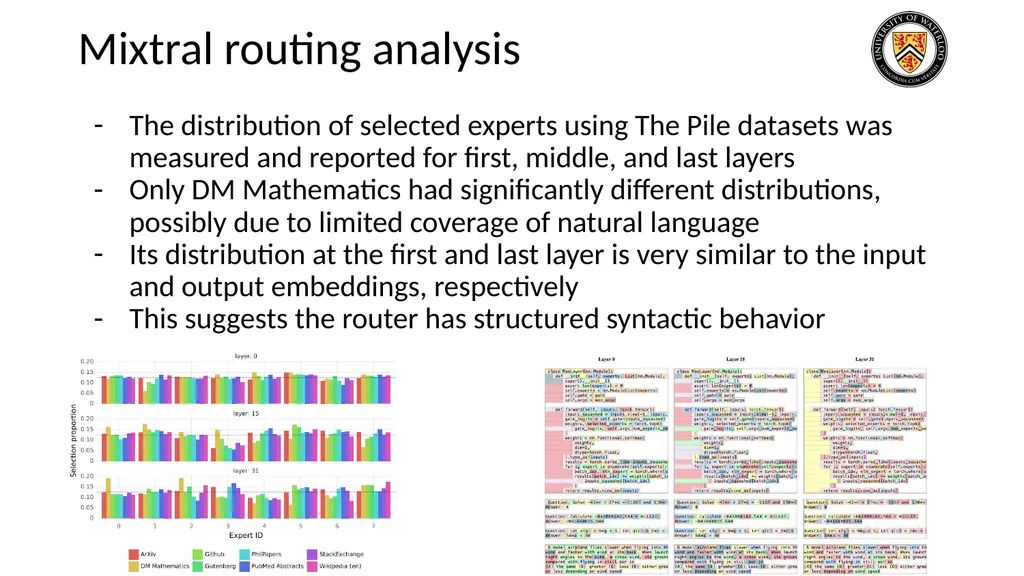
Mixtral routing analysis The distribution of selected experts using The Pile datasets was measured and reported for first, middle, and last layers
Only DM Mathematics had significantly different distributions, possibly due to limited coverage of natural language
Its distribution at the first and last layer is very similar to the input and output embeddings, respectively
This suggests the router has structured syntactic behavior<br>
Only DM Mathematics had significantly different distributions, possibly due to limited coverage of natural language
Its distribution at the first and last layer is very similar to the input and output embeddings, respectively
This suggests the router has structured syntactic behavior<br>
67
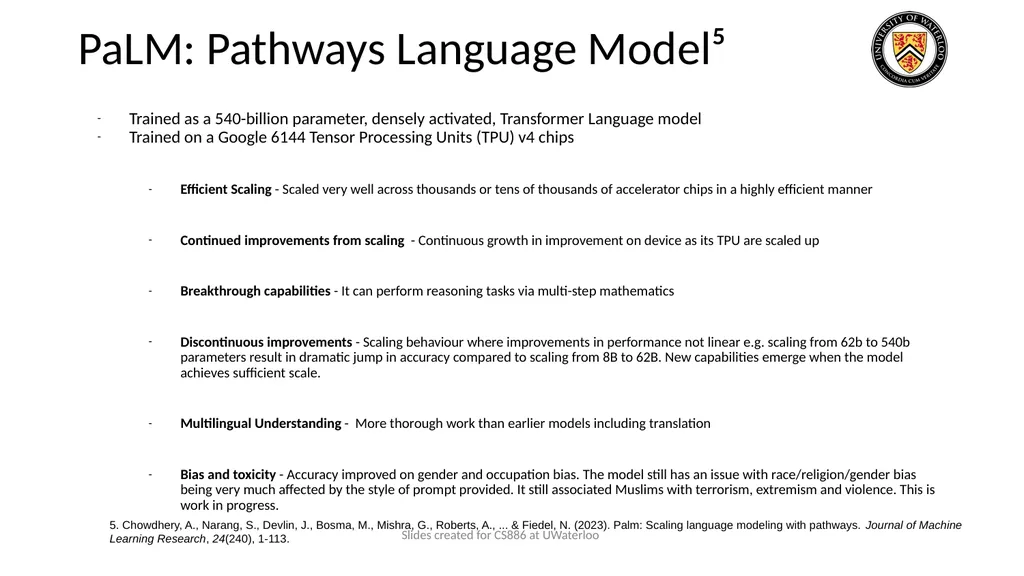
PaLM: Pathways Language Model⁵ Trained as a 540-billion parameter, densely activated, Transformer Language model
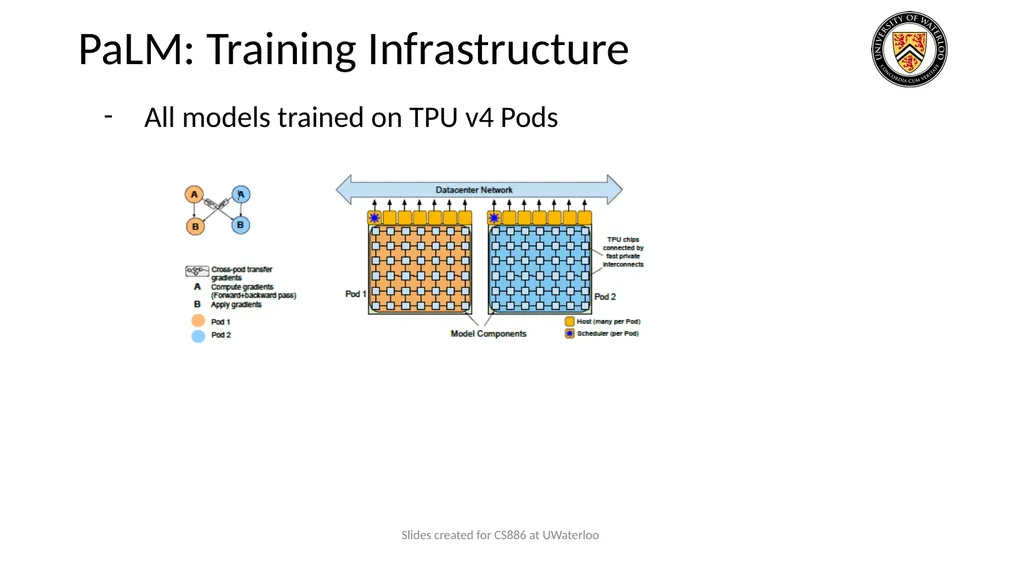
Trained on a Google 6144 Tensor Processing Units (TPU) v4 chips
Efficient Scaling - Scaled very well across thousands or tens of thousands of accelerator chips in a highly efficient manner
Continued improvements from scaling - Continuous growth in improvement on device as its TPU are scaled up
Breakthrough capabilities - It can perform reasoning tasks via multi-step mathematics
Discontinuous improvements - Scaling behaviour where improvements in performance not linear e.g. scaling from 62b to 540b parameters result in dramatic jump in accuracy compared to scaling from 8B to 62B. New capabilities emerge when the model achieves sufficient scale.
Multilingual Understanding - More thorough work than earlier models including translation
Bias and toxicity - Accuracy improved on gender and occupation bias. The model still has an issue with race/religion/gender bias being very much affected by the style of prompt provided. It still associated Muslims with terrorism, extremism and violence. This is work in progress. Slides created for CS886 at UWaterloo 5. Chowdhery, A., Narang, S., Devlin, J., Bosma, M., Mishra, G., Roberts, A., ... & Fiedel, N. (2023). Palm: Scaling language modeling with pathways. Journal of Machine Learning Research, 24(240), 1-113.<br>
Trained on a Google 6144 Tensor Processing Units (TPU) v4 chips
Efficient Scaling - Scaled very well across thousands or tens of thousands of accelerator chips in a highly efficient manner
Continued improvements from scaling - Continuous growth in improvement on device as its TPU are scaled up
Breakthrough capabilities - It can perform reasoning tasks via multi-step mathematics
Discontinuous improvements - Scaling behaviour where improvements in performance not linear e.g. scaling from 62b to 540b parameters result in dramatic jump in accuracy compared to scaling from 8B to 62B. New capabilities emerge when the model achieves sufficient scale.
Multilingual Understanding - More thorough work than earlier models including translation
Bias and toxicity - Accuracy improved on gender and occupation bias. The model still has an issue with race/religion/gender bias being very much affected by the style of prompt provided. It still associated Muslims with terrorism, extremism and violence. This is work in progress. Slides created for CS886 at UWaterloo 5. Chowdhery, A., Narang, S., Devlin, J., Bosma, M., Mishra, G., Roberts, A., ... & Fiedel, N. (2023). Palm: Scaling language modeling with pathways. Journal of Machine Learning Research, 24(240), 1-113.<br>
68
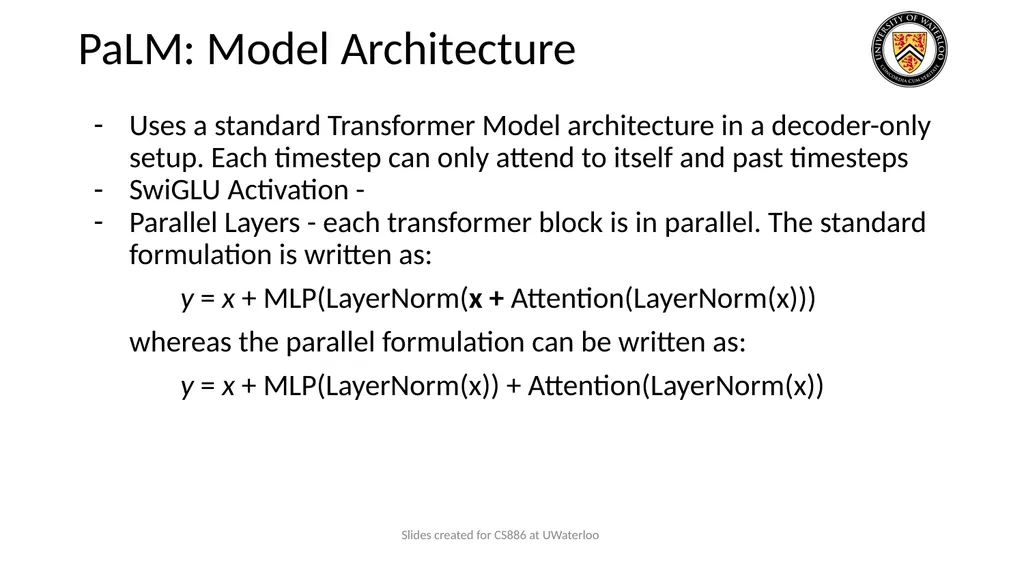
PaLM: Model Architecture Uses a standard Transformer Model architecture in a decoder-only setup. Each timestep can only attend to itself and past timesteps
SwiGLU Activation -
Parallel Layers - each transformer block is in parallel. The standard formulation is written as:
y = x + MLP(LayerNorm(x + Attention(LayerNorm(x)))
whereas the parallel formulation can be written as:
y = x + MLP(LayerNorm(x)) + Attention(LayerNorm(x)) Slides created for CS886 at UWaterloo<br>
SwiGLU Activation -
Parallel Layers - each transformer block is in parallel. The standard formulation is written as:
y = x + MLP(LayerNorm(x + Attention(LayerNorm(x)))
whereas the parallel formulation can be written as:
y = x + MLP(LayerNorm(x)) + Attention(LayerNorm(x)) Slides created for CS886 at UWaterloo<br>
69
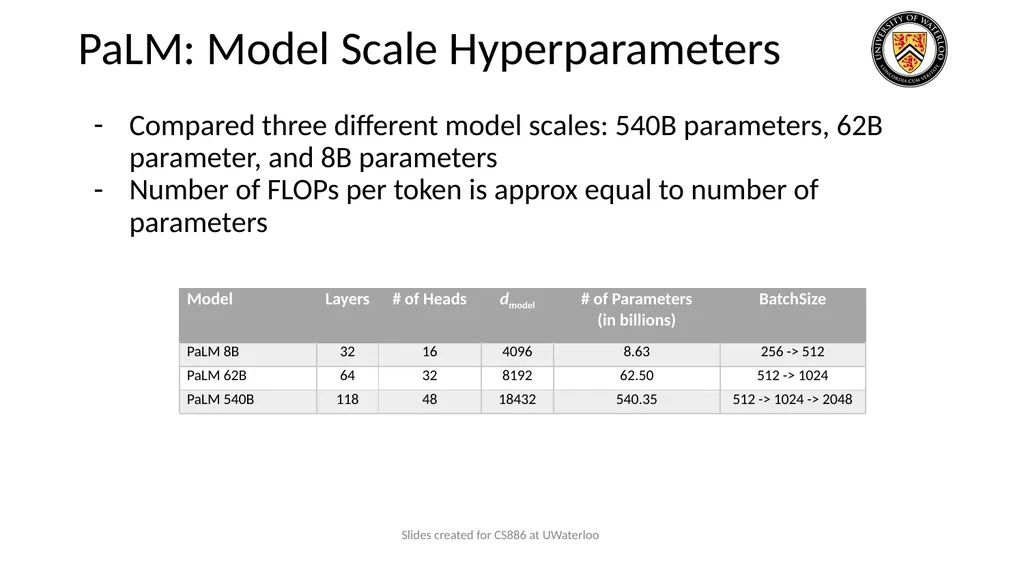
PaLM: Model Scale Hyperparameters Slides created for CS886 at UWaterloo Compared three different model scales: 540B parameters, 62B parameter, and 8B parameters
Number of FLOPs per token is approx equal to number of parameters<br>
Number of FLOPs per token is approx equal to number of parameters<br>
70
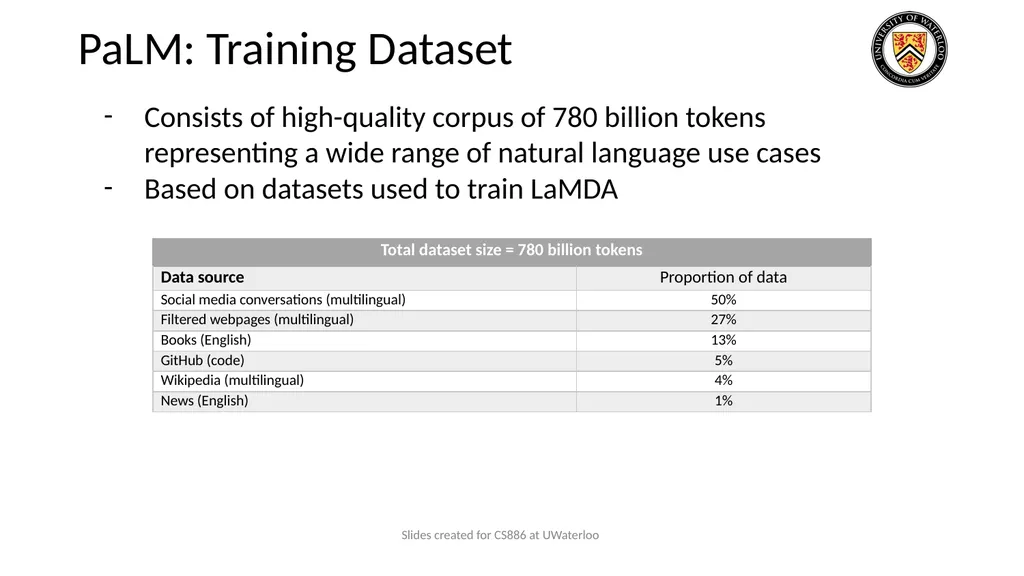
PaLM: Training Dataset Slides created for CS886 at UWaterloo Consists of high-quality corpus of 780 billion tokens representing a wide range of natural language use cases
Based on datasets used to train LaMDA<br>
Based on datasets used to train LaMDA<br>
71
PaLM: Training Infrastructure Slides created for CS886 at UWaterloo All models trained on TPU v4 Pods<br>
72
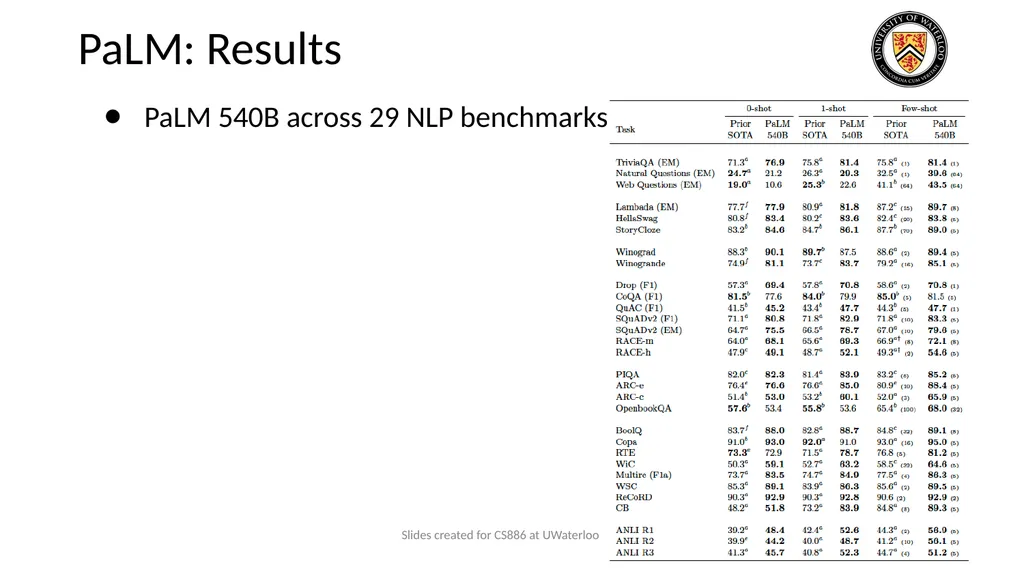
PaLM: Results Slides created for CS886 at UWaterloo PaLM 540B across 29 NLP benchmarks<br>
73
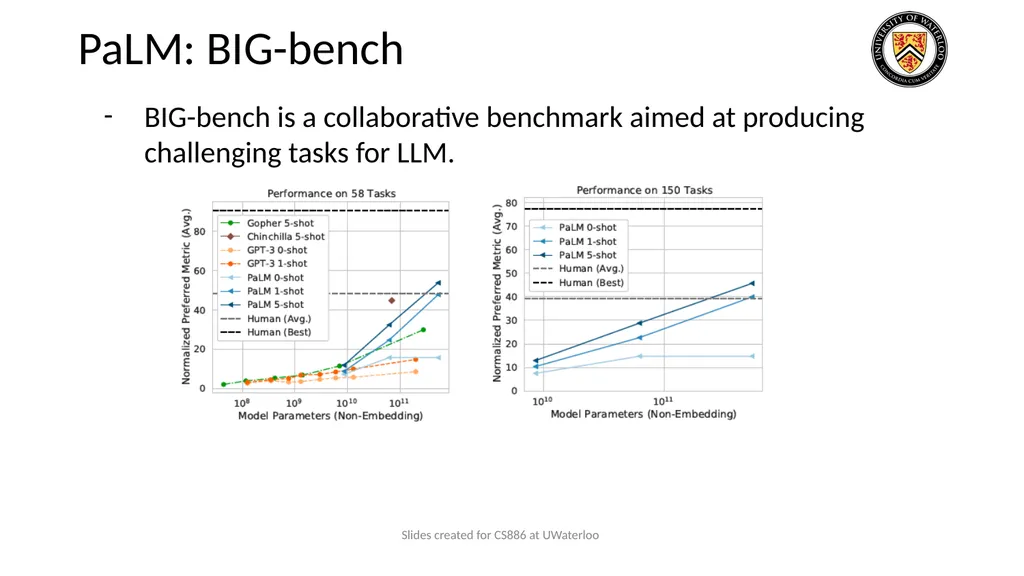
PaLM: BIG-bench Slides created for CS886 at UWaterloo BIG-bench is a collaborative benchmark aimed at producing challenging tasks for LLM.<br>
74
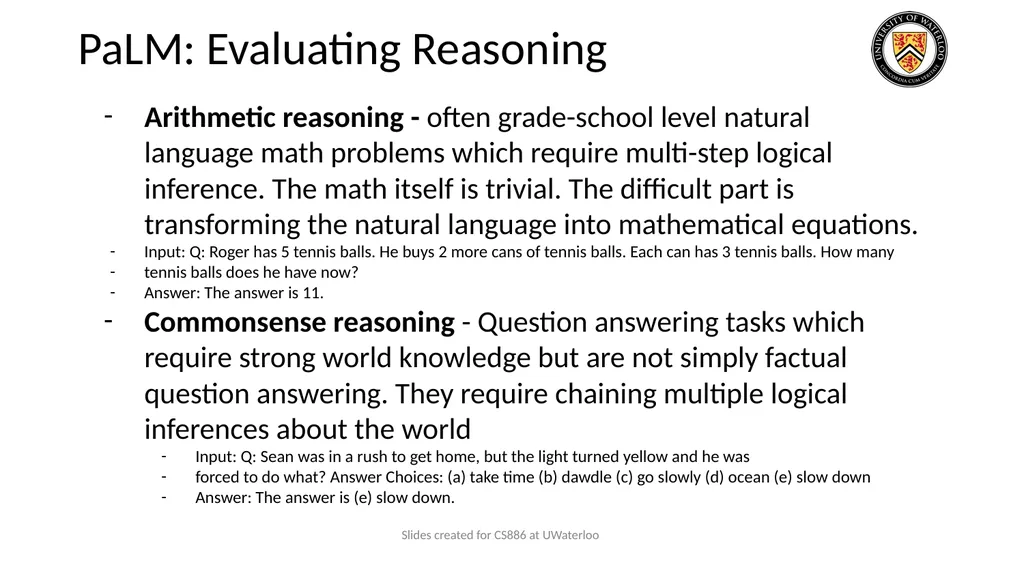
PaLM: Evaluating Reasoning Slides created for CS886 at UWaterloo Arithmetic reasoning - often grade-school level natural language math problems which require multi-step logical inference. The math itself is trivial. The difficult part is transforming the natural language into mathematical equations.
Input: Q: Roger has 5 tennis balls. He buys 2 more cans of tennis balls. Each can has 3 tennis balls. How many
tennis balls does he have now?
Answer: The answer is 11.
Commonsense reasoning - Question answering tasks which require strong world knowledge but are not simply factual question answering. They require chaining multiple logical inferences about the world
Input: Q: Sean was in a rush to get home, but the light turned yellow and he was
forced to do what? Answer Choices: (a) take time (b) dawdle (c) go slowly (d) ocean (e) slow down
Answer: The answer is (e) slow down.<br>
Input: Q: Roger has 5 tennis balls. He buys 2 more cans of tennis balls. Each can has 3 tennis balls. How many
tennis balls does he have now?
Answer: The answer is 11.
Commonsense reasoning - Question answering tasks which require strong world knowledge but are not simply factual question answering. They require chaining multiple logical inferences about the world
Input: Q: Sean was in a rush to get home, but the light turned yellow and he was
forced to do what? Answer Choices: (a) take time (b) dawdle (c) go slowly (d) ocean (e) slow down
Answer: The answer is (e) slow down.<br>
75
PaLM: Chain-of-thought prompting Slides created for CS886 at UWaterloo<br>
76
PaLM: Chain-of-thought Results Slides created for CS886 at UWaterloo<br>
77
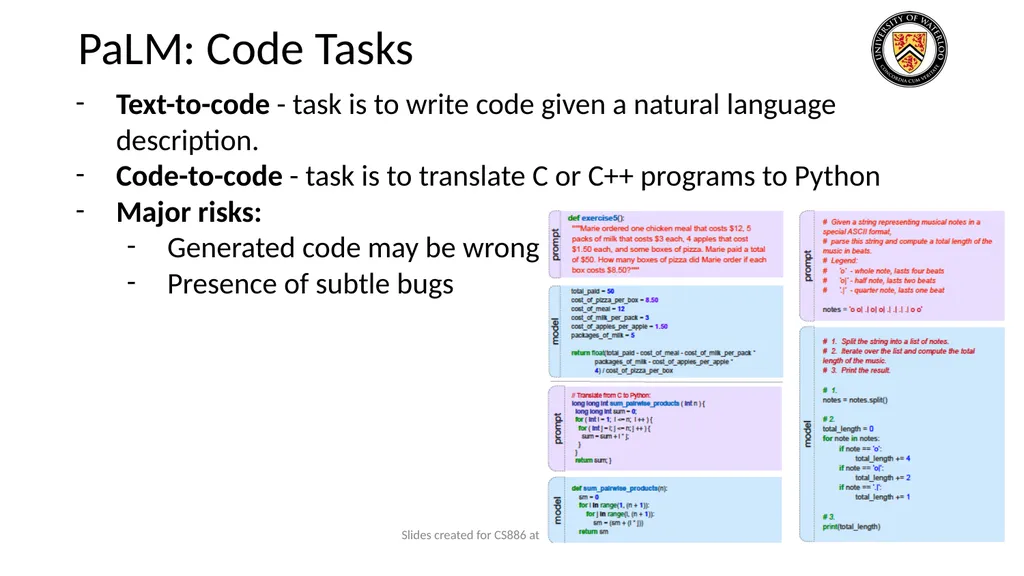
PaLM: Code Tasks Slides created for CS886 at UWaterloo Text-to-code - task is to write code given a natural language description.
Code-to-code - task is to translate C or C++ programs to Python
Major risks:
Generated code may be wrong
Presence of subtle bugs<br>
Code-to-code - task is to translate C or C++ programs to Python
Major risks:
Generated code may be wrong
Presence of subtle bugs<br>
78
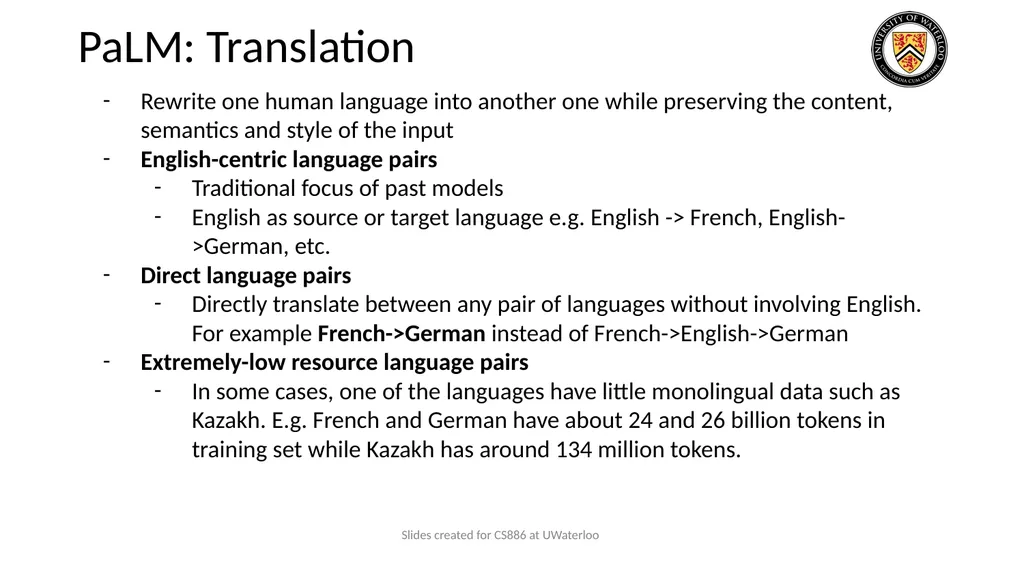
PaLM: Translation Slides created for CS886 at UWaterloo Rewrite one human language into another one while preserving the content, semantics and style of the input
English-centric language pairs
Traditional focus of past models
English as source or target language e.g. English -> French, English->German, etc.
Direct language pairs
Directly translate between any pair of languages without involving English. For example French->German instead of French->English->German
Extremely-low resource language pairs
In some cases, one of the languages have little monolingual data such as Kazakh. E.g. French and German have about 24 and 26 billion tokens in training set while Kazakh has around 134 million tokens.<br>
English-centric language pairs
Traditional focus of past models
English as source or target language e.g. English -> French, English->German, etc.
Direct language pairs
Directly translate between any pair of languages without involving English. For example French->German instead of French->English->German
Extremely-low resource language pairs
In some cases, one of the languages have little monolingual data such as Kazakh. E.g. French and German have about 24 and 26 billion tokens in training set while Kazakh has around 134 million tokens.<br>
79
PaLM: Translation Slides created for CS886 at UWaterloo<br>
80
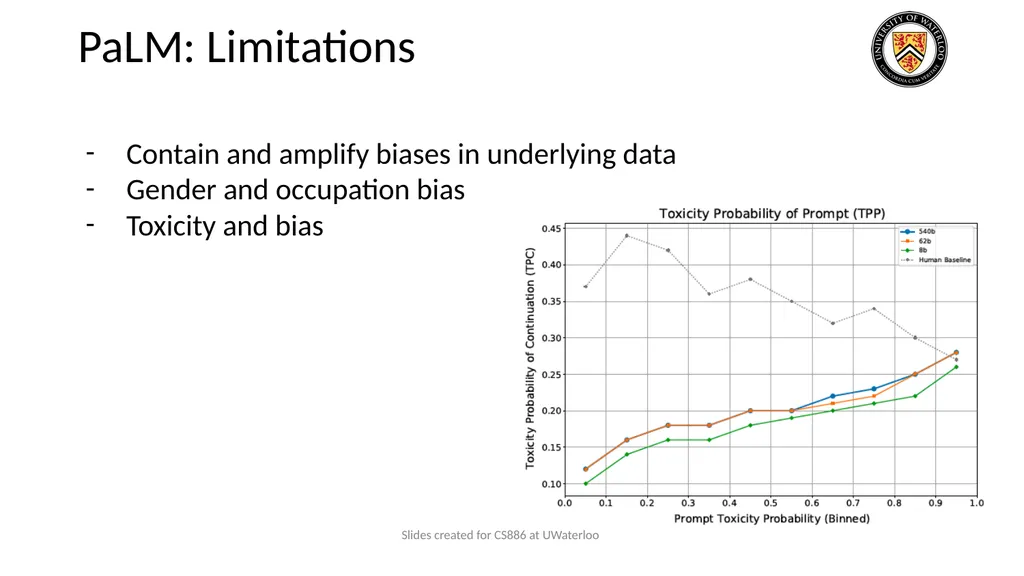
PaLM: Limitations Slides created for CS886 at UWaterloo Contain and amplify biases in underlying data
Gender and occupation bias
Toxicity and bias<br>
Gender and occupation bias
Toxicity and bias<br>
81
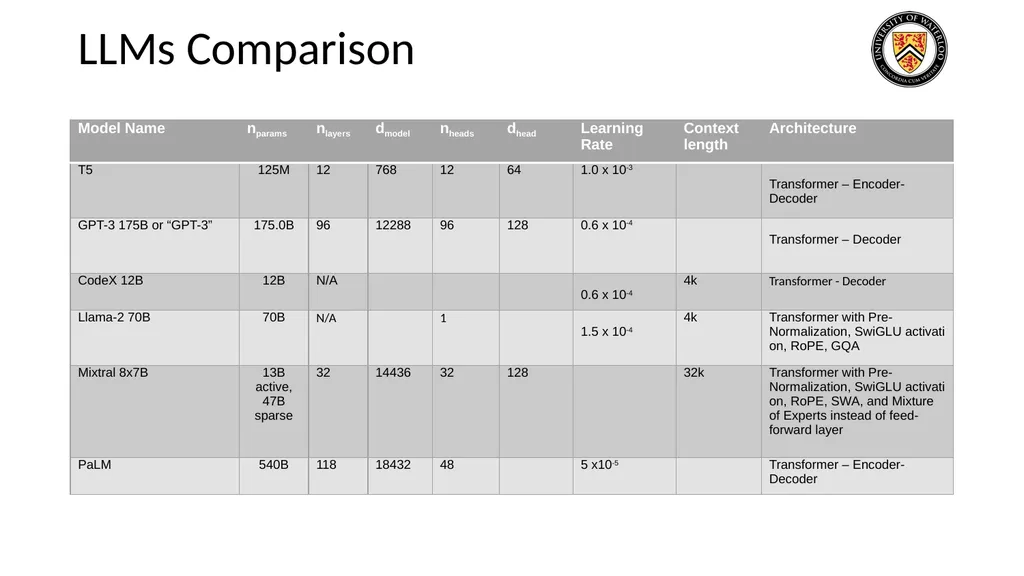
LLMs Comparison<br>
82
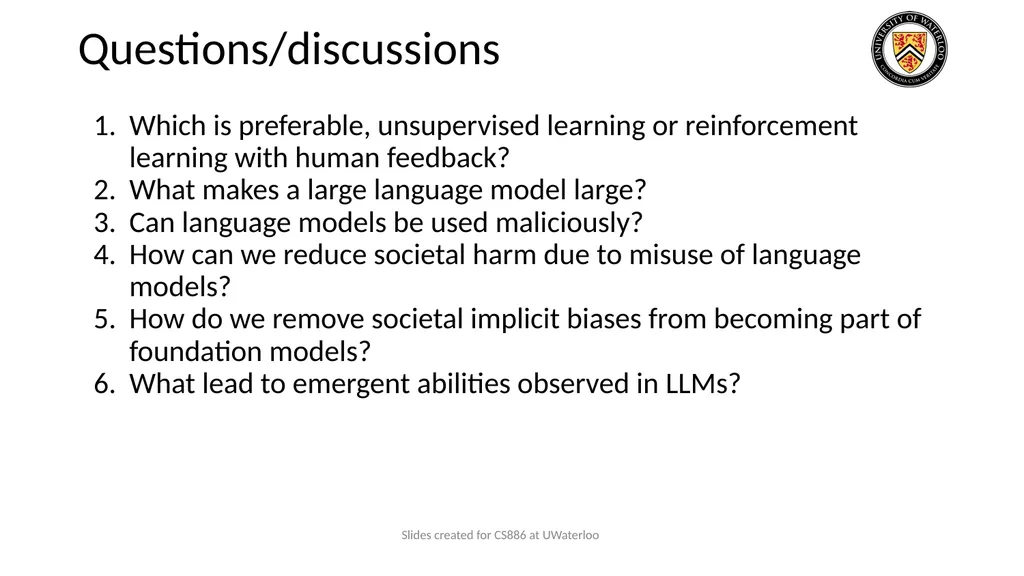
Questions/discussions Which is preferable, unsupervised learning or reinforcement learning with human feedback?
What makes a large language model large?
Can language models be used maliciously?
How can we reduce societal harm due to misuse of language models?
How do we remove societal implicit biases from becoming part of foundation models?
What lead to emergent abilities observed in LLMs? Slides created for CS886 at UWaterloo<br>
What makes a large language model large?
Can language models be used maliciously?
How can we reduce societal harm due to misuse of language models?
How do we remove societal implicit biases from becoming part of foundation models?
What lead to emergent abilities observed in LLMs? Slides created for CS886 at UWaterloo<br>
83
References Chang, Y., Wang, X., Wang, J., Wu, Y., Zhu, K., Chen, H., Yang, L., Yi, X., Wang, C., Wang, Y., Ye, W., Zhang, Y., Chang, Y., Yu, P.S., Yang, Q., & Xie, X. (2023). A Survey on Evaluation of Large Language Models. ArXiv, abs/2307.03109
Raffel, C., Shazeer, N., Roberts, A., Lee, K., Narang, S., Matena, M., ... & Liu, P. J. (2020). Exploring the limits of transfer learning with a unified text-to-text transformer. The Journal of Machine Learning Research, 21(1), 5485-5551.
A. Vaswani et al., “Attention is All you Need,” in Advances in Neural Information Processing Systems (NeurIPS), 2017.
Brown, T., Mann, B., Ryder, N., Subbiah, M., Kaplan, J. D., Dhariwal, P., ... & Amodei, D. (2020). Language models are few-shot learners. Advances in neural information processing systems, 33, 1877-1901.
Chowdhery, A., Narang, S., Devlin, J., Bosma, M., Mishra, G., Roberts, A., ... & Fiedel, N. (2023). Palm: Scaling language modeling with pathways. Journal of Machine Learning Research, 24(240), 1-113.
Chen, Mark, et al. Evaluating Large Language Models Trained on Code. arXiv:2107.03374, arXiv, 14 July 2021. arXiv.org, https://doi.org/10.48550/arXiv.2107.03374.
Touvron, Hugo, et al. Llama 2: Open Foundation and Fine-Tuned Chat Models. arXiv:2307.09288, arXiv, 19 July 2023. arXiv.org, https://doi.org/10.48550/arXiv.2307.09288.
Jiang, Albert Q., et al. Mixtral of Experts. arXiv:2401.04088, arXiv, 8 Jan. 2024. arXiv.org, https://doi.org/10.48550/arXiv.2401.04088. Slides created for CS886 at UWaterloo<br>
Raffel, C., Shazeer, N., Roberts, A., Lee, K., Narang, S., Matena, M., ... & Liu, P. J. (2020). Exploring the limits of transfer learning with a unified text-to-text transformer. The Journal of Machine Learning Research, 21(1), 5485-5551.
A. Vaswani et al., “Attention is All you Need,” in Advances in Neural Information Processing Systems (NeurIPS), 2017.
Brown, T., Mann, B., Ryder, N., Subbiah, M., Kaplan, J. D., Dhariwal, P., ... & Amodei, D. (2020). Language models are few-shot learners. Advances in neural information processing systems, 33, 1877-1901.
Chowdhery, A., Narang, S., Devlin, J., Bosma, M., Mishra, G., Roberts, A., ... & Fiedel, N. (2023). Palm: Scaling language modeling with pathways. Journal of Machine Learning Research, 24(240), 1-113.
Chen, Mark, et al. Evaluating Large Language Models Trained on Code. arXiv:2107.03374, arXiv, 14 July 2021. arXiv.org, https://doi.org/10.48550/arXiv.2107.03374.
Touvron, Hugo, et al. Llama 2: Open Foundation and Fine-Tuned Chat Models. arXiv:2307.09288, arXiv, 19 July 2023. arXiv.org, https://doi.org/10.48550/arXiv.2307.09288.
Jiang, Albert Q., et al. Mixtral of Experts. arXiv:2401.04088, arXiv, 8 Jan. 2024. arXiv.org, https://doi.org/10.48550/arXiv.2401.04088. Slides created for CS886 at UWaterloo<br>