
Lecture no 1 Adv. insect taxonomy The biological
TA
Published · 22 slides · 0 views

1 / 1


Description
Lecture no 1 Adv. insect taxonomy The biological system of classification is called hierarchial concept of classification. This was introduced by Carl Von Linnaeus (1758). A large group of organism is successively subdivided into small
Related Topics
Share
Embed code
Download this presentation From Below
"Lecture no 1 Adv. insect taxonomy The biological" is the property of its rightful owner. Permission is granted to download and print the materials on this website for personal, non-commercial use only, and to display it on your personal computer provided you do not modify the materials and that you retain all copyright notices contained in the materials. By downloading content from our website, you accept the terms of this agreement.
Presentation Transcript
01
Lecture no 1
Adv. insect taxonomy<br>
Adv. insect taxonomy<br>
02
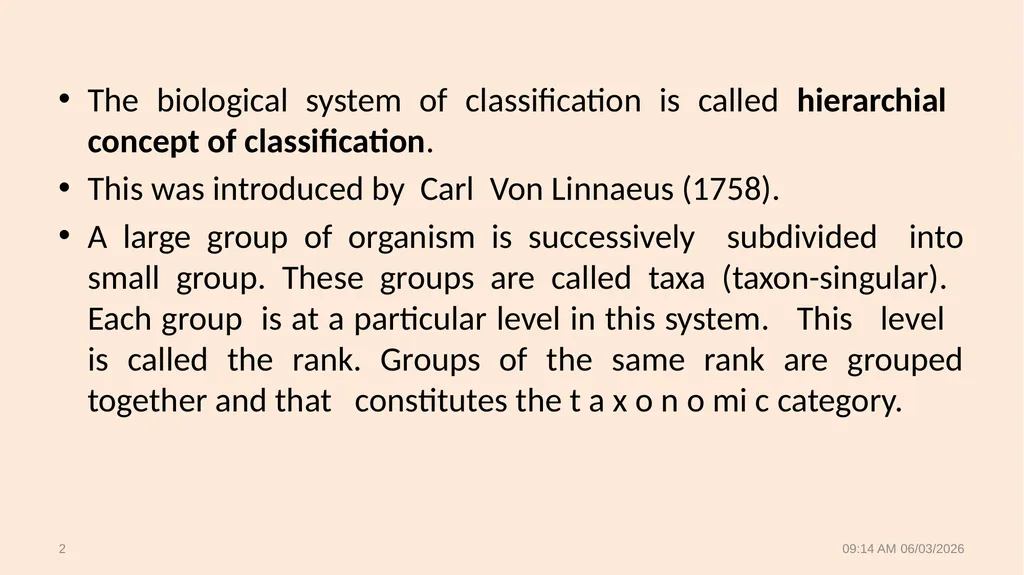
The biological system of classification is called hierarchial concept of classification.
This was introduced by Carl Von Linnaeus (1758).
A large group of organism is successively subdivided into small group. These groups are called taxa (taxon-singular). Each group is at a particular level in this system. This level is called the rank. Groups of the same rank are grouped together and that constitutes the t a x o n o mi c category. 14 نيسان، 24 2<br>
This was introduced by Carl Von Linnaeus (1758).
A large group of organism is successively subdivided into small group. These groups are called taxa (taxon-singular). Each group is at a particular level in this system. This level is called the rank. Groups of the same rank are grouped together and that constitutes the t a x o n o mi c category. 14 نيسان، 24 2<br>
03
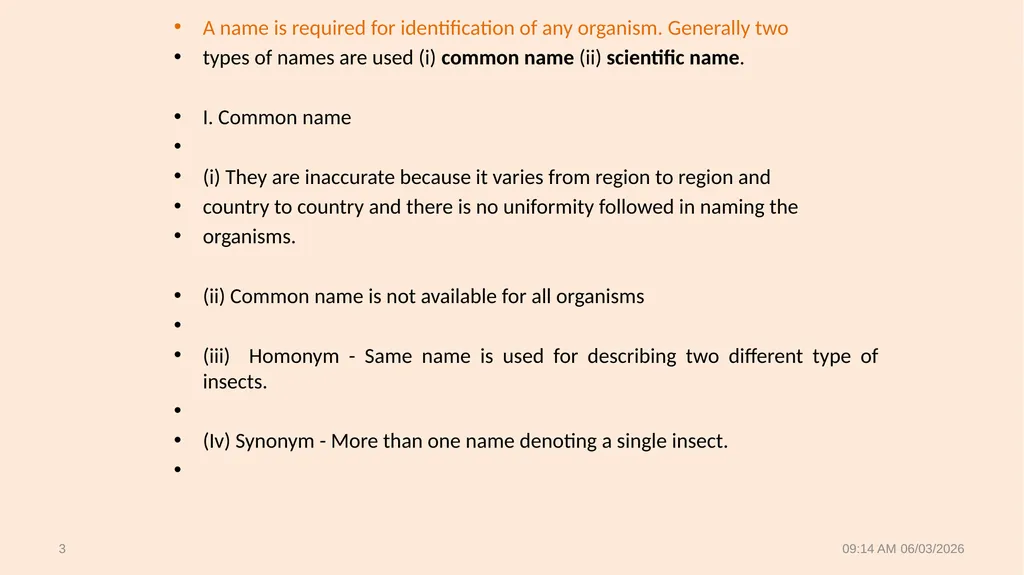
A name is required for identification of any organism. Generally two
types of names are used (i) common name (ii) scientific name.
I. Common name
(i) They are inaccurate because it varies from region to region and
country to country and there is no uniformity followed in naming the
organisms.
(ii) Common name is not available for all organisms
(iii) Homonym - Same name is used for describing two different type of insects.
(Iv) Synonym - More than one name denoting a single insect. 14 نيسان، 24 3<br>
types of names are used (i) common name (ii) scientific name.
I. Common name
(i) They are inaccurate because it varies from region to region and
country to country and there is no uniformity followed in naming the
organisms.
(ii) Common name is not available for all organisms
(iii) Homonym - Same name is used for describing two different type of insects.
(Iv) Synonym - More than one name denoting a single insect. 14 نيسان، 24 3<br>
04
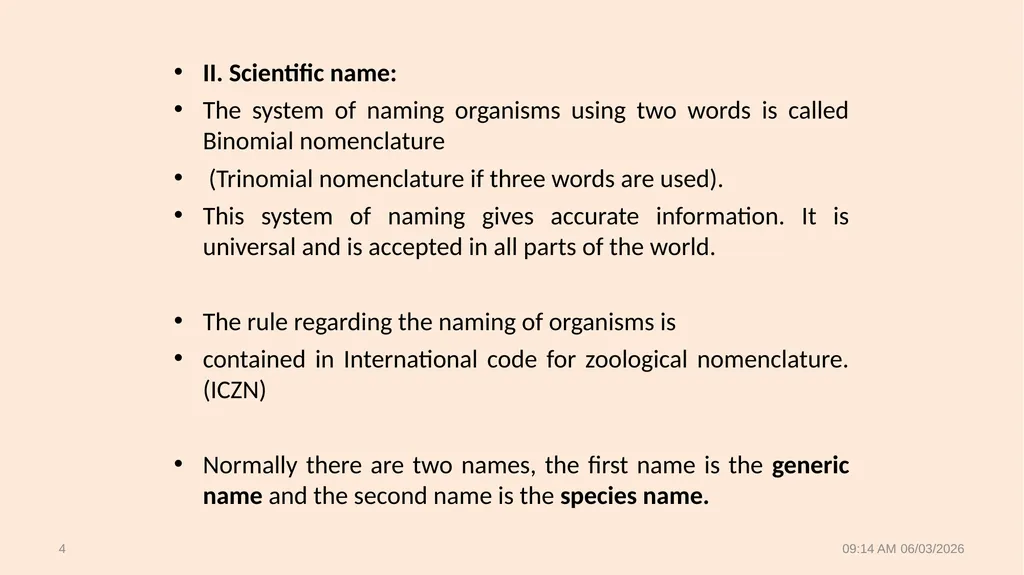
II. Scientific name:
The system of naming organisms using two words is called Binomial nomenclature
(Trinomial nomenclature if three words are used).
This system of naming gives accurate information. It is universal and is accepted in all parts of the world.
The rule regarding the naming of organisms is
contained in International code for zoological nomenclature.(ICZN)
Normally there are two names, the first name is the generic name and the second name is the species name. 14 نيسان، 24 4<br>
The system of naming organisms using two words is called Binomial nomenclature
(Trinomial nomenclature if three words are used).
This system of naming gives accurate information. It is universal and is accepted in all parts of the world.
The rule regarding the naming of organisms is
contained in International code for zoological nomenclature.(ICZN)
Normally there are two names, the first name is the generic name and the second name is the species name. 14 نيسان، 24 4<br>
05
Taxonomy is the science of classification.
Simpson (1961) has defined taxonomy as the theoretical study of c l a s s i f i c a t i o n including basis, principles, procedures and rules. Taxonomy includes nomenclature and classification.
Systematics: The science of study of kind and diversity of organisms and any or all relations among them. Systematics includes taxonomy and evolution.
Systematic focus on speciation 14 نيسان، 24 5<br>
Simpson (1961) has defined taxonomy as the theoretical study of c l a s s i f i c a t i o n including basis, principles, procedures and rules. Taxonomy includes nomenclature and classification.
Systematics: The science of study of kind and diversity of organisms and any or all relations among them. Systematics includes taxonomy and evolution.
Systematic focus on speciation 14 نيسان، 24 5<br>
06
Taxonomy and nomenclature are different disciplines.
Taxonomy recognizes classificatory units or taxa,
whereas nomenclature attaches a given scientific name to each of these units.
Taxonomy is a scientific discipline, whereas nomenclature is a technique. 14 نيسان، 24 6 تصنيف حشرات
د وند خالص على<br>
Taxonomy recognizes classificatory units or taxa,
whereas nomenclature attaches a given scientific name to each of these units.
Taxonomy is a scientific discipline, whereas nomenclature is a technique. 14 نيسان، 24 6 تصنيف حشرات
د وند خالص على<br>
07
The discipline of taxonomy traditionally covers three areas :
alpha (analytically phase):
is the level at which the species are recognized and described
beta (synthetic phase):
refers to the arrangements of the species into a natural system of lower and higher categories
gamma (biological phase) taxonomy
is the analysis of intraspecific variations, ecotypes, polymorphisms, etc 14 نيسان، 24 7 تصنيف حشرات
د وند خالص على<br>
alpha (analytically phase):
is the level at which the species are recognized and described
beta (synthetic phase):
refers to the arrangements of the species into a natural system of lower and higher categories
gamma (biological phase) taxonomy
is the analysis of intraspecific variations, ecotypes, polymorphisms, etc 14 نيسان، 24 7 تصنيف حشرات
د وند خالص على<br>
08
The major purpose of a classification was to serve as an identification key, and the philosophy of the early taxonomists was well suited for the utilitarian purposes of taxonomy. The objective shifted and the interests of the taxonomist broadened when, after 1859, organic diversity was interpreted as the result of evolutionary divergence. No longer was he interested merely in producing identification keys;
The ultimate result of these developments has been the recognition that the universe of the taxonomist is far greater than was previously envisioned. This had an effect on the definition of the terms taxonomy and systematics. Until quite recently these terms were generally considered to be synonymous. Now it has become advantageous to restrict the term taxonomy to its conventional meaning, but to define the term systematics more broadly as the study of organic diversity.<br>
The ultimate result of these developments has been the recognition that the universe of the taxonomist is far greater than was previously envisioned. This had an effect on the definition of the terms taxonomy and systematics. Until quite recently these terms were generally considered to be synonymous. Now it has become advantageous to restrict the term taxonomy to its conventional meaning, but to define the term systematics more broadly as the study of organic diversity.<br>
09
The term taxonomy is derived from the Greek words taxis, arrangment, and nomos, law, and was first proposed, in its French form by de Candolle (1813) for the theory of plant classification. Analogous to astronomy, agronomy, economy, etc., it is correctly formed and need not be amended (Mayr, 1966). It agrees best with current thinking to define it as follows: Taxonomy is the theory and practice of classifying organisms. The term systematics stems from the latinized Greek word systema, as applied to the systems of classification developed by the early naturalists, notably Linnaeus (Systema naturae, 1st ed., 1735). We follow Simpson’s (1961) modern redefinition of this term: “Systematics is the scientific study of the kinds and diversity of organisms and of any and all relationships among them ” or more simply, systematics is the science of the diversity of organisms. The word “relationship” is not used in a narrow phylogenetic sense, but is broadly conceived to include all biological relationships among organisms. This explains why such a broad area of common interest has developed between systematics, evolutionary biology, ecology, and behavioral biology.<br>
10
One of the major preoccupationsالانشغالات of systematics is to determine, by comparison, what the unique properties of every species and higher taxon are. Another is to determine what properties certain taxa have in common with each other, and what the biological causes for the differences or shared characters are. Finally, it concerns itself with variation within taxa. In all these concerns systematics holds a unique and indispensable position among the biological sciences. Classification makes the organic diversity accessible to the other biological disciplines. Without it most of them would be unable to give meaning to their findings. Systematics deals with populations, species, and higher taxa.<br>
11
The terms taxonomy and systematics were defined above. This leaves the term classification, which partly overlaps with taxonomy. The word is used with two different meanings. Most commonly it designates the product of the activity of the taxonomist, the classification of the primates or of the bees. But it is also used as a term for the activity of classifying: “Zoological classification is the ordering of animals into groups (or sets) on the basis of their relationships” (Simpson, 1961). In this sense classification coincides largely with what is sometimes designated as beta taxonomy.<br>
12
The process of classification is totally different from that of identification.
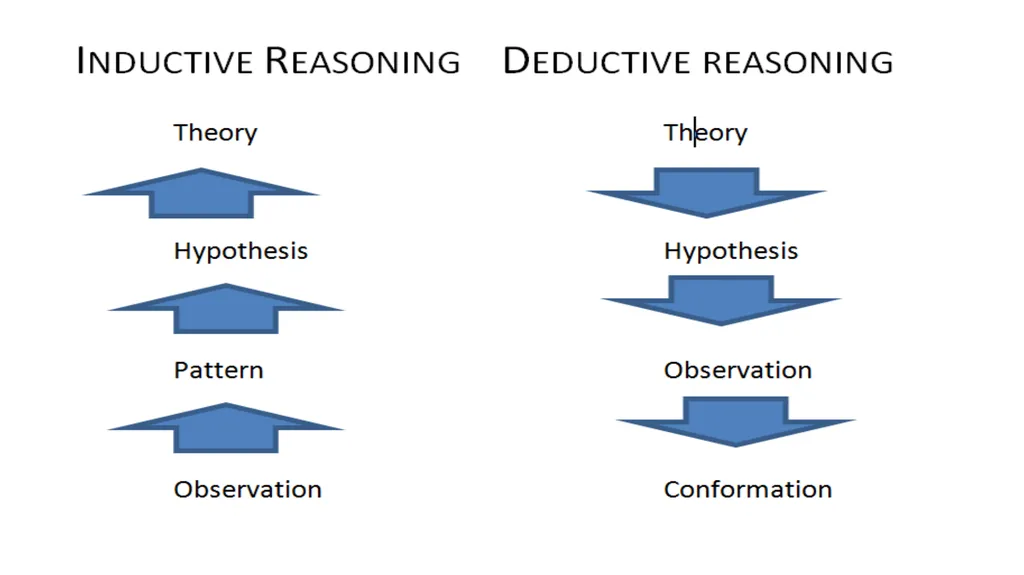
In classification we undertake the ordering of populations and groups of populations at all levels by inductive procedures;
In identification we place individuals by deductive procedures into previously established classes (taxa)
Zoological nomenclature is the application of distinctive names to each of the groups recognized in the zoological classification. The rules governing it<br>
In classification we undertake the ordering of populations and groups of populations at all levels by inductive procedures;
In identification we place individuals by deductive procedures into previously established classes (taxa)
Zoological nomenclature is the application of distinctive names to each of the groups recognized in the zoological classification. The rules governing it<br>
13
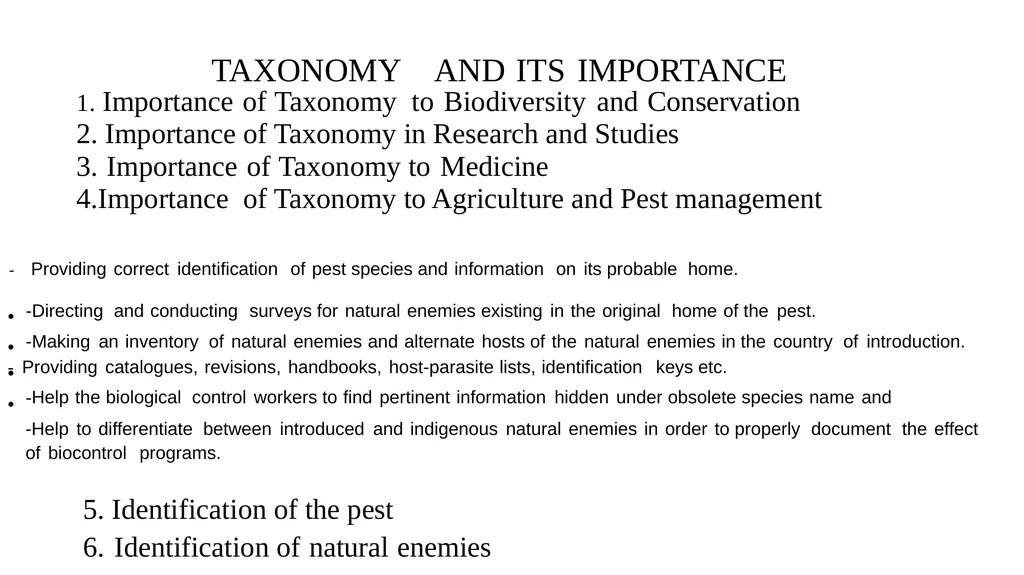
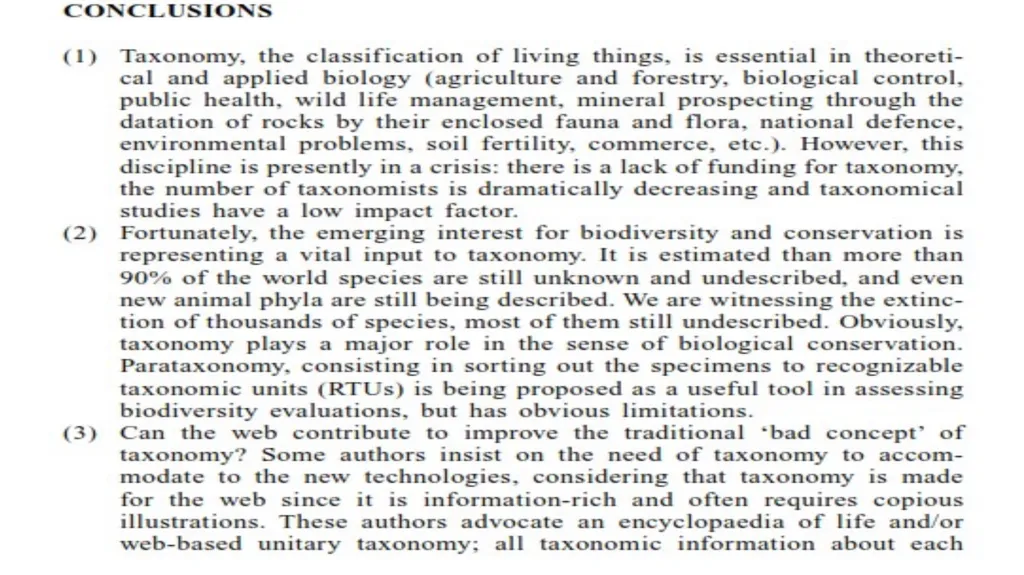
TAXONOMY AND ITS IMPORTANCE 1. Importance of Taxonomy to Biodiversity and Conservation
2. Importance of Taxonomy in Research and Studies
3. Importance of Taxonomy to Medicine
4.Importance of Taxonomy to Agriculture and Pest management
- Providing correct identification of pest species and information on its probable home.
-Directing and conducting surveys for natural enemies existing in the original home of the pest.
-Making an inventory of natural enemies and alternate hosts of the natural enemies in the country of introduction.
- Providing catalogues, revisions, handbooks, host-parasite lists, identification keys etc.
-Help the biological control workers to find pertinent information hidden under obsolete species name and
-Help to differentiate between introduced and indigenous natural enemies in order to properly document the effect of biocontrol programs.
5. Identification of the pest
6. Identification of natural enemies<br>
2. Importance of Taxonomy in Research and Studies
3. Importance of Taxonomy to Medicine
4.Importance of Taxonomy to Agriculture and Pest management
- Providing correct identification of pest species and information on its probable home.
-Directing and conducting surveys for natural enemies existing in the original home of the pest.
-Making an inventory of natural enemies and alternate hosts of the natural enemies in the country of introduction.
- Providing catalogues, revisions, handbooks, host-parasite lists, identification keys etc.
-Help the biological control workers to find pertinent information hidden under obsolete species name and
-Help to differentiate between introduced and indigenous natural enemies in order to properly document the effect of biocontrol programs.
5. Identification of the pest
6. Identification of natural enemies<br>
14
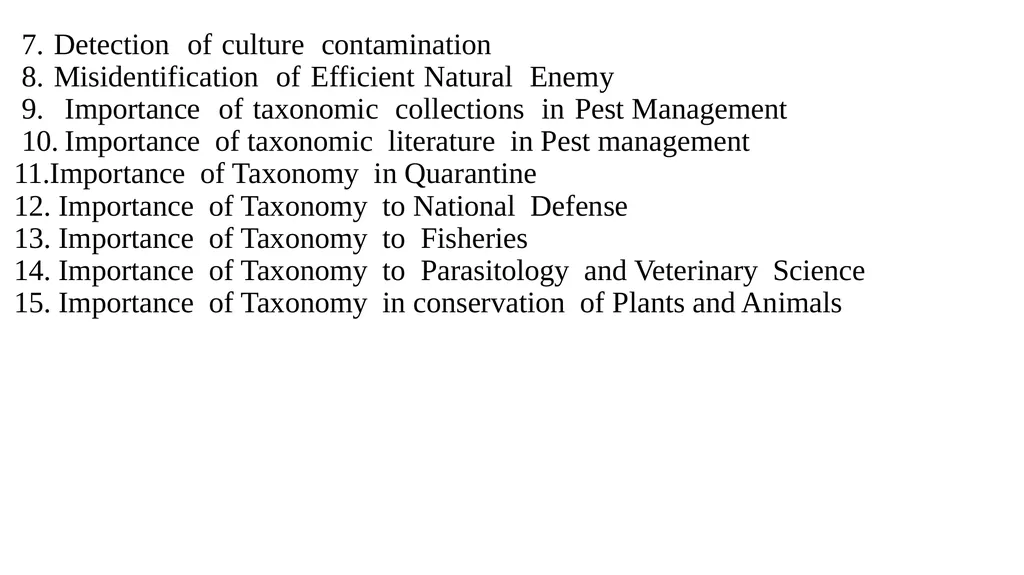
7. Detection of culture contamination
8. Misidentification of Efficient Natural Enemy
Importance of taxonomic collections in Pest Management
Importance of taxonomic literature in Pest management
11.Importance of Taxonomy in Quarantine
12. Importance of Taxonomy to National Defense
13. Importance of Taxonomy to Fisheries
14. Importance of Taxonomy to Parasitology and Veterinary Science
15. Importance of Taxonomy in conservation of Plants and Animals<br>
8. Misidentification of Efficient Natural Enemy
Importance of taxonomic collections in Pest Management
Importance of taxonomic literature in Pest management
11.Importance of Taxonomy in Quarantine
12. Importance of Taxonomy to National Defense
13. Importance of Taxonomy to Fisheries
14. Importance of Taxonomy to Parasitology and Veterinary Science
15. Importance of Taxonomy in conservation of Plants and Animals<br>
15
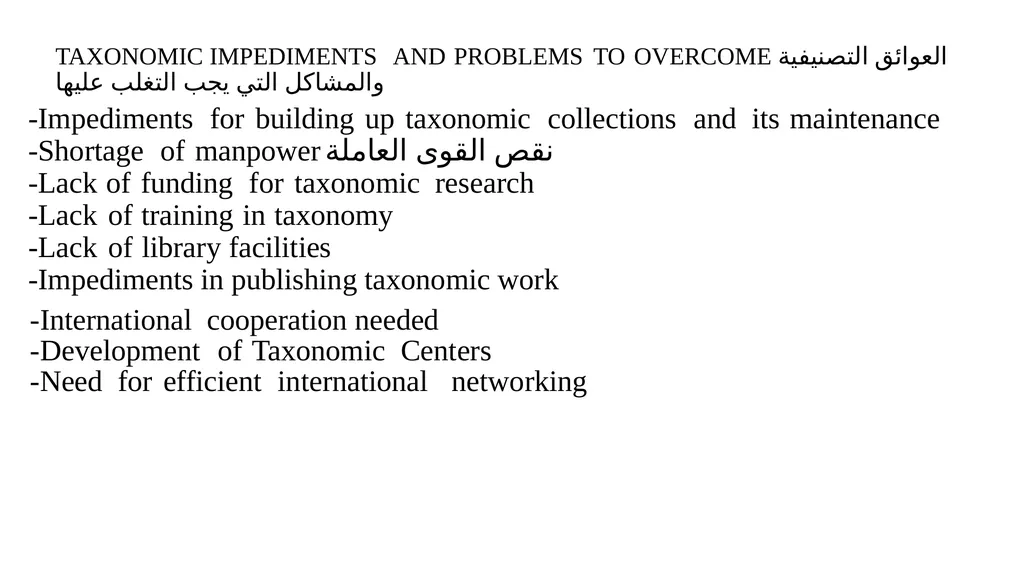
TAXONOMIC IMPEDIMENTS AND PROBLEMS TO OVERCOME العوائق التصنيفية والمشاكل التي يجب التغلب عليها -Impediments for building up taxonomic collections and its maintenance
-Shortage of manpower نقص القوى العاملة
-Lack of funding for taxonomic research
-Lack of training in taxonomy
-Lack of library facilities
-Impediments in publishing taxonomic work
-International cooperation needed
-Development of Taxonomic Centers
-Need for efficient international networking<br>
-Shortage of manpower نقص القوى العاملة
-Lack of funding for taxonomic research
-Lack of training in taxonomy
-Lack of library facilities
-Impediments in publishing taxonomic work
-International cooperation needed
-Development of Taxonomic Centers
-Need for efficient international networking<br>
16
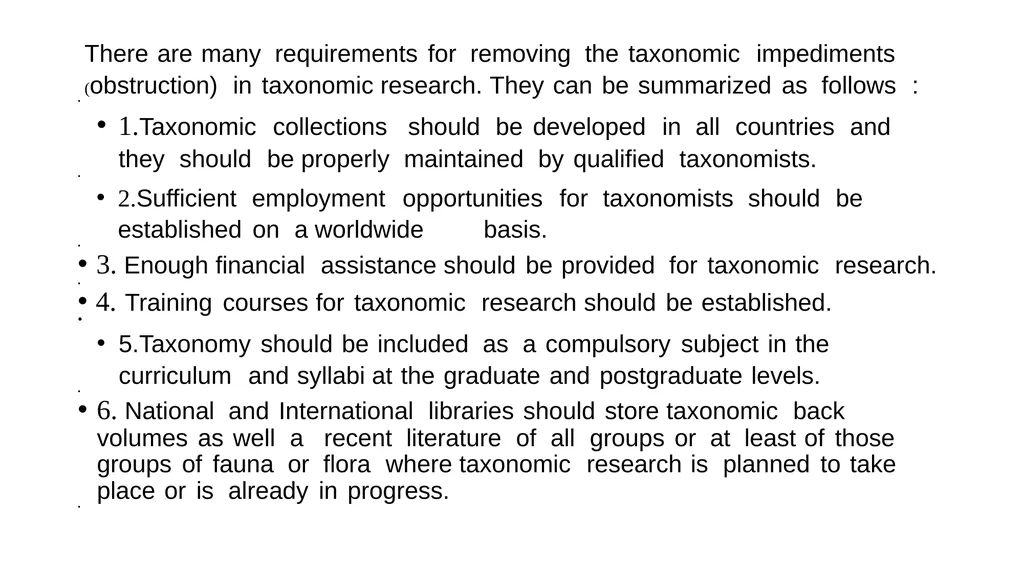
There are many requirements for removing the taxonomic impediments (obstruction) in taxonomic research. They can be summarized as follows :
1.Taxonomic collections should be developed in all countries and they should be properly maintained by qualified taxonomists.
2.Sufficient employment opportunities for taxonomists should be established on a worldwide basis.
3. Enough financial assistance should be provided for taxonomic research.
4. Training courses for taxonomic research should be established.
5.Taxonomy should be included as a compulsory subject in the curriculum and syllabi at the graduate and postgraduate levels.
6. National and International libraries should store taxonomic back volumes as well a recent literature of all groups or at least of those groups of fauna or flora where taxonomic research is planned to take place or is already in progress.<br>
1.Taxonomic collections should be developed in all countries and they should be properly maintained by qualified taxonomists.
2.Sufficient employment opportunities for taxonomists should be established on a worldwide basis.
3. Enough financial assistance should be provided for taxonomic research.
4. Training courses for taxonomic research should be established.
5.Taxonomy should be included as a compulsory subject in the curriculum and syllabi at the graduate and postgraduate levels.
6. National and International libraries should store taxonomic back volumes as well a recent literature of all groups or at least of those groups of fauna or flora where taxonomic research is planned to take place or is already in progress.<br>
17
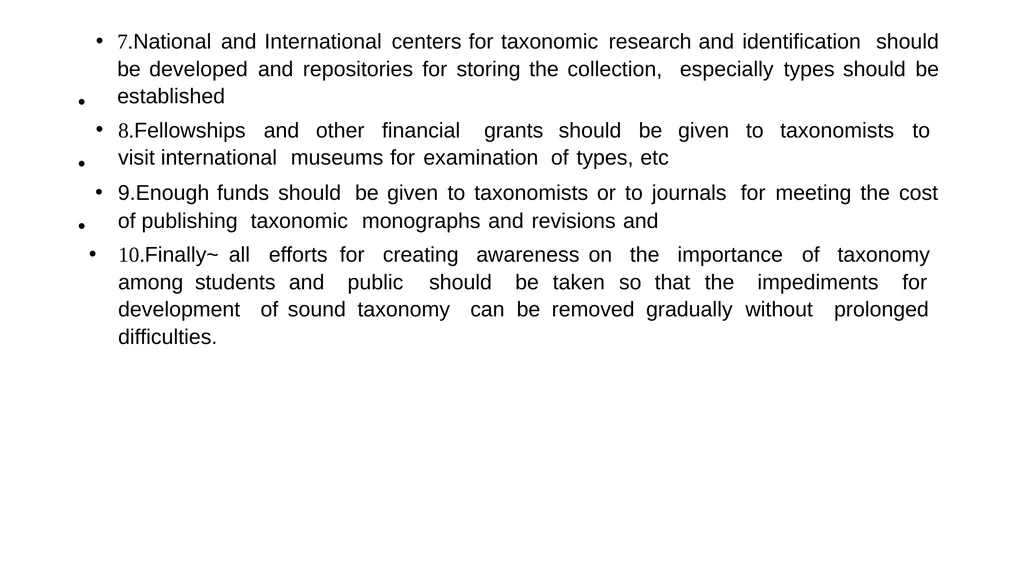
7.National and International centers for taxonomic research and identification should be developed and repositories for storing the collection, especially types should be established
8.Fellowships and other financial grants should be given to taxonomists to visit international museums for examination of types, etc
9.Enough funds should be given to taxonomists or to journals for meeting the cost of publishing taxonomic monographs and revisions and
10.Finally~ all efforts for creating awareness on the importance of taxonomy among students and public should be taken so that the impediments for development of sound taxonomy can be removed gradually without prolonged difficulties.<br>
8.Fellowships and other financial grants should be given to taxonomists to visit international museums for examination of types, etc
9.Enough funds should be given to taxonomists or to journals for meeting the cost of publishing taxonomic monographs and revisions and
10.Finally~ all efforts for creating awareness on the importance of taxonomy among students and public should be taken so that the impediments for development of sound taxonomy can be removed gradually without prolonged difficulties.<br>