
Lesson 3: The concluding discussion Exercise 3

Lesson 3: The concluding discussion Exercise 3
1 / 1
Lesson 3: The concluding discussion Exercise 3 Nick gets out the train and sees a well-known town in front of him. Nothing has been changed, every corner is the same. The green places are replaced by ashes. Nick cant find the river. The

Related Topics

Download this presentation From Below

"Lesson 3: The concluding discussion Exercise 3" is the property of its rightful owner. Permission is granted to download and print the materials on this website for personal, non-commercial use only, and to display it on your personal computer provided you do not modify the materials and that you retain all copyright notices contained in the materials. By downloading content from our website, you accept the terms of this agreement.

Presentation Transcript

01
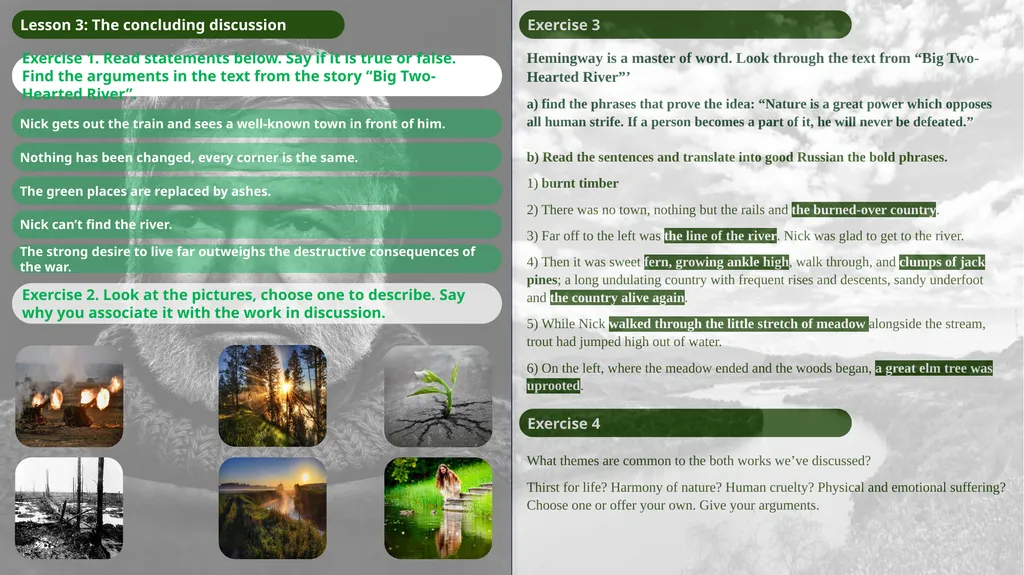
Lesson 3: The concluding discussion Exercise 3 Nick gets out the train and sees a well-known town in front of him. Nothing has been changed, every corner is the same. The green places are replaced by ashes. Nick can’t find the river. The strong desire to live far outweighs the destructive consequences of the war. Exercise 1. Read statements below. Say if it is true or false. Find the arguments in the text from the story “Big Two-Hearted River”. Exercise 2. Look at the pictures, choose one to describe. Say why you associate it with the work in discussion. Hemingway is a master of word. Look through the text from “Big Two-Hearted River”’
a) find the phrases that prove the idea: “Nature is a great power which opposes all human strife. If a person becomes a part of it, he will never be defeated.” b) Read the sentences and translate into good Russian the bold phrases.
1) burnt timber
2) There was no town, nothing but the rails and the burned-over country.
3) Far off to the left was the line of the river. Nick was glad to get to the river.
4) Then it was sweet fern, growing ankle high, walk through, and clumps of jack pines; a long undulating country with frequent rises and descents, sandy underfoot and the country alive again.
5) While Nick walked through the little stretch of meadow alongside the stream, trout had jumped high out of water.
6) On the left, where the meadow ended and the woods began, a great elm tree was uprooted. What themes are common to the both works we’ve discussed?
Thirst for life? Harmony of nature? Human cruelty? Physical and emotional suffering? Choose one or offer your own. Give your arguments. Exercise 4<br>