Lesson 6 Support vector machine (SVM) [ Support

Published  . 0 views
↓ Download
Lesson 6 Support vector machine (SVM) [ Support
1 / 1
Lesson 6 Support vector machine (SVM) [ Support - slide 1 of 36 Lesson 6 Support vector machine (SVM) [ Support - slide 2 of 36 Lesson 6 Support vector machine (SVM) [ Support - slide 3 of 36 Lesson 6 Support vector machine (SVM) [ Support - slide 4 of 36 Lesson 6 Support vector machine (SVM) [ Support - slide 5 of 36 Lesson 6 Support vector machine (SVM) [ Support - slide 6 of 36 Lesson 6 Support vector machine (SVM) [ Support - slide 7 of 36 Lesson 6 Support vector machine (SVM) [ Support - slide 8 of 36 Lesson 6 Support vector machine (SVM) [ Support - slide 9 of 36 Lesson 6 Support vector machine (SVM) [ Support - slide 10 of 36 Lesson 6 Support vector machine (SVM) [ Support - slide 11 of 36 Lesson 6 Support vector machine (SVM) [ Support - slide 12 of 36 Lesson 6 Support vector machine (SVM) [ Support - slide 13 of 36 Lesson 6 Support vector machine (SVM) [ Support - slide 14 of 36 Lesson 6 Support vector machine (SVM) [ Support - slide 15 of 36 Lesson 6 Support vector machine (SVM) [ Support - slide 16 of 36 Lesson 6 Support vector machine (SVM) [ Support - slide 17 of 36 Lesson 6 Support vector machine (SVM) [ Support - slide 18 of 36 Lesson 6 Support vector machine (SVM) [ Support - slide 19 of 36 Lesson 6 Support vector machine (SVM) [ Support - slide 20 of 36 Lesson 6 Support vector machine (SVM) [ Support - slide 21 of 36 Lesson 6 Support vector machine (SVM) [ Support - slide 22 of 36 Lesson 6 Support vector machine (SVM) [ Support - slide 23 of 36 Lesson 6 Support vector machine (SVM) [ Support - slide 24 of 36 Lesson 6 Support vector machine (SVM) [ Support - slide 25 of 36 Lesson 6 Support vector machine (SVM) [ Support - slide 26 of 36 Lesson 6 Support vector machine (SVM) [ Support - slide 27 of 36 Lesson 6 Support vector machine (SVM) [ Support - slide 28 of 36 Lesson 6 Support vector machine (SVM) [ Support - slide 29 of 36 Lesson 6 Support vector machine (SVM) [ Support - slide 30 of 36 Lesson 6 Support vector machine (SVM) [ Support - slide 31 of 36 Lesson 6 Support vector machine (SVM) [ Support - slide 32 of 36 Lesson 6 Support vector machine (SVM) [ Support - slide 33 of 36 Lesson 6 Support vector machine (SVM) [ Support - slide 34 of 36 Lesson 6 Support vector machine (SVM) [ Support - slide 35 of 36 Lesson 6 Support vector machine (SVM) [ Support - slide 36 of 36
Description: Lesson 6 Support vector machine (SVM) Support vector machine (SVM in short) is a Discriminant based classification method where the task is to find a decision boundary separating sample in one class from the other. it is a binary in

Related Topics

Download Presentation

"Lesson 6 Support vector machine (SVM) [ Support" is the property of its rightful owner. Permission is granted to download and print the materials on this website for personal, non-commercial use only, and to display it on your personal computer provided you do not modify the materials and that you retain all copyright notices contained in the materials. By downloading content from our website, you accept the terms of this agreement.

Presentation Transcript

slide2. Lesson 6

Support vector machine (SVM) [
Support vector machine (SVM in short) is a Discriminant based classification method where the task is to find a decision boundary separating sample in one class from the other. it is a binary in nature, means it considers two classes.
SVM is a vase topic. In this lesion, we will focus only on introductory understanding of SVM.
]<br>
slide3. Support vector machine [
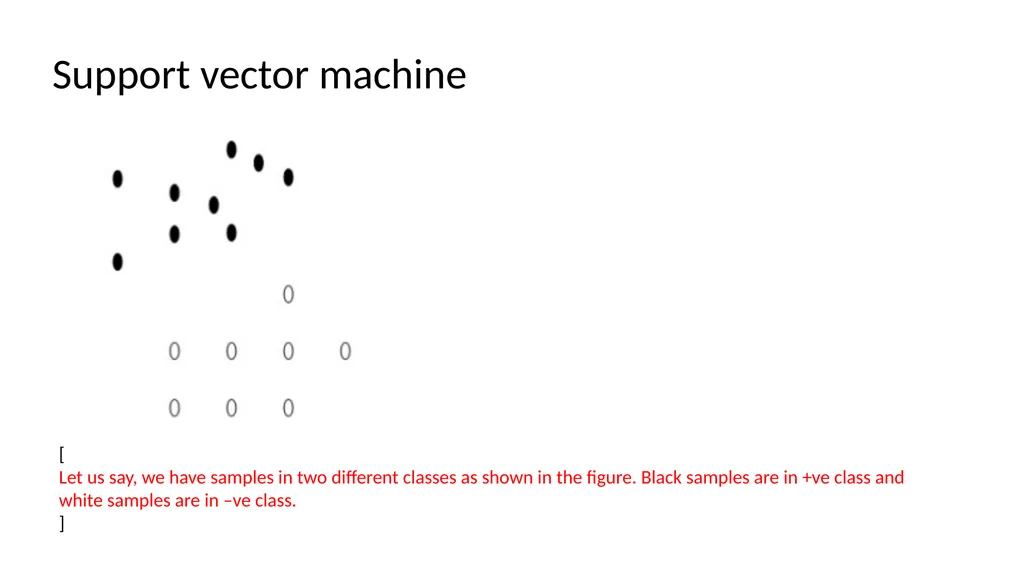
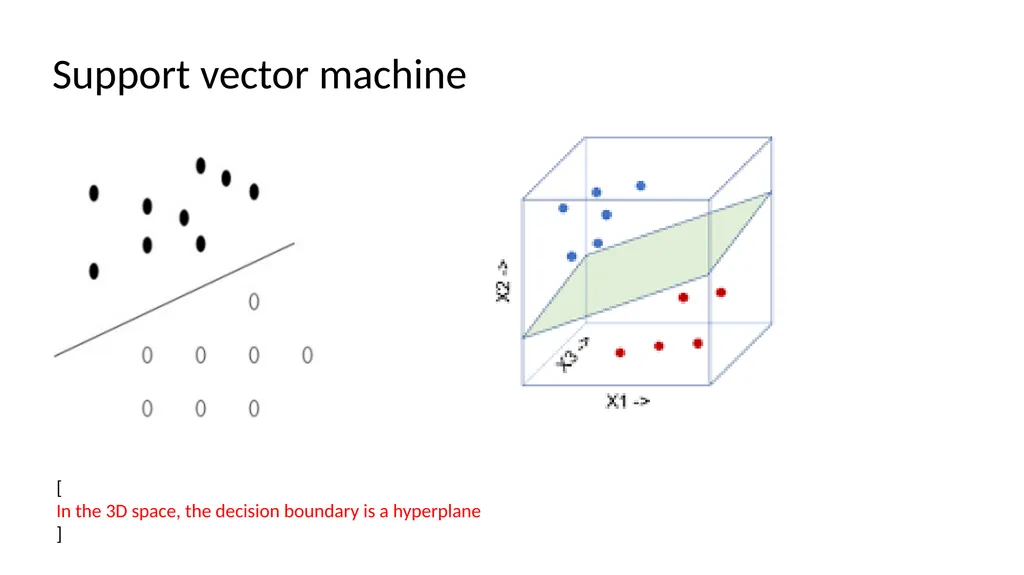
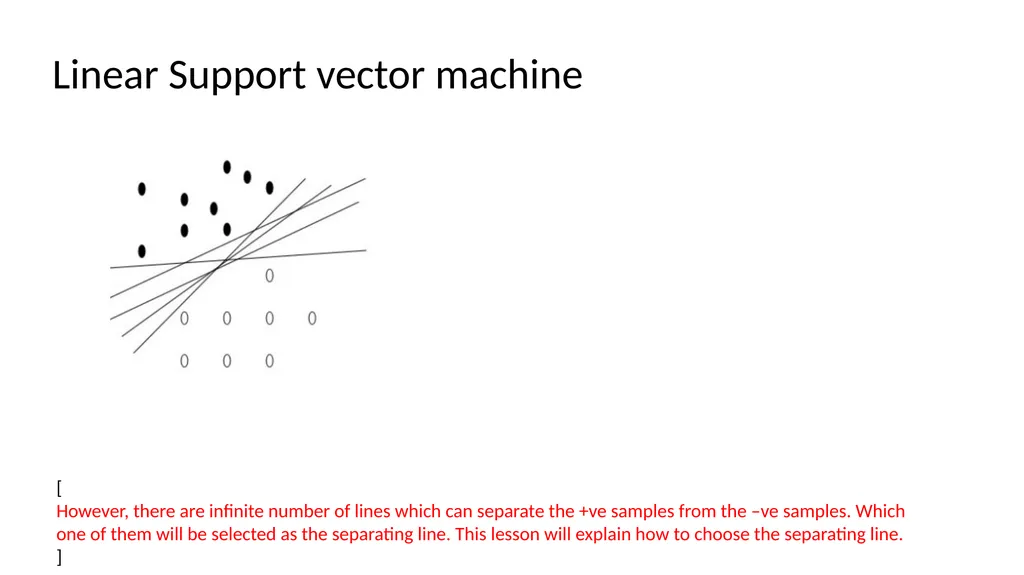
Let us say, we have samples in two different classes as shown in the figure. Black samples are in +ve class and white samples are in –ve class.
]<br>
slide4. Support vector machine [
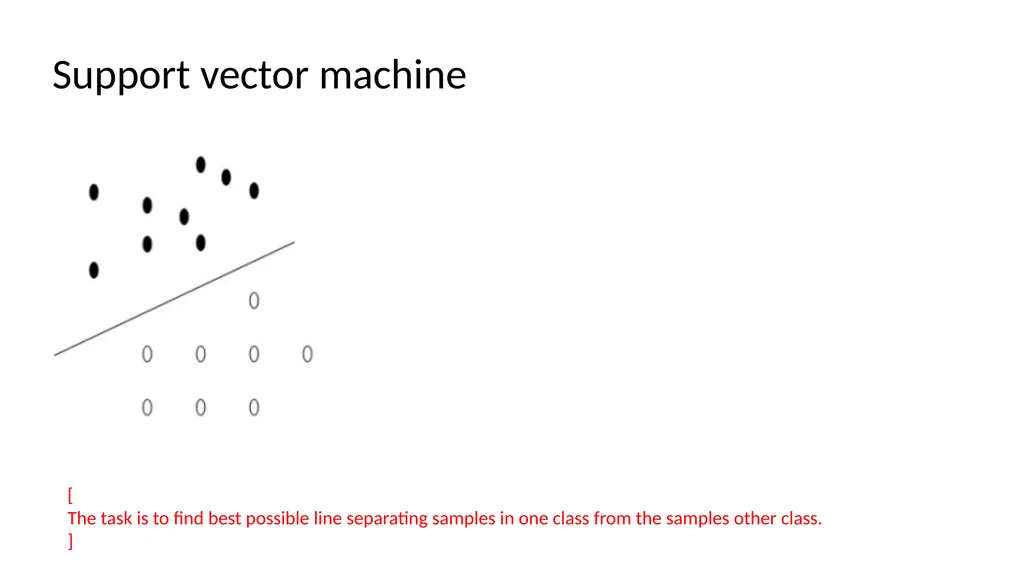
The task is to find best possible line separating samples in one class from the samples other class.
]<br>
slide5. Support vector machine [
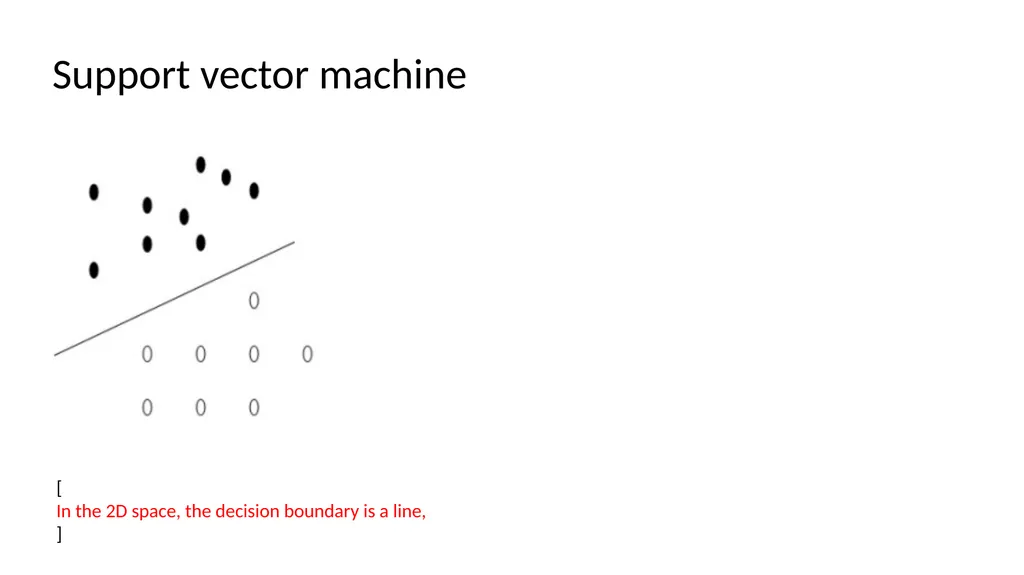
In the 2D space, the decision boundary is a line,
]<br>
slide6. Support vector machine [
In the 3D space, the decision boundary is a hyperplane
]<br>
slide7. Support vector machine – Linear or Non-linear Linear SVM Non-Linear SVM [
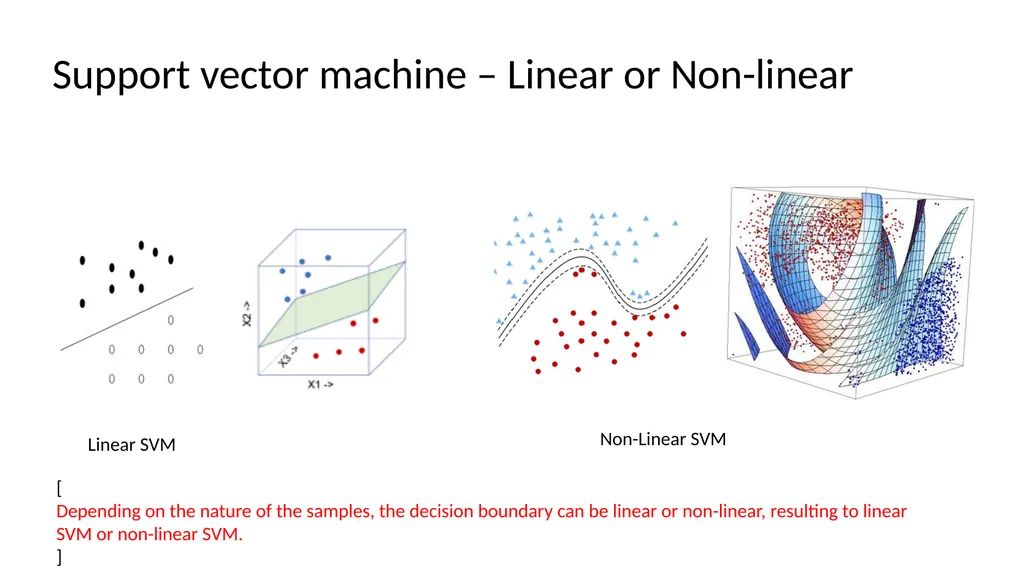
Depending on the nature of the samples, the decision boundary can be linear or non-linear, resulting to linear SVM or non-linear SVM.
]<br>
slide8. Non-Linear to Linear [
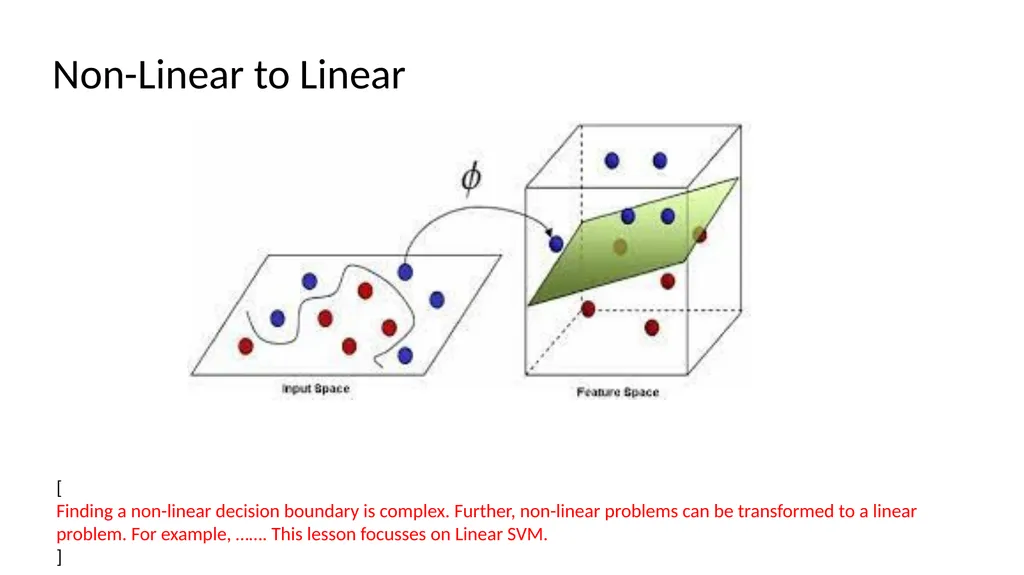
Finding a non-linear decision boundary is complex. Further, non-linear problems can be transformed to a linear problem. For example, ……. This lesson focusses on Linear SVM.
]<br>
slide9. Linear Support vector machine [
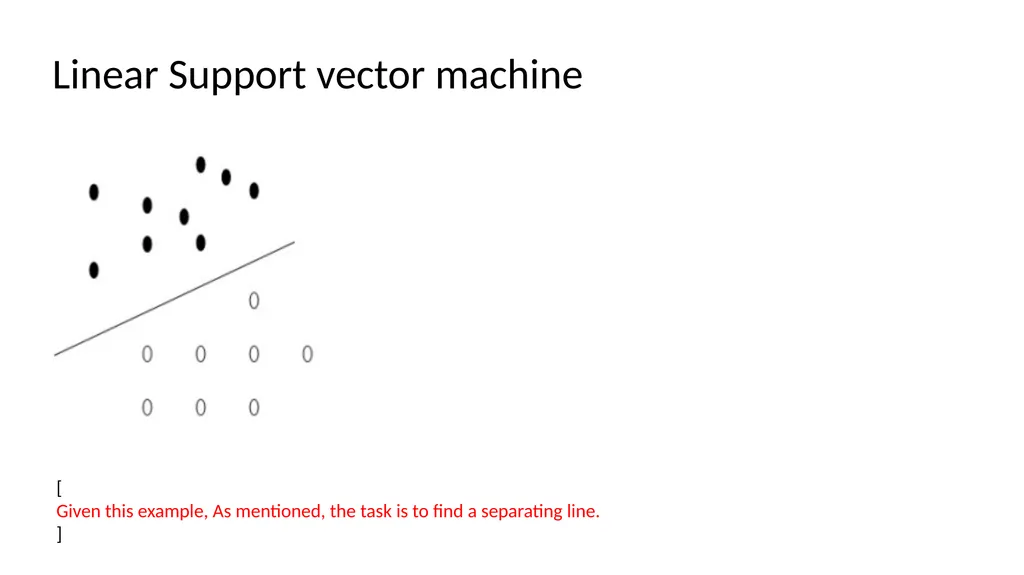
Given this example, As mentioned, the task is to find a separating line.
]<br>
slide10. Linear Support vector machine [
However, there are infinite number of lines which can separate the +ve samples from the –ve samples. Which one of them will be selected as the separating line. This lesson will explain how to choose the separating line.
]<br>
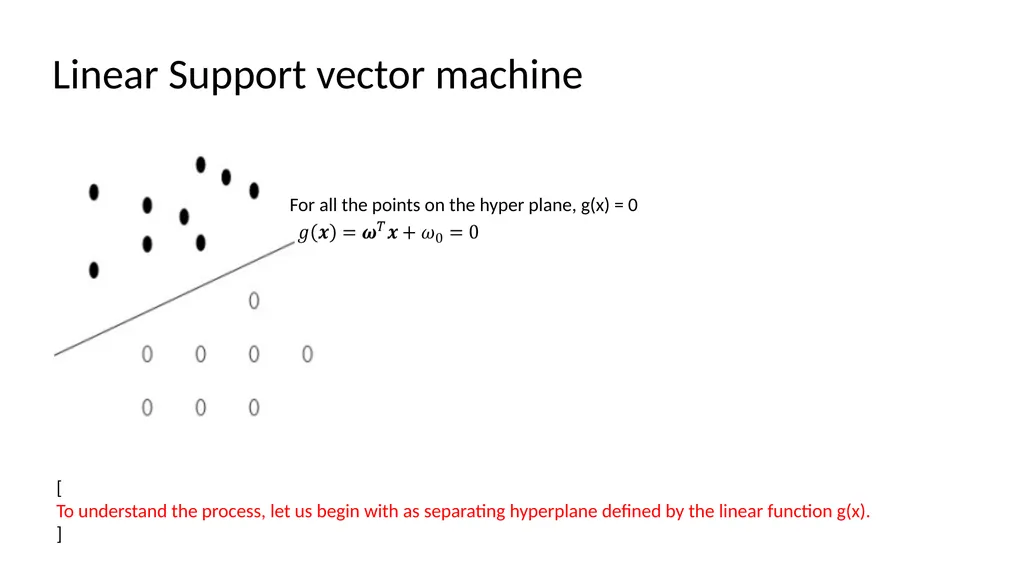
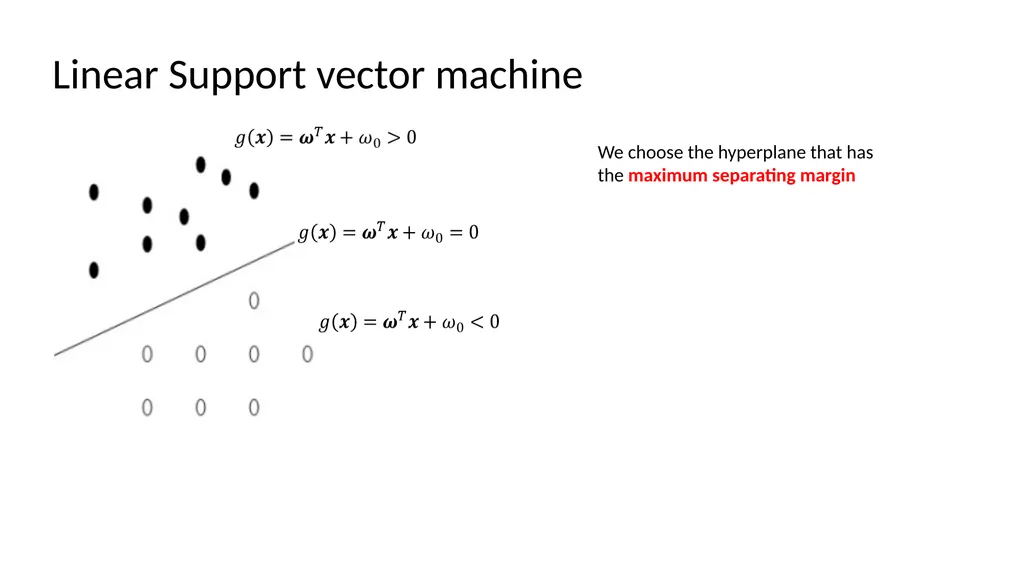
slide11. Linear Support vector machine For all the points on the hyper plane, g(x) = 0 [
To understand the process, let us begin with as separating hyperplane defined by the linear function g(x).
]<br>
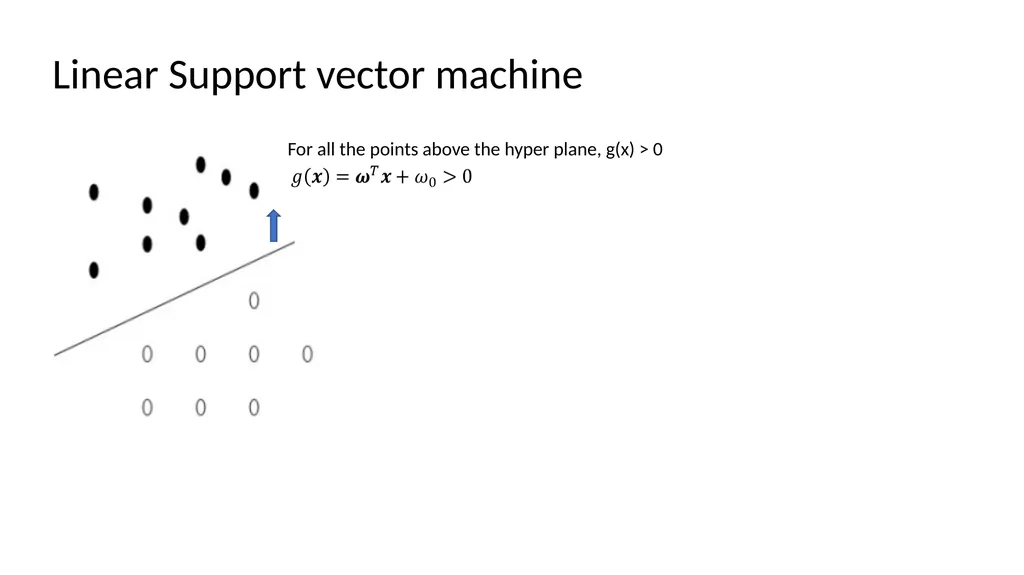
slide12. Linear Support vector machine For all the points above the hyper plane, g(x) > 0<br>
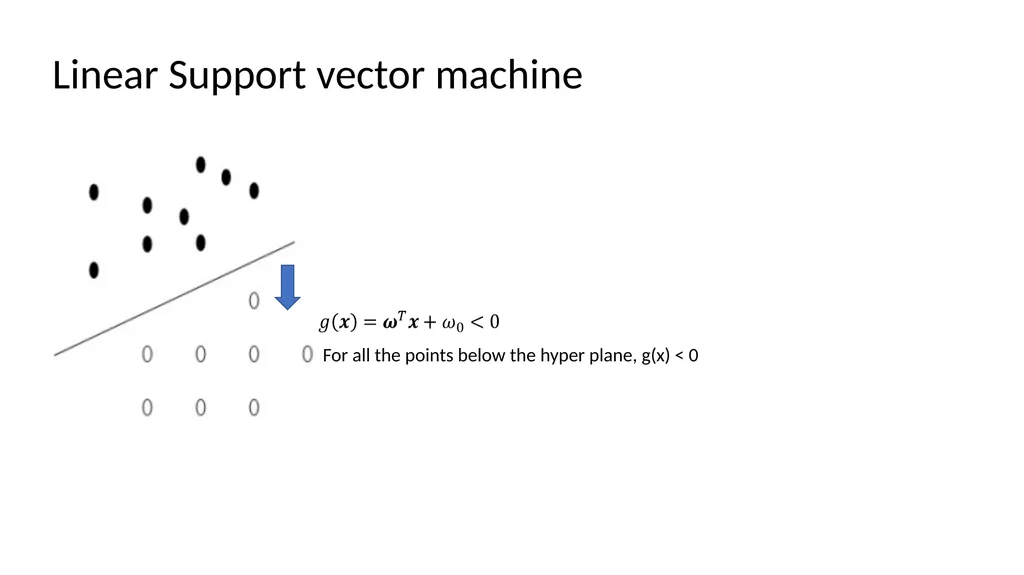
slide13. Linear Support vector machine For all the points below the hyper plane, g(x) < 0<br>
slide14. Linear Support vector machine We choose the hyperplane that has the maximum separating margin<br>
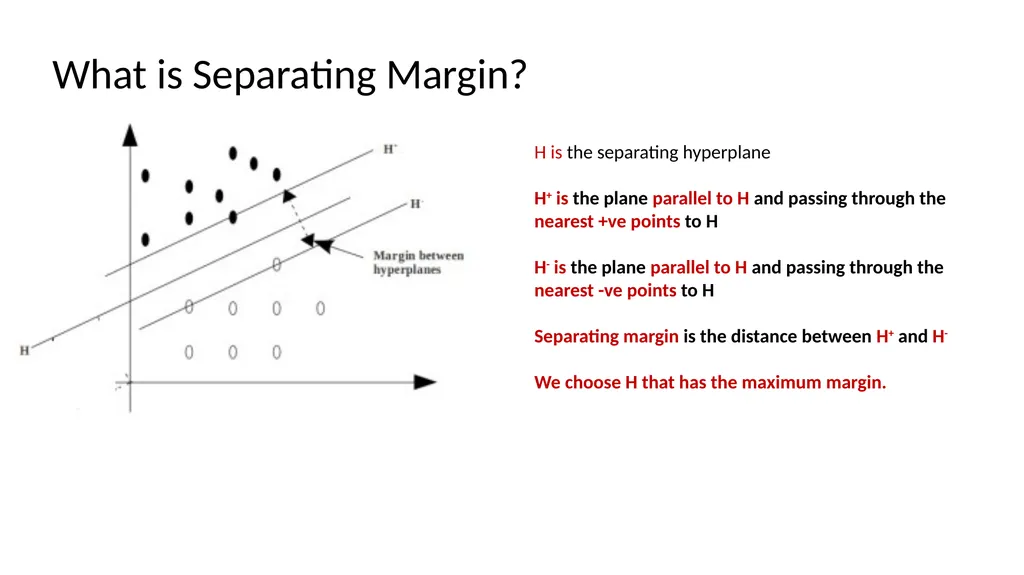
slide15. What is Separating Margin? H is the separating hyperplane

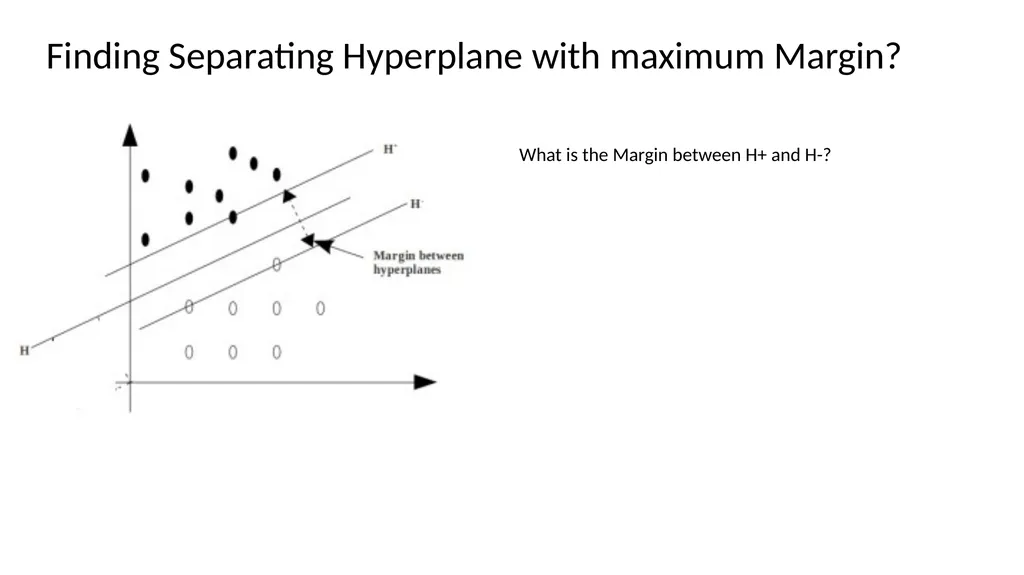
H+ is the plane parallel to H and passing through the nearest +ve points to H

H- is the plane parallel to H and passing through the nearest -ve points to H

Separating margin is the distance between H+ and H-

We choose H that has the maximum margin.<br>
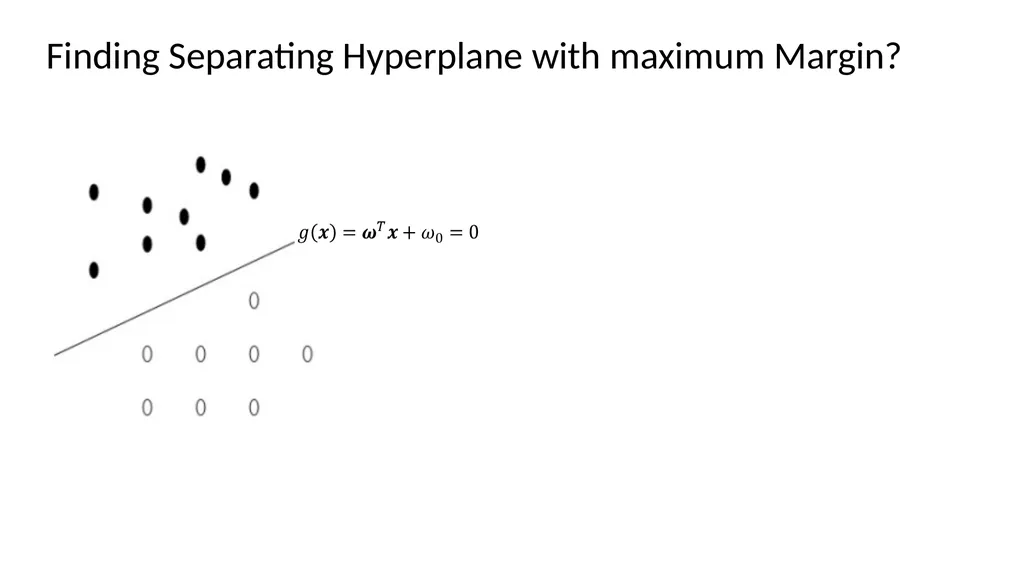
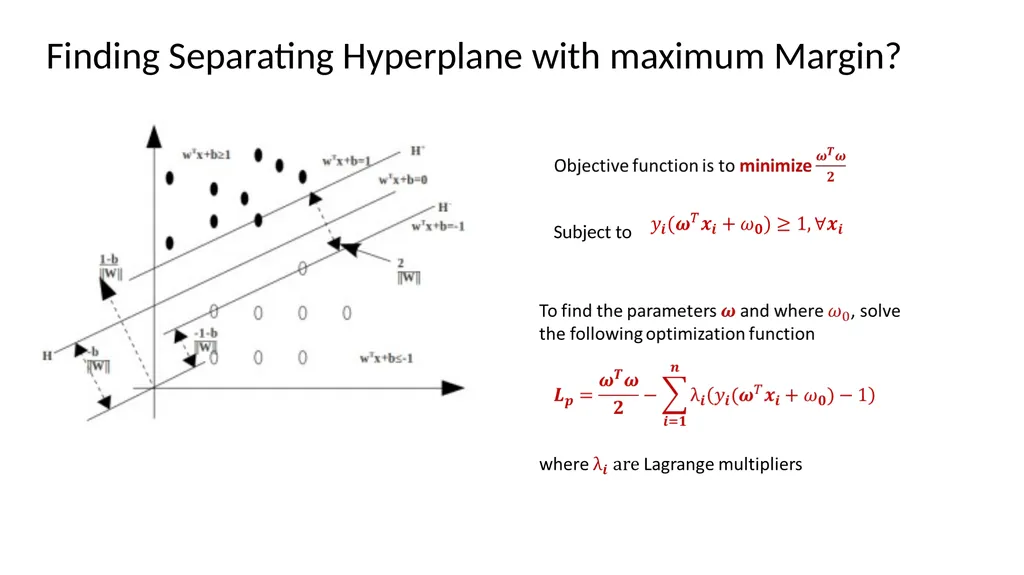
slide16. Finding Separating Hyperplane with maximum Margin?<br>
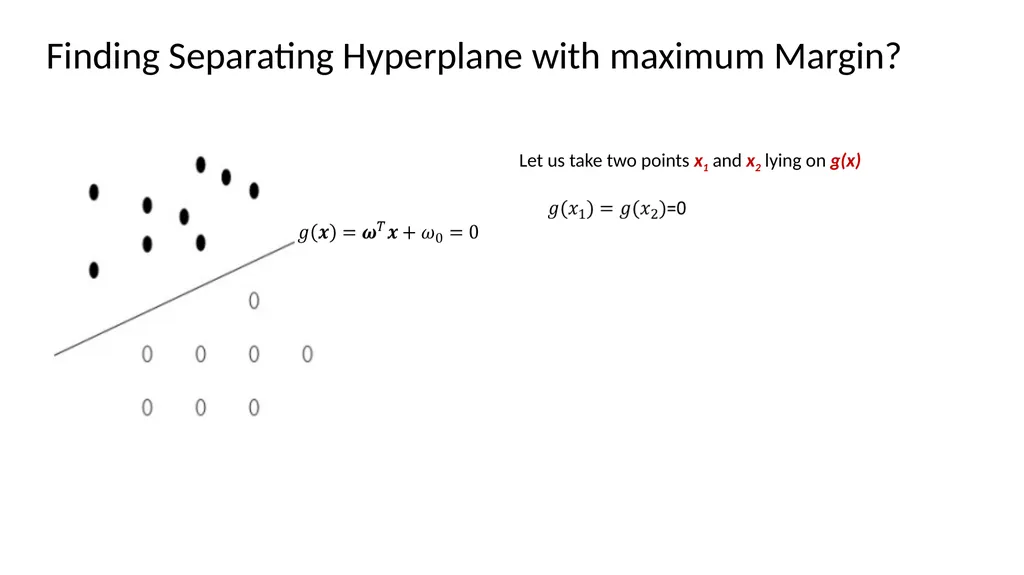
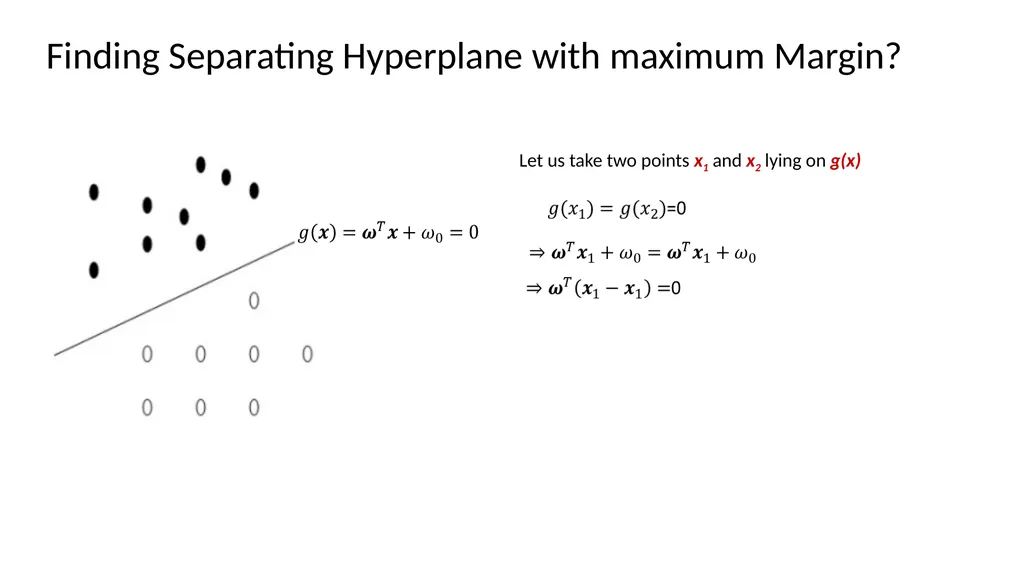
slide17. Finding Separating Hyperplane with maximum Margin? Let us take two points x1 and x2 lying on g(x)<br>
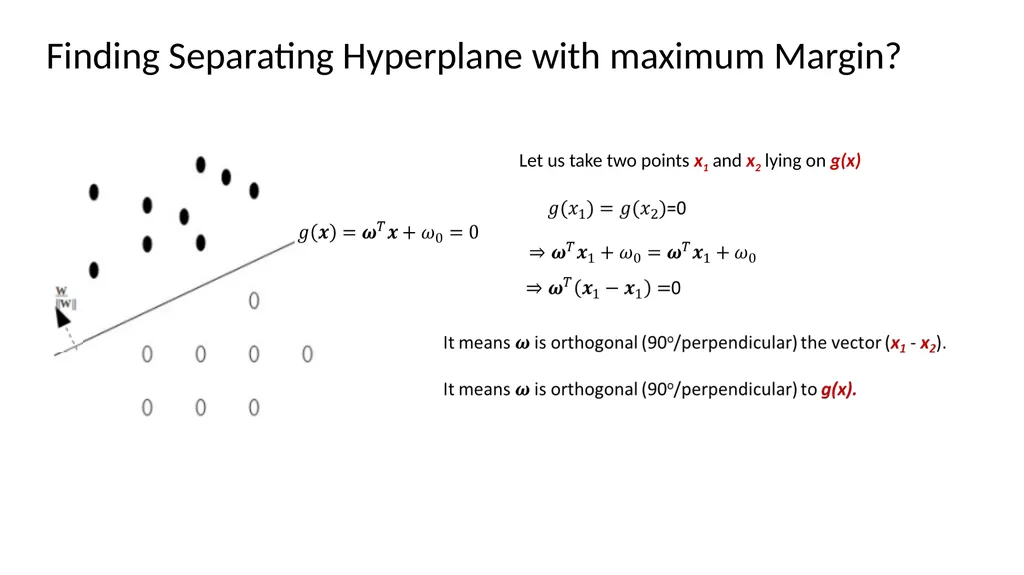
slide18. Finding Separating Hyperplane with maximum Margin? Let us take two points x1 and x2 lying on g(x)<br>
slide19. Finding Separating Hyperplane with maximum Margin? Let us take two points x1 and x2 lying on g(x)<br>
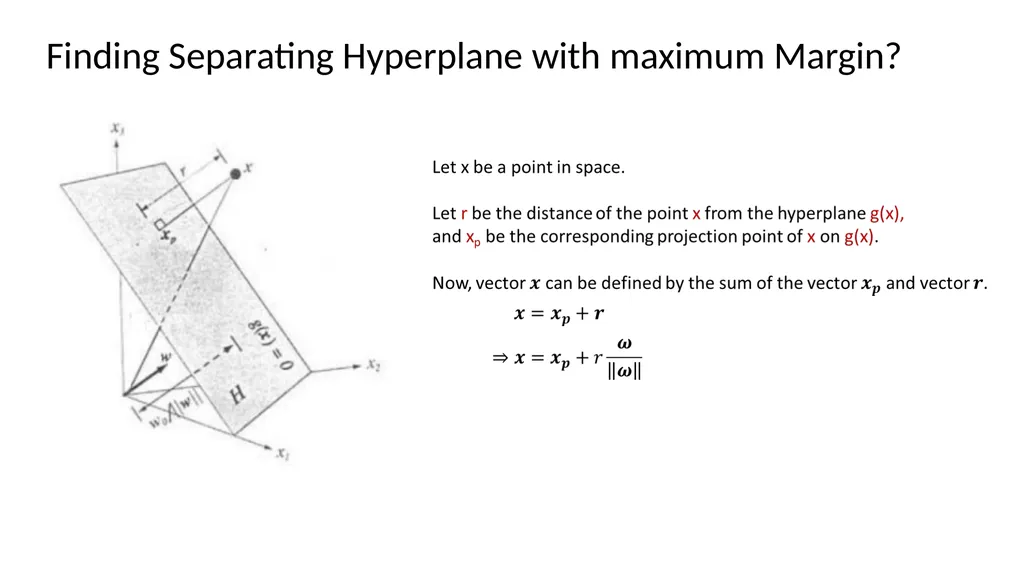
slide20. Finding Separating Hyperplane with maximum Margin?<br>
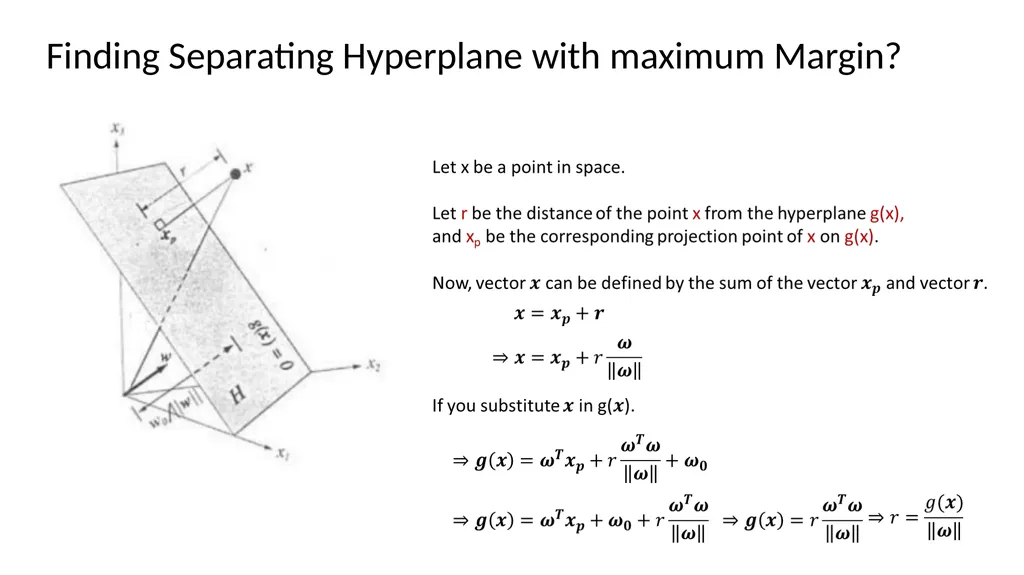
slide21. Finding Separating Hyperplane with maximum Margin?<br>
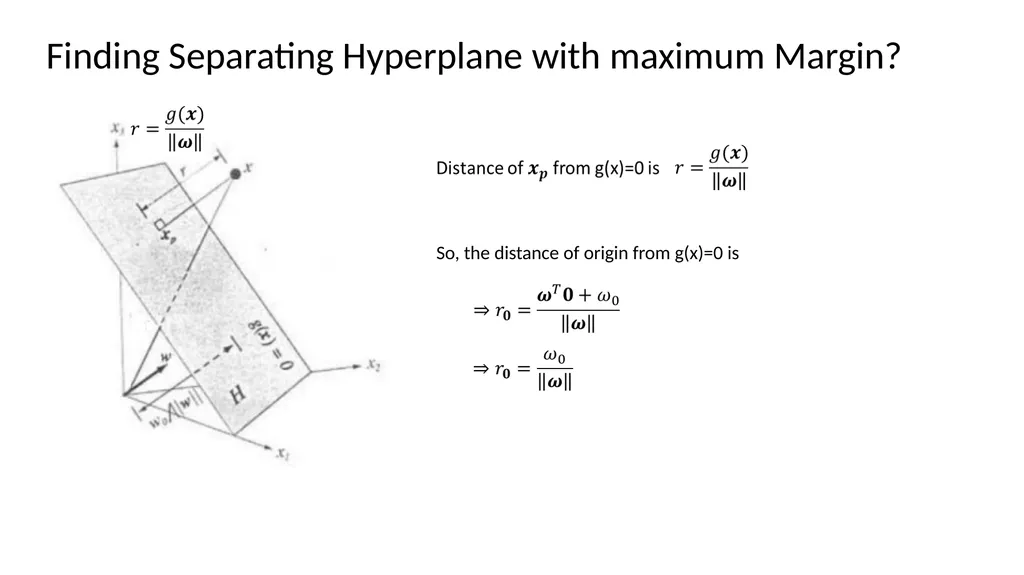
slide22. Finding Separating Hyperplane with maximum Margin? So, the distance of origin from g(x)=0 is<br>
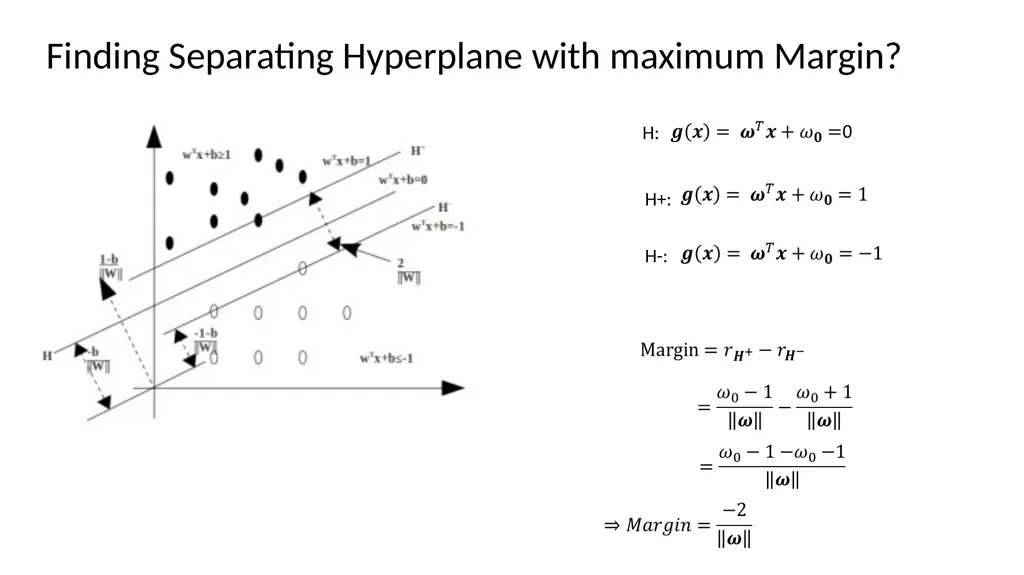
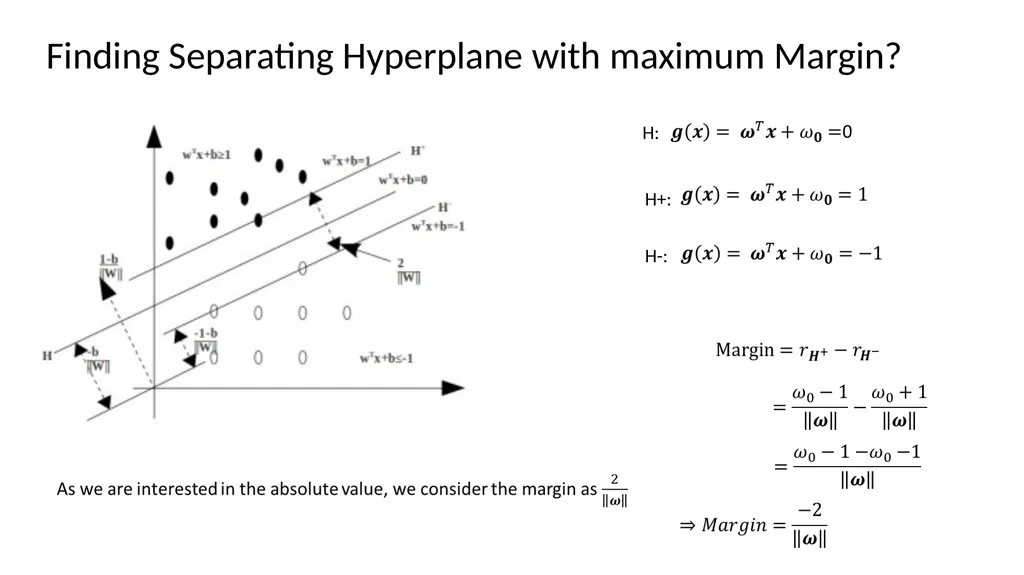
slide23. Finding Separating Hyperplane with maximum Margin? What is the Margin between H+ and H-?<br>
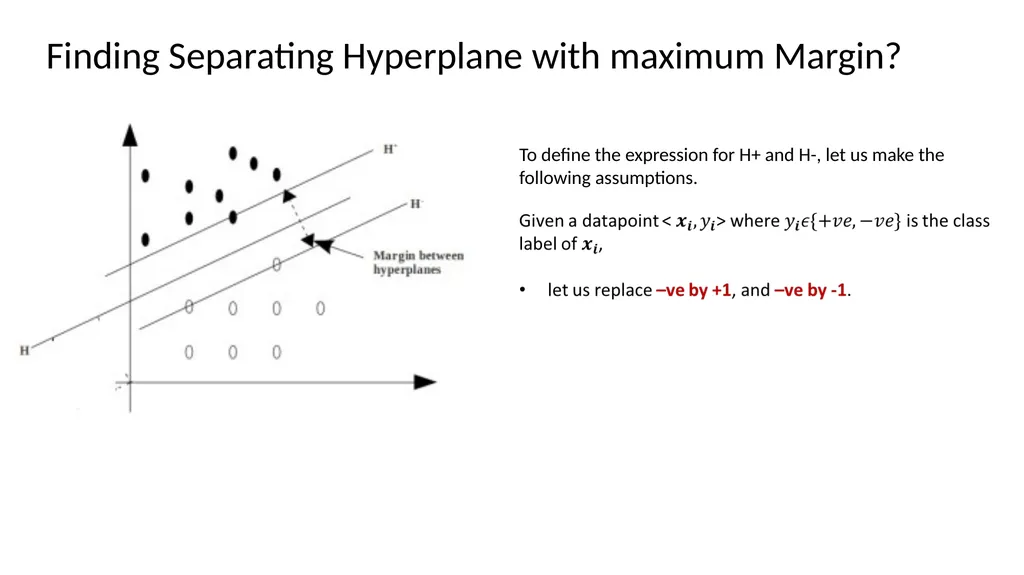
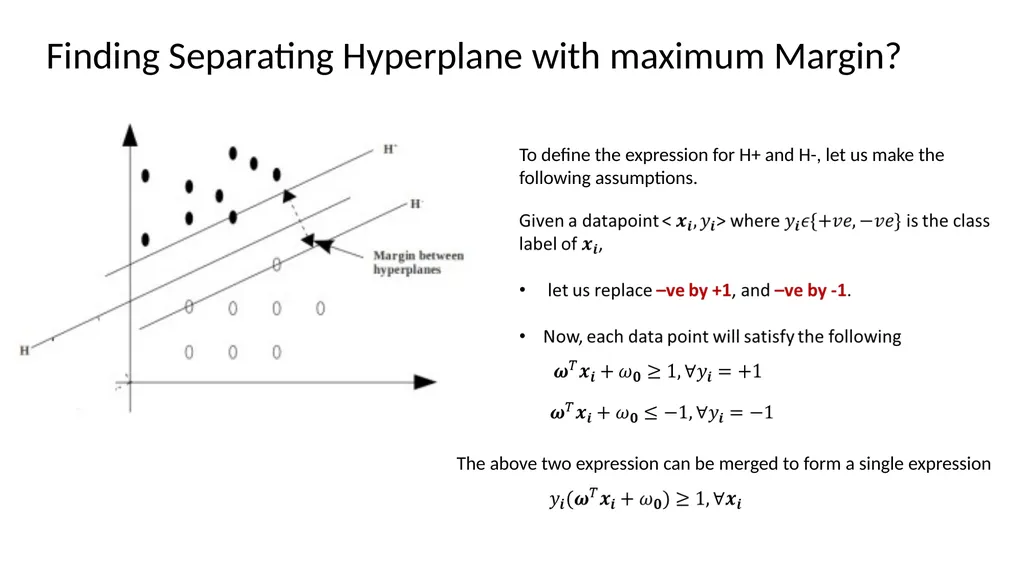
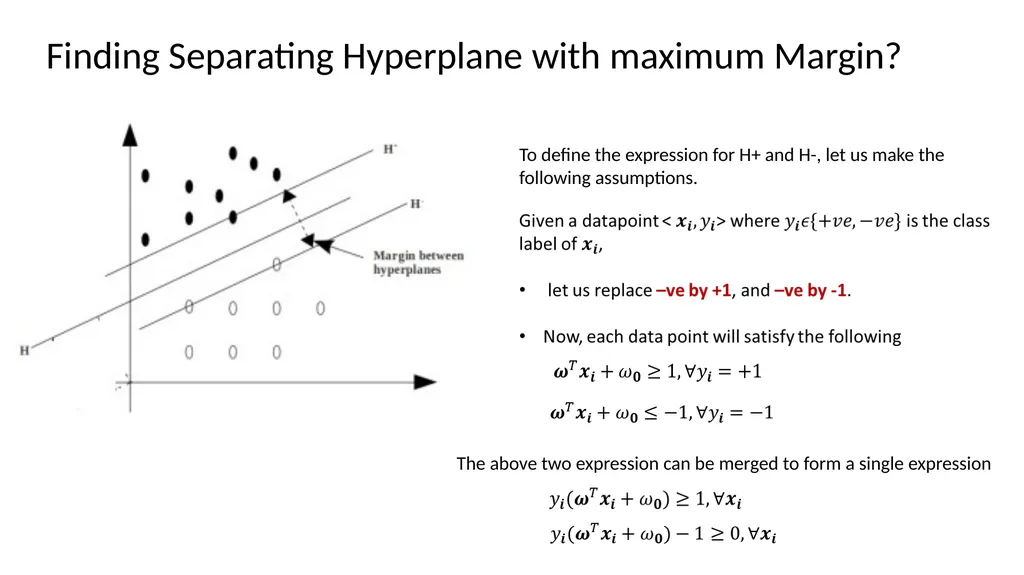
slide24. Finding Separating Hyperplane with maximum Margin? To define the expression for H+ and H-, let us make the following assumptions.<br>
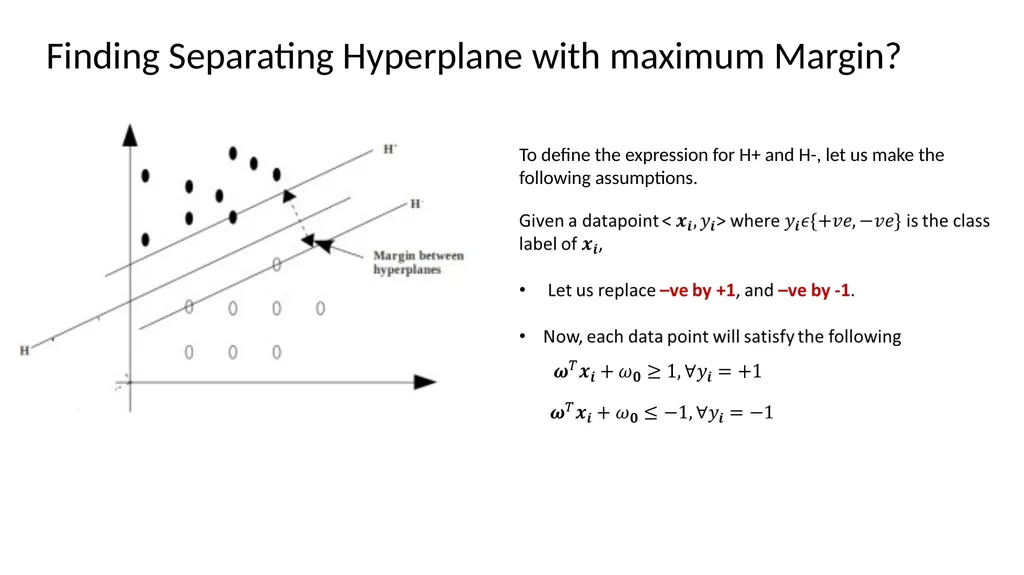
slide25. Finding Separating Hyperplane with maximum Margin? To define the expression for H+ and H-, let us make the following assumptions.<br>
slide26. Finding Separating Hyperplane with maximum Margin? To define the expression for H+ and H-, let us make the following assumptions. The above two expression can be merged to form a single expression<br>
slide27. Finding Separating Hyperplane with maximum Margin? To define the expression for H+ and H-, let us make the following assumptions. The above two expression can be merged to form a single expression<br>
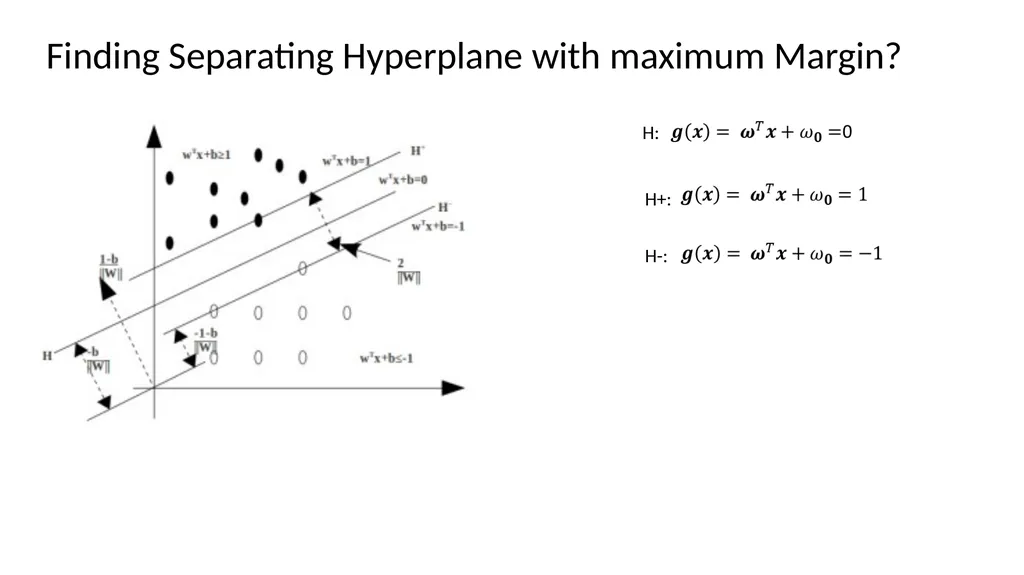
slide28. Finding Separating Hyperplane with maximum Margin? H+: H-: H:<br>
slide29. Finding Separating Hyperplane with maximum Margin? H+: H-: H:<br>
slide30. Finding Separating Hyperplane with maximum Margin? H+: H-: H:<br>
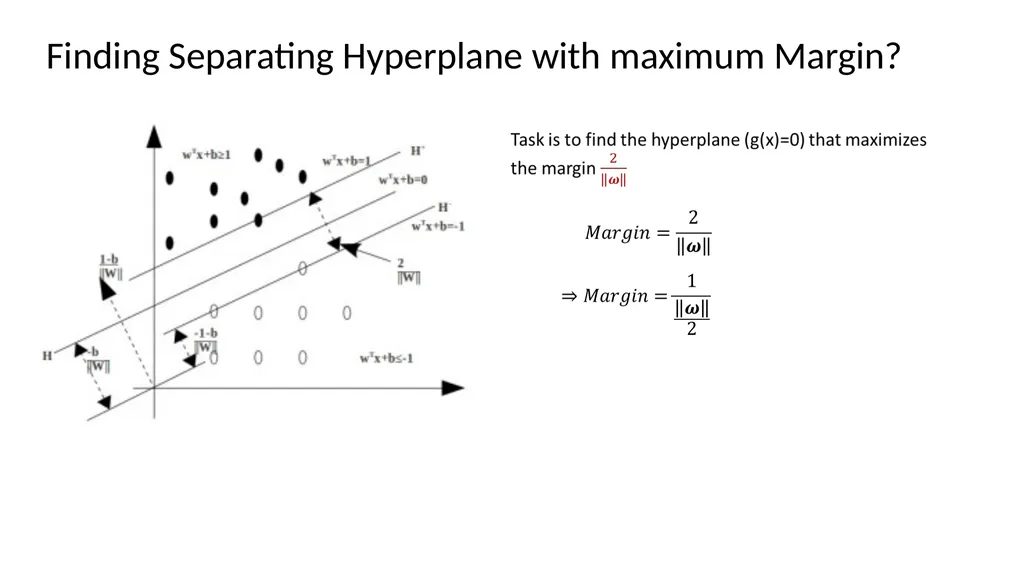
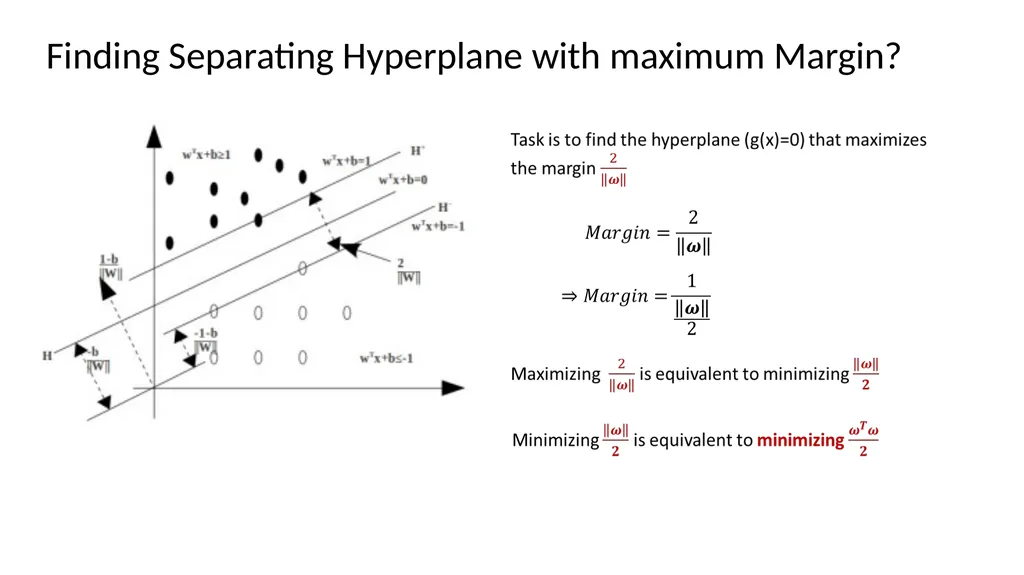
slide31. Finding Separating Hyperplane with maximum Margin?<br>
slide32. Finding Separating Hyperplane with maximum Margin?<br>
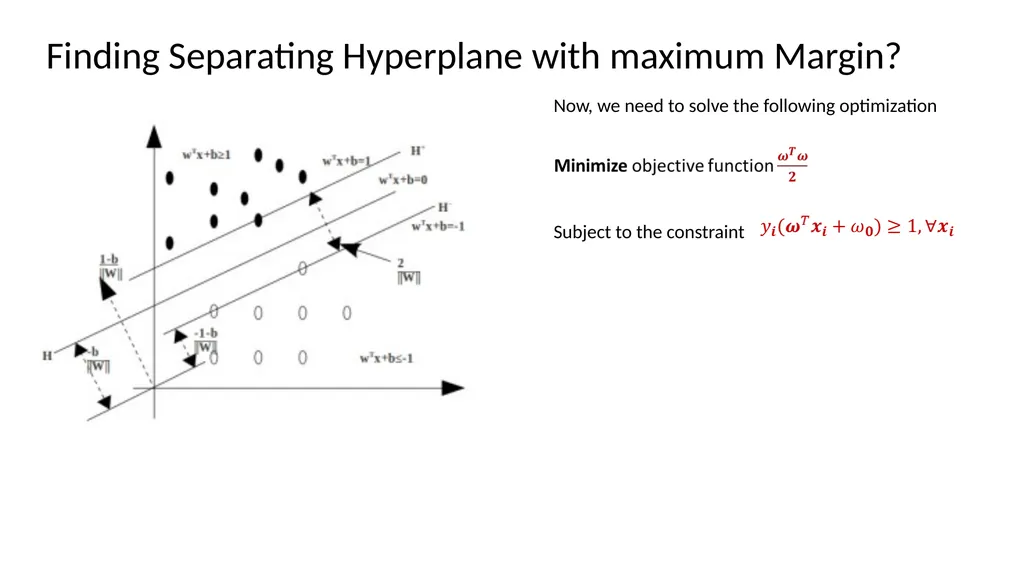
slide33. Finding Separating Hyperplane with maximum Margin? Subject to the constraint Now, we need to solve the following optimization<br>
slide34. Finding Separating Hyperplane with maximum Margin? Subject to<br>
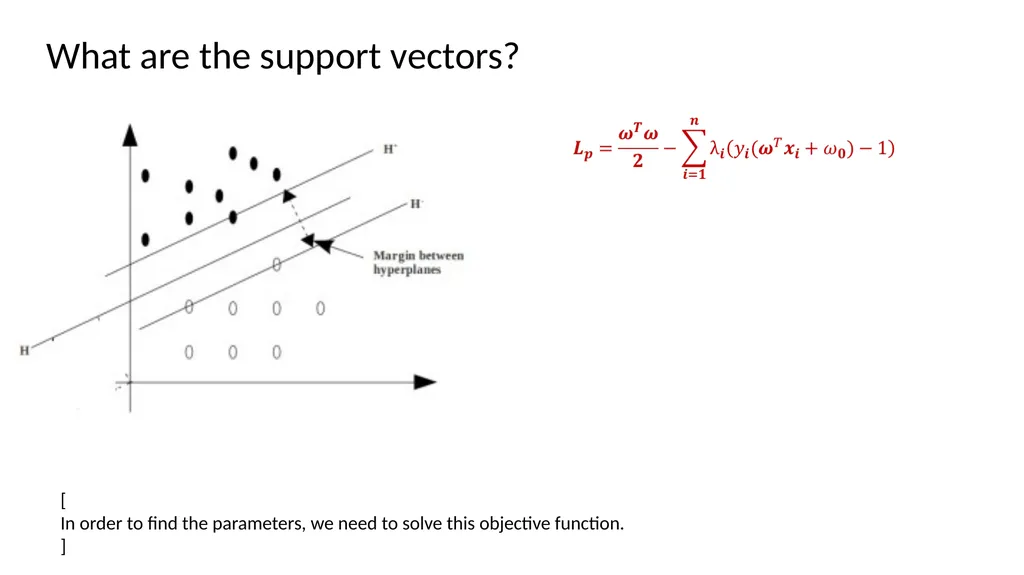
slide35. What are the support vectors? [
In order to find the parameters, we need to solve this objective function.
]<br>
slide36. Summary What is separating hyperplane?

How to define separating hyperplane?

What are Support Vector Machine?

How to classify a new example using SVM<br>