
Lesson: How Can Human Societies Evolve from
Description: Lesson: How Can Human Societies Evolve from Parasitism to Mutualism with Earth? This nest of the eastern phoebe has one brown-headed cowbird egg. The phoebe has been parasitized. Image by Galawebdesign, 3.0. What Are Parasites? 1 Parasites
Related Topics
Download Presentation
"Lesson: How Can Human Societies Evolve from" is the property of its rightful owner. Permission is granted to download and print the materials on this website for personal, non-commercial use only, and to display it on your personal computer provided you do not modify the materials and that you retain all copyright notices contained in the materials. By downloading content from our website, you accept the terms of this agreement.
Presentation Transcript
slide1. Lesson:
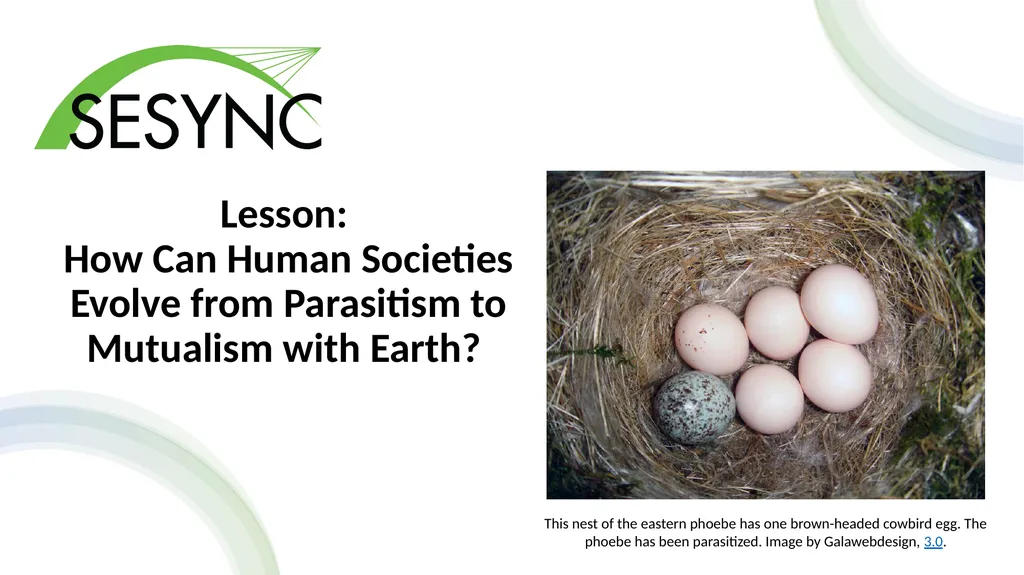
How Can Human Societies Evolve from Parasitism to Mutualism with Earth? This nest of the eastern phoebe has one brown-headed cowbird egg. The phoebe has been parasitized. Image by Galawebdesign, 3.0.<br>
slide2. What Are Parasites? 1 Parasites are predators that weaken their host by feeding on the host’s body or by sapping the host’s resources. In the image to the left, a parasitic crustacean has entered a host fish’s body and attached to the tongue. The parasite feeds on the tongue and eventually other parts of the host, until the host dies. Now consider this image (right) of a surface mine that produces lignite, a form of soft brown coal. This image shows its devastating impacts on local ecosystems and implies its global impacts in contributing to climate change. Is this human activity parasitic to our host? Image by Martin Falbisoner via Wikimedia, 4.0. Image by Marco Vinci via Wikimedia 3.0.<br>
slide3. What Are Mutualists? 2 Mutualists are symbiotic species that have co-evolved for mutual benefit. In the image to the left, a yellowstripe coris receives beneficial grooming from a scarlet cleaner shrimp and the shrimp gets a meal. Now consider this image (right) of a restored gravel pit site in Calgary Olympic Park. The degraded site now absorbs and filters stormwater in coordination with the adjacent stream and meadow, and it provides a public art piece for contemplation. Is this human activity mutualistic with our host? Image is public domain via NOAA. Image by Oceanflynn via Wikimedia Commons, 4.0.<br>
slide4. Earth as Host, Earth as Organism 3 Our home planet is an evolving, delicately balanced complex of interlocking systems.
We can understand these systems in isolation, as the geosphere, the biosphere, and the atmosphere.
But we can also understand them in synergy as physical conditions affect biological life and vice versa.
An obvious example is how mining the geosphere liberates ancient carbon, which we burn, and alters the chemical composition of the atmosphere, which has complicated and emergent effects on biological life across the planet. Public domain image courtesy of NASA.<br>
slide5. Earth as Host, Earth as Organism 4 Many find the Gaia hypothesis to be a useful metaphor for considering how Earth’s interlocking systems work as a kind of homeostasis in the global “body.”
Certain ecosystems, like the Amazon rainforest and deciduous forests, act as “lungs” that oxygenate the global atmosphere.
We can see each annual “breath” taken by the planet in the annual zigzags of the Keeling Curve.
The long-term trend toward higher carbon dioxide concentrations is a central element of human-caused imbalance in the atmosphere, which has increasing, malignant effects across Earth systems. The Keeling Curve. Public domain image.<br>
slide6. How Dare You? I’m Not a Parasite! 5 We may resent feeling blamed for environmental degradation because many degrading activities are simply related to survival: eating, drinking, acquiring resources, and having a cozy place to live.
This lesson challenges us to consider not how individuals but cultures and their values prescribe certain relations with the non-human world.
These relations may be extractive and wasteful (parasitic) or restorative and sustainable (mutualistic).
Our cultural identity influences what behavior we think is normal, virtuous, or malignant. Different cultures may perceive the same activity very differently. Public domain image from MassDOT via Wikimedia Commons.<br>
slide7. Areas of Inquiry for this Lesson 6 Your challenge:
To research, dream, and redesign a parasitic activity so that it becomes a mutualism that benefits Earth.
Infrastructure: Gray Petroculture to Green Community Culture
Agriculture: Monocrop Soil Extraction to Regenerative Polyculture
Waste: Mountains of Plastic to Marvelous Circularity
Communication: Greenwashing to Creative “Righting” and Useful Dreaming
Fragmented Ecosystems: Invasive Eyesores to Novel Communities and Eco-Social Resources
Sociology and Psychology: Inequality and Nature Deficit to Inclusion and Immersion<br>
How Can Human Societies Evolve from Parasitism to Mutualism with Earth? This nest of the eastern phoebe has one brown-headed cowbird egg. The phoebe has been parasitized. Image by Galawebdesign, 3.0.<br>
slide2. What Are Parasites? 1 Parasites are predators that weaken their host by feeding on the host’s body or by sapping the host’s resources. In the image to the left, a parasitic crustacean has entered a host fish’s body and attached to the tongue. The parasite feeds on the tongue and eventually other parts of the host, until the host dies. Now consider this image (right) of a surface mine that produces lignite, a form of soft brown coal. This image shows its devastating impacts on local ecosystems and implies its global impacts in contributing to climate change. Is this human activity parasitic to our host? Image by Martin Falbisoner via Wikimedia, 4.0. Image by Marco Vinci via Wikimedia 3.0.<br>
slide3. What Are Mutualists? 2 Mutualists are symbiotic species that have co-evolved for mutual benefit. In the image to the left, a yellowstripe coris receives beneficial grooming from a scarlet cleaner shrimp and the shrimp gets a meal. Now consider this image (right) of a restored gravel pit site in Calgary Olympic Park. The degraded site now absorbs and filters stormwater in coordination with the adjacent stream and meadow, and it provides a public art piece for contemplation. Is this human activity mutualistic with our host? Image is public domain via NOAA. Image by Oceanflynn via Wikimedia Commons, 4.0.<br>
slide4. Earth as Host, Earth as Organism 3 Our home planet is an evolving, delicately balanced complex of interlocking systems.
We can understand these systems in isolation, as the geosphere, the biosphere, and the atmosphere.
But we can also understand them in synergy as physical conditions affect biological life and vice versa.
An obvious example is how mining the geosphere liberates ancient carbon, which we burn, and alters the chemical composition of the atmosphere, which has complicated and emergent effects on biological life across the planet. Public domain image courtesy of NASA.<br>
slide5. Earth as Host, Earth as Organism 4 Many find the Gaia hypothesis to be a useful metaphor for considering how Earth’s interlocking systems work as a kind of homeostasis in the global “body.”
Certain ecosystems, like the Amazon rainforest and deciduous forests, act as “lungs” that oxygenate the global atmosphere.
We can see each annual “breath” taken by the planet in the annual zigzags of the Keeling Curve.
The long-term trend toward higher carbon dioxide concentrations is a central element of human-caused imbalance in the atmosphere, which has increasing, malignant effects across Earth systems. The Keeling Curve. Public domain image.<br>
slide6. How Dare You? I’m Not a Parasite! 5 We may resent feeling blamed for environmental degradation because many degrading activities are simply related to survival: eating, drinking, acquiring resources, and having a cozy place to live.
This lesson challenges us to consider not how individuals but cultures and their values prescribe certain relations with the non-human world.
These relations may be extractive and wasteful (parasitic) or restorative and sustainable (mutualistic).
Our cultural identity influences what behavior we think is normal, virtuous, or malignant. Different cultures may perceive the same activity very differently. Public domain image from MassDOT via Wikimedia Commons.<br>
slide7. Areas of Inquiry for this Lesson 6 Your challenge:
To research, dream, and redesign a parasitic activity so that it becomes a mutualism that benefits Earth.
Infrastructure: Gray Petroculture to Green Community Culture
Agriculture: Monocrop Soil Extraction to Regenerative Polyculture
Waste: Mountains of Plastic to Marvelous Circularity
Communication: Greenwashing to Creative “Righting” and Useful Dreaming
Fragmented Ecosystems: Invasive Eyesores to Novel Communities and Eco-Social Resources
Sociology and Psychology: Inequality and Nature Deficit to Inclusion and Immersion<br>