
Lexical Analysis (Scanning) Chapter 2 Lexical
FD
Published · 45 slides · 0 views
1 / 1

Description
Lexical Analysis (Scanning) Chapter 2 Lexical Analysis (Scanning) Basic Ideas divide character stream into tokens a token is the smallest logical unit in code common categories: easy to enum. hard to enum. Scanning Token Categories common
Related Topics
Share
Embed code
Download this presentation From Below
"Lexical Analysis (Scanning) Chapter 2 Lexical" is the property of its rightful owner. Permission is granted to download and print the materials on this website for personal, non-commercial use only, and to display it on your personal computer provided you do not modify the materials and that you retain all copyright notices contained in the materials. By downloading content from our website, you accept the terms of this agreement.
Presentation Transcript
01
Lexical Analysis (Scanning)
Chapter 2<br>
02
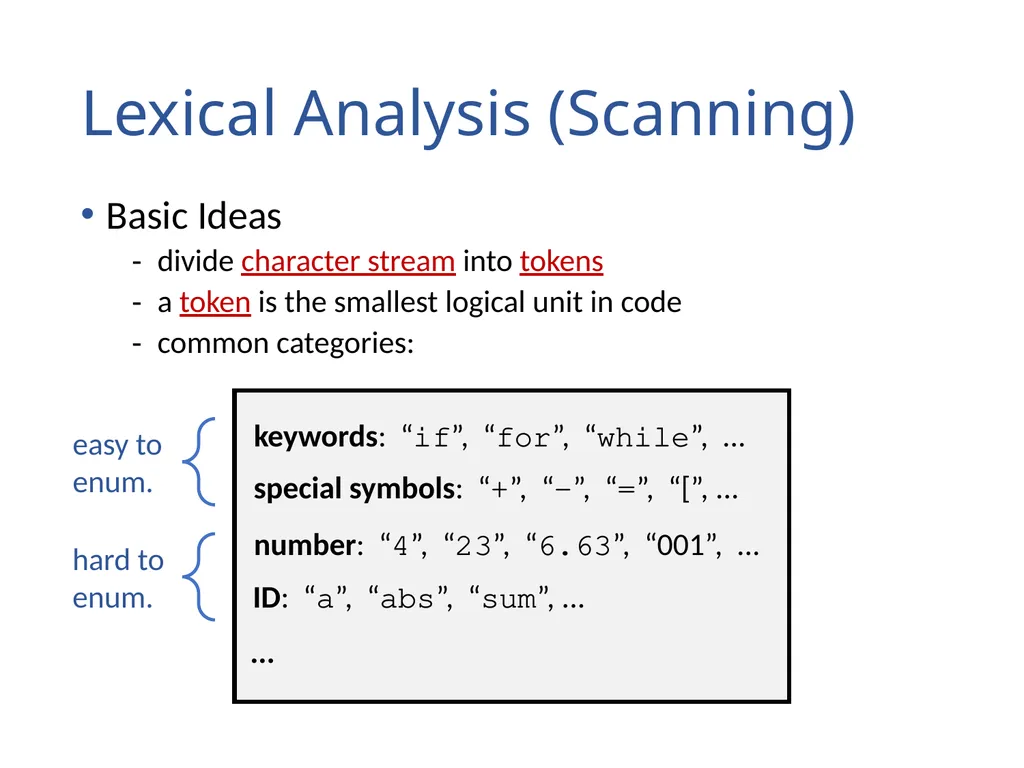
Lexical Analysis (Scanning) Basic Ideas
divide character stream into tokens
a token is the smallest logical unit in code
common categories: easy to
enum. hard to
enum.<br>
divide character stream into tokens
a token is the smallest logical unit in code
common categories: easy to
enum. hard to
enum.<br>
03
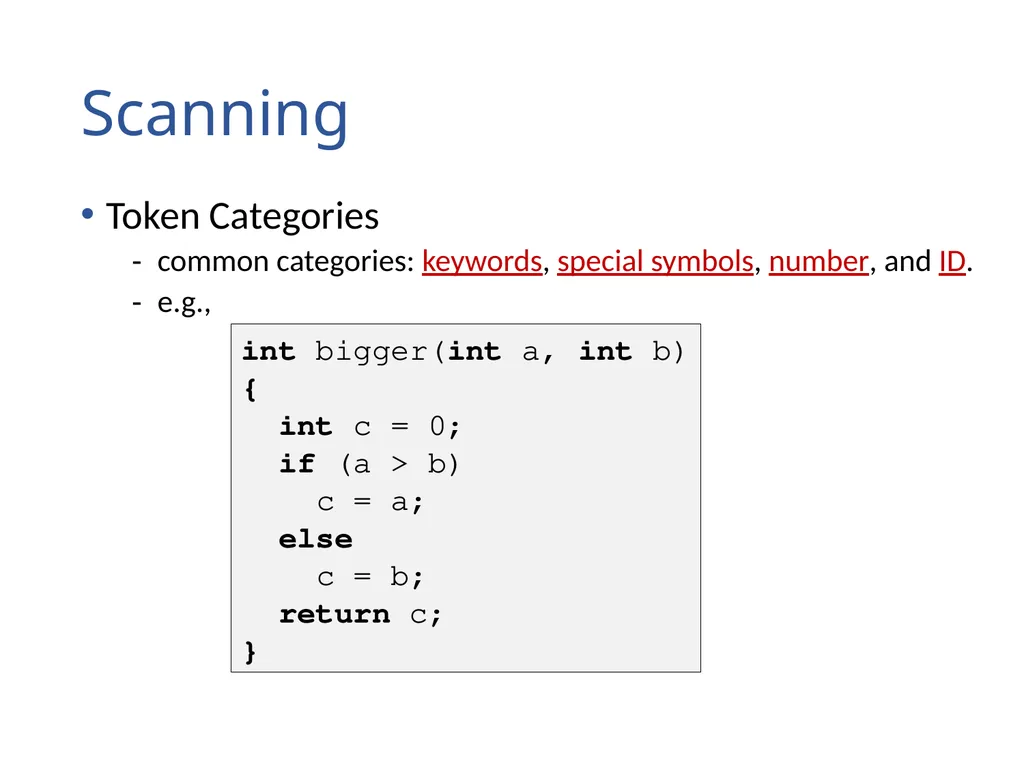
Scanning Token Categories
common categories: keywords, special symbols, number, and ID.
e.g., int bigger(int a, int b)
{
int c = 0;
if (a > b)
c = a;
else
c = b;
return c;
}<br>
common categories: keywords, special symbols, number, and ID.
e.g., int bigger(int a, int b)
{
int c = 0;
if (a > b)
c = a;
else
c = b;
return c;
}<br>
04
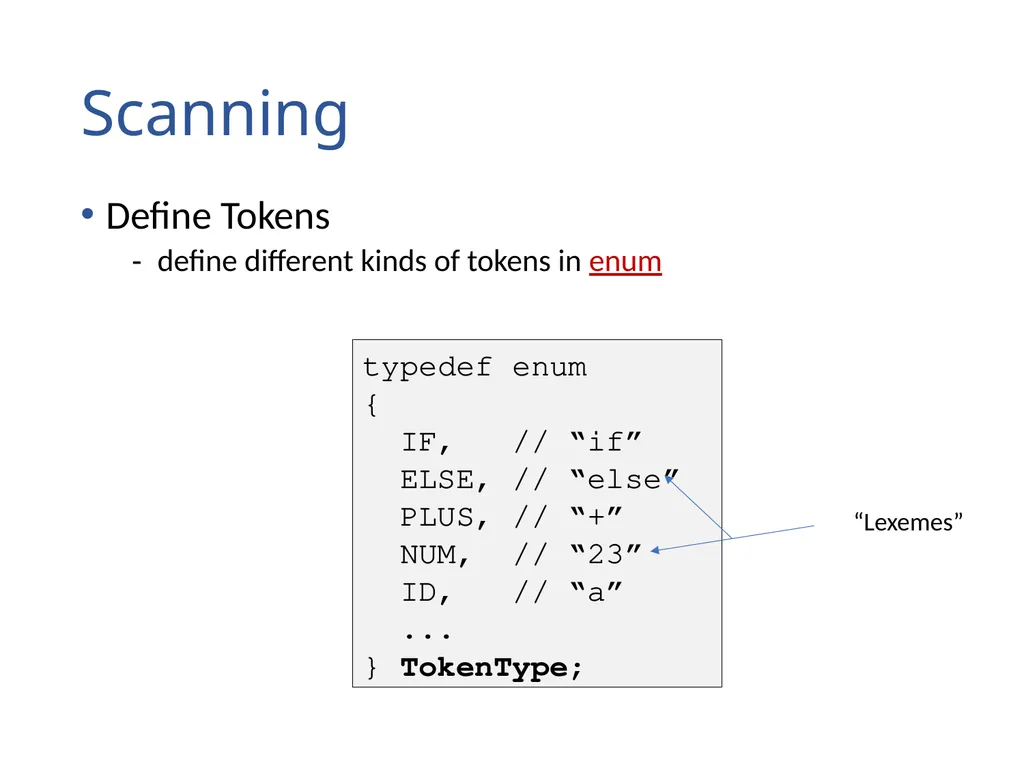
Scanning Define Tokens
define different kinds of tokens in enum typedef enum
{
IF, // “if”
ELSE, // “else”
PLUS, // “+”
NUM, // “23”
ID, // “a”
...
} TokenType; “Lexemes”<br>
define different kinds of tokens in enum typedef enum
{
IF, // “if”
ELSE, // “else”
PLUS, // “+”
NUM, // “23”
ID, // “a”
...
} TokenType; “Lexemes”<br>
05
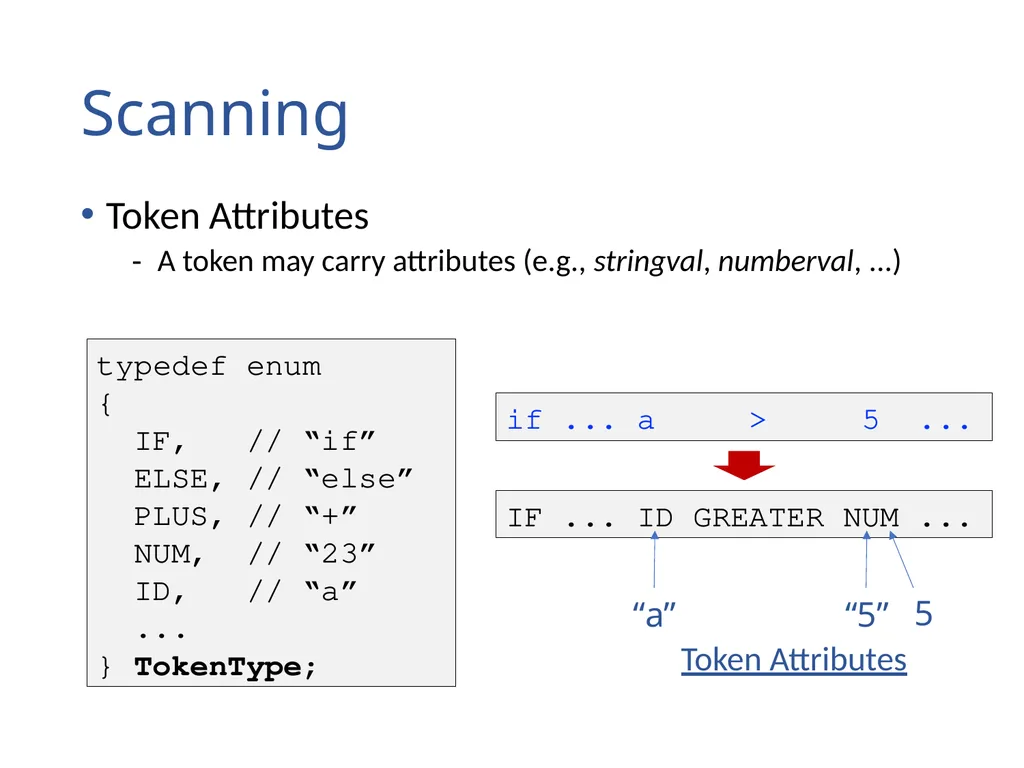
Scanning Token Attributes
A token may carry attributes (e.g., stringval, numberval, ...) typedef enum
{
IF, // “if”
ELSE, // “else”
PLUS, // “+”
NUM, // “23”
ID, // “a”
...
} TokenType; IF ... ID GREATER NUM ... if ... a > 5 ... “a” “5” Token Attributes 5<br>
A token may carry attributes (e.g., stringval, numberval, ...) typedef enum
{
IF, // “if”
ELSE, // “else”
PLUS, // “+”
NUM, // “23”
ID, // “a”
...
} TokenType; IF ... ID GREATER NUM ... if ... a > 5 ... “a” “5” Token Attributes 5<br>
06
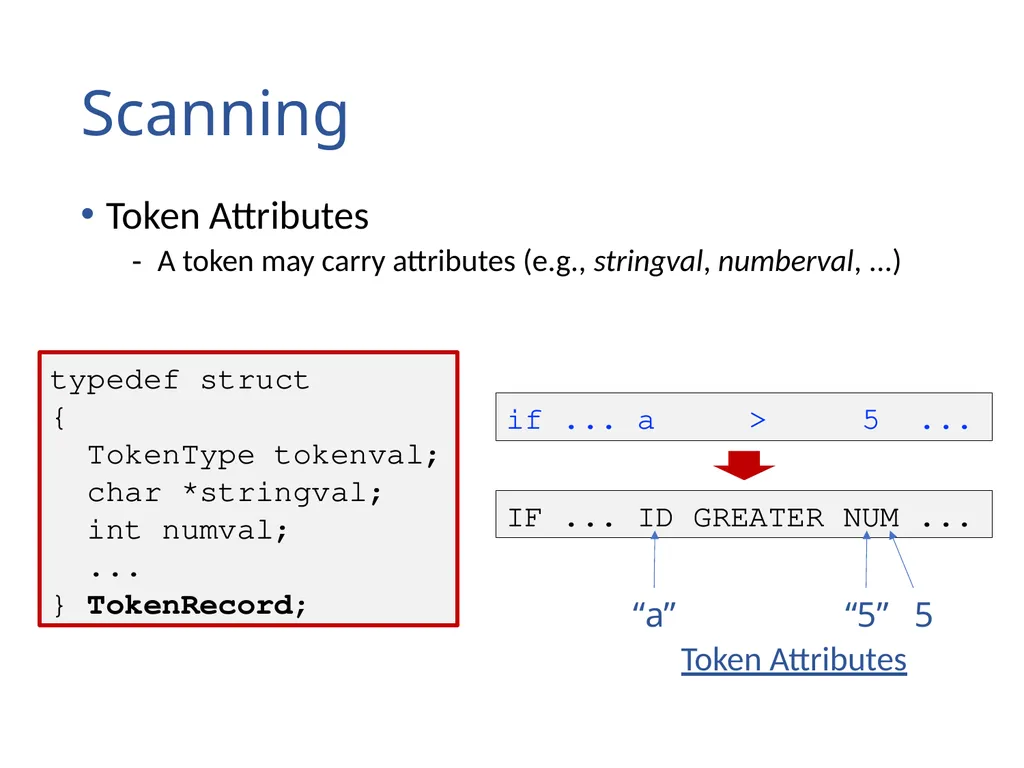
Scanning Token Attributes
A token may carry attributes (e.g., stringval, numberval, ...) typedef struct
{
TokenType tokenval;
char *stringval;
int numval;
...
} TokenRecord; IF ... ID GREATER NUM ... if ... a > 5 ... “a” “5” Token Attributes 5<br>
A token may carry attributes (e.g., stringval, numberval, ...) typedef struct
{
TokenType tokenval;
char *stringval;
int numval;
...
} TokenRecord; IF ... ID GREATER NUM ... if ... a > 5 ... “a” “5” Token Attributes 5<br>
07
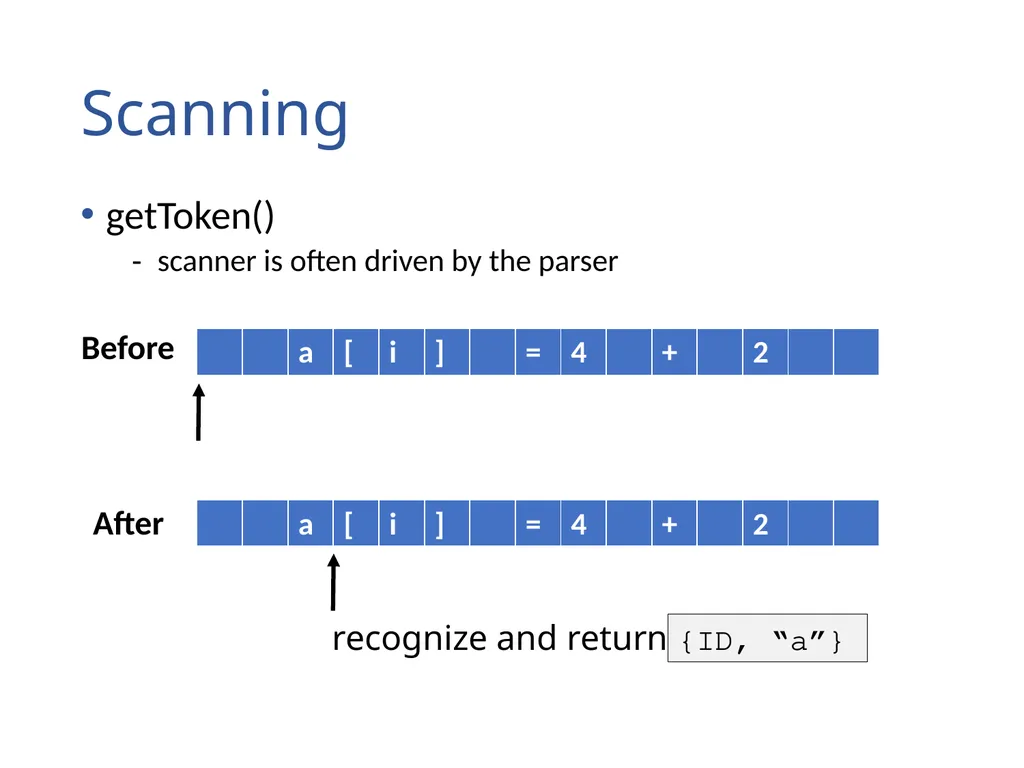
Scanning getToken()
scanner is often driven by the parser Before recognize and return {ID, “a”} After<br>
scanner is often driven by the parser Before recognize and return {ID, “a”} After<br>
08
Regular Expressions<br>
09
Regular Expressions Basics
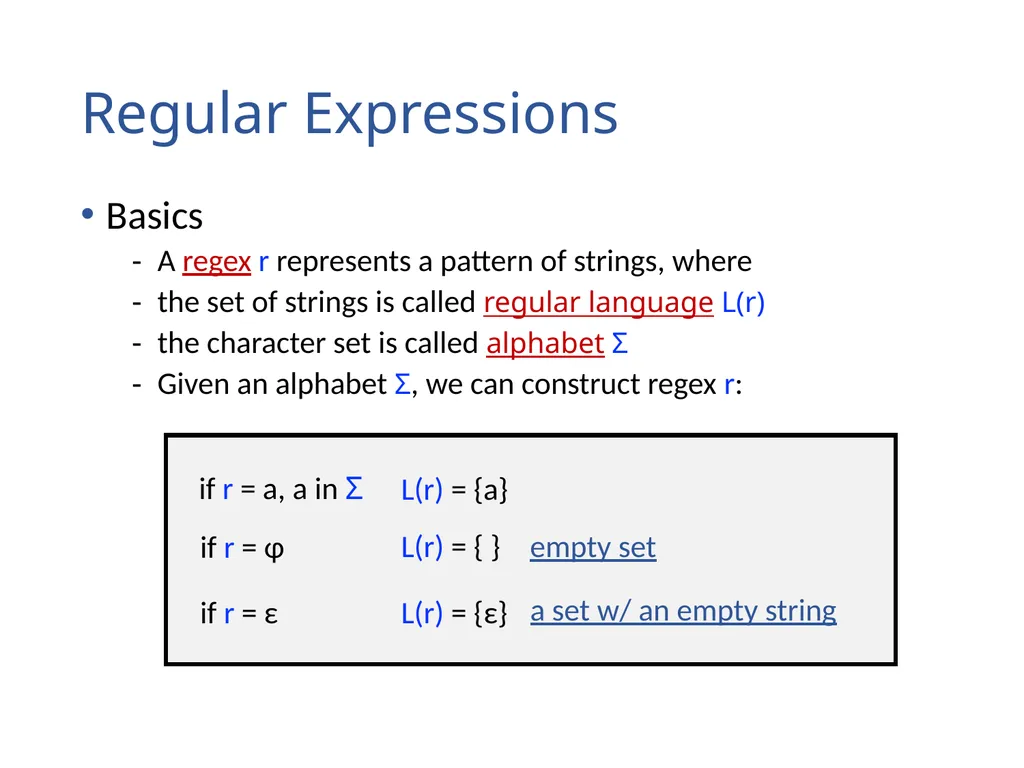
A regex r represents a pattern of strings, where
the set of strings is called regular language L(r)
the character set is called alphabet Σ
Given an alphabet Σ, we can construct regex r: L(r) = {ε} L(r) = {a} if r = ε if r = a, a in Σ if r = ɸ L(r) = { } empty set a set w/ an empty string<br>
A regex r represents a pattern of strings, where
the set of strings is called regular language L(r)
the character set is called alphabet Σ
Given an alphabet Σ, we can construct regex r: L(r) = {ε} L(r) = {a} if r = ε if r = a, a in Σ if r = ɸ L(r) = { } empty set a set w/ an empty string<br>
10
Regular Expressions Operations
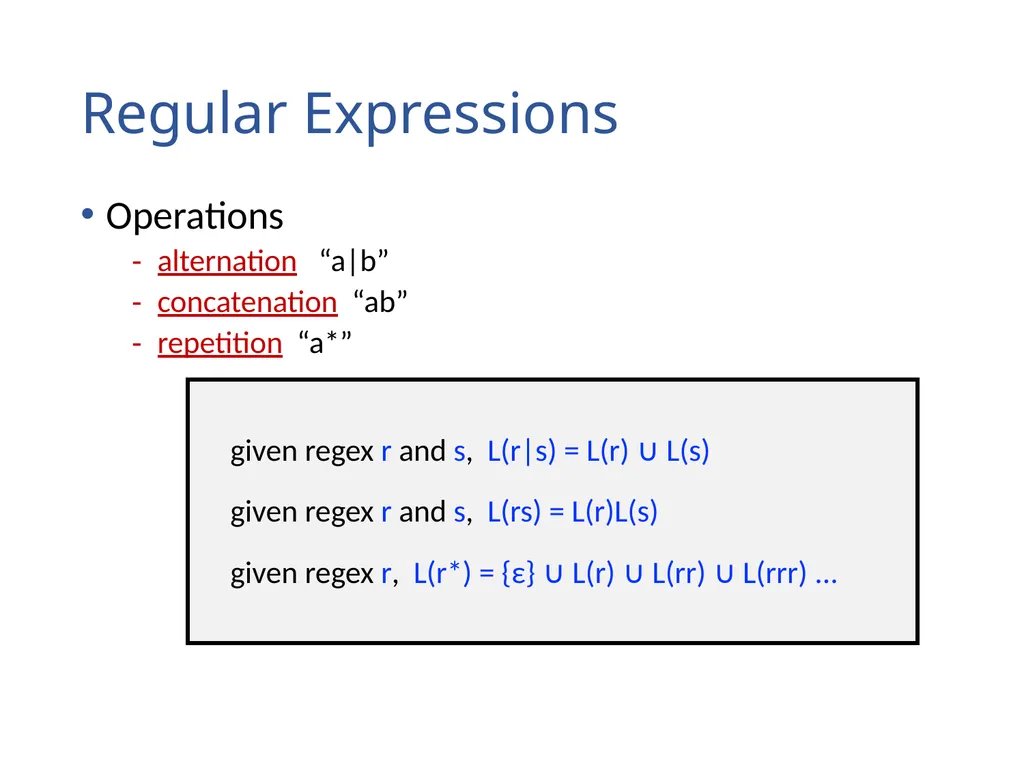
alternation “a|b”
concatenation “ab”
repetition “a*” given regex r and s, L(r|s) = L(r) ∪ L(s) given regex r and s, L(rs) = L(r)L(s) given regex r, L(r*) = {ε} ∪ L(r) ∪ L(rr) ∪ L(rrr) ...<br>
alternation “a|b”
concatenation “ab”
repetition “a*” given regex r and s, L(r|s) = L(r) ∪ L(s) given regex r and s, L(rs) = L(r)L(s) given regex r, L(r*) = {ε} ∪ L(r) ∪ L(rr) ∪ L(rrr) ...<br>
11
Regular Expressions Examples
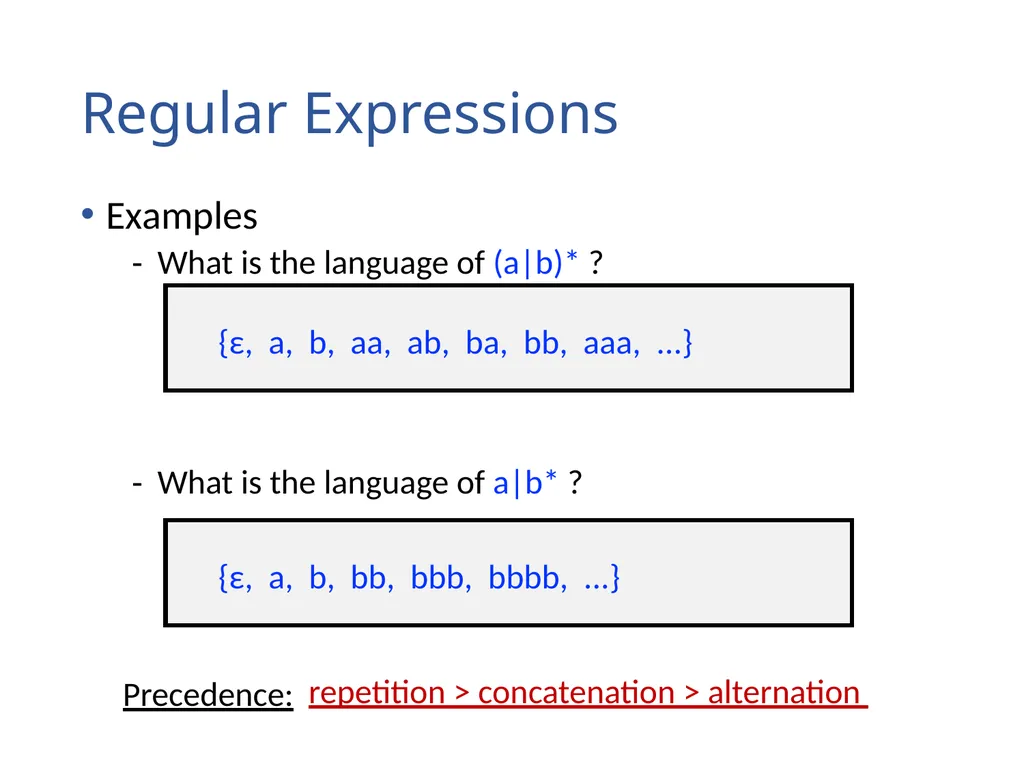
What is the language of (a|b)* ?
What is the language of a|b* ? {ε, a, b, aa, ab, ba, bb, aaa, ...} {ε, a, b, bb, bbb, bbbb, ...} repetition > concatenation > alternation Precedence:<br>
What is the language of (a|b)* ?
What is the language of a|b* ? {ε, a, b, aa, ab, ba, bb, aaa, ...} {ε, a, b, bb, bbb, bbbb, ...} repetition > concatenation > alternation Precedence:<br>
12
Regular Expressions Names
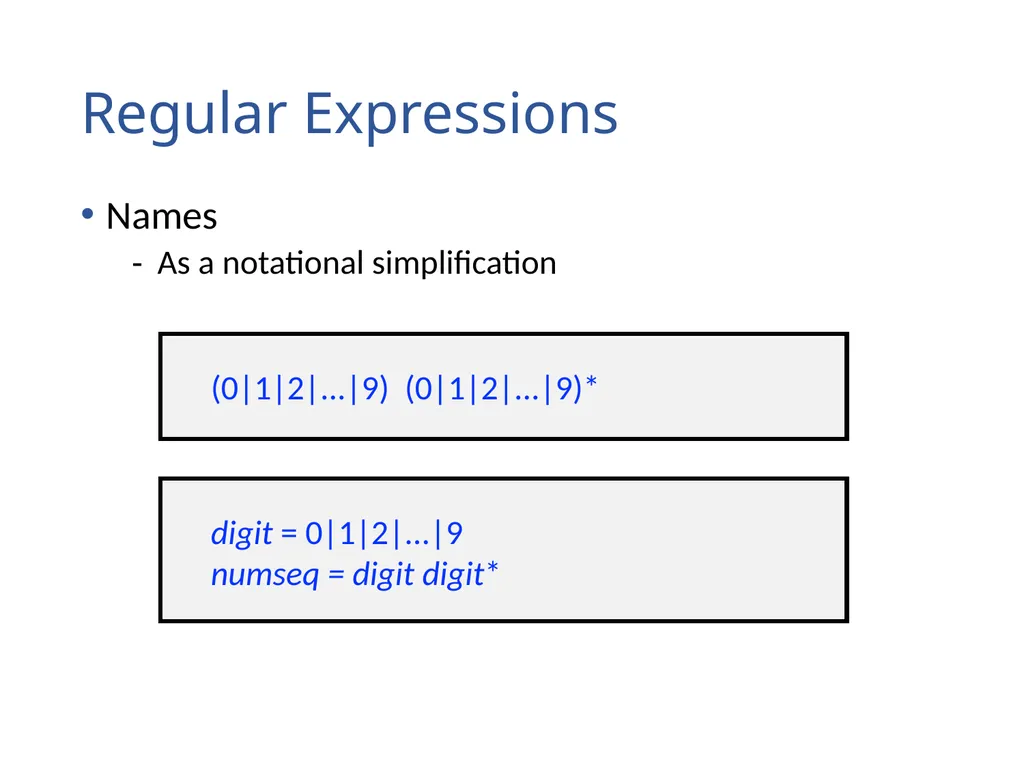
As a notational simplification (0|1|2|...|9) (0|1|2|...|9)* digit = 0|1|2|...|9
numseq = digit digit*<br>
As a notational simplification (0|1|2|...|9) (0|1|2|...|9)* digit = 0|1|2|...|9
numseq = digit digit*<br>
13
Regular Expressions Extended Regex
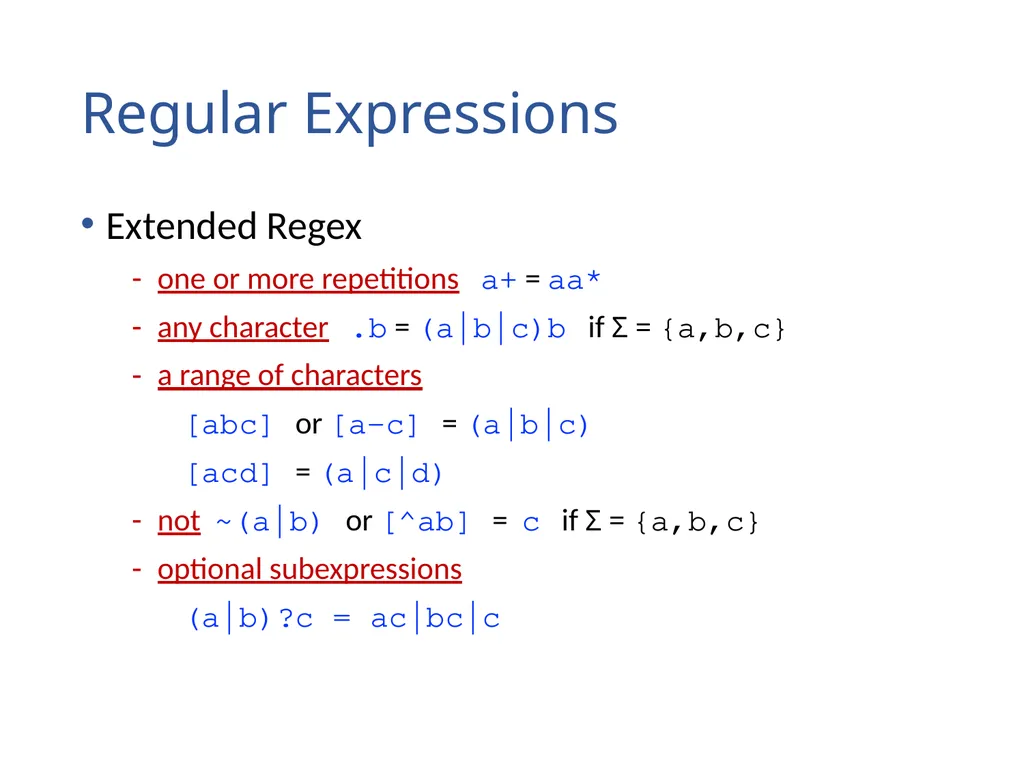
one or more repetitions a+ = aa*
any character .b = (a|b|c)b if Σ = {a,b,c}
a range of characters
[abc] or [a-c] = (a|b|c)
[acd] = (a|c|d)
not ~(a|b) or [^ab] = c if Σ = {a,b,c}
optional subexpressions
(a|b)?c = ac|bc|c<br>
one or more repetitions a+ = aa*
any character .b = (a|b|c)b if Σ = {a,b,c}
a range of characters
[abc] or [a-c] = (a|b|c)
[acd] = (a|c|d)
not ~(a|b) or [^ab] = c if Σ = {a,b,c}
optional subexpressions
(a|b)?c = ac|bc|c<br>
14
Regular Expressions Exercise
What is the regex for US zip code?
What is the regex for any int between 2 and 36? { 92521-4120, 92508, …} digit = [0-9]
zip = digit{5}-digit{4} digit = [0-9]
zip = [2-9] | [12]digit | 3[0-6]<br>
What is the regex for US zip code?
What is the regex for any int between 2 and 36? { 92521-4120, 92508, …} digit = [0-9]
zip = digit{5}-digit{4} digit = [0-9]
zip = [2-9] | [12]digit | 3[0-6]<br>
15
Regular Expression Example
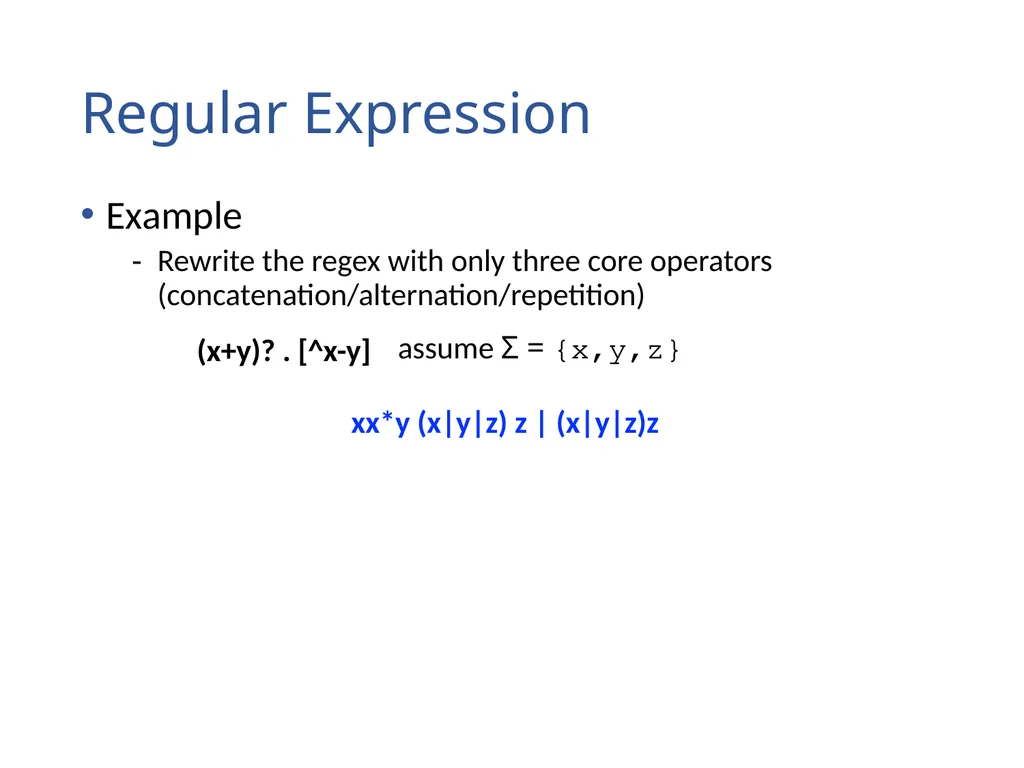
Rewrite the regex with only three core operators (concatenation/alternation/repetition) (x+y)? . [^x-y] assume Σ = {x,y,z} xx*y (x|y|z) z | (x|y|z)z<br>
Rewrite the regex with only three core operators (concatenation/alternation/repetition) (x+y)? . [^x-y] assume Σ = {x,y,z} xx*y (x|y|z) z | (x|y|z)z<br>
16
Regular Expression Exercise
Rewrite the regex with only three core operators (concatenation/alternation/repetition)
Write the regex for strings in C programs (assume escape character \ is not allowed) (x+y)? . [^x-y] assume Σ = {x,y,z} E.g. x = “hello, world!”; “[^”\\]” xx*y (x|y|z) z | (x|y|z)z<br>
Rewrite the regex with only three core operators (concatenation/alternation/repetition)
Write the regex for strings in C programs (assume escape character \ is not allowed) (x+y)? . [^x-y] assume Σ = {x,y,z} E.g. x = “hello, world!”; “[^”\\]” xx*y (x|y|z) z | (x|y|z)z<br>
17
Token Specification<br>
18
Token Specification Specify tokens with regex
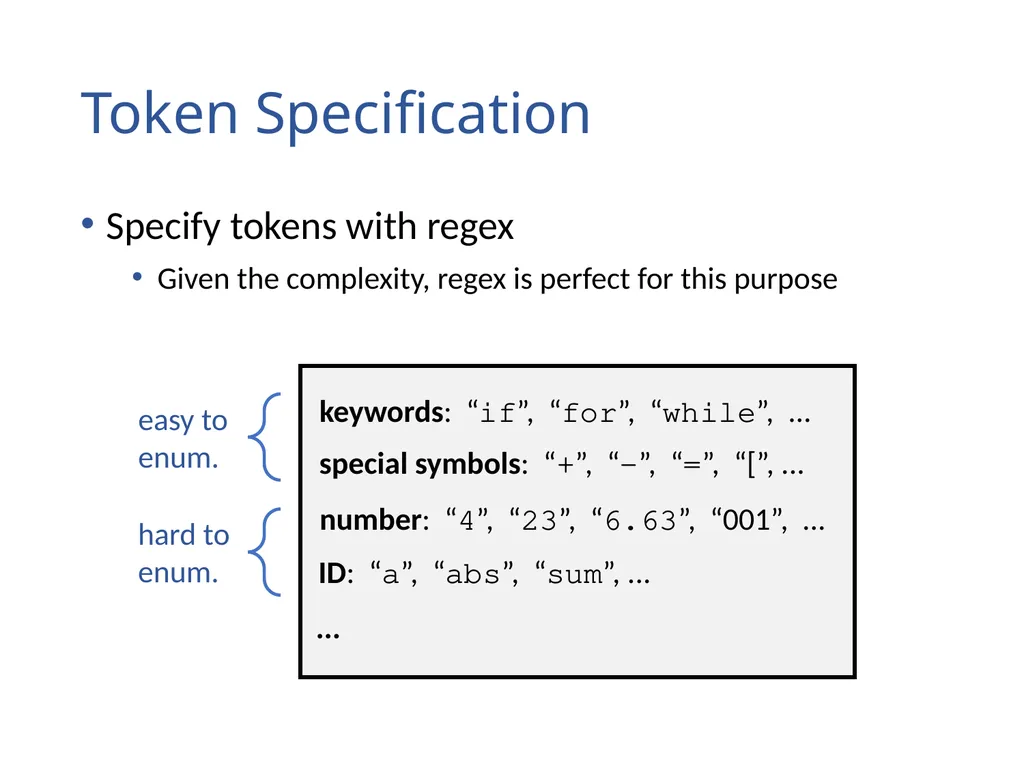
Given the complexity, regex is perfect for this purpose ID: “a”, “abs”, “sum”, ... keywords: “if”, “for”, “while”, ... special symbols: “+”, “-”, “=”, “[”, ... number: “4”, “23”, “6.63”, “001”, ... ... easy to
enum. hard to
enum.<br>
Given the complexity, regex is perfect for this purpose ID: “a”, “abs”, “sum”, ... keywords: “if”, “for”, “while”, ... special symbols: “+”, “-”, “=”, “[”, ... number: “4”, “23”, “6.63”, “001”, ... ... easy to
enum. hard to
enum.<br>
19
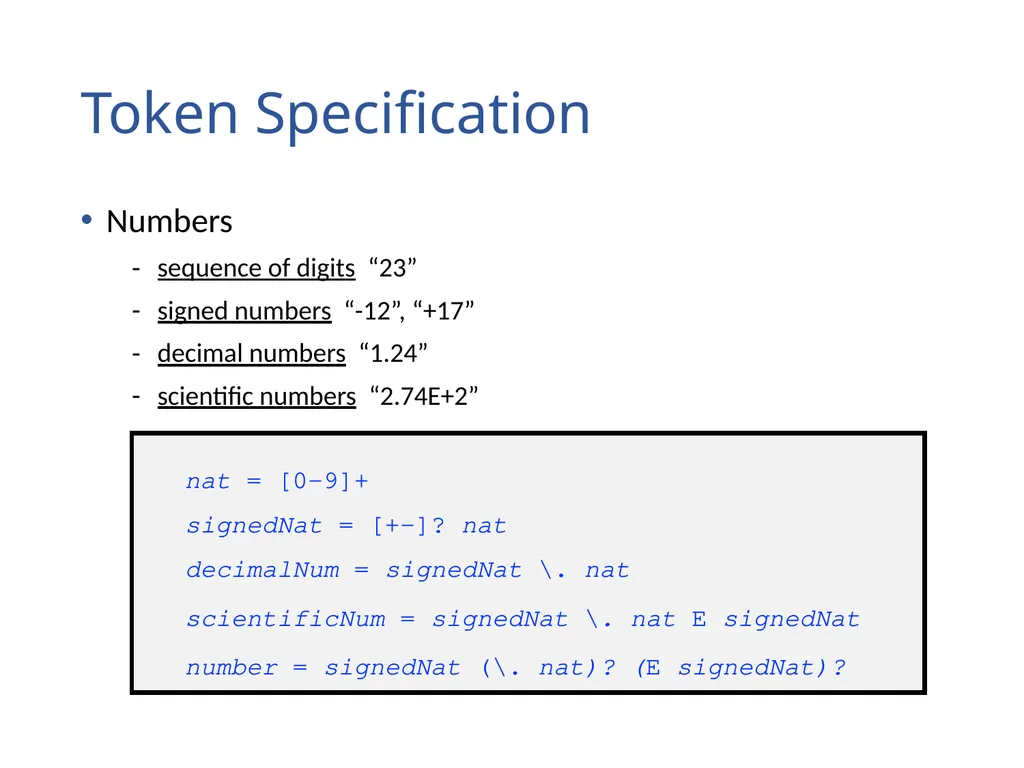
Token Specification Numbers
sequence of digits “23”
signed numbers “-12”, “+17”
decimal numbers “1.24”
scientific numbers “2.74E+2” nat = [0-9]+ signedNat = [+-]? nat decimalNum = signedNat \. nat scientificNum = signedNat \. nat E signedNat number = signedNat (\. nat)? (E signedNat)?<br>
sequence of digits “23”
signed numbers “-12”, “+17”
decimal numbers “1.24”
scientific numbers “2.74E+2” nat = [0-9]+ signedNat = [+-]? nat decimalNum = signedNat \. nat scientificNum = signedNat \. nat E signedNat number = signedNat (\. nat)? (E signedNat)?<br>
20
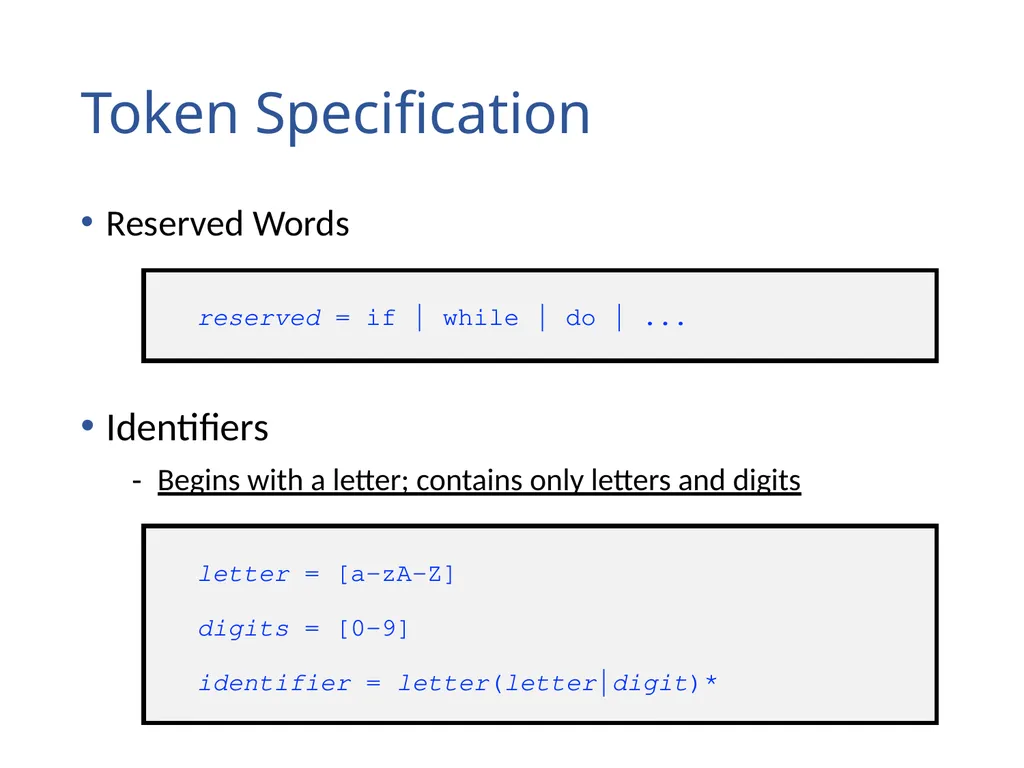
Token Specification Reserved Words reserved = if | while | do | ... Identifiers
Begins with a letter; contains only letters and digits letter = [a-zA-Z] digits = [0-9] identifier = letter(letter|digit)*<br>
Begins with a letter; contains only letters and digits letter = [a-zA-Z] digits = [0-9] identifier = letter(letter|digit)*<br>
21
Example -- Identifier Valid Identifiers
Composed of letters, digits, and underscores
Cannot end in an underscore
Cannot contain two underscores in a row
A1BC_3A_B5<br>
Composed of letters, digits, and underscores
Cannot end in an underscore
Cannot contain two underscores in a row
A1BC_3A_B5<br>
22
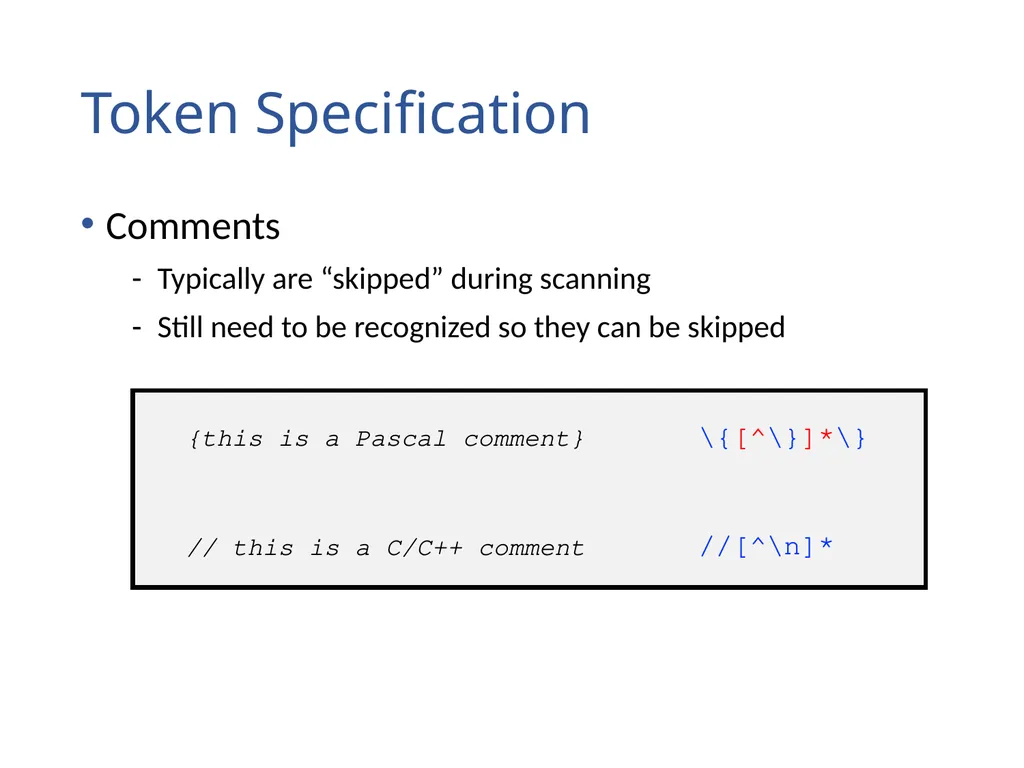
Token Specification {this is a Pascal comment} // this is a C/C++ comment Comments
Typically are “skipped” during scanning
Still need to be recognized so they can be skipped \{[^\}]*\} //[^\n]*<br>
Typically are “skipped” during scanning
Still need to be recognized so they can be skipped \{[^\}]*\} //[^\n]*<br>
23
Comment /* ………. */ / * [^ *]* ( *+ [^ /] [^ *]* )* *+ / /* this is the end **** not yet **** not yet *********/<br>
24
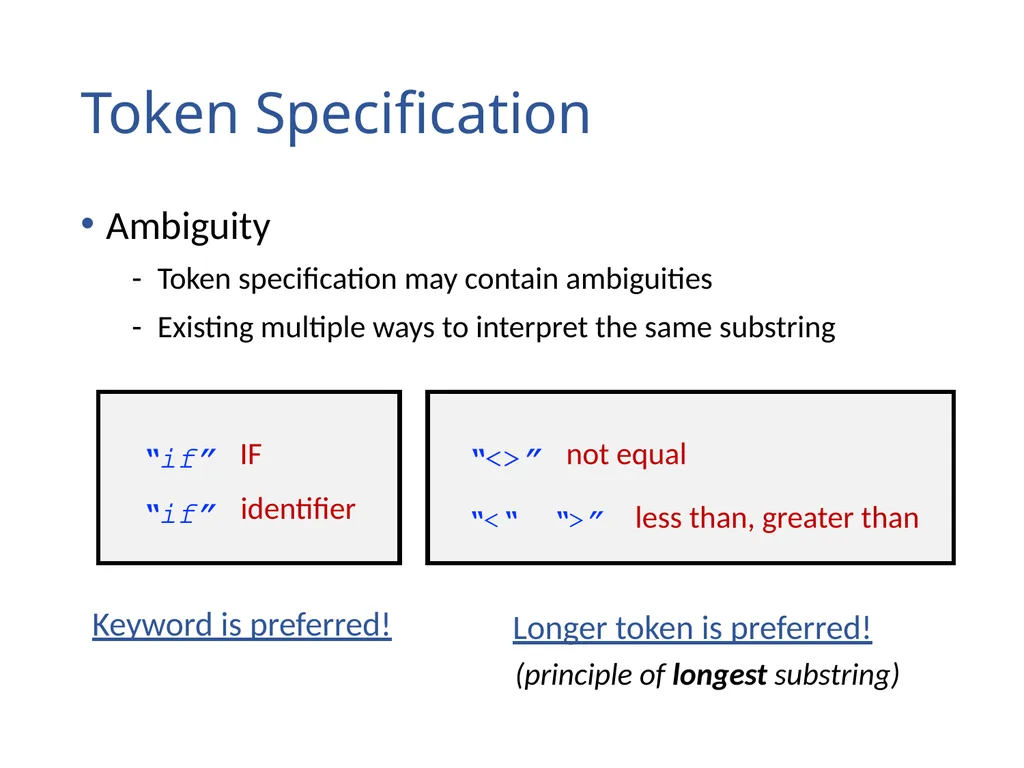
Token Specification “<>” Ambiguity
Token specification may contain ambiguities
Existing multiple ways to interpret the same substring “<“ “>” not equal less than, greater than “if” IF “if” identifier Keyword is preferred! (principle of longest substring) Longer token is preferred!<br>
Token specification may contain ambiguities
Existing multiple ways to interpret the same substring “<“ “>” not equal less than, greater than “if” IF “if” identifier Keyword is preferred! (principle of longest substring) Longer token is preferred!<br>
25
Token Specification “=” Token Delimiters
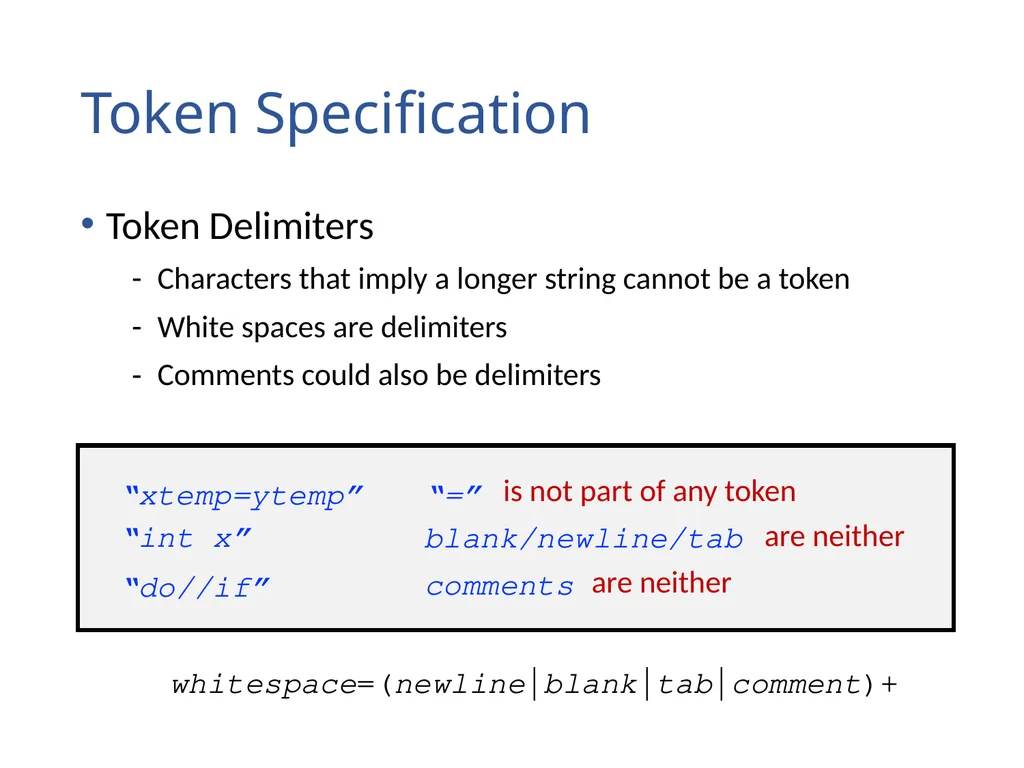
Characters that imply a longer string cannot be a token
White spaces are delimiters
Comments could also be delimiters is not part of any token are neither “xtemp=ytemp” “int x” blank/newline/tab “do//if” are neither comments whitespace=(newline|blank|tab|comment)+<br>
Characters that imply a longer string cannot be a token
White spaces are delimiters
Comments could also be delimiters is not part of any token are neither “xtemp=ytemp” “int x” blank/newline/tab “do//if” are neither comments whitespace=(newline|blank|tab|comment)+<br>
26
Token Specification Token Delimiters
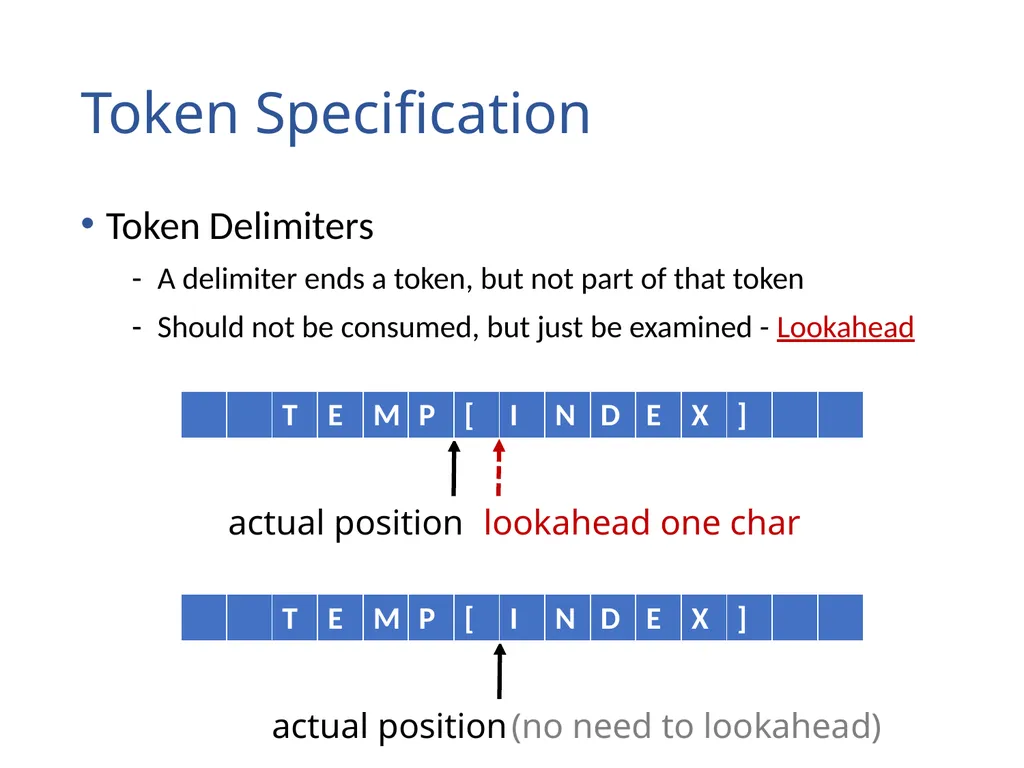
A delimiter ends a token, but not part of that token
Should not be consumed, but just be examined - Lookahead actual position lookahead one char actual position (no need to lookahead)<br>
A delimiter ends a token, but not part of that token
Should not be consumed, but just be examined - Lookahead actual position lookahead one char actual position (no need to lookahead)<br>
27
Finite Automata<br>
28
Finite Automata Equivalence
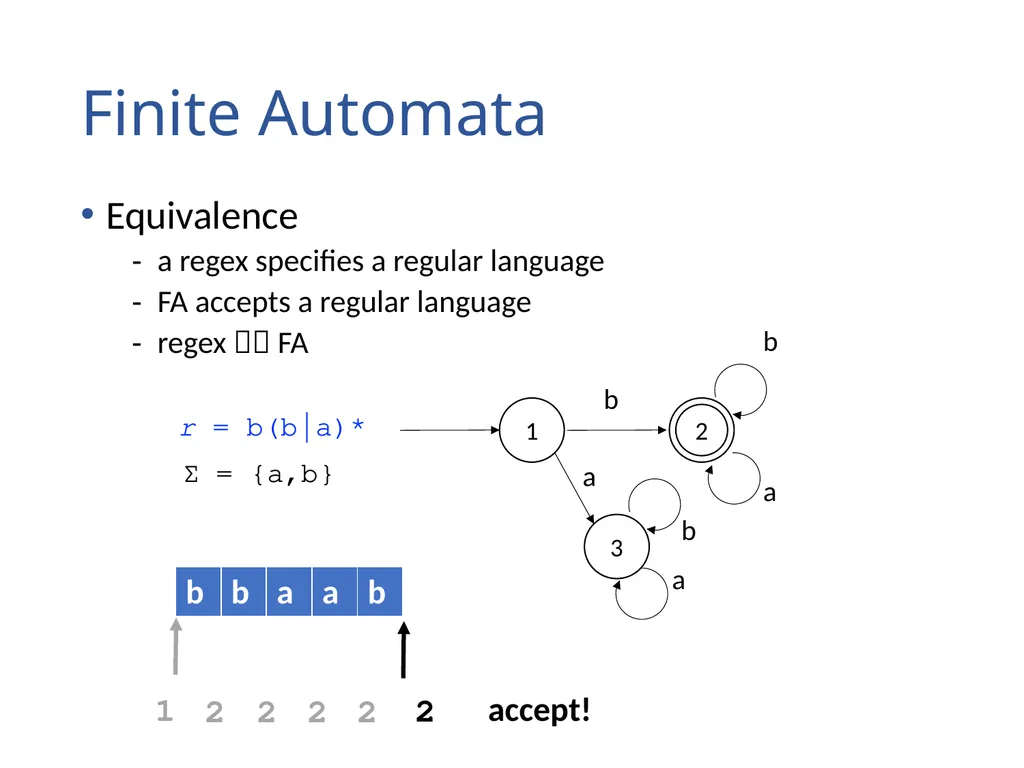
a regex specifies a regular language
FA accepts a regular language
regex FA r = b(b|a)* 1 2 2 2 2 2 accept! Σ = {a,b}<br>
a regex specifies a regular language
FA accepts a regular language
regex FA r = b(b|a)* 1 2 2 2 2 2 accept! Σ = {a,b}<br>
29
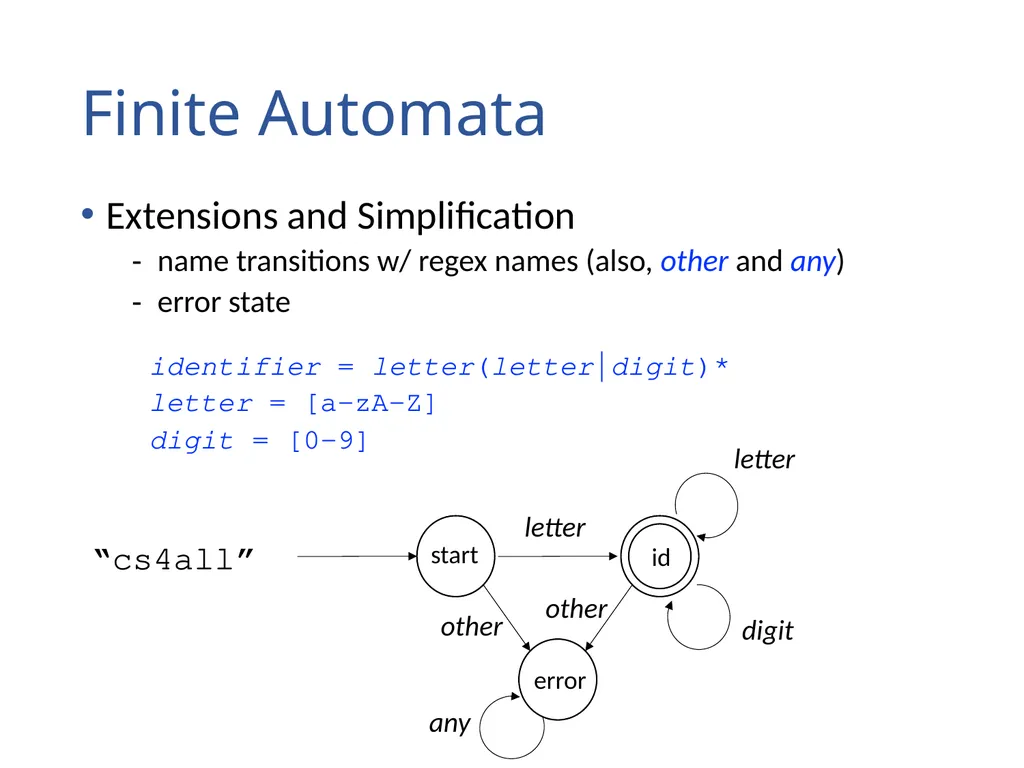
Finite Automata Extensions and Simplification
name transitions w/ regex names (also, other and any)
error state identifier = letter(letter|digit)* letter letter digit start id letter = [a-zA-Z]
digit = [0-9] error other other any “cs4all”<br>
name transitions w/ regex names (also, other and any)
error state identifier = letter(letter|digit)* letter letter digit start id letter = [a-zA-Z]
digit = [0-9] error other other any “cs4all”<br>
30
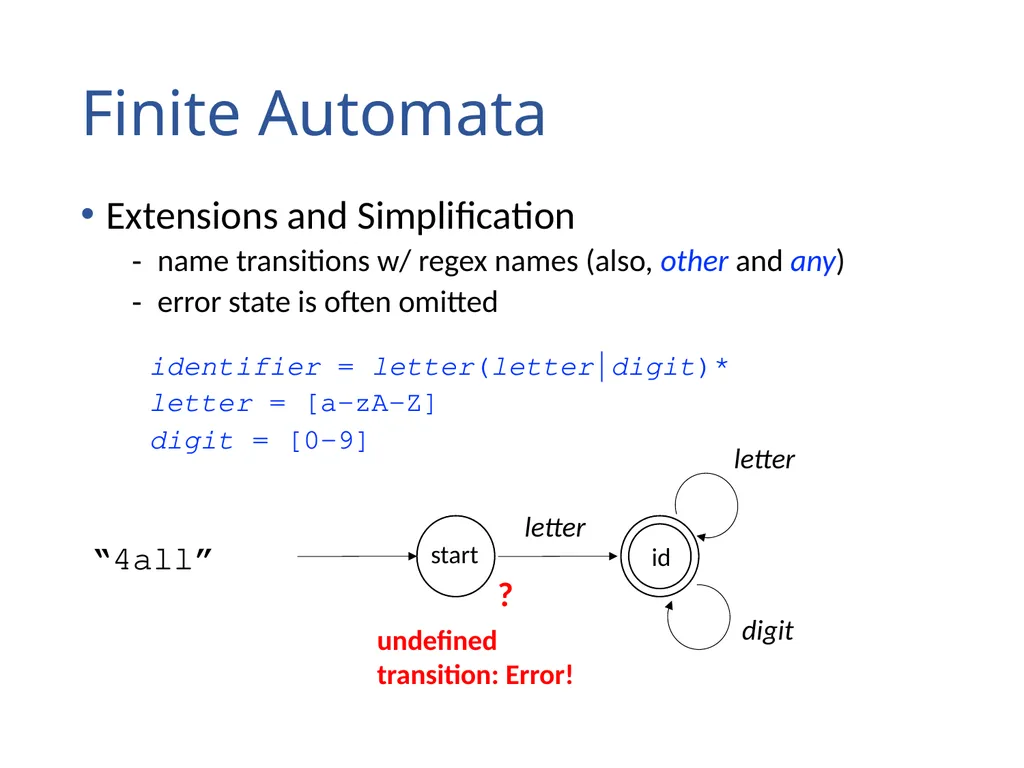
Finite Automata Extensions and Simplification
name transitions w/ regex names (also, other and any)
error state is often omitted letter letter digit start id identifier = letter(letter|digit)* letter = [a-zA-Z]
digit = [0-9] “4all” ? undefined
transition: Error!<br>
name transitions w/ regex names (also, other and any)
error state is often omitted letter letter digit start id identifier = letter(letter|digit)* letter = [a-zA-Z]
digit = [0-9] “4all” ? undefined
transition: Error!<br>
31
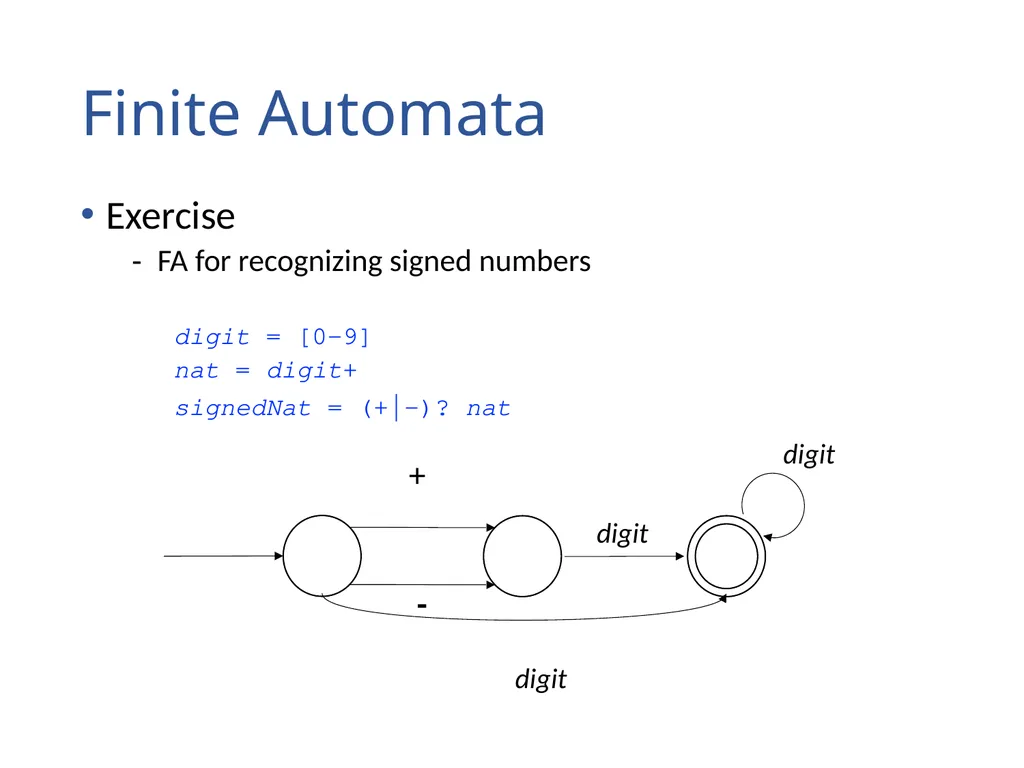
Finite Automata Exercise
FA for recognizing signed numbers signedNat = (+|-)? nat digit = [0-9]
nat = digit+<br>
FA for recognizing signed numbers signedNat = (+|-)? nat digit = [0-9]
nat = digit+<br>
32
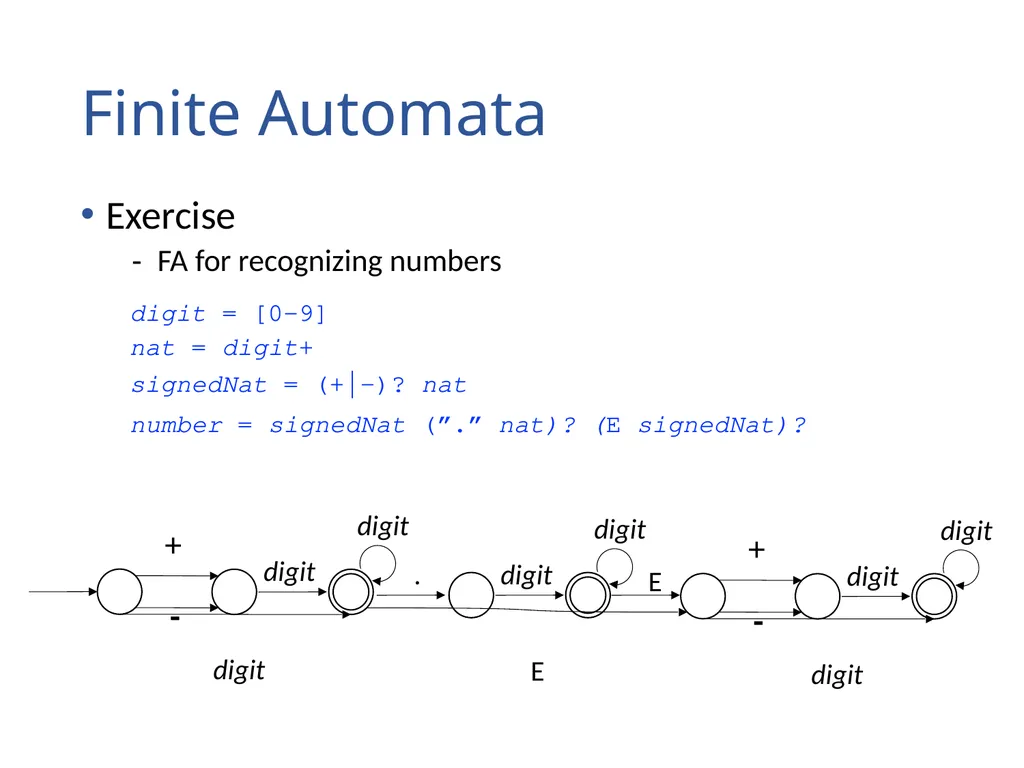
Finite Automata Exercise
FA for recognizing numbers number = signedNat (”.” nat)? (E signedNat)? signedNat = (+|-)? nat digit = [0-9]
nat = digit+ + - digit digit digit digit digit . + - digit digit digit E E<br>
FA for recognizing numbers number = signedNat (”.” nat)? (E signedNat)? signedNat = (+|-)? nat digit = [0-9]
nat = digit+ + - digit digit digit digit digit . + - digit digit digit E E<br>
33
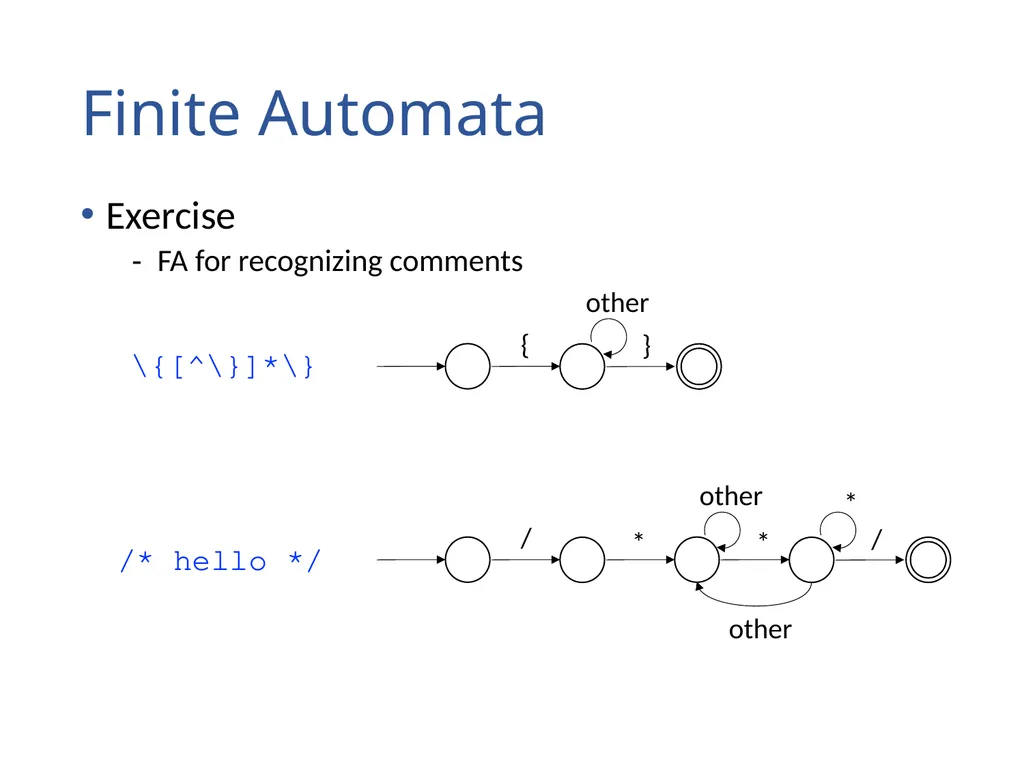
Finite Automata Exercise
FA for recognizing comments { \{[^\}]*\} } other /* hello */<br>
FA for recognizing comments { \{[^\}]*\} } other /* hello */<br>
34
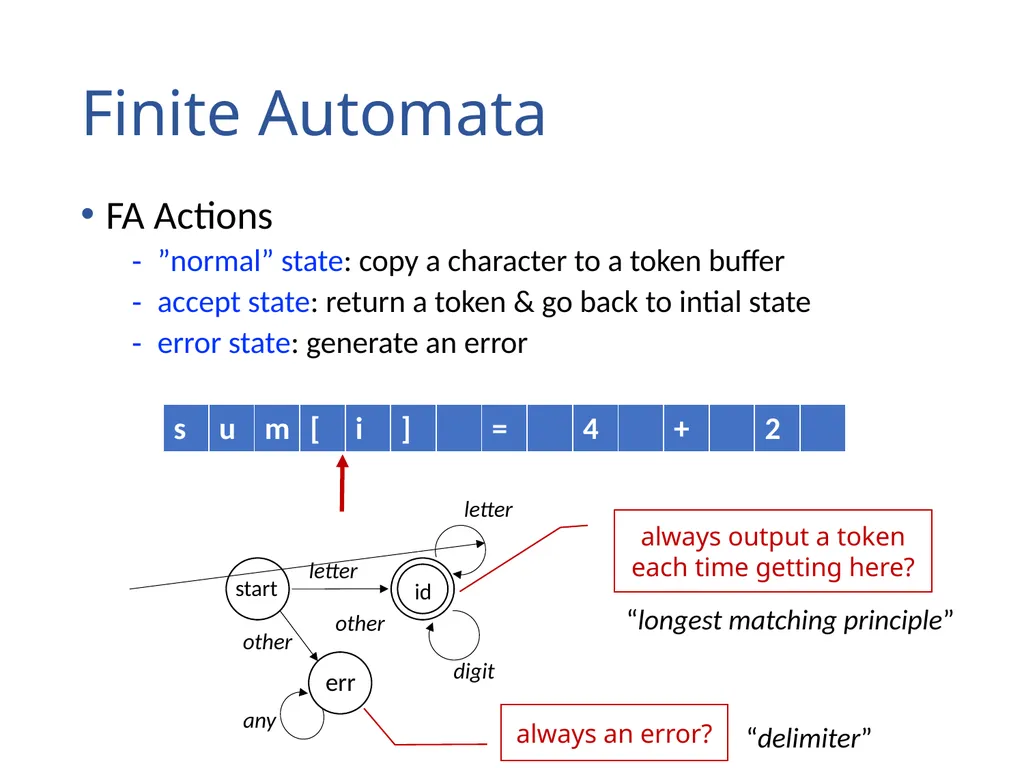
Finite Automata FA Actions
”normal” state: copy a character to a token buffer
accept state: return a token & go back to intial state
error state: generate an error letter letter digit start id err other other any always output a token each time getting here? always an error? “longest matching principle” “delimiter”<br>
”normal” state: copy a character to a token buffer
accept state: return a token & go back to intial state
error state: generate an error letter letter digit start id err other other any always output a token each time getting here? always an error? “longest matching principle” “delimiter”<br>
35
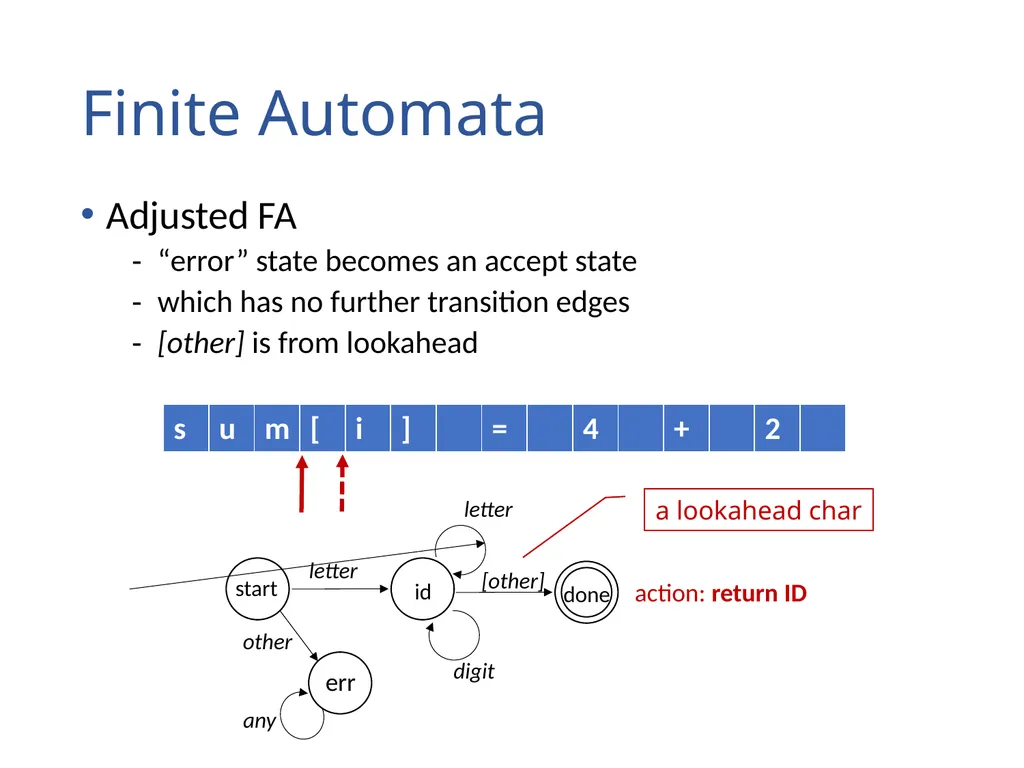
Finite Automata Adjusted FA
“error” state becomes an accept state
which has no further transition edges
[other] is from lookahead letter letter digit start id err other any [other] done action: return ID a lookahead char<br>
“error” state becomes an accept state
which has no further transition edges
[other] is from lookahead letter letter digit start id err other any [other] done action: return ID a lookahead char<br>
36
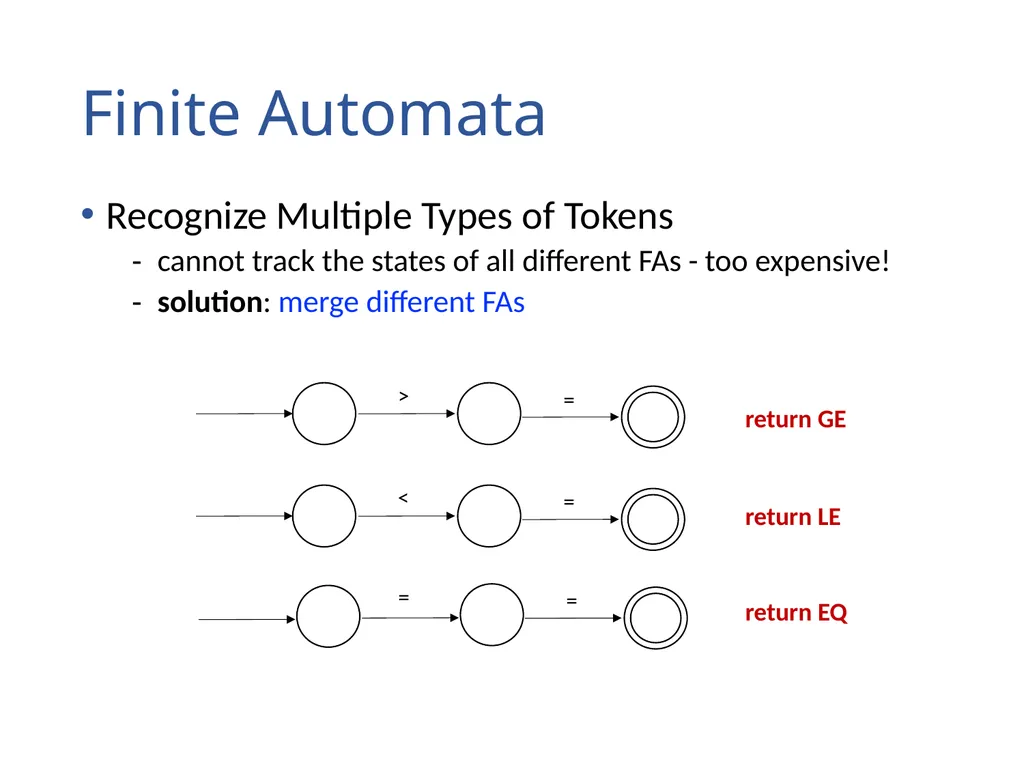
Finite Automata Recognize Multiple Types of Tokens
cannot track the states of all different FAs - too expensive!
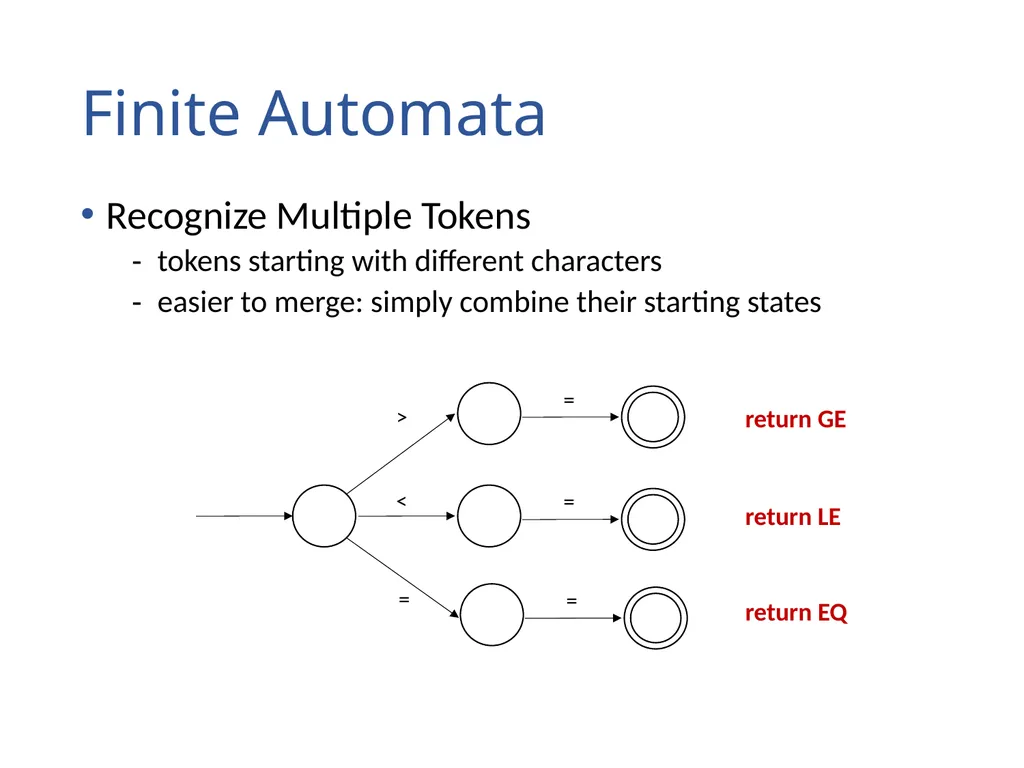
solution: merge different FAs > = < = = return GE return LE return EQ =<br>
cannot track the states of all different FAs - too expensive!
solution: merge different FAs > = < = = return GE return LE return EQ =<br>
37
Finite Automata Recognize Multiple Tokens
tokens starting with different characters
easier to merge: simply combine their starting states > = < = = return GE return LE return EQ =<br>
tokens starting with different characters
easier to merge: simply combine their starting states > = < = = return GE return LE return EQ =<br>
38
Finite Automata Recognize Multiple Tokens
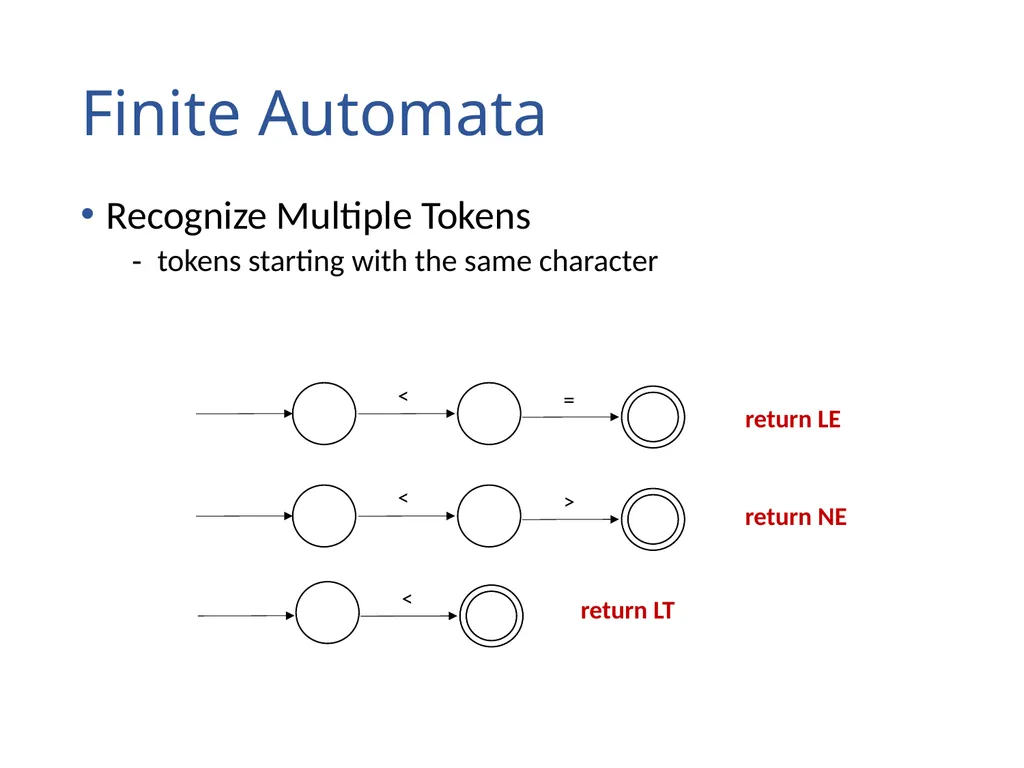
tokens starting with the same character < = < > < return LE return NE return LT<br>
tokens starting with the same character < = < > < return LE return NE return LT<br>
39
Finite Automata Recognize Multiple Tokens
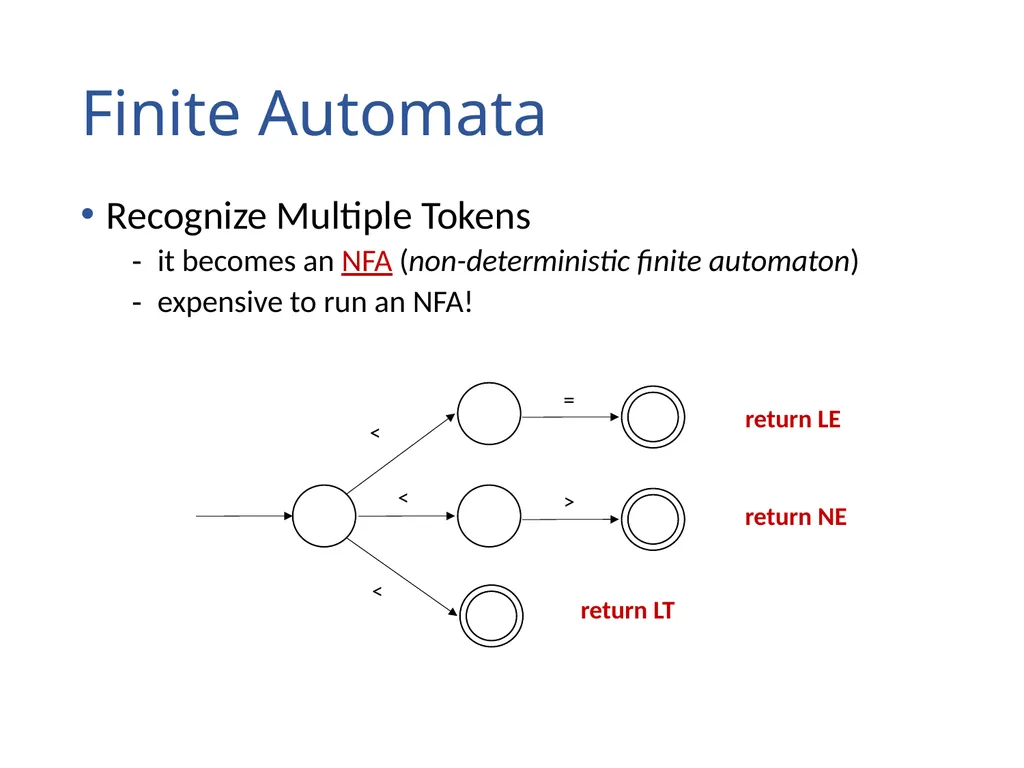
it becomes an NFA (non-deterministic finite automaton)
expensive to run an NFA! < = < > < return LE return NE return LT<br>
it becomes an NFA (non-deterministic finite automaton)
expensive to run an NFA! < = < > < return LE return NE return LT<br>
40
Finite Automata Recognize Multiple Tokens
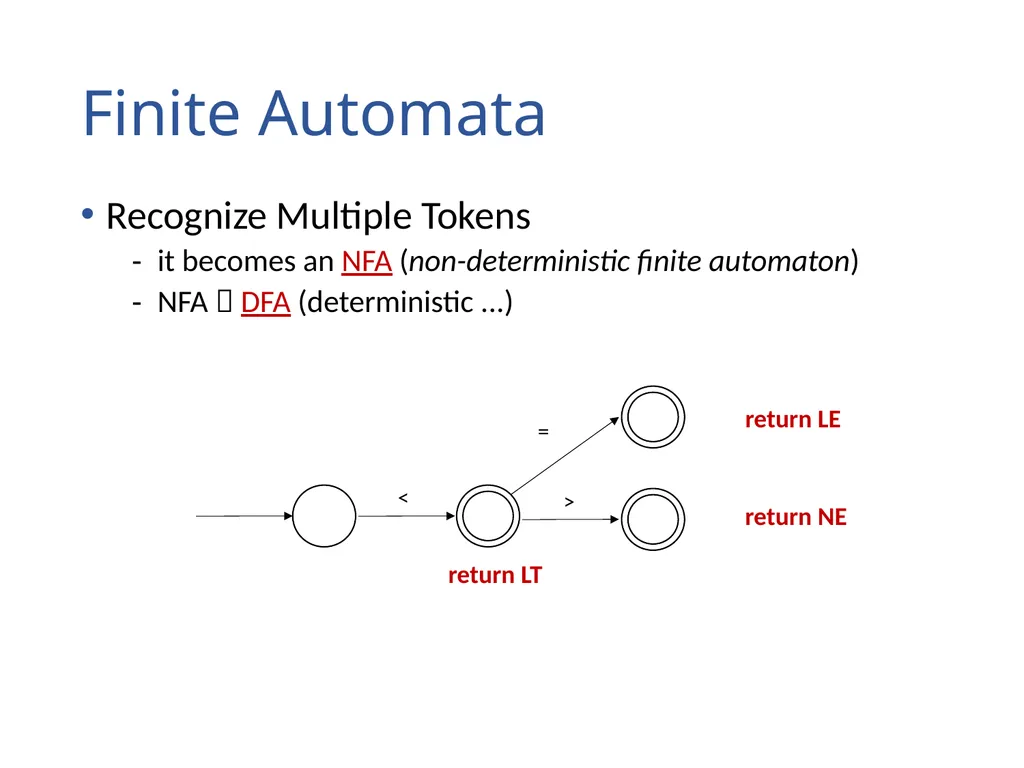
it becomes an NFA (non-deterministic finite automaton)
NFA DFA (deterministic ...) = < > return LE return NE return LT<br>
it becomes an NFA (non-deterministic finite automaton)
NFA DFA (deterministic ...) = < > return LE return NE return LT<br>
41
Finite Automata Recognize Multiple Tokens
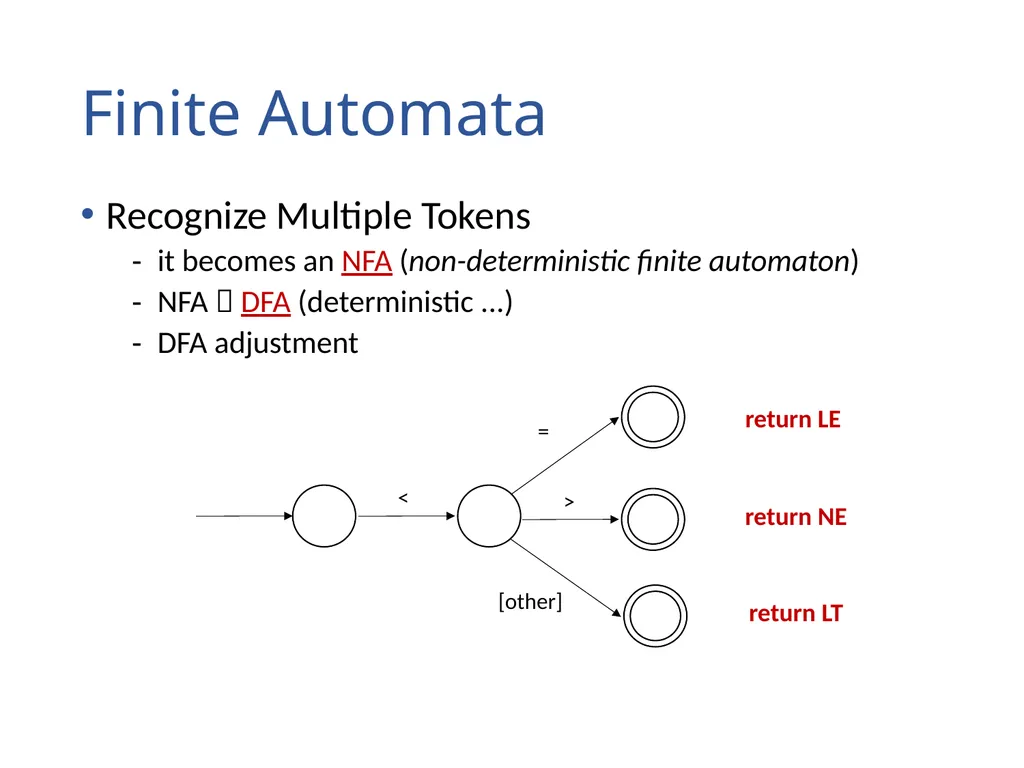
it becomes an NFA (non-deterministic finite automaton)
NFA DFA (deterministic ...)
DFA adjustment = < > [other] return LE return NE return LT<br>
it becomes an NFA (non-deterministic finite automaton)
NFA DFA (deterministic ...)
DFA adjustment = < > [other] return LE return NE return LT<br>
42
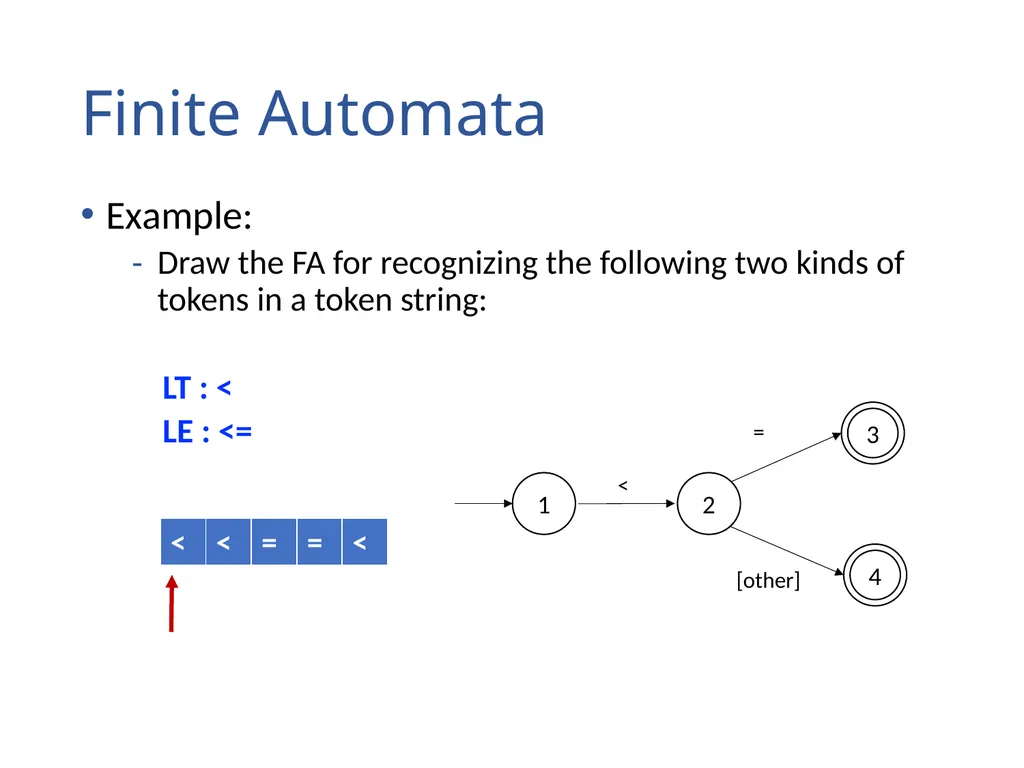
Finite Automata Example:
Draw the FA for recognizing the following two kinds of tokens in a token string:
LT : <
LE : <=<br>
Draw the FA for recognizing the following two kinds of tokens in a token string:
LT : <
LE : <=<br>
43
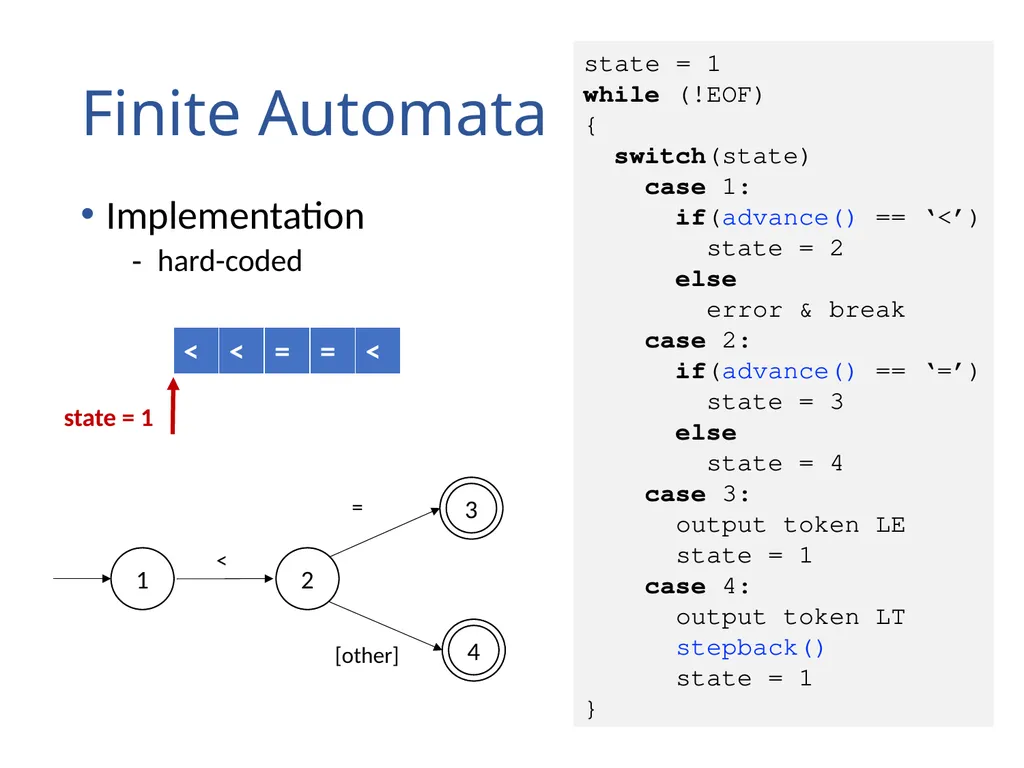
Finite Automata Implementation
hard-coded state = 1
while (!EOF)
{
switch(state)
case 1:
if(advance() == ‘<’)
state = 2
else
error & break
case 2:
if(advance() == ‘=’)
state = 3
else
state = 4
case 3:
output token LE
state = 1
case 4:
output token LT
stepback()
state = 1
} 3 = 1 2 < 4 [other] state = 1<br>
hard-coded state = 1
while (!EOF)
{
switch(state)
case 1:
if(advance() == ‘<’)
state = 2
else
error & break
case 2:
if(advance() == ‘=’)
state = 3
else
state = 4
case 3:
output token LE
state = 1
case 4:
output token LT
stepback()
state = 1
} 3 = 1 2 < 4 [other] state = 1<br>
44
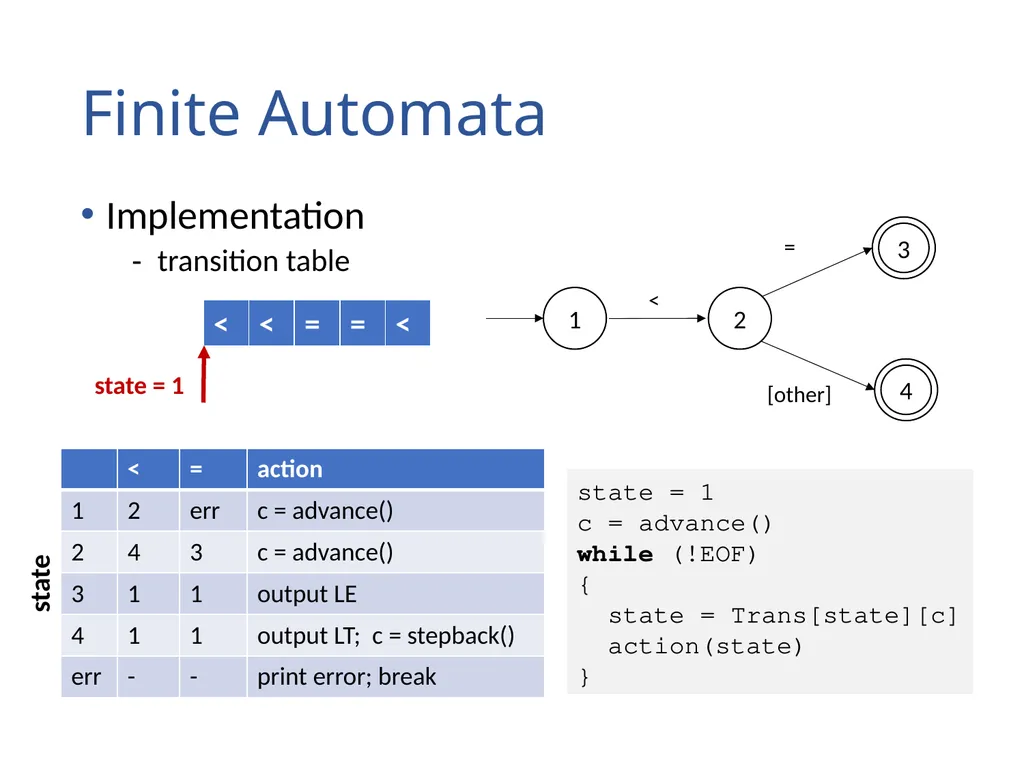
Finite Automata Implementation
transition table state = 1
c = advance()
while (!EOF)
{
state = Trans[state][c]
action(state)
} state = 1 state<br>
transition table state = 1
c = advance()
while (!EOF)
{
state = Trans[state][c]
action(state)
} state = 1 state<br>
45
Putting it All Together<br>
46
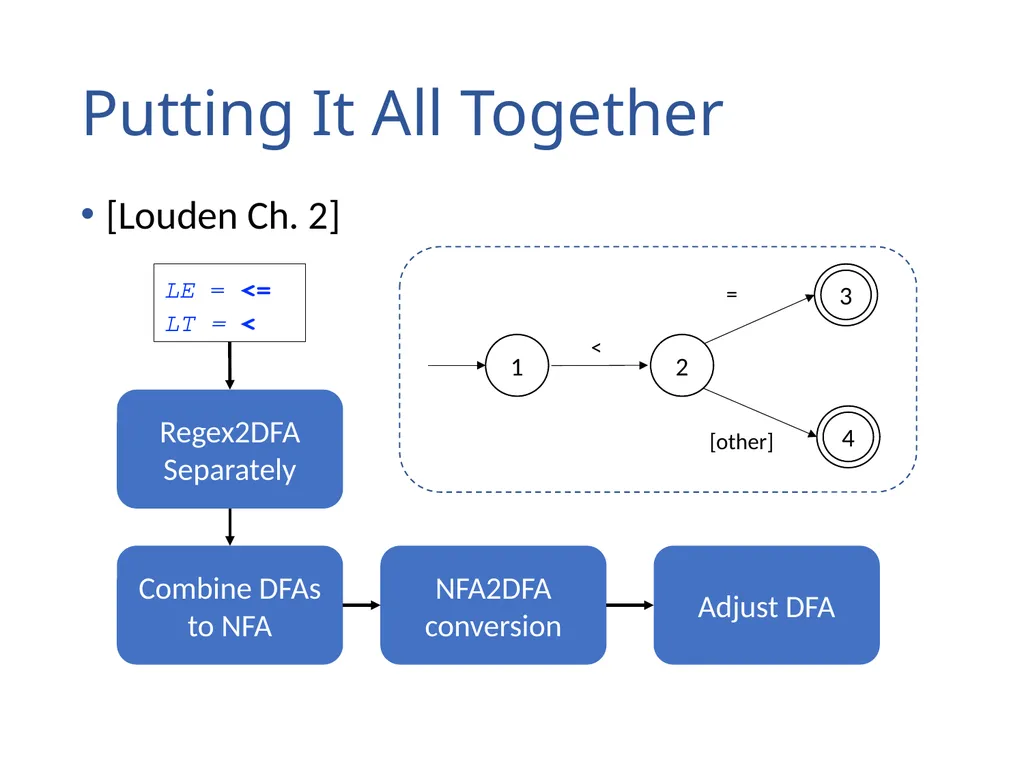
Putting It All Together LE = <=
LT = < Regex2DFA
Separately Combine DFAs to NFA NFA2DFA
conversion Adjust DFA [Louden Ch. 2]<br>
LT = < Regex2DFA
Separately Combine DFAs to NFA NFA2DFA
conversion Adjust DFA [Louden Ch. 2]<br>
47
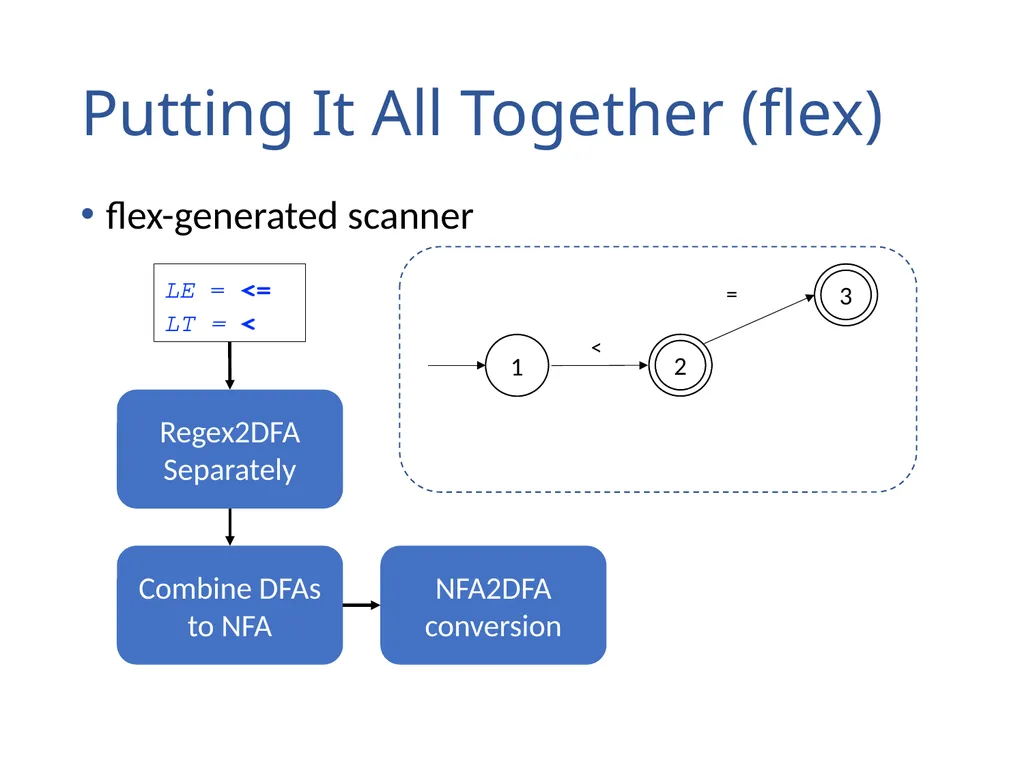
Putting It All Together (flex) 3 = 1 < 2 LE = <=
LT = < Regex2DFA
Separately Combine DFAs to NFA NFA2DFA
conversion flex-generated scanner<br>
LT = < Regex2DFA
Separately Combine DFAs to NFA NFA2DFA
conversion flex-generated scanner<br>
48
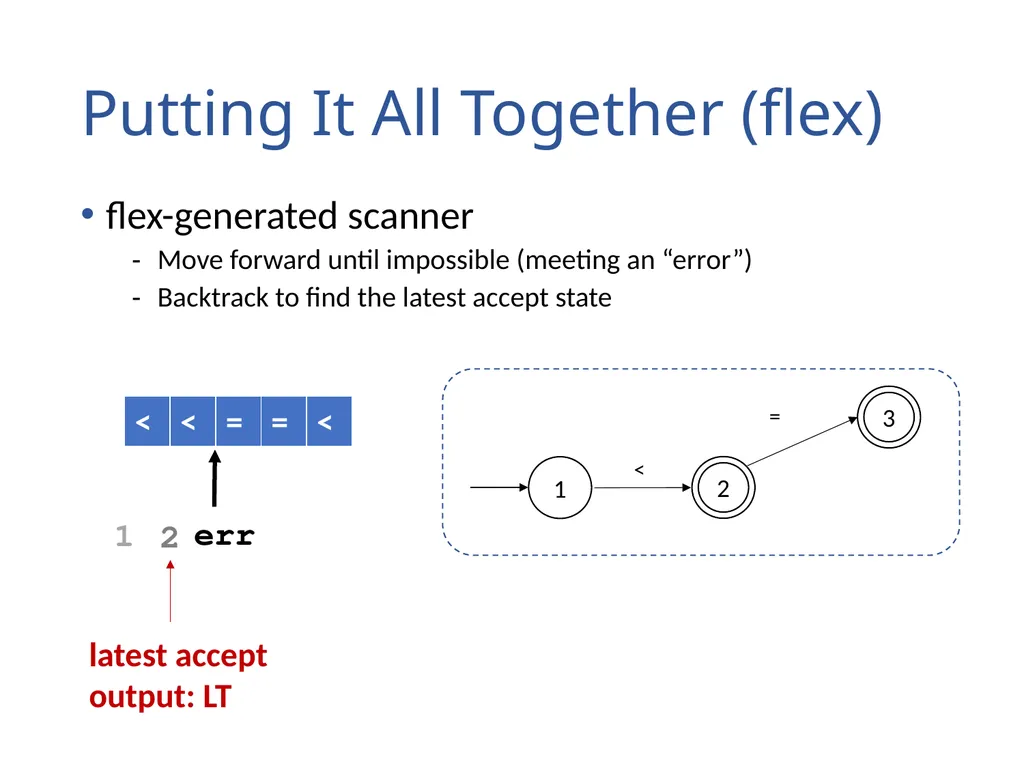
Putting It All Together (flex) 3 = 1 < 2 flex-generated scanner
Move forward until impossible (meeting an “error”)
Backtrack to find the latest accept state 1 2 err latest accept
output: LT<br>
Move forward until impossible (meeting an “error”)
Backtrack to find the latest accept state 1 2 err latest accept
output: LT<br>
49
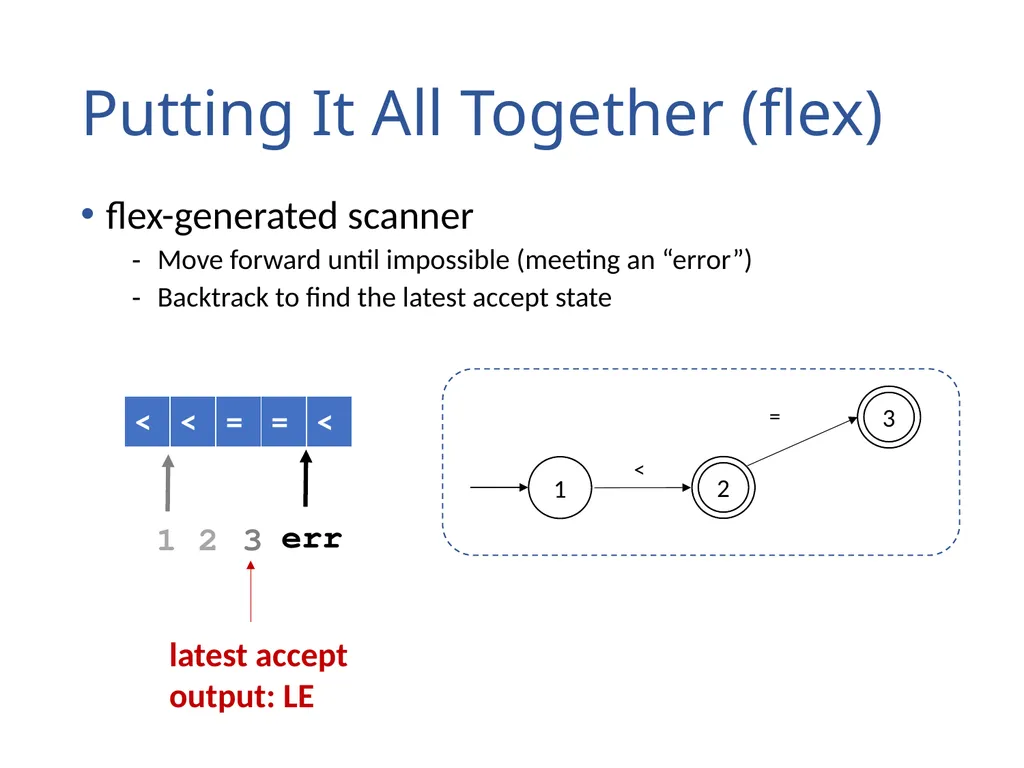
Putting It All Together (flex) 3 = 1 < 2 flex-generated scanner
Move forward until impossible (meeting an “error”)
Backtrack to find the latest accept state 1 2 3 err latest accept
output: LE<br>
Move forward until impossible (meeting an “error”)
Backtrack to find the latest accept state 1 2 3 err latest accept
output: LE<br>
50
Putting It All Together (flex) 3 = 1 < 2 flex-generated scanner
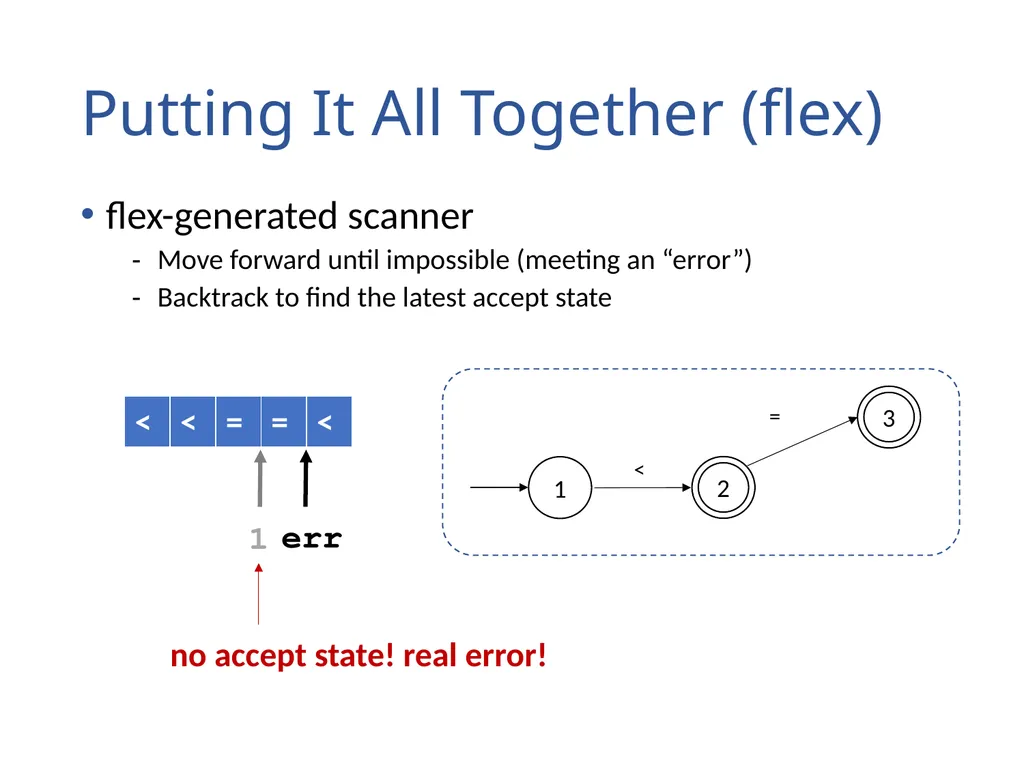
Move forward until impossible (meeting an “error”)
Backtrack to find the latest accept state 1 err no accept state! real error!<br>
Move forward until impossible (meeting an “error”)
Backtrack to find the latest accept state 1 err no accept state! real error!<br>