UNIT - 2 Token Ring Token Ring: Token Ring was developed by IBM in the 1970s as an alternative to Ethernet and to overcome the disadvantages of Ethernet. Initially, Token Ring offered speeds of 4 Mbps, which was later updated to 16 Mbps.
"UNIT - 2 Token Ring Token Ring: Token Ring was" is the property of its rightful owner. Permission is granted to
download and print the materials on this website for personal, non-commercial use only, and to display it
on your personal computer provided you do not modify the materials and that you retain all copyright
notices contained in the materials. By downloading content from our website, you accept the terms of this
agreement.
Presentation Transcript
01
UNIT - 2 Token Ring<br>
02
Token Ring:
Token Ring was developed by IBM in the 1970s as an alternative to Ethernet and to overcome the disadvantages of Ethernet.
Initially, Token Ring offered speeds of 4 Mbps, which was later updated to 16 Mbps.<br>
03
Token Ring manages the token access to the network devices in a different manner.
In Token Ring LANs, an empty token circulates among the different devices on the network.
On receiving the token, a device appends data to the token and transmits it across the network.
The other devices on the network check the destination address, and the device with the corresponding destination address makes a copy of the data.
The original data frame continues circulating on the network and reaches the source device.<br>
04
The source device checks the data frame and recognizes that the data had originated from it and then releases the token for other devices to use.
Therefore, in Token Ring LANs, a device can hold the token only until the original data frame comes back to the source device.
As a result, it is possible that a device may need to release the token before it is able to transmit all the data frames.
The device then waits for its turn to send the remaining frames.
This in contrast to ARCnet where the token is released only after the data transfer is complete.<br>
05
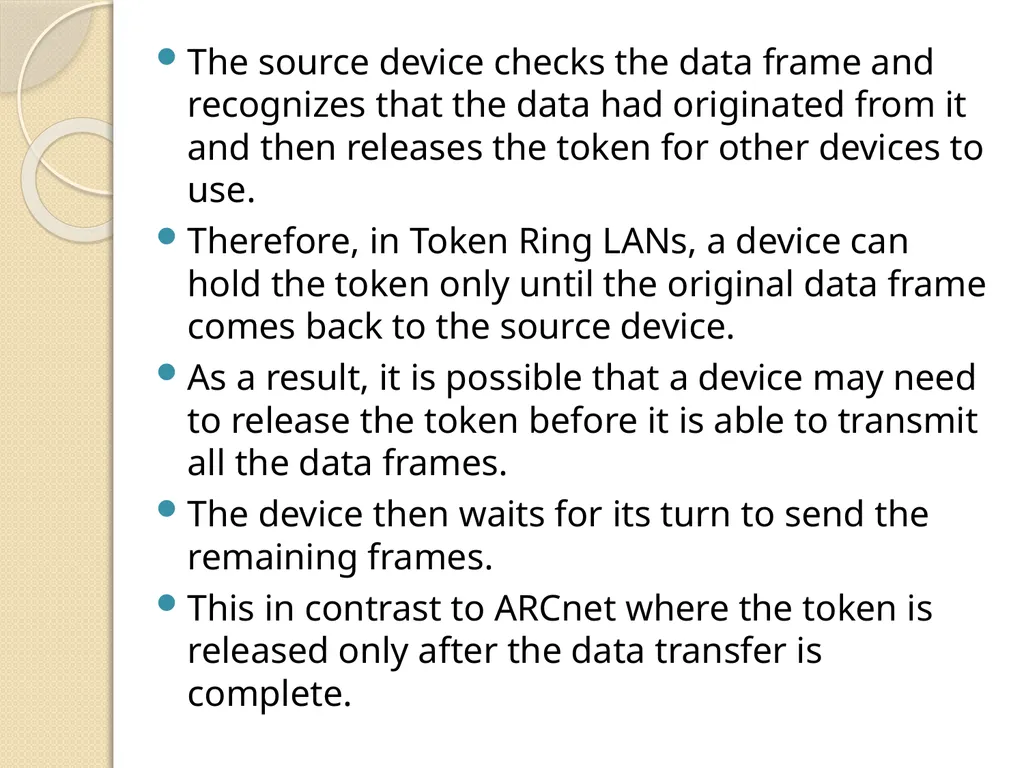
Figurer 4.6 epresents the working of the token-passing scheme in Token Ring LANs.<br>
06
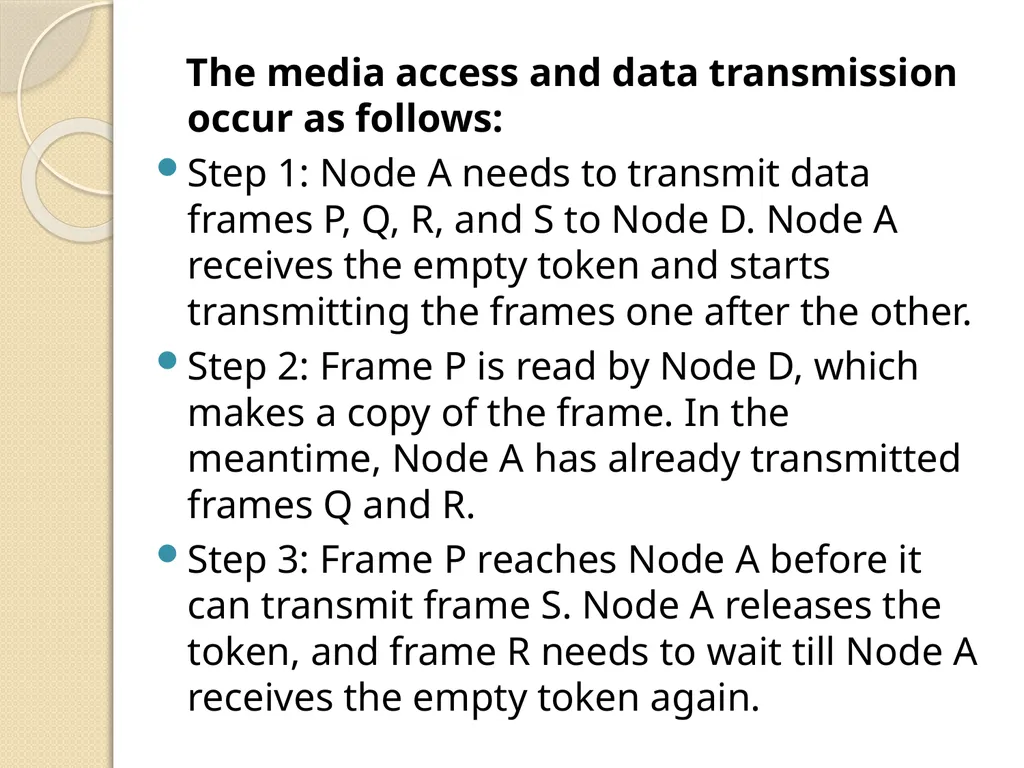
The media access and data transmission occur as follows:
Step 1: Node A needs to transmit data frames P, Q, R, and S to Node D. Node A receives the empty token and starts transmitting the frames one after the other.
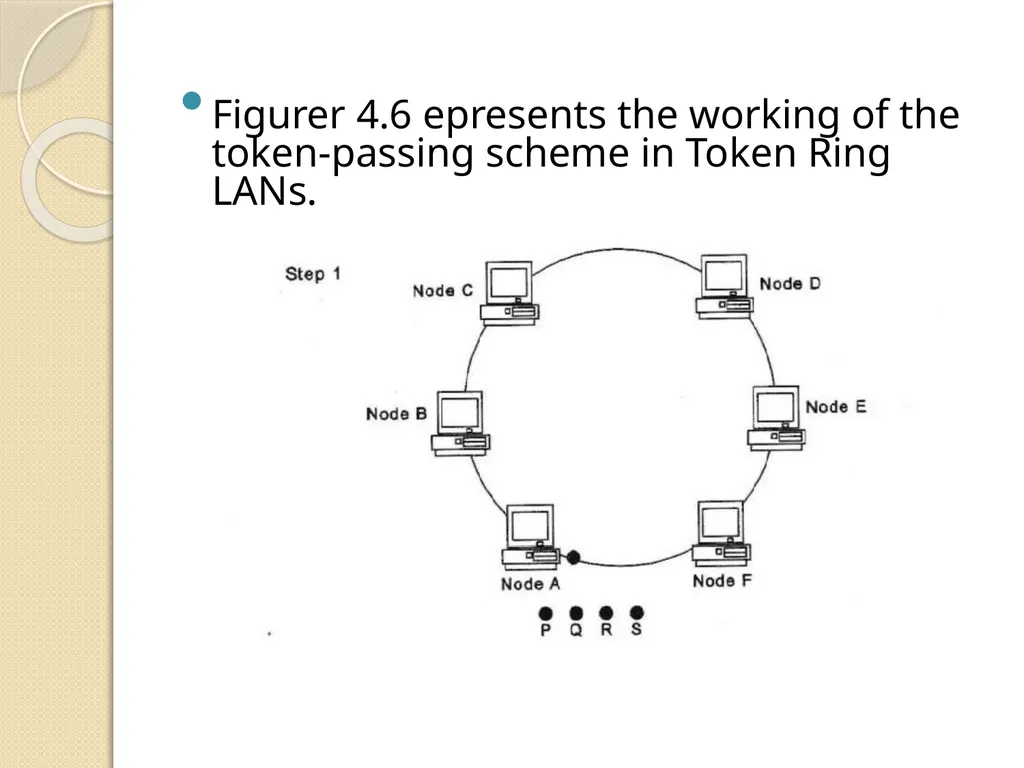
Step 2: Frame P is read by Node D, which makes a copy of the frame. In the meantime, Node A has already transmitted frames Q and R.
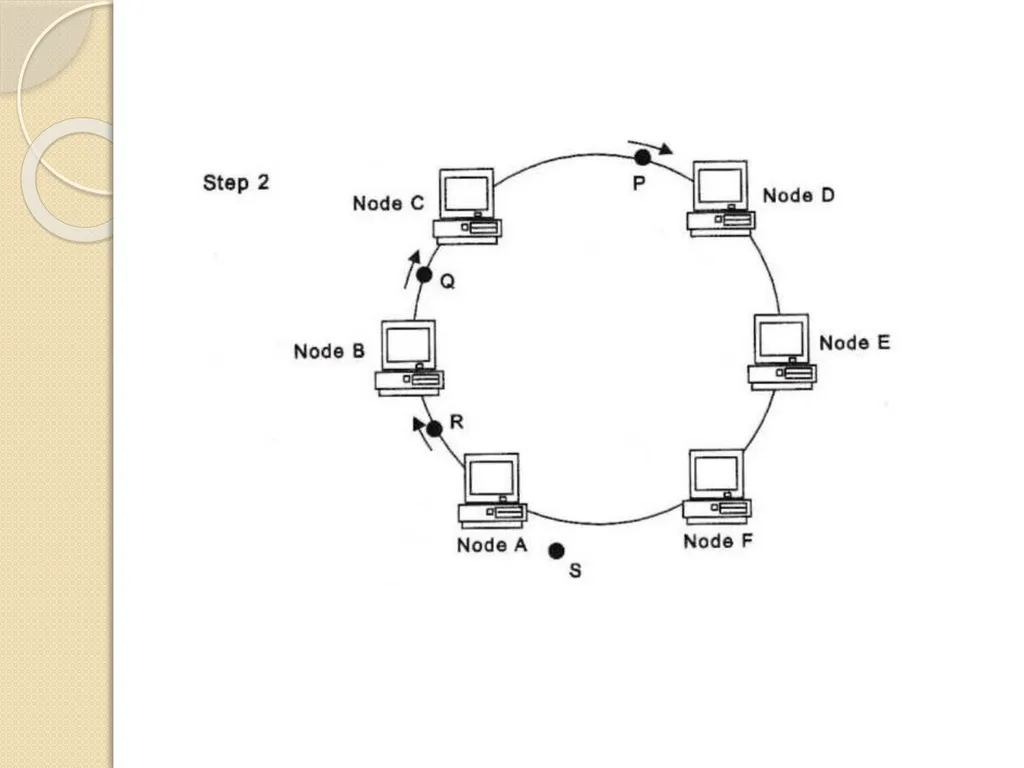
Step 3: Frame P reaches Node A before it can transmit frame S. Node A releases the token, and frame R needs to wait till Node A receives the empty token again.<br>
07
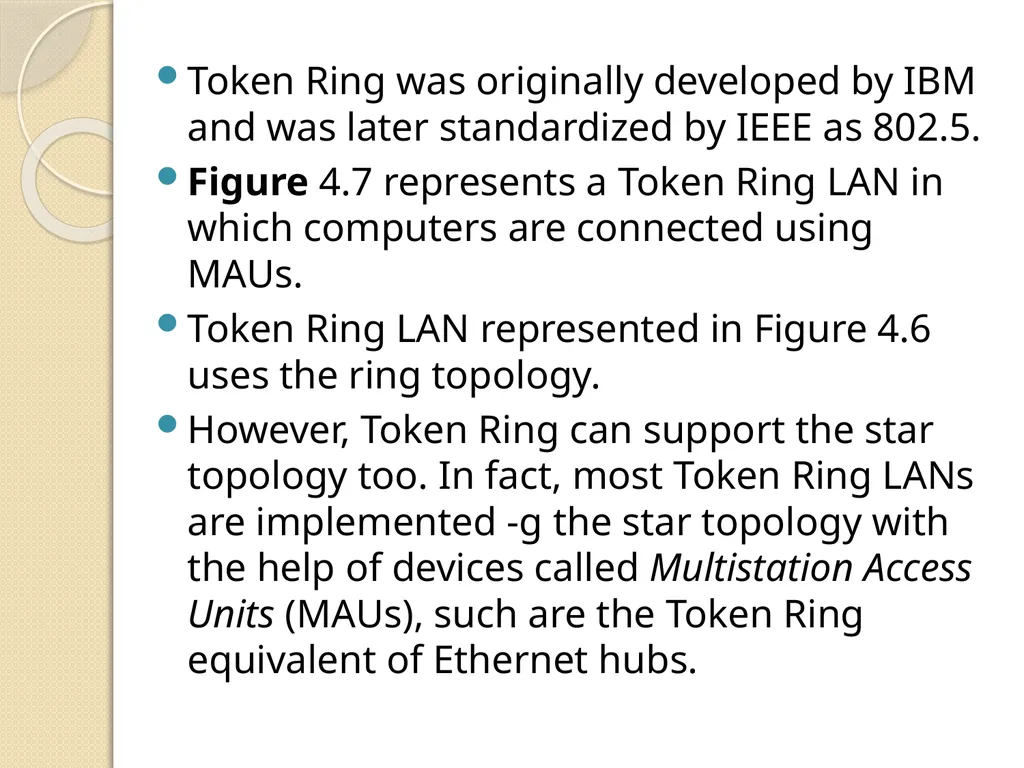
Token Ring was originally developed by IBM and was later standardized by IEEE as 802.5.
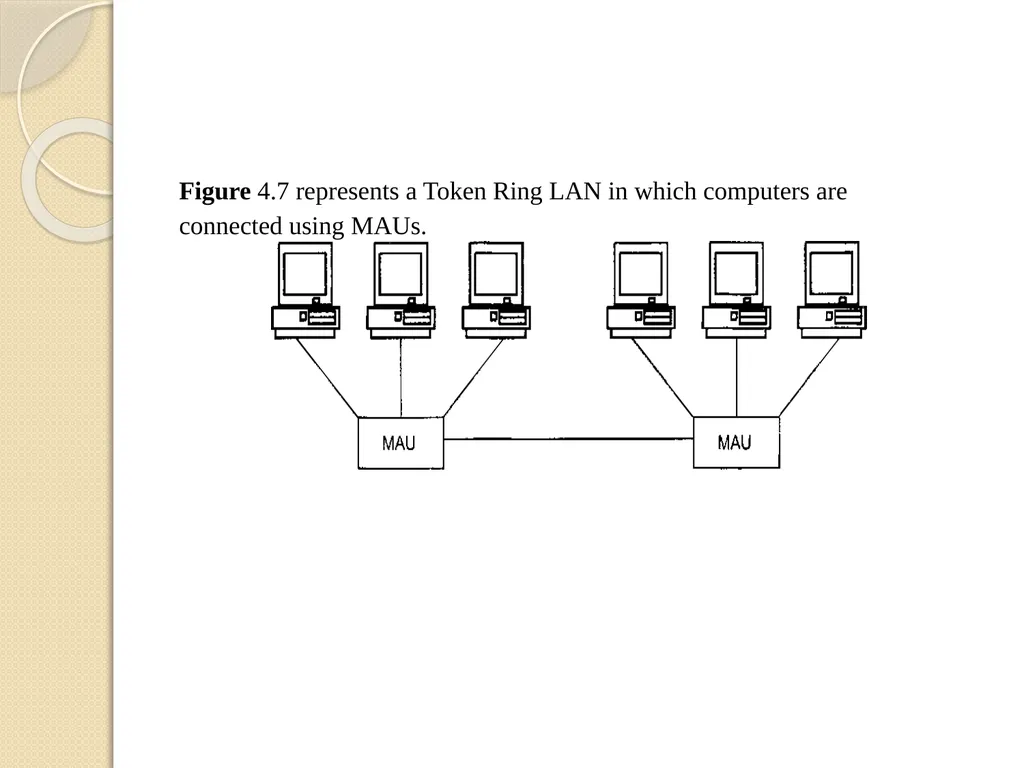
Figure 4.7 represents a Token Ring LAN in which computers are connected using MAUs.
Token Ring LAN represented in Figure 4.6 uses the ring topology.
However, Token Ring can support the star topology too. In fact, most Token Ring LANs are implemented -g the star topology with the help of devices called Multistation Access Units (MAUs), such are the Token Ring equivalent of Ethernet hubs.<br>
08
Token Ring Frame Format:
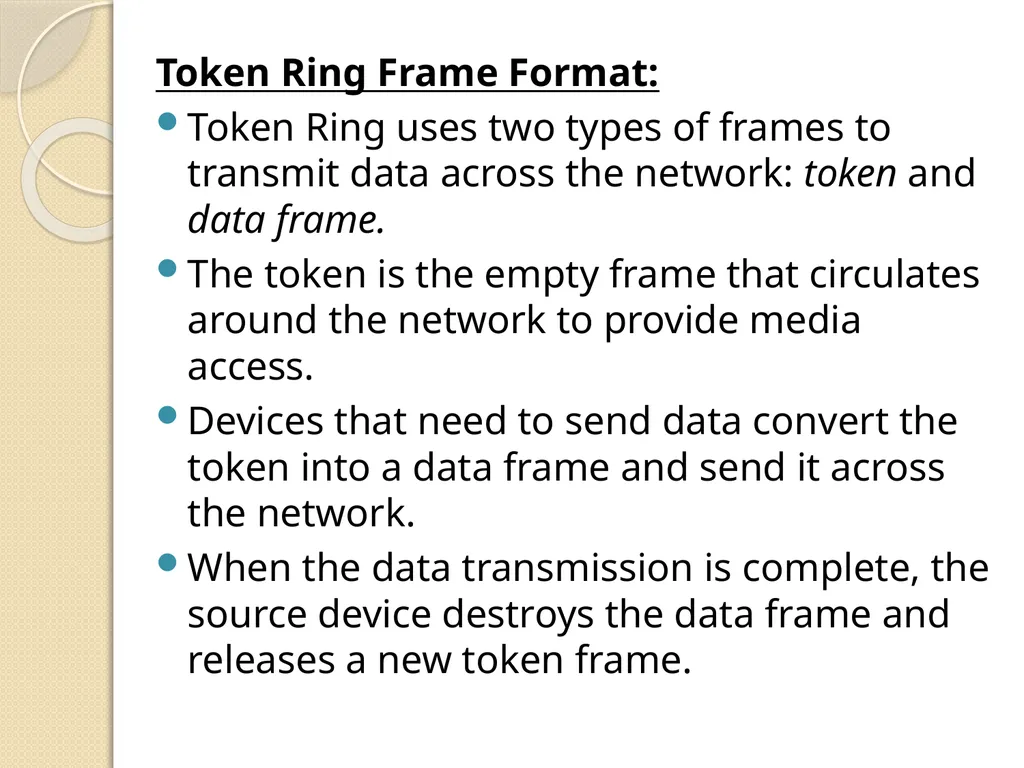
Token Ring uses two types of frames to transmit data across the network: token and data frame.
The token is the empty frame that circulates around the network to provide media access.
Devices that need to send data convert the token into a data frame and send it across the network.
When the data transmission is complete, the source device destroys the data frame and releases a new token frame.<br>
09
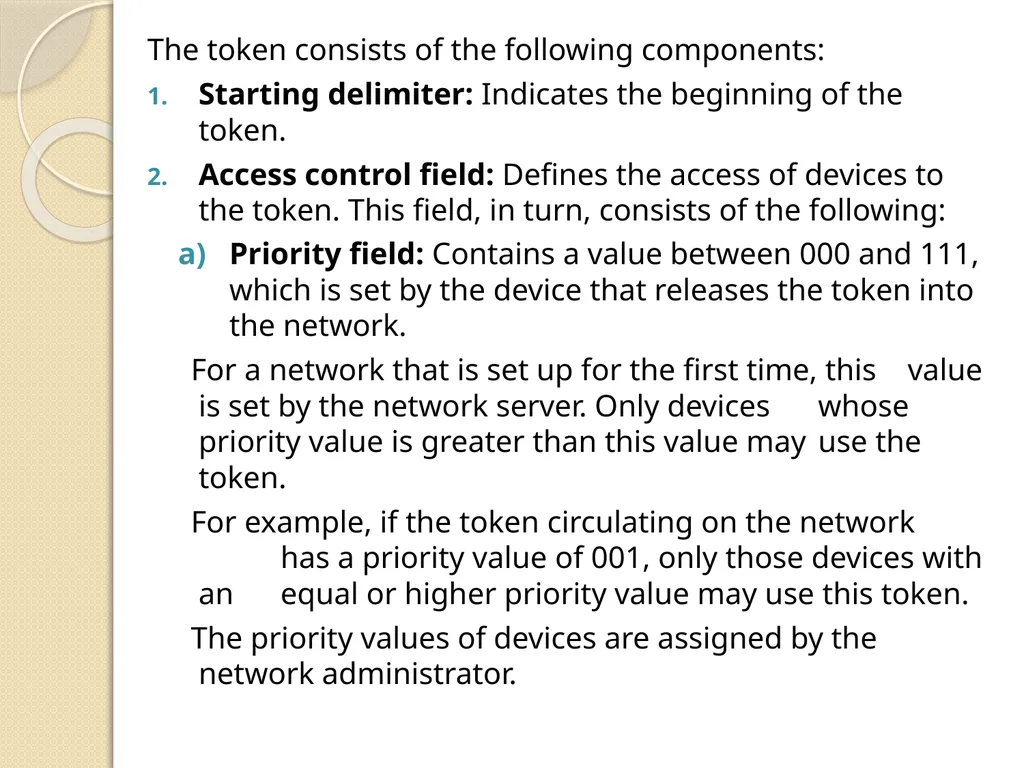
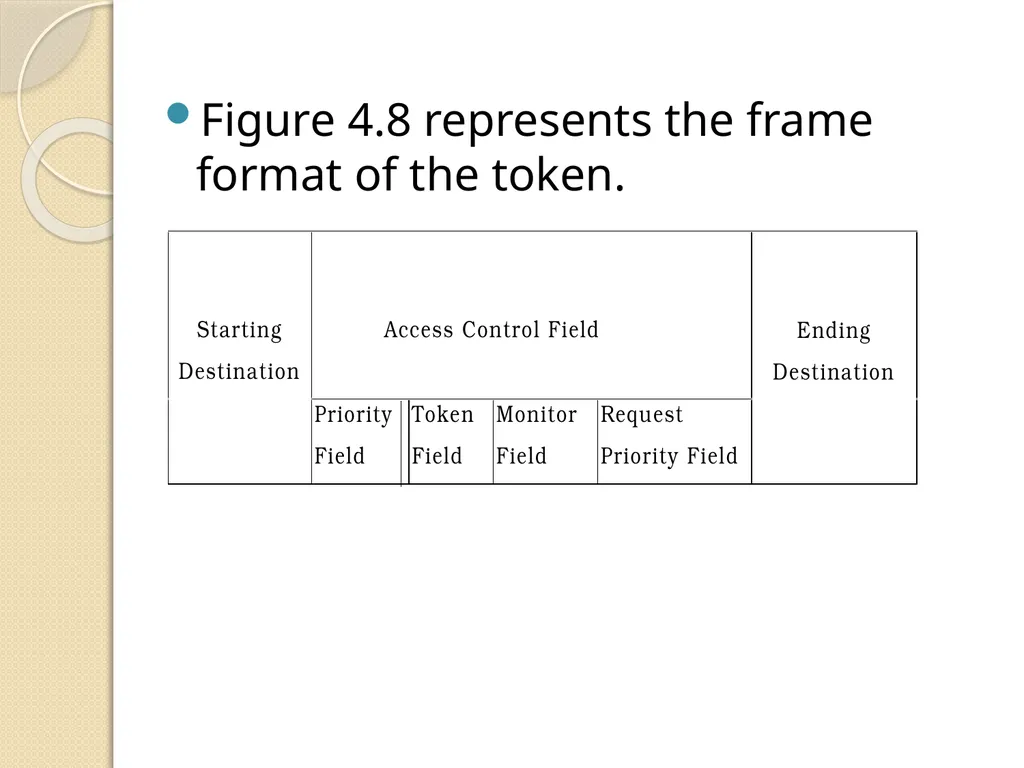
The token consists of the following components:
Starting delimiter: Indicates the beginning of the token.
Access control field: Defines the access of devices to the token. This field, in turn, consists of the following:
Priority field: Contains a value between 000 and 111, which is set by the device that releases the token into the network.
For a network that is set up for the first time, this value is set by the network server. Only devices whose priority value is greater than this value may use the token.
For example, if the token circulating on the network has a priority value of 001, only those devices with an equal or higher priority value may use this token.
The priority values of devices are assigned by the network administrator.<br>
10
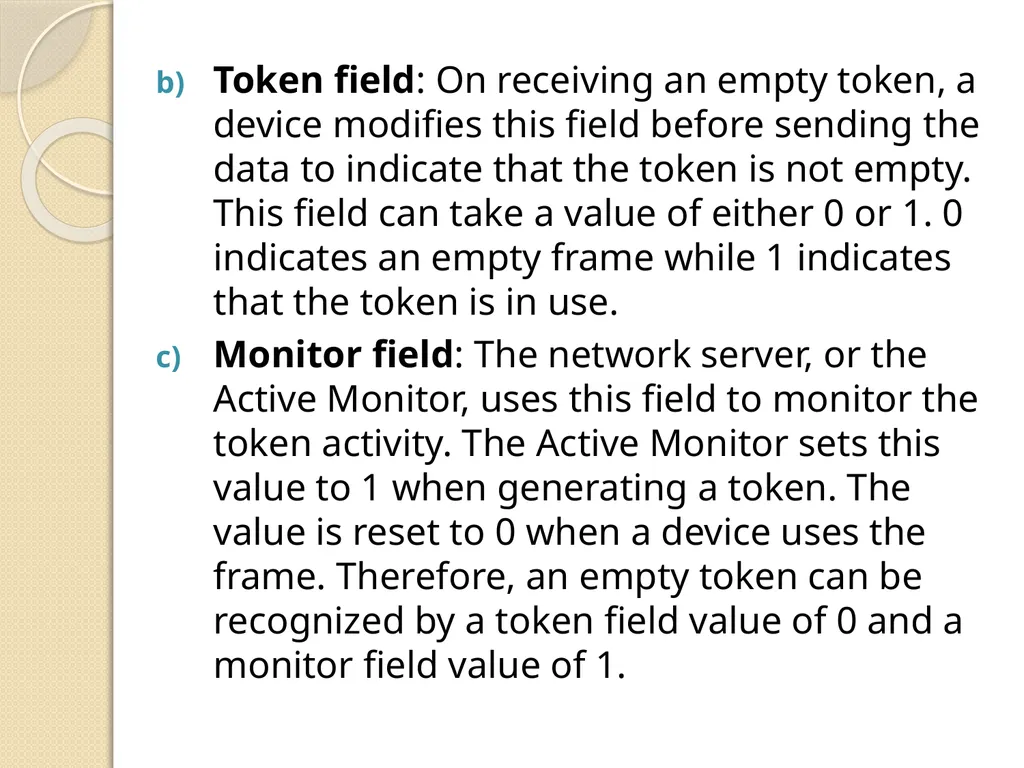
Token field: On receiving an empty token, a device modifies this field before sending the data to indicate that the token is not empty. This field can take a value of either 0 or 1. 0 indicates an empty frame while 1 indicates that the token is in use.
Monitor field: The network server, or the Active Monitor, uses this field to monitor the token activity. The Active Monitor sets this value to 1 when generating a token. The value is reset to 0 when a device uses the frame. Therefore, an empty token can be recognized by a token field value of 0 and a monitor field value of 1.<br>
11
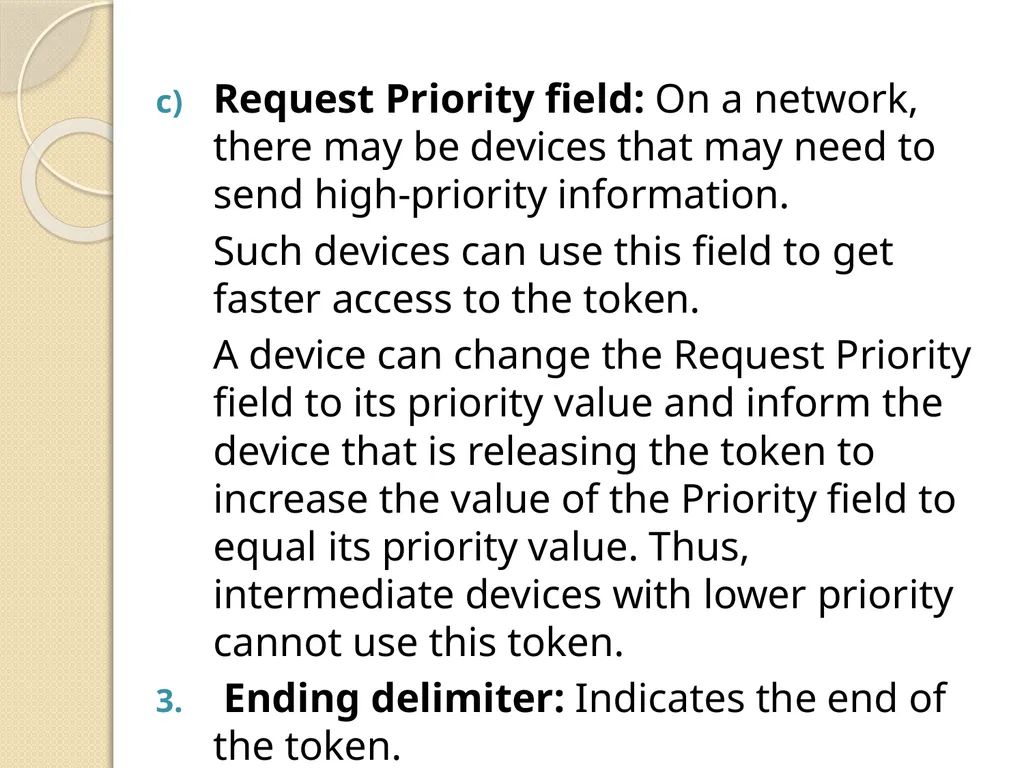
Request Priority field: On a network, there may be devices that may need to send high-priority information.
Such devices can use this field to get faster access to the token.
A device can change the Request Priority field to its priority value and inform the device that is releasing the token to increase the value of the Priority field to equal its priority value. Thus, intermediate devices with lower priority cannot use this token.
Ending delimiter: Indicates the end of the token.<br>
12
Figure 4.8 represents the frame format of the token.<br>
13
Advantages:
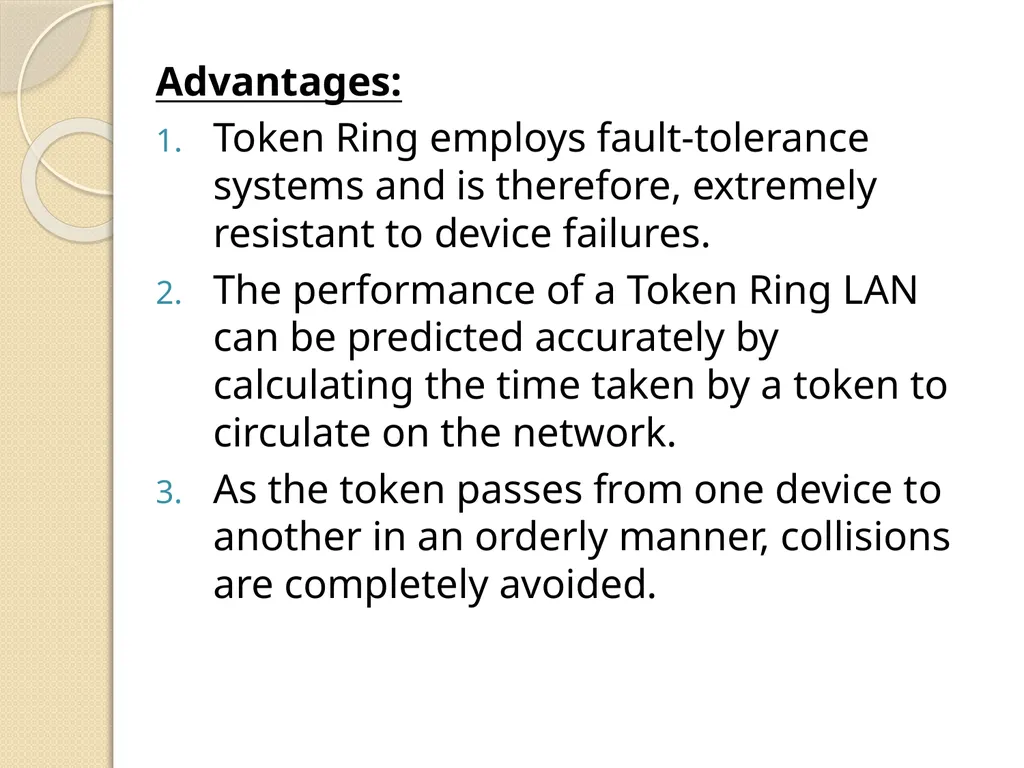
Token Ring employs fault-tolerance systems and is therefore, extremely resistant to device failures.
The performance of a Token Ring LAN can be predicted accurately by calculating the time taken by a token to circulate on the network.
As the token passes from one device to another in an orderly manner, collisions are completely avoided.<br>
14
Disadvantages:
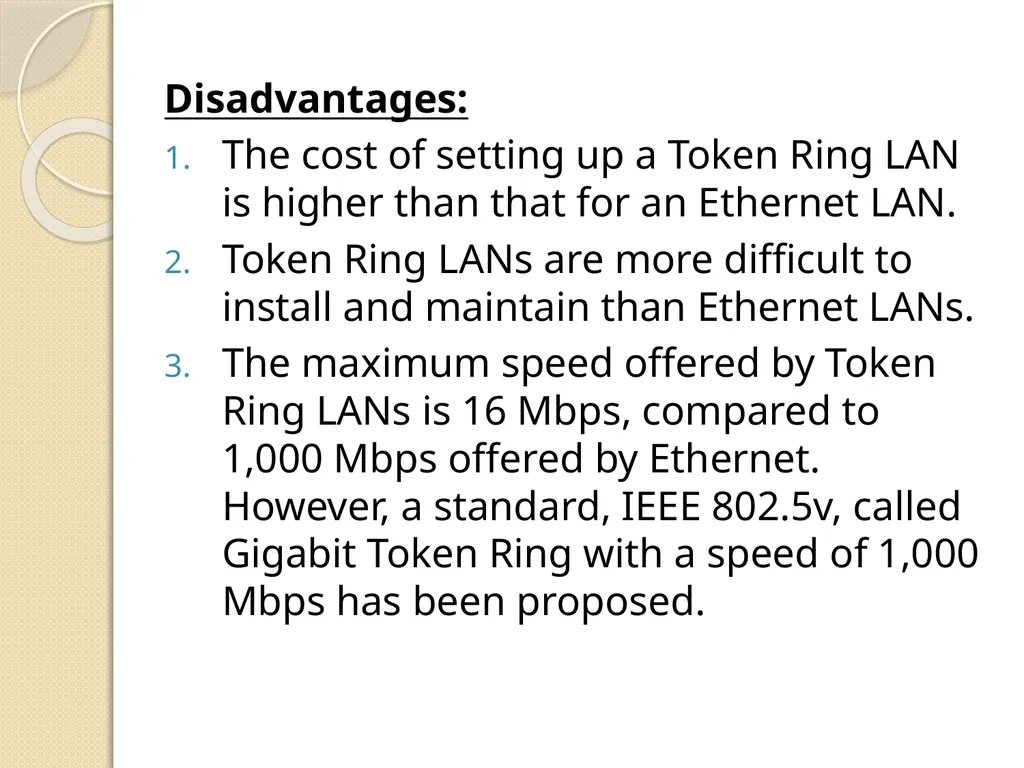
The cost of setting up a Token Ring LAN is higher than that for an Ethernet LAN.
Token Ring LANs are more difficult to install and maintain than Ethernet LANs.
The maximum speed offered by Token Ring LANs is 16 Mbps, compared to 1,000 Mbps offered by Ethernet. However, a standard, IEEE 802.5v, called Gigabit Token Ring with a speed of 1,000 Mbps has been proposed.<br>