
Liberal Learning and the Teacher-Scholar at

Description: Liberal Learning and the Teacher-Scholar at Stetson University Megan ONeill, Director, The Writing Program Greg Sapp, Associate Professor of Religious Studies Chair of the General Education Assessment Committee (GEAC) Alicia Slater,
Related Topics
Download Presentation
"Liberal Learning and the Teacher-Scholar at" is the property of its rightful owner. Permission is granted to download and print the materials on this website for personal, non-commercial use only, and to display it on your personal computer provided you do not modify the materials and that you retain all copyright notices contained in the materials. By downloading content from our website, you accept the terms of this agreement.
Presentation Transcript
slide1. Liberal Learning and the Teacher-Scholar at Stetson University Megan O'Neill, Director, The Writing Program
Greg Sapp, Associate Professor of Religious Studies
Chair of the General Education Assessment Committee (GEAC)
Alicia Slater, Professor and Chair of Biology; Chair, Integrative Health Science; Director, Curriculum and Assessment<br>
slide2. About AAC&U AAC&U is the leading national association concerned with the quality of student learning in college 1,300 institutional members—including accredited public and private colleges and universities of every type and size, including community colleges A network of more than 30,000 faculty members, academic leaders, presidents, and others working for educational reform A meeting ground for all parts of higher education – about our shared responsibilities to students and society<br>
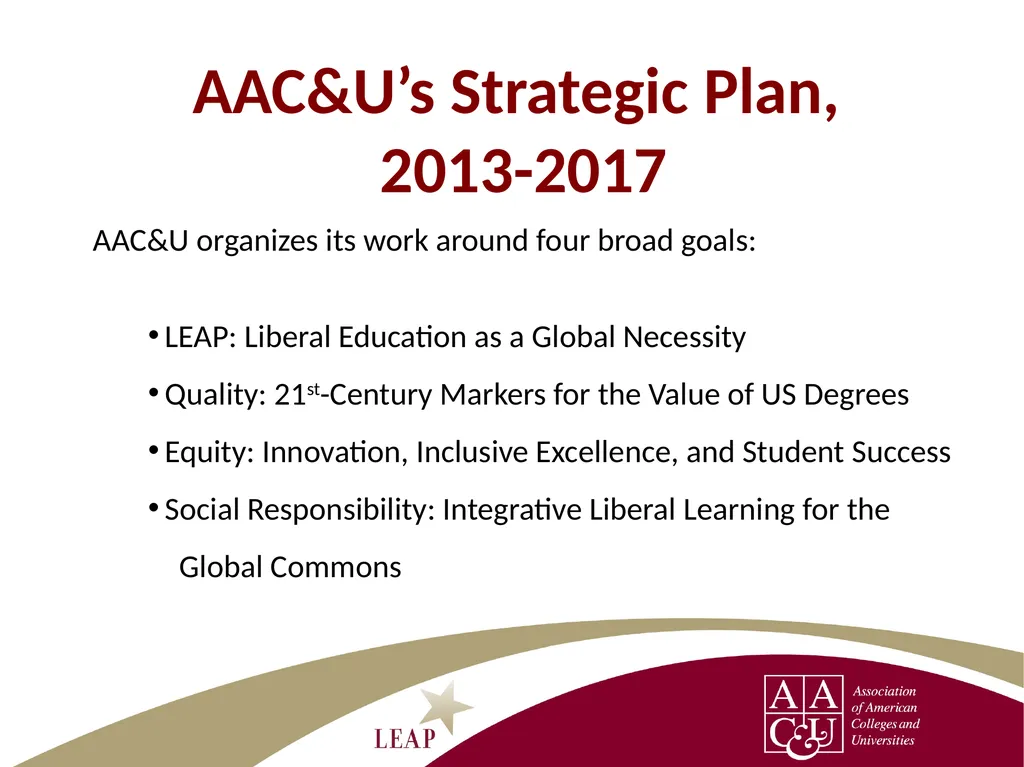
slide3. AAC&U organizes its work around four broad goals:
LEAP: Liberal Education as a Global Necessity
Quality: 21st-Century Markers for the Value of US Degrees
Equity: Innovation, Inclusive Excellence, and Student Success
Social Responsibility: Integrative Liberal Learning for the
Global Commons AAC&U’s Strategic Plan,
2013-2017<br>
slide4. About LEAP Launched in 2005, Liberal Education and America’s Promise (LEAP) is a national initiative that champions the importance of a twenty-first-century liberal education—for individual students and for a nation dependent on economic creativity and democratic vitality.<br>
slide5. Clarifying Terminology AAC&U traditionally –and particularly through LEAP—has advocated for all students to receive a powerful and horizon-expanding liberal education
Liberal Education: An approach to college learning that empowers individuals and prepares them to deal with complexity, diversity and change. It emphasizes broad knowledge of the wider world (e.g., science, culture and society) as well as in-depth achievement in a specific field of interest. It helps students develop a sense of social responsibility as well as strong intellectual and practical skills that span all areas of study, such as communication, analytical and problem-solving skills, and includes a demonstrated ability to apply knowledge and skills in real-world settings.
Liberal Arts: Specific disciplines (e.g., the humanities, sciences, and social sciences)
General Education: The part of a liberal education curriculum shared by all students. It provides broad exposure to multiple disciplines and forms the basis for developing important intellectual and civic capacities.<br>
slide6. Why LEAP? The World is Demanding More:
There is a demand for more numbers of college educated workers
There is a demand for engaged and informed citizens
There also is a demand that those educated workers and citizens have higher levels of learning and knowledge, as well as new and different skills and abilities.<br>
slide7. Why LEAP? Employers are Raising the Bar and Endorse Liberal Education Outcomes
95% of employers put a priority on “hiring people with the intellectual and interpersonal skills that will help them contribute to innovation in the workplace.”
93% of employers agree that “candidates’ demonstrated capacity to think critically, communicate clearly, and solve complex problems is more important than their undergraduate major.”
93% of employers say they are “asking employees to take on more responsibilities and to use a broader set of skills than in the past.”
91% of employers say that “the challenges their employees face are more complex today than they were in the past.” Source: “It Takes More Than a Major: Employer Priorities for College Learning and Student Success” (AAC&U and Hart Research Associates, 2013)<br>
slide8. The Goals of LEAP Spark public debate about the LEAP educational vision and about what learning outcomes are essential for all students; create more informed public support for higher education and for changes to improve quality
Challenge the belief that students must choose either a liberal education or a practical education
Help all students understand, prepare for, and achieve essential learning outcomes in college
Document national, state, and institutional progress in student achievement of essential learning outcomes<br>
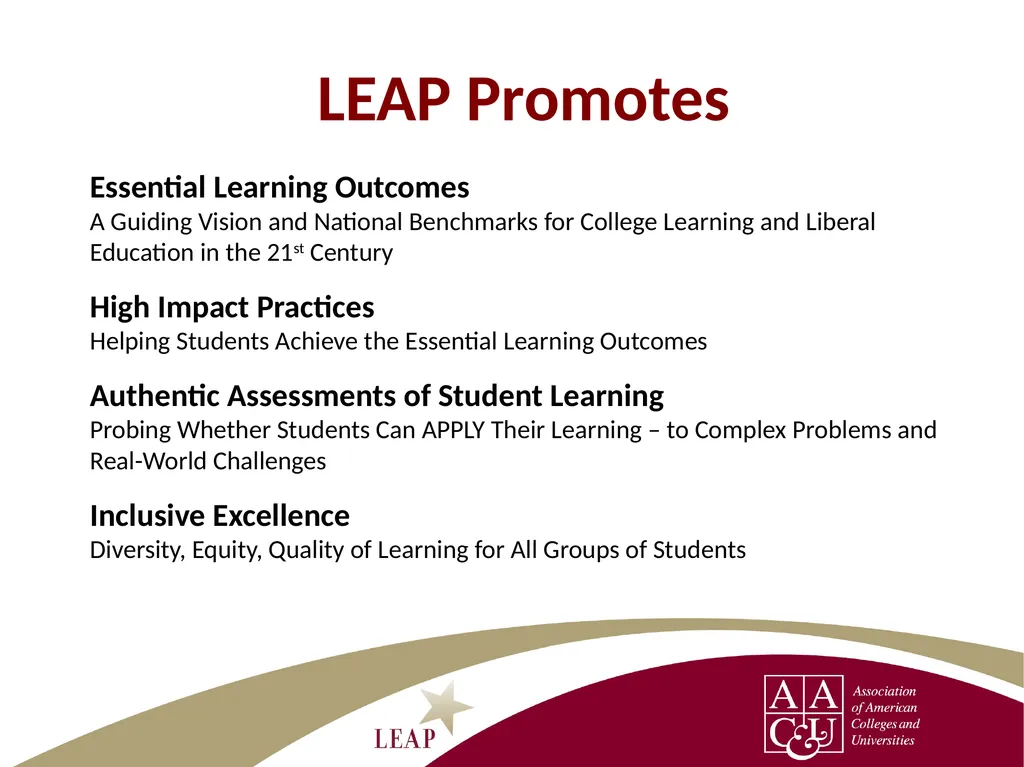
slide9. LEAP Promotes Essential Learning Outcomes
A Guiding Vision and National Benchmarks for College Learning and Liberal Education in the 21st Century
High Impact Practices
Helping Students Achieve the Essential Learning Outcomes
Authentic Assessments of Student Learning
Probing Whether Students Can APPLY Their Learning – to Complex Problems and Real-World Challenges
Inclusive Excellence
Diversity, Equity, Quality of Learning for All Groups of Students<br>
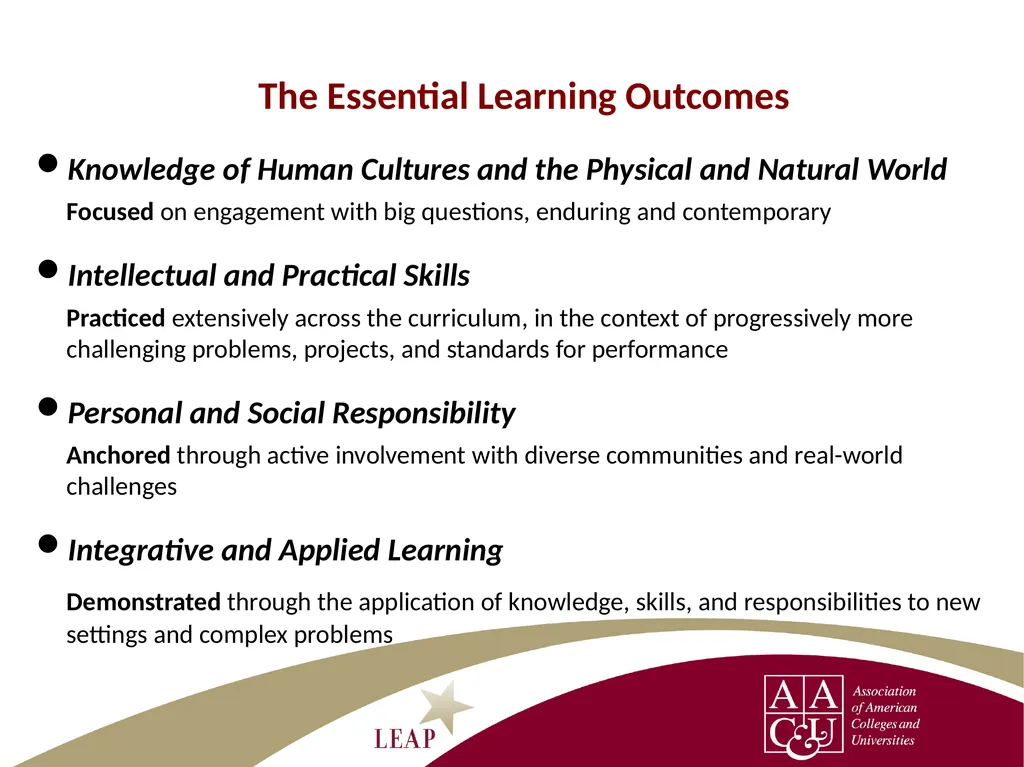
slide10. The Essential Learning Outcomes Knowledge of Human Cultures and the Physical and Natural World
Focused on engagement with big questions, enduring and contemporary
Intellectual and Practical Skills
Practiced extensively across the curriculum, in the context of progressively more challenging problems, projects, and standards for performance
Personal and Social Responsibility
Anchored through active involvement with diverse communities and real-world challenges
Integrative and Applied Learning
Demonstrated through the application of knowledge, skills, and responsibilities to new settings and complex problems<br>
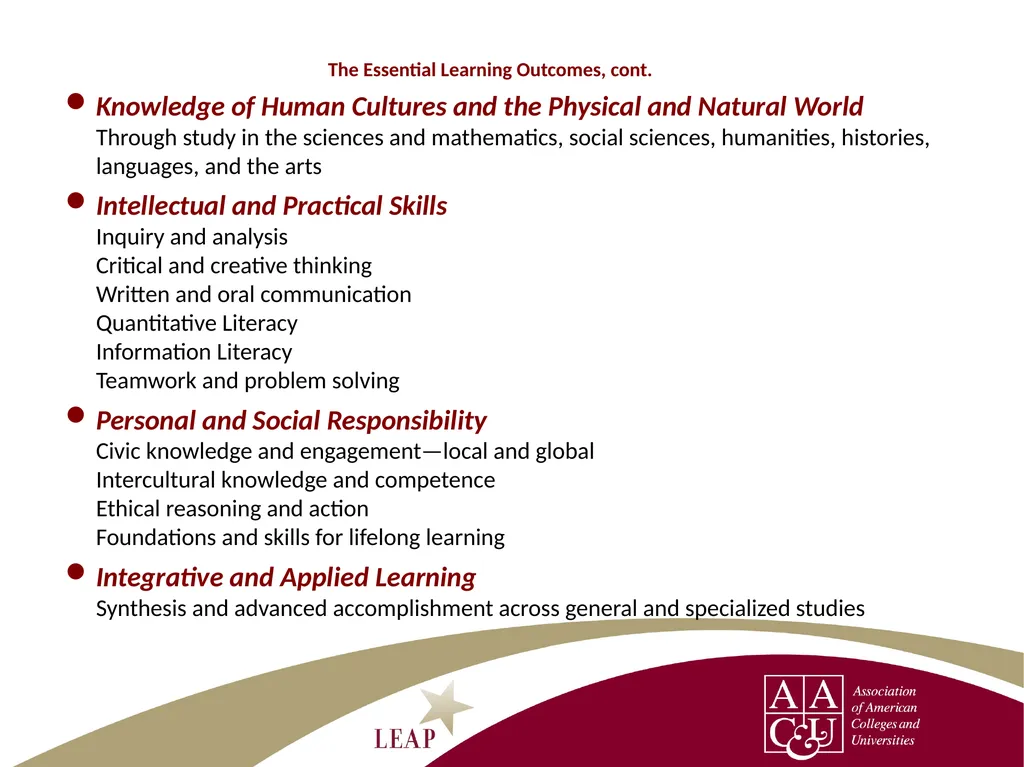
slide11. The Essential Learning Outcomes, cont. Knowledge of Human Cultures and the Physical and Natural World Through study in the sciences and mathematics, social sciences, humanities, histories, languages, and the arts
Intellectual and Practical Skills Inquiry and analysis Critical and creative thinking Written and oral communication Quantitative Literacy Information Literacy Teamwork and problem solving
Personal and Social Responsibility Civic knowledge and engagement—local and global Intercultural knowledge and competence Ethical reasoning and action Foundations and skills for lifelong learning
Integrative and Applied Learning Synthesis and advanced accomplishment across general and specialized studies<br>
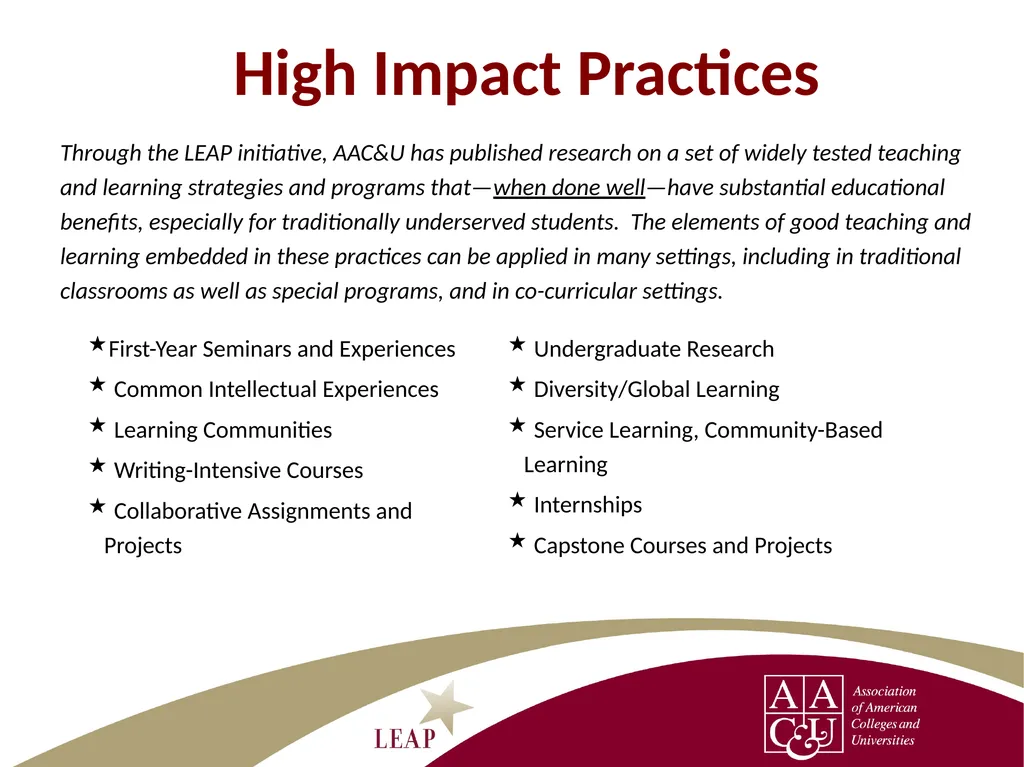
slide12. High Impact Practices Through the LEAP initiative, AAC&U has published research on a set of widely tested teaching and learning strategies and programs that—when done well—have substantial educational benefits, especially for traditionally underserved students. The elements of good teaching and learning embedded in these practices can be applied in many settings, including in traditional classrooms as well as special programs, and in co-curricular settings. First-Year Seminars and Experiences
Common Intellectual Experiences
Learning Communities
Writing-Intensive Courses
Collaborative Assignments and Projects Undergraduate Research
Diversity/Global Learning
Service Learning, Community-Based Learning
Internships
Capstone Courses and Projects<br>
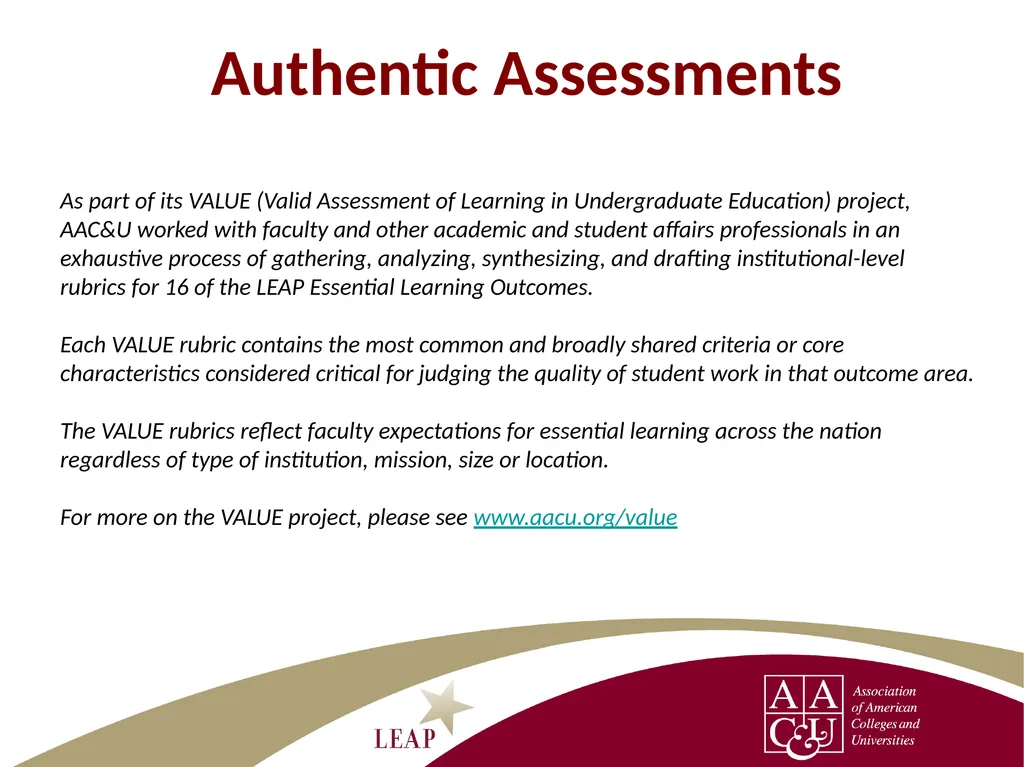
slide13. Authentic Assessments As part of its VALUE (Valid Assessment of Learning in Undergraduate Education) project, AAC&U worked with faculty and other academic and student affairs professionals in an exhaustive process of gathering, analyzing, synthesizing, and drafting institutional-level rubrics for 16 of the LEAP Essential Learning Outcomes. Each VALUE rubric contains the most common and broadly shared criteria or core characteristics considered critical for judging the quality of student work in that outcome area.
The VALUE rubrics reflect faculty expectations for essential learning across the nation regardless of type of institution, mission, size or location. For more on the VALUE project, please see www.aacu.org/value<br>
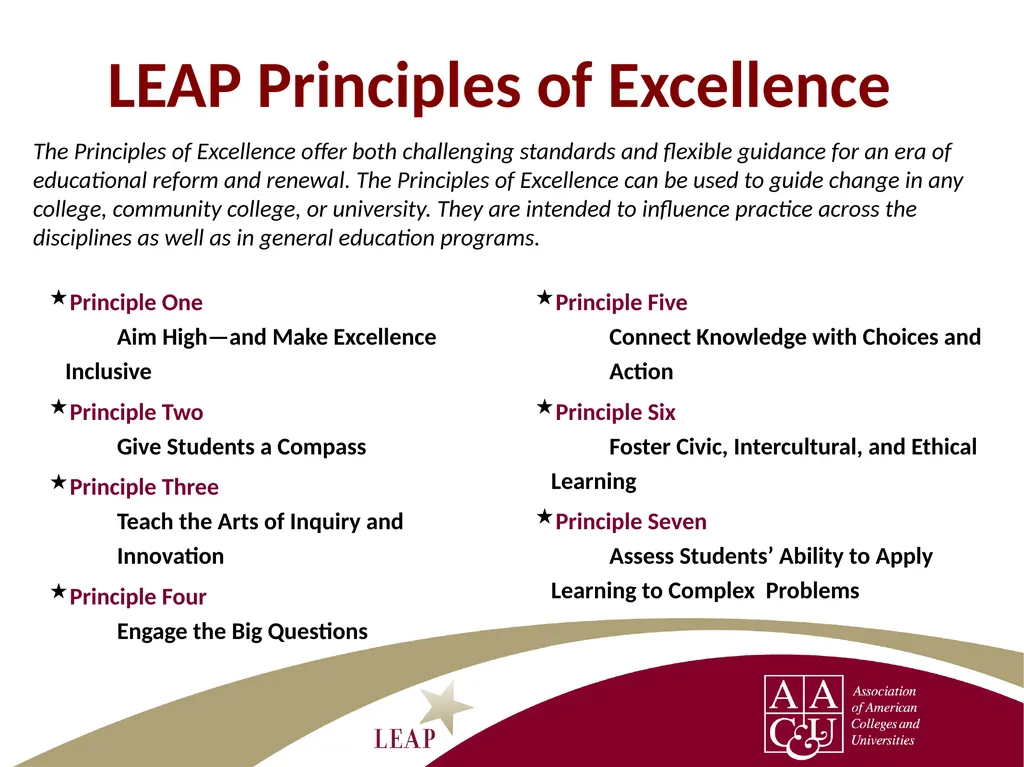
slide14. LEAP Principles of Excellence Principle One Aim High—and Make Excellence Inclusive
Principle Two Give Students a Compass
Principle Three Teach the Arts of Inquiry and Innovation
Principle Four Engage the Big Questions Principle Five Connect Knowledge with Choices and Action
Principle Six Foster Civic, Intercultural, and Ethical Learning
Principle Seven Assess Students’ Ability to Apply Learning to Complex Problems The Principles of Excellence offer both challenging standards and flexible guidance for an era of educational reform and renewal. The Principles of Excellence can be used to guide change in any college, community college, or university. They are intended to influence practice across the disciplines as well as in general education programs.<br>
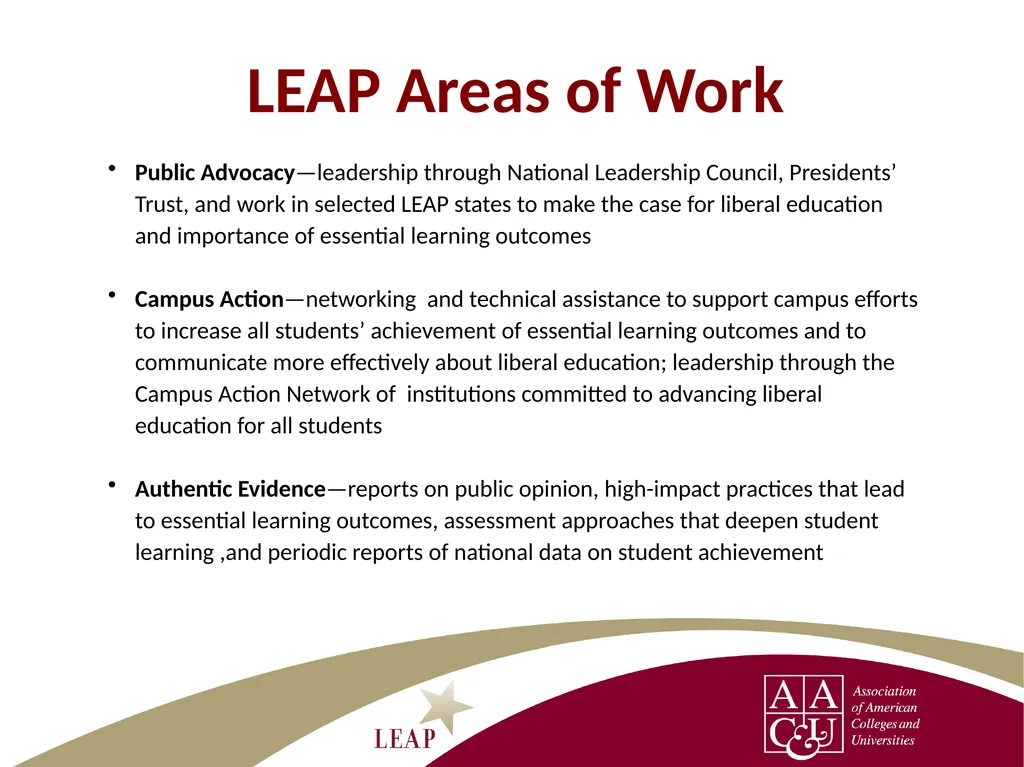
slide15. LEAP Areas of Work Public Advocacy—leadership through National Leadership Council, Presidents’ Trust, and work in selected LEAP states to make the case for liberal education and importance of essential learning outcomes
Campus Action—networking and technical assistance to support campus efforts to increase all students’ achievement of essential learning outcomes and to communicate more effectively about liberal education; leadership through the Campus Action Network of institutions committed to advancing liberal education for all students
Authentic Evidence—reports on public opinion, high-impact practices that lead to essential learning outcomes, assessment approaches that deepen student learning ,and periodic reports of national data on student achievement<br>
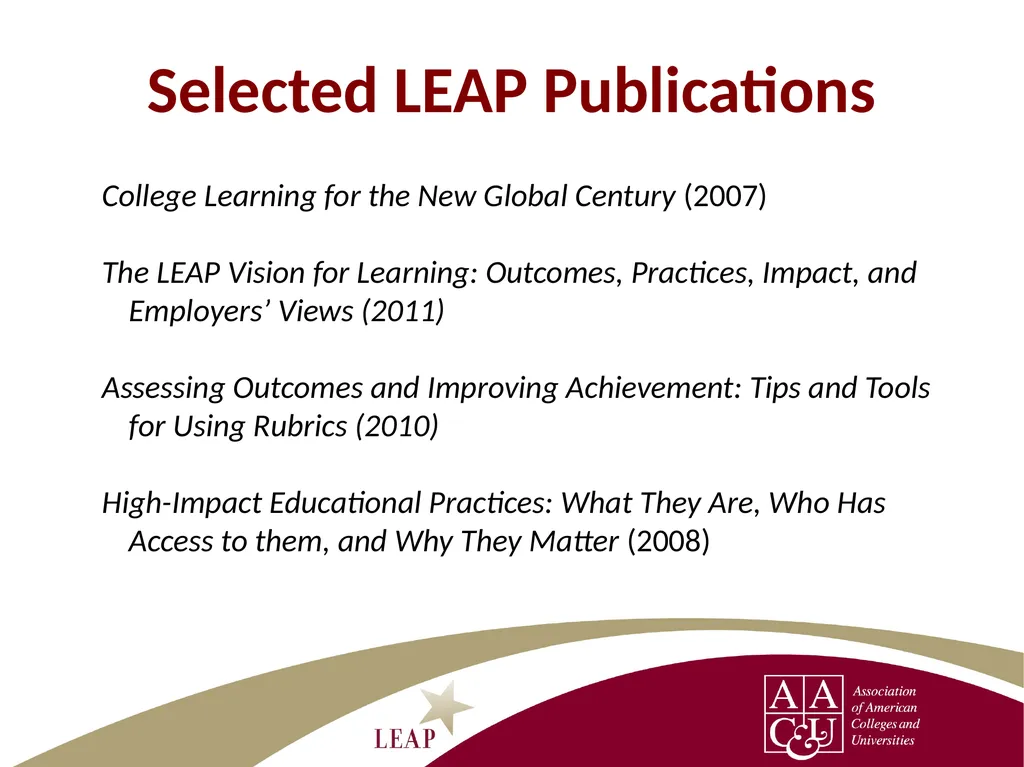
slide16. Selected LEAP Publications College Learning for the New Global Century (2007)
The LEAP Vision for Learning: Outcomes, Practices, Impact, and Employers’ Views (2011)
Assessing Outcomes and Improving Achievement: Tips and Tools for Using Rubrics (2010)
High-Impact Educational Practices: What They Are, Who Has Access to them, and Why They Matter (2008)<br>
slide17. For more information, visit www.aacu.org/LEAP or contact: Bethany Zecher Sutton, Coordinating Director sutton@aacu.org To join the LEAP Campus Action Network, visit www.aacu.org/leap/can/join.cfm<br>
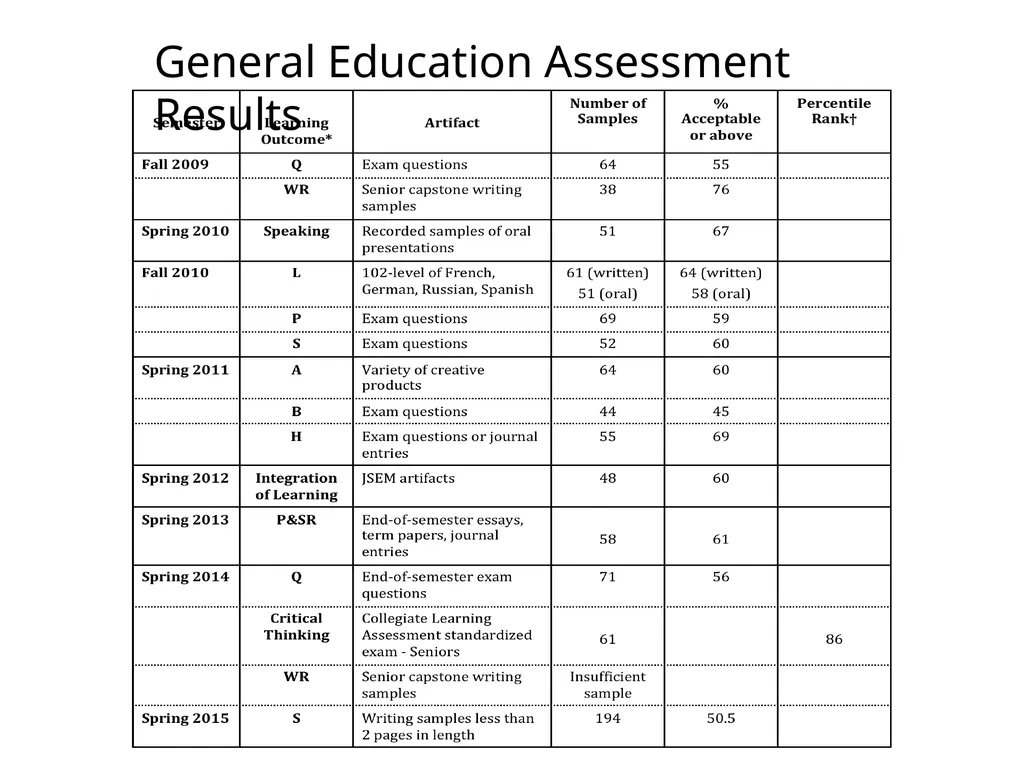
slide18. General Education Assessment Results<br>
slide19. Activity<br>
Greg Sapp, Associate Professor of Religious Studies
Chair of the General Education Assessment Committee (GEAC)
Alicia Slater, Professor and Chair of Biology; Chair, Integrative Health Science; Director, Curriculum and Assessment<br>
slide2. About AAC&U AAC&U is the leading national association concerned with the quality of student learning in college 1,300 institutional members—including accredited public and private colleges and universities of every type and size, including community colleges A network of more than 30,000 faculty members, academic leaders, presidents, and others working for educational reform A meeting ground for all parts of higher education – about our shared responsibilities to students and society<br>
slide3. AAC&U organizes its work around four broad goals:
LEAP: Liberal Education as a Global Necessity
Quality: 21st-Century Markers for the Value of US Degrees
Equity: Innovation, Inclusive Excellence, and Student Success
Social Responsibility: Integrative Liberal Learning for the
Global Commons AAC&U’s Strategic Plan,
2013-2017<br>
slide4. About LEAP Launched in 2005, Liberal Education and America’s Promise (LEAP) is a national initiative that champions the importance of a twenty-first-century liberal education—for individual students and for a nation dependent on economic creativity and democratic vitality.<br>
slide5. Clarifying Terminology AAC&U traditionally –and particularly through LEAP—has advocated for all students to receive a powerful and horizon-expanding liberal education
Liberal Education: An approach to college learning that empowers individuals and prepares them to deal with complexity, diversity and change. It emphasizes broad knowledge of the wider world (e.g., science, culture and society) as well as in-depth achievement in a specific field of interest. It helps students develop a sense of social responsibility as well as strong intellectual and practical skills that span all areas of study, such as communication, analytical and problem-solving skills, and includes a demonstrated ability to apply knowledge and skills in real-world settings.
Liberal Arts: Specific disciplines (e.g., the humanities, sciences, and social sciences)
General Education: The part of a liberal education curriculum shared by all students. It provides broad exposure to multiple disciplines and forms the basis for developing important intellectual and civic capacities.<br>
slide6. Why LEAP? The World is Demanding More:
There is a demand for more numbers of college educated workers
There is a demand for engaged and informed citizens
There also is a demand that those educated workers and citizens have higher levels of learning and knowledge, as well as new and different skills and abilities.<br>
slide7. Why LEAP? Employers are Raising the Bar and Endorse Liberal Education Outcomes
95% of employers put a priority on “hiring people with the intellectual and interpersonal skills that will help them contribute to innovation in the workplace.”
93% of employers agree that “candidates’ demonstrated capacity to think critically, communicate clearly, and solve complex problems is more important than their undergraduate major.”
93% of employers say they are “asking employees to take on more responsibilities and to use a broader set of skills than in the past.”
91% of employers say that “the challenges their employees face are more complex today than they were in the past.” Source: “It Takes More Than a Major: Employer Priorities for College Learning and Student Success” (AAC&U and Hart Research Associates, 2013)<br>
slide8. The Goals of LEAP Spark public debate about the LEAP educational vision and about what learning outcomes are essential for all students; create more informed public support for higher education and for changes to improve quality
Challenge the belief that students must choose either a liberal education or a practical education
Help all students understand, prepare for, and achieve essential learning outcomes in college
Document national, state, and institutional progress in student achievement of essential learning outcomes<br>
slide9. LEAP Promotes Essential Learning Outcomes
A Guiding Vision and National Benchmarks for College Learning and Liberal Education in the 21st Century
High Impact Practices
Helping Students Achieve the Essential Learning Outcomes
Authentic Assessments of Student Learning
Probing Whether Students Can APPLY Their Learning – to Complex Problems and Real-World Challenges
Inclusive Excellence
Diversity, Equity, Quality of Learning for All Groups of Students<br>
slide10. The Essential Learning Outcomes Knowledge of Human Cultures and the Physical and Natural World
Focused on engagement with big questions, enduring and contemporary
Intellectual and Practical Skills
Practiced extensively across the curriculum, in the context of progressively more challenging problems, projects, and standards for performance
Personal and Social Responsibility
Anchored through active involvement with diverse communities and real-world challenges
Integrative and Applied Learning
Demonstrated through the application of knowledge, skills, and responsibilities to new settings and complex problems<br>
slide11. The Essential Learning Outcomes, cont. Knowledge of Human Cultures and the Physical and Natural World Through study in the sciences and mathematics, social sciences, humanities, histories, languages, and the arts
Intellectual and Practical Skills Inquiry and analysis Critical and creative thinking Written and oral communication Quantitative Literacy Information Literacy Teamwork and problem solving
Personal and Social Responsibility Civic knowledge and engagement—local and global Intercultural knowledge and competence Ethical reasoning and action Foundations and skills for lifelong learning
Integrative and Applied Learning Synthesis and advanced accomplishment across general and specialized studies<br>
slide12. High Impact Practices Through the LEAP initiative, AAC&U has published research on a set of widely tested teaching and learning strategies and programs that—when done well—have substantial educational benefits, especially for traditionally underserved students. The elements of good teaching and learning embedded in these practices can be applied in many settings, including in traditional classrooms as well as special programs, and in co-curricular settings. First-Year Seminars and Experiences
Common Intellectual Experiences
Learning Communities
Writing-Intensive Courses
Collaborative Assignments and Projects Undergraduate Research
Diversity/Global Learning
Service Learning, Community-Based Learning
Internships
Capstone Courses and Projects<br>
slide13. Authentic Assessments As part of its VALUE (Valid Assessment of Learning in Undergraduate Education) project, AAC&U worked with faculty and other academic and student affairs professionals in an exhaustive process of gathering, analyzing, synthesizing, and drafting institutional-level rubrics for 16 of the LEAP Essential Learning Outcomes. Each VALUE rubric contains the most common and broadly shared criteria or core characteristics considered critical for judging the quality of student work in that outcome area.
The VALUE rubrics reflect faculty expectations for essential learning across the nation regardless of type of institution, mission, size or location. For more on the VALUE project, please see www.aacu.org/value<br>
slide14. LEAP Principles of Excellence Principle One Aim High—and Make Excellence Inclusive
Principle Two Give Students a Compass
Principle Three Teach the Arts of Inquiry and Innovation
Principle Four Engage the Big Questions Principle Five Connect Knowledge with Choices and Action
Principle Six Foster Civic, Intercultural, and Ethical Learning
Principle Seven Assess Students’ Ability to Apply Learning to Complex Problems The Principles of Excellence offer both challenging standards and flexible guidance for an era of educational reform and renewal. The Principles of Excellence can be used to guide change in any college, community college, or university. They are intended to influence practice across the disciplines as well as in general education programs.<br>
slide15. LEAP Areas of Work Public Advocacy—leadership through National Leadership Council, Presidents’ Trust, and work in selected LEAP states to make the case for liberal education and importance of essential learning outcomes
Campus Action—networking and technical assistance to support campus efforts to increase all students’ achievement of essential learning outcomes and to communicate more effectively about liberal education; leadership through the Campus Action Network of institutions committed to advancing liberal education for all students
Authentic Evidence—reports on public opinion, high-impact practices that lead to essential learning outcomes, assessment approaches that deepen student learning ,and periodic reports of national data on student achievement<br>
slide16. Selected LEAP Publications College Learning for the New Global Century (2007)
The LEAP Vision for Learning: Outcomes, Practices, Impact, and Employers’ Views (2011)
Assessing Outcomes and Improving Achievement: Tips and Tools for Using Rubrics (2010)
High-Impact Educational Practices: What They Are, Who Has Access to them, and Why They Matter (2008)<br>
slide17. For more information, visit www.aacu.org/LEAP or contact: Bethany Zecher Sutton, Coordinating Director sutton@aacu.org To join the LEAP Campus Action Network, visit www.aacu.org/leap/can/join.cfm<br>
slide18. General Education Assessment Results<br>
slide19. Activity<br>