
Library Orientation for HIV/AIDS: Cultural,


Description: Library Orientation for HIVAIDS: Cultural, Social, and Scientific Aspects of the Pandemic Thursday, October 14, 2021 Vince Graziano Sexuality Studies Librarian vince.grazianoconcordia.ca LIBRARY Workshop Outline Searching Sofia for books
Related Topics
Download Presentation
"Library Orientation for HIV/AIDS: Cultural," is the property of its rightful owner. Permission is granted to download and print the materials on this website for personal, non-commercial use only, and to display it on your personal computer provided you do not modify the materials and that you retain all copyright notices contained in the materials. By downloading content from our website, you accept the terms of this agreement.
Presentation Transcript
slide1. Library Orientation for
HIV/AIDS: Cultural, Social, and Scientific Aspects of the Pandemic Thursday, October 14, 2021
Vince Graziano
Sexuality Studies Librarian
vince.graziano@concordia.ca LIBRARY<br>
slide2. Workshop Outline Searching Sofia for books and articles
Finding articles in databases
Academic Search Complete
LGBTQ+ Source
Gender Studies Database
PsycINFO
PubMed
Evaluating sources for credibility
Help is Available<br>
slide3. Sofia for books and articles Now in version 2
Sofia is the name of the catalogue and discovery service for all Quebec University Libraries
Catalogue includes all electronic and physical books, videos etc
A discovery service includes most full-text articles to which Concordia has access
Ability to search QC libraries and libraries worldwide
OR and AND need to be capitalized
Does NOT replace databases
Video:
Searching Sofia<br>
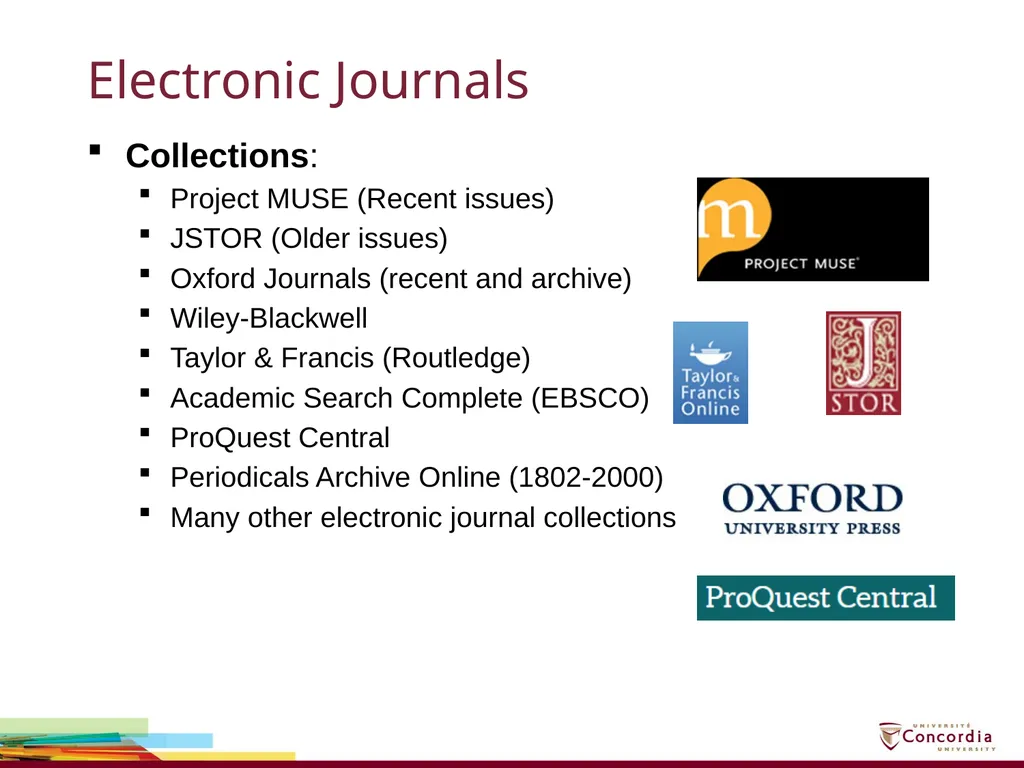
slide4. Electronic Journals Collections:
Project MUSE (Recent issues)
JSTOR (Older issues)
Oxford Journals (recent and archive)
Wiley-Blackwell
Taylor & Francis (Routledge)
Academic Search Complete (EBSCO)
ProQuest Central
Periodicals Archive Online (1802-2000)
Many other electronic journal collections<br>
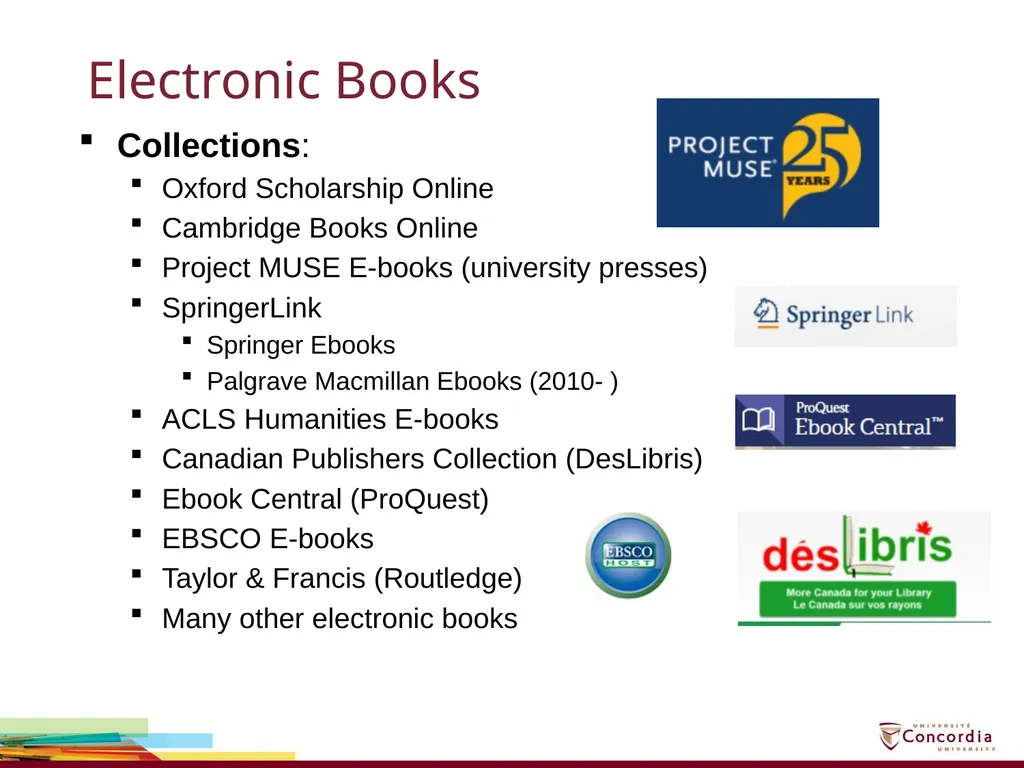
slide5. Electronic Books Collections:
Oxford Scholarship Online
Cambridge Books Online
Project MUSE E-books (university presses)
SpringerLink
Springer Ebooks
Palgrave Macmillan Ebooks (2010- )
ACLS Humanities E-books
Canadian Publishers Collection (DesLibris)
Ebook Central (ProQuest)
EBSCO E-books
Taylor & Francis (Routledge)
Many other electronic books<br>
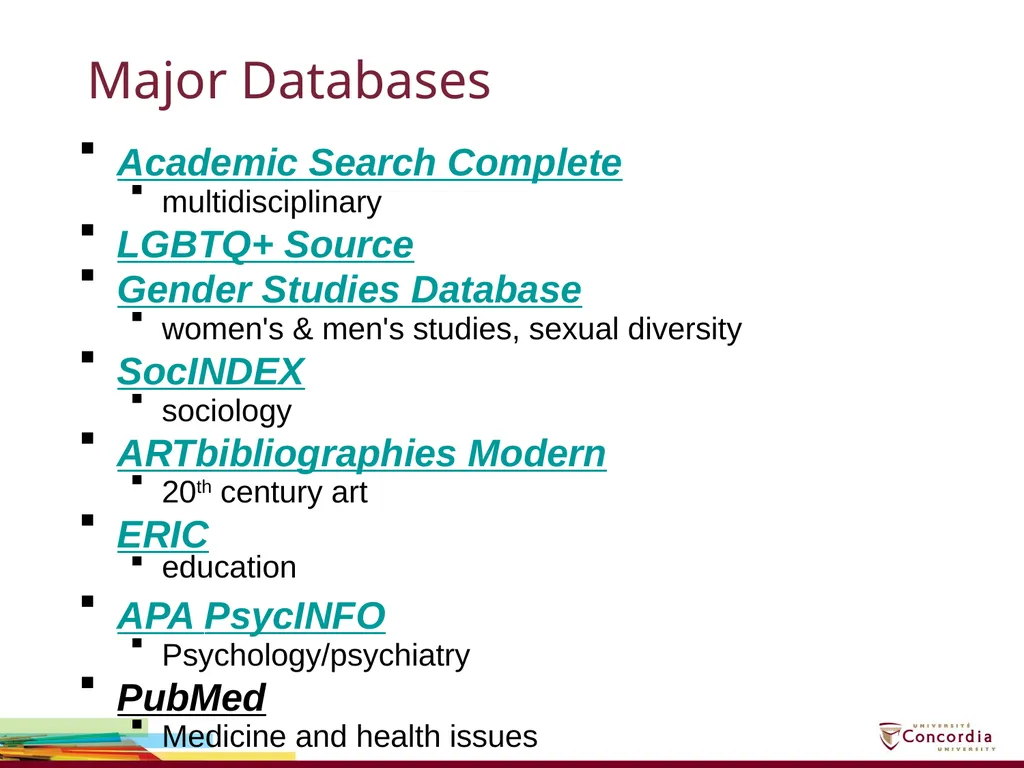
slide6. Major Databases Academic Search Complete
multidisciplinary
LGBTQ+ Source
Gender Studies Database
women's & men's studies, sexual diversity
SocINDEX
sociology
ARTbibliographies Modern
20th century art
ERIC
education
APA PsycINFO
Psychology/psychiatry
PubMed
Medicine and health issues<br>
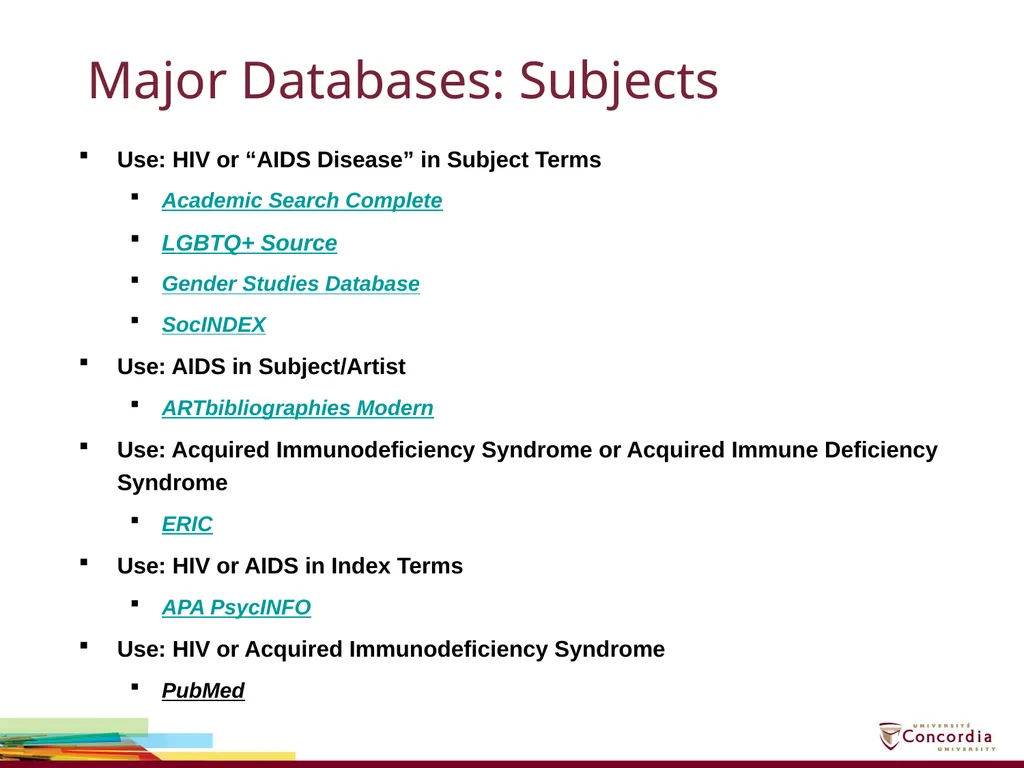
slide7. Major Databases: Subjects Use: HIV or “AIDS Disease” in Subject Terms
Academic Search Complete
LGBTQ+ Source
Gender Studies Database
SocINDEX
Use: AIDS in Subject/Artist
ARTbibliographies Modern
Use: Acquired Immunodeficiency Syndrome or Acquired Immune Deficiency Syndrome
ERIC
Use: HIV or AIDS in Index Terms
APA PsycINFO
Use: HIV or Acquired Immunodeficiency Syndrome
PubMed<br>
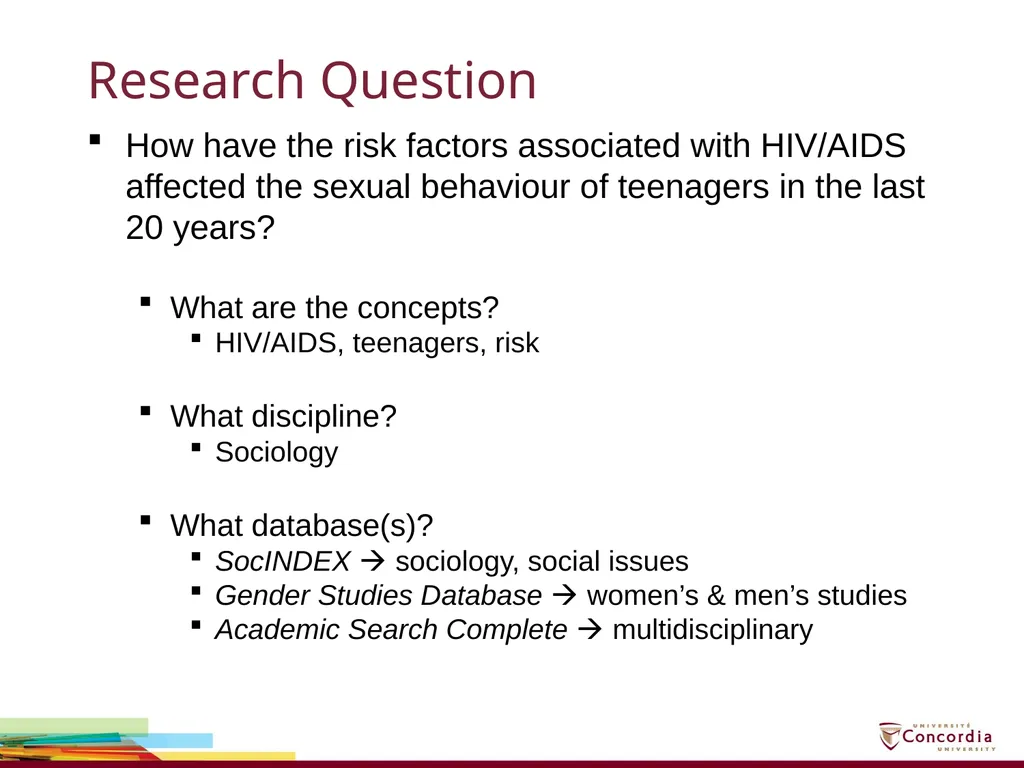
slide8. Research Question How have the risk factors associated with HIV/AIDS affected the sexual behaviour of teenagers in the last 20 years?
What are the concepts?
HIV/AIDS, teenagers, risk
What discipline?
Sociology
What database(s)?
SocINDEX sociology, social issues
Gender Studies Database women’s & men’s studies
Academic Search Complete multidisciplinary<br>
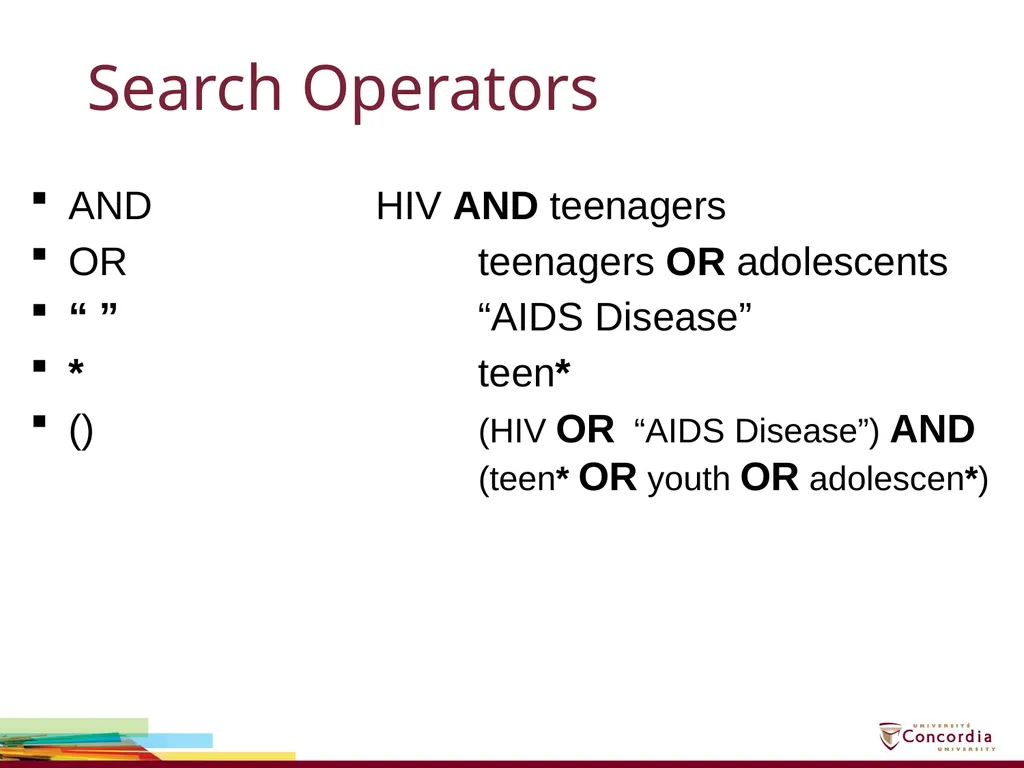
slide9. Search Operators AND HIV AND teenagers
OR teenagers OR adolescents
“ ” “AIDS Disease”
* teen*
() (HIV OR “AIDS Disease”) AND (teen* OR youth OR adolescen*)<br>
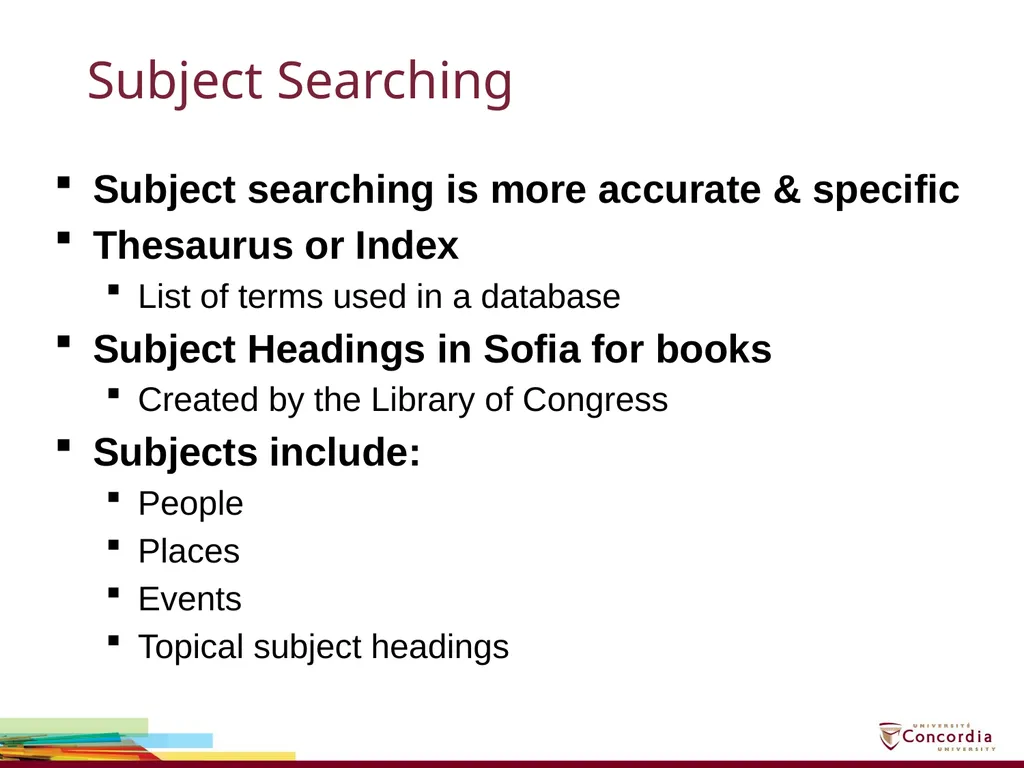
slide10. Subject Searching Subject searching is more accurate & specific
Thesaurus or Index
List of terms used in a database
Subject Headings in Sofia for books
Created by the Library of Congress
Subjects include:
People
Places
Events
Topical subject headings<br>
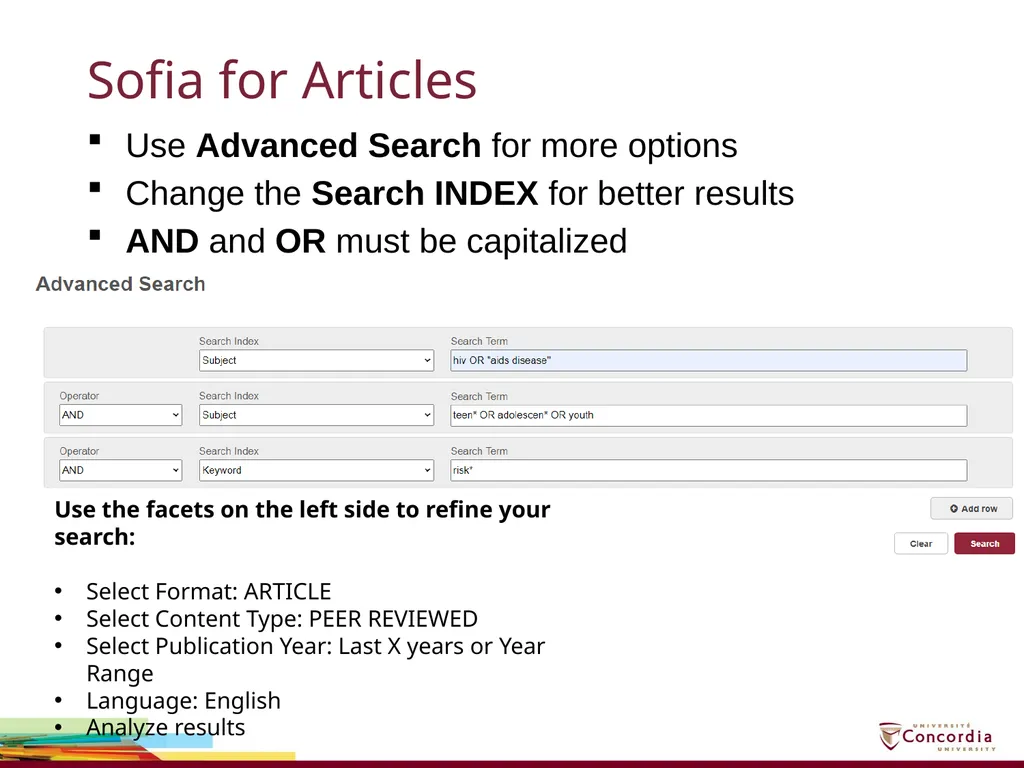
slide11. Sofia for Articles Use Advanced Search for more options
Change the Search INDEX for better results
AND and OR must be capitalized Use the facets on the left side to refine your search:
Select Format: ARTICLE
Select Content Type: PEER REVIEWED
Select Publication Year: Last X years or Year Range
Language: English
Analyze results<br>
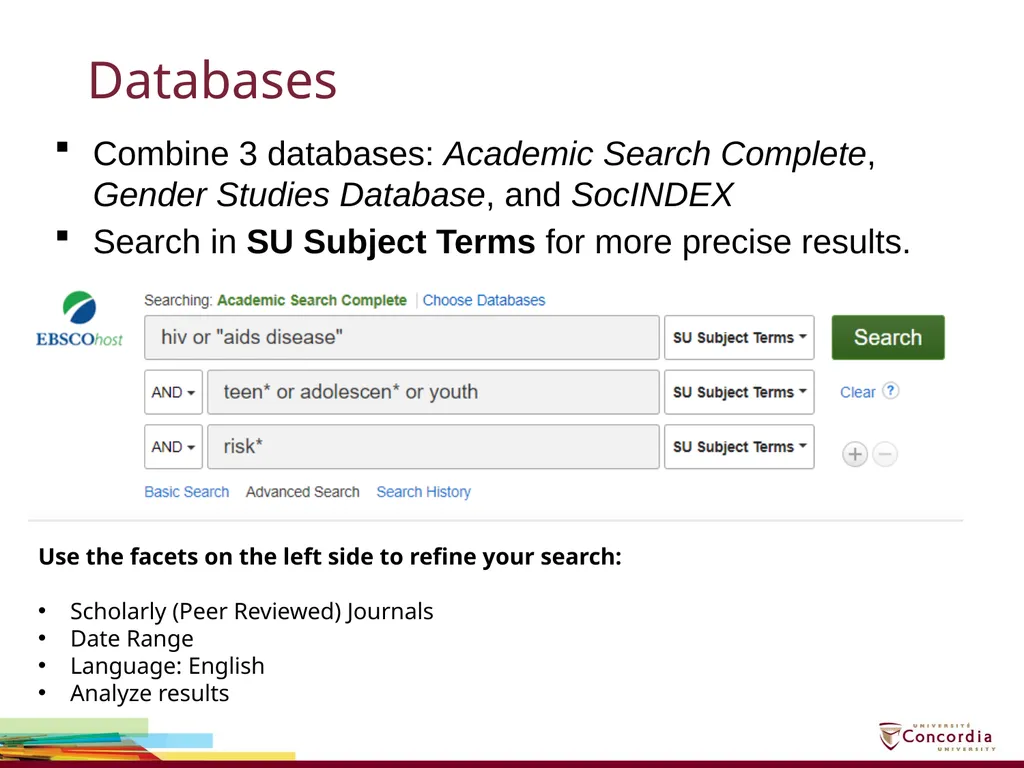
slide12. Databases Combine 3 databases: Academic Search Complete, Gender Studies Database, and SocINDEX
Search in SU Subject Terms for more precise results. Use the facets on the left side to refine your search:
Scholarly (Peer Reviewed) Journals
Date Range
Language: English
Analyze results<br>
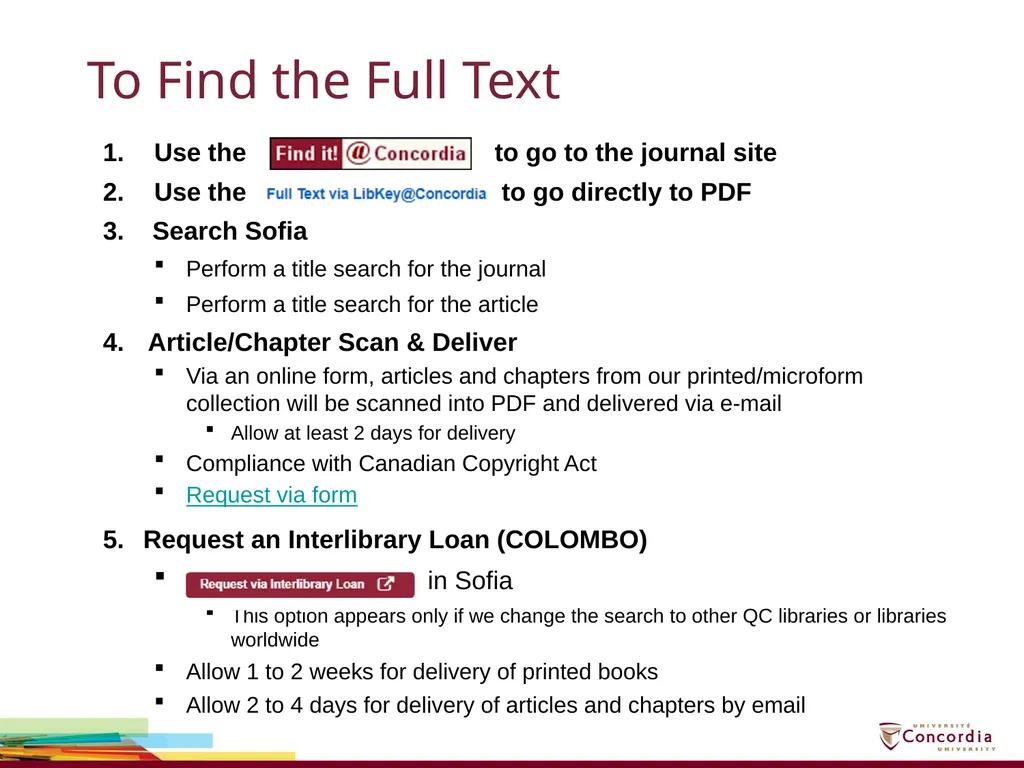
slide13. To Find the Full Text Use the to go to the journal site
Use the to go directly to PDF
3. Search Sofia
Perform a title search for the journal
Perform a title search for the article
4. Article/Chapter Scan & Deliver
Via an online form, articles and chapters from our printed/microform collection will be scanned into PDF and delivered via e-mail
Allow at least 2 days for delivery
Compliance with Canadian Copyright Act
Request via form
5. Request an Interlibrary Loan (COLOMBO)
in Sofia
This option appears only if we change the search to other QC libraries or libraries worldwide
Allow 1 to 2 weeks for delivery of printed books
Allow 2 to 4 days for delivery of articles and chapters by email<br>
slide14. EVALUATING SOURCES for CREDIBILITY<br>
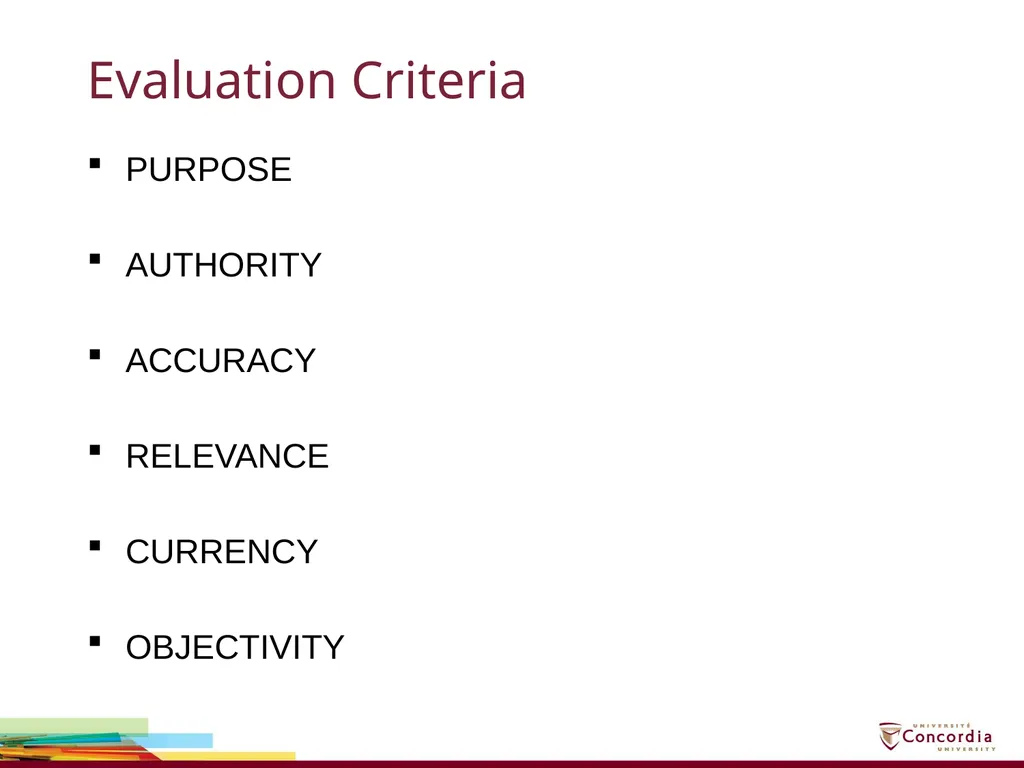
slide15. Evaluation Criteria PURPOSE
AUTHORITY
ACCURACY
RELEVANCE
CURRENCY
OBJECTIVITY<br>
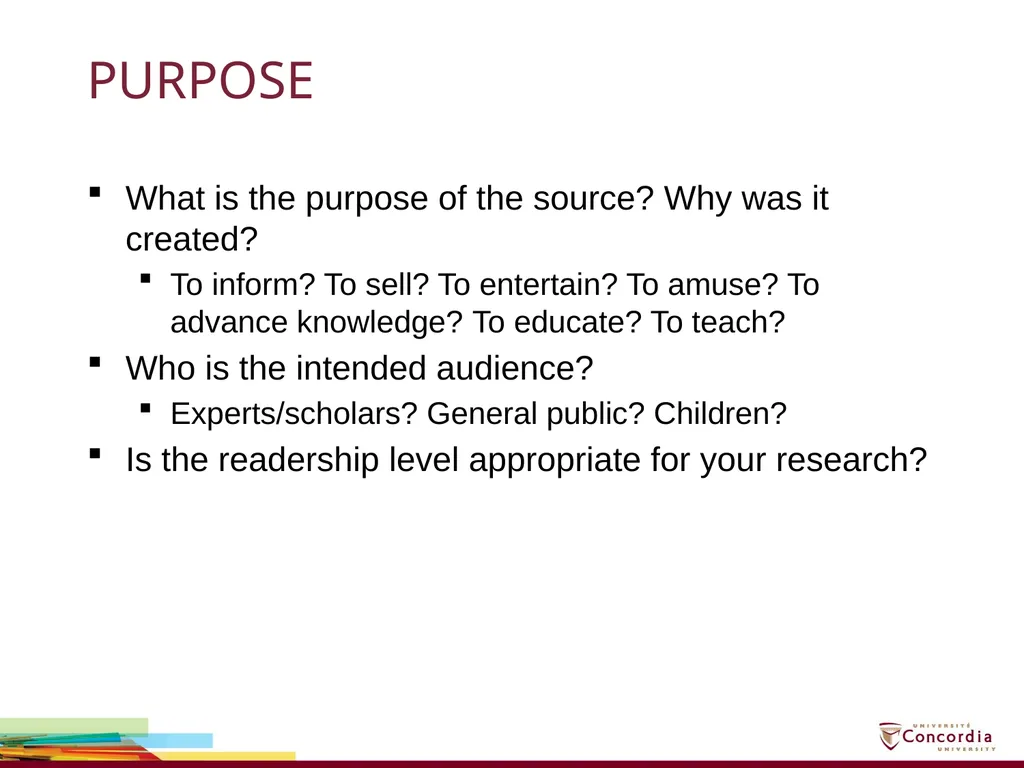
slide16. PURPOSE What is the purpose of the source? Why was it created?
To inform? To sell? To entertain? To amuse? To advance knowledge? To educate? To teach?
Who is the intended audience?
Experts/scholars? General public? Children?
Is the readership level appropriate for your research?<br>
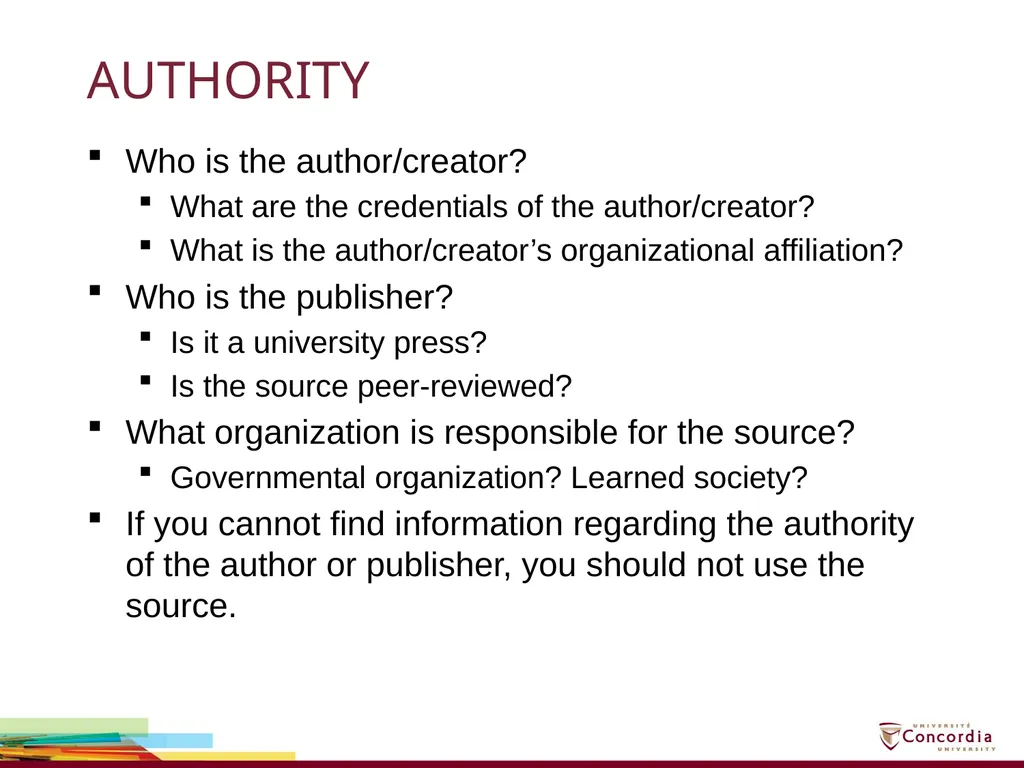
slide17. AUTHORITY Who is the author/creator?
What are the credentials of the author/creator?
What is the author/creator’s organizational affiliation?
Who is the publisher?
Is it a university press?
Is the source peer-reviewed?
What organization is responsible for the source?
Governmental organization? Learned society?
If you cannot find information regarding the authority of the author or publisher, you should not use the source.<br>
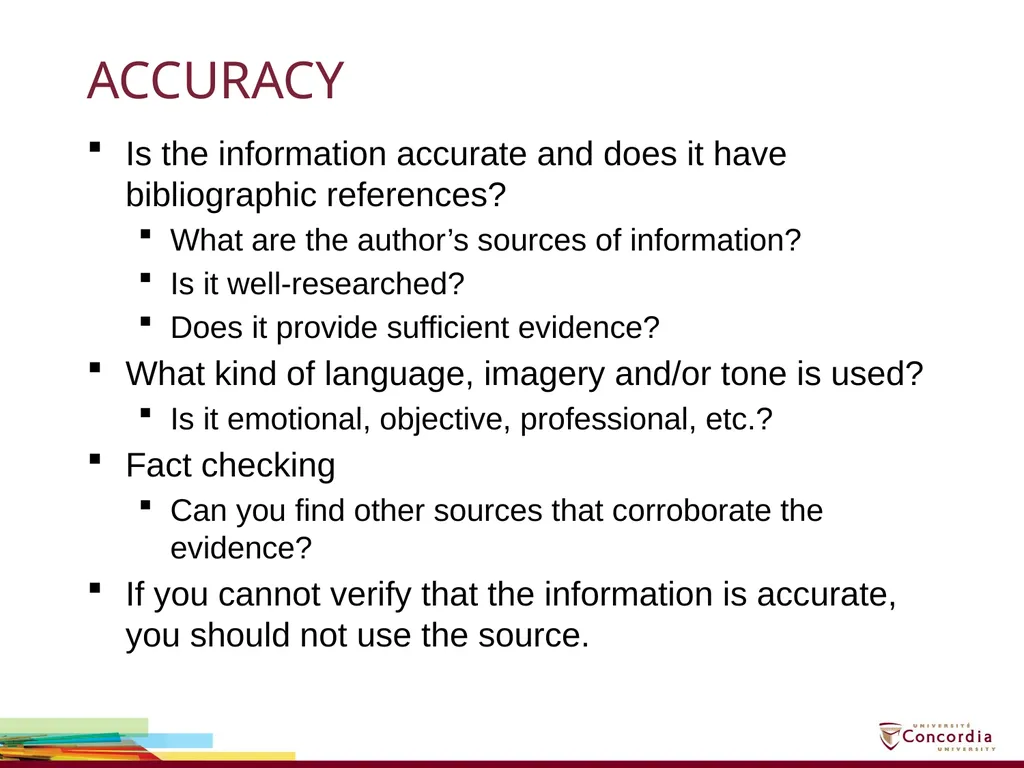
slide18. ACCURACY Is the information accurate and does it have bibliographic references?
What are the author’s sources of information?
Is it well-researched?
Does it provide sufficient evidence?
What kind of language, imagery and/or tone is used?
Is it emotional, objective, professional, etc.?
Fact checking
Can you find other sources that corroborate the evidence?
If you cannot verify that the information is accurate, you should not use the source.<br>
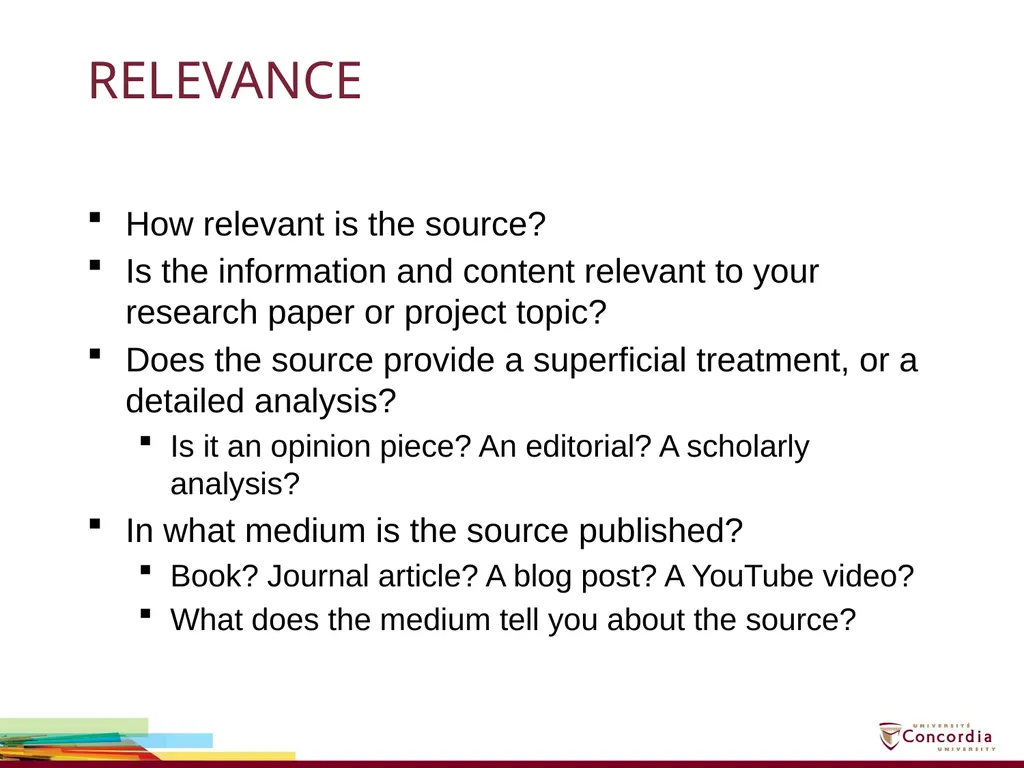
slide19. RELEVANCE How relevant is the source?
Is the information and content relevant to your research paper or project topic?
Does the source provide a superficial treatment, or a detailed analysis?
Is it an opinion piece? An editorial? A scholarly analysis?
In what medium is the source published?
Book? Journal article? A blog post? A YouTube video?
What does the medium tell you about the source?<br>
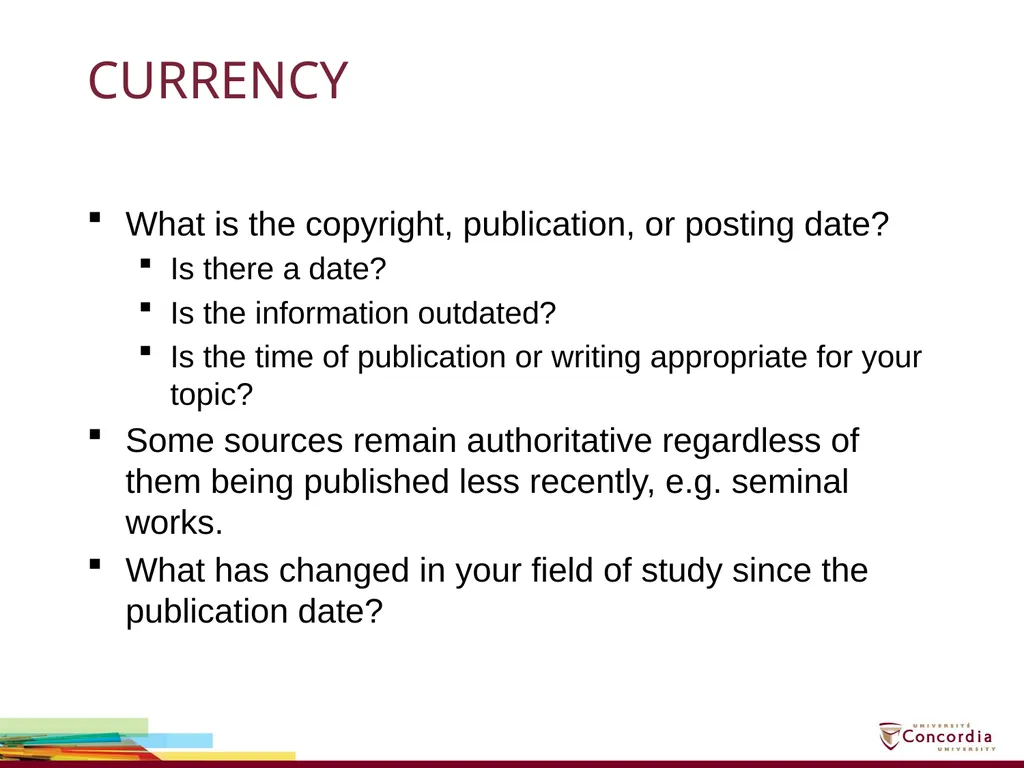
slide20. CURRENCY What is the copyright, publication, or posting date?
Is there a date?
Is the information outdated?
Is the time of publication or writing appropriate for your topic?
Some sources remain authoritative regardless of them being published less recently, e.g. seminal works.
What has changed in your field of study since the publication date?<br>
slide21. OBJECTIVITY Is the material objective and free of advertising, bias, and hidden agendas?
Is the language impartial?
Is the statistical evidence credible?
Conclusions should be based on research and supported evidence
Websites should acknowledge affiliations and associations such as universities, community organizations, social, scientific or government groups or bodies
Media may have a specific intent, and aim to represent a particular stance or bias.<br>
slide22. Help is Available Library website: help & how-to
HIV/AIDS subject guide
Citation style guides
Ask a Librarian
E-mail form
Chat
Ask Us Desks
Entrance to Webster Library
Ask Vince:
vince.graziano@concordia.ca
Office hours: by appointment on ZOOM<br>
Vince Graziano
Sexuality Studies Librarian
vince.graziano@concordia.ca LIBRARY<br>
slide2. Workshop Outline Searching Sofia for books and articles
Finding articles in databases
Academic Search Complete
LGBTQ+ Source
Gender Studies Database
PsycINFO
PubMed
Evaluating sources for credibility
Help is Available<br>
slide3. Sofia for books and articles Now in version 2
Sofia is the name of the catalogue and discovery service for all Quebec University Libraries
Catalogue includes all electronic and physical books, videos etc
A discovery service includes most full-text articles to which Concordia has access
Ability to search QC libraries and libraries worldwide
OR and AND need to be capitalized
Does NOT replace databases
Video:
Searching Sofia<br>
slide4. Electronic Journals Collections:
Project MUSE (Recent issues)
JSTOR (Older issues)
Oxford Journals (recent and archive)
Wiley-Blackwell
Taylor & Francis (Routledge)
Academic Search Complete (EBSCO)
ProQuest Central
Periodicals Archive Online (1802-2000)
Many other electronic journal collections<br>
slide5. Electronic Books Collections:
Oxford Scholarship Online
Cambridge Books Online
Project MUSE E-books (university presses)
SpringerLink
Springer Ebooks
Palgrave Macmillan Ebooks (2010- )
ACLS Humanities E-books
Canadian Publishers Collection (DesLibris)
Ebook Central (ProQuest)
EBSCO E-books
Taylor & Francis (Routledge)
Many other electronic books<br>
slide6. Major Databases Academic Search Complete
multidisciplinary
LGBTQ+ Source
Gender Studies Database
women's & men's studies, sexual diversity
SocINDEX
sociology
ARTbibliographies Modern
20th century art
ERIC
education
APA PsycINFO
Psychology/psychiatry
PubMed
Medicine and health issues<br>
slide7. Major Databases: Subjects Use: HIV or “AIDS Disease” in Subject Terms
Academic Search Complete
LGBTQ+ Source
Gender Studies Database
SocINDEX
Use: AIDS in Subject/Artist
ARTbibliographies Modern
Use: Acquired Immunodeficiency Syndrome or Acquired Immune Deficiency Syndrome
ERIC
Use: HIV or AIDS in Index Terms
APA PsycINFO
Use: HIV or Acquired Immunodeficiency Syndrome
PubMed<br>
slide8. Research Question How have the risk factors associated with HIV/AIDS affected the sexual behaviour of teenagers in the last 20 years?
What are the concepts?
HIV/AIDS, teenagers, risk
What discipline?
Sociology
What database(s)?
SocINDEX sociology, social issues
Gender Studies Database women’s & men’s studies
Academic Search Complete multidisciplinary<br>
slide9. Search Operators AND HIV AND teenagers
OR teenagers OR adolescents
“ ” “AIDS Disease”
* teen*
() (HIV OR “AIDS Disease”) AND (teen* OR youth OR adolescen*)<br>
slide10. Subject Searching Subject searching is more accurate & specific
Thesaurus or Index
List of terms used in a database
Subject Headings in Sofia for books
Created by the Library of Congress
Subjects include:
People
Places
Events
Topical subject headings<br>
slide11. Sofia for Articles Use Advanced Search for more options
Change the Search INDEX for better results
AND and OR must be capitalized Use the facets on the left side to refine your search:
Select Format: ARTICLE
Select Content Type: PEER REVIEWED
Select Publication Year: Last X years or Year Range
Language: English
Analyze results<br>
slide12. Databases Combine 3 databases: Academic Search Complete, Gender Studies Database, and SocINDEX
Search in SU Subject Terms for more precise results. Use the facets on the left side to refine your search:
Scholarly (Peer Reviewed) Journals
Date Range
Language: English
Analyze results<br>
slide13. To Find the Full Text Use the to go to the journal site
Use the to go directly to PDF
3. Search Sofia
Perform a title search for the journal
Perform a title search for the article
4. Article/Chapter Scan & Deliver
Via an online form, articles and chapters from our printed/microform collection will be scanned into PDF and delivered via e-mail
Allow at least 2 days for delivery
Compliance with Canadian Copyright Act
Request via form
5. Request an Interlibrary Loan (COLOMBO)
in Sofia
This option appears only if we change the search to other QC libraries or libraries worldwide
Allow 1 to 2 weeks for delivery of printed books
Allow 2 to 4 days for delivery of articles and chapters by email<br>
slide14. EVALUATING SOURCES for CREDIBILITY<br>
slide15. Evaluation Criteria PURPOSE
AUTHORITY
ACCURACY
RELEVANCE
CURRENCY
OBJECTIVITY<br>
slide16. PURPOSE What is the purpose of the source? Why was it created?
To inform? To sell? To entertain? To amuse? To advance knowledge? To educate? To teach?
Who is the intended audience?
Experts/scholars? General public? Children?
Is the readership level appropriate for your research?<br>
slide17. AUTHORITY Who is the author/creator?
What are the credentials of the author/creator?
What is the author/creator’s organizational affiliation?
Who is the publisher?
Is it a university press?
Is the source peer-reviewed?
What organization is responsible for the source?
Governmental organization? Learned society?
If you cannot find information regarding the authority of the author or publisher, you should not use the source.<br>
slide18. ACCURACY Is the information accurate and does it have bibliographic references?
What are the author’s sources of information?
Is it well-researched?
Does it provide sufficient evidence?
What kind of language, imagery and/or tone is used?
Is it emotional, objective, professional, etc.?
Fact checking
Can you find other sources that corroborate the evidence?
If you cannot verify that the information is accurate, you should not use the source.<br>
slide19. RELEVANCE How relevant is the source?
Is the information and content relevant to your research paper or project topic?
Does the source provide a superficial treatment, or a detailed analysis?
Is it an opinion piece? An editorial? A scholarly analysis?
In what medium is the source published?
Book? Journal article? A blog post? A YouTube video?
What does the medium tell you about the source?<br>
slide20. CURRENCY What is the copyright, publication, or posting date?
Is there a date?
Is the information outdated?
Is the time of publication or writing appropriate for your topic?
Some sources remain authoritative regardless of them being published less recently, e.g. seminal works.
What has changed in your field of study since the publication date?<br>
slide21. OBJECTIVITY Is the material objective and free of advertising, bias, and hidden agendas?
Is the language impartial?
Is the statistical evidence credible?
Conclusions should be based on research and supported evidence
Websites should acknowledge affiliations and associations such as universities, community organizations, social, scientific or government groups or bodies
Media may have a specific intent, and aim to represent a particular stance or bias.<br>
slide22. Help is Available Library website: help & how-to
HIV/AIDS subject guide
Citation style guides
Ask a Librarian
E-mail form
Chat
Ask Us Desks
Entrance to Webster Library
Ask Vince:
vince.graziano@concordia.ca
Office hours: by appointment on ZOOM<br>