
Life after the Leaving Cert Information for


Description: Life after the Leaving Cert Information for Parents Student Options Third Level Course - CAO course in UniversityTechnical UniversityCollegeIT Further Education (PLC) Course Apprenticeship Employment Common Points Scale LCVP - POINTS
Related Topics
Download Presentation
"Life after the Leaving Cert Information for" is the property of its rightful owner. Permission is granted to download and print the materials on this website for personal, non-commercial use only, and to display it on your personal computer provided you do not modify the materials and that you retain all copyright notices contained in the materials. By downloading content from our website, you accept the terms of this agreement.
Presentation Transcript
slide1. Life after the Leaving Cert
Information for Parents<br>
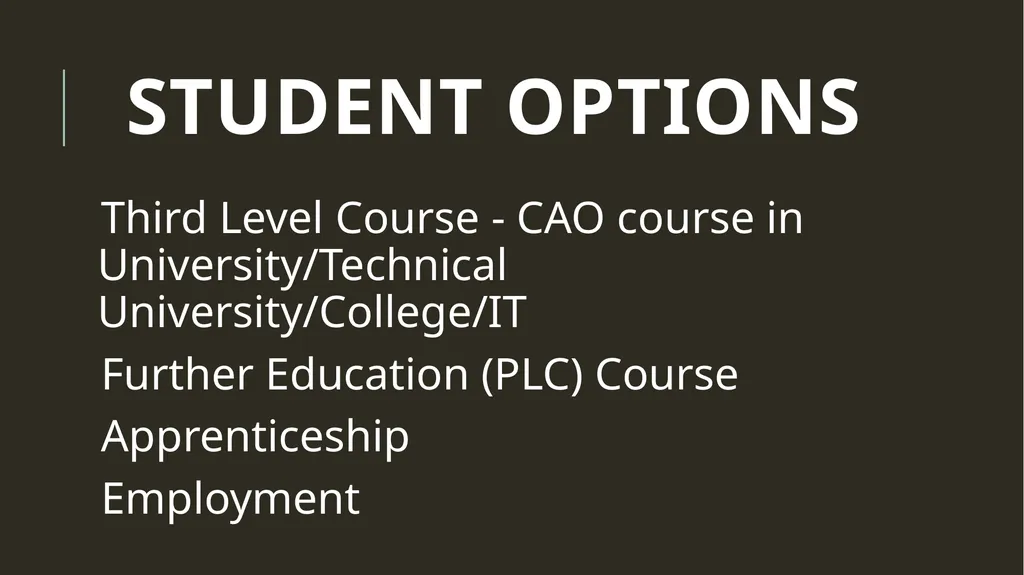
slide2. Student Options Third Level Course - CAO course in University/Technical University/College/IT
Further Education (PLC) Course
Apprenticeship
Employment<br>
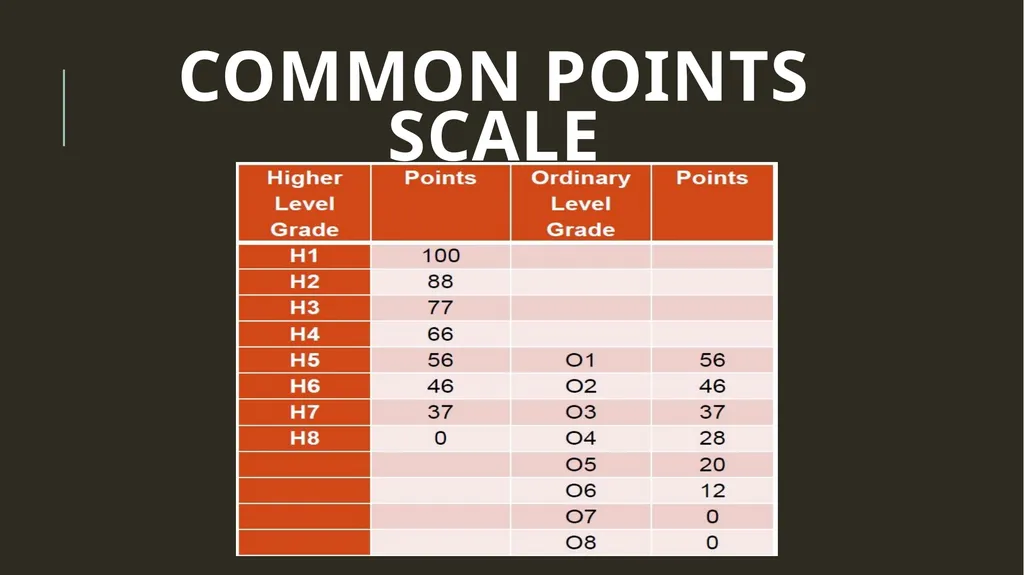
slide3. Common Points Scale<br>
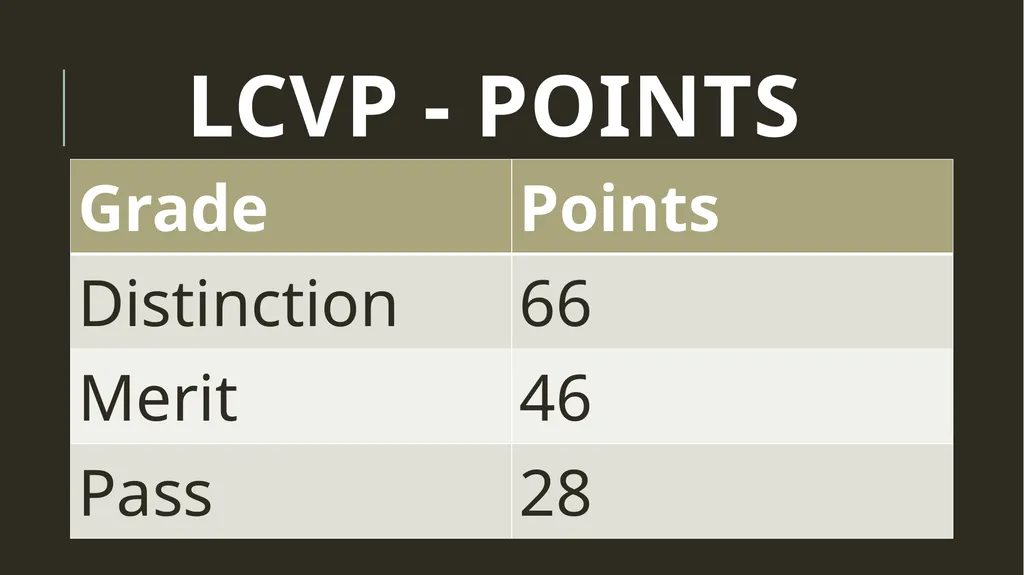
slide4. LCVP - POINTS<br>
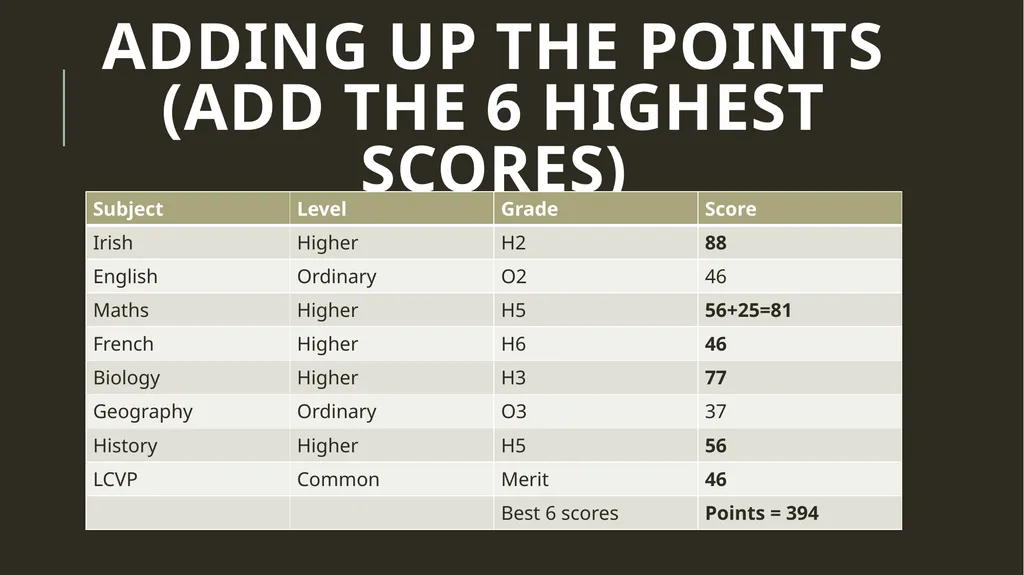
slide5. Adding up the points (Add the 6 highest scores)<br>
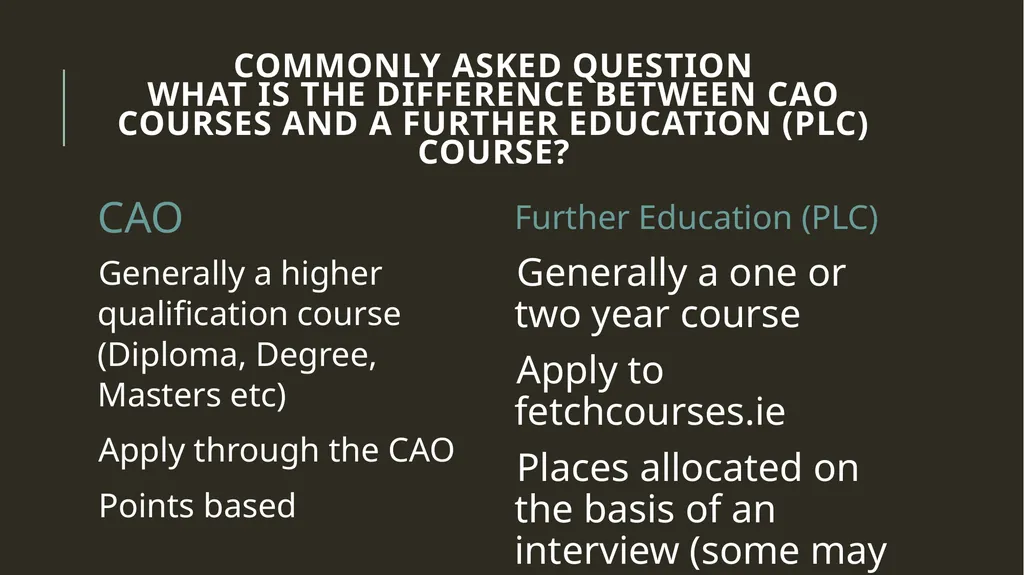
slide6. Commonly asked question What is the difference between CAO courses and a Further Education (PLC) course? CAO Generally a higher qualification course (Diploma, Degree, Masters etc)
Apply through the CAO
Points based Further Education (PLC) Generally a one or two year course
Apply to fetchcourses.ie
Places allocated on the basis of an interview (some may have additional requirements)<br>
slide7. What is the CAO? Central Applications Office
based in Galway.
What do they do?
They process all applications to undergraduate courses in Higher Education Institutions (HEIs).
What do they NOT do?
They do not SET the points each year.<br>
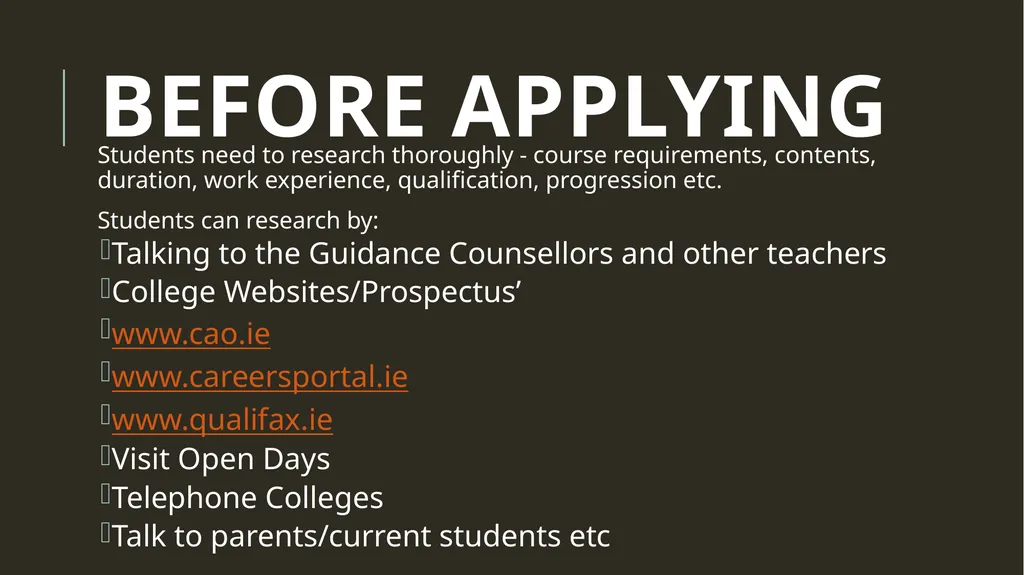
slide8. Before applying Students need to research thoroughly - course requirements, contents, duration, work experience, qualification, progression etc.
Students can research by:
Talking to the Guidance Counsellors and other teachers
College Websites/Prospectus’
www.cao.ie
www.careersportal.ie
www.qualifax.ie
Visit Open Days
Telephone Colleges
Talk to parents/current students etc<br>
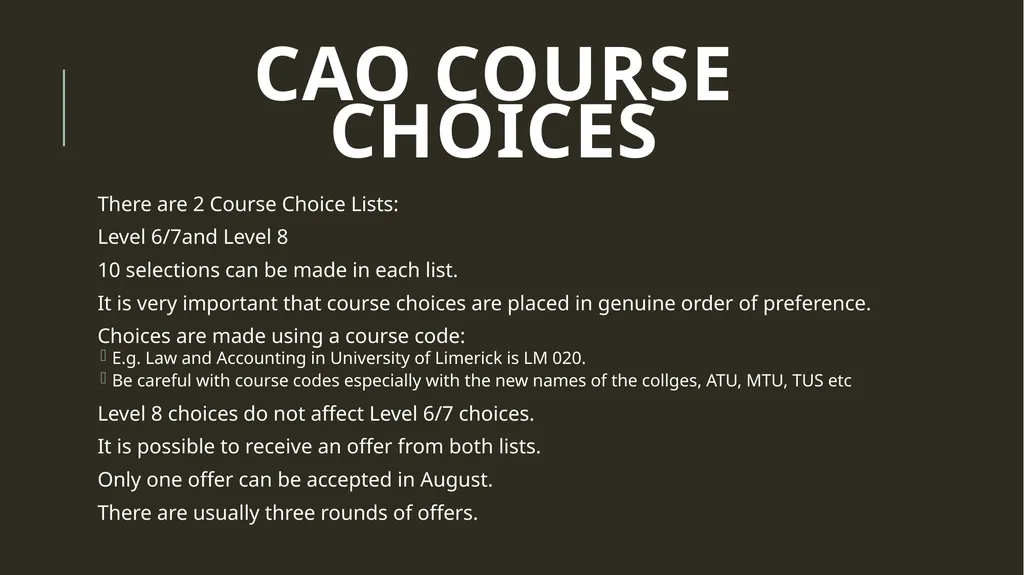
slide9. CAO Course Choices There are 2 Course Choice Lists:
Level 6/7and Level 8
10 selections can be made in each list.
It is very important that course choices are placed in genuine order of preference.
Choices are made using a course code:
E.g. Law and Accounting in University of Limerick is LM 020.
Be careful with course codes especially with the new names of the collges, ATU, MTU, TUS etc
Level 8 choices do not affect Level 6/7 choices.
It is possible to receive an offer from both lists.
Only one offer can be accepted in August.
There are usually three rounds of offers.<br>
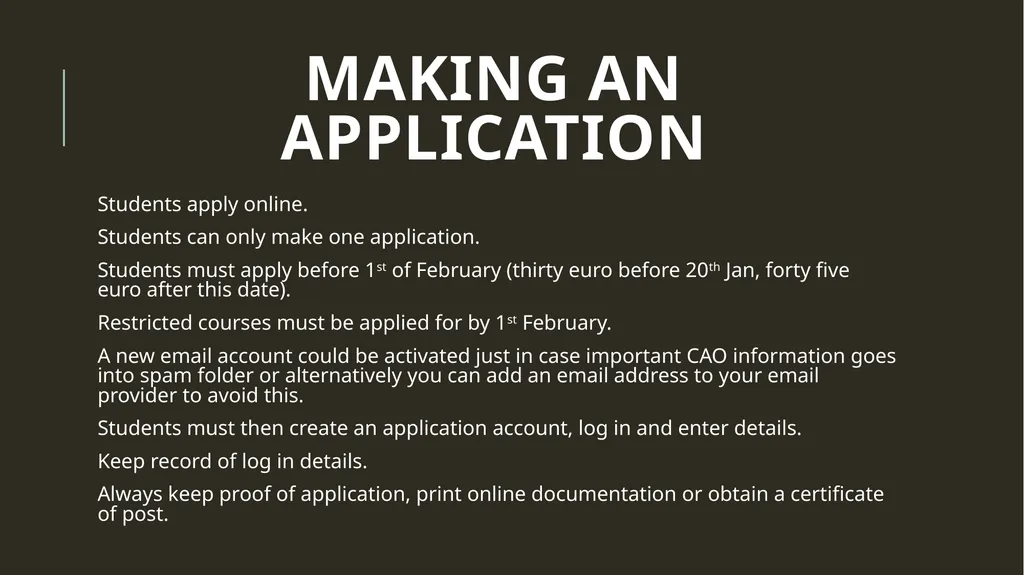
slide10. Making an Application Students apply online.
Students can only make one application.
Students must apply before 1st of February (thirty euro before 20th Jan, forty five euro after this date).
Restricted courses must be applied for by 1st February.
A new email account could be activated just in case important CAO information goes into spam folder or alternatively you can add an email address to your email provider to avoid this.
Students must then create an application account, log in and enter details.
Keep record of log in details.
Always keep proof of application, print online documentation or obtain a certificate of post.<br>
slide11. You do not need to guess what the points are going to be for the courses you are interested in.
Simply list your courses in genuine order of preference from the highest preference 1, to the lowest preference 10.
If you are entitled to an offer, you will be offered the highest preference that you are entitled to.<br>
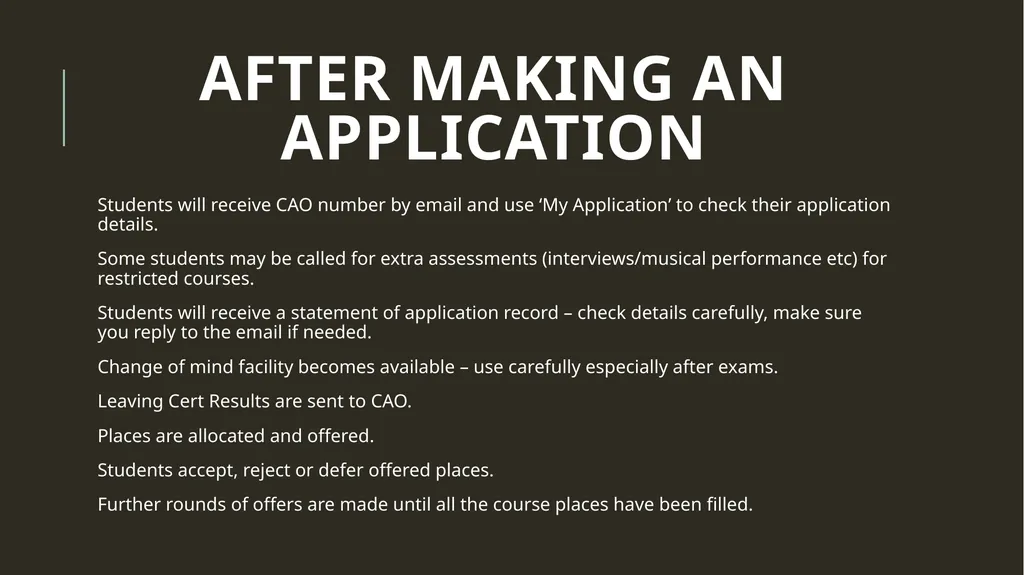
slide12. After Making an Application Students will receive CAO number by email and use ‘My Application’ to check their application details.
Some students may be called for extra assessments (interviews/musical performance etc) for restricted courses.
Students will receive a statement of application record – check details carefully, make sure you reply to the email if needed.
Change of mind facility becomes available – use carefully especially after exams.
Leaving Cert Results are sent to CAO.
Places are allocated and offered.
Students accept, reject or defer offered places.
Further rounds of offers are made until all the course places have been filled.<br>
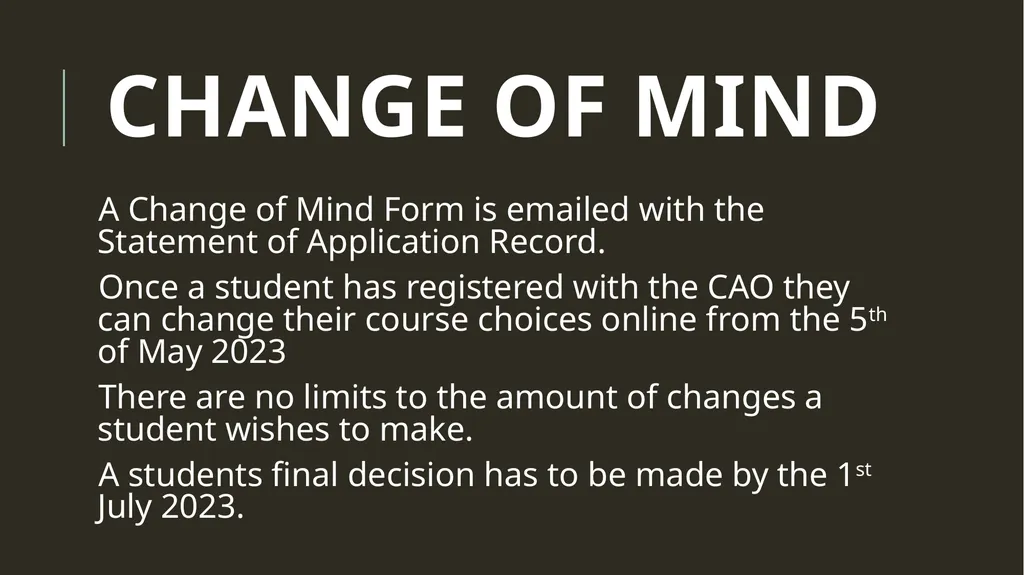
slide13. Change of Mind A Change of Mind Form is emailed with the Statement of Application Record.
Once a student has registered with the CAO they can change their course choices online from the 5th of May 2023
There are no limits to the amount of changes a student wishes to make.
A students final decision has to be made by the 1st July 2023.<br>
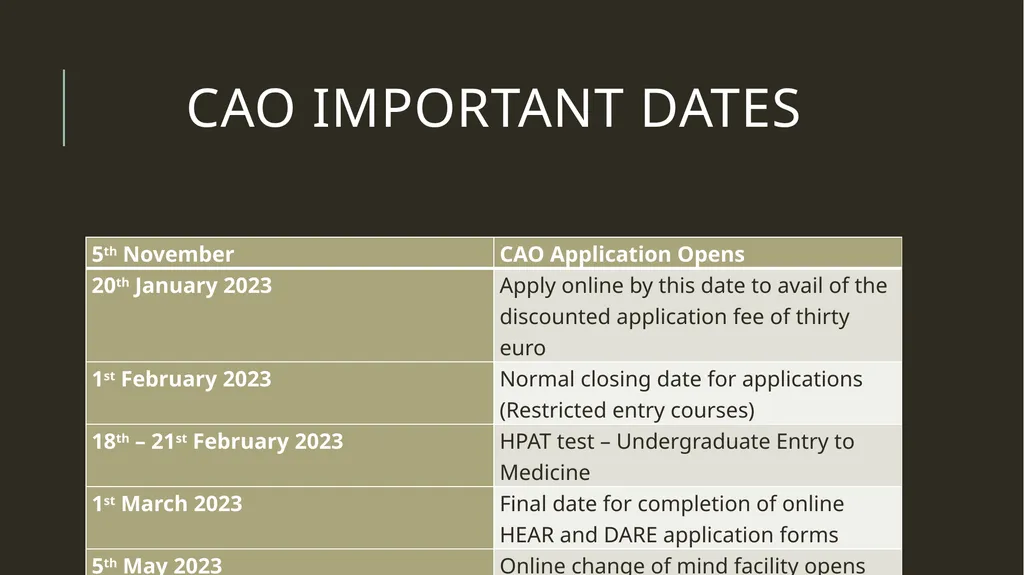
slide14. CAO Important DATES<br>
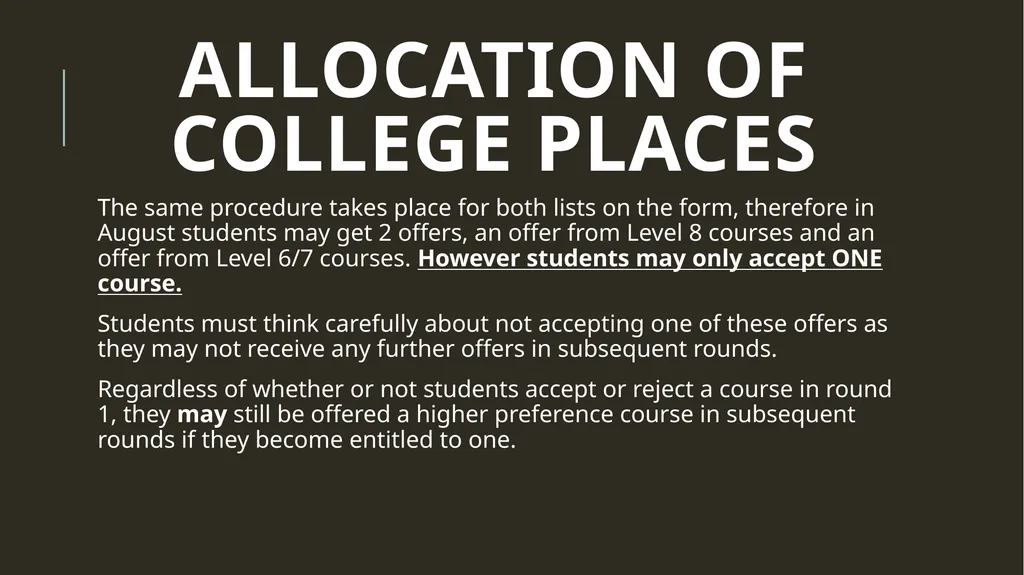
slide15. Allocation of College Places The same procedure takes place for both lists on the form, therefore in August students may get 2 offers, an offer from Level 8 courses and an offer from Level 6/7 courses. However students may only accept ONE course.
Students must think carefully about not accepting one of these offers as they may not receive any further offers in subsequent rounds.
Regardless of whether or not students accept or reject a course in round 1, they may still be offered a higher preference course in subsequent rounds if they become entitled to one.<br>
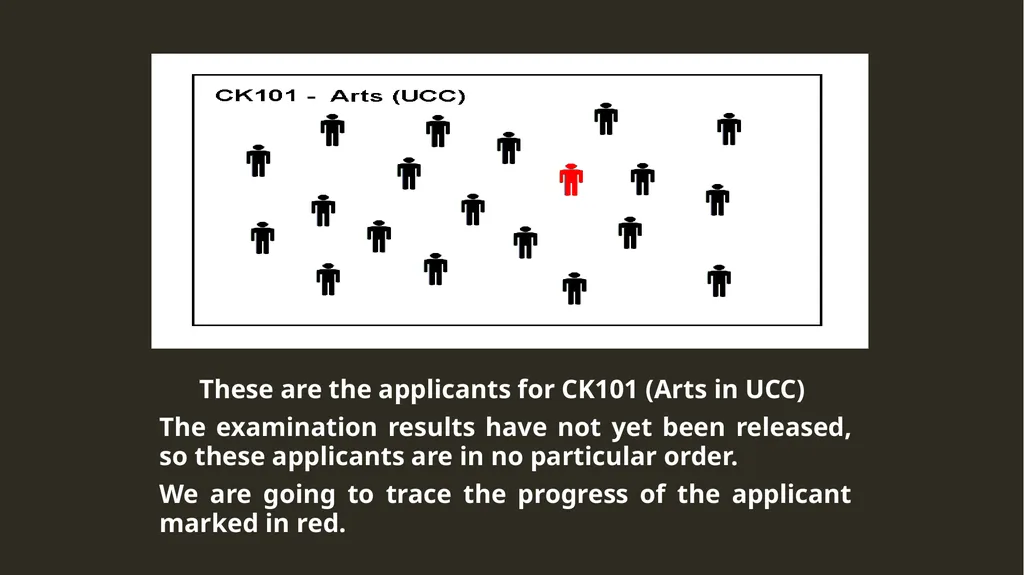
slide16. These are the applicants for CK101 (Arts in UCC)
The examination results have not yet been released, so these applicants are in no particular order.
We are going to trace the progress of the applicant marked in red.<br>
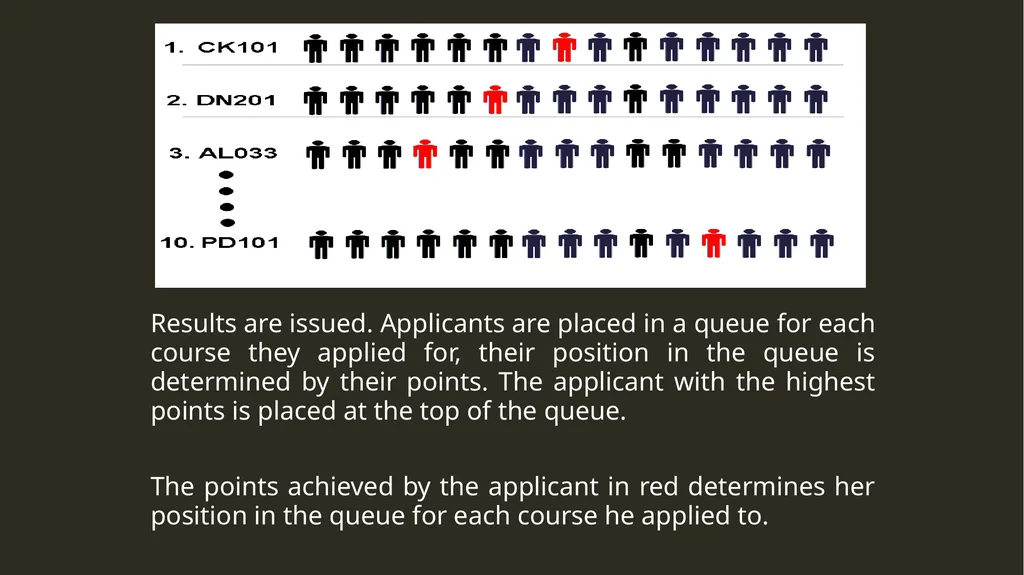
slide17. Results are issued. Applicants are placed in a queue for each course they applied for, their position in the queue is determined by their points. The applicant with the highest points is placed at the top of the queue.
The points achieved by the applicant in red determines her position in the queue for each course he applied to.<br>
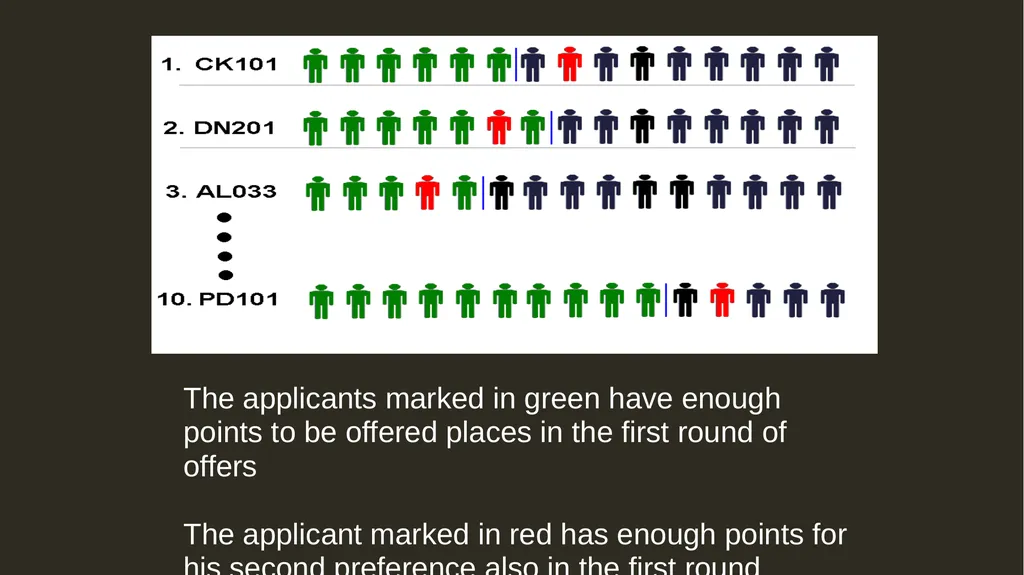
slide18. The applicants marked in green have enough points to be offered places in the first round of offers
The applicant marked in red has enough points for his second preference also in the first round<br>
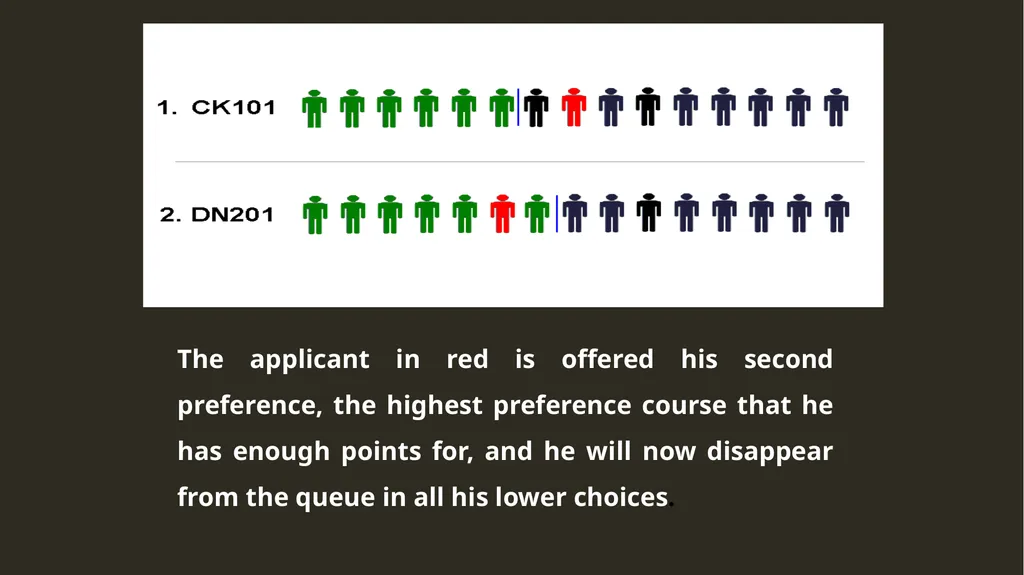
slide19. The applicant in red is offered his second preference, the highest preference course that he has enough points for, and he will now disappear from the queue in all his lower choices.<br>
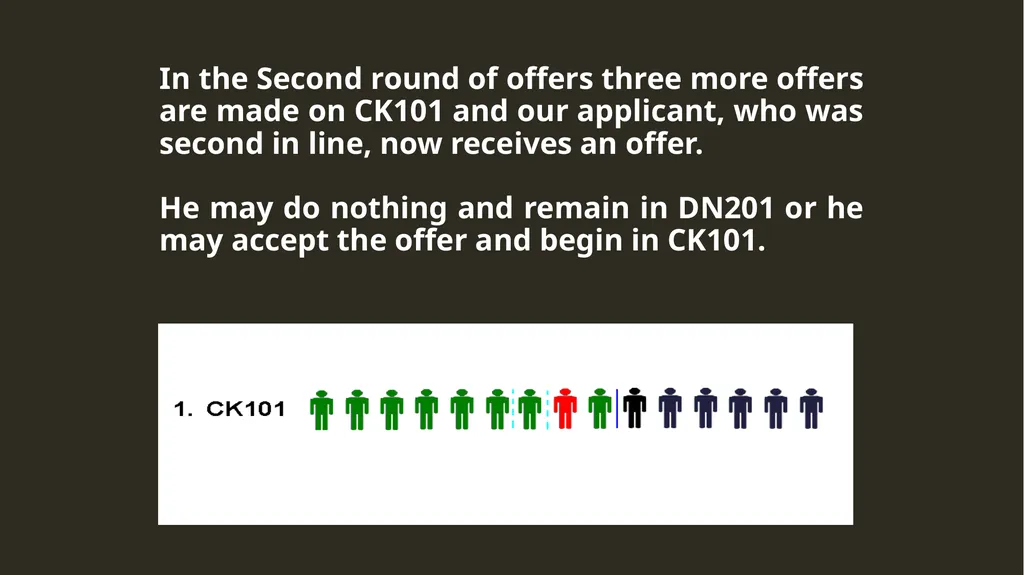
slide20. In the Second round of offers three more offers are made on CK101 and our applicant, who was second in line, now receives an offer.
He may do nothing and remain in DN201 or he may accept the offer and begin in CK101.<br>
slide21. Important Information If a student has an exemption from Irish and/or a third language they must complete an NUI Exemption Form to ensure that they meet the entry requirements of UCD, UCC, NUI Maynooth and NUI Galway and other NUI Colleges
Visit www.cao.ie for more information on exemptions
SUSI (Student Universal Support Ireland) is Ireland’s national awarding authority for all higher and further education grants
SUSI offers funding for eligible students in approved full-time third –level education in Ireland and also in some cases funding for students studying outside the state.
To see if you are eligible for a SUSI grant visit SUSI.ie and click on eligibility reckoner
If you think that your son/daughter may be eligible for a SUSI grant, when filling out the CAO form make sure to click the box beside SUSI in the grant section<br>
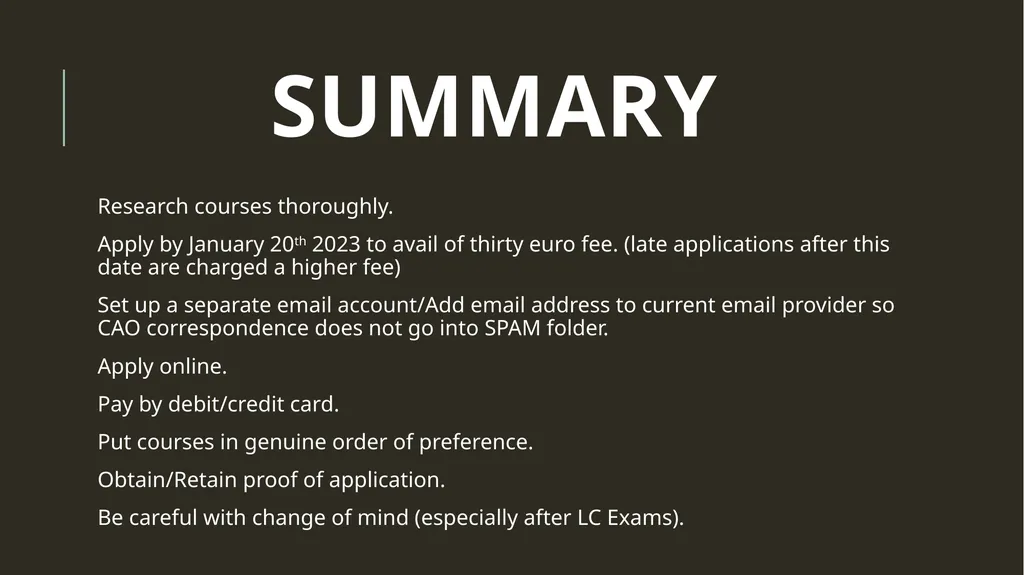
slide22. Summary Research courses thoroughly.
Apply by January 20th 2023 to avail of thirty euro fee. (late applications after this date are charged a higher fee)
Set up a separate email account/Add email address to current email provider so CAO correspondence does not go into SPAM folder.
Apply online.
Pay by debit/credit card.
Put courses in genuine order of preference.
Obtain/Retain proof of application.
Be careful with change of mind (especially after LC Exams).<br>
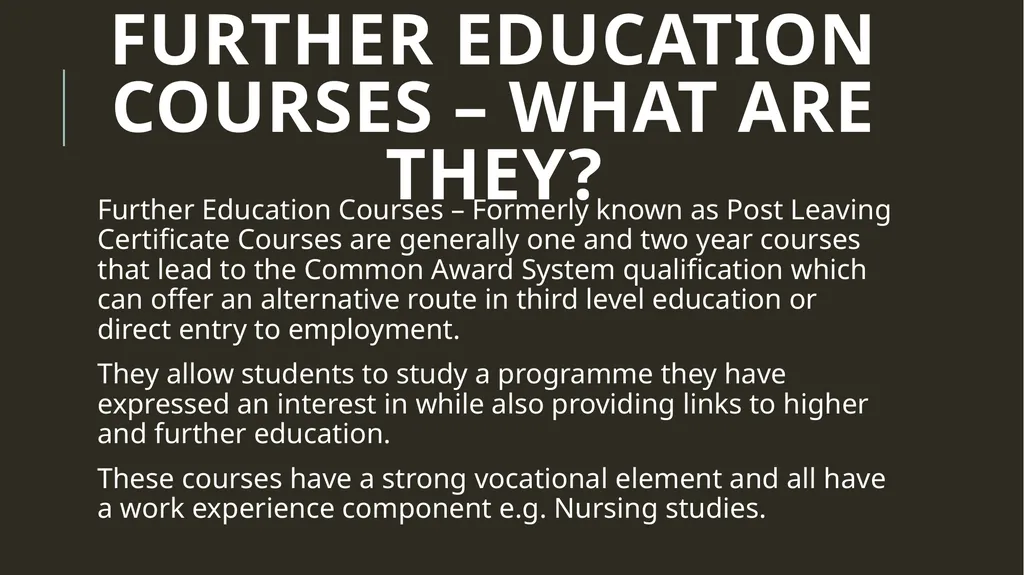
slide23. Further Education Courses – What are they? Further Education Courses – Formerly known as Post Leaving Certificate Courses are generally one and two year courses that lead to the Common Award System qualification which can offer an alternative route in third level education or direct entry to employment.
They allow students to study a programme they have expressed an interest in while also providing links to higher and further education.
These courses have a strong vocational element and all have a work experience component e.g. Nursing studies.<br>
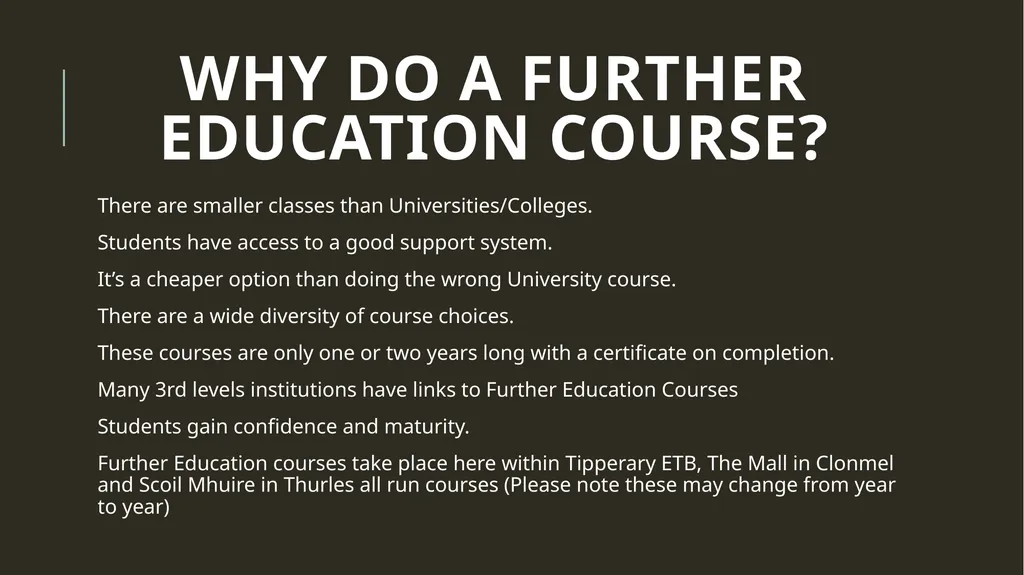
slide24. WHY DO A Further Education COURSE? There are smaller classes than Universities/Colleges.
Students have access to a good support system.
It’s a cheaper option than doing the wrong University course.
There are a wide diversity of course choices.
These courses are only one or two years long with a certificate on completion.
Many 3rd levels institutions have links to Further Education Courses
Students gain confidence and maturity.
Further Education courses take place here within Tipperary ETB, The Mall in Clonmel and Scoil Mhuire in Thurles all run courses (Please note these may change from year to year)<br>
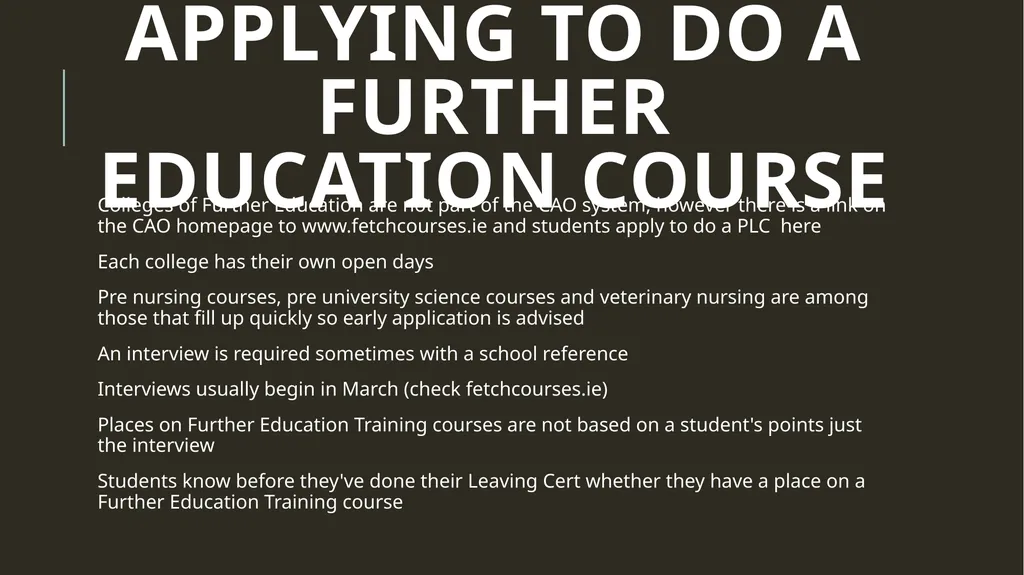
slide25. Applying to do a further education course Colleges of Further Education are not part of the CAO system, however there is a link on the CAO homepage to www.fetchcourses.ie and students apply to do a PLC here
Each college has their own open days
Pre nursing courses, pre university science courses and veterinary nursing are among those that fill up quickly so early application is advised
An interview is required sometimes with a school reference
Interviews usually begin in March (check fetchcourses.ie)
Places on Further Education Training courses are not based on a student's points just the interview
Students know before they've done their Leaving Cert whether they have a place on a Further Education Training course<br>
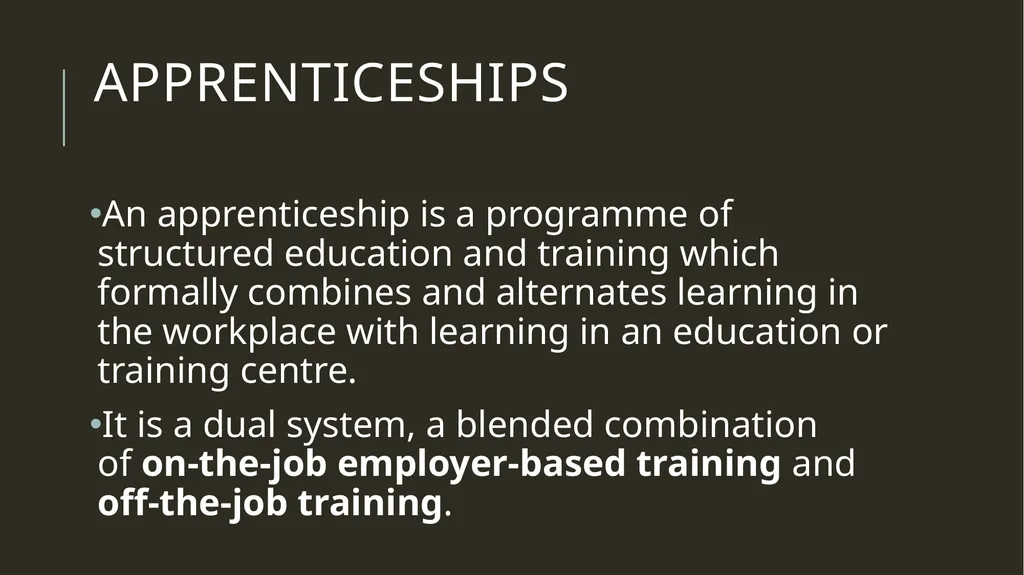
slide26. aPPRENTICESHIPShat is an apprenticeship? An apprenticeship is a programme of structured education and training which formally combines and alternates learning in the workplace with learning in an education or training centre.
It is a dual system, a blended combination of on-the-job employer-based training and off-the-job training.<br>
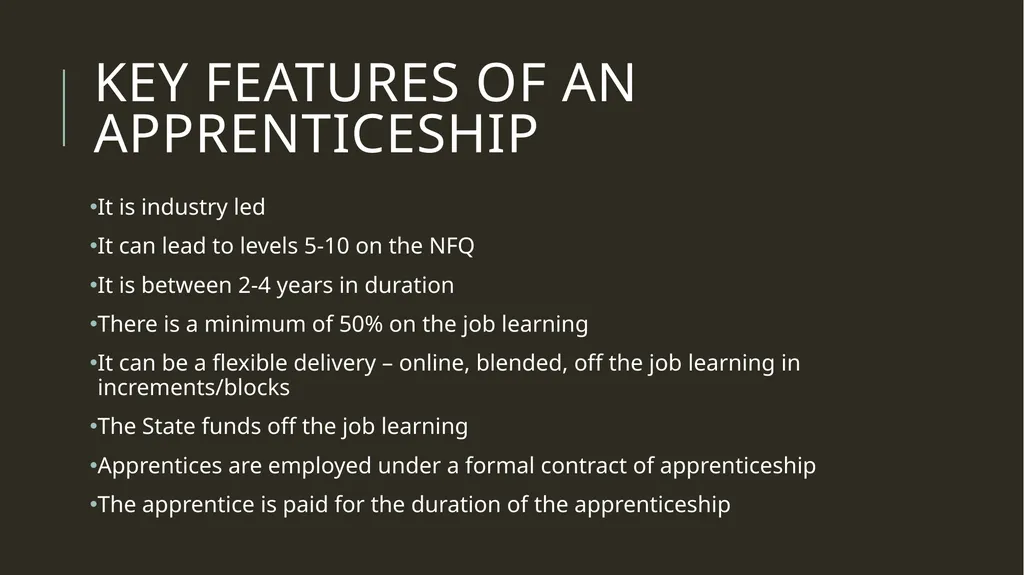
slide27. Key Features of an Apprenticeship It is industry led
It can lead to levels 5-10 on the NFQ
It is between 2-4 years in duration
There is a minimum of 50% on the job learning
It can be a flexible delivery – online, blended, off the job learning in increments/blocks
The State funds off the job learning
Apprentices are employed under a formal contract of apprenticeship
The apprentice is paid for the duration of the apprenticeship<br>
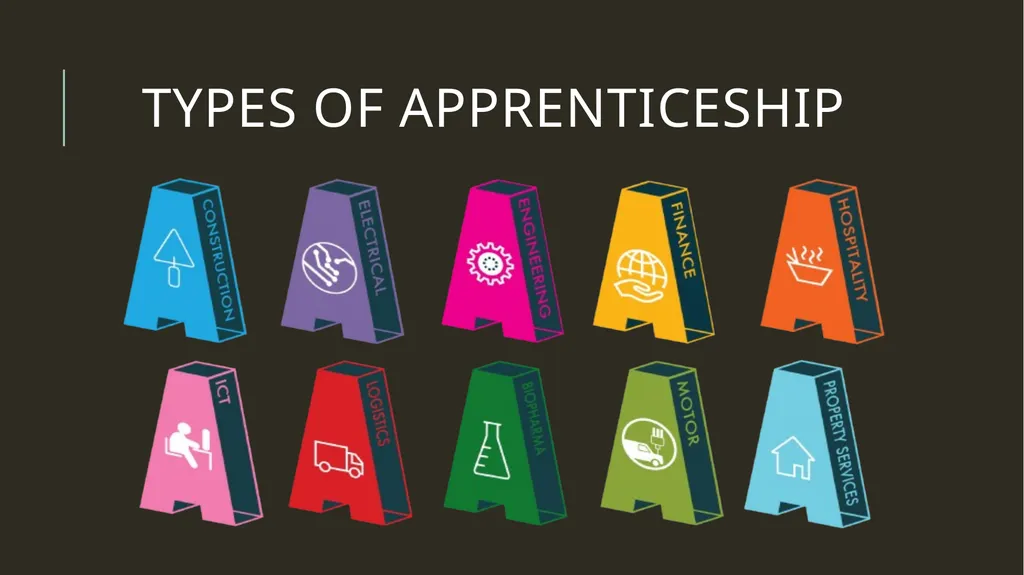
slide28. Types of apprenticeship<br>
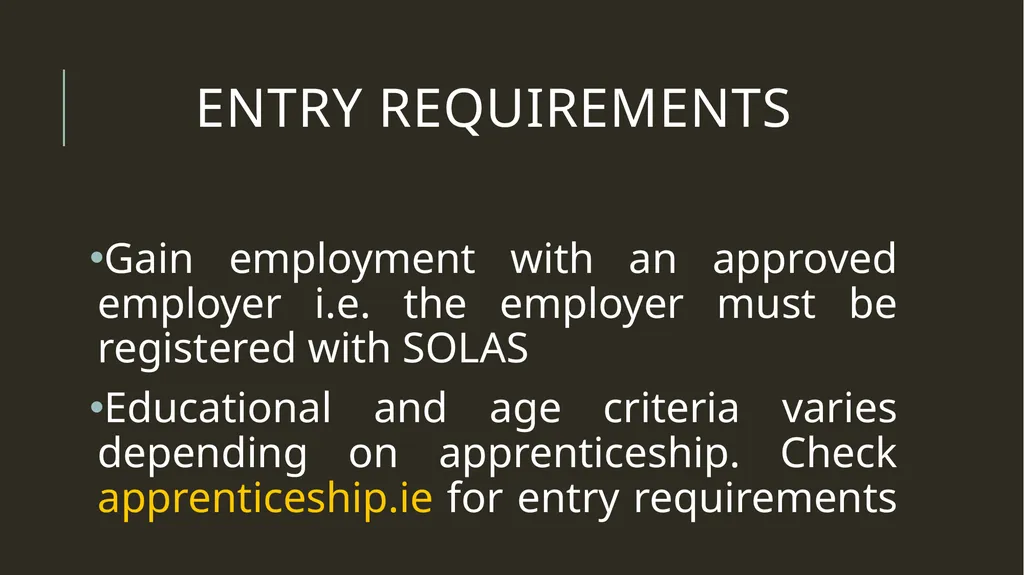
slide29. Entry Requirements Gain employment with an approved employer i.e. the employer must be registered with SOLAS
Educational and age criteria varies depending on apprenticeship. Check apprenticeship.ie for entry requirements<br>
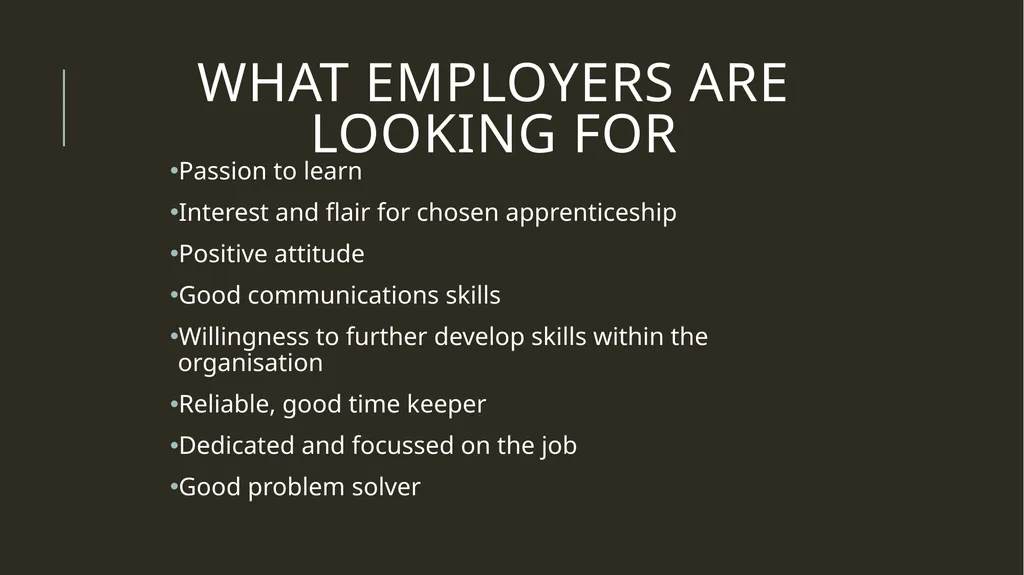
slide30. What employers are looking for Passion to learn
Interest and flair for chosen apprenticeship
Positive attitude
Good communications skills
Willingness to further develop skills within the organisation
Reliable, good time keeper
Dedicated and focussed on the job
Good problem solver<br>
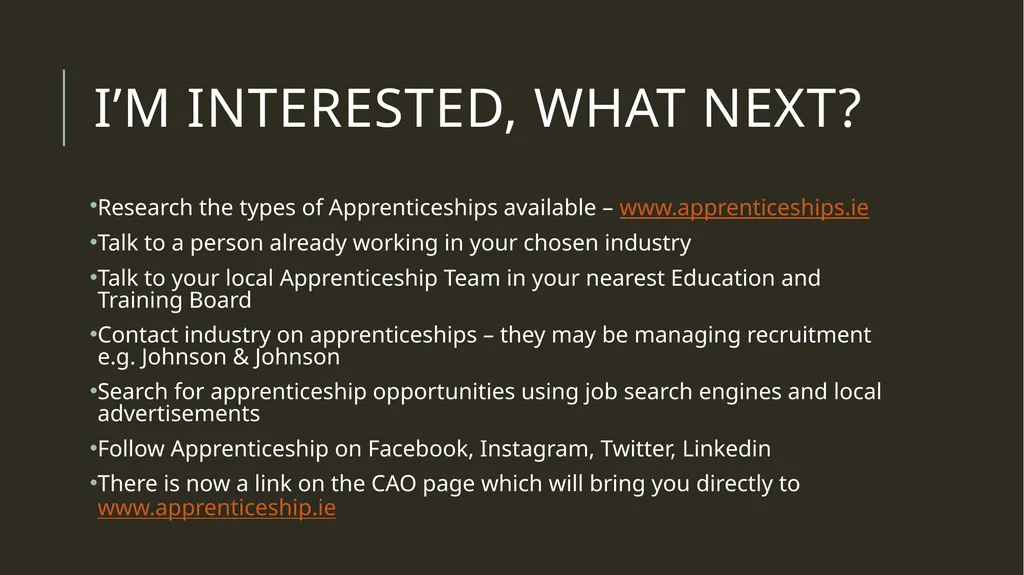
slide31. I’m interested, what next? Research the types of Apprenticeships available – www.apprenticeships.ie
Talk to a person already working in your chosen industry
Talk to your local Apprenticeship Team in your nearest Education and Training Board
Contact industry on apprenticeships – they may be managing recruitment e.g. Johnson & Johnson
Search for apprenticeship opportunities using job search engines and local advertisements
Follow Apprenticeship on Facebook, Instagram, Twitter, Linkedin
There is now a link on the CAO page which will bring you directly to www.apprenticeship.ie<br>
slide2. Student Options Third Level Course - CAO course in University/Technical University/College/IT
Further Education (PLC) Course
Apprenticeship
Employment<br>
slide3. Common Points Scale<br>
slide4. LCVP - POINTS<br>
slide5. Adding up the points (Add the 6 highest scores)<br>
slide6. Commonly asked question What is the difference between CAO courses and a Further Education (PLC) course? CAO Generally a higher qualification course (Diploma, Degree, Masters etc)
Apply through the CAO
Points based Further Education (PLC) Generally a one or two year course
Apply to fetchcourses.ie
Places allocated on the basis of an interview (some may have additional requirements)<br>
slide7. What is the CAO? Central Applications Office
based in Galway.
What do they do?
They process all applications to undergraduate courses in Higher Education Institutions (HEIs).
What do they NOT do?
They do not SET the points each year.<br>
slide8. Before applying Students need to research thoroughly - course requirements, contents, duration, work experience, qualification, progression etc.
Students can research by:
Talking to the Guidance Counsellors and other teachers
College Websites/Prospectus’
www.cao.ie
www.careersportal.ie
www.qualifax.ie
Visit Open Days
Telephone Colleges
Talk to parents/current students etc<br>
slide9. CAO Course Choices There are 2 Course Choice Lists:
Level 6/7and Level 8
10 selections can be made in each list.
It is very important that course choices are placed in genuine order of preference.
Choices are made using a course code:
E.g. Law and Accounting in University of Limerick is LM 020.
Be careful with course codes especially with the new names of the collges, ATU, MTU, TUS etc
Level 8 choices do not affect Level 6/7 choices.
It is possible to receive an offer from both lists.
Only one offer can be accepted in August.
There are usually three rounds of offers.<br>
slide10. Making an Application Students apply online.
Students can only make one application.
Students must apply before 1st of February (thirty euro before 20th Jan, forty five euro after this date).
Restricted courses must be applied for by 1st February.
A new email account could be activated just in case important CAO information goes into spam folder or alternatively you can add an email address to your email provider to avoid this.
Students must then create an application account, log in and enter details.
Keep record of log in details.
Always keep proof of application, print online documentation or obtain a certificate of post.<br>
slide11. You do not need to guess what the points are going to be for the courses you are interested in.
Simply list your courses in genuine order of preference from the highest preference 1, to the lowest preference 10.
If you are entitled to an offer, you will be offered the highest preference that you are entitled to.<br>
slide12. After Making an Application Students will receive CAO number by email and use ‘My Application’ to check their application details.
Some students may be called for extra assessments (interviews/musical performance etc) for restricted courses.
Students will receive a statement of application record – check details carefully, make sure you reply to the email if needed.
Change of mind facility becomes available – use carefully especially after exams.
Leaving Cert Results are sent to CAO.
Places are allocated and offered.
Students accept, reject or defer offered places.
Further rounds of offers are made until all the course places have been filled.<br>
slide13. Change of Mind A Change of Mind Form is emailed with the Statement of Application Record.
Once a student has registered with the CAO they can change their course choices online from the 5th of May 2023
There are no limits to the amount of changes a student wishes to make.
A students final decision has to be made by the 1st July 2023.<br>
slide14. CAO Important DATES<br>
slide15. Allocation of College Places The same procedure takes place for both lists on the form, therefore in August students may get 2 offers, an offer from Level 8 courses and an offer from Level 6/7 courses. However students may only accept ONE course.
Students must think carefully about not accepting one of these offers as they may not receive any further offers in subsequent rounds.
Regardless of whether or not students accept or reject a course in round 1, they may still be offered a higher preference course in subsequent rounds if they become entitled to one.<br>
slide16. These are the applicants for CK101 (Arts in UCC)
The examination results have not yet been released, so these applicants are in no particular order.
We are going to trace the progress of the applicant marked in red.<br>
slide17. Results are issued. Applicants are placed in a queue for each course they applied for, their position in the queue is determined by their points. The applicant with the highest points is placed at the top of the queue.
The points achieved by the applicant in red determines her position in the queue for each course he applied to.<br>
slide18. The applicants marked in green have enough points to be offered places in the first round of offers
The applicant marked in red has enough points for his second preference also in the first round<br>
slide19. The applicant in red is offered his second preference, the highest preference course that he has enough points for, and he will now disappear from the queue in all his lower choices.<br>
slide20. In the Second round of offers three more offers are made on CK101 and our applicant, who was second in line, now receives an offer.
He may do nothing and remain in DN201 or he may accept the offer and begin in CK101.<br>
slide21. Important Information If a student has an exemption from Irish and/or a third language they must complete an NUI Exemption Form to ensure that they meet the entry requirements of UCD, UCC, NUI Maynooth and NUI Galway and other NUI Colleges
Visit www.cao.ie for more information on exemptions
SUSI (Student Universal Support Ireland) is Ireland’s national awarding authority for all higher and further education grants
SUSI offers funding for eligible students in approved full-time third –level education in Ireland and also in some cases funding for students studying outside the state.
To see if you are eligible for a SUSI grant visit SUSI.ie and click on eligibility reckoner
If you think that your son/daughter may be eligible for a SUSI grant, when filling out the CAO form make sure to click the box beside SUSI in the grant section<br>
slide22. Summary Research courses thoroughly.
Apply by January 20th 2023 to avail of thirty euro fee. (late applications after this date are charged a higher fee)
Set up a separate email account/Add email address to current email provider so CAO correspondence does not go into SPAM folder.
Apply online.
Pay by debit/credit card.
Put courses in genuine order of preference.
Obtain/Retain proof of application.
Be careful with change of mind (especially after LC Exams).<br>
slide23. Further Education Courses – What are they? Further Education Courses – Formerly known as Post Leaving Certificate Courses are generally one and two year courses that lead to the Common Award System qualification which can offer an alternative route in third level education or direct entry to employment.
They allow students to study a programme they have expressed an interest in while also providing links to higher and further education.
These courses have a strong vocational element and all have a work experience component e.g. Nursing studies.<br>
slide24. WHY DO A Further Education COURSE? There are smaller classes than Universities/Colleges.
Students have access to a good support system.
It’s a cheaper option than doing the wrong University course.
There are a wide diversity of course choices.
These courses are only one or two years long with a certificate on completion.
Many 3rd levels institutions have links to Further Education Courses
Students gain confidence and maturity.
Further Education courses take place here within Tipperary ETB, The Mall in Clonmel and Scoil Mhuire in Thurles all run courses (Please note these may change from year to year)<br>
slide25. Applying to do a further education course Colleges of Further Education are not part of the CAO system, however there is a link on the CAO homepage to www.fetchcourses.ie and students apply to do a PLC here
Each college has their own open days
Pre nursing courses, pre university science courses and veterinary nursing are among those that fill up quickly so early application is advised
An interview is required sometimes with a school reference
Interviews usually begin in March (check fetchcourses.ie)
Places on Further Education Training courses are not based on a student's points just the interview
Students know before they've done their Leaving Cert whether they have a place on a Further Education Training course<br>
slide26. aPPRENTICESHIPShat is an apprenticeship? An apprenticeship is a programme of structured education and training which formally combines and alternates learning in the workplace with learning in an education or training centre.
It is a dual system, a blended combination of on-the-job employer-based training and off-the-job training.<br>
slide27. Key Features of an Apprenticeship It is industry led
It can lead to levels 5-10 on the NFQ
It is between 2-4 years in duration
There is a minimum of 50% on the job learning
It can be a flexible delivery – online, blended, off the job learning in increments/blocks
The State funds off the job learning
Apprentices are employed under a formal contract of apprenticeship
The apprentice is paid for the duration of the apprenticeship<br>
slide28. Types of apprenticeship<br>
slide29. Entry Requirements Gain employment with an approved employer i.e. the employer must be registered with SOLAS
Educational and age criteria varies depending on apprenticeship. Check apprenticeship.ie for entry requirements<br>
slide30. What employers are looking for Passion to learn
Interest and flair for chosen apprenticeship
Positive attitude
Good communications skills
Willingness to further develop skills within the organisation
Reliable, good time keeper
Dedicated and focussed on the job
Good problem solver<br>
slide31. I’m interested, what next? Research the types of Apprenticeships available – www.apprenticeships.ie
Talk to a person already working in your chosen industry
Talk to your local Apprenticeship Team in your nearest Education and Training Board
Contact industry on apprenticeships – they may be managing recruitment e.g. Johnson & Johnson
Search for apprenticeship opportunities using job search engines and local advertisements
Follow Apprenticeship on Facebook, Instagram, Twitter, Linkedin
There is now a link on the CAO page which will bring you directly to www.apprenticeship.ie<br>